EP0719043A2 - Interaktives Fernsehsystem - Google Patents
Interaktives Fernsehsystem Download PDFInfo
- Publication number
- EP0719043A2 EP0719043A2 EP95119809A EP95119809A EP0719043A2 EP 0719043 A2 EP0719043 A2 EP 0719043A2 EP 95119809 A EP95119809 A EP 95119809A EP 95119809 A EP95119809 A EP 95119809A EP 0719043 A2 EP0719043 A2 EP 0719043A2
- Authority
- EP
- European Patent Office
- Prior art keywords
- field
- descriptor
- control
- indicates
- fields
- Prior art date
- Legal status (The legal status is an assumption and is not a legal conclusion. Google has not performed a legal analysis and makes no representation as to the accuracy of the status listed.)
- Withdrawn
Links
- 230000002452 interceptive effect Effects 0.000 title claims abstract description 34
- 230000005540 biological transmission Effects 0.000 claims abstract description 13
- 238000000034 method Methods 0.000 claims abstract description 4
- 230000008569 process Effects 0.000 claims abstract description 3
- 230000004044 response Effects 0.000 claims description 32
- 238000012800 visualization Methods 0.000 claims description 25
- TVZRAEYQIKYCPH-UHFFFAOYSA-N 3-(trimethylsilyl)propane-1-sulfonic acid Chemical compound C[Si](C)(C)CCCS(O)(=O)=O TVZRAEYQIKYCPH-UHFFFAOYSA-N 0.000 claims description 4
- 230000009471 action Effects 0.000 claims description 4
- 230000015572 biosynthetic process Effects 0.000 claims description 4
- 230000011664 signaling Effects 0.000 claims description 4
- 238000003786 synthesis reaction Methods 0.000 claims description 4
- 239000008186 active pharmaceutical agent Substances 0.000 claims description 3
- 230000000694 effects Effects 0.000 claims description 3
- 230000004913 activation Effects 0.000 claims 1
- 239000003086 colorant Substances 0.000 description 2
- 238000009792 diffusion process Methods 0.000 description 2
- 230000007246 mechanism Effects 0.000 description 2
- 238000004891 communication Methods 0.000 description 1
- 238000012790 confirmation Methods 0.000 description 1
- 238000010276 construction Methods 0.000 description 1
- 230000003247 decreasing effect Effects 0.000 description 1
- 238000011161 development Methods 0.000 description 1
- 230000018109 developmental process Effects 0.000 description 1
- 230000007774 longterm Effects 0.000 description 1
- 230000000750 progressive effect Effects 0.000 description 1
Images




Classifications
-
- H—ELECTRICITY
- H04—ELECTRIC COMMUNICATION TECHNIQUE
- H04N—PICTORIAL COMMUNICATION, e.g. TELEVISION
- H04N21/00—Selective content distribution, e.g. interactive television or video on demand [VOD]
- H04N21/40—Client devices specifically adapted for the reception of or interaction with content, e.g. set-top-box [STB]; Operations thereof
- H04N21/47—End-user applications
- H04N21/472—End-user interface for requesting content, additional data or services; End-user interface for interacting with content, e.g. for content reservation or setting reminders, for requesting event notification, for manipulating displayed content
- H04N21/4722—End-user interface for requesting content, additional data or services; End-user interface for interacting with content, e.g. for content reservation or setting reminders, for requesting event notification, for manipulating displayed content for requesting additional data associated with the content
-
- A63F13/12—
-
- A—HUMAN NECESSITIES
- A63—SPORTS; GAMES; AMUSEMENTS
- A63F—CARD, BOARD, OR ROULETTE GAMES; INDOOR GAMES USING SMALL MOVING PLAYING BODIES; VIDEO GAMES; GAMES NOT OTHERWISE PROVIDED FOR
- A63F13/00—Video games, i.e. games using an electronically generated display having two or more dimensions
- A63F13/30—Interconnection arrangements between game servers and game devices; Interconnection arrangements between game devices; Interconnection arrangements between game servers
-
- H—ELECTRICITY
- H04—ELECTRIC COMMUNICATION TECHNIQUE
- H04N—PICTORIAL COMMUNICATION, e.g. TELEVISION
- H04N21/00—Selective content distribution, e.g. interactive television or video on demand [VOD]
- H04N21/80—Generation or processing of content or additional data by content creator independently of the distribution process; Content per se
- H04N21/81—Monomedia components thereof
- H04N21/812—Monomedia components thereof involving advertisement data
-
- H—ELECTRICITY
- H04—ELECTRIC COMMUNICATION TECHNIQUE
- H04N—PICTORIAL COMMUNICATION, e.g. TELEVISION
- H04N7/00—Television systems
- H04N7/025—Systems for the transmission of digital non-picture data, e.g. of text during the active part of a television frame
-
- H—ELECTRICITY
- H04—ELECTRIC COMMUNICATION TECHNIQUE
- H04N—PICTORIAL COMMUNICATION, e.g. TELEVISION
- H04N7/00—Television systems
- H04N7/025—Systems for the transmission of digital non-picture data, e.g. of text during the active part of a television frame
- H04N7/0255—Display systems therefor
-
- H—ELECTRICITY
- H04—ELECTRIC COMMUNICATION TECHNIQUE
- H04N—PICTORIAL COMMUNICATION, e.g. TELEVISION
- H04N7/00—Television systems
- H04N7/08—Systems for the simultaneous or sequential transmission of more than one television signal, e.g. additional information signals, the signals occupying wholly or partially the same frequency band, e.g. by time division
- H04N7/087—Systems for the simultaneous or sequential transmission of more than one television signal, e.g. additional information signals, the signals occupying wholly or partially the same frequency band, e.g. by time division with signal insertion during the vertical blanking interval only
- H04N7/088—Systems for the simultaneous or sequential transmission of more than one television signal, e.g. additional information signals, the signals occupying wholly or partially the same frequency band, e.g. by time division with signal insertion during the vertical blanking interval only the inserted signal being digital
- H04N7/0882—Systems for the simultaneous or sequential transmission of more than one television signal, e.g. additional information signals, the signals occupying wholly or partially the same frequency band, e.g. by time division with signal insertion during the vertical blanking interval only the inserted signal being digital for the transmission of character code signals, e.g. for teletext
-
- H—ELECTRICITY
- H04—ELECTRIC COMMUNICATION TECHNIQUE
- H04N—PICTORIAL COMMUNICATION, e.g. TELEVISION
- H04N7/00—Television systems
- H04N7/16—Analogue secrecy systems; Analogue subscription systems
- H04N7/173—Analogue secrecy systems; Analogue subscription systems with two-way working, e.g. subscriber sending a programme selection signal
- H04N7/17309—Transmission or handling of upstream communications
-
- A—HUMAN NECESSITIES
- A63—SPORTS; GAMES; AMUSEMENTS
- A63F—CARD, BOARD, OR ROULETTE GAMES; INDOOR GAMES USING SMALL MOVING PLAYING BODIES; VIDEO GAMES; GAMES NOT OTHERWISE PROVIDED FOR
- A63F2300/00—Features of games using an electronically generated display having two or more dimensions, e.g. on a television screen, showing representations related to the game
- A63F2300/40—Features of games using an electronically generated display having two or more dimensions, e.g. on a television screen, showing representations related to the game characterised by details of platform network
- A63F2300/409—Data transfer via television network
Definitions
- the present invention relates to an interactive television system which enables the domestic/residential user to participate actively in TV programmes such as quiz, commercials, opinion polls, sports events, telemarketing, etc.
- a system of the above-mentioned type which comprises a television station suitable to broadcast a TV signal and interactivity data during the vertical blanking interval (VBI) of the TV signal.
- VBI vertical blanking interval
- each user is provided with a TV receiver, a decoder linked to it and a device for direct and automatic access to the telephone line, connected in radio frequency to the decoder.
- the decoder is able to interpret the interactive data transmitted together with the video signal, and to visualize them in overlap on the TV set, and the user makes his choices by means of a remote control with four shifting keys and one for the confirmation of the choice.
- the known systems in fact provide for certain types of interactive activities prefixed and considered to be of interest, for example the so-called couponing, tele-polls, quiz, etc.
- the decoders are therefore suitable to interpret the corresponding and preset controls, however, once the decoders are installed, the introduction of new interactive activities is generally impossible, except particular cases which are in a certain way referable to foreseen control messages. This represents a heavy restriction for this type of systems as the decoders sold in big numbers risk to become obsolete within a short time, or to represent an obstacle for the expansion of the system.
- a further inconvenience of the known systems consists in the substantially inflexible occupation of the available resources, i.e. of TTX system pages or of equivalent on which the interactive data is transmitted.
- the occupation of a relatively high number of pages (or parts of pages) may constitute considerable costs, and which may be destined to grow with a progressive increase of the page value following the diffusion of the TTX service, it is therefore important to find a solution which conforms itself to the number of pages available from time to time.
- the cost of a complex and unsufficiently used system will condition in a heavier way the diffusion of the system.
- the system is provided with a TTX format data inserter.
- the relation between the quantity of the TV station broadcast data (via radio, cable or whatsoever circular type) and the quantity of data sent back by the users towards the TV station through the telephone is important.
- the costs of the second type of data possibly to be shared by operator and user may excessively increase, if the system is structured thus to transmit too simple messages to the user.
- the transmission cost from TV station to the user is insignificant, a major complexity of transmitted interactivity data involves high investment costs.
- the object of the present invention is to realize an interactive television system which overcomes the above-mentioned drawbacks and restrictions of the known method, and in particular, it has to be flexible and elastic for what concerns the introduction of other interactive events.
- the invention achieves these objects by means of an interactive television system which provides for the transmission of interactivity data transmitted together with the TV signal, exploiting the unused lines of the TV signal, and a decoder which is connected to each user TV set to process such interactivity data and to apply to the user TV set signals or visualizations obtained from these ones.
- the system is characterized in that said interactivity data are set up by elementary data units or messages, each one composed by a first header portion and by a second control portion, said control portion including data concerning the number of controls present in the message and at least one interactive option control.
- Fig. 1 shows in a schematic way the structure of an interactive TV system according to the invention.
- reference 1 indicates a TV station including a Replay Station 3 and an antenna 4. This last one broadcasts normal TV programmes to which interactivity data have been added, received together with the signal broadcast by an antenna 13 and transferred to a TV set 9.
- Reference 14 indicates a user decoder which receives through an appropriate Teletex Interface card 2 the informations or data for the interactivity preferably transmitted by a Teletex system.
- the TV station 1 is a so-called replay station, i.e. suitable to broadcast previously recorded programmes.
- the TV station 1 is able to insert the interactivity data into the TV signal and, although the transmitter 1 illustrated by Fig. 1 transmits these composed via radio, in a more general way the TV station 1 broadcasts the signals in a circular way, and thus for example via cable or satellite.
- a TV programme distributor or producer 6 is linked to the TV station 1 to generate, according to predetermined modalities and through a processor 7 or a similar one, interactivity signals or data 10 which are then sent to the TV station 1 via cable.
- a Redundancy Code 5 error protection mechanism of the known type is preferably foreseen, for example a codifier according to a redundant code such as a Hamming code.
- the codified signal 10 can be generated in real time during a live transmission or it is preferably recorded in a storage device 11. This recording may happen during the recording of the transmission or afterwards, but before its broadcasting.
- the decoder device 14 which receives the TV signals retrieves, by means of a Teletex Interface 2 unit from the received interframe signal (for instance Teletex pages), the interactivity signal with Hamming code, and then converts it, through a Redundancy Decoding unit 8 into an interactivity signal 12 identical with the signal 10 generated by the processor 7.
- the signal construction modes are transparent concerning the error protection mechanism as well as concerning the transmission support on which the signal is travelling.
- Teletex system Teletex for RAI in Italy
- Teletex system Teletex for RAI in Italy
- its use is not restricted to this transmission mode, but it may be applied in a more general way to all continuous and unidirectional transmission systems exploiting the unused lines of a television signal, as for instance the French system, etc.
- signal 10 is structured or based on the elementary data unit defined as "messages" or multiple controls.
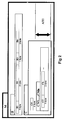
- Fig. 2 illustrates the structure of a generic message (or multiple control) M which is generally speaking shaped in such a way to be completely contained in one TTX "page” set up by approximately 400 "net” bytes, or if longer, it may be distributed on more pages.
- each message M comprises a header portion H and a control portion C.
- the portion H has at its turn a format with four fields, from H1 to H4, respectively.
- the first field H1 is set up by 1 byte (8 bits) and identifies the TV channel on which the system is operating.
- the second field H2 is set up by 3 bytes and identifies the current interactive activity, i.e. a reference number which identifies a given television programme within said channel.
- the third field H3 consists of 1 byte and identifies the sequence number of the message which makes it possible to determine if the message is in sequence with respect to those received up to that moment, and the fourth H4 consists of 2 bytes, and it identifies the time out of the following message.
- this indicates the time within which the following message must arrive, and it allows to prevent from situations where the user remains "suspended" during an interactive activity, due to the missing reception of the following message, imposing in this case the cancellation of the interactive activity.
- the second message or control portion C comprises a first section CN with a 1 byte extension, which indicates the number of controls contained in the remaining (following) bytes of the control portion.
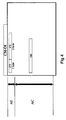
- a single control foresees a Header Area AI and a Control Area AC.
- the Header Area AI is set up by at least two fields, for instance with reference to Fig. 4 by:
- Control Area AC is organized in sectors called "descriptors" of different types, according to the control, which will be described in details regarding the individual controls.
- the controls may be of various types. Approximately the main controls may be subdivided in two groups or types of controls, managing the Interactive Television Activities or ATI and the TV Graphic Management as illustrated hereafter with more details.
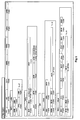
- the TV Mask Descriptor indicated in Fig. 3 by DM comprises a series of data regarding the type of mask to be shown in overlap on the screen, such as for instance position, width, colour of the edge lines, etc.
- the TV mask descriptor comprises preferably a field DDM of 2 bytes for the visualization time out of the mask and a series of sections DZ1, ...DZa which describe the whole of strings to be visualized each one composed by a field DZT of one byte indicating the type of strings which will follow, a field DZL of 2 bytes which indicates the length of the section and a field DZN of 2 bytes which indicates the number of strings contained in the section, and the whole of the string sub-descriptors DS composed by the following fields: Initial Type of information Length (bytes) DSL Descriptor Length 1 DSC Operational Code 1 DSO Type of String 1 DSS Number of Selection 1 DSR Start of the Line 1 DSV Start of Column 1 DSB Nr. of bytes per attribute 1 DSA1...DS
- the String Head DST is set up by a number of bytes which depends on the data of the string itself, but anyhow, not more than 63 bytes. If the string is longer, several strings following each other will be used.
- this one indicates, if the strings are to be written, to be cancelled or to be used for the visualization of the user's name.
- Attribute fields DSA these make it possible to specify the characteristics common to all characters of the string.
- this one may be for example “common”, “band”, “response”, “Winner/ Loser” according to the control in which it is inserted as better pointed out hereafter with reference to the Fig. from 4 to 14.
- the control CM_OI which general structure is illustrated by Fig. 4, is used to show on the screen the mask on which the user makes his choices by means of the remote control.
- the mask may propose the choice between two or more alternative responses shown on the screen to be selected by moving the cursor on the screen.
- control comprises in the Header area the fields CT and CL already taken into consideration, while the Control area provides for a Television Mask Descriptor DM of the type described in Fig. 3 containing one or more string descriptors of the "common" type.
- the control CM_GRU which structure is shown in Fig. 5 is used to define the user's response management rules, i.e. it indicates the operations the device has to carry out according to the Interactive Options control and to the response the user has given through the remote control.
- these may be a print, a scored total, a phone call, a memorialising of the response, etc.
- the control comprises, like in the previous case a CL field indicating the type and length of the control, respectively, and other offset fields from OFF1 to OFF5 which are used as pointers for the relative descriptors.
- the Response Management Descriptor DR comprises a DRR field of 1 byte which indicates the response identification, i.e. the response the operations are linked to, a DRL field of 1 byte for the descriptor and section length (for instance f) each one set up by two fields to describe the operations to be carried out for this response; with reference to the two field allowing the description of the operation to be carried out, the first one includes two bytes identifies the type of operation (DRA) (print, phone call; scored total, etc.), and the second one of 1 byte indicates the Descriptor identification or the weight of the response (DRP).
- DRA type of operation
- DRP Descriptor identification or the weight of the response
- this one indicates the identification of the Telephone or of the Output Descriptor to be connected to that operation or the weight of the response if the operation provides for an updating of the score.
- the Telephone Descriptor DT makes it possible to define in a definite way the phone call the user's device has to make, and it comprises the following fields: Initials Type of Information Length (bytes) DTI Descriptor Identification 1 DTL Descriptor Length 1 DTT Type of Phone Call 1/2 DTE Type of Payment 1/2 DTN Digits of Phone Number 6 DTC Cost of the Phone Call 2 DTR Repetition Number 1 DTF Repetition Frequency 3 DTD Maximum Duration 1 DTA Alternative Operation 1/2 DTB Alternative Descriptor Identification 1/2
- this field indicates if the call refers to a Green Number, Audiotel, Itapac "easy way” etc; in case of a pay call the Type of Payment field DTE indicates if it will be made by credit card, smart card etc.
- this one indicates the estimated cost of the call, and it is calculated on the basis of the Type of Phone Call DTT and of the phone number indicated in the field Digits of the Phone Number DTN.
- this one indicates the maximum duration of the phone call, once this time is finished the system has to close the call, even if this one is still in progress, in order to avoid that due to communication errors the call continues to remain active.
- the Output Descriptor DO is used to define a message to be printed, corresponding to a user's response, and it comprises a Field DOI of 1 byte indicating the identification of the descriptor, the field DOL of 2 bytes for the descriptor length, the field DON of 1 byte indicating the number of lines to be printed, and a series of sections (for instance g) for the description of the lines, each one set up by 1 byte indicating the length of the line DOM, 1 byte for the initial line DOR, 1 byte for the initial column DOC and the text of the line DOT containing a byte number which depends on the informations of the line itself, but anyhow not more than 40 bytes.
- the Signalling Message Descriptor is used to activate on screen a standard message contained in the user's set which comprises a field DLI of 1 byte indicating the descriptor identification, the field DLL of 2 bytes for the descriptor length, the field of 2 bytes indicating the message visualization time out, the field DLN of 1 byte for the attribute number, a series of attributes DLA of 1 byte each for the character attribute description to be visualized, the field DLC of 1 byte indicating the initial column of the outline, the field DLM of 1 byte indicating the maximum line amplitude (preferably not more than 40 bytes), the field DLR of one byte indicating the number of lines to be visualized, a series of sections for the description of the lines (e.g. h) set up by 1 byte for the starting column DLB, 1 byte for the line length DLD (less than or equal to the value indicated in the mentioned DLM field) and the line text bytes DLT to be visualized.
- a standard message contained in the user's set which
- the control CM_SP which structure is shown by Fig. 6, is used to define the score rules for the user's response.
- the control includes, like in the previous case, a field CT and a field CL which indicate the type and the length of the control, respectively, a field CF of 1 bite which indicates the number of present score bands, and a certain number of band fields CQ of 2 bytes each indicating the upper limit of the different score bands.
- the control comprises moreover a TV mask descriptor indicated by DM which is substantially identical with the one shown in Fig. 3 with a series of string sub-descriptors of the "common" type or of the "band” type.
- the control CM_GSP which structure is illustrated in Fig. 7, is used to transmit a courtesy message to users identified as winners.
- the control includes, like in the previous case, a field CT and a field CL which indicates the type and the length of the control, respectively, a field CV of 1 byte which indicates the number of winners to whom the courtesy message has to be sent, and a certain number of fields CU (4 bytes), each one being the identification of one user.
- the control comprises moreover a TV mask descriptor indicated by DM which is substantially identical with the one illustrated in Fig. 3 containing a series of string sub-descriptors of the "common” type or of the "Winner/Loser” type.
- the control CM_DO which structure is illustrated by fig. 8, is used to define the clock type the system has to point out for the user.
- the control comprises, like in the previous cases, a field CT and a field CL which indicate the type and the length of the control, respectively, a field OT of 1 byte indicating the clock type by digits or by decreasing linear bars, the fields OR and OC of 1 byte each indicating the positioning line and column of the clock and the fields OD, OE, OF, OG, OH of 1 byte each, which indicate respectively the background colours of the bar of the linear minutes and seconds, and of the digital minutes and seconds.
- the control CM_DC which structure is illustrated by Fig. 9, is used to define the extremities of the frame which is shown to the user.
- the control comprises, like in the previous cases, a field CT and a field CL which indicate the type and length of the control, the fields NR and NS of 1 byte each which indicate respectively the starting and final line of the frame, and a field ND of 1 byte which indicates the background colour.
- the control CM_DTP which structure is illustrated in Fig. 10, is used to define the score table to be shown to the user.
- the control comprises, like in the previous cases, a field CT and a field CL which indicate the type and the length of the control, respectively, a field PG of 1 byte which indicates the identification of the play or the programme to which it refers, a field PV of 1 byte which indicates the way of visualization which may be the one e.g.
- this one comprises 3 fields of 1 byte each which indicate respectively the Score identification (DUI), that is the score type which may be a Partial Score, Personal Record, Absolute Record etc., the number of lines (DUR) and the number of columns(DUC) into which the score itself has to be positioned.
- DUI Score identification
- DUR number of lines
- DUC number of columns
- this one comprises 3 fields of 1 byte each which indicate the number of lines (DQR), the number of columns (DQC) into which the string and the string length (DQL) have to be placed, and by a field DQT of 5 bytes with the text of the string.
- the control CM_DCS which structure is illustrated in Fig. 11, is used to define special characters to be transmitted to the user.
- the control comprises, like in the previous cases, a field CT and a field CL which indicate respectively, the type and the length of the control, the field SN of one byte which indicates the number of special characters which will follow, and a series of descriptors (e.g. k) of Special Characters DB set up by a field DBC of 1 byte indication of the character which will then be used to recall it for instance in a string of characters followed by a field DBS of 20 bytes which defines point by point the shape of the special character.
- a field CT and a field CL which indicate respectively, the type and the length of the control
- the field SN of one byte which indicates the number of special characters which will follow
- a series of descriptors (e.g. k) of Special Characters DB set up by a field DBC of 1 byte indication of the character which will then be used to recall it for instance in a string of characters followed by a field DBS of 20 bytes which defines point by point the shape of the special character.
- CM_DOG which structure is illustrated in Fig. 12, is used to disable at whatever instant the visualization of the Graphic Options previously indicated, for example Clock Definition, Frame Definition and Score Table Definition.
- the control comprises, like in the previous cases, a field CT and a field CL which indicates the type and length of the control, respectively, the fields BG an BM of 1 byte each which indicate respectively the options to be disabled and the disabling mode, i.e. if the disabling is only related to the following mask or if it is the definite one.
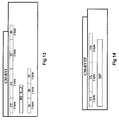
- the control CM_RVI which structure is illustrated in Fig. 13, is used for the control of the visualization of an icon on the user's screen.
- the control comprises like in the previous cases a field CT and a field CL which indicate the type and length of the control, respectively, the fields IT an IN which indicate respectively the visualization time out (2 bytes) and the number of Icon definition strings (1 byte), i.e. the text strings accompanying the icon, the graphic string descriptors of the DQ type previously described (up to 2) and 3 further fields of 1 byte each comprising the Type of Icon IL, the positioning line IR and column IC.
- the control CM_RVTP which structure is illustrated in Fig. 14, is used for the control of the visualization of a Score Table on the user's screen.
- the control comprises, like in the previous cases, a field CT and a field CL which indicate the type and length of the control, respectively, the field CO indicating the visualization time out (2 bytes) and the Score Table descriptor DP which is analogous to the one described by Fig. 10.
Landscapes
- Engineering & Computer Science (AREA)
- Multimedia (AREA)
- Signal Processing (AREA)
- Databases & Information Systems (AREA)
- Human Computer Interaction (AREA)
- Business, Economics & Management (AREA)
- Marketing (AREA)
- Television Systems (AREA)
- Two-Way Televisions, Distribution Of Moving Picture Or The Like (AREA)
Applications Claiming Priority (2)
| Application Number | Priority Date | Filing Date | Title |
|---|---|---|---|
| ITMI942621A IT1271320B (it) | 1994-12-23 | 1994-12-23 | Sistema di televisione interattiva |
| ITMI942621 | 1994-12-23 |
Publications (2)
| Publication Number | Publication Date |
|---|---|
| EP0719043A2 true EP0719043A2 (de) | 1996-06-26 |
| EP0719043A3 EP0719043A3 (de) | 1998-03-11 |
Family
ID=11370062
Family Applications (1)
| Application Number | Title | Priority Date | Filing Date |
|---|---|---|---|
| EP95119809A Withdrawn EP0719043A3 (de) | 1994-12-23 | 1995-12-15 | Interaktives Fernsehsystem |
Country Status (2)
| Country | Link |
|---|---|
| EP (1) | EP0719043A3 (de) |
| IT (1) | IT1271320B (de) |
Cited By (5)
| Publication number | Priority date | Publication date | Assignee | Title |
|---|---|---|---|---|
| WO1998000974A1 (en) * | 1996-07-01 | 1998-01-08 | Thomson Consumer Electronics, Inc. | Protocol and system for transmitting triggers from a remote network and for controlling interactive program content at a broadcast station |
| US6006256A (en) * | 1996-03-11 | 1999-12-21 | Opentv, Inc. | System and method for inserting interactive program content within a television signal originating at a remote network |
| WO2002005568A3 (en) * | 2000-07-10 | 2002-05-30 | Qvc Inc | System and method for enabling television commerce simultaneously for multiple channels for multiple merchants |
| US6889351B1 (en) | 2000-03-30 | 2005-05-03 | Koninklijke Philips Electronics, N.V. | Backward compatible multiple data stream transmission method and system for compressed domain signals |
| KR100485871B1 (ko) * | 1996-07-01 | 2005-09-30 | 오픈 티브이 인코포레이티드 | 원격네트워크로부터트리거를송신하고,방송국에서대화형프로그램내용을제어하기위한프로토콜및시스템 |
Family Cites Families (8)
| Publication number | Priority date | Publication date | Assignee | Title |
|---|---|---|---|---|
| US4367488A (en) * | 1980-12-08 | 1983-01-04 | Sterling Television Presentations Inc. Video Data Systems Division | Data encoding for television |
| US4866770A (en) * | 1986-07-08 | 1989-09-12 | Scientific Atlanta, Inc. | Method and apparatus for communication of video, audio, teletext, and data to groups of decoders in a communication system |
| EP0491068A1 (de) * | 1990-12-18 | 1992-06-24 | International Business Machines Corporation | Selektiver Datensendungsempfängeradapter für Personalrechner |
| EP0491069A1 (de) * | 1990-12-18 | 1992-06-24 | International Business Machines Corporation | Verfahren zur selektiven Datenverteilung mit Einweg-Rundfunkübertragung oder Sendung |
| ATE139400T1 (de) * | 1991-02-28 | 1996-06-15 | Rai Radiotelevisione Italiana | Verfahren zur nachrichtenübertragung über einen fernsehkanal mit dem teletextsystem |
| EP0535572B1 (de) * | 1991-09-30 | 1999-04-21 | Interactive Television, S.A. | Einrichtung für interaktive Zweiwegfernsehübertragung |
| ATE533112T1 (de) * | 1992-11-27 | 2011-11-15 | Io Res Pty Ltd | Verteiltes datenbanksystem und datenbankempfänger dafür |
| IT1271639B (it) * | 1994-05-06 | 1997-06-04 | Italtel Spa | Sistema di televisione interattiva |
-
1994
- 1994-12-23 IT ITMI942621A patent/IT1271320B/it active IP Right Grant
-
1995
- 1995-12-15 EP EP95119809A patent/EP0719043A3/de not_active Withdrawn
Cited By (6)
| Publication number | Priority date | Publication date | Assignee | Title |
|---|---|---|---|---|
| US6006256A (en) * | 1996-03-11 | 1999-12-21 | Opentv, Inc. | System and method for inserting interactive program content within a television signal originating at a remote network |
| WO1998000974A1 (en) * | 1996-07-01 | 1998-01-08 | Thomson Consumer Electronics, Inc. | Protocol and system for transmitting triggers from a remote network and for controlling interactive program content at a broadcast station |
| US5937331A (en) * | 1996-07-01 | 1999-08-10 | Kalluri; Rama | Protocol and system for transmitting triggers from a remote network and for controlling interactive program content at a broadcast station |
| KR100485871B1 (ko) * | 1996-07-01 | 2005-09-30 | 오픈 티브이 인코포레이티드 | 원격네트워크로부터트리거를송신하고,방송국에서대화형프로그램내용을제어하기위한프로토콜및시스템 |
| US6889351B1 (en) | 2000-03-30 | 2005-05-03 | Koninklijke Philips Electronics, N.V. | Backward compatible multiple data stream transmission method and system for compressed domain signals |
| WO2002005568A3 (en) * | 2000-07-10 | 2002-05-30 | Qvc Inc | System and method for enabling television commerce simultaneously for multiple channels for multiple merchants |
Also Published As
| Publication number | Publication date |
|---|---|
| IT1271320B (it) | 1997-05-27 |
| ITMI942621A1 (it) | 1996-06-23 |
| EP0719043A3 (de) | 1998-03-11 |
| ITMI942621A0 (it) | 1994-12-23 |
Similar Documents
| Publication | Publication Date | Title |
|---|---|---|
| EP0746941B1 (de) | Sicherheit für interaktives fernsehen durch zeitmarkierung von transaktionen | |
| EP1133184B1 (de) | Transaktionsbasiertes interaktives Fernsehsystem | |
| US5716273A (en) | Apparatus and method for controlling educational and amusement use of a television | |
| AU2001253232B2 (en) | Systems and methods for recognizing preferred wagerers | |
| JP3908258B2 (ja) | ビデオ信号中のレコーダ・プログラミング・データをダウンロードする方法 | |
| US6330021B1 (en) | Interactive television reception console | |
| WO1995015654B1 (en) | Transaction based interactive television system | |
| AU2001253232A1 (en) | Systems and methods for recognizing preferred wagerers | |
| WO2001050749A3 (en) | Method and system for transmitting and storing interactive device control data using horizontal overscan portion of a video signal | |
| EP0595354B1 (de) | System zur Freigabe und Kostenabrechnung der Nutzung funkübertragener Daten | |
| US5682599A (en) | Two-way broadcasting and receiving system with time limit and/or limit data | |
| EP0719043A2 (de) | Interaktives Fernsehsystem | |
| US6687908B1 (en) | Interactive television | |
| JP3165635B2 (ja) | 多重放送受信装置 | |
| JPH07235911A (ja) | 双方向放送方式及び双方向放送の受信装置 | |
| KR100414511B1 (ko) | 다중 방송 수신 장치 | |
| US5940133A (en) | Method for playing back data signals in television or sound radio program channels | |
| JPH09214446A (ja) | 多重放送送信装置および受信装置 |
Legal Events
| Date | Code | Title | Description |
|---|---|---|---|
| PUAI | Public reference made under article 153(3) epc to a published international application that has entered the european phase |
Free format text: ORIGINAL CODE: 0009012 |
|
| AK | Designated contracting states |
Kind code of ref document: A2 Designated state(s): AT BE CH DE ES FR LI |
|
| PUAL | Search report despatched |
Free format text: ORIGINAL CODE: 0009013 |
|
| AK | Designated contracting states |
Kind code of ref document: A3 Designated state(s): AT BE CH DE ES FR LI |
|
| STAA | Information on the status of an ep patent application or granted ep patent |
Free format text: STATUS: THE APPLICATION IS DEEMED TO BE WITHDRAWN |
|
| 18D | Application deemed to be withdrawn |
Effective date: 19980612 |