EP0719563A2 - Cathéter épidural - Google Patents
Cathéter épidural Download PDFInfo
- Publication number
- EP0719563A2 EP0719563A2 EP95118764A EP95118764A EP0719563A2 EP 0719563 A2 EP0719563 A2 EP 0719563A2 EP 95118764 A EP95118764 A EP 95118764A EP 95118764 A EP95118764 A EP 95118764A EP 0719563 A2 EP0719563 A2 EP 0719563A2
- Authority
- EP
- European Patent Office
- Prior art keywords
- members
- adapter
- catheter
- lumen
- inlet
- Prior art date
- Legal status (The legal status is an assumption and is not a legal conclusion. Google has not performed a legal analysis and makes no representation as to the accuracy of the status listed.)
- Withdrawn
Links
Images


Classifications
-
- A—HUMAN NECESSITIES
- A61—MEDICAL OR VETERINARY SCIENCE; HYGIENE
- A61B—DIAGNOSIS; SURGERY; IDENTIFICATION
- A61B17/00—Surgical instruments, devices or methods
- A61B17/34—Trocars; Puncturing needles
- A61B17/3401—Puncturing needles for the peridural or subarachnoid space or the plexus, e.g. for anaesthesia
-
- A—HUMAN NECESSITIES
- A61—MEDICAL OR VETERINARY SCIENCE; HYGIENE
- A61M—DEVICES FOR INTRODUCING MEDIA INTO, OR ONTO, THE BODY; DEVICES FOR TRANSDUCING BODY MEDIA OR FOR TAKING MEDIA FROM THE BODY; DEVICES FOR PRODUCING OR ENDING SLEEP OR STUPOR
- A61M25/00—Catheters; Hollow probes
-
- A—HUMAN NECESSITIES
- A61—MEDICAL OR VETERINARY SCIENCE; HYGIENE
- A61M—DEVICES FOR INTRODUCING MEDIA INTO, OR ONTO, THE BODY; DEVICES FOR TRANSDUCING BODY MEDIA OR FOR TAKING MEDIA FROM THE BODY; DEVICES FOR PRODUCING OR ENDING SLEEP OR STUPOR
- A61M25/00—Catheters; Hollow probes
- A61M25/0009—Making of catheters or other medical or surgical tubes
- A61M25/0014—Connecting a tube to a hub
-
- A—HUMAN NECESSITIES
- A61—MEDICAL OR VETERINARY SCIENCE; HYGIENE
- A61M—DEVICES FOR INTRODUCING MEDIA INTO, OR ONTO, THE BODY; DEVICES FOR TRANSDUCING BODY MEDIA OR FOR TAKING MEDIA FROM THE BODY; DEVICES FOR PRODUCING OR ENDING SLEEP OR STUPOR
- A61M25/00—Catheters; Hollow probes
- A61M25/0097—Catheters; Hollow probes characterised by the hub
Definitions
- the present invention relates to a catheter and, more particularly, to an epidural catheter adapted for use in long-term epidural anesthesia.
- narcotic acceptors are spread from end to end along the backbone, the narcotic for local anesthesia or hyposensitivity can act directly on any desired acceptor, without requiring other acceptors to be blocked.
- the catheter is caused to "dwell" in the epidural space by first inserting the curved distal piercing end of a tubular metallic needle through the patient's skin and into his or her epidural space. After confirming that the piercing end is positioned correctly, a stylet is withdrawn from the tubular needle so that a desired length of the catheter is introduced therethrough. Then, the tubular needle is slowly removed from the patient, with the catheter being subsequently secured to his or her back by means of a suitable adhesive. Finally, an injector or a long-term dosing apparatus is connected to the proximal end of the catheter so that a narcotic can be supplied to the patient.
- any device for feeding a narcotic that has a diameter larger than that of the catheter should not be connected to the proximal end of the catheter before removal of the piercing needle.
- Practitioners conducting medical operations have first removed the needles and then attached a suitable adapter to the proximal end of each catheter, before connecting a suitable device to each adapter and dosing a narcotic.
- a typical example of a currently available catheter for long-term epidural anesthesia is made and sold by B. Braun A. G. under the trade name "PERIFIX.”
- This catheter has a single lumen and a single orifice situated in the distal end of the catheter.
- the diameter of this orifice for delivery of a narcotic is substantially the same as the diameter of the lumen.
- the catheter mentioned above usually has at its distal end only one output orifice for the delivery of liquid medicine. Thus, only a narrow restricted region around the distal end of the catheter could be anesthetized. In a case in which anesthesia of a wider region is necessary, a larger amount of narcotic should be dosed to the patient.
- a catheter of the double-tube type was proposed in Japanese Utility Model Publication No. 58-13859.
- outlet openings 300 and 400 for delivery of liquid medicine communicate with respective flow paths formed independently of each other.
- This catheter makes it possible to anesthetize a broader area with a lesser amount of narcotic.
- the proximal end of inner tube 200 protrudes sideways from a cylindrical wall of external tube 100, so that medicine inlets 500 and 600 are connected to the proximal ends of outer and inner tubes 100 and 200, respectively.
- the double-tube structure of the catheter does not allow a piercing needle to be taken out of a patient's body and removed from the catheter while the catheter is in its operative position.
- catheters of a certain double-lumen type have also been used.
- This type of catheter has two delivery outlets, however, appropriate connectors have not yet been proposed for attachment of external devices to the catheter's proximal end after removing the piercing needle.
- the diameter of each lumen in this type of catheter is so small that thin and needle-shaped connecting members must be fitted in proximal openings of the lumens and connected to external devices.
- This construction is disadvantageous in that liquid medicine is likely to leak out from the boundary between the catheter tube and the needle-shaped members, and the latter often cause the proximal end of the tube to be damaged or broken.
- an object of the present invention is to provide an epidural catheter including an adapter and a catheter body having two or more lumens extending therethrough, wherein two or more external devices for supply of a liquid medicine can easily and readily be connected through the adapter to the catheter body.
- an epidural catheter that includes a catheter body having a distal end and a proximal end and having formed therein a main lumen and at least one auxiliary lumen.
- the main lumen and the auxiliary lumen extend side by side and in parallel with each other.
- the main lumen has an outlet opening at the distal end an inlet opening at the proximal end.
- the auxiliary lumen has an outlet opening located behind and spaced a predetermined distance from the outlet opening in the main lumen and an inlet lateral opening located toward the proximal end.
- the adapter is disposed on the catheter body.
- the adapter includes a forward member, a middle member and a rearward member that are detachably connected to one another.
- the forward, middle and rearward members each have axial bores to tightly receive the catheter body.
- the axial bores in each member are coaxially aligned and have substantially the same diameter.
- the rearward member has a first inlet port formed therein and communicating with the inlet opening of the main lumen.
- the middle member has a second inlet port formed therein and communicating with the inlet opening of the auxiliary lumen. Seals are disposed between the forward and middle members and between the middle and rearward members.
- the adapter may be made of a transparent thermoplastic resin so that the inlet opening of the auxiliary lumen can be seen through the adapter, when the latter is being attached to the catheter body.
- the catheter body may be provided with an alignment marking so that the inlet opening of the auxiliary lumen corresponds with the second inlet port formed in the middle member.
- the middle and rearward members of the adapter may be formed integral with each other. Similarly, the forward and middle members may be so formed. In addition, the forward, middle and rearward members may be integrally formed in to a one-piece adapter.
- the adapter provided herein is not always disposed on the catheter body, but instead is attached thereto on demand only when necessary. Thus, practitioners or other users can easily take the piercing needle off the catheter body, after having introduced the catheter body into a patient's body through the needle. After the needle has been removed, the adapter connected to the catheter body will form flow paths through the adapter and catheter body, so as to enable the dozing of a narcotic or other liquid medicine.
- the seal disposed in the contact region between the catheter body and the adapter prevents the narcotic from leaking out of the contact region.
- An epidural catheter provided herein is composed of a catheter body and an adapter connectable thereto.
- An example in which the catheter body has two lumens formed therein and therealong will now be described in detail.
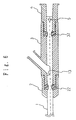
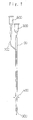
- the catheter body 1 includes a main lumen 14 and an auxiliary lumen 15, and the main lumen 14 has an outlet opening 11 located at a distal end of body 1.
- the auxiliary lumen 15 has an outlet opening 12 located behind and spaced from the distal end and a distance of 5 - 10 cm.
- An inlet opening 16 of the main lumen 14 is disposed at a proximal end of the catheter body 1, with an inlet lateral opening 13 of the auxiliary lumen 15 being disposed near and ahead of the proximal end.
- the adapter includes three members 2, 3 and 4 connectable one to another.
- Members 2, 3 and 4 are provided with axial bores 23, 33 and 41, respectively.
- axial bores 23, 33 and 41 are coaxially aligned and have substantially the same diameter.
- the forward and middle members 2 and 3, respectively, are threaded to engage with one another, with the middle and rearward members 3 and 4, respectively, also being threaded in the same manner.
- a male-threaded lug 35 of the middle member 3 can be fastened into a female-threaded axial cavity 21 formed in the forward member 2.
- a male-threaded lug 42 of the rearward member 4 can be fastened into a female-threaded axial cavity 31 formed in the middle member 3.
- members 2, 3 and 4 constituting the adapter may be connected to one another in manners other than the manner shown in Fig. 1.
- the forward and rearward members 2 and 4 may have a rearward threaded lug and a forward threaded cavity, respectively, with the middle member 3 having a cavity and a lug of complementary shapes.
- members 2, 3 and 4 may be interference-fitted on each other as shown in Fig. 3 or Luer-connected to each other as shown in Fig. 4.
- Annular seals 22 and 32 are compressed by and between adjacent members 2 and 3 and adjacent members 3 and 4, respectively, of the adapter.
- the compressed seals have their inner peripheries reduced so as to be in forced tight contact with the outer periphery of the catheter body 1.
- Each seal may be disposed at a location different from the location shown in Fig. 1, as long as the seal is compressed properly.
- the seal 22 may be attached to the front end face of the middle member's threaded lug 35.
- a first inlet port 43 for receiving a liquid medicine is formed in the rearward member 4 so as to communicate with the interior of the main lumen 14.
- a second inlet port 34 is formed in the middle member 3 so as to communicate with the interior of the auxiliary lumen 15.
- the first and second inlet ports have Luer-tapered inner peripheries, so that Luer-tapered ends of, for example, syringes can closely fit in such ports.
- an alignment marking may be printed on the catheter body, at a point near the proximal end thereof. Such alignment marking is helpful when aligning the second inlet port 34 with the inlet lateral opening 13 of the auxiliary lumen.
- marking 5 is located behind the inlet lateral opening 13 and spaced therefrom a distance "a.” This distance "a" corresponds to the distance between the bottom center of second inlet port 34 and the proximal end of the middle member 3.
- the marking 5 may be printed in any suitable manner and its location may be varied so long as it is clearly and easily visible to the users.
- the adapter as described above may be formed of a suitable thermoplastic resin such as a polycarbonate, a polystyrene or an ABS (acrylonitrile-butadiene-styrene) resin.
- a suitable thermoplastic resin such as a polycarbonate, a polystyrene or an ABS (acrylonitrile-butadiene-styrene) resin.
- the resin is transparent.
- the seals incorporated in the adapter may be formed of a rubber or elastomer, such as natural rubber, butadiene rubber, styrene-butadiene rubber, isoprene, ethylene-propylene rubber, butyl rubber, chloroprene, nitrile rubber, acrylic, urethane or silicone rubber.
- a rubber or elastomer such as natural rubber, butadiene rubber, styrene-butadiene rubber, isoprene, ethylene-propylene rubber, butyl rubber, chloroprene, nitrile rubber, acrylic, urethane or silicone rubber.
- the catheter body may be formed of a flexible thermoplastic resin such as a polyethylene resin, a polypropylene, an ethylene-propylene copolymer, an ethylene-vinyl acetate, a polyvinyl chloride, a polyamide elastomer, a polyurethane resin or its elastomer, a composite material formed of any combination of the aforementioned materials, or an elastomer such as a silicone rubber or a latex rubber. More preferably, the catheter body is formed of a material selected from the group consisting of polyethylene, ethylene-propylene copolymer and a polyurethane elastomer.
- the adapter may be attached to the catheter body 1 in the following manner. First, forward member 2 is fitted on catheter body 1 by sliding body 1 through axial bore 23 in forward member 2. Then, middle member 3 is fitted on and slid forward along catheter body 1 through axial bore 33 in the same manner, until marking 5 coincides with the proximal (rearward) end of middle member 3. After middle member 3 is threaded into forward member 2, rearward member 4 is fitted on catheter body 1 through axial bore 41 and threaded into middle member 3. The first and second inlet ports 43 and 34 of the adapter thus connected to the catheter body can then be used to dose therethrough a narcotic or other liquid medicine to a patient.
- catheter body 1 exemplified above is of the double-lumen type
- additional lumens may be provided to form for example, a triple-lumen or quadruple-lumen catheter body in which case the adapter may include two or three middle members which intervene between the forward and rearward members.
- the forward, middle and rearward members 2, 3 and 4 in the embodiment shown in Fig. 1 are separable from each other.
- the middle and rearward members 3 and 4 are separable from each other but have been connected to form one piece before being fitted on catheter body 1.
- forward and middle members 2 and 3 or middle and rearward members 3 and 4 may be formed so as to be integral with one another.
- forward member 2 is provided with an annular groove 24
- middle member 3 is provided with an annular protrusion 36 as well as an annular groove 37
- rearward member 4 is provided with an annular protrusion 44 so that members 2, 3 and 4 can be joined by forcing them into an interference engagement with each other.
- This construction is advantageous because it avoids the need to rotate each member relative to the catheter body in the process of joining the members together, thereby protecting the catheter body from any torsion.
- members 2, 3 and 4 can be combined with the catheter body more rapidly and more surely.
- Seals 22 and 32 are disposed between adjacent members to prevent leakage of liquid medicine, as described above in connection with the assembly provided in the first embodiment.
- Middle and rearward members 3 and 4 are provided with short cylindrical and female-threaded parts 38 and 45, respectively, which are rotatable relative to members 3 and 4.
- forward and middle members 2 and 3 are provided with protrusions 25 and 39, respectively, which are Luer-shaped in cross section and firmly engageable with the respective threaded parts.
- Seals 22 and 32 are similar to those described in connection with the preceding embodiments. Since only the cylindrical parts are rotated when connecting the members to each other, twisting of catheter body 1 is minimized during the joining process.
- middle and rearward members 3 and 4 have been connected to one another so as to become one piece before being fitted on catheter body 1.
- Fig. 6 shows members 3 and 4 subsequently connected to forward member 2 on catheter body 1.
- the adapter in this embodiment functions as if it includes two parts instead of three parts and, consequently, can be attached to body 1 more easily.
- forward and middle members 2 and 3 also may be connected to one another so as to become one piece before being fitted on catheter body 1.
- one or more of members 2, 3 and 4 may be integrally formed with one another so as to form either a one-piece adapter or a two-piece adapter.
- Seals 22 and 32 are similar to those described in connection with the preceding embodiments. It will also be understood that nuts may be used to connect members 2, 3 and 4.
- the apparatus described above for epidural anesthesia may be used in various manners including, for example, to dose different medicines through the lumens at different rates, or to dose medicine through one lumen and take a blood sample through the other lumen at the same time.
- the multi-lumen catheter includes a catheter body and an adapter which is readily and detachably combined with the catheter body. Therefore, the piercing needle can easily be removed from a patient who is receiving epidural anesthesia, and the adapter is provided with inlet ports for the respective lumens, thus shortening the operation time.
- the open end of the catheter body is protected from damage such as tears or cracks and leakage of liquid from between the body and the adapter is prevented, whereby safety of medical operations using this catheter is remarkably improved.
Landscapes
- Health & Medical Sciences (AREA)
- Life Sciences & Earth Sciences (AREA)
- General Health & Medical Sciences (AREA)
- Public Health (AREA)
- Engineering & Computer Science (AREA)
- Anesthesiology (AREA)
- Biomedical Technology (AREA)
- Heart & Thoracic Surgery (AREA)
- Veterinary Medicine (AREA)
- Animal Behavior & Ethology (AREA)
- Biophysics (AREA)
- Pulmonology (AREA)
- Hematology (AREA)
- Surgery (AREA)
- Pathology (AREA)
- Nuclear Medicine, Radiotherapy & Molecular Imaging (AREA)
- Medical Informatics (AREA)
- Molecular Biology (AREA)
- Infusion, Injection, And Reservoir Apparatuses (AREA)
- Media Introduction/Drainage Providing Device (AREA)
Applications Claiming Priority (2)
| Application Number | Priority Date | Filing Date | Title |
|---|---|---|---|
| JP299420/94 | 1994-12-02 | ||
| JP6299420A JPH08155032A (ja) | 1994-12-02 | 1994-12-02 | 硬膜外カテーテル |
Publications (2)
| Publication Number | Publication Date |
|---|---|
| EP0719563A2 true EP0719563A2 (fr) | 1996-07-03 |
| EP0719563A3 EP0719563A3 (fr) | 1997-01-22 |
Family
ID=17872337
Family Applications (1)
| Application Number | Title | Priority Date | Filing Date |
|---|---|---|---|
| EP95118764A Withdrawn EP0719563A3 (fr) | 1994-12-02 | 1995-11-29 | Cathéter épidural |
Country Status (4)
| Country | Link |
|---|---|
| US (1) | US5700251A (fr) |
| EP (1) | EP0719563A3 (fr) |
| JP (1) | JPH08155032A (fr) |
| KR (1) | KR960021069A (fr) |
Cited By (3)
| Publication number | Priority date | Publication date | Assignee | Title |
|---|---|---|---|---|
| WO1998051364A1 (fr) * | 1997-05-15 | 1998-11-19 | Ali Hassan | Ensemble clapet hemostatique a element telescopique |
| FR2866224A1 (fr) * | 2004-02-17 | 2005-08-19 | Valentin Arana Rallo D | "aiguille perfectionnee pour anesthesies peridurale et intradurale combinees" |
| WO2007022599A1 (fr) * | 2005-08-26 | 2007-03-01 | Novodural Pty Ltd | Améliorations concernant des systèmes d’administration épidurale |
Families Citing this family (16)
| Publication number | Priority date | Publication date | Assignee | Title |
|---|---|---|---|---|
| US6827710B1 (en) | 1996-11-26 | 2004-12-07 | Edwards Lifesciences Corporation | Multiple lumen access device |
| DE19722753A1 (de) * | 1997-05-31 | 1998-12-03 | Wolf Von Casimir | Vorrichtung für den Einsatz bei Eingriffen in das Lumen eines Blutgefäßes |
| JPH1142287A (ja) * | 1997-07-24 | 1999-02-16 | Terumo Corp | カテーテルコネクタ |
| US5935112A (en) * | 1997-10-15 | 1999-08-10 | Stevens; Brian W. | Hemostasis valve with catheter/guidewire seals |
| US6579261B1 (en) * | 1999-06-19 | 2003-06-17 | Adam Spence Corporation | Double lumen-type catheter |
| US6592544B1 (en) * | 1999-11-24 | 2003-07-15 | Edwards Lifesciences Corporation | Vascular access devices having hemostatic safety valve |
| US6641563B1 (en) * | 2000-11-01 | 2003-11-04 | Arrow International, Inc. | Stylet-free epidural catheter and thread assist device |
| US7452354B2 (en) * | 2002-06-26 | 2008-11-18 | Inset Technologies Incorporated | Implantable pump connector for catheter attachment |
| US7455660B2 (en) * | 2002-12-18 | 2008-11-25 | Medical Components, Inc. | Locking guidewire straightener |
| EP2121079A1 (fr) * | 2006-11-30 | 2009-11-25 | Medi-Physics, Inc. | Aiguille à lumière double |
| EP2101711A1 (fr) * | 2006-11-30 | 2009-09-23 | Medi-Physics, Inc. | Aiguille à lumière double présentant une ouverture à encoche allongée |
| NL2000606C2 (nl) * | 2007-04-24 | 2008-10-28 | Gynotec | Inrichting voor het overbrengen van een ovum vanuit een follikel. |
| WO2009119670A1 (fr) * | 2008-03-27 | 2009-10-01 | テルモ株式会社 | Procédé de fabrication de dispositif médical et ensemble dispositif médical |
| JP5844363B2 (ja) * | 2010-07-26 | 2016-01-13 | スティーラブル・インスツルメンツ・ベスローテン・フエンノートシャップ・メット・ベペルクテ・アーンスプラーケレイクヘイトSteerable Instruments Bvba | 身体侵襲管を含むキット、ならびに、そのキットおよびアプリケータを備えるアプリケータパッケージ |
| US11147946B2 (en) * | 2014-10-03 | 2021-10-19 | The Regents Of The University Of Colorado, A Body Corporate | Venous access catheters and methods for portal venous system catheterization |
| JP7237858B2 (ja) | 2017-05-26 | 2023-03-13 | パイパー・アクセス、エルエルシー | カテーテル送達デバイス、システム、及び方法 |
Citations (1)
| Publication number | Priority date | Publication date | Assignee | Title |
|---|---|---|---|---|
| JPS5813859U (ja) | 1981-07-15 | 1983-01-28 | 新日本製鐵株式会社 | 連続鋳造用鋳型 |
Family Cites Families (9)
| Publication number | Priority date | Publication date | Assignee | Title |
|---|---|---|---|---|
| US4958901A (en) * | 1987-07-13 | 1990-09-25 | Neurodelivery Technology, Inc. | Method for making a multi-lumen epidural-spinal needle and tip and stock configuration for the same |
| US4808157A (en) * | 1987-07-13 | 1989-02-28 | Neuro Delivery Technology, Inc. | Multi-lumen epidural-spinal needle |
| US4863439A (en) * | 1987-11-02 | 1989-09-05 | S. Robert Kovac | Surgical cannula |
| EP0550425B1 (fr) * | 1988-10-28 | 1996-07-17 | Kanji Inoue | Ensemble de cathéter à ballon |
| US5084016A (en) * | 1989-09-05 | 1992-01-28 | Freeman Andrew B | Epidural catheter apparatus with an inflation fitting |
| US5085645A (en) * | 1990-08-15 | 1992-02-04 | Becton, Dickinson And Company | Apparatus and method for a catheter adapter with valve |
| US5207648A (en) * | 1990-12-14 | 1993-05-04 | The Kendall Company | Multilumen catheter |
| US5156596A (en) * | 1991-02-04 | 1992-10-20 | Menlo Care, Inc. | Catheter with changeable number of lumens |
| US5250038A (en) * | 1992-10-09 | 1993-10-05 | Cook Incorporated | Multiple lumen vascular access introducer sheath |
-
1994
- 1994-12-02 JP JP6299420A patent/JPH08155032A/ja active Pending
-
1995
- 1995-11-22 KR KR1019950042788A patent/KR960021069A/ko not_active Withdrawn
- 1995-11-29 EP EP95118764A patent/EP0719563A3/fr not_active Withdrawn
- 1995-12-01 US US08/567,390 patent/US5700251A/en not_active Expired - Fee Related
Patent Citations (1)
| Publication number | Priority date | Publication date | Assignee | Title |
|---|---|---|---|---|
| JPS5813859U (ja) | 1981-07-15 | 1983-01-28 | 新日本製鐵株式会社 | 連続鋳造用鋳型 |
Cited By (3)
| Publication number | Priority date | Publication date | Assignee | Title |
|---|---|---|---|---|
| WO1998051364A1 (fr) * | 1997-05-15 | 1998-11-19 | Ali Hassan | Ensemble clapet hemostatique a element telescopique |
| FR2866224A1 (fr) * | 2004-02-17 | 2005-08-19 | Valentin Arana Rallo D | "aiguille perfectionnee pour anesthesies peridurale et intradurale combinees" |
| WO2007022599A1 (fr) * | 2005-08-26 | 2007-03-01 | Novodural Pty Ltd | Améliorations concernant des systèmes d’administration épidurale |
Also Published As
| Publication number | Publication date |
|---|---|
| US5700251A (en) | 1997-12-23 |
| KR960021069A (ko) | 1996-07-18 |
| EP0719563A3 (fr) | 1997-01-22 |
| JPH08155032A (ja) | 1996-06-18 |
Similar Documents
| Publication | Publication Date | Title |
|---|---|---|
| US5700251A (en) | Epidural catheter | |
| US7713257B2 (en) | System and method of delivering local anesthesia | |
| EP0732120B1 (fr) | Contrôle à l'avant/-indicateur à reflux à l'avant aiguille d'introduction par une seule main et ensemble de cathéter | |
| EP0941743B1 (fr) | Adaptateur pour connecter un tube de cathéter avec un dispositif de manutention du fluide | |
| US6086575A (en) | Subcutaneous infusion device | |
| US5318517A (en) | Multiple lumen thoracostomy catheter and method for administering anesthesia | |
| EP2762194B1 (fr) | Raccord | |
| US7120487B2 (en) | Catheter system and method for administering regional anesthesia to a patient | |
| EP3505214B1 (fr) | Dispositif de fixation de système cathéter | |
| US6074377A (en) | Method of installing vascular access device | |
| US4960409A (en) | Method of using bilumen peripheral venous catheter with adapter | |
| EP0241159A2 (fr) | Support pour plusieurs aiguilles et site d'injection sous-cutanée à canaux multiples | |
| US12109368B2 (en) | Integrated catheter assembly | |
| US11998706B2 (en) | Integrated catheter assembly | |
| US20250073454A1 (en) | Set for Neurostimulation | |
| JP4087267B2 (ja) | 留置カテーテル | |
| KR20220087937A (ko) | 항암 포트용 튜브 삽입 세트장치 | |
| WO2000048663A1 (fr) | Site d'injection depourvu d'aiguille et ensemble fil-guide |
Legal Events
| Date | Code | Title | Description |
|---|---|---|---|
| PUAI | Public reference made under article 153(3) epc to a published international application that has entered the european phase |
Free format text: ORIGINAL CODE: 0009012 |
|
| AK | Designated contracting states |
Kind code of ref document: A2 Designated state(s): BE DE FR GB IT |
|
| PUAL | Search report despatched |
Free format text: ORIGINAL CODE: 0009013 |
|
| AK | Designated contracting states |
Kind code of ref document: A3 Designated state(s): BE DE FR GB IT |
|
| 17P | Request for examination filed |
Effective date: 19970715 |
|
| STAA | Information on the status of an ep patent application or granted ep patent |
Free format text: STATUS: THE APPLICATION IS DEEMED TO BE WITHDRAWN |
|
| 18D | Application deemed to be withdrawn |
Effective date: 20000601 |