EP0720020A1 - Gerät und Verfahren zum Test trockener Blutflecken mit der Western-Blot-Prozedur - Google Patents
Gerät und Verfahren zum Test trockener Blutflecken mit der Western-Blot-Prozedur Download PDFInfo
- Publication number
- EP0720020A1 EP0720020A1 EP95309523A EP95309523A EP0720020A1 EP 0720020 A1 EP0720020 A1 EP 0720020A1 EP 95309523 A EP95309523 A EP 95309523A EP 95309523 A EP95309523 A EP 95309523A EP 0720020 A1 EP0720020 A1 EP 0720020A1
- Authority
- EP
- European Patent Office
- Prior art keywords
- western blot
- buffer
- tray
- strip
- trough
- Prior art date
- Legal status (The legal status is an assumption and is not a legal conclusion. Google has not performed a legal analysis and makes no representation as to the accuracy of the status listed.)
- Withdrawn
Links
- 238000001262 western blot Methods 0.000 title claims abstract description 101
- 210000004369 blood Anatomy 0.000 title claims abstract description 61
- 239000008280 blood Substances 0.000 title claims abstract description 61
- 238000012360 testing method Methods 0.000 title claims abstract description 41
- 238000000034 method Methods 0.000 title claims abstract description 22
- 238000013019 agitation Methods 0.000 claims description 27
- 239000007788 liquid Substances 0.000 claims description 7
- 238000011534 incubation Methods 0.000 description 13
- 208000030507 AIDS Diseases 0.000 description 5
- 238000003556 assay Methods 0.000 description 4
- 239000000020 Nitrocellulose Substances 0.000 description 3
- 229920001220 nitrocellulos Polymers 0.000 description 3
- 210000002966 serum Anatomy 0.000 description 3
- 238000012956 testing procedure Methods 0.000 description 3
- YBJHBAHKTGYVGT-ZKWXMUAHSA-N (+)-Biotin Chemical compound N1C(=O)N[C@@H]2[C@H](CCCCC(=O)O)SC[C@@H]21 YBJHBAHKTGYVGT-ZKWXMUAHSA-N 0.000 description 2
- 108700010908 HIV-1 proteins Proteins 0.000 description 2
- 241000713772 Human immunodeficiency virus 1 Species 0.000 description 2
- 241000700605 Viruses Species 0.000 description 2
- 239000000427 antigen Substances 0.000 description 2
- 102000036639 antigens Human genes 0.000 description 2
- 108091007433 antigens Proteins 0.000 description 2
- 238000001514 detection method Methods 0.000 description 2
- 238000007654 immersion Methods 0.000 description 2
- 239000011435 rock Substances 0.000 description 2
- LVSPDZAGCBEQAV-UHFFFAOYSA-N 4-chloronaphthalen-1-ol Chemical compound C1=CC=C2C(O)=CC=C(Cl)C2=C1 LVSPDZAGCBEQAV-UHFFFAOYSA-N 0.000 description 1
- 206010001513 AIDS related complex Diseases 0.000 description 1
- 108090001008 Avidin Proteins 0.000 description 1
- 241000283707 Capra Species 0.000 description 1
- 108010001336 Horseradish Peroxidase Proteins 0.000 description 1
- 108010048209 Human Immunodeficiency Virus Proteins Proteins 0.000 description 1
- 241000725303 Human immunodeficiency virus Species 0.000 description 1
- 108060003951 Immunoglobulin Proteins 0.000 description 1
- 239000004793 Polystyrene Substances 0.000 description 1
- 229960002685 biotin Drugs 0.000 description 1
- 235000020958 biotin Nutrition 0.000 description 1
- 239000011616 biotin Substances 0.000 description 1
- 239000010836 blood and blood product Substances 0.000 description 1
- 229940125691 blood product Drugs 0.000 description 1
- 238000006243 chemical reaction Methods 0.000 description 1
- 238000011109 contamination Methods 0.000 description 1
- 238000012864 cross contamination Methods 0.000 description 1
- 230000007812 deficiency Effects 0.000 description 1
- 230000008020 evaporation Effects 0.000 description 1
- 238000001704 evaporation Methods 0.000 description 1
- 210000003754 fetus Anatomy 0.000 description 1
- 102000018358 immunoglobulin Human genes 0.000 description 1
- 229940072221 immunoglobulins Drugs 0.000 description 1
- 239000003547 immunosorbent Substances 0.000 description 1
- 238000011065 in-situ storage Methods 0.000 description 1
- 238000012423 maintenance Methods 0.000 description 1
- 239000000463 material Substances 0.000 description 1
- 230000009984 peri-natal effect Effects 0.000 description 1
- 230000002572 peristaltic effect Effects 0.000 description 1
- 229920002223 polystyrene Polymers 0.000 description 1
- 230000001568 sexual effect Effects 0.000 description 1
- 239000000758 substrate Substances 0.000 description 1
- 230000003612 virological effect Effects 0.000 description 1
- 238000012800 visualization Methods 0.000 description 1
Images


Classifications
-
- B—PERFORMING OPERATIONS; TRANSPORTING
- B01—PHYSICAL OR CHEMICAL PROCESSES OR APPARATUS IN GENERAL
- B01L—CHEMICAL OR PHYSICAL LABORATORY APPARATUS FOR GENERAL USE
- B01L3/00—Containers or dishes for laboratory use, e.g. laboratory glassware; Droppers
- B01L3/50—Containers for the purpose of retaining a material to be analysed, e.g. test tubes
- B01L3/502—Containers for the purpose of retaining a material to be analysed, e.g. test tubes with fluid transport, e.g. in multi-compartment structures
-
- B—PERFORMING OPERATIONS; TRANSPORTING
- B01—PHYSICAL OR CHEMICAL PROCESSES OR APPARATUS IN GENERAL
- B01F—MIXING, e.g. DISSOLVING, EMULSIFYING OR DISPERSING
- B01F31/00—Mixers with shaking, oscillating, or vibrating mechanisms
- B01F31/20—Mixing the contents of independent containers, e.g. test tubes
- B01F31/23—Mixing the contents of independent containers, e.g. test tubes by pivoting the containers about an axis
-
- B—PERFORMING OPERATIONS; TRANSPORTING
- B01—PHYSICAL OR CHEMICAL PROCESSES OR APPARATUS IN GENERAL
- B01L—CHEMICAL OR PHYSICAL LABORATORY APPARATUS FOR GENERAL USE
- B01L9/00—Supporting devices; Holding devices
- B01L9/52—Supports specially adapted for flat sample carriers, e.g. for plates, slides, chips
-
- G—PHYSICS
- G01—MEASURING; TESTING
- G01N—INVESTIGATING OR ANALYSING MATERIALS BY DETERMINING THEIR CHEMICAL OR PHYSICAL PROPERTIES
- G01N33/00—Investigating or analysing materials by specific methods not covered by groups G01N1/00 - G01N31/00
- G01N33/48—Biological material, e.g. blood, urine; Haemocytometers
- G01N33/50—Chemical analysis of biological material, e.g. blood, urine; Testing involving biospecific ligand binding methods; Immunological testing
- G01N33/53—Immunoassay; Biospecific binding assay; Materials therefor
- G01N33/5302—Apparatus specially adapted for immunological test procedures
-
- G—PHYSICS
- G01—MEASURING; TESTING
- G01N—INVESTIGATING OR ANALYSING MATERIALS BY DETERMINING THEIR CHEMICAL OR PHYSICAL PROPERTIES
- G01N33/00—Investigating or analysing materials by specific methods not covered by groups G01N1/00 - G01N31/00
- G01N33/48—Biological material, e.g. blood, urine; Haemocytometers
- G01N33/50—Chemical analysis of biological material, e.g. blood, urine; Testing involving biospecific ligand binding methods; Immunological testing
- G01N33/53—Immunoassay; Biospecific binding assay; Materials therefor
- G01N33/5302—Apparatus specially adapted for immunological test procedures
- G01N33/5304—Reaction vessels, e.g. agglutination plates
-
- G—PHYSICS
- G01—MEASURING; TESTING
- G01N—INVESTIGATING OR ANALYSING MATERIALS BY DETERMINING THEIR CHEMICAL OR PHYSICAL PROPERTIES
- G01N33/00—Investigating or analysing materials by specific methods not covered by groups G01N1/00 - G01N31/00
- G01N33/48—Biological material, e.g. blood, urine; Haemocytometers
- G01N33/50—Chemical analysis of biological material, e.g. blood, urine; Testing involving biospecific ligand binding methods; Immunological testing
- G01N33/53—Immunoassay; Biospecific binding assay; Materials therefor
- G01N33/569—Immunoassay; Biospecific binding assay; Materials therefor for microorganisms, e.g. protozoa, bacteria, viruses
- G01N33/56983—Viruses
- G01N33/56988—HIV or HTLV
-
- G—PHYSICS
- G01—MEASURING; TESTING
- G01N—INVESTIGATING OR ANALYSING MATERIALS BY DETERMINING THEIR CHEMICAL OR PHYSICAL PROPERTIES
- G01N35/00—Automatic analysis not limited to methods or materials provided for in any single one of groups G01N1/00 - G01N33/00; Handling materials therefor
- G01N35/00029—Automatic analysis not limited to methods or materials provided for in any single one of groups G01N1/00 - G01N33/00; Handling materials therefor provided with flat sample substrates, e.g. slides
- G01N2035/00099—Characterised by type of test elements
- G01N2035/00108—Test strips, e.g. paper
Definitions
- the present invention relates generally to techniques for detecting a foreign element in a blood sample or similar and, more particularly, to a system for performing the Cambridge Biotech Western Blot test.
- HIV-1 Human Deficiency Virus Type 1
- An Enzyme-Linked Immunosorbent Blot Technique which uses separate HIV proteins immobilized on nitrocellulose paper is the Western Blot assay.
- One example of such an assay is the Cambridge Biotech HIV-1 Western Blot Kit. This assay has been used to analyze serum or plasma samples from an individual found to be repeatably reactive. In this test, individual nitrocellulose strips are incubated with serum, plasma specimens or controls. If HIV-1 antibodies are present in the specimen during incubation, the antibodies will bind to the viral antigens.
- test cards typically include a filter paper section having areas designated and, preferably, outlined with dotted lines, on to which the user deposits blood samples. Each blood sample dries in the filter paper forming one or more areas of dried test blood. The filter paper containing the area of dried blood is typically punched out of the card for testing of the blood.
- DBS dried blood spots
- WB Western Blot
- Such trays generally include a plurality of parallel rectangularly shaped wells or troughs. This procedure also requires at least two DBS approximately 1 ⁇ 4" in diameter, a nitrocellulose WB strip and 2 ml of buffer, all of which are deposited together in a single trough.
- the WB strip, DBS and buffer are agitated during incubation. The agitation is usually provided by tilting, rocking or rotating the tray.
- a standard WB tray typically comprises a multiplicity of parallel rectangular troughs in which WB strips are placed together with buffer and DBS.
- Standard WB testing procedure requires that the buffer, DBS and WB strip are agitated during incubation. Although under current testing procedures it is necessary to submerge each portion of the DBSs and WB strip at least once during each agitation cycle, the DBSs and WB strip need not be completely submerged at all times during incubation.
- agitation is generated by rocking the WB tray back and forth about the longitudinal center axis of the tray, also referred to herein as the axis of rotation. Agitation occurs because the rocking motion about the axis of rotation causes the buffer in each trough to move along the longitudinal axis of each trough, which axes are perpendicular to the axis of rotation.
- the current WB assay requires the use of two 1 ⁇ 4" DBSs per test with enough buffer to submerge the entire length of the WB strip and DBSs at least once during each agitation cycle.
- the method of agitation employed during incubation is rocking the WB tray about an axis of rotation which is perpendicular to the longitudinal axes of each trough, the DBSs and length of the strip need to be submerged in the buffer at least once during each cycle.
- Standard WB tray troughs are typically 11.59 cm long and 1.42 cm wide. Assuming these trough dimensions, the height of buffer present in the standard trough should be no less than 0.12 cm in order to completely submerge the DBS(s) and WB strip in buffer once per agitation cycle.
- the DBSs, buffer and WB strip are agitated during incubation for at lease 18 to 22 hours. Accordingly, for large scale testing purposes there exists a need to reduce the agitation/incubation period. Also, because of the limited amount of blood sample available for testing purposes (usually in the form of DBSs), the need also exists for an apparatus and method which requires less blood sample while (1) maintaining an appropriate concentration ratio of dried blood to buffer and (2) keeping the DBS and WB strip submerged in the buffer at least once during each agitation cycle.
- the present invention provides an improved apparatus and method for reducing the amount of dried blood sample required for performing standard Western Blot testing, particularly for detection of the HIV-1 virus.
- This invention also provides an improved apparatus and method for reducing the overall incubation cycle time required during the WB test.
- This invention reduces the amount of blood sample required for WB testing while maintaining or increasing the concentration ratio of dried blood to buffer. These improvements are achieved, at least in part, by altering the shape and dimensions of the troughs found in standard WB trays. Concentrations are maintained or increased by reducing the overall volume of the trough while maintaining the approximate height of liquid buffer so as to assure that the DBSs and WB strip are sufficiently submerged during each agitation cycle. Because less buffer is required in this invention, the blood to buffer concentration may be maintained or increased while less blood sample, (in the form of fewer or smaller DBS(s)) is used.
- the combination of changing the shape and reducing the overall dimensions of the troughs, while using only one 1 ⁇ 4" DBS, produces substantially the same test results as when conventional quantities of blood sample and buffer are employed. Additionally, altering the trough geometries, and thereby maintaining or increasing the blood/buffer concentration, may also serve to reduce the incubation time necessary to complete the WB test.
- the invention disclosed herein provides an apparatus for performing Western Blot testing of blood contained a in dried blood spot.
- the apparatus comprises a tray having an upper surface.
- the upper surface has at least one trough formed therein.
- the trough comprises side walls and a bottom surface which form a dried blood spot receptacle area and an adjacent Western Blot strip receptacle area therein.
- the trough is also suitable for containing the dried blood spot, a Western Blot strip and liquid buffer.
- the invention disclosed also provides a method for performing Western Blot testing of blood contained in a dried blood spot.
- the method comprises containing a dried blood spot, Western Blot strip and less than approximately 2 ml of liquid buffer.
- the method also comprises agitating the blood spot, Western Blot strip and buffer in a series of agitation cycles such that each portion of the blood spot and Western Blot strip are substantially submerged in buffer at least once during each agitation cycle.
- no more than 1 ml of buffer may be contained in the apparatus or utilized in the method.
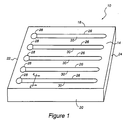
- Figure 1 is a perspective view of a Western Blot tray in accordance with an embodiment of this invention.
- Figure 2 is a plan view of the Western Blot tray of Figure 1.
- Figure 3 is an elevation view of the Western Blot tray and agitator of one embodiment of this invention.
- Figure 4a is a partial cross-sectional view of an embodiment of the Western Blot tray of this invention, taken along the line 4-4 of Figure 1.
- Figure 4b is a partial cross-sectional view of another embodiment of the Western Blot tray of this invention, taken along the line 4-4 of Figure 1.
- Tray 10 comprises an upper surface 14, a lower surface 16, opposite longitudinal side surfaces 18 and 20 and opposite transverse end surfaces 22 and 24, Upper and lower surfaces 14 and 16 are preferably approximately parallel to each other. Side surfaces 18 and 20 preferably are approximately parallel to each other and approximately perpendicular to end surfaces 22 and 24.
- tray 10 removably mounted to agitator 12.
- agitator 12 rocks tray 10 around tray 10's center axis. Tray 10's center axis is shown in Figure 2. The rocking motion about this axis is depicted by the arrows shown in Figure 3.
- tray 10 may further comprise a cover (not shown) to prevent evaporation, contamination of the buffer and cross-contamination of samples contained in each trough 26.
- the cover may comprise a component separate from tray 10 itself or it may be hinged or otherwise removably affixed to tray 10.
- tray 10 further comprises portions defining at least one trough 26 for containing and reacting at least one DBS, buffer and a WB strip during testing.
- each tray 10 comprises a plurality of troughs 26.
- tray 10 may comprise as few as one trough 26 or as many troughs 26 as may be physically accommodated by tray 10.
- troughs 26 comprise a DBS receptacle area 28 and a WB strip area 30.
- DBS area 28 is intended to accommodate the blood sample in the form of a DBS during testing.
- Strip area 30 is intended to accommodate the WB strip during testing.
- trough 26 is not critical provided the shape reduces the volume of buffer required during testing and the amount of blood sample in the form of DBSs is reduced from the two 1 ⁇ 4" DBSs normally used. However, in any configuration of trough 26, a sufficient volume of buffer should preferably be present in trough 26 so that the DBS(s) and all portions of the WB strip are submerged at least once during each agitation cycle.
- the shape of the troughs in existing WB trays typically require approximately 2 ml of buffer in order to submerge all areas of the WB strip and DBS during each agitation cycle.
- reduction in the total volume of the trough enables the volume of buffer to be reduced to approximately 1 ml.
- Reducing trough 26 dimensions enables each portion of the WB strip and DBS(s) to be submerged during each agitation cycle while using approximately 1 ml of buffer.
- trough size, DBS size, and buffer volume are possible in accordance with this invention.
- the depth of trough 26 may also vary depending on the geometric limitations needed to maintain sufficient concentration levels and immersion during agitation. However, a preferred depth is approximately 7/8".
- the volume of trough 26 has been reduced by forming trough 26 into a thermometer shape.
- the thermometer shaped trough 26 comprises a DBS area 28, which area 28 corresponds to a thermometer bulb, and WB strip area 30, which area corresponds to the body of the thermometer.
- Bulbed area 28 is shaped to accommodate the DBS(s) while body area 30 is shaped to accommodate the WB strip.
- Both areas 28 and 30 may be designed to "slip fit" the DBS(s) and WB strip respectively such that trough 26 is slightly larger than the diameter of a DBS at area 28 and slightly larger than the width of the WB strip at area 30.
- the DBS may be sized preferably between about 1/8" and about 1 ⁇ 4" in diameter, although it is readily apparent that other sizes and shapes are sufficient.
- the WB strips may be sized preferably between about 1/8" and about 1 ⁇ 4"in width, although it is readily apparent that other widths are also acceptable.
- the shape of the cross section of trough 26 is also not critical so long as (1) the volume of trough 26 allows for complete immersion of the WB strip and DBS(s) at least once during each agitation cycle and (2) a sufficient concentration ratio of blood to buffer is maintained.
- Cross sections of two preferred embodiments of WB strip area 30 are shown in Figures 4a and 4b respectively.
- Figure 4a depicts an area 30 of trough 26 with a smooth rounded bottom
- Figure 4b depicts area 30 of trough 26 with undercuts 34 and smooth rounded bottom.
- the undercuts 34 shown in Figure 4b allow for the DBS to move within area 30 during agitation.
- Area 30 of Figure 4a is preferably about 1 ⁇ 4" wide while area 30 of Figure 4b is preferably about 1/8" wide at upper surface 14 and undercut by about 1/8" on either side of the straight sides 36 of area 30 of trough 26 to form undercuts 34. Accordingly, the bottom surface of trough 26 in the undercut embodiment of Figure 4b is approximately 3/8" wide.
- WB troughs Numerous other shapes and configurations of the WB troughs are contemplated which will reduce the volume of the buffer and/or the number and/or size of DBSs required for testing purposes.
- the amount of blood sample used in the WB test is contained in one 1 ⁇ 4" diameter DBS.
- a 1 ⁇ 4" diameter DBS has a surface area of approximately 0.04909 in 2 .
- trough 26 geometries are adapted to accommodate one 3/16" diameter DBS or one 1/8" diameter DBS.
- a 1/8" diameter DBS has a surface area of approximately 0.01227 in 2 . It should be noted, however, that it is not necessary that the DBS have a circular shape. Any shape of DBS is acceptable provided that the DBS contains a sufficient amount of blood sample (which may correspond to DBS surface area) to assure accurate testing.
- the WB tray 10 may be modified to accommodate almost any shape of DBS or WB strip.
- the WB strip may be placed in the WB tray on the WB strip's side or edge.
- trough 26 could be approximately 1/8" wide. With the WB strip oriented in this manner, the width of trough 26 would be greatly reduced and consequently, utilize less buffer and a smaller DBS.
- agitator 12 may comprise any mechanism which provides substantially continuous agitation during the WB incubation period.
- Agitator 12 may, for example, either rock, tilt or rotate tray 10.
- tray 10 will be rocked, tilted or rotated in one complete cycle once every two to three seconds.
- One such agitator 12 which uses a rocking motion to create agitation is the Bellco Rocker Platform, Catalog No. 774020000, which measures 50 cm by 50 cm.
- tray 10 Another means for agitating the contents of tray 10 utilizes peristaltic pumps to create a reciprocating flow of the buffer within trough 26. It is expected that any of these agitation means in combination with increased blood to buffer concentrations will reduce incubation times over current WB trays.
- tray 10 is intended to be disposable and preferably made of polystyrene, although other materials may be suitable. Also, tray 10 may be equipped with other optional features. For example, a drain for quick removal or aspiration of buffer from the trough 26 may be provided. It is also possible that a system for automatically filling each trough 26 with buffer may also be provided.
Landscapes
- Health & Medical Sciences (AREA)
- Life Sciences & Earth Sciences (AREA)
- Chemical & Material Sciences (AREA)
- Immunology (AREA)
- Engineering & Computer Science (AREA)
- Hematology (AREA)
- Urology & Nephrology (AREA)
- Biomedical Technology (AREA)
- Molecular Biology (AREA)
- Chemical Kinetics & Catalysis (AREA)
- General Health & Medical Sciences (AREA)
- Analytical Chemistry (AREA)
- Physics & Mathematics (AREA)
- General Physics & Mathematics (AREA)
- Medicinal Chemistry (AREA)
- Biotechnology (AREA)
- Microbiology (AREA)
- Biochemistry (AREA)
- Cell Biology (AREA)
- Food Science & Technology (AREA)
- Pathology (AREA)
- Virology (AREA)
- Clinical Laboratory Science (AREA)
- AIDS & HIV (AREA)
- Tropical Medicine & Parasitology (AREA)
- Investigating Or Analysing Biological Materials (AREA)
Applications Claiming Priority (2)
| Application Number | Priority Date | Filing Date | Title |
|---|---|---|---|
| US367046 | 1982-04-09 | ||
| US36704694A | 1994-12-30 | 1994-12-30 |
Publications (1)
| Publication Number | Publication Date |
|---|---|
| EP0720020A1 true EP0720020A1 (de) | 1996-07-03 |
Family
ID=23445720
Family Applications (1)
| Application Number | Title | Priority Date | Filing Date |
|---|---|---|---|
| EP95309523A Withdrawn EP0720020A1 (de) | 1994-12-30 | 1995-12-29 | Gerät und Verfahren zum Test trockener Blutflecken mit der Western-Blot-Prozedur |
Country Status (1)
| Country | Link |
|---|---|
| EP (1) | EP0720020A1 (de) |
Cited By (5)
| Publication number | Priority date | Publication date | Assignee | Title |
|---|---|---|---|---|
| WO1999047928A3 (en) * | 1998-03-19 | 2000-03-23 | Immunetics Inc | Systems and methods for rapid blot screening |
| WO2001006255A1 (de) * | 1999-07-20 | 2001-01-25 | Byk Gulden Lomberg Chemische Fabrik Gmbh | Vorrichtung zur prozessierung von analyten an festphasen |
| WO2006113831A3 (en) * | 2005-04-20 | 2007-12-06 | Jeffrey A Klein | Method of measuring bleeding volume |
| EP2660602A1 (de) * | 2012-05-03 | 2013-11-06 | Euroimmun Medizinische Labordiagnostika AG | Testkit für die Labordiagnostik |
| EP3539661A1 (de) * | 2018-03-12 | 2019-09-18 | Euroimmun Medizinische Labordiagnostika AG | Inkubationsrinne sowie inkubationswanne mit mehreren inkubationsrinnen |
Citations (1)
| Publication number | Priority date | Publication date | Assignee | Title |
|---|---|---|---|---|
| US4994166A (en) * | 1989-08-22 | 1991-02-19 | Bio-Rad Laboratories, Inc. | Single apparatus for slab gel electrophoresis and blotting |
-
1995
- 1995-12-29 EP EP95309523A patent/EP0720020A1/de not_active Withdrawn
Patent Citations (1)
| Publication number | Priority date | Publication date | Assignee | Title |
|---|---|---|---|---|
| US4994166A (en) * | 1989-08-22 | 1991-02-19 | Bio-Rad Laboratories, Inc. | Single apparatus for slab gel electrophoresis and blotting |
Non-Patent Citations (1)
| Title |
|---|
| T.C. GRANADE ET AL.: "Factors influencing HIV-1 banding patterns in miniaturized Western blot testing of dried blood spot specimens.", JOURNAL OF IMMUNOLOGICAL METHODS, vol. 154, AMSTERDAM NL, pages 225 - 233, XP000567706 * |
Cited By (12)
| Publication number | Priority date | Publication date | Assignee | Title |
|---|---|---|---|---|
| WO1999047928A3 (en) * | 1998-03-19 | 2000-03-23 | Immunetics Inc | Systems and methods for rapid blot screening |
| US6194160B1 (en) | 1998-03-19 | 2001-02-27 | Immunetics, Inc. | Systems and methods for rapid blot screening |
| WO2001006255A1 (de) * | 1999-07-20 | 2001-01-25 | Byk Gulden Lomberg Chemische Fabrik Gmbh | Vorrichtung zur prozessierung von analyten an festphasen |
| WO2006113831A3 (en) * | 2005-04-20 | 2007-12-06 | Jeffrey A Klein | Method of measuring bleeding volume |
| US20100121171A1 (en) * | 2005-04-20 | 2010-05-13 | Klein Jeffrey A | Method of measuring bleeding volume |
| EP2660602A1 (de) * | 2012-05-03 | 2013-11-06 | Euroimmun Medizinische Labordiagnostika AG | Testkit für die Labordiagnostik |
| US20140186971A1 (en) * | 2012-05-03 | 2014-07-03 | Euroimmun Medizinische Labordiagnostika Ag | Testkit for Laboratory Diagnostics |
| US10620191B2 (en) * | 2012-05-03 | 2020-04-14 | Euroimmun Medizinische Labordiagnostika Ag | Testkit for laboratory diagnostics |
| EP3539661A1 (de) * | 2018-03-12 | 2019-09-18 | Euroimmun Medizinische Labordiagnostika AG | Inkubationsrinne sowie inkubationswanne mit mehreren inkubationsrinnen |
| CN110252432A (zh) * | 2018-03-12 | 2019-09-20 | 欧蒙医学实验诊断股份公司 | 培养槽以及具有多个培养槽的培养盘 |
| CN110252432B (zh) * | 2018-03-12 | 2022-07-19 | 欧蒙医学实验诊断股份公司 | 培养槽以及具有多个培养槽的培养盘 |
| US11504718B2 (en) | 2018-03-12 | 2022-11-22 | Euroimmun Medizinische Labordiagnostika Ag | Incubation trough and incubation tray with a plurality of incubation troughs |
Similar Documents
| Publication | Publication Date | Title |
|---|---|---|
| US4793973A (en) | Container for adding antibodies or antigens to a biological liquid | |
| US5188968A (en) | Method and reaction kit for agglutination detection | |
| US4956150A (en) | Disposable microtiter stick | |
| US5503985A (en) | Disposable device for diagnostic assays | |
| TWI550274B (zh) | 微流體檢驗裝置及其運作方法 | |
| US5779907A (en) | Magnetic microplate separator | |
| US6097831A (en) | Non-contract method for assay reagent volume dispense verification | |
| US4147752A (en) | Form piece for apparatuses used for immunoassays and enzyme reactions | |
| CA2427990C (en) | Improved cell carrier grids | |
| JPH0467915B2 (de) | ||
| CN101738465B (zh) | 用于分析液相和固相之间的生物反应的方法和装置 | |
| EP0087899A2 (de) | Anordnung mit mehreren Bechern für immunologische Untersuchungen | |
| WO1997005492A1 (en) | Vessel | |
| JPH0216875B2 (de) | ||
| WO1990014161A1 (en) | Assay element | |
| EP3484623B1 (de) | Abgabevorrichtung für flüssige analytische reagenzien und analytische kits und damit verfahren zur verwendung im zusammenhang damit | |
| JPH06207934A (ja) | キュベットマトリックス | |
| JP3472306B2 (ja) | 流体を処理する方法および装置 | |
| EP3752290B1 (de) | Verwendungsverfahren für eine diagnostische testkartusche zur durchführung mehrerer diagnostischer tests mit einer einzigen flüssigtestprobe eines patienten | |
| US4084937A (en) | Receptacle for collecting urine samples | |
| CN103052874B (zh) | 用于化学和/或生物分析的方法和装置 | |
| GB2188418A (en) | Assay tray assembly | |
| WO1987003218A1 (en) | A disposable microtiter stick | |
| JPH0213977Y2 (de) | ||
| US7148060B2 (en) | Feeding tray for multiwell test apparatus |
Legal Events
| Date | Code | Title | Description |
|---|---|---|---|
| PUAI | Public reference made under article 153(3) epc to a published international application that has entered the european phase |
Free format text: ORIGINAL CODE: 0009012 |
|
| AK | Designated contracting states |
Kind code of ref document: A1 Designated state(s): AT BE CH DE DK ES FR GB GR IE IT LI LU MC NL PT SE |
|
| AX | Request for extension of the european patent |
Free format text: SI PAYMENT 960109 |
|
| RAX | Requested extension states of the european patent have changed |
Free format text: SI PAYMENT 960109 |
|
| 17P | Request for examination filed |
Effective date: 19961206 |
|
| 17Q | First examination report despatched |
Effective date: 19990805 |
|
| STAA | Information on the status of an ep patent application or granted ep patent |
Free format text: STATUS: THE APPLICATION IS DEEMED TO BE WITHDRAWN |
|
| 18D | Application deemed to be withdrawn |
Effective date: 19990701 |