EP0720114B1 - Verfahren und Gerät zur Detektion und Interpretation von Untertiteln in digitalen Videosignalen - Google Patents
Verfahren und Gerät zur Detektion und Interpretation von Untertiteln in digitalen Videosignalen Download PDFInfo
- Publication number
- EP0720114B1 EP0720114B1 EP95117595A EP95117595A EP0720114B1 EP 0720114 B1 EP0720114 B1 EP 0720114B1 EP 95117595 A EP95117595 A EP 95117595A EP 95117595 A EP95117595 A EP 95117595A EP 0720114 B1 EP0720114 B1 EP 0720114B1
- Authority
- EP
- European Patent Office
- Prior art keywords
- image
- identification
- text
- computer
- implemented method
- Prior art date
- Legal status (The legal status is an assumption and is not a legal conclusion. Google has not performed a legal analysis and makes no representation as to the accuracy of the status listed.)
- Expired - Lifetime
Links
Images






Classifications
-
- G—PHYSICS
- G06—COMPUTING OR CALCULATING; COUNTING
- G06V—IMAGE OR VIDEO RECOGNITION OR UNDERSTANDING
- G06V20/00—Scenes; Scene-specific elements
- G06V20/60—Type of objects
- G06V20/62—Text, e.g. of license plates, overlay texts or captions on TV images
- G06V20/635—Overlay text, e.g. embedded captions in a TV programme
-
- G—PHYSICS
- G06—COMPUTING OR CALCULATING; COUNTING
- G06V—IMAGE OR VIDEO RECOGNITION OR UNDERSTANDING
- G06V30/00—Character recognition; Recognising digital ink; Document-oriented image-based pattern recognition
- G06V30/10—Character recognition
Definitions
- the present invention relates to the detection and interpretation of textual captions in video signals and, more particularly, to the identification and interpretation of text captions in digital video signals.
- Text captions are commonly used in domains such as television sports and news broadcasts, to convey information that complements or explains the contents of the audio and video information being presented.
- captions might present game scores and player names in sporting events, or places, situations, and dates in newscasts.
- Fig. 1 illustrates typical captions found in television broadcasts.
- the "text captions” herein referred to should be distinguished from the "closed-captions” used, for example, in broadcast programs to assist the hearing impaired and other audiences interested in live textual transcripts of the words spoken in the sound channel of a broadcast. These captions are transmitted in a separate channel of the signal and are "overlaid” into the screen display of a television receiver by means of a special decoder.
- the captions herein addressed are textual descriptions embedded in the video signal itself.
- an automatic caption detector can be used to address the following two principal problems in digital video management.
- the first problem relates to indexing ⁇ captions can be interpreted with an optical character recognition (OCR) system and used to generate indexes into the contents of the video., e.g. names of persons, places, dates, situations, etc. These indexes serve as references to specific videos or video segments from a large collection. For example, a person could request clips of a particular sports star or when a certain politician appears, or about a certain place.
- the second problem relates to segmentation ⁇ captions can be used to partition the video into meaningful segments based on the visual cues they offer to the viewer. In Fig. 2a, for example, captions were used to segment a video of an interview including a number of individuals. Using the browser one can quickly identify the person of interest and begin playing the corresponding segment (Fig. 2b).
- captions are regularly used to report the score of the game after every field-goal or free-throw.
- the ability to identify and interpret these captions can then be used to generate triplets of the form (time, TeamAScore, TeamBScore), which could latter be used to answer queries such as "show me all the segments of the game where TeamB was ahead by more than 10".
- they can be used to create a score browser which would enable a person to move directly to specific portions of the video; see Fig. 2c.
- the present invention is intended to be implemented by programmable computing apparatus, preferably by a digital computer.
- operational steps herein referred to are generally intended to signify machine operations
- captions in the present context are those textual descriptors overlaid on a video by its producer. More specifically, captions are considered to exhibit the following characteristics. Captions do not move from frame to frame, i.e., they remain in the exact same location in each frame regardless of what is happening in the rest of the scene. Captions remain on the screen for at least a minimum period of time, i.e., they will appear in a plurality of consecutive frames. This is important because it enables sampling of the video to detect captions, and because the redundancy can be used to improve the accuracy of the method.
- Captions are intended to be read from a distance. Thus, there are minimum character sizes that can be utilized in making a determination as to whether a video segment contains next.
- non-caption text may appear in video.
- street signs and advertisement will typically appear in outdoor scenes. Text is also often found in commercial broadcast material. In both cases if one or more of the afore-mentioned characteristics is violated (e.g., the text in a street sign may move in a fast action shot), the text will not be detected in accordance with the present invention.
- the method comprises the identification of text in a document image, involving connected component generation, the connected components being analysed as to whether they are likely to be part of a text region.
- US 5335 297 describes an autonomus real-time adaptive video target detection and position location operators and method.
- Adaptive low pass filters produce horizontal leading and trailing edge and vertical thresholds from each frame of input target and background or clutter video signal.
- a computer-implemented method for the identification and interpretation of text captions in an encoded video stream of digital video signals is provided as defined in claim 1.
- the sampling is at a sampling rate fixed at 1 frame per N, where N is the number of consecutive frames in which the same caption is expected to appear.
- the decoding uses one of JPEG encoding and MPEG.
- the format of the resulting color image is a 24-bit RGB format and the compressing groups is performed eight at a time.
- the mapping of the pixel levels is performed by compressing each byte in the original image (8 continuous pixels) into a binary value in accordance with predetermined criteria. This results in the conversion of a binary edge image of size WIDTH x HEIGHT into an image of size WIDTH/8 x HEIGHT.
- the criteria comprise
- a step of taking a binary image as input and producing a table of connected-components is formatted as follows: Component ID EnclosingRectangle Dimensions Density where Component ID is an integer, Enclosing rectangle are the coordinates of the smallest rectangle containing all the pixels in the component (minX, minY, maxX, maxY), dimensions are measurements of the width, height and area of the enclosing rectangle, and density is the ratio of black pixels, which are associated with edges, in the component.
- a step of determining whether a connected component is likely to contain edges associated with text or not comprises the steps of:
- the method comprises the steps of:
- the computer-implemented method for the identification and interpretation of text captions includes the step of defining the binary image, and its corresponding video frame, as having a caption if and only if it has at least one run satisfying the minimum text height condition.
- the computer-implemented method for the identification and interpretation of text captions includes the step of confirming whether a collection of frames previously determined to have captions is further processed to confirm the result by the steps of:
- a computer-implemented method for the identification and interpretation of text captions in an encoded video stream of digital video signals, as defined in claim 13 is provided.
- the digitized color image is separated into three 8-bit color images corresponding to the three color planes.
- the three color planes are respectively red, green, and blue (RGB).
- a computer-implemented method for the identification and interpretation of text captions in a video stream wherein the frame sequence is compressed as defined in claim 20 is provided.
- the connected components analysis is carried out by computing connected components using a standard 4-neighbor connectivity text.
- each the computed connected component is subjected to two sets of tests involving its geometric properties and contents.
- the geometric tests involve minimum and maximum boundaries on a respective connected component's width, height and area.
- the content tests, applied to an area in the binary image following edge detection corresponding to the connected component include upper and lower boundaries on the proportion of black pixels contains therein, and a threshold on the number of vertical zero-runs, defined as collections of one or more columns in which no black pixels occur.
- the computer-implemented method for the identification and interpretation of text captions comprises the steps of: separating out connected components that passed the tests; projecting values of corresponding pixels in the binary image following edge detection into the vertical axis of the image so as to result in a projection pattern.
- the computer-implemented method for the identification and interpretation of text captions comprises the steps of: testing the projection pattern to determine if it contains runs that exceed a given threshold and thereby determine if a caption is present.
- Such a classification is useful because identifying captions where there is no background requires additional processing, as will become apparent in the course of the present description of the invention and, more particularly, in the description of the algorithm and its application in the context of the invention.
- the processing of digital video to detect and interpret text captions is carried out in two phases. First, frames in the video that contain text captions are identified. Then these captions are separated from the rest of the image. Each step is described separately below.
- the objective of the caption detection phase is to identify the collection of video frames that contain text captions.
- the task is accomplished in two steps as follows:
- the initial detection step involves generating intermediate binary representations of video frames (pre-processing) then determining whether it contains a caption.
- the initial detection step of the algorithm is designed to use information contained in a single frame.
- the size of the sampling rate is a function of the time the captions are expected to be present in the video.
- the inventors have found that the shortest captions appear to be active for at least two seconds, which translates into a sampling rate of 1/60 if the video is digitized at 30 frames per second.
- Frames selected during the sampling process are decoded and converted into individual color images.
- the system uses motion JPEG (Joint Photographic Experts Group) video, but MPEG (Moving Pictures Experts Group) or other formats can be used, given an appropriate frame decoder.
- MPEG Motion Pictures Experts Group
- the preferred representation of the color image is a 24-bit RGB (red-green-blue) format. The use of other color representations or depths would require slight changes to the algorithms.
- the first step performed in the processing of an individual frame is edge detection.
- advantage is taken of the availability of color information by applying edge detection in each separate color plane and then combining the results during the binarization step.
- the process has proven particularly useful in dealing with transparent-background captions in which the letters of the caption blend with the rest of the scene.
- the edge detection technique used involves taking the Pythagorean sum of two Sobel gradient operators at 90 degrees to each other. The algorithm is described "Digital Image Processing" by Gonzalez and Wintz, chapter 7, and implemented in the set of operations made available with the portable bitmap (PBM) file format used in this project.
- PBM portable bitmap
- the gray scale images obtained in the edge detection step are binarized and combined into a single binary edge image.
- the process involves threshholding and OR-ing the image.
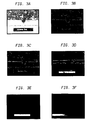
- Figs. 3a-c illustrates the pre-processing tasks.
- Compression ⁇ during this step the binary edge image of a frame, which size is defined to be WIDTH x HEIGHT, is converted into an image of size WIDTH/8 x HEIGHT by compressing each byte in the original image (8 continuous pixels) into a binary value using the following criteria:
- Fig. 3d illustrates a compressed image corresponding to that of Fig. 3c.
- Geometric tests involve minimum and maximum boundaries on the connected component's width, height and area (minimum width, maximum width, minimum height, maximum height, minimum area, maximum area, minimum density, minimum black pixels, maximum black pixels).
- Content tests applied to the area in the original binary edge detection image corresponding to the connected component, include upper and lower boundaries on the percentage of black pixels it contains, and a threshold on the number of vertical zero-runs, defined as collections of one or more columns in which no black pixels occur. The reason for the latter test is to account for the separation that exists between the text characters.
- Fig. 3e shows the components that remain after applying the tests to the compressed image of Fig. 3d.
- the threshold values used by way of example are as follows. minimum width 3 maximum height 40 min. black pixels 0.33 maximum width 40 minimum area 16 max. black pixels 0.66 minimum height 10 maximum area 640 It is noted that these values were set for a frame consisting of 240 lines of 320 pixels.
- the final analysis task involves separating the connected components that passed the test and projecting the values of the corresponding pixels in the original binary edge image into the vertical axis of the image; see Fig. 3f.
- the resulting projection pattern is then tested to determine if it contains runs that exceed a given threshold. This test is based on the observation that shapes corresponding to text will contain a high number of edges concentrated in an area having approximately the height of the expected text.
- the caption detection described above uses the color and shape information contained in each individual frame.
- motion information is utilized to increase the overall accuracy (recall rate) of the method.
- the basic premise for this work is the fact that captions will remain in the same portion of the video while the background changes and thus it is possible to effectively remove background noise by combining the edges of two (or more) neighboring frames.
- N be the frame being analyzed
- E(N) be the corresponding edge image
- D the minimum number of contiguous frames a caption is expected to be up. Based on these parameters the following test is applied:
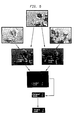
- Fig. 4 illustrates the steps described above.
- the procedure described herein detects a caption using the three basic characteristics described above, i.e., captions do not move, they remain on the screen for at least a minimum period of time, and they are intended to be read from a distance. It is also possible to use additional information about the domain associated with the video to enhance the efficiency of the procedure. In particular, the information of the approximate location of the caption within the frame, enables the algorithm to focus on specific areas of the image (e.g., the bottom half) with the corresponding reduction in processing requirements.
- This approach can be taken a step further if the type of caption being sought is known exactly or almost exactly. For example, in sporting events the score of a match is typically reported constantly throughout the broadcast. In this case a simpler matching algorithm can be used in conjunction with the confirmation step.
- the next step is to interpret the text contained in the caption.
- the task involves locating the area or areas of interest, separating them from the rest of the image, and applying OCR.
- the first two steps are relatively straightforward given the information obtained from the connected component analysis performed during the detection phase.
- applying OCR is a more difficult task, particularly if the caption background is transparent, or even translucid, because the letters in the text will blend with the scene.
- the solution herein disclosed involves taking advantage of motion and color to remove objects in the background.
- the basic premises upon which this solution is based are: (1) captions are displayed using saturated colors; and (2) there is motion on the scene behind the captions.
- the technique is similar to that used in the confirmation step of the capture detection algorithm, but this time the color images themselves are considered.
- motion and color information is utilized as follows:
- N, N-x and N+x be three frames containing the same caption; the value of x should be as large as possible, but all three frames must contain the same caption.
- RGB(N,i,j) be the rgb color values for the i-th pixel of row j in frame N.
- HSV(N,i,j) be the corresponding values in the hue-saturation color model.
- a new color image I is constructed by multiplying the HSV values of N, N-x and N+x, and then normalizing to the maximum value. The resulting image will highlight saturated values that remain in the same location, fading all other values.
- Fig. 5 illustrates the process when applied to the frames shown in Fig. 4. The binary image at the end of the sequence was obtain by threshholding the saturation values of the results.
- the input is in the form of an encoded video stream.
- Step 1 sampling, involves selecting frames for video analysis.
- a sampling rate is fixed at 1 frame per N, where N is the number of consecutive frames in which the same caption is expected to appear.
- Step 2 decoding, involves converting each of the selected frames into a digitized color image.
- a current implementation of the uses motion JPEG encoding.
- the same technique can be applied using MPEG or another other encoding mechanism.
- the preferred format of the resulting color image is a 24-bit RGB format.
- Step 3 edge detection, uses the algorithm described in “Digital Image Processing”, by Gonzales and Wintz.
- Step 4 binarization, converts the greyscale image generated in Step 3 into a bi-level image by means of a thresholding operation.
- Step 5 compression, groups consecutive pixel values in the binary image - eight at a time - and maps them into a binary value by means of the test described above in relation to compression, that is, during this step the binary edge image of a frame, which size is defined to be WIDTH x HEIGHT, is converted into an image of size WIDTH/8 x HEIGHT by compressing each byte in the original image (8 continuous pixels) into a binary value using the criteria given above.
- Step 6 connected component analysis, separates groups of connected pixels and determines whether they are likely to be part of a text region in the image or not.
- the algorithm takes a binary image as input and produces a table of connected-components formatted as follows: Component ID EnclosingRectangle Dimensions Density where Component ID is an integer, Enclosing rectangle are the coordinates of the smallest rectangle containing all the pixels in the component (minX, minY, maxX, maxY), dimensions are measurements of the width, height and area of the enclosing rectangle, and density is the ratio of black pixels, which are associated with edges, in the component.
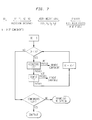
- the algorithm corresponding to the flow chart of Figure 7 is used to determine whether the connected component is likely to contain edges associated with text or not. The following steps are performed for each component:
- Step 1 a geometric test, compares the width, height, and area of the component against predefined minima and maxima, discarding the component if any of the conditions is violated.
- Step 2 a content test, is applied to connected components that pass the geometric test. This test involves comparing the density of the component against predefined upper and lower bounds, as verifying that a minimum number of vertical white runs, corresponding to the gaps that occur between letters, exist.
- the final step in this portion of the algorithm involves projecting the black pixels contained in the connected components that passed the geometric and content tests into the Y-axis of the image.
- the resulting projection pattern is then tested to determine if its vertical runs, defined a sequences of consecutive lines having counts greater than zero, exceed the minimum height of the characters being sought in the caption.
- the binary image, and its corresponding video frame, is considered to have a caption if and only if it has at least one run satisfying the minimum text height condition.
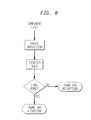
- the flow chart in Figure 9 illustrates the confirmation step. During this step the collection of frames determined in phase I to have captions is further processed to confirm the result.
- N be a frame thought to have a caption.
- the first part of this test involves applying the decoding, edge detection and binarization steps described above to frames N-D/2 and N+D/2 .
- the resulting images are then combined with the binary image of N using an AND operation.
- the result of this operation are two new binary images in which some of the edges associated with the individual frames have been removed, but those associated within text remain.
- the second part of the confirmation step involves applying the compression, connected component analysis and projection evaluation steps described above to each of the two new binary images.
- a frame is said to have a caption, if and only if, either one, or both of the new images is determined to have a caption.
- the flow chart in Figure 10 shows the process as applied to frames containing captions to separate the text from the rest of the scene.
- the technique used also exploits motion in the image to improve the quality of the results.
- the color images themselves, not the edges are combined using this time and addition operations that first adds the values of corresponding pixels in the two images and then normalizes them with respect to the highest pixel value.
- the effect of this operation is to darken pixels with low intensity values, and to enhance pixels with high intensity values such as those typically found in captions.
- the two images obtained in the first step are combined using the same technique to obtain a third color image in which the background is likely to be darkened even more.
- This images is the converted to grey-scale and binarized and yielding a black and white image which can the enhanced and passed to an OCR system.
- the resulting text strings serve as indices into the content of the video.
Landscapes
- Engineering & Computer Science (AREA)
- Physics & Mathematics (AREA)
- General Physics & Mathematics (AREA)
- Multimedia (AREA)
- Theoretical Computer Science (AREA)
- Compression Or Coding Systems Of Tv Signals (AREA)
- Image Analysis (AREA)
Claims (23)
- Ein durch einen Computer implementiertes Verfahren für die Identifizierung von Textbildunterschriften in einem codierten Videostrom aus digitalen Videosignalen, wobei das Verfahren folgendes umfaßt:Abtasten durch Auswahl von Einzelbildern zur Videoanalyse;Decodieren durch Umsetzen jedes ausgewählten Einzelbilds in ein digitalisiertes Farbbild;Durchführen einer Kantenerfassung an den Komponenten des digitalisierten Farbbilds, um Gradientenbilder zu erzeugen;Digitalisieren der resultierenden Gradientenbilder, um mit Hilfe einer Schwellwertbildungsoperation zweiwertige Gradientenbilder zu erzeugen;Verknüpfen der Kantenbilder, um ein einzelnes zweiwertiges Gradientenbild zu erzeugen;Komprimieren von Gruppen von aufeinanderfolgenden Bildelementwerten in dem Binärbild durchAbbildung der aufeinanderfolgenden Bildelementwerte in einen Binärwert, um ein komprimiertes Binärbild abzuleiten, das ein Binärbild mit niedrigerer Auflösung ist; undTrennen von Gruppen verbundener Bildelemente in dem komprimierten Bild mit einem Wert, der das Vorliegen von Kanten anzeigt, und Bestimmen, ob es wahrscheinlich ist, daß sie Teil eines Textgebiets in dem Bild sind, oder nicht.
- Ein durch einen Computer implementiertes Verfahren für die Identifizierung von Textbildunterschriften nach Anspruch 1, bei dem die Abtastung mit einer auf 1 Einzelbild pro N festgelegten Abtastrate erfolgt, wobei N die Anzahl aufeinanderfolgender Einzelbilder ist, in denen man erwartet, daß die gleiche Bildunterschrift erscheint.
- Ein durch einen Computer implementiertes Verfahren für die Identifizierung von Textbildunterschriften nach Anspruch 1, bei dem die Decodierung entweder JPEG-Codierung oder MPEG verwendet.
- Ein durch einen Computer implementiertes Verfahren für die Identifizierung von Textbildunterschriften nach Anspruch 3, bei dem es sich bei dem Format des resultierenden Farbbilds um ein 24-Bit-RGB-Format handelt.
- Ein durch einen Computer implementiertes Verfahren für die Identifizierung von Textbildunterschriften nach Anspruch 1, bei dem jeweils acht Gruppen komprimiert werden.
- Ein durch einen Computer implementiertes Verfahren für die Identifizierung von Textbildunterschriften nach Anspruch 1, bei dem die Abbildung der aufeinanderfolgenden Bildelementwerte durch Komprimieren jedes Byte in dem Vorlagenbild (8 aufeinanderfolgende Bildelemente) zu einem Binärwert gemäß vorbestimmten Kriterien durchgeführt wird, so daß während dieses Schritts ein Binärkantenbild eines Einzelbilds, dessen Größe als BREITE x HÖHE definiert ist, in ein Bild der Größe BREITE/8 x HÖHE umgesetzt wird.
- Ein durch einen Computer implementiertes Verfahren für die Identifizierung von Textbildunterschriften nach Anspruch 6, wobei die Kriterien folgendes umfassen:a) 2 < # weißer Bildelemente < 6; UNDb) mindestens 2 der 4-verbundenen Nachbarn sind 1.
- Ein durch einen Computer implementiertes Verfahren für die Identifizierung von Textbildunterschriften nach Anspruch 1, mit dem Schritt, ein Binärbild als Eingabe zu nehmen und eine Tabelle verbundener Komponenten zu erzeugen, die wie folgt formatiert ist:
Component ID EnclosingRectangle Dimensions Density
wobei Component ID [Komponenten-ID] eine ganze Zahl, Enclosing Rectangle [umschließendes Rechteck] die Koordinaten des kleinsten, alle Bildelemente in der Komponente enthaltenen Rechtecks sind (minX, minY, maxX, maxY), Dimensions [Abmessungen] Messungen der Breite, Höhe und Fläche des umschließenden Rechtecks sind und Density [Dichte] das Verhältnis schwarzer, Kanten zugeordneter Bildelemente in der Komponente ist. - Ein durch einen Computer implementiertes Verfahren für die Identifizierung von Textbildunterschriften nach Anspruch 8, mit dem Schritt, zu bestimmen, ob eine verbundene Komponente wahrscheinlich Text zugeordnete Kanten enthält, oder nicht, wobei der Schritt folgende Schritte umfaßt:(a) einen geometrischen Test, bei dem die Breite, Höhe und Fläche der Komponente mit vorbestimmten Mindestwerten und Höchstwerten verglichen wird und die Komponente verworfen wird, falls irgendeine der Bedingungen verletzt ist, und(b) einen Inhaltstest, der auf die den geometrischen Test bestehenden verbundenen Komponenten angewendet wird, wobei die Dichte der Komponente mit vorbestimmten Ober- und Untergrenzen verglichen wird, um zu verifizieren, daß eine kleinste Anzahl vertikaler weißer Läufe existiert, die den zwischen Buchstaben auftretenden Lücken entsprechen.
- Ein durch einen Computer implementiertes Verfahren für die Identifizierung von Textbildunterschriften nach Anspruch 9, mit den folgenden Schritten:Projizieren von schwarzen Bildelementen, die in verbundenen Komponenten, die den geometrischen und Inhaltstest bestanden haben, enthalten sind, auf die Y-Achse des Bilds, wodurch ein Projektionsmuster erzeugt wird; undTesten des resultierenden Projektionsmusters, um zu bestimmen, ob seine vertikalen Läufe, die als Folgen aufeinanderfolgender Linien mit Zählwerten über Null definiert sind, -eine Mindesthöhe der in der Bildunterschrift gesuchten Zeichen übersteigen.
- Ein durch einen Computer implementiertes Verfahren für die Identifizierung von Textbildunterschriften nach Anspruch 10, mit dem Schritt: Definieren des Binärbilds und seines entsprechenden Videoeinzelbilds derart, daß es eine Bildunterschrift dann und nur dann aufweist, wenn es mindestens einen Lauf aufweist, der der Bedingung der Mindesttexthöhe genügt.
- Ein durch einen Computer implementiertes Verfahren für die Identifizierung von Textbildunterschriften nach Anspruch 11, mit dem Schritt: Bestätigen, ob eine Sammlung von Einzelbildern, von denen durch den Schritt von Anspruch 11 bestimmt wurde, daß sie Bildunterschriften aufweisen, weiter verarbeitet wird, um das Ergebnis durch folgende Schritte zu bestätigen:Definieren, daß N ein Einzelbild ist, von dem bestimmt wurde, daß es eine Bildunterschrift aufweist;Anwenden der obigen Schritte des Decodierens, der Kantenerfassung und Digitalisierung auf die Einzelbilder N-D/2 und N+D/2;Verknüpfen resultierender Bilder mit einem Binärbild von N unter Verwendung einer AND-Operation, um zwei neue Binärbilder zu erhalten, in denen einige der den individuellen Einzelbildern zugeordneten Kanten entfernt worden sind, aber diejenigen, die innerhalb von Text zugeordnet wurden, bestehen bleiben;Anwenden der obigen Schritte Komprimierung, Analyse verbundener Komponenten und Projektionsbewertung auf jedes der beiden neuen Binärbilder; undBestimmen, daß ein Einzelbild dann und nur dann eine Bildunterschrift hat, wenn von einem oder beiden der beiden neuen Bilder bestimmt wird, daß sie eine Bildunterschrift aufweisen.
- Ein durch einen Computer implementiertes Verfahren für die Identifizierung von Textbildunterschriften in einem Videostrom, wobei die Einzelbildfolge komprimiert wird, mit den folgenden Schritten:Bestimmen, ob die Einzelbildzahl geteilt durch eine vorbestimmte Zahl N eine ganze Zahl ist, wobei nicht ganzzahlige verworfen werden;Decodieren komprimierter Einzelbilder, um nicht komprimierte Einzelbilder zu erhalten;Durchführen einer Kantenerfassung an den Komponenten des digitalisierten Farbbilds, um Gradientenbilder zu erzeugen;Digitalisieren der resultierenden Gradientenbilder, um mit Hilfe einer Schwellwertbildungsoperation zweiwertige Gradientenbilder zu erzeugen;Verknüpfen der Kantenbilder, um ein einzelnes zweiwertiges Gradientenbild zu erzeugen;Komprimieren des Binärbilds, um ein komprimiertes Binärbild abzuleiten, das ein Binärbild mit niedrigerer Auflösung ist; undDurchführen einer Analyse verbundener Komponenten, um die Textbildunterschriften zu bestimmen.
- Ein durch einen Computer implementiertes Verfahren für die Identifizierung von Textbildunterschriften nach Anspruch 13, wobei die Analyse verbundener Komponenten durch Berechnen verbundener Komponenten unter Verwendung eines standardmäßigen 4-Nachbar-Verknüpfbarkeitstests ausgeführt wird.
- Ein durch einen Computer implementiertes Verfahren für die Identifizierung von Textbildunterschriften nach Anspruch 13, wobei jede berechnete verbundene Komponente zwei Sätzen von Tests unterzogen wird, bei denen es um ihre geometrischen Eigenschaften und den Inhalt geht.
- Ein durch einen Computer implementiertes Verfahren für die Identifizierung von Textbildunterschriften nach Anspruch 15, bei dem die geometrischen Tests Mindest- und Höchstgrenzen bezüglich der Breite, Höhe und Fläche einer jeweiligen verbundenen Komponente beinhalten.
- Ein durch einen Computer implementiertes Verfahren für die Identifizierung von Textbildunterschriften nach Anspruch 15, wobei die auf eine Fläche im Binärbild nach Kantenerfassung entsprechend der verbundenen Komponente angewandte Inhaltstests Unter- und Obergrenzen an dem Anteil der darin enthaltenen schwarzen Bildelemente und einen Schwellwert bezüglich der Anzahl vertikaler Nulläufe, definiert als Ansammlungen aus einer oder mehreren Spalten, in denen keine schwarzen Bildelemente auftreten, enthalten.
- Ein durch einen Computer implementiertes Verfahren für die Identifizierung von Textbildunterschriften nach Anspruch 17, mit den folgenden Schritten:
Aussondern verbundener Komponenten, die die Tests bestanden haben; und Projizieren von Werten entsprechender Bildelemente in dem Binärbild nach der Kantenerfassung auf die vertikale Achse des Bilds, um ein Projektionsmuster zu erhalten. - Ein durch einen Computer implementiertes Verfahren für die Identifizierung von Textbildunterschriften nach Anspruch 1, mit dem folgenden Schritt:
Testen des Projektionsmusters, um zu bestimmen, ob es Läufe enthält, die einen gegebenen Schwellwert übersteigen, und um auf diese Weise zu bestimmen, ob eine Bildunterschrift vorliegt. - Ein durch einen Computer implementiertes Verfahren für die Identifizierung von Textbildunterschriften in einem codierten Videostrom aus digitalen Videosignalen, wobei das Verfahren folgendes umfaßt:Abtasten durch Auswahl von Einzelbildern zur Videoanalyse;Decodieren durch Umsetzen jedes ausgewählten Einzelbilds in ein digitalisiertes Farbbild;Aufteilen jedes digitalisierten Farbbilds in drei Farbbilder entsprechend den drei Farbebenen;Durchführen einer Kantenerfassung an jeder der Farbebenen, um für jede der Farbebenen ein entsprechendes Grauwertbild zu erzeugen;Anwenden eines Schwellwertbildungsbilds auf jedes der Grauwertbilder, um jeweils drei Binärkantenbilder zu erzeugen;Verknüpfen der drei Binärkantenbilder, um ein einzelnes verknüpftes Binärkantenbild zu erhalten;Komprimieren von Gruppen von aufeinanderfolgenden Bildpunktwerten in dem verknüpften Binärbild durchAbbildung der aufeinanderfolgenden Bildelementwerte auf einen Binärwert, um ein komprimiertes Binärbild abzuleiten, das ein Binärbild mit niedrigerer Auflösung ist;Trennen von Gruppen verbundener Bildelemente in dem komprimierten Binarbild mit einem Wert, der das Vorliegen von Kanten anzeigt, und Bestimmen, ob es wahrscheinlich ist, daß sie Teil eines Textgebiets in dem Bild sind, oder nicht.
- Ein durch einen Computer implementiertes Verfahren für die Identifizierung von Textbildunterschriften nach Anspruch 20, wobei das digitalisierte Farbbild in drei 8-Bit-Farbbilder entsprechend den drei Farbebenen aufgeteilt wird.
- Ein durch einen Computer implementiertes Verfahren für die Identifizierung von Textbildunterschriften nach Anspruch 21, wobei die drei Farbebenen jeweils Rot, Grün und Blau (RGB) sind.
- Ein durch einen Computer implementiertes Verfahren für die Identifizierung von Textbildunterschriften nach Anspruch 1, mit dem Schritt des Anwendens der optischen Zeichenerkennung (OCR) auf einen Teil gefundenen Texts, um den Text auszulegen.
Applications Claiming Priority (2)
| Application Number | Priority Date | Filing Date | Title |
|---|---|---|---|
| US36527794A | 1994-12-28 | 1994-12-28 | |
| US365277 | 1994-12-28 |
Publications (3)
| Publication Number | Publication Date |
|---|---|
| EP0720114A2 EP0720114A2 (de) | 1996-07-03 |
| EP0720114A3 EP0720114A3 (de) | 1997-02-26 |
| EP0720114B1 true EP0720114B1 (de) | 2001-01-24 |
Family
ID=23438200
Family Applications (1)
| Application Number | Title | Priority Date | Filing Date |
|---|---|---|---|
| EP95117595A Expired - Lifetime EP0720114B1 (de) | 1994-12-28 | 1995-11-08 | Verfahren und Gerät zur Detektion und Interpretation von Untertiteln in digitalen Videosignalen |
Country Status (3)
| Country | Link |
|---|---|
| US (1) | US6101274A (de) |
| EP (1) | EP0720114B1 (de) |
| DE (1) | DE69519980T2 (de) |
Cited By (6)
| Publication number | Priority date | Publication date | Assignee | Title |
|---|---|---|---|---|
| US7907271B2 (en) | 2007-06-15 | 2011-03-15 | Historx, Inc. | Method and system for standardizing microscope instruments |
| US7978258B2 (en) | 2007-08-31 | 2011-07-12 | Historx, Inc. | Automatic exposure time selection for imaging tissue |
| US8121365B2 (en) | 2007-08-07 | 2012-02-21 | Historx, Inc. | Method and system for determining an optimal dilution of a reagent |
| US8160348B2 (en) | 2007-08-06 | 2012-04-17 | Historx, Inc. | Methods and system for validating sample images for quantitative immunoassays |
| US8655037B2 (en) | 2007-05-14 | 2014-02-18 | Historx, Inc. | Compartment segregation by pixel characterization using image data clustering |
| US9240043B2 (en) | 2008-09-16 | 2016-01-19 | Novartis Ag | Reproducible quantification of biomarker expression |
Families Citing this family (79)
| Publication number | Priority date | Publication date | Assignee | Title |
|---|---|---|---|---|
| US6587586B1 (en) * | 1997-06-12 | 2003-07-01 | Siemens Corporate Research, Inc. | Extracting textual information from a video sequence |
| DE69722924T2 (de) * | 1997-07-22 | 2004-05-19 | Sony International (Europe) Gmbh | Videogerät mit automatischem Internetzugang |
| JP3011157B2 (ja) * | 1997-10-30 | 2000-02-21 | 日本電気株式会社 | 画像読取方法及び装置 |
| US6366699B1 (en) | 1997-12-04 | 2002-04-02 | Nippon Telegraph And Telephone Corporation | Scheme for extractions and recognitions of telop characters from video data |
| TW420946B (en) * | 1998-07-20 | 2001-02-01 | Intel Corp | Display capture system |
| US6614930B1 (en) * | 1999-01-28 | 2003-09-02 | Koninklijke Philips Electronics N.V. | Video stream classifiable symbol isolation method and system |
| US6608930B1 (en) | 1999-08-09 | 2003-08-19 | Koninklijke Philips Electronics N.V. | Method and system for analyzing video content using detected text in video frames |
| US6731788B1 (en) * | 1999-01-28 | 2004-05-04 | Koninklijke Philips Electronics N.V. | Symbol Classification with shape features applied to neural network |
| FR2794560B1 (fr) * | 1999-06-01 | 2001-09-21 | Thomson Csf | Procede d'aide a la lecture notamment pour malvoyant |
| GB2352915A (en) * | 1999-08-06 | 2001-02-07 | Television Monitoring Services | A method of retrieving text data from a broadcast image |
| US6470094B1 (en) * | 2000-03-14 | 2002-10-22 | Intel Corporation | Generalized text localization in images |
| US6473522B1 (en) * | 2000-03-14 | 2002-10-29 | Intel Corporation | Estimating text color and segmentation of images |
| KR20020027332A (ko) * | 2000-03-31 | 2002-04-13 | 요트.게.아. 롤페즈 | 텍스트 검출 |
| US6738512B1 (en) * | 2000-06-19 | 2004-05-18 | Microsoft Corporation | Using shape suppression to identify areas of images that include particular shapes |
| US6753929B1 (en) * | 2000-06-28 | 2004-06-22 | Vls Com Ltd. | Method and system for real time motion picture segmentation and superposition |
| US7657064B1 (en) * | 2000-09-26 | 2010-02-02 | Digimarc Corporation | Methods of processing text found in images |
| US7456902B2 (en) * | 2000-12-04 | 2008-11-25 | Jlb Ventures, Llc | Method and system for identifying addressing data within a television presentation |
| KR100386116B1 (ko) * | 2000-12-15 | 2003-06-02 | (주) 멀티비아 | 멀티미디어 데이터의 부호화 및 복호화 시스템 |
| US6888893B2 (en) * | 2001-01-05 | 2005-05-03 | Microsoft Corporation | System and process for broadcast and communication with very low bit-rate bi-level or sketch video |
| US20110013081A1 (en) * | 2001-01-11 | 2011-01-20 | Pixelworks, Inc. | System and method for detecting a non-video source in video signals |
| CA2330854A1 (en) * | 2001-01-11 | 2002-07-11 | Jaldi Semiconductor Corp. | A system and method for detecting a non-video source in video signals |
| US6778700B2 (en) | 2001-03-14 | 2004-08-17 | Electronics For Imaging, Inc. | Method and apparatus for text detection |
| JP2004527042A (ja) | 2001-03-30 | 2004-09-02 | シーメンス、ディマティク、ポウスタル、オータメイシャン、エル、ピー | 画像処理方法およびシステム |
| US6993594B2 (en) * | 2001-04-19 | 2006-01-31 | Steven Schneider | Method, product, and apparatus for requesting a resource from an identifier having a character image |
| US7916794B2 (en) * | 2001-04-28 | 2011-03-29 | Microsoft Corporation | System and process for broadcast and communication with very low bit-rate bi-level or sketch video |
| WO2002089033A1 (en) * | 2001-04-30 | 2002-11-07 | Philip Tan Meng Ngee | A multi-dimensional method and system of simulating and managing an alliance investment portfolio |
| ATE413063T1 (de) * | 2001-05-15 | 2008-11-15 | Koninkl Philips Electronics Nv | Untertitelerkennung in anzeigbaren bildbereich eines videosignals |
| FR2825173B1 (fr) * | 2001-05-23 | 2003-10-31 | France Telecom | Procede de detection de zones de texte dans une image video |
| FR2825817B1 (fr) * | 2001-06-07 | 2003-09-19 | Commissariat Energie Atomique | Procede de traitement d'images pour l'extraction automatique d'elements semantiques |
| US7203337B2 (en) | 2001-06-21 | 2007-04-10 | Wespot Ab | Adjusted filters |
| SE519279C2 (sv) * | 2001-06-21 | 2003-02-11 | Wespot Ab | Anpassade filter för detektering av scenförändring |
| US6985631B2 (en) * | 2002-02-20 | 2006-01-10 | Hewlett-Packard Development Company, L.P. | Systems and methods for automatically detecting a corner in a digitally captured image |
| AU2002368117A1 (en) * | 2002-07-26 | 2004-02-16 | National Institute Of Information And Communications Technology Incorporated Administrative Agency | Image recognition apparatus and image recognition program |
| US7136066B2 (en) * | 2002-11-22 | 2006-11-14 | Microsoft Corp. | System and method for scalable portrait video |
| JP4112968B2 (ja) * | 2002-12-26 | 2008-07-02 | 富士通株式会社 | ビデオテキスト処理装置 |
| JP4258385B2 (ja) * | 2004-01-14 | 2009-04-30 | 株式会社デンソー | 路面反射検出装置 |
| KR100537520B1 (ko) * | 2004-02-18 | 2005-12-19 | 삼성전자주식회사 | 동영상의 자막 검출 방법 및 장치 |
| KR100647284B1 (ko) * | 2004-05-21 | 2006-11-23 | 삼성전자주식회사 | 영상의 문자 추출 장치 및 방법 |
| US20060045346A1 (en) * | 2004-08-26 | 2006-03-02 | Hui Zhou | Method and apparatus for locating and extracting captions in a digital image |
| WO2006072897A1 (en) * | 2005-01-04 | 2006-07-13 | Koninklijke Philips Electronics N.V. | Method and device for detecting transparent regions |
| US8745687B2 (en) * | 2005-02-15 | 2014-06-03 | Sony Corporation | Digital closed caption transport in standalone stream |
| US7630544B1 (en) | 2005-04-06 | 2009-12-08 | Seiko Epson Corporation | System and method for locating a character set in a digital image |
| US20060294545A1 (en) * | 2005-06-23 | 2006-12-28 | Microsoft Corporation | Dynamic media guide listings |
| US20070011012A1 (en) * | 2005-07-11 | 2007-01-11 | Steve Yurick | Method, system, and apparatus for facilitating captioning of multi-media content |
| US7966552B2 (en) | 2006-10-16 | 2011-06-21 | Sony Corporation | Trial selection of STB remote control codes |
| US20080091713A1 (en) * | 2006-10-16 | 2008-04-17 | Candelore Brant L | Capture of television metadata via OCR |
| US8077263B2 (en) | 2006-10-23 | 2011-12-13 | Sony Corporation | Decoding multiple remote control code sets |
| US8296808B2 (en) * | 2006-10-23 | 2012-10-23 | Sony Corporation | Metadata from image recognition |
| US7991271B2 (en) | 2007-02-14 | 2011-08-02 | Sony Corporation | Transfer of metadata using video frames |
| US20080098357A1 (en) * | 2006-10-23 | 2008-04-24 | Candelore Brant L | Phantom information commands |
| US7814524B2 (en) | 2007-02-14 | 2010-10-12 | Sony Corporation | Capture of configuration and service provider data via OCR |
| US7689613B2 (en) | 2006-10-23 | 2010-03-30 | Sony Corporation | OCR input to search engine |
| US20080098433A1 (en) * | 2006-10-23 | 2008-04-24 | Hardacker Robert L | User managed internet links from TV |
| SI1870868T1 (sl) * | 2006-11-10 | 2009-02-28 | Engine S R I | Sistem in postopek za odkrivanje povpreäśne hitrosti vozil za kontrolo prometa |
| KR100836197B1 (ko) * | 2006-12-14 | 2008-06-09 | 삼성전자주식회사 | 동영상 자막 검출 장치 및 그 방법 |
| EP2124443A4 (de) * | 2006-12-25 | 2010-02-24 | Ptp Inc | Programmdatenverwaltungsserver, kennungszuteilungseinrichtung, programmdatenverwaltungsverfahren und computerprogramm |
| US8155444B2 (en) * | 2007-01-15 | 2012-04-10 | Microsoft Corporation | Image text to character information conversion |
| US8763038B2 (en) | 2009-01-26 | 2014-06-24 | Sony Corporation | Capture of stylized TV table data via OCR |
| US8438589B2 (en) | 2007-03-28 | 2013-05-07 | Sony Corporation | Obtaining metadata program information during channel changes |
| US8929461B2 (en) * | 2007-04-17 | 2015-01-06 | Intel Corporation | Method and apparatus for caption detection |
| US7912289B2 (en) * | 2007-05-01 | 2011-03-22 | Microsoft Corporation | Image text replacement |
| US20080273114A1 (en) * | 2007-05-04 | 2008-11-06 | Hardacker Robert L | STB channel reader |
| US7929764B2 (en) * | 2007-06-15 | 2011-04-19 | Microsoft Corporation | Identifying character information in media content |
| US20090041352A1 (en) * | 2007-08-10 | 2009-02-12 | Naoki Okamoto | Image formation device, image formation method, and computer-readable recording medium recording image formation program |
| US8230039B2 (en) * | 2008-04-16 | 2012-07-24 | Adobe Systems, Incorporated | Systems and methods for accelerated playback of rich internet applications |
| US8320674B2 (en) | 2008-09-03 | 2012-11-27 | Sony Corporation | Text localization for image and video OCR |
| US8035656B2 (en) | 2008-11-17 | 2011-10-11 | Sony Corporation | TV screen text capture |
| WO2011008821A1 (en) * | 2009-07-15 | 2011-01-20 | Home Box Office, Inc. | Identification of 3d format and graphics rendering on 3d displays |
| US9491398B1 (en) | 2010-12-21 | 2016-11-08 | Pixelworks, Inc. | System and method for processing assorted video signals |
| US9251144B2 (en) | 2011-10-19 | 2016-02-02 | Microsoft Technology Licensing, Llc | Translating language characters in media content |
| TWI462576B (zh) * | 2011-11-25 | 2014-11-21 | Novatek Microelectronics Corp | 固定圖案的邊緣偵測方法與電路 |
| US8494346B2 (en) * | 2011-12-22 | 2013-07-23 | Max Abecassis | Identifying a performer during a playing of a video |
| BR112016006860B8 (pt) | 2013-09-13 | 2023-01-10 | Arris Entpr Inc | Aparelho e método para criar um único fluxo de dados de informações combinadas para renderização em um dispositivo de computação do cliente |
| US9329692B2 (en) | 2013-09-27 | 2016-05-03 | Microsoft Technology Licensing, Llc | Actionable content displayed on a touch screen |
| US9779293B2 (en) * | 2016-01-27 | 2017-10-03 | Honeywell International Inc. | Method and tool for post-mortem analysis of tripped field devices in process industry using optical character recognition and intelligent character recognition |
| CN107545261A (zh) * | 2016-06-23 | 2018-01-05 | 佳能株式会社 | 文本检测的方法及装置 |
| CN109409359A (zh) * | 2018-09-25 | 2019-03-01 | 天津大学 | 一种基于深度学习的视频字幕提取方法 |
| CN114648751B (zh) * | 2020-12-17 | 2026-01-30 | 武汉Tcl集团工业研究院有限公司 | 一种处理视频字幕的方法、装置、终端及存储介质 |
| CN113887334B (zh) * | 2021-09-13 | 2024-08-09 | 华中师范大学 | 一种视频知识点抽取方法及装置 |
Family Cites Families (10)
| Publication number | Priority date | Publication date | Assignee | Title |
|---|---|---|---|---|
| DE3113555A1 (de) * | 1981-04-03 | 1982-10-21 | Siemens AG, 1000 Berlin und 8000 München | Verfahren zum automatischen erkennen von weissbloecken sowie text-, graphik- und/oder graubildbereichen auf druckvorlagen |
| US4811407A (en) * | 1986-01-22 | 1989-03-07 | Cablesoft, Inc. | Method and apparatus for converting analog video character signals into computer recognizable binary data |
| US5459587A (en) * | 1991-05-02 | 1995-10-17 | Minolta Camera Kabushiki Kaisha | Processing apparatus capable of discriminating between pseudo half-tone/non-half-tone image data based upon the number of adjacencies of similar type of pixels within a block |
| US5249050A (en) * | 1991-10-18 | 1993-09-28 | Zenith Electronics Corporation | Closed captioned data line detection system |
| US5392365A (en) * | 1991-12-23 | 1995-02-21 | Eastman Kodak Company | Apparatus for detecting text edges in digital image processing |
| US5335297A (en) * | 1992-01-17 | 1994-08-02 | The United States Of Americas As Represented By The Secretary Of The Navy | Target detection for vision systems |
| US5467410A (en) * | 1992-03-20 | 1995-11-14 | Xerox Corporation | Identification of a blank page in an image processing system |
| GB9206651D0 (en) * | 1992-03-26 | 1992-05-06 | Solid State Logic Ltd | Video processing |
| US5262860A (en) * | 1992-04-23 | 1993-11-16 | International Business Machines Corporation | Method and system communication establishment utilizing captured and processed visually perceptible data within a broadcast video signal |
| US5379130A (en) * | 1992-12-02 | 1995-01-03 | Industrial Technology Research Institute | Text/image separation method |
-
1995
- 1995-11-08 DE DE69519980T patent/DE69519980T2/de not_active Expired - Lifetime
- 1995-11-08 EP EP95117595A patent/EP0720114B1/de not_active Expired - Lifetime
-
1997
- 1997-06-02 US US08/866,970 patent/US6101274A/en not_active Expired - Lifetime
Cited By (9)
| Publication number | Priority date | Publication date | Assignee | Title |
|---|---|---|---|---|
| US8655037B2 (en) | 2007-05-14 | 2014-02-18 | Historx, Inc. | Compartment segregation by pixel characterization using image data clustering |
| US7907271B2 (en) | 2007-06-15 | 2011-03-15 | Historx, Inc. | Method and system for standardizing microscope instruments |
| US8027030B2 (en) | 2007-06-15 | 2011-09-27 | Historx, Inc. | Method and system for standardizing microscope instruments |
| US8120768B2 (en) | 2007-06-15 | 2012-02-21 | Historx, Inc. | Method and system for standardizing microscope instruments |
| US8160348B2 (en) | 2007-08-06 | 2012-04-17 | Historx, Inc. | Methods and system for validating sample images for quantitative immunoassays |
| US8417015B2 (en) | 2007-08-06 | 2013-04-09 | Historx, Inc. | Methods and system for validating sample images for quantitative immunoassays |
| US8121365B2 (en) | 2007-08-07 | 2012-02-21 | Historx, Inc. | Method and system for determining an optimal dilution of a reagent |
| US7978258B2 (en) | 2007-08-31 | 2011-07-12 | Historx, Inc. | Automatic exposure time selection for imaging tissue |
| US9240043B2 (en) | 2008-09-16 | 2016-01-19 | Novartis Ag | Reproducible quantification of biomarker expression |
Also Published As
| Publication number | Publication date |
|---|---|
| EP0720114A3 (de) | 1997-02-26 |
| US6101274A (en) | 2000-08-08 |
| DE69519980D1 (de) | 2001-03-01 |
| DE69519980T2 (de) | 2001-06-07 |
| EP0720114A2 (de) | 1996-07-03 |
Similar Documents
| Publication | Publication Date | Title |
|---|---|---|
| US6101274A (en) | Method and apparatus for detecting and interpreting textual captions in digital video signals | |
| Gllavata et al. | A robust algorithm for text detection in images | |
| KR101452562B1 (ko) | 비디오 이미지에서 텍스트를 검출하는 방법 | |
| US20070286499A1 (en) | Method for Classifying Digital Image Data | |
| JP5067310B2 (ja) | 字幕領域抽出装置、字幕領域抽出方法および字幕領域抽出プログラム | |
| US7403656B2 (en) | Method and apparatus for recognition of character string in scene image | |
| KR20010110416A (ko) | 비디오 스트림 분류가능 심볼 고립 방법 및 시스템 | |
| EP2259207B1 (de) | Verfahren zur Erfassung und Erkennung von Logos in einem Videodatenstrom | |
| JP4626886B2 (ja) | デジタル画像におけるキャプションを位置特定及び抽出する方法及び装置 | |
| US8311269B2 (en) | Blocker image identification apparatus and method | |
| JP3655110B2 (ja) | 映像処理方法及び装置並びに映像処理手順を記録した記録媒体 | |
| Jain et al. | A hybrid approach for detection and recognition of traffic text sign using MSER and OCR | |
| Aung et al. | Automatic license plate detection system for myanmar vehicle license plates | |
| JP2010152800A (ja) | 画像処理装置、画像処理方法およびプログラム | |
| JPH10222678A (ja) | 物体検出装置および物体検出方法 | |
| KR20040033767A (ko) | 한국어 이미지 문자인식기능을 통한 뉴스 동영상의뉴스제목 자동추출방법 | |
| Gao et al. | Automatic news video caption extraction and recognition | |
| EP1460835A1 (de) | Verfahren zur Identifizierung von Marken in Videosequenzen | |
| Li et al. | Effective and efficient video text extraction using key text points | |
| Zhang et al. | A new edge-based text verification approach for video | |
| Gllavata et al. | Finding text in images via local thresholding | |
| Zhao et al. | A robust color-independent text detection method from complex videos | |
| Dinh et al. | Korean text detection and binarization in color signboards | |
| Arai et al. | Text extraction from TV commercial using blob extraction method | |
| Yang et al. | Text detection in video images using adaptive edge detection and stroke width verification |
Legal Events
| Date | Code | Title | Description |
|---|---|---|---|
| PUAI | Public reference made under article 153(3) epc to a published international application that has entered the european phase |
Free format text: ORIGINAL CODE: 0009012 |
|
| AK | Designated contracting states |
Kind code of ref document: A2 Designated state(s): DE FR GB |
|
| PUAL | Search report despatched |
Free format text: ORIGINAL CODE: 0009013 |
|
| AK | Designated contracting states |
Kind code of ref document: A3 Designated state(s): DE FR GB |
|
| 17P | Request for examination filed |
Effective date: 19970820 |
|
| 17Q | First examination report despatched |
Effective date: 19971105 |
|
| GRAG | Despatch of communication of intention to grant |
Free format text: ORIGINAL CODE: EPIDOS AGRA |
|
| GRAG | Despatch of communication of intention to grant |
Free format text: ORIGINAL CODE: EPIDOS AGRA |
|
| GRAH | Despatch of communication of intention to grant a patent |
Free format text: ORIGINAL CODE: EPIDOS IGRA |
|
| GRAH | Despatch of communication of intention to grant a patent |
Free format text: ORIGINAL CODE: EPIDOS IGRA |
|
| GRAA | (expected) grant |
Free format text: ORIGINAL CODE: 0009210 |
|
| AK | Designated contracting states |
Kind code of ref document: B1 Designated state(s): DE FR GB |
|
| REF | Corresponds to: |
Ref document number: 69519980 Country of ref document: DE Date of ref document: 20010301 |
|
| ET | Fr: translation filed | ||
| PLBE | No opposition filed within time limit |
Free format text: ORIGINAL CODE: 0009261 |
|
| STAA | Information on the status of an ep patent application or granted ep patent |
Free format text: STATUS: NO OPPOSITION FILED WITHIN TIME LIMIT |
|
| REG | Reference to a national code |
Ref country code: GB Ref legal event code: IF02 |
|
| 26N | No opposition filed | ||
| REG | Reference to a national code |
Ref country code: GB Ref legal event code: 732E Free format text: REGISTERED BETWEEN 20110303 AND 20110309 |
|
| REG | Reference to a national code |
Ref country code: DE Ref legal event code: R081 Ref document number: 69519980 Country of ref document: DE Owner name: SIEMENS AKTIENGESELLSCHAFT, DE Free format text: FORMER OWNER: SIEMENS CORP. RESEARCH, INC., PRINCETON, N.J., US Effective date: 20110214 Ref country code: DE Ref legal event code: R081 Ref document number: 69519980 Country of ref document: DE Owner name: SIEMENS AKTIENGESELLSCHAFT, DE Free format text: FORMER OWNER: SIEMENS CORP. RESEARCH, INC., PRINCETON, US Effective date: 20110214 |
|
| REG | Reference to a national code |
Ref country code: FR Ref legal event code: TP Owner name: SIEMENS CORPORATION, US Effective date: 20110927 |
|
| REG | Reference to a national code |
Ref country code: DE Ref legal event code: R082 Ref document number: 69519980 Country of ref document: DE |
|
| REG | Reference to a national code |
Ref country code: DE Ref legal event code: R082 Ref document number: 69519980 Country of ref document: DE |
|
| REG | Reference to a national code |
Ref country code: FR Ref legal event code: TP Owner name: SIEMENS AKTIENGESELLSCHAFT, DE Effective date: 20120803 |
|
| REG | Reference to a national code |
Ref country code: DE Ref legal event code: R082 Ref document number: 69519980 Country of ref document: DE Effective date: 20120807 Ref country code: DE Ref legal event code: R082 Ref document number: 69519980 Country of ref document: DE Effective date: 20120806 Ref country code: DE Ref legal event code: R081 Ref document number: 69519980 Country of ref document: DE Owner name: SIEMENS AKTIENGESELLSCHAFT, DE Free format text: FORMER OWNER: SIEMENS CORP. (N. D. GES. D. STAATES DELAWARE), ISELIN, N.J., US Effective date: 20120806 Ref country code: DE Ref legal event code: R081 Ref document number: 69519980 Country of ref document: DE Owner name: SIEMENS AKTIENGESELLSCHAFT, DE Free format text: FORMER OWNER: SIEMENS CORP. (N. D. GES. D. STAATES DELAWARE), ISELIN, US Effective date: 20120806 |
|
| REG | Reference to a national code |
Ref country code: GB Ref legal event code: 732E Free format text: REGISTERED BETWEEN 20121213 AND 20121219 |
|
| PGFP | Annual fee paid to national office [announced via postgrant information from national office to epo] |
Ref country code: DE Payment date: 20140120 Year of fee payment: 19 |
|
| PGFP | Annual fee paid to national office [announced via postgrant information from national office to epo] |
Ref country code: FR Payment date: 20141112 Year of fee payment: 20 Ref country code: GB Payment date: 20141110 Year of fee payment: 20 |
|
| REG | Reference to a national code |
Ref country code: DE Ref legal event code: R119 Ref document number: 69519980 Country of ref document: DE |
|
| PG25 | Lapsed in a contracting state [announced via postgrant information from national office to epo] |
Ref country code: DE Free format text: LAPSE BECAUSE OF NON-PAYMENT OF DUE FEES Effective date: 20150602 |
|
| REG | Reference to a national code |
Ref country code: GB Ref legal event code: PE20 Expiry date: 20151107 |
|
| PG25 | Lapsed in a contracting state [announced via postgrant information from national office to epo] |
Ref country code: GB Free format text: LAPSE BECAUSE OF EXPIRATION OF PROTECTION Effective date: 20151107 |