EP0720384B1 - Estimation de mouvement avec correspondance de bloc employant une fonction de pondération - Google Patents
Estimation de mouvement avec correspondance de bloc employant une fonction de pondération Download PDFInfo
- Publication number
- EP0720384B1 EP0720384B1 EP19940120954 EP94120954A EP0720384B1 EP 0720384 B1 EP0720384 B1 EP 0720384B1 EP 19940120954 EP19940120954 EP 19940120954 EP 94120954 A EP94120954 A EP 94120954A EP 0720384 B1 EP0720384 B1 EP 0720384B1
- Authority
- EP
- European Patent Office
- Prior art keywords
- block
- search
- localized
- luminance level
- search block
- Prior art date
- Legal status (The legal status is an assumption and is not a legal conclusion. Google has not performed a legal analysis and makes no representation as to the accuracy of the status listed.)
- Expired - Lifetime
Links
- 230000006870 function Effects 0.000 claims description 43
- 239000013598 vector Substances 0.000 claims description 28
- 238000006073 displacement reaction Methods 0.000 claims description 9
- 238000000034 method Methods 0.000 claims description 6
- 230000015572 biosynthetic process Effects 0.000 description 10
- 230000005540 biological transmission Effects 0.000 description 3
- 230000000903 blocking effect Effects 0.000 description 3
- 238000007906 compression Methods 0.000 description 3
- 230000006835 compression Effects 0.000 description 3
- 238000005259 measurement Methods 0.000 description 2
- 238000004364 calculation method Methods 0.000 description 1
- 238000013144 data compression Methods 0.000 description 1
- 238000010586 diagram Methods 0.000 description 1
- 238000012986 modification Methods 0.000 description 1
- 230000004048 modification Effects 0.000 description 1
- 230000004044 response Effects 0.000 description 1
- 230000002123 temporal effect Effects 0.000 description 1
Images

Classifications
-
- H—ELECTRICITY
- H04—ELECTRIC COMMUNICATION TECHNIQUE
- H04N—PICTORIAL COMMUNICATION, e.g. TELEVISION
- H04N19/00—Methods or arrangements for coding, decoding, compressing or decompressing digital video signals
- H04N19/50—Methods or arrangements for coding, decoding, compressing or decompressing digital video signals using predictive coding
- H04N19/503—Methods or arrangements for coding, decoding, compressing or decompressing digital video signals using predictive coding involving temporal prediction
- H04N19/51—Motion estimation or motion compensation
Definitions
- the present invention relates to a motion estimation apparatus for use in an image signal encoding system; and, more particularly, to a motion estimation apparatus for detecting a motion vector employing a weight function.
- current frame data is predicted from previous frame data based on an estimation of the motion between the current and the previous frames.
- estimated motion may be described in terms of two dimensional motion vectors representing the displacement of pixels between the previous and the current frames.
- the document EP-A-481 421 discloses a motion vector processing device comprising means for providing a set of motion vectors for a representative pixels included in the current frame together with a corresponding set of error functions.
- the device further comprises means for weighting each error function with a gradient function calculated for pixels around the representative pixel.
- the device identifies motion vector out of the set of motion vectors which correspond to the minimum weighted error function.
- a current frame is divided into a plurality of equal-sized search blocks.
- the size of a search block typically ranges between 8x8 and 32x32 pixels.
- a similarity calculation is performed between the search block of the current frame and each of a multiplicity of equal-sized candidate blocks included in a generally larger search region within a previous frame.
- An error function employing the MSE (mean square error) is used to carry out the similarity measurement between the search block of the current frame and each of the candidate blocks in the search region.
- the error function may be expressed as follows.
- H x V represents the size of a search block
- I(i,j) represents a luminance level of a pixel at a coordinate (i,j) in the search block
- P(i,j) represents a luminance level of a pixel at the coordinate (i,j) in a candidate block.
- a motion vector by definition, represents the displacement between the search block and a candidate block which yields a minimum error function.
- the motion vector is then used in a receiver to construct a picture from a previous frame on a block-by-block basis.
- Such a motion compensated interframe coding scheme does not take into account the continuity between adjacent blocks due to the use of the error function representing the correlation between blocks. Consequently, the block boundaries may become visible because the boundaries are straight lines and highly structured and the discontinuities are particularly noticeable to the human observer.
- Such blocking effect occurring at the boundaries between adjacent blocks in a motion compensation process and the block structure artifacts caused by the blocking effect tends to deteriorate the quality of the coded image.
- an apparatus which estimates a displacement of a search block in a current frame with respect to a plurality of candidate blocks in a previous frame to produce motion vectors and error functions representing the similarity between the search block and each candidate block.
- the motion estimating apparatus employs a weight function to weight a number of error functions based on the local variances for localized subblocks consisting of internal pixels of the search block, selects a weighted error function entailing a minimum error and selects as an output motion vector, a motion vector corresponding to the identified weighted error function.
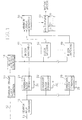
- FIG. 1 there is shown a preferred embodiment of a block matching motion estimation apparatus incorporated in a motion estimation and compensation system which is used to achieve a significant data compression by removing the redundancies between successive frames, i.e., a current frame and its adjacent or previous frame. That is to say, there may be differences between the current frame and the previous frame, induced by a displacement or motion of an object; however, such differences may be confined to a relatively small region within a frame. Therefore, it is not necessary to transmit the entire image data of a current frame to a receiver (not shown). Instead, it may suffice to transmit the displacement information, i.e., motion vectors. The receiver then reconstructs the current frame from its previous frame whose image data is stored in a frame memory within the receiver, utilizing the motion vectors.
- the displacement information i.e., motion vectors
- the current frame signal is provided through a line 12 to a current frame formation section 10.
- the current frame formation section 10 serves to divide the current frame 70 into a plurality of search blocks of an identical size, each comprising H x V pixels. For the purpose of illustration, it is assumed that H and V are both an equal number of 16 for each search block of pixels in the current frame 70.
- Each of the search blocks in sequence is applied to a weight function generator 18 for generating a weight function.
- the weight function generator 18 defines a localized subblock within a search block, wherein the search block, as shown in FIG. 2, generally depicted with a reference numeral 72, has edge pixels extending along with-the edges thereof and internal pixels, excepting the edge pixels, out of the edges, forming a localized subblock 74. And then, a local variance for the localized subblock 74 is derived as the weight function.
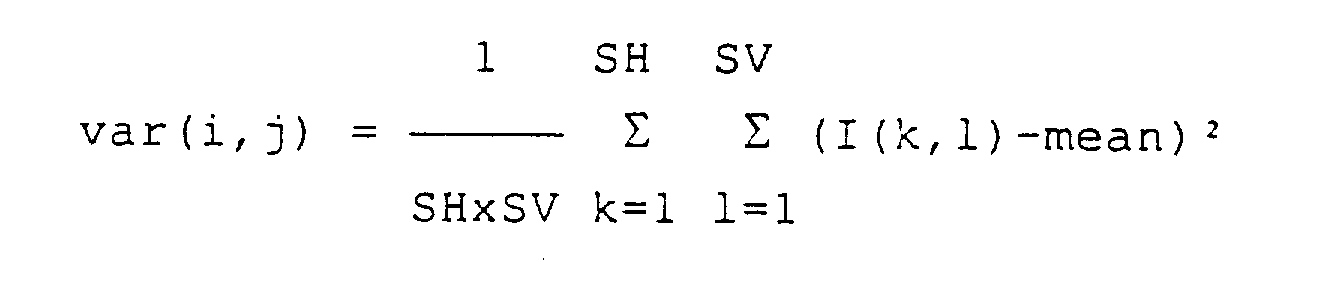
- the local variance is derived as follows: wherein var(i,j) represents the local variance of a pixel at a coordinate (i, j) in the search block; SH x SV is the size of a localized subblock; I(k,l) is a luminance level at the pixel coordinate (k, l) in the localized subblock; and "mean" represents the mean luminance level for internal pixels within the localized subblock.
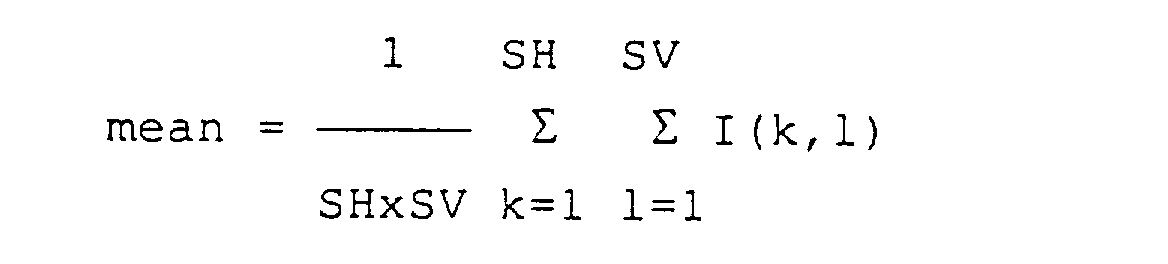
- the mean luminance level is defined as follows:
- the weight function is then provided to a number of block matching sections, only three 41, 42 and 49 of which are exemplarily shown therein.
- the search area formation section 15 defines a generally large search region of the previous frame with an equal size, shape and search pattern, whereby the search or comparison will be carried out.
- the search region data is also applied to a number of candidate block formation sections, only three 21, 22 and 29 of which are illustratively shown therein.
- a candidate block of pixels is generated from the search region as the search block sweeps through the search region starting at the upper leftmost position moving horizontally one pixel position at a time, and then vertically down through the search region moving one scan line at a time, until finally reaching the lower right-most position within the search region. All the possible candidate blocks with the size of H x V pixels are formed within the determined search region.
- each candidate block and the search block of the current frame is derived and then provided to a multiplexer 60 through lines 31 to 39 as a motion vector of that candidate block.
- the pixel data of each candidate block is also provided from each of the candidate block formation sections 21 to 29 to each of the block matching sections 41 to 49.
- an error function employing a MSE measurement is calculated, using the weight function, between the search block from the current frame block formation section 20 and the candidate block from each of the candidate block formation sections 21 to 29.
- comparison of luminance level or light intensity is performed between corresponding pixels in the search block and the candidate block to yield the error function for that candidate block.
- the error function indicates the degree of similarity between the search block and the selected candidate block.
- the weight function derived from the weight function generator 18 is weighted to the error function in order to detect a motion vector which entails a smooth continuity of adjacent blocks to be reconstructed.
- W-MSE The weighted error function "W-MSE” is defined as follows: wherein H x V is the size of a search block; I(i,j) is a luminance level at a pixel coordinate (i,j) in the search block; and P(i,j) is a luminance level at the a pixel coordinate (i,j) in a candidate block.
- the minimum error detector 50 compares the weighted error functions to select a weighted error function which has a smallest error.
- the minimum error detector 50 outputs a selection signal which indicates the block corresponding to the minimum error function to the motion vector selector 60.
- the motion vector selector 60 which is of a conventional multiplexer, in response to the selection signal, chooses the displacement vector of the candidate block, which corresponds to the minimum error function. As described above, if a candidate block has the minimum error function, that candidate block will be most similar to the search block; consequently, the displacement vector of the candidate block will be chosen as the motion vector.
Landscapes
- Engineering & Computer Science (AREA)
- Multimedia (AREA)
- Signal Processing (AREA)
- Compression Or Coding Systems Of Tv Signals (AREA)
Claims (4)
- Dispositif pour détecter des vecteurs de mouvement entre une trame courante (70) et une trame précédente de signaux vidéo utilisant une technique d'estimation de mouvement avec correspondance de bloc, dans lequel la trame courante (70) est divisée en une pluralité de blocs de recherche (72) d'une taille identique et une région de recherche est déterminée dans la trame précédente (70), la région de recherche étant en outre divisée en une multiplicité de blocs candidats de ladite taille identique, comprenant :des moyens (21-29, 41-49) pour estimation de mouvement d'un bloc de recherche (72) par rapport à chacun des blocs candidats pour produire des vecteurs de mouvement et des fonctions d'erreur correspondant à celui-ci, chacun des vecteurs de mouvement représentant le déplacement de pixels entre un bloc de recherche (72) et l'un des blocs candidats;des moyens (10) pour définir des blocs secondaires localisés (74) dans un bloc de recherche (72) en pour calculer une variance locale pour chacun des blocs secondaires localisés (74) pour fournir ainsi des variantes locales des blocs secondaires localisés (74) sous la forme d'une fonction de pondération de façon que les blocs secondaires localisés (74) soient constitués de pixels internes du bloc de recherche (72) ;des moyens (18) pour pondérer chacune des fonctions d'erreur avec la fonction de poids pour produire des fonctions d'erreur pondérées ; etdes moyens (50) pour identifier une fonction d'erreur pondérée entraínant une erreur minimale et sélectionner, en tant que vecteur de mouvement de sortie, un vecteur de mouvement correspondant à la fonction d'erreur pondérée identifiée.
- Dispositif selon la revendication 1, dans lequel la variance locale est définie comme suit :où var(i,j) représente la variance locale d'un pixel pour une coordonnée (i, j) dans un bloc de recherche ; SH x SV est la taille d'un bloc secondaire localisé ; I(k, l) est un niveau de luminance pour la coordonnée de pixel (k, l) dans le bloc secondaire localisé ; et ledit mean représente le niveau de luminance moyen pour les pixels internes dans le bloc secondaire localisé.
- Dispositif selon la revendication 2, dans lequel le niveau de luminance moyen est défini comme suit :
- Dispositif selon la revendication 3, dans lequel la fonction d'erreur pondérée est calculée comme suit :où W-MSE est une fonction d'erreur pondérée ; H x V est la taille d'un bloc de recherche ; I(i, j) est un niveau de luminance pour une coordonnée de pixel (i, j) dans le bloc de recherche ; et P(i, j) est un niveau de luminance pour la coordonnée de pixel (i, j) dans un bloc candidat.

Priority Applications (2)
| Application Number | Priority Date | Filing Date | Title |
|---|---|---|---|
| EP19940120954 EP0720384B1 (fr) | 1994-12-30 | 1994-12-30 | Estimation de mouvement avec correspondance de bloc employant une fonction de pondération |
| DE1994621404 DE69421404T2 (de) | 1994-12-30 | 1994-12-30 | Blockübereinstimmungsbewegungsauswertung mit einer gewichteten Funktion |
Applications Claiming Priority (1)
| Application Number | Priority Date | Filing Date | Title |
|---|---|---|---|
| EP19940120954 EP0720384B1 (fr) | 1994-12-30 | 1994-12-30 | Estimation de mouvement avec correspondance de bloc employant une fonction de pondération |
Publications (2)
| Publication Number | Publication Date |
|---|---|
| EP0720384A1 EP0720384A1 (fr) | 1996-07-03 |
| EP0720384B1 true EP0720384B1 (fr) | 1999-10-27 |
Family
ID=8216587
Family Applications (1)
| Application Number | Title | Priority Date | Filing Date |
|---|---|---|---|
| EP19940120954 Expired - Lifetime EP0720384B1 (fr) | 1994-12-30 | 1994-12-30 | Estimation de mouvement avec correspondance de bloc employant une fonction de pondération |
Country Status (2)
| Country | Link |
|---|---|
| EP (1) | EP0720384B1 (fr) |
| DE (1) | DE69421404T2 (fr) |
Families Citing this family (7)
| Publication number | Priority date | Publication date | Assignee | Title |
|---|---|---|---|---|
| FR2759524B1 (fr) * | 1997-02-10 | 1999-05-14 | Thomson Multimedia Sa | Procede et dispositif de codage par estimation de luminance |
| DE19840735C2 (de) * | 1998-09-07 | 2001-06-07 | Bosch Gmbh Robert | Blockbasierte Bewegungsschätzung bei der Bewegtbildkodierung |
| KR100843112B1 (ko) * | 2000-09-07 | 2008-07-02 | 코닌클리케 필립스 일렉트로닉스 엔.브이. | 이미지 매칭 |
| CN100385953C (zh) * | 2001-07-10 | 2008-04-30 | 皇家菲利浦电子有限公司 | 移动估计的单元和方法以及装备有此类移动估计单元的图像处理设备 |
| CN110942102B (zh) * | 2019-12-03 | 2022-04-01 | 武汉大学 | 一种概率松弛核线匹配方法及系统 |
| JP7521602B2 (ja) * | 2020-12-08 | 2024-07-24 | ソニーグループ株式会社 | 情報処理装置、情報処理方法およびプログラム |
| CN113947689B (zh) * | 2021-09-30 | 2023-10-10 | 西安交通大学 | 一种基于计算机视觉的结构大运动快速测量方法 |
Family Cites Families (5)
| Publication number | Priority date | Publication date | Assignee | Title |
|---|---|---|---|---|
| JPH03266580A (ja) * | 1990-03-15 | 1991-11-27 | Nec Corp | 動ベクトル検出方式 |
| JP2860702B2 (ja) * | 1990-10-16 | 1999-02-24 | シャープ株式会社 | 動きベクトル検出装置 |
| FI89121C (fi) * | 1991-11-11 | 1993-08-10 | Nokia Oy Ab | Foerfarande foer soekning av roerelsevektorer foer en videosignal |
| US5301019A (en) * | 1992-09-17 | 1994-04-05 | Zenith Electronics Corp. | Data compression system having perceptually weighted motion vectors |
| EP0609022A3 (fr) * | 1993-01-25 | 1995-08-23 | Matsushita Electric Industrial Co Ltd | Appareil de codage d'image. |
-
1994
- 1994-12-30 DE DE1994621404 patent/DE69421404T2/de not_active Expired - Fee Related
- 1994-12-30 EP EP19940120954 patent/EP0720384B1/fr not_active Expired - Lifetime
Also Published As
| Publication number | Publication date |
|---|---|
| EP0720384A1 (fr) | 1996-07-03 |
| DE69421404T2 (de) | 2000-02-10 |
| DE69421404D1 (de) | 1999-12-02 |
Similar Documents
| Publication | Publication Date | Title |
|---|---|---|
| EP0720382B1 (fr) | Dispositif d'estimation de mouvement par correspondance de blocs de dimension variable | |
| KR0171154B1 (ko) | 특징점 기반 움직임 추정을 이용하여 비디오 신호를 부호화하는 방법 및 장치 | |
| KR100482898B1 (ko) | 모션벡터를추정하는방법,장치및그장치를포함하는비디오디스플레이장치 | |
| US5686973A (en) | Method for detecting motion vectors for use in a segmentation-based coding system | |
| EP0733996B1 (fr) | Méthode et appareil de détermination de points caractéristiques | |
| KR0181063B1 (ko) | 특징점을 이용한 움직임 보상에서의 그리드 형성방법 및 장치 | |
| KR0171118B1 (ko) | 비디오신호 부호화 장치 | |
| KR0171146B1 (ko) | 특징점을 이용한 움직임 벡터 검출 장치 | |
| JP4001400B2 (ja) | 動きベクトル検出方法及び動きベクトル検出装置 | |
| US20040114688A1 (en) | Device for and method of estimating motion in video encoder | |
| EP0801505A2 (fr) | Affinement de blocs de vecteurs mouvement pour réaliser un champ de mouvement dense | |
| EP0691789A2 (fr) | Procédé et dispositif d'estimation, segmentation et codage pour champs de mouvement | |
| EP0721287A1 (fr) | Méthode et appareil pour coder un signal vidéo | |
| US5825423A (en) | Apparatus for detecting motion vectors using moving object patterns | |
| EP0722252B1 (fr) | Appareil d'estimation de mouvement par correspondance de bord | |
| US5808685A (en) | Block matching motion estimation apparatus employing a weight function | |
| US20050013364A1 (en) | Method of motion vector determination in digital video compression | |
| KR0178229B1 (ko) | 특징점에 근거한 화소단위 움직임 추정을 이용한 영상 처리 장치 | |
| EP0720384B1 (fr) | Estimation de mouvement avec correspondance de bloc employant une fonction de pondération | |
| KR0181029B1 (ko) | 에지를 이용한 특징점 선정장치 | |
| KR100229803B1 (ko) | 움직임 벡터 검출 방법 및 장치 | |
| US6020925A (en) | Method and apparatus for encoding a video signal using pixel-by-pixel motion prediction | |
| US5710603A (en) | Method for detecting motion vectors | |
| KR0178230B1 (ko) | 특징점에 의한 움직임 추정을 이용한 영상 처리 장치 | |
| JP4140091B2 (ja) | 画像情報変換装置および画像情報変換方法 |
Legal Events
| Date | Code | Title | Description |
|---|---|---|---|
| PUAI | Public reference made under article 153(3) epc to a published international application that has entered the european phase |
Free format text: ORIGINAL CODE: 0009012 |
|
| AK | Designated contracting states |
Kind code of ref document: A1 Designated state(s): DE FR GB NL |
|
| 17P | Request for examination filed |
Effective date: 19961023 |
|
| 17Q | First examination report despatched |
Effective date: 19980409 |
|
| GRAG | Despatch of communication of intention to grant |
Free format text: ORIGINAL CODE: EPIDOS AGRA |
|
| GRAG | Despatch of communication of intention to grant |
Free format text: ORIGINAL CODE: EPIDOS AGRA |
|
| GRAH | Despatch of communication of intention to grant a patent |
Free format text: ORIGINAL CODE: EPIDOS IGRA |
|
| GRAH | Despatch of communication of intention to grant a patent |
Free format text: ORIGINAL CODE: EPIDOS IGRA |
|
| GRAA | (expected) grant |
Free format text: ORIGINAL CODE: 0009210 |
|
| AK | Designated contracting states |
Kind code of ref document: B1 Designated state(s): DE FR GB NL |
|
| PG25 | Lapsed in a contracting state [announced via postgrant information from national office to epo] |
Ref country code: NL Free format text: LAPSE BECAUSE OF FAILURE TO SUBMIT A TRANSLATION OF THE DESCRIPTION OR TO PAY THE FEE WITHIN THE PRESCRIBED TIME-LIMIT Effective date: 19991027 |
|
| REF | Corresponds to: |
Ref document number: 69421404 Country of ref document: DE Date of ref document: 19991202 |
|
| PGFP | Annual fee paid to national office [announced via postgrant information from national office to epo] |
Ref country code: GB Payment date: 19991210 Year of fee payment: 6 |
|
| PGFP | Annual fee paid to national office [announced via postgrant information from national office to epo] |
Ref country code: FR Payment date: 19991217 Year of fee payment: 6 |
|
| PGFP | Annual fee paid to national office [announced via postgrant information from national office to epo] |
Ref country code: NL Payment date: 19991223 Year of fee payment: 6 |
|
| ET | Fr: translation filed | ||
| NLV1 | Nl: lapsed or annulled due to failure to fulfill the requirements of art. 29p and 29m of the patents act | ||
| PLBE | No opposition filed within time limit |
Free format text: ORIGINAL CODE: 0009261 |
|
| STAA | Information on the status of an ep patent application or granted ep patent |
Free format text: STATUS: NO OPPOSITION FILED WITHIN TIME LIMIT |
|
| PG25 | Lapsed in a contracting state [announced via postgrant information from national office to epo] |
Ref country code: DE Free format text: LAPSE BECAUSE OF NON-PAYMENT OF DUE FEES Effective date: 20001003 |
|
| 26N | No opposition filed | ||
| PG25 | Lapsed in a contracting state [announced via postgrant information from national office to epo] |
Ref country code: GB Free format text: LAPSE BECAUSE OF NON-PAYMENT OF DUE FEES Effective date: 20001230 |
|
| GBPC | Gb: european patent ceased through non-payment of renewal fee |
Effective date: 20001230 |
|
| PG25 | Lapsed in a contracting state [announced via postgrant information from national office to epo] |
Ref country code: FR Free format text: LAPSE BECAUSE OF NON-PAYMENT OF DUE FEES Effective date: 20010831 |
|
| REG | Reference to a national code |
Ref country code: FR Ref legal event code: ST |