EP0720399A2 - Méthode de commande du mode de fonctionnement d'un appareil mobile associé à un système de communication à commande programmée - Google Patents
Méthode de commande du mode de fonctionnement d'un appareil mobile associé à un système de communication à commande programmée Download PDFInfo
- Publication number
- EP0720399A2 EP0720399A2 EP95119504A EP95119504A EP0720399A2 EP 0720399 A2 EP0720399 A2 EP 0720399A2 EP 95119504 A EP95119504 A EP 95119504A EP 95119504 A EP95119504 A EP 95119504A EP 0720399 A2 EP0720399 A2 EP 0720399A2
- Authority
- EP
- European Patent Office
- Prior art keywords
- mobile terminal
- subscriber
- status messages
- stored
- communication system
- Prior art date
- Legal status (The legal status is an assumption and is not a legal conclusion. Google has not performed a legal analysis and makes no representation as to the accuracy of the status listed.)
- Granted
Links
- 238000004891 communication Methods 0.000 title claims description 43
- 238000000034 method Methods 0.000 title claims description 19
- 230000015654 memory Effects 0.000 claims abstract description 13
- 230000005540 biological transmission Effects 0.000 claims description 11
- 230000011664 signaling Effects 0.000 claims description 11
- 238000011156 evaluation Methods 0.000 claims description 2
- 230000001960 triggered effect Effects 0.000 claims 1
- 230000000007 visual effect Effects 0.000 claims 1
- 230000008878 coupling Effects 0.000 abstract 1
- 238000010168 coupling process Methods 0.000 abstract 1
- 238000005859 coupling reaction Methods 0.000 abstract 1
- 238000005516 engineering process Methods 0.000 description 8
- 230000008569 process Effects 0.000 description 5
- 238000013475 authorization Methods 0.000 description 4
- 238000012545 processing Methods 0.000 description 3
- 230000003936 working memory Effects 0.000 description 3
- 239000013256 coordination polymer Substances 0.000 description 2
- 230000000694 effects Effects 0.000 description 2
- 230000004044 response Effects 0.000 description 2
- 101150071970 SME1 gene Proteins 0.000 description 1
- 101100018847 Saccharomyces cerevisiae (strain ATCC 204508 / S288c) IME2 gene Proteins 0.000 description 1
- 230000004913 activation Effects 0.000 description 1
- 230000001413 cellular effect Effects 0.000 description 1
- 238000010586 diagram Methods 0.000 description 1
- 230000006870 function Effects 0.000 description 1
- 230000006872 improvement Effects 0.000 description 1
- 230000003993 interaction Effects 0.000 description 1
- 230000002093 peripheral effect Effects 0.000 description 1
- 230000009467 reduction Effects 0.000 description 1
- 230000000717 retained effect Effects 0.000 description 1
- 238000010845 search algorithm Methods 0.000 description 1
Images
Classifications
-
- H—ELECTRICITY
- H04—ELECTRIC COMMUNICATION TECHNIQUE
- H04W—WIRELESS COMMUNICATION NETWORKS
- H04W4/00—Services specially adapted for wireless communication networks; Facilities therefor
- H04W4/12—Messaging; Mailboxes; Announcements
-
- H—ELECTRICITY
- H04—ELECTRIC COMMUNICATION TECHNIQUE
- H04M—TELEPHONIC COMMUNICATION
- H04M3/00—Automatic or semi-automatic exchanges
- H04M3/42—Systems providing special services or facilities to subscribers
- H04M3/48—Arrangements for recalling a calling subscriber when the wanted subscriber ceases to be busy
-
- H—ELECTRICITY
- H04—ELECTRIC COMMUNICATION TECHNIQUE
- H04M—TELEPHONIC COMMUNICATION
- H04M3/00—Automatic or semi-automatic exchanges
- H04M3/42—Systems providing special services or facilities to subscribers
- H04M3/50—Centralised arrangements for answering calls; Centralised arrangements for recording messages for absent or busy subscribers ; Centralised arrangements for recording messages
- H04M3/53—Centralised arrangements for recording incoming messages, i.e. mailbox systems
- H04M3/533—Voice mail systems
Definitions
- the invention relates to a method for controlling the operating mode of mobile terminals belonging to the subscriber field of a wireless transmission system connected to a program-controlled communication system and implemented by a radio server unit, the communication system having a microprocessor system which controls the switching, signaling and the performance features and which has a microprocessor which represents it and is formed by storage units which store, among other things, connection and device-related information.
- Communication systems of this type in particular private telecommunications systems (private branch exchanges) are, in addition to the necessary switching control, also capable of controlling or realizing additional control processes which go beyond the actual switching process.
- Such additional functions are generally referred to as performance features, a large number of different performance features being known in particular for the “voice” communication service.
- the option of call forwarding or automatic call forwarding provide the user with a certain degree of mobility, since the call intended for his own device is forwarded to the current location.
- base station radio server unit
- the procedures and protocols required for communication with the mobile devices are processed in the radio server unit, which is connected to the communication system via a corresponding interface. It has access to a variety of mobile devices.
- This radio server unit thus organizes control data, including the storage and administration thereof.
- the assignment of the mobile terminals (radio telephones) to the radio server unit takes place via connection channels on which user or signaling and control data can be transmitted bidirectionally. This can be done, for example, on the basis of the DECT agreement (Digital European Cordless Telecommunication).
- the status of the unavailability is stored, for example, in a working memory area of the system control of the communication system or in the assigned radio server unit, information about the identity of the caller and about actions or performance features performed by the caller.
- a status message of this type relates, for example, to a cross-call switching-related input that it has carried out, the effect of which is therefore retained beyond the duration of the connection attempt in question.
- An example of this is the use of a voice mail system by the unsuccessful calling subscriber. In principle, if the called subscriber cannot be reached, the system messages necessary between the calling and the called end device are not immediately exchanged, but initially also temporarily stored.
- the information which has been stored in the meantime is evaluated and transmitted to the radio subscriber concerned in a suitable form.
- This can be caused by the interaction of the radio server unit and the communication system or also exclusively by the radio server unit.
- the radio subscriber is informed about the identity of the subscriber calling in vain and about the acts of a mediation-related type he has carried out.
- This stored information can also relate to short messages entered by the calling subscriber.
- a corresponding mobile terminal-specific availability signal is sent to the responsible radio server unit.
- the transmission of the stored status messages is then initiated at the next possible time.
- the content of this Messages can be output on the mobile device in different ways.
- an acoustic announcement is also conceivable.
- the measures according to the invention minimize the negative effects of inaccessibility states, which are far more common in mobile terminals than in wired terminals.
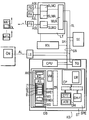
- a central component of the private communication system (private branch exchange) KS shown in the figure as a schematic block diagram is the switching network KN, via which terminal devices - of which the telephone devices FD and FA are indicated schematically - can be connected to one another or to a line AL leading to a public switching system ⁇ N are. Furthermore, at least one radio server unit FS can be connected, which enables wireless communication including the mobile terminals ME1 ... MEn.
- the switching network KN is under the control influence of a central control ST which, in addition to the central processor CPU, contains a storage device SPE and a clock unit TG.
- the central processor CPU controls all switching processes and takes care of the preparation and allocation of the control data. These tasks can also be split across multiple processors.
- Line connection devices are arranged in the communication system KS.
- a line connection device LT is indicated as a representative.
- These line connection devices contain subscriber line modules SLM, each of which is connected to the communication terminals or to a radio server unit FS via subscriber line lines ASL are connected. In principle, two different subscriber line modules can be provided.
- Connection modules SLMD are used for connecting digital communication terminals FD and subscriber connection modules SLMA for connecting analog communication terminals FA.
- the subscriber line module SLMA for analog communication terminals represents the link between these analog terminals, for example telephone terminals FA and the communication system KS.
- This subscriber line module contains, for example, devices for connecting a predetermined number of subscriber lines ASL.
- Each subscriber line module is equipped with the necessary supply, call and indication circuits, as well as with two-wire, four-wire converters and, in the case of in-house digital speech processing, with analog / digital or digital / analog converters for converting speech information.
- the digital or digitized speech information is fed to the digital switching network KN, for example, via a multiplexing device MUX.
- the subscriber line unit SLMD is provided for the connection of digital communication terminals FD and represents the link between the ISDN communication terminal and the communication system KS.
- a line unit SLMD is available for the connection of a certain number of digital communication terminals.
- the message transmission takes place e.g. via message channels and the signaling is transmitted via an additional channel.
- the digital voice information supplied by the communication terminal FD is also forwarded to the switching network KN via the multiplexing device MUX.
- This interface includes, for example, an ISDN part, which can be designed, for example, as a standardized S0 interface.
- the periphery of the communication system KS is supplemented by a signaling unit SE, which is present, among other things, for supplying characters to the communication system.
- the line connection devices LT are controlled in terms of switching technology by the system control ST.
- Each line connection device is connected to the system controller via a signaling channel SK.
- the information is exchanged via this signaling channel SK using the known HDLC transmission procedure.
- the clock signals generated in the system control ST are distributed to the line connection devices LT via a clock line TL.
- the provision of the clock signals is symbolized by the unit TG.
- the signaling channel SK and the clock line TL are part of a system bus SB.
- the processor CPU of the system control ST has access to the information stored in the storage device SPE.
- the memory contains a database DB in which the customer data are stored in the memory part KD. These relate, for example, to the authorizations assigned to the individual terminals FA or FD, to the authorizations assigned to the mobile terminals ME1 ... MEn and to the system configuration AK.
- the database contains the operating system BS, which coordinates the multitude of individual tasks which are typical of the communication system KS and which also have to be carried out at the same time. Its main task is to assign processing instructions to the processor CPU, which is the actual leading unit of the system control, depending on incentives that have arrived or are generated internally in the system control. These include a response to the incentives in question.
- Data that are queried from the database during a connection setup initiated by a communication terminal can be at least partially transferred to the main memory AS.
- this working memory is used to hold temporary data for program sequence control.
- the basic structure of the control of a digital extension communication system KS indicated in the FIG has a modular character and there are at least two hierarchical levels of the program control. One of them is used to control peripheral devices by means of line program modules DH which are respectively adapted to a specific type of terminal.
- Each of these program modules DH offers a system-uniform interface to the switching technology structure level, which in the present case is represented by a switching procedure program module CP.
- program modules DTE for digital devices and ATE for analog devices assigned to the individual device types are indicated in the program module DH.
- a program module DH-F is shown, in which the incentives associated with the mobile terminals ME1 ... MEn are recorded and treated in a specific way.
- the exchange of information between the line technology structure level and the switching technology structure level takes place by means of defined messages which are transmitted, for example, via a software bus structure S indicated by dashed lines.
- This can be seen as an integral part of the operating system BS.
- the program modules of the two control levels mentioned have access to the database DB of the communication system by means of database access routines. The presence of such access routines is indicated by the block ZR shown in broken lines.
- the tasks of the switching procedure program module CP include, for example, the subprocesses of the entire switching procedure necessary for controlling the connection establishment and connection clearing. For example, Authorizations checked and election evaluation procedures carried out. There is also a signaling of switching technology states between the communication terminals and it is possible to activate and deactivate switching technology performance features from the different switching technology states.
- the LM module is shown as a representative of the overall feature program modules provided in the extension communication system KS.
- Mobile terminals ME1 ... MEn can be used to increase the telephone connection options for a certain number of extension subscribers and to ensure accessibility even when they are not at work.
- Each of these mobile terminals can be reached wirelessly via at least one radio server unit FS.
- Each of these radio server units is responsible for establishing and executing call connections.
- at least two radio server units can be arranged adjacent to one another in such a way that they cover the same radio area and thus there is increased accessibility for the subscribers of the wireless transmission system integrated in the extension communication system KS.
- These radio server units can also be placed separately from one another, so that the radio range is increased overall. It then makes sense to overlap the individual radio areas.
- the procedures and protocols required for communication with the mobile terminals ME are processed in the respectively connected radio server unit FS.
- a free radio server unit For a desired connection establishment to a mobile terminal ME, a free radio server unit is activated accordingly.
- the transmission system stands for the radio connections certain number of channel pairs are available.
- each radio switching unit and each mobile terminal cyclically scans these channel pairs.
- a certain number of interference-free channels are continuously queried as "preferred channels" in response to an assignment request.
- This preferred channel table is checked for correctness during operation and updated if necessary.
- the implemented search algorithms ensure that the best call quality is achieved for the mobile terminal sought by a plurality of radio server units by means of the radio server unit that registers first. This reporting takes place by sending out a predefined reporting criterion.
- a search process for a mobile terminal is terminated after a predetermined number of attempts, each of which contains a specific search time.
- Such an unsuccessful search as a result of the no longer available accessibility arises, for example, whenever the mobile terminal in question is outside the spatial accessibility range or when, for example, the power supply can no longer be ensured via the batteries in it.
- the operating switch could also have been put on display, for example to save battery power.
- the call to a mobile terminal does not lead to a connection, this can possibly be communicated to the calling party via display information, with reference to the reason for this.
- the relevant information can be stored in the system memory of the communication system, for example in a memory area MS of the main memory assigned to the mobile terminals or in the module DH-F related to mobile terminals. It can also be provided that this Information is stored in the responsible radio server unit FS.
- the information derived in the inaccessibility state from a call is stored in the working memory AS of the system storage.
- the ISDN feature is identified.
- the subscriber's number and, if applicable, the name can also be saved. This takes place, for example, as the corresponding information I1 in the memory area SME of the memory area MS that is individually assigned to each mobile terminal.
- VM Voice Mail
- this fact is stored, for example, as information I2.
- references to short messages entered by the subscriber in question are stored as further information. These could be predetermined messages or messages that are currently being entered.
- Storage information I3 could, for example, contain that a callback should take place at a specific time. These messages are stored at a suitable location and e.g. available as digital information that can be shown on the display after the subsequent transmission to the relevant mobile terminal.
- the radio server unit which is optionally present as one of several radio server units that form a cellular system, continuously sends out information control signals, which the mobile terminal responds by restoring its reachability by means of appropriate signaling indicating this accessibility.
- This renewed accessibility is, for example, with the re-entry into the respective radio area or with the renewed switching of the mobile terminal in the operational condition given.
- an identification and a corresponding authorization check is carried out in the radio server unit. This means that only one mobile terminal reported in the system can operate communication via the radio link.
- the mobile terminal In order not to put additional strain on the battery of the mobile terminal, a permanent mutual exchange of information between the radio server unit and the mobile terminal can be dispensed with. Since the radio server unit constantly sends out information control signals, the mobile terminal has the option of sending out corresponding information once when switching on or when entering the reception area of the radio server unit to document the functional state. This signaling of the willingness to call is carried out each time at the beginning of the respective availability. If a plurality of radio server units are provided, the individual identifier of the individual mobile terminals can in principle also be constantly exchanged with the respective radio server units to support active subscriber management by the communication system, irrespective of a call state.
- a corresponding positive reachability signal is sent to the radio server unit at least each time the availability is established.
- the information I1 ... In stored in the meantime is then read from the corresponding memory areas and transmitted to the relevant mobile terminal by the radio server unit.
- the information I contained in the mobile terminal device-specific memory areas SME1 ... SMEn is thus brought to the attention of the subscriber. This can be done in different ways.
- the information that a message is stored in the voice mail system can, for example, by the Activation of an indicator light is signaled (message waiting lamp).
- a callback request or the stored short messages can be shown on the display of the relevant mobile device. The subscriber is therefore provided with the latest status messages.
Landscapes
- Engineering & Computer Science (AREA)
- Signal Processing (AREA)
- Computer Networks & Wireless Communication (AREA)
- Mobile Radio Communication Systems (AREA)
Applications Claiming Priority (2)
| Application Number | Priority Date | Filing Date | Title |
|---|---|---|---|
| DE4446809 | 1994-12-27 | ||
| DE4446809 | 1994-12-27 |
Publications (3)
| Publication Number | Publication Date |
|---|---|
| EP0720399A2 true EP0720399A2 (fr) | 1996-07-03 |
| EP0720399A3 EP0720399A3 (fr) | 1999-03-31 |
| EP0720399B1 EP0720399B1 (fr) | 2003-11-05 |
Family
ID=6537274
Family Applications (1)
| Application Number | Title | Priority Date | Filing Date |
|---|---|---|---|
| EP95119504A Expired - Lifetime EP0720399B1 (fr) | 1994-12-27 | 1995-12-11 | Méthode de commande du mode de fonctionnement d'un appareil mobile associé à un système de communication à commande programmée |
Country Status (3)
| Country | Link |
|---|---|
| EP (1) | EP0720399B1 (fr) |
| AT (1) | ATE253802T1 (fr) |
| DE (1) | DE59510821D1 (fr) |
Cited By (4)
| Publication number | Priority date | Publication date | Assignee | Title |
|---|---|---|---|---|
| EP0961370A3 (fr) * | 1998-05-29 | 1999-12-08 | Nokia Mobile Phones Ltd. | Dispositif électronique et son connecteur électrique |
| WO2000044157A1 (fr) * | 1999-01-22 | 2000-07-27 | Siemens Aktiengesellschaft | Procede pour le stockage intermediaire de numeros d'appels d'abonnes appelants et pour la transmission de ces numeros a des abonnes appeles |
| EP1221806A3 (fr) * | 2001-01-04 | 2003-03-26 | Tenovis GmbH & Co. KG | Déviation d'appels en cas d'un abonné mobile non accessible |
| EP1843540A1 (fr) * | 2006-04-04 | 2007-10-10 | Research In Motion Limited | Méthode et dispositif pour renouvellement des clés de chiffrage dans un dispositif de communication mobile |
Family Cites Families (2)
| Publication number | Priority date | Publication date | Assignee | Title |
|---|---|---|---|---|
| FI910683A7 (fi) * | 1991-02-12 | 1992-08-13 | Telenokia Oy | Foerfarande foer automatisk foermedling av ljudmeddelanden i ett mobiltelefonnaet eller motsvarande. |
| DE4124711A1 (de) * | 1991-07-25 | 1993-01-28 | Siemens Ag | Verfahren zur uebermittlung einer abgespeicherten nachricht an ein rufendes fernsprechendgeraet einer kommunikationsanlage bzw. vermittlungseinrichtung |
-
1995
- 1995-12-11 EP EP95119504A patent/EP0720399B1/fr not_active Expired - Lifetime
- 1995-12-11 AT AT95119504T patent/ATE253802T1/de not_active IP Right Cessation
- 1995-12-11 DE DE59510821T patent/DE59510821D1/de not_active Expired - Lifetime
Non-Patent Citations (1)
| Title |
|---|
| None |
Cited By (5)
| Publication number | Priority date | Publication date | Assignee | Title |
|---|---|---|---|---|
| EP0961370A3 (fr) * | 1998-05-29 | 1999-12-08 | Nokia Mobile Phones Ltd. | Dispositif électronique et son connecteur électrique |
| US6439905B2 (en) | 1998-05-29 | 2002-08-27 | Nokia Mobile Phones Limited | Electrical connector with a loop and helical turn |
| WO2000044157A1 (fr) * | 1999-01-22 | 2000-07-27 | Siemens Aktiengesellschaft | Procede pour le stockage intermediaire de numeros d'appels d'abonnes appelants et pour la transmission de ces numeros a des abonnes appeles |
| EP1221806A3 (fr) * | 2001-01-04 | 2003-03-26 | Tenovis GmbH & Co. KG | Déviation d'appels en cas d'un abonné mobile non accessible |
| EP1843540A1 (fr) * | 2006-04-04 | 2007-10-10 | Research In Motion Limited | Méthode et dispositif pour renouvellement des clés de chiffrage dans un dispositif de communication mobile |
Also Published As
| Publication number | Publication date |
|---|---|
| DE59510821D1 (de) | 2003-12-11 |
| ATE253802T1 (de) | 2003-11-15 |
| EP0720399A3 (fr) | 1999-03-31 |
| EP0720399B1 (fr) | 2003-11-05 |
Similar Documents
| Publication | Publication Date | Title |
|---|---|---|
| EP0987912B1 (fr) | Méthode et système pour communication sans fil par au moins deux serveurs de commutation | |
| EP0466736B1 (fr) | Systeme de telephone sans fil avec installation de communication a postes secondaires | |
| DE69927867T2 (de) | System zum Integrieren von privaten Kommunikationsendgeräten | |
| EP0630142A1 (fr) | Procédé pour mémoriser des messages dans des unités à mémoriser des messages connectées en réseau | |
| EP0306693B1 (fr) | Système de communication numérique à structure modulaire | |
| EP0742990A1 (fr) | Systeme de communication a telephones mobiles et son procede d'exploitation | |
| DE69733245T2 (de) | Fernmeldesystemdienst und eine Dienstvorrichtung zur Realisation eines solchen Dienstes | |
| EP0720399B1 (fr) | Méthode de commande du mode de fonctionnement d'un appareil mobile associé à un système de communication à commande programmée | |
| DE68925886T2 (de) | Anordnung zur Wegzuordnung für Mehrfachendgerätegruppen | |
| EP0589248A2 (fr) | Méthode et disposition pour l'affichage de numéros d'appel aux postes téléphoniques d'un central téléphonique privé | |
| EP0535601B1 (fr) | Procédé pour l'établissement de connexions de conférence dans un système de communication à commande par processeur | |
| EP0529343B1 (fr) | Méthode d'établir une liaison de communication entre un terminal de communication, connectée à un central de communication, et plusieurs terminaux | |
| DE4430343A1 (de) | Verfahren zum Anrufen eines Telefonteilnehmers | |
| EP0585480A1 (fr) | Méthode et dispositif pour établir des connexions de conférence dans un central téléphonique commandé par calculation | |
| EP0720406A2 (fr) | Méthode d'aide à l'établissement d'un appel vers un téléphone mobile connecté à un système de communication à commande programmée | |
| EP1037452B1 (fr) | Système et procédé pour la connection d'un appel vers plusieurs utilisateurs en parallèle | |
| EP1230809B1 (fr) | Procede et dispositif de communication pour la mise au point de caracteristiques de performances concernant des abonnes | |
| DE4232861C1 (de) | Verfahren zur Steuerung von Verbindungsprozeduren in einer programmgesteuerten Nebenstellenanlage mit daran angeschlossenen Mobilendgeräten | |
| DE19953221A1 (de) | Verfahren, Netzwerkeinrichtung und Vermittlungsstelle zur Übermittlung einer individuellen, einen Anrufer identifizierenden Nachricht an einen angerufenen Teilnehmer | |
| WO2001091430A1 (fr) | Procede et systeme de communication pour distribuer des relations de communication a des raccordements d'abonnes disposes dans au moins un reseau de communication et affectes a au moins un groupe | |
| WO1992017013A1 (fr) | Systeme de communication numerique avec serveurs de transmission | |
| DE4232862C1 (de) | Verfahren für die Auswertung betriebstechnischer Dateninformationen bei einer programmgesteuerten Nebenstellenanlage mit daran angeschlossenen Mobilendgeräten | |
| EP0866594B1 (fr) | Système de communication, en particulier système de communication privé à commande par programme dans lequel une fonction de calendrier est réalisée | |
| EP1139686B1 (fr) | Méthode et système pour communication mobile | |
| EP0897239A2 (fr) | Sytème de communication commandé par programme avec accès à une mémoire de parole |
Legal Events
| Date | Code | Title | Description |
|---|---|---|---|
| PUAI | Public reference made under article 153(3) epc to a published international application that has entered the european phase |
Free format text: ORIGINAL CODE: 0009012 |
|
| AK | Designated contracting states |
Kind code of ref document: A2 Designated state(s): AT CH DE FR GB IT LI NL SE |
|
| PUAL | Search report despatched |
Free format text: ORIGINAL CODE: 0009013 |
|
| AK | Designated contracting states |
Kind code of ref document: A3 Designated state(s): AT CH DE FR GB IT LI NL SE |
|
| 17P | Request for examination filed |
Effective date: 19990505 |
|
| 17Q | First examination report despatched |
Effective date: 20021202 |
|
| GRAH | Despatch of communication of intention to grant a patent |
Free format text: ORIGINAL CODE: EPIDOS IGRA |
|
| GRAS | Grant fee paid |
Free format text: ORIGINAL CODE: EPIDOSNIGR3 |
|
| GRAA | (expected) grant |
Free format text: ORIGINAL CODE: 0009210 |
|
| AK | Designated contracting states |
Kind code of ref document: B1 Designated state(s): AT CH DE FR GB IT LI NL SE |
|
| PG25 | Lapsed in a contracting state [announced via postgrant information from national office to epo] |
Ref country code: NL Free format text: LAPSE BECAUSE OF FAILURE TO SUBMIT A TRANSLATION OF THE DESCRIPTION OR TO PAY THE FEE WITHIN THE PRESCRIBED TIME-LIMIT Effective date: 20031105 |
|
| REG | Reference to a national code |
Ref country code: GB Ref legal event code: FG4D Free format text: NOT ENGLISH |
|
| REG | Reference to a national code |
Ref country code: CH Ref legal event code: EP |
|
| PG25 | Lapsed in a contracting state [announced via postgrant information from national office to epo] |
Ref country code: AT Free format text: LAPSE BECAUSE OF NON-PAYMENT OF DUE FEES Effective date: 20031211 |
|
| REF | Corresponds to: |
Ref document number: 59510821 Country of ref document: DE Date of ref document: 20031211 Kind code of ref document: P |
|
| PG25 | Lapsed in a contracting state [announced via postgrant information from national office to epo] |
Ref country code: LI Free format text: LAPSE BECAUSE OF NON-PAYMENT OF DUE FEES Effective date: 20031231 Ref country code: CH Free format text: LAPSE BECAUSE OF NON-PAYMENT OF DUE FEES Effective date: 20031231 |
|
| PG25 | Lapsed in a contracting state [announced via postgrant information from national office to epo] |
Ref country code: SE Free format text: LAPSE BECAUSE OF FAILURE TO SUBMIT A TRANSLATION OF THE DESCRIPTION OR TO PAY THE FEE WITHIN THE PRESCRIBED TIME-LIMIT Effective date: 20040205 |
|
| GBT | Gb: translation of ep patent filed (gb section 77(6)(a)/1977) |
Effective date: 20040116 |
|
| NLV1 | Nl: lapsed or annulled due to failure to fulfill the requirements of art. 29p and 29m of the patents act | ||
| ET | Fr: translation filed | ||
| REG | Reference to a national code |
Ref country code: CH Ref legal event code: PL |
|
| PLBE | No opposition filed within time limit |
Free format text: ORIGINAL CODE: 0009261 |
|
| STAA | Information on the status of an ep patent application or granted ep patent |
Free format text: STATUS: NO OPPOSITION FILED WITHIN TIME LIMIT |
|
| 26N | No opposition filed |
Effective date: 20040806 |
|
| REG | Reference to a national code |
Ref country code: GB Ref legal event code: 732E Free format text: REGISTERED BETWEEN 20121025 AND 20121031 |
|
| REG | Reference to a national code |
Ref country code: FR Ref legal event code: TP Owner name: SIEMENS ENTERPRISE COMMUNICATIONS GMBH & CO. K, DE Effective date: 20130108 |
|
| REG | Reference to a national code |
Ref country code: DE Ref legal event code: R084 Ref document number: 59510821 Country of ref document: DE |
|
| REG | Reference to a national code |
Ref country code: DE Ref legal event code: R082 Ref document number: 59510821 Country of ref document: DE Representative=s name: FRITZSCHE PATENT, DE |
|
| REG | Reference to a national code |
Ref country code: DE Ref legal event code: R084 Ref document number: 59510821 Country of ref document: DE Effective date: 20130226 |
|
| REG | Reference to a national code |
Ref country code: DE Ref legal event code: R082 Ref document number: 59510821 Country of ref document: DE Representative=s name: FRITZSCHE PATENT, DE Effective date: 20130313 Ref country code: DE Ref legal event code: R081 Ref document number: 59510821 Country of ref document: DE Owner name: UNIFY GMBH & CO. KG, DE Free format text: FORMER OWNER: SIEMENS AKTIENGESELLSCHAFT, 80333 MUENCHEN, DE Effective date: 20130313 Ref country code: DE Ref legal event code: R081 Ref document number: 59510821 Country of ref document: DE Owner name: SIEMENS ENTERPRISE COMMUNICATIONS GMBH & CO. K, DE Free format text: FORMER OWNER: SIEMENS AKTIENGESELLSCHAFT, 80333 MUENCHEN, DE Effective date: 20130313 |
|
| REG | Reference to a national code |
Ref country code: GB Ref legal event code: 746 Effective date: 20130418 |
|
| REG | Reference to a national code |
Ref country code: DE Ref legal event code: R082 Ref document number: 59510821 Country of ref document: DE Representative=s name: FRITZSCHE PATENT, DE |
|
| REG | Reference to a national code |
Ref country code: DE Ref legal event code: R082 Ref document number: 59510821 Country of ref document: DE Representative=s name: FRITZSCHE PATENT, DE Effective date: 20131112 Ref country code: DE Ref legal event code: R081 Ref document number: 59510821 Country of ref document: DE Owner name: UNIFY GMBH & CO. KG, DE Free format text: FORMER OWNER: SIEMENS ENTERPRISE COMMUNICATIONS GMBH & CO. KG, 81379 MUENCHEN, DE Effective date: 20131112 |
|
| REG | Reference to a national code |
Ref country code: FR Ref legal event code: CD Owner name: UNIFY GMBH & CO.KG, DE Effective date: 20140429 |
|
| PGFP | Annual fee paid to national office [announced via postgrant information from national office to epo] |
Ref country code: GB Payment date: 20141216 Year of fee payment: 20 Ref country code: DE Payment date: 20141218 Year of fee payment: 20 |
|
| PGFP | Annual fee paid to national office [announced via postgrant information from national office to epo] |
Ref country code: FR Payment date: 20141212 Year of fee payment: 20 |
|
| PGFP | Annual fee paid to national office [announced via postgrant information from national office to epo] |
Ref country code: IT Payment date: 20141219 Year of fee payment: 20 |
|
| REG | Reference to a national code |
Ref country code: DE Ref legal event code: R071 Ref document number: 59510821 Country of ref document: DE |
|
| REG | Reference to a national code |
Ref country code: GB Ref legal event code: PE20 Expiry date: 20151210 |
|
| PG25 | Lapsed in a contracting state [announced via postgrant information from national office to epo] |
Ref country code: GB Free format text: LAPSE BECAUSE OF EXPIRATION OF PROTECTION Effective date: 20151210 |