EP0720407A2 - Procédé de détection de l'état d'interférence d'une station de base d'un système de communication radio-mobile - Google Patents
Procédé de détection de l'état d'interférence d'une station de base d'un système de communication radio-mobile Download PDFInfo
- Publication number
- EP0720407A2 EP0720407A2 EP95120162A EP95120162A EP0720407A2 EP 0720407 A2 EP0720407 A2 EP 0720407A2 EP 95120162 A EP95120162 A EP 95120162A EP 95120162 A EP95120162 A EP 95120162A EP 0720407 A2 EP0720407 A2 EP 0720407A2
- Authority
- EP
- European Patent Office
- Prior art keywords
- measured results
- base station
- interference
- mobile station
- state
- Prior art date
- Legal status (The legal status is an assumption and is not a legal conclusion. Google has not performed a legal analysis and makes no representation as to the accuracy of the status listed.)
- Granted
Links
Images



Classifications
-
- H—ELECTRICITY
- H04—ELECTRIC COMMUNICATION TECHNIQUE
- H04W—WIRELESS COMMUNICATION NETWORKS
- H04W16/00—Network planning, e.g. coverage or traffic planning tools; Network deployment, e.g. resource partitioning or cells structures
- H04W16/18—Network planning tools
-
- H—ELECTRICITY
- H04—ELECTRIC COMMUNICATION TECHNIQUE
- H04W—WIRELESS COMMUNICATION NETWORKS
- H04W24/00—Supervisory, monitoring or testing arrangements
-
- H—ELECTRICITY
- H04—ELECTRIC COMMUNICATION TECHNIQUE
- H04W—WIRELESS COMMUNICATION NETWORKS
- H04W24/00—Supervisory, monitoring or testing arrangements
- H04W24/10—Scheduling measurement reports ; Arrangements for measurement reports
Definitions
- the present invention relates to a method for monitoring the state of interference of radio waves by each base station in a mobile radio communication system wherein the service area is divided into a plurality of zones and a plurality of radio channels of different frequencies are reused in respective zones over the entire service area with a minimum of co-channel interference. More particularly, the invention is directed to a method for monitoring the state of interference of radio waves by an autonomous base station which monitors the state of interference of radio waves in the radio channel of the same frequency as that of the radio channel of the base station and, when the state of interference goes down below a prescribed value, switches the radio channel to a different one or goes out of service.
- base stations BS 1 , BS 2 , ..., BS M are each provided in one of a plurality of zones Z 1 , Z 2 , ..., Z M forming a service area SA and, for example, radio channels of frequencies f 1 , f 2 , ..., f 6 are assigned to the zones Z 1 , Z 2 ..., Z M , respectively, as shown.
- radio channels of the same frequency f 1 for example, are assigned to zones distant from each other, such as Z 1 and Z 6 , with particular attention to the suppression of what is called co-channel interference for efficient reuse of a plurality of radio channels of different frequencies over the entire service area to provide for increased utilization factor of frequency.
- the distance between radio base stations using the same channel frequencies in the individual zones and their transmitting power are determined through theoretical calculation such that radio waves to each of the zones from the others are sufficiently attenuated to make the interference negligibly small.
- the conventional system reuses the frequencies f 1 , f 2 , ..., f 6 of the same set with a view to maximizing the utilization factor of radio waves.
- radio waves of the same frequency from two radio base stations may sometimes interfere with each other.
- the measurement cannot be made rapidly following changes in the radio wave propagation environment, and hence gets far behind them, sometimes leaving a region of an undesired state of reception in the zone as it is for a considerably long period of time.
- the measurement is made on the radio wave radiated from only one of a plurality of base stations using the same frequency that are considered to interfere with each other, the mobile radio communication service is impaired during the measurement.
- a mobile station measures the field intensity and quality of a downlink radio wave thereto from a radio base station at regular intervals and reports back thereto the measured results, and the base station statistically processes the reported measured results into data on the radio wave emitted therefrom and makes a comprehensive analysis of such pieces of data, thereby monitoring the interference between the radio wave from the concerned radio base station and radio waves from other base stations using the same frequency as that of the former.
- Fig. 2 there are illustrated an example of the configuration of the base station BS in one zone Z i of the mobile radio communication system of Fig. 1 and a mobile station MS when the present invention is applied thereto.
- the base station BS of the zone Z i has a radio transmitter/receiver 13, a comparison/processing part 17 and a reference characteristic storage part 18.
- the radio base station BS is capable of two-way communications with the mobile station MS in the zone Z i through the use of a downlink radio wave (radio wave directed to the mobile station) RW D and an uplink radio wave (radio wave directed to the radio base station) RW U .
- the downlink radio wave RW D that is sent from the base station BS contains a downlink control channel and a downlink communication channel
- the uplink radio wave RW U that is sent from the mobile station contains an uplink control channel and an uplink communication channel different in frequency from those of the downlink radio wave RW D .
- the base station BS transmits from the radio transmitter/receiver 13 a control signal and a communication signal over the downlink control channel and the downlink communication channel, respectively.
- the control signal that is sent over the downlink control channel has a predetermined format containing, for example, a call control signal for call setup use, a base station identifying signal, a peripheral zone identifying signal and a synchronizing signal.
- the mobile station MS is always in a call waiting state (i.e., in a standby state) and is continuously or intermittently receiving the downlink control channel.
- the mobile station MS Upon receiving an incoming call thereto via the control channel, the mobile station MS sends a control signal via the uplink control channel to the base station BS to acknowledge the reception of the incoming call, then receives the downlink communication channel following an instruction sent over the downlink control channel from the base station BS, and sends a communication signal over the uplink communication channel.
- the field intensity (the receiving signal level) and signal quality (a bit error rate BERR, for instance) of the downlink control channel which the mobile station MS is receiving in each zone Z i are measured at desired time intervals and the measured results are sent to the base station BS over the uplink control channel.
- the base station BS acquires for a desired period of time data on the field intensity and the signal quality received from the mobile station, then statistically processes them and analyzes the state of interference in the channel used in that zone; when it is judged that the state of interference has become worse than a prescribed state, the channel frequency used in that zone is switched to a different frequency.
- the radio base station BS is provided with the comparison/processing part 17 and the reference characteristic storage part 18.
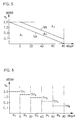
- Fig. 3A Depicted in Fig. 3A are curves E a and B a showing the relationships of the field intensity and the bit error rate measured in the mobile station MS of a certain zone to the distance thereto from the base station BS a in the case where the zone has no interference from base stations of other zones (that is, in an ideal state), the abscissa representing the distance from the base station BS a , the left-hand ordinate the field intensity and the right-hand ordinate the bit error rate BERR.
- the ideal curve E a of the field intensity and the ideal curve B a of the bit error rate with respect to the distance from the base station BS a can be calculated theoretically.
- the distance from the base station BS a is divided into, for example, an error-free region D 0 , a small-error region D 1 , a medium-error region D 2 and a large-error region D 3 .
- the region D 0 is one that permits communication without hindrance; the error in the region D 1 arises mainly from fading; the error in the region D 2 results primarily from fading and noise; and the error in the region D 3 is attributable principally to the degradation of the SN ratio of the receiving signal and this is a difficult-to-communicate region.
- Fig. 3B shows examples of the field intensity and the bit error rate BERR measured with respect to the distance from the base station BS a in the case where a channel of the same frequency as that used in the base station BS a exists as an interference radio wave transmitted from a base station BS b of a zone distant from that of the base station BS a .
- the curve E b shows the field intensity of the interference control channel from the base station BS b .
- the field intensity of a desired receiving control channel drops with distance from the base station BS a as indicated by the curve E a , and at the same time, the field intensity of the interference control channel received from the base station BS b increases as indicated by the curve E b ; hence, the bit error rate BERR begins to abruptly go up at a position nearer to the base station BS a than in the case of Fig. 3A, as indicated by the curve B a in Fig. 3B.
- the error-free region D 0 , the small-error region D 1 and the medium-error region D 2 shift toward the base station BS a and become smaller, whereas the large-error region D 3 becomes larger toward the base station BS a .
- the mobile station MS While in a call waiting state in the control channel of its visiting zone, the mobile station MS always monitors the reception levels of the call waiting control channel of the visiting zone and those of the control channels of peripheral zones at regular intervals so as to detect its migration into a new zone. According to the present invention, the mobile station MS measures the bit error rate BERR of the control signal received in the call waiting control channel and sends the measured value to the base station BS over the uplink control channel together with the reception level of the received control signal.
- the control signal has a predetermined format formed by iterations of a synchronizing word SW, a zone identifying code (referred to as color code) CC and control data DATA.
- the control data DATA differs with the type of the control signal, but the synchronizing word SW is predetermined in the system and the identifying code CC is predetermined for each zone.
- the bit error rate BERR can be measured by detecting a preknown specific signal or signals which are always contained in the control signal, such as any one of the synchronizing word SW, the zone identifying code CC and so forth, or a desired combination thereof.
- the measured reception level and bit error rate BERR can be sent to the base station BS by such methods as described below.
- the method (a) involves the setting of a new signaling format, and hence inevitably causes an unwanted increase in traffic.
- the method (b) is to send the measured results assembled in the existing signal, with a negligibly small increase in traffic, and hence can easily be implemented.
- an interference control channel of the same frequency as that of the desired control channel will increase the bit error rate of the received signal in a desired control channel and degrade the signal quality accordingly.
- the degree of degradation differs with the field intensity ratio between the both channels interfering with each other.
- Fig. 5 is a reference characteristic diagram showing the relationship between the field intensity and the speech or signal quality (bit error rate BERR) that is used as a reference for the analysis of the state of interference.
- the reference characteristic is prestored in the reference characteristic storage part 18 in Fig. 2.
- the straight line 5A indicates a theoretical relationship between the field intensity and the bit error rate BERR obtained by calculations in the ideal state mentioned above with respect to Fig. 3A
- the straight line 5B indicates an allowable range of interference predetermined relative to the theoretical relationship 5A, taking into account the signal quality degradation under the influence of fading and interference of radio waves.
- the measured points (E RL , BERR) defined by the field intensity (the reception level) E RL and the signal quality (BERR) measured by the mobile station MS are in an area A 1 under the straight line 5A in Fig. 5, it can be judged that the control channel of the mobile station is entirely free from the interference by control channels of other zones.
- the measured points (E RL , BERR) are in an area A 2 surrounded by the straight lines 5A and 5B, it can be judged that fading and the influence of interference are permissible.
- the measured points (E RL , BERR) are in an area A 3 above the straight line 5B, it can be judged that there exists an interference channel of a unpermissively high field intensity.
- the reference characteristic depicted in Fig. 5 is prestored in the reference characteristic storage part 18, then the measured points (E RL , BERR) received from individual mobile stations are compared with the reference characteristic of Fig. 5, and on the basis of the results obtained by statistically processing data on the results of comparison (results of judgment as to whether the measured value is abnormal or normal) made for a fixed period of time, a check is made to see if the influence on the channel of the zone by the interfering channels of other zones is within an allowable range (a range wherein the channel frequency need not be switched to another). This can be implemented using such methods as described below.
- the mobile station MS monitors if the timing for measurement has been reached (S 1 ). That is to say, the mobile station MS carries out measurement at regular time intervals, for example, upon each time-out of a preset timer.
- the measurement interval that is, the timer setting time is one or five minutes, for instance; it is also possible to set a short time for a small zone and a relatively long time for a large zone.
- Various other schemes can be employed; for instance, the measurement can be made upon each reception of a location registration report request that is regularly sent from the radio base station BS to the mobile station MS as described previously.
- the mobile station MS measures the field intensity of the downlink radio wave RW D from the radio base station BS, which is usually the radio wave of the control channel for receiving an incoming call, and its quality (the bit error rate, for instance) (S 2 ). Then, the mobile station MS reports the measured results to the radio base station BS with the uplink radio wave RW U , that is, over the control channel for call origination request use (S 3 ). The measured results may also be reported together with a report replying to the afore-mentioned report request from the radio base station BS.
- the radio base station BS waits for the report of measured results from each mobile station MS (S 4 ) and, upon each reception of the report, compares the measured results with the reference characteristic (S 5 ). That is to say, the base station BS compares the measured results with the reference characteristic prestored in the reference characteristic storage part 18 and makes a check to determine if the meausred point indicated by the measured results is abnormal or not, thereafter counting the number of meaured points and the number of abnormal points. Next, the base station BS checks whether a fixed period of time, for example, an hour has passed (S 6 ), and if not, goes back to step S 4 wherein to continue the reception of measured results.
- a fixed period of time for example, an hour has passed
- step S 6 If it is judged in step S 6 that the fixed period of time has passed, the meausred points acquired during the fixed period and the measured points decided as abnormal are statistically processed and a check is made to determine if the influence of the interference channel is within the allowed limit (S 7 ).
- the mobile station measures the field intensity and quality of the downlink radio wave and the radio base station processes the measured results; hence, even while the mobile radio communication system is in service, the state of interference can be evaluated, and when the state of interference varies due to a change in the radio wave environment, it is possible to detect the change in the state of interference following it in a short time.
- the mobile station measures the field intensity and quality of the downlink radio wave and the radio base station processes the measured results; hence, even while the mobile radio communication system is in service, the state of interference can be evaluated, and when the state of interference varies due to a change in the radio wave environment, it is possible to detect the change in the state of interference following it in a short time.
- the validity of the radiated radio wave is judged autonomously.
- the channel frequency used can autonomously be switched to another one of the other assigned frequencies when the base station detects the occurrence of an abnormality; that is, an autonomous base station with no centralized control device can be used.
- the base station Since the mobile station carries out the measurement, an abnormality in the service area (home zone) of the base station is detected from the user's standpoint, and the base station changes the state of propagation of its downlink radio wave by controlling its transmission output or the direction of an antenna, and by learning the state of interference from the measured results sent from the mobile station, an optimum state can be obtained.
Landscapes
- Engineering & Computer Science (AREA)
- Computer Networks & Wireless Communication (AREA)
- Signal Processing (AREA)
- Mobile Radio Communication Systems (AREA)
Applications Claiming Priority (3)
| Application Number | Priority Date | Filing Date | Title |
|---|---|---|---|
| JP32779594 | 1994-12-28 | ||
| JP327795/94 | 1994-12-28 | ||
| JP32779594 | 1994-12-28 |
Publications (3)
| Publication Number | Publication Date |
|---|---|
| EP0720407A2 true EP0720407A2 (fr) | 1996-07-03 |
| EP0720407A3 EP0720407A3 (fr) | 1997-11-05 |
| EP0720407B1 EP0720407B1 (fr) | 2002-04-17 |
Family
ID=18203082
Family Applications (1)
| Application Number | Title | Priority Date | Filing Date |
|---|---|---|---|
| EP95120162A Expired - Lifetime EP0720407B1 (fr) | 1994-12-28 | 1995-12-20 | Procédé de détection de l'état d'interférence d'une station de base d'un système de communication radio-mobile |
Country Status (3)
| Country | Link |
|---|---|
| US (1) | US5603093A (fr) |
| EP (1) | EP0720407B1 (fr) |
| DE (1) | DE69526420T2 (fr) |
Cited By (26)
| Publication number | Priority date | Publication date | Assignee | Title |
|---|---|---|---|---|
| WO1997033446A1 (fr) * | 1996-03-07 | 1997-09-12 | Nokia Telecommunications Oy | Test a distance d'un raccordement d'abonne hertzien |
| WO1997033447A1 (fr) * | 1996-03-07 | 1997-09-12 | Nokia Telecommunications Oy | Procede et systeme de test de l'etat d'un poste d'abonne dans un systeme hertzien |
| WO1998014025A1 (fr) * | 1996-09-27 | 1998-04-02 | Nokia Telecommunications Oy | Planification adaptative de frequences dans un reseau |
| WO1998032302A1 (fr) * | 1997-01-22 | 1998-07-23 | Telefonaktiebolaget Lm Ericsson (Publ) | Procede et dispositif permettant d'estimer un affaiblissement de propagation dans un systeme de radiocommunication |
| WO1998027763A3 (fr) * | 1996-12-19 | 1998-08-06 | Ericsson Telefon Ab L M | Evaluation d'interference de liaisons descendantes dans un systeme de communication cellulaire |
| WO1998029961A3 (fr) * | 1996-12-30 | 1998-08-27 | Nokia Telecommunications Oy | Systeme radio cellulaire et procede de mesure du niveau d'interferences |
| WO1998049853A1 (fr) * | 1997-04-25 | 1998-11-05 | British Telecommunications Public Limited Company | Etude de reseaux de communication sans fil |
| WO1998053630A1 (fr) * | 1997-05-22 | 1998-11-26 | Telefonaktiebolaget Lm Ericsson | Mesure de la qualite phonique dans les reseaux de telecommunications mobiles sur la base de parametres de liaison radio |
| WO1998053621A3 (fr) * | 1997-05-19 | 1999-02-25 | Qualcomm Inc | Procede et appareil pour l'optimisation d'un reseau cellulaire |
| WO1998043455A3 (fr) * | 1997-03-25 | 1999-04-01 | Northern Telecom Ltd | Procede et terminal sans fil permettant de surveiller des communications et de delivrer au reseau des donnees relatives au fonctionnement de terminaux |
| GB2337425A (en) * | 1998-05-14 | 1999-11-17 | Simoco Int Ltd | Radio channel quality estimation |
| US6201960B1 (en) * | 1997-06-24 | 2001-03-13 | Telefonaktiebolaget Lm Ericsson (Publ) | Speech quality measurement based on radio link parameters and objective measurement of received speech signals |
| US6201802B1 (en) | 1997-08-29 | 2001-03-13 | Qualcomm Inc. | Method and apparatus for analyzing base station timing |
| WO2001063958A1 (fr) * | 2000-02-25 | 2001-08-30 | Matsushita Electric Industrial Co.,Ltd. | Appareil de station mobile, appareil de station de base, et procede d'affectation de canal de communication |
| WO2002009312A3 (fr) * | 2000-07-20 | 2002-06-27 | Ericsson Telefon Ab L M | Systemes et procedes de mesure de reciprocite d'interference entre des directions liaison montante et liaison descendante dans un systeme de communication sans fil |
| US6922551B1 (en) | 1998-07-15 | 2005-07-26 | Telefonaktiebolaget L M Ericsson (Publ) | Interference prevention in a radio communications system |
| WO2008031112A3 (fr) * | 2006-09-08 | 2008-04-24 | Qualcomm Inc | Performance de rayonnement d'un dispositif sans fil |
| WO2008088737A3 (fr) * | 2007-01-12 | 2008-11-20 | Interdigital Tech Corp | Procédé et appareil pour mesurer une interférence dans des stations sans fil |
| EP2091283A1 (fr) | 1997-11-03 | 2009-08-19 | Qualcomm Incorporated | Procédé et appareil de transmission de données en paquet à haute vitesse |
| US7848283B2 (en) | 1997-11-03 | 2010-12-07 | Qualcomm Incorporated | Method and apparatus for high rate packet data transmission |
| US8064409B1 (en) | 1999-08-25 | 2011-11-22 | Qualcomm Incorporated | Method and apparatus using a multi-carrier forward link in a wireless communication system |
| US8811200B2 (en) | 2009-09-22 | 2014-08-19 | Qualcomm Incorporated | Physical layer metrics to support adaptive station-dependent channel state information feedback rate in multi-user communication systems |
| EP2187698A4 (fr) * | 2007-08-13 | 2015-03-18 | Ntt Docomo Inc | Système de communication mobile, dispositif de station de base générale, dispositif de station de base et procédé de commande d'état de station de base |
| US9107109B2 (en) | 2000-10-25 | 2015-08-11 | Qualcomm Incorporated | Method and apparatus for determining a data rate in a high rate packet data wireless communications system |
| US9118387B2 (en) | 1997-11-03 | 2015-08-25 | Qualcomm Incorporated | Pilot reference transmission for a wireless communication system |
| US9426821B2 (en) | 2000-10-25 | 2016-08-23 | Qualcomm Incorporated | Method and apparatus for high rate packet data and low delay data transmissions |
Families Citing this family (33)
| Publication number | Priority date | Publication date | Assignee | Title |
|---|---|---|---|---|
| FR2739512B1 (fr) * | 1995-10-03 | 1997-10-31 | France Telecom | Modelisation des interferences dans un reseau radiotelephonique cellulaire |
| JP3415978B2 (ja) * | 1995-11-24 | 2003-06-09 | 富士通株式会社 | キャリア切替え方法 |
| JPH09261153A (ja) * | 1996-03-27 | 1997-10-03 | Aiwa Co Ltd | 携帯用端末装置 |
| US6009332A (en) * | 1996-08-28 | 1999-12-28 | Telefonaktiebolaget Lm Ericsson | Method and system for autonomously allocating a frequency hopping traffic channel in a private radio system |
| US6405043B1 (en) * | 1997-07-02 | 2002-06-11 | Scoreboard, Inc. | Method to characterize the prospective or actual level of interference at a point, in a sector, and throughout a cellular system |
| KR100244198B1 (ko) | 1997-12-09 | 2000-02-01 | 윤종용 | 기지국 환경 잡음 측정기 및 측정방법 |
| JPH11282684A (ja) | 1998-03-27 | 1999-10-15 | Canon Inc | 画像処理装置、画像処理装置の制御方法、および記憶媒体 |
| JP3241672B2 (ja) * | 1998-07-31 | 2001-12-25 | 三菱電機株式会社 | 干渉波検出装置及び干渉波検出方法 |
| GB9817292D0 (en) * | 1998-08-07 | 1998-10-07 | Nokia Mobile Phones Ltd | Digital video coding |
| FI982121L (fi) * | 1998-09-30 | 2000-03-31 | Nokia Networks Oy | Tehonsäätö radiojärjestelmässä |
| JP3512154B2 (ja) * | 1999-01-25 | 2004-03-29 | 松下電器産業株式会社 | 基地局装置 |
| US6556553B1 (en) * | 1999-04-12 | 2003-04-29 | Intermec Ip Corp. | Method for determining when a communication device should rate shift or roam in a wireless environment |
| US6775544B2 (en) | 1999-06-03 | 2004-08-10 | At&T Wireless Services, Inc. | Automatic diagnostic for detection of interference in wireless communication system |
| JP3349477B2 (ja) * | 1999-09-08 | 2002-11-25 | 三洋電機株式会社 | 移動体通信機、移動体通信システムおよび通話チャネル割当要求方法 |
| US6621804B1 (en) | 1999-10-07 | 2003-09-16 | Qualcomm Incorporated | Method and apparatus for predicting favored supplemental channel transmission slots using transmission power measurements of a fundamental channel |
| EP1156609A1 (fr) * | 2000-05-15 | 2001-11-21 | TELEFONAKTIEBOLAGET LM ERICSSON (publ) | Mesure de la qualité de transmission dans un réseau de communication |
| US20030040277A1 (en) * | 2000-07-18 | 2003-02-27 | Deats Bradley W. | Apparatus and method for measuring and identifying sources of communications interference |
| US7366471B1 (en) * | 2000-08-31 | 2008-04-29 | Intel Corporation | Mitigating interference between wireless systems |
| DE60108225T2 (de) * | 2001-05-08 | 2005-12-08 | Agere Systems Guardian Corp., Orlando | Dynamische Frequenzwahl in einem drahtlosen lokalen Netz mit Kanaltausch zwischen Zugriffspunkten |
| US8977284B2 (en) | 2001-10-04 | 2015-03-10 | Traxcell Technologies, LLC | Machine for providing a dynamic data base of geographic location information for a plurality of wireless devices and process for making same |
| US7068976B2 (en) * | 2001-12-18 | 2006-06-27 | Ericsson Inc. | Method of verifying operation of listening control channel |
| US7039017B2 (en) * | 2001-12-28 | 2006-05-02 | Texas Instruments Incorporated | System and method for detecting and locating interferers in a wireless communication system |
| US6859642B2 (en) * | 2002-04-29 | 2005-02-22 | Nokia Corporation | Calibration of signal strength measurements in a cellular communications system |
| JP4069034B2 (ja) * | 2003-07-31 | 2008-03-26 | 松下電器産業株式会社 | 無線送信装置、無線受信装置、無線通信システム、無線送信方法及び無線受信方法 |
| US7493135B2 (en) * | 2004-04-02 | 2009-02-17 | Lg Electronics Inc. | Transmission method for downlink control signal in MIMO system |
| CN100581075C (zh) * | 2004-04-07 | 2010-01-13 | Lg电子株式会社 | Mimo系统中下行链路控制信号的发送方法 |
| CN101951679B (zh) * | 2004-10-19 | 2013-08-21 | 夏普株式会社 | 基站装置和无线通信系统以及无线发送方法 |
| JP2007316070A (ja) * | 2006-05-22 | 2007-12-06 | Polaris Wireless Inc | 無線端末の居場所の予測方法 |
| KR101371148B1 (ko) * | 2007-08-27 | 2014-03-10 | 삼성전자주식회사 | 무선 통신을 수행하는 기지국과 이동국 및 그 제어 방법 |
| ATE535118T1 (de) * | 2008-03-12 | 2011-12-15 | Sequans Comm | Verfahren zum steuern der interferenz, die von einer mobilstation auf nachbarbasisstationen erzeugt wird |
| JP5217688B2 (ja) * | 2008-06-30 | 2013-06-19 | 富士通セミコンダクター株式会社 | 無線端末装置、半導体装置及び通信システム |
| JP5233454B2 (ja) * | 2008-07-08 | 2013-07-10 | 富士通株式会社 | 移動端末局および受信品質測定方法 |
| CN116634473B (zh) * | 2023-07-21 | 2023-10-10 | 中国铁塔股份有限公司云南省分公司 | 无线站点停电退服故障预判方法及其装置 |
Family Cites Families (6)
| Publication number | Priority date | Publication date | Assignee | Title |
|---|---|---|---|---|
| JPH02312492A (ja) * | 1989-05-29 | 1990-12-27 | Nec Corp | 移動通信システムにおけるチャネル割り当て方式および基地局配置情報の学習方式 |
| US5023900A (en) * | 1989-12-07 | 1991-06-11 | Tayloe Daniel R | Cellular radiotelephone diagnostic system |
| SE465004B (sv) * | 1989-12-18 | 1991-07-08 | Televerket | Metod foer faststaellning av multipla interferenser i ett mobilradiosystem |
| SE9202367L (sv) * | 1992-08-18 | 1993-07-26 | Televerket | Foerfarande foer uppskattning av c/i-densitet och interferenssannolikhet i upplaenk |
| US5375123A (en) * | 1993-02-05 | 1994-12-20 | Telefonakitebolaget L. M. Ericsson | Allocation of channels using interference estimation |
| US5506869A (en) * | 1994-10-27 | 1996-04-09 | Northern Telecom Limited | Methods and apparatus for estimating carrier-to-interference ratios at cellular radio base stations |
-
1995
- 1995-12-13 US US08/571,649 patent/US5603093A/en not_active Expired - Lifetime
- 1995-12-20 DE DE69526420T patent/DE69526420T2/de not_active Expired - Lifetime
- 1995-12-20 EP EP95120162A patent/EP0720407B1/fr not_active Expired - Lifetime
Cited By (57)
| Publication number | Priority date | Publication date | Assignee | Title |
|---|---|---|---|---|
| WO1997033447A1 (fr) * | 1996-03-07 | 1997-09-12 | Nokia Telecommunications Oy | Procede et systeme de test de l'etat d'un poste d'abonne dans un systeme hertzien |
| US6169883B1 (en) | 1996-03-07 | 2001-01-02 | Nokia Telecommunications Oy | Remote test of a subscriber connection in a system implementing a wireless subscriber connection |
| WO1997033446A1 (fr) * | 1996-03-07 | 1997-09-12 | Nokia Telecommunications Oy | Test a distance d'un raccordement d'abonne hertzien |
| CN1098017C (zh) * | 1996-09-27 | 2003-01-01 | 诺基亚电信公司 | 蜂窝网络中的自适应频率规划 |
| WO1998014025A1 (fr) * | 1996-09-27 | 1998-04-02 | Nokia Telecommunications Oy | Planification adaptative de frequences dans un reseau |
| US6253086B1 (en) | 1996-09-27 | 2001-06-26 | Nokia Telecommunications Oy | Adaptive frequency planning in a cellular network |
| US6137991A (en) * | 1996-12-19 | 2000-10-24 | Ericsson Telefon Ab L M | Estimating downlink interference in a cellular communications system |
| WO1998027763A3 (fr) * | 1996-12-19 | 1998-08-06 | Ericsson Telefon Ab L M | Evaluation d'interference de liaisons descendantes dans un systeme de communication cellulaire |
| AU746136B2 (en) * | 1996-12-19 | 2002-04-18 | Telefonaktiebolaget Lm Ericsson (Publ) | Estimating downlink interference in a cellular communications system |
| AU728831B2 (en) * | 1996-12-30 | 2001-01-18 | Nokia Telecommunications Oy | A cellular radio system and a method for measuring the interference level |
| WO1998029961A3 (fr) * | 1996-12-30 | 1998-08-27 | Nokia Telecommunications Oy | Systeme radio cellulaire et procede de mesure du niveau d'interferences |
| US6137993A (en) * | 1997-01-22 | 2000-10-24 | Telefonaktiebolaget Lm Ericsson | Method and apparatus for estimating path loss in a radio communications system |
| WO1998032302A1 (fr) * | 1997-01-22 | 1998-07-23 | Telefonaktiebolaget Lm Ericsson (Publ) | Procede et dispositif permettant d'estimer un affaiblissement de propagation dans un systeme de radiocommunication |
| US6088588A (en) * | 1997-03-25 | 2000-07-11 | Nortel Networks Corporation | Method and wireless terminal for monitoring communications and providing network with terminal operation information |
| WO1998043455A3 (fr) * | 1997-03-25 | 1999-04-01 | Northern Telecom Ltd | Procede et terminal sans fil permettant de surveiller des communications et de delivrer au reseau des donnees relatives au fonctionnement de terminaux |
| WO1998049853A1 (fr) * | 1997-04-25 | 1998-11-05 | British Telecommunications Public Limited Company | Etude de reseaux de communication sans fil |
| US6253065B1 (en) | 1997-04-25 | 2001-06-26 | British Telecommunications Public Limited Company | Wireless communications network planning |
| GB2342538B (en) * | 1997-04-25 | 2002-03-06 | British Telecomm | Wireless communications network planning |
| GB2342538A (en) * | 1997-04-25 | 2000-04-12 | British Telecomm | Wireless communications network planning |
| WO1998053621A3 (fr) * | 1997-05-19 | 1999-02-25 | Qualcomm Inc | Procede et appareil pour l'optimisation d'un reseau cellulaire |
| GB2342539B (en) * | 1997-05-22 | 2002-06-12 | Ericsson Telefon Ab L M | Speech quality measurement in mobile telecommunication networks based on radio link parameters |
| GB2342539A (en) * | 1997-05-22 | 2000-04-12 | Ericsson Telefon Ab L M | Speech quality measurement in mobile telecommunication networks based on radio link parameters |
| WO1998053630A1 (fr) * | 1997-05-22 | 1998-11-26 | Telefonaktiebolaget Lm Ericsson | Mesure de la qualite phonique dans les reseaux de telecommunications mobiles sur la base de parametres de liaison radio |
| AU742933B2 (en) * | 1997-05-22 | 2002-01-17 | Telefonaktiebolaget Lm Ericsson (Publ) | Speech quality measurement in mobile telecommunication networks based on radio link parameters |
| US6157830A (en) * | 1997-05-22 | 2000-12-05 | Telefonaktiebolaget Lm Ericsson | Speech quality measurement in mobile telecommunication networks based on radio link parameters |
| US6201960B1 (en) * | 1997-06-24 | 2001-03-13 | Telefonaktiebolaget Lm Ericsson (Publ) | Speech quality measurement based on radio link parameters and objective measurement of received speech signals |
| US6201802B1 (en) | 1997-08-29 | 2001-03-13 | Qualcomm Inc. | Method and apparatus for analyzing base station timing |
| US7848285B2 (en) | 1997-11-03 | 2010-12-07 | Qualcomm Incorporated | Method and apparatus for high rate packet data transmission |
| US8005042B2 (en) | 1997-11-03 | 2011-08-23 | Qualcomm Incorporated | Method and apparatus for high rate packet data transmission |
| US9124344B2 (en) | 1997-11-03 | 2015-09-01 | Qualcomm Incorporated | Pilot reference transmission for a wireless communication system |
| US9118387B2 (en) | 1997-11-03 | 2015-08-25 | Qualcomm Incorporated | Pilot reference transmission for a wireless communication system |
| US9001735B2 (en) | 1997-11-03 | 2015-04-07 | Qualcomm Incorporated | Method and apparatus for high rate packet data transmission |
| US8351372B2 (en) | 1997-11-03 | 2013-01-08 | Qualcomm Incorporated | Method and apparatus for high rate packet data transmission |
| US8311027B2 (en) | 1997-11-03 | 2012-11-13 | Qualcomm Incorporated | Method and apparatus for high rate packet data transmission |
| US8189540B2 (en) | 1997-11-03 | 2012-05-29 | Qualcomm Incorporated | Method and apparatus for high rate packet data transmission |
| EP2091283A1 (fr) | 1997-11-03 | 2009-08-19 | Qualcomm Incorporated | Procédé et appareil de transmission de données en paquet à haute vitesse |
| US7848283B2 (en) | 1997-11-03 | 2010-12-07 | Qualcomm Incorporated | Method and apparatus for high rate packet data transmission |
| US7848284B2 (en) | 1997-11-03 | 2010-12-07 | Qualcomm Incorporated | Method and apparatus for high rate packet data transmission |
| US7848282B2 (en) | 1997-11-03 | 2010-12-07 | Qualcomm Incorporated | Method and apparatus for high rate packet data transmission |
| US8089924B2 (en) | 1997-11-03 | 2012-01-03 | Qualcomm Incorporated | Method and apparatus for high rate packet data transmission |
| US8077655B2 (en) | 1997-11-03 | 2011-12-13 | Qualcomm Incorporated | Method and apparatus for high rate packet data transmission |
| US7995531B2 (en) | 1997-11-03 | 2011-08-09 | Qualcomm Incorporated | Method and apparatus for high rate packet data transmission |
| US8009625B2 (en) | 1997-11-03 | 2011-08-30 | Qualcomm Incorporated | Method and apparatus for high rate packet data transmission |
| GB2337425B (en) * | 1998-05-14 | 2000-12-13 | Simoco Int Ltd | Radio channel quality estimation |
| GB2337425A (en) * | 1998-05-14 | 1999-11-17 | Simoco Int Ltd | Radio channel quality estimation |
| US6922551B1 (en) | 1998-07-15 | 2005-07-26 | Telefonaktiebolaget L M Ericsson (Publ) | Interference prevention in a radio communications system |
| US8064409B1 (en) | 1999-08-25 | 2011-11-22 | Qualcomm Incorporated | Method and apparatus using a multi-carrier forward link in a wireless communication system |
| WO2001063958A1 (fr) * | 2000-02-25 | 2001-08-30 | Matsushita Electric Industrial Co.,Ltd. | Appareil de station mobile, appareil de station de base, et procede d'affectation de canal de communication |
| US6684061B1 (en) | 2000-07-20 | 2004-01-27 | Telefonaktiebolaget Lm Ericsson (Publ) | Systems and methods for measuring interference reciprocity between uplink and downlink directions in a wireless communications system |
| WO2002009312A3 (fr) * | 2000-07-20 | 2002-06-27 | Ericsson Telefon Ab L M | Systemes et procedes de mesure de reciprocite d'interference entre des directions liaison montante et liaison descendante dans un systeme de communication sans fil |
| US9107109B2 (en) | 2000-10-25 | 2015-08-11 | Qualcomm Incorporated | Method and apparatus for determining a data rate in a high rate packet data wireless communications system |
| US9426821B2 (en) | 2000-10-25 | 2016-08-23 | Qualcomm Incorporated | Method and apparatus for high rate packet data and low delay data transmissions |
| US7925253B2 (en) | 2006-09-08 | 2011-04-12 | Qualcomm Incorporated | Radiated performance of a wireless device |
| WO2008031112A3 (fr) * | 2006-09-08 | 2008-04-24 | Qualcomm Inc | Performance de rayonnement d'un dispositif sans fil |
| WO2008088737A3 (fr) * | 2007-01-12 | 2008-11-20 | Interdigital Tech Corp | Procédé et appareil pour mesurer une interférence dans des stations sans fil |
| EP2187698A4 (fr) * | 2007-08-13 | 2015-03-18 | Ntt Docomo Inc | Système de communication mobile, dispositif de station de base générale, dispositif de station de base et procédé de commande d'état de station de base |
| US8811200B2 (en) | 2009-09-22 | 2014-08-19 | Qualcomm Incorporated | Physical layer metrics to support adaptive station-dependent channel state information feedback rate in multi-user communication systems |
Also Published As
| Publication number | Publication date |
|---|---|
| DE69526420D1 (de) | 2002-05-23 |
| US5603093A (en) | 1997-02-11 |
| EP0720407B1 (fr) | 2002-04-17 |
| DE69526420T2 (de) | 2002-10-31 |
| EP0720407A3 (fr) | 1997-11-05 |
Similar Documents
| Publication | Publication Date | Title |
|---|---|---|
| US5603093A (en) | Method for monitoring the state of interference by a base station of a mobile radio communication system | |
| US5548808A (en) | Method for performing a handoff in a communication system | |
| EP0616750B1 (fr) | Algorithme de decision de transfert utilisant des valeurs de bilan de puissance | |
| US5594949A (en) | Mobile assisted channel allocation | |
| EP1320277B1 (fr) | Procede de commande d'acceptation d'appel pour systeme de radiocommunication mobile amcr, et dispositif station mobile | |
| KR100319309B1 (ko) | 이동통신시스템 | |
| US6175745B1 (en) | Initial transmit power determination in a radiocommunication system | |
| US5542097A (en) | Method and system for confirming the identity of a target cell for handoff | |
| US7092732B2 (en) | Radio-communication control method and equipment | |
| EP0648028B1 (fr) | Système de communication mobile | |
| EP0786914A2 (fr) | Système de radiocommunication à accès multiple par répartition dans l'espace et méthode d'affectation des canaux | |
| PL186647B1 (pl) | Sposób i system do estymowania zakłócenia zstępującego w telekomunikacyjnej sieci komórkowej | |
| US5542098A (en) | Method of handover in a cellular system | |
| US6081727A (en) | Transmission power control system capable of disabling communication of a mobile terminal which carries out an abnormal operation | |
| US6434386B1 (en) | Method and system for monitoring power output in transceivers | |
| JP2992563B2 (ja) | 移動通信方式 | |
| AU3260395A (en) | A method for selecting the way to perform a handover, and a cellular radio system | |
| JP2965057B2 (ja) | 移動通信システムの基地局における干渉状態監視方法 | |
| EP1075157B1 (fr) | Procede de jugement de l'attribution d'une liaison radio dans un systeme mobile de communication et controleur de liaison radio | |
| JP3707952B2 (ja) | 無線通信システムおよびその制御方法 | |
| EP0875118A2 (fr) | Procede pour acceder a une microcellule au moyen de voies de commande analogiques | |
| US6697616B1 (en) | Method and base station for functional testing of a transmission and reception path | |
| JP2985948B2 (ja) | 移動通信方式 | |
| WO1998033344A1 (fr) | Mesure de l'utilisation de telephones mobiles cellulaires | |
| US20250071792A1 (en) | Scheduling of time slots in a fixed wireless access network |
Legal Events
| Date | Code | Title | Description |
|---|---|---|---|
| PUAI | Public reference made under article 153(3) epc to a published international application that has entered the european phase |
Free format text: ORIGINAL CODE: 0009012 |
|
| 17P | Request for examination filed |
Effective date: 19951220 |
|
| AK | Designated contracting states |
Kind code of ref document: A2 Designated state(s): DE GB SE |
|
| PUAL | Search report despatched |
Free format text: ORIGINAL CODE: 0009013 |
|
| AK | Designated contracting states |
Kind code of ref document: A3 Designated state(s): DE GB SE |
|
| 17Q | First examination report despatched |
Effective date: 20000302 |
|
| GRAG | Despatch of communication of intention to grant |
Free format text: ORIGINAL CODE: EPIDOS AGRA |
|
| GRAG | Despatch of communication of intention to grant |
Free format text: ORIGINAL CODE: EPIDOS AGRA |
|
| GRAH | Despatch of communication of intention to grant a patent |
Free format text: ORIGINAL CODE: EPIDOS IGRA |
|
| REG | Reference to a national code |
Ref country code: GB Ref legal event code: IF02 |
|
| GRAH | Despatch of communication of intention to grant a patent |
Free format text: ORIGINAL CODE: EPIDOS IGRA |
|
| GRAA | (expected) grant |
Free format text: ORIGINAL CODE: 0009210 |
|
| AK | Designated contracting states |
Kind code of ref document: B1 Designated state(s): DE GB SE |
|
| REF | Corresponds to: |
Ref document number: 69526420 Country of ref document: DE Date of ref document: 20020523 |
|
| PLBE | No opposition filed within time limit |
Free format text: ORIGINAL CODE: 0009261 |
|
| STAA | Information on the status of an ep patent application or granted ep patent |
Free format text: STATUS: NO OPPOSITION FILED WITHIN TIME LIMIT |
|
| 26N | No opposition filed |
Effective date: 20030120 |
|
| PGFP | Annual fee paid to national office [announced via postgrant information from national office to epo] |
Ref country code: GB Payment date: 20141217 Year of fee payment: 20 Ref country code: SE Payment date: 20141211 Year of fee payment: 20 Ref country code: DE Payment date: 20141216 Year of fee payment: 20 |
|
| REG | Reference to a national code |
Ref country code: DE Ref legal event code: R071 Ref document number: 69526420 Country of ref document: DE |
|
| REG | Reference to a national code |
Ref country code: GB Ref legal event code: PE20 Expiry date: 20151219 |
|
| PG25 | Lapsed in a contracting state [announced via postgrant information from national office to epo] |
Ref country code: GB Free format text: LAPSE BECAUSE OF EXPIRATION OF PROTECTION Effective date: 20151219 |
|
| REG | Reference to a national code |
Ref country code: SE Ref legal event code: EUG |