EP0720988A1 - Neue Pseudopeptide mit Trifluormethyl-substituiertem 2-Azabicyclooctan - Google Patents
Neue Pseudopeptide mit Trifluormethyl-substituiertem 2-Azabicyclooctan Download PDFInfo
- Publication number
- EP0720988A1 EP0720988A1 EP95120371A EP95120371A EP0720988A1 EP 0720988 A1 EP0720988 A1 EP 0720988A1 EP 95120371 A EP95120371 A EP 95120371A EP 95120371 A EP95120371 A EP 95120371A EP 0720988 A1 EP0720988 A1 EP 0720988A1
- Authority
- EP
- European Patent Office
- Prior art keywords
- formula
- compounds
- general formula
- radical
- salts
- Prior art date
- Legal status (The legal status is an assumption and is not a legal conclusion. Google has not performed a legal analysis and makes no representation as to the accuracy of the status listed.)
- Withdrawn
Links
- SQJYIQBFHKXOTR-VIUKOLAESA-N N[C@@H](CC(N)=O)C(N[C@@H](Cc1ccccc1)[C@@H](CN([C@@H](CCC1)[C@@H]1C1)[C@@H]1C(F)(F)F)O)=O Chemical compound N[C@@H](CC(N)=O)C(N[C@@H](Cc1ccccc1)[C@@H](CN([C@@H](CCC1)[C@@H]1C1)[C@@H]1C(F)(F)F)O)=O SQJYIQBFHKXOTR-VIUKOLAESA-N 0.000 description 1
Classifications
-
- C—CHEMISTRY; METALLURGY
- C07—ORGANIC CHEMISTRY
- C07D—HETEROCYCLIC COMPOUNDS
- C07D401/00—Heterocyclic compounds containing two or more hetero rings, having nitrogen atoms as the only ring hetero atoms, at least one ring being a six-membered ring with only one nitrogen atom
- C07D401/02—Heterocyclic compounds containing two or more hetero rings, having nitrogen atoms as the only ring hetero atoms, at least one ring being a six-membered ring with only one nitrogen atom containing two hetero rings
- C07D401/12—Heterocyclic compounds containing two or more hetero rings, having nitrogen atoms as the only ring hetero atoms, at least one ring being a six-membered ring with only one nitrogen atom containing two hetero rings linked by a chain containing hetero atoms as chain links
-
- C—CHEMISTRY; METALLURGY
- C07—ORGANIC CHEMISTRY
- C07D—HETEROCYCLIC COMPOUNDS
- C07D209/00—Heterocyclic compounds containing five-membered rings, condensed with other rings, with one nitrogen atom as the only ring hetero atom
- C07D209/02—Heterocyclic compounds containing five-membered rings, condensed with other rings, with one nitrogen atom as the only ring hetero atom condensed with one carbocyclic ring
- C07D209/52—Heterocyclic compounds containing five-membered rings, condensed with other rings, with one nitrogen atom as the only ring hetero atom condensed with one carbocyclic ring condensed with a ring other than six-membered
-
- A—HUMAN NECESSITIES
- A61—MEDICAL OR VETERINARY SCIENCE; HYGIENE
- A61P—SPECIFIC THERAPEUTIC ACTIVITY OF CHEMICAL COMPOUNDS OR MEDICINAL PREPARATIONS
- A61P31/00—Antiinfectives, i.e. antibiotics, antiseptics, chemotherapeutics
- A61P31/12—Antivirals
-
- C—CHEMISTRY; METALLURGY
- C07—ORGANIC CHEMISTRY
- C07D—HETEROCYCLIC COMPOUNDS
- C07D403/00—Heterocyclic compounds containing two or more hetero rings, having nitrogen atoms as the only ring hetero atoms, not provided for by group C07D401/00
- C07D403/02—Heterocyclic compounds containing two or more hetero rings, having nitrogen atoms as the only ring hetero atoms, not provided for by group C07D401/00 containing two hetero rings
- C07D403/12—Heterocyclic compounds containing two or more hetero rings, having nitrogen atoms as the only ring hetero atoms, not provided for by group C07D401/00 containing two hetero rings linked by a chain containing hetero atoms as chain links
-
- C—CHEMISTRY; METALLURGY
- C07—ORGANIC CHEMISTRY
- C07K—PEPTIDES
- C07K5/00—Peptides containing up to four amino acids in a fully defined sequence; Derivatives thereof
- C07K5/04—Peptides containing up to four amino acids in a fully defined sequence; Derivatives thereof containing only normal peptide links
- C07K5/06—Dipeptides
- C07K5/06191—Dipeptides containing heteroatoms different from O, S, or N
-
- A—HUMAN NECESSITIES
- A61—MEDICAL OR VETERINARY SCIENCE; HYGIENE
- A61K—PREPARATIONS FOR MEDICAL, DENTAL OR TOILETRY PURPOSES
- A61K38/00—Medicinal preparations containing peptides
Definitions
- the present invention relates to new pseudopeptides with trifluoromethyl-substituted 2-azabicyclooctane, a process for their preparation and their use as antiretroviral agents.
- EP 528 242 describes trifluoromethyl-containing pseudopeptides as antiretroviral agents, with some of the compounds according to the invention listed here being encompassed by the broadest scope of this publication.
- the compounds of the general formula (I) according to the invention have several asymmetric carbon atoms.
- the rest of the general formula (A) has 6 asymmetric carbon atoms (*), which are independently in the R or S configuration.
- the configurations 1 (R), 2 (R), 3 (S), 4 (S), 5 (S) and 6 (S) are preferred.
- Physiologically acceptable salts of the pseudopeptides with trifluoromethyl-substituted 2-azabicyclooctane can be salts of the substances according to the invention with mineral acids, carboxylic acids or sulfonic acids.
- mineral acids carboxylic acids or sulfonic acids.
- Salts which can be mentioned are salts with customary bases, such as, for example, alkali metal salts (for example sodium or potassium salts), alkaline earth metal salts (for example calcium or magnesium salts) or ammonium salts derived from ammonia or organic amines such as, for example, diethylamine, triethylamine, ethyldiisopropylamine, procaine, dibenzylamine, N-methylmorpholine, dihydroabietylamine, 1-ephedrinamine or methyl-piperidine.
- alkali metal salts for example sodium or potassium salts
- alkaline earth metal salts for example calcium or magnesium salts
- ammonium salts derived from ammonia or organic amines such as, for example, diethylamine, triethylamine, ethyldiisopropylamine, procaine, dibenzylamine, N-methylmorpholine, dihydroabietylamine, 1-ephedrin
- the process according to the invention can be illustrated by the following formula scheme:
- the usual inert solvents which do not change under the reaction conditions are suitable as solvents for all process steps.
- These preferably include organic solvents such as ethers, for example diethyl ether, glycol mono- or dimethyl ether, dioxane or tetrahydrofuran, or hydrocarbons such as benzene, toluene, xylene, cyclohexane or petroleum fractions or halogenated hydrocarbons such as methylene chloride, chloroform, carbon tetrachloride, or dimethyl sulfoxide, dimethylformamide acid, hexamethyl amide, hexamethyl amide, Pyridine, triethylamine or picoline. It is also possible to use mixtures of the solvents mentioned. Dichloromethane, dimethylformamide and tetrahydrofuran are particularly preferred.
- the usual inorganic or organic bases are suitable as bases.
- bases preferably include alkali hydroxides such as sodium or potassium hydroxide, or alkali carbonates such as sodium or potassium carbonate, or alkali alcoholates such as sodium or potassium methoxide, or sodium or potassium ethoxide, or organic amines such as ethyldiisopropylamine, triethylamine, picoline, pyridine or N-methylpiperidine, or amides such as sodium amide or lithium diisopropylamide, or lithium-N-silylalkylamides, such as lithium-N- (bis) triphenysilylamide or lithium alkyls such as n-butyllithium.
- alkali hydroxides such as sodium or potassium hydroxide
- alkali carbonates such as sodium or potassium carbonate
- alkali alcoholates such as sodium or potassium methoxide, or sodium or potassium ethoxide
- organic amines such as ethyldi
- the base is used in an amount of 1 mol to 10 mol, preferably 1 mol to 3 mol, based on 1 mol of the compounds of the general formula (II).
- Suitable auxiliaries are preferably condensing agents, which can also be bases, in particular if the carboxyl group is present as an anhydride.
- the usual condensing agents such as carbodiimides, e.g. N, N'-diethyl, N, N'-diisopropyl, N, N'-dicyclohexylcarbodiimide, N- (3-dimethylaminoisopropyl) -N'-ethyl-carbodiimide hydrochloride, N-cyclohexyl-N '- (2- morpholinoethyl) carbodiimide metho-p-toluenesulfonate (CMCT or Morpho CDI), or carbonyl compounds such as carbonyldiimidazole, or 1,2-oxazolium compounds such as 2-ethyl-5-phenyl-1,2-oxazolium-3-sulfate or 2- tert-butyl-5-methyl-
- the reactions can be carried out both at normal pressure and at elevated or reduced pressure (for example 0.5 to 5 bar), preferably at normal pressure.
- the reaction is generally carried out in a temperature range from -20 ° C to + 40 ° C, preferably from 0 ° C to room temperature.
- the reaction with dimethylcarbamoyl chloride is preferably carried out in pyridine and under a protective gas atmosphere.
- the reaction is generally carried out in a temperature range from + 80 ° C to + 120 ° C, preferably at 100 ° C.
- the carboxylic acids of the general formula (II) are known per se in the case of quinolines, phenyls, pyridyls and biphenyls. Some of the quinoxaline carboxylic acids are known or new and can then be prepared, for example, by reacting the corresponding phenylenediamines with the osonus of D-fructose - prepared in situ by reacting the phenylhydrazone with NaNO 2 and hydrochloric acid - and then oxidizing with H 2 O 2 solution become [cf. see G. Henseke, Chem. Ber. 91, 1958, 1605-11 and DE 24 10 852].
- the compound of the general formula (III) is new and can be prepared, for example, by
- Suitable solvents are the customary organic solvents which do not change under the reaction conditions. These preferably include organic solvents such as alcohols, e.g. Methanol, ethanol or n-propanol, ether e.g. Diethyl ether, glycol mono- or dimethyl ether, dioxane or tetrahydrofuran, or hydrocarbons such as benzene, toluene, xylene, cyclohexane or petroleum fractions or halogenated hydrocarbons such as methylene chloride, dichloroethane (DCE), chloroform, carbon tetrachloride, or dimethyl sulfoxide, dimethyl, phosphoramide, methyl amide, methyl amide, hexamidiamide, hexamethylamine amide, or picolin. It is also possible to use mixtures of the solvents mentioned. Dichloromethane, dichloroethane, dimethylformamide and n-propanol are particularly preferred.
- organic ammonium chlorides or bromides such as, for example, benzyltriethylammonium chloride or bromide, methyltrioctylammonium chloride, tetrabutylammonium bromide, tricaprylmethylammonium chloride (Aliquat 336) are used as auxiliaries. Benzyltriethylammonium chloride and bromide are preferred.
- the reactions can be carried out both at normal pressure and at elevated or reduced pressure (for example 0.5 to 5 bar), preferably at normal pressure.
- the compound of the general formula (VI) is new and can be prepared, for example, by fluorination of 2-azabicyclo [3.3.0] octane-3-carboxylic acid in the particular configuration with HF and SF 4 .
- the compounds according to the invention showed activity in cell cultures infected with lentivirus. This could be shown using the example of the HIV virus.
- the HIV test was carried out with minor modifications using the method of Pauwels et al. [see. Journal of Virological Methods 20 , (1988), 309-321].
- PBL's Normal human blood lymphocytes (PBL's) were enriched via Ficoll-Hypaque and stimulated in the RPMI 1640, 20% fetal calf serum with phytohaemagglutinin (90 ⁇ g / ml) and interleukin-2 (40 U / ml). For infection with the infectious HIV were pelleted into PBL's and the cell pellet was then suspended in 1 ml of HIV virus adsorption solution and incubated for 1 hour at 37 ° C.
- the virus adsorption solution was centrifuged and the infected cell pellet was taken up in growth medium so that 1 ⁇ 10 5 cells per ml were set.
- the cells infected in this way were pipetted into the wells of 96-well microtiter plates at 1 ⁇ 10 4 cells / well.
- the first vertical row of the microtiter plate contained only growth medium and cells that were not infected but were otherwise treated exactly as described above (cell control).
- the second vertical row of the microtiter plate received only HIV-infected cells (virus control) in growth medium.
- the other wells contained the compounds according to the invention in different concentrations, starting from the wells of the 3rd vertical row of the microtiter plate, from which the test substances were diluted 2 to 10 times in steps of two.
- test batches were incubated at 37 ° C. until the untreated virus control showed the syncytia formation typical of HIV (between days 3 and 6 after infection), which was then evaluated microscopically.
- the untreated virus control resulted in about 20 syncytia under these test conditions, while the untreated cell control showed no syncytia.
- the IC 50 values were determined as the concentration of the treated and infected cells at which 50% (approx. 10 syncytia) of the virus-induced syncytia were suppressed by the treatment with the compound according to the invention.
- the compounds according to the invention are valuable active substances for the treatment and prophylaxis of diseases caused by retroviruses in human and veterinary medicine.
- the present invention includes pharmaceutical preparations which, in addition to non-toxic, inert pharmaceutically suitable excipients, contain one or more compounds of the formula (I) or which consist of one or more active compounds of the formula (I), and processes for the preparation of these preparations.
- the active compounds of the formula (I) should be present in the pharmaceutical preparations listed above in a concentration of about 0.1 to 99.5% by weight, preferably about 0.5 to 95% by weight, of the total mixture.
- the pharmaceutical preparations listed above can also contain other active pharmaceutical ingredients.
- the pharmaceutical preparations listed above are prepared in a customary manner by known methods, e.g. by mixing the active ingredient (s) with the excipient (s).
- the active ingredient (s) in total amounts of about 0.5 to about 500, preferably 1 to 100 mg / kg of body weight per 24 hours, optionally in the form multiple doses to achieve the desired results.
- a single dose contains the active ingredient (s), preferably in amounts of about 1 to about 80, in particular 1 to 30 mg / kg body weight.
- the compounds according to the invention are enzyme inhibitors and can be used as such for all purposes for which the enzyme inhibitors are useful. Examples include use as a label for affinity chromatography, use as an aid in the elucidation of enzyme structures and reaction mechanisms, and use as a reagent for diagnostics.
Landscapes
- Chemical & Material Sciences (AREA)
- Organic Chemistry (AREA)
- Health & Medical Sciences (AREA)
- Life Sciences & Earth Sciences (AREA)
- Medicinal Chemistry (AREA)
- General Health & Medical Sciences (AREA)
- Animal Behavior & Ethology (AREA)
- Biophysics (AREA)
- Chemical Kinetics & Catalysis (AREA)
- Nuclear Medicine, Radiotherapy & Molecular Imaging (AREA)
- Oncology (AREA)
- Pharmacology & Pharmacy (AREA)
- Communicable Diseases (AREA)
- Virology (AREA)
- Public Health (AREA)
- Veterinary Medicine (AREA)
- Biochemistry (AREA)
- General Chemical & Material Sciences (AREA)
- Genetics & Genomics (AREA)
- Molecular Biology (AREA)
- Proteomics, Peptides & Aminoacids (AREA)
- Pharmaceuticals Containing Other Organic And Inorganic Compounds (AREA)
- Medicines That Contain Protein Lipid Enzymes And Other Medicines (AREA)
- Peptides Or Proteins (AREA)
- Plural Heterocyclic Compounds (AREA)
- Indole Compounds (AREA)
- Nitrogen Condensed Heterocyclic Rings (AREA)
Abstract
Die vorliegende Erfindung betrifft neue Pseudopeptide mit trifluoromethyl-substituiertem 2-Azabicyclooctan der allgemeinen Formel (I) <IMAGE>
Description
- Die vorliegende Erfindung betrifft neue Pseudopeptide mit Trifluoromethyl-substituiertem 2-Azabicyclooctan, ein Verfahren zu ihrer Herstellung und ihre Verwendung als antiretrovirale Mittel.
- Außerdem sind in der EP 528 242 Trifluoromethyl-haltige Pseudopeptide als antiretrovirale Mittel beschrieben, wobei einige der hier aufgeführten erfindungsgemäßen Verbindungen vom breitesten Bedeutungsumfang dieser Publikation umfaßt sind.
- Die vorliegende Erfindung betrifft neue hochwirksame Pseudopeptide mit trifluoromethyl-substituiertem 2-Azabicyclooctan der allgemeinen Formel (I)

in welcher - A
- für Cyano oder für einen Rest der Formel -CO-NH2 steht,
- R1
- für einen Rest der Formel

worin - R2, R3, R4, R5, R6, R7, R8, R9, R10, R11 und R12
- gleich oder verschieden sind und Phenyl, Hydroxyl, Wasserstoff, Halogen, geradkettiges oder verzweigtes Alkyl mit bis zu 4 Kohlenstoffatomen, Morpholinyl, Phenylthio oder Cycloalkyl mit 3 bis 6 Kohlenstoffatomen bedeuten,
- a
- eine Zahl 0 oder 1 bedeutet,
- Die erfindungsgemäßen Verbindungen der allgemeinen Formel (I) haben mehrere asymmetrische Kohlenstoffatome.
- Der Rest der allgemeinen Formel (A)

besitzt 6 asymmetrische Kohlenstoffatome (*), die unabhängig voneinander in der R- oder S-Konfiguration vorliegen. Bevorzugt sind die Konfigurationen 1(R), 2(R), 3(S), 4(S), 5(S) und 6(S). - Physiologisch unbedenkliche Salze der Pseudopeptide mit trifluoromethyl-substituiertem 2-Azabicyclooctan können Salze der erfindungsgemäßen Stoffe mit Mineralsäuren, Carbonsäuren oder Sulfonsäuren sein. Besonders bevorzugt sind z.B. Salze mit Chlorwasserstoffsäure, Bromwasserstoffsäure, Schwefelsäure, Phosphorsäure, Methansulfonsäure, Ethansulfonsäure, Toluolsulfonsäure, Benzolsulfonsäure, Naphthalindisulfonsäure, Essigsäure, Propionsäure, Milchsäure, Weinsäure, Zitronensäure, Fumarsäure, Maleinsäure oder Benzoesäure.
- Als Salze können Salze mit üblichen Basen genannt werden, wie beispielsweise Alkalimetallsalze (z.B. Natrium- oder Kaliumsalze), Erdalkalisalze (z.B. Calcium- oder Magnesiumsalze) oder Ammoniumsalze, abgeleitet von Ammoniak oder organischen Aminen wie beispielsweise Diethylamin, Triethylamin, Ethyldiisopropylamin, Procain, Dibenzylamin, N-Methylmorpholin, Dihydroabietylamin, 1-Ephedrinamin oder Methyl-piperidin.
- Bevorzugt sind Verbindungen der allgemeinen Formel (I),
in welcher - A
- für Cyano oder für einen Rest der Formel -CO-NH2 steht,
- R1
- für einen Rest der Formel

worin - R2, R3, R4, R5, R6, R7, R8, R9, R10, R11 und R12
- gleich oder verschieden sind und Phenyl, Hydroxyl, Wasserstoff, Fluor, Chlor, Brom, geradkettiges oder verzweigtes Alkyl mit bis zu 3 Kohlenstoffatomen, Morpholinyl, Phenylthio, Cyclopentyl oder Cyclohexyl bedeuten,
- a
- eine Zahl 0 oder 1 bedeutet,
- Besonders bevorzugt sind Verbindungen der allgemeinen Formel (I),
in welcher - A
- für Cyano oder für einen Rest der Formel -CO-NH2 steht,
- R1
- für einen Rest der Formel

worin - R2, R3, R4, R5, R6, R7, R8, R9, R10, R11 und R12
- gleich oder verschieden sind und Wasserstoff, Phenyl, Hydroxyl, Fluor, Chlor, Brom, Methyl, Phenylthio, Cyclopentyl, Cyclohexyl oder Morpholinyl bedeuten,
- a
- eine Zahl 0 oder 1 bedeutet,
- Außerdem wurde ein Verfahren zur Herstellung der erfindungsgemäßen Verbindungen der allgemeinen Formel (I) gefunden, dadurch gekennzeichnet, daß man
- Carbonsäuren der allgemeinen Formel (II)
R1-CO2H (II)
in welcher - R1
- die oben angegebene Bedeutung hat
- Das erfindungsgemäße Verfahren kann durch folgendes Formelschema beispielhaft erläutert werden:

Als Lösemittel eignen sich für alle Verfahrensschritte die üblichen inerten Lösemittel, die sich unter den Reaktionsbedindungen nicht verändern. Hierzu gehören bevorzugt organische Lösemittel wie Ether z.B. Diethylether, Glykolmono- oder -dimethylether, Dioxan oder Teträhydrofuran, oder Kohlenwasserstoffe wie Benzol, Toluol, Xylol, Cyclohexan oder Erdölfraktionen oder Halogenkohlenwasserstoffe wie Methylenchlorid, Chloroform, Tetrachlorkohlenstoff, oder Dimethylsulfoxid, Dimethylformamid, Hexamethylphosphorsäuretriamid, Essigester, Pyridin, Triethylamin oder Picolin. Ebenso ist es möglich, Gemische der genannten Lösemittel zu verwenden. Besonders bevorzugt sind Dichlormethan, Dimethylformamid und Tetrahydrofuran. - Als Basen eignen sich in Abhängigkeit von den einzelnen Verfahrensschritten die üblichen anorganischen oder organischen Basen. Hierzu gehören bevorzugt Alkalihydroxide wie beispielsweise Natrium- oder Kaliumhydroxid, oder Alkalicarbonate wie Natrium- oder Kaliumcarbonat, oder Alkalialkoholate wie beispielsweise Natrium- oder Kaliummethanolat, oder Natrium- oder Kaliumethanolat, oder organische Amine wie Ethyldiisopropylamin, Triethylamin, Picolin, Pyridin oder N-Methylpiperidin, oder Amide wie Natriumamid oder Lithiumdiisopropylamid, oder Lithium-N-silylalkylamide, wie beispielsweise Lithium-N-(bis)triphenysilylamid oder Lithiumalkyle wie n-Butyllithium.
- Die Base wird in einer Menge von 1 Mol bis 10 Mol, bevorzugt von 1 Mol bis 3 Mol, bezogen auf 1 Mol der Verbindungen der allgemeinen Formel (II), eingesetzt.
- Als Hilfsmittel eignen sich bevorzugt Kondensationsmittel, die auch Basen sein können, insbesondere wenn die Carboxylgruppe als Anhydrid aktiviert vorliegt. Bevorzugt werden hier die üblichen Kondensationsmittel wie Carbodiimide, z.B. N,N'-Diethyl-, N,N'-Diisopropyl-, N,N'-Dicyclohexylcarbodiimid, N-(3-Dimethylaminoisopropyl)-N'-ethyl-carbodiimid-Hydrochlorid, N-Cyclohexyl-N'-(2-morpholinoethyl)-carbodiimid-metho-p-toluolsulfonat (CMCT bzw. Morpho CDI), oder Carbonylverbindungen wie Carbonyldiimidazol, oder 1,2-Oxazoliumverbindungen wie 2-Ethyl-5-phenyl-1,2-oxazolium-3-sulfat oder 2-tert.Butyl-5-methyl-isoxazolium-perchlorat, oder Acylaminoverbindungen wie 2-Ethoxy-1-ethoxycarbonyl-1,2-dihydrochinolin, oder Propanphosponsäureanhydrid, oder Isobutylchloroformat, oder Benzotriazolyloxy-tri(dimethylamino)phosphonium-hexafluorophosphat oder 1-Hydroxybenzotriazol.
- Die Reaktionen können sowohl bei Normaldruck als auch bei erhöhtem oder erniedrigtem Druck (beispielsweise 0,5 bis 5 bar), bevorzugt bei Normaldruck, durchgeführt werden.
- Die Umsetzung erfolgt im allgemeinen in einem Temperaturbereich von -20°C bis +40°C, bevorzugt von 0°C bis Raumtemperatur.
- Die Umsetzung mit Dimethylcarbamoylchlorid erfolgt vorzugsweise in Pyridin und unter Schutzgasatmosphäre.
- Die Reaktion wird im allgemeinen in einem Temperaturbereich von +80°C bis +120°C, vorzugsweise bei 100°C durchgeführt.
- Die Carbonsäuren der allgemeinen Formel (II) sind im Fall der Chinoline, Phenyle, Pyridyle und Biphenyle an sich bekannt. Die Chinoxalin-Carbonsäuren sind teilweise bekannt oder neu und können dann beispielsweise durch Umsetzung der entsprechenden Phenylendiamine mit dem Oson der D-Fructose - in situ hergestellt durch Umsetzung des Phenylhydrazons mit NaNO2 und Salzsäure - und anschließender Oxidation mit H2O2-Lösung hergestellt werden [vgl. hierzu G. Henseke, Chem. Ber. 91, 1958, 1605-11 und DE 24 10 852].
- Die Verbindung der allgemeinen Formel (III) ist neu und kann beispielsweise hergestellt werden, indem man
- Verbindungen der allgemeinen Formel (IV)

in welcher - W
- für eine Aminoschutzgruppe, vorzugsweise tert.Butoxycarbonyl,
- W
- die oben angegebene Bedeutung hat,
- Als Lösemittel eignen sich die üblichen organischen Lösemittel, die sich unter den Reaktionsbedingungen nicht verändern. Hierzu gehören bevorzugt organische Lösemittel wie Alkohole, z.B. Methanol, Ethanol oder n-Propanol, Ether z.B. Diethylether, Glykolmono- oder -dimethylether, Dioxan oder Tetrahydrofuran, oder Kohlenwasserstoffe wie Benzol, Toluol, Xylol, Cyclohexan oder Erdölfraktionen oder Halogenkohlenwasserstoffe wie Methylenchlorid, Dichlorethan (DCE), Chloroform, Tetrachlorkohlenstoff, oder Dimethylsulfoxid, Dimethylformamid, Hexamethylphosphorsäuretriamid, Essigester, Pyridin, Triethylamin oder Picolin. Ebenso ist es möglich, Gemische der genannten Lösemittel zu verwenden. Besonders bevorzugt sind Dichlormethan, Dichlorethan, Dimethylformamid und n-Propanol.
- Als Reagentien für die Epoxidierung eignen sich die literaturbekannten Verbindungen wie beispielsweise m-Chlorbenzoesäure, Magnesiummonoperoxyphthalat, Dimethyldioxiran oder Methyl(trifluormethyl)dioxiran. Bevorzugt sind m-Chlorperbenzoesäure und Magnesiummonoperoxyphthalat [vgl. P. Brongham et al., Synthesis (1987), 1015; W. Adam et al., J. Org. Chem 52, 2800 (1987) und R. Curci et al., J. Org. Chem. 53, 3890 (1988)].
- Wird die Epoxidierung mit Hilfe einer Phasentransfer-Katalyse durchgeführt, so werden als Hilfsstoffe beispielsweise organische Ammoniumchloride oder -bromide wie beispielsweise Benzyltriethylammoniumchlorid oder -bromid, Methyltrioctylammoniumchlorid, Tetrabutylammoniumbromid, Tricaprylmethylammoniumchlorid (Aliquat 336) eingesetzt. Bevorzugt sind Benzyltriethylammoniumchlorid und -bromid.
- Die Epoxidierung wird in einem Temperaturbereich von -10°C bis +90°C, bevorzugt von 0°C bis +60°C, durchgeführt.
- Die Reaktionen können sowohl bei Normaldruck als auch bei erhöhtem oder erniedrigtem Druck (beispielsweise 0,5 bis 5 bar), bevorzugt bei Normaldruck, durchgeführt werden.
- Die Verbindungen der allgemeinen Formeln (IV) und (V) sind größtenteils bekannt [vgl. EP 528 242].
- Die Verbindung der allgemeinen Formel (VI) ist neu und kann beispielsweise durch Fluorierung von 2-Azabicyclo[3.3.0]octan-3-carbonsäure in der jeweiligen Konfiguration mit HF und SF4 hergestellt werden.
- Es wurde überraschend gefunden, daß die Verbindungen der allgemeinen Formel (I) eine außerordentlich starke Wirkung gegen Retroviren besitzen. Dies wird mit einem HIV-spezifischen Protease-Enzymtest belegt.
- Die Ergebnisse der unten aufgeführten Beispiele wurden nach dem in den folgenden Literaturangaben [vgl. Hansen, J., Billich, S., Schulze, T., Sukrow, S. and Mölling, K. (1988), EMBO Journal, Vol, 7, No. 6, pp. 1785 - 1791] beschriebenen HIV-Testsystem ermittelt: Gereinigte HIV-Protease wurde mit synthetischem Peptid, das eine Schnittstelle im Gag-Precursor-Protein imitiert und eine in vivo-Spaltstelle der HIV-Protease darstellt, inkubiert. Die entstandenen Spaltprodukte des synthetischen Peptids wurden über Reverse Phase High Performance Liquid Chromatography (RP-HPLC) analysiert. Die angegebenen IC50-Werte beziehen sich auf die Substanzkonzentration, die unter den oben aufgeführten Testbedingungen eine 50%ige Hemmung der Protease-Aktivität bewirkt.
-
Tabelle I Beispiel-Nr. HIV-1-Protease-Inhibition IC 50 [Mol/l] IC 95 [Mol/l] 1 1,8 x 10⁻¹¹ 1,9 x 10⁻¹⁰ 2 1,7 x 10⁻¹¹ 3,6 x 10⁻¹¹ 3 2,4 x 10⁻¹⁰ 2,2 x 10⁻⁸ 4 6,0 x 10⁻¹⁰ 3,3 x 10⁻⁸ 5 9,5 x 10⁻¹¹ 2,1 x 10⁻⁹ 6 9,6 x 10⁻⁸ 3,3 x 10⁻⁷ 7 1,3 x 10⁻⁷ 3,2 x 10⁻⁷ 8 2,4 x 10⁻⁷ 3,2 x 10⁻⁶ 9 1,2 x 10⁻¹⁰ 2,6 x 10⁻⁹ 10 9,6 x 10⁻¹⁰ 3,1 x 10⁻⁷ 11 1,6 x 10⁻¹¹ 3,6 x 10⁻¹¹ 12 1,1 x 10⁻⁹ 3,7 x 10⁻⁹ 13 1,9x 10⁻¹¹ 2,5 x 10⁻¹⁰ 14 3,5 x 10⁻⁹ 1,8 x 10⁻⁷ 15 2,2 x 10⁻⁹ 2,9 x 10⁻⁸ 16 2,0 x 10⁻⁷ 2,7 x 10⁻⁶ 17 1,9 x 10⁻⁶ 3,7 x 10⁻⁵ 19 1,4 x 10⁻¹¹ - Außerdem zeigten die erfindungsgemäßen Verbindungen Wirkung in Lentivirus infizierten Zellkulturen. Dies konnte am Beispiel des HIV-Virus gezeigt werden.
- Der HIV-Test wurde mit geringen Modifikationen nach der Methode von Pauwels et al. [vgl. Journal of Virological Methods 20, (1988), 309-321] durchgeführt.
- Normale menschliche Blutlymphozyten (PBL's) wurden über Ficoll-Hypaque angereichert und im RPMI 1640, 20% fötales Kälberserum mit Phytohaemagglutinin (90 µg/ml) und Interleukin-2 (40 U/ml) stimuliert. Zur Infektion mit dem in-fektiösen HIV wurden PBL's pelletiert und das Zellpellet wurde anschließend in 1 ml HIV-Virusadsorptionslösung suspendiert und 1 Stunde bei 37°C inkubiert.
- Die Virusadsorptionslösung wurde zentrifugiert und das infizierte Zellpellet in Wachstumsmedium aufgenommen, so daß 1 x 10⁵ Zellen pro ml eingestellt waren. Die derart infizierten Zellen wurden zu 1 x 10⁴ Zellen/Napf in die Näpfe von 96er Mikrotiterplatten pipettiert.
- Die erste vertikale Reihe der Mikrotiterplatte enthielt nur Wachstumsmedium und Zellen, die nicht infiziert, aber ansonsten genauso wie oben beschrieben, behandelt worden waren (Zellkontrolle). Die zweite vertikale Reihe der Mikrotiterplatte erhielt nur HIV-infizierte Zellen (Viruskontrolle) in Wachstumsmedium. Die übrigen Näpfe enthielten die erfindungsgemäßen Verbindungen in unterschiedlichen Konzentrationen, ausgehend von den Näpfen der 3. vertikalen Reihe der Mikrotiterplatte, von der die Prüfsubstanzen in 2er Schritten 210fach verdünnt wurden.
- Die Testansätze wurden so lange bei 37°C inkubiert, bis in der unbehandelten Viruskontrolle die für das HIV typische Syncytienbildung auftrat (zwischen Tag 3 und 6 nach Infektion), die dann mikroskopisch ausgewertet wurde. In der unbehandelten Viruskontrolle resultierten unter diesen Testbedingungen etwa 20 Syncytien, währen die unbehandelte Zellkontrolle keine Syncytien aufwies.
- Die IC50-Werte wurden als die Konzentration der behandelten und infizierten Zellen ermittelt, bei der 50% (ca. 10 Syncytien) der virusinduzierten Syncytien durch die Behandlung mit der erfindungsgemäßen Verbindung unterdrückt waren.
- Es wurde nun gefunden, daß die erfindungsgemäßen Verbindungen HIV infizierte Zellen vor der virusinduzierten Zellzerstörung schützen.
-
Tabelle II Beispiel-Nr. PBL IC 50 [Mol/l] 1 8,17 x 10⁻⁸ 2 3,85 x 10⁻⁸ 3 3,5 x 10⁻⁸ 4 2,25 x 10⁻⁸ 5 6,4 x 10⁻⁸ 6 5,8 x 10⁻⁸ 7 5,5 x 10⁻⁷ 8 1,2 x 10⁻⁹ 9 2,4 x 10⁻⁸ 10 8,0 x 10⁻⁸ 11 7,55 x 10⁻⁸ 12 7,74 x 10⁻⁸ 13 7,3 x 10⁻⁸ 14 6,0 x 10⁻⁷ 19 6,74 x 10⁻⁷ - Die erfindungsgemäßen Verbindungen stellen wertvolle Wirkstoffe zur Behandlung und Prophylaxe von Erkrankungen, hervorgerufen durch Retroviren, in der Human- und Tiermedizin dar.
- Als Indikationsgebiete in der Humanmedizin können beispielsweise genannt werden:
- 1.) Die Behandlung und Prophylaxe von menschlichen Retrovirusinfektionen.
- 2.) Für die Behandlung oder Prophylaxe von durch HIV I (Virus der humanen Immundefizienz; früher HTLV III/LAV genannt) und HIV II verursachten Erkrankungen (AIDS) und den damit assoziierten Stadien wie ARC (AIDS related complex) und LAS (Lymphadenopathie-Syndrom) sowie der durch dieses Virus verursachten Immunschwäche und Encephalopathie.
- 3.) Für die Behandlung oder die Prophylaxe einer HTLV-I oder HTLV-II Infektion.
- 4.) Für die Behandlung oder die Prophylaxe des AIDS-carrier Zustandes (AIDS-Überträger-Zustand).
- Als Indikationen in der Tiermedizin können beispielsweise angeführt werden:
Infektionen mit - a) Maedivisna (bei Schafen und Ziegen)
- b) progressivem Pneumonievirus (PPV) (bei Schafen und Ziegen)
- c) caprine arthritis encephalitis Virus (bei Schafen und Ziegen)
- d) Zwoegerziekte Virus (bei Schafen)
- e) infektiösem Virus der Anämie (des Pferdes)
- f) Infektionen, verursacht durch das Katzenleukämievirus
- g) Infektionen, verursacht durch das Virus der Katzen-Immundefizienz (FIV)
- h) Infektionen, verursacht durch das Virus der Affen-Immundefizienz (SIV)
- Zur vorliegenden Erfindung gehören pharmazeutische Zubereitungen, die neben nicht-toxischen, inerten pharmazeutisch geeigneten Trägerstoffen eine oder mehrere Verbindungen der Formel (I) enthalten oder die aus einem oder mehreren Wirkstoffen der Formel (I) bestehen, sowie Verfahren zur Herstellung dieser Zubereitungen.
- Die Wirkstoffe der Formel (I) sollen in den oben aufgeführten pharmazeutischen Zubereitungen in einer Konzentration von etwa 0,1 bis 99,5 Gew.-%, vorzugsweise von etwa 0,5 bis 95 Gew.-% der Gesamtmischung, vorhanden sein.
- Die oben aufgeführten pharmazeutischen Zubereitungen können außer den Verbindungen der Formel (I) auch weitere pharmazeutische Wirkstoffe enthalten.
- Die Herstellung der oben aufgeführten pharmazeutischen Zubereitungen erfolgt in üblicher Weise nach bekannten Methoden, z.B. durch Mischen des oder der Wirkstoffe mit dem oder den Trägerstoffen.
- Im allgemeinen hat es sich sowohl in der Human- als auch in der Veterinärmedizin als vorteilhaft erwiesen, den oder die erfindungsgemäßen Wirkstoffe in Gesamtmengen von etwa 0,5 bis etwa 500, vorzugsweise 1 bis 100 mg/kg Körpergewicht je 24 Stunden, gegebenenfalls in Form mehrerer Einzelgaben, zur Erzielung der gewünschten Ergebnisse zu verabreichen. Eine Einzelgabe enthält den oder die Wirkstoffe, vorzugsweise in Mengen von etwa 1 bis etwa 80, insbesondere 1 bis 30 mg/kg Körpergewicht. Es kann jedoch erforderlich sein, von den genannten Dosierungen abzuweichen, und zwar in Abhängigkeit von der Art und dem Körpergewicht des zu behandelnden Objekts, der Art und der Schwere der Erkrankung, der Art der Zubereitung und der Applikation des Arzneimittels, sowie dem Zeitraum bzw. Intervall, innerhalb welchem die Verabreichung erfolgt.
- Die erfindungsgemäßen Verbindungen sind Enzyminhibitoren und können als solche für alle Zwecke eingesetzt werden für die Enzyminhibitoren brauchbar sind. Beispielhaft ist hier zu nennen der Einsatz als Label für Affinitätschromatographie, die Verwendung als Hilfsmittel für die Aufklärung von Enzymstrukturen und Reaktionsmechanismen sowie der Einsatz als Reagenz für Diagnostika.
-

2,0 g (5,58 Mmol) D-Fructose-phenylosazon (hergestellt nach C.L. Butler, J. Am. Chem. Soc. 51, 1929, 3163) werden in 12 ml Wasser, 12 ml Ethanol und 1,4 ml konz. Salzsäure suspendiert, auf 45°C erwärmt und tropfenweise mit einer Lösung von 0,8g (11,2 Mmol) NaNO2 in 2,5 ml Wasser versetzt. Man erhält eine dunkelrote, klare Lösung, die bei Raumtemperatur mit Natriumacetat abgepuffert wird. Man rührt alles mit 15 ml Essigester aus, trennt die dunkelrote, organische Phase ab, engt die gelbe, wäßrige Phase etwas ein und versetzt mit 0,5 g (3,67 Mmol) 4,5-Dimethylphenylendiamin. Man erhitzt das Gemisch 20 Minuten auf dem siedenden Wasserbad und filtert dann den gelben Niederschlag ab. Man rührt nun anschließend in etwas Methanol aus, filtriert erneut und trocknet.
Ausbeute: 0,3 g (29,4% d.Th.) gelbe Kristalle
Fp.: 190°C (Zers.)
DC: Rf (Substanz ist sehr schwer löslich) = 0,4 (Dichlormethan:Methanol= 9:1) -

0,3 g (1,08 Mmol) der Verbindung aus Beispiel I werden in 10 ml 10%iger H2O2-Lösung suspendiert. Unter Rühren versetzt man mit 0,6 g (15 Mmol) NaOH (fest). Dabei beobachtet man ein Aufschäumen. Nach ca. einer Stunde Rühren erhält man eine klare Lösung. Beim Ansäuern mit konz. Salzsäure fällt ein farbloser Niederschlag aus. Er wird filtriert, mit Wasser gewaschen und getrocknet.
Ausbeute: 160 mg (73,3% d.Th.) farblose Kristalle
Fp.: 203°C (Zers.)
DC: Rf = 0,5 (Dichlormethan/Eisessig/Methanol 90/10/2)
In Analogie zu den Vorschriften der Beispiele I und II werden die folgenden substituierten Chinoxalin-2-carbonsäuren der Tabelle I hergestellt: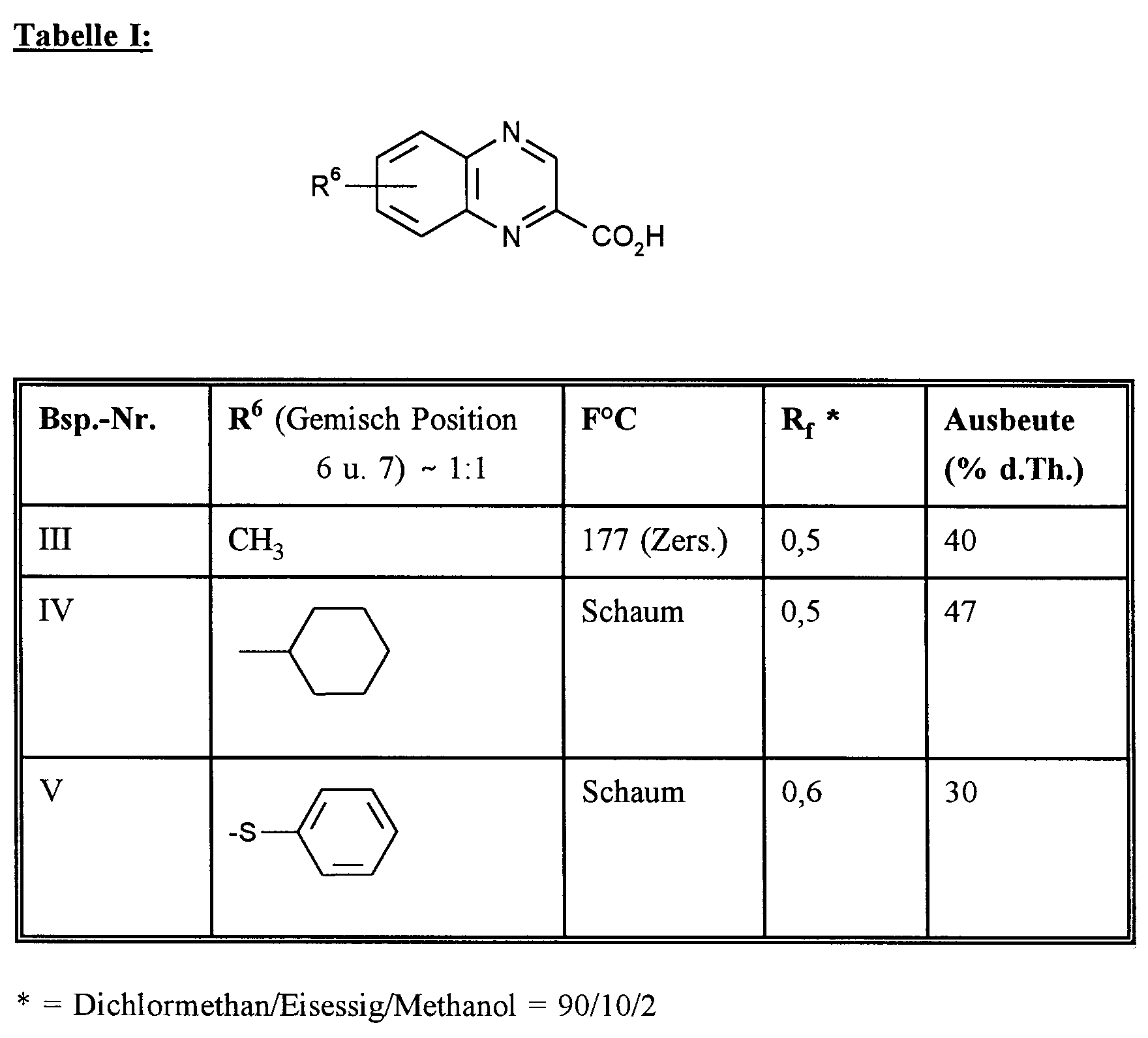
-

5 g (0,0187 Mol) 3-Methyl-4-hydroxy-7-chlorchinolin-2-carbonsäureethylester werden unter Argon mit 25 ml POCl3 zwei Stunden in einem 140°C heißen Ölbad erhitzt. Anschließend destilliert man i.V. POCl3 ab und übergießt vorsichtig mit Eis-wasser. Der ausgefallene Niederschlag wird abfiltriert, mit Wasser gewaschen, getrocknet und aus Dichlormethan / Cyclohexan (1/1) rekristallisiert.
Ausbeute: 3,8 g (71,0% d.Th.) farblose Kristalle
Fp.: 104°C
Rf (Dichlormethan) ~ 0,9 -

1 g (3,5 Mmol) der Verbindung aus Beispiel VI und 0,4 g (4,5 Mmol) Morpholin werden mit 2 Tropfen konz. HCl versetzt und in 5 ml abs. Ethanol 6 Stunden unter Rückfluß erhitzt. Es erfolgt keine Umsetzung. Nach Zusatz von 1 g (11,25 Mmol) Morpholin erhitzt man noch weitere 12 Stunden. Man engt alles i.V. ein und trennt den Rückstand säulenchromatographisch (Kieselgel 60, Dichlormethan / Essigester = 100/5).
Ausbeute: 100 mg (8,5% d.Th.) farblose Kristalle
Fp.: 74°C
Rf (Dichlormethan/Essigester = 100/3) = 0,45 -

0,2 g (0,6 Mmol) der Verbindung aus Beispiel VII werden in 5 ml Ethanol gelöst, auf 50°C erwärmt, mit 1 ml 1 n Natronlauge versetzt und 10 Minuten bei 50°C gerührt. Nach dem Abkühlen versetzt man mit 1 ml 1 n Salzsäure und erhält einen fahlgelben Niederschlag. Er wird abfiltriert und getrocknet.
Ausbeute: 130 mg (70% d.Th.) hellgelbe Kristalle
Fp.: 196°C
Rf (Dichlormethan / Methanol = 9/1) = 0,5 -

55 g (0,355 Mmol) (S,S,S)-2-Azabicyclo[3.3.0]octan-3-carbonsäure werden mit HF und SF4 fluoriert. Die dunkelbraune, alkalische Suspension (ca. 200 ml) wird filtriert, i.V. auf ca. 50 ml eingeengt und dreimal mit 50 ml Dichlormethan extrahiert. Die organische Phase wird getrocknet, i.v. auf ein kleines Volumen eingeengt (dunkelbraunes Öl) und säulenchromatographisch getrennt (Kieselgel 60, Dichlormethan).
Ausbeute: 28,8 g (45,3% d.Th.) leicht bräunliches Öl
Fp.: um 0°C, GC: 99%
Rf = 0,4 (Dichlormethan) -

0,3 g (1 Mmol) (2R)-[1-(N-Benzyloxycarbonyl)amino-2-phenyl-(1S)-ethyl]oxiran und 0,15 g (0,84 Mmol) der Verbindung aus Beispiel IX werden in 2 ml 2-Propanol gelöst und 12 h in einem geschlossenen Gefäß in einem 130°C heißen Ölbad gerührt. Nach dem Erkalten engt man den Inhalt auf ein kleines Volumen ein und trennt ihn säulenchromatographisch (Kieselgel 60, Toluol/Essigester = 100/5).
Ausbeute: 72 mg (18% d.Th.) farbloser Schaum
Rf = 0,2 (Toluol / Essigester = 100/5) -
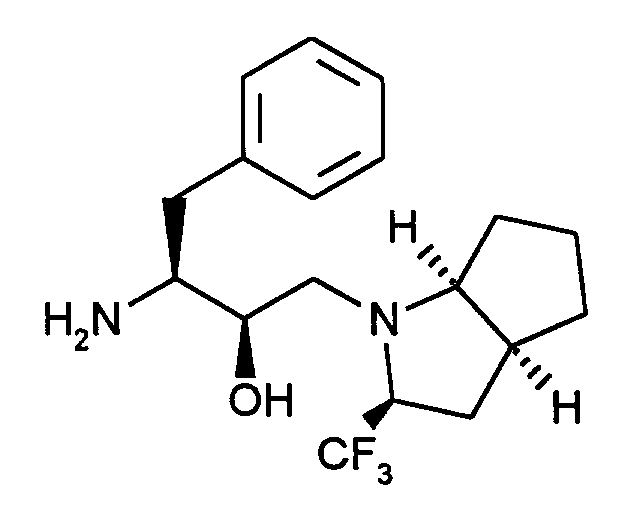
112 mg (0,235 Mmol) der Verbindung aus Beispiel X werden in 15 ml Methanol/THF (1:1) gelöst, mit etwas Pd/C (10%ig) versetzt und zwei Stunden bei Raumtemperatur hydriert. Nach Abfiltrieren des Katalysators und Abdampfen des Lösemittels erhält man ein leicht gelbes Öl.
Ausbeute: 80 mg (~quantitativ)
Rf = 0,6 (Dichlormethan / Methanol = 100/5) -

0,074 g (0,28 Mmol) Z-L-Asn-OH und 0,038 g (0,28 Mmol) HOBT (Hydroxybenzotriazol) werden unter Argonatmosphäre in 5 ml DMF gelöst, im Eisbad auf 0°C abgekühlt und unter Rühren mit 0,119 g (0,28 Mmol) Morpho-CDI versetzt. Man läßt 3 Stunden bei 0°C rühren und versetzt dann mit 0,08 g (0,234 Mmol) der Verbindung aus Beispiel XI, gelöst in 3 ml DMF. Man läßt die Temperatur auf RT ansteigen und rührt weiter über Nacht. Nach Zusatz von Wasser fällt ein farbloser Niederschlag an. Er wird filtriert, mit Wasser gewaschen und getrocknet.
Ausbeute: 87 mg (63,0 % d.Th.) farblose Kristalle
Fp.: 162°C
HPLC: 97,53 %ig -

0,008 g (0,135 Mmol) der Verbindung aus Beispiel XII werden in 10ml Methanol/THF (1:1) gelöst, mit etwas Pd/C (10%ig) versetzt und bei RT 2 Stunden hydriert. Nach Abfiltrieren des Katalysators und Abdampfen des Lösemittels i.V. erhält man ein farbloses Öl.
Ausbeute: 58 mg (95% d.Th.)
Rf = 0,2 (Dichlormethan/Methanol = 100/5) (Ansprühen mit Ninhydrin) -
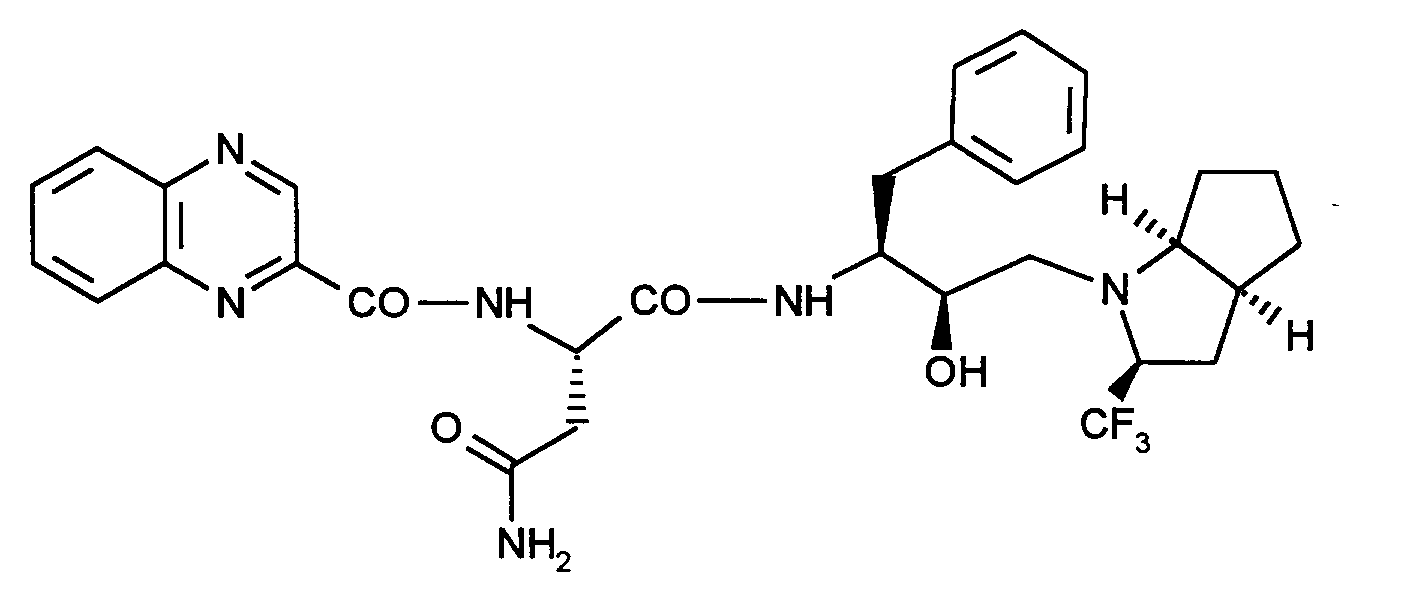
0,095 g (6,7 Mmol) HOBT und 0,071 g (0,7 Mmol) Triethylamin werden unter Argonatmosphäre in 2 ml DMF gelöst, auf -40°C abgekühlt und unter Rühren tropfenweise mit 0,14 g (0,7 Mmol) Chinoxalin-2-carbonsäurechlorid in 3 ml DMF versetzt. Man läßt 2 Stunden im Eisbad reagieren und versetzt dann mit 0,3 g (0,657 Mmol) der Verbindung aus Beispiel XIII. Man laßt das Gemisch über Nacht rühren, wobei die Temperatur auf Raumtemperatur ansteigt. Anschließend fällt man das gewünschte Produkt mit Wasser und reinigt es säulenchromatographisch (Kieselgel 60, Laufmittel: Dichlormethan/Methanol = 100/5).
Ausbeute: 130 mg (≙ 32,3% d.Th.) farbloser Schaum
Rf = 0,5 (Dichlormethan / Methanol = 100/5) -

87 mg (0,142 Mmol) der Verbindung aus Beispiel 1 werden in 1 ml Methanol gelöst, mit 1,42 ml 0,1 n Salzsäure (0,142 Mmol) versetzt und die klare Lösung lyophilisiert.
Ausbeute: 89 mg (96% d.Th.) farbloser Schaum -

0,014 g (0,08 Mol) Chinolin-2-carbonsäure und 0,011 g (0,08 Mol) HOBT werden unter Argon in 5 ml DMF gelöst, im Eisbad auf 0°C abgekühlt und mit 0,034 g (0,08 Mol) Morpho-CDI versetzt. Nach 3stündigem Rühren bei 0°C gibt man 0,03 g (0,0657 Mol) der Verbindung aus Beispiel XIII gelöst in 1 ml DMF, hinzu und laßt über Nacht rühren, wobei die Temperatur auf Raumtemperatur ansteigt. Anschließend fällt man das gewünschte Produkt durch Wasserzusatz aus, filtriert, trocknet und reinigt es durch Ausfällen mit Methanol und Diisopropylether.
Ausbeute: 270 mg (67,2% d.Th.) farbloses Glas
Rf = 0,5 (Dichlormethan / Methanol = 100/5) -

Die Titelverbindung wird in Analogie zur Vorschrift des Beispiels 2 aus 0,5 g (0,8175 Mmol) der Verbindung aus Beispiel 3 und 0,82 ml 0,1 n Salzsäure (0,82 Mmol) hergestellt.
Ausbeute: 0,5 g (96% d.Th.) farbloses Glas
In Analogie zu den obigen Beispielen werden die folgenden neuen Pseudopeptide mit trifluormethyl-substituiertem 2-Azabicyclooctan hergestellt, Tabelle 1:


-

50 mg (0,08 mMol) der Verbindung aus Beispiel 3 werden in 2 ml Pyridin gelöst, unter Argonatmosphäre mit 100 mg (0,92 mMol) Dimethylcarbamoylchlorid versetzt und über Nacht im Ölbad (100°C) erhitzt. Nach dem Abkühlen wird alles im Vakuum zur Trockne eingedampft und der Rückstand mit 5 ml Wasser und 5 ml Dichlormethan ausgerührt. - Die organische Phase wird abgetrennt, getrocknet und zur Trockne eingedampft und der Rückstand säulenchromatographisch getrennt (Kieselgel 60, Laufmittel: Dichlormethan/Essigester = 1/1).
- Farbloser Schaum, Ausbeute: 26 mg (53,6 % der Theorie)
Rf = 0,8 (Dichlormethan/Essigester = 1/1).

gegebenenfalls unter vorgeschalteter Aktivierung der Carbonsäure, in inerten Lösemitteln und in Anwesenheit einer Base und/oder eines Hilfsmittels umsetzt,
und im Fall A = CN abschließend mit Dimethylcarbamoylchlorid ebenfalls in einem der oben aufgeführten Lösemitteln umsetzt.
zunächst mit einer Epoxidierungsreaktion, gegebenenfalls mit Hilfe einer Base oder durch eine Phasentransferkatalyse, in die Verbindungen der allgemeinen Formel (V),

in welcher

in Lösemitteln umsetzt und die Schutzgruppe nach üblichen Methoden abspaltet.
Claims (5)
- Pseudopeptide mit trifluoromethyl-substituiertem 2-Azabicyclooctan der allgemeinen Formel (I)
 A für Cyano oder für einen Rest der Formel -CO-NH2 steht,R1 für einen Rest der Formel
worinR2, R3, R4, R5, R6, R7, R8, R9, R10, R11 und R12 gleich oder verschieden sind und Phenyl, Hydroxyl, Wasserstoff, Halogen, geradkettiges oder verzweigtes Alkyl mit bis zu 4 Kohlenstoffatomen, Morpholinyl, Phenylthio oder Cycloalkyl mit 3 bis 6 Kohlenstoffatomen bedeuten,a eine Zahl 0 oder 1 bedeutet,und deren Salze. - Verbindungen der allgemeinen Formel (I), gemäß Anspruch 1
in welcherA für Cyano oder für einen Rest der Formel -CO-NH2 steht,R1 für einen Rest der Formel
worinR2, R3, R4, R5, R6, R7, R8, R9, R10, R11 und R12 gleich oder verschieden sind und Phenyl, Hydroxyl, Wasserstoff, Fluor, Chlor, Brom, geradkettiges oder verzweigtes Alkyl mit bis zu 3 Kohlenstoffatomen, Morpholinyl, Phenylthio, Cyclopentyl oder Cyclohexyl bedeuten,a eine Zahl 0 oder 1 bedeutet,und deren Salze. - Verbindungen der allgemeinen Formel (I), gemäß Anspruch 1
in welcherA für Cyano oder für einen Rest der Formel -CO-NH2 steht,R1 für einen Rest der Formel
worinR2, R3, R4, R5, R6, R7, R8, R9, R10, R11 und R12 gleich oder verschieden sind Wasserstoff, Phenyl, Hydroxyl, Fluor, Chlor, Brom, Methyl, Phenylthio, Cyclopentyl, Cyclohexyl oder Morpholinyl bedeuten,a eine Zahl 0 oder 1 bedeutet,und deren Salze. - Verfahren zur Herstellung der Verbindungen der allgemeinen Formel (I), gemäß Anspruch 1, dadurch gekennzeichnet, daß man
Carbonsäuren der allgemeinen Formel (II)
R1-CO2-H (II)
in welcherR1 die im Anspruch 1 angegebene Bedeutung hatmit der Verbindung der Formel (III),
und im Fall A = CN abschließend mit Dimethylcarbamoylchlorid, ebenfalls in einem der oben aufgeführten Lösemittel umsetzt. - Arzneimittel enthaltend eine oder mehrere Verbindungen gemäß Anspruch 1.
Applications Claiming Priority (2)
| Application Number | Priority Date | Filing Date | Title |
|---|---|---|---|
| DE19500122 | 1995-01-04 | ||
| DE19500122A DE19500122A1 (de) | 1995-01-04 | 1995-01-04 | Neue Pseudopeptide mit trifluormethyl-substituierten 2-Azabicyclooctan |
Publications (1)
| Publication Number | Publication Date |
|---|---|
| EP0720988A1 true EP0720988A1 (de) | 1996-07-10 |
Family
ID=7750988
Family Applications (1)
| Application Number | Title | Priority Date | Filing Date |
|---|---|---|---|
| EP95120371A Withdrawn EP0720988A1 (de) | 1995-01-04 | 1995-12-22 | Neue Pseudopeptide mit Trifluormethyl-substituiertem 2-Azabicyclooctan |
Country Status (16)
| Country | Link |
|---|---|
| EP (1) | EP0720988A1 (de) |
| JP (1) | JPH08259534A (de) |
| KR (1) | KR960029344A (de) |
| CN (1) | CN1134941A (de) |
| AU (1) | AU4068495A (de) |
| CA (1) | CA2166372A1 (de) |
| CZ (1) | CZ1196A3 (de) |
| DE (1) | DE19500122A1 (de) |
| FI (1) | FI960014A7 (de) |
| HU (1) | HUT74806A (de) |
| IL (1) | IL116621A0 (de) |
| NO (1) | NO960017L (de) |
| NZ (1) | NZ280730A (de) |
| PL (1) | PL312147A1 (de) |
| SK (1) | SK1396A3 (de) |
| ZA (1) | ZA9626B (de) |
Cited By (1)
| Publication number | Priority date | Publication date | Assignee | Title |
|---|---|---|---|---|
| US7576215B2 (en) | 2003-12-12 | 2009-08-18 | Wyeth | Quinolines and pharmaceutical compositions thereof |
Citations (4)
| Publication number | Priority date | Publication date | Assignee | Title |
|---|---|---|---|---|
| DE2410852A1 (de) | 1973-03-16 | 1974-09-19 | Allen & Hanburys Ltd | Neue chinoxalin-2-carboxamidotetrazolderivate, verfahren zu ihrer herstellung und diese enthaltende mittel |
| EP0346847A2 (de) * | 1988-06-13 | 1989-12-20 | F. Hoffmann-La Roche Ag | Aminosäure-Derivate |
| EP0528242A2 (de) | 1991-08-10 | 1993-02-24 | Bayer Ag | Trifluormethyl-haltige Pseudopeptide |
| EP0594540A1 (de) * | 1992-10-23 | 1994-04-27 | Ciba-Geigy Ag | Antiretrovirale Acyl-Verbindungen |
-
1995
- 1995-01-04 DE DE19500122A patent/DE19500122A1/de not_active Withdrawn
- 1995-12-21 NZ NZ280730A patent/NZ280730A/en unknown
- 1995-12-22 EP EP95120371A patent/EP0720988A1/de not_active Withdrawn
- 1995-12-27 JP JP7351260A patent/JPH08259534A/ja active Pending
- 1995-12-28 AU AU40684/95A patent/AU4068495A/en not_active Abandoned
- 1995-12-29 IL IL11662195A patent/IL116621A0/xx unknown
- 1995-12-29 CA CA002166372A patent/CA2166372A1/en not_active Abandoned
- 1995-12-29 HU HU9503928A patent/HUT74806A/hu unknown
-
1996
- 1996-01-02 PL PL96312147A patent/PL312147A1/xx unknown
- 1996-01-02 FI FI960014A patent/FI960014A7/fi unknown
- 1996-01-03 KR KR1019960000007A patent/KR960029344A/ko not_active Withdrawn
- 1996-01-03 CZ CZ9611A patent/CZ1196A3/cs unknown
- 1996-01-03 SK SK13-96A patent/SK1396A3/sk unknown
- 1996-01-03 ZA ZA9626A patent/ZA9626B/xx unknown
- 1996-01-03 NO NO960017A patent/NO960017L/no unknown
- 1996-01-04 CN CN96100928A patent/CN1134941A/zh active Pending
Patent Citations (4)
| Publication number | Priority date | Publication date | Assignee | Title |
|---|---|---|---|---|
| DE2410852A1 (de) | 1973-03-16 | 1974-09-19 | Allen & Hanburys Ltd | Neue chinoxalin-2-carboxamidotetrazolderivate, verfahren zu ihrer herstellung und diese enthaltende mittel |
| EP0346847A2 (de) * | 1988-06-13 | 1989-12-20 | F. Hoffmann-La Roche Ag | Aminosäure-Derivate |
| EP0528242A2 (de) | 1991-08-10 | 1993-02-24 | Bayer Ag | Trifluormethyl-haltige Pseudopeptide |
| EP0594540A1 (de) * | 1992-10-23 | 1994-04-27 | Ciba-Geigy Ag | Antiretrovirale Acyl-Verbindungen |
Non-Patent Citations (7)
| Title |
|---|
| C.L. BUTLER, J. AM. CHEM. SOC., vol. 51, 1929, pages 3163 |
| G. HENSEKE, CHEM. BER., vol. 91, 1958, pages 1605 - 1611 |
| HANSEN, J. ET AL., EMBO JOURNAL, vol. 7, no. 6, 1988, pages 1785 - 1791 |
| JOURNAL OF VIROLOGICAL METHODS, vol. 20, 1988, pages 309 - 321 |
| P. BRONGHAM ET AL.: "Synthesis", 1987, pages: 1015 |
| R. CURCI ET AL., J. ORG. CHEM., vol. 53, 1988, pages 3890 |
| W. ADAM ET AL., J. ORG. CHEM., vol. 52, 1987, pages 2800 |
Cited By (1)
| Publication number | Priority date | Publication date | Assignee | Title |
|---|---|---|---|---|
| US7576215B2 (en) | 2003-12-12 | 2009-08-18 | Wyeth | Quinolines and pharmaceutical compositions thereof |
Also Published As
| Publication number | Publication date |
|---|---|
| CA2166372A1 (en) | 1996-07-05 |
| JPH08259534A (ja) | 1996-10-08 |
| PL312147A1 (en) | 1996-07-08 |
| NZ280730A (en) | 1996-08-27 |
| CN1134941A (zh) | 1996-11-06 |
| HUT74806A (en) | 1997-02-28 |
| NO960017D0 (no) | 1996-01-03 |
| HU9503928D0 (en) | 1996-03-28 |
| SK1396A3 (en) | 1996-08-07 |
| KR960029344A (ko) | 1996-08-17 |
| FI960014A0 (fi) | 1996-01-02 |
| ZA9626B (en) | 1996-07-10 |
| FI960014L (fi) | 1996-07-05 |
| DE19500122A1 (de) | 1996-07-11 |
| NO960017L (no) | 1996-07-05 |
| IL116621A0 (en) | 1996-03-31 |
| CZ1196A3 (en) | 1997-05-14 |
| FI960014A7 (fi) | 1996-07-05 |
| AU4068495A (en) | 1996-07-11 |
Similar Documents
| Publication | Publication Date | Title |
|---|---|---|
| DE69316223T2 (de) | Sulfonylalkanoylaminohydroxyethylaminosulfonamide verwendbar als retrovirale protease-inhibitoren | |
| DE69332002T2 (de) | Hydroxyethylaminosulfonamide verwendbar als Inhibitoren retroviraler Proteasen | |
| EP1301485B1 (de) | Acridin-derivate und deren verwendung als arzneimittel | |
| EP0270947B1 (de) | Substituierte basische 2-Aminotetraline | |
| DE69132423T2 (de) | Inhibitoren retroviraler Proteasen | |
| DE69319351T2 (de) | Hydroxyethylaminosulfamidsäure-derivate verwendbar als inhibitoren retroviraler proteasen | |
| EP0313974A1 (de) | N-substituierte Derivate von 1-Desoxynojirimycin und 1-Desoxymannonojirimycin, Verfahren zu deren Herstellung und deren Verwendung in Arzneimitteln | |
| DE69326077T2 (de) | Sulfonylalkanoylaminohydroxyethylaminosulfaminsäuren verwendbar als inhibitoren retroviraler proteasen | |
| EP0656353A1 (de) | Aminochinolin-Derivate mit einer Wirksamkeit gegen Malariaerreger | |
| DE68920998T2 (de) | 1H/3H-[4-(N,N-CYCLOALKYL UND/ODER VERZWEIGTES ALKYLCARBOXAMIDO)-BENZYL]IMDAZO[4,5-c]PYRIDINE ALS PAF-ANTAGONISTEN. | |
| DE4319039A1 (de) | Substituierte (2-Oxo-1-benzimidazolinyl)-piperidine, Verfahren zu ihrer Herstellung und Verwendung als anti-retrovirale Mittel | |
| EP1529041B1 (de) | Neue prodrugs von 1-methyl-2-(4-amidinophenylaminomethyl)-benzimidazol-5-yl-carbonsäure-(n -2-pyridil-n-2-hydroxycarbonylethyl)-amid, ihre herstellung und ihre verwendung als arzneimittel | |
| DE60025639T2 (de) | Substituierte diazepane | |
| EP0437729A2 (de) | Neue Peptide, Verfahren zu ihrer Herstellung und ihre Verwendung als Arzneimittel, insbesondere als Arzneimittel gegen Retroviren | |
| EP0432595A1 (de) | Neue Peptide, ihre Herstellung und ihre Verwendung in Arzneimitteln | |
| EP0528242A2 (de) | Trifluormethyl-haltige Pseudopeptide | |
| EP0628310A1 (de) | Verwendung von teilweise bekannten substituierten Chromanen als Arzneimittel, neue Wirkstoffe und Verfahren zu ihrer Herstellung | |
| EP0589322B1 (de) | 5-Oxo-dibenzo[a,d]cyclohepta-1,4-diene und ihre Verwendung als retrovirale Mittel | |
| EP0569811B1 (de) | Dithiolanylglycinhaltige HIV-Proteaseinhibitoren vom Hydroxyethylenisostertyp | |
| EP0623605A2 (de) | Substituierte Piperazine als anti-retrovirale Mittel | |
| EP0472077A2 (de) | Phosphonat-haltige Pseudopeptide vom Hydroxyethylamin- und Norstatin-Typ | |
| EP0720987A1 (de) | Neue acylierte Pseudopeptide mit trifluoromethylsubstituiertem 2-Azabicyclooctan | |
| EP0472078A2 (de) | Phosphonopyrrolidin- und piperidin-haltige Pseudopeptide vom Statintyp, Verfahren zu ihrer Herstellung und ihre Verwendung als Arzneimittel gegen Retroviren | |
| EP0720988A1 (de) | Neue Pseudopeptide mit Trifluormethyl-substituiertem 2-Azabicyclooctan | |
| DE69307726T2 (de) | Succinoylaminohydroxyäthylaminosulfamidsäurederivate und ihre verwendung als retrovirale proteasehemmer |
Legal Events
| Date | Code | Title | Description |
|---|---|---|---|
| PUAI | Public reference made under article 153(3) epc to a published international application that has entered the european phase |
Free format text: ORIGINAL CODE: 0009012 |
|
| AK | Designated contracting states |
Kind code of ref document: A1 Designated state(s): AT BE CH DE DK ES FR GB GR IE IT LI LU MC NL PT SE |
|
| AX | Request for extension of the european patent |
Free format text: LT PAYMENT 951222;SI PAYMENT 951222 |
|
| RAX | Requested extension states of the european patent have changed |
Free format text: LT PAYMENT 951222;SI PAYMENT 951222 |
|
| 17P | Request for examination filed |
Effective date: 19961223 |
|
| STAA | Information on the status of an ep patent application or granted ep patent |
Free format text: STATUS: THE APPLICATION HAS BEEN WITHDRAWN |
|
| 18W | Application withdrawn |
Withdrawal date: 19980507 |