EP0721185A2 - Recherche à grande vitesse d'une cassette numérique - Google Patents
Recherche à grande vitesse d'une cassette numérique Download PDFInfo
- Publication number
- EP0721185A2 EP0721185A2 EP96300046A EP96300046A EP0721185A2 EP 0721185 A2 EP0721185 A2 EP 0721185A2 EP 96300046 A EP96300046 A EP 96300046A EP 96300046 A EP96300046 A EP 96300046A EP 0721185 A2 EP0721185 A2 EP 0721185A2
- Authority
- EP
- European Patent Office
- Prior art keywords
- tape
- recording
- count
- current
- block
- Prior art date
- Legal status (The legal status is an assumption and is not a legal conclusion. Google has not performed a legal analysis and makes no representation as to the accuracy of the status listed.)
- Withdrawn
Links
Images







Classifications
-
- G—PHYSICS
- G06—COMPUTING OR CALCULATING; COUNTING
- G06F—ELECTRIC DIGITAL DATA PROCESSING
- G06F3/00—Input arrangements for transferring data to be processed into a form capable of being handled by the computer; Output arrangements for transferring data from processing unit to output unit, e.g. interface arrangements
- G06F3/06—Digital input from, or digital output to, record carriers, e.g. RAID, emulated record carriers or networked record carriers
- G06F3/0601—Interfaces specially adapted for storage systems
-
- G—PHYSICS
- G11—INFORMATION STORAGE
- G11B—INFORMATION STORAGE BASED ON RELATIVE MOVEMENT BETWEEN RECORD CARRIER AND TRANSDUCER
- G11B15/00—Driving, starting or stopping record carriers of filamentary or web form; Driving both such record carriers and heads; Guiding such record carriers or containers therefor; Control thereof; Control of operating function
- G11B15/005—Programmed access in sequence to indexed parts of tracks of operating tapes, by driving or guiding the tape
-
- G—PHYSICS
- G11—INFORMATION STORAGE
- G11B—INFORMATION STORAGE BASED ON RELATIVE MOVEMENT BETWEEN RECORD CARRIER AND TRANSDUCER
- G11B15/00—Driving, starting or stopping record carriers of filamentary or web form; Driving both such record carriers and heads; Guiding such record carriers or containers therefor; Control thereof; Control of operating function
- G11B15/02—Control of operating function, e.g. switching from recording to reproducing
- G11B15/05—Control of operating function, e.g. switching from recording to reproducing by sensing features present on or derived from record carrier or container
- G11B15/087—Control of operating function, e.g. switching from recording to reproducing by sensing features present on or derived from record carrier or container by sensing recorded signals
-
- G—PHYSICS
- G11—INFORMATION STORAGE
- G11B—INFORMATION STORAGE BASED ON RELATIVE MOVEMENT BETWEEN RECORD CARRIER AND TRANSDUCER
- G11B20/00—Signal processing not specific to the method of recording or reproducing; Circuits therefor
- G11B20/10—Digital recording or reproducing
- G11B20/12—Formatting, e.g. arrangement of data block or words on the record carriers
- G11B20/1201—Formatting, e.g. arrangement of data block or words on the record carriers on tapes
- G11B20/1202—Formatting, e.g. arrangement of data block or words on the record carriers on tapes with longitudinal tracks only
- G11B20/1205—Formatting, e.g. arrangement of data block or words on the record carriers on tapes with longitudinal tracks only for discontinuous data, e.g. digital information signals or computer program data
-
- G—PHYSICS
- G11—INFORMATION STORAGE
- G11B—INFORMATION STORAGE BASED ON RELATIVE MOVEMENT BETWEEN RECORD CARRIER AND TRANSDUCER
- G11B27/00—Editing; Indexing; Addressing; Timing or synchronising; Monitoring; Measuring tape travel
- G11B27/10—Indexing; Addressing; Timing or synchronising; Measuring tape travel
- G11B27/102—Programmed access in sequence to addressed parts of tracks of operating record carriers
- G11B27/107—Programmed access in sequence to addressed parts of tracks of operating record carriers of operating tapes
-
- G—PHYSICS
- G11—INFORMATION STORAGE
- G11B—INFORMATION STORAGE BASED ON RELATIVE MOVEMENT BETWEEN RECORD CARRIER AND TRANSDUCER
- G11B27/00—Editing; Indexing; Addressing; Timing or synchronising; Monitoring; Measuring tape travel
- G11B27/10—Indexing; Addressing; Timing or synchronising; Measuring tape travel
- G11B27/11—Indexing; Addressing; Timing or synchronising; Measuring tape travel by using information not detectable on the record carrier
- G11B27/13—Indexing; Addressing; Timing or synchronising; Measuring tape travel by using information not detectable on the record carrier the information being derived from movement of the record carrier, e.g. using tachometer
- G11B27/17—Indexing; Addressing; Timing or synchronising; Measuring tape travel by using information not detectable on the record carrier the information being derived from movement of the record carrier, e.g. using tachometer using electrical sensing means
-
- G—PHYSICS
- G11—INFORMATION STORAGE
- G11B—INFORMATION STORAGE BASED ON RELATIVE MOVEMENT BETWEEN RECORD CARRIER AND TRANSDUCER
- G11B27/00—Editing; Indexing; Addressing; Timing or synchronising; Monitoring; Measuring tape travel
- G11B27/10—Indexing; Addressing; Timing or synchronising; Measuring tape travel
- G11B27/19—Indexing; Addressing; Timing or synchronising; Measuring tape travel by using information detectable on the record carrier
- G11B27/28—Indexing; Addressing; Timing or synchronising; Measuring tape travel by using information detectable on the record carrier by using information signals recorded by the same method as the main recording
- G11B27/32—Indexing; Addressing; Timing or synchronising; Measuring tape travel by using information detectable on the record carrier by using information signals recorded by the same method as the main recording on separate auxiliary tracks of the same or an auxiliary record carrier
- G11B27/322—Indexing; Addressing; Timing or synchronising; Measuring tape travel by using information detectable on the record carrier by using information signals recorded by the same method as the main recording on separate auxiliary tracks of the same or an auxiliary record carrier used signal is digitally coded
- G11B27/323—Time code signal, e.g. on a cue track as SMPTE- or EBU-time code
-
- G—PHYSICS
- G06—COMPUTING OR CALCULATING; COUNTING
- G06F—ELECTRIC DIGITAL DATA PROCESSING
- G06F3/00—Input arrangements for transferring data to be processed into a form capable of being handled by the computer; Output arrangements for transferring data from processing unit to output unit, e.g. interface arrangements
- G06F3/06—Digital input from, or digital output to, record carriers, e.g. RAID, emulated record carriers or networked record carriers
- G06F3/0601—Interfaces specially adapted for storage systems
- G06F3/0668—Interfaces specially adapted for storage systems adopting a particular infrastructure
- G06F3/0671—In-line storage system
- G06F3/0673—Single storage device
- G06F3/0682—Tape device
-
- G—PHYSICS
- G11—INFORMATION STORAGE
- G11B—INFORMATION STORAGE BASED ON RELATIVE MOVEMENT BETWEEN RECORD CARRIER AND TRANSDUCER
- G11B15/00—Driving, starting or stopping record carriers of filamentary or web form; Driving both such record carriers and heads; Guiding such record carriers or containers therefor; Control thereof; Control of operating function
- G11B15/02—Control of operating function, e.g. switching from recording to reproducing
- G11B15/05—Control of operating function, e.g. switching from recording to reproducing by sensing features present on or derived from record carrier or container
- G11B15/06—Control of operating function, e.g. switching from recording to reproducing by sensing features present on or derived from record carrier or container by sensing auxiliary features on record carriers or containers, e.g. to stop machine near the end of a tape
- G11B15/07—Control of operating function, e.g. switching from recording to reproducing by sensing features present on or derived from record carrier or container by sensing auxiliary features on record carriers or containers, e.g. to stop machine near the end of a tape on containers
-
- G—PHYSICS
- G11—INFORMATION STORAGE
- G11B—INFORMATION STORAGE BASED ON RELATIVE MOVEMENT BETWEEN RECORD CARRIER AND TRANSDUCER
- G11B15/00—Driving, starting or stopping record carriers of filamentary or web form; Driving both such record carriers and heads; Guiding such record carriers or containers therefor; Control thereof; Control of operating function
- G11B15/18—Driving; Starting; Stopping; Arrangements for control or regulation thereof
- G11B15/1808—Driving of both record carrier and head
- G11B15/1816—Programmed access in sequence to indexed parts of operating tapes cooperating with rotating heads
-
- G—PHYSICS
- G11—INFORMATION STORAGE
- G11B—INFORMATION STORAGE BASED ON RELATIVE MOVEMENT BETWEEN RECORD CARRIER AND TRANSDUCER
- G11B2220/00—Record carriers by type
- G11B2220/90—Tape-like record carriers
Definitions
- US-A-4,398,300 and US-A-5,179,479 describe similar systems, in which mathematical equations are used to predict on a dead reckoning basis when the tape is approaching the desired target, based on the encoded motion and the thickness of the tape on the encoded reels.
- the accuracy of these systems are not sufficient to stop the tape within a suitable distance of the desired target.
- the invention thus provides a method of searching a digitally recorded tape for a block of information by first mathematically determining the present location of the tape on the spool, and the number of revolutions that must be turned, and then counting the number of revolutions turned at high speed to arrive at the desired location.
- This system decreases the access time by retracting the tape from the read and write head(s) and driving the tape at speeds of 1.27 m.sec -1 , or more, while the tape is contained within the tape cartridge.
- the system knows the tape length from the current data block to the target data block by keeping a running encoder, or line, count of tape hub rotations, locating each data block at an exact count location, and keeping a record of the position of every data block recorded on the tape.
- the supply spool is rotated through a predetermined angle and the angular displacement of the take up spool is read out.
- the amount of tape on the spool can be determined from these.
- the use of the encoder counts, as well as the tape and pack thickness, enables a superior dead reckoning estimate.
- the tape is accelerated to an optimum speed, maintains that speed for the calculated time and encoder count values and then decelerates the tape, to stop it within a fraction of a data block before the start of the requested target block.
- the tape is then engaged into contact with the read and write heads, and proceeds in the forward read mode to the start of the requested target block.
- Fig 1 is a diagram of a prior art tape deck during a tape data block access.
- Fig 2 shows a tape deck configuration during a high speed tape block access.
- Fig 3 shows how a tape deck can be converted from read/write to high speed transfer.
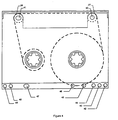
- Fig 4 is a cartridge which can be used for high speed block access with this system.
- Fig 5 is a diagram of the DDS blank tape cartridge initialization format for DOS disk emulation.
- Fig 6 shows the disk operating system "DOS” or DOS Windows version of the removable media Tape/Disk emulation file system.
- Fig 7 is a flow chart of the process of determining whether a tape format is a Tape/Disk emulation, tape emulation or a recording not recorded on this mechanism.
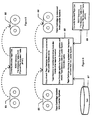
- Fig 9 shows how the directories are cached and kept current in a multiple tape loader environment.
- Fig 10 is a simplified diagram of the encoder hardware.
- Fig 12 is a flow chart of the tape positioning process.
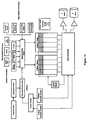
- Fig 13 is a diagram providing a detailed explanation of the dead reckoning process.
- Fig 14 is a plan view of a typical belt driven cartridge.
- Fig 15 is a view of capstan driven single input cartridge system.
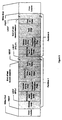
- Fig 16 is a view of tape format.
- Fig 1 is a diagram of a typical tape deck, shown in the fast forward or rewind position.
- the tape 20 is being transferred from one reel 25, to the other 24.
- the proper amount of tension is sensed by the tape tension arm 28.
- the motor of supply reel 25 maintains the appropriate tension for the tape path to read recorded data block marks with the head wheel 21 at tape speeds up to 1.27 m.sec -1 .
- the capstan 22 is typically rotating at a fixed speed, but since the idler 23 is not forcing the tape against the capstan, the tape is free to travel at a faster forward speed.
- the search speed is limited by the ability of the head wheel 21 to read recorded data block marks, the complex tape path and the number of contact points between the tape and the tape deck elements.
- the speed of tape transfer from one reel to the other can be increased by using the tape shuttle configuration of Fig 2, where the tape 20 is simply transferred from one reel to the other.
- the only elements in contact with the tape are the tape guides 26, 27.
- the relative tape distance to the requested tape data block is determined and the tape is shuttled the predetermined distance without removing the tape from the cartridge instead of reading recorded tape position marks as in the Fig 1 configuration.
- the requested data block's location is retrieved from the mounted tape's cached directory, Fig 8.
- Fig 3 One mechanism for converting the tape deck between these two configurations is shown in Fig 3.
- the tape from the first reel 24 contacts the guide 27, is controlled by the nip between the capstan 22 and idler 23 which controls the tape speed, goes around the head wheel guide 30, contacts the head wheel 21, is put under tension by tensioners 28, 29, and is guided around guide 26 to the other reel 25.
- the tensioner 29, the idler 23 and the guide 30 are all retracted down into space 31 so that the tape is allowed to run unimpeded directly between guides 27, 26.
- Fig 4 provides indicators to determine the tape media type and cartridge characteristics. High speed operations (over 2.29 m.sec -1 ) must be limited to cartridges capable of supporting high speed operations.
- Fig 4 is an example of a highspeed, DDS Digital Audio Tape (DAT) industry standard cartridge having a standard hub diameter and incorporates a number of media recognition, sensing and datum holes 40 - 49. Some specific datum holes are the high speed indication hole 46, the file protect hole 48 and the datum holes 40, 41 which identify the location of guides 26, 27. The remaining holes 44, 45, 46 and 49 form an encoded group that specify the cartridge type, media thickness and length.
- DAT Digital Audio Tape
- the first portion of the tape is the Device Area where vendor specific data is recorded.
- the point on the tape immediately after the Device Area is the Logical Beginning Of the Tape,"LBOT".
- the supply (A) reel encoder counter value at the LBOT point is recorded on the tape. Once the encoder counter value for LBOT is recorded, this value becomes the datum for LBOT for all future sessions with the cartridge regardless of which drive mechanism the cartridge is mounted on.
- the DDS Absolute Frame Count (AFC) is set to "1". Future mountings of the initialized and recorded tape will retrieve and set the LBOT into the reel encoder counters to insure that minimal error is introduced by mounting on different mechanisms. Every AFC that is recorded on the tape will contain the supply (A) reel encoder counter value when it is recorded.
- the supply (A) reel encoder counter value (distance from the beginning of tape) for each recorded file data block is also recorded in the tape's directory file.
- the tape's directory file indicates the current recorded contents of the tape and the file's distance from the beginning of the tape.
- Fig 5 shows an example of a tape recorded for the DOS-Windows operating system mass storage environment.
- the tape contains two partitions for the Tape/Disk emulation.
- Thefirst partition (Partition 1) contains tape directory and storage allocation information.
- the second partition (Partition 0) contains the stored file data blocks.
- directory and storage allocation data (ROOT/FAT and PFAT Area) are cached in the controller and all further updates (additional tape record sessions) will be made to the cached copy of the tape directory.
- the updated directory and storage allocation data are appended after the previously retrieved directory and storage allocation data recording when the tape cartridge is removed from the system.
- Fig 6 shows the disk operating system "DOS” or "DOS Windows” version of the removable media Tape/Disk emulation file system.
- the Physical File Allocation Table "PFAT” segments the tape storage into units called DDS Groups.
- the Physical File Allocation Table shows the tape being segmented into DDS Groups, each having a unique encoder counter value.
- the host DOS PC system will request a file in its ROOT directory based on the file name.
- the file's attribute, the file's size, and file's starting Cluster will be examined.
- the DOS File Allocation Table "FAT” allocates mass storage in units called Clusters. Clusters are marked as unused or used as storage is consumed.
- the starting Cluster retrieved during the file access process indexes to the physical start of the storage that was previously allocated for the stored file. Assume Cluster #4 for the example shown. Each allocated Cluster will point to the next allocated Cluster for the stored file until the last Cluster is encountered. Finally, the SCSI bus will pass the indexed Cluster access address to the Tape/Disk emulator in the form of a physical storage address; Sector, Head and Cylinder designations. The tape is emulating a Tape/Disk in this case, and the PFAT table will output the corresponding encoder counter value for the DDS group chosen.
- the tape is read for a maximum of 508 mm to locate a Logical Beginning Of Tape (LBOT) mark. If there is none, the tape is assumed to be blank and not initialized. The tape is initialized by recording all of the data areas shown in Partition 1 and Partition 0 of Fig. 5. If the LBOT mark is found in the initial 508 mm, but an LBOT encoder counter value is not detected in step 36 this is an indication the tape was not recorded on a compatible mechanism. A flag that identifies the tape as foreign is set. If the LBOT encoder counter value position is indicated, in step 36, the tape cartridge and drive mechanism are synchronized. The A and B encoder counter values are set to reflect the LBOT offset from PBOT.
- LBOT Logical Beginning Of Tape
- the cartridge data holes are inspected at step 37 to determine whether the cartridge is capable of high speed motion. If not, the high speed search capability will be disabled and the tape shuttle speed is limited to 2.29 m.sec -1 .
- the Tape/Disk emulation flag located within the vendor group, is read at step 38. If this flag is not set, the foreign flag is inspected at step 39. If the tape is foreign, the LBOT must be determined; in either case the file directories are retrieved, and position tables are cached within the controller. If the Tape/Disk flag is set, the ROOT, FAT and PFAT directories are stored into the drive's controller and the tape is ready for access operations.
- This rewinding of tapes can be avoided by using an automatic tape loader which controls a number of tapes, as shown in Fig 9.
- a number of tapes, 65 are installed in a loader, and as each one is mounted on the drive, all of the directory and table information is read into the automatic loader system controller, 68, and into the drive controller, 69, as was the system in the previous case.
- the difference is that when the tape is first mounted on the drive the tape directories are stored into the automatic loader system's disk, 67, and the tape drive controller cache.
- the automatic loader's disk is updated rather than the tape. The last position of the tape is also saved.
- the tape is wound on each hub which has a radius Rh, the radius to the outside diameter of the tape is shown as Rro, and the thickness of one layer of tape is T. From these values, various tape properties can be calculated.
- T is one tape thickness
- the tape will simply proceed to it at a speed at which the read head can read the tape locations. However, if the requested tape location is distant, the tape deck will retract the tape into the cartridge to allow dead reckoning and high speed tape shuttle on the transport.
- the flow chart for making this decision is shown in Fig 12.
- the drive controller processor When a request is received, the drive controller processor will get the requested DDS group number, and the encoder counter value of the target data block from the physical file allocation table. The current tape position is known by the drive controller. From this information, the distance and direction to the requested target data block can be determined.
- step 60 if the offset is calculated to be less than 75 mm in a forward direction, then the tape will be advanced forward at a speed at which the read head can determine the individual data block marks until the requested data block is found. In the event that the requested data block is in the reverse direction or if the data block is more than 75 mm from the current position the tape must be shuttled at seek speeds using the dead reckoning process.
- step 60 the target block is determined to be more than 75 mm away in the forward direction, or at any distance in the reverse direction, the tape elements will be retracted and the dead reckoning process will be started. Note that the tape can not be driven in the reverse direction even a small amount because of the possibility of tape damage.
- the dead reckoning process is then started, the phases being acceleration, constant velocity and deceleration.
- the encoder count should beat the target encoder count. If it does not, positioning motion adjustments are made to arrive at the proper encoder counter value.
- the tape is extracted from the cartridge and positioned for reading.
- step 61 the first data group mark is read. In the event that the first read data group mark read is greater or less than 5 data groups away from the requested data group the dead reckoning positioning algorithm is adjusted to compensate in future dead reckoning procedures.
- Fig 13 A more detailed explanation of the dead reckoning process is shown in Fig 13.
- the file name is associated with the stored, appropriate data block and tape position encoder count value.
- the resulting requested encoder count value tape position is compared with the current position encoder count to produce a requested encoder count position delta.
- the Map/Table Builder uses the count delta to determine the number of map entries and the direction of the positioning process.
- a number of constants associated with the tape motions process are considered; viscous damping, update rate (the length of time between updating servo parameters), drive inertia, desired maximum acceleration rates, friction and maximum tape speed.
- a number of tape variable parameters are calculated and considered; current pack inertia, current tape thickness, current tape length and current tape hub diameter.
- Map/Table Builder fills the A and B motor tables with a series of desired acceleration, velocity, torque and encoder count values for each of the update intervals.
- the interval counter then goes through the table, one interval at a time and outputs the associated values to the A and B motor servo controllers.
- the tape transport and tension control are completely contained within the tape cartridge. It can be an advantage in some single drive tape formats to advance the tape to a new data block at normal play speed or at multiples of the play speed without the requirement to read data headers to determine tape position or data location. Without the requirement to read data headers to determine the position of the tape, the tape can be moved at speeds that otherwise would not be possible. Access to data can be done by counting the rotations, or portions of a rotation, of the tape motion input source, and accumulating this rotational data into a counter.
- Fig 14 provides a view of the basic internal parts of a belt driven cartridge, a base plate 71 supporting the tape reels 72, 73, the rollers 74, 78, 79, and the tape guides 76, 77, 81.
- Inputting rotational force to the input roller 74 will cause drive belt 80 to rotate which will cause tape reels 72, 73 and rollers 78, 79 to rotate.
- the rotation of the tape reels 72, 73 will cause the tape to move from tape reel to tape reel 73 across guides 76, 77, 81.
- the drive system shown in Fig 15 depicts the drive input scheme of a single drive tape cartridge system.
- the cartridge 91 has a drive roller 93 which has frictional coupling to the friction drive roller 94.
- the friction drive roller is coupled to the capstan motor 97 by either a belt or a frictional coupling 95.
- the capstan motor 97 has a tachometer 96 or signal output of rotational speed.
- the tape in the cartridge 91 while moving across the read write head 92 has a relationship to the tachometer output of the capstan 97.
- the frictional components of this type of tape motion system has slippage that must be considered. This slippage becomes an additional input to the map builder of the servo positioning system.
- Fig 16 shows the relationship of the physical beginning of tape (BOT), the physical end of tape (EOT) and the recorded data.
- BOT physical beginning of tape
- EOT physical end of tape
- the distance from a given data block to another data block can be directly related to the revolutions of the capstan motor counter.
- the proper correction factors for the drive ratios and the cartridge correction factors must be applied.
- the distance between any two data blocks can be accurately determined as a capstan motor rotational value.
- the operation of a single input tape cartridge system is the same as a single reel tape system.
- the tape thickness and tape length are fixed, and if the single input cartridge system correction factors are applied, the distance the tape travels can be directly related to the capstan motor revolutions and encoder counts.
- the differences between a single and a two reel deck are: the stretch of the drive belt is related to the internal pack tension, the difference of the internal friction of the cartridge, the update of the drive wheel friction for this drive (pinch pressure), and the effects of the bow tie tape tension pattern related to direction and distance of travel from the last reversal.
Landscapes
- Engineering & Computer Science (AREA)
- General Engineering & Computer Science (AREA)
- Theoretical Computer Science (AREA)
- Human Computer Interaction (AREA)
- Physics & Mathematics (AREA)
- General Physics & Mathematics (AREA)
- Signal Processing (AREA)
- Indexing, Searching, Synchronizing, And The Amount Of Synchronization Travel Of Record Carriers (AREA)
Applications Claiming Priority (4)
| Application Number | Priority Date | Filing Date | Title |
|---|---|---|---|
| US36812195A | 1995-01-03 | 1995-01-03 | |
| US56969895A | 1995-12-08 | 1995-12-08 | |
| US368121 | 2003-02-17 | ||
| 2003-03-28 |
Publications (2)
| Publication Number | Publication Date |
|---|---|
| EP0721185A2 true EP0721185A2 (fr) | 1996-07-10 |
| EP0721185A3 EP0721185A3 (fr) | 1997-02-05 |
Family
ID=27004051
Family Applications (1)
| Application Number | Title | Priority Date | Filing Date |
|---|---|---|---|
| EP96300046A Withdrawn EP0721185A3 (fr) | 1995-01-03 | 1996-01-03 | Recherche à grande vitesse d'une cassette numérique |
Country Status (1)
| Country | Link |
|---|---|
| EP (1) | EP0721185A3 (fr) |
Cited By (3)
| Publication number | Priority date | Publication date | Assignee | Title |
|---|---|---|---|---|
| WO1999019872A1 (fr) * | 1997-10-15 | 1999-04-22 | Iomega Corporation | Dispositif de detection pour cartouches de bande a plusieurs partitions |
| EP1710676A3 (fr) * | 2005-04-06 | 2009-08-19 | Quantum Corporation | Lecteur de stockage connectable au réseau, avec accessibilité des fichiers |
| EP1009164B1 (fr) * | 1998-12-08 | 2011-03-30 | Sony Corporation | Appareil de caméra et procédé de traitement d'image |
Citations (3)
| Publication number | Priority date | Publication date | Assignee | Title |
|---|---|---|---|---|
| US4398300A (en) | 1977-12-09 | 1983-08-09 | Staar S. A. | Method and apparatus for cassette identification by operating characteristics |
| JPS6185688A (ja) | 1984-10-03 | 1986-05-01 | Casio Comput Co Ltd | 記録情報の自動選択装置 |
| US5179479A (en) | 1989-06-10 | 1993-01-12 | Samsung Electronics Co., Ltd. | Method of high speed searching for a desired tape portion in a digital audio tape recorder |
Family Cites Families (6)
| Publication number | Priority date | Publication date | Assignee | Title |
|---|---|---|---|---|
| US3714382A (en) * | 1970-12-02 | 1973-01-30 | Sykes Datatronics Inc | Method and system for bidirectional search and positioning magnetic recording tape using a reel turn sensor controlled coarse positioning |
| DE3812747A1 (de) * | 1988-04-16 | 1989-10-26 | Ostertag Ulrich | Magnetbandkassette sowie magnetbandgeraet |
| JPH0469850A (ja) * | 1990-07-10 | 1992-03-05 | Sony Corp | テープレコーダの位置制御装置 |
| JPH04339387A (ja) * | 1991-05-16 | 1992-11-26 | Canon Inc | 情報処理装置 |
| EP0587952A1 (fr) * | 1992-09-18 | 1994-03-23 | Fujitsu Limited | Méthode de commande d'un dispositif de stockage à bande |
| US5613082A (en) * | 1993-06-14 | 1997-03-18 | International Business Machines Corporation | Control of record media using device only accessible control areas and directory of media control marks and error history |
-
1996
- 1996-01-03 EP EP96300046A patent/EP0721185A3/fr not_active Withdrawn
Patent Citations (3)
| Publication number | Priority date | Publication date | Assignee | Title |
|---|---|---|---|---|
| US4398300A (en) | 1977-12-09 | 1983-08-09 | Staar S. A. | Method and apparatus for cassette identification by operating characteristics |
| JPS6185688A (ja) | 1984-10-03 | 1986-05-01 | Casio Comput Co Ltd | 記録情報の自動選択装置 |
| US5179479A (en) | 1989-06-10 | 1993-01-12 | Samsung Electronics Co., Ltd. | Method of high speed searching for a desired tape portion in a digital audio tape recorder |
Cited By (4)
| Publication number | Priority date | Publication date | Assignee | Title |
|---|---|---|---|---|
| US6031698A (en) * | 1997-06-10 | 2000-02-29 | Iomega Corporation | Multiple partition tape cartridge detection means |
| WO1999019872A1 (fr) * | 1997-10-15 | 1999-04-22 | Iomega Corporation | Dispositif de detection pour cartouches de bande a plusieurs partitions |
| EP1009164B1 (fr) * | 1998-12-08 | 2011-03-30 | Sony Corporation | Appareil de caméra et procédé de traitement d'image |
| EP1710676A3 (fr) * | 2005-04-06 | 2009-08-19 | Quantum Corporation | Lecteur de stockage connectable au réseau, avec accessibilité des fichiers |
Also Published As
| Publication number | Publication date |
|---|---|
| EP0721185A3 (fr) | 1997-02-05 |
Similar Documents
| Publication | Publication Date | Title |
|---|---|---|
| US5576903A (en) | Method and apparatus for administering data on magnetic tape medium by way of a header segment | |
| EP1145235B1 (fr) | Procede d'enregistrement a vitesse variable pour derouleur de bande magnetique | |
| KR100244839B1 (ko) | 고정된 크기의 파티션을 갖는 저장 매체의 정보기록 방법과 저 장 장치 | |
| JP2993994B2 (ja) | データ格納装置およびデータ格納方法 | |
| EP0630022A2 (fr) | Commande de milieux d'enregistrement utilisant des zones de contrôle accessibles uniquement à un dispositif d'entraînement | |
| EP0323890A2 (fr) | Méthode de stockage de données | |
| US4858039A (en) | Streaming tape drive with direct block addressability | |
| CN1150858A (zh) | 用于磁带的文件直接存取系统和减少反绕的数据配置 | |
| JP2538742B2 (ja) | テ―プシステム、テ―プのコンパティビリティ判定方法およびデ―タ書き込み方法 | |
| US5953177A (en) | Write splicing for helical scan recorder | |
| US5689382A (en) | Method and apparatus for determining head parameter for helical scan recorder | |
| JP3652372B2 (ja) | データ及び補助情報を記憶するための方法及び装置 | |
| JPH04263182A (ja) | テープ上の論理ブロック番号により識別される所望の論理データブロックに迅速にアクセスする方法 | |
| US7143232B2 (en) | Method, system, and program for maintaining a directory for data written to a storage medium | |
| US5923490A (en) | High speed searching of digital cassette | |
| US5475542A (en) | Method and apparatus for improving inter-block gap length tolerance and locate accuracy for write appends | |
| US5487171A (en) | System for reading and stopping reading data from magnetic tape into memory in response to mount command and write command respectively from the system processor | |
| JP3446852B2 (ja) | 記録媒体の動き制御方法および装置 | |
| US6580578B1 (en) | Method and apparatus for presenting both sides of a media to a read/write head in a storage device | |
| JP3160413B2 (ja) | 磁気テープ装置の記録容量算出方法 | |
| US6426842B1 (en) | Tape travel controlling apparatus for use with data recorder | |
| CN1115685C (zh) | 在数据存储媒体的未使用区里记录用户定义的数据的方法 | |
| JP2589505B2 (ja) | テープの残留長さ測定装置 | |
| US6985325B2 (en) | Updateable centralized data position information storage system | |
| US6850381B2 (en) | Apparatus and method for reducing data loss in tape media due to media edge damage on thrown wraps |
Legal Events
| Date | Code | Title | Description |
|---|---|---|---|
| PUAI | Public reference made under article 153(3) epc to a published international application that has entered the european phase |
Free format text: ORIGINAL CODE: 0009012 |
|
| AK | Designated contracting states |
Kind code of ref document: A2 Designated state(s): DE FR GB |
|
| PUAL | Search report despatched |
Free format text: ORIGINAL CODE: 0009013 |
|
| AK | Designated contracting states |
Kind code of ref document: A3 Designated state(s): DE FR GB |
|
| 17P | Request for examination filed |
Effective date: 19970805 |
|
| STAA | Information on the status of an ep patent application or granted ep patent |
Free format text: STATUS: THE APPLICATION IS DEEMED TO BE WITHDRAWN |
|
| 18D | Application deemed to be withdrawn |
Effective date: 19990803 |