EP0721428B1 - Verfahren zur herstellung von papier und karton - Google Patents
Verfahren zur herstellung von papier und karton Download PDFInfo
- Publication number
- EP0721428B1 EP0721428B1 EP94928828A EP94928828A EP0721428B1 EP 0721428 B1 EP0721428 B1 EP 0721428B1 EP 94928828 A EP94928828 A EP 94928828A EP 94928828 A EP94928828 A EP 94928828A EP 0721428 B1 EP0721428 B1 EP 0721428B1
- Authority
- EP
- European Patent Office
- Prior art keywords
- process according
- range
- amount
- formula
- content
- Prior art date
- Legal status (The legal status is an assumption and is not a legal conclusion. Google has not performed a legal analysis and makes no representation as to the accuracy of the status listed.)
- Expired - Lifetime
Links
Images
Classifications
-
- D—TEXTILES; PAPER
- D21—PAPER-MAKING; PRODUCTION OF CELLULOSE
- D21H—PULP COMPOSITIONS; PREPARATION THEREOF NOT COVERED BY SUBCLASSES D21C OR D21D; IMPREGNATING OR COATING OF PAPER; TREATMENT OF FINISHED PAPER NOT COVERED BY CLASS B31 OR SUBCLASS D21G; PAPER NOT OTHERWISE PROVIDED FOR
- D21H21/00—Non-fibrous material added to the pulp, characterised by its function, form or properties; Paper-impregnating or coating material, characterised by its function, form or properties
- D21H21/14—Non-fibrous material added to the pulp, characterised by its function, form or properties; Paper-impregnating or coating material, characterised by its function, form or properties characterised by function or properties in or on the paper
- D21H21/16—Sizing or water-repelling agents
-
- C—CHEMISTRY; METALLURGY
- C02—TREATMENT OF WATER, WASTE WATER, SEWAGE, OR SLUDGE
- C02F—TREATMENT OF WATER, WASTE WATER, SEWAGE, OR SLUDGE
- C02F1/00—Treatment of water, waste water, or sewage
- C02F1/52—Treatment of water, waste water, or sewage by flocculation or precipitation of suspended impurities
- C02F1/5236—Treatment of water, waste water, or sewage by flocculation or precipitation of suspended impurities using inorganic agents
- C02F1/5245—Treatment of water, waste water, or sewage by flocculation or precipitation of suspended impurities using inorganic agents using basic salts, e.g. of aluminium and iron
-
- D—TEXTILES; PAPER
- D21—PAPER-MAKING; PRODUCTION OF CELLULOSE
- D21H—PULP COMPOSITIONS; PREPARATION THEREOF NOT COVERED BY SUBCLASSES D21C OR D21D; IMPREGNATING OR COATING OF PAPER; TREATMENT OF FINISHED PAPER NOT COVERED BY CLASS B31 OR SUBCLASS D21G; PAPER NOT OTHERWISE PROVIDED FOR
- D21H17/00—Non-fibrous material added to the pulp, characterised by its constitution; Paper-impregnating material characterised by its constitution
- D21H17/63—Inorganic compounds
- D21H17/66—Salts, e.g. alums
-
- C—CHEMISTRY; METALLURGY
- C02—TREATMENT OF WATER, WASTE WATER, SEWAGE, OR SLUDGE
- C02F—TREATMENT OF WATER, WASTE WATER, SEWAGE, OR SLUDGE
- C02F2103/00—Nature of the water, waste water, sewage or sludge to be treated
- C02F2103/26—Nature of the water, waste water, sewage or sludge to be treated from the processing of plants or parts thereof
- C02F2103/28—Nature of the water, waste water, sewage or sludge to be treated from the processing of plants or parts thereof from the paper or cellulose industry
-
- Y—GENERAL TAGGING OF NEW TECHNOLOGICAL DEVELOPMENTS; GENERAL TAGGING OF CROSS-SECTIONAL TECHNOLOGIES SPANNING OVER SEVERAL SECTIONS OF THE IPC; TECHNICAL SUBJECTS COVERED BY FORMER USPC CROSS-REFERENCE ART COLLECTIONS [XRACs] AND DIGESTS
- Y10—TECHNICAL SUBJECTS COVERED BY FORMER USPC
- Y10S—TECHNICAL SUBJECTS COVERED BY FORMER USPC CROSS-REFERENCE ART COLLECTIONS [XRACs] AND DIGESTS
- Y10S210/00—Liquid purification or separation
- Y10S210/902—Materials removed
- Y10S210/903—Nitrogenous
Definitions
- the present invention relates to a process for making paper and cardboard, wherein at least one compound with formula (I), as specified hereinafter, is added to the aqueous disperse system of the fibers as sizing agent, and wherein the process wastewater is subjected to a biological denitrification treatment so that it can be reused.
- Paper sizing processes are known in which aluminum salts, such as sulfate and particularly basic aluminum polychloride (PAC), are used as sizing agents.
- PAC basic aluminum polychloride
- total or otherwise significant recycling of the process wastewater is practically impossible when using these inorganic sizing agents.
- the reason for this is that the anion of the salt used as sizing agent accumulates in the recycled water, and this can produce corrosion and/or deposits on the equipment if products containing chloride ions or sulfate ions, respectively, are used.
- the present invention therefore relates to a process for making paper and cardboard, according to claim 1.
- Me is Al in formula (I).
- nitrate or basic aluminum nitrate is used as sizing agent in the sizing of paper with conventional resin-based size, one obtains first of all a good sizing effect but also excellent retention of the fibers and conventional additives that form the mixture.
- the sizes used in paper sizing are cellulose-reactive rosin sizes which can generally be of three types, i.e. saponified resinates, reinforced resinates and emulsified resinates. This list, however, is non-limitative.
- the process according to the present invention is therefore characterized in that the aqueous disperse system of fibers and filler material, with the addition of a cellulose-reactive rosin size, receives the addition, in any stage of the process prior to the forming of the sheet of paper or cardboard, of an aqueous solution the concentration of which is equal to a content of 10 to 20% Al 2 O 3 , of basic aluminum nitrate which has the formula (II): Al 2 (OH) x (NO 3 ) y where
- the amount of basic aluminum nitrate added to the fiber-containing disperse system depends on the amount of size used, in a percentage ranging from 0.4% to 3% of the product in terms of the total dry substances of the paper.
- anoxic sludge designates, according to the present invention, a biological sludge which contains at least one facultative heterotrophic bacterium selected from the group consisting of Pseudomonas, Micrococcus, Archromobacter, Bacillus and Spirillum, which are able to denitrify in anoxic conditions, i.e. in the absence of atmospheric oxygen.
- These bacteria use the nitrate, instead of oxygen, as final electron acceptor in order to complete the enzymatic-catabolic chain that provides energy to the bacteria themselves.
- the waste catabolite is nitrogen instead of water and carbon dioxide as in a normal aerobic catabolism.
- the optimum pH for the action of these bacteria is 7.8 ⁇ 9, preferably in the range 8 ⁇ 8.5.
- the temperature at which the bacteria normally act is the ambient temperature, i.e. it has seasonal maximums and minimums that depend on the location of the plant. In any case it is preferable to keep the temperature of the water to be treated within the range between +5 and +50°C, preferably between +10 and +35°C.
- the amount of the compound having formula (I) used according to the present invention as sizing agent is in the range between 0.4 and 3% of polynitrate with respect to the total dry substances present in the paper, preferably between 0.7 and 1.3% with respect to the dry content. With this amount, the content of nitrates in the water to be denitrified remains within the range between 9.3 and 184 mg/l, preferably between 16.3 and 80 mg/l, of nitrate expressed as nitric nitrogen.
- the anoxic sludge required to denitrify water of this kind has a volatile suspended solid (VSS) content from 1000 to 4000 mg/l and preferably from 2500 to 3500 mg/l; this parameter gives indications as to the concentration of bacteria in the sludge.
- VSS volatile suspended solid
- the time of contact of the water to be denitrified with the anoxic sludge varies in the range between 10 minutes and 7.3 hours, preferably between 30 minutes and 1.3 hours.
- the anoxic sludge in order to be able to denitrify, requires a certain amount of carbon-containing organic substrate, expressed as C.O.D. (chemical oxygen demand), equal to 5 times the amount of nitrate, expressed as nitric nitrogen, that is present.
- C.O.D. chemical oxygen demand
- the C.O.D. must be in the range between 46.5 and 920 mg/l, preferably between 81.5 and 400 mg/l of C.O.D..
- the water does not contain a sufficient amount of C.O.D., it is necessary to add some of it in the form of methanol, in an amount by weight of 3/5 of the missing C.O.D..
- the anoxic sludge for denitrification also requires an amount of phosphorus to be used as nutrient; this amount is equal to 1 mg/l of P for every 5 mg/l of nitric nitrogen to be eliminated.
- the water to be biologically denitrified must contain an amount of P in the range between 2 and 37 mg/l, preferably between 3.5 and 16 mg/l of P. If the water does not contain a sufficient amount of P, it is necessary to add some in the form of a phosphate, as a soluble salt or as phosphoric acid, so that the added phosphor matches the required amount or is slightly in excess.
- the compounds having formula (I) or (II) which are used as sizing agents, according to the present invention are known compounds and/or can be obtained according to known methods, for example (by way of non-limitative indication) as described in US Patents 4,297,336, 3,415,618, 1,192,410, 2,931,706, 3,655,329, 3,497,459, 3,544,476, 3,983,221; GB Patents 2,113,666, 1,357,603, 2,053,172, FR Patent 2,278,319, or in the Japanese patent application published as no. 40-5044 and/or by means of methods described or indicated in the respective Gmelin volumes.
- the compounds having formula (I) or (II) can be obtained by reacting at temperatures in the range between 70 and 200°c and at pressures in the range between 1 and 10 bar, in a steel vessel covered with an enamelled acid-proof or in any case acid-resistant coating, nitric acid at a concentration of 30% to 70% by weight with the oxide or hydrated oxide or hydroxide of the metal Me in an amount between the stoichiometric value and 20% excess with respect to the stoichiometric value.
- the reaction is interrupted by cooling and/or by dilution with cold water and the product is filtered to separate it from the unreacted oxides or hydroxides and from any solid impurities.
- the above described process can be performed continuously in a series of cascade-connected reactors or in a single tubular reactor.
- oxides, hydrated oxides and/or hydroxides preferably used to prepare the compounds having formula (I) or (II) used as sizing agents, according to the present invention are listed hereafter:
- the particle size of the crystalline hydrated oxides, hydroxides, oxides or of the minerals can vary in the range between 1 and 1000 ⁇ m.
- the reflux mixture was heated up to 114°C, which is the reflux temperature, for 20 hours.
- the solution of the basic aluminum hydrate had a 12.5% content of Al 2 O 3 and a 25% basicity, which corresponds to the formula: Al 2 (OH) 1.5 (NO 3 ) 4.5
- the mixture was heated to 115°C without reflux for 7 hours.
- the reaction mixture was heated up to 150°C and this temperature was maintained for 2 hours; the pressure reached a value of 4 bar.
- a second test was conducted with a pH of approximately 5.9 without using calcium carbonate, obtaining printing paper having the following characteristics: Unit weight: 75 g/m 2 Filler: kaolin 10% Fiber composition: cellulose (various kinds) 63% groundwood pulp 7% coating waste 20% (containing 35% CaCO 3 ) Size: emulsified rosin size 0.7% BASIC POLYALUMINUM NITRATE: 1.3% (percentage referred to the dry substance) Cobb 30 sizing index: 38 g/m 2
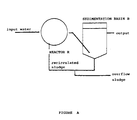
- the pilot plant used has the following characteristics: volume of reactor R 100 l volume of sedimentation basin S 100 l input water flow-rate 30 l/h
- the wastewater to be treated was sent to the pilot plant, directly into the anoxic reactor, from which after contact with the denitrifying sludge it passed into the sedimentation basin S. Here the parts in suspension precipitated by gravity, and clarified water was obtained.
Landscapes
- Chemical & Material Sciences (AREA)
- Inorganic Chemistry (AREA)
- Water Supply & Treatment (AREA)
- Hydrology & Water Resources (AREA)
- Engineering & Computer Science (AREA)
- Environmental & Geological Engineering (AREA)
- Life Sciences & Earth Sciences (AREA)
- Organic Chemistry (AREA)
- Paper (AREA)
- Machines For Manufacturing Corrugated Board In Mechanical Paper-Making Processes (AREA)
- Purification Treatments By Anaerobic Or Anaerobic And Aerobic Bacteria Or Animals (AREA)
- Micro-Organisms Or Cultivation Processes Thereof (AREA)
- Making Paper Articles (AREA)
Claims (18)
- Verfahren zur Herstellung von Papier und Karton, bei dem die wäßrige Dispersion aus Fasern und Zusatzstoff, zu der eine Zugabe von zellulose-reaktionsfähigem Kolophonium-Schlichtleim gegeben wurde, vor Bildung der Papier- oder Kartonblätter in jeder Stufe des Verfahrens eine Zugabe aus wäßriger Lösung als Schlicht- oder Bindemittel aus wenigstens einer durch die Formel (I) dargestellten Verbindung aufnimmt:und x + y = 6 ist,Me gleich Al oder Fe (III) ist,x eine Zahl zwischen 0 und 5,y eine Zahl zwischen 1 und 6,
und wobei das Verfahrensabwasser, das zumindest teilweise wiederverwendet wird, einer biologischen Denitrifikation ausgesetzt wird, wobei denitrierender sauerstoffarmer Schlamm verwendet wird, der in der Lage ist, bei Nichtvorhandensein von molekularem Sauerstoff zu denitrieren, dadurch gekennzeichnet,
daß die denitrierende biologische Behandlung bei einem pH-Wert im Bereich zwischen 8 und 8,5 unter der Bedingung durchgeführt wird, daß das zu behandelnde Abwasser, bevor es denitriert wird, folgendes beinhaltet:a) ein kohlenstoffhaltiges organisches Substrat in Form von C.O.D. (Chemical Oxygene Demand/chemischer Sauerstoffbedarf, CSB) in einer solchen Menge, daß bezüglich des Stickstoffs, der in Form von 3- oder 5-wertigem Stickstoff vorliegt, wenigstens das Massenverhältnis C.O.D.: N = 5 : 1 erreicht wird; undb) eine solche Menge an 3-wertigem Phosphor, daß wenigstens das Massenverhältnis P : N = 1 : 5 erreicht wird. - Verfahren nach Anspruch 1, dadurch gekennzeichnet, daß Me in der Formel (I) Al ist.
- Verfahren nach Anspruch 2, bei dem die Verbindung nach Formel (I) ein Bindemittel ist und hinzugegeben wird in einer Konzentration im Bereich zwischen 10 % und 20 % von Al2O3.
- Verfahren nach wenigstens einem der Ansprüche 1 bis 3, dadurch gekennzeichnet, daß der sauerstoffarme Schlamm in wenigstens eine fakultative heterotrophe Materie enthält, ausgewählt aus der Gruppe, bestehend aus Pseudomonas, Mikrokokkus, Archromobakter, Bazillen und Spirillen.
- Verfahren nach wenigstens einem der Ansprüche 1 bis 4, dadurch gekennzeichnet, daß ein sauerstoffarmer Schlamm mit einem leicht flüchtigen Schwebestoffgehalt in einem Bereich zwischen 1000 mg/l und 4000 mg/l verwendet wird.
- Verfahren nach Anspruch 5, dadurch gekennzeichnet, daß der sauerstoffarme Schlamm einen leicht flüchtigen Schwebestoffgehalt in einem Bereich zwischen 2500 mg/l und 3500 mg/l aufweist.
- Verfahren nach wenigstens einem der vorhergehenden Ansprüche, dadurch gekennzeichnet, daß die Zeit für den Kontakt zwischen dem zu denitrierenden Wasser und dem sauerstoffarmen Schlamm in einem Bereich zwischen 10 Minuten und 7,3 Stunden liegt.
- Verfahren nach Anspruch 7, dadurch gekennzeichnet, daß die Kontaktzeit einen Bereich von 30 Minuten und 1,3 Stunden umfaßt.
- Verfahren nach wenigstens einem der Ansprüche 1 und 2 und 4 bis 8, dadurch gekennzeichnet, daß bezüglich der trockenen Substanz wenigstens ein Schlichtmittel nach der Formel (I) in einer Menge von 0,3 % bis 4 % verwendet wird.
- Verfahren nach Anspruch 9, dadurch gekennzeichnet, daß bezüglich der trockenen Substanz die Menge des Schlichtmittels in einem Bereich von 0,7 % und 1,3 % liegt.
- Verfahren nach Anspruch 3, dadurch gekennzeichnet, daß die Verbindung nach Formel (II) mit einem Prozentsatz von 0,4 % bis 3 % des Produkts bezüglich der Gesamttrockensubstanz des Papiers verwendet wird.
- Verfahren nach Anspruch 11, dadurch gekennzeichnet, daß die Verbindung nach Formel (II) mit einem Prozentsatz verwendet wird, der bezüglich des verwendeten Schlichtleims zwischen 0,7 % und 1,3 % variiert.
- Verfahren nach wenigstens einem der Ansprüche 9 bis 12, dadurch gekennzeichnet, daß der Gehalt des Nitrats im Verfahrensabwasser, das der biologischen Denitrifikation ausgesetzt wird, in einem Bereich zwischen 9,3 mg/l und 184 mg/l liegt.
- Verfahren nach Anspruch 13, dadurch gekennzeichnet, daß der Nitratgehalt in einem Bereich zwischen 16,3 mg/l und 80 mg/l liegt.
- Verfahren nach Anspruch 13, dadurch gekennzeichnet, daß die Menge an C.O.D. (Chemical Oxygene Demand/chemischer Sauerstoffbedarf, CSB) im Verfahrensabwasser, das der biologischen Denitrifikation ausgesetzt wird, in einem Bereich zwischen 46,5 mg/l und 920 mg/l liegt.
- Verfahren nach Anspruch 15, dadurch gekennzeichnet, daß die Menge an C.O.D. (Chemical Oxygene Demand/chemischer Sauerstoffbedarf, CSB) in einem Bereich zwischen 81,5 mg/l und 400 mg/l liegt.
- Verfahren nach einem der Ansprüche 1 bis 3, dadurch gekennzeichnet, daß, wenn der C.O.D. (Chemical Oxygene Demand/chemischer Sauerstoffbedarf, CSB) unzureichend ist, eine solche Menge eines kohlenstoffhaltigen organischen Substrats in Form von C.O.D. (Chemical Oxygene Demand/chemischer Sauerstoffbedarf, CSB) dem zu denitrierenden Verfahrensabwasser zugegeben wird, daß, bevor es der biologischen Denitrifikation ausgesetzt wird, wenigstens der notwendige C.O.D.-Gehalt erreicht wird.
- Verfahren nach den vorhergehenden Ansprüchen, dadurch gekennzeichnet, daß der notwendige C.O.D.(Chemical Oxygene Demand/chemischer Sauerstoffbedarf, CSB)-Gehalt durch die Zugabe von Methanol in einer Menge, die gleich 3/5 der fehlenden Menge an C.O.D. ist, erreicht wird.
Applications Claiming Priority (3)
| Application Number | Priority Date | Filing Date | Title |
|---|---|---|---|
| ITMI932094A IT1270840B (it) | 1993-10-01 | 1993-10-01 | Procedimento per la fabbricazione di carta e cartone |
| ITMI932094 | 1993-10-01 | ||
| PCT/EP1994/003225 WO1995009817A1 (en) | 1993-10-01 | 1994-09-27 | Process for making paper and cardboard |
Publications (2)
| Publication Number | Publication Date |
|---|---|
| EP0721428A1 EP0721428A1 (de) | 1996-07-17 |
| EP0721428B1 true EP0721428B1 (de) | 1998-08-26 |
Family
ID=11366970
Family Applications (1)
| Application Number | Title | Priority Date | Filing Date |
|---|---|---|---|
| EP94928828A Expired - Lifetime EP0721428B1 (de) | 1993-10-01 | 1994-09-27 | Verfahren zur herstellung von papier und karton |
Country Status (10)
| Country | Link |
|---|---|
| US (1) | US5750006A (de) |
| EP (1) | EP0721428B1 (de) |
| AT (1) | ATE170161T1 (de) |
| AU (1) | AU7810394A (de) |
| CA (1) | CA2169570A1 (de) |
| DE (1) | DE69412840D1 (de) |
| FI (1) | FI961420L (de) |
| IT (1) | IT1270840B (de) |
| PL (1) | PL313732A1 (de) |
| WO (1) | WO1995009817A1 (de) |
Families Citing this family (2)
| Publication number | Priority date | Publication date | Assignee | Title |
|---|---|---|---|---|
| CA2693434A1 (en) * | 2007-07-17 | 2009-01-22 | W.R. Grace & Co.-Conn. | Basic aluminum nitrate |
| CN102167460B (zh) * | 2011-03-25 | 2012-07-25 | 中国科学院南京土壤研究所 | 一种含有有机膦酸和无机磷废水处理工艺 |
Family Cites Families (6)
| Publication number | Priority date | Publication date | Assignee | Title |
|---|---|---|---|---|
| GB1107717A (en) * | 1964-06-03 | 1968-03-27 | Peter Spence & Sons Ltd | Improvements in or relating to paper |
| US4039438A (en) * | 1975-10-15 | 1977-08-02 | Anderson Donald R | Biological denitrification of water |
| JPS5939199B2 (ja) * | 1977-02-18 | 1984-09-21 | 山田工業株式会社 | 汚水の生物学的脱窒素法 |
| DE3232095A1 (de) * | 1982-08-28 | 1984-03-01 | Linde Ag, 6200 Wiesbaden | Verfahren zur denitrifikation von kohlenstofffreiem wasser |
| DE3838864A1 (de) * | 1988-11-17 | 1990-05-31 | Giulini Chemie | Verfahren zur ausfaellung und flockung von geloesten wasser- und abwasserinhaltsstoffen sowie schwebstoffen bei der wasseraufbereitung |
| DE3917368A1 (de) * | 1989-05-29 | 1991-03-21 | Degremont | Verfahren zur biologischen umwandlung geloester nitrate und anlage zur durchfuehrung des verfahrens |
-
1993
- 1993-10-01 IT ITMI932094A patent/IT1270840B/it active IP Right Grant
-
1994
- 1994-09-27 DE DE69412840T patent/DE69412840D1/de not_active Expired - Lifetime
- 1994-09-27 EP EP94928828A patent/EP0721428B1/de not_active Expired - Lifetime
- 1994-09-27 PL PL94313732A patent/PL313732A1/xx unknown
- 1994-09-27 WO PCT/EP1994/003225 patent/WO1995009817A1/en not_active Ceased
- 1994-09-27 US US08/619,750 patent/US5750006A/en not_active Expired - Fee Related
- 1994-09-27 CA CA002169570A patent/CA2169570A1/en not_active Abandoned
- 1994-09-27 AT AT94928828T patent/ATE170161T1/de not_active IP Right Cessation
- 1994-09-27 AU AU78103/94A patent/AU7810394A/en not_active Abandoned
- 1994-09-27 FI FI961420A patent/FI961420L/fi not_active Application Discontinuation
Also Published As
| Publication number | Publication date |
|---|---|
| WO1995009817A1 (en) | 1995-04-13 |
| ITMI932094A1 (it) | 1995-04-01 |
| AU7810394A (en) | 1995-05-01 |
| DE69412840D1 (de) | 1998-10-01 |
| IT1270840B (it) | 1997-05-13 |
| CA2169570A1 (en) | 1995-04-13 |
| FI961420A0 (fi) | 1996-03-29 |
| FI961420A7 (fi) | 1996-03-29 |
| EP0721428A1 (de) | 1996-07-17 |
| ITMI932094A0 (it) | 1993-10-01 |
| PL313732A1 (en) | 1996-07-22 |
| US5750006A (en) | 1998-05-12 |
| FI961420L (fi) | 1996-03-29 |
| ATE170161T1 (de) | 1998-09-15 |
Similar Documents
| Publication | Publication Date | Title |
|---|---|---|
| CA1079604A (en) | Polymers for use in water treatment | |
| US4566986A (en) | Flocculating agents and processes for making them | |
| DE69204233T2 (de) | Verfahren und Anlage zur Abwasserreinigung durch Entphosphorung und anaerobe bzw. aerobe Behandlung. | |
| FI97218C (fi) | Jäteveden puhdistusprosessi | |
| EP0071323B1 (de) | Verfahren und Zusammensetzung zur Wasserbehandlung | |
| US20050150838A1 (en) | Cooling water scale and corrosion inhibition | |
| EP0110847B1 (de) | Verfahren zur Herstellung von basischem Aluminiumsulfat | |
| Xiao et al. | Utilizing the supernatant of waste sulfuric acid after dolomite neutralization to recover nutrients from swine wastewater | |
| EP0058794A1 (de) | Mittel und Verfahren zur Behandlung eines wässerigen Mediums | |
| RU2034795C1 (ru) | Способ извлечения из сточных вод фосфатов и органически связанного фосфора | |
| US5750006A (en) | Process for making paper and cardboard | |
| Yigit et al. | Phosphate recovery potential from wastewater by chemical precipitation at batch conditions | |
| EP0189155A1 (de) | Verfahren für die Reduzierung von Klärschlamm aus den Abwasserkläranlagen | |
| Peeva et al. | PRECIPITATION OF STRUVITE FROM DIGESTED SEWAGE SLUDGE BY SEA WATER BRINE AND NATURAL FLOCCULANTS. | |
| US5611928A (en) | Process for treating waste water | |
| EP0380299B1 (de) | Verfahren und Vorrichtung zur Verbesserung des Langelier-Index von städtischem Wasser | |
| RU2715529C1 (ru) | Способ очистки сточных вод от ионов аммония | |
| EP0063197A1 (de) | Verfahren und Zusammensetzung zur Behandlung von wässrigen Flüssigkeiten | |
| KR102578887B1 (ko) | 폴리황산알루미늄철 수용액 제조 방법 | |
| EP0646549A1 (de) | Verfahren für die Aufbereitung von gewerblichem Abwasser mit aus Nitraten oder basischen Nitraten von dreiwertigen Metallen bestehenden Flockungsmitteln | |
| US5618429A (en) | Method for reducing slime and film formation in plants in which the water of paper and pulp machines is circulated and in plants in which cooling water is circulated | |
| US20040052719A1 (en) | Preparation of non corrosive aluminum sulfate | |
| KR960002263B1 (ko) | 고농도 암모니아를 함유하는 유기질 폐수의 처리방법 | |
| Schock | Reasons for corrosion control other than the lead and copper rule | |
| Richterich et al. | Prevention of nitrification-caused erroneous biodegradability data in the closed bottle test |
Legal Events
| Date | Code | Title | Description |
|---|---|---|---|
| PUAI | Public reference made under article 153(3) epc to a published international application that has entered the european phase |
Free format text: ORIGINAL CODE: 0009012 |
|
| 17P | Request for examination filed |
Effective date: 19960229 |
|
| AK | Designated contracting states |
Kind code of ref document: A1 Designated state(s): AT BE CH DE ES FR GB GR IE IT LI NL PT SE |
|
| AX | Request for extension of the european patent |
Free format text: SI PAYMENT 960229 |
|
| RAX | Requested extension states of the european patent have changed |
Free format text: SI PAYMENT 960229 |
|
| 17Q | First examination report despatched |
Effective date: 19961121 |
|
| GRAG | Despatch of communication of intention to grant |
Free format text: ORIGINAL CODE: EPIDOS AGRA |
|
| GRAG | Despatch of communication of intention to grant |
Free format text: ORIGINAL CODE: EPIDOS AGRA |
|
| GRAH | Despatch of communication of intention to grant a patent |
Free format text: ORIGINAL CODE: EPIDOS IGRA |
|
| GRAH | Despatch of communication of intention to grant a patent |
Free format text: ORIGINAL CODE: EPIDOS IGRA |
|
| GRAA | (expected) grant |
Free format text: ORIGINAL CODE: 0009210 |
|
| AK | Designated contracting states |
Kind code of ref document: B1 Designated state(s): AT BE CH DE ES FR GB GR IE IT LI NL PT SE |
|
| AX | Request for extension of the european patent |
Free format text: SI PAYMENT 960229 |
|
| PG25 | Lapsed in a contracting state [announced via postgrant information from national office to epo] |
Ref country code: NL Free format text: LAPSE BECAUSE OF FAILURE TO SUBMIT A TRANSLATION OF THE DESCRIPTION OR TO PAY THE FEE WITHIN THE PRESCRIBED TIME-LIMIT Effective date: 19980826 Ref country code: LI Free format text: LAPSE BECAUSE OF FAILURE TO SUBMIT A TRANSLATION OF THE DESCRIPTION OR TO PAY THE FEE WITHIN THE PRESCRIBED TIME-LIMIT Effective date: 19980826 Ref country code: GR Free format text: LAPSE BECAUSE OF FAILURE TO SUBMIT A TRANSLATION OF THE DESCRIPTION OR TO PAY THE FEE WITHIN THE PRESCRIBED TIME-LIMIT Effective date: 19980826 Ref country code: FR Free format text: LAPSE BECAUSE OF FAILURE TO SUBMIT A TRANSLATION OF THE DESCRIPTION OR TO PAY THE FEE WITHIN THE PRESCRIBED TIME-LIMIT Effective date: 19980826 Ref country code: ES Free format text: THE PATENT HAS BEEN ANNULLED BY A DECISION OF A NATIONAL AUTHORITY Effective date: 19980826 Ref country code: CH Free format text: LAPSE BECAUSE OF FAILURE TO SUBMIT A TRANSLATION OF THE DESCRIPTION OR TO PAY THE FEE WITHIN THE PRESCRIBED TIME-LIMIT Effective date: 19980826 Ref country code: BE Free format text: LAPSE BECAUSE OF FAILURE TO SUBMIT A TRANSLATION OF THE DESCRIPTION OR TO PAY THE FEE WITHIN THE PRESCRIBED TIME-LIMIT Effective date: 19980826 Ref country code: AT Free format text: LAPSE BECAUSE OF FAILURE TO SUBMIT A TRANSLATION OF THE DESCRIPTION OR TO PAY THE FEE WITHIN THE PRESCRIBED TIME-LIMIT Effective date: 19980826 |
|
| REF | Corresponds to: |
Ref document number: 170161 Country of ref document: AT Date of ref document: 19980915 Kind code of ref document: T |
|
| REG | Reference to a national code |
Ref country code: CH Ref legal event code: EP |
|
| REF | Corresponds to: |
Ref document number: 69412840 Country of ref document: DE Date of ref document: 19981001 |
|
| PG25 | Lapsed in a contracting state [announced via postgrant information from national office to epo] |
Ref country code: IE Free format text: LAPSE BECAUSE OF NON-PAYMENT OF DUE FEES Effective date: 19981026 |
|
| REG | Reference to a national code |
Ref country code: IE Ref legal event code: FG4D |
|
| PG25 | Lapsed in a contracting state [announced via postgrant information from national office to epo] |
Ref country code: SE Free format text: LAPSE BECAUSE OF FAILURE TO SUBMIT A TRANSLATION OF THE DESCRIPTION OR TO PAY THE FEE WITHIN THE PRESCRIBED TIME-LIMIT Effective date: 19981126 Ref country code: PT Free format text: LAPSE BECAUSE OF FAILURE TO SUBMIT A TRANSLATION OF THE DESCRIPTION OR TO PAY THE FEE WITHIN THE PRESCRIBED TIME-LIMIT Effective date: 19981126 Ref country code: GB Free format text: LAPSE BECAUSE OF NON-PAYMENT OF DUE FEES Effective date: 19981126 |
|
| PG25 | Lapsed in a contracting state [announced via postgrant information from national office to epo] |
Ref country code: DE Free format text: LAPSE BECAUSE OF FAILURE TO SUBMIT A TRANSLATION OF THE DESCRIPTION OR TO PAY THE FEE WITHIN THE PRESCRIBED TIME-LIMIT Effective date: 19981127 |
|
| EN | Fr: translation not filed | ||
| NLV1 | Nl: lapsed or annulled due to failure to fulfill the requirements of art. 29p and 29m of the patents act | ||
| REG | Reference to a national code |
Ref country code: CH Ref legal event code: PL |
|
| PLBE | No opposition filed within time limit |
Free format text: ORIGINAL CODE: 0009261 |
|
| STAA | Information on the status of an ep patent application or granted ep patent |
Free format text: STATUS: NO OPPOSITION FILED WITHIN TIME LIMIT |
|
| GBPC | Gb: european patent ceased through non-payment of renewal fee |
Effective date: 19981126 |
|
| REG | Reference to a national code |
Ref country code: IE Ref legal event code: MM4A |
|
| 26N | No opposition filed | ||
| PG25 | Lapsed in a contracting state [announced via postgrant information from national office to epo] |
Ref country code: IT Free format text: LAPSE BECAUSE OF NON-PAYMENT OF DUE FEES;WARNING: LAPSES OF ITALIAN PATENTS WITH EFFECTIVE DATE BEFORE 2007 MAY HAVE OCCURRED AT ANY TIME BEFORE 2007. THE CORRECT EFFECTIVE DATE MAY BE DIFFERENT FROM THE ONE RECORDED. Effective date: 20050927 |