EP0722009A2 - Installation d'humidification à vapeur - Google Patents
Installation d'humidification à vapeur Download PDFInfo
- Publication number
- EP0722009A2 EP0722009A2 EP95118995A EP95118995A EP0722009A2 EP 0722009 A2 EP0722009 A2 EP 0722009A2 EP 95118995 A EP95118995 A EP 95118995A EP 95118995 A EP95118995 A EP 95118995A EP 0722009 A2 EP0722009 A2 EP 0722009A2
- Authority
- EP
- European Patent Office
- Prior art keywords
- steam
- humidification device
- distribution channel
- housing
- channel
- Prior art date
- Legal status (The legal status is an assumption and is not a legal conclusion. Google has not performed a legal analysis and makes no representation as to the accuracy of the status listed.)
- Granted
Links
- 238000009434 installation Methods 0.000 title 1
- 238000009826 distribution Methods 0.000 claims abstract description 77
- 238000007664 blowing Methods 0.000 claims description 36
- 238000000034 method Methods 0.000 claims description 18
- 238000010438 heat treatment Methods 0.000 claims description 13
- 238000001035 drying Methods 0.000 claims description 8
- 230000000694 effects Effects 0.000 claims description 4
- XLYOFNOQVPJJNP-UHFFFAOYSA-N water Substances O XLYOFNOQVPJJNP-UHFFFAOYSA-N 0.000 description 47
- 239000000463 material Substances 0.000 description 17
- 230000005484 gravity Effects 0.000 description 5
- 238000004519 manufacturing process Methods 0.000 description 5
- 238000005192 partition Methods 0.000 description 3
- 238000010025 steaming Methods 0.000 description 2
- 238000007740 vapor deposition Methods 0.000 description 2
- 230000001133 acceleration Effects 0.000 description 1
- 230000007423 decrease Effects 0.000 description 1
- 230000001419 dependent effect Effects 0.000 description 1
- 230000006866 deterioration Effects 0.000 description 1
- 230000008092 positive effect Effects 0.000 description 1
- 239000002244 precipitate Substances 0.000 description 1
- 239000007921 spray Substances 0.000 description 1
- 238000009827 uniform distribution Methods 0.000 description 1
- 238000009834 vaporization Methods 0.000 description 1
- 230000008016 vaporization Effects 0.000 description 1
Images

Classifications
-
- D—TEXTILES; PAPER
- D21—PAPER-MAKING; PRODUCTION OF CELLULOSE
- D21F—PAPER-MAKING MACHINES; METHODS OF PRODUCING PAPER THEREON
- D21F7/00—Other details of machines for making continuous webs of paper
- D21F7/008—Steam showers
-
- D—TEXTILES; PAPER
- D21—PAPER-MAKING; PRODUCTION OF CELLULOSE
- D21G—CALENDERS; ACCESSORIES FOR PAPER-MAKING MACHINES
- D21G7/00—Damping devices
Definitions
- the invention relates to a steam humidification device with a housing which has a steam connection and in which a steam blowing chamber is arranged which has a common outer wall provided with steam outlet openings with the housing.
- Steam humidification devices of this type serve to apply steam to passing material webs in order to increase their moisture and temperature.
- a widespread area of application is the production or processing of paper webs, in which such steam moistening devices are used in connection with calenders or other roller arrangements.
- steam is applied to the paper web in order to improve the gloss or smoothness, to change the bulk or density or to increase the moisture.
- a known steam humidification device (DE 43 09 076 A1), which is designed as a steam spray tube has a steam-blowing chamber, which is divided across the width (viewed in the direction of a passing material web), that is to say in the transverse direction, into several sections or zones. Each zone has a valve through which steam can flow from the interior of the housing into the steam chamber of each zone. An acceleration duct is arranged between the valve and the steam blow chamber, from which a supply duct branches off to the steam blow chamber a predetermined distance before its end.
- Another known steam humidification device (DE 41 25 062 A1), which is designed as a steam blow box, has a steam blow chamber, which is also divided into zones in the transverse direction, each zone having its own valve for admitting steam into the steam blow chamber.
- the steam entering the steam blowing chamber was previously used to heat at least one wall of the steam blowing chamber.
- the steam was dried in a steam drying section prior to use.
- Steam humidification devices of this type have the advantage that they can set the amount of steam emitted transversely to the machine direction, at least in zones, differently.
- the disadvantage here is that the many valves make the moistening device complex and therefore expensive. If a single moistening device is not sufficient for loading a material web side, for example because it is operated at the limit of its capacity, two or more moistening devices are often used. In this case, however, it is no longer necessary to equip all humidification devices with separate controllable zones. Rather, it is sufficient here to be able to change the total amount of steam emitted by the steam humidification device.
- the equalization in the cross-machine direction that is to say transversely to the material web passing by, can then be achieved with a single steam humidification device which can be controlled in zones.
- the invention has for its object to provide a steam humidification device that can be operated reliably without zone control.
- a distribution channel which can be filled with steam and is always surrounded by steam is arranged in the interior of the housing and is connected to the steam blowing chamber via a plurality of supply lines distributed over the length of the housing.
- the distribution channel is arranged essentially parallel to the steam blow chamber.
- the wording that the distribution channel is "surrounded on all sides" by steam naturally allows interruptions in this steam environment, as can be caused, for example, by fastening the distribution channel in the housing.
- the distribution channel is constantly heated, so even when the business is down. After standstills, in which the steam humidification device is also switched off, a heating phase is first required in which the distribution channel is continuously surrounded by steam before the material web is acted upon by the steam humidification device.
- the steam can be emitted relatively uniformly over the width of the humidification device.
- the distribution channel ensures that the steam is first distributed across the width, that is to say in the cross-machine direction, before it is fed to the steam-blowing chamber becomes.
- Each section of the width thus receives the same amount of steam under the same pressure.
- zone valves are absent in the present steam humidification device. Rather, only one or two valves are provided which control the steam supply to the humidifying device as a whole. Accordingly, these valves can no longer be directly adjacent to the zones.
- an interruption in operation such as can occur, for example, when replacing a roller in a calender, when changing a web of material web or in other cases, the necessary supply of heat to the steam moistening device is normally no longer guaranteed. When restarting after the interruption, this leads to the fact that the steam, which was in itself intended for the vapor deposition of the material web, initially condenses in the moistening device.
- the heating of the distribution channel ensures that the steam is brought back to the necessary temperature before it can enter the steam blowing chamber. Even if the steam should still carry some water with it, it is very likely that this water will evaporate in the distribution channel at the latest. It is therefore possible to equip such a steam humidification device with a valve for controlling the steam supply to the steam blowing chamber, which is arranged at a distance from the steam humidification device.
- the feed line for the "process steam”, ie the steam which is used to apply the material web can then cool during production breaks, it being entirely acceptable that the process steam contained therein condenses.
- the cross section of the distribution channel is larger than the sum of the cross sections of all supply lines. With this measure it is achieved in a simple manner that the steam first spreads evenly in the distribution channel before it enters the steam-blowing chamber.
- the cross-section of the distribution channel can be determined by the specified dimensioning Keep even across the width of the device without causing pressure drops that would degrade the supply to the steam chamber in certain sections.
- each supply line opens into the steam-blowing chamber with an axis which is essentially perpendicular to an impact wall opposite the supply line.
- the baffle extends essentially at a right angle to the outer wall. This means that water droplets would have to change direction again before they could exit through the steam outlet openings. However, a certain time is required for this change of direction, which leads to an increased residence time of the water droplets in the steam-blowing chamber. During this dwell time, the water droplets have evaporated with a very high probability. It must be emphasized here that the risk that water droplets can even get into the steam-blowing chamber has already been drastically reduced by the heated distribution channel. The additional measures specified here are basically only intended for rare exceptional cases.
- the supply lines preferably project into the interior of the distribution channel with a predetermined length. Steam can therefore only be removed from the interior of the distribution channel, but not from its wall areas. Because of their mass, water droplets will mainly precipitate on the walls of the distribution channel located below by gravity, so that it can be assumed that an essentially anhydrous steam is present in the interior of the distribution channel, that is to say at a distance from its walls. In addition, downward vaporization can also be carried out with this configuration. In this case, the supply lines emerge downwards from the distribution channel. However, through the protruding end of the supply lines, water that is in the distribution channel at the bottom, i.e. the wall below in the direction of gravity, does not enter the supply line.
- the supply lines between the distribution channel and the steam-blowing chamber preferably have an arc which extends over approximately 90 °. Since the supply lines are also received inside the housing and surrounded by steam, this measure achieves a small extension of the distance in which the steam is led through a heated environment.
- the arc can be used to easily generate the desired direction of the steam as it enters the steam-blowing chamber. In addition, when flowing through the arch, any water still remaining is thrown against the heated arch wall by centrifugal force and then evaporated. In addition, there is the advantageous effect of noise reduction.
- the supply lines preferably open into the steam-blowing chamber at substantially equal intervals. With this simple measure, it becomes a relatively even one Loading of the steam blowing chamber with the result of a uniform steaming in the cross machine direction.
- the distance between the end of the steam blow chamber and the mouth of the next supply line into the steam blow chamber is approximately half as large as the distance between adjacent mouths of supply lines. If you think of the steam blowing chamber divided into zones, then each supply line opens approximately in the middle of such a zone. In this way, a uniform distribution of the steam can be ensured in a simple manner.
- the distribution channel preferably has a steam supply, the distance of each supply line from the steam supply being at most half the length of the distribution channel. This measure also contributes to an equalization of the steam distribution in the steam blowing chamber. The distance that the steam has to travel is kept as short as possible with simple measures.
- the housing has a heating steam connection and the distribution channel has a separate process steam connection.
- the heating steam connection can be permanently placed under steam, whereby the interior of the housing is filled with hot steam. This steam then serves to heat the distribution channel and also to heat the steam blowing chamber, which can also be arranged inside the housing.
- the temperature of the steam can be controlled relatively easily via the pressure at the heating steam connection.
- the amount of steam fed into the distribution channel can be controlled via the process steam connection, which is provided with a valve for this purpose. This The valve no longer has to be arranged in the immediate vicinity of the moistening device, which can be very advantageous, particularly when space is limited, for example in web pockets when deflecting between nips.
- the process steam connection has an input channel running inside the housing, which is connected to the distribution channel via a connecting channel which opens approximately in the middle of the distribution channel.
- the process steam is then heated in the housing as soon as it arrives, specifically in the inlet duct. This further reduces the problems that can arise with water droplets entrained in the steam. It is only necessary to ensure that the capacity of the input channel is adapted to the amount of water to be expected.
- the inlet channel is designed as a steam drying section.
- Steam drying can be effected, for example, by increasing the cross section of the inlet channel compared to the process steam connection. The flow velocity of the incoming steam is reduced and water that enters the input channel with the steam can settle and settle relatively easily on the bottom of the input channel.
- the effect can also be improved in that the input channel effects at least one change of direction in the flow path of the steam.
- a change of direction is relatively easy for the steam to take part in.
- the water droplets which have a greater inertia due to their mass, will initially resist such a change of direction, i.e. the water droplets tend to fly straight on. If, for example, a wall is provided in this direction of movement, the water droplets are caught by this wall and can then flow downwards. In this way, water droplets are mechanically removed from the steam.
- the connecting channel branches off essentially at right angles from the input channel and a predetermined distance before its end.
- the change in direction which is forced through the connecting channel, creates an obstacle for the water droplets. Due to the sluggishness, these initially fly straight on. Because the entrance channel continues a small distance behind the branch of the connecting channel, the water droplets can also maintain their direction of movement. They then collect in a kind of sack at the end of the entrance channel and can be removed there.
- the distribution channel has at least one inlet valve, the steam-carrying parts of which are arranged in the interior of the housing, steam passing through the inlet valve from the interior of the housing into the distribution channel.
- the process steam ie the steam used for the treatment of the material web
- the distribution channel is permanently heated by the steam.
- the steam can always be up to the steam humidifier even when production is interrupted. The risk that the steam cools down and condenses out in a supply line is far lower.
- the fact that the inlet valve is arranged at least with its steam-carrying parts in the interior of the housing ensures that these parts are also permanently heated, so that here too there is no danger that the steam will cool down and condense out.
- an inlet valve is arranged in the area of each end of the distribution channel. In some cases, more space is available in the area of the ends than in the center of the steam humidifier. By using two inlet valves, a relatively uniform steam distribution can be achieved.
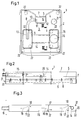
- a steam humidification device 1 has a housing 2 with an interior 3.
- a housing wall 4 is U-shaped in the interior 3. This housing wall 4 forms, together with a diffuser sheet 5, a steam blowing chamber 6.
- the diffuser sheet 5 has a large number of steam outlet openings 7.
- the steam blow chamber 6 is connected to a distribution channel 9 via a plurality of supply lines 8.
- Each supply line 8 is guided with its mouth 10 into the steam blow chamber 6 in such a way that the mouth axis 11 is directed essentially at right angles to an opposite wall of the steam blow chamber 6, which is referred to below as the baffle wall 12.
- the baffle 12 is again at a right angle to the diffuser plate 5.
- the supply line 8 protrudes with a certain length 13 into the interior of the distribution channel 9. Steam can therefore only get into the supply line 8 from inside the distribution channel 9. Water that may be deposited on the walls of the distribution channel 9 is prevented from entering the supply line 8.
- the distribution channel 9 is connected to an input channel 15 via a connecting channel 14, which forms a steam supply.
- the input channel 15 has a process steam connection 16, via the steam, which is used to act on a material web, not shown should be fed to the input channel 15.
- the input channel 15 is designed as a steam drying section. Steam drying is achieved here by two measures.
- the cross section of the inlet channel 15 is substantially larger than the cross section of the process steam connection 16. This leads to the flow rate of the steam in the input channel being reduced compared to the flow rate of the steam in the process steam connection 16, so that any water carried along can fall down.
- partition walls 17 with openings 18 are provided in the inlet channel, which, as indicated by arrows 19, force the steam to change direction.
- the steam can undergo a change in direction according to the arrows 19 relatively easily. However, due to its greater sluggishness, carried water tends to fly straight on. It hits the walls 17 and flows down there in the direction of gravity. In a manner not shown, a drainage option can be provided for each wall, for example in the form of a siphon. Instead, however, the outflowing water from all walls 17 can be collected and removed as a whole.
- the connecting channel 14 branches off from the input channel 15 a certain distance before the end of the latter, essentially at right angles.
- the input channel 15 therefore forms at its end a type of sack 20 in which remaining water droplets can be collected.
- a drainage option is provided there in a manner not shown.
- the housing 2 has a heating steam connection 21 through which the interior 3 of the housing 2 can be placed under steam. Depending on the pressure on Heating steam connection 21 and thus the pressure of the steam in the interior 3 of the housing 2 will set a corresponding temperature in the interior 3.
- the steam located in the interior 3 of the housing 2 thus heats both the inlet duct 15 and the distribution duct 19. Furthermore, the supply lines 8 and three walls of the steam-blowing chamber 6 are heated by the heating steam.
- the probability that there is still water in the steam is practically zero in the steam blowing chamber. Water droplets that have made their way there will first hit the heated baffle 12 where they can evaporate. If they do not evaporate, they are reflected back into the incoming steam jet.
- the design shown can increase the dwell time of water droplets in the steam-blowing chamber in such a way that they are vaporized there with a probability bordering on certainty and can no longer escape through the openings 7 of the diffuser sheet 5.
- the distribution channel 9 has a cross-section that is greater than the sum of the cross-sections of all supply lines 8. Therefore, a relatively uniform vapor pressure will build up in the distribution channel 9, which is no longer dependent on the distance from the connecting channel 14. Such a dependency also becomes extensive as a result mitigates that the maximum distance of a supply line 8 from the connecting channel 14 is half the length of the distribution channel 9. The distance the steam traveled from the connecting duct 14 to the farthest Supply line 8 must cover, is kept as short as possible.
- the inlet channel 15 extends approximately to the middle of the distribution channel 9
- the steam must cover half the width of the steam humidification device 1 before it can enter the distribution channel 9.
- this route is already heated overall, so that water still in the steam can evaporate. Further water which has still not evaporated or has been separated off by the partition walls 17 can then evaporate in the distribution channel 9.
- a large number of drainage openings 22 are shown schematically, but are known in connection with steam blow boxes. For example, they can be connected to a siphon or a corresponding valve in order to drain water without loss of pressure.
- Such a steam humidification device 1 can be operated with a remote valve, not shown, which controls the steam output by the steam humidification device 1 as a whole. If this valve is closed, for example in the event of a production interruption, the line between this valve, not shown, and the steam humidification device 1 will cool down. The steam contained in it can condense out. When the steam humidification device 1 is restarted, the corresponding amount of water, for example 0.5 or 1 l, will then enter the inlet channel 15. Since this is designed as a steam drying section, the water will already be substantially removed there, in part by mechanical measures such as the partition walls 17 and the bag 20 and in part by the heating. Continue Any remaining water can then evaporate in the distribution channel 9, which is fully heated.
- the steam humidification device 101 is now arranged in such a way that the steaming takes place downwards in the direction of gravity. Accordingly, the diffuser sheet 105, which forms the outer wall of the housing 102 in this area, is arranged at the bottom in the direction of gravity. Accordingly, the supply line 108 also emerges downward from the distribution channel 109. Even if water should accumulate in the distribution channel 109, this water cannot flow into the steam blowing chamber 106 due to the end 113 of the supply line 108 protruding into the distribution channel 109.
- the distribution channel 109 no longer has a separate process steam connection. Rather, only a single steam connection 121 is provided, which supplies the interior 103 of the housing 102 with steam.
- valves 23 To supply the distribution channel 109, two valves 23 are provided, the steam-carrying parts of which are arranged in the interior 103 of the housing 102.
- the valves 23 form inlet valves for the distribution channel 109, ie they control the steam supply from the interior 103 of the housing 102 into the distribution channel 109.
- the distribution channel 109 is permanently and completely surrounded by steam.
- the flow path of the steam is indicated by arrows.
- valves 23 are arranged in the region of the two ends of the distribution channel 109, i.e. here, too, the maximum distance from the entry into the distribution channel 109 to the mouth of the most distant supply line 108 is a maximum of half the length of the distribution channel 109.
- the distance E between adjacent mouths of the supply lines 108 into the steam blowing chamber 106 is essentially the same.
- the distance E 'between the supply line 108, which is most closely adjacent to the end of the steam-blowing chamber 106, is approximately half the distance E.
- the individual supply lines therefore always open in the middle of imaginary zones of the steam-blowing chamber 106, which, however, are neither individually divided nor are individually controllable.
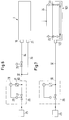
- FIG. 6 schematically shows the path of the steam from a steam source 25 to the steam humidification device 1.
- a pressure regulator 26 which in a known manner has a valve 27 which is controlled by a drive 28 controlled by a regulator 28 29 keeps the pressure at the outlet 30 of the pressure regulator 26 constant.
- the controller or converter 28 receives its measured values via a sensor 31.
- the steam line 32 branches behind the pressure regulator 26.
- a branch 33 is connected directly to the heating steam connection 21 of the steam humidification device 1. Steam is therefore constantly present at the pressure which is predetermined by the pressure regulator 26.
- Another branch 34 is connected to the process steam connection 16.
- a valve 35 is arranged with which the process steam supply is controlled in other words, the amount of steam to be directed onto the material web.
- FIG. 7 shows schematically the path of the steam in the configuration of the device 101 according to FIGS. 4 and 5.
- a steam source 25 with a downstream pressure regulator 26 is provided.
- the output 30 of the pressure regulator is connected via the steam line 32 directly to the heating steam connection 121 of the steam humidification device 101.
- the steam supplied via the connection 121 is supplied to the steam blowing chamber 106 via the valves 23, which are controlled jointly via a common line 24.
- the valves 23, 25 are designed as self-closing valves, for example as spring-closing valves, which remain closed without being acted upon by a corresponding control force. They are preferably designed as linear valves, in which the amount of vapor passed is linearly related to the control signal for the valve 23, 25.
Landscapes
- Air Humidification (AREA)
- Paper (AREA)
- Devices For Medical Bathing And Washing (AREA)
Applications Claiming Priority (2)
| Application Number | Priority Date | Filing Date | Title |
|---|---|---|---|
| DE19500752 | 1995-01-12 | ||
| DE19500752A DE19500752C2 (de) | 1995-01-12 | 1995-01-12 | Dampfbefeuchtungseinrichtung |
Publications (3)
| Publication Number | Publication Date |
|---|---|
| EP0722009A2 true EP0722009A2 (fr) | 1996-07-17 |
| EP0722009A3 EP0722009A3 (fr) | 1998-02-04 |
| EP0722009B1 EP0722009B1 (fr) | 2002-03-13 |
Family
ID=7751359
Family Applications (1)
| Application Number | Title | Priority Date | Filing Date |
|---|---|---|---|
| EP95118995A Expired - Lifetime EP0722009B1 (fr) | 1995-01-12 | 1995-12-02 | Installation d'humidification à vapeur |
Country Status (5)
| Country | Link |
|---|---|
| US (1) | US5623771A (fr) |
| EP (1) | EP0722009B1 (fr) |
| AT (1) | ATE214445T1 (fr) |
| CA (1) | CA2165095C (fr) |
| DE (1) | DE19500752C2 (fr) |
Cited By (1)
| Publication number | Priority date | Publication date | Assignee | Title |
|---|---|---|---|---|
| EP1213387A3 (fr) * | 2000-12-08 | 2003-12-03 | Voith Paper Patent GmbH | Machine pour la fabrication d'une bande fibreuse |
Families Citing this family (8)
| Publication number | Priority date | Publication date | Assignee | Title |
|---|---|---|---|---|
| CA2192520A1 (fr) | 1996-03-05 | 1997-09-05 | Ian M. Penn | Tringle extensible et methode de mise en place de ladite tringle |
| US6796997B1 (en) | 1996-03-05 | 2004-09-28 | Evysio Medical Devices Ulc | Expandable stent |
| EP1066804B1 (fr) | 1996-03-05 | 2004-07-14 | Evysio Medical Devices Ulc | Stent extensible |
| US5798026A (en) * | 1996-10-04 | 1998-08-25 | Measurex Devron Inc. | Dry end steam applicator |
| US6287425B1 (en) * | 1998-05-18 | 2001-09-11 | The Procter & Gamble Company | Apparatus for increasing bulk of foreshortened fibrous web |
| WO2010037226A1 (fr) * | 2008-10-01 | 2010-04-08 | Dr. Gum Inc. | Appareil et procédé pour éliminer d’une surface, des dépôts de gomme, des substances adhésives, de la peinture et autre |
| DE102010041762A1 (de) | 2010-09-30 | 2012-04-05 | Voith Patent Gmbh | Vorrichtung zum Befeuchten der Oberflächenschicht einer Faserstoffbahn |
| DE102015217370A1 (de) * | 2015-09-11 | 2017-01-05 | Voith Patent Gmbh | Dampfblaskasten |
Citations (2)
| Publication number | Priority date | Publication date | Assignee | Title |
|---|---|---|---|---|
| DE4125062A1 (de) | 1991-07-29 | 1993-02-04 | Vib Apparatebau Gmbh | Dampfblaskasten |
| DE4309076A1 (de) | 1993-03-20 | 1994-09-22 | Vib Apparatebau Gmbh | Dampfsprührohr und Verfahren zum Einstellen von Glanz und/oder Glätte einer Materialbahn |
Family Cites Families (6)
| Publication number | Priority date | Publication date | Assignee | Title |
|---|---|---|---|---|
| US3097994A (en) * | 1961-02-03 | 1963-07-16 | Kimberly Clark Co | Steaming device for a papermaking machine |
| US3850792A (en) * | 1972-10-26 | 1974-11-26 | R Pennington | Steam drying device for paper making machine |
| US4398355A (en) * | 1981-02-25 | 1983-08-16 | Dove Norman F | Steam distribution apparatus |
| MX160230A (es) * | 1986-02-04 | 1990-01-10 | Beloit Corp | Mejoras a valvula de control para una caja de vapor de una maquina secadora de papel |
| WO1991014045A1 (fr) * | 1990-03-09 | 1991-09-19 | Devron-Hercules Inc. | Douche a vapeur a egouttage reduit du condensat |
| US5079855A (en) * | 1991-02-15 | 1992-01-14 | Carrier Associates, Inc. | Drying chamber and air distribution means therefor |
-
1995
- 1995-01-12 DE DE19500752A patent/DE19500752C2/de not_active Expired - Fee Related
- 1995-12-02 AT AT95118995T patent/ATE214445T1/de not_active IP Right Cessation
- 1995-12-02 EP EP95118995A patent/EP0722009B1/fr not_active Expired - Lifetime
- 1995-12-13 CA CA002165095A patent/CA2165095C/fr not_active Expired - Fee Related
-
1996
- 1996-01-03 US US08/582,453 patent/US5623771A/en not_active Expired - Lifetime
Patent Citations (2)
| Publication number | Priority date | Publication date | Assignee | Title |
|---|---|---|---|---|
| DE4125062A1 (de) | 1991-07-29 | 1993-02-04 | Vib Apparatebau Gmbh | Dampfblaskasten |
| DE4309076A1 (de) | 1993-03-20 | 1994-09-22 | Vib Apparatebau Gmbh | Dampfsprührohr und Verfahren zum Einstellen von Glanz und/oder Glätte einer Materialbahn |
Cited By (1)
| Publication number | Priority date | Publication date | Assignee | Title |
|---|---|---|---|---|
| EP1213387A3 (fr) * | 2000-12-08 | 2003-12-03 | Voith Paper Patent GmbH | Machine pour la fabrication d'une bande fibreuse |
Also Published As
| Publication number | Publication date |
|---|---|
| US5623771A (en) | 1997-04-29 |
| ATE214445T1 (de) | 2002-03-15 |
| DE19500752C1 (de) | 1996-01-04 |
| DE19500752C2 (de) | 2000-11-30 |
| CA2165095A1 (fr) | 1996-07-13 |
| EP0722009B1 (fr) | 2002-03-13 |
| EP0722009A3 (fr) | 1998-02-04 |
| CA2165095C (fr) | 1998-12-01 |
Similar Documents
| Publication | Publication Date | Title |
|---|---|---|
| EP0275914B1 (fr) | Dispositif pour amener la vapeur sur une bande comme le papier | |
| AT392991B (de) | Trockenpartie fuer eine maschine zur herstellung oder verarbeitung von faserbahnen, insbesondere papierbahnen | |
| DE4301023C2 (de) | Verfahren und Vorrichtung zum Erhöhen von Glanz und/oder Glätte einer Papierbahn | |
| WO1983000514A1 (fr) | Groupe de cylindres de sechage | |
| DE19534573C2 (de) | Dampfblaskasten und Verfahren zum zonenweisen Temperieren einer laufenden Papierbahn | |
| EP0528160B1 (fr) | Diffuseur de vapeur | |
| EP0722009B1 (fr) | Installation d'humidification à vapeur | |
| DE69205778T2 (de) | Dampfblaskasten. | |
| EP2783039B1 (fr) | Procédé permettant de transférer une bande de matériau d'un dispositif de séchage à une unité fonctionnelle située en aval et dispositif de séchage | |
| EP0618328B1 (fr) | Distributeur de vapeur et procédé pour contrÔler le lissé et/ou la brillance d'une bande | |
| EP0319681A2 (fr) | Dispositif pour le traitement thermique d'une large bande de textile en déplacement continu | |
| EP0275915B1 (fr) | Distributeur de vapeur | |
| DE4309076C2 (de) | Dampfsprührohr | |
| DE102004064010B4 (de) | Verfahren zur Steuerung von Dampfmenge und/oder Dampfaustrittsgeschwindigkeit aus den Dampfaustrittsöffnungen eines Dampfblaskastens | |
| DE102005016706B4 (de) | Mit Seitenführung ausgestatteter Unterdruck-Bandförderer für Materialbahn-Herstellungsmaschinen | |
| DE202018101776U1 (de) | Dampfbalken und Schrumpftunnel | |
| EP1531197B1 (fr) | Distributeur de vapeur | |
| DE29703627U1 (de) | Vorrichtung zum Abdichten eines Dampfblaskastens | |
| DE10255716B4 (de) | Bahnbehandlungsvorrichtung, insbesondere Kalander | |
| AT16082U1 (de) | Vorrichtung zum kühlen einer faserbahn | |
| DE102006027529A1 (de) | Vorrichtung zum berührungslosen Führen einer Materialbahn, insbesondere einer Papier- oder Kartonbahn, und Anordnung mit einer Beschichtungseinrichtung für eine Materialbahn und einer derartigen Vorrichtung | |
| DE102004062563A1 (de) | Vorrichtung und Verfahren zum Behandeln einer Materialbahn | |
| DE102011086617A1 (de) | Dampfblaskasten | |
| DE102004028081A1 (de) | Vorrichtung zum Anlegen einer Folienbahn | |
| DE19929661A1 (de) | Verfahren und Anordnung bei der Nachbehandlungsmaschine oder dergleichen für Papierbahn oder dergleichen |
Legal Events
| Date | Code | Title | Description |
|---|---|---|---|
| PUAI | Public reference made under article 153(3) epc to a published international application that has entered the european phase |
Free format text: ORIGINAL CODE: 0009012 |
|
| AK | Designated contracting states |
Kind code of ref document: A2 Designated state(s): AT FR GB IT SE |
|
| PUAL | Search report despatched |
Free format text: ORIGINAL CODE: 0009013 |
|
| AK | Designated contracting states |
Kind code of ref document: A3 Designated state(s): AT FR GB IT SE |
|
| 17P | Request for examination filed |
Effective date: 19980224 |
|
| 17Q | First examination report despatched |
Effective date: 19991123 |
|
| GRAG | Despatch of communication of intention to grant |
Free format text: ORIGINAL CODE: EPIDOS AGRA |
|
| GRAG | Despatch of communication of intention to grant |
Free format text: ORIGINAL CODE: EPIDOS AGRA |
|
| GRAH | Despatch of communication of intention to grant a patent |
Free format text: ORIGINAL CODE: EPIDOS IGRA |
|
| GRAH | Despatch of communication of intention to grant a patent |
Free format text: ORIGINAL CODE: EPIDOS IGRA |
|
| REG | Reference to a national code |
Ref country code: GB Ref legal event code: IF02 |
|
| GRAA | (expected) grant |
Free format text: ORIGINAL CODE: 0009210 |
|
| AK | Designated contracting states |
Kind code of ref document: B1 Designated state(s): AT FR GB IT SE |
|
| REF | Corresponds to: |
Ref document number: 214445 Country of ref document: AT Date of ref document: 20020315 Kind code of ref document: T |
|
| GBT | Gb: translation of ep patent filed (gb section 77(6)(a)/1977) |
Effective date: 20020617 |
|
| ET | Fr: translation filed | ||
| PLBE | No opposition filed within time limit |
Free format text: ORIGINAL CODE: 0009261 |
|
| STAA | Information on the status of an ep patent application or granted ep patent |
Free format text: STATUS: NO OPPOSITION FILED WITHIN TIME LIMIT |
|
| 26N | No opposition filed |
Effective date: 20021216 |
|
| PGFP | Annual fee paid to national office [announced via postgrant information from national office to epo] |
Ref country code: FR Payment date: 20061123 Year of fee payment: 12 |
|
| PGFP | Annual fee paid to national office [announced via postgrant information from national office to epo] |
Ref country code: GB Payment date: 20061129 Year of fee payment: 12 |
|
| PGFP | Annual fee paid to national office [announced via postgrant information from national office to epo] |
Ref country code: AT Payment date: 20061229 Year of fee payment: 12 |
|
| PGFP | Annual fee paid to national office [announced via postgrant information from national office to epo] |
Ref country code: IT Payment date: 20071222 Year of fee payment: 13 |
|
| PGFP | Annual fee paid to national office [announced via postgrant information from national office to epo] |
Ref country code: SE Payment date: 20071220 Year of fee payment: 13 |
|
| GBPC | Gb: european patent ceased through non-payment of renewal fee |
Effective date: 20071202 |
|
| PG25 | Lapsed in a contracting state [announced via postgrant information from national office to epo] |
Ref country code: AT Free format text: LAPSE BECAUSE OF NON-PAYMENT OF DUE FEES Effective date: 20071202 |
|
| REG | Reference to a national code |
Ref country code: FR Ref legal event code: ST Effective date: 20081020 |
|
| PG25 | Lapsed in a contracting state [announced via postgrant information from national office to epo] |
Ref country code: GB Free format text: LAPSE BECAUSE OF NON-PAYMENT OF DUE FEES Effective date: 20071202 |
|
| PG25 | Lapsed in a contracting state [announced via postgrant information from national office to epo] |
Ref country code: FR Free format text: LAPSE BECAUSE OF NON-PAYMENT OF DUE FEES Effective date: 20071231 |
|
| EUG | Se: european patent has lapsed | ||
| PG25 | Lapsed in a contracting state [announced via postgrant information from national office to epo] |
Ref country code: SE Free format text: LAPSE BECAUSE OF NON-PAYMENT OF DUE FEES Effective date: 20081203 |
|
| PG25 | Lapsed in a contracting state [announced via postgrant information from national office to epo] |
Ref country code: IT Free format text: LAPSE BECAUSE OF NON-PAYMENT OF DUE FEES Effective date: 20081202 |