EP0722164A1 - Méthode et appareil pour charactériser un signal d'entrée - Google Patents
Méthode et appareil pour charactériser un signal d'entrée Download PDFInfo
- Publication number
- EP0722164A1 EP0722164A1 EP95309299A EP95309299A EP0722164A1 EP 0722164 A1 EP0722164 A1 EP 0722164A1 EP 95309299 A EP95309299 A EP 95309299A EP 95309299 A EP95309299 A EP 95309299A EP 0722164 A1 EP0722164 A1 EP 0722164A1
- Authority
- EP
- European Patent Office
- Prior art keywords
- signal
- accordance
- neural network
- feature set
- voice
- Prior art date
- Legal status (The legal status is an assumption and is not a legal conclusion. Google has not performed a legal analysis and makes no representation as to the accuracy of the status listed.)
- Granted
Links
Images

Classifications
-
- G—PHYSICS
- G01—MEASURING; TESTING
- G01R—MEASURING ELECTRIC VARIABLES; MEASURING MAGNETIC VARIABLES
- G01R29/00—Arrangements for measuring or indicating electric quantities not covered by groups G01R19/00 - G01R27/00
- G01R29/26—Measuring noise figure; Measuring signal-to-noise ratio
-
- G—PHYSICS
- G10—MUSICAL INSTRUMENTS; ACOUSTICS
- G10L—SPEECH ANALYSIS TECHNIQUES OR SPEECH SYNTHESIS; SPEECH RECOGNITION; SPEECH OR VOICE PROCESSING TECHNIQUES; SPEECH OR AUDIO CODING OR DECODING
- G10L15/00—Speech recognition
- G10L15/02—Feature extraction for speech recognition; Selection of recognition unit
-
- H—ELECTRICITY
- H04—ELECTRIC COMMUNICATION TECHNIQUE
- H04M—TELEPHONIC COMMUNICATION
- H04M3/00—Automatic or semi-automatic exchanges
- H04M3/22—Arrangements for supervision, monitoring or testing
-
- G—PHYSICS
- G10—MUSICAL INSTRUMENTS; ACOUSTICS
- G10L—SPEECH ANALYSIS TECHNIQUES OR SPEECH SYNTHESIS; SPEECH RECOGNITION; SPEECH OR VOICE PROCESSING TECHNIQUES; SPEECH OR AUDIO CODING OR DECODING
- G10L25/00—Speech or voice analysis techniques not restricted to a single one of groups G10L15/00 - G10L21/00
- G10L25/27—Speech or voice analysis techniques not restricted to a single one of groups G10L15/00 - G10L21/00 characterised by the analysis technique
- G10L25/30—Speech or voice analysis techniques not restricted to a single one of groups G10L15/00 - G10L21/00 characterised by the analysis technique using neural networks
-
- H—ELECTRICITY
- H04—ELECTRIC COMMUNICATION TECHNIQUE
- H04M—TELEPHONIC COMMUNICATION
- H04M2201/00—Electronic components, circuits, software, systems or apparatus used in telephone systems
- H04M2201/40—Electronic components, circuits, software, systems or apparatus used in telephone systems using speech recognition
Definitions
- the invention relates to methods and apparatus for characterizing input signals and, more particularly, to the assessment of signal characteristics, such as signal quality, associated with subjective human analysis.
- signal characteristics must be measured to determine whether systems which produce, transmit, and receive the signals are properly performing.
- assessment of signal characteristics is complex because many factors are considered in such an assessment.
- signal assessment often involves subjective human analysis. The resulting analysis is used to monitor the systems associated with the signal.
- voice coding refers to electrical representations of voice signals including, but not limited to, output from an individual voice coder/decoder (i.e., a device which produces a digital representation of a voice signal, typically for a telecommunications system), output from a voice coder which has been carried by a communications system and decoded, and analog representations of voice signals.
- performance of voice signal control schemes frequently entails subjective listening tests. To be reliable, these tests must be consistent for all voice signals from a particular signal source, such as a voice coder, and coder independent for comparative assessment of the subjective quality of the various coding algorithms.
- a commonly used subjective measure is the mean opinion score ("MOS").
- MOS tests involve a sufficiently large subject group of people (e.g., 44 people), take longer than one month to conduct, and are expensive (e.g., can cost in the range of tens of thousands of dollars for preparation, testing and analysis).
- a long-sought ideal has been to evaluate voice quality with an automated measurement technique. Since any measure must ultimately be validated by comparison with subjective human assessment, the automated measure must predict the score of a generally accepted signal quality rating scheme, such as MOS, with accuracy and consistency.
- the present invention provides a method and apparatus for measuring at least one signal characteristic. Initially, a set of features is selected which characterize a signal. An intelligent system, such as a neural network, is trained in the relationship between feature sets and signal characteristics. The selected feature set is then extracted from a first input signal. The extracted feature set from the first signal is input to the trained intelligent system. The intelligent system creates an output signal based on the feature set extracted from the first input signal. This output signal is then used to characterize the input signal.
- An intelligent system such as a neural network
- the subject invention is employed to assess voice quality, typically as expressed in MOS scores, in a manner which accurately corresponds to the analysis of human evaluators.
- voice quality typically as expressed in MOS scores
- the present invention provides a measurement technique which is independent of various voice coding algorithms and consistent for any given algorithm.
- FIG. 1 schematically depicts a signal characteristic measurement system according to the present invention.
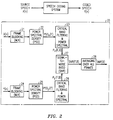
- FIG. 2 schematically depicts a feature extraction system for voice signals employed in the signal characteristic measurement system of FIG. 1.
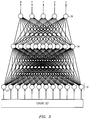
- FIG. 3 schematically depicts a multilayer perceptron ("MLP") neural network employed in one embodiment of a signal characteristic measurement system.
- MLP multilayer perceptron
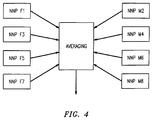
- FIG. 4 schematically depicts an array of the signal characteristic measurement systems of FIG. 1 used to provide an average signal characteristic measurement.
- Signal measurement system 10 comprises two principal sub-systems, feature extraction system 20 and intelligent system 30.
- feature extraction system 20 a feature set is derived from an input signal.
- a feature set is a group of signal parameters which characterize an input signal with respect to the signal attribute to be measured by system 10.
- the feature set extracted from the input signal is sent from feature extraction system 20 to intelligent system 30.
- the use of feature extraction system 20 reduces the quantity of data to be processed by the intelligent system.
- Intelligent system 30 is trained in the relationship between feature sets and corresponding signal characteristics. Intelligent system 30 operates on the extracted feature set to produce an output signal which characterizes the input signal for the attribute being measured.
- intelligent system refers to any system which is capable of adaptive learning, e.g., learning which is adjusted to accommodate changing circumstances. Examples of intelligent systems are systems which employ artificial intelligence (e.g., machines capable of imitating intelligent human behavior) and neural networks. Neural networks include systems which can learn through trial and error processes. Typically, neural networks employ plural processing elements interconnected such that the network simulates higher order mental functioning.
- FIG. 2 depicts a feature extraction system 20 employed in the analysis of voice signal quality.
- signal characteristic measurement system 10 is used to determine voice signal quality as represented by MOS scores quantifying subjective human analysis.
- the feature set comprises a set of parameters which captures the spectral distortion of a subject voice signal, e.g., a coded voice signal, from a reference signal over the ear-critical frequency bands. Since many psycho-acoustic studies of perceived sound differences can be interpreted in terms of difference of spectral features, the use of spectral distortion as a feature set parameter is one approach to feature set selection.
- the feature set is based upon a power spectral measure. While this is one approach to feature set compilation, it is understood that the present invention is capable of employing a variety of approaches to capture a set of features based on the desired metrics.
- Other metrics which can be employed in voice signal feature set compilation include a Bark transform (power spectral in the Bark domain, an EIH (ensemble interval histogram) model, and an information index model. Additional parameters, such as those described, are optionally added to the feature set to expand the robustness of the technique.
- a source voice signal is represented as X(n) while a coded voice signal (the term coding used herein as defined above) is represented as Y(n).
- FIG. 2 depicts feature extraction in terms of coded voice signals, it is understood that the present invention is applicable to voice signals from a variety of sources, both coded and uncoded. Both the original signal X(n) and its coded version Y(n) are separately processed by substantially similar operations.
- the signal is blocked into M frames of N samples.
- the frames are non-overlapping.
- Frame blocking of the signal X(n) takes place at frame-blocking circuit 21, and of the signal Y(n) at frame-blocking circuit 24.
- the number of frames M depends on the length of the signal.
- the number of samples available for analysis over a short-time interval depends on the frequency of the signal and the duration of that interval.
- the analyzed voice signal was a 16 bit linearly quantization sampled at 8 kHz.
- the signal was and should preferably be analyzed in discrete short-time intervals, Y(n) (or X(n)).
- the signal is time invariant or quasi-stationary. This assumption is important because parameter estimation in a time-varying (non-stationary) system is more difficult.
- the signal is assumed to be time-invariant over a 20 ms interval. Physically, this means that the shape of the vocal tract remains constant over this interval.
- an analysis window of 8 ms results in N equals 64 samples.
- the output of the frame blocking step is the matrix Y(1:M, 1:N) (or X(1:M, 1:N)).
- PSD power spectral density
- fft(x) is the Fast Fourier Transform of the vector x.
- the peripheral auditory analysis model by critical band filters is employed.
- the peripheral auditory analysis model results from studies showing poorer discrimination at high frequencies than at low frequencies in the human auditory system and observations on masking of tones by noise.
- the model postulates that sounds are pre-processed by critical band filters, with center frequency spacing and bandwidths increasing with frequency. These filters may be viewed as the tuning curves of auditory neurons. Table 2 provides a set of approximations of measured critical bandwidths.
- the power spectral is computed per frame for each critical band as follows. Since the maximum frequency component in the voice signal is 4000 Hz, the first 18 critical bands of the above table are selected. Accordingly, the PSD for each frame calculated in blocks 22 and 25, respectively passes through critical band filters 23 and 26 restricting the PSD to an upper limit of 4000 Hz.
- the power spectral distortion can be computed at 27 and averaged at 28 over all frames for each band.
- This feature set has 18 elements -- corresponding to the 18 critical bands -- representing the spectral distortion of the coded voice at the critical frequency bands.
- the feature set is processed by intelligent system 30 to measure the input signal characteristics.
- the intelligent system is first trained in the relationship between feature sets and signal characteristics. Following training, the intelligent system is operated to yield the signal characteristic being assessed.
- intelligent system 30 comprises a neural network, schematically depicted in FIG 3. While the following description relates to a neural network embodiment, it is emphasized that any system capable of adaptive learning, as described above, can be employed as intelligent system 30.
- An exemplary neural network employed in the present invention comprises a multilayer perceptron ("MLP").
- the neural network includes a plurality of nodes 31 called neurons.
- the system output for any given input is a function of the various neurons activated by the input.
- the MLP neural network has three layers of neurons.
- the first (input) layer 32 receives the input signal, passes its output to the second (hidden) layer 34 which passes its output to the last (output) layer 36 which then generates the output for the system.
- the expression "hidden” when applied to a particular neuron or layer refers to a neuron or layer which is intermediate an input or output neuron or layer.
- a preferred embodiment of the subject invention uses eighteen (18) neurons in the input layer, thirty-six (36) neurons with sigmoid activation function in the hidden layer, and five (5) neurons with sigmoid activation function in the output layer. Further description of the operation of neural networks is found in R. H. Nielsen, Neurocomputing , (Addison-Wesley, 1990), the disclosure of which is incorporated by reference herein.
- the neural network is trained in the relationship between feature sets and signal characteristics. Neural networks learn in a variety of ways. For analysis of voice signal quality, the neural network of the present invention learns the relationship between MOS values, i.e., the signal characteristic being measured, and the extracted feature set (described above).
- the training data set includes a number of different voice feature sets and their corresponding MOS values.
- training employs a backpropagation algorithm, enhanced with momentum and adaptive learning rate algorithms. While use of the backpropagation algorithm is illustrative, it is understood that any algorithm or group of algorithms suitable for training of neural networks can be employed in the present invention.
- backpropagation the input and output of the input layer are the same. For each input-hidden neuron connection there is a corresponding weight reflecting the strength of that connection.
- each hidden neuron factors in the weight and any threshold value to all the input signals it receives and then calculates their weighted sum. The weighted sums of all the hidden nodes are sent to the output nodes.
- each output neuron is aware of the target output.
- the output neuron determines whether the initial weights have to be increased or decreased. That difference is then propagated back to the hidden nodes which adjust all their weights by that same amount. Since all the weights are adjusted equally, the optimal weights are generally obtained after many iterations.
- Momentum allows a network to respond not only to the local gradient, a function of the last difference between target and actual output, but also to recent trends in the error surface. Acting like a low pass filter, momentum allows the network to ignore small features in the error surface. Without momentum, the system can become trapped in a shallow local minimum. With momentum, the network avoids becoming trapped in such local minima, assisting convergence of each weight to its optimal value.
- Another algorithm further enhances training of the neural network.
- the initial network output and error are calculated.
- new weights and biases are calculated using the current learning rate.
- New output and error are then calculated. If the new error exceeds the old error by more than a predefined ratio, the new weights, biases, output, and error are discarded and the learning rate is decreased. Otherwise, the new weights, biases, output, and error are kept. If the new error is less than the old error, the learning rate is increased. This procedure increases the learning rate, but only to the extent that the network can learn without large increases in error. Thus a near optimal learning rate is obtained. When a larger learning rate could result in stable learning, the learning rate is increased. When the learning is too high to guarantee a decrease in error, it is decreased until stable learning resumes.
- the intelligent system produces, from the input feature set, an output signal.
- the output signal relates to the MOS score for the input signal.
- the MOS score is rated on a scale of 1 - 5, 1 being bad and 5 being excellent.
- Training of the neural network of the present invention is advantageously accomplished as follows.
- the subject invention was trained and tested with subjective test results from previous human MOS tests.
- the training feature data sets included voice signals produced by different sources such as by different speech coders and different channel conditions.
- the voices used in the tests was from analog and digital cellular systems with different Carrier to Interference ratios (C/I). Each ratio for each type of system counted as a separate test condition.
- Each test condition had eight (8) speakers, four (4) female and four (4) male (F1, F3, F5, F7, M2, M6, M8) and forty-four (44) listeners.
- Each speaker had two different sentences for a total of 16 sentences.
- the system can be trained using test results in which different coding rates are used as separate test conditions.
- FIG. 4 To determine an average MOS score, an array of the signal characteristic measurement systems of FIG. 1 are created as depicted in FIG. 4.
- the FIG. 4 embodiment includes eight signal characteristic measurement systems designated NNP F1, NNP F3, NNP F5, NNP F7, NNP M2, NNP M4, NNP M6, and NNP M8. These designations correspond to the speakers listed above. There was one system per speaker, each trained to learn the relationship between the feature sets of voice signals of its own speaker and the corresponding MOS values independent of the test-condition. Voice samples are based on two sentences by each of four male and female speakers and are similar to the samples used for a human MOS test. As shown in FIG. 4, the eight (8) MOS scores per test condition were averaged for a final average MOS score. Advantageously, this final MOS score is used for communication system evaluation, voice coder/decoder evaluation, coding algorithm evaluation, and the like. For the conditions described above, the average MOS error was found to be 0.05 with a standard deviation of 0.15.
- the embodiments of the present invention when applied to human speech, are language-independent. That is, the methods and apparatus accurately correlate to the MOS values of human evaluators regardless of the natural language employed by the speaker. Consequently, the present invention can be used to analyze new voice coding algorithms.
- the system and method described above provide a fast, accurate indication of signal quality. Due to their speed and accuracy, embodiments of the present invention can be employed in communications network to dynamically control network parameters to yield improved voice quality.
Landscapes
- Engineering & Computer Science (AREA)
- Physics & Mathematics (AREA)
- Health & Medical Sciences (AREA)
- Computational Linguistics (AREA)
- Audiology, Speech & Language Pathology (AREA)
- Human Computer Interaction (AREA)
- Computer Vision & Pattern Recognition (AREA)
- Acoustics & Sound (AREA)
- Multimedia (AREA)
- Signal Processing (AREA)
- General Physics & Mathematics (AREA)
- Compression, Expansion, Code Conversion, And Decoders (AREA)
- Monitoring And Testing Of Transmission In General (AREA)
- Character Discrimination (AREA)
Applications Claiming Priority (2)
| Application Number | Priority Date | Filing Date | Title |
|---|---|---|---|
| US370917 | 1989-06-23 | ||
| US08/370,917 US5715372A (en) | 1995-01-10 | 1995-01-10 | Method and apparatus for characterizing an input signal |
Publications (2)
| Publication Number | Publication Date |
|---|---|
| EP0722164A1 true EP0722164A1 (fr) | 1996-07-17 |
| EP0722164B1 EP0722164B1 (fr) | 2001-02-07 |
Family
ID=23461722
Family Applications (1)
| Application Number | Title | Priority Date | Filing Date |
|---|---|---|---|
| EP95309299A Expired - Lifetime EP0722164B1 (fr) | 1995-01-10 | 1995-12-20 | Méthode et appareil pour charactériser un signal d'entrée |
Country Status (7)
| Country | Link |
|---|---|
| US (2) | US5715372A (fr) |
| EP (1) | EP0722164B1 (fr) |
| JP (1) | JPH08314884A (fr) |
| KR (1) | KR960029798A (fr) |
| CA (1) | CA2165229C (fr) |
| DE (1) | DE69520067T2 (fr) |
| SG (1) | SG44395A1 (fr) |
Cited By (15)
| Publication number | Priority date | Publication date | Assignee | Title |
|---|---|---|---|---|
| WO1998006196A1 (fr) * | 1996-08-02 | 1998-02-12 | Ascom Infrasys Ag | Procede et dispositif pour evaluer la qualite d'un signal vocal transmis |
| WO1998053589A1 (fr) * | 1997-05-16 | 1998-11-26 | British Telecommunications Public Limited Company | Test d'equipement de telecommunications |
| US5867813A (en) * | 1995-05-01 | 1999-02-02 | Ascom Infrasys Ag. | Method and apparatus for automatically and reproducibly rating the transmission quality of a speech transmission system |
| WO2001024490A1 (fr) * | 1999-09-30 | 2001-04-05 | Teradyne, Inc. | Qualification d'une ligne d'abonne par des reseaux neuraux en fonction des caracteristiques de transmission de donnees |
| US6446038B1 (en) * | 1996-04-01 | 2002-09-03 | Qwest Communications International, Inc. | Method and system for objectively evaluating speech |
| EP0887957A3 (fr) * | 1997-06-25 | 2002-09-11 | Lucent Technologies Inc. | Système de contrôle pour un système de télécommunication utilisant rétroaction |
| US6914961B2 (en) | 2002-09-30 | 2005-07-05 | Teradyne, Inc. | Speed binning by neural network |
| US7012991B1 (en) | 1999-06-23 | 2006-03-14 | Teradyne, Inc. | Qualifying telephone lines for data transmission |
| US7042983B2 (en) | 2000-10-19 | 2006-05-09 | Teradyne, Inc. | Method and apparatus for bridged tap impact analysis |
| US7071703B2 (en) | 2000-03-03 | 2006-07-04 | Teradyne, Inc. | Technique for estimation of a subscriber line insertion loss |
| US7263174B2 (en) | 1999-04-20 | 2007-08-28 | Teradyne, Inc. | Predicting performance of telephone lines for data services |
| US7386039B2 (en) | 2003-09-26 | 2008-06-10 | Tollgrade Communications, Inc. | Method and apparatus for identifying faults in a broadband network |
| US7529348B2 (en) | 2000-07-19 | 2009-05-05 | Tollgrade Communications, Inc. | Method of performing insertion loss estimation |
| CN104581758A (zh) * | 2013-10-25 | 2015-04-29 | 中国移动通信集团广东有限公司 | 一种语音质量的估计方法、装置及电子设备 |
| WO2020024556A1 (fr) * | 2018-08-02 | 2020-02-06 | 平安科技(深圳)有限公司 | Procédé et appareil d'évaluation de qualité de musique, dispositif informatique et support de stockage |
Families Citing this family (49)
| Publication number | Priority date | Publication date | Assignee | Title |
|---|---|---|---|---|
| NZ313705A (en) * | 1995-07-27 | 1998-11-25 | British Telecomm | Assessment of signal quality |
| US6075884A (en) * | 1996-03-29 | 2000-06-13 | Sarnoff Corporation | Method and apparatus for training a neural network to learn and use fidelity metric as a control mechanism |
| WO1999041844A1 (fr) * | 1998-02-12 | 1999-08-19 | Sgs-Thomson Microelectronics Asia Pacific (Pte) Ltd. | Procede base sur un reseau neural servant a realiser un codage exponentiel dans un codeur par transformation afin d'obtenir une qualite audio elevee |
| CA2230188A1 (fr) | 1998-03-27 | 1999-09-27 | William C. Treurniet | Mesurage de la qualite audio objective |
| US6275797B1 (en) * | 1998-04-17 | 2001-08-14 | Cisco Technology, Inc. | Method and apparatus for measuring voice path quality by means of speech recognition |
| US7099282B1 (en) | 1998-12-24 | 2006-08-29 | Mci, Inc. | Determining the effects of new types of impairments on perceived quality of a voice service |
| US6985559B2 (en) * | 1998-12-24 | 2006-01-10 | Mci, Inc. | Method and apparatus for estimating quality in a telephonic voice connection |
| US7085230B2 (en) | 1998-12-24 | 2006-08-01 | Mci, Llc | Method and system for evaluating the quality of packet-switched voice signals |
| US7653002B2 (en) * | 1998-12-24 | 2010-01-26 | Verizon Business Global Llc | Real time monitoring of perceived quality of packet voice transmission |
| US6438373B1 (en) * | 1999-02-22 | 2002-08-20 | Agilent Technologies, Inc. | Time synchronization of human speech samples in quality assessment system for communications system |
| US6542866B1 (en) | 1999-09-22 | 2003-04-01 | Microsoft Corporation | Speech recognition method and apparatus utilizing multiple feature streams |
| IT1319914B1 (it) * | 2000-02-24 | 2003-11-12 | Fiat Ricerche | Procedimento per l'ottimizzazione della qualita' acustica di unsegnale sonoro sulla base di parametri psico-acustici. |
| US7366714B2 (en) | 2000-03-23 | 2008-04-29 | Albert Krachman | Method and system for providing electronic discovery on computer databases and archives using statement analysis to detect false statements and recover relevant data |
| US6738760B1 (en) * | 2000-03-23 | 2004-05-18 | Albert Krachman | Method and system for providing electronic discovery on computer databases and archives using artificial intelligence to recover legally relevant data |
| US7035873B2 (en) * | 2001-08-20 | 2006-04-25 | Microsoft Corporation | System and methods for providing adaptive media property classification |
| US6963975B1 (en) * | 2000-08-11 | 2005-11-08 | Microsoft Corporation | System and method for audio fingerprinting |
| US7076316B2 (en) * | 2001-02-02 | 2006-07-11 | Nortel Networks Limited | Method and apparatus for controlling an operative setting of a communications link |
| US6553061B1 (en) | 2001-02-08 | 2003-04-22 | Worldcom, Inc. | Method and apparatus for detecting a waveform |
| US20020147587A1 (en) * | 2001-03-01 | 2002-10-10 | Ordinate Corporation | System for measuring intelligibility of spoken language |
| US6794567B2 (en) * | 2002-08-09 | 2004-09-21 | Sony Corporation | Audio quality based culling in a peer-to-peer distribution model |
| US20040167774A1 (en) * | 2002-11-27 | 2004-08-26 | University Of Florida | Audio-based method, system, and apparatus for measurement of voice quality |
| US7305341B2 (en) * | 2003-06-25 | 2007-12-04 | Lucent Technologies Inc. | Method of reflecting time/language distortion in objective speech quality assessment |
| US8140980B2 (en) | 2003-08-05 | 2012-03-20 | Verizon Business Global Llc | Method and system for providing conferencing services |
| JP2005301921A (ja) * | 2004-04-15 | 2005-10-27 | Sharp Corp | 楽曲検索システムおよび楽曲検索方法 |
| US7209864B1 (en) * | 2004-09-09 | 2007-04-24 | Sun Microsystems, Inc. | Method for collecting and reducing performance-related data in constrained environments |
| US7680250B1 (en) | 2004-11-24 | 2010-03-16 | Interactive Quality Services | Interactive method and system of testing an automated call telephonic communication system |
| DE102005010076A1 (de) * | 2005-03-04 | 2006-09-07 | Siemens Ag | Bildbearbeitungsverfahren für ein digitales medizinisches Untersuchungsbild und zugehörige Untersuchungseinrichtung |
| US20070053287A1 (en) * | 2005-09-07 | 2007-03-08 | Gang Li | System and method for selecting data rates in a wireless communication system |
| ATE546906T1 (de) * | 2005-10-13 | 2012-03-15 | Nat Ict Australia Ltd | Verfahren und vorrichtung zur automatisierten identifikation von signalkenngrössen |
| US20070171816A1 (en) * | 2006-01-20 | 2007-07-26 | Lucent Technologies Inc. | Method and apparatus for call reroute based upon QoS |
| US20070203694A1 (en) * | 2006-02-28 | 2007-08-30 | Nortel Networks Limited | Single-sided speech quality measurement |
| US20070291648A1 (en) * | 2006-06-15 | 2007-12-20 | Lucent Technologies Inc. | VoIP voice quality remote for switch-to-switch connections |
| ES2533626T3 (es) * | 2007-03-02 | 2015-04-13 | Telefonaktiebolaget L M Ericsson (Publ) | Métodos y adaptaciones en una red de telecomunicaciones |
| KR100905586B1 (ko) * | 2007-05-28 | 2009-07-02 | 삼성전자주식회사 | 로봇에서의 원거리 음성 인식을 위한 마이크의 성능 평가시스템 및 방법 |
| US8140331B2 (en) * | 2007-07-06 | 2012-03-20 | Xia Lou | Feature extraction for identification and classification of audio signals |
| KR20150032390A (ko) * | 2013-09-16 | 2015-03-26 | 삼성전자주식회사 | 음성 명료도 향상을 위한 음성 신호 처리 장치 및 방법 |
| US10243678B2 (en) | 2013-10-28 | 2019-03-26 | National Instruments Corporation | Linearization of radio frequency transceivers and test systems through dynamic extraction of complex nonlinear models thereof |
| US20150170655A1 (en) * | 2013-12-15 | 2015-06-18 | Qualcomm Incorporated | Systems and methods of blind bandwidth extension |
| EP3504708B1 (fr) | 2016-09-09 | 2020-07-15 | Huawei Technologies Co., Ltd. | Dispositif et procédé de classification d'un environnement acoustique |
| CN106531190B (zh) * | 2016-10-12 | 2020-05-05 | 科大讯飞股份有限公司 | 语音质量评价方法和装置 |
| US10580228B2 (en) * | 2017-07-07 | 2020-03-03 | The Boeing Company | Fault detection system and method for vehicle system prognosis |
| US10325588B2 (en) | 2017-09-28 | 2019-06-18 | International Business Machines Corporation | Acoustic feature extractor selected according to status flag of frame of acoustic signal |
| US10504536B2 (en) * | 2017-11-30 | 2019-12-10 | Logmein, Inc. | Audio quality in real-time communications over a network |
| US11343301B2 (en) | 2017-11-30 | 2022-05-24 | Goto Group, Inc. | Managing jitter buffer length for improved audio quality |
| US10528867B1 (en) * | 2018-10-08 | 2020-01-07 | StradVision, Inc. | Learning method and learning device for neural network at adaptive learning rate, and testing method and testing device using the same |
| WO2021118543A1 (fr) * | 2019-12-10 | 2021-06-17 | Google Llc | Encodeur variationnel hiérarchique fondé sur l'attention |
| KR102387780B1 (ko) * | 2020-03-30 | 2022-04-18 | 주식회사 아르고스다인 | 신경망 기반의 배터리 용량 추정 방법 및 장치 |
| CN113759103A (zh) * | 2020-06-05 | 2021-12-07 | 中国石油天然气股份有限公司 | 一种丙烯聚合质量在线测量系统 |
| CN116229949A (zh) * | 2022-12-29 | 2023-06-06 | 科大讯飞股份有限公司 | 音频识别方法和音频识别模型的训练方法 |
Citations (3)
| Publication number | Priority date | Publication date | Assignee | Title |
|---|---|---|---|---|
| US5220640A (en) * | 1990-09-20 | 1993-06-15 | Motorola, Inc. | Neural net architecture for rate-varying inputs |
| US5263107A (en) * | 1991-01-31 | 1993-11-16 | Sharp Kabushiki Kaisha | Receptive field neural network with shift-invariant pattern recognition |
| EP0586714A1 (fr) * | 1992-03-30 | 1994-03-16 | Seiko Epson Corporation | Appareil de reconnaissance vocale utilisant un reseau neuronal, et procede d'apprentissage associe |
Family Cites Families (5)
| Publication number | Priority date | Publication date | Assignee | Title |
|---|---|---|---|---|
| US4628529A (en) * | 1985-07-01 | 1986-12-09 | Motorola, Inc. | Noise suppression system |
| US4827517A (en) * | 1985-12-26 | 1989-05-02 | American Telephone And Telegraph Company, At&T Bell Laboratories | Digital speech processor using arbitrary excitation coding |
| US5179624A (en) * | 1988-09-07 | 1993-01-12 | Hitachi, Ltd. | Speech recognition apparatus using neural network and fuzzy logic |
| US5274714A (en) * | 1990-06-04 | 1993-12-28 | Neuristics, Inc. | Method and apparatus for determining and organizing feature vectors for neural network recognition |
| US5550543A (en) * | 1994-10-14 | 1996-08-27 | Lucent Technologies Inc. | Frame erasure or packet loss compensation method |
-
1995
- 1995-01-10 US US08/370,917 patent/US5715372A/en not_active Expired - Lifetime
- 1995-08-28 US US08/520,191 patent/US5758027A/en not_active Expired - Lifetime
- 1995-12-14 CA CA002165229A patent/CA2165229C/fr not_active Expired - Fee Related
- 1995-12-20 EP EP95309299A patent/EP0722164B1/fr not_active Expired - Lifetime
- 1995-12-20 DE DE69520067T patent/DE69520067T2/de not_active Expired - Lifetime
-
1996
- 1996-01-09 SG SG1996000108A patent/SG44395A1/en unknown
- 1996-01-09 KR KR1019960000268A patent/KR960029798A/ko not_active Ceased
- 1996-01-10 JP JP8002018A patent/JPH08314884A/ja active Pending
Patent Citations (3)
| Publication number | Priority date | Publication date | Assignee | Title |
|---|---|---|---|---|
| US5220640A (en) * | 1990-09-20 | 1993-06-15 | Motorola, Inc. | Neural net architecture for rate-varying inputs |
| US5263107A (en) * | 1991-01-31 | 1993-11-16 | Sharp Kabushiki Kaisha | Receptive field neural network with shift-invariant pattern recognition |
| EP0586714A1 (fr) * | 1992-03-30 | 1994-03-16 | Seiko Epson Corporation | Appareil de reconnaissance vocale utilisant un reseau neuronal, et procede d'apprentissage associe |
Cited By (18)
| Publication number | Priority date | Publication date | Assignee | Title |
|---|---|---|---|---|
| US5867813A (en) * | 1995-05-01 | 1999-02-02 | Ascom Infrasys Ag. | Method and apparatus for automatically and reproducibly rating the transmission quality of a speech transmission system |
| US6446038B1 (en) * | 1996-04-01 | 2002-09-03 | Qwest Communications International, Inc. | Method and system for objectively evaluating speech |
| WO1998006196A1 (fr) * | 1996-08-02 | 1998-02-12 | Ascom Infrasys Ag | Procede et dispositif pour evaluer la qualite d'un signal vocal transmis |
| US6427133B1 (en) | 1996-08-02 | 2002-07-30 | Ascom Infrasys Ag | Process and device for evaluating the quality of a transmitted voice signal |
| WO1998053589A1 (fr) * | 1997-05-16 | 1998-11-26 | British Telecommunications Public Limited Company | Test d'equipement de telecommunications |
| EP0887957A3 (fr) * | 1997-06-25 | 2002-09-11 | Lucent Technologies Inc. | Système de contrôle pour un système de télécommunication utilisant rétroaction |
| US7263174B2 (en) | 1999-04-20 | 2007-08-28 | Teradyne, Inc. | Predicting performance of telephone lines for data services |
| US7012991B1 (en) | 1999-06-23 | 2006-03-14 | Teradyne, Inc. | Qualifying telephone lines for data transmission |
| US7436935B2 (en) | 1999-06-23 | 2008-10-14 | Tollgrade Communications, Inc. | Qualifying telephone lines for data transmission |
| US6687336B1 (en) | 1999-09-30 | 2004-02-03 | Teradyne, Inc. | Line qualification with neural networks |
| WO2001024490A1 (fr) * | 1999-09-30 | 2001-04-05 | Teradyne, Inc. | Qualification d'une ligne d'abonne par des reseaux neuraux en fonction des caracteristiques de transmission de donnees |
| US7071703B2 (en) | 2000-03-03 | 2006-07-04 | Teradyne, Inc. | Technique for estimation of a subscriber line insertion loss |
| US7529348B2 (en) | 2000-07-19 | 2009-05-05 | Tollgrade Communications, Inc. | Method of performing insertion loss estimation |
| US7042983B2 (en) | 2000-10-19 | 2006-05-09 | Teradyne, Inc. | Method and apparatus for bridged tap impact analysis |
| US6914961B2 (en) | 2002-09-30 | 2005-07-05 | Teradyne, Inc. | Speed binning by neural network |
| US7386039B2 (en) | 2003-09-26 | 2008-06-10 | Tollgrade Communications, Inc. | Method and apparatus for identifying faults in a broadband network |
| CN104581758A (zh) * | 2013-10-25 | 2015-04-29 | 中国移动通信集团广东有限公司 | 一种语音质量的估计方法、装置及电子设备 |
| WO2020024556A1 (fr) * | 2018-08-02 | 2020-02-06 | 平安科技(深圳)有限公司 | Procédé et appareil d'évaluation de qualité de musique, dispositif informatique et support de stockage |
Also Published As
| Publication number | Publication date |
|---|---|
| US5715372A (en) | 1998-02-03 |
| DE69520067T2 (de) | 2001-07-19 |
| CA2165229A1 (fr) | 1996-07-11 |
| SG44395A1 (en) | 1997-12-19 |
| CA2165229C (fr) | 1999-06-15 |
| US5758027A (en) | 1998-05-26 |
| KR960029798A (ko) | 1996-08-17 |
| DE69520067D1 (de) | 2001-03-15 |
| JPH08314884A (ja) | 1996-11-29 |
| EP0722164B1 (fr) | 2001-02-07 |
Similar Documents
| Publication | Publication Date | Title |
|---|---|---|
| US5715372A (en) | Method and apparatus for characterizing an input signal | |
| US5848384A (en) | Analysis of audio quality using speech recognition and synthesis | |
| US6035270A (en) | Trained artificial neural networks using an imperfect vocal tract model for assessment of speech signal quality | |
| US5867813A (en) | Method and apparatus for automatically and reproducibly rating the transmission quality of a speech transmission system | |
| EP1083541B1 (fr) | Méthode et appareil pour la détection de la parole | |
| US6651041B1 (en) | Method for executing automatic evaluation of transmission quality of audio signals using source/received-signal spectral covariance | |
| US5621854A (en) | Method and apparatus for objective speech quality measurements of telecommunication equipment | |
| EP0856961B1 (fr) | Tester un appareil de télécommunication | |
| KR101148671B1 (ko) | 오디오 전송 시스템의 음성 명료도 측정 방법 및 시스템 | |
| US9786300B2 (en) | Single-sided speech quality measurement | |
| WO1995015035A1 (fr) | Procede et appareil permettant de tester un equipement de telecommunications | |
| EP1899961A1 (fr) | Procede et systeme d'evaluation de la qualite vocale | |
| Dubey et al. | Non-intrusive speech quality assessment using several combinations of auditory features | |
| EP1611571B1 (fr) | Procede et systeme de prediction de la qualite vocale d'un systeme de transmission audio | |
| US5799133A (en) | Training process | |
| US20090161882A1 (en) | Method of Measuring an Audio Signal Perceived Quality Degraded by a Noise Presence | |
| Tarraf et al. | Neural network-based voice quality measurement technique | |
| Tchorz et al. | Noise suppression based on neurophysiologically-motivated SNR estimation for robust speech recognition | |
| Steeneken | Subjective and objective intelligibility measures | |
| Murrin et al. | Objective measure of the performance of voice activity detectors | |
| Grimaldi | An improved procedure for QoS measurement in telecommunication systems |
Legal Events
| Date | Code | Title | Description |
|---|---|---|---|
| PUAI | Public reference made under article 153(3) epc to a published international application that has entered the european phase |
Free format text: ORIGINAL CODE: 0009012 |
|
| AK | Designated contracting states |
Kind code of ref document: A1 Designated state(s): DE FR GB SE |
|
| 17P | Request for examination filed |
Effective date: 19961218 |
|
| 17Q | First examination report despatched |
Effective date: 19981214 |
|
| GRAG | Despatch of communication of intention to grant |
Free format text: ORIGINAL CODE: EPIDOS AGRA |
|
| GRAG | Despatch of communication of intention to grant |
Free format text: ORIGINAL CODE: EPIDOS AGRA |
|
| GRAG | Despatch of communication of intention to grant |
Free format text: ORIGINAL CODE: EPIDOS AGRA |
|
| GRAH | Despatch of communication of intention to grant a patent |
Free format text: ORIGINAL CODE: EPIDOS IGRA |
|
| RIC1 | Information provided on ipc code assigned before grant |
Free format text: 7G 10L 15/02 A, 7H 04M 3/22 B |
|
| GRAH | Despatch of communication of intention to grant a patent |
Free format text: ORIGINAL CODE: EPIDOS IGRA |
|
| GRAA | (expected) grant |
Free format text: ORIGINAL CODE: 0009210 |
|
| AK | Designated contracting states |
Kind code of ref document: B1 Designated state(s): DE FR GB SE |
|
| PG25 | Lapsed in a contracting state [announced via postgrant information from national office to epo] |
Ref country code: SE Free format text: LAPSE BECAUSE OF FAILURE TO SUBMIT A TRANSLATION OF THE DESCRIPTION OR TO PAY THE FEE WITHIN THE PRESCRIBED TIME-LIMIT Effective date: 20010207 |
|
| REF | Corresponds to: |
Ref document number: 69520067 Country of ref document: DE Date of ref document: 20010315 |
|
| ET | Fr: translation filed | ||
| PLBE | No opposition filed within time limit |
Free format text: ORIGINAL CODE: 0009261 |
|
| STAA | Information on the status of an ep patent application or granted ep patent |
Free format text: STATUS: NO OPPOSITION FILED WITHIN TIME LIMIT |
|
| REG | Reference to a national code |
Ref country code: GB Ref legal event code: IF02 |
|
| 26N | No opposition filed | ||
| REG | Reference to a national code |
Ref country code: FR Ref legal event code: TP Owner name: ALCATEL-LUCENT USA INC., US Effective date: 20130823 Ref country code: FR Ref legal event code: CD Owner name: ALCATEL-LUCENT USA INC., US Effective date: 20130823 |
|
| REG | Reference to a national code |
Ref country code: GB Ref legal event code: 732E Free format text: REGISTERED BETWEEN 20140102 AND 20140108 |
|
| PGFP | Annual fee paid to national office [announced via postgrant information from national office to epo] |
Ref country code: DE Payment date: 20131220 Year of fee payment: 19 Ref country code: GB Payment date: 20131219 Year of fee payment: 19 |
|
| REG | Reference to a national code |
Ref country code: GB Ref legal event code: 732E Free format text: REGISTERED BETWEEN 20140109 AND 20140115 |
|
| REG | Reference to a national code |
Ref country code: FR Ref legal event code: GC Effective date: 20140410 |
|
| PGFP | Annual fee paid to national office [announced via postgrant information from national office to epo] |
Ref country code: FR Payment date: 20131220 Year of fee payment: 19 |
|
| REG | Reference to a national code |
Ref country code: FR Ref legal event code: RG Effective date: 20141015 |
|
| REG | Reference to a national code |
Ref country code: DE Ref legal event code: R119 Ref document number: 69520067 Country of ref document: DE |
|
| GBPC | Gb: european patent ceased through non-payment of renewal fee |
Effective date: 20141220 |
|
| REG | Reference to a national code |
Ref country code: FR Ref legal event code: ST Effective date: 20150831 |
|
| PG25 | Lapsed in a contracting state [announced via postgrant information from national office to epo] |
Ref country code: DE Free format text: LAPSE BECAUSE OF NON-PAYMENT OF DUE FEES Effective date: 20150701 Ref country code: GB Free format text: LAPSE BECAUSE OF NON-PAYMENT OF DUE FEES Effective date: 20141220 |
|
| PG25 | Lapsed in a contracting state [announced via postgrant information from national office to epo] |
Ref country code: FR Free format text: LAPSE BECAUSE OF NON-PAYMENT OF DUE FEES Effective date: 20141231 |