EP0722251A1 - Verfahren zur Bildinterpolation - Google Patents
Verfahren zur Bildinterpolation Download PDFInfo
- Publication number
- EP0722251A1 EP0722251A1 EP96400042A EP96400042A EP0722251A1 EP 0722251 A1 EP0722251 A1 EP 0722251A1 EP 96400042 A EP96400042 A EP 96400042A EP 96400042 A EP96400042 A EP 96400042A EP 0722251 A1 EP0722251 A1 EP 0722251A1
- Authority
- EP
- European Patent Office
- Prior art keywords
- image
- images
- vertices
- triangulation
- interpolation
- Prior art date
- Legal status (The legal status is an assumption and is not a legal conclusion. Google has not performed a legal analysis and makes no representation as to the accuracy of the status listed.)
- Granted
Links
Images


Classifications
-
- G—PHYSICS
- G06—COMPUTING OR CALCULATING; COUNTING
- G06T—IMAGE DATA PROCESSING OR GENERATION, IN GENERAL
- G06T3/00—Geometric image transformations in the plane of the image
- G06T3/40—Scaling of whole images or parts thereof, e.g. expanding or contracting
- G06T3/4007—Scaling of whole images or parts thereof, e.g. expanding or contracting based on interpolation, e.g. bilinear interpolation
-
- G—PHYSICS
- G06—COMPUTING OR CALCULATING; COUNTING
- G06T—IMAGE DATA PROCESSING OR GENERATION, IN GENERAL
- G06T7/00—Image analysis
- G06T7/20—Analysis of motion
- G06T7/246—Analysis of motion using feature-based methods, e.g. the tracking of corners or segments
- G06T7/251—Analysis of motion using feature-based methods, e.g. the tracking of corners or segments involving models
-
- G—PHYSICS
- G06—COMPUTING OR CALCULATING; COUNTING
- G06T—IMAGE DATA PROCESSING OR GENERATION, IN GENERAL
- G06T7/00—Image analysis
- G06T7/97—Determining parameters from multiple pictures
-
- H—ELECTRICITY
- H04—ELECTRIC COMMUNICATION TECHNIQUE
- H04N—PICTORIAL COMMUNICATION, e.g. TELEVISION
- H04N13/00—Stereoscopic video systems; Multi-view video systems; Details thereof
- H04N13/10—Processing, recording or transmission of stereoscopic or multi-view image signals
- H04N13/106—Processing image signals
- H04N13/111—Transformation of image signals corresponding to virtual viewpoints, e.g. spatial image interpolation
- H04N13/117—Transformation of image signals corresponding to virtual viewpoints, e.g. spatial image interpolation the virtual viewpoint locations being selected by the viewers or determined by viewer tracking
-
- H—ELECTRICITY
- H04—ELECTRIC COMMUNICATION TECHNIQUE
- H04N—PICTORIAL COMMUNICATION, e.g. TELEVISION
- H04N19/00—Methods or arrangements for coding, decoding, compressing or decompressing digital video signals
- H04N19/50—Methods or arrangements for coding, decoding, compressing or decompressing digital video signals using predictive coding
- H04N19/503—Methods or arrangements for coding, decoding, compressing or decompressing digital video signals using predictive coding involving temporal prediction
- H04N19/51—Motion estimation or motion compensation
- H04N19/537—Motion estimation other than block-based
-
- H—ELECTRICITY
- H04—ELECTRIC COMMUNICATION TECHNIQUE
- H04N—PICTORIAL COMMUNICATION, e.g. TELEVISION
- H04N19/00—Methods or arrangements for coding, decoding, compressing or decompressing digital video signals
- H04N19/50—Methods or arrangements for coding, decoding, compressing or decompressing digital video signals using predictive coding
- H04N19/503—Methods or arrangements for coding, decoding, compressing or decompressing digital video signals using predictive coding involving temporal prediction
- H04N19/51—Motion estimation or motion compensation
- H04N19/577—Motion compensation with bidirectional frame interpolation, i.e. using B-pictures
-
- H—ELECTRICITY
- H04—ELECTRIC COMMUNICATION TECHNIQUE
- H04N—PICTORIAL COMMUNICATION, e.g. TELEVISION
- H04N19/00—Methods or arrangements for coding, decoding, compressing or decompressing digital video signals
- H04N19/50—Methods or arrangements for coding, decoding, compressing or decompressing digital video signals using predictive coding
- H04N19/587—Methods or arrangements for coding, decoding, compressing or decompressing digital video signals using predictive coding involving temporal sub-sampling or interpolation, e.g. decimation or subsequent interpolation of pictures in a video sequence
-
- H—ELECTRICITY
- H04—ELECTRIC COMMUNICATION TECHNIQUE
- H04N—PICTORIAL COMMUNICATION, e.g. TELEVISION
- H04N19/00—Methods or arrangements for coding, decoding, compressing or decompressing digital video signals
- H04N19/50—Methods or arrangements for coding, decoding, compressing or decompressing digital video signals using predictive coding
- H04N19/597—Methods or arrangements for coding, decoding, compressing or decompressing digital video signals using predictive coding specially adapted for multi-view video sequence encoding
-
- G—PHYSICS
- G06—COMPUTING OR CALCULATING; COUNTING
- G06T—IMAGE DATA PROCESSING OR GENERATION, IN GENERAL
- G06T2207/00—Indexing scheme for image analysis or image enhancement
- G06T2207/10—Image acquisition modality
- G06T2207/10016—Video; Image sequence
- G06T2207/10021—Stereoscopic video; Stereoscopic image sequence
-
- G—PHYSICS
- G06—COMPUTING OR CALCULATING; COUNTING
- G06T—IMAGE DATA PROCESSING OR GENERATION, IN GENERAL
- G06T2207/00—Indexing scheme for image analysis or image enhancement
- G06T2207/20—Special algorithmic details
- G06T2207/20228—Disparity calculation for image-based rendering
-
- H—ELECTRICITY
- H04—ELECTRIC COMMUNICATION TECHNIQUE
- H04N—PICTORIAL COMMUNICATION, e.g. TELEVISION
- H04N13/00—Stereoscopic video systems; Multi-view video systems; Details thereof
- H04N13/10—Processing, recording or transmission of stereoscopic or multi-view image signals
- H04N13/189—Recording image signals; Reproducing recorded image signals
-
- H—ELECTRICITY
- H04—ELECTRIC COMMUNICATION TECHNIQUE
- H04N—PICTORIAL COMMUNICATION, e.g. TELEVISION
- H04N13/00—Stereoscopic video systems; Multi-view video systems; Details thereof
- H04N13/10—Processing, recording or transmission of stereoscopic or multi-view image signals
- H04N13/194—Transmission of image signals
-
- H—ELECTRICITY
- H04—ELECTRIC COMMUNICATION TECHNIQUE
- H04N—PICTORIAL COMMUNICATION, e.g. TELEVISION
- H04N13/00—Stereoscopic video systems; Multi-view video systems; Details thereof
- H04N2013/0074—Stereoscopic image analysis
- H04N2013/0081—Depth or disparity estimation from stereoscopic image signals
-
- H—ELECTRICITY
- H04—ELECTRIC COMMUNICATION TECHNIQUE
- H04N—PICTORIAL COMMUNICATION, e.g. TELEVISION
- H04N13/00—Stereoscopic video systems; Multi-view video systems; Details thereof
- H04N2013/0074—Stereoscopic image analysis
- H04N2013/0085—Motion estimation from stereoscopic image signals
-
- H—ELECTRICITY
- H04—ELECTRIC COMMUNICATION TECHNIQUE
- H04N—PICTORIAL COMMUNICATION, e.g. TELEVISION
- H04N13/00—Stereoscopic video systems; Multi-view video systems; Details thereof
- H04N2013/0074—Stereoscopic image analysis
- H04N2013/0092—Image segmentation from stereoscopic image signals
-
- H—ELECTRICITY
- H04—ELECTRIC COMMUNICATION TECHNIQUE
- H04N—PICTORIAL COMMUNICATION, e.g. TELEVISION
- H04N13/00—Stereoscopic video systems; Multi-view video systems; Details thereof
- H04N2013/0074—Stereoscopic image analysis
- H04N2013/0096—Synchronisation or controlling aspects
Definitions
- the present invention relates to a method of interpolating images by triangulation and geometric transformation.
- the technical field of the invention is that of image interpolation, whether this interpolation is temporal or stereoscopic.
- temporal inter-image interpolation consists of the construction and insertion of additional images by a reception system.
- the quality of the images thus reconstructed partly depends on the quality of the compression or restitution system.
- An interpolated image can also be used as a prediction image in certain coding methods (as is the case for the ISO / IEC 11172.2 standard called MPEG1): they are then called "B-frames", “P -frames ".
- Temporal image interpolation is also useful in the case of medical applications for which exposure may be desired patient to the camera (x-rays for example) by reducing the number of views, i.e. images.
- Another application is that of image interpolation in the case of stereoscopy. We then speak of stereoscopic interpolated images.
- the image interpolation methods are reduced in many practical implementations to a simple copying from the previous image (re-reading of a memory) or to a linear interpolation.
- the triangulation of the images was especially proposed to improve the prediction of images in the case of inter-image diagrams with estimation-compensation of movement (see references [4] and [5]).
- bidirectional image is, conventionally, not used with an estimation of motion based triangle but only with a base of blocks.
- the known methods which aim at obtaining denser and more continuous vector fields require the calculation of the vectors towards the front (future of the image (nk) towards the image (n)) and towards the rear (past of image (n) to image (nk)) in order to identify occlusion zones (see reference [1]).
- the methods existing to date do not allow easily, and in a single pass, to obtain a vector field for the image to be interpolated which covers the image continuously.
- a document referenced [7] at the end of the description describes an image interpolation method in which all the image elements are reconstructed at a time in their trajectory using a mesh cutting the image into blocks having the form of quadrilaterals not overlapping.
- the displacement of the nodes of this mesh determines the desired deformations of the image blocks.
- An estimation is made of the movements of these nodes.
- An affine mapping can be performed by dividing each quadrilateral into two triangles.
- the subject of the invention is a method making it possible to produce interpolated images using dense and continuous vector fields.
- the invention also aims to minimize the amount of information to be transmitted.
- the number of vertices is fixed at the start of the sequence or estimated during the processing of the sequence thanks to an analysis of the dynamic activity of the images, the fact that this number is variable allowing a control of the number of motion vectors used to represent the full vector field.
- the step of calculating the vertices (or nodes) of the triangles is carried out automatically.
- One of the main originalities of the method of the invention lies in the fact that the vertices are calculated by the system itself, without transmitting additional information.
- the vertices are placed automatically at characteristic points of the image defined by a large spatial gradient and / or a large temporal gradient.
- the partitioning of the image is carried out by virtue of an automatic triangulation of the vertices detected.
- the spatial and temporal gradients can be determined from the images in memory.
- the movement at any point of a given triangle corresponds to an affine transformation entirely defined by the movement of the three vertices of the triangle.
- the interpolation process inserted in a complete coding scheme can be followed by coding of information concerning the interpolation error, so as to improve the quality of the images interpolated at the decoder.
- the coding of the interpolation error is carried out by a conventional coding method.
- the method of the invention can be improved by the transmission of additional information in order to increase the quality of the interpolation.
- the invention can be an integral part of a coding system using bidirectional prediction modes.
- an automatic mesh is implemented.
- the reference image is image n or image n-k.
- the image n-k is subjected to high-pass filtering.
- the points chosen are points of significant gradient or points of significant temporal difference.
- the method of the invention can be integrated into a rate reduction coding system or be made more efficient in a reconstruction system by coding the interpolation error.
- the triangulation process is then applied to privileged points whose determination is made unequivocally as soon as the images considered are identical.
- a conventional coding is then carried out on the error signal between the true image and its prediction (the interpolated image).
- the invention used in the context of a compression system makes it possible to use the interpolated image as a prediction for which additional data can be transmitted using a conventional method (for example coding by signal transformation error between the true image and its prediction interpolated with the method of the invention).
- the method of the invention does not require transmitting the characteristic points (vertices of the triangles and vectors) used.
- This same method of the invention is applicable for the calculation of intermediate images in the case of stereoscopic images.
- an image is represented by a set of adjacent triangles.
- the reference sites considered are the vertices of each triangle, so that the transformed image obtained is continuous.
- the images (n) and (n-k) between which the images are to be interpolated are stored so that the calculations necessary for implementing the method can be performed.
- the number of images that can be interpolated is variable: it depends on the value of k.
- the images (n) and (nk) can consist of images of the same scene at different times (n) and (nk) (case of temporal interpolation), or in images representing the same scene at the same time under different viewing angles (case of stereoscopic interpolation).
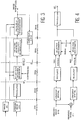
- FIG. 2 illustrates an inter-image interpolation by motion compensation based on a triangular decomposition of an image.
- This first embodiment of the invention comprises the succession of the following steps:
- a first step consists in memorizing the images (n) and (n-k). These images (n) and (n-k) are those known by the reconstruction system. In the case of a decoder, these are images reconstructed from information transmitted by an encoder. The number of images that can be interpolated corresponds to the value (k-1).
- a second step consists in the complete triangulation of the reference image, which in this mode can be the image (n) or the image (n-k) depending on the implementation chosen.
- an automatic mesh is implemented within the framework of the method. It consists in making a triangulation from a set of points chosen in the image according to certain predetermined characteristics. In particular, it is possible to choose points of significant gradient, such as points of significant temporal difference. The vertices are chosen from these points so that they are distributed throughout the image.
- An example of a mesh can be as follows: the image (nk) is subjected to high-pass filtering.
- the gradient image obtained which can be thresholded, provides the set of points from which the vertices will be chosen. This selection is made, for example, by defining a minimum interval between each vertex, this interval taking into account the total number of vertices, dimensions of the image and the number of gradient points obtained.
- Another simple selection process consists in retaining only the largest NbMax gradient points.
- An example of a gradient mask used for high-pass filtering is then:
- the number of vertices NbMax is a parameter which can be variable depending on the desired precision and the accepted complexity.
- the parameters from this second step are the coordinates of the vertices (or nodes) S nk or triangles.
- a third step is the estimation of the motion and the deformations of these triangles for the image (n-k + p) with 0 ⁇ p ⁇ k located between the image (n) and the image (nk).
- the images for the set of p values between 1 and (k-1) can be interpolated with a predetermined order which depends on the counter.
- Known methods such as that described in reference [4], can be used to estimate these vectors.
- the method of the invention can be implemented by using information on the vertices of the triangles and the motion vectors which come from the parameters transmitted by a triangle-based coding system of the type proposed in references [3] and [ 4].
- the parameters resulting from this third stage are the estimates of the vectors displacement of the vertices between the image (nk) and the image (n-k + p) noted From these vectors we calculate the coordinates of the displaced vertices S n-k + p or .
- the triangulation can be that defined by Delaunay in reference [6].
- a fourth step consists in calculating the vectors for each point of the triangles of the image (n-k + p) to be interpolated, that is to say in making an estimate of the deformations.
- the evolution of each triangle is represented by an affine transformation. This type of transformation allows the representation of a large number of transformations such as rotations, zooms, translations.
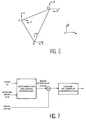
- the corresponding transformed position (x ', y') is given by the following relation: where the coefficients a, b, c, d, e, f are determined for each triangle.
- the matrix is invertible if the determinant is different from zero, that is to say if the area of the triangle is non-zero, and therefore if the triangle is not degenerate.
- a fifth step consists in calculating the points of the image (n-k + p) according to their estimated vectors.
- the image is represented by a set of adjacent triangles, as illustrated in FIGS. 6A, 6B and 6C.
- L m (k) corresponds to the value of the image m at point k.
- This value L can be in particular the luminance or any other desired characteristic of the image.
- the proposed algorithm uses a continuous vector field due to the model considered. If we consider the structure and motion information, the value L n-k + p , for example the luminance, of the image to be interpolated is calculated for each triangle as follows: with:
- the method of the invention can also be integrated into a rate reduction coding system or be made more efficient in a reconstruction system by coding the interpolation error.
- the triangulation process is applied to privileged points whose determination is made unequivocally as soon as the images considered are identical: it is for example the choice of the NbMax largest gradient points with a predefined calculation mask.
- a conventional coding is then carried out on the error signal between the true image and its prediction (the interpolated image). This method makes it possible to use a triangulation interpolation in any coding.
Landscapes
- Engineering & Computer Science (AREA)
- Multimedia (AREA)
- Signal Processing (AREA)
- Physics & Mathematics (AREA)
- General Physics & Mathematics (AREA)
- Theoretical Computer Science (AREA)
- Computer Vision & Pattern Recognition (AREA)
- Compression Or Coding Systems Of Tv Signals (AREA)
Applications Claiming Priority (2)
| Application Number | Priority Date | Filing Date | Title |
|---|---|---|---|
| FR9500204 | 1995-01-10 | ||
| FR9500204A FR2729266A1 (fr) | 1995-01-10 | 1995-01-10 | Procede d'interpolation d'images |
Publications (2)
| Publication Number | Publication Date |
|---|---|
| EP0722251A1 true EP0722251A1 (de) | 1996-07-17 |
| EP0722251B1 EP0722251B1 (de) | 2009-03-18 |
Family
ID=9474982
Family Applications (1)
| Application Number | Title | Priority Date | Filing Date |
|---|---|---|---|
| EP96400042A Expired - Lifetime EP0722251B1 (de) | 1995-01-10 | 1996-01-08 | Verfahren zur Bildinterpolation |
Country Status (4)
| Country | Link |
|---|---|
| US (1) | US5933547A (de) |
| EP (1) | EP0722251B1 (de) |
| DE (1) | DE69637869D1 (de) |
| FR (1) | FR2729266A1 (de) |
Cited By (3)
| Publication number | Priority date | Publication date | Assignee | Title |
|---|---|---|---|---|
| GB2323993A (en) * | 1997-03-31 | 1998-10-07 | Samsung Electronics Co Ltd | Method for motion estimation in a moving picture |
| GB2323992A (en) * | 1997-03-31 | 1998-10-07 | Samsung Electronics Co Ltd | Motion compensation using triangle patch wireframe model |
| EP1187494A3 (de) * | 1995-12-22 | 2002-04-10 | Dynamic Digital Depth Research Pty. Ltd. | Verfahrenzur Bildumwandlung und Kodierung |
Families Citing this family (10)
| Publication number | Priority date | Publication date | Assignee | Title |
|---|---|---|---|---|
| US6023301A (en) * | 1995-07-14 | 2000-02-08 | Sharp Kabushiki Kaisha | Video coding device and video decoding device |
| AU1983397A (en) * | 1996-02-29 | 1997-09-16 | Acuson Corporation | Multiple ultrasound image registration system, method and transducer |
| DE69733689T2 (de) * | 1997-12-01 | 2006-05-18 | Agfa-Gevaert | Verfahren und Vorrichtung zur Aufzeichnung eines Strahlungsbildes von einem länglichen Körper |
| US6438275B1 (en) * | 1999-04-21 | 2002-08-20 | Intel Corporation | Method for motion compensated frame rate upsampling based on piecewise affine warping |
| US6625333B1 (en) * | 1999-08-06 | 2003-09-23 | Her Majesty The Queen In Right Of Canada As Represented By The Minister Of Industry Through Communications Research Centre | Method for temporal interpolation of an image sequence using object-based image analysis |
| CA2380105A1 (en) * | 2002-04-09 | 2003-10-09 | Nicholas Routhier | Process and system for encoding and playback of stereoscopic video sequences |
| JP4053490B2 (ja) * | 2003-03-25 | 2008-02-27 | 株式会社東芝 | フレーム補間のための補間画像作成方法及びこれを用いた画像表示システム、補間画像作成装置 |
| EP1622393B1 (de) * | 2004-07-30 | 2010-03-31 | STMicroelectronics S.r.l. | Farbinterpolation mit datenabhängiger Triangulation |
| US20060239585A1 (en) * | 2005-04-04 | 2006-10-26 | Valadez Gerardo H | System and method for reducing artifacts in motion corrected dynamic image sequences |
| DE102008024732B4 (de) * | 2008-05-19 | 2010-04-01 | Carl Zeiss Surgical Gmbh | Medizinisch optisches Beobachtungsgerät und Verfahren zum Erstellen einer stereoskopischen Zwischenperspektive in einem derartigen Gerät |
Citations (2)
| Publication number | Priority date | Publication date | Assignee | Title |
|---|---|---|---|---|
| EP0397402A2 (de) * | 1989-05-11 | 1990-11-14 | Matsushita Electric Industrial Co., Ltd. | Bewegtbildsignalkodier- und -dekodiervorrichtung |
| EP0632657A1 (de) * | 1993-06-02 | 1995-01-04 | Oy Nokia Ab | Verfahren zur Prädiktion eines Bildes |
Family Cites Families (3)
| Publication number | Priority date | Publication date | Assignee | Title |
|---|---|---|---|---|
| SE9002647L (sv) * | 1990-08-15 | 1991-09-02 | Televerket | Metod foer roerelsekompensering och elastisk deformation i bildsekvenser |
| US5617482A (en) * | 1990-08-15 | 1997-04-01 | Televerket | Method of motion compensation and elastic deformation in picture sequences |
| US5307450A (en) * | 1991-02-19 | 1994-04-26 | Silicon Graphics, Inc. | Z-subdivision for improved texture mapping |
-
1995
- 1995-01-10 FR FR9500204A patent/FR2729266A1/fr active Granted
-
1996
- 1996-01-08 DE DE69637869T patent/DE69637869D1/de not_active Expired - Lifetime
- 1996-01-08 EP EP96400042A patent/EP0722251B1/de not_active Expired - Lifetime
- 1996-01-11 US US08/584,354 patent/US5933547A/en not_active Expired - Lifetime
Patent Citations (2)
| Publication number | Priority date | Publication date | Assignee | Title |
|---|---|---|---|---|
| EP0397402A2 (de) * | 1989-05-11 | 1990-11-14 | Matsushita Electric Industrial Co., Ltd. | Bewegtbildsignalkodier- und -dekodiervorrichtung |
| EP0632657A1 (de) * | 1993-06-02 | 1995-01-04 | Oy Nokia Ab | Verfahren zur Prädiktion eines Bildes |
Non-Patent Citations (7)
| Title |
|---|
| C.H.HUANG ET AL.: "A new motion compensation method for image sequence coding using hierarchical grid interpolation", IEEE TRANSACTIONS ON CIRCUITS AND SYSTEMS FOR VIDEO TECHNOLOGY, vol. 4, no. 1, NEW YORK US, pages 42 - 51, XP000439483, DOI: doi:10.1109/76.276171 * |
| G.KUMMERFELDT ET AL.: "Coding Television Signals at 320 and 64 Kbit/s", SPIE - IMAGE CODING, vol. 594, pages 119 - 128 * |
| G.SULLIVAN AND R.L.BAKER: "Motion Compensation for video compression using control grid interpolation", ICASSP'91 - INTERNATIONAL CONFERENCE ON ACOUSTICS, SPEECH AND SIGNAL PROCESSING, vol. 4, 14 April 1991 (1991-04-14) - 17 April 1991 (1991-04-17), pages 2713 - 2716, XP010043566, DOI: doi:10.1109/ICASSP.1991.150962 * |
| J.K.KIM AND C.M.KYUNG: "Fast frame-to-frame interpolation technique for scenes containing moving objects", ELECTRONICS LETTERS, vol. 27, no. 20, 26 September 1991 (1991-09-26), STEVENAGE GB, pages 1788 - 1790, XP000264337, DOI: doi:10.1049/el:19911112 * |
| J.NIEWEGLOWSKI ET AL.: "A novel video coding scheme based on temporal prediction using digital image warping", IEEE TRANSACTIONS ON CONSUMER ELECTRONICS, vol. 39, no. 3, pages 141 - 150 * |
| J.NIEWEGLOWSKI ET AL.: "Motion Compensated Video Sequence Interpolation Using Digital Image Warping", ICASSP'94 - IEEE INTERNATIONAL CONFERENCE ON ACOUSTICS, SPEECH AND SIGNAL PROCESSING, vol. 5, 19 April 1994 (1994-04-19) - 22 April 1994 (1994-04-22), pages 205 - 208 * |
| NAKAYA ET AL.: "An iterative motion estimation method using triangular patches for motion compensation", VISUAL COMMUNICATION AND IMAGE PROCESSING '91 - PROCEEDINGS OF THE SPIE, 1991, vol. 1605, no. 2, US, pages 546 - 557 * |
Cited By (4)
| Publication number | Priority date | Publication date | Assignee | Title |
|---|---|---|---|---|
| EP1187494A3 (de) * | 1995-12-22 | 2002-04-10 | Dynamic Digital Depth Research Pty. Ltd. | Verfahrenzur Bildumwandlung und Kodierung |
| GB2323993A (en) * | 1997-03-31 | 1998-10-07 | Samsung Electronics Co Ltd | Method for motion estimation in a moving picture |
| GB2323992A (en) * | 1997-03-31 | 1998-10-07 | Samsung Electronics Co Ltd | Motion compensation using triangle patch wireframe model |
| GB2323993B (en) * | 1997-03-31 | 1999-06-02 | Samsung Electronics Co Ltd | Method for motion estimation in a moving picture |
Also Published As
| Publication number | Publication date |
|---|---|
| FR2729266A1 (fr) | 1996-07-12 |
| FR2729266B1 (de) | 1997-02-21 |
| EP0722251B1 (de) | 2009-03-18 |
| DE69637869D1 (de) | 2009-04-30 |
| US5933547A (en) | 1999-08-03 |
Similar Documents
| Publication | Publication Date | Title |
|---|---|---|
| US5943445A (en) | Dynamic sprites for encoding video data | |
| EP0941522B1 (de) | Videokompressionsmethode und vorrichtung | |
| CN114450940B (zh) | 一种对沉浸式视频进行编解码的方法以及编码器、解码器 | |
| US10404961B2 (en) | Auxiliary data for artifacts—aware view synthesis | |
| Tom et al. | Resolution enhancement of monochrome and color video using motion compensation | |
| EP0722251B1 (de) | Verfahren zur Bildinterpolation | |
| TW201703518A (zh) | 用於使用深度資訊之全視差壓縮光場合成之方法 | |
| CN113785585A (zh) | 用于编码和解码多视图视频序列的方法和设备 | |
| FR2813485A1 (fr) | Procede de construction d'au moins une image interpolee entre deux images d'une sequence animee, procedes de codage et de decodage, signal et support de donnees correspondant | |
| Hu et al. | A multi-user oriented live free-viewpoint video streaming system based on view interpolation | |
| Knorr et al. | Stereoscopic 3D from 2D video with super-resolution capability | |
| Vosters et al. | Overview of efficient high-quality state-of-the-art depth enhancement methods by thorough design space exploration | |
| EP2374278B1 (de) | Videocodierung basierend auf globaler bewegungskompensation | |
| EP3725080A1 (de) | Verfahren und vorrichtungen zur codierung und decodierung einer für ein omnidirektionales video repräsentativen mehrfachansichtsvideosequenz | |
| CA2528709A1 (en) | Method of representing a sequence of pictures using 3d models, and corresponding devices and signal | |
| Vosters et al. | Evaluation of efficient high quality depth upsampling methods for 3DTV | |
| TW536918B (en) | Method to increase the temporal resolution of continuous image series | |
| FR3073068A1 (fr) | Procede de restauration d'images | |
| Redert et al. | Challenges in 3DTV image processing | |
| US20250232480A1 (en) | V-dmc normal encoding integration in v-dmc and base mesh encoder | |
| WO2019008233A1 (en) | METHOD AND APPARATUS FOR ENCODING MULTIMEDIA CONTENT | |
| Lingadahalli-Ravi | Machine Learning-based Depth Estimation and View Synthesis for Immersive Video | |
| Marichal | Motion estimation and compensation for very low bitrate video coding | |
| EP4104446A1 (de) | Verfahren und vorrichtung zur verarbeitung von daten von mehrfachansichtsvideo | |
| CN117788545A (zh) | 水下单目深度估计成像方法及装置、电子设备、存储介质 |
Legal Events
| Date | Code | Title | Description |
|---|---|---|---|
| PUAI | Public reference made under article 153(3) epc to a published international application that has entered the european phase |
Free format text: ORIGINAL CODE: 0009012 |
|
| AK | Designated contracting states |
Kind code of ref document: A1 Designated state(s): DE GB |
|
| 17P | Request for examination filed |
Effective date: 19961223 |
|
| 17Q | First examination report despatched |
Effective date: 20070320 |
|
| GRAP | Despatch of communication of intention to grant a patent |
Free format text: ORIGINAL CODE: EPIDOSNIGR1 |
|
| GRAS | Grant fee paid |
Free format text: ORIGINAL CODE: EPIDOSNIGR3 |
|
| GRAA | (expected) grant |
Free format text: ORIGINAL CODE: 0009210 |
|
| AK | Designated contracting states |
Kind code of ref document: B1 Designated state(s): DE GB |
|
| REG | Reference to a national code |
Ref country code: GB Ref legal event code: FG4D Free format text: NOT ENGLISH |
|
| REF | Corresponds to: |
Ref document number: 69637869 Country of ref document: DE Date of ref document: 20090430 Kind code of ref document: P |
|
| RAP2 | Party data changed (patent owner data changed or rights of a patent transferred) |
Owner name: GULA CONSULTING LIMITED LIABILITY COMPANY |
|
| PLBE | No opposition filed within time limit |
Free format text: ORIGINAL CODE: 0009261 |
|
| STAA | Information on the status of an ep patent application or granted ep patent |
Free format text: STATUS: NO OPPOSITION FILED WITHIN TIME LIMIT |
|
| REG | Reference to a national code |
Ref country code: GB Ref legal event code: 732E Free format text: REGISTERED BETWEEN 20100107 AND 20100113 |
|
| 26N | No opposition filed |
Effective date: 20091221 |
|
| PGFP | Annual fee paid to national office [announced via postgrant information from national office to epo] |
Ref country code: GB Payment date: 20131227 Year of fee payment: 19 |
|
| PGFP | Annual fee paid to national office [announced via postgrant information from national office to epo] |
Ref country code: DE Payment date: 20140131 Year of fee payment: 19 |
|
| REG | Reference to a national code |
Ref country code: DE Ref legal event code: R119 Ref document number: 69637869 Country of ref document: DE |
|
| GBPC | Gb: european patent ceased through non-payment of renewal fee |
Effective date: 20150108 |
|
| PG25 | Lapsed in a contracting state [announced via postgrant information from national office to epo] |
Ref country code: GB Free format text: LAPSE BECAUSE OF NON-PAYMENT OF DUE FEES Effective date: 20150108 Ref country code: DE Free format text: LAPSE BECAUSE OF NON-PAYMENT OF DUE FEES Effective date: 20150801 |