EP0722443B1 - Recuperation du 3,4-epoxy-1-butene contenu dans des effluents d'oxydation au 1,3-butadiene - Google Patents
Recuperation du 3,4-epoxy-1-butene contenu dans des effluents d'oxydation au 1,3-butadiene Download PDFInfo
- Publication number
- EP0722443B1 EP0722443B1 EP94929266A EP94929266A EP0722443B1 EP 0722443 B1 EP0722443 B1 EP 0722443B1 EP 94929266 A EP94929266 A EP 94929266A EP 94929266 A EP94929266 A EP 94929266A EP 0722443 B1 EP0722443 B1 EP 0722443B1
- Authority
- EP
- European Patent Office
- Prior art keywords
- butadiene
- effluent
- butane
- mole percent
- epb
- Prior art date
- Legal status (The legal status is an assumption and is not a legal conclusion. Google has not performed a legal analysis and makes no representation as to the accuracy of the status listed.)
- Expired - Lifetime
Links
- KAKZBPTYRLMSJV-UHFFFAOYSA-N Butadiene Chemical compound C=CC=C KAKZBPTYRLMSJV-UHFFFAOYSA-N 0.000 title claims abstract description 422
- 238000011084 recovery Methods 0.000 title claims abstract description 35
- GXBYFVGCMPJVJX-UHFFFAOYSA-N Epoxybutene Chemical compound C=CC1CO1 GXBYFVGCMPJVJX-UHFFFAOYSA-N 0.000 title claims abstract description 12
- 230000003647 oxidation Effects 0.000 title description 8
- 238000007254 oxidation reaction Methods 0.000 title description 8
- IJDNQMDRQITEOD-UHFFFAOYSA-N n-butane Chemical compound CCCC IJDNQMDRQITEOD-UHFFFAOYSA-N 0.000 claims abstract description 172
- OFBQJSOFQDEBGM-UHFFFAOYSA-N n-pentane Natural products CCCCC OFBQJSOFQDEBGM-UHFFFAOYSA-N 0.000 claims abstract description 170
- 239000001273 butane Substances 0.000 claims abstract description 168
- 238000006735 epoxidation reaction Methods 0.000 claims abstract description 94
- 238000010521 absorption reaction Methods 0.000 claims abstract description 63
- 239000007788 liquid Substances 0.000 claims abstract description 62
- 239000000203 mixture Substances 0.000 claims abstract description 59
- 239000007789 gas Substances 0.000 claims abstract description 53
- QVGXLLKOCUKJST-UHFFFAOYSA-N atomic oxygen Chemical compound [O] QVGXLLKOCUKJST-UHFFFAOYSA-N 0.000 claims abstract description 49
- 239000001301 oxygen Substances 0.000 claims abstract description 49
- 229910052760 oxygen Inorganic materials 0.000 claims abstract description 49
- 238000000034 method Methods 0.000 claims abstract description 31
- 239000003054 catalyst Substances 0.000 claims abstract description 19
- CURLTUGMZLYLDI-UHFFFAOYSA-N Carbon dioxide Chemical compound O=C=O CURLTUGMZLYLDI-UHFFFAOYSA-N 0.000 claims description 74
- 239000006096 absorbing agent Substances 0.000 claims description 53
- XLYOFNOQVPJJNP-UHFFFAOYSA-N water Substances O XLYOFNOQVPJJNP-UHFFFAOYSA-N 0.000 claims description 43
- 239000001569 carbon dioxide Substances 0.000 claims description 37
- 229910002092 carbon dioxide Inorganic materials 0.000 claims description 37
- 238000004519 manufacturing process Methods 0.000 claims description 20
- 239000002585 base Substances 0.000 claims description 12
- 238000007906 compression Methods 0.000 claims description 11
- 230000006835 compression Effects 0.000 claims description 11
- 239000002904 solvent Substances 0.000 claims description 11
- BQCADISMDOOEFD-UHFFFAOYSA-N Silver Chemical compound [Ag] BQCADISMDOOEFD-UHFFFAOYSA-N 0.000 claims description 10
- 150000008044 alkali metal hydroxides Chemical class 0.000 claims description 10
- 238000001816 cooling Methods 0.000 claims description 10
- 229910052709 silver Inorganic materials 0.000 claims description 10
- 239000004332 silver Substances 0.000 claims description 10
- 239000007864 aqueous solution Substances 0.000 claims description 8
- 239000000243 solution Substances 0.000 claims description 7
- 238000004064 recycling Methods 0.000 claims description 4
- 238000000926 separation method Methods 0.000 claims description 4
- 229910000288 alkali metal carbonate Inorganic materials 0.000 claims 2
- 150000008041 alkali metal carbonates Chemical class 0.000 claims 2
- 150000001338 aliphatic hydrocarbons Chemical class 0.000 claims 1
- 229910052799 carbon Inorganic materials 0.000 claims 1
- 229920006395 saturated elastomer Polymers 0.000 claims 1
- 239000000463 material Substances 0.000 abstract description 13
- 230000002745 absorbent Effects 0.000 abstract description 8
- 239000002250 absorbent Substances 0.000 abstract description 8
- 239000011261 inert gas Substances 0.000 abstract description 7
- KWYUFKZDYYNOTN-UHFFFAOYSA-M Potassium hydroxide Chemical compound [OH-].[K+] KWYUFKZDYYNOTN-UHFFFAOYSA-M 0.000 description 15
- VNWKTOKETHGBQD-UHFFFAOYSA-N methane Chemical compound C VNWKTOKETHGBQD-UHFFFAOYSA-N 0.000 description 14
- 238000006243 chemical reaction Methods 0.000 description 11
- 238000012856 packing Methods 0.000 description 11
- 239000003701 inert diluent Substances 0.000 description 10
- 239000003085 diluting agent Substances 0.000 description 9
- XKRFYHLGVUSROY-UHFFFAOYSA-N Argon Chemical compound [Ar] XKRFYHLGVUSROY-UHFFFAOYSA-N 0.000 description 8
- 239000000376 reactant Substances 0.000 description 8
- -1 water Chemical class 0.000 description 8
- 150000004820 halides Chemical class 0.000 description 7
- 238000006116 polymerization reaction Methods 0.000 description 7
- BVKZGUZCCUSVTD-UHFFFAOYSA-L Carbonate Chemical compound [O-]C([O-])=O BVKZGUZCCUSVTD-UHFFFAOYSA-L 0.000 description 6
- 230000015572 biosynthetic process Effects 0.000 description 6
- 239000003112 inhibitor Substances 0.000 description 6
- IAYPIBMASNFSPL-UHFFFAOYSA-N Ethylene oxide Chemical compound C1CO1 IAYPIBMASNFSPL-UHFFFAOYSA-N 0.000 description 5
- 238000004821 distillation Methods 0.000 description 5
- 239000012071 phase Substances 0.000 description 5
- 239000000047 product Substances 0.000 description 5
- WSLDOOZREJYCGB-UHFFFAOYSA-N 1,2-Dichloroethane Chemical compound ClCCCl WSLDOOZREJYCGB-UHFFFAOYSA-N 0.000 description 4
- IJGRMHOSHXDMSA-UHFFFAOYSA-N Atomic nitrogen Chemical compound N#N IJGRMHOSHXDMSA-UHFFFAOYSA-N 0.000 description 4
- 229910052786 argon Inorganic materials 0.000 description 4
- 150000001875 compounds Chemical class 0.000 description 4
- 239000012535 impurity Substances 0.000 description 4
- BWHMMNNQKKPAPP-UHFFFAOYSA-L potassium carbonate Chemical compound [K+].[K+].[O-]C([O-])=O BWHMMNNQKKPAPP-UHFFFAOYSA-L 0.000 description 4
- UHOVQNZJYSORNB-UHFFFAOYSA-N Benzene Chemical compound C1=CC=CC=C1 UHOVQNZJYSORNB-UHFFFAOYSA-N 0.000 description 3
- LYCAIKOWRPUZTN-UHFFFAOYSA-N Ethylene glycol Chemical compound OCCO LYCAIKOWRPUZTN-UHFFFAOYSA-N 0.000 description 3
- HEMHJVSKTPXQMS-UHFFFAOYSA-M Sodium hydroxide Chemical compound [OH-].[Na+] HEMHJVSKTPXQMS-UHFFFAOYSA-M 0.000 description 3
- YXFVVABEGXRONW-UHFFFAOYSA-N Toluene Chemical compound CC1=CC=CC=C1 YXFVVABEGXRONW-UHFFFAOYSA-N 0.000 description 3
- 238000009835 boiling Methods 0.000 description 3
- IWJMQXOBCQTQCF-UHFFFAOYSA-N but-3-enal Chemical compound C=CCC=O IWJMQXOBCQTQCF-UHFFFAOYSA-N 0.000 description 3
- MLUCVPSAIODCQM-NSCUHMNNSA-N crotonaldehyde Chemical compound C\C=C\C=O MLUCVPSAIODCQM-NSCUHMNNSA-N 0.000 description 3
- MLUCVPSAIODCQM-UHFFFAOYSA-N crotonaldehyde Natural products CC=CC=O MLUCVPSAIODCQM-UHFFFAOYSA-N 0.000 description 3
- 150000002009 diols Chemical class 0.000 description 3
- VLKZOEOYAKHREP-UHFFFAOYSA-N n-Hexane Chemical compound CCCCCC VLKZOEOYAKHREP-UHFFFAOYSA-N 0.000 description 3
- 229910000027 potassium carbonate Inorganic materials 0.000 description 3
- 238000010926 purge Methods 0.000 description 3
- ORTVZLZNOYNASJ-UPHRSURJSA-N (z)-but-2-ene-1,4-diol Chemical compound OC\C=C/CO ORTVZLZNOYNASJ-UPHRSURJSA-N 0.000 description 2
- HGINCPLSRVDWNT-UHFFFAOYSA-N Acrolein Chemical compound C=CC=O HGINCPLSRVDWNT-UHFFFAOYSA-N 0.000 description 2
- YLQBMQCUIZJEEH-UHFFFAOYSA-N Furan Chemical compound C=1C=COC=1 YLQBMQCUIZJEEH-UHFFFAOYSA-N 0.000 description 2
- IMNFDUFMRHMDMM-UHFFFAOYSA-N N-Heptane Chemical compound CCCCCCC IMNFDUFMRHMDMM-UHFFFAOYSA-N 0.000 description 2
- CDBYLPFSWZWCQE-UHFFFAOYSA-L Sodium Carbonate Chemical compound [Na+].[Na+].[O-]C([O-])=O CDBYLPFSWZWCQE-UHFFFAOYSA-L 0.000 description 2
- 229910000831 Steel Inorganic materials 0.000 description 2
- 239000003513 alkali Substances 0.000 description 2
- ITMIAZBRRZANGB-UHFFFAOYSA-N but-3-ene-1,2-diol Chemical compound OCC(O)C=C ITMIAZBRRZANGB-UHFFFAOYSA-N 0.000 description 2
- 230000000694 effects Effects 0.000 description 2
- 150000002483 hydrogen compounds Chemical class 0.000 description 2
- NNPPMTNAJDCUHE-UHFFFAOYSA-N isobutane Chemical compound CC(C)C NNPPMTNAJDCUHE-UHFFFAOYSA-N 0.000 description 2
- 229910052757 nitrogen Inorganic materials 0.000 description 2
- 229920000642 polymer Polymers 0.000 description 2
- 229910001220 stainless steel Inorganic materials 0.000 description 2
- 239000010935 stainless steel Substances 0.000 description 2
- 239000010959 steel Substances 0.000 description 2
- SDRZFSPCVYEJTP-UHFFFAOYSA-N 1-ethenylcyclohexene Chemical compound C=CC1=CCCCC1 SDRZFSPCVYEJTP-UHFFFAOYSA-N 0.000 description 1
- HZAXFHJVJLSVMW-UHFFFAOYSA-N 2-Aminoethan-1-ol Chemical compound NCCO HZAXFHJVJLSVMW-UHFFFAOYSA-N 0.000 description 1
- BJEMXPVDXFSROA-UHFFFAOYSA-N 3-butylbenzene-1,2-diol Chemical group CCCCC1=CC=CC(O)=C1O BJEMXPVDXFSROA-UHFFFAOYSA-N 0.000 description 1
- XDTMQSROBMDMFD-UHFFFAOYSA-N Cyclohexane Chemical compound C1CCCCC1 XDTMQSROBMDMFD-UHFFFAOYSA-N 0.000 description 1
- VGGSQFUCUMXWEO-UHFFFAOYSA-N Ethene Chemical compound C=C VGGSQFUCUMXWEO-UHFFFAOYSA-N 0.000 description 1
- 239000005977 Ethylene Substances 0.000 description 1
- CTQNGGLPUBDAKN-UHFFFAOYSA-N O-Xylene Chemical compound CC1=CC=CC=C1C CTQNGGLPUBDAKN-UHFFFAOYSA-N 0.000 description 1
- 238000009825 accumulation Methods 0.000 description 1
- 230000002411 adverse Effects 0.000 description 1
- 150000001339 alkali metal compounds Chemical class 0.000 description 1
- 150000001412 amines Chemical class 0.000 description 1
- 239000008346 aqueous phase Substances 0.000 description 1
- 150000004982 aromatic amines Chemical group 0.000 description 1
- 150000004945 aromatic hydrocarbons Chemical class 0.000 description 1
- 239000006227 byproduct Substances 0.000 description 1
- UBAZGMLMVVQSCD-UHFFFAOYSA-N carbon dioxide;molecular oxygen Chemical compound O=O.O=C=O UBAZGMLMVVQSCD-UHFFFAOYSA-N 0.000 description 1
- 150000004649 carbonic acid derivatives Chemical class 0.000 description 1
- 238000010668 complexation reaction Methods 0.000 description 1
- 238000010586 diagram Methods 0.000 description 1
- ZBCBWPMODOFKDW-UHFFFAOYSA-N diethanolamine Chemical compound OCCNCCO ZBCBWPMODOFKDW-UHFFFAOYSA-N 0.000 description 1
- 230000007717 exclusion Effects 0.000 description 1
- 239000002360 explosive Substances 0.000 description 1
- 239000012530 fluid Substances 0.000 description 1
- 239000001307 helium Substances 0.000 description 1
- 229910052734 helium Inorganic materials 0.000 description 1
- SWQJXJOGLNCZEY-UHFFFAOYSA-N helium atom Chemical compound [He] SWQJXJOGLNCZEY-UHFFFAOYSA-N 0.000 description 1
- 229930195733 hydrocarbon Natural products 0.000 description 1
- 230000007062 hydrolysis Effects 0.000 description 1
- 238000006460 hydrolysis reaction Methods 0.000 description 1
- 150000004679 hydroxides Chemical class 0.000 description 1
- 239000001282 iso-butane Substances 0.000 description 1
- 150000002605 large molecules Chemical class 0.000 description 1
- 239000007791 liquid phase Substances 0.000 description 1
- 239000006193 liquid solution Substances 0.000 description 1
- 239000012528 membrane Substances 0.000 description 1
- 239000002808 molecular sieve Substances 0.000 description 1
- 239000011368 organic material Substances 0.000 description 1
- 150000002989 phenols Chemical class 0.000 description 1
- 230000009257 reactivity Effects 0.000 description 1
- 230000001105 regulatory effect Effects 0.000 description 1
- 229930195734 saturated hydrocarbon Natural products 0.000 description 1
- 238000005201 scrubbing Methods 0.000 description 1
- URGAHOPLAPQHLN-UHFFFAOYSA-N sodium aluminosilicate Chemical compound [Na+].[Al+3].[O-][Si]([O-])=O.[O-][Si]([O-])=O URGAHOPLAPQHLN-UHFFFAOYSA-N 0.000 description 1
- 229910000029 sodium carbonate Inorganic materials 0.000 description 1
- 239000000126 substance Substances 0.000 description 1
- 239000008096 xylene Substances 0.000 description 1
Images
Classifications
-
- C—CHEMISTRY; METALLURGY
- C07—ORGANIC CHEMISTRY
- C07D—HETEROCYCLIC COMPOUNDS
- C07D303/00—Compounds containing three-membered rings having one oxygen atom as the only ring hetero atom
- C07D303/02—Compounds containing oxirane rings
- C07D303/04—Compounds containing oxirane rings containing only hydrogen and carbon atoms in addition to the ring oxygen atoms
Definitions
- This invention pertains to the recovery of 3,4-epoxy-1-butene from an oxidation effluent comprising 3,4-epoxy-1-butene, unreacted 1,3-butadiene, butane as an inert diluent, and oxygen produced by the selective oxidation of 1,3-butadiene. More specifically, one embodiment of the present invention pertains to a process wherein the aforesaid oxidation effluent is intimately contacted with a mixture of liquid butane and 1,3-butadiene in an absorption zone to obtain a solution of 3,4-epoxy-1-butene in butane and 1,3-butadiene.
- Another embodiment of the invention pertains to the utilization of the 3,4-epoxy-1-butene recovery process as a means for accurately regulating the amount of the butane diluent and 1,3-butadiene reactant in the gas fed to an oxidation zone wherein 1,3-butadiene is selectively oxidized to 3,4-epoxy-1-butene.
- U.S. Patents 4,897,498 and 4,950,773 disclose processes for the manufacture of 3,4-epoxy-1-butene (referred to herein as EpB) by the selective epoxidation of 1,3-butadiene (referred to herein as butadiene) wherein butadiene is contacted with an oxygen-containing gas in the presence of certain silver catalysts.
- EpB 3,4-epoxy-1-butene
- butadiene 1,3-butadiene
- an oxygen-containing gas in the presence of certain silver catalysts.
- the epoxidation effluent thus contains significant amounts of butadiene which must be recovered and recycled to the epoxidation zone.
- Obtaining a high yield of EpB also requires the presence of an inert gas diluent in the gas feed to the epoxidation zone.
- An inert gas such as methane, nitrogen, helium, or the like, constituting from 25 to 85 mole percent of the gas feed to the epoxidation zone, is usually employed.
- EpB is a very reactive compound which can be used to manufacture a variety of chemicals. Due to its reactivity, the recovery of EpB from epoxidation effluents must be performed under mild conditions to avoid the conversion of EpB to other undesired compounds such as butenediols and oligomers. It is possible to recover EpB directly from the epoxidation effluent by compressing the gaseous effluent to pressures sufficiently high to liquefy the EpB. However, the compression of the effluent would require the use of a series of compressors and heat exchangers to remove the heat of compression and maintain the EpB at a temperature which would minimize by-product formation.
- An absorbent suitable for use in the recovery of EpB must be inert with respect to both EpB and to oxidation in the epoxidation zone.
- Saturated hydrocarbons such as pentane, hexane, cyclohexane, heptane, and the like form azeotropes with EpB which makes separation of EpB from the solvent quite difficult.
- aromatic hydrocarbons such as benzene, toluene, or xylene, and their presence in the EpB production system causes a decrease in the activity of the silver epoxidation catalyst due to complexation with the silver.
- temperatures that must be employed with these solvents to recover all the butadiene in a pressure distillation column cause losses of EpB due to polymerization and reaction with active hydrogen compounds, e.g., water, butenediols, and/or higher EpB adducts.
- active hydrogen compounds e.g., water, butenediols, and/or higher EpB adducts.
- U.S. Patent 5,117,012 discloses a process for the recovery of EpB from an oxidation effluent comprising EpB, butadiene, an inert diluent gas, and oxygen by contacting the oxidation effluent with liquid butadiene in an absorption zone to obtain a solution of EpB in butadiene.
- the inert diluent gases specifically contemplated by the '012 patent are nitrogen and methane.
- the pressures required in the absorber for recovery of EpB would be 10 bars (1,000 kPa) or higher using reasonable temperatures, e.g., 5 to 20°C.
- Such high pressures result in a number of disadvantages such as the capital and operating costs for the compressor(s) required to achieve the high pressures, EpB losses through hydrolysis and oligomer formation caused by the temperatures produced by the compression of the reactor gas effluent, and butadiene losses due to polymerization resulting in lower overall yields and downtime.
- EpB can be recovered from a substantially-gaseous, epoxidation effluent comprising EpB, butane, butadiene, and oxygen by intimately contacting the effluent with a mixture of liquid butane and butadiene in an absorption zone. It also has been found that by the use of certain conditions within the absorption zone, a vapor effluent containing a predetermined concentration of butane and butadiene may be removed from the absorption zone and utilized as the diluent and reactant, respectively, to the epoxidation zone.
- One embodiment of our invention therefore pertains to a process for the recovery of EpB from a substantially-gaseous effluent from an epoxidation zone wherein butadiene is contacted with an oxygen-containing gas using butane as the inert diluent in the presence of a catalyst, to produce an epoxidation effluent comprising EpB, butane, butadiene, and oxygen which comprises feeding the effluent to an absorption vessel wherein the effluent is intimately contacted with a mixture of liquid butane and butadiene at a pressure of 2 to 10 bars (200 to 1,000 kPa) and a temperature of 0 to 60°C to obtain:
- the use of a mixture of butane and butadiene as the absorbent is economically advantageous as compared to the use of other organic materials which are extraneous to the EpB production system.
- the use of another absorbent would increase costs due to the additional equipment required for its recovery in addition to the added cost of the absorbent material itself. Since butane can function as both the reactor diluent and an absorbent component the number of components in the process are minimized.
- the use of a mixture of butane and butadiene reduces compression and utility costs since a much lower pressure is required for recovery of the EpB. Using a mixture of butane and butadiene also reduces the amount of butadiene needed in the EpB production system, thus reducing polymer formation and other related yield losses.
- the present invention may be used in combination with any epoxidation process wherein butadiene is contacted with an oxygen-containing gas using butane as the diluent in the presence of a catalyst to produce an epoxidation effluent comprising EpB, butane, butadiene, and oxygen.
- the silver-catalyzed, epoxidation processes described in U.S. Patents 4,897,498 and 4,950,773 are typical of those which may be employed in the epoxidation zone.
- the epoxidation zone comprises one or more reactors of any design that allows removal of the heat of reaction in order to prevent an exothermic temperature excursion from occurring.
- a shell-and-tube design typically used for ethylene oxide production, may be employed.
- Other types of reactor designs include multi-staged adiabatic reactors, fluidized bed reactors, moving or transport bed reactors and the like.
- the feed to the epoxidation zone comprises butadiene, an oxygen-containing gas and butane which acts as an inert diluent gas.
- any oxygen (O 2 ) concentration up to the explosive limit can be used.
- relatively high oxygen concentrations e.g., up to 30 mole percent may be employed.
- the butadiene concentration typically is 4 to 50 mole percent.
- the butadiene:oxygen mole ratio in the feed normally is maintained within the range of 1:5 to 10:1.
- the inert gas, i.e., butane usually constitutes 25 to 85 mole percent of the total feed to the epoxidation zone.
- the feed also include a small amount, e.g., 1 to 40 parts per million (ppm) of a halide source such as 1,2-dichloroethane.
- a halide source such as 1,2-dichloroethane.
- Various other organic halides may be used, many of which are described in U.S. Patent 4,950,773.
- the concentration of the organic halide in the feed more commonly is in the range of 2 to 10 ppm.
- the feed also may contain minor amounts, e.g., 6 mole percent or greater, of impurities such as up to 4 mole percent water and up to 2 mole percent carbon dioxide.
- Some argon may also be present in the feed.
- the amount of argon is controlled by purging a small amount of the recycle gas. Typically, the amount of argon is maintained at less than 10 percent.
- the reactor of the epoxidation zone may be operated at pressures ranging from 0.1 to 20 bars (10 to 2,000 kPa), pressures in the range of 1 to 3 bars (100 to 300 kPa) normally are used.
- the epoxidation feed typically is heated to 175 to 225°C in a pre-heater prior to entering the epoxidation reactor.
- the temperature of the epoxidation effluent is maintained at 190 to 250°C, preferably 210 to 230°C, by adjusting the pre-heater temperature and/or the concentration of oxygen and/or the organic halide in the feed.
- the silver catalysts described in U. S. Patent 4,897,498 are examples of the epoxidation catalysts which may be used to convert butadiene to EpB.
- the catalyst preferably is a supported, cesium-promoted, silver catalyst.
- the gaseous epoxidation effluent typically comprises 0.5 to 6 mole percent EpB, 4 to 50 mole percent butadiene, 4 to 25 mole percent oxygen and 25 to 85 mole percent inert (butane) gas.
- the effluent also contains a total of 0.5 to 10 mole percent of water, carbon dioxide, acrolein, furan, vinylacetaldehyde, and crotonaldehyde, formed in the epoxidation zone. Unconsumed organic halide also is present in the epoxidation effluent.
- the overall selectivity to EpB is 88-95%.
- the percent conversion of butadiene is: Moles butadiene converted Moles butadiene fed X 100 and the percent selectivity to 3,4-epoxy-1-butene is: Moles butadiene converted to 3,4-epoxy-1-butene Moles butadiene converted X 100
- the epoxidation effluent is fed to a cooling/compression zone comprising one or more heat exchangers and one or more compressors wherein the effluent is pressurized to a pressure of 3 to 10 bars absolute (300 to 1,000 kPa) and cooled to a temperature of 0 to 100°C.
- the cooling/compression zone may include a gas/liquid separator to remove any condensed liquids, e.g., water and/or butenediols (3-butene-1,2-diol and 2-butene-1,4-diol), from the pressurized and cooled effluent prior to feeding it to the absorption zone.
- the absorption zone comprises a columnar, pressure vessel containing trays or a packing material which facilitates intimate gas/liquid contact.
- suitable packing material include Koch-Sulzer packing, Pall rings, Berl saddles, and Penn State packing.
- the absorption vessel normally is provided with means, such as a disengaging space above the packing, to prevent or minimize entrainment of liquids in the gas stream removed from the upper section thereof.
- the pressurized, cooled, substantially gaseous, epoxidation effluent is fed to the lower section of the absorption vessel, preferably near the bottom of the vessel.
- a mixture of liquid butane and butadiene is fed to the upper section, preferably near the top, of the absorption vessel and flows downward, thereby absorbing or scrubbing the EpB component from the upwardly-flowing epoxidation effluent.
- the butane:butadiene mole ratio of the absorber solvent normally is maintained in the range of 20:1 to 1:2 with mole ratios of 12:1 to 2:1 being preferred.
- a solution of EpB in butane and butadiene is removed from the base of the absorption vessel and a vapor comprising butadiene, butane, oxygen and carbon dioxide components of the epoxidation effluent is removed from the top of the vessel.
- the epoxidation effluent is intimately contacted with a mixture of liquid butane and butadiene in the absorption zone at a pressure of 2 to 10 bars (200 to 1,000 kPa) and a temperature of 0 to 60°C.
- the absorption zone preferably is operated at pressures and temperatures of 3 to 6 bars (300 to 600 kPa) and 10 to 50°C to minimize the reaction of the EpB with the minor amounts of active hydrogen compounds present.
- the particular combination of pressure and temperature are selected to provide a predetermined concentration of butane and butadiene, e.g., 30 to 95, preferably 40 to 90, mole percent, in the vapor effluent removed from the absorption vessel.
- the ratio of butane to butadiene in the absorber solvent also determines the concentration of these components in the gas effluent from the absorber.
- the butane:butadiene mole ratio in the absorber solvent is maintained to provide an absorber gas effluent containing 4 to 50, preferably 7 to 20, mole percent of butadiene, and 25 to 85, preferably 40 to 80, mole percent of butane.
- the mole percent composition of the vapor effluent from the absorber may be determined by applying both Dalton's law and Raoult's law to the components of the absorber.
- the butane/butadiene-containing vapor effluent thus obtained can be recycled, directly or indirectly, to the epoxidation zone and provide all of the butadiene reactant and butane diluent for the epoxidation reaction.
- the amount of the liquid butane and butadiene mixture fed to the absorption vessel can vary substantially depending, for example, on the particular vessel, packing material and conditions employed and the feed rate and composition of the epoxidation effluent fed.
- the weight ratio of the absorber solvent feed to epoxidation effluent feed is in the range of 0.1:1 to 0.6:1.
- the temperature of the liquid butane and butadiene fed typically is in the range of 0 to 40°C.
- a liquid effluent (absorption underflow) comprising a solution of EpB in butane and butadiene is removed from the base of the absorption vessel and is fed to a butane/butadiene recovery zone.
- a portion, e.g., up to 95 volume percent, of the underflow may be recycled to the absorption vessel.
- the recycle stream optionally may be cooled by means of a heat exchanger and returned to the lower section of the absorption vessel to control or regulate the temperature therein.
- the concentration of EpB in the absorption underflow stream may vary substantially, e.g., from 2 to 40 weight percent based on the total weight of the stream. Normally, the EpB concentration is in the range of 5 to 15 weight percent (same basis).
- the underflow also contains minor amounts of water, diol and other materials, e.g., up to 5 mole percent water and up to 2 mole percent diol.
- the mole ratio of the butane to butadiene in the underflow is the same as the butane:butadiene mole ratio of the liquid absorption solvent fed to the absorber.
- the butane/butadiene recovery zone comprises a distillation vessel, e.g., a column, a heat source at the base of the vessel, cooling means to condense vapor removed from the top of the vessel and a separator to separate water from the condensed liquid.
- the absorption column underflow may be fed to the mid-section of the recovery column to obtain (1) a gas effluent comprising a mixture of butane and butadiene from the upper section of the column and (2) a liquid effluent comprising crude EpB from the lower section of the column.
- the gas effluent contains a minor amount of water which may be removed from the EpB production system by condensing the effluent to obtain a two-phase, liquid mixture and separating the aqueous phase from the butane/butadiene phase.
- Water and butadiene or butane form a constant boiling mixture (azeotrope) having a boiling point of approximately 43°C at 4.8 bars (480 kPa) pressure.
- the water removal may be enhanced by recycling a portion, e.g., up to 95 weight percent, of the condensed butane/butadiene phase to the upper section of the butane/butadiene recovery vessel.
- the water-depleted butane/butadiene stream removed from the butane/butadiene recovery zone may be recycled, directly or indirectly, to the absorption zone along with fresh butane/butadiene.
- Fresh butadiene also must be added to make up for that consumed in the reactor zone.
- fresh butadiene may be added at any point in the recycle loop and it is not necessary that the makeup butadiene be added in the liquid mixture of butane and butadiene fed to the absorber.
- a second embodiment of the invention concerns a process for the recovery of EpB from a substantially-gaseous, epoxidation effluent from an epoxidation zone wherein butadiene is contacted with an oxygen-containing gas using butane as the diluent in the presence of a catalyst to produce an epoxidation effluent comprising EpB, butane and butadiene which comprises the steps of:
- the conditions employed within the butane/butadiene recovery column may vary significantly depending on the particular apparatus employed.
- the pressures and temperatures normally are within the range of 2 to 6 bars (200 to 600 kPa) and 5 to 150°C.
- the column preferably is operated at a column base pressure and temperature of 2.5 to 5 bars (250 to 500 kPa) and 100 to 130°C and a column head pressure and temperature of 2.5 to 5 bars (250 to 500 kPa) and 5 to 50°C.
- the butane/butadiene recovery preferably is carried out in the presence of a polymerization inhibitor, such as a phenolic compound, e.g., tertiary butyl catechol or an aromatic amine oxide compound, e.g., Actrene (trademark) 230 inhibitor supplied by Exxon.
- a polymerization inhibitor such as a phenolic compound, e.g., tertiary butyl catechol or an aromatic amine oxide compound, e.g., Actrene (trademark) 230 inhibitor supplied by Exxon.
- the polymerization inhibitor may be added to the upper section of the butane/butadiene recovery column.
- the formation of low molecular weight, butadiene polymerization products is substantially suppressed by the addition of 300 to 400 ppm Actrene 230 inhibitor, based on the amount of vapor removed from the column, to the top of the butane/butadiene recovery column by means of a low-flow addition device such as a syringe pump.
- the inhibitor also may be added to the base of the absorption vessel, e.g., with the liquid butane/butadiene feed, and transported to the butane/butadiene recovery zone in the liquid effluent stream obtained from the absorption vessel to reduce polymer formation in the transfer lines and tanks.
- the liquid underflow obtained from the butane/butadiene recovery zone comprises EpB, typically 90 to 99 weight percent EpB, and minor amounts of butane, butadiene, vinyl acetaldehyde, butenediols, vinylcyclohexene, crotonaldehyde and higher boiling impurities.
- EpB typically 90 to 99 weight percent EpB
- This crude EpB may be further purified by distillation wherein EpB is taken overhead and most of the impurities are removed from the base of the distillation column.
- the absorption zone may be operated to provide a vapor effluent containing a predetermined amount of the inert diluent butane and reactant butadiene which can be fed to, and provide all of the butane diluent and the butadiene reactant for, the epoxidation zone.
- This advantageous method of supplying both the inert diluent and the butadiene reactant to the epoxidation zone constitutes another embodiment of the present invention.
- This embodiment concerns a process for the manufacture and separation of EpB which comprises the steps of:
- the butane/butadiene-containing effluent gas optionally is passed through a carbon dioxide removal zone wherein the carbon dioxide concentration of the gas is reduced to less than 2 mole percent, preferably less than 1 mole percent and most preferably to less than 0.5 mole percent.
- Carbon dioxide removal may be accomplished by various known means such as by absorption using alkali and alkaline earth hydroxides and carbonates such as sodium hydroxide, potassium hydroxide, sodium carbonate or potassium carbonate, amines such as monoethanolamine and diethanolamine and size exclusion techniques using membranes or molecular sieves.
- the carbon dioxide removal zone may comprise, for example, an absorption vessel wherein the gas is intimately contacted with an aqueous solution of an alkali metal hydroxide such as potassium hydroxide and from which a carbon dioxide-depleted gas effluent is removed.
- an aqueous solution of an alkali metal hydroxide such as potassium hydroxide
- the aqueous solution of the alkali metal hydroxide e.g., a 30 to 50 weight percent aqueous solution of potassium hydroxide
- the pressure within the vessel typically is 2 to 9 bars (200 to 900 kPa).
- the carbon dioxide removal zone may include an alkali removal vessel (scrubber) wherein the carbon dioxide-depleted gas stream is contacted (scrubbed) with water to remove any alkali metal hydroxide or carbonate entrained in the gas removed from the carbon dioxide absorption vessel.
- Typical pressures and temperatures within the scrubber vessel are 2 to 9 bars (200 to 900 kPa) and 5 to 110°C.
- the oxygen content of the butadiene-containing effluent gas obtained from the EpB absorption zone (or the carbon dioxide removal zone) is supplemented by an oxygen feed prior to feeding the gas to the epoxidation zone.
- an organic halide discussed hereinabove also is added to the effluent gas.
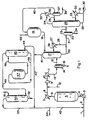
- a mixture comprising butane, butadiene, oxygen, and an organic halide is fed by conduit 2 to heat exchanger 3 wherein the mixture is preheated to a temperature of 175 to 225°C and then is fed via conduit 4 to epoxidation reactor 5.
- the epoxidation reactor may contain a plurality of steel tubes packed with a silver catalyst such as a cesium-promoted, supported, silver catalyst.
- the gas feed passes through the catalyst-containing steel tubes wherein butadiene is selectively oxidized to EpB and exits the epoxidation reactor through conduit 6.
- a heat exchange fluid is passed over the exterior of the reactor tubes to remove the heat of reaction.
- the temperature and pressure within conduit 6 typically is 1 to 4 bars (100 to 400 kPa) and 200 to 240°C.
- the epoxidation effluent is fed to heat exchangers 7 and 11 and compressor 9 by conduits 6, 8 and 10 wherein the temperature of the effluent stream is reduced to 0 to 100°C and the pressure is increased to 2 to 12 bars (200 to 1200 kPa).
- Makeup butadiene may be added to conduit 8 via conduit 12.
- the cooled and pressurized effluent is transported by conduit 13 to gas/liquid separator 14 and then through conduit 15 to absorber 17.
- the function of gas/liquid separator 14 is the removal of materials such as butenediols and water which are liquefied by the cooling and compression of the epoxidation effluent stream.
- a mixture of liquid butane and butadiene is fed from butane/butadiene recovery tank 19 through conduit 18 to the upper section of absorber 17 which contains a suitable packing material to provide intimate contact between the effluent fed by line 15 and liquid butane/butadiene mixture fed by line 18.
- the pressure and temperature within absorber 17 are within the ranges of 2 to 10 bars (200 to 1,000 kPa) and 0 to 60°C, provided that the combination of pressure and temperature maintains a liquid phase within the absorber.
- the conditions of pressure and temperature also are controlled to provide a predetermined concentration of both butane and butadiene in the gaseous effluent removed from the top of the absorber.
- a liquid effluent comprising a solution of EpB in butane/butadiene is removed from the base of absorber 17 and transported via conduits 20 and 21 to water separator 22 and then through conduit 23 to the mid-section of butane/butadiene recovery column 25.
- a portion, e.g., up to 95 weight percent, of the liquid effluent stream may be recycled through conduits 26, heat exchanger 27 and conduit 28 to absorber 17. This recycle stream functions to provide additional cooling of the contents of the absorber.
- the concentration of EpB in the liquid solution fed by line 23 to column 25 typically is 5 to 25 weight percent based on the total weight of the solution.
- Column 25 typically is equipped with trays or a packing material and is operated at a base pressure and temperature of 2.5 to 5 bars (250 to 500 kPa) and 100 to 130°C and a head (top) temperature of 2.5 to 5 bars (250 to 500 kPa) and 5 to 50°C to vaporize substantially all of the butane/butadiene fed.
- a liquid stream of crude EpB is removed from column 25 and from the EpB production system via conduits 29 and 30. This stream may be further refined by one or more distillations to increase the purity of the EpB, e.g., up to 99+%.
- the heat required to vaporize butane and butadiene in column 25 is provided by recycling a portion, e.g., up to 95 weight percent, of the liquid stream to column 25 by means of conduit 31, heat exchanger (reboiler) 32 and conduit 33.
- a vapor comprised of butane, butadiene, and a minor amount of water is removed from column 25 through conduit 34, condensed in heat exchanger 35 and fed by conduit 36 to water separator 37. Water collects in the lower section of separator 37 and is removed from the production system by conduit 39.
- Separation of the butane and butadiene mixture and water from the other materials fed to column 25 is enhanced by recycling a portion, e.g., from 50 to 95 weight percent, of the condensed butane/butadiene to the column via line 38.
- a butadiene polymerization inhibitor also may be added to column 25, for example, by means of line 38.
- the remainder of the condensed butane/butadiene is transported by conduit 40 to butane/butadiene recovery tank 19.
- a mixture of fresh butane/butadiene also is fed to tank 19 by line 55. This stream may contain butadiene to make up for the amount consumed in reactor 5 in addition to the butadiene and butane vented in the purge.
- a vapor effluent comprising butadiene, butane, and oxygen is removed from absorber 17 via conduit 41.
- the butadiene content of the vapor effluent is within the range of 4 to 50, preferably 7 to 20 mole percent.
- butane usually constitutes 25 to 85 mole percent of the total feed to the epoxidation zone.
- the butane/butadiene-containing vapor effluent is conveyed to epoxidation reactor 5 by conduits 42, 43, 2 and 4 and preheater 3 and provides both the butadiene reactant and the inert gas, i.e. butane, for the epoxidation reaction.
- vapor effluent removed from EpB absorber 17 via line 41 is transported by conduit 44 to a carbon dioxide removal zone comprising carbon dioxide absorber 45, aqueous alkali metal hydroxide tank 47 and scrubber 50.
- the vapor effluent is fed by conduit 44 to the lower section of absorber 45 which contains an appropriate packing material.
- An aqueous solution of an alkali metal hydroxide is fed via conduit 46 to the upper section of absorber 45 from aqueous alkali metal hydroxide tank 47.
- Carbon dioxide is absorbed by the conversion of the alkali metal hydroxide to a carbonate.
- the aqueous solution of alkali metal hydroxide/carbonate is removed from absorber 45 and returned to tank 47 by line 48.
- a hot carbonate carbon dioxide removal system well-known to those skilled in the art may be used.
- a carbon dioxide-depleted vapor is removed from the top of absorber 45 and conveyed by conduit 49 to the lower section of scrubber 50 wherein any alkali metal compound entrained in the carbon dioxide-depleted vapor is removed.
- Water is fed by means of conduit 51 to the upper section of scrubber 50 and removed from the bottom of the scrubber through line 52.
- An alkali-free vapor stream is removed from the top of the scrubber and transported via lines 53, 43, 2 and 4 and preheater 3 to the epoxidation reactor as described previously.
- a small purge via line 54 is required to remove argon which is an impurity present in the oxygen feed to the epoxidation zone.
- the processes provided by the present invention are further illustrated by the following example using the EpB production system described in the Figure.
- the flow rates are given in parts by weight.
- the epoxidation reactor employed fixed beds of the cesium-promoted, supported silver catalyst described in U.S. Patent 4,897,498.
- a gas mixture comprising butane (inert gas), oxygen, butadiene, water and 4-5 ppm 1,2-dichloroethane in methane is heated to 180°C in preheater 3 and fed by line 4 to epoxidation reactor 5 at a rate of 23,780 parts per hour at a pressure of 2 to 2.5 bars (200 to 250 kPa).
- Methane is utilized as a means of delivering the 1,2-dichloroethane to the EpB reaction system and normally is not present in a concentration greater than 0.7 weight percent at any point in the process.
- the epoxidation effluent gas comprising methane, oxygen, butane, butadiene, water, carbon dioxide, EpB and high boilers are removed from reactor 5 via line 6 at the rate of 23,791 parts per hour and transported through heat exchangers 7 and 11 and compressor 9 by lines 6, 8, 10 and 13 to gas/liquid separator 114.
- Butadiene is fed via conduit 12 at a rate of 321 parts per hour.
- Water and butenediols are removed from separator 14 through conduit 16 at rates of 3.3 and 0.3 parts per hour, respectively.
- EpB absorber 17 which consists of a 1.8 m section of stainless steel pipe having an inside diameter of approximately 10 cm.
- the absorber is packed with 14.1 liters of 6.35 mm Penn State packing except for a 0.5 m vacant space at the top.
- a mixture of liquid butane and butadiene (91.6/8.4 weight percent) is feed at a pressure of 6.5 bars (650 kPa) and a temperature of 20°C by conduit 18 to the side and near the top of absorber 17 at a rate of 5764 parts per hour.
- the pressure and temperature within the absorber are 4.9 bars (490 kPa) and 40°C.
- a liquid comprising butane, butadiene, EpB, water, butenediols and high boilers is removed from absorber 17 and transported by conduit 20 and 21 to separator 22.
- Water and butenediols are removed from separator 22 by line 24 at rates of 25.6 and 4.6 parts per hour, respectively, and the stream is fed through conduit 23 to the mid-section of butane/butadiene recovery column 25 at a rate of 5826 parts per hour.
- a portion of the conduit 20 stream is removed by line 26, cooled in heat exchanger 27 and recycled via conduit 28 to the lower section of absorber 20 at a rate of 11710 parts per hour.
- Column 25 is operated at a base pressure and temperature of 4.8 bar (480 kPa) and 125°C and a top pressure and temperature of 4.8 bar (480 kPa) and 45°C.
- a liquid stream comprising EpB, butenediols, and high boilers is removed from the base of column 25 and from the production system via conduits 29 and 30 at a rate of 372 parts per hour.
- a portion of the liquid stream of line 29 is removed by line 31, passed through heat exchanger 32 and fed via line 33 to the lower section of column 25 to maintain the base temperature of 125°C therein.
- the crude EpB product of line 30 may be distilled to obtain an overhead EpB product having a purity in excess of 99 percent.
- a vapor effluent comprising methane, oxygen, carbon dioxide, butane, and butadiene is removed from absorber 20 through line 41 at a rate of 24,019 parts per hour and is fed by line 44 to the lower sidewall of carbon dioxide absorber 45.
- the vapor effluent may be returned directly to epoxidation reactor 5 via lines 41, 42, 43, 2 and 4 and preheater 3 although the carbon dioxide present in the vapor has been found to adversely affect the epoxidation reaction.
- the carbon dioxide absorber consists of a 1.8 m section of stainless steel pipe having an internal diameter of 7.6 cm.
- An aqueous solution containing approximately 20 weight percent potassium hydroxide/carbonate is fed via conduit 46 to the upper section of, and removed via conduit 48 from the bottom of, absorber 45 at a rate of 9640 parts per hour.
- a carbon dioxide-depleted vapor effluent is removed from absorber 45 and fed at a rate of 24,914 parts per hour by conduit 49 to the lower section of scrubber 50 wherein any entrained potassium hydroxide/carbonate is removed by water fed through line 51 and removed by line 52.
- the vapor effluent from scrubber 50 is transported to reactor 5 by lines 53, 43, 2 and 4 and preheater 4 at a rate of 23,780 parts per hour.
- a portion of the line 43 stream is purged (line 54) from the production system at a rate of 359 parts per hour.
- a mixture of methane, 1,2-dichloroethane and oxygen is combined with the line 40 stream at a rate of 225 parts per hour.
- EpB is produced at a rate of 0.24 Kg per liter catalyst per hour at an average butadiene conversion of 16.9 mole percent and an overall EpB yield of 88.5 percent.
- This EpB production rate is achieved by operating the described EpB production system continuously for a period of time exceeding 300 hours.
- compositions of some of the streams of the preceding example are set forth in Table I wherein the values given are weight percentages based on the total weight of the stream composition.
- Diols refers to a mixture of 3-butene-1,2-diol and 2-butene-1,4-diol and high boilers include vinyl acetaldehyde, crotonaldehyde and high molecular weight compounds.
- one embodiment of the invention is the use of the EpB absorber as the source of the butane diluent and butadiene reactant fed to the epoxidation reactor.
- the mole percent butadiene in the vapor effluent from the EpB absorber normally is maintained between 4 and 50, preferably between 7 and 20, mole percent and the mole percent butane is normally maintained between 25 to 85 mole percent, preferably between 40 to 80 mole percent.
- a wide variety of combinations of butane:butadiene ratios, pressure, and temperature may be employed within the absorber to produce vapor effluents containing such concentrations of butane and of butadiene.
- the EpB absorber preferably is operated within the range of 10 to 50°C and 3 to 6 bars (300 to 600 kpa) since cooling the epoxidation effluent to less than 0°C is costly due to the equipment required and the increased operating costs involved and pressurizing the effluent significantly above 8 bars (800 kPa) can cause a decrease in the overall yield of EpB due to its conversion to other compounds in the cooling/compression zone.
- Tables II, III, and IV show the pressures (in bars absolute) which are required when using temperatures of 0°C to 60°C to produce vapor effluents containing 50, 60, 70, 80, and 90 mole percent of three different butane/butadiene mixtures.
- the temperatures (Temp., °C) reported in Tables II, III, and IV are the temperatures of the vapor effluent as it exits the absorber.
- the data reported in Table II were the result of varying pressure and temperature within absorber 17 when
Landscapes
- Chemical & Material Sciences (AREA)
- Organic Chemistry (AREA)
- Epoxy Compounds (AREA)
- Low-Molecular Organic Synthesis Reactions Using Catalysts (AREA)
Abstract
Claims (12)
- Procédé de récupération d'EpB d'un effluent essentiellement gazeux d'une zone d'époxidation dans laquelle du butadiène est mis en contact avec un gaz contenant de l'oxygène en présence d'un catalyseur et de butane pour produire un effluent d'époxidation comprenant de l'EpB, du butadiène, de l'oxygène et du butane, qui consiste à alimenter l'effluent dans un récipient d'absorption dans lequel l'effluent est mis en contact intime avec un mélange de butane et de butadiène sous une pression de 2 à 10 bars (200 à 1.000 kPa) et à une température de 0 à 60°C pour obtenir :(1) un effluent sous forme de vapeur comprenant du butadiène, de l'oxygène et du butane provenant de la partie supérieure du récipient d'absorption; et(2) un effluent sous forme liquide comprenant de l'EpB, du butadiène, et du butane provenant de la partie inférieure du récipient d'absorption;dans lequel l'EpB est le 3,4-époxy-1-butène, le butadiène est le 1,3-butadiène et la proportion molaire butane:butadiène du mélange liquide avec lequel l'effluent est mis en contact est de 20:1 à 1:2.
- Procédé selon la revendication 1 dans lequel l'effluent d'époxidation comprend de 0,5 à 6 pour-cent de moles d'EpB, 4 à 50 pour-cent de moles de butadiène, 4 à 25 pour-cent de moles d'oxygène et 25 à 85 pour-cent de moles de butane et la quantité de solvant absorbant liquide employée est de 0,1 à 0,6 parties en poids par partie en poids d'effluent d'époxidation.
- Procédé selon la revendication 1 dans lequel l'effluent d'époxidation comprend de 0,5 à 6 pour-cent de moles d'EpB, 4 à 50 pour-cent de moles de butadiène, 4 à 25 pour-cent de moles d'oxygène et 25 à 85 pour-cent de moles de butane qui consiste à alimenter l'effluent dans un récipient d'absorption dans lequel l'effluent est mis en contact intime avec un mélange de butadiène et de butane liquide sous une pression de 3 à 6 bars (300 à 600 kPa) et à une température de 10 à 50°C pour obtenir:(1) un effluent sous forme de vapeur comprenant du butadiène, du butane, et de l'oxygène provenant de la partie supérieure du récipient d'absorption; et(2) un effluent liquide comprenant de l'EpB, du butane, et du butadiène provenant de la partie inférieure du récipient d'absorption.
- Procédé selon la revendication 3 dans lequel l'effluent sous forme de vapeur (1) contient de 4 à 50 pour-cent de moles de butadiène et de 25 à 85 pour-cent de moles de butane, et l'effluent liquide (2) contient de 5 à 40 pour-cent en poids d'EpB.
- Procédé selon la revendication 1 comprenant les étapes consistant à :(A) alimenter l'effluent dans un récipient d'absorption dans lequel l'effluent est mis en contact intime avec un mélange de butadiène et de butane liquide sous une pression de 3 à 6 bars (300 à 600 kPa) et à une température de 10 à 50°C pour obtenir :(1) un effluent sous forme de vapeur comprenant du butane, de l'oxygène et du butadiène provenant de la partie supérieure du récipient d'absorption; et(2) un effluent liquide comprenant de l'EpB, de l'eau, du butane, et du butadiène provenant de la partie inférieure du récipient d'absorption;(B) alimenter l'effluent de l'étape (A)(2) dans un récipient de récupération de solvant fonctionnant sous une pression de 2,5 à 5 bars (250 à 500 kPa) et à une température comprise entre 5 et 130°C pour obtenir :(1) un effluent sous forme de vapeur comprenant du butane, du butadiène et de l'eau provenant de la partie supérieure de la colonne; et(2) un effluent liquide comprenant de l'EpB brut provenant de la partie inférieure de la colonne;(C) condenser l'effluent sous forme de vapeur de l'étape (B)(1) pour obtenir un mélange biphase comprenant de l'eau et un mélange de butane et de butadiène et séparer l'eau du système biphase pour obtenir un mélange épuisé en eau de butane et de butadiène; et(D) récupérer le mélange épuisé en eau de butane et butadiène.
- Procédé selon la revendication 5 dans lequel l'effluent d'époxidation comprend de 0,5 à 6 pour-cent de moles d'EpB, 4 à 50 pour-cent de moles de butadiène, 4 à 25 pour-cent de moles d'oxygène et 25 à 85 pour-cent de moles de butane, la quantité de butadiène et de butane liquide utilisée est de 0,1 à 0,6 parties en poids par partie en poids d'effluent d'époxidation et l'effluent liquide (A)(2) contient de 2 à 60 pour-cent en poids d'EpB.
- Procédé selon la revendication 1 dans lequel l'effluent d'époxidation comprend de 0,5 à 6 pour-cent de moles d'EpB, 4 à 50 pour-cent de moles de butadiène, 4 à 25 pour-cent de moles d'oxygène et 25 à 85 pour-cent de moles de butane, comprenant les étapes consistant à :(A) alimenter l'effluent dans un récipient d'absorption dans lequel l'effluent est mis en contact intime avec un mélange de butadiène et de butane liquide sous une pression de 3 à 6 bars (300 à 600 kPa) et à une température de 10 à 50°C pour obtenir :(1) un effluent sous forme de vapeur comprenant du butadiène, de l'oxygène, et du butane provenant de la partie supérieure du récipient d'absorption; et(2) un effluent liquide comprenant 5 à 40 pour-cent en poids d'EpB et du butadiène et du butane provenant de la partie inférieure du récipient d'absorption;(B) alimenter l'effluent de l'étape (A)(2) dans une colonne de récupération de solvant fonctionnant sous une pression et à une température de base de colonne de 2,5 à 5 bars (250 à 500 kPa) et 100 à 130°C et sous une pression et à une température de tête de colonne de 2,5 à 5 bars (250 à 500 kPa) et 5 à 50°C pour obtenir :(1) un effluent sous forme de vapeur comprenant du butadiène et du butane provenant de la partie supérieure de la colonne; et(2) un effluent liquide comprenant de l'EpB brut provenant de la partie inférieure de la colonne;(C) condenser l'effluent sous forme de vapeur de l'étape (B)(1) pour obtenir un mélange biphase comprenant de l'eau et du butadiène / butane et séparer l'eau du mélange biphase pour obtenir un flux de butadiène / butane épuisé en eau; et(D) récupérer le mélange épuisé en eau de butane et de butadiène.
- Procédé de fabrication et de séparation d'EpB comprenant les étapes consistant à :I. alimenter un gaz comprenant de 4 à 50 pour-cent de moles de butadiène, 5 à 30 pour-cent de moles d'oxygène et 25 à 85 pour-cent de moles de butane dans une zone d'époxidation dans laquelle le butadiène est époxydé en EpB en présence d'un catalyseur argent;II. retirer de la zone d'époxidation un effluent d'époxidation gazeux comprenant de 0,5 à 6 pour-cent de moles d'EpB, 4 à 50 pour-cent de moles de butadiène, 4 à 25 pour-cent de moles d'oxygène et 25 à 85 pour-cent de moles de butane;III. alimenter l'effluent gazeux d'époxidation dans une zone de refroidissement / compression dans laquelle l'effluent est comprimé sous une pression de 3 à 10 bars (300 à 1.000 kPa) et refroidi à une température de 0 à 100°C;IV. alimenter l'effluent obtenu à l'étape (III) dans un récipient d'absorption dans lequel l'effluent est mis en contact intime avec un mélange de butadiène et de butane liquide, dans lequel la proportion molaire butane:butadiène est de 20:1 à 1:2, sous une pression de 3 à 6 bars (300 à 600 kPa) et à une température de 10 à 50°C pour obtenir :(1) un effluent sous forme de vapeur comprenant de l'oxygène, 25 à 85 pour-cent de moles de butane, et 4 à 50 pour-cent de moles de butadiène provenant de la partie supérieure du récipient d'absorption; et(2) un effluent liquide comprenant de l'EpB, du butane et du butadiène provenant de la partie inférieure du récipient d'absorption;V. recycler l'effluent de l'étape IV (1) dans la zone d'époxidation; le butadiène alimenté dans l'étape I étant fourni par l'effluent de l'étape IV (1), l'EpB étant du 3,4-époxy-1-butène, le butadiène étant du 1,3-butadiène, et le butane étant un hydrocarbure aliphatique saturé qui contient 4 atomes de carbone.
- Procédé selon la revendication 8 dans lequel le gaz de l'étape I contient moins de 1 pour-cent de moles de bioxyde de carbone.
- Procédé selon la revendication 8 dans lequel l'effluent sous forme de vapeur de l'étape IV (1) est alimenté dans une zone d'élimination du bioxyde de carbone pour obtenir un effluent sous forme de vapeur épuisé en bioxyde de carbone contenant moins de 2 pour-cent de moles de bioxyde de carbone et l'effluent épuisé en bioxyde de carbone est alimenté dans la zone d'époxidation.
- Procédé selon la revendication 10 dans lequel la zone d'élimination du bioxyde de carbone comprend un récipient d'absorption dans lequel l'effluent sous forme de vapeur de l'étape IV (1) est mis en contact avec une solution aqueuse d'un hydroxyde de métal alcalin ou d'un carbonate de métal alcalin.
- Procédé selon la revendication 8 comprenant les étapes consistant à :I. alimenter un gaz comprenant de 4 à 50 pour-cent de moles de butadiène, 5 à 30 pour-cent de moles d'oxygène et 25 à 85 pour-cent de moles de butane dans une zone d'époxidation dans laquelle le butadiène est époxydé en EpB en présence d'un catalyseur argent;II. retirer de la zone d'époxidation un effluent d'époxidation gazeux comprenant de 0,5 à 6 pour-cent de moles d'EpB, 4 à 50 pour-cent de moles de butadiène, 4 à 25 pour-cent de moles d'oxygène et 25 à 85 pour-cent de moles de butane;III. alimenter l'effluent d'époxidation gazeux dans une zone de refroidissement / compression dans laquelle l'effluent est comprimé à une pression de 3 à 10 bars (300 à 1.000 kPa) et refroidi à une température de 0 à 100°C;IV. alimenter l'effluent obtenu à l'étape (III) dans un récipient d'absorption dans lequel l'effluent est mis en contact intime avec un mélange de butadiène et de butane liquide, dans lequel la proportion molaire butane:butadiène est de 20:1 à 1:2, sous une pression de 3 à 6 bars (300 à 600 kPa) et à une température de 10 à 50°C pour obtenir :(1) un effluent sous forme de vapeur comprenant de l'oxygène, 40 à 80 pour-cent de moles de butane et 7 à 20 pour-cent de moles de butadiène provenant de la partie supérieure du récipient d'absorption; et(2) un effluent liquide comprenant une solution contenant de 2 à 40 pour-cent en poids d'EpB dans un mélange de butane et de butadiène provenant de la partie inférieure du récipient d'absorption; etV. alimenter l'effluent de l'étape IV (1) dans une zone d'élimination du bioxyde de carbone comprenant un récipient d'absorption dans lequel l'effluent sous forme de vapeur de l'étape IV (1) est mis en contact avec une solution aqueuse d'un hydroxyde de métal alcalin ou d'un carbonate de métal alcalin pour obtenir un effluent sous forme de vapeur épuisé en bioxyde de carbone en contenant moins de 1 pour-cent et alimenter l'effluent épuisé en bioxyde de carbone dans la zone d'époxidation,dans lequel le butadiène et le butane alimentés dans l'étape I sont fournis par l'effluent épuisé en bioxyde de carbone de l'étape V.
Applications Claiming Priority (3)
| Application Number | Priority Date | Filing Date | Title |
|---|---|---|---|
| US130926 | 1993-10-04 | ||
| US08/130,926 US5312931A (en) | 1993-10-04 | 1993-10-04 | Recovery of 3,4-epoxy-1-butene from 1,3,-butadiene oxidation effluents |
| PCT/US1994/010638 WO1995009849A1 (fr) | 1993-10-04 | 1994-09-21 | Recuperation du 3,4-epoxy-1-butene contenu dans des effluents d'oxydation au 1,3-butadiene |
Publications (2)
| Publication Number | Publication Date |
|---|---|
| EP0722443A1 EP0722443A1 (fr) | 1996-07-24 |
| EP0722443B1 true EP0722443B1 (fr) | 1997-04-09 |
Family
ID=22447020
Family Applications (1)
| Application Number | Title | Priority Date | Filing Date |
|---|---|---|---|
| EP94929266A Expired - Lifetime EP0722443B1 (fr) | 1993-10-04 | 1994-09-21 | Recuperation du 3,4-epoxy-1-butene contenu dans des effluents d'oxydation au 1,3-butadiene |
Country Status (6)
| Country | Link |
|---|---|
| US (1) | US5312931A (fr) |
| EP (1) | EP0722443B1 (fr) |
| CN (1) | CN1138329A (fr) |
| CA (1) | CA2173235C (fr) |
| DE (1) | DE69402562T2 (fr) |
| WO (1) | WO1995009849A1 (fr) |
Families Citing this family (14)
| Publication number | Priority date | Publication date | Assignee | Title |
|---|---|---|---|---|
| US5312931A (en) * | 1993-10-04 | 1994-05-17 | Eastman Chemical Company | Recovery of 3,4-epoxy-1-butene from 1,3,-butadiene oxidation effluents |
| US5362890A (en) * | 1993-10-04 | 1994-11-08 | Eastman Chemical Company | Gas phase process for the epoxidation of non-allylic olefins |
| US5681969A (en) * | 1996-05-03 | 1997-10-28 | Eastman Chemical Company | Continuous process for the conversion of 2,5-dihydrofuran to 2,3-dihydrofuran |
| US5756779A (en) * | 1997-09-29 | 1998-05-26 | Eastman Chemical Company | Recovery of 3,4-epoxy-1-butene from 1,3-butadiene oxidation effluents |
| US5986141A (en) * | 1998-09-29 | 1999-11-16 | Eastman Chemical Company | Process for the production of cyclopropanemethylamine |
| US6018061A (en) * | 1999-05-05 | 2000-01-25 | Eastman Chemical Company | Process for recovering 3,4-epoxy-1-butene |
| US6172245B1 (en) | 1999-12-16 | 2001-01-09 | Eastman Chemical Company | Gas phase process for the epoxidation of non-allylic olefins |
| US6270739B1 (en) | 2000-06-16 | 2001-08-07 | Eastman Chemical Company | Process for the removal of carbon dioxide from 3,4-epoxy-1-butene process recycle streams |
| DE10131297A1 (de) * | 2001-06-29 | 2003-01-09 | Basf Ag | Verfahren zur Herstellung von partiellen Oxidationsprodukten und/oder partiellen Ammoxidationsprodukten wenigstens eines olefinischen Kohlenwasserstoffs |
| US6596882B2 (en) | 2001-07-20 | 2003-07-22 | Eastman Chemical Company | Recovery and purification of 3,4-epoxy-1-butene using water-miscible solvents |
| US6500970B1 (en) * | 2001-07-20 | 2002-12-31 | Eastman Chemical Company | Recovery and purification of 3,4-epoxy-1-butene using high-boiling solvents |
| US6395913B1 (en) * | 2001-07-20 | 2002-05-28 | Eastman Chemical Company | Recovery and purification of 3,4-epoxy-1-butene |
| DE10213968A1 (de) * | 2002-03-28 | 2003-10-30 | Basf Ag | Verfahren zur Herstellung von Ethylenoxid mit integrierter Kohlendioxidwäsche unter Verwendung einer aminhaltigen Absorptionslösung |
| US11187727B2 (en) | 2019-04-29 | 2021-11-30 | Schweitzer Engineering Laboratories, Inc. | Capacitance-coupled voltage transformer monitoring |
Family Cites Families (2)
| Publication number | Priority date | Publication date | Assignee | Title |
|---|---|---|---|---|
| US5117012A (en) * | 1991-10-07 | 1992-05-26 | Eastman Kodak Company | Recovery of 3,4-epoxy-1-butene from 1,3-butadiene oxidation effluents |
| US5312931A (en) * | 1993-10-04 | 1994-05-17 | Eastman Chemical Company | Recovery of 3,4-epoxy-1-butene from 1,3,-butadiene oxidation effluents |
-
1993
- 1993-10-04 US US08/130,926 patent/US5312931A/en not_active Expired - Lifetime
-
1994
- 1994-09-21 WO PCT/US1994/010638 patent/WO1995009849A1/fr not_active Ceased
- 1994-09-21 CA CA002173235A patent/CA2173235C/fr not_active Expired - Fee Related
- 1994-09-21 EP EP94929266A patent/EP0722443B1/fr not_active Expired - Lifetime
- 1994-09-21 CN CN94194224.4A patent/CN1138329A/zh active Pending
- 1994-09-21 DE DE69402562T patent/DE69402562T2/de not_active Expired - Lifetime
Also Published As
| Publication number | Publication date |
|---|---|
| EP0722443A1 (fr) | 1996-07-24 |
| CN1138329A (zh) | 1996-12-18 |
| WO1995009849A1 (fr) | 1995-04-13 |
| DE69402562T2 (de) | 1997-07-17 |
| CA2173235C (fr) | 2000-01-11 |
| DE69402562D1 (de) | 1997-05-15 |
| US5312931A (en) | 1994-05-17 |
| CA2173235A1 (fr) | 1995-04-13 |
Similar Documents
| Publication | Publication Date | Title |
|---|---|---|
| EP0643708B1 (fr) | Recuperation de 3,4-epoxy-1-butene contenu dans des effluents d'oxydation de 1,3-butadiene | |
| US5214185A (en) | Continuous process for preparing dimethyl carbonate | |
| US5312931A (en) | Recovery of 3,4-epoxy-1-butene from 1,3,-butadiene oxidation effluents | |
| US6270739B1 (en) | Process for the removal of carbon dioxide from 3,4-epoxy-1-butene process recycle streams | |
| EP1021427B1 (fr) | Recuperation de 3,4-epoxy-1-butene a partir d'effluents d'oxydation du 1,3-butadiene | |
| EP1419146B1 (fr) | Procede d'epoxydation d'olefines | |
| EP0891316B1 (fr) | Procedes de production de methylmercaptopropanal | |
| JP2795360B2 (ja) | 炭酸ジメチルの連続的製法 | |
| US6596882B2 (en) | Recovery and purification of 3,4-epoxy-1-butene using water-miscible solvents | |
| EP0732317B1 (fr) | Procédé pour augmenter le rendement de l'alcool tertiobutylique dans un procédé de récupération de l'alcool tertiobutylique | |
| WO2010027732A1 (fr) | Procédé de production d'acroléine et/ou d'acide acrylique à partir de propane | |
| US4251460A (en) | Process for production of dimethylformamide | |
| US6500970B1 (en) | Recovery and purification of 3,4-epoxy-1-butene using high-boiling solvents | |
| US4228301A (en) | Process for the preparation of diacetoxybutene |
Legal Events
| Date | Code | Title | Description |
|---|---|---|---|
| PUAI | Public reference made under article 153(3) epc to a published international application that has entered the european phase |
Free format text: ORIGINAL CODE: 0009012 |
|
| 17P | Request for examination filed |
Effective date: 19960319 |
|
| AK | Designated contracting states |
Kind code of ref document: A1 Designated state(s): DE NL |
|
| GRAG | Despatch of communication of intention to grant |
Free format text: ORIGINAL CODE: EPIDOS AGRA |
|
| 17Q | First examination report despatched |
Effective date: 19960821 |
|
| GRAH | Despatch of communication of intention to grant a patent |
Free format text: ORIGINAL CODE: EPIDOS IGRA |
|
| GRAH | Despatch of communication of intention to grant a patent |
Free format text: ORIGINAL CODE: EPIDOS IGRA |
|
| GRAA | (expected) grant |
Free format text: ORIGINAL CODE: 0009210 |
|
| AK | Designated contracting states |
Kind code of ref document: B1 Designated state(s): DE NL |
|
| REF | Corresponds to: |
Ref document number: 69402562 Country of ref document: DE Date of ref document: 19970515 |
|
| PLBE | No opposition filed within time limit |
Free format text: ORIGINAL CODE: 0009261 |
|
| STAA | Information on the status of an ep patent application or granted ep patent |
Free format text: STATUS: NO OPPOSITION FILED WITHIN TIME LIMIT |
|
| 26N | No opposition filed | ||
| PGFP | Annual fee paid to national office [announced via postgrant information from national office to epo] |
Ref country code: NL Payment date: 20010618 Year of fee payment: 8 |
|
| PG25 | Lapsed in a contracting state [announced via postgrant information from national office to epo] |
Ref country code: NL Free format text: LAPSE BECAUSE OF NON-PAYMENT OF DUE FEES Effective date: 20030401 |
|
| PGFP | Annual fee paid to national office [announced via postgrant information from national office to epo] |
Ref country code: DE Payment date: 20090930 Year of fee payment: 16 |
|
| REG | Reference to a national code |
Ref country code: DE Ref legal event code: R119 Ref document number: 69402562 Country of ref document: DE Effective date: 20110401 |
|
| PG25 | Lapsed in a contracting state [announced via postgrant information from national office to epo] |
Ref country code: DE Free format text: LAPSE BECAUSE OF NON-PAYMENT OF DUE FEES Effective date: 20110401 |