EP0722843B1 - Verfahren zur Dekoration von Gegenständen durch Sublimation - Google Patents
Verfahren zur Dekoration von Gegenständen durch Sublimation Download PDFInfo
- Publication number
- EP0722843B1 EP0722843B1 EP96100006A EP96100006A EP0722843B1 EP 0722843 B1 EP0722843 B1 EP 0722843B1 EP 96100006 A EP96100006 A EP 96100006A EP 96100006 A EP96100006 A EP 96100006A EP 0722843 B1 EP0722843 B1 EP 0722843B1
- Authority
- EP
- European Patent Office
- Prior art keywords
- layer
- coating
- transparent coating
- transparent
- process according
- Prior art date
- Legal status (The legal status is an assumption and is not a legal conclusion. Google has not performed a legal analysis and makes no representation as to the accuracy of the status listed.)
- Expired - Lifetime
Links
- 238000000034 method Methods 0.000 title claims abstract description 30
- 238000000859 sublimation Methods 0.000 title description 11
- 230000008022 sublimation Effects 0.000 title description 11
- 238000000576 coating method Methods 0.000 claims abstract description 63
- 239000011248 coating agent Substances 0.000 claims abstract description 58
- 229920003023 plastic Polymers 0.000 claims abstract description 27
- 239000000463 material Substances 0.000 claims abstract description 24
- 239000004033 plastic Substances 0.000 claims abstract description 24
- 238000005034 decoration Methods 0.000 claims abstract description 23
- 239000002966 varnish Substances 0.000 claims abstract description 13
- 230000001070 adhesive effect Effects 0.000 claims abstract description 9
- 239000000853 adhesive Substances 0.000 claims abstract description 8
- 239000007788 liquid Substances 0.000 claims abstract description 7
- 238000010438 heat treatment Methods 0.000 claims abstract description 6
- 238000000465 moulding Methods 0.000 claims abstract description 6
- 238000007639 printing Methods 0.000 claims abstract description 4
- 229920001169 thermoplastic Polymers 0.000 claims abstract description 3
- 239000004416 thermosoftening plastic Substances 0.000 claims abstract description 3
- 239000003292 glue Substances 0.000 claims abstract 2
- 239000010410 layer Substances 0.000 claims description 54
- 239000000976 ink Substances 0.000 claims description 20
- 238000004132 cross linking Methods 0.000 claims description 15
- 230000008569 process Effects 0.000 claims description 14
- 239000007787 solid Substances 0.000 claims description 13
- 239000011241 protective layer Substances 0.000 claims description 10
- 239000002131 composite material Substances 0.000 claims description 5
- 238000007731 hot pressing Methods 0.000 claims description 5
- 238000004026 adhesive bonding Methods 0.000 claims description 4
- 229920001187 thermosetting polymer Polymers 0.000 claims description 4
- 239000004922 lacquer Substances 0.000 claims description 3
- 238000002360 preparation method Methods 0.000 claims description 3
- 239000002313 adhesive film Substances 0.000 claims 3
- PPBRXRYQALVLMV-UHFFFAOYSA-N Styrene Natural products C=CC1=CC=CC=C1 PPBRXRYQALVLMV-UHFFFAOYSA-N 0.000 abstract description 11
- 229920000122 acrylonitrile butadiene styrene Polymers 0.000 abstract description 6
- 229920001893 acrylonitrile styrene Polymers 0.000 abstract description 6
- SCUZVMOVTVSBLE-UHFFFAOYSA-N prop-2-enenitrile;styrene Chemical class C=CC#N.C=CC1=CC=CC=C1 SCUZVMOVTVSBLE-UHFFFAOYSA-N 0.000 abstract description 6
- 238000007650 screen-printing Methods 0.000 abstract description 6
- 229920002803 thermoplastic polyurethane Polymers 0.000 abstract description 6
- 229920001577 copolymer Polymers 0.000 abstract description 4
- 229920001971 elastomer Polymers 0.000 abstract description 4
- 239000000806 elastomer Substances 0.000 abstract description 4
- KKEYFWRCBNTPAC-UHFFFAOYSA-N Terephthalic acid Chemical class OC(=O)C1=CC=C(C(O)=O)C=C1 KKEYFWRCBNTPAC-UHFFFAOYSA-N 0.000 abstract description 2
- 229920002857 polybutadiene Polymers 0.000 abstract description 2
- 239000007921 spray Substances 0.000 abstract description 2
- 239000005062 Polybutadiene Substances 0.000 abstract 1
- 238000009281 ultraviolet germicidal irradiation Methods 0.000 abstract 1
- 238000004519 manufacturing process Methods 0.000 description 7
- 230000002787 reinforcement Effects 0.000 description 7
- 230000005012 migration Effects 0.000 description 6
- 238000013508 migration Methods 0.000 description 6
- 229920005989 resin Polymers 0.000 description 6
- 239000011347 resin Substances 0.000 description 6
- 239000000243 solution Substances 0.000 description 6
- XECAHXYUAAWDEL-UHFFFAOYSA-N acrylonitrile butadiene styrene Chemical compound C=CC=C.C=CC#N.C=CC1=CC=CC=C1 XECAHXYUAAWDEL-UHFFFAOYSA-N 0.000 description 5
- 239000004676 acrylonitrile butadiene styrene Substances 0.000 description 5
- XUMBMVFBXHLACL-UHFFFAOYSA-N Melanin Chemical compound O=C1C(=O)C(C2=CNC3=C(C(C(=O)C4=C32)=O)C)=C2C4=CNC2=C1C XUMBMVFBXHLACL-UHFFFAOYSA-N 0.000 description 4
- 230000008901 benefit Effects 0.000 description 4
- 238000009792 diffusion process Methods 0.000 description 4
- 230000001681 protective effect Effects 0.000 description 4
- 150000008064 anhydrides Chemical class 0.000 description 3
- 239000000123 paper Substances 0.000 description 3
- 239000000049 pigment Substances 0.000 description 3
- -1 polyethylene Polymers 0.000 description 3
- 239000002356 single layer Substances 0.000 description 3
- 239000000758 substrate Substances 0.000 description 3
- 239000004753 textile Substances 0.000 description 3
- OKTJSMMVPCPJKN-UHFFFAOYSA-N Carbon Chemical compound [C] OKTJSMMVPCPJKN-UHFFFAOYSA-N 0.000 description 2
- 239000004698 Polyethylene Substances 0.000 description 2
- 239000004823 Reactive adhesive Substances 0.000 description 2
- GWEVSGVZZGPLCZ-UHFFFAOYSA-N Titan oxide Chemical compound O=[Ti]=O GWEVSGVZZGPLCZ-UHFFFAOYSA-N 0.000 description 2
- 229920001807 Urea-formaldehyde Polymers 0.000 description 2
- 230000016571 aggressive behavior Effects 0.000 description 2
- 229910052799 carbon Inorganic materials 0.000 description 2
- 239000001913 cellulose Substances 0.000 description 2
- 229920002678 cellulose Polymers 0.000 description 2
- 239000003086 colorant Substances 0.000 description 2
- 238000001816 cooling Methods 0.000 description 2
- 239000006260 foam Substances 0.000 description 2
- 238000002347 injection Methods 0.000 description 2
- 239000007924 injection Substances 0.000 description 2
- 239000000203 mixture Substances 0.000 description 2
- 230000019612 pigmentation Effects 0.000 description 2
- 238000007747 plating Methods 0.000 description 2
- 229920000573 polyethylene Polymers 0.000 description 2
- 229920000139 polyethylene terephthalate Polymers 0.000 description 2
- 230000005855 radiation Effects 0.000 description 2
- 238000006748 scratching Methods 0.000 description 2
- 230000002393 scratching effect Effects 0.000 description 2
- 230000035939 shock Effects 0.000 description 2
- 239000002904 solvent Substances 0.000 description 2
- 239000012780 transparent material Substances 0.000 description 2
- NLHHRLWOUZZQLW-UHFFFAOYSA-N Acrylonitrile Chemical compound C=CC#N NLHHRLWOUZZQLW-UHFFFAOYSA-N 0.000 description 1
- 206010001488 Aggression Diseases 0.000 description 1
- 239000004593 Epoxy Substances 0.000 description 1
- JOYRKODLDBILNP-UHFFFAOYSA-N Ethyl urethane Chemical compound CCOC(N)=O JOYRKODLDBILNP-UHFFFAOYSA-N 0.000 description 1
- 229920000877 Melamine resin Polymers 0.000 description 1
- 239000004640 Melamine resin Substances 0.000 description 1
- BPQQTUXANYXVAA-UHFFFAOYSA-N Orthosilicate Chemical compound [O-][Si]([O-])([O-])[O-] BPQQTUXANYXVAA-UHFFFAOYSA-N 0.000 description 1
- 239000004952 Polyamide Substances 0.000 description 1
- 239000004793 Polystyrene Substances 0.000 description 1
- 206010063493 Premature ageing Diseases 0.000 description 1
- 208000032038 Premature aging Diseases 0.000 description 1
- 238000005299 abrasion Methods 0.000 description 1
- 230000009471 action Effects 0.000 description 1
- PNEYBMLMFCGWSK-UHFFFAOYSA-N aluminium oxide Inorganic materials [O-2].[O-2].[O-2].[Al+3].[Al+3] PNEYBMLMFCGWSK-UHFFFAOYSA-N 0.000 description 1
- 239000007767 bonding agent Substances 0.000 description 1
- NTXGQCSETZTARF-UHFFFAOYSA-N buta-1,3-diene;prop-2-enenitrile Chemical compound C=CC=C.C=CC#N NTXGQCSETZTARF-UHFFFAOYSA-N 0.000 description 1
- 150000001732 carboxylic acid derivatives Chemical class 0.000 description 1
- 239000011093 chipboard Substances 0.000 description 1
- 230000000295 complement effect Effects 0.000 description 1
- 150000001875 compounds Chemical class 0.000 description 1
- 239000000470 constituent Substances 0.000 description 1
- 238000010411 cooking Methods 0.000 description 1
- 238000000151 deposition Methods 0.000 description 1
- 238000001035 drying Methods 0.000 description 1
- 239000000975 dye Substances 0.000 description 1
- 230000000694 effects Effects 0.000 description 1
- 238000001704 evaporation Methods 0.000 description 1
- 239000000284 extract Substances 0.000 description 1
- 238000001125 extrusion Methods 0.000 description 1
- 239000002657 fibrous material Substances 0.000 description 1
- 239000000945 filler Substances 0.000 description 1
- 230000006870 function Effects 0.000 description 1
- 238000005470 impregnation Methods 0.000 description 1
- 239000011147 inorganic material Substances 0.000 description 1
- 230000010354 integration Effects 0.000 description 1
- 229920000554 ionomer Polymers 0.000 description 1
- 230000002427 irreversible effect Effects 0.000 description 1
- 239000002649 leather substitute Substances 0.000 description 1
- FPYJFEHAWHCUMM-UHFFFAOYSA-N maleic anhydride Chemical compound O=C1OC(=O)C=C1 FPYJFEHAWHCUMM-UHFFFAOYSA-N 0.000 description 1
- 239000007769 metal material Substances 0.000 description 1
- 239000012768 molten material Substances 0.000 description 1
- 230000035515 penetration Effects 0.000 description 1
- 239000002985 plastic film Substances 0.000 description 1
- 239000011120 plywood Substances 0.000 description 1
- 229920002647 polyamide Polymers 0.000 description 1
- 239000004417 polycarbonate Substances 0.000 description 1
- 229920000515 polycarbonate Polymers 0.000 description 1
- ODGAOXROABLFNM-UHFFFAOYSA-N polynoxylin Chemical compound O=C.NC(N)=O ODGAOXROABLFNM-UHFFFAOYSA-N 0.000 description 1
- 229920000098 polyolefin Polymers 0.000 description 1
- 229920002223 polystyrene Polymers 0.000 description 1
- 239000004810 polytetrafluoroethylene Substances 0.000 description 1
- 229920001343 polytetrafluoroethylene Polymers 0.000 description 1
- 229920002635 polyurethane Polymers 0.000 description 1
- 239000004814 polyurethane Substances 0.000 description 1
- 239000011253 protective coating Substances 0.000 description 1
- 230000009993 protective function Effects 0.000 description 1
- 238000011084 recovery Methods 0.000 description 1
- 230000003014 reinforcing effect Effects 0.000 description 1
- 238000009877 rendering Methods 0.000 description 1
- 230000000717 retained effect Effects 0.000 description 1
- 238000007711 solidification Methods 0.000 description 1
- 230000008023 solidification Effects 0.000 description 1
- 239000012815 thermoplastic material Substances 0.000 description 1
- 229920005992 thermoplastic resin Polymers 0.000 description 1
- 239000004408 titanium dioxide Substances 0.000 description 1
- 239000002023 wood Substances 0.000 description 1
Images



Classifications
-
- B—PERFORMING OPERATIONS; TRANSPORTING
- B44—DECORATIVE ARTS
- B44C—PRODUCING DECORATIVE EFFECTS; MOSAICS; TARSIA WORK; PAPERHANGING
- B44C1/00—Processes, not specifically provided for elsewhere, for producing decorative surface effects
- B44C1/16—Processes, not specifically provided for elsewhere, for producing decorative surface effects for applying transfer pictures or the like
- B44C1/165—Processes, not specifically provided for elsewhere, for producing decorative surface effects for applying transfer pictures or the like for decalcomanias; sheet material therefor
- B44C1/17—Dry transfer
- B44C1/1712—Decalcomanias applied under heat and pressure, e.g. provided with a heat activable adhesive
- B44C1/1716—Decalcomanias provided with a particular decorative layer, e.g. specially adapted to allow the formation of a metallic or dyestuff layer on a substrate unsuitable for direct deposition
-
- B—PERFORMING OPERATIONS; TRANSPORTING
- B41—PRINTING; LINING MACHINES; TYPEWRITERS; STAMPS
- B41M—PRINTING, DUPLICATING, MARKING, OR COPYING PROCESSES; COLOUR PRINTING
- B41M5/00—Duplicating or marking methods; Sheet materials for use therein
- B41M5/025—Duplicating or marking methods; Sheet materials for use therein by transferring ink from the master sheet
- B41M5/035—Duplicating or marking methods; Sheet materials for use therein by transferring ink from the master sheet by sublimation or volatilisation of pre-printed design, e.g. sublistatic
-
- B—PERFORMING OPERATIONS; TRANSPORTING
- B41—PRINTING; LINING MACHINES; TYPEWRITERS; STAMPS
- B41M—PRINTING, DUPLICATING, MARKING, OR COPYING PROCESSES; COLOUR PRINTING
- B41M7/00—After-treatment of prints, e.g. heating, irradiating, setting of the ink, protection of the printed stock
- B41M7/0045—After-treatment of prints, e.g. heating, irradiating, setting of the ink, protection of the printed stock using protective coatings or film forming compositions cured by mechanical wave energy, e.g. ultrasonics, cured by electromagnetic radiation or waves, e.g. ultraviolet radiation, electron beams, or cured by magnetic or electric fields, e.g. electric discharge, plasma
-
- B—PERFORMING OPERATIONS; TRANSPORTING
- B41—PRINTING; LINING MACHINES; TYPEWRITERS; STAMPS
- B41M—PRINTING, DUPLICATING, MARKING, OR COPYING PROCESSES; COLOUR PRINTING
- B41M7/00—After-treatment of prints, e.g. heating, irradiating, setting of the ink, protection of the printed stock
- B41M7/0054—After-treatment of prints, e.g. heating, irradiating, setting of the ink, protection of the printed stock using protective coatings or film forming compositions cured by thermal means, e.g. infrared radiation, heat
Definitions
- the present invention relates to a method of decorating an article by sublimable ink printing method (s). It no longer applies particularly to articles in the form of laminates grouping together different plastic and composite materials such as skis in general, surfboards, skateboards and other similar objects.
- Sublimation is a technique well suited for decorating such items that allow the use of many different plastic supports and print any designs without the need to submit the support for a preliminary specific preparation operation.
- the principle of transfer consists in evaporating inks contained on a support paper under form of dry extracts by application of heat and pressure against the support to decorate. The process is clean, rapid and without the release of vapors or harmful solvents.
- the decoration is transferred to the external surface of a transparent layer covering the article to be decorated.
- An ink gradient is formed over a few tenths of a mm from the outer surface towards the inside of the transparent layer.
- the major drawback is that the decor is directly subject to external aggression and can be deteriorated quickly if the conditions of use of the article are severe (when the article is subject to shocks, scratches, strong UV radiation, etc.).
- Patent application FR-A-2 620 975 also belonging to the plaintiff is distinguished from the previous one by the fact that sublimation is first performed on an opaque monolayer sheet which is then assembled by gluing on a transparent single-layer protective sheet. The set is then attached to the article by hot gluing.
- the transparent layer thus decorated is assembled with an opaque layer.
- the assembly is then secured to the object by hot bonding.
- the increase in temperature during bonding causes a restart of the migration of the inks, which then diffuse in the opaque layer. Diffusion in depth creates the aforementioned pastellization problem, which is also associated with significant lateral diffusion due to some heat creep opaque layer; which makes the final decor less clear.
- Document EP-A-0 421 140 relates to a method of decoration and covering of substrates; for example wooden products of the furniture type kitchen or office. It consists in impregnating a sheet presublimated in fibrous material by a pre-crosslinked solution of melanin resin and / or urea-formaldehyde. Then this sheet is heated, molded with the substrate by application of temperature and pressure so as to obtain crosslinking full of resin.
- This resin which serves as a protective covering must have qualities of resistance to scratching, stretching and others. However for an effective action, such a covering must in principle be of a thickness that is difficult to obtain by impregnation. Such protection is generally insufficient.
- Melanin and / or urea-formaldehyde resins are known generally for their ability to bond with cellulose-based materials, such as wood, plywood, chipboard, and other cellulose derivatives. In however, they are not very compatible with bonding with most materials plastics used in the composition of composite laminates such as skis, surfboards and the like.
- Document EP 0 625 433 applies to the manufacture of supply elements and furniture; such as cupboards, etc.
- the method is to produce a decorative cover sheet based on polystyrene or polyolefin decorated by ink transfer (gravure, sublimation, etc.).
- the sheet undergoes a varnishing operation by which the layer of varnish protects the transferred design, then the sheet is applied for example by adhesives to the filler core of the supply element.
- the varnish has for essential role of ensuring the protection of the decoration.
- Such a means may prove to be sufficient for interior furniture; however, it does not provide protection sufficient for a product subject to very harsh external conditions, such as skiing for example. Resistance to edges or club blows from a protective varnish is notoriously insufficient. Resistance to conditions of the unprotected varnish is weak and leads to hardening and premature aging. The varnish quickly loses its initial appearance and its covering and protective power.
- Document CH-A-542042 relates to a traditional process for transferring continuous of a transparent plastic strip serving as a protective coating on a non-textile substrate (synthetic leather, plastic, etc.).
- the document EP-A-033 776 relates to a process which consists in obtaining two steps a top cover of a ski printed from a sheet of polyethylene or PTFE. First, the sheet is heated and then high temperature and high pressure contact with a print containing sublimable and diffusable pigments. The second step is to control the cooling temperature to produce a solidification without distortion and obtain pigment stability.
- Document JP-A-55114589 relates to a method of decorating a sheet of inorganic or metallic material. We apply a solution of colloidal mixture of alumina and / or silicate and a melamine resin on the face printed from said sheet. This coating is resistant to abrasion and external conditions and therefore serves as protection of the decor.
- the object of the present invention is to provide a solution to the problems aforementioned encountered in the field of decorating articles in the form of laminates such as skis, snowboards or other objects of a similar nature which are mainly made of materials derived from carbon chemistry (plastics, foams, elastomers, etc.).
- one of the goals is to achieve a decoration by sublimation on a face protected from external aggressions and which retains its original colors and perfect clarity even after bonding to hot and pressurized complex decorated on the rest of the article.
- the crosslinked transparent coating has resistance to hot creep which is significantly improved, which prevents any lateral diffusion inks which can create a lack of clarity during subsequent operations of bonding or molding using high temperatures and high pressures.
- the coating transparent is chosen from varnishes, serigraphy inks without pigment, adhesive coatings or reactive adhesives, thermoplastic films or thermosetting.
- the main property retained for the choice of these coatings is their good resistance to hot creep after crosslinking and their ability to remain equally transparent.
- an application of the coating is carried out. liquid or very slightly viscous state by means of application of the type to curtain, roller, spray or screen printing on the first side of said layer.
- the hardening of the coating by crosslinking is carried out by heating, by irradiation with UV rays, or by irradiation with IR rays.
- crosslinking with UV rays presents the advantage of consuming little energy.
- said first layer is chosen from among the transparent sublimable plastics which constitute the outer layer of protection of the decorated complex and in that after the completion of the third hardening step of the transparent coating, assembly is carried out on the transparent coating of the second layer consisting of an undercoat of contrast chosen in an opaque material on the transparent coating.
- the contrast underlay reveals the full intensity and depth of the decoration through the transparent layer and its coating.
- the inks do not migrate into the opaque layer due to the presence of hardened transparent coating and the decor remains clear and perfectly contrasted whatever the next steps are.
- the adhesion of the undercoat is carried out contrast on the transparent coating by interposing a solid film of bonding and hot pressing.
- the contrast undercoat is chosen from lacquers or pigmented varnish and is deposited in a liquid state on the transparent coating hardened. This method is appreciated for its simplicity and the economical aspect.
- the contrast sublayer is chosen from solid bonding films having good adhesion properties with the hardened transparent coating on the one hand and with the rest of the article on which it is intended to be reported on the other hand and in that one obtains its membership by hot pressing.
- said first layer is chosen from among the opaque sublimable plastics which constitutes the sub-layer of contrast of the decorated complex and in that after the hardening of the transparent coating, we proceed to the assembly of a second layer constituting the protective layer of the complex, chosen from plastic material transparent, on the transparent coating covering the contrast underlay.
- the adhesion of the protective layer on the transparent coating by interposing a solid film bonding agent with good adhesion properties with the protective layer on the one hand and with the hardened transparent coating on the other.
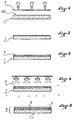
- the decoration pattern to be printed is in a manner known per se in a sheet of backing paper (4) which is applied under pressure (P) to a temperature (T) for a time (t) against the face (100) or internal face of the transparent layer.
- the transparent layer can be chosen from the materials polyamide sublimable plastics such as PA11, PA12, PA6.3, PA6.6, etc, Polycarbonates, ABS (Acrylonitrile Butadiene Styrene), AS (Acrylonitrile Styrene) transparent mixed with a TPU (thermoplastic urethane elastomer), Polyethylene Terephthalates (PET).
- polyamide sublimable plastics such as PA11, PA12, PA6.3, PA6.6, etc, Polycarbonates, ABS (Acrylonitrile Butadiene Styrene), AS (Acrylonitrile Styrene) transparent mixed with a TPU (thermoplastic urethane elastomer), Polyethylene Terephthalates (PET).
- the thickness of the transparent layer is between 0.2 and 1.1 mm. This thickness is chosen sufficient to provide sufficient protection to scratches of all kinds (edges, sticks, shocks, etc.). Sublimation is operated at a temperature between 160 and 180 ° C, a pressure of 1 to 2 bars for a time between 1 min 30 sec and about 4 min. The depth of ink migration front is around or slightly greater than 0.20 mm.
- the next or second step is to cover the layer thus predecorated by a transparent or translucent coating (2) in crosslinkable material, hereinafter called "transparent coating".
- transparent coating in crosslinkable material
- the covering of the face (100) by the coating can be achieved by different means adapted according to the type of coating.
- automatic means can be used application to the curtain, roller or manual means such as passage to the pistol.
- screen printing inks the application will be done using of the screen printing technique.
- it will suffice to make a hot plating of the film on the face of the transparent layer by means adapted. In the latter case, the crosslinking is obtained simultaneously during the plating by increasing the crosslinking temperature of the constituent resin the film.
- crosslinking is obtained in a third step by heating in the oven or by radiation under IR or UV lamps, for example (figure 4).
- the purpose of crosslinking is to modify the state of the coating to bring it to an irreversible hardening state allowing it to remain stable thermally and withstand hot creep in later stages of pressure cooking necessary for assembling the decorated complex on the article itself; these stages generally taking place in a mold at pressures around 7 to 10 bars approximately, and at temperatures between 60 and 150 ° C.
- Sublimation inks are likely to migrate inside the coating during this crosslinking phase in a small proportion, which does not affect the precision and colors of the decor.
- an underlay is assembled of contrast (3) on the coating itself.
- the underlay (3) is rendered opaque by pigmentation, preferably in white for example by means of titanium dioxide incorporated during manufacture. Relative to the pigmentation of the contrast underlay which is intended to reveal the decor, it is necessary to specify that we are by no means limited to the color white. For example, range of clear, metallic or pearly shades.
- the contrast layer (3) can be chosen from lacquers or varnishes pigmented; and in this case, the deposit is made in the liquid state on the coating (2) already hardened. You can then either let it dry at room temperature or activate the drying by heating for example. We then obtain the complex (5) of FIG. 5. This complex is then reported on the article and adhesion can be done using a solid bonding film (7) between the article (6) and the opaque undercoat (3) of the complex (5), by applying a sufficient temperature and pressure, as in mold for example. Besides its role as an adhesive, the film has the function secondary to absorb the structural irregularities of the reinforcements on the face of article contact. Thus the top of the decorated complex retains its appearance smooth after adhesion on the article.
- the contrast layer can also be a solid opaque bonding film. which will be chosen for its properties of compatibility with bonding with the coating (2) and with the surface of the article on which it is intended to come into contact.
- the contrast layer can also be a simple opaque layer of material. plastic having no adhesion compatibility with the coating (2) or with the rest of the article (6).
- the assembly can be done by interposing solid bonding films (70, 71) between the coating (2) and the opaque layer (3) on the one hand, and between the opaque layer (3) and the rest of the article (6) on the other.
- provision can be made for the various layers to be assembled during a single stage of hot and pressure assembly in a mold ( Figures 7 and 8). In any case, this subsequent molding step does not affect the quality of the sublimated decor thanks to the principle of the invention implemented before.
- the transparent layer (1) has an external face (101) in contact with the external environment and a face internal (100) which has been printed, but which is sheltered from the external environment.
- the crosslinked coating (2) is also protected by the thickness of the layer transparent. In reality, it has no specific protective function for the decor.
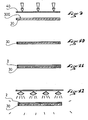
- One of its faces (300) is transferred to a decoration by sublimation. by means of a backing paper (40) under suitable heating conditions and pressure ( Figures 9 and 10).
- the next step is to cover the face (300) thus decorated with the opaque layer by transparent or translucent coating of crosslinkable material (2) as described in the previous mode ( Figure 11), and we proceed to its crosslinking ( Figure 12).
- a protective layer is assembled transparent (10) on the coating (2) covering the opaque layer (30) at the by means of a solid bonding film (72), itself chosen from transparent material and suitable for bonding both with the opaque layer and with the coating (2) in appropriate heat and pressure conditions (Figure 14).
- the complex (50) as well formed can be added to the rest of the article to be decorated (6) by means of a second bonding film (73) for example ( Figure 15).
- Figures 16 and 17 illustrate an example of assembly of a complex decorated (5, 50) as previously manufactured, with the upper reinforcement element (8) for the manufacture of a ski.
- a hot forming mold comprising a lower die (9), has a stack of layers intended to form the top of the ski; the complex pre-decorated (5, 50) according to the invention, a layer (8) intended to form the reinforcement upper of the ski and a solid film (74) compatibilizing intended to ensure the bonding from above with the rest of the ski.
- the reinforcing layer (8) consists of one or more textile plies of reinforcement pre-impregnated with a thermosetting or thermoplastic resin.
- the hot pressing operation ensures crosslinking or the complement of crosslinking of the resin and the adhesion of the film (74) to the reinforcement (8). After hardening, the top thus formed can be removed.
- the subsequent manufacturing operation consists in placing the top in a mold as well as the lower elements (edges, sole, lower reinforcement, etc.) then inject a foam between these elements to make the core of the ski.
- the pre-decorated complex (5) can also be used to cover, at least partially an injected plastic object.
- a complex pre-decorated (5) as previously obtained.
- the molten material depositing on the face of the opaque layer (3); which causes the adhesion of the complex with the mass injected.
- a single nozzle injection 900 but of course, the mold could have more.
- the mold (90) After cooling, the mold (90) is opened and the object which has on one of its faces, at least, the predecorated complex (5) ( Figure 19).
- This method is particularly well suited for decorating plastic articles like tip tips or ski heels, or other attachments on a ski or a surf.
Landscapes
- Physics & Mathematics (AREA)
- Engineering & Computer Science (AREA)
- Electromagnetism (AREA)
- Mechanical Engineering (AREA)
- Plasma & Fusion (AREA)
- Laminated Bodies (AREA)
- Manufacture Of Macromolecular Shaped Articles (AREA)
- Printing Methods (AREA)
- Decoration By Transfer Pictures (AREA)
- Lining Or Joining Of Plastics Or The Like (AREA)
- Application Of Or Painting With Fluid Materials (AREA)
Claims (10)
- Verfahren zum Dekorieren eines Gegenstandes aus Verbundmaterialien, insbesondere eines Ski, eines Snowboard oder eines Skatebord, welches die Herstellung eines dekorierten Komplexes (5, 50) umfaßt, der anschließend mit dem Gegenstand durch Kleben oder Heißformen verbunden wird, in dessen Verlauf:die Übertragung eines Dekors nach dem Verfahren des Druckens mit sublimierbarer Tinte (sublimierbaren Tinten) auf der ersten Seite (100, 300) einer ersten Schicht aus Plastikmaterial (1, 30) durchgeführt wird;die Überdeckung der so dekorierten ersten Seite mit einem transparenten Überzug (2) aus vernetzbarem Material durchgeführt wird;die Härtung des Überzugs (2) durch Vernetzung durchgeführt wird, um seine Beständigkeit gegen Fließen und seine thermische Stabilität im Hinblick auf die spätere Verbindung des Komplexes (5, 50) mit dem Rest des zu dekorierenden Gegenstands (6) zu verbessern;schließlich Anbringen einer zweiten Schicht aus Plastikmaterial (3, 10) auf dem transparenten Überzug (2).
- Verfahren zum Dekorieren nach Anspruch 1, dadurch gekennzeichnet , daß der transparente Überzug (2) gewählt ist unter den Firnissen, Siebdrucktinten ohne Pigment, Haftbeschichtungen oder Reaktivkleber, Schichten aus thermoplastischem oder duroplastischem Material.
- Verfahren zum Dekorieren nach Anspruch 2, dadurch gekennzeichnet, daß der Überzug in flüssigem oder sehr schwach viskosem Zustand durch Auftragungsmittel vom Typ Vorhang, mit der Pistole, mit der Walze oder durch Siebdruck auf die erste Seite (100, 300) der Schicht (1, 30) aufgetragen wird.
- Verfahren zum Dekorieren nach Anspruch 3, dadurch gekennzeichnet, daß die durch Vernetzung bewirkte Aushärtung des Überzugs durch Erhitzen, durch UV-Bestrahlung oder durch IR-Bestrahlung durchgeführt wird.
- Verfahren zum Dekorieren nach einem der Ansprüche 1 bis 4, dadurch gekennzeichnet, daß die erste Schicht (1) unter den transparenten sublimierbaren Plastikmaterialien ausgewählt wird, die die äußere Schutzschicht des dekorierten Komplexes (5) bilden, und daß nach Durchführung der Aushärtung des transparenten Überzugs (2) die Anbringung auf den transparenten Überzug (2) der zweiten Schicht ausgeführt wird, die durch eine aus einem undurchsichtigen Material ausgewählte Kontrastunterschicht gebildet ist.
- Verfahren zum Dekorieren nach Anspruch 5, dadurch gekennzeichnet, daß das Anheften der Kontrast-Unterschicht (3) auf dem transparenten Überzug (2) durch Zwischenlegen eines festen Klebefilms (70) und Heißpressen vorgenommen wird.
- Verfahren zum Dekorieren nach Anspruch 5, dadurch gekennzeichnet, daß die Kontrast-Unterschicht (3) unter den Lacken oder pigmentierten Firnissen ausgewählt und in flüssigem Zustand auf dem gehärteten transparenten Überzug aufgebracht wird.
- Verfahren zum Dekorieren nach Anspruch 5, dadurch gekennzeichnet, daß die Kontrast-Unterschicht (3) unter den festen Klebefilmen mit guten Hafteigenschaften an dem gehärteten transparenten Überzug (2) einerseits und an dem Rest des Gegenstands (6) andererseits ausgewählt ist, auf dem er beiderseits aufgebracht werden soll, und daß man seine Haftung durch Heißpressen erzielt.
- Verfahren zum Dekorieren nach Anspruch 1, 2 oder 3, dadurch gekennzeichnet, daß die erste Schicht unter den undurchsichtigen sublimierbaren Plastikmaterialien (30) ausgewählt ist, die die Kontrast-Unterschicht des dekorierten Komplexes (50) bildet, und daß nach Ausführung der Aushärtung des transparenten Überzugs (2) die Anbringung einer zweiten Schicht, die eine Schutzschicht (10) des Komplexes bildet, ausgewählt aus transparentem Plastikmaterial, auf dem die Kontrast-Unterschicht (30) bedeckenden transparenten Überzug ausgeführt wird.
- Verfahren zum Dekorieren nach Anspruch 9, dadurch gekennzeichnet, daß die Haftung der Schutzschicht (10) auf dem transparenten Überzug (2) durch Zwischenlegen eines festen Klebefilms (72) mit guten Hafteigenschaften an der Schutzschicht (10) einerseits und an dem gehärteten transparenten Überzug (2) andererseits ausgeführt wird.
Priority Applications (1)
| Application Number | Priority Date | Filing Date | Title |
|---|---|---|---|
| SI9630023T SI0722843T1 (en) | 1995-01-16 | 1996-01-02 | Method of decorating an article by sublimation |
Applications Claiming Priority (2)
| Application Number | Priority Date | Filing Date | Title |
|---|---|---|---|
| FR9500684 | 1995-01-16 | ||
| FR9500684A FR2729337B1 (fr) | 1995-01-16 | 1995-01-16 | Procede de decoration d'un article par sublimation |
Publications (2)
| Publication Number | Publication Date |
|---|---|
| EP0722843A1 EP0722843A1 (de) | 1996-07-24 |
| EP0722843B1 true EP0722843B1 (de) | 1998-08-19 |
Family
ID=9475372
Family Applications (1)
| Application Number | Title | Priority Date | Filing Date |
|---|---|---|---|
| EP96100006A Expired - Lifetime EP0722843B1 (de) | 1995-01-16 | 1996-01-02 | Verfahren zur Dekoration von Gegenständen durch Sublimation |
Country Status (5)
| Country | Link |
|---|---|
| EP (1) | EP0722843B1 (de) |
| AT (1) | ATE169870T1 (de) |
| ES (1) | ES2122723T3 (de) |
| FR (1) | FR2729337B1 (de) |
| SI (1) | SI0722843T1 (de) |
Cited By (1)
| Publication number | Priority date | Publication date | Assignee | Title |
|---|---|---|---|---|
| FR3166093A1 (fr) | 2024-09-12 | 2026-03-13 | Stellantis Auto Sas | Sublimation sur pièce laquée de véhicule automobile |
Families Citing this family (11)
| Publication number | Priority date | Publication date | Assignee | Title |
|---|---|---|---|---|
| FR2741008B1 (fr) * | 1995-11-15 | 1998-01-30 | Salomon Sa | Procede de decoration d'un article composite du type ski, surf ou planche a roulette |
| FR2757450B1 (fr) * | 1996-12-24 | 1999-02-26 | Salomon Sa | Procede de decoration d'un article composite du type ski, surf, planche a roulettes ou composant de cycle |
| FR2770990B1 (fr) * | 1997-11-14 | 2000-01-28 | Ciapem | Procede de realisation d'un plan de travail ou de pose notamment d'appareil electromenager |
| FR2841147B1 (fr) * | 2002-06-25 | 2004-09-10 | Salomon Sa | Procede de decoration d'un article, tel qu'un engin de sport |
| FR2847433B1 (fr) * | 2002-11-25 | 2005-02-25 | Salomon Sa | Procede de decoration d'une chaussure de ski |
| FR2861641B1 (fr) * | 2003-10-31 | 2006-02-03 | Salomon Sa | Procede de decoration et de renfort d'une coque de chaussure de sport |
| EP1557206A1 (de) * | 2004-01-22 | 2005-07-27 | Ims Kunststoff Ag | Dekoration eines Mehrschichtenprodukts, insbesondere eines Wintersportgeräts |
| EP1557207A1 (de) * | 2004-01-22 | 2005-07-27 | IMS Kunststoff AG | Dekoration eines Mehrschichtenprodukts, insbesondere eines Wintersportgeräts |
| AT502884B1 (de) | 2004-01-30 | 2011-01-15 | Atomic Austria Gmbh | Verfahren zur herstellung eines brettartigen gleitgerätes, insbesondere eines schi oder snowboard, sowie brettartiges gleitgerät, insbesondere schi oder snowboard |
| CH696997A5 (fr) | 2004-03-11 | 2008-03-14 | Lange Int Sa | Chaussure de sport avec décoration. |
| CH697115A5 (fr) * | 2004-04-08 | 2008-05-15 | Lange Int Sa | Chaussure de sport avec décoration. |
Family Cites Families (7)
| Publication number | Priority date | Publication date | Assignee | Title |
|---|---|---|---|---|
| CH542042A (de) * | 1971-09-13 | 1973-09-30 | Geiser Ag Tenta Werke | Verfahren zum Übertragen eines Druckmusters auf eine transparente Kunststoffschicht |
| JPS55114589A (en) * | 1979-02-28 | 1980-09-03 | Sumitomo Chem Co Ltd | Improving thermal transfer body |
| DE3004518C2 (de) * | 1980-02-07 | 1987-12-23 | Laube, Reiner, 6000 Frankfurt | Verfahren zum Färben (Bedrucken) von Skideck- oder Laufbelägen, sowie danach hergestellte Beläge |
| FR2620974B1 (fr) | 1987-09-25 | 1991-09-27 | Salomon Sa | Procede de decoration d'articles par une methode d'impression par sublimation |
| FR2620975B1 (fr) | 1987-09-25 | 1991-09-27 | Salomon Sa | Procede de decoration d'un objet par la methode d'impression par transfert d'encres sublimables |
| DE3932139A1 (de) * | 1989-09-27 | 1991-04-04 | Nortech Chemie | Verfahren zum dekorieren und beschichten eines substrates |
| IT1262122B (it) * | 1993-05-21 | 1996-06-19 | Ilcamdecor S R L | Procedimento per la produzione di foglio di rivestimento nobilitante decorato per elementi per mobili ed elementi rivestiti per contenitoridi mobili cosi' ottenuti |
-
1995
- 1995-01-16 FR FR9500684A patent/FR2729337B1/fr not_active Expired - Fee Related
-
1996
- 1996-01-02 AT AT96100006T patent/ATE169870T1/de active
- 1996-01-02 EP EP96100006A patent/EP0722843B1/de not_active Expired - Lifetime
- 1996-01-02 SI SI9630023T patent/SI0722843T1/xx unknown
- 1996-01-02 ES ES96100006T patent/ES2122723T3/es not_active Expired - Lifetime
Cited By (1)
| Publication number | Priority date | Publication date | Assignee | Title |
|---|---|---|---|---|
| FR3166093A1 (fr) | 2024-09-12 | 2026-03-13 | Stellantis Auto Sas | Sublimation sur pièce laquée de véhicule automobile |
Also Published As
| Publication number | Publication date |
|---|---|
| ATE169870T1 (de) | 1998-09-15 |
| ES2122723T3 (es) | 1998-12-16 |
| EP0722843A1 (de) | 1996-07-24 |
| SI0722843T1 (en) | 1998-12-31 |
| FR2729337A1 (fr) | 1996-07-19 |
| FR2729337B1 (fr) | 1997-07-04 |
Similar Documents
| Publication | Publication Date | Title |
|---|---|---|
| EP0606556B1 (de) | Dekorationsverfahren für die Oberseite des skis | |
| EP0774365B1 (de) | Verfahren zum Dekorieren von Verbundkörpern wie Ski, Surfbretter oder Skateboards | |
| EP0722843A1 (de) | Verfahren zur Dekoration von Gegenständen durch Sublimation | |
| FR2847433A1 (fr) | Procede de decoration d'une chaussure de ski | |
| FR2866814A1 (fr) | Procede pour fabriquer un engin de glisse en forme de planche er engin de glisse en forme de planche correspondant | |
| EP0850785B1 (de) | Verfahren zum Dekorieren eines Verbundkörpers, z.B. eines Skis, eines Surfbrettes, eines Skateboards oder eines Bestandteiles eines Fahrrads | |
| FR2624055A1 (fr) | Procede pour la preparation d'un article decoratif en bois | |
| EP0774280B1 (de) | Verfahren zur Herstellung eines Halbfabrikats zum Dekorieren von Gleitbrettern | |
| EP0811401B1 (de) | Komplexe Deckschicht für Gleitbretter | |
| EP1827800B1 (de) | Verzierter artikel | |
| FR2660251A1 (fr) | Procede de decoration d'un article et complexe de decoration renforce obtenu par ce procede. | |
| EP3991982B1 (de) | Verfahren zur dekoration eines gleitbretts und gleitbrett welches auf seiner sichtbaren seite ein dekoriertes verbundmaterial trägt | |
| EP2291292A1 (de) | Material zur wärmeübertragungsdekoration und herstellungsverfahren dafür | |
| EP1666105B1 (de) | Dekorationsverfahren für ein Gleit- oder Rollbrett sowie das durch das Dekorationsverfahren hergestellte Gleit- oder Rollbrett | |
| EP1500414B1 (de) | Markierungsverfahren eines Gleit- oder Rollgerät mit laminierter Struktur und Sportgerät geeignet für das Markierungsverfahren | |
| EP1449568A1 (de) | Aussenseite eines Schneegleitbretts mit transparenter Schutzfolie und sein Verfahren | |
| FR2740385A1 (fr) | Stratifie, notamment de decoration d'un substrat, et article obtenu a partir d'un substrat incluant ledit stratifie, leurs procedes de fabrication et procede de decoration en faisant application | |
| JPS606762B2 (ja) | 化粧材及びその製造方法 | |
| FR2522298A1 (fr) | Article decoratif, son procede de fabrication et materiaux pour revetement de sol le comprenant | |
| BE559356A (de) | ||
| FR2884173A1 (fr) | Procede de decors en rotomoulage | |
| KR20080026901A (ko) | 핫픽스 제조방법 | |
| FR2677583A1 (fr) | Procede pour la decoration d'un support. | |
| FR2906499A1 (fr) | Procede de fabrication d'un objet au moins en partie en matiere synthetique, decore | |
| BE395784A (de) |
Legal Events
| Date | Code | Title | Description |
|---|---|---|---|
| PUAI | Public reference made under article 153(3) epc to a published international application that has entered the european phase |
Free format text: ORIGINAL CODE: 0009012 |
|
| AK | Designated contracting states |
Kind code of ref document: A1 Designated state(s): AT ES |
|
| AX | Request for extension of the european patent |
Free format text: SI PAYMENT 960102 |
|
| RAX | Requested extension states of the european patent have changed |
Free format text: SI PAYMENT 960102 |
|
| 17P | Request for examination filed |
Effective date: 19970120 |
|
| GRAG | Despatch of communication of intention to grant |
Free format text: ORIGINAL CODE: EPIDOS AGRA |
|
| GRAG | Despatch of communication of intention to grant |
Free format text: ORIGINAL CODE: EPIDOS AGRA |
|
| GRAH | Despatch of communication of intention to grant a patent |
Free format text: ORIGINAL CODE: EPIDOS IGRA |
|
| 17Q | First examination report despatched |
Effective date: 19971230 |
|
| GRAH | Despatch of communication of intention to grant a patent |
Free format text: ORIGINAL CODE: EPIDOS IGRA |
|
| GRAA | (expected) grant |
Free format text: ORIGINAL CODE: 0009210 |
|
| AK | Designated contracting states |
Kind code of ref document: B1 Designated state(s): AT ES |
|
| AX | Request for extension of the european patent |
Free format text: SI PAYMENT 960102 |
|
| REF | Corresponds to: |
Ref document number: 169870 Country of ref document: AT Date of ref document: 19980915 Kind code of ref document: T |
|
| REG | Reference to a national code |
Ref country code: ES Ref legal event code: FG2A Ref document number: 2122723 Country of ref document: ES Kind code of ref document: T3 |
|
| PLBE | No opposition filed within time limit |
Free format text: ORIGINAL CODE: 0009261 |
|
| STAA | Information on the status of an ep patent application or granted ep patent |
Free format text: STATUS: NO OPPOSITION FILED WITHIN TIME LIMIT |
|
| 26N | No opposition filed | ||
| PGFP | Annual fee paid to national office [announced via postgrant information from national office to epo] |
Ref country code: ES Payment date: 20010115 Year of fee payment: 6 |
|
| PG25 | Lapsed in a contracting state [announced via postgrant information from national office to epo] |
Ref country code: ES Free format text: LAPSE BECAUSE OF NON-PAYMENT OF DUE FEES Effective date: 20020103 |
|
| REG | Reference to a national code |
Ref country code: ES Ref legal event code: FD2A Effective date: 20031022 |
|
| PGFP | Annual fee paid to national office [announced via postgrant information from national office to epo] |
Ref country code: AT Payment date: 20111229 Year of fee payment: 17 |
|
| REG | Reference to a national code |
Ref country code: AT Ref legal event code: MM01 Ref document number: 169870 Country of ref document: AT Kind code of ref document: T Effective date: 20130131 |
|
| PG25 | Lapsed in a contracting state [announced via postgrant information from national office to epo] |
Ref country code: AT Free format text: LAPSE BECAUSE OF NON-PAYMENT OF DUE FEES Effective date: 20130131 |