EP0722891A2 - Ensemble récipient flexible - Google Patents
Ensemble récipient flexible Download PDFInfo
- Publication number
- EP0722891A2 EP0722891A2 EP96300371A EP96300371A EP0722891A2 EP 0722891 A2 EP0722891 A2 EP 0722891A2 EP 96300371 A EP96300371 A EP 96300371A EP 96300371 A EP96300371 A EP 96300371A EP 0722891 A2 EP0722891 A2 EP 0722891A2
- Authority
- EP
- European Patent Office
- Prior art keywords
- container
- tube
- collar
- sheets
- opening
- Prior art date
- Legal status (The legal status is an assumption and is not a legal conclusion. Google has not performed a legal analysis and makes no representation as to the accuracy of the status listed.)
- Withdrawn
Links
Images

Classifications
-
- B—PERFORMING OPERATIONS; TRANSPORTING
- B65—CONVEYING; PACKING; STORING; HANDLING THIN OR FILAMENTARY MATERIAL
- B65D—CONTAINERS FOR STORAGE OR TRANSPORT OF ARTICLES OR MATERIALS, e.g. BAGS, BARRELS, BOTTLES, BOXES, CANS, CARTONS, CRATES, DRUMS, JARS, TANKS, HOPPERS, FORWARDING CONTAINERS; ACCESSORIES, CLOSURES, OR FITTINGS THEREFOR; PACKAGING ELEMENTS; PACKAGES
- B65D77/00—Packages formed by enclosing articles or materials in preformed containers, e.g. boxes, cartons, sacks or bags
- B65D77/04—Articles or materials enclosed in two or more containers disposed one within another
- B65D77/06—Liquids or semi-liquids or other materials or articles enclosed in flexible containers disposed within rigid containers
- B65D77/061—Liquids or semi-liquids or other materials or articles enclosed in flexible containers disposed within rigid containers the containers being mounted on a pallet
Definitions
- This invention relates to flexible container assemblies of the type which can be used for the bulk transportation of materials, especially liquids or particulate solids. Such containers are often supported in an outer rigid casing. One or more openings can be provided in the container and the casing when present through which the container can be filled or emptied or both.
- Containers of this type can be made of flexible sheet material, for example flexible polymeric material.
- An opening in the container for filling or emptying can have a tube extending from it which can be used, for example, to mount a valve or to engage an appropriate conduit through which material can flow into or out of the container.
- the tube can have formations on it for engaging a conduit, such as screw threads or the formations of one half of a bayonet fitting.
- Flexible containers of this kind can be supported by means of a rigid casing which has an opening in it to allow access to the opening on the container. It has been recognised that it can be advantageous to restrict relative rotation between the casing and the tube on the container, for example to facilitate the formations of connections between the tube and a conduit.
- Such assemblies which comprise multiple containers providing two or more walls are generally formed individually, with the innermost container being formed first and subsequent containers being formed around the innermost container.
- the containers are formed with aligned openings for filling and emptying, with a common tube passing through the opening in the outer container to be connected to the inner container.
- the multiple containers are bonded together (for example by welding) to a common flange on the tube, generally in a single weld.
- the invention provides a container assembly comprising:
- the assembly of the present invention enables a secure connection to be made conveniently between a tube provided on a flexible container and an opening on a casing for the container so that the relative rotational movement between the container and the casing is restricted or substantially prevented. This facilitates the formation of a connection between the tube and a conduit through which a material, especially a fluid material, can be supplied to or removed from the container.
- the present invention also makes it possible to provide additional fittings secured to the container assembly at the point for connection of a conduit for supply or removal of material.
- a collar might be used which carries means for forming a locking connection between a conduit and the container assembly, to prevent separation of the conduit from the assembly while fluid is flowing between the conduit and the container.
- the collar might instead or in addition have a plate portion on which a legend can be displayed, for example relating to material in the container as to its identity or conditions that must be taken into account when transferring the material into or out of the container, or relating to the source or intended destination of the material.
- the provision of this information on a collar mounted on or adjacent to the container tube has the advantage that it is easily visible to an operator of filling or emptying equipment. Furthermore, it is fastened securely to the container, while also taking advantage of the flexibility introduced by the modular construction of the assembly of the invention.
- a further advantage of the invention is that it makes it possible to make connections between a flexible container and a casing with a wide variety of configurations of the opening in the casing and formations on the tube, by selection of an appropriate collar. Incompatibility of configurations of container and casing opening have led previously to large inventory requirements for users of flexible containers and the present invention enables this problem to be overcome.
- the formation on the tube on the container outlet and the inwardly directed formation on the collar each comprise at least one flat; more preferably the formations on the tube and the collar are each provided by a plurality of flats (for example a series of at least six flats) arranged around each of the tube and the collar so that flats on the tube can engage corresponding flats on the collar when the collar is fitted over the tube.
- a plurality of flats for example a series of at least six flats
- the outwardly directed formation on the collar comprises at least one flat, more preferably a plurality of flats (for example at least six flats).
- the opening in the casing is preferably provided with a corresponding formation for engaging the flat or at least one of the flats on the collar.
- the tube on the container outlet has a pair of spaced apart wall portions which face one another along the tube and define a channel portion between them by which the tube is engaged axially by the opening in the casing.
- the wall portions can be provided in the manner of flanges.
- the flexible container will be made from a material selected according to the materials which are to be provided in the container. Polyolefin materials, especially polyethylene and polypropylene, are suitable for many applications.
- the flexible container may be formed from more than one layer of the selected material.
- the flexible container will generally be arranged with a shape corresponding to the internal shape of the casing so that it can be supported by the casing.
- the container will generally be the same size as the casing or slightly bigger than the casing so that it is supported by the casing over substantially its entire area.
- the flexible container will generally have two openings formed in it, for filling and emptying the container respectively.
- the filling opening will be at or towards the top of the container and the emptying opening will be at or towards the base of the container, in the base or a side wall (with a gap being left between the opening and base in some circumstances so that unwanted heavy residues are left in the container).
- the features of the assembly of the present invention can be incorporated at the filling opening or the emptying opening or both openings of a container which has more than one opening.
- the tube in the opening to the container is preferably made from a material which can conveniently be attached to the material of the flexible container, especially by a technique such as welding which does not require the use of a material other than the materials of the container and the tube. Accordingly, a material such as polyethylene can conveniently be used, especially when the container itself is made from polyethylene. A further advantage of the use of a material such as polyethylene is that the tube can be formed conveniently by a moulding technique such as injection moulding.
- the tube on the container may be provided with formations for forming a connection to a conduit by which the container can be filled or emptied.
- the formations might comprise screw threads (internal or external as appropriate) or a bayonet fitting formation.
- the collar may be generally annular so that it is fitted over the container tube by sliding over the tube.
- the collar may be provided as a split annulus so that it can be fitted over the tube by opening the collar and then closing it around the tube.
- the collar might be provided in two or more separate pieces which can but need not close around the tube.
- the collar might comprise two pieces positioned one on each of two opposite sides of the tube.
- a collar which comprises more than one piece has the advantage that it can be fitted over a tube on a container which bears a pair of flanges, between the flanges, so that the collar is located positively axially along the tube.
- the assembly includes means for forming a seal between the tube and the collar.
- the assembly includes two flexible containers for additional security for fluid carried in the assembly.
- the tube can be mounted on one of the containers at an opening into that container, and the collar can be mounted on the other of the containers at an opening into that container.
- the present invention with the tube and collar components allows the independence of the seals provided by the two flexible containers to be maintained through to the flanged outlet. It can be contrasted with known assemblies in which two or more flexible containers are provided, in which a single outlet is provided welded or otherwise fastened to both (or all) of the containers. This can lead to leakage of fluid, notwithstanding the fact that there are two containers, because of the weakness inherent to the outlet portion of a container and the fact that the double seal feature is not available in that region.
- the invention provides a flexible container assembly which comprises:
- This container assembly can include features of the container assembly that is discussed in detail above.
- the invention provides a method of making a flexible container assembly, which comprises:
- the multiple container assembly of the invention has significant advantages, in particular in its manufacture.
- a container assembly providing multiple walls can be made in a single step from a collection of sheets of material appropriate sized and positioned in relation to one another, by a welding process for example using heated bar welding equipment as is known.
- the provision of mutually non-weldable materials at the interface between the first and second containers can ensure that the containers remain separated, providing independent barriers to flow of material out of the container assembly when in use.
- Each of the containers of the assembly can itself comprise a plurality of sheets of material forming each wall of the container.
- each wall of the container might comprise two, three or more sheets of material.
- the weldable material of at least one of the first and second containers can comprise a polyolefin, preferably polyethylene.
- the sheets of each container can often comprise a common material such as a polyethylene material.
- the sheets will be of materials such that they can be connected to one other by welding, at least in the materials on the surfaces of the sheets where they contact one another.
- the assembly can be formed by folding sheets of material before the welding operation.
- welds along three edges can be used to form the containers, although a weld extending parallel to the fold, spaced a short distance from it can be beneficial to minimise weaknesses in the fold region.
- the assembly can be formed without folding the sheets, generally by means of welds along, for example along each of four edges.
- the sheets from which the outer container is formed will generally be larger than the sheets from which the inner container is formed, so that the sheets of the outer container can be welded to one another in border regions around the sheets of the inner containers, so that the sheets of the inner container are located within the outer container and unaffected by the outer container welds.
- Materials for the sheets of the respective containers, which can be welded to one another to form the containers, are required to be appropriate compatible when heated to a temperature at which they soften.
- Suitable polymeric materials include certain polyolefins such as polyethylene, polyamides, polyesters and so on.
- the weldable materials of component layers of a container can be the same (or at least contain similar components) as one another or different, provided that materials of a single container are appropriately compatible for it to be possible to bond them to one another by welding.
- the weldable materials of one of the containers can be different from the weldable materials of the other of the containers, and the required combination of mutually non-weldable materials at the interface between the containers can be achieved in this way.
- the weldable materials of the two containers can be the same or at least contain similar components, in which case, the required combination of non-weldable materials at the interface between the containers can be achieved by introduction of another material at the interface, for example as a surface coating.
- a surface coating might comprise polymeric material (such as a coating of polyester on a polyethylene sheet) or a non-polymeric material such as a metallic material.
- mutually non-weldable materials can also be achieved by other techniques rather than by different chemical compositions, such as appropriate physical processing. For example, the materials might be cross-linked so that they lose their ability to soften sufficiently to form a weld when heated.
- Materials that are suitably non-weldable are such that, when heated to the temperature at which a weld is formed as required between the component sheets of one or other of the containers, a weld is not formed between the said materials.
- the absence of a weld can arise for example because one of the materials does not soften at the temperature, or because of molecular incompatibility.
- An example of combinations of non-weldable materials include certain polyethylene and polyester combinations.
- a material that is non-weldable with respect to the adjacent material of the first container can be provided on the external surface of the second container, at least in selected regions thereof, or a material that is non-weldable with respect to the material of the external surface of the second container is provided on the internal surface of the first container, at least in selected regions thereof.
- Non-weldable material might be provided on the external surface of the inner container or on the internal surface of the outer container in selected regions of the surface, for example by application in the form of a tape or by spreading it onto the surface as a liquid or powder which can then cure, or be dried or otherwise treated to form a solid layer if necessary.
- One of the first and second containers can comprise a sheet made from two materials arranged in layers, one of the said materials being weldable to another sheet of that container and the outer such material being non-weldable with respect to the adjacent material of the other container.
- Such composite sheets can be made by processes such as coextrusion.
- the second container of the assembly can have an opening formed in it and a tube extending from that opening with at least one formation on the tube, and the first container can then have an opening formed in it and a collar mounted on the container surrounding the opening, the collar being capable of fitting over the tube and having an inwardly directed formation on it which can engage the formation on the tube to prevent relative rotation between the tube and the collar when the collar is fitted over the tube.
- Sealing means between the tube and the collar can comprise a gasket formed from a resiliently deformable material.
- Suitable materials might include, for example, rubbers, foams and other elastomeric materials, sealant materials such as mastics and greases.
- the sealing means might include a clamp. It will often be preferred for the sealing means to include means for fastening the tube and the collar together, especially when the sealing means includes a gasket.
- the sealing means can include a quantity of an adhesive material by which the collar and the tube can be fastened to one another.
- the components can also be fastened to one another by techniques such as welding (when the sealing means comprises the material of the components involved in the weld).
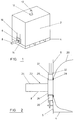
- Figure 1 shows a container assembly which comprises a rigid casing 2 on a base 4 which is capable of receiving the tines of a pallet truck.
- the container has an opening 6 in one of its side walls, through which an outlet tube 8 on a flexible container within the casing can protrude.
- An opening 10 is provided in the top of the casing, through which a tube 12 on a flexible container can protrude.
- a sliding gate 14 is provided for the opening 6.
- the gate 14 can slide on rails 16.
- the illustrated assembly includes a flexible container 20 located within the casing.
- the container is formed from polyethylene sheet material.
- the flexible container has attached to it by welding an injection moulded outlet 22.
- the outlet includes a tube 8 which has externally threaded portion 24 for connection to a conduit for discharge of fluid from the flexible container 20.
- the outlet 22 includes an enlarged portion which has a series of six flats arranged around it so that the enlarged portion 26 is generally hexagonal when viewed in cross-section along the axis of the tube 8.
- the enlarged portion 26 is defined axially by two flanges 28.
- the connection between the flexible container 20 and the outlet 22 is made by welding the container to the inner most one of the flanges 28.
- the collar 30 is formed in two parts which can be fitted around the enlarged portion 26 of the outlet 22.
- the collar has a series of six flats arranged around it on its internal surface, to engage the corresponding flats on the enlarged portion 26 of the outlet 22. As a result of the interaction between the two series of flats, rotation of the collar relative to the enlarged portion is prevented.
- the collar 30 fits between the flanges on the enlarged portion of the outlet so that the collar can not be moved axially relative to the outlet.
- the collar has a series of flats arranged around its outer surface. The distance between two opposite flats is approximately equal to the width of the gate 6 on the side of the casing.
- the collar has a pair of flanges 32 on opposite axial sides of the collar.
- the distance between two opposite flats on the collar is approximately equal to the width of the gate 6 on the side 5 of the casing.
- the gate can therefore be dropped over the collar with the sides of the opening in the gate received between the flanges 32 on the collar.
- the engagement between the flats on the collar and the sides of the gate ensures that the collar, and therefore also the outlet 22 on the flexible container 20, can not be rotated relative to the casing.
- the engagement of the gate 6 with the flanges 32 on the collar ensure that the collar, and therefore also the outlet 22 on the container 20, can not be moved relative to the casing, inwardly or outwardly.
- the collar can include other features.
- it can include a plate on which a legend can be provided, for example to identify the material within the container.
- Figure 3 shows a collection of sheets of material which can be used to make a flexible container assembly.
- the collection includes three outer container sheets 62, 64, 66 of a polyethylene material of approximately equal dimensions. They are placed so that their edges are aligned.
- a collar 70 is mounted with its flange appropriately positioned on the sheets according to the desired position of an opening for filling the container or emptying it.
- the collection further includes two inner container sheets 72, 74 of a polyethylene material, and a composite sheet 76 which is formed as a laminate of a polyethylene material and a material which is non-weldable to polyethylene, such as a polyester.
- a composite sheet can be formed by coextrusion.
- the inner container sheets 72, 74 and the composite sheet 76 are of approximately equal dimensions, and are placed so that their edges are aligned.
- a flanged tube 78 is mounted with its flange appropriately positioned on the sheets according to the desired position of an opening for filling the container or emptying it, and so that it can register with the flange on the outer container sheets.
- the inner and outer container sheets are positioned so that there is a border around the inner container sheets 72, 74, 76 provided by the edge regions of the outer container sheets 62, 64, 66.
- An opening is cut in the outer container sheets for the tube 78 to extend through.
- the collection of sheets is then folded along the centre-line 80.
- the sheets are then welded together to form the inner and outer containers.
- Two sets of welds are formed.
- a first set of welds are formed a short distance from the edges of the outer container sheets, in the border regions of the outer container sheets, generally along the dotted lines 82 shown in Figure 3.
- a weld can be formed parallel and close to the centre fold line 80.
- a second set of welds is formed in the edge regions of the inner container sheets, along each of the edges of those sheets and preferably also parallel and close to the centre fold line 80.
- the welds between the sheets are formed by the application of heated weld bars to the external surface of the outermost sheet 62. This causes the material of the sheets under that bar to fuse so that the sheets 62, 64, 66 of the outer container and the sheets 72, 74, 76 of the inner container respectively fuse together.
- the use of materials of the containers at the interface between them that are mutually non-weldable ensures so that the formation of welds between the first and second containers is avoided when welds are formed between the sheets of the second container by the application of heat through the sheets of the first container.
- Figure 4 shows the container assembly made from the use of the collection of sheets shown in Figure 3.
- the centre fold line 80 now defines one edge of the container assembly.
- the welds 84 by which the sheets of the outer container 85 are fastened to one another are shown by solid lines 86.
- the inner container is shown by a first set of dotted lines 88.
- the welds by which the sheets of the inner container are fastened to one another are shown by a second set of dotted lines 90.
- the tube 78 mounted on the inner container 88 is shown protruding through the collar 70 on the outer container 85.
- the container can be made from a matching set of sheets positioned arranged to provide the upper and lower walls of the inner and outer containers, respectively.
- Figure 5 shows a collection of two sheets which can be used, with a corresponding pair of sheets to provide the opposite walls of the containers, to form a container assembly, in a fashion similar to that used with the sheets shown in Figures 3 and 4.
- the outer container is formed from a single sheet 96, of a weldable material such as polyethylene.
- the inner container is formed from a composite sheet 98. That sheet comprises polyethylene with a border region that is coated with a material that is non-weldable with respect to the polyethylene of the outer container sheet.
Landscapes
- Engineering & Computer Science (AREA)
- Mechanical Engineering (AREA)
- Packages (AREA)
Applications Claiming Priority (2)
| Application Number | Priority Date | Filing Date | Title |
|---|---|---|---|
| GBGB9501004.7A GB9501004D0 (en) | 1995-01-19 | 1995-01-19 | A flexible container assembley |
| GB9501004 | 1995-01-19 |
Publications (2)
| Publication Number | Publication Date |
|---|---|
| EP0722891A2 true EP0722891A2 (fr) | 1996-07-24 |
| EP0722891A3 EP0722891A3 (fr) | 1996-09-11 |
Family
ID=10768226
Family Applications (1)
| Application Number | Title | Priority Date | Filing Date |
|---|---|---|---|
| EP96300371A Withdrawn EP0722891A3 (fr) | 1995-01-19 | 1996-01-18 | Ensemble récipient flexible |
Country Status (2)
| Country | Link |
|---|---|
| EP (1) | EP0722891A3 (fr) |
| GB (1) | GB9501004D0 (fr) |
Cited By (2)
| Publication number | Priority date | Publication date | Assignee | Title |
|---|---|---|---|---|
| EP1370470A4 (fr) * | 2001-03-19 | 2007-04-18 | Baxter Int | Recipient flexible a volume large |
| US8821472B2 (en) | 2003-10-21 | 2014-09-02 | Novo Nordisk A/S | Reservoir device with integrated mounting means |
Family Cites Families (7)
| Publication number | Priority date | Publication date | Assignee | Title |
|---|---|---|---|---|
| US3233817A (en) * | 1964-02-24 | 1966-02-08 | Stone Container Corp | Paperboard package with plastic bag insert for storage and shipping of fluids |
| DE2544428A1 (de) * | 1975-10-04 | 1977-04-21 | Vuh Handels Gmbh | Verpackung fuer wenigstens eine wasserdichte uhr mit einem durchsichtigen behaelter |
| US4524883A (en) * | 1983-06-27 | 1985-06-25 | Brockway, Inc. | Stackable container |
| US4778699A (en) * | 1986-09-15 | 1988-10-18 | Reynolds Metals Company | Plastics film laminates |
| US4771917A (en) * | 1986-12-17 | 1988-09-20 | Connelly Containers, Inc. | Container for fluent material |
| DE3836068A1 (de) * | 1988-10-22 | 1990-04-26 | Henkel Kgaa | Verpackungsbehaelter zur aufnahme eines fliessfaehigen produktes |
| FR2652065B1 (fr) * | 1989-09-15 | 1991-12-27 | Socar | Systeme de calage d'une outre en une matiere souple dans un conteneur en un materiau rigide ou semi-rigide. |
-
1995
- 1995-01-19 GB GBGB9501004.7A patent/GB9501004D0/en active Pending
-
1996
- 1996-01-18 EP EP96300371A patent/EP0722891A3/fr not_active Withdrawn
Cited By (2)
| Publication number | Priority date | Publication date | Assignee | Title |
|---|---|---|---|---|
| EP1370470A4 (fr) * | 2001-03-19 | 2007-04-18 | Baxter Int | Recipient flexible a volume large |
| US8821472B2 (en) | 2003-10-21 | 2014-09-02 | Novo Nordisk A/S | Reservoir device with integrated mounting means |
Also Published As
| Publication number | Publication date |
|---|---|
| EP0722891A3 (fr) | 1996-09-11 |
| GB9501004D0 (en) | 1995-03-08 |
Similar Documents
| Publication | Publication Date | Title |
|---|---|---|
| US6024220A (en) | Encapsulated seam for multilayer materials | |
| US8371752B2 (en) | Plastic bag with overpressure relief | |
| US5851072A (en) | Spout construction for bulk box liquid liner | |
| CN1091737C (zh) | 用于运输物质的容器及其组装方法 | |
| KR101058767B1 (ko) | 유체용 용기 및 그것을 사용한 유체들이 용기 | |
| US5513474A (en) | Double-walled formwork element and process for manufacturing it | |
| JP2660480B2 (ja) | プラスチック製繰り返し使用容器、その製造方法および修復方法 | |
| EP0971674B1 (fr) | Recipient a usages multiples pourvu de rabats servant a contenir une solution | |
| KR20010023982A (ko) | 생약학 유체 제품을 운반하기 위한 가요성 백 | |
| US9957148B2 (en) | Pouch with a tube spout fitment | |
| SE8306939D0 (sv) | Sett att forsegla en tomningsoppning samt anordning for genomforande av settet | |
| US20050041888A1 (en) | Openable and re-closable container and method for making the container having contents stored therein | |
| EP1009687B1 (fr) | Garniture interne de container | |
| US20170203868A1 (en) | Pouch with fitment and method of making same | |
| US6195964B1 (en) | Rectangular inner bag for loading into cylindrical container | |
| EP0722891A2 (fr) | Ensemble récipient flexible | |
| US6391404B1 (en) | Coextruded multilayer film materials and containers made therefrom | |
| CN114162456B (zh) | 容器及辅助内容物容纳器具 | |
| US5626254A (en) | Apparatus and method for rapid installation of container liner and access ports | |
| EP2605906B1 (fr) | Dispositif biopharmaceutique à usage unique d'élaboration, stockage, transport d'un produit biopharmaceutique et tube multicouche correspondant | |
| KR102774764B1 (ko) | 팰릿 컨테이너 | |
| US20040065056A1 (en) | Patch for flexible container | |
| JPH10746A (ja) | 容器内に装着するプラスチック・フィルム内袋 | |
| EP1565385B1 (fr) | Dispositif de raccordement | |
| EP0910762B1 (fr) | Systeme de clapet antiretour et son procede de production |
Legal Events
| Date | Code | Title | Description |
|---|---|---|---|
| PUAI | Public reference made under article 153(3) epc to a published international application that has entered the european phase |
Free format text: ORIGINAL CODE: 0009012 |
|
| AK | Designated contracting states |
Kind code of ref document: A2 Designated state(s): DE FR GB |
|
| PUAL | Search report despatched |
Free format text: ORIGINAL CODE: 0009013 |
|
| AK | Designated contracting states |
Kind code of ref document: A3 Designated state(s): DE FR GB |
|
| STAA | Information on the status of an ep patent application or granted ep patent |
Free format text: STATUS: THE APPLICATION IS DEEMED TO BE WITHDRAWN |
|
| 18D | Application deemed to be withdrawn |
Effective date: 19970312 |