EP0723977A1 - Procédé de récupération de polyoléfines - Google Patents
Procédé de récupération de polyoléfines Download PDFInfo
- Publication number
- EP0723977A1 EP0723977A1 EP95250019A EP95250019A EP0723977A1 EP 0723977 A1 EP0723977 A1 EP 0723977A1 EP 95250019 A EP95250019 A EP 95250019A EP 95250019 A EP95250019 A EP 95250019A EP 0723977 A1 EP0723977 A1 EP 0723977A1
- Authority
- EP
- European Patent Office
- Prior art keywords
- product material
- water
- polyolefin
- product
- mixing
- Prior art date
- Legal status (The legal status is an assumption and is not a legal conclusion. Google has not performed a legal analysis and makes no representation as to the accuracy of the status listed.)
- Granted
Links
Images

Classifications
-
- C—CHEMISTRY; METALLURGY
- C08—ORGANIC MACROMOLECULAR COMPOUNDS; THEIR PREPARATION OR CHEMICAL WORKING-UP; COMPOSITIONS BASED THEREON
- C08F—MACROMOLECULAR COMPOUNDS OBTAINED BY REACTIONS ONLY INVOLVING CARBON-TO-CARBON UNSATURATED BONDS
- C08F6/00—Post-polymerisation treatments
- C08F6/001—Removal of residual monomers by physical means
-
- C—CHEMISTRY; METALLURGY
- C08—ORGANIC MACROMOLECULAR COMPOUNDS; THEIR PREPARATION OR CHEMICAL WORKING-UP; COMPOSITIONS BASED THEREON
- C08F—MACROMOLECULAR COMPOUNDS OBTAINED BY REACTIONS ONLY INVOLVING CARBON-TO-CARBON UNSATURATED BONDS
- C08F6/00—Post-polymerisation treatments
- C08F6/02—Neutralisation of the polymerisation mass, e.g. killing the catalyst also removal of catalyst residues
Definitions
- the present invention relates to methods for product recovery of polyolefins, and more specifically to a method of product recovery for high-molecular-weight amorphous poly alpha-olefins.
- High-molecular-weight amorphous poly alpha-olefins such as amorphous propylene homo- and co-polymers, are important for their use in diverse products.
- the broad utility of these materials is due in large part to the unique combination of chemical and physical properties such as chemical inertness, softness, flexibility, etc., exhibited by these materials.
- amorphous polyolefins are formed in a reactor and mixed with water to deactivate catalysts and remove any monomer(s). Removing the catalysts and any monomer(s) renders wet, granular chunks of the product. For the material to be shaped into various products, the chunks must be dried and then extruded or otherwise shaped.
- Extrusion of the material typically involves feeding the dried chunks from a hopper to the feed section of a screw-type extruder.
- the polyolefin material is moved through the extruder by screw flights where it is heated and mechanically worked before it is pelletized or otherwise shaped under high pressure.
- such materials are also shaped by other high temperature methods such as injection molding, roll milling and compression molding.
- Both lower- and higher-molecular-weight amorphous poly alpha-olefins are typically processed as outlined above.
- the present invention overcomes the foregoing and other problems associated with the prior art by providing a product recovery method for polyolefins, particularly high-molecular-weight amorphous poly alpha-olefins, wherein the use of water during the method is significantly decreased, reducing the need for additional equipment such as storage tanks, lines and valves, and wherein the method operates such that intermediate storage of the material is eliminated, thus preventing the need for additional storage tanks and associated maintenance equipment.
- the monomer(s) for the polyolefin are fed into a reactor.
- the reactor is cooled to maintain the appropriate temperature necessary for the production of the desired polyolefin.
- appropriate catalysts are added to the reactor.
- the polyolefin material As the polyolefin material is produced, it is transferred from the reactor to a kneader. This transfer is accomplished by a number of methods, but is preferably accomplished via a blipper valve. Inside the kneader, the polyolefin material is heated to drive off any unreacted monomer(s) remaining in the polyolefin material. Sigma blades are used to mechanically work the product material to facilitate this removal process.
- the polyolefin material is then transferred via the screw flights of the kneader to an extruder for further processing.
- This step of the method the direct transfer of the polyolefin material in a liquid form, provides a distinct advantage over prior methods of storing the polyolefin in wet chunk form and drying the chunks at a later date for extrusion.
- the polyolefin material is mixed with small amounts of water to deactivate any remaining catalyst(s) in the material and antioxidants. Heating the material further drives off any unreacted monomer(s), antioxidant solvents and excess steam added during this stage.
- polyolefin material is transferred to a pelletizer where it is pelletized for storage and/or use.
- High-molecular-weight amorphous poly alpha-olefins exhibit increased tackiness and viscosity when compared with lower-molecular-weight poly alpha-olefins. Product recovery of these higher-molecular-weight poly alpha-olefins has proven especially successful utilizing the present method of recovery.
- the present method minimizes the use of water to carry the product through the several stages of recovery processing, thereby minimizing the need for storage tanks, delivery and removal lines, valves and other equipment used to introduce, maintain, remove and recycle the water. Additionally, the present method allows for continuous processing of the polyolefin material in a substantially liquid or molten state. This avoids the intermediate step associated with existing methods of product recovery wherein the material is stored as wet chunks and dried at a later stage for further processing. The elimination of this step also precludes the need for additional equipment required for the storage, maintenance and drying of the product material prior to further processing.
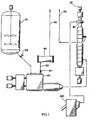
- FIGURE 1 there is shown the apparatus associated with the product recovery method of the present invention.
- the monomer(s) comprising the polyolefin to be produced are continuously fed into a reactor 10.
- the monomer(s) utilized will naturally depend upon the polyolefin to be produced.
- the reactor is cooled and pressurized to maintain the desired temperature and pressure for the reaction to occur.
- the resulting polymer is continuously transferred to a kneader 20 via a blipper valve 22.
- the use of a blipper valve 22 allows for convenient control of the rate at which the product material is released from the reactor 10 to the kneader 20.
- the product material is heated to a temperature of from about 250° - 500° Fahrenheit, depending upon the polyolefin to be produced. This increase in temperature drives off unreacted elements contained within the product material, such as unreacted propylene, ethylene, hydrogen and other monomers.
- a pair of sigma blades (not shown) within the kneader 20 mechanically works the product material to facilitate the removal of unreacted monomers and other volatiles from the product material.
- the gases produced by this process are vented through a vent line 30 from the kneader 20 to a knockout pot 40. From the knockout pot 40, the vented gases are purified and returned to the polyolefin plant for reuse via return line 45.
- a vent valve 47 closes during each blip of material from the reactor 10 to the kneader 20. With the vent valve 47 closed, the high gas velocity within the relatively small volume kneader does not drive the polyolefin material into the vent line 30.
- the vent valve 47 is operated by a microprocessor-based timer (not shown) which controls and coordinates both the blipper valve 22 and the vent valve 47.
- Product material is delivered from the sigma blades to a variable speed screw (not shown).
- the screw fights transfer the product material from the kneader 20 to an extruder 50.
- the speed of the screw is adjusted so as to maintain a constant inventory of product material in the kneader 20.
- the barrel of the screw is heated to maintain the product material at a temperature substantially consistent with the temperature in the kneader 20.
- the product material is mixed with steam to deactivate the catalysts and with additives to achieve the desired polyolefin material.
- the steam is added, via a metered water pump (not shown) to deactivate the catalyst(s) added to the reactor 10 to facilitate formation of the polyolefin.
- a metered water pump not shown
- Additional heating facilitates the removal of any excess water and further removes any remaining unreacted monomers or other volatiles from the product material.
- Gases produced within the extruder 50 are vented via an extruder vent line 70 from the extruder 50.
- the product material is transferred to a pelletizer 80.
- the pelletizer 80 includes a die plate and a set of rotating blades (not shown) driven by a variable speed motor 90. Heat is provided to the die plate to maintain the product material at an extrusion temperature. As the product material emerges from the die holes, it is cut into pellets sized according to the speed of the rotating blades and is cooled by circulating water. The product material rapidly solidifies upon contact with the water.
- the pellets are carried by flowing water to a dryer 100, where the pellets are recovered from the water and dried with air. The pellets are then packaged and stored for later use.
- FIGURE 2 is a flow diagram illustrating the steps associated with the product recovery method of the present invention.
- the monomer(s) necessary to produce the desired polyolefin are continuously fed into a reactor during step 110.
- the reactor is cooled to facilitate the production of the polyolefin material.
- Polyolefin material is then transferred to a kneader where unreacted monomer(s) and volatile(s) are removed 120.
- the monomer(s) and volatile(s) are driven off by heating the polyolefin material in the kneader. Mechanical working of the polyolefin material by a pair of sigma blades in this step enhances the removal of unreacted elements. Gases produced during this step of the process are vented through a knockout pot and are purified for reuse 130 and 140.
- step 150 the polyolefin material is transferred to an extruder where water and desired additives such as antioxidants are mixed with the polyolefin material 160 and 170.
- water and desired additives such as antioxidants are mixed with the polyolefin material 160 and 170.
- the addition of water deactivates the catalysts in the polyolefin material. Gases produced during this step of the product recovery method are also vented 180.
- the polyolefin material is transferred from the extruder to a pelletizer.
- the pelletizer the polyolefin material is cut via rotating blades into pellets and is cooled by circulating water 190.
- the pellets are transferred by the flowing water to a dryer.
- the pellets are removed from the water and dried with air prior to being packaged or used 200.
Landscapes
- Chemical & Material Sciences (AREA)
- Health & Medical Sciences (AREA)
- Chemical Kinetics & Catalysis (AREA)
- Medicinal Chemistry (AREA)
- Polymers & Plastics (AREA)
- Organic Chemistry (AREA)
- Addition Polymer Or Copolymer, Post-Treatments, Or Chemical Modifications (AREA)
- Processing And Handling Of Plastics And Other Materials For Molding In General (AREA)
Priority Applications (5)
| Application Number | Priority Date | Filing Date | Title |
|---|---|---|---|
| ES95250019T ES2146711T3 (es) | 1995-01-26 | 1995-01-26 | Procedimiento para la recuperacion de poliolefinas. |
| EP95250019A EP0723977B1 (fr) | 1995-01-26 | 1995-01-26 | Procédé de récupération de polyoléfines |
| DE69517579T DE69517579T2 (de) | 1995-01-26 | 1995-01-26 | Verfahren zur Gewinnung von Polyolefinen |
| AT95250019T ATE194006T1 (de) | 1995-01-26 | 1995-01-26 | Verfahren zur gewinnung von polyolefinen |
| CN95101848A CN1056622C (zh) | 1995-01-26 | 1995-02-25 | 聚烯烃的产物回收方法 |
Applications Claiming Priority (2)
| Application Number | Priority Date | Filing Date | Title |
|---|---|---|---|
| EP95250019A EP0723977B1 (fr) | 1995-01-26 | 1995-01-26 | Procédé de récupération de polyoléfines |
| CN95101848A CN1056622C (zh) | 1995-01-26 | 1995-02-25 | 聚烯烃的产物回收方法 |
Publications (2)
| Publication Number | Publication Date |
|---|---|
| EP0723977A1 true EP0723977A1 (fr) | 1996-07-31 |
| EP0723977B1 EP0723977B1 (fr) | 2000-06-21 |
Family
ID=37102580
Family Applications (1)
| Application Number | Title | Priority Date | Filing Date |
|---|---|---|---|
| EP95250019A Expired - Lifetime EP0723977B1 (fr) | 1995-01-26 | 1995-01-26 | Procédé de récupération de polyoléfines |
Country Status (5)
| Country | Link |
|---|---|
| EP (1) | EP0723977B1 (fr) |
| CN (1) | CN1056622C (fr) |
| AT (1) | ATE194006T1 (fr) |
| DE (1) | DE69517579T2 (fr) |
| ES (1) | ES2146711T3 (fr) |
Cited By (1)
| Publication number | Priority date | Publication date | Assignee | Title |
|---|---|---|---|---|
| EP0839837A1 (fr) * | 1996-10-31 | 1998-05-06 | PCD-Polymere Gesellschaft m.b.H. | Procédé pour la préparation continue de polypropylène élastomère |
Citations (6)
| Publication number | Priority date | Publication date | Assignee | Title |
|---|---|---|---|---|
| GB1510261A (en) * | 1974-07-20 | 1978-05-10 | Sumitomo Chemical Co | Method of removing unreacted monomer from polymer |
| US4099335A (en) * | 1976-11-19 | 1978-07-11 | Standard Oil Company (Indiana) | Drying and finishing operations in slurry or bulk phase polymerization processes |
| FR2387753A1 (fr) * | 1977-04-12 | 1978-11-17 | Union Carbide Corp | Pompe a engrenage pour liquides visqueux |
| EP0123882A1 (fr) * | 1983-04-02 | 1984-11-07 | BASF Aktiengesellschaft | Procédé pour la mise en oeuvre de polyoléfines finement divisés préparés par une polymérisation en présence de catalyseurs halogénés du type Ziegler-Natta |
| US4701489A (en) * | 1986-09-08 | 1987-10-20 | El Paso Products Company | Process for the production of stable noncorrosive amorphous polyalphaolefins |
| EP0348907A2 (fr) * | 1988-06-28 | 1990-01-03 | Union Carbide Corporation | Procédé de décharge d'un produit fluidisé |
Family Cites Families (1)
| Publication number | Priority date | Publication date | Assignee | Title |
|---|---|---|---|---|
| US3690180A (en) * | 1970-01-30 | 1972-09-12 | Spanstaal | Dredger vessel and a method of determining the loaded weight of sedimented material in a dredger vessel |
-
1995
- 1995-01-26 ES ES95250019T patent/ES2146711T3/es not_active Expired - Lifetime
- 1995-01-26 AT AT95250019T patent/ATE194006T1/de not_active IP Right Cessation
- 1995-01-26 DE DE69517579T patent/DE69517579T2/de not_active Expired - Fee Related
- 1995-01-26 EP EP95250019A patent/EP0723977B1/fr not_active Expired - Lifetime
- 1995-02-25 CN CN95101848A patent/CN1056622C/zh not_active Expired - Fee Related
Patent Citations (6)
| Publication number | Priority date | Publication date | Assignee | Title |
|---|---|---|---|---|
| GB1510261A (en) * | 1974-07-20 | 1978-05-10 | Sumitomo Chemical Co | Method of removing unreacted monomer from polymer |
| US4099335A (en) * | 1976-11-19 | 1978-07-11 | Standard Oil Company (Indiana) | Drying and finishing operations in slurry or bulk phase polymerization processes |
| FR2387753A1 (fr) * | 1977-04-12 | 1978-11-17 | Union Carbide Corp | Pompe a engrenage pour liquides visqueux |
| EP0123882A1 (fr) * | 1983-04-02 | 1984-11-07 | BASF Aktiengesellschaft | Procédé pour la mise en oeuvre de polyoléfines finement divisés préparés par une polymérisation en présence de catalyseurs halogénés du type Ziegler-Natta |
| US4701489A (en) * | 1986-09-08 | 1987-10-20 | El Paso Products Company | Process for the production of stable noncorrosive amorphous polyalphaolefins |
| EP0348907A2 (fr) * | 1988-06-28 | 1990-01-03 | Union Carbide Corporation | Procédé de décharge d'un produit fluidisé |
Cited By (1)
| Publication number | Priority date | Publication date | Assignee | Title |
|---|---|---|---|---|
| EP0839837A1 (fr) * | 1996-10-31 | 1998-05-06 | PCD-Polymere Gesellschaft m.b.H. | Procédé pour la préparation continue de polypropylène élastomère |
Also Published As
| Publication number | Publication date |
|---|---|
| DE69517579D1 (de) | 2000-07-27 |
| CN1129707A (zh) | 1996-08-28 |
| ATE194006T1 (de) | 2000-07-15 |
| EP0723977B1 (fr) | 2000-06-21 |
| CN1056622C (zh) | 2000-09-20 |
| DE69517579T2 (de) | 2001-02-08 |
| ES2146711T3 (es) | 2000-08-16 |
Similar Documents
| Publication | Publication Date | Title |
|---|---|---|
| EP0728796B1 (fr) | Procédé d'amélioration de la transformabilité de polymère à ultrafaible viscosité à l'état fondu | |
| US4958006A (en) | Fluidized bed product discharge process | |
| EP0410914B1 (fr) | Particles coulables en matériaux collants dans leur état normal, et procédé pour sa préparation | |
| US5948447A (en) | Apparatus for product recovery of polyolefings | |
| US20110120498A1 (en) | Process for Purging an Extrusion Apparatus | |
| HU189323B (en) | Process and equipment for gaining of polimers from solutions | |
| CN100519637C (zh) | 高分子化合物的处理方法及其处理装置 | |
| KR101486638B1 (ko) | 무수 무용매 중합체의 제조 방법 | |
| CN1131277C (zh) | 一种辐照交联发泡聚丙烯材料及其制备方法 | |
| CA1321852C (fr) | Procede d'extraction du solvant contenu dans une solution de polymere | |
| JP4102260B2 (ja) | ポリマーの超臨界処理装置 | |
| CN100357345C (zh) | 聚合物处理方法和装置 | |
| US5807976A (en) | Method for product recovery of polyolefins | |
| EP0723977B1 (fr) | Procédé de récupération de polyoléfines | |
| CA2141146C (fr) | Methode pour la recuperation de produits dans des polyolefines | |
| US7569617B2 (en) | Method and instrument of polymer processing treatment | |
| EP0735053B1 (fr) | Elimination d'oligomères dans des polymères alpha-oléfiniques essentiellement cristallins | |
| JPH08217822A (ja) | ポリオレフィン生成物の回収方法 | |
| FI90325B (fi) | Menetelmä sähköäjohtavan muovituotteen valmistamiseksi | |
| JP4180125B2 (ja) | 重合反応生成物の精製方法 | |
| US3008940A (en) | Water removal from polymers | |
| US3468868A (en) | Polymer recovery process | |
| FI90324B (fi) | Menetelmä sähköäjohtavan muovituotteen valmistamiseksi | |
| CN112743704A (zh) | 一种聚氨酯热塑性弹性体及其制备方法和应用 | |
| CN1083431A (zh) | 热塑性聚合物的预发泡颗粒的压力处理及其装置 |
Legal Events
| Date | Code | Title | Description |
|---|---|---|---|
| PUAI | Public reference made under article 153(3) epc to a published international application that has entered the european phase |
Free format text: ORIGINAL CODE: 0009012 |
|
| AK | Designated contracting states |
Kind code of ref document: A1 Designated state(s): AT BE DE ES FR GB IT NL SE |
|
| 17P | Request for examination filed |
Effective date: 19961106 |
|
| 17Q | First examination report despatched |
Effective date: 19970630 |
|
| GRAG | Despatch of communication of intention to grant |
Free format text: ORIGINAL CODE: EPIDOS AGRA |
|
| GRAG | Despatch of communication of intention to grant |
Free format text: ORIGINAL CODE: EPIDOS AGRA |
|
| GRAH | Despatch of communication of intention to grant a patent |
Free format text: ORIGINAL CODE: EPIDOS IGRA |
|
| RAP1 | Party data changed (applicant data changed or rights of an application transferred) |
Owner name: HUNTSMAN POLYMERS CORPORATION |
|
| GRAH | Despatch of communication of intention to grant a patent |
Free format text: ORIGINAL CODE: EPIDOS IGRA |
|
| GRAA | (expected) grant |
Free format text: ORIGINAL CODE: 0009210 |
|
| ITF | It: translation for a ep patent filed | ||
| AK | Designated contracting states |
Kind code of ref document: B1 Designated state(s): AT BE DE ES FR GB IT NL SE |
|
| REF | Corresponds to: |
Ref document number: 194006 Country of ref document: AT Date of ref document: 20000715 Kind code of ref document: T |
|
| REF | Corresponds to: |
Ref document number: 69517579 Country of ref document: DE Date of ref document: 20000727 |
|
| ET | Fr: translation filed | ||
| REG | Reference to a national code |
Ref country code: ES Ref legal event code: FG2A Ref document number: 2146711 Country of ref document: ES Kind code of ref document: T3 |
|
| PGFP | Annual fee paid to national office [announced via postgrant information from national office to epo] |
Ref country code: GB Payment date: 20001211 Year of fee payment: 7 |
|
| PGFP | Annual fee paid to national office [announced via postgrant information from national office to epo] |
Ref country code: AT Payment date: 20001212 Year of fee payment: 7 |
|
| PGFP | Annual fee paid to national office [announced via postgrant information from national office to epo] |
Ref country code: NL Payment date: 20001222 Year of fee payment: 7 |
|
| PGFP | Annual fee paid to national office [announced via postgrant information from national office to epo] |
Ref country code: SE Payment date: 20010103 Year of fee payment: 7 Ref country code: FR Payment date: 20010103 Year of fee payment: 7 |
|
| PGFP | Annual fee paid to national office [announced via postgrant information from national office to epo] |
Ref country code: ES Payment date: 20010122 Year of fee payment: 7 |
|
| PGFP | Annual fee paid to national office [announced via postgrant information from national office to epo] |
Ref country code: DE Payment date: 20010126 Year of fee payment: 7 |
|
| PGFP | Annual fee paid to national office [announced via postgrant information from national office to epo] |
Ref country code: BE Payment date: 20010326 Year of fee payment: 7 |
|
| PLBE | No opposition filed within time limit |
Free format text: ORIGINAL CODE: 0009261 |
|
| STAA | Information on the status of an ep patent application or granted ep patent |
Free format text: STATUS: NO OPPOSITION FILED WITHIN TIME LIMIT |
|
| 26N | No opposition filed | ||
| REG | Reference to a national code |
Ref country code: GB Ref legal event code: IF02 |
|
| PG25 | Lapsed in a contracting state [announced via postgrant information from national office to epo] |
Ref country code: GB Free format text: LAPSE BECAUSE OF NON-PAYMENT OF DUE FEES Effective date: 20020126 Ref country code: AT Free format text: LAPSE BECAUSE OF NON-PAYMENT OF DUE FEES Effective date: 20020126 |
|
| PG25 | Lapsed in a contracting state [announced via postgrant information from national office to epo] |
Ref country code: SE Free format text: LAPSE BECAUSE OF NON-PAYMENT OF DUE FEES Effective date: 20020127 |
|
| PG25 | Lapsed in a contracting state [announced via postgrant information from national office to epo] |
Ref country code: ES Free format text: LAPSE BECAUSE OF NON-PAYMENT OF DUE FEES Effective date: 20020128 |
|
| PG25 | Lapsed in a contracting state [announced via postgrant information from national office to epo] |
Ref country code: BE Free format text: LAPSE BECAUSE OF NON-PAYMENT OF DUE FEES Effective date: 20020131 |
|
| BERE | Be: lapsed |
Owner name: HUNTSMAN POLYMERS CORP. Effective date: 20020131 |
|
| PG25 | Lapsed in a contracting state [announced via postgrant information from national office to epo] |
Ref country code: NL Free format text: LAPSE BECAUSE OF NON-PAYMENT OF DUE FEES Effective date: 20020801 Ref country code: DE Free format text: LAPSE BECAUSE OF NON-PAYMENT OF DUE FEES Effective date: 20020801 |
|
| EUG | Se: european patent has lapsed |
Ref document number: 95250019.7 |
|
| GBPC | Gb: european patent ceased through non-payment of renewal fee |
Effective date: 20020126 |
|
| PG25 | Lapsed in a contracting state [announced via postgrant information from national office to epo] |
Ref country code: FR Free format text: LAPSE BECAUSE OF NON-PAYMENT OF DUE FEES Effective date: 20020930 |
|
| NLV4 | Nl: lapsed or anulled due to non-payment of the annual fee |
Effective date: 20020801 |
|
| REG | Reference to a national code |
Ref country code: FR Ref legal event code: ST |
|
| REG | Reference to a national code |
Ref country code: ES Ref legal event code: FD2A Effective date: 20031022 |
|
| PG25 | Lapsed in a contracting state [announced via postgrant information from national office to epo] |
Ref country code: IT Free format text: LAPSE BECAUSE OF NON-PAYMENT OF DUE FEES Effective date: 20050126 |