EP0724251B1 - Sprachanpassungsgerät - Google Patents
Sprachanpassungsgerät Download PDFInfo
- Publication number
- EP0724251B1 EP0724251B1 EP96101048A EP96101048A EP0724251B1 EP 0724251 B1 EP0724251 B1 EP 0724251B1 EP 96101048 A EP96101048 A EP 96101048A EP 96101048 A EP96101048 A EP 96101048A EP 0724251 B1 EP0724251 B1 EP 0724251B1
- Authority
- EP
- European Patent Office
- Prior art keywords
- speech
- adaptation
- reference pattern
- unit
- independent reference
- Prior art date
- Legal status (The legal status is an assumption and is not a legal conclusion. Google has not performed a legal analysis and makes no representation as to the accuracy of the status listed.)
- Expired - Lifetime
Links
- 230000006978 adaptation Effects 0.000 title claims description 176
- 239000013598 vector Substances 0.000 claims description 86
- 238000013139 quantization Methods 0.000 claims description 10
- 238000012549 training Methods 0.000 claims description 10
- 238000012937 correction Methods 0.000 claims description 6
- 238000009826 distribution Methods 0.000 claims description 4
- 238000000034 method Methods 0.000 description 22
- 238000001228 spectrum Methods 0.000 description 13
- 230000000694 effects Effects 0.000 description 12
- 238000004364 calculation method Methods 0.000 description 8
- 238000010586 diagram Methods 0.000 description 8
- 230000006870 function Effects 0.000 description 7
- 230000008901 benefit Effects 0.000 description 6
- 230000007704 transition Effects 0.000 description 6
- 238000012545 processing Methods 0.000 description 4
- 230000009467 reduction Effects 0.000 description 4
- 230000005540 biological transmission Effects 0.000 description 3
- 230000001419 dependent effect Effects 0.000 description 3
- 230000011218 segmentation Effects 0.000 description 3
- 238000004891 communication Methods 0.000 description 2
- 230000007613 environmental effect Effects 0.000 description 2
- 238000010606 normalization Methods 0.000 description 2
- 230000002441 reversible effect Effects 0.000 description 2
- 230000003595 spectral effect Effects 0.000 description 2
- 238000007476 Maximum Likelihood Methods 0.000 description 1
- 239000000654 additive Substances 0.000 description 1
- 230000000996 additive effect Effects 0.000 description 1
- 230000015572 biosynthetic process Effects 0.000 description 1
- 230000008859 change Effects 0.000 description 1
- 238000006243 chemical reaction Methods 0.000 description 1
- 238000000605 extraction Methods 0.000 description 1
- 230000005484 gravity Effects 0.000 description 1
- 238000007689 inspection Methods 0.000 description 1
- 238000012417 linear regression Methods 0.000 description 1
- 230000007246 mechanism Effects 0.000 description 1
- 238000000926 separation method Methods 0.000 description 1
- 238000012795 verification Methods 0.000 description 1
Images


Classifications
-
- G—PHYSICS
- G10—MUSICAL INSTRUMENTS; ACOUSTICS
- G10L—SPEECH ANALYSIS TECHNIQUES OR SPEECH SYNTHESIS; SPEECH RECOGNITION; SPEECH OR VOICE PROCESSING TECHNIQUES; SPEECH OR AUDIO CODING OR DECODING
- G10L15/00—Speech recognition
- G10L15/06—Creation of reference templates; Training of speech recognition systems, e.g. adaptation to the characteristics of the speaker's voice
- G10L15/065—Adaptation
-
- G—PHYSICS
- G10—MUSICAL INSTRUMENTS; ACOUSTICS
- G10L—SPEECH ANALYSIS TECHNIQUES OR SPEECH SYNTHESIS; SPEECH RECOGNITION; SPEECH OR VOICE PROCESSING TECHNIQUES; SPEECH OR AUDIO CODING OR DECODING
- G10L15/00—Speech recognition
- G10L15/02—Feature extraction for speech recognition; Selection of recognition unit
-
- G—PHYSICS
- G10—MUSICAL INSTRUMENTS; ACOUSTICS
- G10L—SPEECH ANALYSIS TECHNIQUES OR SPEECH SYNTHESIS; SPEECH RECOGNITION; SPEECH OR VOICE PROCESSING TECHNIQUES; SPEECH OR AUDIO CODING OR DECODING
- G10L15/00—Speech recognition
- G10L15/08—Speech classification or search
- G10L2015/088—Word spotting
Definitions
- the present invention relates to a speech adaptation device which is suitable for a speech recognition device and a word spotting device and, more particularly, to technique for use in adjusting a difference between an input speech and a reference pattern to improve performance.
- a speech recognition rate in recognizing a speech is known to fall due to differences in tone between an input speech and a reference pattern.
- a major factor that particularly causes the reduction of the speech recognition rate can generally be classified into two factors.
- One of the two factors is an environmental factor due to an environment where a speaker makes the speech.
- Another one of the two factors is due to the speaker's speech itself.
- the environmental factor can further be classified into two factors: an additional noise such as a background noise which is incorporated along with the speech of the speaker and acts in an additive manner on spectrum, and a channel distortion such as transmission characteristics of a microphone or a telephone line which distort the spectrum itself and act in a multiplicative manner on the spectrum.
- a speech adaptation device suitable for a speech recognition device is disclosed in a paper contributed by Takagi, Hattori, and Watanabe, to Proceedings of the spring Meeting of the Acoustic Society, 2-P-8, pages 173-174 (1994. 3), under the title of "Speech Recognition with Environment Adaptation by Spectrum Equalization” (hereinafter, referred to as a first cited article (I)).
- the speech adaptation device comprises an analysis unit, a reference pattern memory, and a preliminary matching unit.
- An input speech subjected to deformation by the additional noise and the transmission distortion is converted into a time series of feature vectors in the analysis unit.
- the reference pattern memory preliminarily memorizes a plurality of word reference patterns which are previously analyzed by the use of training speeches in a similar manner to the analysis unit and which hold time series information for each word to be recognized.
- Each word reference pattern is previously provided with a label indicative of the distinction between a speech interval and a noise interval.
- the preliminary matching unit carries out matching between the time series of the feature vectors of the input speech and the time series of each word reference pattern, chooses a first word reference pattern, and obtains a time-alignment between the input speech and the first word reference pattern in relation to a time axis.
- a mean vector calculation unit carries out an adaptation operation of the reference pattern in the manner which will later be described in detail.
- Such an adaptation operation eliminates the difference in environment between the reference pattern and the input speech, so that it is possible to provide the speech adaptation device having a stable and high performance even when the environment is varied.
- the conventional speech adaptation device has a problem that the input speech should be one of the words which are prepared previously because the reference pattern memory memorizes the word reference patterns. In other words, there is a problem that the performance after the adaptation is deteriorated significantly in the case where a word other than those prepared previously is received as the input speech.
- the speech adaptation device in which vocabulary is determined previously has a problem that the performance of the adaptation is deteriorated significantly if a speech other than the previously defined vocabulary is received, which in turn deteriorates the recognition performance for the continuous speech.
- a speech adaptation device comprises an analysis unit for use in converting an unknown input speech into a time series of feature vectors, and a vocabulary independent reference pattern memory for memorizing a plurality of vocabulary independent reference patterns having one or more categories.
- Each category has one or more acoustic units and has such a connection relation of the acoustic units that allows reception of any sequence of the acoustic units appearing in the unknown input speech.
- the speech adaptation device further comprises a preliminary matching unit connected to the analysis unit and the vocabulary independent reference pattern memory for use in making time-alignment between the time series of the feature vectors of the unknown input speech obtained from the analysis unit and the vocabulary independent reference pattern to obtain mean vectors for individual categories of the unknown input speech and the vocabulary independent reference pattern from the aligned portion for the individual categories of the feature vectors of the unknown input speech and the vocabulary independent reference pattern, and an adaptation unit for use in making correction of at least one of the time series of the feature vectors of the unknown input speech and the vocabulary independent reference pattern by using the mean vectors for each category calculated by the preliminary matching unit.
- the speech adaptation device is of the type that cited hereinbefore as the first cited article (I ).
- An input speech subjected to deformation by an additional noise and a transmission distortion is converted into a time series of feature vectors in an analysis unit 11.
- a reference pattern memory 12 preliminarily memorizes a plurality of word reference patterns.
- the word reference patterns can be obtained by using training speeches in a manner carried out in the analysis unit 11 and hold time series information for each word to be recognized.
- Each word reference pattern is previously provided with a label indicative of the distinction between a speech interval and a noise interval.
- a preliminary matching unit 13 carries out matching between the time series of feature vectors of the input speech and the time series of each word reference pattern, chooses a best matched word reference pattern as a first word reference pattern, and obtains a time-alignment between the input speech and the first word reference pattern in relation to a time axis.
- a mean vector calculation unit 14 calculates mean vectors of each of the noise intervals and the speech intervals on the basis of the time-alignment between the first word reference pattern obtained by the preliminary matching unit 13 and the feature vectors of the input speech. In this event, let the mean vectors of the speech intervals and the noise intervals in the input speech be Sv and Nv, respectively, and the mean vectors of the speech intervals and the noise intervals in the first word reference pattern be Sw and Nw, respectively.
- a correction unit 15 carries out an adaptation operation of the first word reference pattern by using the four mean vectors calculated in the mean vector calculation unit 14 in accordance with a first equation (1) given by;
- W(t) represents a word reference pattern before the adaptation
- t represents an index of all word reference patterns
- (t) represents an adapted word reference pattern after the adaptation.
- the above-mentioned adaptation operation is carried out each time when the analysis unit 11 receives the input speech.
- the adapted reference pattern is memorized in an adapted reference pattern memory 16.
- Such an adaptation operation eliminates the difference in environment between the word reference pattern and the input speech, so that it is possible to provide a speech adaptation device having a stable and high performance even when the environment is changed.
- the speech adaptation device has a problem that the input speech should be one of the words which are prepared previously because the reference pattern memory 12 memorizes the word reference patterns. In other words, there is a problem that the performance after the adaptation is deteriorated significantly in the case where a word other than those prepared previously is received as the input speech.
- the present invention is for providing the speech adaptation device which is capable of carrying out adaptation with high accuracy by using a plurality of vocabulary independent reference patterns, even for the input speech of which content cannot be known previously.
- the time series of given spectrum is represented by X(t) (where t is a discrete time instant). Note that it is obvious that the spectrum and cepstrum is reversible with each other if the cepstrum is used as the feature vectors, so that description is made only for the case where the spectrum is used.
- the input speech is typically difficult to be extracted positively with a beginning and an end of the speech and there is a possibility of a consonant at the beginning being lost, so that the speech slightly longer than the extracted beginning and end is typically analyzed to avoid loss of the speech.
- a vocabulary independent reference pattern memory 22 preliminarily memorizes a plurality of vocabulary independent reference patterns.
- the vocabulary independent reference patterns can be obtained from reference speaker speeches analyzed previously in a manner similar to the analysis unit 11. For example, as illustrated in Fig. 3, the reference speaker speech is classified into two categories of an acoustic unit for a speech portion and an acoustic unit for a noise portion and are registered as two state EMM (Hidden Markov Model).
- EMM Hidden Markov Model
- a reference pattern capable of receiving all speeches of a subjected language when the acoustic unit of the reference pattern is composed with the smaller (e.g., syllable) unit rather than using a large unit such as a word and is connected to allow reception of transition of them all.
- a preliminary matching unit 23 makes time-alignment between the time series X(t) of the feature vectors of the input speech and the vocabulary independent reference patterns, determines whether the input speech belongs to the speech or the noise of the vocabulary independent reference patterns, and produces at the same time mean vectors of the input speech and the vocabulary independent reference patterns, respectively, for the speech portion and the noise portion.
- the adaptation unit 24 carries out an adaptation operation by using these four mean vectors in accordance with the first equation (1) mentioned hereinbefore.
- the first speech adaptation device comprises the analysis unit 21 for use in converting the input speech into a time series of feature vectors.
- the vocabulary independent reference pattern memory 22 preliminarily memorizes a plurality of vocabulary independent reference patterns which have one or more categories, each category having one or more acoustic units, and having such a connection relation of the acoustic units that allows reception of any sequence of the acoustic units appeared in the input speech.
- the preliminary matching unit 23 is for use in making time-alignment between the time series of the feature vectors of the input speech obtained from the analysis unit 21 and the vocabulary independent reference patterns to obtain mean vectors for individual categories of the input speech and the vocabulary independent reference patterns from the aligned portion for the individual categories of the feature vectors of the input speech and the vocabulary independent reference patterns.
- the adaptation unit 24 is for use in making correction of at least one of the time series of the feature vectors of the input speech and the vocabulary independent reference patterns by using the mean vectors for each category calculated by the preliminary matching unit 23.
- the input speech including the noise is converted into the time series of the feature vectors for preliminary matching in the analysis unit 21.
- Those typically and often used as the feature vectors are considered to be, for example, power information, a change amount of power information, the cepstrum, or a linear regression coefficient of the cepstrum, and a combination thereof may be used as the feature vectors.
- spectrum it is possible to use logarithmicated spectrum.
- the input speech typically has a portion existing therein where no speech is present before and after the utterance and only ambient noise is contained.
- the vocabulary independent reference patterns are made independent concerning vocabulary by means of providing such a connection relation of the acoustic units that allows reception of any acoustic units appearing in the input speech.
- a method of forming these reference patterns may be the one using HMM (Hidden Markov Model) as described in, for example, pages 162-170 of the second cited article (II ), or may be a code book subjected to the vector quantization or the feature vectors of the speech.
- HMM Hidden Markov Model
- it is achieved by means of, for example, composing to have all connection relations among the acoustic units that are the partial extraction of training speeches or trained results.
- it is achieved by means of allowing all transitions among the acoustic units corresponding to individual syllables such as /a/, /i/, /u/, ...
- /n/ and connecting such that any and all time series of the syllables can be accepted.
- various ones can be considered but it is preferable to use ones having an equal or smaller length than a word.
- the preliminary matching unit 23 makes time-alignment between the vocabulary independent reference patterns generated in this way and the time series of the feature vectors of the input speech.
- This time-alignment may be methods such as the DP matching or HMM as timing normalized matching.
- the timing normalized matching may not necessarily be used when each acoustic unit of the vocabulary independent reference patterns has no non-linear extension and reduction function along the time axis (the acoustic unit always corresponds to a frame of a fixed length), and it can be realized only by means of the processing of selecting the acoustic unit the likelihood thereof is the maximum. Based on the time-alignment information so obtained, a mean value for each category is obtained for both the input and reference patterns.
- the adaptation unit 24 carries out adaptation of at least one of the input speech and the vocabulary independent reference patterns by using the mean values for each category obtained in the preliminary matching unit 23, and produces results thereof as an adapted input speech or an adapted reference pattern.
- the adapted reference pattern is memorized in an adapted reference pattern memory 25.
- Pig. 3 is a view illustrating an example of the vocabulary independent reference patterns applied to a second speech adaptation device according to the present invention.
- the second speech adaptation device is characterized by the vocabulary independent reference patterns and the adaptation unit 24.
- the category of the vocabulary independent reference patterns comprises one or more noise categories and one or more speech categories (in which the speech and the noise are represented by S and N, respectively).
- the adaptation unit 24 replaces a noise portion of either one of the time series of the feature vectors of the input speech or the vocabulary independent reference patterns with a mean vector Ni of the noise portion of the other, subtracts a mean vector Nt of the noise portion of either one from a speech portion of the same, then multiplies it with (Si - Ni)/(St - Nt), (wherein the slash / indicates division for each channel of the vectors, Si indicates a mean vector of the speech portion of the other, and St indicates a mean vector of the speech portion of the same), and further adds Ni thereto.
- the acoustic units trained from a training speech are divided into a speech portion and a noise portion to make time-alignment to two categories of speech and noise. Transition from and to two categories as well as within categories can be made optionally. There may be a number of acoustic units in the speech and the noise.
- the preliminary matching unit 23 selects the acoustic unit having the maximum likelihood at each time instant and recomputes the mean value for each category depending on whether it is the speech category or the noise. With this structure, reception can be made for any uttered contents appearing in the language used.
- the adaptation unit 24 carries out the adaptation as, for example, those indicated in the first cited article (I ).
- the mean vectors of the speech interval and the noise interval of the input speech be Sv and Nv, respectively, and the mean vectors of the speech interval and the noise interval of the reference patterns be Sw and Nw, respectively.
- the adaptation unit 24 carries out the adaptation as described above. Of the reference patterns those belonging to the noise category are replaced with the mean vector Nv of the noise in the input speech. In this example, the adaptation for the reference patterns has been described. However, similar processing may be made for the input speech.
- This adaptation technique is adaptation on the spectrum but it may be realized easily by means of providing a conversion unit between the cepstrum and the spectrum when the feature vectors are the cepstrum. In such an event, the mean vector may be obtained on the cepstrum or may be obtained after once being converted into the spectrum.
- the description will proceed to a third speech adaptation device according to the present invention.
- the third speech adaptation device is characterized by the adaptation unit 24. Namely, the adaptation unit 24 carries out correction for at least one of the time series of the feature vectors of the input speech and the vocabulary independent reference patterns by using a difference between the average vectors of each category.
- any one may be feasible if it is an adaptation technique utilizing the mean value for each category.
- the technique like speaker adaptation may be used.
- speaker adaptation is used that is disclosed in a paper contributed by Shinoda, Iso, and Watanabe to Proceedings of the Electronic, Information and Communication Society, A. Vol. J77-A, No. 2, pages 120-127 (February 1994), under the title of "Speaker Adaptation using Spectral Interpolation for Speech Recognition" (hereinafter, referred to as a third cited article (III)).
- a method called spectral interpolation which is represented by a third equation given by: may be used, where j represents the category of the reference pattern in which the acoustic category is present in the input speech.
- the adaptation unit 24 adapts only for the vocabulary independent reference patterns, it may of course carry out equivalent processing on the input speech.
- cepstrum mean normalization For example, in the speech adaptation device disclosed in a paper contributed by A.E. Rosenberg, et al, to Proceedings of ICSLP94, S31.1, pages 1835-1838 (1994), under the title of "Cepstral Channel Normalization Technique for HMM-Based Speaker Verification” (hereinafter, referred to as a fourth cited article (IV )), the number of categories is equal to 2 (speech and noise) and the feature vector uses the cepstrum to carry out the adaptation only for the speech portion of the input speech.
- a word reference pattern is used in the fourth cited article (IV ) rather than the vocabulary independent reference pattern.
- This adaptation technique may be, however, used for the adaptation unit 24 of the present invention. More specifically, let the feature vector for the speech portion of the input speech (cepstrum) be yt, the mean value of the feature vectors of the speech portion thereof be y , and the mean value of the speech portions of the reference pattern be y tr , the adaptation is carried out in accordance with a sixth equation given by: yt ⁇ yt - ( y - y tr ). Namely, the input speech is replaced by using the difference between the mean vectors of that category.
- the fourth speech adaptation device uses the vocabulary independent reference patterns in which the acoustic unit of the vocabulary independent reference patterns of the first, the second, and the third speech adaptation devices mentioned before is based on a consonant (C), a vowel (v) and a noise (N) appearing in the input speech, or based on a sequence of two or more of these (such as CV, VC, CVC, VN).
- C consonant
- v vowel
- N noise
- Fig. 4 shows the case where three categories for example are provided and the acoustic unit of each category is a syllable.
- a case for Japanese is indicated herein, a similar structure may be made with a language other than this. Transition from and to respective categories as well as within categories can be made optionally. Therefore, any and all uttered contents in the language can be received with the structure in which all syllables appearing are categorized into one of the three categories. While the case has thus been given herein where the acoustic unit is a syllable, a unit of two or more sequences of syllables may be used. In addition, anything may be used if it is a unit similar to a syllable.
- Advantages of using the structure of the type described are in that such a structure is allowed that avoids connection impossible in the subjected language such as /nn/ because of the linguistic information added previously to the acoustic unit, and in that the precision of the preliminary matching is improved, which in turn has a high adaptation performance. Furthermore, the results of the adaptation can be applied to word spotting or speech recognition directly by using the acoustic units commonly for a dictionary for the word spotting or the speech recognition, allowing to provide a more sophisticated device.
- a fifth speech adaptation device is characterized in that the acoustic unit of the vocabulary independent reference patterns in the fourth speech adaptation device mentioned above is formed by using, for example, the HMM.
- the HMM generally has a plurality of states. In the example of the acoustic units illustrated in Fig. 4, each acoustic unit is composed of individual HMM.
- the fifth speech adaptation device is characterized in that the acoustic unit of the vocabulary independent reference pattern in the fourth speech adaptation device is formed by using, for example, a part of the time series feature vectors of the training speech.
- the training speech is the pronunciation /toukyou/
- this is segmented and separated by syllable into /to/,/u/,/kyo/,/u/.
- the feature vector of this separated each syllable is formed as the acoustic unit.
- the segmentation may be carried out through inspection, or may be carried out automatically by using HMM already trained.
- the acoustic unit of the vocabulary independent reference pattern in the fourth speech adaptation device is formed by using each centroid obtained after the vector quantization.
- the vector quantization is a technique which has widely been used for recognition and coding of speech, and is a technique to put together, by each neighbor, vectors within an acoustic space distributed almost unlimitedly and express them with a limited number of vectors.
- the vector quantization technique is disclosed in, for example, a book published by Electronics, Information, and Communication Society and Corona Co., pages 26-28 (1988), under the title of "Speech Recognition using Probability Models", and description thereof is therefore omitted here.
- the reference pattern may be formed by a unit of syllable by means of a sequence of code books formed of a large number of vector-quantized training speeches.
- Each vocabulary independent reference pattern is structured by using the acoustic unit such as a syllable obtained in the manner described above.
- a sixth speech adaptation device is characterized in that it has the vocabulary independent reference patterns in which the acoustic unit of the vocabulary independent reference patterns of the first, the second, or the third speech adaptation device mentioned above is, for example, a state of HMM.
- the HMM is composed of sequences of plural states and has such a structure that allows reception of utterance of any and all contents by means of separating the sequence of this state into the acoustic unit.
- An advantage of the structure of the type described is that the speech adaptation device of this type can be structured readily without previous segmentation even in the case where an original reference pattern is not formed of smaller basic units such as syllables previously separated (e.g., a technique in which training is carried out for each word template).
- the sixth speech adaptation device has such the vocabulary independent reference patterns that the acoustic unit of the vocabulary independent reference patterns of the first, the second, or the third speech adaptation device is, for example, each centroid obtained after the vector quantization.
- Each cluster center of gravity may be used as the acoustic unit when the original reference pattern is structured by using the vector quantization technique.
- the vector quantization is carried out with a large number of speechutterances, and the centroid of the resultant code books is used as the acoustic unit to form the vocabulary independent reference pattern, which allows reception of appearance of any and all contents.
- An advantage of such structure lies in the point that the acoustic unit can be realized through a simple technique because it has no non-linear extension function in the direction of the time axis along the advantages that the sixth speech adaptation device commonly has.
- the sixth speech adaptation device may have such the vocabulary independent reference patterns that the acoustic unit of the vocabulary independent reference patterns of the first, the second, or the third speech adaptation device of the present invention is, for example, a distribution of HMM.
- the HMM is composed of sequences of plural states and each state can be composed in so-called multi Gaussian having a number of distributions.
- the states of the HMM are separated individually, and this may be used to form the vocabulary independent reference patterns.
- a seventh speech adaptation device is characterized in that the vocabulary independent reference patterns in any one of the first, the second, the third, the fourth, and the fifth speech adaptation devices are formed by using the acoustic unit of the reference pattern for speech recognition and word spotting.
- the reference pattern for the word spotting or the speech recognition has an acoustic unit based on a syllable.
- the acoustic units are joined to form the reference pattern as /to/, /u/, /kyo/, /u/.
- the vocabulary independent reference pattern uses the acoustic unit of these syllables as such alone, and, it is possible to form such that the utterance of any and all contents in a language can be received when it is formed to allow reception of transitions between all syllables as in Fig. 4.
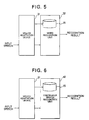
- Fig. 5 is a block diagram of a word speech recognition device according to the present invention.
- the word recognition device comprises the seventh speech adaptation device depicted as 31 and mentioned above and a word recognition unit 32 for carrying out word recognition by using the adaptation results obtained from the seventh speech adaptation device.
- the word recognition unit 32 comprises the adapted reference pattern memory 25 described in conjunction with Fig. 2.
- the adapted input speech and the adapted reference pattern adapted in the speech adaptation device 31 are subjected to word recognition in the word recognition unit 32.
- the speech adaptation device 31 does not suffer from performance reduction after the adaptation even when the adaptation is carried out with an utterance not present in the vocabulary for the word recognition because it does not depend on the vocabulary of the word recognition unit 32.
- the speech recognition performance may be deteriorated after the adaptation with a speech that is not the one to be recognized previously.
- the adaptation is carried out at a high performance even in such a case, so that it is possible to provide a word speech recognition device having a stable adaptation mechanism which is independent of the vocabulary.
- some speech recognition devices have such a function that is called a so-called rejection to reject speech inputs other than those in the vocabulary.
- the reject can be achieved at a high performance by using the speech adaptation device of the present invention that is not dependent on the vocabulary.
- Fig. 6 is a block diagram of a continuous speech recognition device according to the present invention.
- the continuous speech recognition device comprises the seventh speech adaptation device 31 mentioned above and a continuous speech recognition unit 42 for carrying out continuous speech recognition by using the adaptation results obtained from the seventh speech adaptation device 31.
- the adapted input speech and the adapted reference pattern adapted in the speech adaptation device 31 are subjected to continuous speech recognition in the continuous speech recognition unit 42.
- a large volume of calculation is required for the continuous speech recognition.
- Conventional speech adaptation devices use a word reference pattern, so that a large volume of calculation and memory capacity are required for the preliminary matching using this word reference pattern with the structure capable of receiving a continuous speech by using the word reference pattern.
- the speech adaptation unit 31 does not depend on the vocabulary of the continuous speech recognition unit 42 and carries out adaptation with less calculation amount.
- many non-predictable language phenomena are generated typically in a continuous speech, faltering, repetition, and unnecessary words.
- the conventional speech adaptation devices using the word reference pattern cannot deal with these utterances.
- a device having a high recognition performance can be provided by using the speech adaptation device of high performance which is not dependent on the vocabulary.
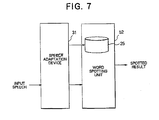
- Fig. 7 is a block diagram of a word spotting device according to the present invention.
- the word spotting device comprises the seventh speech adaptation device 31 mentioned above and a word spotting unit 52 for carrying out word spotting by using the adaptation results obtained from the seventh speech adaptation device 31.
- the adapted input speech and the adapted reference pattern adapted in the seventh speech adaptation device 31 are subjected to word spotting in the word spotting unit 52.
- the input speeches are all unknown in the word spotting in which decision is made whether a predetermined word is present out of continuous conversation. Accordingly, it is impossible to prepare previously word reference patterns because the vocabulary is unknown in the conventional speech adaptation device using the word reference pattern, and it is thus impossible to provide such a device.
- the seventh speech adaptation device 31 allows at the first time to provide a sophisticated word spotting device where an unknown vocabulary is negligible, by using the speech adaptation device 31.
- the first speech adaptation device According to the first speech adaptation device according to the present invention, there is an effect that stable adaptation can be realized for any speeches because it is not dependent on the vocabulary of the input speech.
- the fourth and the fifth speech adaptation devices of the present invention there is an effect that the more sophisticated speech adaptation device can be provided because it is possible to limit transition which is impossible for the subjected language, along with to provide the sophisticated speech adaptation device which does not depend on the vocabulary of the input speech.
- the speech adaptation device of the type described can be provided readily without carrying out segmentation previously even in the case of previous separation for formation into the smaller reference units such as syllables, along with to provide the sophisticated speech adaptation device which does not depend on the vocabulary of the input speech.
- the sixth speech adaptation device is formed by using each centroid obtained after the vector quantization or the HMM distribution, there are effects that the acoustic unit can be realized with a more simple matching technique because it has no non-linear extension function along the time axis, and in turn an inexpensive device can be provided, along with the effects of the sixth speech adaptation device of the present invention.
- the seventh speech adaptation device of the present invention there is an effect that the adaptation result is utilized directly on the word spotting or the speech recognition by using the acoustic unit commonly for the reference pattern for the word spotting or the speech recognition, allowing to provide a more sophisticated device.
- the word speech recognition device of the present invention there is an effect that the word speech recognition device can be provided that has the stable adaptation function independent of the vocabulary.
- the performance does not deteriorated after the adaptation with a word to be rejected because the adaptation does not depend on the vocabulary, realizing the more sophisticated rejection.
- the amount calculation and the memory capacity are reduced significantly, so that it is possible to provide an inexpensive device.
- a stable and sophisticated continuous speech recognition device can be provided even when a non-predictable linguistic phenomenon occurs such as faltering, repetition, and unnecessary words because it uses the speech adaptation device of high performance which is independent of the vocabulary.
- the word spotting device of the present invention there is an effect that it becomes possible for the first time by using the speech adaptation device independent of the vocabulary, which cannot be formed conventionally using the adaptation device of the type described.
Landscapes
- Engineering & Computer Science (AREA)
- Artificial Intelligence (AREA)
- Computational Linguistics (AREA)
- Health & Medical Sciences (AREA)
- Audiology, Speech & Language Pathology (AREA)
- Human Computer Interaction (AREA)
- Physics & Mathematics (AREA)
- Acoustics & Sound (AREA)
- Multimedia (AREA)
- Machine Translation (AREA)
- Telephonic Communication Services (AREA)
Claims (10)
- Sprachanpassungsvorrichtung mit einer Analyseeinheit (21), die beim Umwandeln unbekannter eingegebener Sprache in eine Zeitreihe von Merkmalsvektoren verwendet wird, wobei die Vorrichtung weiter aufweist:einen vokabularunabhängigen Bezugsmusterspeicher (22) zum Speichern mehrerer vokabularunabhängiger Bezugsmuster mit einer oder mehreren Kategorien, wobei jede Kategorie eine oder mehrere Akustikeinheiten aufweist, und mit einer Verbindungsbeziehung der Akustikeinheiten, die den Empfang jeder beliebigen Folge der in der unbekannten eingegebenen Sprache auftretenden Akustikeinheiten ermöglicht,eine Einheit (23) zum vorläufigen Zusammenpassen, die mit der Analyseeinheit und dem vokabularunabhängigen Bezugsmusterspeicher verbunden ist und die beim Herstellen einer zeitlichen Anordnung zwischen den Zeitreihen der Merkmalsvektoren der von der Analyseeinheit erhaltenen unbekannten eingegebenen Sprache und des vokabularunabhängigen Bezugsmusters verwendet wird, um Mittelvektoren für einzelne Kategorien der unbekannten eingegebenen Sprache und des vokabularunabhängigen Bezugsmusters vom angeordneten Abschnitt für die einzelnen Kategorien der Merkmalsvektoren der unbekannten eingegebenen Sprache und des vokabularunabhängigen Bezugsmusters zu erhalten, undeine Anpassungseinheit (24), die beim Vornehmen einer Korrektur der Zeitreihe der Merkmalsvektoren der unbekannten eingegebenen Sprache und/oder des vokabularunabhängigen Bezugsmusters unter Verwendung der durch die Einheit zum vorläufigen Zusammenpassen berechneten Mittelvektoren für jede Kategorie verwendet wird.
- Sprachanpassungsvorrichtung nach Anspruch 1, wobei die Kategorie des vokabularunabhängigen Bezugsmusters eine oder mehrere Rauschkategorien und eine oder mehrere Sprachkategorien aufweist, wobei die Anpassungseinheit einen Rauschabschnitt der Zeitreihe der Merkmalsvektoren der eingegebenen Sprache oder des vokabularunabhängigen Bezugsmusters durch einen Mittelvektor Ni des Rauschabschnitts des anderen ersetzt, einen Mittelvektor Nt des Rauschabschnitts von einem von ihnen von einem Sprachabschnitt desselben subtrahiert, ihn dann mit (Si - Ni)/(St - Nt) multipliziert (wobei ein Schrägstrich / eine Division für jeden Kanal der Vektoren angibt, Si einen Mittelvektor des Sprachabschnitts des anderen angibt und St einen Mittelvektor des Sprachabschnitts von demselben angibt) und weiter Ni dazu addiert.
- Sprachanpassungsvörrichtung nach Anspruch 1 oder 2, wobei die Anpassungseinheit unter Verwendung einer Differenz zwischen den Mittelvektoren jeder Kategorie für die Zeitreihe der Merkmalsvektoren der eingegebenen Sprache und/oder des vokabularunabhängigen Bezugsmusters eine Korrektur vornimmt.
- Sprachanpassungsvorrichtung nach einem der Ansprüche 1, 2 und 3, wobei die Akustikeinheit des vokabularunabhängigen Bezugsmusters auf einem Konsonanten (C), einem Vokal (V) und Rauschen (N), die in der eingegebenen Sprache auftreten, oder auf einer Folge von zwei oder mehreren von diesen (wie CV, VC, CVC, VN) beruht.
- Sprachanpassungsvorrichtung nach Anspruch 4, wobei die Akustikeinheit des vokabularunabhängigen Bezugsmusters unter Verwendung entweder eines HMM (verborgenes Markov-Modell), eines Teils einer Zeitreihe von Merkmalsvektoren von Trainings-Sprachdaten oder jedes nach der Vektorquantisierung erhaltenen Zentroids gebildet wird.
- Sprachanpassungsvorrichtung nach einem der Ansprüche 1, 2 und 3, wobei die Akustikeinheit des vokabularunabhängigen Bezugsmusters entweder ein HMM-Zustand, jedes nach der Vektorquantisierung erhaltene Zentroid oder eine HMM-Verteilung ist.
- Sprachanpassungsvorrichtung nach einem der Ansprüche 1, 2, 3, 4, 5 und 6, wobei das vokabularunabhängige Bezugsmuster unter Verwendung einer Akustikeinheit des Bezugsmusters zur Erkennung oder zur Wortsuche gebildet wird.
- Wort-Spracherkennungsvorrichtung, aufweisend:die Sprachanpassungsvorrichtung nach Anspruch 7 undeine Worterkennungseinheit (32) zum Erkennen eines Worts unter Verwendung eines Ergebnisses der von der Sprachanpassungsvorrichtung ausgeführten Anpassung.
- Kontinuierliche Spracherkennungsvorrichtung, aufweisend:die Sprachanpassungsvorrichtung nach Anspruch 7 undeine kontinuierliche Spracherkennungseinheit (42) zum kontinuierlichen Erkennen von Sprache unter Verwendung eines Ergebnisses der von der Sprachanpassungsvorrichtung ausgeführten Anpassung.
- Wortsuchvorrichtung, aufweisend:die Sprachanpassungsvorrichtung nach Anspruch 7 undeine Wortsucheinheit (52) zum Ausführen einer Wortsuche unter Verwendung eines Ergebnisses der von der Sprachanpassungsvorrichtung ausgeführten Anpassung.
Applications Claiming Priority (3)
| Application Number | Priority Date | Filing Date | Title |
|---|---|---|---|
| JP11042/95 | 1995-01-26 | ||
| JP1104295 | 1995-01-26 | ||
| JP7011042A JP3008799B2 (ja) | 1995-01-26 | 1995-01-26 | 音声適応化装置,単語音声認識装置,連続音声認識装置およびワードスポッティング装置 |
Publications (2)
| Publication Number | Publication Date |
|---|---|
| EP0724251A1 EP0724251A1 (de) | 1996-07-31 |
| EP0724251B1 true EP0724251B1 (de) | 2000-08-02 |
Family
ID=11767002
Family Applications (1)
| Application Number | Title | Priority Date | Filing Date |
|---|---|---|---|
| EP96101048A Expired - Lifetime EP0724251B1 (de) | 1995-01-26 | 1996-01-25 | Sprachanpassungsgerät |
Country Status (4)
| Country | Link |
|---|---|
| US (1) | US5819223A (de) |
| EP (1) | EP0724251B1 (de) |
| JP (1) | JP3008799B2 (de) |
| DE (1) | DE69609531T2 (de) |
Families Citing this family (17)
| Publication number | Priority date | Publication date | Assignee | Title |
|---|---|---|---|---|
| JP3001037B2 (ja) * | 1995-12-13 | 2000-01-17 | 日本電気株式会社 | 音声認識装置 |
| JPH1063293A (ja) * | 1996-08-23 | 1998-03-06 | Kokusai Denshin Denwa Co Ltd <Kdd> | 電話音声認識装置 |
| FR2769117B1 (fr) * | 1997-09-29 | 2000-11-10 | Matra Comm | Procede d'apprentissage dans un systeme de reconnaissance de parole |
| US6073095A (en) * | 1997-10-15 | 2000-06-06 | International Business Machines Corporation | Fast vocabulary independent method and apparatus for spotting words in speech |
| US6418411B1 (en) * | 1999-03-12 | 2002-07-09 | Texas Instruments Incorporated | Method and system for adaptive speech recognition in a noisy environment |
| EP1215653B1 (de) * | 2000-12-18 | 2003-09-17 | Siemens Aktiengesellschaft | Verfahren und Anordnung zur Spracherkennung für ein Kleingerät |
| US6917918B2 (en) * | 2000-12-22 | 2005-07-12 | Microsoft Corporation | Method and system for frame alignment and unsupervised adaptation of acoustic models |
| JP4858663B2 (ja) * | 2001-06-08 | 2012-01-18 | 日本電気株式会社 | 音声認識方法及び音声認識装置 |
| US7209881B2 (en) * | 2001-12-20 | 2007-04-24 | Matsushita Electric Industrial Co., Ltd. | Preparing acoustic models by sufficient statistics and noise-superimposed speech data |
| US8170873B1 (en) * | 2003-07-23 | 2012-05-01 | Nexidia Inc. | Comparing events in word spotting |
| US20050038647A1 (en) * | 2003-08-11 | 2005-02-17 | Aurilab, Llc | Program product, method and system for detecting reduced speech |
| JP2009527024A (ja) * | 2006-02-14 | 2009-07-23 | インテレクチャル ベンチャーズ ファンド 21 エルエルシー | 話者非依存的音声認識を有する通信装置 |
| WO2007105409A1 (ja) * | 2006-02-27 | 2007-09-20 | Nec Corporation | 標準パタン適応装置、標準パタン適応方法および標準パタン適応プログラム |
| US7880639B2 (en) * | 2006-09-06 | 2011-02-01 | Lutron Electronics Co., Inc. | Method of establishing communication with wireless control devices |
| US8478587B2 (en) | 2007-03-16 | 2013-07-02 | Panasonic Corporation | Voice analysis device, voice analysis method, voice analysis program, and system integration circuit |
| GB2544070B (en) * | 2015-11-04 | 2021-12-29 | The Chancellor Masters And Scholars Of The Univ Of Cambridge | Speech processing system and method |
| KR102782186B1 (ko) * | 2018-07-13 | 2025-03-17 | 삼성전자 주식회사 | 개인화 ASR(automatic speech recognition) 모델을 생성하는 전자 장치 및 이를 동작하는 방법 |
Family Cites Families (9)
| Publication number | Priority date | Publication date | Assignee | Title |
|---|---|---|---|---|
| JPS63158596A (ja) * | 1986-12-23 | 1988-07-01 | 株式会社東芝 | 音韻類似度計算装置 |
| JPH01102599A (ja) * | 1987-10-12 | 1989-04-20 | Internatl Business Mach Corp <Ibm> | 音声認識方法 |
| JP2733955B2 (ja) * | 1988-05-18 | 1998-03-30 | 日本電気株式会社 | 適応型音声認識装置 |
| US5315689A (en) * | 1988-05-27 | 1994-05-24 | Kabushiki Kaisha Toshiba | Speech recognition system having word-based and phoneme-based recognition means |
| JPH0636156B2 (ja) * | 1989-03-13 | 1994-05-11 | インターナショナル・ビジネス・マシーンズ・コーポレーション | 音声認識装置 |
| US5199077A (en) * | 1991-09-19 | 1993-03-30 | Xerox Corporation | Wordspotting for voice editing and indexing |
| US5390278A (en) * | 1991-10-08 | 1995-02-14 | Bell Canada | Phoneme based speech recognition |
| US5425129A (en) * | 1992-10-29 | 1995-06-13 | International Business Machines Corporation | Method for word spotting in continuous speech |
| AU7802194A (en) * | 1993-09-30 | 1995-04-18 | Apple Computer, Inc. | Continuous reference adaptation in a pattern recognition system |
-
1995
- 1995-01-26 JP JP7011042A patent/JP3008799B2/ja not_active Expired - Fee Related
-
1996
- 1996-01-25 EP EP96101048A patent/EP0724251B1/de not_active Expired - Lifetime
- 1996-01-25 DE DE69609531T patent/DE69609531T2/de not_active Expired - Lifetime
- 1996-01-26 US US08/592,174 patent/US5819223A/en not_active Expired - Fee Related
Also Published As
| Publication number | Publication date |
|---|---|
| US5819223A (en) | 1998-10-06 |
| DE69609531D1 (de) | 2000-09-07 |
| DE69609531T2 (de) | 2000-12-21 |
| EP0724251A1 (de) | 1996-07-31 |
| JPH08202385A (ja) | 1996-08-09 |
| JP3008799B2 (ja) | 2000-02-14 |
Similar Documents
| Publication | Publication Date | Title |
|---|---|---|
| EP0724251B1 (de) | Sprachanpassungsgerät | |
| EP1400952B1 (de) | Umgebungs- und sprecheradaptierte Spracherkennung | |
| EP1103952B1 (de) | Kontextabhängige akustische Modelle für die Spracherkennung mit Eigenstimmenanpassung | |
| EP0686965B1 (de) | Spracherkennung mit Sprecheradaptierung mittels Berechnung von Mittelwerten akustischer Kategorien | |
| Satoh et al. | A robust speaker verification system against imposture using an HMM-based speech synthesis system. | |
| JPH06110493A (ja) | 音声モデルの構成方法及び音声認識装置 | |
| EP0779609B1 (de) | Sprachadaptionssystem und Spracherkenner | |
| EP0453649A2 (de) | Verfahren und Einrichtung zur Wortmodellierung mittels zusammengesetzten Markov-Modellen | |
| Dupont et al. | Hybrid HMM/ANN systems for training independent tasks: Experiments on phonebook and related improvements | |
| EP0685835B1 (de) | Spracherkennung auf Grundlage von "HMMs" | |
| Wang | Incorporating knowledge on segmental duration in HMM-based continuous speech recognition | |
| JPH08211897A (ja) | 音声認識装置 | |
| US5960396A (en) | Standard pattern production system employing information criterion | |
| US5774848A (en) | Reference pattern training system and speech recognition system using the same | |
| JPH05232989A (ja) | 音響モデルの話者適応化法 | |
| JP3532248B2 (ja) | 学習音声パタンモデル使用音声認識装置 | |
| JP2976795B2 (ja) | 話者適応化方式 | |
| JPH0786758B2 (ja) | 音声認識装置 | |
| JP3256979B2 (ja) | 音響モデルの入力音声に対する尤度を求める方法 | |
| JP2912513B2 (ja) | ヒドン・マルコフ・モデルの学習方法 | |
| Olsen | Speaker verification based on phonetic decision making. | |
| JP3105708B2 (ja) | 音声認識装置 | |
| JPH08248974A (ja) | 音声認識装置および標準パタンの学習方法 | |
| Emori et al. | Vocal tract length normalization using rapid maximum‐likelihood estimation for speech recognition | |
| JP3412501B2 (ja) | タスク適応化装置及び音声認識装置 |
Legal Events
| Date | Code | Title | Description |
|---|---|---|---|
| PUAI | Public reference made under article 153(3) epc to a published international application that has entered the european phase |
Free format text: ORIGINAL CODE: 0009012 |
|
| 17P | Request for examination filed |
Effective date: 19960603 |
|
| AK | Designated contracting states |
Kind code of ref document: A1 Designated state(s): DE FR GB |
|
| GRAG | Despatch of communication of intention to grant |
Free format text: ORIGINAL CODE: EPIDOS AGRA |
|
| GRAG | Despatch of communication of intention to grant |
Free format text: ORIGINAL CODE: EPIDOS AGRA |
|
| 17Q | First examination report despatched |
Effective date: 19990705 |
|
| GRAG | Despatch of communication of intention to grant |
Free format text: ORIGINAL CODE: EPIDOS AGRA |
|
| GRAG | Despatch of communication of intention to grant |
Free format text: ORIGINAL CODE: EPIDOS AGRA |
|
| GRAH | Despatch of communication of intention to grant a patent |
Free format text: ORIGINAL CODE: EPIDOS IGRA |
|
| RIC1 | Information provided on ipc code assigned before grant |
Free format text: 7G 10L 15/20 A |
|
| GRAH | Despatch of communication of intention to grant a patent |
Free format text: ORIGINAL CODE: EPIDOS IGRA |
|
| GRAA | (expected) grant |
Free format text: ORIGINAL CODE: 0009210 |
|
| AK | Designated contracting states |
Kind code of ref document: B1 Designated state(s): DE FR GB |
|
| REF | Corresponds to: |
Ref document number: 69609531 Country of ref document: DE Date of ref document: 20000907 |
|
| ET | Fr: translation filed | ||
| PLBE | No opposition filed within time limit |
Free format text: ORIGINAL CODE: 0009261 |
|
| STAA | Information on the status of an ep patent application or granted ep patent |
Free format text: STATUS: NO OPPOSITION FILED WITHIN TIME LIMIT |
|
| 26N | No opposition filed | ||
| REG | Reference to a national code |
Ref country code: GB Ref legal event code: IF02 |
|
| PGFP | Annual fee paid to national office [announced via postgrant information from national office to epo] |
Ref country code: FR Payment date: 20040108 Year of fee payment: 9 |
|
| PG25 | Lapsed in a contracting state [announced via postgrant information from national office to epo] |
Ref country code: FR Free format text: LAPSE BECAUSE OF NON-PAYMENT OF DUE FEES Effective date: 20050930 |
|
| REG | Reference to a national code |
Ref country code: FR Ref legal event code: ST |
|
| PGFP | Annual fee paid to national office [announced via postgrant information from national office to epo] |
Ref country code: GB Payment date: 20130123 Year of fee payment: 18 Ref country code: DE Payment date: 20130123 Year of fee payment: 18 |
|
| REG | Reference to a national code |
Ref country code: DE Ref legal event code: R119 Ref document number: 69609531 Country of ref document: DE |
|
| GBPC | Gb: european patent ceased through non-payment of renewal fee |
Effective date: 20140125 |
|
| REG | Reference to a national code |
Ref country code: DE Ref legal event code: R119 Ref document number: 69609531 Country of ref document: DE Effective date: 20140801 |
|
| PG25 | Lapsed in a contracting state [announced via postgrant information from national office to epo] |
Ref country code: DE Free format text: LAPSE BECAUSE OF NON-PAYMENT OF DUE FEES Effective date: 20140801 |
|
| PG25 | Lapsed in a contracting state [announced via postgrant information from national office to epo] |
Ref country code: GB Free format text: LAPSE BECAUSE OF NON-PAYMENT OF DUE FEES Effective date: 20140125 |