EP0724308A2 - Antennenanordnung - Google Patents
Antennenanordnung Download PDFInfo
- Publication number
- EP0724308A2 EP0724308A2 EP95120130A EP95120130A EP0724308A2 EP 0724308 A2 EP0724308 A2 EP 0724308A2 EP 95120130 A EP95120130 A EP 95120130A EP 95120130 A EP95120130 A EP 95120130A EP 0724308 A2 EP0724308 A2 EP 0724308A2
- Authority
- EP
- European Patent Office
- Prior art keywords
- voltage
- antenna
- channel
- capacitor
- disabled
- Prior art date
- Legal status (The legal status is an assumption and is not a legal conclusion. Google has not performed a legal analysis and makes no representation as to the accuracy of the status listed.)
- Withdrawn
Links
Images
Classifications
-
- H—ELECTRICITY
- H01—ELECTRIC ELEMENTS
- H01Q—ANTENNAS, i.e. RADIO AERIALS
- H01Q3/00—Arrangements for changing or varying the orientation or the shape of the directional pattern of the waves radiated from an antenna or antenna system
- H01Q3/24—Arrangements for changing or varying the orientation or the shape of the directional pattern of the waves radiated from an antenna or antenna system varying the orientation by switching energy from one active radiating element to another, e.g. for beam switching
Definitions
- This invention generally relates to multiple antenna capability in transceiver systems.
- an interrogating antenna In a standard Radio Frequency-Identification (RF-ID) system, an interrogating antenna, sometimes called the transmitter antenna, transmits a power burst signal of some predetermined duration to power up the passive transponder in the field to respond. Once the transponder is fully charged from the interrogation signal, the power burst signal is damped at the interrogator, and the transponder transmits it response telegram. The response telegram is received by a receive antenna in the interrogation unit and generally consists of identification information and/or sensor or other data.
- RFID Radio Frequency-Identification
- the problems associated with connecting more than one antenna to a single RF Module exist in the particular method used to multiplex the antennas to the RF module or interrogation unit. Generally switches are used to connect the antennas to the RF Module. Due to low power losses and the high reliability associated with power MOS FETs, power MOS FETs are generally the switch of choice. Power MOS FETs, however, have the disadvantage that a parasitic anti-parallel diode exists across the drain to source pins of the FETs while the device is not conducting. The anti-parallel diode is automatically generated in the production of the Power MOS FETs and manifests itself as a P-N junction barrier in the silicon substrate of the MOS FET. The disadvantageous characteristics of the diode are the conducting and non-conducting features of the diode upon proper application of voltage applied across the diode, such that the diodes enhance conduction of the MOS FETs when the MOS FETs are not conducting.
- Anti-serial connection of the MOS FETs creates anti-serial connection of the parasitic diodes as well and therefore the cathode of the parasitic diode always appears at the drain pin of the MOS FET, and the anode of the parasitic diode exists at the source pin of the MOS FET, resulting in only one parasitic diode in conduction at a time.
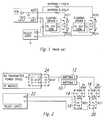
- connecting MOSFETs anti-serial creates the additional requirement of having to use a driver circuit, to operate the gate pin of the power MOSFETs, which is not referenced to ground, or is floating, as shown in Figure 1. This greatly increases the cost of the Multiplexer and transceiver system due to the expensive nature of the floating driver circuit.
- a floating driver circuit is expensive and not commonly used, because it is not referenced to ground. Unable to reference a signal to ground, the floating driver circuit requires the use of a transformer to galvanically separate the digital control signals from the driver circuit for each channel. The transformer must also withstand high voltages which also makes it more expensive. In conclusion, the additional MOSFETs used to solve the parasitic diode problem, created a much more significant cost and feasibility burden.
- a preferred embodiment of the invention overcomes the disadvantage of the parasitic diode by connecting the power MOS FET to the antenna via a serially connected capacitor.
- the serially connected capacitor may be charged up to the peak positive D.C. voltage of the antenna resonator circuit of the enabled channel, via the parasitic diode.
- the capacitor in the disabled channel is charged via the parasitic diode while a different transmit channel has been selected and when the antenna resonator of that different channel, builds up the antenna resonance voltage. Once the voltage at the antenna resonator is at the maximum, the capacitor in the disabled channel is also charged up to the maximum voltage and therefore, the antenna resonance voltage of the enabled channel minus the stored voltage of the disabled channel capacitor will never be less than zero.
- the disabled MOS FET is also blocked for positive voltages because that is the basic function of the MOS FET switch.
- the parasitic diode is not conducting in this situation, because the diode is reversed biased in this case and therefore needs a negative voltage to conduct.
- One advantage of this invention is a replacement of the excessive number of expensive additional components previously necessary to solve the parasitic diode problem with fewer significantly less expensive components.
- a second advantage of this configuration is the ease in implementation and facilitation of the new improved solution.
- FIG. 2 A preferred embodiment of the invention is shown in Figure 2.
- the Transmit/Receive (Tx/Rx) Multiplexed parts of the Radio Frequency (RF) module which are necessary to describe the invention are shown.
- Channel 1 consists of antenna 1,10, capacitor 14, and transistor is.
- Channel 2 consists of antenna 2,12, capacitor 16, and transistor 20. Each channel is connected to a different port of logic circuit 22. In addition, both channels are connected to the resonant circuit 24 of the transmitter stage.
- transistor 20 is conducting via the parasitic diode across the drain to source pins of transistor 20. Due to the parasitic diode phenomena, effectively, there are two antennas connected in parallel to the antenna resonator 24. This in turn detunes resonator 24 and inhibits antenna resonator's 24 ability to generate the high voltages necessary to charge up the transponder. Without the series capacitors 14,16, the above-mentioned result is effected.
- the capacitor 16 is charged up to the peak voltage of the antenna resonator 24 via the parasitic diode across transistor 20.
- the polarity of the voltage charged onto capacitor 16 is positive with respect to the ground of antenna 2,12 (which is also at the same potential as the source pin of the MOSFET). Therefore, the source pin of transistor 20 is at a positive potential due to the voltage at the antenna resonator 24 plus the positive voltage charged onto capacitor 16 and therefore transistor 20 will not conduct via the parasitic diode.
Landscapes
- Transmitters (AREA)
- Logic Circuits (AREA)
- Radar Systems Or Details Thereof (AREA)
- Electronic Switches (AREA)
Applications Claiming Priority (2)
| Application Number | Priority Date | Filing Date | Title |
|---|---|---|---|
| US36564494A | 1994-12-29 | 1994-12-29 | |
| US365644 | 1994-12-29 |
Publications (2)
| Publication Number | Publication Date |
|---|---|
| EP0724308A2 true EP0724308A2 (de) | 1996-07-31 |
| EP0724308A3 EP0724308A3 (de) | 1998-10-14 |
Family
ID=23439726
Family Applications (1)
| Application Number | Title | Priority Date | Filing Date |
|---|---|---|---|
| EP95120130A Withdrawn EP0724308A3 (de) | 1994-12-29 | 1995-12-20 | Antennenanordnung |
Country Status (2)
| Country | Link |
|---|---|
| EP (1) | EP0724308A3 (de) |
| JP (1) | JPH08320376A (de) |
Cited By (3)
| Publication number | Priority date | Publication date | Assignee | Title |
|---|---|---|---|---|
| EP0740262A3 (de) * | 1995-04-28 | 2004-01-02 | Texas Instruments Deutschland Gmbh | Identifizierungssystem-Leser mit multiplexierten Antennen |
| DE102004058613A1 (de) * | 2004-12-04 | 2006-06-08 | Conti Temic Microelectronic Gmbh | Sendevorrichtung für mehrere zueinander parallele, unabhängig voneinander über je eine Zuleitung versorgbare Antenne |
| US9774086B2 (en) | 2007-03-02 | 2017-09-26 | Qualcomm Incorporated | Wireless power apparatus and methods |
Families Citing this family (4)
| Publication number | Priority date | Publication date | Assignee | Title |
|---|---|---|---|---|
| US9130602B2 (en) | 2006-01-18 | 2015-09-08 | Qualcomm Incorporated | Method and apparatus for delivering energy to an electrical or electronic device via a wireless link |
| US8447234B2 (en) | 2006-01-18 | 2013-05-21 | Qualcomm Incorporated | Method and system for powering an electronic device via a wireless link |
| US9124120B2 (en) | 2007-06-11 | 2015-09-01 | Qualcomm Incorporated | Wireless power system and proximity effects |
| US9601267B2 (en) | 2013-07-03 | 2017-03-21 | Qualcomm Incorporated | Wireless power transmitter with a plurality of magnetic oscillators |
Family Cites Families (7)
| Publication number | Priority date | Publication date | Assignee | Title |
|---|---|---|---|---|
| US4857893A (en) * | 1986-07-18 | 1989-08-15 | Bi Inc. | Single chip transponder device |
| DE301127T1 (de) * | 1987-07-31 | 1989-08-24 | Texas Instruments Deutschland Gmbh, 8050 Freising | Transponder-anordnung. |
| US4987392A (en) * | 1988-10-17 | 1991-01-22 | Motorola, Inc. | Gallium arsenide antenna switch |
| NL9100110A (nl) * | 1991-01-23 | 1992-08-17 | Texas Instruments Holland | Ondervraagstation voor identificatiedoeleinden met afzonderlijke zend- en ontvangantennes. |
| JPH077464A (ja) * | 1993-06-16 | 1995-01-10 | Saakit Design:Kk | ダイバーシティー受信機 |
| JPH077449A (ja) * | 1993-06-17 | 1995-01-10 | Oki Electric Ind Co Ltd | アンテナ切り替えスイッチ |
| US5729236A (en) * | 1995-04-28 | 1998-03-17 | Texas Instruments Incorporated | Identification system reader with multiplexed antennas |
-
1995
- 1995-12-20 EP EP95120130A patent/EP0724308A3/de not_active Withdrawn
- 1995-12-27 JP JP7341546A patent/JPH08320376A/ja active Pending
Cited By (3)
| Publication number | Priority date | Publication date | Assignee | Title |
|---|---|---|---|---|
| EP0740262A3 (de) * | 1995-04-28 | 2004-01-02 | Texas Instruments Deutschland Gmbh | Identifizierungssystem-Leser mit multiplexierten Antennen |
| DE102004058613A1 (de) * | 2004-12-04 | 2006-06-08 | Conti Temic Microelectronic Gmbh | Sendevorrichtung für mehrere zueinander parallele, unabhängig voneinander über je eine Zuleitung versorgbare Antenne |
| US9774086B2 (en) | 2007-03-02 | 2017-09-26 | Qualcomm Incorporated | Wireless power apparatus and methods |
Also Published As
| Publication number | Publication date |
|---|---|
| EP0724308A3 (de) | 1998-10-14 |
| JPH08320376A (ja) | 1996-12-03 |
Similar Documents
| Publication | Publication Date | Title |
|---|---|---|
| US6239675B1 (en) | Tuning circuit having switchable capacitor controlled by a selection circuit | |
| US8476961B2 (en) | System and method of transistor switch biasing in a high power semiconductor switch | |
| KR100306306B1 (ko) | 정보통신장치 | |
| US6218819B1 (en) | Voltage regulation device having a differential amplifier coupled to a switching transistor | |
| JP2019103136A5 (de) | ||
| US20100290368A1 (en) | Half-duplex rfid transponder and a method of operating a half-duplex rfid transponder | |
| US11050238B2 (en) | Electronic circuit for providing protection for an energy supply for a receiving device | |
| EP0724308A2 (de) | Antennenanordnung | |
| US5563589A (en) | Remote identification device | |
| US20060252394A1 (en) | Switching circuit | |
| US4979232A (en) | Self-biasing solid-state T/R switch | |
| US20040259505A1 (en) | Switch circuit especially suitable for use in wireless LAN applications | |
| US4637065A (en) | Broadband solid state antenna switch | |
| WO2018044489A1 (en) | Transmitting and receiving device and ultrasound system | |
| US6262903B1 (en) | Direct-current power supply circuit having control sections with at least one control section having priority over another control section | |
| US20110182369A1 (en) | Input/output signal controller and input/output signal control system employing the input/output controller | |
| US5642059A (en) | Bus driver circuit with overvoltage protection | |
| WO1995013668A1 (en) | Electronic antenna switching system | |
| US6114883A (en) | Circuit for driving semiconductor switches | |
| US10305376B1 (en) | Switchable charge pump for multi-mode operation | |
| CA2312974A1 (en) | Active transponder switchable into passive transponder | |
| US20260048707A1 (en) | Control device for a load in a vehicle control system and vehicle | |
| US5737165A (en) | Apparatus for databus fault isolation | |
| US6066974A (en) | High power transistor switch with low transmission loss | |
| CN212811546U (zh) | 一种芯片控制转换电路 |
Legal Events
| Date | Code | Title | Description |
|---|---|---|---|
| PUAI | Public reference made under article 153(3) epc to a published international application that has entered the european phase |
Free format text: ORIGINAL CODE: 0009012 |
|
| AK | Designated contracting states |
Kind code of ref document: A2 Designated state(s): DE FR GB IT NL |
|
| RIN1 | Information on inventor provided before grant (corrected) |
Inventor name: FLAXL, THOMAS JOSEF |
|
| RAP1 | Party data changed (applicant data changed or rights of an application transferred) |
Owner name: TEXAS INSTRUMENTS DEUTSCHLAND GMBH |
|
| PUAL | Search report despatched |
Free format text: ORIGINAL CODE: 0009013 |
|
| AK | Designated contracting states |
Kind code of ref document: A3 Designated state(s): DE FR GB IT NL |
|
| 17P | Request for examination filed |
Effective date: 19990407 |
|
| 17Q | First examination report despatched |
Effective date: 20030721 |
|
| STAA | Information on the status of an ep patent application or granted ep patent |
Free format text: STATUS: THE APPLICATION IS DEEMED TO BE WITHDRAWN |
|
| 18D | Application deemed to be withdrawn |
Effective date: 20040203 |