EP0724356A2 - Verbessertes Verfahren und System zur Erzeugung von mehrstufigen halbtongerasterten Bildern aus einem digitalen Eingangsbild - Google Patents
Verbessertes Verfahren und System zur Erzeugung von mehrstufigen halbtongerasterten Bildern aus einem digitalen Eingangsbild Download PDFInfo
- Publication number
- EP0724356A2 EP0724356A2 EP96420010A EP96420010A EP0724356A2 EP 0724356 A2 EP0724356 A2 EP 0724356A2 EP 96420010 A EP96420010 A EP 96420010A EP 96420010 A EP96420010 A EP 96420010A EP 0724356 A2 EP0724356 A2 EP 0724356A2
- Authority
- EP
- European Patent Office
- Prior art keywords
- pixel values
- halftone
- level
- image
- values
- Prior art date
- Legal status (The legal status is an assumption and is not a legal conclusion. Google has not performed a legal analysis and makes no representation as to the accuracy of the status listed.)
- Withdrawn
Links
Images


Classifications
-
- H—ELECTRICITY
- H04—ELECTRIC COMMUNICATION TECHNIQUE
- H04N—PICTORIAL COMMUNICATION, e.g. TELEVISION
- H04N1/00—Scanning, transmission or reproduction of documents or the like, e.g. facsimile transmission; Details thereof
- H04N1/40—Picture signal circuits
- H04N1/40087—Multi-toning, i.e. converting a continuous-tone signal for reproduction with more than two discrete brightnesses or optical densities, e.g. dots of grey and black inks on white paper
Definitions
- the present invention relates generally to a method and system for forming multi-level halftone images from an input digital image, which generated halftone images minimize halftone patterns.
- Multi-level halftoning methods eliminate contouring artifacts by preserving the original average color level in a local image region. In some cases, the number of output colors of the display device is large enough so that contouring does not occur and, as a result, multi-level halftoning is generally not necessary. Even in such a case, there may be advantages to using multi-level halftoning techniques. For example, it may be possible to reduce the amount of RAM required in a printer or the disk-space required for an image file by reducing the number of bits required to store each image pixel. In this case, multi-level halftoning could be considered to be a form of image compression.
- Gentile et. al. describe generalizations of both the conventional error-diffusion and dither techniques for use with multi-level image displays. They report a number of variations for each technique related to the form of the quantizer which is used to map the input color values to the quantized output color values. In particular, they describe two image independent quantizers, a "RGB cubical quantizer” and a "L*u*v* uniform quantizer.”
- the RGB cubical quantizer includes a one-dimensional quantizer which is applied to each channel of a digital image.
- the output colors for this quantizer form a cubical lattice in the RGB color space.
- the advantage of this form of quantizer is that it is simple to implement and fast to compute.
- the disadvantage is that the visibility of the halftoning patterns will, in general, vary widely as a function of the input color value. This is particularly true when a linear quantizer, which is the simplest to implement and to compute, is used.
- the quantized image can be stored in a smaller amount of memory than the input image.
- the present invention resides in a method for forming a multi-level halftone image from an input digital image having a plurality of pixels so that the visibility of halftone patterns is minimized, comprising the steps of (a) transforming input pixel values which represent the tone level of each pixel into modified pixel values which are approximately linear with perceived lightness; (b) applying a multi-level halftoning process to the modified pixel values to produce halftone pixel values having a reduced number of tone levels which are uniformly distributed; and (c) transforming the halftone pixel values into output pixel values for permitting an output device to display the digital image so that visibility of halftone patterns is minimized.
- an image sensor 2 typically includes a plurality of pixels 4 arranged in a contiguous, predetermined configuration. Each pixel 4 receives a portion of an incident image thereon, and when assembled in the predetermined arrangement, they collectively represent the total incident image in electronic form. Each pixel is represented in digital form by a value of 0-255 (I(x,y)), which value I(x,y) represents one of the plurality of shades between black and white or, in other words, the tone level I(x,y).
- the transformation LUT 10 values are determined by computing the perceived lightness corresponding to each of the possible input levels, or pixel values I(x,y). These perceived lightness values are then quantized to one of different transformed output levels T(x,y).
- the input image is an 8-bit video image
- the perceived lightness can then be computed with one of the many formulas which can be found in the prior art.
- the 1976 CIELAB formula gives the perceived lightness as: where Y/Y 0 is the normalized value of the Y tristimulus value.
- Y/Y 0 is equal to the normalized image intensity, I.
- the value to be stored in the transformation LUT 10 can then be determined by quantizing the perceived lightness to N T possible levels where NINT() represents the nearest integer operation.
- the number of possible levels in the transformed image, NT should be chosen so that the lightness difference between adjacent transformed levels is substantially below the threshold of the smallest detectable difference.
- N T > N I .
- Typical values for N T are in the range of 256 to 4096.
- a dither matrix entry at column xd and row yd of the dither matrix is selected by performing a modulo operation 30 on the x and y addresses corresponding to the current pixel in the transformed image.
- the modulo operation simply computes the remainder when the row number is divided by the number of rows in the dither matrix, or the column number is divided by the number of columns in the dither matrix.
- the use of the modulo operator has the effect of tiling the dither matrix over the image in a repeating fashion.
- a modulated image value is then computed by multiplying 32 the selected dither matrix value by a constant C 2 , and adding 34 the resulting value to the transformed image value T(x,y) which has been multiplied 33 by a constant C 1 .
- the modulated image value is then uniformly quantized by dividing 35 by a constant C 3 and truncating it to an integer 36 to form the quantized image value Q(x,y).
- the values of the constants C 1 , C 2 and C 3 are chosen so that the amount of modulation introduced by the dither signal is matched to the size of the quantization interval.
- One such combination of scale factors is given by:
- the computational efficiency of the algorithm can be increased by incorporating the scale factor C 1 into the transformation LUT, incorporating the scale factor C 2 into the values stored in the dither matrix, and implementing the divide by the factor C 3 as a look-up table. If the value of C 3 is a power of two, the divide operation can also be implemented as a bit-shift operation on the modulated image value.
- dither matrices can be used such as a clustered-dot pattern, or a Bayer dither pattern, or more preferably a blue-noise dither pattern (see U. S. Patents 4,920,501, and 5,214,517 which are hereby incorporated by reference).
- a multi-level error diffusion algorithm which can be used for the multi-level halftoning step 12 in the present invention.
- the transformed image value T(x,y) for the current image pixel is quantized to N Q levels using a uniform quantizer 50 to form the quantized image value Q(x,y).
- a difference signal is computed 54 between the transformed image value and the quantized image value which has been scaled to have the same range as the transformed image using the multiplier 52.
- the difference signal represents the error introduced by the quantization process.
- the difference signal is multiplied by a series of error weights 56, and is added 58 to the transformed pixel values of nearby pixels which have yet to be processed.
- the propagation of the errors made during the quantization process to the nearby pixels insures that the mean of the transformed pixel values is preserved over a local image region.
- the quantized image will contain N Q possible quantized levels. Since N Q will generally be substantially less than the number of possible input levels NI, the amount of memory required to store the quantized image will be less than that required to store the input image. For example, if the input image had 256 possible input levels for each channel (8 bits/pixel/color), and the quantized image had 16 possible quantized levels for each channel (4 bits/pixel/color), the amount of memory required to store the image would be reduced by a factor of two. It can be seen that this invention is, in part, a form of image compression, but it has the advantage over conventional compression techniques that the computations to compute the quantized image are relatively simple, and that individual pixels within the quantized image can be directly addressed.
- the resulting reduction in the memory requirements can be useful for many applications. For example, frame buffers are frequently required to store images in various kinds of printers and image display devices. Use of the present invention can reduce the required amount of RAM by a factor of two or more with no visible reduction in the image quality. As another example, consider the case where the image must be transmitted across a data bus in a digital image processing system, or across a telecommunication line which connects different computer systems, use of the present invention will significantly reduce the time necessary to transmit the image data.
- the quantized image value Q(x,y) is outputted to an output device 18, such as a printer or a video display, and converted to an output image which can be displayed on the appropriate output device 18. This is done by using the quantized pixel values Q(x,y) to address the calibration LUT 16.
- the calibration LUT 18 converts the quantized pixel values Q(x,y) into the form necessary O(x,y) for the output device to display the image.
- To construct the calibration LUT 16 it is necessary to determine the physical response of the particular output device 18. For example, the perceived lightness, which are produced by a typical printer, can be measured as a function of the display values. This information can then be combined with desired perceived lightness for each of the quantized values to compute the calibration table.
- processing steps i.e., transformation look-up table 10, multi-level halftoning, storage 14 and calibration
- processing steps i.e., transformation look-up table 10, multi-level halftoning, storage 14 and calibration
- processor 6 of a printer 8 could be performed in any suitable computer hardware device, such as a host computer.
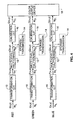
- Fig. 4 illustrates a method of applying color images to the above described method and devices.
- This method includes applying each of the above described steps to each color channel.
- the transformation LUTs 10, multi-level halftoning algorithms 12, and the calibration LUTs 16 may or may not be different for each of the three channels.
- the transformation LUTs 10 may be computed using a number of different approaches.
- the same transformation LUT 10 is used for each of the color channels, and the values stored in the transformation LUTs 10 are computed so that the perceived lightness difference between sequential transformed levels for neutral colors is approximately constant.
- the input device is a color video display having 8-bit values for each of the red, green and blue channels.
- Neutral colors can be formed using equal red, green and blue input code values.
- the normalized intensity for each of the channels can be compute using Eq. (1).
- the tristimulus values can then be computed by applying a matrix correction to a vector containing the normalized intensities: where M is the phosphor matrix and I R , I G and I B are the normalized intensities for the red, green, and blue channels, respectively.
- Y Y 0 m 10 I R + m 11 I G + m 12 I B
- This approach will insure that the maximum visibility of the halftone patterns for the neutral patches is minimized.
Landscapes
- Physics & Mathematics (AREA)
- Discrete Mathematics (AREA)
- General Physics & Mathematics (AREA)
- Engineering & Computer Science (AREA)
- Multimedia (AREA)
- Signal Processing (AREA)
- Image Processing (AREA)
- Facsimile Image Signal Circuits (AREA)
Applications Claiming Priority (2)
| Application Number | Priority Date | Filing Date | Title |
|---|---|---|---|
| US378851 | 1995-01-26 | ||
| US08/378,851 US5742405A (en) | 1995-01-26 | 1995-01-26 | Method and system for forming multi-level halftone images from an input digital image |
Publications (2)
| Publication Number | Publication Date |
|---|---|
| EP0724356A2 true EP0724356A2 (de) | 1996-07-31 |
| EP0724356A3 EP0724356A3 (de) | 1996-11-13 |
Family
ID=23494804
Family Applications (1)
| Application Number | Title | Priority Date | Filing Date |
|---|---|---|---|
| EP96420010A Withdrawn EP0724356A3 (de) | 1995-01-26 | 1996-01-11 | Verbessertes Verfahren und System zur Erzeugung von mehrstufigen halbtongerasterten Bildern aus einem digitalen Eingangsbild |
Country Status (3)
| Country | Link |
|---|---|
| US (1) | US5742405A (de) |
| EP (1) | EP0724356A3 (de) |
| JP (1) | JPH08249465A (de) |
Cited By (2)
| Publication number | Priority date | Publication date | Assignee | Title |
|---|---|---|---|---|
| US6331899B1 (en) * | 1998-10-14 | 2001-12-18 | Electronics For Imaging, Inc. | Method and apparatus for automatically generating single-channel critical color transformations |
| EP1345414A3 (de) * | 2002-03-15 | 2005-04-27 | Canon Kabushiki Kaisha | Bildaufzeichnungssystem und -Vorrichtung, Bilddatenquellenvorrichtung, Bildverarbeitungsverfahren, und Programm |
Families Citing this family (22)
| Publication number | Priority date | Publication date | Assignee | Title |
|---|---|---|---|---|
| US6330075B1 (en) * | 1995-08-03 | 2001-12-11 | Canon Kabushiki Kaisha | Image processing method and apparatus |
| US5905490A (en) * | 1996-02-26 | 1999-05-18 | Seiko Epson Corporation | Generating color-correction look-up-table addresses by multi-level half-toning |
| US6118547A (en) * | 1996-07-17 | 2000-09-12 | Canon Kabushiki Kaisha | Image processing method and apparatus |
| US6014226A (en) * | 1997-07-01 | 2000-01-11 | Xerox Corporation | Multilevel halftoning with reduced texture contours and coverage control |
| US6178008B1 (en) | 1997-10-30 | 2001-01-23 | Hewlett-Packard Company | Constructing device-state tables for inkjet printing |
| US6081344A (en) * | 1997-10-30 | 2000-06-27 | Hewlett-Packard Company | Device state error diffusion technique for halftoning |
| US6629739B2 (en) | 1999-12-17 | 2003-10-07 | Xerox Corporation | Apparatus and method for drop size switching in ink jet printing |
| US6842266B1 (en) * | 2000-02-25 | 2005-01-11 | Xerox Corporation | Systems and methods that determine an image processing system tone reproduction curve |
| EP1158484A3 (de) * | 2000-05-25 | 2008-12-31 | Seiko Epson Corporation | Verarbeitung von an ein Anzeigegerät gelieferten Bilddaten |
| US7218420B1 (en) * | 2000-08-01 | 2007-05-15 | Eastman Kodak Company | Gray level halftone processing |
| US7079287B1 (en) | 2000-08-01 | 2006-07-18 | Eastman Kodak Company | Edge enhancement of gray level images |
| JP2002057913A (ja) * | 2000-08-01 | 2002-02-22 | Nexpress Solutions Llc | 個人的好みに応じたカラー強調をもたらす像記録装置および像記録方法 |
| US7079281B1 (en) | 2000-08-01 | 2006-07-18 | Eastman Kodak Company | Edge enhancement processor and method with adjustable threshold setting |
| US7102789B2 (en) * | 2001-09-17 | 2006-09-05 | Sharp Laboratories Of America, Inc. | Method for rendering an image comprising multi-level pixels |
| US20050157791A1 (en) * | 2004-01-20 | 2005-07-21 | Eastman Kodak Company | System and method for video tone scale reduction |
| US7362472B2 (en) * | 2004-03-05 | 2008-04-22 | Eastman Kodak Company | Color error diffusion |
| US7616341B2 (en) * | 2004-07-12 | 2009-11-10 | Toshiba Corporation | System and method for metadata controlled multi-configured halftone screening |
| JP2006237902A (ja) * | 2005-02-23 | 2006-09-07 | Sony Corp | 階調変換装置、画像処理装置、印刷装置、階調変換方法及びプログラム |
| US8593693B2 (en) * | 2009-11-12 | 2013-11-26 | Ricoh Production Print Solutions LLC | Outputting gray color values in color-managed CMYK to CMYK color conversions based on input gray color values |
| US8867100B2 (en) * | 2010-06-22 | 2014-10-21 | LRC Solutions, LLC. | Image quantization for digital printing |
| DE102010055229A1 (de) * | 2010-12-20 | 2012-06-21 | Arnold & Richter Cine Technik Gmbh & Co. Betriebs Kg | Bildaufzeichnungssystem und Verfahren zum Kalibrieren, Komprimieren und Dekomprimieren von Bildsignalwerten |
| US8934142B2 (en) | 2013-04-30 | 2015-01-13 | Hewlett-Packard Indigo B.V. | Halftone screen |
Family Cites Families (23)
| Publication number | Priority date | Publication date | Assignee | Title |
|---|---|---|---|---|
| US4058828A (en) * | 1975-05-27 | 1977-11-15 | Eastman Kodak Company | Document copying apparatus |
| JPS56152373A (en) * | 1980-04-24 | 1981-11-25 | Fuji Photo Film Co Ltd | Laser recording device |
| US4965672A (en) * | 1987-05-11 | 1990-10-23 | The Mead Corporation | Method and apparatus for halftone imaging |
| GB8722228D0 (en) * | 1987-09-22 | 1987-10-28 | Crosfield Electronics Ltd | Image processing |
| US5150429A (en) * | 1987-12-17 | 1992-09-22 | Eastman Kodak Company | Image processor with error diffusion modulated threshold matrix |
| US4962542A (en) * | 1988-08-29 | 1990-10-09 | Eastman Kodak Company | Method for reducing artifacts in error diffused images |
| US5107346A (en) * | 1988-10-14 | 1992-04-21 | Bowers Imaging Technologies, Inc. | Process for providing digital halftone images with random error diffusion |
| US4920501A (en) * | 1988-10-19 | 1990-04-24 | Eastman Kodak Company | Digital halftoning with minimum visual modulation patterns |
| JPH0380767A (ja) * | 1989-08-24 | 1991-04-05 | Ricoh Co Ltd | 画像の階調記録装置 |
| US5210623A (en) * | 1989-12-21 | 1993-05-11 | Eastman Kodak Company | Apparatus and method for quantizing and/or reconstructing multi-dimensional digital image signals |
| US5214517A (en) * | 1990-02-07 | 1993-05-25 | Eastman Kodak Company | Digital halftoning with correlated minimum visual modulation patterns |
| JP2974363B2 (ja) * | 1990-04-02 | 1999-11-10 | 株式会社リコー | 画像処理装置 |
| US5339171A (en) * | 1990-04-24 | 1994-08-16 | Ricoh Company, Ltd. | Image processing apparatus especially suitable for producing smooth-edged output multi-level tone data having fewer levels than input multi-level tone data |
| US5109282A (en) * | 1990-06-20 | 1992-04-28 | Eye Research Institute Of Retina Foundation | Halftone imaging method and apparatus utilizing pyramidol error convergence |
| JPH04119763A (ja) * | 1990-09-11 | 1992-04-21 | Toshiba Corp | 画像処理装置 |
| US5111310A (en) * | 1990-12-04 | 1992-05-05 | Research Technologies Corporation, Inc. | Method and apparatus for halftone rendering of a gray scale image using a blue noise mask |
| US5323247A (en) * | 1990-12-04 | 1994-06-21 | Research Corporation Technologies | Method and apparatus for halftoning and inverse halftoning and the transmission of such images |
| US5341228A (en) * | 1990-12-04 | 1994-08-23 | Research Corporation Technologies | Method and apparatus for halftone rendering of a gray scale image using a blue noise mask |
| US5267054A (en) * | 1991-06-26 | 1993-11-30 | Sun Microsystems, Inc. | Method and apparatus for the reduction of memory space required for a digital halftone system |
| US5243443A (en) * | 1991-12-06 | 1993-09-07 | Xerox Corporation | Halftoning with error feedback and image dependent enhancement |
| US5359430A (en) * | 1992-05-15 | 1994-10-25 | Microsoft Corporation | Block-halftoning method and system with compressed error image |
| US5291311A (en) * | 1992-06-29 | 1994-03-01 | Eastman Kodak Company | Apparatus and method for generating multi-level output values for pixels in a halftone cell |
| EP0593304B1 (de) * | 1992-10-15 | 1999-04-14 | Digital Equipment Corporation | Erzeugung von Schablonen mit homogener Verteilung binärer Elemente, anwendbar bei Halbton-Bildwiedergabe |
-
1995
- 1995-01-26 US US08/378,851 patent/US5742405A/en not_active Expired - Lifetime
-
1996
- 1996-01-11 EP EP96420010A patent/EP0724356A3/de not_active Withdrawn
- 1996-01-25 JP JP8011137A patent/JPH08249465A/ja active Pending
Cited By (3)
| Publication number | Priority date | Publication date | Assignee | Title |
|---|---|---|---|---|
| US6331899B1 (en) * | 1998-10-14 | 2001-12-18 | Electronics For Imaging, Inc. | Method and apparatus for automatically generating single-channel critical color transformations |
| EP1345414A3 (de) * | 2002-03-15 | 2005-04-27 | Canon Kabushiki Kaisha | Bildaufzeichnungssystem und -Vorrichtung, Bilddatenquellenvorrichtung, Bildverarbeitungsverfahren, und Programm |
| US7672011B2 (en) | 2002-03-15 | 2010-03-02 | Canon Kabushiki Kaisha | Image recording system, image data resource apparatus, image recording apparatus, image processing method, and program |
Also Published As
| Publication number | Publication date |
|---|---|
| EP0724356A3 (de) | 1996-11-13 |
| US5742405A (en) | 1998-04-21 |
| JPH08249465A (ja) | 1996-09-27 |
Similar Documents
| Publication | Publication Date | Title |
|---|---|---|
| US5742405A (en) | Method and system for forming multi-level halftone images from an input digital image | |
| US5377041A (en) | Method and apparatus employing mean preserving spatial modulation for transforming a digital color image signal | |
| JP3737149B2 (ja) | カラー・イメージ生成システムおよび方法 | |
| EP0606993B1 (de) | Abschneidung des Farbtonbereichs | |
| US6870644B2 (en) | Tone dependent plane dependent error diffusion halftoning | |
| US5774112A (en) | Method and apparatus for tone correction of a digital color image with preservation of the chromaticity of the image | |
| US5553200A (en) | Method and apparatus for providing bit-rate reduction and reconstruction of image data using dither arrays | |
| US4992862A (en) | Color conversion display apparatus and method | |
| EP0650289A1 (de) | Verfahren und Gerät zur Erzeugung von Halbtonmustern für eine Multipegelausgabeeinrichtung | |
| EP0820189A2 (de) | Verfahren und Vorrichtung zur Farbraumumwandlung | |
| EP0580151A2 (de) | Prozess zur Bestimmung von mittelwerterhaltenden Matrizen mit mehrstufigen Halbtonwerten und variierenden Modulationsbeträgen | |
| EP1636788A2 (de) | Transformation von drei eingangsfarbsignalen in mehr farbsignale | |
| US20030081228A1 (en) | Method for halftoning a multi-channel digital color image having at least one group of similar color channels | |
| US7417771B2 (en) | Error diffusion halftoning system | |
| US6853468B2 (en) | Reducing quantization errors in imaging systems | |
| EP0725533B1 (de) | Verarbeitung von halbtongerasterten Farbbildern | |
| US6690389B2 (en) | Tone modifying dithering system | |
| US5754309A (en) | Tone correction for multi-level halftoned images | |
| US5946455A (en) | Model based error diffusion with correction propagation | |
| US6515770B1 (en) | Dither mask generation with calibration-independent number of threshold levels | |
| EP1011263B1 (de) | Farbkorrekturverfahren mit Multipegelhalbtonrasterung | |
| KR100657339B1 (ko) | 휘도 보존 양자화 및 하프톤닝을 결합하는 방법 및 시스템 | |
| US20100134809A1 (en) | Gamma correction method for error diffusion | |
| US6633412B1 (en) | Smoothness enhancement in laser printing through periodic modulation of halftone cell | |
| US7593135B2 (en) | Digital image multitoning method |
Legal Events
| Date | Code | Title | Description |
|---|---|---|---|
| PUAI | Public reference made under article 153(3) epc to a published international application that has entered the european phase |
Free format text: ORIGINAL CODE: 0009012 |
|
| AK | Designated contracting states |
Kind code of ref document: A2 Designated state(s): DE FR GB |
|
| PUAL | Search report despatched |
Free format text: ORIGINAL CODE: 0009013 |
|
| AK | Designated contracting states |
Kind code of ref document: A3 Designated state(s): DE FR GB |
|
| 17P | Request for examination filed |
Effective date: 19970425 |
|
| 17Q | First examination report despatched |
Effective date: 19990505 |
|
| STAA | Information on the status of an ep patent application or granted ep patent |
Free format text: STATUS: THE APPLICATION IS DEEMED TO BE WITHDRAWN |
|
| 18D | Application deemed to be withdrawn |
Effective date: 19990916 |