EP0724370A1 - Verhütung von Diensteninteraktionen in Telekommunikationssystemen - Google Patents
Verhütung von Diensteninteraktionen in Telekommunikationssystemen Download PDFInfo
- Publication number
- EP0724370A1 EP0724370A1 EP96300387A EP96300387A EP0724370A1 EP 0724370 A1 EP0724370 A1 EP 0724370A1 EP 96300387 A EP96300387 A EP 96300387A EP 96300387 A EP96300387 A EP 96300387A EP 0724370 A1 EP0724370 A1 EP 0724370A1
- Authority
- EP
- European Patent Office
- Prior art keywords
- software
- sub
- call
- systems
- interaction manager
- Prior art date
- Legal status (The legal status is an assumption and is not a legal conclusion. Google has not performed a legal analysis and makes no representation as to the accuracy of the status listed.)
- Withdrawn
Links
Images


Classifications
-
- H—ELECTRICITY
- H04—ELECTRIC COMMUNICATION TECHNIQUE
- H04Q—SELECTING
- H04Q3/00—Selecting arrangements
- H04Q3/42—Circuit arrangements for indirect selecting controlled by common circuits, e.g. register controller, marker
- H04Q3/54—Circuit arrangements for indirect selecting controlled by common circuits, e.g. register controller, marker in which the logic circuitry controlling the exchange is centralised
- H04Q3/545—Circuit arrangements for indirect selecting controlled by common circuits, e.g. register controller, marker in which the logic circuitry controlling the exchange is centralised using a stored program
- H04Q3/54508—Configuration, initialisation
- H04Q3/54525—Features introduction
-
- H—ELECTRICITY
- H04—ELECTRIC COMMUNICATION TECHNIQUE
- H04M—TELEPHONIC COMMUNICATION
- H04M3/00—Automatic or semi-automatic exchanges
- H04M3/42—Systems providing special services or facilities to subscribers
- H04M3/42136—Administration or customisation of services
- H04M3/4217—Managing service interactions
-
- H—ELECTRICITY
- H04—ELECTRIC COMMUNICATION TECHNIQUE
- H04Q—SELECTING
- H04Q3/00—Selecting arrangements
- H04Q3/0016—Arrangements providing connection between exchanges
- H04Q3/0029—Provisions for intelligent networking
- H04Q3/0041—Provisions for intelligent networking involving techniques for avoiding interaction of call service features
-
- H—ELECTRICITY
- H04—ELECTRIC COMMUNICATION TECHNIQUE
- H04Q—SELECTING
- H04Q2213/00—Indexing scheme relating to selecting arrangements in general and for multiplex systems
- H04Q2213/1305—Software aspects
-
- H—ELECTRICITY
- H04—ELECTRIC COMMUNICATION TECHNIQUE
- H04Q—SELECTING
- H04Q2213/00—Indexing scheme relating to selecting arrangements in general and for multiplex systems
- H04Q2213/13501—Feature interactions
-
- H—ELECTRICITY
- H04—ELECTRIC COMMUNICATION TECHNIQUE
- H04Q—SELECTING
- H04Q2213/00—Indexing scheme relating to selecting arrangements in general and for multiplex systems
- H04Q2213/13502—Indexing scheme relating to selecting arrangements in general and for multiplex systems primitives - inc. service-independent building blocks [SIBBs]
-
- H—ELECTRICITY
- H04—ELECTRIC COMMUNICATION TECHNIQUE
- H04Q—SELECTING
- H04Q2213/00—Indexing scheme relating to selecting arrangements in general and for multiplex systems
- H04Q2213/13527—Indexing scheme relating to selecting arrangements in general and for multiplex systems protocols - X.25, TCAP etc.
Definitions
- the Intelligent Network is a term for a public network architecture which has been adopted internationally to take us into the next century 1 .
- the added value services e.g. Call Waiting, Three Party Calling etc.
- SCP Service Control Point
- SSP Service Switching Point
- CSTA Computer Supported Telecommunication Applications
- CSTA is used to provide value added services such as Teledialling and Automatic Call Distribution, since private systems have had enhanced call processing functionality for a number of years now within the basic switching product.
- CSTA is more often thought of as being an arrangement whereby an external computing element works in conjunction with a PABX system to provide augmented call processing functionality which neither of them could provide independently of the other.
- the incoming call arrives at the terminating PABX and is routed by the CSTA-CC package to a terminal. Let us assume that the agent at that terminal is not able to take that call for one of a variety of reasons, and after a few rings the calling party wishes to place a Ring Back When Next Used request on the terminal, using functionality provided by the IN.
- a software controlled system comprising an event generator, a plurality of software sub-systems, each sub-system containing the same plurality of features, an interaction manager and an external feature module, wherein all events are routed from the event generator to a sub-system via the interaction manager, only a one of the plurality of sub-systems being able to provide a response directly to the event generator, a response from any other of the plurality of sub-systems being directed to the interaction manager.
- PABXs consist of hardware, which is basically a processor, a call switching sub-system and various option cards, and the software, which drives the hardware and provides the functionality that largely differentiates one switching product from another. It is by the development and extension of this software that a product is enhanced and maintains market differentiation against its competitors.
- the functionality of the embedded software can be further subdivided into two classes; That which supports the basic call and that which implements value added features which operate on top of the base. It is these value added features which provide the added functionality.
- PABXs Private Automatic Branch Exchanges
- PABXs Private Automatic Branch Exchanges
- this additional software is tightly integrated with the base software and cannot viably be separated out from it.
- the interactions between features within this code have been resolved by rules hard coded into the system such that the implementation of an individual feature is influenced by the other features that are also present. Indeed, it would be difficult to remove one feature from the system due to the subtle interactions between it and others.
- the messages from the existing feature to the new feature may be viewed as the actions that the other services would take if they were permitted to continue as if the new feature were not present.
- the messages from the new feature to the other services may be viewed as requests to modify the behaviour of the existing services in the light of the requirements of the new feature.
- ETSI European Telecommunications Standards Institute
- the first of these two objections can be overcome by providing a generic event delivery system which takes the events from the hardware and determines where they should be passed to via some defined triggering system.
- the second objection can be overcome by providing multiple copies of the software, only one of which operates as the master copy which is permitted control of the physical hardware. This may be termed the 'Live' Software Sub-system.
- a second copy of the software behaves as if it has control of the hardware but in fact passes its commands back to the newly added feature.
- the new feature can override any actions that the switch may wish to perform and the Feature Module is itself responsible for determining what events it is interested in.
- the Feature Module would pass the event directly to the Live Software Sub-system for processing, since the event would be of no interest to it.
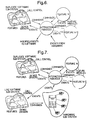
- the Duplicate Software Sub-system as shown in Figure 5 (which has been kept in synchronism with the Live Software Sub-system). This will then perform exactly the same processing as would the real software and will return its results as if driving the hardware, to the Feature Module.
- the Feature Module can then determine what events to send to the Live Software Sub-system to be actioned to the switch hardware.
- the Feature Interaction module is then responsible for the arbitration between a number of external features and the embedded features which were already present within the switching system, which is simply viewed as being one more feature, or collection of features.
- the principle of the external Feature Manager module is described in Cain 4 .
- Additional copies of the software can be implemented quite easily by using a cache system which is switched in when a copy is required.
- the same processor, reading from the same physical memory, can then be used which removes the problem of synchronisation between duplicate copies of the software.
- duplicate mode i.e. when the write cache is turned on
- all writes to memory will in fact be to the cache and will have no permanent effect, since the cache can be flushed rather than being allowed to write back to the permanent memory. If however the Interaction Manager determines that the event should be allowed to progress as normal then no additional processing is required as the cache can simply be released and allowed to write back.
- the feature makes a copy of itself using the fork call.
- the parent process then waits.
- the child process takes and processes each of the events from the Core Switch until it receives either a commit or abort transaction message. If it receives a commit message it sends a message to the parent process telling it to die. The child process then becomes the parent.
- the Interaction Manager would be implemented as a separate software system which would need to have high speed connections to all of the Feature Modules which could potentially be involved in a single call, since otherwise the overall performance of the switching system will suffer.
- This approach offers an upgrade path which also allows more and more functionality to be moved out of the core switch to external processing agents as time progresses.
- the approach does not preclude the use of any of the advanced Interaction Resolution Techniques which are now at the research stage including Negotiation and Resource Contention Techniques. Indeed, the adoption of this approach moves a switching product considerably closer to enabling an implementation using any of these technologies.
- Typical ACD applications would be flight booking or enquiry services, where each individual incoming call is routed to the agent who has been free for the longest period of time. In this way, each agent receives an approximately equivalent amount of time on calls.
- a service whereby the calling party is presented with ring tone and the called party, who is already busy on another call, receives a short burst of tone, indicating that there is another call to be answered.
- the called party than has the option to continue the current call or to answer the one which is ringing.
- Intelligent Network An architecture which allows the separation of Services from the Basic Call so that services can be developed independently.
- a private switch which can be connected to other private switches to form a Private Network (PN).
- PN Private Network
- Ring Backs are services where the party which sets them is called back when the party that they were trying to call becomes available.
- a Ring Back When Free is set when the terminating party is busy and the originating party will be rung back when the terminating party goes on hook.
- a Ring Back When Next Used is set when the terminating party does not answer and in this case the originating party will be rung back when the terminating party completes their next call.
- the SSP is totally responsible for the control of the basic call and sends requests to the SCP for additional instructions to support services.
Landscapes
- Engineering & Computer Science (AREA)
- Computer Networks & Wireless Communication (AREA)
- Signal Processing (AREA)
- Exchange Systems With Centralized Control (AREA)
- Computer And Data Communications (AREA)
- Stored Programmes (AREA)
- Telephonic Communication Services (AREA)
Applications Claiming Priority (2)
| Application Number | Priority Date | Filing Date | Title |
|---|---|---|---|
| GB9501716 | 1995-01-28 | ||
| GBGB9501716.6A GB9501716D0 (en) | 1995-01-28 | 1995-01-28 | Service interactions |
Publications (1)
| Publication Number | Publication Date |
|---|---|
| EP0724370A1 true EP0724370A1 (de) | 1996-07-31 |
Family
ID=10768760
Family Applications (1)
| Application Number | Title | Priority Date | Filing Date |
|---|---|---|---|
| EP96300387A Withdrawn EP0724370A1 (de) | 1995-01-28 | 1996-01-19 | Verhütung von Diensteninteraktionen in Telekommunikationssystemen |
Country Status (6)
| Country | Link |
|---|---|
| EP (1) | EP0724370A1 (de) |
| JP (1) | JPH08280047A (de) |
| CN (1) | CN1137654A (de) |
| AU (1) | AU4218896A (de) |
| GB (2) | GB9501716D0 (de) |
| ZA (1) | ZA96484B (de) |
Cited By (4)
| Publication number | Priority date | Publication date | Assignee | Title |
|---|---|---|---|---|
| GB2348304A (en) * | 1999-03-24 | 2000-09-27 | Ibm | Optimising device driver debug tracing |
| US6661887B1 (en) | 1997-09-25 | 2003-12-09 | Nokia Networks Oy | Service interaction in an intelligent network |
| US6728236B2 (en) * | 1996-10-16 | 2004-04-27 | British Telecommunications Public Limited Company | Multimedia call center |
| CN112216353A (zh) * | 2020-11-02 | 2021-01-12 | 长沙理工大学 | 一种用于预测药物-靶标相互作用关系的方法和设备 |
Families Citing this family (5)
| Publication number | Priority date | Publication date | Assignee | Title |
|---|---|---|---|---|
| GB2315637B (en) * | 1996-07-19 | 2000-09-13 | Ericsson Telefon Ab L M | Testing mechanism |
| CA2299639C (en) | 1999-03-05 | 2005-11-01 | Mitel Corporation | Adaptive rule-based mechanism and method for feature interaction resolution |
| GB2347579B (en) * | 1999-03-05 | 2003-12-24 | Mitel Corp | Adaptive rule-based mechanism and method for feature interaction resolution |
| GB2351870B (en) * | 1999-07-09 | 2001-09-19 | Mitel Corp | Feature interaction resolution using fuzzy rules |
| CN100456699C (zh) * | 2006-08-08 | 2009-01-28 | 华为技术有限公司 | 通信网络中业务能力交互管理系统及其方法 |
Citations (2)
| Publication number | Priority date | Publication date | Assignee | Title |
|---|---|---|---|---|
| EP0576864A2 (de) * | 1992-06-30 | 1994-01-05 | Siemens Stromberg-Carlson | Anrufbearbeitungssystem |
| EP0598526A2 (de) * | 1992-11-16 | 1994-05-25 | AT&T Corp. | Fernmeldesystem mit verbesserter Rekonfigurationsfähigkeit |
Family Cites Families (3)
| Publication number | Priority date | Publication date | Assignee | Title |
|---|---|---|---|---|
| US5337351A (en) * | 1992-02-28 | 1994-08-09 | Nec America, Inc. | Feature interaction arbitrator |
| US5448631A (en) * | 1992-10-13 | 1995-09-05 | U S West Advanced Technologies, Inc. | Apparatus for handling features in a telephone network |
| US5404396A (en) * | 1993-08-27 | 1995-04-04 | Telefonaktiebolaget Lm Ericsson | Feature interaction manager |
-
1995
- 1995-01-28 GB GBGB9501716.6A patent/GB9501716D0/en active Pending
-
1996
- 1996-01-19 EP EP96300387A patent/EP0724370A1/de not_active Withdrawn
- 1996-01-22 ZA ZA96484A patent/ZA96484B/xx unknown
- 1996-01-25 AU AU42188/96A patent/AU4218896A/en not_active Abandoned
- 1996-01-26 JP JP8032938A patent/JPH08280047A/ja active Pending
- 1996-01-26 CN CN96104377A patent/CN1137654A/zh active Pending
- 1996-01-29 GB GB9601752A patent/GB2299730A/en not_active Withdrawn
Patent Citations (2)
| Publication number | Priority date | Publication date | Assignee | Title |
|---|---|---|---|---|
| EP0576864A2 (de) * | 1992-06-30 | 1994-01-05 | Siemens Stromberg-Carlson | Anrufbearbeitungssystem |
| EP0598526A2 (de) * | 1992-11-16 | 1994-05-25 | AT&T Corp. | Fernmeldesystem mit verbesserter Rekonfigurationsfähigkeit |
Non-Patent Citations (3)
| Title |
|---|
| L. SCHESSEL: "Administrable Feature Interaction Concept", INTERNATIONAL SWITCHING SYMPOSIUM - PAPER B6.3, vol. 2, 25 October 1992 (1992-10-25) - 30 October 1992 (1992-10-30), YOKOHAMA (JP), pages 122 - 126, XP000337708 * |
| R. ENGRAM ET AL: "Transparent software and hardware changes in a telecommunication system", FIFTH INTERNATIONAL CONFERENCE ON SOFTWARE ENGINEERING FOR TELECOMMUNICATION SWITCHTING SYSTEMS, 4 July 1983 (1983-07-04) - 8 July 1983 (1983-07-08), LUND (SE), pages 157 - 162, XP002004485 * |
| R. LUND ET AL: "A solution for switch based rapid service delivery in 1991", INTERNATIONAL SWITCHING SYMPOSIUM - PAPER B6.4, vol. 4, 28 May 1990 (1990-05-28) - 1 June 1990 (1990-06-01), STOCKHOLM (SE), pages 165 - 168, XP000124116 * |
Cited By (7)
| Publication number | Priority date | Publication date | Assignee | Title |
|---|---|---|---|---|
| US6728236B2 (en) * | 1996-10-16 | 2004-04-27 | British Telecommunications Public Limited Company | Multimedia call center |
| US6661887B1 (en) | 1997-09-25 | 2003-12-09 | Nokia Networks Oy | Service interaction in an intelligent network |
| GB2348304A (en) * | 1999-03-24 | 2000-09-27 | Ibm | Optimising device driver debug tracing |
| US6526567B1 (en) | 1999-03-24 | 2003-02-25 | International Business Machines Corporation | System and method for optimizing a device driver by incorporating debugging and tracing |
| GB2348304B (en) * | 1999-03-24 | 2003-07-09 | Ibm | Optimising Device Driver Debug Tracing |
| CN112216353A (zh) * | 2020-11-02 | 2021-01-12 | 长沙理工大学 | 一种用于预测药物-靶标相互作用关系的方法和设备 |
| CN112216353B (zh) * | 2020-11-02 | 2024-04-02 | 长沙理工大学 | 一种用于预测药物-靶标相互作用关系的方法和设备 |
Also Published As
| Publication number | Publication date |
|---|---|
| JPH08280047A (ja) | 1996-10-22 |
| CN1137654A (zh) | 1996-12-11 |
| AU4218896A (en) | 1996-08-08 |
| GB9601752D0 (en) | 1996-03-27 |
| ZA96484B (en) | 1996-08-13 |
| GB9501716D0 (en) | 1995-03-15 |
| GB2299730A (en) | 1996-10-09 |
Similar Documents
| Publication | Publication Date | Title |
|---|---|---|
| Cameron et al. | A feature-interaction benchmark for IN and beyond | |
| US6526134B1 (en) | Call set-up by an intelligent network | |
| US5479495A (en) | Method and system for automatically accessing and invoking switch-based services in an advanced intelligent network | |
| US5644631A (en) | Method and apparatus for delivering calling services | |
| CA1331802C (en) | Modularly structured digital communications system having operations-oriented and security-oriented components | |
| US6535596B1 (en) | Call processing system utilizing subscriber services and preferences | |
| US4903258A (en) | Modularly structured digital communications system | |
| US6895087B2 (en) | Flexible software architecture for a call processing system | |
| US6055302A (en) | System and method for incoming and outgoing interrogations for store-and-forward services | |
| US6167126A (en) | Method for flexibly provisioning switching devices and a switching device incorporating the same | |
| US6002756A (en) | Method and system for implementing intelligent telecommunication services utilizing self-sustaining, fault-tolerant object oriented architecture | |
| AU732819B2 (en) | System and method for incoming and outgoing interrogations for store-and-forward services | |
| GB2299730A (en) | Interaction of special services in a telecommunications system | |
| EP0765581B1 (de) | Verteilte verbindungssteuerung in telekommunikationsnetzwerken | |
| US5940378A (en) | Call control in exchange suitable for intelligent network | |
| CN1097400C (zh) | 在智能网络呼叫中实现连续呼叫的方法 | |
| EP0576864A2 (de) | Anrufbearbeitungssystem | |
| EP1036469B1 (de) | Dienstinteraktion in einem intelligenten netzwerk | |
| EP0873029A1 (de) | Service Control Point Schnittstelle | |
| US6771762B1 (en) | System and method for call merge to an AIN SSP from an intelligent peripheral | |
| EP1095523A1 (de) | Telekommunikationssystem zum bereitstellen von in- und nicht-in-diensten | |
| KR100346119B1 (ko) | 지능망의 연속호 서비스 방법 | |
| KR960003504B1 (ko) | 지능망 서비스 로직 시험 방법 | |
| KR960013278B1 (ko) | 전전자 교환기에서 디지틀 가입자 호 보류 방법 | |
| CN1390424A (zh) | 用于在多个连接控制器之间传输与业务有关的信息的方法和装置 |
Legal Events
| Date | Code | Title | Description |
|---|---|---|---|
| PUAI | Public reference made under article 153(3) epc to a published international application that has entered the european phase |
Free format text: ORIGINAL CODE: 0009012 |
|
| AK | Designated contracting states |
Kind code of ref document: A1 Designated state(s): CH DE ES FR IE IT LI NL SE |
|
| 17P | Request for examination filed |
Effective date: 19970127 |
|
| RAP1 | Party data changed (applicant data changed or rights of an application transferred) |
Owner name: SIEMENS GEC COMMUNICATION SYSTEMS LIMITED |
|
| RAP1 | Party data changed (applicant data changed or rights of an application transferred) |
Owner name: SIEMENS PLC |
|
| STAA | Information on the status of an ep patent application or granted ep patent |
Free format text: STATUS: THE APPLICATION HAS BEEN WITHDRAWN |
|
| 18W | Application withdrawn |
Withdrawal date: 19990427 |