EP0725015A1 - Emballage pour comprimés contenus dans un blister - Google Patents
Emballage pour comprimés contenus dans un blister Download PDFInfo
- Publication number
- EP0725015A1 EP0725015A1 EP96100893A EP96100893A EP0725015A1 EP 0725015 A1 EP0725015 A1 EP 0725015A1 EP 96100893 A EP96100893 A EP 96100893A EP 96100893 A EP96100893 A EP 96100893A EP 0725015 A1 EP0725015 A1 EP 0725015A1
- Authority
- EP
- European Patent Office
- Prior art keywords
- blister
- packaging
- section
- blister section
- base
- Prior art date
- Legal status (The legal status is an assumption and is not a legal conclusion. Google has not performed a legal analysis and makes no representation as to the accuracy of the status listed.)
- Withdrawn
Links
- 238000004806 packaging method and process Methods 0.000 claims description 85
- 239000000853 adhesive Substances 0.000 claims description 6
- 230000001070 adhesive effect Effects 0.000 claims description 6
- 238000012856 packing Methods 0.000 abstract 4
- 230000035515 penetration Effects 0.000 abstract 1
- 239000003826 tablet Substances 0.000 description 32
- 239000003814 drug Substances 0.000 description 16
- 229940079593 drug Drugs 0.000 description 11
- 239000002775 capsule Substances 0.000 description 4
- 229940126601 medicinal product Drugs 0.000 description 4
- 238000003860 storage Methods 0.000 description 4
- -1 Polyethylene Polymers 0.000 description 3
- 239000004033 plastic Substances 0.000 description 3
- 229920003023 plastic Polymers 0.000 description 3
- 239000000047 product Substances 0.000 description 3
- 239000007787 solid Substances 0.000 description 3
- 239000004743 Polypropylene Substances 0.000 description 2
- 239000008298 dragée Substances 0.000 description 2
- 238000004519 manufacturing process Methods 0.000 description 2
- 239000000463 material Substances 0.000 description 2
- 239000008188 pellet Substances 0.000 description 2
- 229920001155 polypropylene Polymers 0.000 description 2
- 239000002699 waste material Substances 0.000 description 2
- ZAMOUSCENKQFHK-UHFFFAOYSA-N Chlorine atom Chemical compound [Cl] ZAMOUSCENKQFHK-UHFFFAOYSA-N 0.000 description 1
- 108010010803 Gelatin Proteins 0.000 description 1
- 239000004698 Polyethylene Substances 0.000 description 1
- 229920002472 Starch Polymers 0.000 description 1
- 239000002390 adhesive tape Substances 0.000 description 1
- 229910052782 aluminium Inorganic materials 0.000 description 1
- XAGFODPZIPBFFR-UHFFFAOYSA-N aluminium Chemical compound [Al] XAGFODPZIPBFFR-UHFFFAOYSA-N 0.000 description 1
- 239000000460 chlorine Substances 0.000 description 1
- 229910052801 chlorine Inorganic materials 0.000 description 1
- 238000005520 cutting process Methods 0.000 description 1
- 238000011161 development Methods 0.000 description 1
- 230000018109 developmental process Effects 0.000 description 1
- 235000015872 dietary supplement Nutrition 0.000 description 1
- 230000000694 effects Effects 0.000 description 1
- 230000007613 environmental effect Effects 0.000 description 1
- 239000011888 foil Substances 0.000 description 1
- 235000013305 food Nutrition 0.000 description 1
- 229920000159 gelatin Polymers 0.000 description 1
- 239000008273 gelatin Substances 0.000 description 1
- 235000019322 gelatine Nutrition 0.000 description 1
- 235000011852 gelatine desserts Nutrition 0.000 description 1
- 229910001385 heavy metal Inorganic materials 0.000 description 1
- 235000012907 honey Nutrition 0.000 description 1
- 230000036512 infertility Effects 0.000 description 1
- 229910052500 inorganic mineral Inorganic materials 0.000 description 1
- 230000007774 longterm Effects 0.000 description 1
- 238000000034 method Methods 0.000 description 1
- 239000011707 mineral Substances 0.000 description 1
- 235000010755 mineral Nutrition 0.000 description 1
- 239000004081 narcotic agent Substances 0.000 description 1
- 239000005445 natural material Substances 0.000 description 1
- 239000000902 placebo Substances 0.000 description 1
- 229940068196 placebo Drugs 0.000 description 1
- 229920000573 polyethylene Polymers 0.000 description 1
- 230000001681 protective effect Effects 0.000 description 1
- 235000018102 proteins Nutrition 0.000 description 1
- 108090000623 proteins and genes Proteins 0.000 description 1
- 102000004169 proteins and genes Human genes 0.000 description 1
- 239000005871 repellent Substances 0.000 description 1
- 230000035945 sensitivity Effects 0.000 description 1
- 235000019698 starch Nutrition 0.000 description 1
- 239000008107 starch Substances 0.000 description 1
- 239000000126 substance Substances 0.000 description 1
- 235000015961 tonic Nutrition 0.000 description 1
- 230000001256 tonic effect Effects 0.000 description 1
- 229960000716 tonics Drugs 0.000 description 1
- 235000013343 vitamin Nutrition 0.000 description 1
- 229940088594 vitamin Drugs 0.000 description 1
- 229930003231 vitamin Natural products 0.000 description 1
- 239000011782 vitamin Substances 0.000 description 1
Images


Classifications
-
- B—PERFORMING OPERATIONS; TRANSPORTING
- B65—CONVEYING; PACKING; STORING; HANDLING THIN OR FILAMENTARY MATERIAL
- B65D—CONTAINERS FOR STORAGE OR TRANSPORT OF ARTICLES OR MATERIALS, e.g. BAGS, BARRELS, BOTTLES, BOXES, CANS, CARTONS, CRATES, DRUMS, JARS, TANKS, HOPPERS, FORWARDING CONTAINERS; ACCESSORIES, CLOSURES, OR FITTINGS THEREFOR; PACKAGING ELEMENTS; PACKAGES
- B65D83/00—Containers or packages with special means for dispensing contents
- B65D83/04—Containers or packages with special means for dispensing contents for dispensing annular, disc-shaped, spherical or like small articles, e.g. tablets or pills
- B65D83/0445—Containers or packages with special means for dispensing contents for dispensing annular, disc-shaped, spherical or like small articles, e.g. tablets or pills all the articles being stored in individual compartments
- B65D83/0463—Containers or packages with special means for dispensing contents for dispensing annular, disc-shaped, spherical or like small articles, e.g. tablets or pills all the articles being stored in individual compartments formed in a band or a blisterweb, inserted in a dispensing device or container
Definitions
- the invention relates to a packaging of tablets or the like accommodated in a blister section according to the preamble of claim 1.
- a blister strip can e.g. B. 1 to 20 or more tablets, coated tablets or capsules.
- the actual packaging can contain 1 to 10 or more of the blister strips mentioned.
- tablets hereinafter includes any type of solid drug, such as. B. also capsules, coated tablets, pellets and others.
- tablets in the aforementioned sense can also contain food, nutritional supplements and tonics, vitamins, minerals, personal care products, etc.
- pharmacies also require a package insert or a "leaflet” prescribed by the German Medicines Act, which contains information and instructions on the use and the profile of the drug in question in terms of consumer protection.
- Used blister strips require special disposal because they often contain heavy metals and / or chlorine-containing plastics. However, since there is no special waste regulation for used blister strips, there is a considerable environmental impact from used drug blister strips.
- the package insert also accommodates in the package, so that the user often takes this package insert out of the package and often throws it away when a blister strip is first removed. The consumer misses the information contained in the package insert for the time until the medication is used up. This can also result in a health risk for the consumer.
- the Medicinal Products Act prescribes that the package insert must be of a certain size, design and legibility.
- the medicinal product manufacturer is obliged to ensure that the package leaflet can be kept intact in the packaging and is visible inside the packaging whenever the package is opened.
- a blister pack is known in which a blister strip is glued to a folding pack in such a way that the individual tablets of the blister strip overlap with cutouts of the folding pack and thus the Allow tablets to be removed while the blister strip remains attached to the folding pack.
- This packaging is a blister packaging for tablets exclusively for the clinical testing of drugs, e.g. B. in clinics and hospitals.
- the packaging is only intended to help the user to differentiate the medicament (verum) actually to be tested from the apparent tablet, the so-called "placebo".
- placebo As described there, it is a "blister card” as such, on which an instruction (“instructions") - not to be confused with a "package insert” - is printed.
- the blister card described in GB-OS-2 266 880 is not suitable for placing medicinal products on the market under pharmaceutical law.
- the invention has for its object to provide a package for receiving tablets in a blister section, which is environmentally friendly, enables improved handling, ensures safe storage of tablets and package insert and is inexpensive.
- a generic packaging is essentially characterized in that the blister section is inserted into a one-piece packaging blank, which in the folded state, the die Includes tablets containing side of the blister section and at the same time contains a receiving space for a package insert.
- the invention ensures that the entire packaging is formed as a single piece, a part of which receives the blister section, which is usually inseparable from the rest of the packaging blank.
- the fact that the tablets are inside the folded packaging means that they cannot be accidentally pressed out of the packaging or damaged. This also ensures "child safety”.
- the blister section is preferably formed as part of a folded-out blank from rectangular carrier surfaces that can be closed at the open end by an adhesive strip. This ensures easy opening and reclosing of the packaging. It is not necessary to push a blister section into or out of separate packaging. This saves packaging cutting, the packaging remains secure and handling is significantly improved.
- the special design of the packaging also allows the package insert to be inserted into a pocket of the package, where it is always available and the information in the package insert can be read at any time if required.
- the empty blister strip can be removed and disposed of.
- the user can insert new blister strips into the receiving pocket of the packaging according to the invention from a storage container which contains several blister strips of the same medicament.
- the packaging according to the invention which generally carries a 10-pack blister strip, can be offered in combination with a large pack which contains larger quantities of the same medication in 10-pack blister strips.
- the blister strips are then dimensioned such that they fit seamlessly into the above-mentioned receiving pocket of the packaging according to the invention.
- the packaging according to the invention can also be used as a reusable bag for holding Serve blister strips. The user therefore always has smaller and smaller amounts of his medication at hand.
- the packaging according to the invention can also be designed in such a way that the blister section is designed as an extension of a side wall of the packaging, the blister section being able to be inserted into the interior of the packaging by folding, so that packaging results in the folded state in which the blister section is enclosed on both sides by outer walls.
- a packaging corresponds entirely to a conventional packaging in which blister strips are loosely accommodated.
- the blister section can be part of the packaging blank, so that there is no need to slide a loose blister section out or in.
- the packaging according to the invention it is also possible with the packaging according to the invention to use a plurality of blister sections which, however, are connected to one another and form part of the overall packaging blank. If there are more than two blister sections, these are folded, for example, in a zigzag fashion. It can be provided that the fold edges are perforated between individual blister sections in order to be able to prematurely separate an empty blister section from the rest of the packaging blank.
- the packaging blank contains cutouts through which the raised foil areas of already finished blister sections can be carried out, the blister sections being glued to the rest of the packaging blank, for example, or being held by a cover surface.
- a packaging according to the invention generally has sufficient free space on the inside of the packaging in order to be able to hold further information there, which was previously usually printed on a package insert, so that the package insert can be reduced in size.
- packaging addresses a common problem with expiration date handling. Since the blister strips of conventional packaging are often lost after being removed from the packaging, it has previously been necessary for the expiry date to be printed on both the blister strips and on the packaging. In the case of the packaging according to the invention, the expiry date cannot be printed on the packaging, since the printing on the blister strip is sufficient. For this reason, it is preferred that the blister strip in the present packaging is designed in such a way that the expiry date always appears when it is pushed into the blister bag as intended. This saves one work step in the manufacture of the packaging and at the same time ensures compliance with the drug regulations on the expiry date.
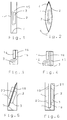
- Fig. 1 shows a packaging in the simplest form.
- the packaging consists of two rectangular halves, one half being formed by the front side 1 and the other half by the rear side 2.
- the halves are connected to one another via the underside 7. At their open edges they can be releasably attached to one another by an adhesive strip, which also forms the tamper-evident seal.
- a tablet 3 Inside the front 1 and back 2 there is a tablet 3, enclosed between the back 2 and a transparent film 15, which forms the top of the blister strip.
- Environmentally friendly, transparent natural or plastic materials can be used for this.
- Transparent, solid strips of honey, gelatin, protein, starch and paper come into consideration as natural substances.
- Polyethylene, propylant, polypropylene (PP) and similar substances can be used as plastics.
- the back of the blister strip can be formed by water-repellent, tearable material.
- z. B. aluminum coated paper z. B. aluminum coated paper.
- Fig. 2 shows a rectangular packaging in which the front and back sides are separated only by a crease line 5.
- the remaining structure of the packaging corresponds to that of Fig. 1.
- the closure can also be formed by an adhesive strip 4 in this case.
- the rear side 2 can directly form the rear cover layer of the blister section which is applied to a carrier board 14.
- a corresponding sectional view of the rear side 2 is shown in FIG. 3.
- a transparent film 15 is applied to the cover layer 16, which also forms the outside, the tablet 3 being located between the transparent film 15 and the cover layer 16.
- the transparent film 15 is covered on the upper side by the carrier layer 14 provided with cutouts, which is part of the packaging blank.
- the cover layer 16 consists in particular of an aluminum-paper connection, which on the one hand provides a sterile seal for the tablet receiving space guaranteed, on the other hand, however, it can be broken open from the inside onto a tablet by sufficient pressure.
- FIG. 4 shows a cutout view of a packaging as it is preferably used in the embodiments according to FIGS. 1 and 2.
- the back layer 17 provided with openings, which is part of the packaging blank, forms the back of the packaging to which a blister section with the cover layer 16 and a transparent film 15 is applied.
- the blister section can, but need not, also be accommodated in an additional carrier layer 14.
- Fig. 5 shows a package in which the base is folded back inside the package so that there are two sub-bases 18, 19 inside the package, which are placed back to back. As a result, two blister sections with tablets 3 and 20 can be accommodated simultaneously.
- the partial base areas 18 and 19 are arranged parallel to the side walls 1 and 2. This is brought about by the edge section designed as a carrier tab 21.
- the blister sections are placed back to back.
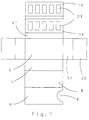
- end faces of the packaging can remain open in all of the aforementioned embodiments, it can also be provided that the end faces are closed by side and folding tabs 24 and 25, as shown in a plan view of a package cutout according to FIG. 7 are.
- the partial base areas 18 and 19 of the one-piece packaging blank are provided with cutouts 23 and form the carrier layer 14 for receiving the blister sections, the transparent films of which protrude through the cutouts 23.
- the packaging blank has two carrier surfaces 8 and 9 connected to one another on the edge, of which the surface 9 has a lateral arcuate cutout 6. Since the carrier surfaces are connected to one another only on the edge side, in particular on the long sides, a pocket for accommodating the package insert, in which the latter is loosely accommodated, results after the carrier surfaces 8 and 9 are folded.
- FIG. 8 A similar design without side flaps is shown in FIG. 8. It is also shown there that the base area contains a cutout 10 in which the embossed expiry date of the blister section can be seen.
- a cover surface 13 which has a rectangular window 12 in order to be able to receive the tablets and which is glued to the base on three sides in order to form a receiving pocket for the blister section in this way.
- the tablets When the blister strip is inserted into the pocket thus formed, the tablets can be pushed out through the back of the blister and through the openings in the base. After removing the last tablet, the blister strip can be removed and replaced with a new one from a storage box so that the amount of waste can be reduced.
- FIG. 9 shows a finished packaging according to FIG. 8 with 10 tablets in a blister section 28.
- the package insert 27 In the pocket of the carrier surface 9 there is the package insert 27, which can be removed if required, but which, unlike a conventional box, can remain in the packaging without any disruptive influence.
Landscapes
- Engineering & Computer Science (AREA)
- Mechanical Engineering (AREA)
- Packages (AREA)
Applications Claiming Priority (2)
| Application Number | Priority Date | Filing Date | Title |
|---|---|---|---|
| DE19503730 | 1995-02-04 | ||
| DE19503730 | 1995-02-04 |
Publications (1)
| Publication Number | Publication Date |
|---|---|
| EP0725015A1 true EP0725015A1 (fr) | 1996-08-07 |
Family
ID=7753216
Family Applications (1)
| Application Number | Title | Priority Date | Filing Date |
|---|---|---|---|
| EP96100893A Withdrawn EP0725015A1 (fr) | 1995-02-04 | 1996-01-23 | Emballage pour comprimés contenus dans un blister |
Country Status (1)
| Country | Link |
|---|---|
| EP (1) | EP0725015A1 (fr) |
Cited By (1)
| Publication number | Priority date | Publication date | Assignee | Title |
|---|---|---|---|---|
| EP0940353A1 (fr) * | 1998-03-04 | 1999-09-08 | Westvaco Corporation | Découpe en carton pour un emballage autonome et refermable |
Citations (5)
| Publication number | Priority date | Publication date | Assignee | Title |
|---|---|---|---|---|
| US4340141A (en) * | 1981-02-23 | 1982-07-20 | E. I. Du Pont De Nemours And Company | Unit dose drug control package |
| EP0189276A2 (fr) * | 1985-01-21 | 1986-07-30 | Manrex Limited | Emballage pour la distribution de médicaments |
| EP0307352A1 (fr) * | 1987-08-07 | 1989-03-15 | Ciba-Geigy Ag | Emballage pour médicaments |
| US5242055A (en) * | 1992-11-27 | 1993-09-07 | Udl Laboratories, Inc. | Packaging system for medication |
| FR2716443A1 (fr) * | 1994-02-19 | 1995-08-25 | Automotive Prod France | Emballage de présentation. |
-
1996
- 1996-01-23 EP EP96100893A patent/EP0725015A1/fr not_active Withdrawn
Patent Citations (5)
| Publication number | Priority date | Publication date | Assignee | Title |
|---|---|---|---|---|
| US4340141A (en) * | 1981-02-23 | 1982-07-20 | E. I. Du Pont De Nemours And Company | Unit dose drug control package |
| EP0189276A2 (fr) * | 1985-01-21 | 1986-07-30 | Manrex Limited | Emballage pour la distribution de médicaments |
| EP0307352A1 (fr) * | 1987-08-07 | 1989-03-15 | Ciba-Geigy Ag | Emballage pour médicaments |
| US5242055A (en) * | 1992-11-27 | 1993-09-07 | Udl Laboratories, Inc. | Packaging system for medication |
| FR2716443A1 (fr) * | 1994-02-19 | 1995-08-25 | Automotive Prod France | Emballage de présentation. |
Cited By (1)
| Publication number | Priority date | Publication date | Assignee | Title |
|---|---|---|---|---|
| EP0940353A1 (fr) * | 1998-03-04 | 1999-09-08 | Westvaco Corporation | Découpe en carton pour un emballage autonome et refermable |
Similar Documents
| Publication | Publication Date | Title |
|---|---|---|
| DE69422683T2 (de) | Verpackung für Kontaktlinsen | |
| DE60102699T2 (de) | Einzeldosisblisterverpackung mit schlüssellochöffnung | |
| EP0718208B1 (fr) | Emballage de type blister | |
| EP1947027B1 (fr) | Habillage transparent et procédé de stockage temporaire de produits | |
| DE4429503C2 (de) | Packung, insbesondere Arzneimittelpackung | |
| DE2501640C3 (de) | Packung zum Sichtbarmachen von verpackten Einzelerzeugnissen | |
| DE2920162A1 (de) | Blisterverpackung | |
| DE3905851A1 (de) | Arzneimittelpackung | |
| EP0922651B1 (fr) | Emballage refermable | |
| EP0710206B1 (fr) | Emballage de produits sous forme de morceaux | |
| DE69400623T2 (de) | Faltschachtel mit wiederverschliessbarer Öffnung | |
| EP1481913A1 (fr) | Emballage inviolable pour les enfants | |
| DE4319609C1 (de) | Spender für feste Arzneimittel | |
| DE69328718T2 (de) | Verbesserte blisterpackungen | |
| EP0307352B1 (fr) | Emballage pour médicaments | |
| EP1108413B1 (fr) | Utilisation d'un emballage du type "blister" | |
| EP0725015A1 (fr) | Emballage pour comprimés contenus dans un blister | |
| CH537319A (de) | Klappverpackung für Tabletten oder Pillen | |
| EP1056657A1 (fr) | Procede de production d'un emballage pour medicaments | |
| DE29921100U1 (de) | Blisterpackung | |
| EP4000586A1 (fr) | Récipient pour médicaments, ensemble permettant de former un récipient pour médicaments et procédé de fourniture d'un récipient pour médicaments | |
| EP3924267B1 (fr) | Emballage doté d'une sécurité enfant | |
| DE202019102748U1 (de) | Medikamentendispenser aus Zellstoff | |
| DE29520904U1 (de) | Verpackung zur Aufnahme von in einem Blisterabschnitt aufgenommenen Tabletten | |
| DE7225796U (de) | Musterpackung für Arzneimittel |
Legal Events
| Date | Code | Title | Description |
|---|---|---|---|
| PUAI | Public reference made under article 153(3) epc to a published international application that has entered the european phase |
Free format text: ORIGINAL CODE: 0009012 |
|
| AK | Designated contracting states |
Kind code of ref document: A1 Designated state(s): AT BE CH DE DK ES FR GB GR IT LI NL PT SE |
|
| RBV | Designated contracting states (corrected) |
Designated state(s): AT BE CH DE DK ES FR GB GR IT LI NL PT SE |
|
| 17P | Request for examination filed |
Effective date: 19970207 |
|
| 17Q | First examination report despatched |
Effective date: 19971030 |
|
| STAA | Information on the status of an ep patent application or granted ep patent |
Free format text: STATUS: THE APPLICATION IS DEEMED TO BE WITHDRAWN |
|
| 18D | Application deemed to be withdrawn |
Effective date: 19980511 |