EP0725271A1 - Verfahren zur Messung einer Enzym-Reaktion mittels Raman-Streuung - Google Patents
Verfahren zur Messung einer Enzym-Reaktion mittels Raman-Streuung Download PDFInfo
- Publication number
- EP0725271A1 EP0725271A1 EP96101441A EP96101441A EP0725271A1 EP 0725271 A1 EP0725271 A1 EP 0725271A1 EP 96101441 A EP96101441 A EP 96101441A EP 96101441 A EP96101441 A EP 96101441A EP 0725271 A1 EP0725271 A1 EP 0725271A1
- Authority
- EP
- European Patent Office
- Prior art keywords
- enzyme
- raman scattering
- sample solution
- reaction
- peak
- Prior art date
- Legal status (The legal status is an assumption and is not a legal conclusion. Google has not performed a legal analysis and makes no representation as to the accuracy of the status listed.)
- Withdrawn
Links
- 238000001069 Raman spectroscopy Methods 0.000 title claims description 53
- 238000006911 enzymatic reaction Methods 0.000 title claims description 36
- 238000000034 method Methods 0.000 title claims description 27
- 238000006243 chemical reaction Methods 0.000 claims abstract description 48
- 239000000758 substrate Substances 0.000 claims abstract description 39
- 238000005259 measurement Methods 0.000 claims abstract description 35
- 238000001228 spectrum Methods 0.000 claims abstract description 26
- 238000011088 calibration curve Methods 0.000 claims abstract description 16
- 239000012488 sample solution Substances 0.000 claims description 45
- 102000004190 Enzymes Human genes 0.000 claims description 43
- 108090000790 Enzymes Proteins 0.000 claims description 43
- 230000005284 excitation Effects 0.000 claims description 31
- 150000002500 ions Chemical class 0.000 claims description 29
- 230000000694 effects Effects 0.000 claims description 9
- 230000003595 spectral effect Effects 0.000 claims description 8
- 230000001678 irradiating effect Effects 0.000 claims description 5
- 108090000854 Oxidoreductases Proteins 0.000 claims description 4
- 102000004316 Oxidoreductases Human genes 0.000 claims description 4
- WQZGKKKJIJFFOK-GASJEMHNSA-N Glucose Natural products OC[C@H]1OC(O)[C@H](O)[C@@H](O)[C@@H]1O WQZGKKKJIJFFOK-GASJEMHNSA-N 0.000 abstract description 18
- 239000008103 glucose Substances 0.000 abstract description 18
- 108010015776 Glucose oxidase Proteins 0.000 abstract description 8
- 239000004366 Glucose oxidase Substances 0.000 abstract description 8
- 229940116332 glucose oxidase Drugs 0.000 abstract description 8
- 235000019420 glucose oxidase Nutrition 0.000 abstract description 8
- BYGOPQKDHGXNCD-UHFFFAOYSA-N tripotassium;iron(3+);hexacyanide Chemical compound [K+].[K+].[K+].[Fe+3].N#[C-].N#[C-].N#[C-].N#[C-].N#[C-].N#[C-] BYGOPQKDHGXNCD-UHFFFAOYSA-N 0.000 abstract description 5
- 238000000149 argon plasma sintering Methods 0.000 abstract description 2
- 229940088598 enzyme Drugs 0.000 description 30
- 239000000243 solution Substances 0.000 description 15
- MHAJPDPJQMAIIY-UHFFFAOYSA-N Hydrogen peroxide Chemical compound OO MHAJPDPJQMAIIY-UHFFFAOYSA-N 0.000 description 14
- JVTAAEKCZFNVCJ-UHFFFAOYSA-M Lactate Chemical compound CC(O)C([O-])=O JVTAAEKCZFNVCJ-UHFFFAOYSA-M 0.000 description 4
- 108010073450 Lactate 2-monooxygenase Proteins 0.000 description 4
- 230000002255 enzymatic effect Effects 0.000 description 4
- 239000000523 sample Substances 0.000 description 4
- 238000004040 coloring Methods 0.000 description 3
- 238000001514 detection method Methods 0.000 description 3
- 230000005283 ground state Effects 0.000 description 3
- 230000003647 oxidation Effects 0.000 description 3
- 238000007254 oxidation reaction Methods 0.000 description 3
- 239000010453 quartz Substances 0.000 description 3
- 230000003014 reinforcing effect Effects 0.000 description 3
- VYPSYNLAJGMNEJ-UHFFFAOYSA-N silicon dioxide Inorganic materials O=[Si]=O VYPSYNLAJGMNEJ-UHFFFAOYSA-N 0.000 description 3
- 238000002798 spectrophotometry method Methods 0.000 description 3
- 239000000126 substance Substances 0.000 description 3
- 102000003992 Peroxidases Human genes 0.000 description 2
- NBIIXXVUZAFLBC-UHFFFAOYSA-N Phosphoric acid Chemical compound OP(O)(O)=O NBIIXXVUZAFLBC-UHFFFAOYSA-N 0.000 description 2
- 238000004458 analytical method Methods 0.000 description 2
- 239000003638 chemical reducing agent Substances 0.000 description 2
- 230000005494 condensation Effects 0.000 description 2
- 238000009833 condensation Methods 0.000 description 2
- 230000005281 excited state Effects 0.000 description 2
- QRMZSPFSDQBLIX-UHFFFAOYSA-N homovanillic acid Chemical compound COC1=CC(CC(O)=O)=CC=C1O QRMZSPFSDQBLIX-UHFFFAOYSA-N 0.000 description 2
- 230000003287 optical effect Effects 0.000 description 2
- 238000006395 oxidase reaction Methods 0.000 description 2
- 108040007629 peroxidase activity proteins Proteins 0.000 description 2
- 108010015428 Bilirubin oxidase Proteins 0.000 description 1
- 102000030523 Catechol oxidase Human genes 0.000 description 1
- 108010031396 Catechol oxidase Proteins 0.000 description 1
- 108010089254 Cholesterol oxidase Proteins 0.000 description 1
- ISWSIDIOOBJBQZ-UHFFFAOYSA-N Phenol Chemical compound OC1=CC=CC=C1 ISWSIDIOOBJBQZ-UHFFFAOYSA-N 0.000 description 1
- 238000001237 Raman spectrum Methods 0.000 description 1
- 238000010521 absorption reaction Methods 0.000 description 1
- 229910000147 aluminium phosphate Inorganic materials 0.000 description 1
- 239000007853 buffer solution Substances 0.000 description 1
- 239000003054 catalyst Substances 0.000 description 1
- 239000007795 chemical reaction product Substances 0.000 description 1
- 239000003153 chemical reaction reagent Substances 0.000 description 1
- 238000010586 diagram Methods 0.000 description 1
- 239000006185 dispersion Substances 0.000 description 1
- 238000002474 experimental method Methods 0.000 description 1
- 239000011521 glass Substances 0.000 description 1
- 229910052736 halogen Inorganic materials 0.000 description 1
- 150000002367 halogens Chemical class 0.000 description 1
- KNJDBYZZKAZQNG-UHFFFAOYSA-N lucigenin Chemical compound [O-][N+]([O-])=O.[O-][N+]([O-])=O.C12=CC=CC=C2[N+](C)=C(C=CC=C2)C2=C1C1=C(C=CC=C2)C2=[N+](C)C2=CC=CC=C12 KNJDBYZZKAZQNG-UHFFFAOYSA-N 0.000 description 1
- HWYHZTIRURJOHG-UHFFFAOYSA-N luminol Chemical compound O=C1NNC(=O)C2=C1C(N)=CC=C2 HWYHZTIRURJOHG-UHFFFAOYSA-N 0.000 description 1
- 238000000691 measurement method Methods 0.000 description 1
- 239000000203 mixture Substances 0.000 description 1
- 238000004204 optical analysis method Methods 0.000 description 1
- 230000010355 oscillation Effects 0.000 description 1
- 230000001590 oxidative effect Effects 0.000 description 1
- 239000000049 pigment Substances 0.000 description 1
- -1 polyethylene terephthalate Polymers 0.000 description 1
- 229920000139 polyethylene terephthalate Polymers 0.000 description 1
- 239000005020 polyethylene terephthalate Substances 0.000 description 1
- 102000004169 proteins and genes Human genes 0.000 description 1
- 108090000623 proteins and genes Proteins 0.000 description 1
- 108010001816 pyranose oxidase Proteins 0.000 description 1
- 230000005855 radiation Effects 0.000 description 1
- 230000036647 reaction Effects 0.000 description 1
- 230000002787 reinforcement Effects 0.000 description 1
- 230000035945 sensitivity Effects 0.000 description 1
- 239000012780 transparent material Substances 0.000 description 1
Images





Classifications
-
- G—PHYSICS
- G01—MEASURING; TESTING
- G01N—INVESTIGATING OR ANALYSING MATERIALS BY DETERMINING THEIR CHEMICAL OR PHYSICAL PROPERTIES
- G01N21/00—Investigating or analysing materials by the use of optical means, i.e. using sub-millimetre waves, infrared, visible or ultraviolet light
- G01N21/62—Systems in which the material investigated is excited whereby it emits light or causes a change in wavelength of the incident light
- G01N21/63—Systems in which the material investigated is excited whereby it emits light or causes a change in wavelength of the incident light optically excited
- G01N21/65—Raman scattering
-
- C—CHEMISTRY; METALLURGY
- C12—BIOCHEMISTRY; BEER; SPIRITS; WINE; VINEGAR; MICROBIOLOGY; ENZYMOLOGY; MUTATION OR GENETIC ENGINEERING
- C12Q—MEASURING OR TESTING PROCESSES INVOLVING ENZYMES, NUCLEIC ACIDS OR MICROORGANISMS; COMPOSITIONS OR TEST PAPERS THEREFOR; PROCESSES OF PREPARING SUCH COMPOSITIONS; CONDITION-RESPONSIVE CONTROL IN MICROBIOLOGICAL OR ENZYMOLOGICAL PROCESSES
- C12Q1/00—Measuring or testing processes involving enzymes, nucleic acids or microorganisms; Compositions therefor; Processes of preparing such compositions
- C12Q1/26—Measuring or testing processes involving enzymes, nucleic acids or microorganisms; Compositions therefor; Processes of preparing such compositions involving oxidoreductase
-
- G—PHYSICS
- G01—MEASURING; TESTING
- G01N—INVESTIGATING OR ANALYSING MATERIALS BY DETERMINING THEIR CHEMICAL OR PHYSICAL PROPERTIES
- G01N21/00—Investigating or analysing materials by the use of optical means, i.e. using sub-millimetre waves, infrared, visible or ultraviolet light
- G01N21/62—Systems in which the material investigated is excited whereby it emits light or causes a change in wavelength of the incident light
- G01N21/63—Systems in which the material investigated is excited whereby it emits light or causes a change in wavelength of the incident light optically excited
- G01N21/65—Raman scattering
- G01N2021/651—Cuvettes therefore
Definitions
- the present invention relates to qualitative measurement and quantitative measurement of a target substrate of a specific enzyme in an enzyme reaction, and a method of measuring activity of an enzyme.
- Some methods are carried out as methods of measuring an enzyme reaction, and the following methods are known in the art, if the enzyme reaction is a reaction system generating hydrogen peroxide, for example:
- Raman scattering analysis utilizes the following phenomenon: When specific molecules are irradiated with radiation energy which is in the form of electromagnetic waves, small parts of molecules holding photons do not return to original vibration levels but fall to those having different electron ground states after releasing the held photons. Therefore, levels of energy released from these molecules are specific thereto, and the specific molecules can be identified by detecting the levels of the released energy as electromagnetic waves.
- an energy beam which is released by Raman scattering may be in a state lower than absorbed energy (stokes Raman scattering) or higher than the same (anti-stokes Raman scattering), the intensity of anti-stokes Raman scattering is extremely weak since the number of electrons which are in excited states is by far smaller than that of electrons which are in ground states.
- the method of identifying specific molecules generally employs measurement by stoke Raman scattering.
- An object of the present invention is to enable qualitative measurement or quantitative measurement of a substrate of an enzyme reaction, or measurement of activity of an enzyme.
- the enzyme is added to a sample solution to which ferricyanic ions are added, the sample solution is irradiated with an excitation beam of a single wavelength before and after the addition of the enzyme so that scattered light from the sample solution is received and separated into its spectral components, and presence or absence of the target substrate of the enzyme is measured depending on whether or not the Raman scattering spectrum from the sample solution after the addition of the enzyme includes reinforced peaks of those of the Raman scattering spectrum from the sample solution before the addition of the enzyme.
- a quantitative measurement method for obtaining substrate concentration, operations of adding ferricyanic ions of constant concentrations and enzymes of constant units to standard sample solutions containing target substrates having known concentrations for causing an enzyme reaction, irradiating the standard sample solutions with excitation beams of single wavelength for receiving scattered light from the standard sample solutions and separating the scattered light into spectral components, and measuring reaction velocities from time changes of peak intensity values of reinforced peaks of those of Raman scattering spectra from the standard sample solutions on a plurality of standard sample solutions having different target substrate concentrations for forming a calibration curve showing relations between the target substrate concentrations and the reaction velocities.
- Ferricyanic ions and an enzyme of the same concentration and the same unit as those in the measurement for forming the calibration curve are added to a measurement sample solution containing a target substrate having an unknown concentration, and this measurement sample solution is irradiated with an excitation beam similarly to the above for measuring a reaction velocity from time changes of peak intensity values of the same Raman scattering peaks as those employed for forming the calibration curve, thereby obtaining the substrate concentration of the measurement sample solution on the basis of the calibration curve.
- ferricyanic ions of a constant concentration and an enzyme of a constant unit are added to a sample solution containing a target substrate having a known concentration for causing an enzyme reaction, the sample solution is irradiated with an excitation beam of a single wavelength so that scattered light from the standard sample solution is received and separated into its spectral components, and a reaction velocity is measured from time changes of peak intensity of reinforced peaks of those of a Raman scattering spectrum from the sample solution before the enzyme reaction, thereby obtaining activity of the enzyme on the basis of the reaction velocity.
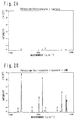
- Fig. 1A and Fig. 1B shows changes of Raman scattering spectra of ferricyanic ions in enzyme reaction systems having substrates of glucose and enzymes of glucose oxidase.
- Fig. 1A shows the Raman spectrum of ferricyanic ions measured by adding the ferricyanic ions to a reaction solution containing glucose. In this reaction system, only extremely weak Raman scattering of the ferricyanic ions is observed.
- Fig. 1B shows a Raman scattering spectrum which was measured after several minutes from addition of glucose oxidase (GOD), serving as an enzyme, to the reaction solution of Fig. 1A containing glucose and ferricyanic ions.
- This spectrum includes some peaks, in which some peaks observed in the Raman scattering spectrum from the reaction solution before the addition of the enzyme were reinforced.
- Fig. 2A and Fig. 2B shows changes of Raman scattering spectra of ferricyanic ions in other enzyme reaction systems.
- Fig. 2A showing a result of an operation of adding ferricyanic ions to a reaction solution containing lactate as a substrate and measuring its Raman scattering spectrum, weak Raman scattering peaks of the ferricyanic ions are observed similarly to Fig. 1A.
- Fig. 2B shows a Raman scattering spectrum which was obtained by adding lactate oxidase (LOD) as an enzyme to the reaction solution of Fig. 2A containing lactate and ferricyanic ions and making measurement after a lapse of several minutes.
- LOD lactate oxidase
- This Raman scattering spectrum also includes peaks in which some peaks observed in the Raman scattering spectrum from the reaction solution before the addition of the enzyme were reinforced.
- the reinforced Raman scattering peaks appear at the same shift wavenumbers to indicate that the peaks of these spectra are Raman scattering spectra by the same substance, although the enzyme reaction systems are different from each other. It is understood that the same influences are exerted regardless of the types of the enzyme reactions, although it is not clarified how the ferricyanic ions are influenced by progress of the enzyme reactions.
- the Raman scattering peaks in which the ferricyanic ions are influenced by the enzyme reactions and the peak intensity levels are reinforced are present at 1550 to 1680 cm -1 , 1850 to 1880 cm -1 , 2000 to 2150 cm -1 , 2350 to 2380 cm -1 and 2450 to 2580 cm -1 in shift wavenumbers with respect to excitation wavelengths.
- Concrete examples of the peak positions are 1574 cm -1 , 1658 cm -1 , 1872 cm -1 , 2012 cm -1 , 2081 cm -1 , 2142 cm -1 , 2374 cm -1 , 2464 cm -1 , 2562 cm -1 and the like.
- qualitative measurement is performed on the fact that an enzyme reaction is caused by reinforcement of these Raman scattering peaks, i.e., the fact that the target substrate of the enzyme is present in the sample solution, and quantitative measurement is performed through any of these Raman scattering peaks. Further, the activity of the enzyme is measured by measuring the velocity for reinforcing any of these peaks.
- An enzyme has substrate specificity and reaction specificity causing only a certain reaction with respect to a specific substance (target substrate).
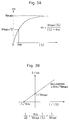
- an enzyme reaction When an enzyme reaction is caused, its reaction product progresses at a constant velocity in an initial stage of the reaction, and thereafter the reaction velocity is gradually reduced, in a state concretely illustrated in Fig. 4 described later as Example.
- the Michaelis constant Km is a value corresponding to the substrate concentration [S] obtained when the reaction velocity vo is Vmax/2, and the maximum reaction velocity Vmax and the Michaelis constant Km provide activity of the enzyme.
- the maximum reaction velocity Vmax which is an asymptotic value, cannot be correctly obtained from the graph of Fig. 3A.
- Km Michaelis constant
- the equation (2) can be expressed in the form of a linear expression as shown in Fig. 3B with 1/[S] and 1/vo on the axes of abscissas and ordinates, whereby Km and Vmax can be experimentally obtained by expressing Vo obtained by an experiment in the graph of Fig. 3B with respect to the substrate concentration [S].
- ferricyanic ions are added to an enzyme reaction system for obtaining the maximum value vo of increase velocities of Raman scattering peaks which are reinforced since the ferricyanic ions are influenced by an enzyme reaction, so that activity of the enzyme can be obtained on the basis of the equation (1) or (2) between the maximum value vo and the substrate concentration [S].
- the present invention is also applicable to enzyme reactions by oxidoreductases such as pyranose oxidase, bilirubin oxidase, cholesterol oxidase and polyphenol oxidase, and those of other types of enzymes, for example.
- qualitative measurement or quantitative measurement of a substrate, or enzymatic activity measurement is performed by measuring Raman scattered light which is reinforced through ferricyanic ions influenced by an enzyme reaction, whereby an enzyme reaction can be measured by a simple optical measuring method.
- a glucose solution 100 mg/dl
- 14.5 U of glucose oxidase serving as an enzyme
- 250 ⁇ l of a potassium ferricyanate solution 0.5 M
- a quartz scattered light cell and adjusted with a phosphoric acid buffer solution to be pH 7. 4 for preparing a sample solution, which in turn is maintained at 25°C and reacted.
- An He-Ne laser beam is incident upon the reaction solution as an excitation beam, and scattered light thereof is separated into its spectral components for measuring growth of a peak at a position shifted by a wavenumber of 2081 cm -1 from the wavelength of the excitation beam every 10 seconds.
- the result is shown in Fig. 4 as symbol "a".
- the peak intensity is substantially linearly increased in the initial stage, and thereafter the increased velocity is reduced.
- the reaction velocity vo at which the peak intensity is linearly increased in the initial stage is measured.
- Fig. 4 shows a result obtained by adding potassium ferricyanate to a reaction system of substrate lactate and enzyme lactate oxidase for causing a reaction and measuring a change of the same peak at the shift wavenumber of 2081 cm -1 as symbol "b".
- reaction solutions in which the amount of each potassium ferricyanate solution (0.5 M) is set at a constant value of 250 ⁇ l the concentration of each glucose oxidase is set at a constant value of 14.5 U and the amount of each glucose substrate is set at a constant value of 250 ⁇ l while glucose concentrations are varied as 250 mg/dl, 125 mg/dl, 100 mg/dl, 80 mg/dl and 50 mg/dl, Fig. 5 shows results obtained by measuring intensity changes of peaks at the shift wavenumber of 2081 cm -1 in light scattering spectra every 10 seconds.
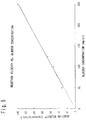
- Fig. 6 shows results of correlations between maximum values of reaction velocities at the respective glucose concentrations obtained from the results of Fig. 5 and the glucose concentrations.
- Fig. 6 serves as a calibration curve for obtaining an unknown glucose concentration of a measurement sample solution.
- a potassium ferricyanate solution 0.5 M
- 14.5 U of glucose oxidase are added to 250 ⁇ l of the measurement sample solution similarly to the case of forming the calibration curve, the mixture is adjusted to pH 7.4, and the sample temperature is maintained at 25°C so that the maximum value of the reaction velocity is measured from an intensity change of a prescribed peak, such as the peak at the shift wavenumber of 2081 cm -1 , for example.
- the glucose concentration of the substrate can be obtained by applying the measured maximum value of the reaction velocity to the calibration curve of Fig. 6.
- Fig. 7 illustrates an exemplary apparatus for measuring Raman scattered light in the present invention.
- Numeral 1 denotes an excitation light source, which is formed by a laser unit, for example, for measuring Raman scattered light.
- the laser unit which can be prepared from an Ar ion laser, a Kr ion laser, an He-Ne laser, an He-Cd laser or an Nd:YAG laser performing continuous oscillation, or a pulse laser, can be selected from lasers of wide wavelength ranges over near ultraviolet and near infrared regions.
- a halogen lamp or the like can also be employed as a light source other than the laser unit. It is assumed here that an He-Ne laser is employed as the light source 1.
- Numeral 2 denotes a power source unit controlling the output of the light source 1.
- Numeral 4 denotes a bandpass filter, which is adapted to cut a sideband from a laser beam 12 oscillated from the light source 1.
- the laser beam 12 is separated into an excitation beam 12s of a sample side and a reference beam 12r of a reference side, so that the excitation beam 12s is converged and incident upon a cell 3 by a lens 9 through a bandpass filter 7 for cutting a wavelength beam which is generated by a half mirror 5.
- the cell 3 which is a tubular scattered light cell of quartz, contains a reaction solution, and is maintained at a constant temperature of 25°C, for example.
- a mirror 11a is arranged in an incident direction of the excitation beam 12s in order to reinforce scattered light which is generated from the react ion solution contained in the cell 3, so that the excitation beam 12s is transmitted through the cell 3 and thereafter reflected by the mirror 11a to be incident upon the cell 3 again, thereby reinforcing Raman scattering.
- Another mirror 11b is arranged in a direction which is at 90° with respect to the incident direction of the excitation beam 12s for reflecting the same toward a spectroscope 22, so that the scattered light which is generated from the cell 3 is converged by converging lenses 16 and 20 with the excitation beam along with that reflected by the mirror 11b and converged by the spectroscope 22 through a filter 21.
- the filter 21 is adapted to cut an excitation light component for introducing only a scattered light component into the spectroscope 22.
- the spectroscope 22 and a detector 23 are formed by those of multi-channel detection systems by polychromators in which plural detection elements are arranged along the dispersion direction of the spectroscope 22.
- Numeral 24 denotes a detector control part for deriving an output from the multi-channel detector 23 every wavelength.
- the spectroscope 22 can alternatively be prepared from a scan spectroscope while the detector 23 can be prepared by that comprising a single detection element.
- a spectroscope control part 25 is required for wavelength-scanning the spectroscope 22.
- the reference beam 12r which is separated from the excitation beam 12s through the half mirror 5 is bent toward a detector 30 through a mirror 6, to be incident upon the detector 30 through a bandpass filter 8 for cutting a wavelength beam generated from the mirror 6, so that light source intensity is detected.
- a data processing operation/output part 31 corrects a detected value of Raman scattered light by the spectroscope 22 and the detector 23 with a detected value of the reference beam side detector 30 indicating the light source intensity for obtaining a Raman scattering spectrum, thereby calculating the maximum value of the reaction velocity from an intensity change of a specific peak and outputting the same.
- the data processing operation/output part 31 holds calibration curve data which are formed by previous measurement, and calculates a substrate concentration from the maximum value of a reaction velocity obtained by measuring an unknown sample on the basis of the calibration curve for outputting the same.
- the data processing operation/output part 31 performs wavelength scanning through the spectroscope control part 25.
- Figs. 8A and 8B show exemplary cells for further effectively reinforcing Raman scattering by excitation beams.
- a cell 3a is in the form of a round bottom flask which is made of a transparent material such as glass, quartz or polyethylene terephthalate, for storing a sample solution.
- This cell 3a is engaged in an integrating-spherical cell holder 10a.
- the cell holder 10a has a reflecting inner surface.
- the cell holder 10a is provided with a window for receiving an excitation beam 12s which is emitted from an excitation light source and extracting scattered light in a direction which is at an angle of 180° to the direction of incidence.
- the excitation beam 12s is bent by a mirror 14, and introduced into the cell 3a through the window of the cell holder 10a.
- Numeral 16 denotes a condenser lens for condensing the scattered light outgoing from the window of the cell holder 10a. While the mirror 14 is arranged on an optical axis of the condenser lens 16, the same is sufficiently small as compared with the aperture of the condenser lens 16, and will not inhibit the condenser lens 16 from condensing the scattered light.
- the excitation beam which is applied to the sample solution stored in the cell 3a is repeatedly reflected by the inner surface of the cell holder 10a, extracted from the window of the cell holder 10a with Raman scattering, and guided toward a spectral detector.
- a cell holder 10b is provided with windows for extracting scattered light in a direction which is at 90° with respect to the direction of incidence of an excitation beam 12s.
- the cell 3a is engaged in the integrating-spherical cell holder 10b having a reflecting inner surface, while the cell holder 10b is provided with windows for introducing the excitation beam 12s from a direction y and extracting scattered light 18 in a direction x which is at an angle of 90° to the direction y.
- a plurality of peaks are recognized in Raman scattering in which ferricyanic ions are influenced by an enzyme reaction and reinforced, whereby qualitative measurement or quantitative measurement of a substrate, or enzymatic activity measurement can be carried out not only through the peak at the shift wavenumber 2081 cm -1 employed in Example but through any other peak.
Landscapes
- Chemical & Material Sciences (AREA)
- Health & Medical Sciences (AREA)
- Life Sciences & Earth Sciences (AREA)
- Organic Chemistry (AREA)
- Zoology (AREA)
- Proteomics, Peptides & Aminoacids (AREA)
- Analytical Chemistry (AREA)
- Engineering & Computer Science (AREA)
- General Health & Medical Sciences (AREA)
- Immunology (AREA)
- Biochemistry (AREA)
- Physics & Mathematics (AREA)
- Wood Science & Technology (AREA)
- Molecular Biology (AREA)
- Bioinformatics & Cheminformatics (AREA)
- Microbiology (AREA)
- Biophysics (AREA)
- General Engineering & Computer Science (AREA)
- Biotechnology (AREA)
- Genetics & Genomics (AREA)
- Nuclear Medicine, Radiotherapy & Molecular Imaging (AREA)
- General Physics & Mathematics (AREA)
- Pathology (AREA)
- Investigating, Analyzing Materials By Fluorescence Or Luminescence (AREA)
Applications Claiming Priority (2)
| Application Number | Priority Date | Filing Date | Title |
|---|---|---|---|
| JP3756495 | 1995-02-01 | ||
| JP37564/95 | 1995-02-01 |
Publications (1)
| Publication Number | Publication Date |
|---|---|
| EP0725271A1 true EP0725271A1 (de) | 1996-08-07 |
Family
ID=12501028
Family Applications (1)
| Application Number | Title | Priority Date | Filing Date |
|---|---|---|---|
| EP96101441A Withdrawn EP0725271A1 (de) | 1995-02-01 | 1996-02-01 | Verfahren zur Messung einer Enzym-Reaktion mittels Raman-Streuung |
Country Status (2)
| Country | Link |
|---|---|
| US (1) | US5741660A (de) |
| EP (1) | EP0725271A1 (de) |
Cited By (4)
| Publication number | Priority date | Publication date | Assignee | Title |
|---|---|---|---|---|
| US7599057B2 (en) | 2005-10-17 | 2009-10-06 | Sword Diagnostics, Inc. | Method and apparatus for detection of biological organisms using Raman scattering |
| WO2009128978A1 (en) * | 2008-04-16 | 2009-10-22 | Sword Diagnostics, Inc. | Methods for detecting organisms and enzymatic reactions using raman spectroscopy |
| US10155973B2 (en) | 2005-10-17 | 2018-12-18 | Sword Diagnostics, Inc. | Methods for detecting organisms and enzymatic reactions using raman spectroscopy and aromatic compounds comprising phosphate |
| CN113349766A (zh) * | 2015-07-10 | 2021-09-07 | 雅培糖尿病护理公司 | 对于生理参数进行动态葡萄糖曲线响应的系统、装置和方法 |
Families Citing this family (2)
| Publication number | Priority date | Publication date | Assignee | Title |
|---|---|---|---|---|
| CN111948191B (zh) * | 2020-07-30 | 2022-10-18 | 季华实验室 | 一种多光源拉曼光谱分析方法及其应用 |
| CN113295672A (zh) * | 2021-06-02 | 2021-08-24 | 上海海洋大学 | 基于表面增强拉曼光谱技术定量检测海水中碱性磷酸酶的方法 |
Citations (2)
| Publication number | Priority date | Publication date | Assignee | Title |
|---|---|---|---|---|
| US5266498A (en) * | 1989-10-27 | 1993-11-30 | Abbott Laboratories | Ligand binding assay for an analyte using surface-enhanced scattering (SERS) signal |
| US5376556A (en) * | 1989-10-27 | 1994-12-27 | Abbott Laboratories | Surface-enhanced Raman spectroscopy immunoassay |
Family Cites Families (1)
| Publication number | Priority date | Publication date | Assignee | Title |
|---|---|---|---|---|
| JPH0749309A (ja) * | 1993-08-05 | 1995-02-21 | Kyoto Daiichi Kagaku:Kk | 光散乱式成分濃度測定装置および方法 |
-
1996
- 1996-01-30 US US08/594,205 patent/US5741660A/en not_active Expired - Fee Related
- 1996-02-01 EP EP96101441A patent/EP0725271A1/de not_active Withdrawn
Patent Citations (2)
| Publication number | Priority date | Publication date | Assignee | Title |
|---|---|---|---|---|
| US5266498A (en) * | 1989-10-27 | 1993-11-30 | Abbott Laboratories | Ligand binding assay for an analyte using surface-enhanced scattering (SERS) signal |
| US5376556A (en) * | 1989-10-27 | 1994-12-27 | Abbott Laboratories | Surface-enhanced Raman spectroscopy immunoassay |
Cited By (7)
| Publication number | Priority date | Publication date | Assignee | Title |
|---|---|---|---|---|
| US7599057B2 (en) | 2005-10-17 | 2009-10-06 | Sword Diagnostics, Inc. | Method and apparatus for detection of biological organisms using Raman scattering |
| US7947437B2 (en) | 2005-10-17 | 2011-05-24 | Sword Diagnostics, Inc. | Methods for detecting organisms and enzymatic reactions using raman spectroscopy |
| US8243267B2 (en) | 2005-10-17 | 2012-08-14 | Neal Arthur Siegel | Method and apparatus for detection of biological organisms using raman scattering |
| US9260742B2 (en) | 2005-10-17 | 2016-02-16 | Sword Diagnostics, Inc. | Methods for detecting organisms and enzymatic reactions using raman spectroscopy |
| US10155973B2 (en) | 2005-10-17 | 2018-12-18 | Sword Diagnostics, Inc. | Methods for detecting organisms and enzymatic reactions using raman spectroscopy and aromatic compounds comprising phosphate |
| WO2009128978A1 (en) * | 2008-04-16 | 2009-10-22 | Sword Diagnostics, Inc. | Methods for detecting organisms and enzymatic reactions using raman spectroscopy |
| CN113349766A (zh) * | 2015-07-10 | 2021-09-07 | 雅培糖尿病护理公司 | 对于生理参数进行动态葡萄糖曲线响应的系统、装置和方法 |
Also Published As
| Publication number | Publication date |
|---|---|
| US5741660A (en) | 1998-04-21 |
Similar Documents
| Publication | Publication Date | Title |
|---|---|---|
| US5942754A (en) | Method of and apparatus for determining hydrogen peroxide | |
| CA2402575C (en) | Method and apparatus for detecting the presence of microbes and determining their physiological status | |
| EP0231470B1 (de) | Verfahren und Vorrichtung zur Bestimmung von Spurenbestandteilen durch gleichzeitige Messung der Photolumineszenz und eines photoakustischen Signals | |
| EP0667398A2 (de) | Verfahren und Vorrichtung zur Detektion der spezifischen Basensequenz der DNS | |
| US6226082B1 (en) | Method and apparatus for the quantitative analysis of a liquid sample with surface enhanced spectroscopy | |
| US5753449A (en) | Method of and apparatus for determining hydrogen peroxide by raman scattering | |
| EP0751382A2 (de) | Verfahren und Vorrichtung zum Messen von Spektren | |
| US5221958A (en) | Reflection fluorometer | |
| Williams et al. | Automated chemiluminescence method for determining the reduced form of nicotinamide adenine dinucleotide coupled to the measurement of lactate dehydrogenase activity | |
| US5741660A (en) | Method of measuring enzyme reaction by Raman scattering | |
| US5804451A (en) | Optical measuring method for mevalonic acid | |
| US7211377B1 (en) | Method for detecting the presence of dormant cryptobiotic microorganisms | |
| US5712167A (en) | Method of measuring Amadori compound by light scattering | |
| EP0711992B1 (de) | Verfahren zur Bestimmung einer fluoreszierenden Substanz, sowie Verfahren zur Enzym-Aktivität-Bestimmung | |
| JPH08271429A (ja) | ラマン散乱による酵素反応の測定方法 | |
| GB2142156A (en) | Fluorescent spectroscopy | |
| JPS63219398A (ja) | 過酸化水素の定量法 | |
| CN1160201A (zh) | 用拉曼散射测定过氧化氢的方法和仪器 | |
| JPH08233740A (ja) | ラマン散乱による過酸化水素の定量方法及び装置 | |
| CN1159576A (zh) | 使用拉曼散射测量酶反应的方法 | |
| JP3112648B2 (ja) | エッチング副産物に対するモニタリング方法及びその装置 | |
| JP3867081B2 (ja) | 酸化還元指示薬としてのアミン−n−オキサイドによるアナライトの蛍光測定 | |
| Bright et al. | Minimisation of bilirubin interference in the determination of fluorescein using first-derivative synchronous excitation fluorescence spectroscopy | |
| JP3738789B2 (ja) | 光散乱によるアマドリ化合物の測定方法 | |
| EP2807270B1 (de) | Verfahren zur auswertung der qualität eines testelementes |
Legal Events
| Date | Code | Title | Description |
|---|---|---|---|
| PUAI | Public reference made under article 153(3) epc to a published international application that has entered the european phase |
Free format text: ORIGINAL CODE: 0009012 |
|
| AK | Designated contracting states |
Kind code of ref document: A1 Designated state(s): CH DE FR GB IT LI |
|
| 17P | Request for examination filed |
Effective date: 19961107 |
|
| STAA | Information on the status of an ep patent application or granted ep patent |
Free format text: STATUS: THE APPLICATION HAS BEEN WITHDRAWN |
|
| 18W | Application withdrawn |
Effective date: 20030714 |