EP0725354A1 - Spielmaschine mit spielsituationsabhängigen Ansagen - Google Patents
Spielmaschine mit spielsituationsabhängigen Ansagen Download PDFInfo
- Publication number
- EP0725354A1 EP0725354A1 EP95101311A EP95101311A EP0725354A1 EP 0725354 A1 EP0725354 A1 EP 0725354A1 EP 95101311 A EP95101311 A EP 95101311A EP 95101311 A EP95101311 A EP 95101311A EP 0725354 A1 EP0725354 A1 EP 0725354A1
- Authority
- EP
- European Patent Office
- Prior art keywords
- data
- game
- vocal
- game machine
- vocal sound
- Prior art date
- Legal status (The legal status is an assumption and is not a legal conclusion. Google has not performed a legal analysis and makes no representation as to the accuracy of the status listed.)
- Granted
Links
- 230000001755 vocal effect Effects 0.000 claims abstract description 97
- 238000004519 manufacturing process Methods 0.000 claims description 4
- 238000006243 chemical reaction Methods 0.000 claims description 2
- 238000011161 development Methods 0.000 description 14
- 230000018109 developmental process Effects 0.000 description 14
- 230000000694 effects Effects 0.000 description 6
- 230000033001 locomotion Effects 0.000 description 5
- 238000013500 data storage Methods 0.000 description 4
- 238000010586 diagram Methods 0.000 description 4
- 230000004044 response Effects 0.000 description 3
- 238000005516 engineering process Methods 0.000 description 2
- 230000006870 function Effects 0.000 description 2
- 238000000034 method Methods 0.000 description 2
- 230000002093 peripheral effect Effects 0.000 description 2
- 238000013144 data compression Methods 0.000 description 1
- 230000005236 sound signal Effects 0.000 description 1
Images


Classifications
-
- A63F13/10—
-
- A—HUMAN NECESSITIES
- A63—SPORTS; GAMES; AMUSEMENTS
- A63F—CARD, BOARD, OR ROULETTE GAMES; INDOOR GAMES USING SMALL MOVING PLAYING BODIES; VIDEO GAMES; GAMES NOT OTHERWISE PROVIDED FOR
- A63F13/00—Video games, i.e. games using an electronically generated display having two or more dimensions
- A63F13/50—Controlling the output signals based on the game progress
- A63F13/54—Controlling the output signals based on the game progress involving acoustic signals, e.g. for simulating revolutions per minute [RPM] dependent engine sounds in a driving game or reverberation against a virtual wall
-
- A—HUMAN NECESSITIES
- A63—SPORTS; GAMES; AMUSEMENTS
- A63F—CARD, BOARD, OR ROULETTE GAMES; INDOOR GAMES USING SMALL MOVING PLAYING BODIES; VIDEO GAMES; GAMES NOT OTHERWISE PROVIDED FOR
- A63F13/00—Video games, i.e. games using an electronically generated display having two or more dimensions
- A63F13/45—Controlling the progress of the video game
-
- A—HUMAN NECESSITIES
- A63—SPORTS; GAMES; AMUSEMENTS
- A63F—CARD, BOARD, OR ROULETTE GAMES; INDOOR GAMES USING SMALL MOVING PLAYING BODIES; VIDEO GAMES; GAMES NOT OTHERWISE PROVIDED FOR
- A63F2300/00—Features of games using an electronically generated display having two or more dimensions, e.g. on a television screen, showing representations related to the game
- A63F2300/60—Methods for processing data by generating or executing the game program
- A63F2300/6063—Methods for processing data by generating or executing the game program for sound processing
Definitions
- This invention relates to a game machine provided with a number of operating members for giving an operational command to a character displayed on a monitor and a controller for receiving the operational command to control the development of game in accordance with a given game program.
- Japanese Unexamined Utility Model Publication No. SHO 55-56686 and Japanese Unexamined Utility Model Publication No. SHO 55-72994 respectively disclose a baseball game machine and a golf game machine accompanied with play-by-play announcement sound.
- such a game machine is associated with a sound record sheet which is inserted into a loading section of the game machine to generate prepared sound for play-by-play announcement in accordance with the development of game, thereby providing a realistic impression.
- the conventional sound effects typically represented by the above-mentioned footsteps associated with the movement of character, is chiefly characterized in that a sounding time is short because of its simple sound nature, processing is based on easy repetition of the same sound, and the sound effects are applied to particular operations only. Thus, such conventional sound effects will encounter with a difficulty of creating consecutive sounds constituting a meaningful sentence. Since such delicate sound effects require too much data, development of game will be generally obstructed by processing such sound effect if executed based on the conventional technology.
- a game machine of the present invention comprises: a monitor on which a game scene is displayed; a manipulator operable to generate an instructive signal in accordance with an operation of a player; a storage portion operable to store data for each of a plurality of vocal sound groups, each vocal sound group expressing a word in connection with the game; a controller operable to produce a new game scene on the monitor in accordance with a game program installed therein and an instructive signal generated by the manipulator, and designate data for a vocal sound group suitable to the produced new scene; and a sound generator operable to generate vocal sounds suitable for the new scene based on the designated data.
- the sound generator may be constructed by a converter operable to convert the designated data to vocal sounds at a rate which holds the frequency of the vocal sound data within an audible band; and a data transfer operable to transfer the designated data to the converter at a rate faster than the rate of conversion in the converter.
- the storage portion may be provided with a data region storing data parts in accordance with their respective addresses and a reference region storing the head address of each vocal sound group data and the number of data parts to render the controller designate data by specifying the head address and the number of data parts.
- the transfer of a data part is executed by temporarily interrupting the production of a new scene.
- the controller may be provided with a timer operable to provide an interrupting time.
- the storage portion operable to store data of a plurality of vocal sound groups and the controller operable to produce a new game scene on the monitor in accordance with a game program and an instructive signal generated by the manipulator. Further, the controller is operable to designate data of a vocal sound group suitable to the produced new scene which vocal sounds suitable for the new scene is in turn generated based on. This makes it possible to generate vocal sounds suitable for game developments, which consequently providing an improved realistic atmosphere.
- the data transfer is executed from the storage portion to the converter faster than the rate at which the designated data is converted to vocal sound. Accordingly, vocal sounds are generated without the likelihood of giving the player an awkward delay.
- the data is divided into a plurality of data parts, and the plurality of data parts are transferred one after another at a predetermined interval to the converter. This makes it possible to reduce time of each data transfer according to needs. Accordingly, the data transfer will give little influence to the processing of the controller to produce game scenes.
- Each data part is assigned with a specified address.
- the storage portion mainly consists of the data region and the reference region. Accordingly, the designation of a suitable vocal sound group will be executed with ease.
- the transfer of a data part is executed by temporarily interrupting the production of a new scene.
- the controller may be provided with a timer operable to provide an interrupting time. Accordingly, vocal sounds relative to a new scene will be generated simultaneously with the production of the new scene.
- FIG. 1 is a block diagram showing a principal arrangement of a game machine of the present invention.
- a reference numeral 1 represents an operation unit including a manipulating lever, switches, and buttons. Operative contents of the operation unit 1 is sent via an I/O port 2 to a main CPU 3.
- the manipulating lever of the operation unit 1 gives a command relating to a moving direction of the character.
- the switches and buttons enable the character to cause a predetermined motion, such as a pitching motion, a throwing motion, and a bat swing in a baseball game, at a predetermined timing.
- this kind of game machine has a team creating function of allowing a game player to flexibly select his/her favorite team and baseball players using the operation unit 1.
- the main CPU 3 executes an overall control of the operations of the game machine, and has a ROM 31 for storing a game program and a RAM 32 for temporarily storing processing data.
- the ROM 31 can be omitted if the game program is stored in a game cassette detachably inserted in a cassette loading section of the game machine.
- a vocal sound data storage portion 4 stores various data of groups of vocal sounds required for play-by-play announcement in association with development of game and an instructive signal generated by the operation unit 1, which will be described in detail later.
- a baseball game contains a total of four scenes, i.e., a batting scene, a fielding scene, a changing-over scene and a game set scene.
- a predetermined number of vocal sound groups are assigned to each of four scenes for play-by-play announcement in accordance with the development of game and manipulation of the operation unit 1.
- a play-by-play announcement for example, goes like "BREAKING BALL, STRIKE”, “FIRST BATTER, CENTER, SMITH, NUMBER 5", “STRIKE, BATTER OUT, THREE MEN OUT”, or the like, as described later.
- announcement for example, goes like "HIT!, THIS IS BIG, HOME RUN, SCORING A FIRST POINT", "CATCH A BALL, NICE PLAY, RETURN THE BALL TO HOME BASE, RUNNER OUT” or the like.
- vocal sound groups as: “INNING”, “BOTTOM”, “TOP”, “ENDING”, “TEAM NAME”, “END SCORELESS”, “GO INTO REVERSE”, etc.
- the main CPU 3 successively designates an appropriate vocal sound group to be used in the play-by-play announcement in accordance with the development of game and a operational command given from the operation unit 1.
- the designated vocal sound group after being applied the pulse code modulation (PCM) and a predetermined data compression processing, is transferred to a later-described sound CPU 5.
- PCM pulse code modulation
- the sound CPU 5 temporarily stores vocal sound group data for play-by-play announcement which has been transferred from the main CPU 3.
- the vocal sound data after being applied a demodulation and an expansion processing, are read out at a predetermined rate which holds the frequency of the vocal sound data within an audible band.
- a sound controller 6 converts vocal sound data into an analog sound waveform signal which is output from a number of loud speakers 8 through an amplifier 7.
- a CRT controller 9 accesses a graphic memory 10 to supply a frame memory 11 with necessary image signals and characters in response to control signals supplied from the main CPU 3.
- the frame memory 11 stores the image signals and characters read out from the graphic memory 10.
- a video signal generating circuit 12 converts the image signals and others stored in the frame memory 11 into video signals, and periodically supplies these video signals to a monitor 13 at a high speed.
- the monitor 13 such as CRT or LCD, provides a scene image on a screen thereof in accordance with the received video signals.
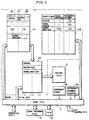
- Fig. 2 is a diagram showing details of the vocal sound data storage portion 4 and its peripheral devices.
- the vocal sound data storage portion 4 includes three storage regions: a vocal sound data region 41, a reference region 42 and an arranging region 43.
- the vocal sound data region 41 includes a ROM having a predetermined storage capacity, and stores data of groups of vocal sounds for play-by-play announcement.
- the vocal sound data is a series of digital signals representing a voice waveform.
- Each vocal sound group data is divided into a specified number of data parts. Each data part is assigned with a specified address. For example, addresses 1-10 are assigned to the vocal sound group "STRIKE”, addresses 11-39 are assigned to the vocal sound group "BATTER OUT”, and addresses 100-119 are assigned to the vocal sound group "THREE MEN OUT".
- the reference region 42 includes a ROM having a predetermined storage capacity, and stores the head address and the number of data parts of each vocal sound group data.
- Each vocal sound group data are partially sent each data part to the sound CPU 5. Accordingly, the number of data parts is identical to the number of partial data transfers for each vocal sound group.
- the vocal sound group "STRIKE” is divided into ten data parts. Accordingly, the vocal sound group "STRIKE” is completely transferred in ten partial data transfers.
- the number of partial data transfers is not required to be equal to the number of data parts, but each vocal sound group data may be transferred smaller times than the number of data parts.
- the data amount which is to be transferred in one martial data transfer is 80H (substantially equivalent to 128 bytes).
- Vocal sound groups are determined in accordance with the development of game and an instructive signal generated by manipulation of the operation unit 1. For example, in the case of a pitched ball being a strike, the main CPU 3 designates the vocal sound group "STRIKE” whose head address is 1 and partial transfer number is 10. Further, if this "STRIKE” is a third strike, the main CPU 3 also designates the vocal sound group “BATTER OUT” whose head address is 11 and partial transfer number is 29. Furthermore, if three men are out in this instance, the CPU 3 also designates the vocal sound group "THREE MEN OUT" whose head address is 100 and partial transfer number is 20.
- the arranging region 43 includes an RAM, and stores data of the designated vocal sound groups, i.e., "STRIKE”, “BATTER OUT", and “THREE MEN OUT", in the order of designations of the main CPU 3.
- the main CPU 3 partially transfers these vocal sound group data to the sound CPU 5 in the order of designation.
- a resettable interrupting timer 33 sets an interrupting time to partially transfer vocal sound data, for example, at an interval of 1/60 second. More specifically, the main CPU 3 assigns, for example, 10% of each 1/60 second to the partial transfer of vocal sound data and assigns the remaining 90% of 1/60 second to the game processing.
- An interrupting number counter 34 is adapted for counting the number of interruptions or partial transfers.
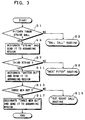
- Fig. 3 is a flowchart showing an operation of designating of vocal sound groups under a batting scene in a baseball game wherein a ball pitched by a pitcher is about to be judged.
- Step S1 it is judged whether or not the pitcher has thrown a strike ball (Step S1). If the judgment is "NO” (i.e. the pitcher has not thrown a strike ball) in Step S1, the CPU 3 proceeds to Step S3 in which a "BALL CALL" routine is executed. On the contrary, if the judgment is "YES” in Step S1, the CPU 3 proceeds to Step S5 in which the vocal sound group "STRIKE” is designated by specifying the head address and the number of partial transfers (1, 10) of the reference region 42, and the "STRIKE" vocal sound data is sent from the vocal sound data region 41 to the arranging region 43.
- the vocal sound group "STRIKE" is designated by specifying the head address and the number of partial transfers (1, 10) of the reference region 42, and the "STRIKE" vocal sound data is sent from the vocal sound data region 41 to the arranging region 43.
- Step S7 it is further judged in Step S7 whether or not this is a third strike. If the judgment is "NO” in Step S7, the CPU 3 proceeds to Step S9 in which a "NEXT PITCH” routine is executed. On the contrary, if the judgment is "YES” in Step S7, the CPU 3 proceeds to Step S11 in which the vocal sound group "BATTER OUT" is designated by specifying the head address of the partial transfer number (11, 29) of the reference region 42, and the "BATTER OUT" vocal sound data is sent from the vocal sound data region 41 to the arranging region 43.
- Step S13 it is judged in Step S13 whether or not three men are out. If the judgment is "NO” in Step S13, the CPU 3 proceeds to Step S15 in which a "OUT COUNT CALL" routine is executed. In the "OUT COUNT CALL", "ONE MAN OUT” or “TWO MEN OUT" vocal sound data is sent from the vocal sound data region 41 to the arranging region 43.
- Step S13 the CPU 3 proceeds to Step S17 in which the vocal sound group "THREE MEN OUT" is designated by specifying the head address of the partial transfer number (100, 200) of the reference region 42, and the "THREE MEN OUT" vocal mound data is sent from the vocal sound data region 41 to the arranging region 43.
- Fig. 4 is a flowchart showing an operation of transferring a partial data of a designated vocal sound group to the sound CPU 5.
- the CPU 3 enters this partial transferring operation in response to an elapse of 1/60 second measured by the interrupting timer 33.
- Step S23 the CPU 3 proceeds to Step S25 in which partial data transfer number (Nd) necessary for the given vocal sound group is set based on the data stored in the reference region 42. Subsequently, the CPU 3 proceeds to Step S27. On the contrary, if the judgment is "NO” in Step S23, the CPU 3 skips Step S25 and directly proceeds to Step S25 because the present transfer is in the process of transferring data for the given vocal sound group.
- Step S27 the n-th partial data is transferred from the arranging region 43 to the sound CPU 5.
- the partial data transfer number "n" i.e., the count number of the interrupting number counter 34, is incremented by 1 in Step S29.
- Step S31 it is judged in Step S31 whether or not the incremented transfer number "n" is smaller than or equals to the set transfer number Nd. If the judgment is "YES” in Step S31, i.e., the present transfer is in the process of transferring partial data for the given vocal sound, the CPU 3 proceeds to Step S33 to reset the interrupting timer 33 and then return to a main routine.
- Step S31 i.e., the present transfer completes the transfer of data for the given vocal sound group
- the CPU 3 proceeds to Step S35 to reset the present partial data transfer number "n" to "1" and then proceeds to Step S33.
- Step S21 If the judgment is "NO" in Step S21, i.e., no transfer data is stored in the arranging region 43, the CPU 3 ends this partial data transfer routine.
- the loud speakers 8 generate a vocal sound in accordance with a sound signal from the sound CPU 5 for a period which is longer than the period of transferring a partial data. Therefore, utilizing this difference between the sound generation period and the partial data transfer period, it is possible to transfer a next partial data before the loud speakers 8 terminate the generation of sound based on the previous partial data. Accordingly, even if a number of vocal sound groups are successively supplied, these vocal sounds can be surely generated by the loud speakers 8 without giving the game player any awkward delay.
- one partial data is transferred every 1/60 second.
- the partial data transfer period may be changed depending on the processing content of the main CPU 3. For example, when the main CPU 3 is not required to assign a long period for processing of game development, it may be possible to transfer a mass of an appropriate number of partial data or all the partial data for a given sound group.
Landscapes
- Engineering & Computer Science (AREA)
- Multimedia (AREA)
- Physics & Mathematics (AREA)
- Acoustics & Sound (AREA)
- Pinball Game Machines (AREA)
- Processing Or Creating Images (AREA)
Priority Applications (2)
| Application Number | Priority Date | Filing Date | Title |
|---|---|---|---|
| EP95101311A EP0725354B1 (de) | 1995-01-31 | 1995-01-31 | Spielmaschine mit spielsituationsabhängigen Ansagen |
| DE69510908T DE69510908T2 (de) | 1995-01-31 | 1995-01-31 | Spielmaschine mit spielsituationsabhängigen Ansagen |
Applications Claiming Priority (1)
| Application Number | Priority Date | Filing Date | Title |
|---|---|---|---|
| EP95101311A EP0725354B1 (de) | 1995-01-31 | 1995-01-31 | Spielmaschine mit spielsituationsabhängigen Ansagen |
Publications (2)
| Publication Number | Publication Date |
|---|---|
| EP0725354A1 true EP0725354A1 (de) | 1996-08-07 |
| EP0725354B1 EP0725354B1 (de) | 1999-07-21 |
Family
ID=8218945
Family Applications (1)
| Application Number | Title | Priority Date | Filing Date |
|---|---|---|---|
| EP95101311A Expired - Lifetime EP0725354B1 (de) | 1995-01-31 | 1995-01-31 | Spielmaschine mit spielsituationsabhängigen Ansagen |
Country Status (2)
| Country | Link |
|---|---|
| EP (1) | EP0725354B1 (de) |
| DE (1) | DE69510908T2 (de) |
Cited By (4)
| Publication number | Priority date | Publication date | Assignee | Title |
|---|---|---|---|---|
| US6540613B2 (en) | 2000-03-13 | 2003-04-01 | Konami Corporation | Video game apparatus, background sound output setting method in video game, and computer-readable recording medium storing background sound output setting program |
| US6544122B2 (en) | 1998-10-08 | 2003-04-08 | Konami Co., Ltd. | Background-sound control system for a video game apparatus |
| US6599195B1 (en) * | 1998-10-08 | 2003-07-29 | Konami Co., Ltd. | Background sound switching apparatus, background-sound switching method, readable recording medium with recording background-sound switching program, and video game apparatus |
| US7048632B2 (en) | 1998-03-19 | 2006-05-23 | Konami Co., Ltd. | Image processing method, video game apparatus and storage medium |
Citations (3)
| Publication number | Priority date | Publication date | Assignee | Title |
|---|---|---|---|---|
| GB2163929A (en) * | 1984-08-30 | 1986-03-05 | Casio Computer Co Ltd | Electronic game apparatus |
| WO1986002753A1 (en) * | 1984-10-24 | 1986-05-09 | Videodrome Limited | Interactive systems |
| US5067079A (en) * | 1989-02-06 | 1991-11-19 | Smith Engineering | Interactive audio baseball game |
-
1995
- 1995-01-31 EP EP95101311A patent/EP0725354B1/de not_active Expired - Lifetime
- 1995-01-31 DE DE69510908T patent/DE69510908T2/de not_active Expired - Lifetime
Patent Citations (3)
| Publication number | Priority date | Publication date | Assignee | Title |
|---|---|---|---|---|
| GB2163929A (en) * | 1984-08-30 | 1986-03-05 | Casio Computer Co Ltd | Electronic game apparatus |
| WO1986002753A1 (en) * | 1984-10-24 | 1986-05-09 | Videodrome Limited | Interactive systems |
| US5067079A (en) * | 1989-02-06 | 1991-11-19 | Smith Engineering | Interactive audio baseball game |
Non-Patent Citations (1)
| Title |
|---|
| J. M. PRESTON: "Compact Disc-Interactive; A Designer's Overview", KLUWER TECHNICAL BOOKS, DEVENTER, THE NETHERLANDS * |
Cited By (4)
| Publication number | Priority date | Publication date | Assignee | Title |
|---|---|---|---|---|
| US7048632B2 (en) | 1998-03-19 | 2006-05-23 | Konami Co., Ltd. | Image processing method, video game apparatus and storage medium |
| US6544122B2 (en) | 1998-10-08 | 2003-04-08 | Konami Co., Ltd. | Background-sound control system for a video game apparatus |
| US6599195B1 (en) * | 1998-10-08 | 2003-07-29 | Konami Co., Ltd. | Background sound switching apparatus, background-sound switching method, readable recording medium with recording background-sound switching program, and video game apparatus |
| US6540613B2 (en) | 2000-03-13 | 2003-04-01 | Konami Corporation | Video game apparatus, background sound output setting method in video game, and computer-readable recording medium storing background sound output setting program |
Also Published As
| Publication number | Publication date |
|---|---|
| DE69510908T2 (de) | 2000-03-30 |
| EP0725354B1 (de) | 1999-07-21 |
| DE69510908D1 (de) | 1999-08-26 |
Similar Documents
| Publication | Publication Date | Title |
|---|---|---|
| US5735743A (en) | Game machine having play-by-play announcement | |
| US6905413B1 (en) | Music game system | |
| JP2951948B1 (ja) | ゲームシステムおよびそのゲームを実行するためのプログラムを格納したコンピュータ読取り可能な記憶媒体 | |
| KR100508368B1 (ko) | 게임장치및게임장치에있어서의화면표시방법 | |
| AU7186798A (en) | Competitive video game apparatus, method of playing video game, and computer-readable recording medium | |
| US4195838A (en) | Electronic game with varying event probabilities | |
| EP1279423B1 (de) | Aufzeichnungsmedium für Volumenkontrollprogramm, Volumenkontrollverfahren, Videospielvorrichtung and Volumenkontrollprogramm | |
| JP3890646B2 (ja) | ゲーム機における音声発生装置及び方法 | |
| EP0725354B1 (de) | Spielmaschine mit spielsituationsabhängigen Ansagen | |
| JP3735359B2 (ja) | ビデオゲームプログラム、ビデオゲーム装置及びビデオゲーム方法 | |
| EP1666107A1 (de) | Videospielprogramm, videospielvorrichtung und videospielverfahren | |
| JPH02283390A (ja) | ゲーム機用プログラマブルコントローラ | |
| US6458033B1 (en) | Program for processing a live commentary, computer-readable recording medium on which such a program is recorded, and live commentary processing apparatus and method | |
| DE60020416T2 (de) | Vorrichtung zur Spielübung von Melodien | |
| US6491582B1 (en) | Video game device, play control method for video game, and readable recording medium recording the method | |
| JPH09253335A (ja) | ビデオゲーム機 | |
| KR0144029B1 (ko) | 실황방송기능을 갖춘 게임기 | |
| JPH05329272A (ja) | 演奏動作玩具 | |
| CN1082212C (zh) | 可作比赛实况解说的游戏机 | |
| JPH08318051A (ja) | 音声出力の声色を変えることができるゲーム機 | |
| JPH11231872A (ja) | 楽音生成装置、画像生成装置、ゲーム装置及び情報記憶媒体 | |
| JP2550826B2 (ja) | 電子楽器 | |
| JP2002058870A (ja) | 実況を処理するためのプログラムを記録したコンピュータ読み取り可能な記録媒体およびプログラム、ならびに、実況処理装置およびその方法 | |
| JPS61179180A (ja) | 自動ボウリング採点方法および自動ボウリング採点装置 | |
| JPS59232568A (ja) | 音声合成ゲ−ム器 |
Legal Events
| Date | Code | Title | Description |
|---|---|---|---|
| PUAI | Public reference made under article 153(3) epc to a published international application that has entered the european phase |
Free format text: ORIGINAL CODE: 0009012 |
|
| AK | Designated contracting states |
Kind code of ref document: A1 Designated state(s): DE FR GB |
|
| 17P | Request for examination filed |
Effective date: 19970205 |
|
| 17Q | First examination report despatched |
Effective date: 19980219 |
|
| GRAG | Despatch of communication of intention to grant |
Free format text: ORIGINAL CODE: EPIDOS AGRA |
|
| GRAG | Despatch of communication of intention to grant |
Free format text: ORIGINAL CODE: EPIDOS AGRA |
|
| GRAH | Despatch of communication of intention to grant a patent |
Free format text: ORIGINAL CODE: EPIDOS IGRA |
|
| GRAH | Despatch of communication of intention to grant a patent |
Free format text: ORIGINAL CODE: EPIDOS IGRA |
|
| GRAA | (expected) grant |
Free format text: ORIGINAL CODE: 0009210 |
|
| AK | Designated contracting states |
Kind code of ref document: B1 Designated state(s): DE FR GB |
|
| REF | Corresponds to: |
Ref document number: 69510908 Country of ref document: DE Date of ref document: 19990826 |
|
| ET | Fr: translation filed | ||
| RAP2 | Party data changed (patent owner data changed or rights of a patent transferred) |
Owner name: KABUSHIKI KAISHA KONAMI COMPUTER ENTERTAINMENT OSA |
|
| PLBE | No opposition filed within time limit |
Free format text: ORIGINAL CODE: 0009261 |
|
| STAA | Information on the status of an ep patent application or granted ep patent |
Free format text: STATUS: NO OPPOSITION FILED WITHIN TIME LIMIT |
|
| 26N | No opposition filed | ||
| REG | Reference to a national code |
Ref country code: GB Ref legal event code: IF02 |
|
| REG | Reference to a national code |
Ref country code: GB Ref legal event code: 732E Free format text: REGISTERED BETWEEN 20090514 AND 20090520 |
|
| REG | Reference to a national code |
Ref country code: FR Ref legal event code: TP Ref country code: FR Ref legal event code: CD Ref country code: FR Ref legal event code: CA |
|
| PGFP | Annual fee paid to national office [announced via postgrant information from national office to epo] |
Ref country code: DE Payment date: 20140122 Year of fee payment: 20 |
|
| PGFP | Annual fee paid to national office [announced via postgrant information from national office to epo] |
Ref country code: FR Payment date: 20140123 Year of fee payment: 20 |
|
| PGFP | Annual fee paid to national office [announced via postgrant information from national office to epo] |
Ref country code: GB Payment date: 20140121 Year of fee payment: 20 |
|
| REG | Reference to a national code |
Ref country code: DE Ref legal event code: R071 Ref document number: 69510908 Country of ref document: DE |
|
| REG | Reference to a national code |
Ref country code: GB Ref legal event code: PE20 Expiry date: 20150130 |
|
| PG25 | Lapsed in a contracting state [announced via postgrant information from national office to epo] |
Ref country code: GB Free format text: LAPSE BECAUSE OF EXPIRATION OF PROTECTION Effective date: 20150130 |