EP0725762B1 - Methode zur trennung von metallen und alkoholen von einem emulgierten organischen/wässrigen abwasser - Google Patents
Methode zur trennung von metallen und alkoholen von einem emulgierten organischen/wässrigen abwasser Download PDFInfo
- Publication number
- EP0725762B1 EP0725762B1 EP95901696A EP95901696A EP0725762B1 EP 0725762 B1 EP0725762 B1 EP 0725762B1 EP 95901696 A EP95901696 A EP 95901696A EP 95901696 A EP95901696 A EP 95901696A EP 0725762 B1 EP0725762 B1 EP 0725762B1
- Authority
- EP
- European Patent Office
- Prior art keywords
- profiles
- stator core
- edges
- housing
- stator
- Prior art date
- Legal status (The legal status is an assumption and is not a legal conclusion. Google has not performed a legal analysis and makes no representation as to the accuracy of the status listed.)
- Expired - Lifetime
Links
- 238000000034 method Methods 0.000 title claims abstract description 15
- 239000002184 metal Substances 0.000 title abstract 3
- 229910052751 metal Inorganic materials 0.000 title abstract 3
- 150000001298 alcohols Chemical class 0.000 title 1
- 150000002739 metals Chemical class 0.000 title 1
- 238000004519 manufacturing process Methods 0.000 claims description 19
- LFQSCWFLJHTTHZ-UHFFFAOYSA-N Ethanol Chemical compound CCO LFQSCWFLJHTTHZ-UHFFFAOYSA-N 0.000 abstract 3
- 150000004696 coordination complex Chemical class 0.000 abstract 3
- XLYOFNOQVPJJNP-UHFFFAOYSA-N water Substances O XLYOFNOQVPJJNP-UHFFFAOYSA-N 0.000 abstract 3
- 239000008346 aqueous phase Substances 0.000 abstract 2
- 238000007599 discharging Methods 0.000 abstract 1
- 239000012074 organic phase Substances 0.000 abstract 1
- 238000004064 recycling Methods 0.000 abstract 1
- 238000003466 welding Methods 0.000 description 11
- 238000001125 extrusion Methods 0.000 description 5
- 238000004804 winding Methods 0.000 description 5
- 238000005266 casting Methods 0.000 description 4
- 238000010438 heat treatment Methods 0.000 description 4
- 238000003754 machining Methods 0.000 description 3
- XAGFODPZIPBFFR-UHFFFAOYSA-N aluminium Chemical compound [Al] XAGFODPZIPBFFR-UHFFFAOYSA-N 0.000 description 2
- 229910052782 aluminium Inorganic materials 0.000 description 2
- 239000004411 aluminium Substances 0.000 description 2
- 238000001816 cooling Methods 0.000 description 2
- 230000006978 adaptation Effects 0.000 description 1
- 229910010293 ceramic material Inorganic materials 0.000 description 1
- 238000005336 cracking Methods 0.000 description 1
- 230000020169 heat generation Effects 0.000 description 1
- 239000000463 material Substances 0.000 description 1
- 238000012986 modification Methods 0.000 description 1
- 230000004048 modification Effects 0.000 description 1
Images


Classifications
-
- B—PERFORMING OPERATIONS; TRANSPORTING
- B01—PHYSICAL OR CHEMICAL PROCESSES OR APPARATUS IN GENERAL
- B01D—SEPARATION
- B01D61/00—Processes of separation using semi-permeable membranes, e.g. dialysis, osmosis or ultrafiltration; Apparatus, accessories or auxiliary operations specially adapted therefor
- B01D61/02—Reverse osmosis; Hyperfiltration ; Nanofiltration
- B01D61/025—Reverse osmosis; Hyperfiltration
-
- B—PERFORMING OPERATIONS; TRANSPORTING
- B01—PHYSICAL OR CHEMICAL PROCESSES OR APPARATUS IN GENERAL
- B01D—SEPARATION
- B01D17/00—Separation of liquids, not provided for elsewhere, e.g. by thermal diffusion
- B01D17/02—Separation of non-miscible liquids
-
- B—PERFORMING OPERATIONS; TRANSPORTING
- B01—PHYSICAL OR CHEMICAL PROCESSES OR APPARATUS IN GENERAL
- B01D—SEPARATION
- B01D61/00—Processes of separation using semi-permeable membranes, e.g. dialysis, osmosis or ultrafiltration; Apparatus, accessories or auxiliary operations specially adapted therefor
- B01D61/02—Reverse osmosis; Hyperfiltration ; Nanofiltration
- B01D61/04—Feed pretreatment
-
- B—PERFORMING OPERATIONS; TRANSPORTING
- B01—PHYSICAL OR CHEMICAL PROCESSES OR APPARATUS IN GENERAL
- B01D—SEPARATION
- B01D61/00—Processes of separation using semi-permeable membranes, e.g. dialysis, osmosis or ultrafiltration; Apparatus, accessories or auxiliary operations specially adapted therefor
- B01D61/36—Pervaporation; Membrane distillation; Liquid permeation
- B01D61/362—Pervaporation
-
- B—PERFORMING OPERATIONS; TRANSPORTING
- B01—PHYSICAL OR CHEMICAL PROCESSES OR APPARATUS IN GENERAL
- B01D—SEPARATION
- B01D61/00—Processes of separation using semi-permeable membranes, e.g. dialysis, osmosis or ultrafiltration; Apparatus, accessories or auxiliary operations specially adapted therefor
- B01D61/58—Multistep processes
-
- C—CHEMISTRY; METALLURGY
- C02—TREATMENT OF WATER, WASTE WATER, SEWAGE, OR SLUDGE
- C02F—TREATMENT OF WATER, WASTE WATER, SEWAGE, OR SLUDGE
- C02F1/00—Treatment of water, waste water, or sewage
- C02F1/44—Treatment of water, waste water, or sewage by dialysis, osmosis or reverse osmosis
-
- B—PERFORMING OPERATIONS; TRANSPORTING
- B01—PHYSICAL OR CHEMICAL PROCESSES OR APPARATUS IN GENERAL
- B01D—SEPARATION
- B01D2311/00—Details relating to membrane separation process operations and control
- B01D2311/04—Specific process operations in the feed stream; Feed pretreatment
-
- C—CHEMISTRY; METALLURGY
- C02—TREATMENT OF WATER, WASTE WATER, SEWAGE, OR SLUDGE
- C02F—TREATMENT OF WATER, WASTE WATER, SEWAGE, OR SLUDGE
- C02F1/00—Treatment of water, waste water, or sewage
- C02F1/44—Treatment of water, waste water, or sewage by dialysis, osmosis or reverse osmosis
- C02F1/441—Treatment of water, waste water, or sewage by dialysis, osmosis or reverse osmosis by reverse osmosis
-
- C—CHEMISTRY; METALLURGY
- C02—TREATMENT OF WATER, WASTE WATER, SEWAGE, OR SLUDGE
- C02F—TREATMENT OF WATER, WASTE WATER, SEWAGE, OR SLUDGE
- C02F1/00—Treatment of water, waste water, or sewage
- C02F1/44—Treatment of water, waste water, or sewage by dialysis, osmosis or reverse osmosis
- C02F1/448—Treatment of water, waste water, or sewage by dialysis, osmosis or reverse osmosis by pervaporation
Definitions
- the present invention relates to a method for manufacturing a stator for a rotating electric machine, for example an asynchronous machine, the stator comprising a stator core, substantially in the form of a hollow circular cylinder, and a tubular housing which, at the operating temperature of the machine, surrounds the stator core with a shrinkage fit, the stator core and the housing being manufactured as separate limits.
- Stators for electric machines of the intended kind have hitherto often been manufactured with, for example, housings cast in aluminium. Casting of such housings entails high tool costs, above all in the case of large machine diameters and, particularly when the housing is cast directly around the stator core, results in several difficult technical problems such as thermal emission to surrounding machine components, tendencies to cracking of the casting, etc., which have to be solved. Because of the heat generation during the casting process, the stator windings of the machine can be mounted in the stator core only after the casting of the housing.
- tubular blanks preferably of aluminium
- the housing is given such internal dimensions that, at the operating temperature of the machine, it makes contact with the stator core with a shrinkage fit which provides sufficient torque transmitting and heat transmitting capacity but, after heating, can be applied around the stator core. If the temperature increase of the housing is limited to a level which is not harmful for the other parts of the stator, this method of manufacture permits mounting of the stator windings of the machine in the stator core before the housing is applied, which is an advantage from the point of view of production technique.
- the housing normally has to be machined internally to ensure, on the one hand, the necessary shrinkage fit and, on the other, that the heating of the housing when it is applied around the stator core can be limited to a level which is harmless to the other stator parts.
- Considerable demands are placed on the capacity of the machines which manufacture the extruded blanks, which renders the blanks expensive to manufacture.
- the blanks are also voluminous, which entails high transport costs in the event that they are manufactured at some other place than that where the stator in its entirety is manufactured.
- EP-B-0 048 213 it is known to manufacture a housing of two or more extruded profiles, which, at their edges extending in the axial direction of the machine, exhibit a hook-shaped bar and a slot corresponding to the bar.
- the housing is held together by a hook-shaped bar on one profile engaging into the slot on the adjacent profile.
- the necessary grip between the housing and the stator core appears to be achieved by the bar resiliently engaging into the slot such that the housing is thereby kept against the stator core by a spring force.
- this design probably leads to dimensioning problems and at least requires a strong dimensioning of the hook-shaped bar to ensure a sufficient grip between the housing and the stator core.
- the object of the invention is to provide a method for manufacturing a stator for a rotating electric machine, which method permits the stator windings of the machine to be mounted in the stator core before the housing of the stator is applied around the stator core, but which eliminates the operation involving internal machining of the housing as well as the above-mentioned problems associated with the manufacture of tubular blanks for housings and with housings comprising a plurality of resiliently composed profiles.
- this is achieved by fixing a number of extruded profiles, each of which being defined by two edges and comprising a concave smooth limiting surface with a radius of curvature substantially corresponding to the external diameter of the stator core, in relation to each other such that their concave limiting surfaces form a tubular configuration with a predetermined internal diameter, the number and dimension of the profiles between the edges mentioned being so chosen that, placed together around the stator core, they would essentially surround the stator core without overlapping each other and such that gaps are formed between at least some of the edges thereof when they are fixed to the tubular configuration mentioned, and by welding the profiles together along their edges into a tubular housing with weld joints whose widths are adapted to fill up the gaps mentioned.
- FIG 1A shows in cross section a tubular housing 1 for a stator for an electric asynchronous machine.
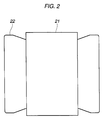
- the housing is intended to surround a stator core 21, schematically shown in Figure 2.
- the stator core substantially has the shape of a hollow circular cylinder with a known external diameter D1.
- slots for the stator windings 22 of the machine are provided in a known manner (not shown in Figure 2). These stator windings may be placed in their slots before the housing, manufactured according to the invention, is applied onto the stator core.
- the housing is composed of four identical extruded profiles 31, 32, 33, 34, of which profile 34 is shown in Figure 3A.
- the concave limiting surface 341 facing the stator core consists of a smooth surface, formed by generatrices along a circular arc whose centre in the figure is designated 0.
- the arc has a radius of curvature substantially corresponding to the external diameter of the stator core.
- the edges 345, 346 of the profile extend in the axial direction of the stator and the surface 341 exhibits, at each edge of the profile, recesses 3411, 3412 in a radial direction extending along the edges of the profile.
- the extent of the profile comprises an angle of 90° less an arc length 2S, such that in relation to a symmetry line for the profile, at each edge of the concave surface, a play S is formed between the edge and a radius from 0 which forms an angle of 45° with the symmetry line.
- the play S may advantageously be chosen to be about 1 mm.
- the bevel of the edges make an angle of 30° with the radial direction.
- the profiles are joined into a tube by means of welds in the axial direction of the machine.
- a weld joint is shown in detail in Figure 1B.
- the weld joint 51 fills up the gap 41 between the profiles 31 and 32. It is advantageous to arrange in the recess an axially extending supporting bar 61 for the weld.
- the supporting bar is of a material which during the welding fuses with the weld joint and is given such dimensions that the bar is completely accommodated in the space formed by the recesses on two adjacently located profiles.
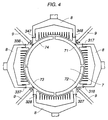
- the mandrel comprises four jaws 71, 72, 73, 74 which in a manner known per se, but not shown in detail in the figure, are connected to each other.
- Each one of the jaws comprises in the tangential direction an arc of 90° less an arc length 2B.
- Profiles and jaws are placed in the tangential direction in such a way in relation to each other that one jaw supports adjacent parts of two adjoining profiles.
- the jaws are essentially concentrically displaceable in a radial direction between two radial positions.
- the mandrel, with the jaws in their external radial position, is turned in a lathe into the desired predetermined diameter D2.
- the diameter of the mandrel is so chosen in relation to the external diameter D1 of the stator core that, on the one hand, the welded-together housing, which at room temperature will have the internal diameter D2, after heating to a temperature which is harmless for the other parts of the machine, for example 180°C, may be applied around the stator core but, on the other hand, at the operating temperature of the machine, makes contact with the stator core with a desired shrinkage fit.
- the arc 2S is so chosen that gaps are formed between at least some of the edges of the profiles when they are fixed to the tubular configurations.
- the profiles are pressed against the mandrel with pistons 8 which make contact with a compressive force against support surfaces 317, 318, 327, 328, 337, 338, 347, 348 on the profiles.
- the compressive force is achieved, for example, by compressed air.
- the welding of the profiles then takes place by applying axially extending weld joints along the edges of the profiles whereby the weld joints automatically fill up the gaps which, when the profiles have been applied against the mandrel, are formed between adjacent profiles.
- the weld joints are given a width which gives the tubular housing the desired internal diameter and their width is automatically adapted to compensate for the width tolerances which have arisen during the extrusion of the profiles.
- the welding may advantageously be carried out by a welding robot (not shown in the figure) which is programmed for the purpose and which operates welding guns 9 along a predetermined track.
- the jaws are moved to their internal radial position, whereby the gaps existing between the jaws, when the jaws are located in their outer radial position, are reduced in width to adapt to the reduced circumference of the mandrel.
- the tubular housing can now be detached from the mandrel in order to be applied around the stator core, in a subsequent operation, after heating.
- the machining of the housing to form supports for feet and terminal box may be performed in a manner known per se, and advantageously before the housing is applied around the stator core.
- the concave limiting surface of the profiles may be formed to comprise axially extending fins 3413, 3414 facing the stator core, which engage into corresponding slots in the stator core (not shown in Figure 2).
- the invention is not limited to the embodiment shown but a plurality of modifications are feasible within the scope of the appended claims, for example for the method of fixing the profiles in relation to each other prior to welding them together.
- the number of profiles from which the housing is to be manufactured may, of course, based on production economy considerations, be chosen to be different from four. If the chosen number is N, the extent of the profile between its edges is chosen to comprise an angle 360°/N less one arc length 2S.
- the supporting bar for the welds may, alternatively, be formed, for example, from a ceramic material which during the welding does not fuse with the weld joint, whereby the supporting bar in this case, after the welding, is removed and will not constitute part of the housing.
Landscapes
- Engineering & Computer Science (AREA)
- Water Supply & Treatment (AREA)
- Chemical & Material Sciences (AREA)
- Chemical Kinetics & Catalysis (AREA)
- Nanotechnology (AREA)
- Life Sciences & Earth Sciences (AREA)
- Hydrology & Water Resources (AREA)
- Environmental & Geological Engineering (AREA)
- Organic Chemistry (AREA)
- Physics & Mathematics (AREA)
- Thermal Sciences (AREA)
- Separation Using Semi-Permeable Membranes (AREA)
- Manufacture Of Motors, Generators (AREA)
- Water Treatment By Electricity Or Magnetism (AREA)
- Physical Water Treatments (AREA)
Claims (4)
- Herstellungsvertahren für einen Stator einer rotierenden elektrischen Maschine, beispielsweise einer Asynchronmaschine, wobei der Stator einen vorwiegend in Gestalt eines kreisförmigen Hohlzylinders vorliegenden Statorkern (21) und ein rohrförmiges Gehäuse (1) umfasst, welches bei Arbeitstemperatur der Maschine den Statorkern mit Schrumpfpassung umschliesst, wobei der Stator und das Gehäuse als gesonderte Einheiten hergestellt werden, dadurch gekennzeichnet, dass die Herstellung des Gehäuses folgende Schritte umfasst:eine Anzahl stranggepresster Profile (31, 32, 33, 34), jeweils von zwei Kanten (345, 346) begrenzt und eine konkave glatte Begrenzungsfläche (341) umfassend, die zwischen den erwähntne Kanten verlegt ist und von Generatrixen entlang eines Bogens mit einem im wesentlichen dem Aussendurchmesser des Statorkernes entsprechenden Krümmungsradius gebildet wird, miteinander so befestigt werden, dass ihre konkave Begrenzungsfläche eine Rohrtorm mit einem vorausbestimmten Innendurchmesser bildet, wobei die Anzahl und die Dimensionen der Profile zwischen besagten Kanten so gewählt sind, dass sie zusammen um den Statorkern herumgelegt im wesentlichen besagten Statorkern ohne einander zu überlappen umschliessen und so, dass Spalte (41, 42, 43 , 44) zwischen wenigstens einigen ihrer Kanten beim Festsetzen an die besagte rohrähnliche Form gebildet werden, unddie Profile werden entlang ihrer Kanten zu einem rohrförmigen Gehäuse mit Hilfe von Schweissnähten zusammengeschweisst, deren Breite vorgesehen ist besagte Spalte auszufüllen.
- Verfahren gemäss Patentanspruch 1, dadurch gekennzeichnet, dass die Profile zueinander festgelegt werden, indem sie um einen im wesentlichen zylindrischen Dorn (7) angeordnet werden mit einem Aussendurchmesser, der dem vorausbestimmten Innendurchmesser der Rohrform entspricht.
- Verfahren gemäss Patentanspruch 1, dadurch gekennzeichnet, dass die Profile gegen den Dorn durch ein Anpressen gegen diesen mit Hilfe einer Druckvorrichtung (8) angelegt werden.
- Verfahren gemäss irgendeinem der vorhergehenden Patenanspüche, wobei die konkave Begrenzungsfläche der Profile an den Profilkanten Aussparungen (3411, 3412) entlang besagten Kanten aufweist, dadurch gekennzeichnet, dass ein Stützstange (61) für die Schweissnaht beim Zusammenschweissen der Profile in die Aussparungen zwischen zwei benachbarten Profilen verlegt ist.
Applications Claiming Priority (3)
| Application Number | Priority Date | Filing Date | Title |
|---|---|---|---|
| US14624193A | 1993-10-29 | 1993-10-29 | |
| US146241 | 1993-10-29 | ||
| PCT/US1994/012176 WO1995011860A1 (en) | 1993-10-29 | 1994-10-25 | Method for separating metals and alcohols from an emulsified organic/aqueous effluent |
Publications (2)
| Publication Number | Publication Date |
|---|---|
| EP0725762A1 EP0725762A1 (de) | 1996-08-14 |
| EP0725762B1 true EP0725762B1 (de) | 1998-06-03 |
Family
ID=22516460
Family Applications (1)
| Application Number | Title | Priority Date | Filing Date |
|---|---|---|---|
| EP95901696A Expired - Lifetime EP0725762B1 (de) | 1993-10-29 | 1994-10-25 | Methode zur trennung von metallen und alkoholen von einem emulgierten organischen/wässrigen abwasser |
Country Status (5)
| Country | Link |
|---|---|
| EP (1) | EP0725762B1 (de) |
| CA (1) | CA2175197A1 (de) |
| DE (1) | DE69410816T2 (de) |
| ES (1) | ES2116710T3 (de) |
| WO (1) | WO1995011860A1 (de) |
Family Cites Families (4)
| Publication number | Priority date | Publication date | Assignee | Title |
|---|---|---|---|---|
| US4366063A (en) * | 1981-06-17 | 1982-12-28 | Romec Environmental Research & Development, Inc. | Process and apparatus for recovering usable water and other materials from oil field mud/waste pits |
| GB2207618B (en) * | 1987-08-05 | 1991-05-15 | Ciba Geigy Ag | Process for treating aqueous fluids containing organic compounds and salts of polyvalent inorganic acids |
| JPH01180208A (ja) * | 1988-01-11 | 1989-07-18 | Toray Ind Inc | 複合半透膜の製造方法およびその膜 |
| US5009783A (en) * | 1990-01-02 | 1991-04-23 | Texaco Inc. | Separation of compositions containing water and organic oxygenates |
-
1994
- 1994-10-25 WO PCT/US1994/012176 patent/WO1995011860A1/en not_active Ceased
- 1994-10-25 CA CA002175197A patent/CA2175197A1/en not_active Abandoned
- 1994-10-25 EP EP95901696A patent/EP0725762B1/de not_active Expired - Lifetime
- 1994-10-25 DE DE69410816T patent/DE69410816T2/de not_active Expired - Fee Related
- 1994-10-25 ES ES95901696T patent/ES2116710T3/es not_active Expired - Lifetime
Also Published As
| Publication number | Publication date |
|---|---|
| ES2116710T3 (es) | 1998-07-16 |
| WO1995011860A1 (en) | 1995-05-04 |
| CA2175197A1 (en) | 1995-05-04 |
| EP0725762A1 (de) | 1996-08-14 |
| DE69410816T2 (de) | 1998-12-03 |
| DE69410816D1 (de) | 1998-07-09 |
Similar Documents
| Publication | Publication Date | Title |
|---|---|---|
| US4656713A (en) | Method for forming an air gap pipe | |
| US6247231B1 (en) | Method for repairing heat exchanger tubing through partial tube replacement | |
| US4806726A (en) | Apparatus for machining a bent elongated member of variable configuration | |
| US5624067A (en) | Method and apparatus for weld joining pipe sections | |
| CA2113001A1 (en) | Method for brazing rotor bars to end rings of a rotor for an asynchronous ac motor | |
| JP2002224923A (ja) | パイプクランプ装置 | |
| JP2004529037A (ja) | 車軸およびそれを作る方法と装置 | |
| US4582242A (en) | Method of making formed end metal products | |
| EP0729666A1 (de) | Verfahren zur herstellung eines stators für eine rotierende elektrische maschine | |
| JPH0236026A (ja) | 薄肉パイプの加工方法 | |
| CN119839094A (zh) | 一种双金属复合管加工设备以及双金属复合管的加工方法 | |
| FI81892C (fi) | Foerfarande foer tillverkning av valsar eller cylindrar foer pappersmaskin samt med foerfarandet tillverkad vals eller cylinder. | |
| US4712295A (en) | Clamp apparatus | |
| JP2002239639A (ja) | パイプの曲げ加工方法及び曲げ加工装置 | |
| JP2007202235A (ja) | かご形ロータおよびこれを用いた電動機 | |
| US5826452A (en) | Method for the manufacture of a machine part with external teeth | |
| JP2532790Y2 (ja) | パイプ状部材の突合わせ溶接装置 | |
| JP2004001054A (ja) | 突合せ接合方法 | |
| CN116981521A (zh) | 制造具有造型内部结构的管的方法 | |
| US4830266A (en) | Method of producing weld metal tubing empoying a reusable mandrel | |
| EP0329135B1 (de) | Methode zum Verkleiden einer Walze oder dgl., insbesondere einer Presswalze einer Papiermaschine oder eines Holländers | |
| EP0684683A1 (de) | Verfahren zur Herstellung von Statorgehäusen | |
| US2958759A (en) | Gear and shaft assembly | |
| JP4089046B2 (ja) | パイプの溶接方法 | |
| RU2143329C1 (ru) | Способ закрепления неформоустойчивых тонкостенных трубных заготовок |
Legal Events
| Date | Code | Title | Description |
|---|---|---|---|
| PUAI | Public reference made under article 153(3) epc to a published international application that has entered the european phase |
Free format text: ORIGINAL CODE: 0009012 |
|
| 17P | Request for examination filed |
Effective date: 19960501 |
|
| AK | Designated contracting states |
Kind code of ref document: A1 Designated state(s): BE DE ES FR GB IT NL |
|
| 17Q | First examination report despatched |
Effective date: 19961223 |
|
| GRAG | Despatch of communication of intention to grant |
Free format text: ORIGINAL CODE: EPIDOS AGRA |
|
| GRAG | Despatch of communication of intention to grant |
Free format text: ORIGINAL CODE: EPIDOS AGRA |
|
| GRAH | Despatch of communication of intention to grant a patent |
Free format text: ORIGINAL CODE: EPIDOS IGRA |
|
| GRAH | Despatch of communication of intention to grant a patent |
Free format text: ORIGINAL CODE: EPIDOS IGRA |
|
| GRAA | (expected) grant |
Free format text: ORIGINAL CODE: 0009210 |
|
| AK | Designated contracting states |
Kind code of ref document: B1 Designated state(s): BE DE ES FR GB IT NL |
|
| ITF | It: translation for a ep patent filed | ||
| REF | Corresponds to: |
Ref document number: 69410816 Country of ref document: DE Date of ref document: 19980709 |
|
| REG | Reference to a national code |
Ref country code: ES Ref legal event code: FG2A Ref document number: 2116710 Country of ref document: ES Kind code of ref document: T3 |
|
| ET | Fr: translation filed | ||
| PLBE | No opposition filed within time limit |
Free format text: ORIGINAL CODE: 0009261 |
|
| STAA | Information on the status of an ep patent application or granted ep patent |
Free format text: STATUS: NO OPPOSITION FILED WITHIN TIME LIMIT |
|
| 26N | No opposition filed | ||
| PGFP | Annual fee paid to national office [announced via postgrant information from national office to epo] |
Ref country code: FR Payment date: 19990914 Year of fee payment: 6 |
|
| PGFP | Annual fee paid to national office [announced via postgrant information from national office to epo] |
Ref country code: GB Payment date: 19990920 Year of fee payment: 6 |
|
| PGFP | Annual fee paid to national office [announced via postgrant information from national office to epo] |
Ref country code: NL Payment date: 19990921 Year of fee payment: 6 |
|
| PGFP | Annual fee paid to national office [announced via postgrant information from national office to epo] |
Ref country code: DE Payment date: 19990930 Year of fee payment: 6 |
|
| PGFP | Annual fee paid to national office [announced via postgrant information from national office to epo] |
Ref country code: BE Payment date: 19991004 Year of fee payment: 6 |
|
| PGFP | Annual fee paid to national office [announced via postgrant information from national office to epo] |
Ref country code: ES Payment date: 19991006 Year of fee payment: 6 |
|
| PG25 | Lapsed in a contracting state [announced via postgrant information from national office to epo] |
Ref country code: GB Free format text: LAPSE BECAUSE OF NON-PAYMENT OF DUE FEES Effective date: 20001025 |
|
| PG25 | Lapsed in a contracting state [announced via postgrant information from national office to epo] |
Ref country code: ES Free format text: LAPSE BECAUSE OF NON-PAYMENT OF DUE FEES Effective date: 20001026 |
|
| PG25 | Lapsed in a contracting state [announced via postgrant information from national office to epo] |
Ref country code: BE Free format text: LAPSE BECAUSE OF NON-PAYMENT OF DUE FEES Effective date: 20001031 |
|
| BERE | Be: lapsed |
Owner name: EXXON CHEMICAL PATENTS INC. Effective date: 20001031 |
|
| PG25 | Lapsed in a contracting state [announced via postgrant information from national office to epo] |
Ref country code: NL Free format text: LAPSE BECAUSE OF NON-PAYMENT OF DUE FEES Effective date: 20010501 |
|
| GBPC | Gb: european patent ceased through non-payment of renewal fee |
Effective date: 20001025 |
|
| PG25 | Lapsed in a contracting state [announced via postgrant information from national office to epo] |
Ref country code: FR Free format text: LAPSE BECAUSE OF NON-PAYMENT OF DUE FEES Effective date: 20010629 |
|
| NLV4 | Nl: lapsed or anulled due to non-payment of the annual fee |
Effective date: 20010501 |
|
| PG25 | Lapsed in a contracting state [announced via postgrant information from national office to epo] |
Ref country code: DE Free format text: LAPSE BECAUSE OF NON-PAYMENT OF DUE FEES Effective date: 20010703 |
|
| REG | Reference to a national code |
Ref country code: FR Ref legal event code: ST |
|
| REG | Reference to a national code |
Ref country code: ES Ref legal event code: FD2A Effective date: 20011113 |
|
| PG25 | Lapsed in a contracting state [announced via postgrant information from national office to epo] |
Ref country code: IT Free format text: LAPSE BECAUSE OF NON-PAYMENT OF DUE FEES Effective date: 20051025 |