EP0726326B1 - Procédé pour produire de la fonte liquide - Google Patents
Procédé pour produire de la fonte liquide Download PDFInfo
- Publication number
- EP0726326B1 EP0726326B1 EP96200246A EP96200246A EP0726326B1 EP 0726326 B1 EP0726326 B1 EP 0726326B1 EP 96200246 A EP96200246 A EP 96200246A EP 96200246 A EP96200246 A EP 96200246A EP 0726326 B1 EP0726326 B1 EP 0726326B1
- Authority
- EP
- European Patent Office
- Prior art keywords
- coal
- metallurgical vessel
- melting cyclone
- slag layer
- iron ore
- Prior art date
- Legal status (The legal status is an assumption and is not a legal conclusion. Google has not performed a legal analysis and makes no representation as to the accuracy of the status listed.)
- Expired - Lifetime
Links
Images


Classifications
-
- C—CHEMISTRY; METALLURGY
- C21—METALLURGY OF IRON
- C21B—MANUFACTURE OF IRON OR STEEL
- C21B13/00—Making spongy iron or liquid steel, by direct processes
- C21B13/14—Multi-stage processes processes carried out in different vessels or furnaces
-
- C—CHEMISTRY; METALLURGY
- C21—METALLURGY OF IRON
- C21B—MANUFACTURE OF IRON OR STEEL
- C21B13/00—Making spongy iron or liquid steel, by direct processes
- C21B13/12—Making spongy iron or liquid steel, by direct processes in electric furnaces
-
- C—CHEMISTRY; METALLURGY
- C21—METALLURGY OF IRON
- C21B—MANUFACTURE OF IRON OR STEEL
- C21B13/00—Making spongy iron or liquid steel, by direct processes
- C21B13/0006—Making spongy iron or liquid steel, by direct processes obtaining iron or steel in a molten state
-
- C—CHEMISTRY; METALLURGY
- C21—METALLURGY OF IRON
- C21B—MANUFACTURE OF IRON OR STEEL
- C21B2100/00—Handling of exhaust gases produced during the manufacture of iron or steel
- C21B2100/40—Gas purification of exhaust gases to be recirculated or used in other metallurgical processes
- C21B2100/44—Removing particles, e.g. by scrubbing, dedusting
-
- C—CHEMISTRY; METALLURGY
- C21—METALLURGY OF IRON
- C21B—MANUFACTURE OF IRON OR STEEL
- C21B2100/00—Handling of exhaust gases produced during the manufacture of iron or steel
- C21B2100/60—Process control or energy utilisation in the manufacture of iron or steel
- C21B2100/62—Energy conversion other than by heat exchange, e.g. by use of exhaust gas in energy production
-
- C—CHEMISTRY; METALLURGY
- C21—METALLURGY OF IRON
- C21B—MANUFACTURE OF IRON OR STEEL
- C21B2100/00—Handling of exhaust gases produced during the manufacture of iron or steel
- C21B2100/60—Process control or energy utilisation in the manufacture of iron or steel
- C21B2100/66—Heat exchange
-
- Y—GENERAL TAGGING OF NEW TECHNOLOGICAL DEVELOPMENTS; GENERAL TAGGING OF CROSS-SECTIONAL TECHNOLOGIES SPANNING OVER SEVERAL SECTIONS OF THE IPC; TECHNICAL SUBJECTS COVERED BY FORMER USPC CROSS-REFERENCE ART COLLECTIONS [XRACs] AND DIGESTS
- Y02—TECHNOLOGIES OR APPLICATIONS FOR MITIGATION OR ADAPTATION AGAINST CLIMATE CHANGE
- Y02P—CLIMATE CHANGE MITIGATION TECHNOLOGIES IN THE PRODUCTION OR PROCESSING OF GOODS
- Y02P10/00—Technologies related to metal processing
- Y02P10/10—Reduction of greenhouse gas [GHG] emissions
- Y02P10/134—Reduction of greenhouse gas [GHG] emissions by avoiding CO2, e.g. using hydrogen
Definitions
- the invention relates to a process for producing molten pig iron by direct reduction of iron ore comprising a pre-reduction stage and a final reduction stage.
- the problem is that the post-combustion of the process gas that occurs in the metallurgical vessel in the final reduction stage must be high in the metallurgical vessel, that is to say at least 0.40, in order to generate the heat required in the final reduction stage at a reasonable coal and oxygen consumption. This heat which is released above the melt is only of partial benefit to the melt. If post-combustion is less than 0.40, then a high coal consumption results and costly and low volatile coal must be used.
- the process gas contains much sensible heat and chemical energy. The sensible heat in the process gas may be used in different ways.
- the process gas with the chemical energy content is called export gas from this point.
- EP-A-236802 describes a similar process in which coal is fed into the pig iron bath through bottom tuyeres of the vessel. Hot air at 1200°C is blown into the vessel, and causes a post-combustion therein so that the process gas leaving the vessel has an oxidation degree of 40%. The hot air at 1200°C is also blown into the melting cyclone, where a second post-combustion occurs to an oxidation degree of 80%.
- EP-A-237811 describes a process similar to that of EP-A-236802, in which only half of the process gas from the metallurgical vessel passes to the melting cyclone, via a passage in which hot air is injected to cause a second post-combustion so that the gases enter the melting cyclone at 2500°C.
- the molten iron ore passes from the melting cyclone to the vessel via a separate opening.
- NL-B-257692 also describes a pre-reduction in a melting cyclone, but does not discuss the post-combustion in the vessel.
- An object of the invention is to provide a process for producing molten pig iron by direct reduction comprising a pre-reduction stage in a melting cyclone and a final reduction stage in a metallurgical vessel, in which, notwithstanding a low post-combustion degree in the metallurgical vessel, a low coal consumption results.
- Another object of the invention is to provide a process for producing molten pig iron by direct reduction, in which it is possible to select the degree to which export gas is produced in relation to the use of the export gas.
- a process for producing molten pig iron by direct reduction of iron ore in a pre-reduction stage followed by a final reduction stage comprising the steps of
- the process of the invention produces more export gas with a greater chemical energy content, the lower the post-combustion ratio is set. In some cases it is desirable to produce more or less export gas. This process offers that possibility.
- the coal is supplied directly into the slag layer. This means that the coal enters the slag layer in its solid particulate form, and not via solution in the pig iron bath, as in the method of EP-A-236802.
- a thick slag layer preferably 1 to 3m deep may be obtained, in which the partial post-combustion and the reduction of the FeO by the carbon take place.
- it is desirable that at least some, preferably at least 25%, of the coal is supplied in the form of relatively coarse particles, i.e. particles of average size 6mm or more.
- the coal is supplied directly into the slag layer by at least one of (i) pneumatically transporting finely divided coal by at least one lance, (ii) pneumatically transporting finely divided coal by means of at least one side-tuyere of the metallurgical vessel discharging directly into said slag layer, and (iii) dropping coal particles having an average size of not less than 6mm into the slag layer.
- Finely divided coal is coal having a particle size of less than 6mm, preferably less than 1mm.
- the coal consumption is preferably in the range 500 to 1000 kg per tonne of pig iron produced.
- oxygen may be supplied in the form of air, or another mixture of oxygen and other gas, but preferably the oxygen supplied to the melting cyclone is injected into the cyclone in the form of substantially pure oxygen. This may be at low temperature, e.g. below 100°C. Similarly, preferably the oxygen supplied to the metallurgical vessel is in the form of substantially pure oxygen and is at a temperature of not more than 100°C.
- the post-combustion ratio of the reducing process gas on exiting from the metallurgical vessel is in the range from 0.20 to 0.55, and more preferably from 0.30 to 0.45.
- a post-combustion ratio (as defined above) of the process gas on exit from the melting cyclone is at least 0.60, more preferably at least 0.70, and the coal consumption is in the range from 600 to 800 kg, more preferably 650 to 750 kg, coal per ton of pig iron produced.
- the process can produce pig iron at a low coal consumption.
- the process gas no longer has so much chemical energy and has a high post-combustion ratio.
- high volatile coal is used. This is far less costly than low volatile coal. It has been found that high volatile coal can be used well in the process in accordance with the invention. In the known processes using a reduction shaft it is not possible to use high volatile coal because of the high post-combustion ratio required with these processes in the metallurgical vessel.
- the pre-reduction degree (PRD) of the iron ore on leaving the melting cyclone defined as 1 - [0] A [0] B is in the range 0.15 to 0.30, wherein [0] A is the oxygen content in mole fraction of the pre-reduced iron ore from the melting cyclone and [0] B is the oxygen content in mole fraction of the iron ore supplied to the melting cyclone.
- the temperature of the pre-reduced iron ore on leaving the melting cyclone is desirably in the range 1200 to 1600°C, and preferably the reducing process gas is none of cooled, dedusted and reformed between the metallurgical vessel and the melting cyclone. Thus this gas may pass directly into the melting cyclone from the vessel by the same passage as the molten part-reduced ore.
- a particular advantage is achieved by a process in which the concentration of the iron compounds Fe x O y in the slag layer is kept low by supplying the coal to the slag layer at least partly in finely distributed state, i.e. with particle size less than 6mm.
- the coal oxidizes into CO and CO 2 .
- R is the reaction rate of the final reduction
- k is a constant which however in initial approximation is inversely proportional to the characteristic
- linear dimension of the coal particles A is the specific surface of the coal particles
- C is the concentration of the iron compounds Fe x O y in the slag.
- the coal is at least partly supplied into the slag in the form of powder coal.
- This very finely divided state of the coal keeps the service life of the lining of the metallurgical vessel at a maximum.
- the invention can be carried out in an apparatus for the production of molten pig iron by direct reduction of iron ore, comprising
- the coal supply means preferably comprises at least one of (i) at least one lance for pneumatically conveying coal in finely divided form, (ii) at least one side-tuyere of the metallurgical vessel for pneumatically conveying coal in finely divided form, and (iii) means for gravitationally dropping coal into the slag layer.
- Fig. 1 shows a melting cyclone 1 to which iron ore concentrate is supplied with a carrier gas through a supply system 2. At the same time substantially pure oxygen is supplied to the melting cyclone 1 via a supply system 3.
- the term "pure oxygen" is here used as understood in the steel-making art.
- a metallurgical vessel 4 Directly beneath the melting cyclone and in open connection with it is a metallurgical vessel 4. The iron ore is pre-reduced in the melting cyclone 1 and melted by a reducing process gas originating from the metallurgical vessel 4. In this process gas a post-combustion is maintained with the oxygen in the melting cyclone 1.
- the 15 to 30% pre-reduced and molten iron ore trickles at a temperature of preferably 1400-1600°C down the wall 5 of the melting cyclone 1 directly into the metallurgical vessel 4.
- this slag layer 7 is 2m thick.
- Substantially pure oxygen is supplied to a lance 12 in the metallurgical vessel 4 by supply system 16 and coal by supply system 9.
- the pre-reduced iron ore is finally reduced by the coal supplied thus supplied directly into the slag layer 7, whereby a process gas comprising CO 2 and CO is formed that also contains H 2 O and H 2 from the hydrogen originating from the coal.
- the process gas is post-combusted in the metallurgical vessel to a post-combustion ratio of preferably 40% maximum.
- the heat released during this works to the benefit of the slag layer with a certain heat transfer efficiency (HTE).
- HTE heat transfer efficiency
- the process gas flows directly into the melting cyclone 1, is further post-combusted there as mentioned above, and leaves the melting cyclone 1 with a certain post-combustion ratio.
- the molten crude iron and the slag are tapped off at 10.
- Fig. 1 also indicates that inert gas can be supplied at position 11 through the bottom of the metallurgical vessel 4 in order to stir the melt 6.
- the melting cyclone 1 and the metallurgical vessel 4 form one entity, that is to say they are directly connected together by an opening through which both the molten iron ore and the process gas pass, without any connecting pipework because the melting cyclone 1 is placed directly on top of the metallurgical vessel 4.
- Fig. 1 indicates by way of example the supply of oxygen and coal to the metallurgical vessel 4 by means of a central lance 12. Which discharges within, or just above, the slag layer 7. Many variants may be considered for this.
- the supply of coal not as lumpy coal but rather in finely distributed state, the preference goes to one or more lances or tuyeres 17, for example through the side wall of the metallurgical vessel 4 by which the finely distributed coal, preferably powder coal, is injected directly into the slag layer. This accelerates the final reduction of the pre-reduced iron ore in the slag layer 7 so that the refractory lining 13 of the metallurgical vessel 4 at the level of the slag layer is preserved.
- some of the coal may be in lumpy form, i.e. of size >6mm. This may be fed gravitationaly, via suitable openings in the vessel.
- the process gas leaves the melting cyclone 1 at a temperature of 1200-1800°C.
- This sensible heat is converted in a boiler 14 into steam, from which electricity may be generated.
- the electrical capacity thus obtained is more than adequate for producing the oxygen required.
- the process gas still contains chemical energy by which electricity may also be generated.
- the process can be run under an elevated pressure of for example 3 bars in the melting cyclone 1 and the metallurgical vessel 4.
- Fig. 1 also shows that the process gas is dedusted after the boiler 14 in a venturi scrubber 15.
- the process gas which is called export gas after the boiler, still contains chemical energy, called export energy from this point, the quantity of which may be selected according to needs by adjusting the coal consumption of the process beyond the minimum coal consumption that is needed for the production of pig iron.
- Fig. 2 shows by way of example the relationship between the sensible heat and the chemical energy in the process gas that leaves the melting cyclone on the one hand and the coal consumption on the other.
- the example of Fig. 2 applies for the case that the post-combustion ratio in the metallurgical vessel is 25% and that the heat transfer efficiency in the metallurgical vessel is 80%.
- the Figure shows that under these circumstances in the first instance the sensible heat in the process gas is virtually constant and independent of the coal consumption.
- the chemical energy in the export gas increases with the coal consumption.
- the sensible heat in the process gas of about 5 GJ per ton of crude iron which is inevitable can be converted in a boiler into steam and then into electricity which may be used for the production of oxygen needed.
- the quantity of chemical energy in the export gas can be selected by adjusting the post-combustion ratio.
- the minimum coal consumption under the given circumstances is approximately 640 kg per ton of crude iron.
- Fig. 3 shows by way of example one operating window of the process in accordance with the invention.
- the example of Fig. 3 applies for the case that the iron ore is pre-reduced in the melting cyclone by 20% and that the pre-reduced iron ore goes to the metallurgical vessel at a temperature of 1500°C.
- Fig. 3 takes into account a cooling loss of 500 MJ per tonne pig iron and no losses of coal and iron oxide.
- the example of Fig. 3 shows the relationship between the heat transfer efficiency from the metallurgical vessel and the post-combustion ratio in the metallurgical vessel with the coal consumption as parameter.
- the temperature of the process gas in the metallurgical vessel is too high; on the other hand there are limits to the highest value of the heat transfer efficiency of the process gas to the slag layer and the melt.
- the post-combustion ratio is too high the process gas in the melting cyclone becomes too lean; there is then insufficient CO in the process gas for achieving 20% pre-reduction in the melting cyclone.
- the post-combustion ratio is too low, the coal consumption becomes too high and too much process gas is produced.
- the post-combustion ratio must be high. In the example of Fig. 3 the minimum coal consumption is approximately 640 kg per ton of pig iron at a heat transfer efficiency of approximately 80%.
- the post-combustion ratio in the melting cyclone is also high (at least 70%).
- the coal consumption could be reduced to 500 kg per ton of crude iron.
- the process in accordance with the invention offers the possibility of generating export energy up to approximately 10 GJ per ton of crude iron at a coal consumption of some 900 kg per ton of crude iron.
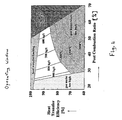
- Fig. 4 shows another operating window of the process of the invention, in which the post-combustion ratio may range from about 0.25 to 0.55.
- Fig. 4 takes into account a cooling loss of 1000 MJ per tonne pig iron which typically may occur and also losses of coal and iron oxide of 60 kg per tonne pig iron each, e.g. as dust.
- medium volatile coal with 32 MJ/kg is used and the coal consumption is in the range 500-1000 kg/tonne pig iron.
Landscapes
- Engineering & Computer Science (AREA)
- Chemical & Material Sciences (AREA)
- Manufacturing & Machinery (AREA)
- Materials Engineering (AREA)
- Metallurgy (AREA)
- Organic Chemistry (AREA)
- Manufacture Of Iron (AREA)
- Refinement Of Pig-Iron, Manufacture Of Cast Iron, And Steel Manufacture Other Than In Revolving Furnaces (AREA)
- Vertical, Hearth, Or Arc Furnaces (AREA)
- Manufacture And Refinement Of Metals (AREA)
Claims (14)
- Procédé pour produire de la fonte brute liquide par réduction directe de minerai de fer lors d'une étape de préréduction suivie d'une étape de réduction finale, comprenant les étapes consistant à:caractérisé en ce que(a) lors de ladite étape de préréduction, acheminer, du minerai de fer jusque dans un four cyclone de fusion (1) et préréduire celui-ci dans le four à l'aide de gaz réducteurs de traitement résultant de ladite étape de réduction finale,(b) effectuer une post-combustion dans lesdits gaz réducteurs de traitement dans ledit four cyclone de fusion en envoyant de l'oxygène dans celui-ci de façon que ledit minerai de fer présent dans ledit four cyclone de fusion (1) fonde au moins partiellement,(c) permettre au minerai de fer préréduit et au moins partiellement fondu de descendre dudit four cyclone de fusion (1) jusque dans une cuve métallurgique (4) située sous celui-ci lorsque ladite réduction finale a lieu, et(d) effectuer ladite réduction finale dans ladite cuve métallurgique (4) dans une couche de laitier (7) présente dans celle-ci en envoyant du charbon et de l'oxygène dans ladite cuve métallurgique et en formant de la sorte lesdits gaz réducteurs de traitement, et en effectuant une post-combustion partielle dans lesdits gaz réducteurs de traitement dans ladite cuve métallurgique à l'aide dudit oxygène envoyé dans celle-ci,(1) ledit charbon est envoyé directement dans ladite couche de laitier (7),(2) ladite post-combustion partielle dans ladite cuve métallurgique(4) est effectuée au moins en partie dans ladite couche de laitier, et(3) le taux de post-combustion, défini sous la forme
- Procédé selon la revendication 1, comprenant l'envoi dudit charbon directement dans ladite couche de laitier par (i) transport pneumatique, par au moins une lance (12), de charbon en fines particules, et/ou par (ii) transport pneumatique de charbon en fines particules à l'aide d'au moins une tuyère latérale de ladite cuve métallurgique refoulant directement dans ladite couche de laitier, et/ou (iii) en laissant tomber dans la couche de laitier des particules de charbon dont les dimensions moyennes ne sont pas inférieures à 6 mm.
- Procédé selon la revendication 1 ou la revendication 2, dans lequel ledit charbon envoyé directement dans ladite couche de laitier comporte au moins 25% en poids de particules ne mesurant pas moins de 6 mm.
- Procédé selon l'une quelconque des revendications 1 à 3, dans lequel la consommation de charbon dans le procédé est de l'ordre de 500 à 1000 kg par tonne de fonte brute produite.
- Procédé selon l'une quelconque des revendications 1 à 4, dans lequel ledit oxygène envoyé dans ledit four cyclone de fusion est injecté dans le cyclone sous la forme d'oxygène sensiblement pur.
- Procédé selon l'une quelconque des revendications 1 à 5, dans lequel ledit oxygène envoyé dans ladite cuve métallurgique se présente sous la forme d'oxygène sensiblement pur et se trouve à une température non supérieure à 100°C.
- Procédé selon l'une quelconque des revendications 1 à 6, dans lequel ledit taux de post-combustion des gaz réducteurs de traitement à leur sortie de ladite cuve métallurgique est de l'ordre de 0,20 à 0,55, et de préférence de l'ordre de 0,30 à 0,45.
- Procédé selon l'une quelconque des revendications 1 à 7, dans lequel un taux de post-combustion (défini dans la revendication 1) des gaz de traitement à leur sortie du four cyclone de fusion est au moins de 0,760, de préférence au moins de 0,70, et la consommation de charbon est comprise entre 600 et 800 kg, de préférence entre 650 et 750 kg de charbon par tonne de fonte brute produite.
- Procédé selon l'une quelconque des revendications 1 à 8, dans lequel ledit charbon fourni est un charbon très volatile.
- Procédé selon l'une quelconque des revendications 1 à 9, dans lequel le degré de préréduction (PRD) du minerai de fer à sa sortie du four cyclone de fusion, défini par l'expression
- Procédé selon l'une quelconque des revendications 1 à 10, dans lequel la température du minerai de fer préréduit à sa sortie du four cyclone de fusion est de l'ordre de 1200 à 1600°C.
- Procédé selon l'une quelconque des revendications 1 à 11, dans lequel les gaz réducteurs produits par le procédé ne sont pas refroidis, dépoussiérés ni récupérés entre la cuve métallurgique et le four cyclone de fusion.
- Procédé selon l'une quelconque des revendications 1 à 12, dans lequel ledit charbon est au moins partiellement envoyé dans la couche de laitier sous la forme de poudre de charbon.
- Procédé selon l'une quelconque des revendications 1 à 13, dans lequel ledit charbon est envoyé dans la couche de laitier avec un gaz porteur à l'aide d'au moins une lance d'injection plongée dans la couche de laitier ou débitant à proximité immédiate du dessus de la couche de laitier.
Applications Claiming Priority (2)
| Application Number | Priority Date | Filing Date | Title |
|---|---|---|---|
| NL9500264A NL9500264A (nl) | 1995-02-13 | 1995-02-13 | Werkwijze voor het produceren van vloeibaar ruwijzer. |
| NL9500264 | 1995-02-13 |
Publications (3)
| Publication Number | Publication Date |
|---|---|
| EP0726326A2 EP0726326A2 (fr) | 1996-08-14 |
| EP0726326A3 EP0726326A3 (fr) | 1996-12-27 |
| EP0726326B1 true EP0726326B1 (fr) | 2001-11-07 |
Family
ID=19865575
Family Applications (1)
| Application Number | Title | Priority Date | Filing Date |
|---|---|---|---|
| EP96200246A Expired - Lifetime EP0726326B1 (fr) | 1995-02-13 | 1996-02-05 | Procédé pour produire de la fonte liquide |
Country Status (14)
| Country | Link |
|---|---|
| US (2) | US5800592A (fr) |
| EP (1) | EP0726326B1 (fr) |
| KR (1) | KR0178445B1 (fr) |
| CN (1) | CN1046960C (fr) |
| AT (1) | ATE208426T1 (fr) |
| BR (1) | BR9600707A (fr) |
| CA (1) | CA2169020C (fr) |
| DE (1) | DE69616607T2 (fr) |
| ES (1) | ES2166858T3 (fr) |
| NL (1) | NL9500264A (fr) |
| PL (1) | PL180334B1 (fr) |
| RU (1) | RU2109070C1 (fr) |
| UA (1) | UA29482C2 (fr) |
| ZA (1) | ZA96967B (fr) |
Cited By (2)
| Publication number | Priority date | Publication date | Assignee | Title |
|---|---|---|---|---|
| WO2012126055A1 (fr) * | 2011-03-21 | 2012-09-27 | Technological Resources Pty. Limited | Procédé de fusion directe d'une charge à teneur élevée en soufre |
| US12595520B2 (en) | 2019-11-28 | 2026-04-07 | Tata Steel Ijmuiden B.V. | Apparatus for the production of molten iron |
Families Citing this family (41)
| Publication number | Priority date | Publication date | Assignee | Title |
|---|---|---|---|---|
| NL9500264A (nl) * | 1995-02-13 | 1996-09-02 | Hoogovens Staal Bv | Werkwijze voor het produceren van vloeibaar ruwijzer. |
| AUPN226095A0 (en) | 1995-04-07 | 1995-05-04 | Technological Resources Pty Limited | A method of producing metals and metal alloys |
| NL1000838C2 (nl) * | 1995-07-19 | 1997-01-21 | Hoogovens Staal Bv | Werkwijze en inrichting voor het produceren van ruwijzer door smelting reduction. |
| US5885322A (en) * | 1996-03-22 | 1999-03-23 | Steel Technology Corporation | Method for reducing iron losses in an iron smelting process |
| WO1997035038A1 (fr) | 1996-03-22 | 1997-09-25 | Steel Technology Corporation | Fonctionnement stable d'un haut fourneau |
| US5980606A (en) * | 1996-03-22 | 1999-11-09 | Steel Technology Corporation | Method for reducing sulfuric content in the offgas of an iron smelting process |
| AT405944B (de) * | 1996-04-19 | 1999-12-27 | Holderbank Financ Glarus | Verfahren zum reduzieren von oxidischen schlacken |
| AUPO426096A0 (en) | 1996-12-18 | 1997-01-23 | Technological Resources Pty Limited | Method and apparatus for producing metals and metal alloys |
| AUPO426396A0 (en) | 1996-12-18 | 1997-01-23 | Technological Resources Pty Limited | A method of producing iron |
| IT1291118B1 (it) | 1997-03-25 | 1998-12-29 | Sviluppo Materiali Spa | Procedimento per la produzione diretta di ghisa a partire da minerale ferrifero fine e da carbone fossile ed apparecchiatura idonea per |
| NL1006553C2 (nl) * | 1997-07-11 | 1999-01-12 | Hoogovens Staal Bv | Werkwijze voor het sturen (control) van een smelting reduction process. |
| US6214084B1 (en) * | 1997-09-03 | 2001-04-10 | The Boc Group, Inc. | Iron manufacturing process |
| AUPO944697A0 (en) * | 1997-09-26 | 1997-10-16 | Technological Resources Pty Limited | A method of producing metals and metal alloys |
| US6193781B1 (en) * | 1997-12-09 | 2001-02-27 | The Boc Group, Inc. | Method of smelting iron ore |
| AUPP442598A0 (en) | 1998-07-01 | 1998-07-23 | Technological Resources Pty Limited | Direct smelting vessel |
| AUPP442698A0 (en) * | 1998-07-01 | 1998-07-23 | Technological Resources Pty Limited | A direct smelting process |
| AUPP483898A0 (en) | 1998-07-24 | 1998-08-13 | Technological Resources Pty Limited | A direct smelting process & apparatus |
| MY119760A (en) | 1998-07-24 | 2005-07-29 | Tech Resources Pty Ltd | A direct smelting process |
| AUPP554098A0 (en) | 1998-08-28 | 1998-09-17 | Technological Resources Pty Limited | A process and an apparatus for producing metals and metal alloys |
| AUPP570098A0 (en) | 1998-09-04 | 1998-10-01 | Technological Resources Pty Limited | A direct smelting process |
| AUPP647198A0 (en) * | 1998-10-14 | 1998-11-05 | Technological Resources Pty Limited | A process and an apparatus for producing metals and metal alloys |
| AUPP805599A0 (en) | 1999-01-08 | 1999-02-04 | Technological Resources Pty Limited | A direct smelting process |
| AUPQ083599A0 (en) | 1999-06-08 | 1999-07-01 | Technological Resources Pty Limited | Direct smelting vessel |
| AUPQ152299A0 (en) | 1999-07-09 | 1999-08-05 | Technological Resources Pty Limited | Start-up procedure for direct smelting process |
| AUPQ205799A0 (en) | 1999-08-05 | 1999-08-26 | Technological Resources Pty Limited | A direct smelting process |
| AUPQ213099A0 (en) | 1999-08-10 | 1999-09-02 | Technological Resources Pty Limited | Pressure control |
| AUPQ308799A0 (en) | 1999-09-27 | 1999-10-21 | Technological Resources Pty Limited | A direct smelting process |
| AUPQ346399A0 (en) | 1999-10-15 | 1999-11-11 | Technological Resources Pty Limited | Stable idle procedure |
| AUPQ365799A0 (en) | 1999-10-26 | 1999-11-18 | Technological Resources Pty Limited | A direct smelting apparatus and process |
| US6602321B2 (en) | 2000-09-26 | 2003-08-05 | Technological Resources Pty. Ltd. | Direct smelting process |
| EP1431403A1 (fr) * | 2002-07-10 | 2004-06-23 | Corus Technology BV | Dispositif et procédé de fusion directe |
| CN100455678C (zh) * | 2006-01-25 | 2009-01-28 | 中冶赛迪工程技术股份有限公司 | 熔融还原炉喷吹煤粉工艺 |
| CN101688258B (zh) * | 2007-04-04 | 2015-09-09 | 塔塔钢铁荷兰科技有限责任公司 | 制备在金属制造方法中使用的还原剂的方法和设备、使用所述设备的金属制造方法和金属制造装置 |
| JP5166804B2 (ja) * | 2007-09-19 | 2013-03-21 | 株式会社神戸製鋼所 | 溶鉄製造方法 |
| CN101445848B (zh) * | 2008-12-22 | 2010-08-11 | 莱芜钢铁集团有限公司 | 一种含铁物料连续炼钢工艺方法及装置 |
| WO2013091847A1 (fr) | 2011-12-19 | 2013-06-27 | Tata Steel Nederland Technology Bv | Cyclone de fusion et appareil équipé d'un tel cyclone de fusion |
| CN103924024B (zh) * | 2013-01-10 | 2016-02-24 | 宝山钢铁股份有限公司 | 一种铁浴熔融还原炉预还原方法 |
| CN105874085B (zh) | 2013-12-19 | 2019-04-09 | 塔塔钢铁荷兰科技有限责任公司 | 操作熔炼旋流器的方法 |
| AU2020246810B2 (en) | 2019-03-22 | 2025-10-16 | Tata Steel Nederland Technology B.V. | Method of manufacturing iron in a metallurgical vessel |
| PL4028562T3 (pl) | 2019-09-12 | 2023-11-27 | Tata Steel Ijmuiden B.V. | Sposób wprowadzania wsadu metalonośnego w procesie produkcji surówki |
| WO2021144284A1 (fr) | 2020-01-14 | 2021-07-22 | Tata Steel Ijmuiden B.V. | Charge liquide pour un convertisseur basique à oxygène |
Family Cites Families (14)
| Publication number | Priority date | Publication date | Assignee | Title |
|---|---|---|---|---|
| DE1508076A1 (de) * | 1965-11-08 | 1969-02-20 | Shell Int Research | Verfahren zur Gewinnung von Eisen und Stahl |
| DE1508075A1 (de) * | 1965-11-08 | 1969-02-20 | Shell Int Research | Verfahren zur Gewinnung von Eisen und Stahl |
| DE3607775A1 (de) * | 1986-03-08 | 1987-09-17 | Kloeckner Cra Tech | Verfahren zur schmelzreduktion von eisenerz |
| DE3607774A1 (de) * | 1986-03-08 | 1987-09-17 | Kloeckner Cra Tech | Verfahren zur zweistufigen schmelzreduktion von eisenerz |
| JPH079017B2 (ja) * | 1986-05-29 | 1995-02-01 | 日本鋼管株式会社 | 溶融還元法 |
| JPS62280315A (ja) * | 1986-05-29 | 1987-12-05 | Nippon Kokan Kk <Nkk> | 溶融還元法 |
| JPS6338506A (ja) * | 1986-07-31 | 1988-02-19 | Nippon Steel Corp | 溶融還元炉への粉状炭材添加方法 |
| JPH0826378B2 (ja) * | 1986-10-30 | 1996-03-13 | 住友金属工業株式会社 | クロム含有溶鉄の製造方法 |
| FI84841C (sv) * | 1988-03-30 | 1992-01-27 | Ahlstroem Oy | Förfarande och anordning för reduktion av metalloxidhaltigt material |
| FI83670C (sv) * | 1988-03-30 | 1991-08-12 | Ahlstroem Oy | Förreduktion av metalloxidhaltigt material |
| US5228901A (en) * | 1991-02-25 | 1993-07-20 | Idaho Research Foundation, Inc. | Partial reduction of particulate iron ores and cyclone reactor |
| NL9400936A (nl) * | 1994-06-09 | 1996-01-02 | Hoogovens Groep Bv | Werkwijze voor het behandelen van zinkhoudend stof. |
| NL9500264A (nl) * | 1995-02-13 | 1996-09-02 | Hoogovens Staal Bv | Werkwijze voor het produceren van vloeibaar ruwijzer. |
| NL9500600A (nl) * | 1995-03-29 | 1996-11-01 | Hoogovens Staal Bv | Inrichting voor het produceren van vloeibaar ruwijzer door directe reductie. |
-
1995
- 1995-02-13 NL NL9500264A patent/NL9500264A/nl not_active Application Discontinuation
-
1996
- 1996-02-05 ES ES96200246T patent/ES2166858T3/es not_active Expired - Lifetime
- 1996-02-05 AT AT96200246T patent/ATE208426T1/de active
- 1996-02-05 US US08/596,607 patent/US5800592A/en not_active Expired - Lifetime
- 1996-02-05 EP EP96200246A patent/EP0726326B1/fr not_active Expired - Lifetime
- 1996-02-05 DE DE69616607T patent/DE69616607T2/de not_active Expired - Lifetime
- 1996-02-07 CA CA002169020A patent/CA2169020C/fr not_active Expired - Fee Related
- 1996-02-07 ZA ZA96967A patent/ZA96967B/xx unknown
- 1996-02-12 CN CN96104008A patent/CN1046960C/zh not_active Expired - Fee Related
- 1996-02-12 RU RU96102421A patent/RU2109070C1/ru not_active IP Right Cessation
- 1996-02-13 UA UA96020531A patent/UA29482C2/uk unknown
- 1996-02-13 KR KR1019960003680A patent/KR0178445B1/ko not_active Expired - Fee Related
- 1996-02-13 BR BR9600707A patent/BR9600707A/pt not_active IP Right Cessation
- 1996-02-13 PL PL96312776A patent/PL180334B1/pl not_active IP Right Cessation
-
1998
- 1998-04-13 US US09/058,958 patent/US5968448A/en not_active Expired - Lifetime
Cited By (3)
| Publication number | Priority date | Publication date | Assignee | Title |
|---|---|---|---|---|
| WO2012126055A1 (fr) * | 2011-03-21 | 2012-09-27 | Technological Resources Pty. Limited | Procédé de fusion directe d'une charge à teneur élevée en soufre |
| RU2600290C2 (ru) * | 2011-03-21 | 2016-10-20 | Текнолоджикал Ресорсиз Пти. Лимитед | Способ прямого плавления сырья с высоким содержанием серы |
| US12595520B2 (en) | 2019-11-28 | 2026-04-07 | Tata Steel Ijmuiden B.V. | Apparatus for the production of molten iron |
Also Published As
| Publication number | Publication date |
|---|---|
| KR960031629A (ko) | 1996-09-17 |
| DE69616607T2 (de) | 2002-08-01 |
| ATE208426T1 (de) | 2001-11-15 |
| EP0726326A2 (fr) | 1996-08-14 |
| US5800592A (en) | 1998-09-01 |
| CA2169020A1 (fr) | 1996-08-14 |
| AU692344B2 (en) | 1998-06-04 |
| UA29482C2 (uk) | 2000-11-15 |
| KR0178445B1 (ko) | 1999-02-18 |
| CN1141345A (zh) | 1997-01-29 |
| ES2166858T3 (es) | 2002-05-01 |
| BR9600707A (pt) | 1997-12-30 |
| RU2109070C1 (ru) | 1998-04-20 |
| PL180334B1 (pl) | 2001-01-31 |
| ZA96967B (en) | 1996-08-19 |
| CN1046960C (zh) | 1999-12-01 |
| US5968448A (en) | 1999-10-19 |
| EP0726326A3 (fr) | 1996-12-27 |
| DE69616607D1 (de) | 2001-12-13 |
| AU4339696A (en) | 1996-08-29 |
| CA2169020C (fr) | 2000-05-02 |
| PL312776A1 (en) | 1996-08-19 |
| NL9500264A (nl) | 1996-09-02 |
Similar Documents
| Publication | Publication Date | Title |
|---|---|---|
| EP0726326B1 (fr) | Procédé pour produire de la fonte liquide | |
| EP0563559B1 (fr) | Procédé de réduction en bain de fusion à productivité élevée | |
| US4566904A (en) | Process for the production of iron | |
| US4849015A (en) | Method for two-stage melt reduction of iron ore | |
| EP1034311B1 (fr) | Procede de fusion directe pour la production de metaux a partir d'oxydes metalliques | |
| US4827486A (en) | Process for increasing the energy input in electric arc furnaces | |
| US5480473A (en) | Method for intensifying the reactions in metallurgical reaction vessels | |
| US5431710A (en) | Method for continuously producing iron, steel or semi-steel and energy | |
| EP1098997B1 (fr) | Procede de fusion directe | |
| EP0597270A2 (fr) | Procédé d'opération d'une tuyère multimédia et un système de tuyère | |
| US4419128A (en) | Continuous melting, refining and casting process | |
| US5135572A (en) | Method for in-bath smelting reduction of metals | |
| US5919282A (en) | Process for vacuum refining molten steel and apparatus thereof | |
| AU704090B2 (en) | Process and apparatus for the manufacture of steel from iron carbide | |
| US5733358A (en) | Process and apparatus for the manufacture of steel from iron carbide | |
| US6146440A (en) | Process for the direct production of cast iron from iron bearing ore, and an apparatus suitable to carry out said process | |
| US6197088B1 (en) | Producing liquid iron having a low sulfur content | |
| RU2086657C1 (ru) | Устройство для восстановления окислов металлов углеродом и плавления металлов в доменной печи | |
| SU1608226A1 (ru) | Способ восстановлени железа из окислов в жидкой шлаковой ванне | |
| MXPA00002928A (en) | Direct smelting process for producing metals from metal oxides |
Legal Events
| Date | Code | Title | Description |
|---|---|---|---|
| PUAI | Public reference made under article 153(3) epc to a published international application that has entered the european phase |
Free format text: ORIGINAL CODE: 0009012 |
|
| AK | Designated contracting states |
Kind code of ref document: A2 Designated state(s): AT BE DE ES FR GB IT |
|
| PUAL | Search report despatched |
Free format text: ORIGINAL CODE: 0009013 |
|
| AK | Designated contracting states |
Kind code of ref document: A3 Designated state(s): AT BE DE ES FR GB IT |
|
| 17P | Request for examination filed |
Effective date: 19970627 |
|
| RAP1 | Party data changed (applicant data changed or rights of an application transferred) |
Owner name: CORUS STAAL BV |
|
| 17Q | First examination report despatched |
Effective date: 20001124 |
|
| GRAG | Despatch of communication of intention to grant |
Free format text: ORIGINAL CODE: EPIDOS AGRA |
|
| GRAG | Despatch of communication of intention to grant |
Free format text: ORIGINAL CODE: EPIDOS AGRA |
|
| GRAH | Despatch of communication of intention to grant a patent |
Free format text: ORIGINAL CODE: EPIDOS IGRA |
|
| GRAH | Despatch of communication of intention to grant a patent |
Free format text: ORIGINAL CODE: EPIDOS IGRA |
|
| GRAA | (expected) grant |
Free format text: ORIGINAL CODE: 0009210 |
|
| AK | Designated contracting states |
Kind code of ref document: B1 Designated state(s): AT BE DE ES FR GB IT |
|
| REF | Corresponds to: |
Ref document number: 208426 Country of ref document: AT Date of ref document: 20011115 Kind code of ref document: T |
|
| REF | Corresponds to: |
Ref document number: 69616607 Country of ref document: DE Date of ref document: 20011213 |
|
| REG | Reference to a national code |
Ref country code: GB Ref legal event code: IF02 |
|
| ET | Fr: translation filed | ||
| REG | Reference to a national code |
Ref country code: ES Ref legal event code: FG2A Ref document number: 2166858 Country of ref document: ES Kind code of ref document: T3 |
|
| PLBE | No opposition filed within time limit |
Free format text: ORIGINAL CODE: 0009261 |
|
| STAA | Information on the status of an ep patent application or granted ep patent |
Free format text: STATUS: NO OPPOSITION FILED WITHIN TIME LIMIT |
|
| 26N | No opposition filed | ||
| PGFP | Annual fee paid to national office [announced via postgrant information from national office to epo] |
Ref country code: IT Payment date: 20120224 Year of fee payment: 17 |
|
| PGFP | Annual fee paid to national office [announced via postgrant information from national office to epo] |
Ref country code: DE Payment date: 20130227 Year of fee payment: 18 Ref country code: GB Payment date: 20130227 Year of fee payment: 18 Ref country code: FR Payment date: 20130311 Year of fee payment: 18 Ref country code: ES Payment date: 20130226 Year of fee payment: 18 |
|
| PGFP | Annual fee paid to national office [announced via postgrant information from national office to epo] |
Ref country code: BE Payment date: 20130227 Year of fee payment: 18 |
|
| PGFP | Annual fee paid to national office [announced via postgrant information from national office to epo] |
Ref country code: AT Payment date: 20130122 Year of fee payment: 18 |
|
| BERE | Be: lapsed |
Owner name: *CORUS STAAL B.V. Effective date: 20140228 |
|
| REG | Reference to a national code |
Ref country code: DE Ref legal event code: R119 Ref document number: 69616607 Country of ref document: DE |
|
| REG | Reference to a national code |
Ref country code: AT Ref legal event code: MM01 Ref document number: 208426 Country of ref document: AT Kind code of ref document: T Effective date: 20140205 |
|
| GBPC | Gb: european patent ceased through non-payment of renewal fee |
Effective date: 20140205 |
|
| REG | Reference to a national code |
Ref country code: FR Ref legal event code: ST Effective date: 20141031 |
|
| REG | Reference to a national code |
Ref country code: DE Ref legal event code: R119 Ref document number: 69616607 Country of ref document: DE Effective date: 20140902 |
|
| PG25 | Lapsed in a contracting state [announced via postgrant information from national office to epo] |
Ref country code: AT Free format text: LAPSE BECAUSE OF NON-PAYMENT OF DUE FEES Effective date: 20140205 |
|
| PG25 | Lapsed in a contracting state [announced via postgrant information from national office to epo] |
Ref country code: BE Free format text: LAPSE BECAUSE OF NON-PAYMENT OF DUE FEES Effective date: 20140228 Ref country code: FR Free format text: LAPSE BECAUSE OF NON-PAYMENT OF DUE FEES Effective date: 20140228 Ref country code: GB Free format text: LAPSE BECAUSE OF NON-PAYMENT OF DUE FEES Effective date: 20140205 Ref country code: DE Free format text: LAPSE BECAUSE OF NON-PAYMENT OF DUE FEES Effective date: 20140902 |
|
| REG | Reference to a national code |
Ref country code: ES Ref legal event code: FD2A Effective date: 20150330 |
|
| PG25 | Lapsed in a contracting state [announced via postgrant information from national office to epo] |
Ref country code: ES Free format text: LAPSE BECAUSE OF NON-PAYMENT OF DUE FEES Effective date: 20140206 |
|
| PG25 | Lapsed in a contracting state [announced via postgrant information from national office to epo] |
Ref country code: IT Free format text: LAPSE BECAUSE OF NON-PAYMENT OF DUE FEES Effective date: 20140205 |