EP0726352B1 - Process for producing patterned textiles - Google Patents
Process for producing patterned textiles Download PDFInfo
- Publication number
- EP0726352B1 EP0726352B1 EP96100202A EP96100202A EP0726352B1 EP 0726352 B1 EP0726352 B1 EP 0726352B1 EP 96100202 A EP96100202 A EP 96100202A EP 96100202 A EP96100202 A EP 96100202A EP 0726352 B1 EP0726352 B1 EP 0726352B1
- Authority
- EP
- European Patent Office
- Prior art keywords
- weight
- bis
- textiles
- polyisocyanates
- diisocyanate
- Prior art date
- Legal status (The legal status is an assumption and is not a legal conclusion. Google has not performed a legal analysis and makes no representation as to the accuracy of the status listed.)
- Expired - Lifetime
Links
- 239000004753 textile Substances 0.000 title claims description 24
- 238000000034 method Methods 0.000 title claims description 15
- 229920001228 polyisocyanate Polymers 0.000 claims description 61
- 239000005056 polyisocyanate Substances 0.000 claims description 59
- 229920000742 Cotton Polymers 0.000 claims description 14
- 229920000570 polyether Polymers 0.000 claims description 10
- XLYOFNOQVPJJNP-UHFFFAOYSA-N water Substances O XLYOFNOQVPJJNP-UHFFFAOYSA-N 0.000 claims description 10
- 239000011230 binding agent Substances 0.000 claims description 9
- 239000000463 material Substances 0.000 claims description 9
- -1 oxethyl Chemical group 0.000 claims description 7
- 229920000058 polyacrylate Polymers 0.000 claims description 7
- 239000004814 polyurethane Substances 0.000 claims description 7
- 229920002635 polyurethane Polymers 0.000 claims description 7
- 239000002562 thickening agent Substances 0.000 claims description 7
- 125000001931 aliphatic group Chemical group 0.000 claims description 5
- 239000003960 organic solvent Substances 0.000 claims description 5
- VGGSQFUCUMXWEO-UHFFFAOYSA-N Ethene Chemical compound C=C VGGSQFUCUMXWEO-UHFFFAOYSA-N 0.000 claims description 3
- 125000001797 benzyl group Chemical group [H]C1=C([H])C([H])=C(C([H])=C1[H])C([H])([H])* 0.000 claims description 3
- 125000000113 cyclohexyl group Chemical group [H]C1([H])C([H])([H])C([H])([H])C([H])(*)C([H])([H])C1([H])[H] 0.000 claims description 3
- 125000001511 cyclopentyl group Chemical group [H]C1([H])C([H])([H])C([H])([H])C([H])(*)C1([H])[H] 0.000 claims description 3
- 125000003055 glycidyl group Chemical group C(C1CO1)* 0.000 claims description 3
- 229910052760 oxygen Chemical group 0.000 claims description 3
- 239000001301 oxygen Chemical group 0.000 claims description 3
- 125000001997 phenyl group Chemical group [H]C1=C([H])C([H])=C(*)C([H])=C1[H] 0.000 claims description 3
- 229920000642 polymer Polymers 0.000 claims description 3
- QQONPFPTGQHPMA-UHFFFAOYSA-N propylene Natural products CC=C QQONPFPTGQHPMA-UHFFFAOYSA-N 0.000 claims description 3
- 125000003944 tolyl group Chemical group 0.000 claims description 3
- 239000005977 Ethylene Substances 0.000 claims description 2
- NINIDFKCEFEMDL-UHFFFAOYSA-N Sulfur Chemical group [S] NINIDFKCEFEMDL-UHFFFAOYSA-N 0.000 claims description 2
- QVGXLLKOCUKJST-UHFFFAOYSA-N atomic oxygen Chemical group [O] QVGXLLKOCUKJST-UHFFFAOYSA-N 0.000 claims description 2
- 125000004805 propylene group Chemical group [H]C([H])([H])C([H])([*:1])C([H])([H])[*:2] 0.000 claims description 2
- 229910052717 sulfur Inorganic materials 0.000 claims description 2
- 239000011593 sulfur Substances 0.000 claims description 2
- 125000003837 (C1-C20) alkyl group Chemical group 0.000 claims 1
- 125000003358 C2-C20 alkenyl group Chemical group 0.000 claims 1
- 125000005442 diisocyanate group Chemical group 0.000 description 20
- 150000001875 compounds Chemical class 0.000 description 13
- RRAMGCGOFNQTLD-UHFFFAOYSA-N hexamethylene diisocyanate Chemical compound O=C=NCCCCCCN=C=O RRAMGCGOFNQTLD-UHFFFAOYSA-N 0.000 description 12
- 125000004433 nitrogen atom Chemical group N* 0.000 description 11
- 239000000203 mixture Substances 0.000 description 10
- 239000000975 dye Substances 0.000 description 9
- 238000005406 washing Methods 0.000 description 9
- 239000005057 Hexamethylene diisocyanate Substances 0.000 description 8
- WUGQZFFCHPXWKQ-UHFFFAOYSA-N Propanolamine Chemical compound NCCCO WUGQZFFCHPXWKQ-UHFFFAOYSA-N 0.000 description 7
- NIMLQBUJDJZYEJ-UHFFFAOYSA-N isophorone diisocyanate Chemical compound CC1(C)CC(N=C=O)CC(C)(CN=C=O)C1 NIMLQBUJDJZYEJ-UHFFFAOYSA-N 0.000 description 7
- WSFSSNUMVMOOMR-UHFFFAOYSA-N Formaldehyde Chemical compound O=C WSFSSNUMVMOOMR-UHFFFAOYSA-N 0.000 description 6
- 239000005058 Isophorone diisocyanate Substances 0.000 description 6
- 239000003795 chemical substances by application Substances 0.000 description 6
- 229910052757 nitrogen Inorganic materials 0.000 description 6
- PEDCQBHIVMGVHV-UHFFFAOYSA-N Glycerine Chemical compound OCC(O)CO PEDCQBHIVMGVHV-UHFFFAOYSA-N 0.000 description 5
- RWRDLPDLKQPQOW-UHFFFAOYSA-N Pyrrolidine Chemical compound C1CCNC1 RWRDLPDLKQPQOW-UHFFFAOYSA-N 0.000 description 4
- 230000006735 deficit Effects 0.000 description 4
- 150000004985 diamines Chemical class 0.000 description 4
- 238000005530 etching Methods 0.000 description 4
- 239000004744 fabric Substances 0.000 description 4
- 125000002887 hydroxy group Chemical group [H]O* 0.000 description 4
- IQPQWNKOIGAROB-UHFFFAOYSA-N isocyanate group Chemical group [N-]=C=O IQPQWNKOIGAROB-UHFFFAOYSA-N 0.000 description 4
- HLJDOURGTRAFHE-UHFFFAOYSA-N isocyanic acid;3,5,5-trimethylcyclohex-2-en-1-one Chemical compound N=C=O.N=C=O.CC1=CC(=O)CC(C)(C)C1 HLJDOURGTRAFHE-UHFFFAOYSA-N 0.000 description 4
- 230000009021 linear effect Effects 0.000 description 4
- 238000004519 manufacturing process Methods 0.000 description 4
- ZWEHNKRNPOVVGH-UHFFFAOYSA-N 2-Butanone Chemical compound CCC(C)=O ZWEHNKRNPOVVGH-UHFFFAOYSA-N 0.000 description 3
- CSCPPACGZOOCGX-UHFFFAOYSA-N Acetone Chemical compound CC(C)=O CSCPPACGZOOCGX-UHFFFAOYSA-N 0.000 description 3
- XEKOWRVHYACXOJ-UHFFFAOYSA-N Ethyl acetate Chemical compound CCOC(C)=O XEKOWRVHYACXOJ-UHFFFAOYSA-N 0.000 description 3
- JOYRKODLDBILNP-UHFFFAOYSA-N Ethyl urethane Chemical compound CCOC(N)=O JOYRKODLDBILNP-UHFFFAOYSA-N 0.000 description 3
- LYCAIKOWRPUZTN-UHFFFAOYSA-N Ethylene glycol Chemical compound OCCO LYCAIKOWRPUZTN-UHFFFAOYSA-N 0.000 description 3
- OKKJLVBELUTLKV-UHFFFAOYSA-N Methanol Chemical compound OC OKKJLVBELUTLKV-UHFFFAOYSA-N 0.000 description 3
- YNAVUWVOSKDBBP-UHFFFAOYSA-N Morpholine Chemical compound C1COCCN1 YNAVUWVOSKDBBP-UHFFFAOYSA-N 0.000 description 3
- GLUUGHFHXGJENI-UHFFFAOYSA-N Piperazine Chemical compound C1CNCCN1 GLUUGHFHXGJENI-UHFFFAOYSA-N 0.000 description 3
- NQRYJNQNLNOLGT-UHFFFAOYSA-N Piperidine Chemical compound C1CCNCC1 NQRYJNQNLNOLGT-UHFFFAOYSA-N 0.000 description 3
- 239000004721 Polyphenylene oxide Substances 0.000 description 3
- DNIAPMSPPWPWGF-UHFFFAOYSA-N Propylene glycol Chemical compound CC(O)CO DNIAPMSPPWPWGF-UHFFFAOYSA-N 0.000 description 3
- ZJCCRDAZUWHFQH-UHFFFAOYSA-N Trimethylolpropane Chemical compound CCC(CO)(CO)CO ZJCCRDAZUWHFQH-UHFFFAOYSA-N 0.000 description 3
- 150000001414 amino alcohols Chemical class 0.000 description 3
- OHJMTUPIZMNBFR-UHFFFAOYSA-N biuret Chemical group NC(=O)NC(N)=O OHJMTUPIZMNBFR-UHFFFAOYSA-N 0.000 description 3
- 229920001577 copolymer Polymers 0.000 description 3
- 239000012948 isocyanate Substances 0.000 description 3
- 150000002513 isocyanates Chemical class 0.000 description 3
- 230000014759 maintenance of location Effects 0.000 description 3
- 239000004575 stone Substances 0.000 description 3
- QKOWXXDOHMJOMQ-UHFFFAOYSA-N 1,3,5-tris(6-isocyanatohexyl)biuret Chemical compound O=C=NCCCCCCNC(=O)N(CCCCCCN=C=O)C(=O)NCCCCCCN=C=O QKOWXXDOHMJOMQ-UHFFFAOYSA-N 0.000 description 2
- SMZOUWXMTYCWNB-UHFFFAOYSA-N 2-(2-methoxy-5-methylphenyl)ethanamine Chemical compound COC1=CC=C(C)C=C1CCN SMZOUWXMTYCWNB-UHFFFAOYSA-N 0.000 description 2
- HZAXFHJVJLSVMW-UHFFFAOYSA-N 2-Aminoethan-1-ol Chemical compound NCCO HZAXFHJVJLSVMW-UHFFFAOYSA-N 0.000 description 2
- ALRHLSYJTWAHJZ-UHFFFAOYSA-N 3-hydroxypropionic acid Chemical compound OCCC(O)=O ALRHLSYJTWAHJZ-UHFFFAOYSA-N 0.000 description 2
- YEJRWHAVMIAJKC-UHFFFAOYSA-N 4-Butyrolactone Chemical compound O=C1CCCO1 YEJRWHAVMIAJKC-UHFFFAOYSA-N 0.000 description 2
- HRPVXLWXLXDGHG-UHFFFAOYSA-N Acrylamide Chemical compound NC(=O)C=C HRPVXLWXLXDGHG-UHFFFAOYSA-N 0.000 description 2
- QGZKDVFQNNGYKY-UHFFFAOYSA-N Ammonia Chemical compound N QGZKDVFQNNGYKY-UHFFFAOYSA-N 0.000 description 2
- PAYRUJLWNCNPSJ-UHFFFAOYSA-N Aniline Chemical compound NC1=CC=CC=C1 PAYRUJLWNCNPSJ-UHFFFAOYSA-N 0.000 description 2
- IJGRMHOSHXDMSA-UHFFFAOYSA-N Atomic nitrogen Chemical compound N#N IJGRMHOSHXDMSA-UHFFFAOYSA-N 0.000 description 2
- CURLTUGMZLYLDI-UHFFFAOYSA-N Carbon dioxide Chemical compound O=C=O CURLTUGMZLYLDI-UHFFFAOYSA-N 0.000 description 2
- RTZKZFJDLAIYFH-UHFFFAOYSA-N Diethyl ether Chemical compound CCOCC RTZKZFJDLAIYFH-UHFFFAOYSA-N 0.000 description 2
- AEMRFAOFKBGASW-UHFFFAOYSA-N Glycolic acid Chemical compound OCC(O)=O AEMRFAOFKBGASW-UHFFFAOYSA-N 0.000 description 2
- 235000000177 Indigofera tinctoria Nutrition 0.000 description 2
- AFBPFSWMIHJQDM-UHFFFAOYSA-N N-methylaniline Chemical compound CNC1=CC=CC=C1 AFBPFSWMIHJQDM-UHFFFAOYSA-N 0.000 description 2
- 229920002125 Sokalan® Polymers 0.000 description 2
- 239000002253 acid Substances 0.000 description 2
- NIXOWILDQLNWCW-UHFFFAOYSA-N acrylic acid group Chemical group C(C=C)(=O)O NIXOWILDQLNWCW-UHFFFAOYSA-N 0.000 description 2
- 125000000129 anionic group Chemical group 0.000 description 2
- BVKZGUZCCUSVTD-UHFFFAOYSA-N carbonic acid Chemical class OC(O)=O BVKZGUZCCUSVTD-UHFFFAOYSA-N 0.000 description 2
- 125000003178 carboxy group Chemical group [H]OC(*)=O 0.000 description 2
- 238000006243 chemical reaction Methods 0.000 description 2
- 239000003086 colorant Substances 0.000 description 2
- 125000004122 cyclic group Chemical group 0.000 description 2
- USIUVYZYUHIAEV-UHFFFAOYSA-N diphenyl ether Chemical compound C=1C=CC=CC=1OC1=CC=CC=C1 USIUVYZYUHIAEV-UHFFFAOYSA-N 0.000 description 2
- 239000006185 dispersion Substances 0.000 description 2
- 238000004043 dyeing Methods 0.000 description 2
- 238000007046 ethoxylation reaction Methods 0.000 description 2
- 235000011187 glycerol Nutrition 0.000 description 2
- 229940097275 indigo Drugs 0.000 description 2
- COHYTHOBJLSHDF-UHFFFAOYSA-N indigo powder Natural products N1C2=CC=CC=C2C(=O)C1=C1C(=O)C2=CC=CC=C2N1 COHYTHOBJLSHDF-UHFFFAOYSA-N 0.000 description 2
- ZFSLODLOARCGLH-UHFFFAOYSA-N isocyanuric acid Chemical group OC1=NC(O)=NC(O)=N1 ZFSLODLOARCGLH-UHFFFAOYSA-N 0.000 description 2
- HXSACZWWBYWLIS-UHFFFAOYSA-N oxadiazine-4,5,6-trione Chemical group O=C1ON=NC(=O)C1=O HXSACZWWBYWLIS-UHFFFAOYSA-N 0.000 description 2
- 125000004430 oxygen atom Chemical group O* 0.000 description 2
- 229920001515 polyalkylene glycol Polymers 0.000 description 2
- 229920005862 polyol Polymers 0.000 description 2
- 150000003077 polyols Chemical class 0.000 description 2
- 239000004576 sand Substances 0.000 description 2
- 239000002904 solvent Substances 0.000 description 2
- AVWRKZWQTYIKIY-UHFFFAOYSA-N urea-1-carboxylic acid Chemical group NC(=O)NC(O)=O AVWRKZWQTYIKIY-UHFFFAOYSA-N 0.000 description 2
- 239000000984 vat dye Substances 0.000 description 2
- IALZLVVOMYFDGE-UHFFFAOYSA-N (2-chloro-5-cyanatophenyl) cyanate Chemical compound ClC1=CC=C(OC#N)C=C1OC#N IALZLVVOMYFDGE-UHFFFAOYSA-N 0.000 description 1
- VNMOIBZLSJDQEO-UHFFFAOYSA-N 1,10-diisocyanatodecane Chemical compound O=C=NCCCCCCCCCCN=C=O VNMOIBZLSJDQEO-UHFFFAOYSA-N 0.000 description 1
- GFNDFCFPJQPVQL-UHFFFAOYSA-N 1,12-diisocyanatododecane Chemical compound O=C=NCCCCCCCCCCCCN=C=O GFNDFCFPJQPVQL-UHFFFAOYSA-N 0.000 description 1
- NNOZGCICXAYKLW-UHFFFAOYSA-N 1,2-bis(2-isocyanatopropan-2-yl)benzene Chemical compound O=C=NC(C)(C)C1=CC=CC=C1C(C)(C)N=C=O NNOZGCICXAYKLW-UHFFFAOYSA-N 0.000 description 1
- ODKSRULWLOLNJQ-UHFFFAOYSA-N 1,2-diisocyanatocyclohexane Chemical compound O=C=NC1CCCCC1N=C=O ODKSRULWLOLNJQ-UHFFFAOYSA-N 0.000 description 1
- PFUKECZPRROVOD-UHFFFAOYSA-N 1,3,5-triisocyanato-2-methylbenzene Chemical compound CC1=C(N=C=O)C=C(N=C=O)C=C1N=C=O PFUKECZPRROVOD-UHFFFAOYSA-N 0.000 description 1
- OHTRJOZKRSVAOX-UHFFFAOYSA-N 1,3-diisocyanato-2-methylcyclohexane Chemical compound CC1C(N=C=O)CCCC1N=C=O OHTRJOZKRSVAOX-UHFFFAOYSA-N 0.000 description 1
- OHLKMGYGBHFODF-UHFFFAOYSA-N 1,4-bis(isocyanatomethyl)benzene Chemical compound O=C=NCC1=CC=C(CN=C=O)C=C1 OHLKMGYGBHFODF-UHFFFAOYSA-N 0.000 description 1
- ALQLPWJFHRMHIU-UHFFFAOYSA-N 1,4-diisocyanatobenzene Chemical compound O=C=NC1=CC=C(N=C=O)C=C1 ALQLPWJFHRMHIU-UHFFFAOYSA-N 0.000 description 1
- OVBFMUAFNIIQAL-UHFFFAOYSA-N 1,4-diisocyanatobutane Chemical compound O=C=NCCCCN=C=O OVBFMUAFNIIQAL-UHFFFAOYSA-N 0.000 description 1
- JMFCAIUTSABFDU-UHFFFAOYSA-N 1,6-diisocyanatohexane Chemical compound O=C=NCCCCCCN=C=O.O=C=NCCCCCCN=C=O JMFCAIUTSABFDU-UHFFFAOYSA-N 0.000 description 1
- QUPKOUOXSNGVLB-UHFFFAOYSA-N 1,8-diisocyanatooctane Chemical compound O=C=NCCCCCCCCN=C=O QUPKOUOXSNGVLB-UHFFFAOYSA-N 0.000 description 1
- FNGREQBHSNEPKP-UHFFFAOYSA-N 1-(3,4-dihydrooxazin-2-yl)propan-2-ol Chemical compound CC(O)CN1CCC=CO1 FNGREQBHSNEPKP-UHFFFAOYSA-N 0.000 description 1
- MHKUWCCXUOVTMU-UHFFFAOYSA-N 1-(4,5-dihydro-1,3-oxazol-2-yl)propan-2-ol Chemical compound CC(O)CC1=NCCO1 MHKUWCCXUOVTMU-UHFFFAOYSA-N 0.000 description 1
- PCAFNJDUSMKKHJ-UHFFFAOYSA-N 1-(4-methylpiperazin-1-yl)propan-2-ol Chemical compound CC(O)CN1CCN(C)CC1 PCAFNJDUSMKKHJ-UHFFFAOYSA-N 0.000 description 1
- PVOAHINGSUIXLS-UHFFFAOYSA-N 1-Methylpiperazine Chemical compound CN1CCNCC1 PVOAHINGSUIXLS-UHFFFAOYSA-N 0.000 description 1
- WGCYRFWNGRMRJA-UHFFFAOYSA-N 1-ethylpiperazine Chemical compound CCN1CCNCC1 WGCYRFWNGRMRJA-UHFFFAOYSA-N 0.000 description 1
- MKZPMOFOBNHBSL-UHFFFAOYSA-N 1-isocyanato-1-methylcyclohexane Chemical compound O=C=NC1(C)CCCCC1 MKZPMOFOBNHBSL-UHFFFAOYSA-N 0.000 description 1
- SWZKXIPDGAAYKE-UHFFFAOYSA-N 1-morpholin-4-ylpropan-2-amine Chemical compound CC(N)CN1CCOCC1 SWZKXIPDGAAYKE-UHFFFAOYSA-N 0.000 description 1
- YAXQOLYGKLGQKA-UHFFFAOYSA-N 1-morpholin-4-ylpropan-2-ol Chemical compound CC(O)CN1CCOCC1 YAXQOLYGKLGQKA-UHFFFAOYSA-N 0.000 description 1
- IRNAEDHJBNPCEZ-UHFFFAOYSA-N 1-n,1-n,2-trimethylpropane-1,2-diamine Chemical compound CN(C)CC(C)(C)N IRNAEDHJBNPCEZ-UHFFFAOYSA-N 0.000 description 1
- CAPCBAYULRXQAN-UHFFFAOYSA-N 1-n,1-n-diethylpentane-1,4-diamine Chemical compound CCN(CC)CCCC(C)N CAPCBAYULRXQAN-UHFFFAOYSA-N 0.000 description 1
- ZGZHNQPTNCGKHS-UHFFFAOYSA-N 1-n,1-n-diethylpropane-1,2-diamine Chemical compound CCN(CC)CC(C)N ZGZHNQPTNCGKHS-UHFFFAOYSA-N 0.000 description 1
- RRQHLOZQFPWDCA-UHFFFAOYSA-N 1-n,1-n-dimethylpropane-1,2-diamine Chemical compound CC(N)CN(C)C RRQHLOZQFPWDCA-UHFFFAOYSA-N 0.000 description 1
- ZFDABCDCTKLGOK-UHFFFAOYSA-N 1-piperidin-1-ylpropan-2-amine Chemical compound CC(N)CN1CCCCC1 ZFDABCDCTKLGOK-UHFFFAOYSA-N 0.000 description 1
- UCASFSAKVJTSET-UHFFFAOYSA-N 1-piperidin-1-ylpropan-2-ol Chemical compound CC(O)CN1CCCCC1 UCASFSAKVJTSET-UHFFFAOYSA-N 0.000 description 1
- PTBDIHRZYDMNKB-UHFFFAOYSA-N 2,2-Bis(hydroxymethyl)propionic acid Chemical compound OCC(C)(CO)C(O)=O PTBDIHRZYDMNKB-UHFFFAOYSA-N 0.000 description 1
- JVYDLYGCSIHCMR-UHFFFAOYSA-N 2,2-bis(hydroxymethyl)butanoic acid Chemical compound CCC(CO)(CO)C(O)=O JVYDLYGCSIHCMR-UHFFFAOYSA-N 0.000 description 1
- IKTKBPBOEUDORD-UHFFFAOYSA-N 2-(3,4-dihydrooxazin-2-yl)ethanol Chemical compound OCCN1CCC=CO1 IKTKBPBOEUDORD-UHFFFAOYSA-N 0.000 description 1
- PAWVJRPRVYDHLQ-UHFFFAOYSA-N 2-(4,5-dihydro-1,3-oxazol-2-yl)ethanol Chemical compound OCCC1=NCCO1 PAWVJRPRVYDHLQ-UHFFFAOYSA-N 0.000 description 1
- QHTUMQYGZQYEOZ-UHFFFAOYSA-N 2-(4-methylpiperazin-1-yl)ethanol Chemical compound CN1CCN(CCO)CC1 QHTUMQYGZQYEOZ-UHFFFAOYSA-N 0.000 description 1
- IWSZDQRGNFLMJS-UHFFFAOYSA-N 2-(dibutylamino)ethanol Chemical compound CCCCN(CCO)CCCC IWSZDQRGNFLMJS-UHFFFAOYSA-N 0.000 description 1
- KKFDCBRMNNSAAW-UHFFFAOYSA-N 2-(morpholin-4-yl)ethanol Chemical compound OCCN1CCOCC1 KKFDCBRMNNSAAW-UHFFFAOYSA-N 0.000 description 1
- KZTWONRVIPPDKH-UHFFFAOYSA-N 2-(piperidin-1-yl)ethanol Chemical compound OCCN1CCCCC1 KZTWONRVIPPDKH-UHFFFAOYSA-N 0.000 description 1
- IMSODMZESSGVBE-UHFFFAOYSA-N 2-Oxazoline Chemical compound C1CN=CO1 IMSODMZESSGVBE-UHFFFAOYSA-N 0.000 description 1
- NDLNTMNRNCENRZ-UHFFFAOYSA-N 2-[2-hydroxyethyl(octadecyl)amino]ethanol Chemical compound CCCCCCCCCCCCCCCCCCN(CCO)CCO NDLNTMNRNCENRZ-UHFFFAOYSA-N 0.000 description 1
- GVNHOISKXMSMPX-UHFFFAOYSA-N 2-[butyl(2-hydroxyethyl)amino]ethanol Chemical compound CCCCN(CCO)CCO GVNHOISKXMSMPX-UHFFFAOYSA-N 0.000 description 1
- BFSVOASYOCHEOV-UHFFFAOYSA-N 2-diethylaminoethanol Chemical compound CCN(CC)CCO BFSVOASYOCHEOV-UHFFFAOYSA-N 0.000 description 1
- BOLMDIXLULGTBD-UHFFFAOYSA-N 3,4-dihydro-2h-oxazine Chemical group C1CC=CON1 BOLMDIXLULGTBD-UHFFFAOYSA-N 0.000 description 1
- YQYKHRLORGCFJR-UHFFFAOYSA-N 3-(3,4-dihydrooxazin-2-yl)propan-1-ol Chemical compound OCCCN1CCC=CO1 YQYKHRLORGCFJR-UHFFFAOYSA-N 0.000 description 1
- VEERNCWDIVHRAJ-UHFFFAOYSA-N 3-(4,5-dihydro-1,3-oxazol-2-yl)propan-1-ol Chemical compound OCCCC1=NCCO1 VEERNCWDIVHRAJ-UHFFFAOYSA-N 0.000 description 1
- WACQLQIAUWURGA-UHFFFAOYSA-N 3-hydroxy-2,2-bis(hydroxymethyl)propanoic acid Chemical compound OCC(CO)(CO)C(O)=O WACQLQIAUWURGA-UHFFFAOYSA-N 0.000 description 1
- RDFQSFOGKVZWKF-UHFFFAOYSA-N 3-hydroxy-2,2-dimethylpropanoic acid Chemical compound OCC(C)(C)C(O)=O RDFQSFOGKVZWKF-UHFFFAOYSA-N 0.000 description 1
- ULMZOZMSDIOZAF-UHFFFAOYSA-N 3-hydroxy-2-(hydroxymethyl)propanoic acid Chemical compound OCC(CO)C(O)=O ULMZOZMSDIOZAF-UHFFFAOYSA-N 0.000 description 1
- UIKUBYKUYUSRSM-UHFFFAOYSA-N 3-morpholinopropylamine Chemical compound NCCCN1CCOCC1 UIKUBYKUYUSRSM-UHFFFAOYSA-N 0.000 description 1
- JMUCXULQKPWSTJ-UHFFFAOYSA-N 3-piperidin-1-ylpropan-1-amine Chemical compound NCCCN1CCCCC1 JMUCXULQKPWSTJ-UHFFFAOYSA-N 0.000 description 1
- UPMLOUAZCHDJJD-UHFFFAOYSA-N 4,4'-Diphenylmethane Diisocyanate Chemical compound C1=CC(N=C=O)=CC=C1CC1=CC=C(N=C=O)C=C1 UPMLOUAZCHDJJD-UHFFFAOYSA-N 0.000 description 1
- GSFOUKVQYFLTRA-UHFFFAOYSA-N 4-(4-methylpiperazin-1-yl)butan-1-ol Chemical compound CN1CCN(CCCCO)CC1 GSFOUKVQYFLTRA-UHFFFAOYSA-N 0.000 description 1
- SJZRECIVHVDYJC-UHFFFAOYSA-N 4-hydroxybutyric acid Chemical compound OCCCC(O)=O SJZRECIVHVDYJC-UHFFFAOYSA-N 0.000 description 1
- 229940006015 4-hydroxybutyric acid Drugs 0.000 description 1
- 239000004971 Cross linker Substances 0.000 description 1
- OIFBSDVPJOWBCH-UHFFFAOYSA-N Diethyl carbonate Chemical compound CCOC(=O)OCC OIFBSDVPJOWBCH-UHFFFAOYSA-N 0.000 description 1
- MYMOFIZGZYHOMD-UHFFFAOYSA-N Dioxygen Chemical compound O=O MYMOFIZGZYHOMD-UHFFFAOYSA-N 0.000 description 1
- 102000004190 Enzymes Human genes 0.000 description 1
- 108090000790 Enzymes Proteins 0.000 description 1
- KMTRUDSVKNLOMY-UHFFFAOYSA-N Ethylene carbonate Chemical compound O=C1OCCO1 KMTRUDSVKNLOMY-UHFFFAOYSA-N 0.000 description 1
- IAYPIBMASNFSPL-UHFFFAOYSA-N Ethylene oxide Chemical compound C1CO1 IAYPIBMASNFSPL-UHFFFAOYSA-N 0.000 description 1
- PIICEJLVQHRZGT-UHFFFAOYSA-N Ethylenediamine Chemical compound NCCN PIICEJLVQHRZGT-UHFFFAOYSA-N 0.000 description 1
- CERQOIWHTDAKMF-UHFFFAOYSA-N Methacrylic acid Chemical compound CC(=C)C(O)=O CERQOIWHTDAKMF-UHFFFAOYSA-N 0.000 description 1
- UEEJHVSXFDXPFK-UHFFFAOYSA-N N-dimethylaminoethanol Chemical compound CN(C)CCO UEEJHVSXFDXPFK-UHFFFAOYSA-N 0.000 description 1
- CVGYTOLNWAMTRJ-UHFFFAOYSA-N N=C=O.N=C=O.CCCCC(C)C(C)(C)C Chemical compound N=C=O.N=C=O.CCCCC(C)C(C)(C)C CVGYTOLNWAMTRJ-UHFFFAOYSA-N 0.000 description 1
- JTDWCIXOEPQECG-UHFFFAOYSA-N N=C=O.N=C=O.CCCCCC(C)(C)C Chemical compound N=C=O.N=C=O.CCCCCC(C)(C)C JTDWCIXOEPQECG-UHFFFAOYSA-N 0.000 description 1
- 229920003171 Poly (ethylene oxide) Polymers 0.000 description 1
- 229920002845 Poly(methacrylic acid) Polymers 0.000 description 1
- GOOHAUXETOMSMM-UHFFFAOYSA-N Propylene oxide Chemical compound CC1CO1 GOOHAUXETOMSMM-UHFFFAOYSA-N 0.000 description 1
- GSEJCLTVZPLZKY-UHFFFAOYSA-N Triethanolamine Chemical compound OCCN(CCO)CCO GSEJCLTVZPLZKY-UHFFFAOYSA-N 0.000 description 1
- 239000007983 Tris buffer Substances 0.000 description 1
- 150000007513 acids Chemical class 0.000 description 1
- 229920000615 alginic acid Polymers 0.000 description 1
- 235000010443 alginic acid Nutrition 0.000 description 1
- 125000003342 alkenyl group Chemical group 0.000 description 1
- 125000000217 alkyl group Chemical group 0.000 description 1
- 125000002947 alkylene group Chemical group 0.000 description 1
- 150000001412 amines Chemical class 0.000 description 1
- 229910021529 ammonia Inorganic materials 0.000 description 1
- VEZXCJBBBCKRPI-UHFFFAOYSA-N beta-propiolactone Chemical compound O=C1CCO1 VEZXCJBBBCKRPI-UHFFFAOYSA-N 0.000 description 1
- 230000015572 biosynthetic process Effects 0.000 description 1
- 238000005282 brightening Methods 0.000 description 1
- CDQSJQSWAWPGKG-UHFFFAOYSA-N butane-1,1-diol Chemical compound CCCC(O)O CDQSJQSWAWPGKG-UHFFFAOYSA-N 0.000 description 1
- 239000001569 carbon dioxide Substances 0.000 description 1
- 229910002092 carbon dioxide Inorganic materials 0.000 description 1
- 150000004651 carbonic acid esters Chemical class 0.000 description 1
- 239000003638 chemical reducing agent Substances 0.000 description 1
- 238000001816 cooling Methods 0.000 description 1
- ZBCBWPMODOFKDW-UHFFFAOYSA-N diethanolamine Chemical compound OCCNCCO ZBCBWPMODOFKDW-UHFFFAOYSA-N 0.000 description 1
- 238000006471 dimerization reaction Methods 0.000 description 1
- 238000001035 drying Methods 0.000 description 1
- 230000000694 effects Effects 0.000 description 1
- 239000003792 electrolyte Substances 0.000 description 1
- ZINJLDJMHCUBIP-UHFFFAOYSA-N ethametsulfuron-methyl Chemical compound CCOC1=NC(NC)=NC(NC(=O)NS(=O)(=O)C=2C(=CC=CC=2)C(=O)OC)=N1 ZINJLDJMHCUBIP-UHFFFAOYSA-N 0.000 description 1
- 229910052739 hydrogen Inorganic materials 0.000 description 1
- 125000004029 hydroxymethyl group Chemical group [H]OC([H])([H])* 0.000 description 1
- 150000002500 ions Chemical group 0.000 description 1
- 150000002596 lactones Chemical class 0.000 description 1
- 125000005397 methacrylic acid ester group Chemical group 0.000 description 1
- CRVGTESFCCXCTH-UHFFFAOYSA-N methyl diethanolamine Chemical compound OCCN(C)CCO CRVGTESFCCXCTH-UHFFFAOYSA-N 0.000 description 1
- 239000003607 modifier Substances 0.000 description 1
- ULDIVZQLPBUHAG-UHFFFAOYSA-N n',n',2,2-tetramethylpropane-1,3-diamine Chemical compound CN(C)CC(C)(C)CN ULDIVZQLPBUHAG-UHFFFAOYSA-N 0.000 description 1
- UDGSVBYJWHOHNN-UHFFFAOYSA-N n',n'-diethylethane-1,2-diamine Chemical compound CCN(CC)CCN UDGSVBYJWHOHNN-UHFFFAOYSA-N 0.000 description 1
- QOHMWDJIBGVPIF-UHFFFAOYSA-N n',n'-diethylpropane-1,3-diamine Chemical compound CCN(CC)CCCN QOHMWDJIBGVPIF-UHFFFAOYSA-N 0.000 description 1
- DILRJUIACXKSQE-UHFFFAOYSA-N n',n'-dimethylethane-1,2-diamine Chemical compound CN(C)CCN DILRJUIACXKSQE-UHFFFAOYSA-N 0.000 description 1
- HDCAZTXEZQWTIJ-UHFFFAOYSA-N n,n',n'-triethylethane-1,2-diamine Chemical compound CCNCCN(CC)CC HDCAZTXEZQWTIJ-UHFFFAOYSA-N 0.000 description 1
- HVOYZOQVDYHUPF-UHFFFAOYSA-N n,n',n'-trimethylethane-1,2-diamine Chemical compound CNCCN(C)C HVOYZOQVDYHUPF-UHFFFAOYSA-N 0.000 description 1
- ABLZXFCXXLZCGV-UHFFFAOYSA-N phosphonic acid group Chemical group P(O)(O)=O ABLZXFCXXLZCGV-UHFFFAOYSA-N 0.000 description 1
- 125000004193 piperazinyl group Chemical group 0.000 description 1
- 229920006122 polyamide resin Polymers 0.000 description 1
- 229920000728 polyester Polymers 0.000 description 1
- 229920001225 polyester resin Polymers 0.000 description 1
- 229920006389 polyphenyl polymer Polymers 0.000 description 1
- 229920003009 polyurethane dispersion Polymers 0.000 description 1
- 239000003755 preservative agent Substances 0.000 description 1
- 229960000380 propiolactone Drugs 0.000 description 1
- RUOJZAUFBMNUDX-UHFFFAOYSA-N propylene carbonate Chemical compound CC1COC(=O)O1 RUOJZAUFBMNUDX-UHFFFAOYSA-N 0.000 description 1
- 235000013772 propylene glycol Nutrition 0.000 description 1
- 150000003254 radicals Chemical class 0.000 description 1
- 229920005989 resin Polymers 0.000 description 1
- 239000011347 resin Substances 0.000 description 1
- 239000000243 solution Substances 0.000 description 1
- 239000007858 starting material Substances 0.000 description 1
- 150000005846 sugar alcohols Polymers 0.000 description 1
- 125000000542 sulfonic acid group Chemical group 0.000 description 1
- 150000003512 tertiary amines Chemical class 0.000 description 1
- RUELTTOHQODFPA-UHFFFAOYSA-N toluene 2,6-diisocyanate Chemical compound CC1=C(N=C=O)C=CC=C1N=C=O RUELTTOHQODFPA-UHFFFAOYSA-N 0.000 description 1
- 239000013638 trimer Substances 0.000 description 1
- 239000000080 wetting agent Substances 0.000 description 1
- PAPBSGBWRJIAAV-UHFFFAOYSA-N ε-Caprolactone Chemical compound O=C1CCCCCO1 PAPBSGBWRJIAAV-UHFFFAOYSA-N 0.000 description 1
Classifications
-
- C—CHEMISTRY; METALLURGY
- C08—ORGANIC MACROMOLECULAR COMPOUNDS; THEIR PREPARATION OR CHEMICAL WORKING-UP; COMPOSITIONS BASED THEREON
- C08G—MACROMOLECULAR COMPOUNDS OBTAINED OTHERWISE THAN BY REACTIONS ONLY INVOLVING UNSATURATED CARBON-TO-CARBON BONDS
- C08G18/00—Polymeric products of isocyanates or isothiocyanates
- C08G18/06—Polymeric products of isocyanates or isothiocyanates with compounds having active hydrogen
- C08G18/70—Polymeric products of isocyanates or isothiocyanates with compounds having active hydrogen characterised by the isocyanates or isothiocyanates used
- C08G18/72—Polyisocyanates or polyisothiocyanates
- C08G18/77—Polyisocyanates or polyisothiocyanates having heteroatoms in addition to the isocyanate or isothiocyanate nitrogen and oxygen or sulfur
- C08G18/78—Nitrogen
- C08G18/7806—Nitrogen containing -N-C=0 groups
- C08G18/7818—Nitrogen containing -N-C=0 groups containing ureum or ureum derivative groups
- C08G18/7831—Nitrogen containing -N-C=0 groups containing ureum or ureum derivative groups containing biuret groups
-
- C—CHEMISTRY; METALLURGY
- C08—ORGANIC MACROMOLECULAR COMPOUNDS; THEIR PREPARATION OR CHEMICAL WORKING-UP; COMPOSITIONS BASED THEREON
- C08G—MACROMOLECULAR COMPOUNDS OBTAINED OTHERWISE THAN BY REACTIONS ONLY INVOLVING UNSATURATED CARBON-TO-CARBON BONDS
- C08G18/00—Polymeric products of isocyanates or isothiocyanates
- C08G18/06—Polymeric products of isocyanates or isothiocyanates with compounds having active hydrogen
- C08G18/08—Processes
- C08G18/0804—Manufacture of polymers containing ionic or ionogenic groups
-
- C—CHEMISTRY; METALLURGY
- C08—ORGANIC MACROMOLECULAR COMPOUNDS; THEIR PREPARATION OR CHEMICAL WORKING-UP; COMPOSITIONS BASED THEREON
- C08G—MACROMOLECULAR COMPOUNDS OBTAINED OTHERWISE THAN BY REACTIONS ONLY INVOLVING UNSATURATED CARBON-TO-CARBON BONDS
- C08G18/00—Polymeric products of isocyanates or isothiocyanates
- C08G18/06—Polymeric products of isocyanates or isothiocyanates with compounds having active hydrogen
- C08G18/28—Polymeric products of isocyanates or isothiocyanates with compounds having active hydrogen characterised by the compounds used containing active hydrogen
- C08G18/2805—Compounds having only one group containing active hydrogen
- C08G18/2815—Monohydroxy compounds
- C08G18/283—Compounds containing ether groups, e.g. oxyalkylated monohydroxy compounds
-
- C—CHEMISTRY; METALLURGY
- C08—ORGANIC MACROMOLECULAR COMPOUNDS; THEIR PREPARATION OR CHEMICAL WORKING-UP; COMPOSITIONS BASED THEREON
- C08G—MACROMOLECULAR COMPOUNDS OBTAINED OTHERWISE THAN BY REACTIONS ONLY INVOLVING UNSATURATED CARBON-TO-CARBON BONDS
- C08G18/00—Polymeric products of isocyanates or isothiocyanates
- C08G18/06—Polymeric products of isocyanates or isothiocyanates with compounds having active hydrogen
- C08G18/70—Polymeric products of isocyanates or isothiocyanates with compounds having active hydrogen characterised by the isocyanates or isothiocyanates used
- C08G18/72—Polyisocyanates or polyisothiocyanates
- C08G18/80—Masked polyisocyanates
- C08G18/8003—Masked polyisocyanates masked with compounds having at least two groups containing active hydrogen
- C08G18/8006—Masked polyisocyanates masked with compounds having at least two groups containing active hydrogen with compounds of C08G18/32
- C08G18/8041—Masked polyisocyanates masked with compounds having at least two groups containing active hydrogen with compounds of C08G18/32 with compounds of C08G18/3271
-
- C—CHEMISTRY; METALLURGY
- C08—ORGANIC MACROMOLECULAR COMPOUNDS; THEIR PREPARATION OR CHEMICAL WORKING-UP; COMPOSITIONS BASED THEREON
- C08G—MACROMOLECULAR COMPOUNDS OBTAINED OTHERWISE THAN BY REACTIONS ONLY INVOLVING UNSATURATED CARBON-TO-CARBON BONDS
- C08G18/00—Polymeric products of isocyanates or isothiocyanates
- C08G18/06—Polymeric products of isocyanates or isothiocyanates with compounds having active hydrogen
- C08G18/70—Polymeric products of isocyanates or isothiocyanates with compounds having active hydrogen characterised by the isocyanates or isothiocyanates used
- C08G18/72—Polyisocyanates or polyisothiocyanates
- C08G18/80—Masked polyisocyanates
- C08G18/8003—Masked polyisocyanates masked with compounds having at least two groups containing active hydrogen
- C08G18/8048—Masked polyisocyanates masked with compounds having at least two groups containing active hydrogen with compounds of C08G18/34
-
- C—CHEMISTRY; METALLURGY
- C08—ORGANIC MACROMOLECULAR COMPOUNDS; THEIR PREPARATION OR CHEMICAL WORKING-UP; COMPOSITIONS BASED THEREON
- C08G—MACROMOLECULAR COMPOUNDS OBTAINED OTHERWISE THAN BY REACTIONS ONLY INVOLVING UNSATURATED CARBON-TO-CARBON BONDS
- C08G18/00—Polymeric products of isocyanates or isothiocyanates
- C08G18/06—Polymeric products of isocyanates or isothiocyanates with compounds having active hydrogen
- C08G18/70—Polymeric products of isocyanates or isothiocyanates with compounds having active hydrogen characterised by the isocyanates or isothiocyanates used
- C08G18/72—Polyisocyanates or polyisothiocyanates
- C08G18/80—Masked polyisocyanates
- C08G18/8061—Masked polyisocyanates masked with compounds having only one group containing active hydrogen
- C08G18/8064—Masked polyisocyanates masked with compounds having only one group containing active hydrogen with monohydroxy compounds
-
- D—TEXTILES; PAPER
- D06—TREATMENT OF TEXTILES OR THE LIKE; LAUNDERING; FLEXIBLE MATERIALS NOT OTHERWISE PROVIDED FOR
- D06B—TREATING TEXTILE MATERIALS USING LIQUIDS, GASES OR VAPOURS
- D06B11/00—Treatment of selected parts of textile materials, e.g. partial dyeing
- D06B11/0079—Local modifications of the ability of the textile material to receive the treating materials, (e.g. its dyeability)
-
- D—TEXTILES; PAPER
- D06—TREATMENT OF TEXTILES OR THE LIKE; LAUNDERING; FLEXIBLE MATERIALS NOT OTHERWISE PROVIDED FOR
- D06L—DRY-CLEANING, WASHING OR BLEACHING FIBRES, FILAMENTS, THREADS, YARNS, FABRICS, FEATHERS OR MADE-UP FIBROUS GOODS; BLEACHING LEATHER OR FURS
- D06L1/00—Dry-cleaning or washing fibres, filaments, threads, yarns, fabrics, feathers or made-up fibrous goods
- D06L1/12—Dry-cleaning or washing fibres, filaments, threads, yarns, fabrics, feathers or made-up fibrous goods using aqueous solvents
-
- D—TEXTILES; PAPER
- D06—TREATMENT OF TEXTILES OR THE LIKE; LAUNDERING; FLEXIBLE MATERIALS NOT OTHERWISE PROVIDED FOR
- D06L—DRY-CLEANING, WASHING OR BLEACHING FIBRES, FILAMENTS, THREADS, YARNS, FABRICS, FEATHERS OR MADE-UP FIBROUS GOODS; BLEACHING LEATHER OR FURS
- D06L4/00—Bleaching fibres, filaments, threads, yarns, fabrics, feathers or made-up fibrous goods; Bleaching leather or furs
- D06L4/30—Bleaching fibres, filaments, threads, yarns, fabrics, feathers or made-up fibrous goods; Bleaching leather or furs using reducing agents
-
- D—TEXTILES; PAPER
- D06—TREATMENT OF TEXTILES OR THE LIKE; LAUNDERING; FLEXIBLE MATERIALS NOT OTHERWISE PROVIDED FOR
- D06P—DYEING OR PRINTING TEXTILES; DYEING LEATHER, FURS OR SOLID MACROMOLECULAR SUBSTANCES IN ANY FORM
- D06P1/00—General processes of dyeing or printing textiles, or general processes of dyeing leather, furs, or solid macromolecular substances in any form, classified according to the dyes, pigments, or auxiliary substances employed
- D06P1/22—General processes of dyeing or printing textiles, or general processes of dyeing leather, furs, or solid macromolecular substances in any form, classified according to the dyes, pigments, or auxiliary substances employed using vat dyestuffs including indigo
- D06P1/228—Indigo
-
- D—TEXTILES; PAPER
- D06—TREATMENT OF TEXTILES OR THE LIKE; LAUNDERING; FLEXIBLE MATERIALS NOT OTHERWISE PROVIDED FOR
- D06P—DYEING OR PRINTING TEXTILES; DYEING LEATHER, FURS OR SOLID MACROMOLECULAR SUBSTANCES IN ANY FORM
- D06P1/00—General processes of dyeing or printing textiles, or general processes of dyeing leather, furs, or solid macromolecular substances in any form, classified according to the dyes, pigments, or auxiliary substances employed
- D06P1/44—General processes of dyeing or printing textiles, or general processes of dyeing leather, furs, or solid macromolecular substances in any form, classified according to the dyes, pigments, or auxiliary substances employed using insoluble pigments or auxiliary substances, e.g. binders
- D06P1/52—General processes of dyeing or printing textiles, or general processes of dyeing leather, furs, or solid macromolecular substances in any form, classified according to the dyes, pigments, or auxiliary substances employed using insoluble pigments or auxiliary substances, e.g. binders using compositions containing synthetic macromolecular substances
- D06P1/5207—Macromolecular compounds obtained by reactions involving only carbon-to-carbon unsaturated bonds
- D06P1/525—Polymers of unsaturated carboxylic acids or functional derivatives thereof
- D06P1/5257—(Meth)acrylic acid
-
- D—TEXTILES; PAPER
- D06—TREATMENT OF TEXTILES OR THE LIKE; LAUNDERING; FLEXIBLE MATERIALS NOT OTHERWISE PROVIDED FOR
- D06P—DYEING OR PRINTING TEXTILES; DYEING LEATHER, FURS OR SOLID MACROMOLECULAR SUBSTANCES IN ANY FORM
- D06P1/00—General processes of dyeing or printing textiles, or general processes of dyeing leather, furs, or solid macromolecular substances in any form, classified according to the dyes, pigments, or auxiliary substances employed
- D06P1/44—General processes of dyeing or printing textiles, or general processes of dyeing leather, furs, or solid macromolecular substances in any form, classified according to the dyes, pigments, or auxiliary substances employed using insoluble pigments or auxiliary substances, e.g. binders
- D06P1/52—General processes of dyeing or printing textiles, or general processes of dyeing leather, furs, or solid macromolecular substances in any form, classified according to the dyes, pigments, or auxiliary substances employed using insoluble pigments or auxiliary substances, e.g. binders using compositions containing synthetic macromolecular substances
- D06P1/5264—Macromolecular compounds obtained otherwise than by reactions involving only unsaturated carbon-to-carbon bonds
- D06P1/5285—Polyurethanes; Polyurea; Polyguanides
-
- D—TEXTILES; PAPER
- D06—TREATMENT OF TEXTILES OR THE LIKE; LAUNDERING; FLEXIBLE MATERIALS NOT OTHERWISE PROVIDED FOR
- D06P—DYEING OR PRINTING TEXTILES; DYEING LEATHER, FURS OR SOLID MACROMOLECULAR SUBSTANCES IN ANY FORM
- D06P1/00—General processes of dyeing or printing textiles, or general processes of dyeing leather, furs, or solid macromolecular substances in any form, classified according to the dyes, pigments, or auxiliary substances employed
- D06P1/44—General processes of dyeing or printing textiles, or general processes of dyeing leather, furs, or solid macromolecular substances in any form, classified according to the dyes, pigments, or auxiliary substances employed using insoluble pigments or auxiliary substances, e.g. binders
- D06P1/52—General processes of dyeing or printing textiles, or general processes of dyeing leather, furs, or solid macromolecular substances in any form, classified according to the dyes, pigments, or auxiliary substances employed using insoluble pigments or auxiliary substances, e.g. binders using compositions containing synthetic macromolecular substances
- D06P1/54—Substances with reactive groups together with crosslinking agents
-
- D—TEXTILES; PAPER
- D06—TREATMENT OF TEXTILES OR THE LIKE; LAUNDERING; FLEXIBLE MATERIALS NOT OTHERWISE PROVIDED FOR
- D06P—DYEING OR PRINTING TEXTILES; DYEING LEATHER, FURS OR SOLID MACROMOLECULAR SUBSTANCES IN ANY FORM
- D06P1/00—General processes of dyeing or printing textiles, or general processes of dyeing leather, furs, or solid macromolecular substances in any form, classified according to the dyes, pigments, or auxiliary substances employed
- D06P1/44—General processes of dyeing or printing textiles, or general processes of dyeing leather, furs, or solid macromolecular substances in any form, classified according to the dyes, pigments, or auxiliary substances employed using insoluble pigments or auxiliary substances, e.g. binders
- D06P1/60—General processes of dyeing or printing textiles, or general processes of dyeing leather, furs, or solid macromolecular substances in any form, classified according to the dyes, pigments, or auxiliary substances employed using insoluble pigments or auxiliary substances, e.g. binders using compositions containing polyethers
- D06P1/607—Nitrogen-containing polyethers or their quaternary derivatives
- D06P1/6073—Nitrogen-containing polyethers or their quaternary derivatives containing CON=, OCON=, SO2N=, OSO2N= groups
-
- D—TEXTILES; PAPER
- D06—TREATMENT OF TEXTILES OR THE LIKE; LAUNDERING; FLEXIBLE MATERIALS NOT OTHERWISE PROVIDED FOR
- D06P—DYEING OR PRINTING TEXTILES; DYEING LEATHER, FURS OR SOLID MACROMOLECULAR SUBSTANCES IN ANY FORM
- D06P5/00—Other features in dyeing or printing textiles, or dyeing leather, furs, or solid macromolecular substances in any form
- D06P5/15—Locally discharging the dyes
- D06P5/158—Locally discharging the dyes with other compounds
Definitions
- etching pastes For creating patterns on, for example, dyed cotton one usually proceeds by either printing a reservation agent before dyeing (the reserved Spots cannot be stained) or by etching out using an etching paste after dyeing and then washing out the etching paste creates the pattern.
- a reservation tool printing pastes are used that are thermally fixed must and usually contain formaldehyde.
- etching pastes also disadvantageous, especially because they are mostly strongly alkaline react.
- DE 16 19 670 discloses a method for printing textiles in transparent printing, at which is done as follows: A dyed or undyed textile is covered with a clear or also clear-colored, binder-free solution with a viscosity of 9000 to 29,000 cP / 25 ° C printed in pattern.
- the object of the present application was to produce a process of patterned textiles, which is made of Reasons for simplifying the process, protecting the textile, saving energy and ecology on the reservation means customary for textile printing and etchant without and without additional Dye gets along.
- a method for producing patterned Found textiles which is characterized in that one dyed textile material printed with a suitable color retention agent and then by washing the dye on the non-printed areas created the pattern.
- the method according to the invention produces excellent results in particular Results if one modified hydrophilically as a color holding agent Polyisocyanates used together with suitable binders.
- DE-A 42 17 716 describes the use of polyisocyanate mixtures with an average NCO functionality of 1.8 to 4.2 and a content of (cyclo) aliphatically bound isocyanate groups from 12.0 to 21.5% by weight, these polyisocyanates also can be modified hydrophilically, as a crosslinker for in textile printing pastes recommended binders recommended.
- Polyisocyanates serve the usual diisocyanates and / or usual higher functional polyisocyanates with a medium NCO functionality from 2.0 to 4.5. These components can alone or in a mixture.
- Examples of common diisocyanates are aliphatic diisocyanates such as tetramethylene diisocyanate, hexamethylene diisocyanate (1,6-diisocyanatohexane), Octamethylene diisocyanate, decamethylene diisocyanate, Dodecamethylene diisocyanate, tetradecamethylene diisocyanate, trimethylhexane diisocyanate or tetramethylhexane diisocyanate, cycloaliphatic Diisocyanates such as 1,4-, 1,3- or 1,2-diisocyanatocyclohexane, 4,4'-di (isocyanatocyclohexyl) methane, 1-isocyanato-3,3,5-trimethyl-5- (isocyanatomethyl) cyclohexane (Isophorone diisocyanate) or 2,4- or 2,6-diisocyanato-1-methylcyclohexane and aromatic di
- Suitable higher-functionality polyisocyanates are Triisocyanates such as 2,4,6-triisocyanatotoluene or 2,4,4-triisocyanatodiphenyl ether or the mixtures of di-, tri- and higher polyisocyanates by phosgenation of corresponding Aniline / formaldehyde condensates are obtained and methylene bridges have polyphenyl polyisocyanates.
- aliphatic diisocyanates are used and aliphatic higher functional polyisocyanates in particular prefers.
- the described diisocyanates and / or more functionalized Polyisocyanates become non-ionic hydrophilic for conversion modified polyisocyanates for use in the invention are particularly preferred with NCO-reactive compounds implemented the hydrophilic structural elements with nonionic Groups or with polar groups that are not in ion groups can be transferred. That’s it Diisocyanate or polyisocyanate in a stoichiometric excess before so the resulting hydrophilically modified polyisocyanate still has free NCO groups.
- hydroxyl-terminated polyesters other hydroxyl-terminated polyethers or on polyols, e.g. Ethylene glycol, trimethylolpropane or butanediol
- prepolymers generate and then these prepolymers or simultaneously with the polyethers I in deficit to the hydrophilic implement modified polyisocyanates with free NCO groups.
- non-ionically hydrophilically modified polyisocyanates from diisocyanate or polyisocyanate and polyalkylene glycols of the formula HO- (AO) n-H, in which A and n are the above Have meanings to produce. Both endpoints react OH groups of the polyalkylene glycol with isocyanate.
- the described diisocyanates and / or more functionalized Polyisocyanates are modified to be converted into anionically hydrophilic Reacted polyisocyanates with NCO-reactive compounds, the hydrophilic anionic groups, in particular Acid groups such as carboxyl groups, sulfonic acid groups or Phosphonic acid groups.
- the diisocyanate or Polyisocyanate in a stoichiometric excess, so that resulting hydrophilically modified polyisocyanate is still free Has NCO groups.
- NCO-reactive compounds with anionic groups come especially hydroxycarboxylic acids like 2-hydroxyacetic acid, 3-hydroxypropionic acid, 4-hydroxybutyric acid or hydroxypivalic acid and 2,2,2-tris and 2,2-bis (hydroxymethyl) alkanoic acids, e.g. 2,2-bis (hydroxymethyl) acetic acid, 2,2-bis (hydroxymethyl) propionic acid, 2,2-bis (hydroxymethyl) butyric acid or 2,2,2-tris (hydroxymethyl) acetic acid.
- the carboxyl groups can be partially or completely by a base be neutralized to in a water soluble or water dispersible Form.
- the base is preferred a tertiary amine, which is known to oppose Isocyanate is inert.
- the described diisocyanates and / or more functionalized Polyisocyanates can also be mixed with a non-ionic hydrophilically modifying and anionically hydrophilically modifying Compounds that are added sequentially or simultaneously are implemented, for example with a deficit the polyethers I and the described hydroxycarboxylic acids.
- anionically hydrophilically modified polyisocyanates are in the documents DE-A 40 01 783, DE-A 41 13 160 and DE-A 41 42 275 described in more detail.
- the described diisocyanates and / or more functionalized Polyisocyanates are modified to be converted into cationically hydrophilic Reacted polyisocyanates with NCO-reactive compounds, the chemically built-in alkylatable or protonatable Functions with the formation of a cationic center included.
- such functions are tertiary nitrogen atoms, which are known to be inert to isocyanate and can be easily quaternized or protonated.
- Particularly suitable amino alcohols II are N-methyldiethanolamine, N-methyldi (iso) propanolamine, N-butyldiethanolamine, N-butyldi (iso) propanolamine, N-stearyldiethanolamine, N-stearyldi (iso) propanolamine, N, N-dimethylethanolamine, N, N-dimethyl (iso) propanolamine, N, N-diethylethanolamine, N, N-diethyl (iso) propanolamine, N, N-dibutylethanolamine, N, N-dibutyl (iso) propanolamine, triethanolamine, tri (iso) propanolamine, N- (2-hydroxyethyl) morpholine, N- (2-hydroxypropyl) morpholine, N- (2-hydroxyethyl) piperidine, N- (2-hydroxypropyl) piperidine, N-methyl-N '- (2-hydroxy
- NCO-reactive compounds with tertiary nitrogen atoms are preferably diamines of the general formula IIIa or IIIb in which R 2 to R 4 have the abovementioned meanings and R 5 denotes C 1 to C 5 alkyl or forms a five- or six-membered ring, in particular a piperazine ring, with R 2 .
- Particularly suitable diamines IIIa are N, N-dimethylethylenediamine, N, N-diethyl-ethylenediamine, N, N-dimethyl-1,3-diamino-2,2-dimethylpropane, N, N-diethyl-1,3-propylenediamine, N- (3-aminopropyl) morpholine, N- (2-aminopropyl) morpholine, N- (3-aminopropyl) piperidine, N- (2-aminopropyl) piperidine, 4-amino-1- (N, N-diethylamino) pentane, 2-amino-1- (N, N-dimethylamino) propane, 2-amino-1- (N, N-diethylamino) propane or 2-amino-1- (N, N-dimethylamino) -2-methylpropane.
- Particularly suitable diamines IIIb are N, N, N'-trimethylethylenediamine, N, N, N'-triethylethylenediamine, N-methylpiperazine or N-ethyl piperazine.
- polyether (poly) oles can also be used as NCO-reactive compounds with built-in tertiary nitrogen atoms, the by propoxylation and / or ethoxylation of amine nitrogen having starter molecules can be produced, are used.
- Such polyether (poly) ole are, for example, the propoxylation and ethoxylation products of ammonia, ethanolamine, Diethanolamine, ethylenediamine or N-methylaniline.
- NCO-reactive compounds that can be used are tertiary nitrogen atoms containing polyester and polyamide resins, tertiary Urethane group-containing polyols containing nitrogen atoms and Polyhydroxypolyacrylates containing tertiary nitrogen atoms.
- the described diisocyanates and / or more functionalized Polyisocyanates can also be mixed with a non-ionic hydrophilically modifying and cationically hydrophilically modifying Compounds that are added sequentially or simultaneously are implemented, for example with a deficit the polyethers I and the amino alcohols II or the diamines IIIa or IIIb. Mixtures of non-ionically hydrophilic modifiers and are anionically hydrophilic modifying compounds possible.
- hydrophilically modified polyisocyanates described can in the printing pastes to be used according to the invention in undiluted Form or dissolved in inert organic solvents become.
- Suitable solvents are, for example in DE-A 35 21 618 and in the German patent application P 44 29 446.8.
- Inert come in particular as such organic solvents ethyl acetate, acetone, methyl ethyl ketone, Carbonic acid esters such as diethyl carbonate, 1,2-ethylene carbonate or 1,2-propylene carbonate and lactones such as ⁇ -propiolactone ⁇ -butyrolactone or ⁇ -caprolactone into consideration.
- Polyacrylates or polyurethanes are particularly suitable as binders or mixtures thereof.
- polyacrylates for example polyacrylic acids, polymethacrylic acids, copolymers from acrylic or methacrylic acid and acrylic or methacrylic acid esters, Copolymers of acrylamide and acrylic acid and Copolymers of acrylamide and hydroxyalkyl acrylates into consideration.
- polyurethanes here are as described in DE-A 26 45 779 and US-A 4 092 286 are considered.
- the binders used are usually used as aqueous dispersions.
- the color retention agents to be used according to the invention can also be used also contain usual auxiliaries for printing pastes, so before all thickeners, wetting agents or preservatives.
- Preferred thickeners are those which are stable to electrolytes and can be easily washed out. Both Natural-based thickeners, e.g. Alginates, as well those used on a synthetic basis.
- the invention Process applied to textile material dyed with indigo. These are usually cotton textiles (denim). But also on textiles dyed with other vat dyes made of cotton or cotton-containing material can according to the Process according to the invention with excellent results pattern be generated.
- washing out the dye on the unprinted areas takes place completely or partially, i.e. in the latter case occurs a lightening of the color compared to the printed areas, so that the pattern stands out clearly. Depending on the degree of washing out this brightening is more or less strong. In case of with indigo-dyed cotton textiles will brighten the unprinted areas, for example by washing with stones or sand. You can wash out the dye in principle also by treatment with enzymes or with reducing agents make a complete removal of the dye at the non-printed areas.
- the method according to the invention allows patterned textiles, especially with cotton fabrics dyed with indigo simple, gentle and energy-saving way of working to manufacture, because there are no thermal fixing steps necessary.
- the textile material only needs to be dyed once an additional dye application, for example after printing with the colorant, is not necessary. It was Surprisingly, that the mixtures preferably used hydrophilically modified polyisocyanates and binders themselves when washing under drastic mechanical stress (stones, Sand) have such a washing permanence and the dye on the printed areas practically without loss of authenticity hold.
- a biuret polyisocyanate based on hexamethylene diisocyanate which essentially consists of N, N ', N "-Tris (6-isocyanatohexyl) biuret and whose higher homologues existed with an NCO content of 21.9%, a content of monomeric hexamethylene diisocyanate less than 0.5% by weight, a viscosity at 23 ° C of 2.9 Pa ⁇ s and an average NCO functionality of 3.3 stirred.
- a clear resin was obtained an NCO content of 18.1 wt .-% and a viscosity at 23 ° C of 3900 mPas.
Landscapes
- Chemical & Material Sciences (AREA)
- Engineering & Computer Science (AREA)
- Textile Engineering (AREA)
- Chemical Kinetics & Catalysis (AREA)
- Medicinal Chemistry (AREA)
- Organic Chemistry (AREA)
- Polymers & Plastics (AREA)
- Health & Medical Sciences (AREA)
- Manufacturing & Machinery (AREA)
- Materials Engineering (AREA)
- Polyurethanes Or Polyureas (AREA)
- Treatments For Attaching Organic Compounds To Fibrous Goods (AREA)
- Coloring (AREA)
Description
Die vorliegende Erfindung betrifft ein Verfahren zur Herstellung von gemusterten Textilien,
dadurch gekennzeichnet, dass man mit Küpenfarbstoffen gefärbte Baumwolltextilien oder
baumwollhaltiges Material mit einem Farbhaltemittel bedruckt, das zusammengesetzt ist aus
Zur Erzeugung von Mustern auf beispielsweise küpengefärbter Baumwolle geht man üblicherweise so vor, daß man entweder durch Aufdrucken eines Reservierungsmittels vor dem Färben (die reservierten Stellen lassen sich nicht anfärben) oder durch Herausätzen mittels einer Ätzpaste nach dem Färben und anschließendes Auswaschen der Ätzpaste das Muster erzeugt. Als Reservierungsmittel werden Druckpasten eingesetzt, die thermisch fixiert werden müssen und normalerweise formaldehydhaltig sind. Ätzpasten sind ebenfalls nachteilig, insbesondere weil sie meist stark alkalisch reagieren.For creating patterns on, for example, dyed cotton one usually proceeds by either printing a reservation agent before dyeing (the reserved Spots cannot be stained) or by etching out using an etching paste after dyeing and then washing out the etching paste creates the pattern. As a reservation tool printing pastes are used that are thermally fixed must and usually contain formaldehyde. Are etching pastes also disadvantageous, especially because they are mostly strongly alkaline react.
DE 16 19 670 offenbart ein Verfahren zum Bedrucken von Textilien im Transparentdruck, bei dem man wie folgt vorgeht: Ein gefärbtes oder ungefärbtes Textil wird mit einer klaren oder auch klar gefärbten, bindemittelfreien Lösung mit einer Viskosität von 9000 bis 29.000cP/25°C mustermäßig bedruckt.DE 16 19 670 discloses a method for printing textiles in transparent printing, at which is done as follows: A dyed or undyed textile is covered with a clear or also clear-colored, binder-free solution with a viscosity of 9000 to 29,000 cP / 25 ° C printed in pattern.
An dieser Stelle entsteht eine durchscheinende Wirkung (Seite 3, letzte Zeile). Anschließend werden die nicht bedruckten Flächen gefärbt. In einem abschließenden Schritt trocknet man etwa 24 oder mehr Stunden, oder man heizt das Gewebe bei erhöhten Temperaturen nach, wobei als Temperaturen etwa 100 bis 200°C genannt sind.At this point there is a translucent effect (page 3, last line). Subsequently the unprinted areas are colored. In a final step you dry about 24 or more hours, or you reheat the fabric at elevated temperatures, where temperatures of about 100 to 200 ° C are mentioned.
Aufgabe der vorliegenden Anmeldung war es, ein Verfahren zur Herstellung von gemusterten Textilien bereitzustellen, welches aus Gründen der Verfahrensvereinfachung, Textilschonung, Energieeinsparung und Ökologie auf die für den Textildruck üblichen Reservierungsmittel und Ätzmittel verzichtet und ohne zusätzlichen Farbstoff auskommt.The object of the present application was to produce a process of patterned textiles, which is made of Reasons for simplifying the process, protecting the textile, saving energy and ecology on the reservation means customary for textile printing and etchant without and without additional Dye gets along.
Demgemäß wurde ein Verfahren zur Herstellung von gemusterten Textilien gefunden, welches dadurch gekennzeichnet ist, daß man gefärbtes Textilmaterial mit einem geeigneten Farbhaltemittel bedruckt und anschließend durch Auswaschen des Farbstoffes an den nicht bedruckten Stellen das Muster erzeugt.Accordingly, a method for producing patterned Found textiles, which is characterized in that one dyed textile material printed with a suitable color retention agent and then by washing the dye on the non-printed areas created the pattern.
Das erfindungsgemäße Verfahren ergibt insbesondere hervorragende Ergebnisse, wenn man als Farbhaltemittel hydrophil modifizierte Polyisocyanate zusammen mit geeigneten Bindemitteln verwendet.The method according to the invention produces excellent results in particular Results if one modified hydrophilically as a color holding agent Polyisocyanates used together with suitable binders.
In der DE-A 42 17 716 wird die Verwendung von Polyisocyanatgemischen mit einer mittleren NCO-Funktionalität von 1,8 bis 4,2 und einem Gehalt an (cyclo)aliphatisch gebundenen Isocyanatgruppen von 12,0 bis 21,5 Gew.-%, wobei diese Polyisocyanate auch hydrophil modifiziert sein können, als Vernetzer für in Textildruckpasten verwendete Bindemittel empfohlen. DE-A 42 17 716 describes the use of polyisocyanate mixtures with an average NCO functionality of 1.8 to 4.2 and a content of (cyclo) aliphatically bound isocyanate groups from 12.0 to 21.5% by weight, these polyisocyanates also can be modified hydrophilically, as a crosslinker for in textile printing pastes recommended binders recommended.
Als Basis für die erfindungsgemäß verwendeten hydrophil modifizierten Polyisocyanate dienen übliche Diisocyanate und/oder übliche höher funktionelle Polyisocyanate mit einer mittleren NCO-Funktionalität von 2,0 bis 4,5. Diese Komponenten können alleine oder im Gemisch vorliegen.As the basis for the hydrophilically modified used according to the invention Polyisocyanates serve the usual diisocyanates and / or usual higher functional polyisocyanates with a medium NCO functionality from 2.0 to 4.5. These components can alone or in a mixture.
Beispiele für übliche Diisocyanate sind aliphatische Diisocyanate wie Tetramethylendiisocyanat, Hexamethylendiisocyanat (1,6-Diisocyanatohexan), Octamethylendiisocyanat, Decamethylendiisocyanat, Dodecamethylendiisocyanat, Tetradecamethylendiisocyanat, Trimethylhexandiisocyanat oder Tetramethylhexandiisocyanat, cycloaliphatische Diisocyanate wie 1,4-, 1,3- oder 1,2-Diisocyanatocyclohexan, 4,4'-Di(isocyanatocyclohexyl)methan, 1-Isocyanato-3,3,5-trimethyl-5-(isocyanatomethyl)cyclohexan (Isophorondiisocyanat) oder 2,4- oder 2,6-Diisocyanato-1-methylcyclohexan sowie aromatische Diisocyanate wie 2,4- oder 2,6-Toluylendiisocyanat, Tetramethylxylylendiisocyanat, p-Xylylendiisocyanat, 2,4'- oder 4,4'-Diisocyanatodiphenylmethan, 1,3-oder 1,4-Phenylendiisocyanat, 1-Chlor-2,4-phenylencyanat, 4,4'-Diisocyanato-3,3'-dimethyldiphenyl, 3-Methyldiphenylmethan-4,4'-diisocyanat oder Diphenylether-4,4'-diisocyanat. Es können auch Gemische der genannten Diisocyanate vorliegen. Bevorzugt werden hiervon aliphatische Diisocyanate, insbesondere Hexamethylendiisocyanat und Isophorondiisocyanat.Examples of common diisocyanates are aliphatic diisocyanates such as tetramethylene diisocyanate, hexamethylene diisocyanate (1,6-diisocyanatohexane), Octamethylene diisocyanate, decamethylene diisocyanate, Dodecamethylene diisocyanate, tetradecamethylene diisocyanate, trimethylhexane diisocyanate or tetramethylhexane diisocyanate, cycloaliphatic Diisocyanates such as 1,4-, 1,3- or 1,2-diisocyanatocyclohexane, 4,4'-di (isocyanatocyclohexyl) methane, 1-isocyanato-3,3,5-trimethyl-5- (isocyanatomethyl) cyclohexane (Isophorone diisocyanate) or 2,4- or 2,6-diisocyanato-1-methylcyclohexane and aromatic diisocyanates such as 2,4- or 2,6-tolylene diisocyanate, tetramethylxylylene diisocyanate, p-xylylene diisocyanate, 2,4'- or 4,4'-diisocyanatodiphenylmethane, 1,3- or 1,4-phenylene diisocyanate, 1-chloro-2,4-phenylene cyanate, 4,4'-diisocyanato-3,3'-dimethyldiphenyl, 3-methyldiphenylmethane-4,4'-diisocyanate or diphenyl ether 4,4'-diisocyanate. It Mixtures of the diisocyanates mentioned can also be present. Prefers aliphatic diisocyanates, especially hexamethylene diisocyanate and isophorone diisocyanate.
Als übliche höher funktionelle Polyisocyanate eignen sich beispielsweise Triisocyanate wie 2,4,6-Triisocyanatotoluol oder 2,4,4-Triisocyanatodiphenylether oder die Gemische aus Di-, Tri- und höheren Polyisocyanaten, die durch Phosgenierung von entsprechenden Anilin/Formaldehyd-Kondensaten erhalten werden und Methylenbrücken aufweisende Polyphenylpolyisocyanate darstellen.Examples of suitable higher-functionality polyisocyanates are Triisocyanates such as 2,4,6-triisocyanatotoluene or 2,4,4-triisocyanatodiphenyl ether or the mixtures of di-, tri- and higher polyisocyanates by phosgenation of corresponding Aniline / formaldehyde condensates are obtained and methylene bridges have polyphenyl polyisocyanates.
Von besonderem Interesse sind übliche aliphatische höher funktionelle
Polyisocyanate der folgenden Gruppen:
Für die erfindungsgemäße Verwendung werden aliphatische Diisocyanate und aliphatische höher funktionelle Polyisocyanate besonders bevorzugt.For the use according to the invention, aliphatic diisocyanates are used and aliphatic higher functional polyisocyanates in particular prefers.
Die beschriebenen Diisocyanate und/oder höher funktionalisierten Polyisocyanate werden zur Überführung in nicht-ionisch hydrophil modifizierte Polyisocyanate, die für die erfindungsgemäße Verwendung besonders bevorzugt werden, mit NCO-reaktiven Verbindungen umgesetzt, die hydrophil machende Strukturelemente mit nichtionischen Gruppen oder mit polaren Gruppen, die nicht in Ionengruppen übergeführt werden können, enthalten. Dabei liegt das Diisocyanat bzw. Polyisocyanat im stöchiometrischen Überschuß vor, damit das resultierende hydrophil modifizierte Polyisocyanat noch freie NCO-Gruppen aufweist.The described diisocyanates and / or more functionalized Polyisocyanates become non-ionic hydrophilic for conversion modified polyisocyanates for use in the invention are particularly preferred with NCO-reactive compounds implemented the hydrophilic structural elements with nonionic Groups or with polar groups that are not in ion groups can be transferred. That’s it Diisocyanate or polyisocyanate in a stoichiometric excess before so the resulting hydrophilically modified polyisocyanate still has free NCO groups.
Als solche NCO-reaktive Verbindungen mit hydrophil machenden
Strukturelementen kommen vor allem hydroxylgruppenterminierte
Polyether der allgemeinen Formel I
- R1
- für C1- bis C20-Alkyl, insbesondere C1- bis C4-Alkyl, oder C2- bis C20-Alkenyl, Cyclopentyl, Cyclohexyl, Glycidyl, Oxetyl, Phenyl, Tolyl, Benzyl, Furfuryl oder Tetrahydrofurfuryl steht,
- X
- Schwefel oder insbesondere Sauerstoff bezeichnet,
- A
- Propylen oder vor allem Ethylen bedeutet, wobei auch insbesondere blockweise gemischt ethoxylierte und propoxylierte Verbindungen auftreten können, und
- n
- für eine Zahl von 5 bis 120, insbesondere 10 bis 25 steht,
- R 1
- represents C 1 to C 20 alkyl, in particular C 1 to C 4 alkyl, or C 2 to C 20 alkenyl, cyclopentyl, cyclohexyl, glycidyl, oxetyl, phenyl, tolyl, benzyl, furfuryl or tetrahydrofurfuryl,
- X
- Denotes sulfur or especially oxygen,
- A
- Propylene or especially ethylene means, and in particular mixed ethoxylated and propoxylated compounds can also occur in blocks, and
- n
- represents a number from 5 to 120, in particular 10 to 25,
Hierbei handelt es sich besonders bevorzugt um auf C1- bis C4-Alkanol gestartete Ethylenoxid- oder Propylenoxid-Polyether mit mittleren Molekulargewichten von 250 bis 7000, insbesondere 450 bis 1500.These are particularly preferably on C 1 - to C 4 alkanol started ethylene oxide or propylene oxide polyethers having average molecular weights of from 250 to 7000, in particular from 450 to 1,500.
Man kann aus den beschriebenen Diisocyanaten und/oder höher funktionalisierten Polyisocyanaten auch zuerst durch Umsetzung mit einem Unterschuß an hydroxylgruppenterminierten Polyestern, an anderen hydroxylgruppenterminierten Polyethern oder an Polyolen, z.B. Ethylenglykol, Trimethylolpropan oder Butandiol, Präpolymere erzeugen und diese Präpolymere dann anschließend oder auch gleichzeitig mit den Polyethern I im Unterschuß zu den hydrophil modifizierten Polyisocyanaten mit freien NCO- Gruppen umsetzen.One can from the described diisocyanates and / or more functionalized Polyisocyanates also first by reaction with a deficit of hydroxyl-terminated polyesters other hydroxyl-terminated polyethers or on polyols, e.g. Ethylene glycol, trimethylolpropane or butanediol, prepolymers generate and then these prepolymers or simultaneously with the polyethers I in deficit to the hydrophilic implement modified polyisocyanates with free NCO groups.
Es ist auch möglich, nicht-ionisch hydrophil modifizierte Polyisocyanate aus Diisocyanat bzw. Polyisocyanat und Polyalkylenglykolen der Formel HO-(AO)n-H, in der A und n die oben genannten Bedeutungen haben, herzustellen. Dabei reagieren beide endständigen OH-Gruppen des Polyalkylenglykols mit Isocyanat ab. It is also possible to use non-ionically hydrophilically modified polyisocyanates from diisocyanate or polyisocyanate and polyalkylene glycols of the formula HO- (AO) n-H, in which A and n are the above Have meanings to produce. Both endpoints react OH groups of the polyalkylene glycol with isocyanate.
Die aufgezählten Arten nicht-ionisch hydrophil modifizierter Polyisocyanate sind in den Schriften DE-A 24 47 135, DE-A 26 10 552, DE-A 29 08 844, EP-A 013 112, EP-A 019 844, DE-A 40 36 927, DE-A 41 36 618, EP-B 206 059, EP-A 464 781 und EP-A 516 361 näher beschrieben.The listed types are non-ionically hydrophilically modified Polyisocyanates are described in DE-A 24 47 135, DE-A 26 10 552, DE-A 29 08 844, EP-A 013 112, EP-A 019 844, DE-A 40 36 927, DE-A 41 36 618, EP-B 206 059, EP-A 464 781 and EP-A 516 361 closer described.
Die beschriebenen Diisocyanate und/oder höher funktionalisierten Polyisocyanate werden zur Überführung in anionisch hydrophil modifizierte Polyisocyanate mit NCO-reaktiven Verbindungen umgesetzt, die hydrophil machende anionische Gruppen, insbesondere Säuregruppen wie Carboxylgruppen, Sulfonsäuregruppen oder Phosphonsäuregruppen, enthalten. Dabei liegt das Diisocyanat bzw. Polyisocyanat im stöchiometrischen Überschuß vor, damit das resultierende hydrophil modifizierte Polyisocyanat noch freie NCO-Gruppen aufweist.The described diisocyanates and / or more functionalized Polyisocyanates are modified to be converted into anionically hydrophilic Reacted polyisocyanates with NCO-reactive compounds, the hydrophilic anionic groups, in particular Acid groups such as carboxyl groups, sulfonic acid groups or Phosphonic acid groups. The diisocyanate or Polyisocyanate in a stoichiometric excess, so that resulting hydrophilically modified polyisocyanate is still free Has NCO groups.
Als solche NCO-reaktiven Verbindungen mit anionischen Gruppen kommen vor allem Hydroxycarbonsäuren wie 2-Hydroxyessigsäure, 3-Hydroxypropionsäure, 4-Hydroxybuttersäure oder Hydroxypivalinsäure und 2,2,2-Tris- sowie 2,2-Bis-(hydroxymethyl)alkansäuren, z.B. 2,2-Bis(hydroxymethyl)essigsäure, 2,2-Bis-(hydroxymethyl)propionsäure, 2,2-Bis-(hydroxymethyl)buttersäure oder 2,2,2-Tris(hydroxymethyl)essigsäure, in Betracht. Die Carboxylgruppen können teilweise oder vollständig durch eine Base neutralisiert sein, um in einer wasserlöslichen oder wasserdispergierbaren Form vorzuliegen. Als Base tritt hierbei vorzugsweise ein tertiäres Amin auf, welches bekanntermaßen gegenüber Isocyanat inert ist.As such, NCO-reactive compounds with anionic groups come especially hydroxycarboxylic acids like 2-hydroxyacetic acid, 3-hydroxypropionic acid, 4-hydroxybutyric acid or hydroxypivalic acid and 2,2,2-tris and 2,2-bis (hydroxymethyl) alkanoic acids, e.g. 2,2-bis (hydroxymethyl) acetic acid, 2,2-bis (hydroxymethyl) propionic acid, 2,2-bis (hydroxymethyl) butyric acid or 2,2,2-tris (hydroxymethyl) acetic acid. The carboxyl groups can be partially or completely by a base be neutralized to in a water soluble or water dispersible Form. The base is preferred a tertiary amine, which is known to oppose Isocyanate is inert.
Die beschriebenen Diisocyanate und/oder höher funktionalisierten Polyisocyanate können auch mit einer Mischung aus nicht-ionisch hydrophil modifizierenden und anionisch hydrophil modifizierenden Verbindungen, welche nacheinander oder gleichzeitig zugegeben werden, umgesetzt werden, beispielsweise mit einem Unterschuß aus den Polyethern I und den beschriebenen Hydroxycarbonsäuren.The described diisocyanates and / or more functionalized Polyisocyanates can also be mixed with a non-ionic hydrophilically modifying and anionically hydrophilically modifying Compounds that are added sequentially or simultaneously are implemented, for example with a deficit the polyethers I and the described hydroxycarboxylic acids.
Die aufgezählten Arten anionisch hydrophil modifizierter Polyisocyanate sind in den Schriften DE-A 40 01 783, DE-A 41 13 160 und DE-A 41 42 275 näher beschrieben.The listed types of anionically hydrophilically modified polyisocyanates are in the documents DE-A 40 01 783, DE-A 41 13 160 and DE-A 41 42 275 described in more detail.
Die beschriebenen Diisocyanate und/oder höher funktionalisierten Polyisocyanate werden zur Überführung in kationisch hydrophil modifizierte Polyisocyanate mit NCO-reaktiven Verbindungen umgesetzt, die chemisch eingebaute alkylierbare oder protonierbare Funktionen unter Ausbildung eines kationischen Zentrums enthalten. Insbesondere sind solche Funktionen tertiäre Stickstoffatome, welche bekanntermaßen gegenüber Isocyanat inert sind und sich leicht quaternieren oder protonieren lassen. Bei der Umsetzung von Diisocyanat bzw. Polyisocyanat mit diesen NCO-reaktiven Verbindungen liegen erstere im Überschuß vor, damit das resultierende hydrophil modifizierte Polyisocyanat noch freie NCO-Gruppen aufweist.The described diisocyanates and / or more functionalized Polyisocyanates are modified to be converted into cationically hydrophilic Reacted polyisocyanates with NCO-reactive compounds, the chemically built-in alkylatable or protonatable Functions with the formation of a cationic center included. In particular, such functions are tertiary nitrogen atoms, which are known to be inert to isocyanate and can be easily quaternized or protonated. When implementing of diisocyanate or polyisocyanate with these NCO-reactive Connections exist in excess so that the resulting hydrophilically modified polyisocyanate is still free Has NCO groups.
Als derartige NCO-reaktive Verbindungen mit tertiären Stickstoffatomen
kommen vorzugsweise Aminoalkohole der allgemeinen Formel
II
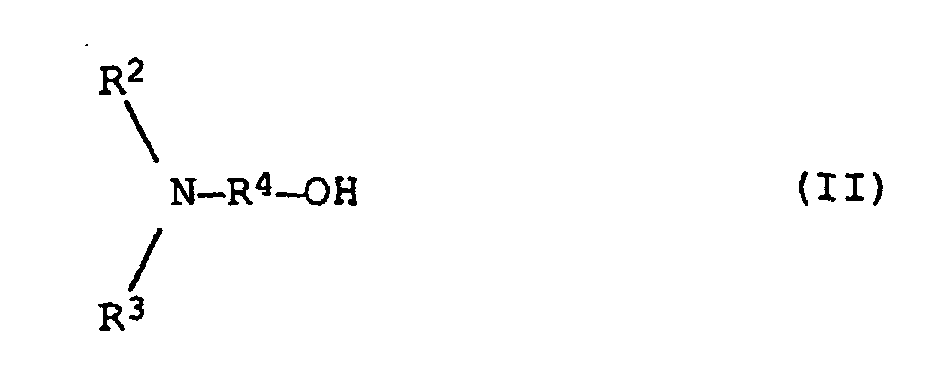
- R2 und R3
- lineares oder verzweigtes C1- bis C20-Alkyl, insbesondere C1- bis C5-Alkyl, bedeuten oder zusammen mit dem N-Atom einen fünf- oder sechsgliedrigen Ring bilden, der noch ein O-Atom oder ein tertiäres N-Atom enthalten kann, insbesondere einen Piperidin-, Morpholin-, Piperazin-, Pyrrolidin-, Oxazolin- oder Dihydrooxazin-Ring, wobei die Reste R2 und R3 noch zusätzlich Hydroxylgruppen, insbesondere jeweils eine Hydroxylgruppe, tragen können, und
- R4
- eine C2- bis C10-Alkylengruppe, insbesondere eine C2- bis C6-Alkylengruppe, die linear oder verzweigt sein kann, bezeichnet,
- R 2 and R 3
- are linear or branched C 1 - to C 20 -alkyl, in particular C 1 - to C 5 -alkyl, or form together with the N atom a five- or six-membered ring which is also an O atom or a tertiary N atom may contain, in particular a piperidine, morpholine, piperazine, pyrrolidine, oxazoline or dihydrooxazine ring, where the radicals R 2 and R 3 may additionally carry hydroxyl groups, in particular in each case one hydroxyl group, and
- R 4
- denotes a C 2 to C 10 alkylene group, in particular a C 2 to C 6 alkylene group, which can be linear or branched,
Als Aminoalkohole II eignen sich vor allem N-Methyldiethanolamin, N-Methyldi(iso)propanolamin, N-Butyldiethanolamin, N-Butyldi(iso)propanolamin, N-Stearyldiethanolamin, N-Stearyldi(iso)propanolamin, N,N-Dimethylethanolamin, N,N-Dimethyl(iso)propanolamin, N,N-Diethylethanolamin, N,N-Diethyl(iso)propanolamin, N,N-Dibutylethanolamin, N,N-Dibutyl(iso)propanolamin, Triethanolamin, Tri(iso)propanolamin, N-(2-Hydroxyethyl)morpholin, N-(2-Hydroxylpropyl)morpholin, N-(2-Hydroxyethyl)piperidin, N-(2-Hydroxypropyl)piperidin, N-Methyl-N'-(2-hydroxyethyl)piperazin, N-Methyl-N'-(2-hydroxypropyl)piperazin, N-Methyl-N'-(4-hydroxybutyl)piperazin, 2-Hydroxyethyl-oxazolin, 2-Hydroxypropyl-oxazolin, 3-Hydroxypropyl-oxazolin, 2-Hydroxyethyl-dihydrooxazin, 2-Hydroxypropyl-dihydrooxazin oder 3-Hydroxypropyl-dihydrooxazin.Particularly suitable amino alcohols II are N-methyldiethanolamine, N-methyldi (iso) propanolamine, N-butyldiethanolamine, N-butyldi (iso) propanolamine, N-stearyldiethanolamine, N-stearyldi (iso) propanolamine, N, N-dimethylethanolamine, N, N-dimethyl (iso) propanolamine, N, N-diethylethanolamine, N, N-diethyl (iso) propanolamine, N, N-dibutylethanolamine, N, N-dibutyl (iso) propanolamine, triethanolamine, tri (iso) propanolamine, N- (2-hydroxyethyl) morpholine, N- (2-hydroxypropyl) morpholine, N- (2-hydroxyethyl) piperidine, N- (2-hydroxypropyl) piperidine, N-methyl-N '- (2-hydroxyethyl) piperazine, N-methyl-N' - (2-hydroxypropyl) piperazine, N-methyl-N '- (4-hydroxybutyl) piperazine, 2-hydroxyethyl-oxazoline, 2-hydroxypropyl oxazoline, 3-hydroxypropyl oxazoline, 2-hydroxyethyl dihydrooxazine, 2-hydroxypropyl dihydrooxazine or 3-hydroxypropyl dihydrooxazine.
Weiterhin kommen als derartige NCO-reaktive Verbindungen mit tertiären
Stickstoffatomen vorzugsweise Diamine der allgemeinen Formel
IIIa oder IIIb

Als Diamine IIIa eignen sich vor allem N,N-Dimethyl-ethylendiamin, N,N-Diethyl-ethylendiamin, N,N-Dimethyl-1,3-diamino-2,2-dimethylpropan, N,N-Diethyl-1,3-propylendiamin, N-(3-Aminopropyl)morpholin, N-(2-Aminopropyl)morpholin, N-(3-Aminopropyl)piperidin, N-(2-Aminopropyl)piperidin, 4-Amino-1-(N,N-diethylamino)pentan, 2-Amino-1-(N,N-dimethylamino)propan, 2-Amino-1-(N,N-diethylamino)propan oder 2-Amino-1- (N,N-dimethylamino)-2-methylpropan.Particularly suitable diamines IIIa are N, N-dimethylethylenediamine, N, N-diethyl-ethylenediamine, N, N-dimethyl-1,3-diamino-2,2-dimethylpropane, N, N-diethyl-1,3-propylenediamine, N- (3-aminopropyl) morpholine, N- (2-aminopropyl) morpholine, N- (3-aminopropyl) piperidine, N- (2-aminopropyl) piperidine, 4-amino-1- (N, N-diethylamino) pentane, 2-amino-1- (N, N-dimethylamino) propane, 2-amino-1- (N, N-diethylamino) propane or 2-amino-1- (N, N-dimethylamino) -2-methylpropane.
Als Diamine IIIb eignen sich vor allem N,N,N'-Trimethyl-ethylendiamin, N,N,N'-Triethyl-ethylendiamin, N-Methylpiperazin oder N-Ethylpiperazin.Particularly suitable diamines IIIb are N, N, N'-trimethylethylenediamine, N, N, N'-triethylethylenediamine, N-methylpiperazine or N-ethyl piperazine.
Weiterhin können als NCO-reaktive Verbindungen auch Polyether(poly)ole mit eingebauten tertiären Stickstoffatomen, die durch Propoxylierung und/oder Ethoxylierung von Aminstickstoff aufweisenden Startermolekülen herstellbar sind, eingesetzt werden. Derartige Polyether(poly)ole sind beispielsweise die Propoxylierungs- und Ethoxylierungsprodukte von Ammoniak, Ethanolamin, Diethanolamin, Ethylendiamin oder N-Methylanilin.Furthermore, polyether (poly) oles can also be used as NCO-reactive compounds with built-in tertiary nitrogen atoms, the by propoxylation and / or ethoxylation of amine nitrogen having starter molecules can be produced, are used. Such polyether (poly) ole are, for example, the propoxylation and ethoxylation products of ammonia, ethanolamine, Diethanolamine, ethylenediamine or N-methylaniline.
Andere verwendbare NCO-reaktive Verbindungen sind tertiäre Stickstoffatome aufweisende Polyester- und Polyamidharze, tertiäre Stickstoffatome aufweisende urethangruppenhaltige Polyole sowie tertiäre Stickstoffatome aufweisende Polyhydroxypolyacrylate.Other NCO-reactive compounds that can be used are tertiary nitrogen atoms containing polyester and polyamide resins, tertiary Urethane group-containing polyols containing nitrogen atoms and Polyhydroxypolyacrylates containing tertiary nitrogen atoms.
Die beschriebenen Diisocyanate und/oder höher funktionalisierten Polyisocyanate können auch mit einer Mischung aus nicht-ionisch hydrophil modifizierenden und kationisch hydrophil modifizierenden Verbindungen, welche nacheinander oder gleichzeitig zugegeben werden, umgesetzt werden, beispielsweise mit einem Unterschuß aus den Polyethern I und den Aminoalkoholen II oder den Diaminen IIIa bzw. IIIb. Auch Mischungen aus nichtionisch hydrophil modifizierenden und anionisch hydrophil modifizierenden Verbindungen sind möglich.The described diisocyanates and / or more functionalized Polyisocyanates can also be mixed with a non-ionic hydrophilically modifying and cationically hydrophilically modifying Compounds that are added sequentially or simultaneously are implemented, for example with a deficit the polyethers I and the amino alcohols II or the diamines IIIa or IIIb. Mixtures of non-ionically hydrophilic modifiers and are anionically hydrophilic modifying compounds possible.
Die aufgezählten Arten kationisch hydrophil modifizierter Polyisocyanate sind in den Schriften DE-A 42 03 510 und EP-A 531 820 näher beschrieben.The listed types of cationically hydrophilic modified polyisocyanates are in the documents DE-A 42 03 510 and EP-A 531 820 described in more detail.
Die beschriebenen hydrophil modifizierten Polyisocyanate können in die erfindungsgemäß einzusetzenden Druckpasten in unverdünnter Form oder in inerten organischen Lösungsmitteln gelöst eingearbeitet werden. Hierfür geeignete Lösungsmittel sind beispielsweise in der DE-A 35 21 618 und in der deutschen Patentanmeldung P 44 29 446.8 beschrieben. Insbesondere kommen als derartige inerte organische Lösungsmittel Ethylacetat, Aceton, Methylethylketon, Kohlensäureester wie Diethylcarbonat, 1,2-Ethylencarbonat oder 1,2-Proplyencarbonat sowie Lactone wie β-Propiolacton γ-Butyrolacton oder ε-Caprolacton in Betracht.The hydrophilically modified polyisocyanates described can in the printing pastes to be used according to the invention in undiluted Form or dissolved in inert organic solvents become. Suitable solvents are, for example in DE-A 35 21 618 and in the German patent application P 44 29 446.8. Inert come in particular as such organic solvents ethyl acetate, acetone, methyl ethyl ketone, Carbonic acid esters such as diethyl carbonate, 1,2-ethylene carbonate or 1,2-propylene carbonate and lactones such as β-propiolactone γ-butyrolactone or ε-caprolactone into consideration.
Als Bindemittel eignen sich insbesondere Polyacrylate oder Polyurethane oder Mischungen hieraus. Als Polyacrylate kommen hierbei beispielsweise Polyacrylsäuren, Polymethacrylsäuren, Copolymerisate aus Acryl- oder Methacrylsäure und Acryl- oder Methacrylsäureestern, Copolymerisate aus Acrylamid und Acrylsäure und Copolymerisate aus Acrylamid und Hydroxyalkylacrylaten in Betracht. Als Polyurethane kommen hierbei beispielsweise solche, wie sie in der DE-A 26 45 779 und der US-A 4 092 286 beschrieben sind, in Betracht. Die verwendeten Bindemittel werden üblicherweise als wäßrige Dispersionen eingesetzt.Polyacrylates or polyurethanes are particularly suitable as binders or mixtures thereof. Here come as polyacrylates for example polyacrylic acids, polymethacrylic acids, copolymers from acrylic or methacrylic acid and acrylic or methacrylic acid esters, Copolymers of acrylamide and acrylic acid and Copolymers of acrylamide and hydroxyalkyl acrylates into consideration. Examples of polyurethanes here are as described in DE-A 26 45 779 and US-A 4 092 286 are considered. The binders used are usually used as aqueous dispersions.
Die erfindungsgemäß einzusetzenden Farbhaltemittel können darüber hinaus noch für Druckpasten übliche Hilfsmittel enthalten, so vor allem Verdickungsmittel, Netzmittel oder Konservierungsmittel.The color retention agents to be used according to the invention can also be used also contain usual auxiliaries for printing pastes, so before all thickeners, wetting agents or preservatives.
Als Verdickungsmittel werden vorzugsweise solche eingesetzt, die elektrolytstabil und gut auswaschbar sind. Dabei können sowohl Verdickungsmittel auf natürlicher Basis, z.B. Alginate, als auch solche auf synthetischer Basis verwendet werden.Preferred thickeners are those which are stable to electrolytes and can be easily washed out. Both Natural-based thickeners, e.g. Alginates, as well those used on a synthetic basis.
Die erfindungsgemäß einzusetzenden Farbhaltemittel liegen üblicherweise als farblose Druckpasten vor. Sie sind vorzugsweise wie folgt zusammengesetzt:
- 0,5 bis 30 Gew.-%,
- vorzugsweise 1 bis 10 Gew.-% hydrophil modifiziertes Polyisocyanat
- 5 bis 95 Gew.-%,
- vorzugsweise 8 bis 25 Gew.-%, bezogen auf den Polymergehalt, Polyacrylat und/oder Polyurethan als Bindemittel
- 0,5 bis 10 Gew.-%,
- vorzugsweise 1 bis 7 Gew.-% übliches Verdikkungsmittel
- 0 bis 20 Gew.-%,
- vorzugsweise 0 bis 10 Gew.-% weitere übliche Hilfsmittel
- 0 bis 90 Gew.-%,
- vorzugsweise 1 bis 85 Gew.-% Wasser und/oder inerte organische Lösungsmittel.
- 0.5 to 30% by weight,
- preferably 1 to 10% by weight of hydrophilically modified polyisocyanate
- 5 to 95% by weight,
- preferably 8 to 25 wt .-%, based on the polymer content, polyacrylate and / or polyurethane as a binder
- 0.5 to 10% by weight,
- preferably 1 to 7% by weight of conventional thickener
- 0 to 20% by weight,
- preferably 0 to 10% by weight of other customary auxiliaries
- 0 to 90% by weight,
- preferably 1 to 85% by weight of water and / or inert organic solvents.
Unter Textilien bzw. Textilmaterial sind hier sowohl Gewebe als auch daraus hergestellte Kleidungsstücke zu verstehen.Under textiles or textile material here are both fabrics and also understand garments made from it.
In einer bevorzugten Ausführungsform wird das erfindungsgemäße Verfahren bei mit Indigo gefärbtem Textilmaterial angewandt. Hierbei handelt es sich in der Regel um Baumwolltextilien (Denim). Aber auch auf mit anderen Küpenfarbstoffen gefärbten Textilien aus Baumwolle oder baumwollhaltigem Material können nach dem erfindungsgemäßen Verfahren mit hervorragenden Resultaten Muster erzeugt werden.In a preferred embodiment, the invention Process applied to textile material dyed with indigo. These are usually cotton textiles (denim). But also on textiles dyed with other vat dyes made of cotton or cotton-containing material can according to the Process according to the invention with excellent results pattern be generated.
Das Auswaschen des Farbstoffes an den nicht bedruckten Stellen erfolgt vollständig oder teilweise, d.h. im letzten Fall tritt eine Aufhellung der Färbung gegenüber den bedruckten Stellen auf, so daß das Muster deutlich hervortritt. Je nach Grad des Auswaschens ist diese Aufhellung mehr oder weniger stark. Im Fall von mit Indigo gefärbten Baumwoll-Textilien wird eine Aufhellung der nicht bedruckten Stellen beispielsweise durch Waschen mit Steinen oder Sand erzeugt. Man kann das Auswaschen des Farbstoffes aber prinzipiell auch durch Behandlung mit Enzymen oder mit Reduktionsmitteln vornehmen, wobei hierbei eine vollständige Entfernung des Farbstoffes an den nicht bedruckten Stellen erfolgen kann.Washing out the dye on the unprinted areas takes place completely or partially, i.e. in the latter case occurs a lightening of the color compared to the printed areas, so that the pattern stands out clearly. Depending on the degree of washing out this brightening is more or less strong. In case of with indigo-dyed cotton textiles will brighten the unprinted areas, for example by washing with stones or sand. You can wash out the dye in principle also by treatment with enzymes or with reducing agents make a complete removal of the dye at the non-printed areas.
Das Bedrucken des gefärbten Textilmaterials mit den beschriebenen Farbhaltemitteln, das Auswaschen des Farbstoffes und gegebenenfalls zwischen - oder nachgeschaltete Trockenschritte geschehen normalerweise in den üblichen Apparaturen und nach den üblichen Techniken. The printing of the dyed textile material with the described Coloring agents, washing out the dye and, if necessary intermediate or downstream drying steps occur usually in the usual equipment and after the usual Techniques.
Das erfindungsgemäße Verfahren erlaubt es, gemusterte Textilien, insbesondere mit Indigo gefärbte Baumwoll-Textilien, durch eine einfache, materialschonende und energiersparende Arbeitsweise herzustellen, denn es sind keine thermischen Fixierungsschritte notwendig. Das Textilmaterial braucht nur einmal eingefärbt zu werden, eine zusätzliche Farbstoffapplikation, etwa nach dem Bedrucken mit dem Farbhaltemittel, ist nicht erforderlich. Es war überraschend, daß die vorzugsweise eingesetzten Mischungen aus hydrophil modifizierten Polyisocyanaten und Bindemitteln selbst beim Waschen unter drastischer mechanische Beanspruchung (Steine, Sand) eine derartige Waschpermanenz aufweisen und den Farbstoff auf den bedruckten Stellen praktisch ohne Echtheitseinbußen halten.The method according to the invention allows patterned textiles, especially with cotton fabrics dyed with indigo simple, gentle and energy-saving way of working to manufacture, because there are no thermal fixing steps necessary. The textile material only needs to be dyed once an additional dye application, for example after printing with the colorant, is not necessary. It was Surprisingly, that the mixtures preferably used hydrophilically modified polyisocyanates and binders themselves when washing under drastic mechanical stress (stones, Sand) have such a washing permanence and the dye on the printed areas practically without loss of authenticity hold.
Durch Aufdrucken einer farblosen Druckpaste aus
wurde auf üblichem indigogefärbten Baumwollgewebe ein nicht sichtbares Muster erzeugt. Anschließend wurde das Gewebe in einem üblichen Stoneprozeß gewaschen. An den bedruckten Stellen blieb der originale Farbton erhalten, an den nicht bedruckten Stellen trat eine Aufhellung auf, so daß das Muster deutlich sichtbar wurde. Dabei war die Abgrenzung zwischen bedruckten und nicht bedruckten Stellen ausreichend scharf.did not become a common indigo-dyed cotton fabric creates a visible pattern. Then the tissue was in one usual stone process washed. Stuck in the printed areas preserve the original color in the unprinted areas lightening occurred so that the pattern was clearly visible has been. The distinction was made between printed and unprinted Focus sufficiently.
Das oben genannte nicht-ionisch hydrophil modifizierte Polyisocyanat war nach folgender Herstellvorschrift (gemäß Beispiel 8 der DE-A 40 36 927) erhalten werden:The above non-ionically hydrophilically modified polyisocyanate was according to the following manufacturing instructions (according to Example 8 DE-A 40 36 927) can be obtained:
Zu 150 g (0,3 mol) eines auf Methanol gestarteten, monofunktionellen Polyethylenoxid-Polyethers mit einem Molekulargewicht von 500 g/mol wurden bei 60°C 25 g (0,15 mol) Hexamethylendiisocyanat gegeben und 30 min gerührt. Nach dieser Zeit betrug der NCO-Gehalt < 0,05 Gew.-%. Dann wurde auf 30°C gekühlt und es wurden 900 g eines Biuretpolyisocyanats auf Basis von Hexamethylendiisocyanat, welches im wesentlichen aus N,N',N"-Tris(6-isocyanatohexyl)-biuret und dessen höheren Homologen bestand, mit einem NCO-Gehalt von 21,9 %, einem Gehalt an monomerem Hexamethylendiisocyanat von weniger als 0,5 Gew.-%, einer Viskosität bei 23°C von 2,9 Pa·s und einer mittleren NCO-Funktionalität von 3,3 eingerührt. Nach Abkühlen erhielt man ein klares Harz mit einem NCO-Gehalt von 18,1 Gew.-% und einer Viskosität bei 23°C von 3900 mPa·s.To 150 g (0.3 mol) of a monofunctional one started on methanol Polyethylene oxide polyether with a molecular weight of 500 g / mol became 25 g (0.15 mol) hexamethylene diisocyanate at 60 ° C given and stirred for 30 min. After this time, the NCO content was <0.05% by weight. Then it was cooled to 30 ° C and it was 900 g of a biuret polyisocyanate based on hexamethylene diisocyanate, which essentially consists of N, N ', N "-Tris (6-isocyanatohexyl) biuret and whose higher homologues existed with an NCO content of 21.9%, a content of monomeric hexamethylene diisocyanate less than 0.5% by weight, a viscosity at 23 ° C of 2.9 Pa · s and an average NCO functionality of 3.3 stirred. After cooling, a clear resin was obtained an NCO content of 18.1 wt .-% and a viscosity at 23 ° C of 3900 mPas.
Claims (5)
- A process for producing patterned textiles, characterized in that vat-dyed cotton textiles or cotton-containing material is printed with a color preserver which is composed ofand then the dye is washed out of the unprinted areas to produce the pattern.0.5 to 30% by weight, preferably 1 to 10% by weight, of hydrophilic modified polyisocyanate,5 to 95% by weight, preferably 8 to 25% by weight, based on the polymer content, of polyacrylate and/or polyurethane as binder,0.5 to 10% by weight, preferably 1 to 7% by weight, of customary thickener,0 to 20% by weight, preferably 0 to 10% by weight, of further customary auxiliaries,0 to 90% by weight, preferably 1 to 85% by weight, of water and/or inert organic solvents,
- A process as claimed in claim 1, characterized in that the hydrophilic modified polyisocyanate used is nonionic.
- A process as claimed in claim 2, characterized in that the nonionic hydrophilic modified polyisocyanate used contains, as built-in units, hydroxyl-terminated polyethers of the general formula I
- R1
- is C1-C20-alkyl or C2-C20-alkenyl, cyclopentyl, cyclohexyl, glycidyl, oxethyl, phenyl, tolyl, benzyl, furfuryl or tetrahydrofurfuryl,
- X
- is sulfur or oxygen,
- A
- is propylene or ethylene, and
- n
- is from 5 to 120.
- A process as claimed in any of claims 1 to 3, characterized in that the hydrophilic modified polyisocyanate used is based on an aliphatic diisocyanate and an aliphatic higher functionalized polyisocyanate.
- A process as claimed in any of claims 1 to 4, characterized in that the vat-dyed cotton textiles or cotton-containing material are indigo-dyed cotton textiles (denim).
Applications Claiming Priority (2)
| Application Number | Priority Date | Filing Date | Title |
|---|---|---|---|
| DE19501055A DE19501055A1 (en) | 1995-01-16 | 1995-01-16 | Process for the production of patterned textiles |
| DE19501055 | 1995-01-16 |
Publications (3)
| Publication Number | Publication Date |
|---|---|
| EP0726352A2 EP0726352A2 (en) | 1996-08-14 |
| EP0726352A3 EP0726352A3 (en) | 1998-05-20 |
| EP0726352B1 true EP0726352B1 (en) | 2003-05-07 |
Family
ID=7751559
Family Applications (1)
| Application Number | Title | Priority Date | Filing Date |
|---|---|---|---|
| EP96100202A Expired - Lifetime EP0726352B1 (en) | 1995-01-16 | 1996-01-09 | Process for producing patterned textiles |
Country Status (4)
| Country | Link |
|---|---|
| EP (1) | EP0726352B1 (en) |
| DE (2) | DE19501055A1 (en) |
| ES (1) | ES2199263T3 (en) |
| PT (1) | PT726352E (en) |
Families Citing this family (4)
| Publication number | Priority date | Publication date | Assignee | Title |
|---|---|---|---|---|
| DE102011115882A1 (en) * | 2011-10-12 | 2013-04-18 | Freshtex Worldwide Textile-Service Gmbh | Coloring garment having seam that is surrounded with fabric region, comprises applying coloring mixture comprising binding agent and color pigment containing coloring agent, on portion of seam, and fixing coloring mixture |
| CN102758362A (en) * | 2012-07-25 | 2012-10-31 | 晋江龙之族工贸发展有限公司 | Invisible printing adhesive and printing process thereof |
| CN107205390A (en) | 2015-01-29 | 2017-09-26 | 巴斯夫欧洲公司 | Herbicidal phenylpyridines |
| CN106120381B (en) * | 2016-07-27 | 2018-08-14 | 常州大学 | It is a kind of to prepare the technique for imitating old style fabric based on bipseudoindoxyl dye pad dyeing |
Family Cites Families (2)
| Publication number | Priority date | Publication date | Assignee | Title |
|---|---|---|---|---|
| DE1619670A1 (en) * | 1951-01-28 | 1971-02-25 | Bayer Ag | Process for printing textile fabrics using transparent printing |
| DE4217716A1 (en) * | 1992-05-29 | 1993-12-02 | Bayer Ag | Crosslinker for textile printing binders |
-
1995
- 1995-01-16 DE DE19501055A patent/DE19501055A1/en not_active Withdrawn
-
1996
- 1996-01-09 ES ES96100202T patent/ES2199263T3/en not_active Expired - Lifetime
- 1996-01-09 EP EP96100202A patent/EP0726352B1/en not_active Expired - Lifetime
- 1996-01-09 PT PT96100202T patent/PT726352E/en unknown
- 1996-01-09 DE DE59610411T patent/DE59610411D1/en not_active Expired - Lifetime
Also Published As
| Publication number | Publication date |
|---|---|
| PT726352E (en) | 2003-09-30 |
| EP0726352A2 (en) | 1996-08-14 |
| EP0726352A3 (en) | 1998-05-20 |
| DE19501055A1 (en) | 1996-07-18 |
| ES2199263T3 (en) | 2004-02-16 |
| DE59610411D1 (en) | 2003-06-12 |
Similar Documents
| Publication | Publication Date | Title |
|---|---|---|
| EP1379724B1 (en) | Use of hydrophilically modified polyisocyanates and polyurethanes as crease-proofing additive for domestic applications | |
| DE4217716A1 (en) | Crosslinker for textile printing binders | |
| CH705566A2 (en) | Polyurethane derivatives, compositions thereof, and coloring additives comprising the polyurethane derivatives. | |
| EP0726352B1 (en) | Process for producing patterned textiles | |
| DE10245209A1 (en) | recording fluids | |
| JP7158663B2 (en) | Fiber or Leather Crosslinkers, Treatments, and Structures | |
| EP0758417B1 (en) | Use of hydrophilically modified polyisocyanates in the field of textiles | |
| EP0985747B1 (en) | Process for manufacturing cellulosic fibres | |
| EP1184400A1 (en) | Aromatic polyisocyanates blocked with pyrazole or pyrazole derivatives, process for their preparation and their use | |
| DE2524243A1 (en) | PROCESS FOR DYING AND PRINTING CELLULOSE FIBERS OR MIXTURES OF CELLULOSE FIBERS WITH SYNTHETIC FIBERS | |
| EP1137840A2 (en) | Permanent agent for finishing fibres or fibre-based products | |
| DE1495830B2 (en) | METHOD FOR PREPARING SOLUTIONS OF POLYURETHANE ELASTOMERS | |
| DE3816699A1 (en) | METHOD FOR TREATING DYED TEXTILE MATERIALS | |
| EP2162582A2 (en) | Aqueous formulations and the use thereof for coloring or coating substrates | |
| DE2058502C3 (en) | Polyurethane elastomers | |
| DE10149268A1 (en) | New polyurethane block copolymers with hydrophilic end groups, used in crosslinkable dispersion binder systems for pigment preparations, especially ink for ink-jet printing | |
| DE19537240A1 (en) | Stabilisation of dyed textile against yellowing in air, useful for yarn or fabric of cellulose or mixed fibre, etc. | |
| DE4430165A1 (en) | Hydrophilically modified poly-isocyanate(s) | |
| DE4415449A1 (en) | Hydrophilically modified poly-isocyanate(s) | |
| DE2657140B2 (en) | Dye preparations | |
| DE1494610A1 (en) | Process for the production of elastic threads and fibers with improved dyeing properties | |
| DE1494613C3 (en) | Process for the production of crosslinked rubber elastic threads and fibers | |
| DE19743457A1 (en) | Biodegradable binders for dyeing | |
| DE19533218A1 (en) | Hydrophilic modified poly:isocyanate use as curing agent during sizing and opt. dyeing with indigo | |
| EP1005584A1 (en) | Wool with a non-felting finish and self-dispersing isocyanates therefor |
Legal Events
| Date | Code | Title | Description |
|---|---|---|---|
| PUAI | Public reference made under article 153(3) epc to a published international application that has entered the european phase |
Free format text: ORIGINAL CODE: 0009012 |
|
| AK | Designated contracting states |
Kind code of ref document: A2 Designated state(s): BE DE ES GB IT PT |
|
| PUAL | Search report despatched |
Free format text: ORIGINAL CODE: 0009013 |
|
| AK | Designated contracting states |
Kind code of ref document: A3 Designated state(s): BE DE ES GB IT PT |
|
| 17P | Request for examination filed |
Effective date: 19980422 |
|
| 17Q | First examination report despatched |
Effective date: 20000121 |
|
| GRAH | Despatch of communication of intention to grant a patent |
Free format text: ORIGINAL CODE: EPIDOS IGRA |
|
| GRAH | Despatch of communication of intention to grant a patent |
Free format text: ORIGINAL CODE: EPIDOS IGRA |
|
| GRAA | (expected) grant |
Free format text: ORIGINAL CODE: 0009210 |
|
| AK | Designated contracting states |
Designated state(s): BE DE ES GB IT PT |
|
| REG | Reference to a national code |
Ref country code: GB Ref legal event code: FG4D Free format text: NOT ENGLISH |
|
| REF | Corresponds to: |
Ref document number: 59610411 Country of ref document: DE Date of ref document: 20030612 Kind code of ref document: P |
|
| GBT | Gb: translation of ep patent filed (gb section 77(6)(a)/1977) | ||
| REG | Reference to a national code |
Ref country code: PT Ref legal event code: SC4A Free format text: AVAILABILITY OF NATIONAL TRANSLATION Effective date: 20030807 |
|
| PGFP | Annual fee paid to national office [announced via postgrant information from national office to epo] |
Ref country code: GB Payment date: 20040107 Year of fee payment: 9 |
|
| PGFP | Annual fee paid to national office [announced via postgrant information from national office to epo] |
Ref country code: PT Payment date: 20040122 Year of fee payment: 9 Ref country code: DE Payment date: 20040122 Year of fee payment: 9 |
|
| PGFP | Annual fee paid to national office [announced via postgrant information from national office to epo] |
Ref country code: ES Payment date: 20040123 Year of fee payment: 9 |
|
| REG | Reference to a national code |
Ref country code: ES Ref legal event code: FG2A Ref document number: 2199263 Country of ref document: ES Kind code of ref document: T3 |
|
| PLBE | No opposition filed within time limit |
Free format text: ORIGINAL CODE: 0009261 |
|
| STAA | Information on the status of an ep patent application or granted ep patent |
Free format text: STATUS: NO OPPOSITION FILED WITHIN TIME LIMIT |
|
| PGFP | Annual fee paid to national office [announced via postgrant information from national office to epo] |
Ref country code: BE Payment date: 20040409 Year of fee payment: 9 |
|
| 26N | No opposition filed |
Effective date: 20040210 |
|
| PG25 | Lapsed in a contracting state [announced via postgrant information from national office to epo] |
Ref country code: IT Free format text: LAPSE BECAUSE OF NON-PAYMENT OF DUE FEES;WARNING: LAPSES OF ITALIAN PATENTS WITH EFFECTIVE DATE BEFORE 2007 MAY HAVE OCCURRED AT ANY TIME BEFORE 2007. THE CORRECT EFFECTIVE DATE MAY BE DIFFERENT FROM THE ONE RECORDED. Effective date: 20050109 Ref country code: GB Free format text: LAPSE BECAUSE OF NON-PAYMENT OF DUE FEES Effective date: 20050109 |
|
| PG25 | Lapsed in a contracting state [announced via postgrant information from national office to epo] |
Ref country code: ES Free format text: LAPSE BECAUSE OF NON-PAYMENT OF DUE FEES Effective date: 20050110 |
|
| PG25 | Lapsed in a contracting state [announced via postgrant information from national office to epo] |
Ref country code: BE Free format text: LAPSE BECAUSE OF NON-PAYMENT OF DUE FEES Effective date: 20050131 |
|
| PG25 | Lapsed in a contracting state [announced via postgrant information from national office to epo] |
Ref country code: DE Free format text: LAPSE BECAUSE OF THE APPLICANT RENOUNCES Effective date: 20050223 |
|
| PG25 | Lapsed in a contracting state [announced via postgrant information from national office to epo] |
Ref country code: PT Free format text: LAPSE BECAUSE OF NON-PAYMENT OF DUE FEES Effective date: 20050711 |
|
| BERE | Be: lapsed |
Owner name: *BASF A.G. Effective date: 20050131 |
|
| GBPC | Gb: european patent ceased through non-payment of renewal fee |
Effective date: 20050109 |
|
| REG | Reference to a national code |
Ref country code: PT Ref legal event code: MM4A Effective date: 20050711 |
|
| REG | Reference to a national code |
Ref country code: ES Ref legal event code: FD2A Effective date: 20050110 |
|
| BERE | Be: lapsed |
Owner name: *BASF A.G. Effective date: 20050131 |