EP0726460B1 - A method of characterizing hydrocarbon feeds and products using infra-red spectra - Google Patents
A method of characterizing hydrocarbon feeds and products using infra-red spectra Download PDFInfo
- Publication number
- EP0726460B1 EP0726460B1 EP96300754A EP96300754A EP0726460B1 EP 0726460 B1 EP0726460 B1 EP 0726460B1 EP 96300754 A EP96300754 A EP 96300754A EP 96300754 A EP96300754 A EP 96300754A EP 0726460 B1 EP0726460 B1 EP 0726460B1
- Authority
- EP
- European Patent Office
- Prior art keywords
- ring
- lumps
- aromatics
- spectra
- feed
- Prior art date
- Legal status (The legal status is an assumption and is not a legal conclusion. Google has not performed a legal analysis and makes no representation as to the accuracy of the status listed.)
- Expired - Lifetime
Links
- 0 CC(C1)(C(C*C2C=C(CC3[C@@]4(*5)*3CC5CCC4)C2)*C2)C2CC1C1=CC=C1 Chemical compound CC(C1)(C(C*C2C=C(CC3[C@@]4(*5)*3CC5CCC4)C2)*C2)C2CC1C1=CC=C1 0.000 description 1
Images








Classifications
-
- G—PHYSICS
- G01—MEASURING; TESTING
- G01N—INVESTIGATING OR ANALYSING MATERIALS BY DETERMINING THEIR CHEMICAL OR PHYSICAL PROPERTIES
- G01N33/00—Investigating or analysing materials by specific methods not covered by groups G01N1/00 - G01N31/00
- G01N33/26—Oils; Viscous liquids; Paints; Inks
- G01N33/28—Oils, i.e. hydrocarbon liquids
- G01N33/2829—Mixtures of fuels
-
- C—CHEMISTRY; METALLURGY
- C10—PETROLEUM, GAS OR COKE INDUSTRIES; TECHNICAL GASES CONTAINING CARBON MONOXIDE; FUELS; LUBRICANTS; PEAT
- C10G—CRACKING HYDROCARBON OILS; PRODUCTION OF LIQUID HYDROCARBON MIXTURES, e.g. BY DESTRUCTIVE HYDROGENATION, OLIGOMERISATION, POLYMERISATION; RECOVERY OF HYDROCARBON OILS FROM OIL-SHALE, OIL-SAND, OR GASES; REFINING MIXTURES MAINLY CONSISTING OF HYDROCARBONS; REFORMING OF NAPHTHA; MINERAL WAXES
- C10G11/00—Catalytic cracking, in the absence of hydrogen, of hydrocarbon oils
- C10G11/14—Catalytic cracking, in the absence of hydrogen, of hydrocarbon oils with preheated moving solid catalysts
- C10G11/18—Catalytic cracking, in the absence of hydrogen, of hydrocarbon oils with preheated moving solid catalysts according to the "fluidised-bed" technique
- C10G11/187—Controlling or regulating
-
- G—PHYSICS
- G01—MEASURING; TESTING
- G01N—INVESTIGATING OR ANALYSING MATERIALS BY DETERMINING THEIR CHEMICAL OR PHYSICAL PROPERTIES
- G01N21/00—Investigating or analysing materials by the use of optical means, i.e. using sub-millimetre waves, infrared, visible or ultraviolet light
- G01N21/17—Systems in which incident light is modified in accordance with the properties of the material investigated
- G01N21/25—Colour; Spectral properties, i.e. comparison of effect of material on the light at two or more different wavelengths or wavelength bands
- G01N21/31—Investigating relative effect of material at wavelengths characteristic of specific elements or molecules, e.g. atomic absorption spectrometry
- G01N21/35—Investigating relative effect of material at wavelengths characteristic of specific elements or molecules, e.g. atomic absorption spectrometry using infrared light
-
- G—PHYSICS
- G01—MEASURING; TESTING
- G01N—INVESTIGATING OR ANALYSING MATERIALS BY DETERMINING THEIR CHEMICAL OR PHYSICAL PROPERTIES
- G01N33/00—Investigating or analysing materials by specific methods not covered by groups G01N1/00 - G01N31/00
- G01N33/26—Oils; Viscous liquids; Paints; Inks
- G01N33/28—Oils, i.e. hydrocarbon liquids
- G01N33/2835—Specific substances contained in the oils or fuels
-
- Y—GENERAL TAGGING OF NEW TECHNOLOGICAL DEVELOPMENTS; GENERAL TAGGING OF CROSS-SECTIONAL TECHNOLOGIES SPANNING OVER SEVERAL SECTIONS OF THE IPC; TECHNICAL SUBJECTS COVERED BY FORMER USPC CROSS-REFERENCE ART COLLECTIONS [XRACs] AND DIGESTS
- Y10—TECHNICAL SUBJECTS COVERED BY FORMER USPC
- Y10T—TECHNICAL SUBJECTS COVERED BY FORMER US CLASSIFICATION
- Y10T436/00—Chemistry: analytical and immunological testing
- Y10T436/11—Automated chemical analysis
- Y10T436/117497—Automated chemical analysis with a continuously flowing sample or carrier stream
-
- Y—GENERAL TAGGING OF NEW TECHNOLOGICAL DEVELOPMENTS; GENERAL TAGGING OF CROSS-SECTIONAL TECHNOLOGIES SPANNING OVER SEVERAL SECTIONS OF THE IPC; TECHNICAL SUBJECTS COVERED BY FORMER USPC CROSS-REFERENCE ART COLLECTIONS [XRACs] AND DIGESTS
- Y10—TECHNICAL SUBJECTS COVERED BY FORMER USPC
- Y10T—TECHNICAL SUBJECTS COVERED BY FORMER US CLASSIFICATION
- Y10T436/00—Chemistry: analytical and immunological testing
- Y10T436/12—Condition responsive control
-
- Y—GENERAL TAGGING OF NEW TECHNOLOGICAL DEVELOPMENTS; GENERAL TAGGING OF CROSS-SECTIONAL TECHNOLOGIES SPANNING OVER SEVERAL SECTIONS OF THE IPC; TECHNICAL SUBJECTS COVERED BY FORMER USPC CROSS-REFERENCE ART COLLECTIONS [XRACs] AND DIGESTS
- Y10—TECHNICAL SUBJECTS COVERED BY FORMER USPC
- Y10T—TECHNICAL SUBJECTS COVERED BY FORMER US CLASSIFICATION
- Y10T436/00—Chemistry: analytical and immunological testing
- Y10T436/21—Hydrocarbon
-
- Y—GENERAL TAGGING OF NEW TECHNOLOGICAL DEVELOPMENTS; GENERAL TAGGING OF CROSS-SECTIONAL TECHNOLOGIES SPANNING OVER SEVERAL SECTIONS OF THE IPC; TECHNICAL SUBJECTS COVERED BY FORMER USPC CROSS-REFERENCE ART COLLECTIONS [XRACs] AND DIGESTS
- Y10—TECHNICAL SUBJECTS COVERED BY FORMER USPC
- Y10T—TECHNICAL SUBJECTS COVERED BY FORMER US CLASSIFICATION
- Y10T436/00—Chemistry: analytical and immunological testing
- Y10T436/21—Hydrocarbon
- Y10T436/212—Aromatic
-
- Y—GENERAL TAGGING OF NEW TECHNOLOGICAL DEVELOPMENTS; GENERAL TAGGING OF CROSS-SECTIONAL TECHNOLOGIES SPANNING OVER SEVERAL SECTIONS OF THE IPC; TECHNICAL SUBJECTS COVERED BY FORMER USPC CROSS-REFERENCE ART COLLECTIONS [XRACs] AND DIGESTS
- Y10—TECHNICAL SUBJECTS COVERED BY FORMER USPC
- Y10T—TECHNICAL SUBJECTS COVERED BY FORMER US CLASSIFICATION
- Y10T436/00—Chemistry: analytical and immunological testing
- Y10T436/21—Hydrocarbon
- Y10T436/214—Acyclic [e.g., methane, octane, isoparaffin, etc.]
-
- Y—GENERAL TAGGING OF NEW TECHNOLOGICAL DEVELOPMENTS; GENERAL TAGGING OF CROSS-SECTIONAL TECHNOLOGIES SPANNING OVER SEVERAL SECTIONS OF THE IPC; TECHNICAL SUBJECTS COVERED BY FORMER USPC CROSS-REFERENCE ART COLLECTIONS [XRACs] AND DIGESTS
- Y10—TECHNICAL SUBJECTS COVERED BY FORMER USPC
- Y10T—TECHNICAL SUBJECTS COVERED BY FORMER US CLASSIFICATION
- Y10T436/00—Chemistry: analytical and immunological testing
- Y10T436/21—Hydrocarbon
- Y10T436/214—Acyclic [e.g., methane, octane, isoparaffin, etc.]
- Y10T436/216—Unsaturated [e.g., ethylene, diene, etc.]
Definitions
- the present invention relates to a method of determining the concentration of compositional lumps in one or more fractions of a hydrocarbon feed or product.
- HPLC High Performance Liquid Chromatography
- FDMS Field-Desorption Mass Spectroscopy
- US-A-5223714 describes and claims a process for controlling the blending of a plurality of fluid components comprising in combination the steps of:
- EP-A-0706040 which was published after the application date of the present patent application and which claims an earlier priority date describes and claims a method of determining or predicting a value P x of a property of a material X or a property of a process from said material or yield of said process, which method comprises measuring the absorption D ix of said material at more than one wavelength in the region 600-2600 nm, comparing the said absorptions or a derivative thereof with absorptions D im or derivatives thereof at the same wavelength for a number of standards S in a bank for which the said property or yield P is known, and choosing from the bank at least one standard S m with property P m said standard having the smallest average value of the absolute difference at each wavelength i between the absorption D ix (or derivative thereof) for the material and the absorption D im (or derivative thereof) for the standard S m to obtain P x , with averaging of said properties or yields P m when more than one standard S m is chosen.
- the present invention provides a method to determine the chemical concentration of one or more of a number of the constituent classes of a hydrocarbon feed (or product) to and/or from a process, e.g. a catalytic cracking process.
- a process e.g. a catalytic cracking process.
- the method of the invention is defined in claim 1 of the claims following this general description.
- These constituent classes which are referred to as "lumps”, may include14 different molecular types in 4 different boiling range fractions.
- a specific lump will include all individual molecular components which are expected to react in a similar way in the catalytic cracking unit.
- the present invention may be used, e.g., for the analysis of catfeeds in real time (a few minutes), online, and without requirements for feed prefractionation through Infrared Analysis of the whole catfeed sample and subsequent chemometric prediction of the feed components.
- the invention can also be employed for laboratory or at-line analyses of catfeeds.
- the invention can be used to analyse samples from research reactors whose volumes are too small to allow for characterization by the distillation/HPLC/FDMS method.
- the invention may be principally useful for real time analysis, control and optimization of a catalytic cracking unit, it would also be used to advantage for analysis, control and optimization of other petrochemical process units where lump based process models are employed.
- the invention would be used to monitor changes in component lump concentrations across a hydrotreating unit, or across a lube extraction unit.
- the present invention may be implemented by:
- compositional lumps may be selected from (a)the group comprising or consisting of total 1-ring aromatics, 1-ring aromatic cores, total 2-ring aromatics, 2-ring aromatic cores, total 3-ring aromatics, 3-ring aromatic cores, total 4+ring aromatics, 4+ring aromatic cores, total polars, and polar cores and/or (b) the group comprising or consisting of paraffins, cyclic olefins, noncyclic olefins, 1-ring naphthenes, 2-ring naphthenes, 1-ring alkyl aromatics, and 1-ring naphthenoaromatics and/or (c) the group comprising or consisting of paraffins, 1-ring naphthenes, 2-ring naphthenes, 1-ring alkyl aromatics, 1-ring naphthenoaromatics, 2-ring alkyl aromatics, 2-ring naphthenoaromatics, and 2-ring denuded aromatics and/or (d) the group consisting of paraffins, 1-ring naphthenes,
- FIG. 1 shows a schematic of an analysis scheme referred to below as Analysis Scheme 1. This analysis scheme is used to determine component lumps of feeds to and/or products from hydrocarbon conversion, separation and blending process units.
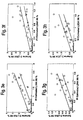
- Figure 2 shows plot of results for the calibration of the IR analysis of heavy ((VGO) and resid) component lumps for example 1.
- Component lump abbreviations are from Table 1.
- the lines on each graph represent an estimate of the 95% confidence limits in the reference data against which the IR analysis is calibrated.
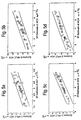
- Figure 3 shows plot of results for the calibration of the IR analysis of distillate component lumps for example 1.
- Component lump abbreviations are from Table 1.
- the lines on each graph represent an estimate of the 95% confidence limits in the reference data against which the IR analysis is calibrated.
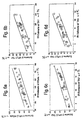
- Figure 4 shows plots of results for the calibration of the IR analysis of elemental data (sulfur and nitrogen contents), microcarbon residue (MCR) measured as weight percent of resid, and feed density for example 1.
- the lines on each graph represent an estimate of the 95% confidence limits in the reference data against which the IR analysis is calibrated.
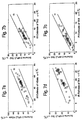
- Figure 5 shows plots of results for the calibration of the IR analysis of aromatic core data for example 2.
- the aromatic core reference data is obtained from HPLC analysis as described under Analysis Scheme 2 below.
- the abbreviations for the aromatic core lumps are given in Table 2.
- the lines on each graph represent an estimate of the 95% confidence limits in the reference data against which the IR analysis is calibrated.
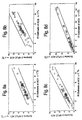
- Figure 6 show plots of results for the calibration of the IR analysis of HPLC mass data for example 2.
- the HPLC mass reference data is obtained from HPLC analysis as described under Analysis Scheme 2 below.
- the abbreviations for the mass lumps are given in Table 2.
- the lines on each graph represent an estimate of the 95% confidence limits in the reference data against which the IR analysis is calibrated.
- Figure 7 show plots of results for the calibration of the IR analysis of HPLC mass data for example 3.
- the HPLC mass reference data is obtained from HPLC analysis as decribed under Analysis Scheme 2 below.
- the abbreviations for the mass lumps are given in Table 2.
- the lines on each graph represent an estimate of the 95% confidence limits in the reference data against which the IR analysis is calibrated.
- Figure 8 shows plots of results for the calibration of the IR analysis of aromatic core data for example 3.
- the aromatic core reference data is obtained from HPLC analysis as described under Analysis Scheme 2 below.
- the abbreviations for the aromatic core lumps are given in Table 2.
- the lines on each graph represent an estimate of the 95% confidence limits in the reference data against which the IR analysis is calibrated.
- FIG 9 shows a diagram of a refinery operation discussed in example 4.
- Vacuum residue (Resid) is processed in a hydrotreating unit (HT) to produce hydrotreated vacuum residue (Residfinate) which is then blended with vacuum gas oil (VGO) at valve X.
- VGO vacuum gas oil
- the blended material is used as the whole feed to a Fluidized Catalytic Cracking Unit (FCCU).
- FCCU Fluidized Catalytic Cracking Unit
- the present invention can be used to determine component lump information on any of all of four streams, the VGO (A1), the Resid (A2), the Residfinate (A3), and/or the whole feed (A4).
- the component lump information can be used for feedforward control of the hydrotreating unit (A2), for feedback control of the hydrotreating unit (A3), for feedforward control of the blending (A1 and A3), for feedback control of the blending (A4), and for feedforward control of the FCCU (A4).
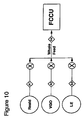
- FIG 10 shows a diagram of a refinery operation discussed in example 5.
- Vacuum residue (Resid), vacuum gas oil (VGO) and lube extract (LE) are held in three tanks.
- Component lump analyses A1, A2 and A3 are used for feedforward control the blending of whole feed from the three feed streams through adjustment of valves (X).
- Component lump analysis of the whole feed (A4) is used for feedback control of the blending, and/or feedforward control of the FCCU.
- Feeds to catalytic units can include components with boiling points in the naphtha to vacuum resid range.
- To analyze such broad boiling range feeds in terms of lumped components that undergo similar reactions will generally require a sophisticated analytical scheme involving prefractionation of the feed into appropriate boiling range cuts and analysis of the cuts in terms of molecular component lumps.
- An example analytical scheme (Analysis Scheme 1) is shown in Figure I.
- Analysis Scheme 1 involves fractionating the full boiling range feed into a C 5 - 430°F (221.1°C), naphtha cut, a 430°F-650°F (221.1-343.3°C) distillate cut, a 650°F-1050°F (343.3-565.6°C) vacuum gas oil cut, and a 1050°F+ (565.6°C+) vacuum resid cut using standard 15/5 distillation and vacuum distillation procedures.
- the naphtha and distillate cuts are analyzed by standard mass spectroscopic analyses to obtain naphtha and distillate component lumps.
- the vacuum gas oil and vacuum resid cuts are first separated into fractions by preparative High Performance Liquid Chromatography, and then the HPLC fractions are further characterized by mass spectroscopic techniques such as Field Desorption Mass Spectroscopy.
- mass spectroscopic techniques such as Field Desorption Mass Spectroscopy.
- One HPLC technology suitable for separating feeds into appropriate fractions for subsequent MS analysis to produce molecular lumps has been described by Haberman, Overfeld and Robbins (J.I. Haberman, R.E. Overfeld, and W. K. Robbins, U.S. Patent 4,988,446, January 29, 1991).
- the types of molecular lumps typically obtained by an analysis scheme similar to that shown in Figure 1 are listed in Table 1. MOLECULAR LUMPS OBTAINED FROM ANALYSIS SCHEME IN FIGURE I NPAR.
- Alkyl Aromatics are aromatics which contain only straight or branched substituent chains.
- NaphthenoAromatics are aromatics which contain one or more saturate rings in addition to possible straight or branched substituent chains. Denuded aromatics have no side chains larger than one methyl group.
- 2-Ring and 3-Ring Aromatics contain 2 and 3 aromatic rings per molecule. 4+ Ring Aromatics contain 4 or more aromatic rings per molecule.
- Polar fractions separated by the HPLC can be separately analyzed and included as polar lumps, or can be distributed across the other measured lumps.
- elemental data* such as sulfur and nitrogen contents, physical inspections such as density, and reactivity measures such as micro carbon residue may be measured on total feeds and/or distillate cuts.
- the time required for obtaining the molecular lumps for a feed sample can be days to weeks. Data obtained in this fashion is used for design of the kinetic model, and for off-line calculations of optimum unit operating conditions, but it is not sufficiently timely to be used for the real time control and optimization of the process unit.
- Analysis Scheme 1 An alternative to Analysis Scheme 1 is to eliminate the mass spectroscopic analysis of the VGO and resid fractions and directly use analytical scale HPLC analyses of these fractions.
- the HPLC technology described by Haberman, Overfield and Robbins can provide total mass of aromatics, and aromatic core mass (mass in aromatic ring excluding substituents) through combined use of evaporative mass and UV diode array detectors.
- Analysis Scheme 2 is of particular advantage when feeds are limited to the VGO boiling range since it can be accomplished solely using HPLC. For full boiling range feeds, prefractionation of the feed prior to HPLC analysis, and MS analysis of the naphtha and distillate cuts are still required.
- a third alternative is to correlate the molecular lumps obtained from Analysis Scheme 1 (preparative scale HPLC plus MS) to the lumps from Analysis Scheme 2 (HPLC with mass and UV detection) for a set of feeds, and then to use those correlations to convert results from Analysis Scheme 2 into the molecular lumps which would have been obtained by Scheme 1.
- the correlations can be accomplished using only the HPLC mass and core lumps, or they can be augmented by additional analytical tests. For instance, API gravity (ASTM 0287), elemental data, or micro-carbon residue (D4530) data on VGO or resid cuts could be used as independent variables in addition to the HPLC mass and core lumps to correlate to Scheme 1 lumps as dependent variables.
- the time required to prefractionate the feed into boiling range cuts, and to analyze the cuts by MS and/or HPLC will be on the order of days to weeks.
- the analyses are thus not suited to on-line analysis, control and optimization.
- the present invention seeks to address this problem though the use of infrared analysis to replace these analytical schemes.
- infrared analysis in process control has been discussed by several authors. None have used infrared to obtain detailed compositional lump information on petrochemical feeds as complex as cat feeds.
- Espinosa, Lambert, Martens and Ventron (European Patent Application 0304232, 11.08.88) describe the use of Near-Infrared spectroscopy to determine the properties and/or yield of a product from a hydrocarbon conversion or separation process. Unlike the current invention, their method works by correlating the spectrum of a feed directly to the property and/or yield of product without the use of a process model. Their invention cannot be used with a complex kinetic process model, and is applicable only to processes at the same fixed conditions as were used in developing the correlation.
- Maggard (U.S. Patent 5,349,189, Sept. 20, 1994) describes the use of Near-Infrared to measure gross molecular grouping or classes such as paraffins, isoparaffins, aromatics, naphthenes and olefins (PIANO). Maggard does not demonstrate that his technique is applicable for hydrocarbons other than gasolines (naphthas), and does not provide the differentiation of aromatics and naphthenes by ring size that the current invention provides.
- PIANO olefins
- Maggard (U.S. Patent 5,348,645, Sept. 20, 1994) describes the use of Near-Infrared for controlling organic sulfur content of a hydrocarbon product from a sulfur-removal process of a blending process. Maggard's measurements are conducted in a different spectral region from the present invention.
- the present invention is accomplished by:
- the spectra in steps (1b) and (2a) are preferably collected over the extended mid-infrared spectral range of 7000 to 400 cm -1 .
- the spectra may be collected using cells with calcium fluoride windows to contain the feeds which have nominal pathlengths of approximately 0.5 millimeters, in which case the spectral range will preferably be from 6700 to 1720 cm -1 .
- cells with potassium bromide windows and nominal 0.05 millimeter pathlengths may be employed, in which case the spectral range will preferably be from 3800 to 400 cm -1 .
- Other sampling techniques such as attenuated total reflection (ATR) could also be used in the collection of the spectra over all or part of the extended mid-infrared range.
- ATR attenuated total reflection
- the extended mid-infrared spectra are obtained using Fourier Transform Infrared (FT-IR) instrumentation. Spectra are preferably collected at 2 cm -1 resolution, although other resolutions could also be employed.
- FT-IR Fourier Transform Infrared
- the feed samples are maintained at a temperature sufficient to ensure flow of the feed through the cell.
- Flow may be interrupted during the spectral measurement as would be typically done for laboratory application, or may be continuous during the spectral measurement.
- Temperatures in the range of 60°C. could typically be employed, although higher or lower temperatures can also be used providing that they are high enough to ensure flow of the feed, and low enough to prevent thermal reaction of the feed during measurement.
- Temperatures will preferably be maintained to within +/-5°C of the nominal temperature during the spectral measurement.
- step (1c) is accomplished using any one of several chemometric methods including MultiLinear Regression (MLR), Partial Least Squares (PLS), Principal Components Regression (PCR), or Constrained Principal Spectra Analysis (CPSA).
- MLR MultiLinear Regression
- PLS Partial Least Squares
- PCR Principal Components Regression
- CPSA Constrained Principal Spectra Analysis
- Example 1 Estimation of Compositional Lumps for Catfeeds boiling above 430°F. via Correlation of Extended FT-MIR Spectral Data to Data from Analysis Scheme 3.
- Spectra for 74 catfeeds boiling about 430°F were measured over the 7000-400 cm -1 extended mid infrared range using a FT-IR spectrometer operating at 2 cm -1 resolution. A cell with 0.5 millimeter pathlength and calcium fluoride windows which was thermostated at 60 +/- 1°C was employed for the spectral measurement.
- Two calibrations were developed for molecular lumps, elemental data, physical inspections and reactivity measures of the feed and feed fractions using Constrained Principal Spectra Analysis (CPSA). The parameters used in the calibrations were as follows:
- Figure 2 shows plots of calibration results for the heavy (VGO and resid) component lumps.
- Figure 3 shows similar plots for distillate lumps.
- Figure 4 shows plots for elemental data, micro carbon residue measured as wt% of resid, and feed density. In each case, the lines on the graph are an estimate of the reproducibility of the reference method data.
- Abbreviations in Figures 2-4 are from Table 1.
- Example 2 Estimation of Component Lumps for Catfeeds Boiling above 650°F (343.3°C). via Correlation of Extended FT-MIR Spectral Data to Data from Analysis Scheme 2.
- Spectra for 40 catfeeds boiling above 650°F (343.3°C). were measured over the 7000-400 cm -1 extended mid infrared range using a FT-IR spectrometer operating at 2 cm -1 resolution.
- Two calibrations were developed for molecular lumps, elemental data, physical inspections and reactivity measures of the feed and feed fractions using Constrained Principal Spectra Analysis (CPSA). The parameters used in the calibrations were identical to those used in calibration 2 in example 1.
- CPSA Constrained Principal Spectra Analysis
- Example 3 Estimation of Component Lumps for Catfeeds Boiling above 650°F (343.3°C) via Correlation of FT-MIR Spectral Data to Data from Analysis Scheme 2.
- FT-MIR Spectra of 50 catfeeds having initial boiling points nominally greater than 650°F (343.3°C) were measured over the range of 4000-400 cm -1 mid infrared range using a FT-IR spectrometer operating at 2 cm -1 resolution.
- a cell with 0.05 millimeter pathlength and potassium bromide windows which was thermostated at 60 +/- 1°C was employed for the spectral measurement.
- a calibration was developed for molecular lumps of the feeds using Constrained Principal Spectra Analysis (CPSA). The parameters used in the calibrations were as follows:
- Spectral absorbance values in the frequency ranges from 3800 to 2995 cm -1 , 1935 to 1550 cm -1 , and from 1400 to 600 cm -1 were used in a CPSA model.
- the region from 2995 to 1935 cm -1 and from 1550 to 1400 cm -1 were excluded since the absorptions occurring in these regions are beyond the linear dynamic range of the FT-IR spectrometer.
- Linear polynomial corrections were employed in the 3800 to 2995 cm -1 and 1935 to 1550 cm -1 regions and quadratic polynomial corrections in the 1400 to 600 cm -1 region in the CPSA models to compensate for baseline variations. Water vapor corrections were also included to compensate for variations in the spectrometer purge.
- FIG. 9 shows a refinery operation in which vacuum residue material (Resid in the Figure) is processed in a hydrogen treatment unit (labeled HT) to produce hydrotreated vacuum resid (Residfinate).
- the Residfinate material is then combined in varying proportions with Vacuum Gas Oil (VGO), and the blended material is used as the whole feed to a Fluidized Catalytic Cracking Unit (FCCU).
- VGO Vacuum Gas Oil
- FCCU Fluidized Catalytic Cracking Unit
- Example 5 Control of feed to a Catalytic Cracking Process
- FIG. 10 shows an example of a refinery wherein Catalytic Cracking feed components are segregated by type: Vacuum Gas Oil (VGO), Vacuum Resid (Resid) and Lube Extract (LE) are held in three separate tanks.
- VGO Vacuum Gas Oil
- Resid Vacuum Resid
- L Lube Extract
- An online infrared analysis of the lump composition of each of the three component streams is performed.
- the compositional information provided by the analyzer is then used to control the mixing ratio of the three streams to provide control of two independent feed properties, for example, coke make and crackability.
- the feed analysis information is also used for control of FCCU process variables such as temperature.
Landscapes
- Chemical & Material Sciences (AREA)
- Life Sciences & Earth Sciences (AREA)
- Engineering & Computer Science (AREA)
- Physics & Mathematics (AREA)
- Health & Medical Sciences (AREA)
- Oil, Petroleum & Natural Gas (AREA)
- Analytical Chemistry (AREA)
- General Physics & Mathematics (AREA)
- Pathology (AREA)
- General Chemical & Material Sciences (AREA)
- Chemical Kinetics & Catalysis (AREA)
- Biochemistry (AREA)
- General Health & Medical Sciences (AREA)
- Immunology (AREA)
- Food Science & Technology (AREA)
- Medicinal Chemistry (AREA)
- Spectroscopy & Molecular Physics (AREA)
- Organic Chemistry (AREA)
- Investigating Or Analysing Materials By Optical Means (AREA)
- Production Of Liquid Hydrocarbon Mixture For Refining Petroleum (AREA)
- Investigating Or Analyzing Non-Biological Materials By The Use Of Chemical Means (AREA)
Applications Claiming Priority (2)
| Application Number | Priority Date | Filing Date | Title |
|---|---|---|---|
| US38525795A | 1995-02-08 | 1995-02-08 | |
| US385257 | 1995-02-08 |
Publications (3)
| Publication Number | Publication Date |
|---|---|
| EP0726460A2 EP0726460A2 (en) | 1996-08-14 |
| EP0726460A3 EP0726460A3 (en) | 1997-08-06 |
| EP0726460B1 true EP0726460B1 (en) | 2002-09-11 |
Family
ID=23520667
Family Applications (1)
| Application Number | Title | Priority Date | Filing Date |
|---|---|---|---|
| EP96300754A Expired - Lifetime EP0726460B1 (en) | 1995-02-08 | 1996-02-02 | A method of characterizing hydrocarbon feeds and products using infra-red spectra |
Country Status (9)
| Country | Link |
|---|---|
| US (1) | US5817517A (da) |
| EP (1) | EP0726460B1 (da) |
| JP (1) | JP3878686B2 (da) |
| AU (1) | AU701755B2 (da) |
| CA (1) | CA2168384C (da) |
| DE (1) | DE69623513T2 (da) |
| DK (1) | DK0726460T3 (da) |
| MY (1) | MY118324A (da) |
| SG (1) | SG40819A1 (da) |
Families Citing this family (59)
| Publication number | Priority date | Publication date | Assignee | Title |
|---|---|---|---|---|
| US6087662A (en) * | 1998-05-22 | 2000-07-11 | Marathon Ashland Petroleum Llc | Process for analysis of asphaltene content in hydrocarbon mixtures by middle infrared spectroscopy |
| ES2186549B1 (es) * | 2001-07-03 | 2004-08-16 | Universidad De Vigo | Analisis cuantitativo de carrageninas mediante espectroscopia de ir aplicando el metodo pls. |
| RU2292379C2 (ru) * | 2001-08-08 | 2007-01-27 | Шелл Интернэшнл Рисерч Маатсхаппий Б.В. | Способ получения углеводородного продукта с содержанием серы ниже 0,05 мас.% |
| US7302349B2 (en) | 2002-08-16 | 2007-11-27 | Lattec I/S | System and a method for observing and predicting a physiological state of an animal |
| US7238847B2 (en) * | 2002-12-23 | 2007-07-03 | Shell Oil Company | Apparatus and method for determining and controlling the hydrogen-to-carbon ratio of a pyrolysis product liquid fraction |
| CN104020277A (zh) * | 2004-09-15 | 2014-09-03 | 英国石油国际有限公司 | 评估炼油原料的方法 |
| US20070212790A1 (en) * | 2006-03-13 | 2007-09-13 | Marathon Petroleum Company Llc | Method for monitoring feeds to catalytic cracking units by near-infrared spectroscopy |
| US20080078695A1 (en) * | 2006-09-29 | 2008-04-03 | Marathon Petroleum Company, Llc | Method and apparatus for controlling catalytic cracking by near-infrared spectroscopy |
| US20080078693A1 (en) * | 2006-09-29 | 2008-04-03 | Marathon Petroleum Company Llc | Method and apparatus for controlling FCC hydrotreating by near-infrared spectroscopy |
| US8682597B2 (en) * | 2007-10-16 | 2014-03-25 | Exxonmobil Research And Engineering Company | Estimating detailed compositional information from limited analytical data |
| US9665693B2 (en) * | 2012-05-30 | 2017-05-30 | Exxonmobil Research And Engineering Company | System and method to generate molecular formula distributions beyond a predetermined threshold for a petroleum stream |
| US9864823B2 (en) | 2015-03-30 | 2018-01-09 | Uop Llc | Cleansing system for a feed composition based on environmental factors |
| US10222787B2 (en) | 2016-09-16 | 2019-03-05 | Uop Llc | Interactive petrochemical plant diagnostic system and method for chemical process model analysis |
| US10754359B2 (en) | 2017-03-27 | 2020-08-25 | Uop Llc | Operating slide valves in petrochemical plants or refineries |
| US10678272B2 (en) | 2017-03-27 | 2020-06-09 | Uop Llc | Early prediction and detection of slide valve sticking in petrochemical plants or refineries |
| US11130111B2 (en) | 2017-03-28 | 2021-09-28 | Uop Llc | Air-cooled heat exchangers |
| US11396002B2 (en) | 2017-03-28 | 2022-07-26 | Uop Llc | Detecting and correcting problems in liquid lifting in heat exchangers |
| US10794644B2 (en) | 2017-03-28 | 2020-10-06 | Uop Llc | Detecting and correcting thermal stresses in heat exchangers in a petrochemical plant or refinery |
| US10663238B2 (en) | 2017-03-28 | 2020-05-26 | Uop Llc | Detecting and correcting maldistribution in heat exchangers in a petrochemical plant or refinery |
| US10962302B2 (en) | 2017-03-28 | 2021-03-30 | Uop Llc | Heat exchangers in a petrochemical plant or refinery |
| US10844290B2 (en) | 2017-03-28 | 2020-11-24 | Uop Llc | Rotating equipment in a petrochemical plant or refinery |
| US10670353B2 (en) | 2017-03-28 | 2020-06-02 | Uop Llc | Detecting and correcting cross-leakage in heat exchangers in a petrochemical plant or refinery |
| US11037376B2 (en) | 2017-03-28 | 2021-06-15 | Uop Llc | Sensor location for rotating equipment in a petrochemical plant or refinery |
| US10670027B2 (en) | 2017-03-28 | 2020-06-02 | Uop Llc | Determining quality of gas for rotating equipment in a petrochemical plant or refinery |
| US10752845B2 (en) | 2017-03-28 | 2020-08-25 | Uop Llc | Using molecular weight and invariant mapping to determine performance of rotating equipment in a petrochemical plant or refinery |
| US10752844B2 (en) | 2017-03-28 | 2020-08-25 | Uop Llc | Rotating equipment in a petrochemical plant or refinery |
| US10695711B2 (en) | 2017-04-28 | 2020-06-30 | Uop Llc | Remote monitoring of adsorber process units |
| US10913905B2 (en) | 2017-06-19 | 2021-02-09 | Uop Llc | Catalyst cycle length prediction using eigen analysis |
| US11365886B2 (en) | 2017-06-19 | 2022-06-21 | Uop Llc | Remote monitoring of fired heaters |
| US10739798B2 (en) | 2017-06-20 | 2020-08-11 | Uop Llc | Incipient temperature excursion mitigation and control |
| US11130692B2 (en) | 2017-06-28 | 2021-09-28 | Uop Llc | Process and apparatus for dosing nutrients to a bioreactor |
| US10994240B2 (en) | 2017-09-18 | 2021-05-04 | Uop Llc | Remote monitoring of pressure swing adsorption units |
| US10696906B2 (en) | 2017-09-29 | 2020-06-30 | Marathon Petroleum Company Lp | Tower bottoms coke catching device |
| US11194317B2 (en) | 2017-10-02 | 2021-12-07 | Uop Llc | Remote monitoring of chloride treaters using a process simulator based chloride distribution estimate |
| US11676061B2 (en) | 2017-10-05 | 2023-06-13 | Honeywell International Inc. | Harnessing machine learning and data analytics for a real time predictive model for a FCC pre-treatment unit |
| US11105787B2 (en) | 2017-10-20 | 2021-08-31 | Honeywell International Inc. | System and method to optimize crude oil distillation or other processing by inline analysis of crude oil properties |
| US10901403B2 (en) | 2018-02-20 | 2021-01-26 | Uop Llc | Developing linear process models using reactor kinetic equations |
| US10734098B2 (en) | 2018-03-30 | 2020-08-04 | Uop Llc | Catalytic dehydrogenation catalyst health index |
| US12000720B2 (en) | 2018-09-10 | 2024-06-04 | Marathon Petroleum Company Lp | Product inventory monitoring |
| WO2020072176A1 (en) * | 2018-10-02 | 2020-04-09 | Exxonmobil Research And Engineering Company | Systems and methods for implicit chemical resolution of vacuum gas oils and fit quality determination |
| US10953377B2 (en) | 2018-12-10 | 2021-03-23 | Uop Llc | Delta temperature control of catalytic dehydrogenation process reactors |
| US12031676B2 (en) | 2019-03-25 | 2024-07-09 | Marathon Petroleum Company Lp | Insulation securement system and associated methods |
| US11975316B2 (en) | 2019-05-09 | 2024-05-07 | Marathon Petroleum Company Lp | Methods and reforming systems for re-dispersing platinum on reforming catalyst |
| CA3212045A1 (en) | 2019-05-30 | 2020-11-30 | Marathon Petroleum Company Lp | Methods and systems for minimizing nox and co emissions in natural draft heaters |
| WO2021030003A1 (en) * | 2019-08-09 | 2021-02-18 | Exxonmobil Research And Engineering Company | Method for the evaluation of hydrocarbon feedstocks for catalytic cracking |
| CA3109606C (en) | 2020-02-19 | 2022-12-06 | Marathon Petroleum Company Lp | Low sulfur fuel oil blends for paraffinic resid stability and associated methods |
| US11702600B2 (en) | 2021-02-25 | 2023-07-18 | Marathon Petroleum Company Lp | Assemblies and methods for enhancing fluid catalytic cracking (FCC) processes during the FCC process using spectroscopic analyzers |
| US11905468B2 (en) | 2021-02-25 | 2024-02-20 | Marathon Petroleum Company Lp | Assemblies and methods for enhancing control of fluid catalytic cracking (FCC) processes using spectroscopic analyzers |
| US12461022B2 (en) | 2021-02-25 | 2025-11-04 | Marathon Petroleum Company Lp | Methods and assemblies for determining and using standardized spectral responses for calibration of spectroscopic analyzers |
| US12473500B2 (en) | 2021-02-25 | 2025-11-18 | Marathon Petroleum Company Lp | Assemblies and methods for enhancing control of fluid catalytic cracking (FCC) processes using spectroscopic analyzers |
| US20250012744A1 (en) | 2021-02-25 | 2025-01-09 | Marathon Petroleum Company Lp | Methods and assemblies for enhancing control of refining processes using spectroscopic analyzers |
| US11898109B2 (en) | 2021-02-25 | 2024-02-13 | Marathon Petroleum Company Lp | Assemblies and methods for enhancing control of hydrotreating and fluid catalytic cracking (FCC) processes using spectroscopic analyzers |
| US11692141B2 (en) | 2021-10-10 | 2023-07-04 | Marathon Petroleum Company Lp | Methods and systems for enhancing processing of hydrocarbons in a fluid catalytic cracking unit using a renewable additive |
| US11802257B2 (en) | 2022-01-31 | 2023-10-31 | Marathon Petroleum Company Lp | Systems and methods for reducing rendered fats pour point |
| US12311305B2 (en) | 2022-12-08 | 2025-05-27 | Marathon Petroleum Company Lp | Removable flue gas strainer and associated methods |
| US12306076B2 (en) | 2023-05-12 | 2025-05-20 | Marathon Petroleum Company Lp | Systems, apparatuses, and methods for sample cylinder inspection, pressurization, and sample disposal |
| US12533615B2 (en) | 2023-06-02 | 2026-01-27 | Marathon Petroleum Company Lp | Methods and systems for reducing contaminants in a feed stream |
| US12415962B2 (en) | 2023-11-10 | 2025-09-16 | Marathon Petroleum Company Lp | Systems and methods for producing aviation fuel |
| US12599848B2 (en) | 2024-06-03 | 2026-04-14 | Marathon Petroleum Company Lp | Systems, analyzers, controllers, and associated methods to enhance fluid separation for distillation operations |
Family Cites Families (15)
| Publication number | Priority date | Publication date | Assignee | Title |
|---|---|---|---|---|
| US4282084A (en) * | 1978-09-27 | 1981-08-04 | Mobil Oil Corporation | Catalytic cracking process |
| EP0304232B1 (en) * | 1987-08-18 | 1996-12-27 | Bp Oil International Limited | Method for the direct determination of physical properties of hydrocarbon products |
| GB2217838A (en) * | 1988-04-15 | 1989-11-01 | Shell Int Research | Near infrared determination of petrophysical and petrochemical properties |
| FR2631957B1 (fr) * | 1988-05-30 | 1990-08-31 | Bp Chimie Sa | Procede et appareillage de fabrication d'olefines et de diolefines par reaction de vapocraquage d'hydrocarbures controlee a l'aide d'un systeme comprenant un spectrophotometre infrarouge |
| US4963745A (en) * | 1989-09-01 | 1990-10-16 | Ashland Oil, Inc. | Octane measuring process and device |
| US5349188A (en) * | 1990-04-09 | 1994-09-20 | Ashland Oil, Inc. | Near infrared analysis of piano constituents and octane number of hydrocarbons |
| US5145785A (en) * | 1990-12-11 | 1992-09-08 | Ashland Oil, Inc. | Determination of aromatics in hydrocarbons by near infrared spectroscopy and calibration therefor |
| US5121337A (en) * | 1990-10-15 | 1992-06-09 | Exxon Research And Engineering Company | Method for correcting spectral data for data due to the spectral measurement process itself and estimating unknown property and/or composition data of a sample using such method |
| US5223714A (en) * | 1991-11-26 | 1993-06-29 | Ashland Oil, Inc. | Process for predicting properties of multi-component fluid blends |
| US5225679A (en) * | 1992-01-24 | 1993-07-06 | Boston Advanced Technologies, Inc. | Methods and apparatus for determining hydrocarbon fuel properties |
| MY108958A (en) * | 1992-10-05 | 1996-11-30 | Shell Int Research | An apparatus for fuel quality monitoring |
| US5412581A (en) * | 1992-11-05 | 1995-05-02 | Marathon Oil Company | Method for measuring physical properties of hydrocarbons |
| US5360972A (en) * | 1993-08-17 | 1994-11-01 | Western Atlas International, Inc. | Method for improving chemometric estimations of properties of materials |
| US5407830A (en) * | 1993-12-01 | 1995-04-18 | Mobil Oil Corporation | Control of low inventory alkylation unit |
| EP0706040A1 (en) * | 1994-10-07 | 1996-04-10 | Bp Chemicals S.N.C. | Property determination |
-
1996
- 1996-01-30 CA CA002168384A patent/CA2168384C/en not_active Expired - Lifetime
- 1996-02-02 EP EP96300754A patent/EP0726460B1/en not_active Expired - Lifetime
- 1996-02-02 DE DE69623513T patent/DE69623513T2/de not_active Expired - Lifetime
- 1996-02-02 DK DK96300754T patent/DK0726460T3/da active
- 1996-02-06 AU AU43394/96A patent/AU701755B2/en not_active Expired
- 1996-02-06 SG SG1996001065A patent/SG40819A1/en unknown
- 1996-02-07 MY MYPI96000456A patent/MY118324A/en unknown
- 1996-02-08 JP JP04662696A patent/JP3878686B2/ja not_active Expired - Fee Related
-
1997
- 1997-08-22 US US08/918,540 patent/US5817517A/en not_active Expired - Lifetime
Also Published As
| Publication number | Publication date |
|---|---|
| AU4339496A (en) | 1996-08-15 |
| JP3878686B2 (ja) | 2007-02-07 |
| US5817517A (en) | 1998-10-06 |
| CA2168384C (en) | 2007-05-15 |
| EP0726460A2 (en) | 1996-08-14 |
| JPH08337783A (ja) | 1996-12-24 |
| CA2168384A1 (en) | 1996-08-09 |
| AU701755B2 (en) | 1999-02-04 |
| SG40819A1 (en) | 1997-06-14 |
| EP0726460A3 (en) | 1997-08-06 |
| MY118324A (en) | 2004-10-30 |
| DE69623513T2 (de) | 2003-01-09 |
| DK0726460T3 (da) | 2002-10-07 |
| DE69623513D1 (de) | 2002-10-17 |
Similar Documents
| Publication | Publication Date | Title |
|---|---|---|
| EP0726460B1 (en) | A method of characterizing hydrocarbon feeds and products using infra-red spectra | |
| EP0555216B1 (en) | Process and apparatus for analysis of hydrocarbons by near-infrared spectroscopy | |
| US11905468B2 (en) | Assemblies and methods for enhancing control of fluid catalytic cracking (FCC) processes using spectroscopic analyzers | |
| US11702600B2 (en) | Assemblies and methods for enhancing fluid catalytic cracking (FCC) processes during the FCC process using spectroscopic analyzers | |
| US5145785A (en) | Determination of aromatics in hydrocarbons by near infrared spectroscopy and calibration therefor | |
| US12473500B2 (en) | Assemblies and methods for enhancing control of fluid catalytic cracking (FCC) processes using spectroscopic analyzers | |
| EP1463937B1 (en) | Method for analyzing an unknown material as a blend of known materials calculated so as to match certain analytical data and predicting properties of the unknown based on the calculated blend | |
| JP3493028B2 (ja) | 混合製品の調製方法 | |
| EP3861320B1 (en) | Systems and methods for implicit chemical resolution of vacuum gas oils and fit quality determination | |
| CA3190483A1 (en) | Assemblies and methods for enhancing fluid catalytic cracking (fcc) processes during the fcc process using spectroscopic analyzers | |
| Zanier-Szydlowski et al. | Control of refining processes on mid-distillates by near infrared spectroscopy | |
| WO1996000380A1 (en) | Determination of sulfur in hydrocarbons by near infrared spectroscopy | |
| EP0801298B1 (en) | Control of process | |
| CA3190475A1 (en) | Assemblies and methods for enhancing control of fluid catalytic cracking (fcc) processes using spectroscopic analyzers |
Legal Events
| Date | Code | Title | Description |
|---|---|---|---|
| PUAI | Public reference made under article 153(3) epc to a published international application that has entered the european phase |
Free format text: ORIGINAL CODE: 0009012 |
|
| AK | Designated contracting states |
Kind code of ref document: A2 Designated state(s): DE DK FR GB IT NL |
|
| PUAL | Search report despatched |
Free format text: ORIGINAL CODE: 0009013 |
|
| AK | Designated contracting states |
Kind code of ref document: A3 Designated state(s): DE DK FR GB IT NL |
|
| 17P | Request for examination filed |
Effective date: 19980112 |
|
| 17Q | First examination report despatched |
Effective date: 19990121 |
|
| RAP1 | Party data changed (applicant data changed or rights of an application transferred) |
Owner name: EXXONMOBIL RESEARCH AND ENGINEERING COMPANY |
|
| GRAG | Despatch of communication of intention to grant |
Free format text: ORIGINAL CODE: EPIDOS AGRA |
|
| GRAG | Despatch of communication of intention to grant |
Free format text: ORIGINAL CODE: EPIDOS AGRA |
|
| GRAG | Despatch of communication of intention to grant |
Free format text: ORIGINAL CODE: EPIDOS AGRA |
|
| GRAH | Despatch of communication of intention to grant a patent |
Free format text: ORIGINAL CODE: EPIDOS IGRA |
|
| GRAH | Despatch of communication of intention to grant a patent |
Free format text: ORIGINAL CODE: EPIDOS IGRA |
|
| GRAA | (expected) grant |
Free format text: ORIGINAL CODE: 0009210 |
|
| AK | Designated contracting states |
Kind code of ref document: B1 Designated state(s): DE DK FR GB IT NL |
|
| REG | Reference to a national code |
Ref country code: GB Ref legal event code: FG4D |
|
| REG | Reference to a national code |
Ref country code: DK Ref legal event code: T3 |
|
| REF | Corresponds to: |
Ref document number: 69623513 Country of ref document: DE Date of ref document: 20021017 |
|
| ET | Fr: translation filed | ||
| PLBE | No opposition filed within time limit |
Free format text: ORIGINAL CODE: 0009261 |
|
| STAA | Information on the status of an ep patent application or granted ep patent |
Free format text: STATUS: NO OPPOSITION FILED WITHIN TIME LIMIT |
|
| 26N | No opposition filed |
Effective date: 20030612 |
|
| REG | Reference to a national code |
Ref country code: FR Ref legal event code: PLFP Year of fee payment: 20 |
|
| PGFP | Annual fee paid to national office [announced via postgrant information from national office to epo] |
Ref country code: NL Payment date: 20150210 Year of fee payment: 20 |
|
| PGFP | Annual fee paid to national office [announced via postgrant information from national office to epo] |
Ref country code: IT Payment date: 20150213 Year of fee payment: 20 Ref country code: DE Payment date: 20150227 Year of fee payment: 20 Ref country code: DK Payment date: 20150126 Year of fee payment: 20 |
|
| PGFP | Annual fee paid to national office [announced via postgrant information from national office to epo] |
Ref country code: FR Payment date: 20150126 Year of fee payment: 20 Ref country code: GB Payment date: 20150126 Year of fee payment: 20 |
|
| REG | Reference to a national code |
Ref country code: DE Ref legal event code: R071 Ref document number: 69623513 Country of ref document: DE |
|
| REG | Reference to a national code |
Ref country code: NL Ref legal event code: MK Effective date: 20160201 |
|
| REG | Reference to a national code |
Ref country code: DK Ref legal event code: EUP Effective date: 20160202 |
|
| REG | Reference to a national code |
Ref country code: GB Ref legal event code: PE20 Expiry date: 20160201 |
|
| PG25 | Lapsed in a contracting state [announced via postgrant information from national office to epo] |
Ref country code: GB Free format text: LAPSE BECAUSE OF EXPIRATION OF PROTECTION Effective date: 20160201 |