EP0726462B1 - Appareil et méthode pour un essai de liaison sur un matériau porteur absorbant - Google Patents
Appareil et méthode pour un essai de liaison sur un matériau porteur absorbant Download PDFInfo
- Publication number
- EP0726462B1 EP0726462B1 EP96101322A EP96101322A EP0726462B1 EP 0726462 B1 EP0726462 B1 EP 0726462B1 EP 96101322 A EP96101322 A EP 96101322A EP 96101322 A EP96101322 A EP 96101322A EP 0726462 B1 EP0726462 B1 EP 0726462B1
- Authority
- EP
- European Patent Office
- Prior art keywords
- absorbent material
- reagent
- liquid
- flow
- membrane
- Prior art date
- Legal status (The legal status is an assumption and is not a legal conclusion. Google has not performed a legal analysis and makes no representation as to the accuracy of the status listed.)
- Expired - Lifetime
Links
Images





Classifications
-
- G—PHYSICS
- G01—MEASURING; TESTING
- G01N—INVESTIGATING OR ANALYSING MATERIALS BY DETERMINING THEIR CHEMICAL OR PHYSICAL PROPERTIES
- G01N33/00—Investigating or analysing materials by specific methods not covered by groups G01N1/00 - G01N31/00
- G01N33/48—Biological material, e.g. blood, urine; Haemocytometers
- G01N33/50—Chemical analysis of biological material, e.g. blood, urine; Testing involving biospecific ligand binding methods; Immunological testing
- G01N33/53—Immunoassay; Biospecific binding assay; Materials therefor
- G01N33/543—Immunoassay; Biospecific binding assay; Materials therefor with an insoluble carrier for immobilising immunochemicals
- G01N33/54366—Apparatus specially adapted for solid-phase testing
- G01N33/54386—Analytical elements
- G01N33/54387—Immunochromatographic test strips
- G01N33/54388—Immunochromatographic test strips based on lateral flow
- G01N33/54389—Immunochromatographic test strips based on lateral flow with bidirectional or multidirectional lateral flow, e.g. wherein the sample flows from a single, common sample application point into multiple strips, lanes or zones
-
- G—PHYSICS
- G01—MEASURING; TESTING
- G01N—INVESTIGATING OR ANALYSING MATERIALS BY DETERMINING THEIR CHEMICAL OR PHYSICAL PROPERTIES
- G01N33/00—Investigating or analysing materials by specific methods not covered by groups G01N1/00 - G01N31/00
- G01N33/48—Biological material, e.g. blood, urine; Haemocytometers
- G01N33/50—Chemical analysis of biological material, e.g. blood, urine; Testing involving biospecific ligand binding methods; Immunological testing
- G01N33/53—Immunoassay; Biospecific binding assay; Materials therefor
- G01N33/543—Immunoassay; Biospecific binding assay; Materials therefor with an insoluble carrier for immobilising immunochemicals
-
- G—PHYSICS
- G01—MEASURING; TESTING
- G01N—INVESTIGATING OR ANALYSING MATERIALS BY DETERMINING THEIR CHEMICAL OR PHYSICAL PROPERTIES
- G01N33/00—Investigating or analysing materials by specific methods not covered by groups G01N1/00 - G01N31/00
- G01N33/48—Biological material, e.g. blood, urine; Haemocytometers
- G01N33/50—Chemical analysis of biological material, e.g. blood, urine; Testing involving biospecific ligand binding methods; Immunological testing
- G01N33/53—Immunoassay; Biospecific binding assay; Materials therefor
- G01N33/543—Immunoassay; Biospecific binding assay; Materials therefor with an insoluble carrier for immobilising immunochemicals
- G01N33/54366—Apparatus specially adapted for solid-phase testing
- G01N33/54386—Analytical elements
- G01N33/54387—Immunochromatographic test strips
- G01N33/54388—Immunochromatographic test strips based on lateral flow
-
- Y—GENERAL TAGGING OF NEW TECHNOLOGICAL DEVELOPMENTS; GENERAL TAGGING OF CROSS-SECTIONAL TECHNOLOGIES SPANNING OVER SEVERAL SECTIONS OF THE IPC; TECHNICAL SUBJECTS COVERED BY FORMER USPC CROSS-REFERENCE ART COLLECTIONS [XRACs] AND DIGESTS
- Y10—TECHNICAL SUBJECTS COVERED BY FORMER USPC
- Y10S—TECHNICAL SUBJECTS COVERED BY FORMER USPC CROSS-REFERENCE ART COLLECTIONS [XRACs] AND DIGESTS
- Y10S435/00—Chemistry: molecular biology and microbiology
- Y10S435/97—Test strip or test slide
-
- Y—GENERAL TAGGING OF NEW TECHNOLOGICAL DEVELOPMENTS; GENERAL TAGGING OF CROSS-SECTIONAL TECHNOLOGIES SPANNING OVER SEVERAL SECTIONS OF THE IPC; TECHNICAL SUBJECTS COVERED BY FORMER USPC CROSS-REFERENCE ART COLLECTIONS [XRACs] AND DIGESTS
- Y10—TECHNICAL SUBJECTS COVERED BY FORMER USPC
- Y10S—TECHNICAL SUBJECTS COVERED BY FORMER USPC CROSS-REFERENCE ART COLLECTIONS [XRACs] AND DIGESTS
- Y10S435/00—Chemistry: molecular biology and microbiology
- Y10S435/971—Capture of complex after antigen-antibody reaction
-
- Y—GENERAL TAGGING OF NEW TECHNOLOGICAL DEVELOPMENTS; GENERAL TAGGING OF CROSS-SECTIONAL TECHNOLOGIES SPANNING OVER SEVERAL SECTIONS OF THE IPC; TECHNICAL SUBJECTS COVERED BY FORMER USPC CROSS-REFERENCE ART COLLECTIONS [XRACs] AND DIGESTS
- Y10—TECHNICAL SUBJECTS COVERED BY FORMER USPC
- Y10S—TECHNICAL SUBJECTS COVERED BY FORMER USPC CROSS-REFERENCE ART COLLECTIONS [XRACs] AND DIGESTS
- Y10S436/00—Chemistry: analytical and immunological testing
- Y10S436/807—Apparatus included in process claim, e.g. physical support structures
- Y10S436/81—Tube, bottle, or dipstick
Definitions
- the invention relates to an apparatus and a method for carrying out binding assays.
- the invention also relates in particular to assays which utilize porous carrier materials for transporting reagents.
- Specific binding assays are valuable tools useful in numerous applications. Such assays involve two or more binding components, one of which is analyte. Examples of specific binding components include antibody and antigen, DNA and/or RNA hybridization, and receptor-ligand interaction. Numerous specific binding assays formats are known in the art, and include competition, sandwich, and agglutination assays. Unfortunately, specific binding is not always observable. Accordingly, labeling techniques have been developed to make the binding either indirectly or directly observable. Labeling typically involves attaching a detectable label to one or both binding components.
- Radioisotopes, fluorophores, and enzymes are examples of "indirect” labels, since they require instrumentation and/or special treatment for detection. In contrast, "direct” labels are visible to the naked eye and do not require special procedures or instrumentation for detection.
- Metallic sols, dye sols and colored latex are examples of "direct" labels.
- One component of the binding pair for example, antibody or antigen
- the porous carrier material for example, a fibrous or porous membrane
- a sample containing analyte is typically mixed with a labeled analyte or labeled analyte analog (the reagent) capable of specifically binding with the immobilized component.
- the mixture is then applied to the porous carrier material. Migration of the mixture, caused by capillary wicking within the porous carrier material, brings the reagent to a position where it competes for a limited number of binding sites of the immobilized specific binding component.
- a portion of the labeled reagent specifically binds to the immobilized reagent and in turn becomes immobilized.
- the amount of bound labeled reagent is in inverse proportion to the amount of analyte in the sample.
- unreacted material is removed by washing, for example by applying appropriate volume of an eluant to the porous carrier material.
- the label can be developed and/or measured ("indirect” label), or visually evaluated (“direct” label).
- Labeled reagent can also be impregnated into the porous carrier material so that the labeled reagent becomes mobile when moistened. In such a case, the addition of the sample itself may be sufficient to initiate and run the assay.
- Deutsch, et al. U.S. Patent Nos. 4,094,647, 4,235,601 and 4,361,537 discloses a test device for determining a characteristic of a sample (a specific binding assay) in which reagents are mixed and transported in a transportative strip element (also see Baker, et al., WO 87/02774, published May 7, 1987).
- a first specific radiolabeled reagent is impregnated into the strip, and a second reagent is immobilized onto the strip downstream of the first reagent via attachment to microbeads.
- a sample is applied upstream of the first reagent, and the beginning end of the strip is dipped into an eluant.
- Eluant migrating through the strip picks up the sample.
- the eluant containing the sample then rehydrates the first reagent, mixes it with the sample, and transports the sample and first reagent to the second reagent. where a specific binding reaction immobilizes a portion of the radiolabeled reagent. Excess radiolabeled reagent is washed away towards the terminal end of the strip. Alternatively, labeled reagent may be applied directly to the strip body.
- United States Patent No. 4,938,927 issued to Kelton, et al. discloses a rotary fluid manipulator containing a circular chromatographic membrane divided by fluid blocking means into many fluid passages. Each fluid passage contains a labeled specific binding reagent and an immobilized specific binding reagent. A test specimen is applied onto or nearby the labeled reagent. Then, an eluant is applied at a special location close to the center of the membrane. The eluant moves within particular passage towards the outer side of the circle by wicking and centrifugal force.
- the principles of the specific binding assay itself are identical to those described in Deutsch, et al.
- United States Patent No. 5,238,652 to Sun, et al. relates to an analytical test device for a competition assay for particular non-protein antigens, such as antigens representing drugs of abuse.
- Colored latex particles sensitized with detecting antibodies for the non-protein antigen are applied directly to the chromatographic membrane in such a way that latex spheres are immobile when dry and mobile when contacted with liquid. Downstream of the latex, the membrane is impregnated with a permanently immobile drug conjugate probe.
- a sample such as body fluid is applied to the membrane, the latex particles are resuspended by the sample and migrate towards the conjugate. If drugs or their metabolites are present in the sample, binding to antibody on the latex will occur during this migration.
- European Patent No. 0 291 194 B1 discloses an analytical test device comprising a hollow casing containing a chromatographic porous membrane.
- the device also contains labeled (for example, colored latex) specific binding reagent for an analyte, and an unlabeled specific reagent for the same analyte, permanently immobilized on the membrane.
- labeled for example, colored latex
- the liquid sample permeates the membrane by capillary action, picking up the labeled reagent and migrating to the zone with the unlabeled specific reagent.
- the presence of an analyte within the sample is determined by the extent of labeled reagent binding using either a sandwich or a competition format.
- EP-A 0 525 829 discloses a chromatographic test strip.
- An inert support foil carries several sheet-like pieces of bibulous material. These sheets are arranged in a linear manner and touch each other pairwise, thus forming a continuous liquid transport pathway. Liquid sample which is introduced to the sheet-like piece on one end of the test strip moves through the consequent pieces until the last piece of sheet material on the opposite end of the strip is reached. Thereby, reagents contained in one or several sheet pieces interact with the analyte contained in the sample liquid and allow its detection.
- the labeled reagent As a surface layer, a glazing material, such as aqueous sucrose or cellulose, is applied prior to the application of the labeled reagent to form a glaze layer. The labeled reagent is then applied on top of the glaze. In practice, however, the glazing material penetrates to some extent into the thickness of the membrane, as does the labeled reagent.
- reagents it is preferred to uniformly mobilize reagents to form a continuum with no or minimal concentration gradient.
- Such a continuum favors a uniform degree of binding (especially critical for the competition assays), and prepossesses a reproducible uniform result band.
- One known way to achieve mobilization and a uniform concentration throughout solution of the reagents is to premix a sample and a liquid binding reagent, for instance labeled binding reagent, and then apply the mixture to a test device, either directly or via a mediating sample pad. Regrettably, however, this multistep procedure is predisposed to experimental error and increases handling of potentially hazardous samples.
- One-step devices require only the single step of adding sample to perform a test.
- the binding reagent is usually embedded into an absorbent material which is in serial contact with the porous carrier material or directly applied to the porous carrier material.
- the liquid front of a sample non-uniformly mobilizes the dry impregnated binding reagent so that the reagent concentration is highest at the front, thus resulting in a non-uniform concentration pattern which is very sensitive to any variation in the porous carrier material.
- Even small lot-to-lot differences can cause an adverse affect and precise titration of the labeled reagent is required. Since the titer is chosen with respect to performance at cutoff level of an analyte, it is often difficult to achieve substantial differentiation between no analyte and analyte-at-cutoff signals.
- the object of the invention therefore is to provide an assaying device which makes possible to overcome the above-mentioned problems.
- An assaying device is characterized in that it comprises
- the subject invention overcomes the above-mentioned problems and provides an improved specific binding assay through the use of an additional top membrane (a porous carrier material) which contains a specific binding reagent.
- an additional top membrane a porous carrier material
- rehydration of the specific reagent and the extent of its dilution by the sample is controlled thereby optimizing the performance of the assay.
- This unique design achieves a more uniform migration pattern of the labeled reagent, and eliminates undesirable flooding of the membrane body when excessive sample volume is applied.
- the subject invention can be used with, but is not limited to use with an assaying device for conducting specific binding assays, in particular drug of abuse assays.
- an assaying device for conducting specific binding assays, in particular drug of abuse assays.
- Such an assaying device is configured and dimensioned to incorporate porous carrier material test strips.
- a device of this type is disclosed by European Patent Application with publication No. EP-A-0668745.
- the first absorbent material and the second absorbent material are preferably composed of the same material.
- the first absorbent material is preferably selected from the group consisting of bibulous membranes and porous membranes.
- the first absorbent material is preferably nitrocellulose.
- the second absorbent material is preferably selected from the group consisting of bibulous membranes and porous membranes.
- the second absorbent material is preferably nitrocellulose.
- the first absorbent material and the second absorbent material are held in contact with each other by a holder, the holder being preferably a band of material, said band of material being preferably a polyester film.
- the second reagent is labeled, the label being preferably a colored latex.
- the first absorbent material has a plurality of reagents immobilized thereon.
- the second absorbent material has a plurality of reagents immobilized thereon.
- the first reagent and the second reagent have an affinity to bind with each other.
- the first reagent and the second reagent each have an affinity to bind with the same substance.
- the wicking rate of the first absorbent material is the same or higher than the wicking rate of the second absorbent material.
- the wicking rate of the first absorbent material is lower than the wicking rate of the second absorbent material.
- the first reagent is irreversibly immobilized on the first absorbent material.
- the first absorbent material and the second absorbent material each have planar surfaces.
- the planar surface of the first absorbent material is juxtaposed to the planar surface of the second absorbent material.
- a method for conducting a binding assay according to the invention is characterized in that it comprises:
- the first flow of liquid within the first absorbent material flows at the same or greater velocity than the second flow of liquid within the second absorbent material.
- the first flow of liquid within the first absorbent material flows at a lesser velocity than the second flow of liquid within the second absorbent material.
- the apparatus and method of the present invention are particularly well suited for use in testing drugs of abuse, such as cocaine, amphetamines, cannabinoids, barbiturates, benzodiazepines, opiates, phencyclidines, propoxyphine, methaqualone, tricyclic antidepressants and methadone, as well as for clinical chemistry, pregnancy, and similar testing.
- drugs of abuse such as cocaine, amphetamines, cannabinoids, barbiturates, benzodiazepines, opiates, phencyclidines, propoxyphine, methaqualone, tricyclic antidepressants and methadone, as well as for clinical chemistry, pregnancy, and similar testing.
- membrane membrane
- porous carrier material porous carrier material
- absorbent material absorbent material
- the “top” and “main” membranes have been described with the terms “forward” and “rearward.”
- “Forward” is the portion of a membrane which extends beyond the lengthwise midpoint (located in the direction of liquid flow within the membrane). The most forward portion of a membrane is referred to as the “terminal end.”
- “Rearward” is opposite of forward and relates to the portion of the membrane which precedes the lengthwise midpoint in the direction of the end initially contacted by the liquid sample. The most rearward portion of the membrane is referred to as the “beginning end.”
- Downstream is the direction in which the liquid flows within the membranes. In contrast, "upstream” relates to a direction opposite the flow of liquid within the membrane.
- a sample is absorbed at the beginning end of the main membrane and is transported along the length of the main membrane by capillary action.
- membrane length is in the range of 1-10 cm, width 0.4-2 cm, and thickness 0.1-1 mm.
- the membrane is shaped as an elongated, thin rectangular prism.
- the reagent-containing top membrane (generally containing a labeled reagent)
- the reagent-containing top membrane splits into two flows: one continues to run in the main membrane, the second permeates into the top membrane, typically in the rearward portion, and mobilizes the reagent located within the top membrane.
- the reagent within the top membrane is mobile when in a moist state.
- a single reagent is described as being in the top membrane, it should be appreciated that multiple reagents may also be employed.
- a plurality of top membranes each containing one or more reagents may be utilized.
- Preferred labels are colored colloidal particles, and colored latex is most preferred. Colored latex is readily visible to the naked eye when bound in the detection zone, therefore no additional developing procedures are required. Procedures for sensitization of latex with specific binding reagents are well known in the art (for example, see Illum, L. and P.D.E. Jones, Attachment of Monoclonal Antibodies to Microspheres, Methods in Enzymology , Vol. 112 , pages 67-84 (1985)) and Galloway, R.J., Development of Microparticle Tests and Immunoassays, Seradyn, Inc. , pages 6-31 (1988)). As alluded to above, multiple reagents may be utilized in one or more top membranes. As such, multiple latex containing membranes or one latex containing membrane sensitized with a plurality of binding reagents, for example antigens and/or antibodies, may be employed.
- the two parallel flows reunite and mix in the main membrane near or at the forward edge of the top membrane. While migration continues towards the detection site within the main membrane, a binding reaction between the reagent and the analyte takes place. The extent of this binding or simply the presence of the analyte, depending on whether the assay is a competition or a sandwich format, is measured at a detection site, where specific binding with the immobilized reagent occurs. Unbound material continues to migrate downstream towards the terminal end of the main membrane and is partially captured at the control site. No unbound labeled reagent remains in the detection or the control sites.
- the top membrane is in contact with the upper surface of the main membrane upstream of the detection site (see FIG 1D).
- a sample pad can be used to absorb a liquid sample and release the liquid into the beginning end of the main membrane.
- the sample pad is typically fashioned from a blotting material, and is in contact with the main membrane.
- the sample pad may optionally contain additional reagents.
- a "sink" pad fashioned from a blotting material, can be used at the terminal end of the main membrane to absorb excess reagent solution and foster capillary flow in the main membrane for a longer period of time.
- the membranes and the pads are preferably disposed in a holder.
- the use of a sample pad and a sink pad are described in U.S. Patent Nos. 4,956,302 and 5,238,652. A skilled artisan having read the present specification would be able to use such pads in connection with the present invention.
- top and main membranes include bibulous or fibrous material capable of capillary action, such as thin layer chromatography materials, paper or cellulose chromatography substrates, porous synthetic plastics, etc.
- Preferred absorbent materials have good wicking ability, a smooth surface which insures good contact between the "main” and “top” membranes, reversible binding of the labeled compound to the membrane to promote quantitative mobilization, ability to transport a labeled reagent by capillary action, availability of wicking characteristics within suitable range, reproducible and convenient reagent application and handling.
- Preferred membranes include nitrocellulose and nylon. Moreover, membranes precast on plastic are preferred because of handling convenience. Nitrocellulose is desirable because it (i) is able to bind proteins by adsorption without requiring complicated covalent linking, (ii) has excellent wicking characteristics, and (iii) is available in a convenient range of pore sizes. Backed nitrocellulose (for example, precast on a plastic material), is most preferred. Procedures for adsorption of specific proteins on nitrocellulose to form detection and control sites, and blocking of unoccupied binding sites on the nitrocellulose with neutral blocking reagent are well known in the art (see for example, Harvey, M.A., Optimization of Nitrocellulose Membrane-Based Immunoassays, Schleicher & Schuell , No. 557, pp. 18-23, 1991).
- Migration rates vary with membrane properties, for example, pore size. Selection of flow rate, appropriate membrane type, and pore size is within the knowledge of the skilled artisan, and can be determined with minimal experimentation.
- reagent typically labeled
- the extent of dilution has been postulated to be controlled by flow dynamics in the present invention rather than by the rate of reagent mobilization, as in known formats.
- the subject invention provides the advantage of relatively constant concentration of the top membrane reagent within the reunited flow which occurs downstream in the main membrane. This constant concentration of reagent is maintained as long as the reagent supply in the top membrane lasts.
- the rate of reagent dilution from the top membrane can be controlled by choosing an appropriate difference in wicking rates between the main membrane and the top membrane.
- “Wicking rate” refers to the speed of liquid movement within the membrane (distance/time).
- the top membrane can be made from the same material or other suitable porous carrier material. However, for convenience, the top and the main membranes are generally made from the same material. Such a choice of appropriate membrane materials is readily made by the skilled artisan having read the present specification. For instance, when a higher rate of dilution is required, reagent can be applied via a membrane having slower wicking properties, for example, by using a membrane having a smaller pore size.
- the wicking rate for the main membrane is preferably higher than or equal to the wicking rate of the top membrane.
- Prewetting advantageously (i) facilitates uniform migration of the reagent from the top membrane, (ii) eliminates or at least significantly reduces negative effect of hydrophobicity due to unlabeled binding reagents at the detection site, and (iii) facilitates binding at the detection site.
- a labeled binding reagent is normally applied to a membrane which has previously been blocked with a blocking compound in order to avoid nonspecific binding of a labeled reagent to the membrane surface.
- the membrane can be cut and the test strips assembled in any suitable manner.
- the membrane may be pre-formed to certain dimensional specifications. For instance, it can be convenient to assemble large segments first by securing the top membrane on the surface of the main membrane, which is then cut into strips.
- the top membrane preferably is the same width as the main membrane, or is more narrow.
- the length of each membrane is determined empirically, but relatively short membranes with the dimensions just sufficient to accommodate the required amount of a binding reagent are preferred. Exact distance between the membrane and the detection site is determined by balancing the time required for proper mixing of the reagents and completion of a binding reaction, with the deterioration of uniform migration if the distance is too long. Such special parameters can be determined through minimal experimentation. Presently, a distance in the range from 0.5 cm to 5 cm is preferred. Position of the top membrane on the main membrane is upstream of the detection site, but downstream of the sample application site.
- Lamination of the main and top membranes further prevents occasional membrane flooding due to excess sample traveling outside of the membranes. If a flood wave of sample reaches the location where reagent is imbedded, it may completely distort the test result. This problem is particularly acute in the applications where the sample migrates downwards.
- the top and main membranes can be achieved in a number of ways.
- the main and the top membranes can be pressed against each other by housing elements, or may be laminated one to another, or both. Lamination is preferred because a reliable "tight" contact is achieved. Moreover, the laminate acts as a dam to prevent flooding.
- a preferred way to maximize contact between the membranes involves laminating the top membrane over the main membrane in juxtaposition using a polyester film, such as the mylar tape described in the following example.
- reagent from the top membrane not to cross the interface between the membranes to any appreciable extent, but rather to be transported completely inside the top membrane towards the forward edge.
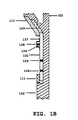
- FIGS 1A through 1D depict a specific device which utilizes chromatographic principles to perform specific binding assays.
- Three porous carrier membranes testing three different analytes are shown in a plastic holder (102).
- a plastic holder may form a portion of an assaying device of the type disclosed by European Patent Application with publication No. EP-A-0668745.
- plastic holder (102) will retain three to five porous carrier membranes.
- FIG. 1A shows three porous carrier membranes
- FIG. 1C shows windows for five porous carrier membranes.
- Main membrane (101) contains detection site (103) and control site (104). Labeled specific binding reagent (105) is embedded in top membrane (106) which contacts the upper surface of main membrane (101). Top membrane (106) is tightly attached to main membrane (101) with a polyester film with adhesive backing, e.g. with adhesive mylar tape (107). Contacting and preferably slightly overlapping, beginning end (108) of each main membrane (101) is sample pad (109). Sample contacts sample pad (109) through several small holes in the back side of the pad (not shown). A soft rubber seal (110) sits on the top of sample pad (109). The degree of softness needed is readily determined by the skilled artisan. Seal (110) is somewhat dimensionally larger than sample pad (109), so that it covers sample pad (109) and seals it along its borders when squeezed.
- Sealing is required to prevent leakage of the sample when the chromatographic membranes are installed vertically (sample migrates in a downwards direction).
- a seal (110) can also be used when the apparatus is used in other than a vertical position.
- Absorbent pad (111) at the terminal end (112) of the chromatographic membranes is common to all three membranes.
- Each detection site can be observed through a cross-shaped result window (113) and the corresponding control site through a circular control window (114) of the cover panel (115).
- the plastic of the cover panel is typically not transparent.
- the cross-shaped result window labeled with COC is for an assay for the detection of benzoylecgonine in urine.
- the cross-shaped result window labeled with THC which stands for Tetrahydrocannabinoids, is for an assay for the detection of cannabinoids in urine.
- the cross-shaped result window labeled with MOR is for an assay for the detection of opiates in urine.
- the appearance of a blue bar in each of the round windows 114 labeled TEST COMPLETE indicates that the corresponding test has run to completion and that the results may be interpreted.
- These windows 114 expose an area of the membrane strip that is coated with anti-bovine serum albumin antibodies. Latex microparticles are overcoated with bovine serum albumin so that when they migrate past this area of the membrane the antibody binds to the bovine serum albumin and captures the microparticle.
- the present invention is particularly useful in a competition assay format.
- the labeled reagent in the top membrane is either the analyte itself or an analog capable of the same type of specific binding.
- the labeled reagent is mobilized and diluted by a sample, and migrates with the sample towards the detection site, where unlabeled reagent capable of binding the analyte or its structural analog is immobilized. If analyte is present in a sample, it will compete with the labeled reagent for a limited number of binding sites in the detection zone, and the relative concentration of the analyte can be determined from the extent of reduction of binding of the labeled reagent.
- the labeled reagent is a binding partner of the analyte or of its structural analog.
- the labeled reagent is mobilized and diluted by a sample, and then migrates with the sample towards the detection site, where the unlabeled analyte or its analog is immobilized. If analyte is present in the sample, then during the course of migration it will bind to the labeled reagent. Remaining unsaturated binding sites of the labeled reagent can bind to the immobilized reagent in the detection site. Once again, concentration of the analyte can be determined from the extent of reduction of binding of the labeled reagent.
- the ratio of concentrations of binding components in migrating liquid should not fluctuate significantly over the dimensions of the labeled reagent moving zone. Also, uniformity should not decay over the term of migration to the detection site. Deviation in flow uniformity allows competition to fluctuate, and leads to poorly reproducible results.
- the present invention minimizes non-uniformity, and improves sensitivity by making the labeled reagent more dilute (as described below).
- Discrimination between zero analyte level and cut-off analyte level can be improved by increasing the total amount of labeled reagent and increasing the volume in which it is presented.
- analytical signal at zero drug level becomes stronger, while the signal at cut-off level is kept unchanged, the steeper calibration curve allows better discrimination.
- both the labeled reagent and the unlabeled immobilized reagent are the binding partners of the analyte (though they typically should bind to different epitopes of the analyte).
- both the labeled and immobilized unlabeled reagents are present in excess of the analyte. If analyte is present in the sample, then during the course of migration it will fully bind to the labeled reagent. In the detection site, analyte, which is already bound to the labeled reagent, will bind to the immobilized reagent, forming the sandwich. The analyte concentration is directly proportional to the binding at the detection site.
- Morphine derivative - N-[3-[(7,8-Didehydro-4,5-epoxy-6-hydro-17-methyl-morphinan-3-yl)oxy]propoxy]-4-isothiocyanatobenzamide- was prepared as described in European Application with publication No. EP-A-0386644.
- BSA bovine serum albumin
- the reaction mixture was stirred at room temperature for 16 hours and then transferred to dialysis tubing and dialyzed first against 15 volumes of 20% DMSO - potassium phosphate buffer (50 mM, pH 8), second against 10% DMSO - potassium phosphate buffer, and third for four times more against potassium phosphate buffer.
- Colored uniform carboxylate-modified styrene microparticles e.g. blue latex from Seradyn (0.3 micron particles) was first washed three times at 1% solids by centrifuging in 20 mM, pH 6.1 MES (2-[N-morpholino]ethanesulfonic acid). The washed latex was then adjusted to 5% solids in MES and (i) sensitized with 2 mg/mL anti-morphine monoclonal antibody for 16 hours at room temperature, (ii) blocked with BSA solution in MES for 1 hour at room temperature, then (iii) washed for three times at 1% solids in MES by centrifugation, and (iv) adjusted again to 5% solids. Before use, equal volumes of this latex and 35% w/v sucrose in MES were mixed.
- nitrocellulose cast directly on polyester film e.g. Mylar backed large pore size nitrocellulose (10-20 micron) from Millipore
- PVA polyvinyl alcohol
- Sample pads were prepared by cutting a cellulose filter paper, e.g. BioRad gel blotter, into 0.5 cm 2 pieces. The same cellulose filter paper was used for the sink pads.
- a cellulose filter paper e.g. BioRad gel blotter
- nitrocellulose which was previously blocked in the same manner as the main membrane, was cut into 5 mm wide strips and latex was applied using the IVEK dispensing system. After drying for 30 min. at 37°C, this membrane was placed, nitrocellulose surface down, onto the main membrane and laminated to the main membrane with a polyester film with adhesive backing, e.g. with Adhesive Research Inc. adhesive mylar. After this, the segment was cut into 5 mm wide strips, sample pad and sink pad placed respectively at the beginning and terminal ends of the strips, and the calibration curve obtained using solutions containing predetermined amounts of the drug (morphine sulfate).
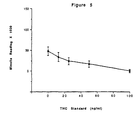
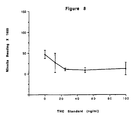
- the optimal calibration curve (1.1 ⁇ l/cm of latex) is shown in FIG. 2. This curve, and the following curves shown in Figures 3 to 8, were obtained by determining the colorimetric density of the result bands using a tristimulus reflective color analyzer, e.g. Minolta CR-241 Chroma Meter.
- the vertical axis indicates values measured with Minolta CR-241 Chroma Meter multiplied by 1000. This is indicated by the label "Minolta reading x 1000".
- This Minolta readings are taken from the colorimetric density, Dx, derived from the X, Y, Z tristimulus values as determined by the CIE (Commission Internationale de l'Eclairage).
- the tristimulus values are derived from the Yxy color system established by the CIE in 1931, wherein Y is the lightness factor and x and y are the coordinates of the chromaticity diagram.
- Uniformity of the result band and control band can be characterized by color intensity variation for the five reading points.
- Table 1 presents %CV in control and result band intensities. Variation (%CV) in result and control band intensity Morphine standard concentration Fig. No. 0 ng/mL 75 ng/ml 150 ng/mL Control anti-BSA 2 8.0 9.3 15.6 5.3 3 24.1 17.1 151.9 22.7
- Nitrocellulose membranes as described for this invention in Example 1 were prepared using: a tetrahydrocannabinoid-BSA conjugate prepared similarly to the morphine-BSA conjugate, but at a 20:1 drug derivative to BSA ratio; ⁇ -cyclodextrin incorporated into the sample pad; and blue latex sensitized with anti-tetrahydrocannabinoid monoclonal antibodies. Analysis of the colored results bands were performed as in Example 1. An optimal calibration curve of 3.0 ⁇ l/cm latex is shown in FIG. 4.
- FIG. 5 and FIG. 6 show optimal THC curves when the latex is applied directly to the main membrane (1 ⁇ l/cm) by the IVEK system and a compressed air liquid dispensing system or airbrush, e.g. a Paasche Company airbrush, respectively.
- Uniformity of the result band and control band can be characterized by color intensity variation for the five reading points.
- Table 2 presents %CV in control and result band intensities. Variation (%CV) in result and control band intensity THC standard concentration Fig. No. 0 ng/mL 12.5 ng/ml 25 ng/mL Control anti-BSA 4 15.5 7.9 12.5 5.3 5 21.4 33.1 37.2 22.7 6 40.8 2L5 52.7 44.3 7 31.8 31.2 54.8 66.0 8 21.6 86.6 22.9 22.6
- the present apparatus offers superior results when compared with the systems of the prior art.
Landscapes
- Health & Medical Sciences (AREA)
- Immunology (AREA)
- Life Sciences & Earth Sciences (AREA)
- Engineering & Computer Science (AREA)
- Molecular Biology (AREA)
- Biomedical Technology (AREA)
- Chemical & Material Sciences (AREA)
- Hematology (AREA)
- Urology & Nephrology (AREA)
- Biotechnology (AREA)
- Biochemistry (AREA)
- Cell Biology (AREA)
- Food Science & Technology (AREA)
- Medicinal Chemistry (AREA)
- Physics & Mathematics (AREA)
- Analytical Chemistry (AREA)
- Microbiology (AREA)
- General Health & Medical Sciences (AREA)
- General Physics & Mathematics (AREA)
- Pathology (AREA)
- Investigating Or Analysing Biological Materials (AREA)
- Investigating Or Analysing Materials By The Use Of Chemical Reactions (AREA)
- Investigating Or Analyzing Non-Biological Materials By The Use Of Chemical Means (AREA)
Claims (21)
- Dispositif pour effectuer un essai de liaison, qui comporte :(a) un premier matériel absorbant (101) ayant un premier réactif immobilisé dessus à un premier emplacement prédéterminé, et(b) un second matériel absorbant (106) en contact avec le premier matériel absorbant (101), et situé au-dessus de celui-ci, ayant dessus un second réactif immobilisé de manière séparable à un second emplacement prédéterminé, le premier matériel absorbant (101) et le second matériel (106) étant positionné en juxtaposition l'un et l'autre de sorte qu'un écoulement de liquide à travers le premier matériel absorbant (101) amène le second réactif à être libéré du second matériel absorbant (106) et à s'écouler à travers le premier matériel absorbant (101).
- Dispositif selon la revendication 1, dans lequel le premier matériel absorbant (101) et le second matériel absorbant (106) sont constitués du même matériel.
- Dispositif selon la revendication 1, dans lequel le premier matériel absorbant (101) est sélectionné parmi le groupe constitué de membranes spongieuses et de membranes poreuses.
- Dispositif selon la revendication 1, dans lequel le second matériel absorbant (106) est sélectionné parmi le groupe constitué de membranes spongieuses et de membranes poreuses.
- Dispositif selon la revendication 3, dans lequel le matériel absorbant (101) est une nitrocellulose.
- Dispositif selon la revendication 4, dans lequel le matériel absorbant (106) est une nitrocellulose.
- Dispositif selon la revendication 1, dans lequel le premier matériel absorbant (101) et le second matériel absorbant (106) sont maintenus en contact l'un avec l'autre par un élément de maintien.
- Dispositif selon la revendication 1, dans lequel le premier matériel absorbant (101) et le second matériel absorbant (106) sont maintenus en contact l'un avec l'autre par une bande de matériel (107).
- Dispositif selon la revendication 8, dans lequel le matériel (107) est un film de polyester.
- Dispositif selon la revendication 1, dans lequel le second réactif est marqué.
- Dispositif selon la revendication 1, dans lequel le premier matériel absorbant (101) a une pluralité de réactifs immobilisés dessus.
- Dispositif selon la revendication 1, dans lequel le second matériel absorbant (106) a une pluralité de réactifs immobilisés dessus.
- Dispositif selon la revendication 10, dans lequel le marqueur est un latex coloré.
- Dispositif selon la revendication 1, dans lequel le premier réactif et le second réactif ont une affinité de liaison l'un avec l'autre.
- Dispositif selon la revendication 1, dans lequel le taux d'attraction du premier matériel absorbant (101) est supérieur ou égal au taux d'attraction du second matériel absorbant (106).
- Dispositif selon la revendication 1, dans lequel le premier réactif est immobilisé de manière irréversible sur le premier matériel absorbant (101).
- Dispositif selon la revendication 1, dans lequel le premier matériel absorbant (101) et le second matériel absorbant (106) ont chacun des surfaces planes.
- Dispositif selon la revendication 17, dans lequel la surface plane du premier matériel absorbant (101) est juxtaposée à la surface plane du second matériel absorbant (106).
- Dispositif selon la revendication 1, dans lequel le premier réactif et le second réactif ont chacun une affinité de liaison avec la même substance.
- Procédé pour effectuer un essai de liaison, qui comporte les étapes consistant à :introduire un échantillon liquide dans le premier matériel absorbant (101) du dispositif selon l'une quelconque des revendications 1 à 19, pour générer un premier écoulement de liquide dans le premier matériel absorbant (101), lequel premier écoulement de liquide se divise en deux écoulements lorsqu'il atteint le second matériel absorbant (106), de manière à introduire le liquide depuis le premier matériel absorbant (101) dans le second matériel absorbant (106) afin de générer un second écoulement de liquide dans le second matériel absorbant (106) tout en maintenant le premier écoulement de liquide dans le premier matériel absorbant (101), etdéplacer le second réactif dans le second écoulement de liquide au sein du second matériel absorbant (106), le second écoulement, après déplacement du second réactif, étant dans une direction généralement parallèle au premier écoulement de liquide au sein du premier matériel absorbant (101), et introduire le second écoulement de liquide et le second réactif provenant du second matériel absorbant (106) dans le premier matériau absorbant (101) pour les unir au premier écoulement de liquide au sein du premier matériel absorbant (101).
- Procédé selon la revendication 20, dans lequel le premier écoulement de liquide dans le premier matériel absorbant (101) s'écoule à une vitesse supérieure ou égale au second écoulement de liquide dans le second matériel absorbant (106).
Applications Claiming Priority (2)
| Application Number | Priority Date | Filing Date | Title |
|---|---|---|---|
| US38530095A | 1995-02-10 | 1995-02-10 | |
| US385300 | 2003-03-10 |
Publications (2)
| Publication Number | Publication Date |
|---|---|
| EP0726462A1 EP0726462A1 (fr) | 1996-08-14 |
| EP0726462B1 true EP0726462B1 (fr) | 2002-04-03 |
Family
ID=23520835
Family Applications (1)
| Application Number | Title | Priority Date | Filing Date |
|---|---|---|---|
| EP96101322A Expired - Lifetime EP0726462B1 (fr) | 1995-02-10 | 1996-01-31 | Appareil et méthode pour un essai de liaison sur un matériau porteur absorbant |
Country Status (7)
| Country | Link |
|---|---|
| US (1) | US5770458A (fr) |
| EP (1) | EP0726462B1 (fr) |
| JP (1) | JP4007624B2 (fr) |
| AT (1) | ATE215699T1 (fr) |
| CA (1) | CA2167362A1 (fr) |
| DE (1) | DE69620281T2 (fr) |
| ES (1) | ES2173216T3 (fr) |
Families Citing this family (44)
| Publication number | Priority date | Publication date | Assignee | Title |
|---|---|---|---|---|
| US6342183B1 (en) | 1997-02-14 | 2002-01-29 | Escreen | System for collecting and locally analyzing a fluid specimen |
| US6514461B1 (en) * | 1997-02-14 | 2003-02-04 | Escreen, Inc. | System for automatically testing a fluid specimen |
| KR100292182B1 (ko) * | 1997-09-18 | 2001-11-26 | 모리시타 요이찌 | 면역크로마토그라피장치 |
| US6168758B1 (en) * | 1997-11-19 | 2001-01-02 | Starplex Scientific | Liquid sample assay device |
| US6306642B1 (en) * | 1997-11-24 | 2001-10-23 | Quidel Corporation | Enzyme substrate delivery and product registration in one step enzyme immunoassays |
| EP0947820B1 (fr) * | 1998-03-31 | 2004-08-25 | Evotec OAI AG | Méthode de préparation d'un échantillon |
| US7347972B1 (en) * | 1998-07-22 | 2008-03-25 | Jin Po Lee | Multiple analyte assay device |
| US8623291B2 (en) | 1998-07-14 | 2014-01-07 | Jin Po Lee | Multiple analyte assay device |
| US8202487B2 (en) * | 1998-07-22 | 2012-06-19 | Jin Po Lee | Multiple analyte assay devices |
| US6379620B1 (en) * | 1998-11-16 | 2002-04-30 | Barry M. Tydings | Assaying device and method for in field urinalysis |
| US6514769B2 (en) * | 1999-07-29 | 2003-02-04 | Jin Po Lee | Multiple analyte assay device with sample integrity monitoring system |
| US6136549A (en) * | 1999-10-15 | 2000-10-24 | Feistel; Christopher C. | systems and methods for performing magnetic chromatography assays |
| US6534324B1 (en) * | 2000-05-12 | 2003-03-18 | Mizuho Usa, Inc. | Rapid assay strip and method of rapid competitive assay |
| DE10032290C2 (de) * | 2000-07-03 | 2002-05-08 | Roche Diagnostics Gmbh | Adsorptionsmittelhaltige Kontrollflüssigkeit |
| US6492127B2 (en) * | 2001-01-23 | 2002-12-10 | Varian, Inc. | Lateral flow testing device with on-board chemical reactant |
| KR20030008748A (ko) * | 2001-07-20 | 2003-01-29 | 한국과학기술연구원 | 필로폰과 대마초의 동시감식용 면역검출지 |
| US7049150B2 (en) * | 2001-12-28 | 2006-05-23 | Varian, Inc. | Binding assay device with non-absorbent carrier material |
| US7029918B2 (en) | 2002-01-25 | 2006-04-18 | Roche Diagnostics Operations, Inc. | Water-soluble derivatives of lipophilic drugs |
| US6805838B2 (en) * | 2002-03-04 | 2004-10-19 | Barry M. Tydings | Assaying device and method for in field urinalysis |
| US7709047B2 (en) * | 2003-01-24 | 2010-05-04 | The United States Of America As Represented By The Secretary Of The Department Of Health And Human Services | Target activated microtransfer |
| US7695752B2 (en) * | 2003-01-24 | 2010-04-13 | The Government Of The United States Of America As Represented By The Secretary Of The Department Of Health And Human Services | Target activated microtransfer |
| US20040184965A1 (en) * | 2003-03-18 | 2004-09-23 | Smith Jack V. | Testing cup |
| WO2004092101A2 (fr) * | 2003-04-10 | 2004-10-28 | Mallinckrodt Inc. | Traitement stereoselectif du ?9-tetrahydrocannabinol |
| US7393697B2 (en) * | 2003-06-06 | 2008-07-01 | Advantage Diagnostics Corporation | Diagnostic test for analytes in a sample |
| DE10330981B4 (de) * | 2003-07-09 | 2010-04-01 | Medion Diagnostics Ag | Vorrichtung und Verfahren zur simultanen Durchführung von Blutgruppenbestimmung, Serumgegenprobe und Antikörpersuch-Test |
| DE10330982A1 (de) * | 2003-07-09 | 2005-02-17 | Prisma Diagnostika Gmbh | Vorrichtung und Verfahren zur simultanen Bestimmung von Blutgruppenantigenen |
| US20060216833A1 (en) * | 2004-06-24 | 2006-09-28 | The Regents Of The University Of California | Spot test kit for explosives detection |
| EP1657551A1 (fr) * | 2004-11-11 | 2006-05-17 | EnviteC-Wismar GmbH | Procédé et kit pour la détection des cannabinoides |
| US20060199276A1 (en) * | 2005-03-07 | 2006-09-07 | Bernhard Armani | Device for multiple rapid detection and testing of diseases, disorders and immunity in human, animals and the environment |
| US20070020699A1 (en) * | 2005-07-19 | 2007-01-25 | Idexx Laboratories, Inc. | Lateral flow assay and device using magnetic particles |
| CN100478671C (zh) * | 2005-10-25 | 2009-04-15 | 艾康生物技术(杭州)有限公司 | 用于液体样本的检测装置和方法 |
| JP2007187650A (ja) * | 2005-12-16 | 2007-07-26 | Horiba Ltd | 免疫測定法を用いたフィプロニルの測定キット |
| US7749772B1 (en) | 2006-06-29 | 2010-07-06 | Varian, Inc. | Antibody and immunoassays for determining the presence of Δ9-Tetrahydrocannabinol |
| US20080019867A1 (en) * | 2006-07-22 | 2008-01-24 | Johnson Paul K | Urinalysis screening device |
| US20080153110A1 (en) * | 2006-10-25 | 2008-06-26 | Tim Scherkenback | Combination Rapid Detection Cartridges For Biological and Environmental Agents, Methods of Production and Uses Thereof |
| WO2008141351A1 (fr) * | 2007-05-21 | 2008-11-27 | Erber Aktiengesellschaft | Procédé permettant de déterminer de manière quantitative des analytes au moyen d'un élément test ainsi qu'un système de test et son utilisation |
| CN101603967B (zh) * | 2008-06-10 | 2015-02-18 | 英科新创(厦门)科技有限公司 | 快速检测人ABO/Rh/MN血型的方法及试剂盒 |
| US9332967B2 (en) * | 2009-04-16 | 2016-05-10 | Ameditech, Inc. | Invertable assaying device with fluid level adjusting cover |
| JP5852329B2 (ja) * | 2011-05-31 | 2016-02-03 | 積水メディカル株式会社 | HbA1cの免疫学的測定方法 |
| CN103792365A (zh) * | 2012-11-05 | 2014-05-14 | 江苏维赛科技生物发展有限公司 | 串珠镰刀菌素胶体金试纸条的制备及使用方法 |
| US9724689B2 (en) * | 2012-11-20 | 2017-08-08 | Detectachem Llc | Colorimetric test system designed to control flow of simultaneously released chemicals to a target area |
| JP6226624B2 (ja) * | 2013-08-08 | 2017-11-08 | 田中貴金属工業株式会社 | 溶血性レンサ球菌診断イムノクロマト試薬、キット及び検出方法 |
| JP6026595B2 (ja) * | 2015-06-08 | 2016-11-16 | 積水メディカル株式会社 | HbA1cの免疫学的測定方法 |
| US20210362152A1 (en) * | 2020-05-19 | 2021-11-25 | Core Diagnostics Corporation | Device for quantifying an assay |
Family Cites Families (23)
| Publication number | Priority date | Publication date | Assignee | Title |
|---|---|---|---|---|
| US3857931A (en) * | 1971-02-01 | 1974-12-31 | Hoffmann La Roche | Latex polymer reagents for diagnostic tests |
| US4094647A (en) * | 1976-07-02 | 1978-06-13 | Thyroid Diagnostics, Inc. | Test device |
| US4121975A (en) * | 1976-08-20 | 1978-10-24 | Syva Company | Pretreatment of samples for polyiodothyronine assays |
| US4235601A (en) * | 1979-01-12 | 1980-11-25 | Thyroid Diagnostics, Inc. | Test device and method for its use |
| US4361537A (en) * | 1979-01-12 | 1982-11-30 | Thyroid Diagnostics, Inc. | Test device and method for its use |
| US4938927A (en) * | 1982-01-08 | 1990-07-03 | Environmental Diagnostics, Inc. | Rotary fluid manipulator |
| HU194858B (en) * | 1982-12-03 | 1988-03-28 | Chinoin Gyogyszer Es Vegyeszet | Process for producing dibenzo/b,d/pirane derivatives and pharmaceutical compositions containing them |
| DE3445816C1 (de) * | 1984-12-15 | 1986-06-12 | Behringwerke Ag, 3550 Marburg | Flaechenfoermiges diagnostisches Mittel |
| GB8526741D0 (en) * | 1985-10-30 | 1985-12-04 | Boots Celltech Diagnostics | Binding assay device |
| CA1291031C (fr) * | 1985-12-23 | 1991-10-22 | Nikolaas C.J. De Jaeger | Methode pour la detection de liants specifiques et des substances liables par ceux-ci |
| DE3643516A1 (de) * | 1986-12-19 | 1988-06-30 | Boehringer Mannheim Gmbh | Testtraeger fuer die analytische bestimmung von bestandteilen von koerperfluessigkeiten |
| US4798804A (en) * | 1987-02-05 | 1989-01-17 | Syntex (U.S.A.) Inc. | Serum pretreatment in digoxin immunoassay |
| ES2150428T3 (es) * | 1987-04-27 | 2000-12-01 | Unilever Nv | Ensayos de union especifica. |
| US4956302A (en) * | 1987-09-11 | 1990-09-11 | Abbott Laboratories | Lateral flow chromatographic binding assay device |
| US5275785A (en) * | 1987-10-30 | 1994-01-04 | Unilever Patent Holdings B.V. | Test device for detecting an analyte in a liquid sample |
| DE3826057A1 (de) * | 1988-07-30 | 1990-02-01 | Boehringer Mannheim Gmbh | Testtraeger zur analytischen bestimmung eines bestandteils einer fluessigen probe |
| DE3842702A1 (de) * | 1988-12-19 | 1990-06-21 | Boehringer Mannheim Gmbh | Testtraeger zur analytischen untersuchung einer probenfluessigkeit mit hilfe einer spezifischen bindungsreaktion zweier bioaffiner bindungspartner und entsprechendes testverfahren |
| DE69030829T2 (de) * | 1989-03-10 | 1998-01-15 | Hoffmann La Roche | Reagenzien zum Nachweis von Drogen |
| GB8920135D0 (en) * | 1989-09-06 | 1989-10-18 | Erba Carlo Spa | Use of dehydrated cyclodextrins for improving drug dissolution |
| US5238652A (en) * | 1990-06-20 | 1993-08-24 | Drug Screening Systems, Inc. | Analytical test devices for competition assay for drugs of non-protein antigens using immunochromatographic techniques |
| GB9014903D0 (en) * | 1990-07-05 | 1990-08-22 | Unilever Plc | Assays |
| US5411893A (en) * | 1993-03-15 | 1995-05-02 | Difco Laboratories | Dry slide for diagnostic tests |
| US5403551A (en) * | 1993-09-16 | 1995-04-04 | Roche Diagnostic Systems, Inc. | Assaying device and container for in field analysis of a specimen and later shipment of the unadulterated specimen |
-
1996
- 1996-01-16 CA CA002167362A patent/CA2167362A1/fr not_active Abandoned
- 1996-01-31 EP EP96101322A patent/EP0726462B1/fr not_active Expired - Lifetime
- 1996-01-31 AT AT96101322T patent/ATE215699T1/de not_active IP Right Cessation
- 1996-01-31 DE DE69620281T patent/DE69620281T2/de not_active Expired - Lifetime
- 1996-01-31 ES ES96101322T patent/ES2173216T3/es not_active Expired - Lifetime
- 1996-02-08 JP JP02275896A patent/JP4007624B2/ja not_active Expired - Lifetime
-
1997
- 1997-06-17 US US08/877,189 patent/US5770458A/en not_active Expired - Lifetime
Also Published As
| Publication number | Publication date |
|---|---|
| ATE215699T1 (de) | 2002-04-15 |
| DE69620281D1 (de) | 2002-05-08 |
| DE69620281T2 (de) | 2002-10-31 |
| CA2167362A1 (fr) | 1996-08-11 |
| JPH08248030A (ja) | 1996-09-27 |
| US5770458A (en) | 1998-06-23 |
| EP0726462A1 (fr) | 1996-08-14 |
| JP4007624B2 (ja) | 2007-11-14 |
| ES2173216T3 (es) | 2002-10-16 |
Similar Documents
| Publication | Publication Date | Title |
|---|---|---|
| EP0726462A1 (fr) | Appareil et méthode pour un essai de liaison sur un matériau porteur absorbant | |
| EP0824697B1 (fr) | Dispositif d'immunochromatographie a une phase et son utilisation | |
| US4839297A (en) | Test carrier and method for the analytical determination of a component of a body fluid | |
| US5846838A (en) | Opposable-element assay device employing conductive barrier | |
| EP1376130B1 (fr) | Dispositif d'analyse à éléments opposables | |
| EP1046913B1 (fr) | Essai immunochromatographique | |
| EP0941468B1 (fr) | Dispositif hybride d'immunochromatographie en une etape et procede d'utilisation | |
| US5110550A (en) | Test carrier for the analytical determination of a component of a liquid sample | |
| EP0774666A1 (fr) | Dispositif et procédé de dosage des composants biologiques dans un échantillon | |
| US20070281370A1 (en) | Method for adding an apparent non-signal line to a lateral flow assay | |
| EP0587222B1 (fr) | Eléments secs avec une couche absorbante séparée pour immunoessais | |
| US20100317126A1 (en) | Agglutination assay method in porous medium layer | |
| EP0888547B1 (fr) | Analyse immunologique du sang entier | |
| EP1061368B1 (fr) | Essai d'agglutination dans un milieu liant | |
| EP0427534B1 (fr) | Amélioration dans un essai diagnostique non-instrumental d'une détermination à distance |
Legal Events
| Date | Code | Title | Description |
|---|---|---|---|
| PUAI | Public reference made under article 153(3) epc to a published international application that has entered the european phase |
Free format text: ORIGINAL CODE: 0009012 |
|
| 17P | Request for examination filed |
Effective date: 19960131 |
|
| AK | Designated contracting states |
Kind code of ref document: A1 Designated state(s): AT BE CH DE DK ES FR GB GR IE IT LI LU NL PT |
|
| 17Q | First examination report despatched |
Effective date: 20000309 |
|
| GRAG | Despatch of communication of intention to grant |
Free format text: ORIGINAL CODE: EPIDOS AGRA |
|
| GRAG | Despatch of communication of intention to grant |
Free format text: ORIGINAL CODE: EPIDOS AGRA |
|
| GRAH | Despatch of communication of intention to grant a patent |
Free format text: ORIGINAL CODE: EPIDOS IGRA |
|
| REG | Reference to a national code |
Ref country code: GB Ref legal event code: IF02 |
|
| GRAH | Despatch of communication of intention to grant a patent |
Free format text: ORIGINAL CODE: EPIDOS IGRA |
|
| GRAA | (expected) grant |
Free format text: ORIGINAL CODE: 0009210 |
|
| AK | Designated contracting states |
Kind code of ref document: B1 Designated state(s): AT BE CH DE DK ES FR GB GR IE IT LI LU NL PT |
|
| PG25 | Lapsed in a contracting state [announced via postgrant information from national office to epo] |
Ref country code: NL Free format text: LAPSE BECAUSE OF FAILURE TO SUBMIT A TRANSLATION OF THE DESCRIPTION OR TO PAY THE FEE WITHIN THE PRESCRIBED TIME-LIMIT Effective date: 20020403 Ref country code: GR Free format text: LAPSE BECAUSE OF FAILURE TO SUBMIT A TRANSLATION OF THE DESCRIPTION OR TO PAY THE FEE WITHIN THE PRESCRIBED TIME-LIMIT Effective date: 20020403 Ref country code: BE Free format text: LAPSE BECAUSE OF FAILURE TO SUBMIT A TRANSLATION OF THE DESCRIPTION OR TO PAY THE FEE WITHIN THE PRESCRIBED TIME-LIMIT Effective date: 20020403 Ref country code: AT Free format text: LAPSE BECAUSE OF FAILURE TO SUBMIT A TRANSLATION OF THE DESCRIPTION OR TO PAY THE FEE WITHIN THE PRESCRIBED TIME-LIMIT Effective date: 20020403 |
|
| REF | Corresponds to: |
Ref document number: 215699 Country of ref document: AT Date of ref document: 20020415 Kind code of ref document: T |
|
| REG | Reference to a national code |
Ref country code: CH Ref legal event code: EP |
|
| REF | Corresponds to: |
Ref document number: 69620281 Country of ref document: DE Date of ref document: 20020508 |
|
| REG | Reference to a national code |
Ref country code: IE Ref legal event code: FG4D |
|
| PG25 | Lapsed in a contracting state [announced via postgrant information from national office to epo] |
Ref country code: PT Free format text: LAPSE BECAUSE OF FAILURE TO SUBMIT A TRANSLATION OF THE DESCRIPTION OR TO PAY THE FEE WITHIN THE PRESCRIBED TIME-LIMIT Effective date: 20020703 Ref country code: DK Free format text: LAPSE BECAUSE OF FAILURE TO SUBMIT A TRANSLATION OF THE DESCRIPTION OR TO PAY THE FEE WITHIN THE PRESCRIBED TIME-LIMIT Effective date: 20020703 |
|
| ET | Fr: translation filed | ||
| NLV1 | Nl: lapsed or annulled due to failure to fulfill the requirements of art. 29p and 29m of the patents act | ||
| REG | Reference to a national code |
Ref country code: ES Ref legal event code: FG2A Ref document number: 2173216 Country of ref document: ES Kind code of ref document: T3 |
|
| PG25 | Lapsed in a contracting state [announced via postgrant information from national office to epo] |
Ref country code: LU Free format text: LAPSE BECAUSE OF NON-PAYMENT OF DUE FEES Effective date: 20030131 Ref country code: IE Free format text: LAPSE BECAUSE OF NON-PAYMENT OF DUE FEES Effective date: 20030131 |
|
| PLBE | No opposition filed within time limit |
Free format text: ORIGINAL CODE: 0009261 |
|
| STAA | Information on the status of an ep patent application or granted ep patent |
Free format text: STATUS: NO OPPOSITION FILED WITHIN TIME LIMIT |
|
| 26N | No opposition filed |
Effective date: 20030106 |
|
| REG | Reference to a national code |
Ref country code: IE Ref legal event code: MM4A |
|
| PGFP | Annual fee paid to national office [announced via postgrant information from national office to epo] |
Ref country code: GB Payment date: 20141230 Year of fee payment: 20 |
|
| PGFP | Annual fee paid to national office [announced via postgrant information from national office to epo] |
Ref country code: FR Payment date: 20141226 Year of fee payment: 20 |
|
| PGFP | Annual fee paid to national office [announced via postgrant information from national office to epo] |
Ref country code: DE Payment date: 20150126 Year of fee payment: 20 Ref country code: IT Payment date: 20150120 Year of fee payment: 20 Ref country code: ES Payment date: 20150114 Year of fee payment: 20 Ref country code: CH Payment date: 20150126 Year of fee payment: 20 |
|
| REG | Reference to a national code |
Ref country code: DE Ref legal event code: R071 Ref document number: 69620281 Country of ref document: DE |
|
| REG | Reference to a national code |
Ref country code: CH Ref legal event code: PL |
|
| REG | Reference to a national code |
Ref country code: GB Ref legal event code: PE20 Expiry date: 20160130 |
|
| PG25 | Lapsed in a contracting state [announced via postgrant information from national office to epo] |
Ref country code: GB Free format text: LAPSE BECAUSE OF EXPIRATION OF PROTECTION Effective date: 20160130 |
|
| REG | Reference to a national code |
Ref country code: ES Ref legal event code: FD2A Effective date: 20160526 |
|
| PG25 | Lapsed in a contracting state [announced via postgrant information from national office to epo] |
Ref country code: ES Free format text: LAPSE BECAUSE OF EXPIRATION OF PROTECTION Effective date: 20160201 |