EP0726537A1 - Verfahren und System um Bedingungen für Massen von Daten in einer Datenbank zu überprüfen - Google Patents
Verfahren und System um Bedingungen für Massen von Daten in einer Datenbank zu überprüfen Download PDFInfo
- Publication number
- EP0726537A1 EP0726537A1 EP96300875A EP96300875A EP0726537A1 EP 0726537 A1 EP0726537 A1 EP 0726537A1 EP 96300875 A EP96300875 A EP 96300875A EP 96300875 A EP96300875 A EP 96300875A EP 0726537 A1 EP0726537 A1 EP 0726537A1
- Authority
- EP
- European Patent Office
- Prior art keywords
- constraint
- records
- record
- insert
- query
- Prior art date
- Legal status (The legal status is an assumption and is not a legal conclusion. Google has not performed a legal analysis and makes no representation as to the accuracy of the status listed.)
- Withdrawn
Links
Images






Classifications
-
- G—PHYSICS
- G06—COMPUTING OR CALCULATING; COUNTING
- G06F—ELECTRIC DIGITAL DATA PROCESSING
- G06F16/00—Information retrieval; Database structures therefor; File system structures therefor
- G06F16/20—Information retrieval; Database structures therefor; File system structures therefor of structured data, e.g. relational data
- G06F16/28—Databases characterised by their database models, e.g. relational or object models
- G06F16/284—Relational databases
-
- Y—GENERAL TAGGING OF NEW TECHNOLOGICAL DEVELOPMENTS; GENERAL TAGGING OF CROSS-SECTIONAL TECHNOLOGIES SPANNING OVER SEVERAL SECTIONS OF THE IPC; TECHNICAL SUBJECTS COVERED BY FORMER USPC CROSS-REFERENCE ART COLLECTIONS [XRACs] AND DIGESTS
- Y10—TECHNICAL SUBJECTS COVERED BY FORMER USPC
- Y10S—TECHNICAL SUBJECTS COVERED BY FORMER USPC CROSS-REFERENCE ART COLLECTIONS [XRACs] AND DIGESTS
- Y10S707/00—Data processing: database and file management or data structures
- Y10S707/99931—Database or file accessing
- Y10S707/99932—Access augmentation or optimizing
-
- Y—GENERAL TAGGING OF NEW TECHNOLOGICAL DEVELOPMENTS; GENERAL TAGGING OF CROSS-SECTIONAL TECHNOLOGIES SPANNING OVER SEVERAL SECTIONS OF THE IPC; TECHNICAL SUBJECTS COVERED BY FORMER USPC CROSS-REFERENCE ART COLLECTIONS [XRACs] AND DIGESTS
- Y10—TECHNICAL SUBJECTS COVERED BY FORMER USPC
- Y10S—TECHNICAL SUBJECTS COVERED BY FORMER USPC CROSS-REFERENCE ART COLLECTIONS [XRACs] AND DIGESTS
- Y10S707/00—Data processing: database and file management or data structures
- Y10S707/99931—Database or file accessing
- Y10S707/99933—Query processing, i.e. searching
- Y10S707/99934—Query formulation, input preparation, or translation
-
- Y—GENERAL TAGGING OF NEW TECHNOLOGICAL DEVELOPMENTS; GENERAL TAGGING OF CROSS-SECTIONAL TECHNOLOGIES SPANNING OVER SEVERAL SECTIONS OF THE IPC; TECHNICAL SUBJECTS COVERED BY FORMER USPC CROSS-REFERENCE ART COLLECTIONS [XRACs] AND DIGESTS
- Y10—TECHNICAL SUBJECTS COVERED BY FORMER USPC
- Y10S—TECHNICAL SUBJECTS COVERED BY FORMER USPC CROSS-REFERENCE ART COLLECTIONS [XRACs] AND DIGESTS
- Y10S707/00—Data processing: database and file management or data structures
- Y10S707/99941—Database schema or data structure
- Y10S707/99942—Manipulating data structure, e.g. compression, compaction, compilation
Definitions
- This invention relates generally to Relational Database Processing Systems, and in particular, to constraint checking and violation capture for bulk data stored in a relational database.
- a relational database management system uses relational techniques for storing and retrieving data.
- Relational databases are computerized information storage and retrieval systems in which data in the form of tables ("relations") are typically stored for use on disk drives or similar mass data stores.
- a “relation” includes a set of rows ("tuples” or “records”) spanning one or more columns.
- a “record” expresses a mathematical relation between its column elements.
- An RDMS receives and executes commands to store, retrieve and delete data using high-level query languages such as the Structured Query Language (SQL).
- SQL Structured Query Language
- the term "query” means a set of commands for acting on data in a stored database.
- An SQL standard has been maintained by the International Standards Organization (ISO) since 1986. Reference is also made to the SQL-92 standard "Database Language SQL” published by the American National Standards Institute (ANSI) as ANSI X3.135-1992 and published by the ISO as ISO/IEC 9075:1992 for the official specification of the 1992 version of the Structured Query Language. See also James R. Groff et al. ( LAN Times Guide to SQL , Osborne McGraw-Hill, Berkeley, CA, 1994) for a description of SQL-92.
- a table in an RDMS is partitioned into rows and columns such that there is one value at each intersection of a row and column. All of the values in a column are of the same data type. The only exception to this rule is that a value could be NULL.
- a NULL is a marker used to fill a place in a column where data is missing for some reason.
- Tables are created explicitly by using the SQL CREATE TABLE command.
- a table may be created as “permanent”, “temporary”, or “virtual”.
- Permanent tables include the base tables that contain the fundamental data that is permanently stored in the database. Fundamental data refers to the data for which the database is created to manage in the first place, for example, records of a group such as employees or students.
- Virtual tables - also called “view” - are tables derived from base tables using queries. The view does not exist in the database as a stored set of values like a base table. Instead the rows and columns of data visible through the view are the query results produced by the query that defines the view. The definition of the view is stored in the database.
- Temporary tables are not permanently stored, but are used for handling intermediate results, similar to program variables. Temporary tables are automatically flushed at the end of a working session.
- a table may be created, yet not have any data in it. Such a table, referred to as "empty”, is typically created for receiving data at a
- Constraints define conditions that data must meet to be entered into a permanent table of fundamental data. Constraints may apply to columns or to tables; they are checked by an RDMS. A constraint can be checked at any of the following times:
- constraint checking can impose a severe bottleneck if not deferred until all of the data are loaded.
- Referential integrity is the state when all foreign key values are present in their parent keys. If an employee's department is eliminated and its corresponding record is deleted from the parent table, then the foreign key in the employee record, representing that department, is invalid. In such a case, the system would lack referential integrity. Although the above simple example shows a foreign and primary key having only one column, referential integrity can be assured using multi-column keys.
- the record for the employee having no department is said to be "orphaned" because the foreign key has no parent table.
- a typical SQL technique for dealing with orphans is to eliminate them when their parent references are eliminated.
- a function known as CASCADE is available in SQL for ensuring that records having foreign keys are eliminated when their referenced primary keys are eliminated.
- the invention provides methods and tools for constraint-checking of bulk-loaded data after storage in a relational database, that also ensures referential integrity.
- a data processor generates an INSERT query for inserting one or more records into a bulk-loaded table in an RDMS.
- the processor then calls an SQL compiler to compile an SQL INSERT command.
- the code generated to execute the INSERT includes code to check for constraint violations in the records to be inserted.
- the method according to the preferred embodiment of this invention replaces an INSERT command with a SELECT command, thereby enabling the resulting code to "constraint-check" the bulk-loaded data by selecting records that are in violation of the column constraints.
- the preferred embodiment of the invention further includes an environment in which the above-described method may be carried out.
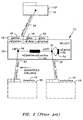
- Fig. 1 a query translation process used in the known IBM Starburst relational database management system (Starburst RDMS) is shown with modifications necessitated for enabling the present invention.
- the IBM Starburst RDMS is described in detail in L. M. Hass, et al., "An Extensible Processor for an Extended Relational Query Language", IBM Research Report, RJ 6182, IBM Almaden Research Center, San Jose, CA, April 1988.
- Queries written in SQL, or the like, are processed in phases as shown in Fig. 1.
- An SQL query is first lexed at 13, parsed and checked semantically at 14, and converted into an internal representation denoted as the Query Graph Model (QGM) 15.
- the QGM is a well-known data structure that summarizes the semantic relationships of the query for use by all components of the query compiler.
- a QGM optimization procedure 16 then rewrites the QGM in canonical form by iteratively transforming the QGM into a semantically equivalent QGM 15. Reference for explanation regarding such optimization is made to W. Hasen, et al., "Query Rewrite Optimization in Starburst, IBM Research Report, RJ 6367, IBM Almaden Research Center, San Jose, CA, August 1988.
- QGM optimization 16 The purpose of QGM optimization 16 is to simplify QGM 15 to help the subsequent plan optimization process to produce improved Query Execution Plans (QEPs).
- a plan optimization procedure 18 generates alternative QEPs, and chooses the best QEP 20, based on estimated costs.
- the plan refinement procedure 22 transforms best QEP 20 further by adding information necessary at execution time to make QEP 20 suitable for efficient execution.
- QGM optimization step 16 is separate and distinct from QEP optimization step 18.
- U.S. Patent 5,345,585 issued to Iyer et al. entirely incorporated herein by this reference, for a discussion of a useful join optimization method suitable for use in QEP optimization step 18.
- This invention is a constraint checking improvement that enables constraint checking of bulk-loaded data by using a QGM 15, the known constraint engine combined with a known SQL compiler, this combination being denoted as the constraint compiler 24, and a new module 26 described below.
- QGM 15 For an understanding of QGM 15 characteristics, reference is made to Hamid Pirahesh, et al., "Extensible/Rule Based Query Rewrite Optimization in Starburst," Proceedings of ACM SIGMOD '92 International Conference on Management of Data , San Diego, CA, 1992.
- QGM 15 embraces the concepts of (a) quantifiers or record variables, (b) predicates, and (c) SELECT operations. This invention extends these concepts in a new and useful way to achieve its objectives.
- the embodiment of this invention uses a particular program object module coupled with computer hardware, shown in Fig. 3 and discussed in detail below.
- This module is represented schematically in Fig. 1 at 26, and is denominated as the "SET CONSTRAINTS MODULE".
- the method performed partly by this module is implemented in software, but it may also be embodied as hardware logic that implements the rules described below in connection with the flow charts in Figs. 4-8.
- this invention may be embodied as software code stored in any useful recording medium, including being recorded magnetically on the computer disk, shown in Fig. 12.
- this invention extends RDMS features such as SQL query processing and QGM optimization to enable constraint checking of bulk-loaded data stored in a table residing in the database, it is necessary to discuss the QGM. Additionally, the constraint checking system also captures violations including those offending referential constraints, so that it is necessary to discuss referential integrity.
- the QGM The QGM
- FIG. 2 provides a QGM representation of the following SQL query:
- a SELECT box 24 is shown with a body 26 and a head 28.
- Body 26 includes dataflow arcs 30 and 32, which are also shown as the internal vertices 34 and 36.
- Vertex 36 is a set-former that ranges on (reads from) the box 38, which provides records on arc 32.
- vertex 34 ranges on box 40, which flows records on dataflow arc 30.
- the attributes to be retrieved from the query, PARTNO 46, DESC 48 and PRICE 50 are in head 28. Boxes 38 and 40 represent the base-relations accessed by the query, INVENTORY 42 and QUOTATIONS 44, respectively.
- Box 24 embraces the operations to be performed on the query to identify the PARTNOs that match in the two base-relations, as required by the join predicate 52 represented as an internal predicate edge joining vertices 34 and 36.
- Vertex 34 also includes a self-referencing predicate 54 to identify prices of those PARTNOs that exceed 100.
- each box or node (formally denominated “quantifier node”) in Fig. 2 is coupled to one or more other nodes by dataflow arcs (formally denominated “quantifier columns”).
- base-relation node 38 is coupled to select node 24 by data-flow arc 32
- base-relation node 40 is connected to select node 24 by data flow arc 30.
- the activities inside select node 24 produce a new stream of data records that are coupled to the TOP node 56 along a dataflow arc 58.
- TOP node 56 represents the data output table requested by the query.
- the object of several known QGM optimization procedures is to merge one or more nodes where possible by eliminating (collapsing) dataflow arcs.
- the above-cited Pirahesh et al. reference describes a set of rules for merging any number of nodes into a single SELECT node, with certain restrictions on non-existential or non-Boolean factor subqueries, set operators, aggregates and user-defined extension operators such as OUTER JOIN.
- QGM optimization step 16 usually rewrites the QGM to eliminate numerous nodes and data-flow arcs even before considering useful query execution plans in plan optimization step 18 (Fig. 1).
- One or more columns in a base-relation may be assigned a "key attribute", such as "primary key” or "foreign key".
- the primary key of a base-relation uniquely identifies each record (row) in the relation.
- a foreign key establishes a "referential" relationship between the base-table (child) and another (parent) table designated by the foreign key column attribute.
- An unique key is a set of columns whose values uniquely determine a record in the table, so a primary key is, by definition, an unique key.
- a parent/child relationship may be established between two relations by adding a foreign-key attribute to one and relating it to an unique key attribute in another, as is well-known in the art. Such relationships may be added without limit and each key attribute may span several columns.
- a referential constraint relates a possibly multi-column foreign key from the child table to an unique key in the parent table. There is only one primary key in a table, but there may be many unique keys.
- the child records Upon deletion of a parent record that has one or more children, the child records are orphaned because their foreign key values no longer match any existing primary key value in the parent relation. Deleting a record from the child relation is no problem because the parent merely loses a child. Updating the primary key in a parent record is a different form of this problem. If the primary key of a parent record is modified, all existing children of that record become orphans because their foreign key values no longer match an existing primary key value.
- SQL For each parent/child relationship created by a foreign key, SQL provides for an associated delete rule and an associated update rule.
- the delete rule specifies DBMS action when a user tries to delete a parent record. Available rules include RESTRICT, CASCADE, SET NULL, and SET DEFAULT.
- the update rule also specifies one of these DBMS actions when the user tries to update the value of one of the primary key columns in the parent relation.
- the usual RESTRICT rule merely rejects the attempted operation.
- the CASCADE rule automatically deletes and updates records from the children responsive to a command to delete or update a parent record.
- Fig. 3 shows a functional block diagram of a computer-implemented database processing system 68.
- System 68 includes a central processing unit (CPU) 70, which is coupled to a parallel bus 72.
- the query input terminal 74 allows the user to enter queries into system 68, either from a remote terminal or through any other useful method known in the art.
- a "user query” includes a combination of SQL commands intended to produce one or more output data tables according to specification included in the query.
- the data output terminal 76 displays the query results to the user and may be physically co-located with query input terminal 74.
- System 68 includes the address space 78, which is shown schematically as containing program objects and data objects.
- the base table 80 is an example of a data object pulled into address space 78 from the external mass store 82 by way of bus 72.
- the view definition 84 is another data object representing a "virtual table" made up of elements from one or more base tables in accordance with a VIEW definition statement.
- External mass store 82 includes a generally large plurality of base tables (also denominated base relations), exemplified by base tables 86 and 88. These base tables are moved partially or entirely between memory space 78 and external mass store 82 in a manner well-known in the art for database management systems.
- Address space 78 also includes the control program object 90, which manages the other components of system 68. These components include the query parser 14 for accepting the query input from terminal 74 and forwarding it to the Query Graph Model (QGM) optimizer 16. The Constraint Compiler (C.C.) 24 and the Set Constraints (S.C.) Module 26 interact between the parser and the QGM.
- QGM Query Graph Model
- the QGM optimizer rewrites the QGM representation of the user query to provide a "canonical form" of the QGM for output to the query optimizer 16.
- a QGM canonical form may include a large cyclical join graph organized within a single select node having dataflow arcs from many base-tables, subject to the restrictions of primary and referential integrity.
- This embodiment employs known SQL statements in novel ways to solve the problems of the prior art. Therefore, a brief discussion of important SQL statements are included below.
- a SELECT statement is used to retrieve data and generally comprises the format: "SELECT ⁇ clause ⁇ FROM ⁇ clause ⁇ WHERE ⁇ clause ⁇ GROUP BY ⁇ clause ⁇ HAVING ⁇ clause ⁇ ORDER BY ⁇ clause ⁇ .”
- the clauses generally must follow this sequence, but only the SELECT statement and FROM clauses are required.
- the result of executing a SELECT statement is a subset of data retrieved by the RDMS software from one or more existing tables or views stored in the relational database, with the FROM clause telling the RDMS software the name of the table or view from which the data is being selected.
- the subset of data is treated as a new table, termed the "result table", which typically comprises a temporary table.
- the items specified in the SELECT clause of the SELECT statement determine the columns that will be returned in the result table from the table(s) identified in the FROM clause.
- the WHERE clause determines which rows should be returned in the result table.
- the WHERE clause contains a "search condition" that must be satisfied by each row returned in the result table.
- the rows that satisfy the search condition form an intermediate set, which is then processed further according to specifications in the SELECT clause.
- the search condition may include one or more predicates, each of which specify a comparison between two or more column values, constants or correlated values. Multiple predicates in the WHERE clause are themselves connected by Boolean operators.
- a JOIN operation combines tables or views by appending rows from one table or view to another table or view.
- the rows, or portions of rows, from the different tables or views are concatenated horizontally through common columns.
- the JOIN operation is not provided explicitly as an SQL statement; instead it may be implied by naming more than one table or view in the FROM clause of the SELECT statement.
- JOIN operations normally include a WHERE clause that identifies the columns through which the rows can be combined.
- the WHERE clause may also include one or more predicates in a subquery with conditional operators that are used to select the rows to be joined.
- INSERT statement adds data to a database according to the format: "INSERT INTO table.name VALUES (constant [, ...]
- the SQL compiler has means for generating an internal process that compiles in the code to check constraints against the data modified by the SQL command.
- the DELETE statement may be used to remove data according to the format: "DELETE FROM table.name [WHERE ⁇ condition clause ⁇ ]." DELETE erases all records of the table which satisfy the WHERE clause's predicates.
- a predicate is an expression that is used in certain statements to test values and determine whether the effects of the statement should be applied to their values.
- a predicate may have a Boolean value of TRUE, FALSE, or UNKNOWN.
- the UNKNOWN value results when NULLS are used in comparisons.
- NOT NULL means that a column being checked may not contain the NULL value.
- the symbol tables include brief definitions of the symbols used in a preferred embodiment of pseudocode useful for implementing this invention.
- Tables S-1 through S-3 define the symbols used in the pseudocode embodiments shown in Tables 1-5.
- a raise error function raises a given error and rolls back the statement whenever it is invoked.
- a DELETE (or INSERT) operator can also flow data into other operators just like a select. For example: select c 1 , 2 from (delete c 1 , 5 FROM T where c 1 > 5); selects a record with two columns for each record deleted from T . The first column is the value of the c 1 column of the deleted record and the second column is always 5.
- COMPOUND SQL allows a grouping of a set of SQL statements together, and allows them to share common subexpressions. For example:
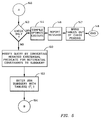
- the process is implicitly started by the bulk loading of one or more tables ⁇ T i ⁇ in mass store 82, as shown in step 130.
- a table T i will be placed in a pending state until constraints are checked.
- Table T i can be represented by either table 86 or 88 (Fig. 3).
- the SELECT CONSTRAINTS process is initiated by an invocation command, for example, "SELECT COMMAND ON", as shown in step 132.
- the invocation command may be performed as an SQL query or may be automatically passed to processor 70.
- the invocation command causes the SELECT CONSTRAINTS module to generate an INSERT query denoted as Q MAIN that is really a "dummy" insert of records that purportedly are to be inserted in the table T i as shown in step 134.
- the processor calls the constraint compiler 24 (Fig. 3) to compile the INSERT commands and check for constraint violations according to the constraint rule engine, as shown in step 136.
- the compiler 24 compiles Q MAIN and produces a query that has been modified to provide the code for checking constraints.
- An example of the modification of the query, Q MAIN from Table 1 is provided below in Table 2:
- step 138 of Fig. 4 is provided below in Table 3 in a preferred pseudocode embodiment of this invention, wherein any INSERT statement is replaced with a SELECT statement.
- step 140 the processing of the SET CONSTRAINTS continues at step 140, signifying the continuity of flow between Figs. 4 and 5.
- a determinative step 142 asks if the control program or a user requires only information that an error has occurred when the first constraint violation is found. If so, then this case is denoted as "check only”. If "check only" is performed, then in step 144 the query of the type shown in Table 3 is compiled, optimized and executed, according to normal QGM processing discussed with reference to Fig. 1 above.
- the error data reporting message generated in step 146 is then communicated. For example, it may be passed to display 76 or recorded in mass storage unit 82 for later retrieval.
- step 147 if there are no errors, tables are taken out of the pending state. If level 1 information is sufficient, processing ends at step 148.
- level 1 information for generating further information or deleting the offending records to recover referential integrity may be employed, as described below.
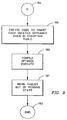
- step 150 Pseudocode representations of the steps 150 through 174 are provided in Table 4 and described below. Therefore, it will be helpful for the reader to refer to Table 4 while following the steps in the flow chart.
- step 150 corresponds to lines 47-61 in Table 3.
- step 152 the subquery is outer-joined with its corresponding tables, as shown at lines 25-35 of Table 4. Table 4 is also discussed below in connection with Fig. 6.
- Step 158 creates code that identifies all records in the one or more tables T i that exhibit constraint violations, either by violating a check constraint or by violating referential integrity.
- the SET CONSTRAINTS module generates code that can construct a message for each record in violation that contains all constraint names for all records in violation. The message contains all of the constraint names concatenated in a string.
- the SET CONSTRAINTS module constructs an INSERT statement that serves to place information in a new table.
- the new table will contain columns identifying records that are in violation of constraints, and will include for each identified record a timestamp indicating a reporting time, and the constructed message.
- This new table is denominated "the exception table” and is denoted herein as E i .
- Step 166 inquires if it is desirable to "fix-up" the table(s) having violations. "Fix-up” refers to deleting records in violation of constraints, both primary and referential and also requires removing orphaned records from the database. If no fix-up is desired, steps 168, 170 and 174 are executed. The non-fix-up case ends with step 174.
- step 168 the constructed modified query is compiled, optimized and executed according to the normal query translation process described above with reference to Fig. 1. Then, the exception table E i is populated using the INSERT statement generated in step 164. The non-fix-up case ends in step 174. In step 171, if there are no errors, then tables are brought out of pending state.
- step 176 the module selects each record id ( rid ) for each record having violating entries.
- step 178 the module implements a fix-up process, by replacing INSERTS with common table expressions (VIOL i ) to represent violating records.
- VOL i common table expressions
- step 180 the module creates a temporary table DT i that is used later to select violating records to be deleted from the database.
- the pseudocode representation of step 180 is shown in Table 5 at lines 121-129.
- Step 182 creates code to insert the deleted records in the exception table by first creating an INSERT statement to perform this activity.
- An exception table E i exists for each bulk-loaded table T i .
- the pseudocode for carrying out step 182 is shown in Table 5 at lines 130-137.
- the exception table is essentially a violation table that is used to flag all errors designating violations inherent in the original data before any violating records are deleted.
- step 188 processing continues from Fig. 7 as step 184 flows into step 188.
- the presence of the DELETE from a parent table in the query causes the constraint compiler to naturally compile in the code that eliminates orphan records, as shown in step 188. In this way, the orphaned children records can be inspected before they are erased.
- step 190 the system of Fig. 3 carries out the constructed code created in the above steps, wherein the query is compiled, optimized, and executed in normal fashion, as described above with reference to Fig. 1.
- the tables are brought out of pending state in step 191. Processing of the method of this invention by the system of Fig. 3 ends in step 192.
- a specific example is shown to illustrate an application of the method of the invention employing general case of the preferred embodiment of the pseudocode of Tables 1-5.
- the general case pseudocode is shown in a modified state, as the specific example values are substituted in Tables 6-10.
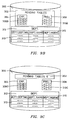
- Fig. 9A three tables 304, 308 and 312 are shown stored on storage unit 300.
- the empty tables 304 and 308 are created to store employee (EMP) information and project (PROJ) information, respectively.
- State 302 indicates a pending state, which the tables will be placed in at the time of receiving data that remains to be checked.
- Table 304 is empty because data 306A is an empty string or simply blank.
- Data 310A of empty table 308 is also blank.
- the table 312 contains department (DEPT) information and its data area 313 contains information regarding departments.
- Tables 304, 308 and 312 are created according to the following definitions:
- tape unit 314 contains an EMP table 316 having data 318 and a PROJ table 320 having data 322.
- the data from the tables on the tape is to be bulk-loaded into the empty tables on storage unit 300.
- the EMP table contains columns 317, denoted as EMP.EMPNO, EMP.DEPTNO, and EMP.AGE, defining in respective order the employee number, department number, and age of each employee.
- the PROJ table contains columns 319 denoted as PROJ.PROJNO and PROJ.LEAD, defining in respective order the project number and project leader.
- the project leader is an employee that must also be identified by the EMP table.
- the EMP and PROJ tables are populated with data from the tape and are placed in the pending state.
- the EMP table 304 contains new data 306B
- the PROJ table 308 contains new data 310B.
- the tables are in the pending state 302, meaning they cannot be used.
- the DEPT table contains the columns 315 denoted as DEPT.DEPTNO, DEPT.NAME and DEPT.MGRNO, defining respectively the department number, department name, and the department manager's number.
- the pending state 302 no longer refers to the EMP and PROJ tables.
- the data 306C and 310C of respective tables 304 and 308 is usable.
- the department table 312 which is used for ensuring referential integrity of its data 313 is also usable.
- the EMP.DEPTNO column of table 304 must have referential integrity with a record in the DEPT table 312. Further, the EMP.AGE column must be checked for violation of constraint MINAGE. Assume this constraint is that the minimum employee age must be 16 years (e.g., EMP.AGE ⁇ 16).
- the PROJ.LEAD column of the PROJ table must also be checked to ensure referential integrity with an EMP.EMPNO identified in the EMP table.
- a dummy INSERT query is generated with an INSERT statement for each table, as shown below:
- the processor calls the constraints compiler 24 to compile the INSERT commands and check for constraint violations according to the constraint rules described above with reference to Figs. 9A-9C.
- the resulting query is shown below.
- This query is compiled, optimized and executed to report that a violation has been found. If it is desired to report all records that violate constraints, and what those constraints are, then it is necessary to create exception tables. Thus, for each record from table EMP or PROJ that violates at least one constraint, it is necessary to insert a record into an exception table E EMP or E PROJ (respectively) that contains each column of the violating record. Preferably, the timestamp and an identifying message that is a concatenating name of all constraint violations is also placed in the table. The resulting query is shown below in Table 9.
- the constraint processor compiles additional code that modifies the query of Table 10 to DELETE all records from PROJ that are orphaned by deletes of records from EMP. This results in the following query.
- the command line 404 contains the required syntactical statement, "SET CONSTRAINTS.” This statement combined with "IMMEDIATE CHECKED" can be used to invoke the module. It is also required that a TABLE-NAME be identified for being checked for constraint violations, as illustrated in line 404.
- the SET CONSTRAINTS command may be invoked with a clause FOR IMMEDIATE CHECKED, that designates the checking is to begin immediately.
- the FOR-EXCEPTION clause designates that any row that is in violation of a FOREIGN KEY or CHECK key restraint will be copied to an exception table, such as table E i , and deleted from the original table.
- the IN TABLE-NAME1 clause specifies the table from which rows that violate constraints are to be copied.
- the USE TABLE-NAME2 clause specifies the particular exception table into which error rows are to be copied. Other variations of the illustrated syntax may be employed.
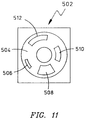
- an article of manufacture such as the prerecorded floppy disk 502 in Fig. 11 or other similar computer program product, for use with a data processing system, could include a storage medium, such as magnetic storage medium 504, and program means recorded thereon, such as the program means 506, 508, 510 and 512 in Fig. 10, for directing the data processing system to facilitate the practice of the method of this invention. It will be understood that such apparatus and articles of manufacture also fall within the spirit and scope of this invention.
Landscapes
- Engineering & Computer Science (AREA)
- Databases & Information Systems (AREA)
- Theoretical Computer Science (AREA)
- Data Mining & Analysis (AREA)
- Physics & Mathematics (AREA)
- General Engineering & Computer Science (AREA)
- General Physics & Mathematics (AREA)
- Information Retrieval, Db Structures And Fs Structures Therefor (AREA)
Applications Claiming Priority (2)
| Application Number | Priority Date | Filing Date | Title |
|---|---|---|---|
| US08/387,037 US5706494A (en) | 1995-02-10 | 1995-02-10 | System and method for constraint checking bulk data in a database |
| US387037 | 1995-02-10 |
Publications (1)
| Publication Number | Publication Date |
|---|---|
| EP0726537A1 true EP0726537A1 (de) | 1996-08-14 |
Family
ID=23528178
Family Applications (1)
| Application Number | Title | Priority Date | Filing Date |
|---|---|---|---|
| EP96300875A Withdrawn EP0726537A1 (de) | 1995-02-10 | 1996-02-09 | Verfahren und System um Bedingungen für Massen von Daten in einer Datenbank zu überprüfen |
Country Status (3)
| Country | Link |
|---|---|
| US (1) | US5706494A (de) |
| EP (1) | EP0726537A1 (de) |
| JP (1) | JP3251837B2 (de) |
Cited By (7)
| Publication number | Priority date | Publication date | Assignee | Title |
|---|---|---|---|---|
| DE19725965C2 (de) * | 1997-06-19 | 2000-07-27 | Naser Abdelwahab | Verfahren eines deduktiven Kataloges zur allgemeinen Constraintsbehandlung im erweiterten relationalen Datenbankkonzept |
| WO2005038669A1 (de) * | 2003-10-06 | 2005-04-28 | Softel Gmbh | Verfahren zur bearbeitung von cdr-informationen |
| US7702638B2 (en) | 2005-04-22 | 2010-04-20 | Sap Ag | Systems and methods for off-line modeling a business application |
| US7720879B2 (en) | 2005-04-22 | 2010-05-18 | Sap Ag | Methods of using an integrated development environment to configure business applications |
| DE102015013593A1 (de) | 2015-10-15 | 2017-04-20 | makmad.org e.V. | Effizientes Verfahren zur logischen Vervollständigung eines deduktiven Kataloges zur allgemeinen Constraintsbehandlung im erweiterten relationalen Datenbankkonzept |
| CN108898485A (zh) * | 2018-06-07 | 2018-11-27 | 阿里巴巴集团控股有限公司 | 一种数据校验的方法及装置 |
| DE102018008923A1 (de) | 2018-10-09 | 2020-05-20 | makmad.org e. V. | Verfahren zur Erstellung einer effizienten, logisch vollständigen, ontologischen Ebene im erweiterten relationalen Datenbankkonzept |
Families Citing this family (88)
| Publication number | Priority date | Publication date | Assignee | Title |
|---|---|---|---|---|
| US6032159A (en) * | 1996-11-27 | 2000-02-29 | Altera Corporation | Apparatus and method for annotated bulk copying files to a database |
| US5963934A (en) * | 1997-06-30 | 1999-10-05 | International Business Machines Corporation | Intelligent compilation of scripting language for query processing systems |
| US6427143B1 (en) * | 1998-04-10 | 2002-07-30 | Computer Associates Think, Inc. | Method for loading rows into a database table while enforcing constraints |
| US6304876B1 (en) | 1998-06-05 | 2001-10-16 | Computer Associates Think, Inc. | Method for enforcing integrity constraints in a database table using an index |
| US6189010B1 (en) | 1998-06-10 | 2001-02-13 | Platinum Technology, Inc. | Method for repairing constraint violations in a database management system |
| US6732094B1 (en) | 1998-07-08 | 2004-05-04 | Ncr Corporation | Method and apparatus that evaluate an expression based upon database results |
| US6401089B2 (en) * | 1998-10-27 | 2002-06-04 | Computer Associates Think, Inc. | Method for maintaining exception tables for a check utility |
| AU2004202616B2 (en) * | 1998-10-27 | 2008-09-04 | Computer Associates Think, Inc | Method for Maintaining Exception Tables for a Check Utility |
| US6886012B1 (en) | 1998-11-18 | 2005-04-26 | International Business Machines Corporation | Providing traditional update semantics when updates change the location of data records |
| US6202063B1 (en) * | 1999-05-28 | 2001-03-13 | Lucent Technologies Inc. | Methods and apparatus for generating and using safe constraint queries |
| US6397204B1 (en) | 1999-06-25 | 2002-05-28 | International Business Machines Corporation | Method, system, and program for determining the join ordering of tables in a join query |
| US6374235B1 (en) | 1999-06-25 | 2002-04-16 | International Business Machines Corporation | Method, system, and program for a join operation on a multi-column table and satellite tables including duplicate values |
| US6446063B1 (en) | 1999-06-25 | 2002-09-03 | International Business Machines Corporation | Method, system, and program for performing a join operation on a multi column table and satellite tables |
| US6453314B1 (en) | 1999-07-30 | 2002-09-17 | International Business Machines Corporation | System and method for selective incremental deferred constraint processing after bulk loading data |
| US6339777B1 (en) | 1999-07-30 | 2002-01-15 | International Business Machines Corporation | Method and system for handling foreign key update in an object-oriented database environment |
| US6463429B1 (en) | 2000-04-12 | 2002-10-08 | International Business Machines Corporation | System and method for consistency constraint management in database middleware |
| US7016903B1 (en) | 2001-01-25 | 2006-03-21 | Oracle International Corporation | Method for conditionally updating or inserting a row into a table |
| US6820080B2 (en) * | 2001-03-26 | 2004-11-16 | International Business Machines Corporation | Dependent object processing for triggers |
| CA2351990A1 (en) * | 2001-06-26 | 2002-12-26 | Ibm Canada Limited-Ibm Canada Limitee | Rule based engine for validating financial transactions |
| WO2003017136A1 (en) * | 2001-08-16 | 2003-02-27 | Etagon Israel Ltd. | Using associative memory to perform database operations |
| CA2357937A1 (en) * | 2001-09-28 | 2003-03-28 | Ibm Canada Limited-Ibm Canada Limitee | Database diagnostic system and method |
| US7076482B2 (en) * | 2001-10-25 | 2006-07-11 | Bea Systems, Inc. | Multi-part looked-up table fields and its use in data processing operations involving multiple tables of a relational database |
| US7421436B2 (en) * | 2001-12-21 | 2008-09-02 | International Business Machines Corporation | Decentralized many-to-many relationship management in an object persistence management system |
| CA2384174A1 (en) * | 2002-04-29 | 2003-10-29 | Ibm Canada Limited-Ibm Canada Limitee | Classification of data for insertion into a database |
| US8301657B1 (en) * | 2002-05-09 | 2012-10-30 | Teradata Us, Inc. | Set-level database access for performing row-sequential operations |
| US7447687B2 (en) * | 2002-05-10 | 2008-11-04 | International Business Machines Corporation | Methods to browse database query information |
| US7165077B2 (en) * | 2002-10-08 | 2007-01-16 | Omnicare, Inc. | Method for processing and organizing pharmacy data |
| US7502791B2 (en) * | 2002-11-26 | 2009-03-10 | Norsync Technology A/S | Database constraint enforcer |
| KR100532823B1 (ko) * | 2002-11-30 | 2005-12-02 | 이원재 | 데이터 무결성 관리장치와 관리방법 그리고 그 방법을컴퓨터 상에서 실행하는 프로그램을 기록한 기록매체 |
| US7305410B2 (en) * | 2002-12-26 | 2007-12-04 | Rocket Software, Inc. | Low-latency method to replace SQL insert for bulk data transfer to relational database |
| US7953694B2 (en) * | 2003-01-13 | 2011-05-31 | International Business Machines Corporation | Method, system, and program for specifying multidimensional calculations for a relational OLAP engine |
| US6829600B2 (en) * | 2003-04-03 | 2004-12-07 | Oracle International Corporation | Merge delete statement for database operations |
| US7895191B2 (en) * | 2003-04-09 | 2011-02-22 | International Business Machines Corporation | Improving performance of database queries |
| US7930291B2 (en) * | 2004-06-18 | 2011-04-19 | Bmc Software, Inc. | Constraint processing |
| US7664790B2 (en) * | 2004-06-18 | 2010-02-16 | Bmc Software, Inc. | Cascade delete processing |
| US7359923B2 (en) | 2004-08-20 | 2008-04-15 | International Business Machines Corporation | Online incremental deferred integrity processing and maintenance of rolled in and rolled out data |
| US7328220B2 (en) * | 2004-12-29 | 2008-02-05 | Lucent Technologies Inc. | Sketch-based multi-query processing over data streams |
| US8224863B2 (en) * | 2004-12-29 | 2012-07-17 | Alcatel Lucent | Equivalence class-based method and apparatus for cost-based repair of database constraint violations |
| US10387440B2 (en) | 2007-03-29 | 2019-08-20 | Jda Software Group, Inc. | Generic data staging and loading using enhanced metadata and associated method |
| US9569482B2 (en) * | 2007-05-09 | 2017-02-14 | Oracle International Corporation | Transforming default values dynamically |
| US8296316B2 (en) * | 2007-10-17 | 2012-10-23 | Oracle International Corporation | Dynamically sharing a subtree of operators in a data stream management system operating on existing queries |
| US8073826B2 (en) | 2007-10-18 | 2011-12-06 | Oracle International Corporation | Support for user defined functions in a data stream management system |
| US7991766B2 (en) * | 2007-10-20 | 2011-08-02 | Oracle International Corporation | Support for user defined aggregations in a data stream management system |
| US8521867B2 (en) * | 2007-10-20 | 2013-08-27 | Oracle International Corporation | Support for incrementally processing user defined aggregations in a data stream management system |
| US8019795B2 (en) * | 2007-12-05 | 2011-09-13 | Microsoft Corporation | Data warehouse test automation framework |
| US8495487B2 (en) * | 2009-01-04 | 2013-07-23 | Sandra Lee Jerome | Web-based dealership management system |
| US8108367B2 (en) * | 2008-05-20 | 2012-01-31 | International Business Machines Corporation | Constraints with hidden rows in a database |
| US20090300069A1 (en) * | 2008-05-29 | 2009-12-03 | O'sullivan Michael Patrick | Method and system for the logical deletion of relational database records |
| US8639675B2 (en) * | 2008-08-28 | 2014-01-28 | Make Technologies, Inc. | Linking of parent-child data records in a legacy software modernization system |
| US9305238B2 (en) * | 2008-08-29 | 2016-04-05 | Oracle International Corporation | Framework for supporting regular expression-based pattern matching in data streams |
| US8352517B2 (en) * | 2009-03-02 | 2013-01-08 | Oracle International Corporation | Infrastructure for spilling pages to a persistent store |
| US8935293B2 (en) * | 2009-03-02 | 2015-01-13 | Oracle International Corporation | Framework for dynamically generating tuple and page classes |
| US8250048B2 (en) * | 2009-04-20 | 2012-08-21 | Oracle International Corporation | Access control for graph data |
| US8387076B2 (en) * | 2009-07-21 | 2013-02-26 | Oracle International Corporation | Standardized database connectivity support for an event processing server |
| US8321450B2 (en) * | 2009-07-21 | 2012-11-27 | Oracle International Corporation | Standardized database connectivity support for an event processing server in an embedded context |
| US8301660B2 (en) * | 2009-07-22 | 2012-10-30 | Oracle International Corporation | Enforcing restrictions for graph data manipulation operations |
| US8527458B2 (en) * | 2009-08-03 | 2013-09-03 | Oracle International Corporation | Logging framework for a data stream processing server |
| US8386466B2 (en) * | 2009-08-03 | 2013-02-26 | Oracle International Corporation | Log visualization tool for a data stream processing server |
| US9430494B2 (en) * | 2009-12-28 | 2016-08-30 | Oracle International Corporation | Spatial data cartridge for event processing systems |
| US8959106B2 (en) * | 2009-12-28 | 2015-02-17 | Oracle International Corporation | Class loading using java data cartridges |
| US9305057B2 (en) * | 2009-12-28 | 2016-04-05 | Oracle International Corporation | Extensible indexing framework using data cartridges |
| US8713049B2 (en) | 2010-09-17 | 2014-04-29 | Oracle International Corporation | Support for a parameterized query/view in complex event processing |
| US9189280B2 (en) | 2010-11-18 | 2015-11-17 | Oracle International Corporation | Tracking large numbers of moving objects in an event processing system |
| US8990416B2 (en) | 2011-05-06 | 2015-03-24 | Oracle International Corporation | Support for a new insert stream (ISTREAM) operation in complex event processing (CEP) |
| US9329975B2 (en) | 2011-07-07 | 2016-05-03 | Oracle International Corporation | Continuous query language (CQL) debugger in complex event processing (CEP) |
| US9053153B2 (en) * | 2012-06-18 | 2015-06-09 | Sap Se | Inter-query parallelization of constraint checking |
| US9026561B2 (en) | 2012-07-02 | 2015-05-05 | International Business Machines Corporation | Automated report of broken relationships between tables |
| US9805095B2 (en) | 2012-09-28 | 2017-10-31 | Oracle International Corporation | State initialization for continuous queries over archived views |
| US9563663B2 (en) | 2012-09-28 | 2017-02-07 | Oracle International Corporation | Fast path evaluation of Boolean predicates |
| US20140149360A1 (en) * | 2012-11-27 | 2014-05-29 | Sap Ag | Usage of Filters for Database-Level Implementation of Constraints |
| US10956422B2 (en) | 2012-12-05 | 2021-03-23 | Oracle International Corporation | Integrating event processing with map-reduce |
| US9098587B2 (en) | 2013-01-15 | 2015-08-04 | Oracle International Corporation | Variable duration non-event pattern matching |
| US10298444B2 (en) | 2013-01-15 | 2019-05-21 | Oracle International Corporation | Variable duration windows on continuous data streams |
| US9047249B2 (en) | 2013-02-19 | 2015-06-02 | Oracle International Corporation | Handling faults in a continuous event processing (CEP) system |
| US9390135B2 (en) | 2013-02-19 | 2016-07-12 | Oracle International Corporation | Executing continuous event processing (CEP) queries in parallel |
| US9418113B2 (en) | 2013-05-30 | 2016-08-16 | Oracle International Corporation | Value based windows on relations in continuous data streams |
| US9934279B2 (en) | 2013-12-05 | 2018-04-03 | Oracle International Corporation | Pattern matching across multiple input data streams |
| US9015165B1 (en) * | 2014-03-03 | 2015-04-21 | Michael L. Hamm | Text-SQL relational database |
| US9244978B2 (en) | 2014-06-11 | 2016-01-26 | Oracle International Corporation | Custom partitioning of a data stream |
| US9712645B2 (en) | 2014-06-26 | 2017-07-18 | Oracle International Corporation | Embedded event processing |
| US9886486B2 (en) | 2014-09-24 | 2018-02-06 | Oracle International Corporation | Enriching events with dynamically typed big data for event processing |
| US10120907B2 (en) | 2014-09-24 | 2018-11-06 | Oracle International Corporation | Scaling event processing using distributed flows and map-reduce operations |
| US9589085B1 (en) * | 2014-12-03 | 2017-03-07 | Cadence Design Systems, Inc. | Systems and methods for viewing analog simulation check violations in an electronic design automation framework |
| KR20160078032A (ko) * | 2014-12-24 | 2016-07-04 | 삼성전자주식회사 | 전자 설계 자동화를 위한 장치 및 방법 |
| WO2017018901A1 (en) | 2015-07-24 | 2017-02-02 | Oracle International Corporation | Visually exploring and analyzing event streams |
| CN107229651A (zh) * | 2016-03-25 | 2017-10-03 | 阿里巴巴集团控股有限公司 | 唯一性约束异常的确定方法、异常处理方法及装置 |
| AU2016231506B2 (en) * | 2016-09-20 | 2022-02-17 | Global Software Innovation Pty Ltd | Systems and methods for accessing a database management system |
| US11694211B2 (en) * | 2021-06-28 | 2023-07-04 | Stripe, Inc. | Constant-time cascading deletion of resources |
Citations (2)
| Publication number | Priority date | Publication date | Assignee | Title |
|---|---|---|---|---|
| EP0351209A2 (de) * | 1988-07-15 | 1990-01-17 | International Business Machines Corporation | Verfahren zur Durchführung von Operationen in einem relationalen Datenbankverwaltungssystem |
| EP0399744A2 (de) * | 1989-05-24 | 1990-11-28 | International Business Machines Corporation | Verfahren und Vorrichtung zur Erhaltung der funktionellen und organisatorischen Unversehrtheit einer relationalen Datenbasis in einem Datenverarbeitungssystem |
Family Cites Families (12)
| Publication number | Priority date | Publication date | Assignee | Title |
|---|---|---|---|---|
| US4506326A (en) * | 1983-02-28 | 1985-03-19 | International Business Machines Corporation | Apparatus and method for synthesizing a query for accessing a relational data base |
| US4933848A (en) * | 1988-07-15 | 1990-06-12 | International Business Machines Corporation | Method for enforcing referential constraints in a database management system |
| EP0360387B1 (de) * | 1988-09-23 | 1996-05-08 | International Business Machines Corporation | Datenbankverwaltungssystem |
| US5133075A (en) * | 1988-12-19 | 1992-07-21 | Hewlett-Packard Company | Method of monitoring changes in attribute values of object in an object-oriented database |
| KR940004389B1 (ko) * | 1989-10-13 | 1994-05-23 | 인터내셔널 비지네스 머신즈 코포레이션 | 관계형 데이타베이스에 대한 액세스플랜 발생 방법 및 시스템 |
| US5201046A (en) * | 1990-06-22 | 1993-04-06 | Xidak, Inc. | Relational database management system and method for storing, retrieving and modifying directed graph data structures |
| US5295256A (en) * | 1990-12-14 | 1994-03-15 | Racal-Datacom, Inc. | Automatic storage of persistent objects in a relational schema |
| US5355474A (en) * | 1991-09-27 | 1994-10-11 | Thuraisngham Bhavani M | System for multilevel secure database management using a knowledge base with release-based and other security constraints for query, response and update modification |
| US5421008A (en) * | 1991-11-08 | 1995-05-30 | International Business Machines Corporation | System for interactive graphical construction of a data base query and storing of the query object links as an object |
| US5367675A (en) * | 1991-12-13 | 1994-11-22 | International Business Machines Corporation | Computer automated system and method for optimizing the processing of a query in a relational database system by merging subqueries with the query |
| US5301317A (en) * | 1992-04-27 | 1994-04-05 | International Business Machines Corporation | System for adapting query optimization effort to expected execution time |
| US5499359A (en) * | 1994-01-18 | 1996-03-12 | Borland International, Inc. | Methods for improved referential integrity in a relational database management system |
-
1995
- 1995-02-10 US US08/387,037 patent/US5706494A/en not_active Expired - Fee Related
-
1996
- 1996-01-31 JP JP01616296A patent/JP3251837B2/ja not_active Expired - Fee Related
- 1996-02-09 EP EP96300875A patent/EP0726537A1/de not_active Withdrawn
Patent Citations (2)
| Publication number | Priority date | Publication date | Assignee | Title |
|---|---|---|---|---|
| EP0351209A2 (de) * | 1988-07-15 | 1990-01-17 | International Business Machines Corporation | Verfahren zur Durchführung von Operationen in einem relationalen Datenbankverwaltungssystem |
| EP0399744A2 (de) * | 1989-05-24 | 1990-11-28 | International Business Machines Corporation | Verfahren und Vorrichtung zur Erhaltung der funktionellen und organisatorischen Unversehrtheit einer relationalen Datenbasis in einem Datenverarbeitungssystem |
Non-Patent Citations (1)
| Title |
|---|
| EBERHARD R ET AL: "DB2 referential integrity performance", INFO DB, SPRING 1989, USA, vol. 4, no. 1, ISSN 0891-6004, pages 13 - 19, XP000571335 * |
Cited By (7)
| Publication number | Priority date | Publication date | Assignee | Title |
|---|---|---|---|---|
| DE19725965C2 (de) * | 1997-06-19 | 2000-07-27 | Naser Abdelwahab | Verfahren eines deduktiven Kataloges zur allgemeinen Constraintsbehandlung im erweiterten relationalen Datenbankkonzept |
| WO2005038669A1 (de) * | 2003-10-06 | 2005-04-28 | Softel Gmbh | Verfahren zur bearbeitung von cdr-informationen |
| US7702638B2 (en) | 2005-04-22 | 2010-04-20 | Sap Ag | Systems and methods for off-line modeling a business application |
| US7720879B2 (en) | 2005-04-22 | 2010-05-18 | Sap Ag | Methods of using an integrated development environment to configure business applications |
| DE102015013593A1 (de) | 2015-10-15 | 2017-04-20 | makmad.org e.V. | Effizientes Verfahren zur logischen Vervollständigung eines deduktiven Kataloges zur allgemeinen Constraintsbehandlung im erweiterten relationalen Datenbankkonzept |
| CN108898485A (zh) * | 2018-06-07 | 2018-11-27 | 阿里巴巴集团控股有限公司 | 一种数据校验的方法及装置 |
| DE102018008923A1 (de) | 2018-10-09 | 2020-05-20 | makmad.org e. V. | Verfahren zur Erstellung einer effizienten, logisch vollständigen, ontologischen Ebene im erweiterten relationalen Datenbankkonzept |
Also Published As
| Publication number | Publication date |
|---|---|
| US5706494A (en) | 1998-01-06 |
| JPH08255102A (ja) | 1996-10-01 |
| JP3251837B2 (ja) | 2002-01-28 |
Similar Documents
| Publication | Publication Date | Title |
|---|---|---|
| EP0726537A1 (de) | Verfahren und System um Bedingungen für Massen von Daten in einer Datenbank zu überprüfen | |
| US6453314B1 (en) | System and method for selective incremental deferred constraint processing after bulk loading data | |
| US5367675A (en) | Computer automated system and method for optimizing the processing of a query in a relational database system by merging subqueries with the query | |
| AU772754B2 (en) | System and method for rewriting relational database queries | |
| US5873075A (en) | Synchronization of SQL actions in a relational database system | |
| US5546576A (en) | Query optimizer system that detects and prevents mutating table violations of database integrity in a query before execution plan generation | |
| US5857182A (en) | Database management system, method and program for supporting the mutation of a composite object without read/write and write/write conflicts | |
| US6618719B1 (en) | Database system with methodology for reusing cost-based optimization decisions | |
| US7174327B2 (en) | Generating one or more XML documents from a relational database using XPath data model | |
| Grefen et al. | Integrity control in relational database systems—an overview | |
| US6278994B1 (en) | Fully integrated architecture for user-defined search | |
| US7031956B1 (en) | System and method for synchronizing and/or updating an existing relational database with supplemental XML data | |
| US5950210A (en) | Database row version differentiation process | |
| US5511186A (en) | System and methods for performing multi-source searches over heterogeneous databases | |
| US6374263B1 (en) | System for maintaining precomputed views | |
| US7275056B2 (en) | System and method for transforming queries using window aggregation | |
| US6098075A (en) | Deferred referential integrity checking based on determining whether row at-a-time referential integrity checking would yield the same results as deferred integrity checking | |
| US6763352B2 (en) | Incremental maintenance of summary tables with complex grouping expressions | |
| US5963933A (en) | Efficient implementation of full outer join and anti-join | |
| US6219662B1 (en) | Supporting database indexes based on a generalized B-tree index | |
| US7844633B2 (en) | System and method for storage, management and automatic indexing of structured documents | |
| US6167399A (en) | Join index for relational databases | |
| US20050165866A1 (en) | Method and apparatus for updating XML views of relational data | |
| EP0747838A1 (de) | Verfahren und Vorrichtung zur kompletten Beseitigung von SQL-Unterabfragen | |
| Bair et al. | Notions of upward compatibility of temporal query languages |
Legal Events
| Date | Code | Title | Description |
|---|---|---|---|
| PUAI | Public reference made under article 153(3) epc to a published international application that has entered the european phase |
Free format text: ORIGINAL CODE: 0009012 |
|
| AK | Designated contracting states |
Kind code of ref document: A1 Designated state(s): DE FR GB |
|
| STAA | Information on the status of an ep patent application or granted ep patent |
Free format text: STATUS: THE APPLICATION IS DEEMED TO BE WITHDRAWN |
|
| 18D | Application deemed to be withdrawn |
Effective date: 19970215 |