EP0727748A1 - Méthode et dispositif pour apprentissage non-supervisé multicouche en utilisant une hiérarchie de réseaux neuronaux - Google Patents
Méthode et dispositif pour apprentissage non-supervisé multicouche en utilisant une hiérarchie de réseaux neuronaux Download PDFInfo
- Publication number
- EP0727748A1 EP0727748A1 EP95102265A EP95102265A EP0727748A1 EP 0727748 A1 EP0727748 A1 EP 0727748A1 EP 95102265 A EP95102265 A EP 95102265A EP 95102265 A EP95102265 A EP 95102265A EP 0727748 A1 EP0727748 A1 EP 0727748A1
- Authority
- EP
- European Patent Office
- Prior art keywords
- neuron
- neurons
- network
- level
- excitation
- Prior art date
- Legal status (The legal status is an assumption and is not a legal conclusion. Google has not performed a legal analysis and makes no representation as to the accuracy of the status listed.)
- Withdrawn
Links
Images




Classifications
-
- G—PHYSICS
- G06—COMPUTING OR CALCULATING; COUNTING
- G06N—COMPUTING ARRANGEMENTS BASED ON SPECIFIC COMPUTATIONAL MODELS
- G06N3/00—Computing arrangements based on biological models
- G06N3/02—Neural networks
- G06N3/04—Architecture, e.g. interconnection topology
- G06N3/045—Combinations of networks
-
- G—PHYSICS
- G06—COMPUTING OR CALCULATING; COUNTING
- G06N—COMPUTING ARRANGEMENTS BASED ON SPECIFIC COMPUTATIONAL MODELS
- G06N3/00—Computing arrangements based on biological models
- G06N3/02—Neural networks
- G06N3/04—Architecture, e.g. interconnection topology
- G06N3/0495—Quantised networks; Sparse networks; Compressed networks
-
- G—PHYSICS
- G06—COMPUTING OR CALCULATING; COUNTING
- G06N—COMPUTING ARRANGEMENTS BASED ON SPECIFIC COMPUTATIONAL MODELS
- G06N3/00—Computing arrangements based on biological models
- G06N3/02—Neural networks
- G06N3/04—Architecture, e.g. interconnection topology
- G06N3/0499—Feedforward networks
-
- G—PHYSICS
- G06—COMPUTING OR CALCULATING; COUNTING
- G06N—COMPUTING ARRANGEMENTS BASED ON SPECIFIC COMPUTATIONAL MODELS
- G06N3/00—Computing arrangements based on biological models
- G06N3/02—Neural networks
- G06N3/08—Learning methods
- G06N3/082—Learning methods modifying the architecture, e.g. adding, deleting or silencing nodes or connections
Definitions
- the invention relates to a method for multi-stage unsupervised learning using a hierarchy of neural networks, which can be used, among other things, for the classification of optical or acoustic input patterns, for image recognition, speech recognition, image compression and time series analysis.
- the single-stage unsupervised learning in neural networks e.g. "Competitive learning” or the Kohonen network
- the unsupervised learning of the division of the input pattern into classes takes place in only one neuron layer.
- only one neuron is selected in this neuron layer, specifically the one in which the input weights achieve the highest agreement with the input pattern and which is therefore most excited. Only this neuron determines the output value.
- Each neuron in this layer of neurons learns to recognize a specific class of mutually similar patterns.
- the learning process also means that neighboring neurons in the neuron layer recognize similar input patterns.
- Another neuron layer can be used to generate the output information (e.g. in the counter-propagation network), but this layer uses supervised learning, i.e. the associated output values are specified for each input pattern to be learned.
- Simple Patterns which, for example, consist only of components of complex patterns
- different components of a pattern cannot be identified individually, but only as a whole pattern. If there are several components in an input pattern that do not belong together as a whole (eg randomly scattered parts), it is not possible to recognize the individual components on their own.
- a e.g. spatially slightly shifted input pattern represent a completely different input vector and thereby a completely different neuron in the neuron layer is most strongly excited.
- identical patterns which differ slightly in their position, can then be assigned to completely different classes.
- the object of the invention is therefore to create a method and a correspondingly working arrangement, which enables multi-stage unsupervised learning. Simple sub-patterns of an overall input pattern are classified at our lower levels. These classification results are combined at higher levels and so more complex partial patterns or the overall mother are classified, with each level learning unsupervised.
- the classification results can be output at the lower levels, i.e. the classification of the components can be output.
- This can be used, for example, for image compression, since components contained therein are recognized at lower levels of the network hierarchy when processing an image section and the numbers of the maximally excited neurons at these levels are output as the compression result.
- preprocessing In the case of single-stage unsupervised learning, preprocessing is often carried out, which recognizes the properties of the input pattern or components and transmits these to the neural network for further processing.
- This preprocessing can be carried out in the case of multilevel unsupervised learning at the lower levels (using unsupervised learning).
- the determination of the most excited neuron (at the top level), i.e. the classification of the input pattern, can be carried out more quickly.
- components that are assigned to the same class can be parts of completely different patterns. This is of great advantage in learning to classify the components, since each input pattern can consist of several components, the classification of which is learned, and therefore less different input patterns are required for learning to classify these components than in single-stage unsupervised learning.
- each stage consists of one or more neural networks, each network consisting of a neuron layer that learns unsupervised.
- the outputs of two or more neural networks on a lower level serve as inputs of a network on the level above. Overall, this results in a hierarchy of neural networks.
- the overall input pattern is divided into contiguous parts, which are used as input vectors for the individual neural networks of the lowest level of the overall hierarchy.
- the networks of each stage are divided into network groups, with successive networks within a network group of the first stage processing successive parts of the overall input pattern.
- Each network group is assigned its own network in the higher level, with each neuron in such an assigned network its 1st input is connected to the output of a neuron of the 1st network in the network group, its 2nd input is connected to the output of a neuron of the 2.
- Network connected in the network group, etc. Its last input is connected to the output of a neuron of the last network in the network group.
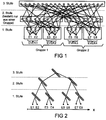
- E1 to E8 are the inputs
- EVEK1 to EVEK4 are the input vectors for the networks of the lowest level.
- FIG. 2 shows an abstraction from FIG. 1, in which in each network only one neuron has its inputs (representative of all others).
- the networks of the lowest level are structured as follows:
- the neurons have input weights W, for example in the value range from 0 to 1, and input values X, for example, also in the value range of 0 to 1, the excitation being higher in a neuron with n inputs, the higher the correspondence between the input values X and the input weights W.
- the excitation of a neuron is based on the formula (1 - // W1-X1 //) + (1 - // W2-X2 //) + ... + (1 - // Wn-Xn //) calculated. (//...// means the amount.)
- This formula can be written in the following simple form: n - // W1-X1 // - // W2-X2 // - ... - // Wn-Xn //
- the maximum excitation of a neuron with n inputs is the value n, namely when the input values X match the input weights W.
- the lowest level neurons can also have only one input.
- a group of weight vectors of neurons on the lowest level is clearly assigned to each neuron of a network of a higher level, the outputs of which are connected directly or indirectly via neurons at higher levels to the inputs of this neuron at a higher level.
- This group of weight vectors corresponds to a (partial) input pattern, which is represented by this neuron at a higher level.
- a mass is assigned to each neuron, which is a measure of how often a neuron has already fired when processing an input pattern.
- All networks in the entire hierarchy are dynamically changeable, ie neurons can be added to each network neurons can be deleted or combined with other neurons. This happens when processing input patterns during the learning phase.
- the learning phase can be followed by a phase of pure pattern classification, in which learning (such as adjusting the weight vectors) no longer takes place.
- the networks of the hierarchy are only filled with neurons, starting at the lowest level.
- a new neuron is inserted into a network if the network processes an input vector and if the network does not yet contain any neurons or if the neuron of this network with the maximum excitation has a one defined for each level Excitation threshold does not exceed (e.g. 90% of the maximum excitation value for this stage).
- the input vector for this network is assigned to the inserted neuron as the weight vector.
- the condition for the insertion of a neuron can also take into account the mass of the neuron with the maximum excitation by increasing the minimum excitation value with a high ratio of the mass of this neuron to the total mass of this network. This results in a finer division into similarity classes for input vectors that occur relatively frequently.
- the weight vector of a neuron is changed if no new neuron is inserted into the network when processing an input vector.
- the neuron with the highest excitation within this network is selected.
- the new weight vector for the selected neuron results from the weighted average of the weight vector of the neuron and the input vector according to their masses. (The input vector has the mass 1.)
- the mass of the selected neuron is then increased by 1.
- a new neuron is inserted into a network if the network processes excitation values from neurons of the layer below and if the network does not yet contain any neurons or if the most excited neuron of this network is the one for each level falls below the defined excitation threshold.
- the first input of the inserted neuron is connected to the output of the neuron of the first network of the assigned network group on the level below which is most excited within its layer.
- the second input of the inserted neuron is connected to the output of the neuron of the second network of the assigned network group on the level below which is most excited within its layer, etc.
- the most excited neuron of this network learns by connecting its inputs to outputs of other neurons of the assigned network group of the lower level.
- the weight vectors assigned to this neuron are first determined on the lowest level and then the mean value vectors are formed on the lowest level, which result from the weighted average of the weight vectors and the associated input vectors.
- the weight vectors are weighted with the value of the mass of the learning neuron.
- the input vectors are weighted 1.
- the resultant mean vectors are then processed by the corresponding networks also at the higher levels and the inputs of the learning neuron are then connected to the outputs of the neurons of the assigned network group of the level below that are the most excited within their network. This completes the learning process for this neuron.
- a network hierarchy is assumed in which the outputs of two adjacent networks on a lower level are connected to a network on the level above, as shown in FIG. 1 and FIG. 2.
- This network hierarchy is not limited to 3 levels as shown there, but can have any number of levels. It is suitable for processing one-dimensional patterns which, as shown in FIG. 2, have only an extension in the x direction. This is e.g. in the case of a temporal sequence of values such as in time series analysis or speech recognition.
- n-dimensional vectors In speech recognition, a sequence of n-dimensional vectors is analyzed, each of which describes a spectrum of the acoustic frequency distribution. To process these vectors, the neurons of the networks of the lowest level need n inputs so that the weights of each neuron represent an n-dimensional vector.
- This limitation of the network hierarchy can easily be expanded to a higher number than two neighboring networks, e.g. shown in FIG.
- a network hierarchy consisting of any number of levels can be constructed. It is suitable for processing 2-dimensional optical patterns.
- Steps A, B and C are repeated until MAXSUM is less than or equal to one of the excitations of the neurons in the superordinate network that have already been determined. Then the processing of these two output tables is stopped, but is continued later in the case when for the output table of the higher-level network, further neuron entries are required.
- the neuron in the network at the highest level with the highest excitation is found as soon as the neuron in the output table assigned to this network with the highest excitation has a higher excitation than the value stored in the associated MAXSUM.
- NTAB is a table memory, the rows of which are addressed by the address at its address input ENR.
- Each line of NTAB can store values for a specific neuron, the number of which corresponds to the line number in NTAB.
- the following table shows the neuron parameters that are stored in the individual columns of NTAB: Table I NTAB1 1. Input weight NTAB2 2. Input weight NTAB3 Mass of neurons NTAB4 Excitation of the neuron NTAB5 Blocking mark
- NTAB all neurons of a neural network are stored on the first level.
- ATAB is a table memory, the rows of which are addressed by the address applied to its address input ZNR. Values for a particular neuron can be stored in each line of ATAB. The number of the respective neuron is entered in column ATAB1, the excitation of this neuron is entered in column ATAB2. In ATAB, the neurons are entered in descending order according to the level of their excitation.
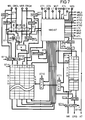
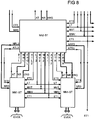
- the structure of the excitation and mean vector generator is shown in FIG. 6.
- the controller NN1-ST controls the sequence of the arrangement. It uses the control lines ST1 to ST12 to control the multiplexers MUX1 to MUX6 and the transfer or storage of data with control clocks.
- the control sequence for the arrangement is as follows: For initialization, possibly existing entries are deleted in the NTAB5 column. Entries in ATAB are deleted. Then the input vector EVEK is loaded into VREG and from there via MUX1 and MUX2 into EREG. The excitation is then determined for all neurons that are already stored in NTAB by outputting the input weights for each neuron according to NREG and determining the excitation for this neuron with the excitation generator. This excitation is then in NTAB4 in the corresponding line registered. The maximum excitation is also determined, which is then compared with a defined excitation threshold.
- NTAB neuron entry in NTAB
- the values for its input weights are taken from EREG and stored in NTAB1 and NTAB2 in the line that corresponds to this neuron.
- the value 1 is entered in NTAB4 for its excitation and the value 0 in NTAB3 for its mass.
- the most excited neuron which has not yet been entered in ATAB, is entered with its number and excitation in ATAB in a loop, which is referred to below as the main loop.
- NTAB5 a lock mark is set for this neuron, as a sign that this neuron is already entered in ATAB.
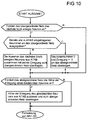
- the output control OUTPUT 1 (FIG. 10) is called up and queried whether the higher-level network requests the next highly excited neuron with an input clock ET2. If this is the case, the number and the excitation of the next highly excited neuron are transmitted from ATAB to the higher-level network. However, if all the neurons entered in ATAB have already been output to the higher-level network, then the neuron number 0 and the value -1 for excitation are transmitted to the higher-level network. An output clock AT is then generated.
- the neuron number supplied by the input NR3 is loaded into the register NNR via MUX3 and the line in NTAB that corresponds to the desired neuron is addressed via the address input ENR .
- the excitation stored in this line in NTAB4 is read out and loaded into AER via MUX5. Then an output tract AT is generated.
- a learning clock LT has been sent from the higher-level network
- the learning process is carried out as shown in FIG. 9B. If this is not the case, it is determined whether all the NTAB neurons have already been entered in ATAB. In this case, a branch is made to the beginning of the inner loop and the output control OUTPUT1 is called and processed. Otherwise it is determined whether all neurons previously entered in ATAB have already been output to the higher-level network. In this case it branches to the beginning of the main loop. Otherwise it branches to the beginning of the inner loop.
- the learning process proceeds as follows: First, the number of the first neuron entered in ATAB is read from ATAB1 and passed to ENR via MUX6. The weights and the mass of the neuron entry in NTAB, whose row is now addressed, are loaded into NREG and adopted by PREPROCESSING. The mean vector generator now generates the mean vector, the components of which represent the new weights for the learning neuron. It is loaded into EREG via MUX1 and MUX2 and from there it is stored in the NTAB line addressed by ENR. The mass stored in NTAB3 for this neuron is increased by a fixed value DM, e.g. is between 0 and 1. An output clock AT is then generated and the higher-level network is informed that the learning process has ended.
- DM fixed value
- a control clock MVT is waited for by the higher-level network to generate an average vector.
- the input weights of the neuron the number of which is from parent network is supplied at input NR3, read from NTAB1 and NTAB2 and loaded into NREG1 and NREG2.
- the mass delivered at the MMV input is loaded into NREG3 via MUX4.
- PREPROCESSING takes over the values in NREG and the mean vector generated by the mean vector generator is loaded into EREG via MUX1 and MUX2.
- all entries in NTAB4 and in ATAB are deleted and for all neurons in NTAB the excitation is newly determined and stored in NTAB4.
- NTAB5 a lock mark is set for this neuron, as a sign that this neuron is already entered in ATAB.
- the output control OUTPUT 1 (FIG. 9) is then called up and processed as already described above.
- the control clock loop it is determined whether a control clock MVT has been sent by the higher-level network to generate an average vector. In this case, a branch is made to the beginning of the mean vector loop.
- a control clock ST1 has been sent from the higher-level network for processing the next input vector.
- a branch is made to the start of the controller NN1-ST (FIG. 9A). Otherwise it is determined whether all neurons from NTAB have already been entered in ATAB. In this case, the system branches to the beginning of the control cycle loop. Otherwise it is queried whether all neurons have already been read out from ATAB. In this case, the system branches to the beginning of the ATAB loop. Otherwise the system branches to the beginning of the control clock loop.
- NTAB is a table memory, the rows of which are addressed by the address which is present at its address input ENR. In every line of NTAB values can be saved for a specific neuron whose number corresponds to the line number in NTAB.
- the following table shows the neuron parameters that are stored in the individual columns of NTAB: Table II NTAB1 No. of the neuron to which the 1st input is connected. NTAB2 No. of the neuron to which the 2nd input is connected. NTAB3 Mass of neurons NTAB4 Excitation of the neuron NTAB5 Blocking mark
- All neurons in a neural network from level 2 onwards are stored in NTAB.
- ATAB is a table memory that has the same functionality as has already been described for ATAB in the arrangement for a 1st stage network.
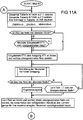
- the controller NN2-ST controls the sequence of the arrangement. It uses the control lines ST1 to ST20 to control the multiplexers MUX1 to MUX8 and the transfer or storage of data with control clocks.
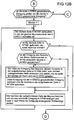
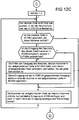
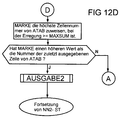
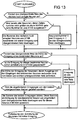
- FIGS. 12A to 12D and FIG. 13 the control sequence for the arrangement is as follows: For initialization, the entire table column NTAB4 is set to -1 and NTAB5 is set to 0. Entries in ATAB are deleted. ZMARK, ZAUS and MERKER are set to 0.
- the controller waits for the next input clock ET1 from the higher-level network.
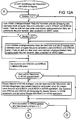
- FIG. 12A to 12D the partial control DETERMINATION OF THE NEURONS WITH HIGH EXCITATION is called (FIG. 12A to 12D).
- the flag still has the value 0, so that EREG is loaded with the first entry in ATAB of the left and right subordinate networks. This is done by sending an input clock ET2 to the lower left network via the output ATL2. If this network has provided the desired information, it sends an output clock AT which is received via the input ETL.
- the information at the NRL and ERGL inputs can be loaded into EREG1 and EREG2. Since this is the first neuron requested by the left subordinate network, this is also loaded into NRR1.
- the information is requested from the subordinate network on the right and loaded into EREG3 and EREG4 and in this case also into NRR2.
- MUX1 and MUX2 are controlled so that the adder delivers the sum of EREG2 and EREG4. This is loaded into MAXSUM.
- neuron No. 1 is now inserted in the 1st line.
- the numbers of the neurons connected to the inputs of this new neuron are taken from EREG1 and EREG3 and saved in the 1st line of NTAB1 and NTAB2.
- the sum of EREG2 and EREG4 is stored as excitation for this neuron in NTAB4.
- the value 0 is stored in NTAB3. This value is increased later for this neuron during the learning process.
- both neuron numbers loaded in EREG have the value 0, this means that all neurons of the two subordinate networks have already been read from their ATABs. In in this case, a branch is made to the beginning of the partial diagram in FIG. 12D.
- the excitation stored in EREG2 is compared with the excitation stored in EREG4. If it is larger, the flag is set to 1 and, as described in more detail in FIG. 12B, its excitation is determined for each neuron entered in NTAB whose left input is connected to the neuron whose number is loaded in EREG1. If its excitation is not yet stored in NTAB4, the level of excitation of the neuron that is connected to its right input is requested by the right subordinate network by first providing the neuron number at output NRR3 and then generating an output clock ATR3 . Then the controller waits until the right subordinate network sends an output clock AT, which is received via the input ETR. Now the excitation delivered at the ERGR input is loaded into the ERR2 register.
- the multiplexers MUX1 and MUX2 are driven so that the adder delivers the sum of EREG2 and ERR2.
- This sum is stored for the corresponding neuron in NTAB4 and, in addition, its neuron number and excitation are inserted in ATAB, sorted in descending order according to the level of excitation.
- the flag is set to 2 and, as described in more detail in FIG. 12C, the procedure is analogous to that in FIG. 12B.
- MARKE is assigned the highest line number from ATAB at which the excitation is greater than or equal to the value loaded in MAXSUM. If MARKE has a higher value than the number of the last line from ATAB, entries from ATAB can be sent to the higher-level network again. To do this, the output control OUTPUT2 is called. Otherwise, a branch is made to the beginning of this partial control (FIG. 12A).
- a query is made as to whether the higher-level network requests the next highly excited neuron from ATAB with an input clock ET2. In this case it is determined whether all neuron entries up to the line number determined by MARKE have already been output to the higher-level network. In this case the neuron number 0 and for excitation the value -1 is transmitted to the higher-level network, which recognizes from these values that all existing neurons in this network have already been transmitted to the higher-level network. Otherwise the number of the next highly excited neuron from ATAB is loaded together with its excitation into the registers ANR and AER and an output clock AT is generated.
- the higher-level network requests the level of excitation of a particular neuron with an input clock ET3
- the number of this neuron is loaded from the input NR3 via MUX3 into NNR. Then it is routed via MUX5 and MUX4 to the address input ENR and the entry for this neuron in NTAB is addressed. Now it is checked whether a valid value for the excitation of this neuron has already been entered in column NTAB4 in this row. In this case, the excitation is loaded into the register AER and an output clock AT is generated, and the partial control DETERMINATION OF THE NEURONS WITH HIGH EXCITATION is then continued.
- the excitation of the neurons whose numbers are in NTAB1 and NTAB2 on this line, whose outputs are connected to the inputs of this neuron, is requested by the left and right subordinate networks.
- the numbers in NTAB1 and NTAB2 are made available at the outputs NRL3 and NRR3 and then an output clock ATL3 and ATR3 are generated, which is received in the subordinate networks as ET3.
- the output control is now waiting for an input clock ETL to arrive. After it has arrived, the excitation now present at the ERGL input is loaded into the ERR1 register.
- the excitation supplied by the subordinate network on the right is loaded into the register ERR2 accordingly.
- the multiplexers MUX1 and MUX2 are now controlled so that the adder forms the sum of ERR1 and ERR2. This sum is stored in NTAB4 in the corresponding line. Then the partial control DETERMINATION OF THE NEURONS WITH HIGH EXCITATION continues, which has now also reached the end.
- the control NN2-ST is now continued (FIG. 11A).
- the partial control DETERMINATION OF THE NEURONS WITH HIGH EXCITATION is called again and processed again as described above. If the network is at the top level, the result, i.e. the number of the most excited neuron, is output. This is the first neuron entry in ATAB1. After the output of the result or after a learning cycle from the higher level has been received via the input LT, a learning cycle LT2 is sent to the left and right lower networks and waits until both networks report the successful completion of the learning process for their maximally excited neurons have by each sending an output clock AT, which is received via the inputs ETL or ETR.
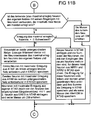
- the learning process for the maximally excited neuron of the own network follows (FIG. 11B). First, it is determined whether this neuron has its inputs connected to neurons that are the most excited within their networks. This is done by reading the numbers of the neurons connected to its inputs from NTAB and comparing them with the values stored in NRR1 and NRR2. If they are equal, the inputs of the learning neuron are already connected to the correct neurons of the subordinate networks. Therefore, the learning process is ended after increasing the mass of the learning neuron by DM and entering it in NTAB3.
- the excitation of the maximally excited neuron is less than the defined excitation threshold value.
- a new neuron is in NTAB inserted and the number of the neurons connected to the inputs of this new neuron for this new neuron from NRR1 and NRR2 via MUX7 and MUX8 and stored in NTAB.
- the excitation for these two neurons is requested from the left and right subordinate networks and their sum is stored as excitation for the inserted neuron in NTAB4 and the value DM is stored as its mass in NTAB3.
- the mass of this neuron is made available at the output ML2 and then an average vector clock MVT is sent via the output MV2 to both subordinate networks and this prompts them, average vectors to generate and process with the mass of neurons provided at their MMV input.
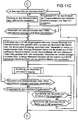
- the processing of the input pattern is completed and an input clock is generated for reading in the input vectors of the next input pattern. Otherwise, the parent network is informed with an output clock AT that the learning process has been carried out for its own network. Then a mean vector clock MVT from the higher-level network is waited for.
- the neuron After its arrival, the neuron is searched for in NTAB at the beginning of a first loop, the number of which is supplied by the higher-level network via input NR3. Then the numbers of the neurons to which the inputs of this neuron are connected are read from NTAB1 and NTAB2. These numbers are made available to the subordinate networks via the outputs NRL3 and NRR3. Now the neuron mass, which is available at the MMV input, is made available to the two subordinate networks via its inputs MMV via the output MN2. A mean value vector clock MVT is then generated and sent to both subordinate networks via the output MV2.
- the partial control DETERMINATION OF THE NEURONS WITH HIGH EXCITATION is called and executed as already explained above.
- the higher-level network has sent a control clock MVT for the generation and subsequent processing of an average vector. In this case it branches to the beginning of the first loop. Otherwise it is queried whether all neurons from NTAB have already been entered in ATAB. If this is the case, the system branches to the beginning of the third loop. Otherwise it is queried whether all neurons up to the line number as loaded in MARKE have already been read out from ATAB. In this case, the system branches to the beginning of the second loop, otherwise to the beginning of the third loop.
- FIG. 4 shows a network hierarchy which is expanded compared to FIG.
- the sub-network hierarchies, which extend to the 2nd level, were copied and additionally offset by one position in the x-direction to the left or right.
- the sub-network hierarchies shifted by one position on the second level recognize sub-patterns shifted by one position.
- networks are added at higher levels that are only shifted by one position in relation to the existing networks, including the sub-network hierarchy additionally required for them on the levels below.
- networks can be added that are shifted by 1 to n positions, where n can be higher the higher the level.
- the weight vector of this continuous neuron is used as the input vector for this network.
- the neuron with the highest excitation (except the continuous neuron itself) is selected. If this excitation exceeds the excitation threshold defined for this stage (but now reduced), the continuous neuron is combined with the selected neuron.
- the weight vector of the resulting neuron results from the weighted average of the weight vectors of the two combined neurons, which are weighted according to their masses.
- the mass of the resulting neuron results from the sum of the masses of the two combined neurons.
- the connection from the outputs of the two combined neurons to the inputs of neurons of the overlying neuron layer are replaced by connections from the output of the resulting neuron to the corresponding inputs of the neurons of the overlying layer.
- the compression in networks at a higher level takes place as follows: Two neurons in the network to be compressed are combined into one neuron if the deviation of the groups of weight vectors assigned to them at the lowest level falls below a minimum value. For this purpose, the following procedure is carried out for each neuron of this network: The group of weight vectors assigned to this continuous neuron at the lowest level is used as a group of input vectors and is also processed by the corresponding networks at higher levels. The neuron with the highest excitation in the network to be compressed, apart from the continuous neuron itself, is selected. If this excitation exceeds the excitation threshold defined for this stage (but now reduced), the continuous neuron is combined with the selected neuron.
- the connections of the inputs of the resulting neuron are determined as follows:
- the weighted average is formed from the group of weight vectors at the lowest level assigned to the continuous neuron and from the group of weight vectors at the lowest level assigned to the selected neuron, the mass of the continuous neuron and the mass of the selected neuron being used for weighting.
- the group of mean value vectors determined in this way is used as a group of input vectors and is also processed by the corresponding networks at higher levels.
- the inputs of the resulting neuron are then connected to the outputs of the neurons of the associated network group of the level below which are most excited within their network.
- the mass of the resulting neuron results from the sum of the masses of the two combined neurons.
- the connection from the outputs of the two combined neurons to the inputs of neurons of the overlying neuron layer are replaced by connections from the output of the resulting neuron to the corresponding inputs of the neurons of the overlying layer.
Landscapes
- Engineering & Computer Science (AREA)
- Theoretical Computer Science (AREA)
- Physics & Mathematics (AREA)
- Data Mining & Analysis (AREA)
- General Health & Medical Sciences (AREA)
- Biomedical Technology (AREA)
- Biophysics (AREA)
- Computational Linguistics (AREA)
- Life Sciences & Earth Sciences (AREA)
- Evolutionary Computation (AREA)
- Artificial Intelligence (AREA)
- Molecular Biology (AREA)
- Computing Systems (AREA)
- General Engineering & Computer Science (AREA)
- General Physics & Mathematics (AREA)
- Mathematical Physics (AREA)
- Software Systems (AREA)
- Health & Medical Sciences (AREA)
- Image Analysis (AREA)
Priority Applications (1)
| Application Number | Priority Date | Filing Date | Title |
|---|---|---|---|
| EP95102265A EP0727748A1 (fr) | 1995-02-17 | 1995-02-17 | Méthode et dispositif pour apprentissage non-supervisé multicouche en utilisant une hiérarchie de réseaux neuronaux |
Applications Claiming Priority (1)
| Application Number | Priority Date | Filing Date | Title |
|---|---|---|---|
| EP95102265A EP0727748A1 (fr) | 1995-02-17 | 1995-02-17 | Méthode et dispositif pour apprentissage non-supervisé multicouche en utilisant une hiérarchie de réseaux neuronaux |
Publications (1)
| Publication Number | Publication Date |
|---|---|
| EP0727748A1 true EP0727748A1 (fr) | 1996-08-21 |
Family
ID=8218996
Family Applications (1)
| Application Number | Title | Priority Date | Filing Date |
|---|---|---|---|
| EP95102265A Withdrawn EP0727748A1 (fr) | 1995-02-17 | 1995-02-17 | Méthode et dispositif pour apprentissage non-supervisé multicouche en utilisant une hiérarchie de réseaux neuronaux |
Country Status (1)
| Country | Link |
|---|---|
| EP (1) | EP0727748A1 (fr) |
Cited By (4)
| Publication number | Priority date | Publication date | Assignee | Title |
|---|---|---|---|---|
| WO1999028859A1 (fr) * | 1997-12-01 | 1999-06-10 | Chris Alan Kortge | Dispositif de reconnaissance de formes avec apprentissage de caracteristiques independantes |
| WO2000003355A3 (fr) * | 1998-07-08 | 2000-04-20 | Siemens Ag | Reseau neuronal, et procede et dispositif pour l'entrainement d'un reseau neuronal |
| CN102262645A (zh) * | 2010-05-27 | 2011-11-30 | 索尼公司 | 信息处理装置、信息处理方法以及程序 |
| US9886193B2 (en) | 2015-05-15 | 2018-02-06 | International Business Machines Corporation | Architecture and implementation of cortical system, and fabricating an architecture using 3D wafer scale integration |
Citations (1)
| Publication number | Priority date | Publication date | Assignee | Title |
|---|---|---|---|---|
| EP0459276A2 (fr) * | 1990-05-21 | 1991-12-04 | Yozan Inc. | Système de traitement de données |
-
1995
- 1995-02-17 EP EP95102265A patent/EP0727748A1/fr not_active Withdrawn
Patent Citations (1)
| Publication number | Priority date | Publication date | Assignee | Title |
|---|---|---|---|---|
| EP0459276A2 (fr) * | 1990-05-21 | 1991-12-04 | Yozan Inc. | Système de traitement de données |
Non-Patent Citations (4)
| Title |
|---|
| ETHEM ALPAYDIN: "GROW-AND-LEARN: AN INCREMENTAL METHOD FOR CATEGORY LEARNING GROW-AND-LEARN: AN INCREMENTAL METHOD FOR CATEGORY LEARNING", PROCEEDINGS OF THE INTERNATIONAL CONFERENCE ON NEURAL NETWORKS, PARIS, JULY 9 - 13, 1990, vol. 2, 9 July 1990 (1990-07-09), INSTITUTE OF ELECTRICAL AND ELECTRONICS ENGINEERS, pages 761 - 764, XP000145402 * |
| SANKAR A ET AL: "GROWING AND PRUNING NEURAL TREE NETWORKS", IEEE TRANSACTIONS ON COMPUTERS, vol. 42, no. 3, 1 March 1993 (1993-03-01), pages 291 - 299, XP000364322 * |
| TSENG H C ET AL: "SCALABILITY IN NEURAL NETWORK DESIGN: AN ADD-ON SCHEME", PROCEEDINGS OF THE INTERNATIONAL CONFERENCE ON NEURAL NETWORKS (ICN, SAN FRANCISCO, MAR. 28 - APR. 1, 1993, vol. 1, 28 March 1993 (1993-03-28), INSTITUTE OF ELECTRICAL AND ELECTRONICS ENGINEERS, pages 444 - 449, XP000366817 * |
| ZHEN-PING LO ET AL: "A NEURAL PIECEWISE LINEAR CLASSIFIER FOR PATTERN CLASSIFICATION", PROCEEDINGS OF THE INTERNATIONAL JOINT CONFERENCE ON NEURAL NETWORK (IJCNN), SEATTLE, JULY 8 - 12, 1991, vol. 1, 8 July 1991 (1991-07-08), INSTITUTE OF ELECTRICAL AND ELECTRONICS ENGINEERS, pages 263 - 268, XP000238303 * |
Cited By (6)
| Publication number | Priority date | Publication date | Assignee | Title |
|---|---|---|---|---|
| WO1999028859A1 (fr) * | 1997-12-01 | 1999-06-10 | Chris Alan Kortge | Dispositif de reconnaissance de formes avec apprentissage de caracteristiques independantes |
| WO2000003355A3 (fr) * | 1998-07-08 | 2000-04-20 | Siemens Ag | Reseau neuronal, et procede et dispositif pour l'entrainement d'un reseau neuronal |
| CN102262645A (zh) * | 2010-05-27 | 2011-11-30 | 索尼公司 | 信息处理装置、信息处理方法以及程序 |
| US9886193B2 (en) | 2015-05-15 | 2018-02-06 | International Business Machines Corporation | Architecture and implementation of cortical system, and fabricating an architecture using 3D wafer scale integration |
| US10503402B2 (en) | 2015-05-15 | 2019-12-10 | International Business Machines Corporation | Architecture and implementation of cortical system, and fabricating an architecture using 3D wafer scale integration |
| US10613754B2 (en) | 2015-05-15 | 2020-04-07 | International Business Machines Corporation | Architecture and implementation of cortical system, and fabricating an architecture using 3D wafer scale integration |
Similar Documents
| Publication | Publication Date | Title |
|---|---|---|
| DE69514444T2 (de) | Verfahren für die Ablauffolgeplanung von aufeinanderfolgenden Aufgaben mit Zeitzwangsbedingungen | |
| DE69423834T2 (de) | Produktionssteuersystem, das eine optimale zuteilungsregel auswählt | |
| DE3911465C2 (de) | Verfahren zur automatischen Konfiguration technischer Systeme aus Komponenten | |
| DE3416939A1 (de) | Verfahren zur steuerung von betriebseinrichtungen | |
| DE19822543A1 (de) | Verfahren zum Zuteilen von Aufträgen, Datenverarbeitssystem, Client-Datenbearbeitungsknoten und computerlesbares Speichermedium | |
| DE69635544T2 (de) | Optimierung der Leistung in einem Paket-Transportsystem mit Paketschlitzpriorität | |
| DE2508799A1 (de) | Digitale logische grundschaltung fuer lernmaschinen | |
| DE69629540T2 (de) | Verfahren und Gerät zum Sortieren von Elementen | |
| DE19531635C1 (de) | Ordnungsverfahren für Zugehörigkeitsfunktionswerte lingustischer Eingangswerte in einem Fuzzy-Logic-Prozessor und Anordnungen zu deren Durchführung | |
| EP4535191A2 (fr) | Système de classificateur et procédé de génération distribuée de modèles de classification | |
| WO2020193481A1 (fr) | Procédé et dispositif d'apprentissage et de réalisation d'un réseau neuronal artificiel | |
| WO1996014608A1 (fr) | Procede de mise au point d'un regulateur a logique floue | |
| EP0956531A1 (fr) | Procede pour la transformation d'une logique floue servant a la simulation d'un processus technique en un reseau neuronal | |
| EP1159655B1 (fr) | Systeme d'automatisation comportant des objets d'automatisation composes d'elements modulaires | |
| EP1248430B1 (fr) | Méthode et dispositif de génération de masques filtrants pour vérifier l'importance de caractéristiques | |
| DE102018112803A1 (de) | Verfahren zum Bestimmen einer physikalischen Verbindungstopologie eines für die Steuergerätentwicklung eingerichteten, echtzeitfähigen Testgeräts | |
| EP0430342B1 (fr) | Circuit pour l'établissement de connexions de conférence | |
| DE3609925A1 (de) | Einrichtung zur simulation von neuronensystemen | |
| EP1331794B1 (fr) | Procédé d'attribution d'adresses dans un réseau et ses composants | |
| DE3854709T2 (de) | In einem Vorderinferenzsystem verwendetes Elementprüfsystem. | |
| DE69310210T2 (de) | Neuronale netzwerk architektur | |
| WO2004053606A1 (fr) | Procede pour determiner une repartition d'objets physiques sur des installations d'un systeme d'installations | |
| EP1388770B1 (fr) | Méthode et dispositif pour déterminer la séquence d' usinage des lots de production | |
| DE4020001C2 (de) | Schaltungsanordnung einer Neuronenschaltung und eines damit aufgebauten neuronalen Netzes | |
| EP1357477A2 (fr) | Dispositif connecté à un système de bus |
Legal Events
| Date | Code | Title | Description |
|---|---|---|---|
| PUAI | Public reference made under article 153(3) epc to a published international application that has entered the european phase |
Free format text: ORIGINAL CODE: 0009012 |
|
| AK | Designated contracting states |
Kind code of ref document: A1 Designated state(s): DE FR GB |
|
| RBV | Designated contracting states (corrected) |
Designated state(s): DE FR GB |
|
| STAA | Information on the status of an ep patent application or granted ep patent |
Free format text: STATUS: THE APPLICATION IS DEEMED TO BE WITHDRAWN |
|
| 18D | Application deemed to be withdrawn |
Effective date: 19970222 |