EP0728242B1 - Mechanische teilneutralisation von wasserstoffbrücken zur herstellung eines weicheren, seidigeren, luftgelegten faserprodukts - Google Patents
Mechanische teilneutralisation von wasserstoffbrücken zur herstellung eines weicheren, seidigeren, luftgelegten faserprodukts Download PDFInfo
- Publication number
- EP0728242B1 EP0728242B1 EP94930941A EP94930941A EP0728242B1 EP 0728242 B1 EP0728242 B1 EP 0728242B1 EP 94930941 A EP94930941 A EP 94930941A EP 94930941 A EP94930941 A EP 94930941A EP 0728242 B1 EP0728242 B1 EP 0728242B1
- Authority
- EP
- European Patent Office
- Prior art keywords
- stretching
- fibers
- bonds
- rollers
- web
- Prior art date
- Legal status (The legal status is an assumption and is not a legal conclusion. Google has not performed a legal analysis and makes no representation as to the accuracy of the status listed.)
- Expired - Lifetime
Links
- 239000001257 hydrogen Substances 0.000 title claims description 27
- 229910052739 hydrogen Inorganic materials 0.000 title claims description 27
- 238000004519 manufacturing process Methods 0.000 title claims description 15
- 238000006386 neutralization reaction Methods 0.000 title description 7
- 238000000034 method Methods 0.000 claims abstract description 16
- 239000000835 fiber Substances 0.000 claims description 55
- 239000011230 binding agent Substances 0.000 claims description 27
- 239000004816 latex Substances 0.000 claims description 25
- 229920000126 latex Polymers 0.000 claims description 25
- 238000001035 drying Methods 0.000 claims description 11
- 239000007789 gas Substances 0.000 claims description 5
- 239000007900 aqueous suspension Substances 0.000 claims description 2
- 239000003795 chemical substances by application Substances 0.000 claims description 2
- 239000000047 product Substances 0.000 description 55
- 230000000694 effects Effects 0.000 description 9
- 239000012467 final product Substances 0.000 description 7
- 230000008569 process Effects 0.000 description 7
- 239000005018 casein Substances 0.000 description 4
- 235000021240 caseins Nutrition 0.000 description 4
- 230000003472 neutralizing effect Effects 0.000 description 3
- 238000005336 cracking Methods 0.000 description 2
- 238000004049 embossing Methods 0.000 description 2
- 239000002657 fibrous material Substances 0.000 description 2
- 239000000725 suspension Substances 0.000 description 2
- XLYOFNOQVPJJNP-UHFFFAOYSA-N water Substances O XLYOFNOQVPJJNP-UHFFFAOYSA-N 0.000 description 2
- 229910000906 Bronze Inorganic materials 0.000 description 1
- UFHFLCQGNIYNRP-UHFFFAOYSA-N Hydrogen Chemical compound [H][H] UFHFLCQGNIYNRP-UHFFFAOYSA-N 0.000 description 1
- 230000009471 action Effects 0.000 description 1
- 238000005054 agglomeration Methods 0.000 description 1
- 230000002776 aggregation Effects 0.000 description 1
- 239000010974 bronze Substances 0.000 description 1
- KUNSUQLRTQLHQQ-UHFFFAOYSA-N copper tin Chemical compound [Cu].[Sn] KUNSUQLRTQLHQQ-UHFFFAOYSA-N 0.000 description 1
- 238000004132 cross linking Methods 0.000 description 1
- 238000009826 distribution Methods 0.000 description 1
- 239000000463 material Substances 0.000 description 1
- 230000004048 modification Effects 0.000 description 1
- 238000012986 modification Methods 0.000 description 1
- 239000011368 organic material Substances 0.000 description 1
- 238000005507 spraying Methods 0.000 description 1
Images


Classifications
-
- D—TEXTILES; PAPER
- D04—BRAIDING; LACE-MAKING; KNITTING; TRIMMINGS; NON-WOVEN FABRICS
- D04H—MAKING TEXTILE FABRICS, e.g. FROM FIBRES OR FILAMENTARY MATERIAL; FABRICS MADE BY SUCH PROCESSES OR APPARATUS, e.g. FELTS, NON-WOVEN FABRICS; COTTON-WOOL; WADDING ; NON-WOVEN FABRICS FROM STAPLE FIBRES, FILAMENTS OR YARNS, BONDED WITH AT LEAST ONE WEB-LIKE MATERIAL DURING THEIR CONSOLIDATION
- D04H1/00—Non-woven fabrics formed wholly or mainly of staple fibres or like relatively short fibres
- D04H1/40—Non-woven fabrics formed wholly or mainly of staple fibres or like relatively short fibres from fleeces or layers composed of fibres without existing or potential cohesive properties
- D04H1/58—Non-woven fabrics formed wholly or mainly of staple fibres or like relatively short fibres from fleeces or layers composed of fibres without existing or potential cohesive properties by applying, incorporating or activating chemical or thermoplastic bonding agents, e.g. adhesives
- D04H1/64—Non-woven fabrics formed wholly or mainly of staple fibres or like relatively short fibres from fleeces or layers composed of fibres without existing or potential cohesive properties by applying, incorporating or activating chemical or thermoplastic bonding agents, e.g. adhesives the bonding agent being applied in wet state, e.g. chemical agents in dispersions or solutions
Definitions
- This invention concerns a method for production of a soft and silky air-laid fibrous sheet having fibers and groups of fibers bonded to other fibers and other groups of fibers, having the steps of passing a stream of gas containing suspended organic natural fibers through a gas-permeable forming surface to form a fibrous sheet thereon, applying binder agent onto the sheet, and drying the fibrous sheet, and curing said binder, and an apparatus for production of a soft and silky air laid fibrous sheet comprising means for dry-laying a fibrous sheet in a dry state via an air stream onto a forming surface, means for applying a binder solution onto the fibrous sheet in order to establish a combination of brittle bonds and elastic bonds, means for drying the fibrous web by application of heat, means for curing the web after the fibers have been dried.
- the invention is in particular concerned with the manufacture of such fibrous sheet in which the soft and silky effect is obtained through a neutralizing or at least a partly neutralizing of the brittle bonds which may be provided in the
- binder solution onto a dry laid sheet of fibrous material in order to form an effective bond between individual fibers and groups of fibers. After the air-lying of the organic natural fibers onto a forming surface the binder solution is applied onto the so-formed fibrous sheet. After the applying of such solution in one or several application stations the web is led through a drying unit and then through a curing unit.
- brittle hydrogen bonds When applying the binder solution a combination of brittle hydrogen bonds and elastic latex bonds are provided.
- the hydrogen bonds are valuable in a fibrous sheet although they are generally brittle. However, the hydrogen bonds are not brittle when they only stay in groups of several fiber agglomerations or between single fibers and groups of fibers. These hydrogen bonds make the overall sheet stronger. However, due to the brittleness of the hydrogen bonds the fibrous sheet would appear as a rather stiff web having a poor hand and feel. Also the drapability would be poor.
- the elastic latex bonds are valuable as they will provide a web being soft and silky.
- Such web would also have a good hand and feel.
- the latex is applied in a suspension of water, and accordingly, the hydrogen bonds would also be provided when providing latex bonds.
- EP-A-0,077,005 the manufacture of a dry-laid fibrous web is disclosed.
- a web is described in which the absorbency is enhanced by compressing and densifying portions of the web. It is also disclosed that it is possible to emboss such web.
- the publication does not disclose the possibility of producing a soft and silky air-laid fibrous sheet which is manufactured by the use of an evenly distributed aqueous latex binder.
- the prior art does not disclose a solution which makes it possible to manufacture a soft and silky air-laid fibrous fiber sheet which is manufactured by the use of an aqueous binder solution, which product will simultaneously be a strong product.
- a method of and an apparatus for production of a soft and silky air laid fibrous sheet as described in claims 1 and 6 wherein the brittle bonds in the dry laid web of the organic material fibers are neutralized or partly neutralized by stretching.
- the brittle bonds are preferably neutralized in a pattern which separates the remaining hydrogen bonds in small groups which could be compared with small islands being separated by breaking lines in which the brittle bonds are neutralized whereas the elastic bonds are maintained.
- Said elastic bonds connect the islands in which the brittle bonds are maintained totally or partly.
- Hydrogen bond is unavoidably because the latex solution is suspended in so much water that the hydrogen bond is all over and through the dry formed product. According to this invention the hydrogen bond will remain in very small areas or islands which have not been subjected to the neutralization stretching process. Thus the strong coherence of the product will be maintained in said areas or islands and in the connected islands.
- the dry formed sheet consists of agglomerated fibers arranged in groups being in contact or connection with the other agglomerates or groups of fibers then the sheet will result as a product being stronger than a product having only single fibers being in mutually contact or connection with other single fibers. Accordingly, a product having agglomerates of fibers being interconnected through the hydrogen bonds and which agglomerates at their side are interconnected with each other through the latex bonds then the resulting sheet will not only be soft but also a strong product.
- the neutralization is preferably effected by stretching the sheet at least in two directions, however, also a stretching in three or four directions is possible.
- wrecking lines are established in the brittle bonds. Said wrecking lines may be compared to the randomly orientated cracking occuring in the earth during spill of droughts.
- a more or less randomly orientated pattern is obtained in which the brittle bonds, viz. the hydrogen bonds are neutralized.
- the latex bonds may be stretched without cracking in the pattern.
- an advantageous sheet is obtained having groups of interconnected fibers instead of single fibers.
- the final product will have soft quality, be strong and have a good and feel and a good drapability.
- each of the mosaic sections contain small groups of fibers being interconnected by the hydrogen bonds and possibly also the casein bonds. Said sections being separated by a fine network of lines in which the hydrogen bonds and possible also the casein bonds, if any, are neutralized or released from their tension. Thereby a very strong and very soft product is obtained.
- the stretching is effected by use of a series of at least two rollers having thread-formed surfaces.
- the rollers are provided with alternating left handed and right handed threads and the web is urged against the threads, however, without the use of any pressure roller. Due to the action of the threads the sheet is stretched cross-wise.
- the stretching rollers are provided with smooth threads whereon the sheet is able to slide by creating a possibility of having a small increase in the width of the web formed. This is effected in the longitudinal direction of the rollers, viz. cross-wise to the machine direction of the sheet formed. The increase might have a value of 2 to 4 % of the original width.
- successively rollers are driven with a higher surface velocity thereby establishing a stretching in the longitudinal direction of the sheet.
- At least two rollers are used, however, it is recommended to use a series of more than 4 rollers.
- the difference in the surface velocity from one roller to the next roller is the order of 1 ⁇ 2 to 1%.
- a stretching in the longitudinal direction is established which together with the stretching in the cross-wise direction provides a random pattern of breacking lines giving the sheet produced the above-mentioned remarkable good qualities.
- the stretching might increase the length of between 2 and 4% of the original length.
- threaded rollers may be supplemented by use of bombarded rollers.
- bombarded rollers it is possible to use a series of bombarded rollers only to effect the stretching. Thereby a stretching orientated diagonal or cross-wise is effected from one roller to the following roller.
- bombarded rollers they should also be driven with a successively higher surface velocity in order to effect a stretching in the longitudinal direction of the sheet, viz. in the machine direction.
- the product might be provided with an embossing before it is introduced into the series of bombarded rollers or just before the curing process takes place of the latex. In this situation the embossing pattern will be maintained during the passage passing the bombarded rollers.
- rollers or at least one roller having smooth protuberances in its surface are used.
- the web is urged against this surface and thereby establishing a multi-directional stretching.
- a stretching is provided in a local area in front of each protuberance. Thereby the random pattern of breacking lines is provided.
- rollers having other forms e.g. those known from the manufacture of corrugated paper.
- each pair of rollers alternately is provided with round-going grooves and longitudinal orientated grooves.
- the sheet when passing through such pair of rollers may not be nipped.
- the paper may slide between the pair of rolles.
- rollers of this type it is possible to provide a pattern of breacking lines being more well defined, and thereby it is possible to manufacture a final product having more specific properties in the machine direction and in the cross-wise direction.
- stretching rollers having a smooth surface it is also possible to make use of rollers provided with sandpaper-like surface.
- the fibrous sheet After the neutralization process the fibrous sheet would have fiber groups of say from 2 to 10 fibers instead of single fibers and instead of a continuation of the fibers being interconnected by hydrogen bonds. It is possible to variate the size of the fiber group depending on the stretching effect. Thus a higher degree of stretching would provide minor fiber groups and a lower degree of stretching would fiber groups having a higher number of hydrogen interconnected fibers. Thus it is possible to determine the qualities of the product produced dependend on the intended use of the final product.
- FIG. 1 Preferred embodiments for an apparatus according to the present invention is diagrammatically illustrated in Figs. 1-3. In these Figures identical or corresponding elements are designated with same reference numbers and will only be explained in details in connection with Fig. 1.
- the apparatus includes a fiber distributor 1, a suction box 2, and an endless foraminous forming wire 3 passing there between the endless forming wire consisting e.g. of a mesh net constructed using bronze wires.
- the forming wire 3 is driven by suitable means (not shown) such that it will continously pass between the distributor 1 and the suction box 2.
- the forming wire 3 moves in direction of an arrow 4.
- the suction box 2 includes a suction pipe 5 which is connected to a fan (not shown) for the creation of a vacuum therein.
- the forming wire 3 passes through the nip of a pair of rollers 6,7 and below a nozzle 8 spraying a binder solution onto the product formed.
- the nozzle 8 is connected with a mixing box 10 and the mixing box 10 is connected with supplying means 11 and 12.
- An endless band 13 is arranged in continuation of the forming wire 3.
- the band 13 is driven in direction of the arrow 14.
- a further endless band 15 is provided above the forming wire 4 and the endless band 13.
- the endless band 3 is a gas permeable band wounded on three rollers 16, 17, and 18. From the roller 17 a wall 19 is provided thereby dividing the interior space of the gas permeable band 15 into two compartments 20 and 21.
- a vacuum is created through a fan (not shown) thereby lifting the fibrous product 22 free of the forming wire 3.
- a overpressure is created e.g. by means of the same fan which creates the vacuum in compartment 20. Thereby the fibrous product 22 is transferred and deposited onto the endless band 13.
- the apparatus also comprises two sets of rollers 23,24 and 25,26, respectively, and a further nozzle 8 which is mounted between said sets of rollers and to which a binder solution is supplied from the mixing box 10.
- the rollers 24 and 26 may preferably be heated rollers.
- the apparatus comprises a drying unit 27, a stretching unit 28, a curing unit 29 and a roller 30 for binding the final product.
- the stretching unit 28 shown in Fig. 1 comprises a series of four bombarded rollers 31. Between the bombarded rollers 31 turning and tighten rollers 32 are provided. The turning and tighten rollers 32 are movable along the arrows 33 in order to urge the fibrous product 22 against the bombarded rollers 31 with different forces thereby effecting different degrees of stretching.
- the apparatus illustrated in Figs. 2 and 3 differs only from the apparatus illustrated in Fig. 1 by the use of other stretching units 28.
- the stretching unit in Fig. 2 comprises a single roller 34 having a surface provided with small protuberances thus providing a surface which corresponds to the surface known from a corncob, however, each protuberance is much smaller as compared to a corngrain.
- the stretching unit 28 comprises two turning and tighten rollers 35 being movable along arrows 36 in order to urge the fibrous product 22 against the roller 34 with different forces thereby effecting different degrees of stretching.
- the stretching unit 28 illustrated in Fig. 3 comprises a series of four rollers 37 and 38.
- the rollers 37 and 38 comprise a left hand thread and a right hand thread, respectively.
- the fibrous product 22 is led according to a sine-formed path through the series of rollers 37,38 alternately being urged into contact with a left hand thread and a right hand thread thereby establishing a stretch as the fibrous product 22 is urged against the rollers 37,38 in a tightened manner.
- the threads provided on the rollers 37,38 are rounded thereby allowing the fibrous product 22 to slide on the top of the threads.
- a fiber material is deposited on the forming wire 3 on which it is moved in direction of arrow 4 and forms a fiber layer when air is sucked away through the suction box 2.
- the fiber layer thus formed is rolled when passing the nip of the rollers 6,7 and a binder solution 9 is the applied to one side of the layer by means of the nozzle 8.
- the product thus formed has such a strength that it can be removed from the forming wire 3 by means of the gas permeable endless band 15. Due to the vacuum in the chamber 20 the fibrous product 22 is lifted free of the forming wire 3 and is then deposited onto the band 13 due to the overpressure in the compartment 21.
- the fibrous product 22 is then passed through the set of rollers 23,24 and passes the nozzle 28 at which a binder solution 9 is applied on the side of the product facing downwards on the forming wire 3.
- a drying unit 27 When the material has passed the set of rollers 25,26 it is led through a drying unit 27.
- the rollers 24 and 26 are preferably heated so as to remove a part of the moisture supplied together with the binder solution. Thus is might be possible to obviate a use of a separate drying unit 27.
- the fibrous product 22 is led to a step in which the softening treatment according to the invention is effected.
- the product 22 is passed through the stretching unit 28 in which the product is stretched at least in two directions. The effect on the stretching would be explained in more detail below.
- the product 22 is wound on the roller 30 it is led through a curing unit 29.
- the nozzles 8 are provided with a binder solution from a mixing box 10.
- the mixing box 10 comprises preferably mixing means in order to effect a intimate mixing by a whipping process.
- the product to be mixed in the mixing box 10 is provided from supply means 11 and 12.
- the supply means 12 contain a latex binder which preferably is a SBR latex binder in an aqueous suspension which is known in the art. It is noted that it is also possible to use other binders which are well-known in the art.
- the latex binder solution might be modified by introducing a softener product from the supply means 11.
- the introduction of a softener product into the latex binder suspension has given surprisingly improvements in the qualities of the final product obtained in that it is more soft and silky and also stronger than normal after the stretching operation effecting in the stretching unit 28.
- the modification of the latex binder solution is preferred in order to obtain the soft and silky product which is provided after the mechanical neutralizing process according to the present invention.
- the stretching unit 28 comprises bombarded rollers 31 which are well-known. However, so far bombarded rollers 21 have been used for smoothening a fibrous product. According to the present invention the fibrous product 22 is urged against the bombarded rollers 31 through the influence from the turning and tiedend rollers 32 thereby applying the fibrous product 22 onto the rollers 31 with a force sufficient to effect a stretching. Preferably, each succeeding bombarded roller is driven with a higher surface velocity than a before going roller 31 in order to effect a stretching in the longitudinal direction of the product 22. Due to the stretching it is possible to obtain a fine pattern of invisible neutralization lines to be explained below.
- roller 34 may be followed by one or more bombarded rollers for effecting a smoothening.
- the roller 34 might have protuberances having a height of between 2 mm and 3 mm and having a mutual distance between protuberances of between 5 mm and 20 mm.
- the thread is formed by a sine-shaped surface of the roller in which each sine-wave has a height of between 5 and 10 mm and having a mutual distance between the waves of between 10 and 15 mm.
- the roller may have a diameter of between 0.4 and 0.6 m. The same diameters could also be used for the rollers 31 and 34.
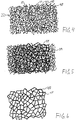
- Fig. 4 a fragmentary enlarged view of a fibrous product 22 is illustrated. It is seen that the single fibers 39 are distributed with a normal air-forming distribution of the fibers 39 in all positions and with hydrogen bonds and latex bonds at cross-linking points of the individual fibers.
- Fig. 5 illustrates greatly enlarged a fibrous product 22 corresponding to that illustrated in Fig. 2, however, treated with a modified latex binder and subjected to a stretching process as described above.
- a mosaic of lines 41 is illustrated separating the product in mosaic sections 42 in which the hydrogen bonds are maintained.
- the brittle hydrogen bonds and casein bonds are neutralized whereas the elastic latex bonds are maintained even after the stretching of the product 22.
- the product will all over its surface maintain the latex bonds.
- the product is obtained having groups of interconnected fibers 39 in the mosaic sections 42 when said groups of fibers are interconnected with other groups of fibers or single fibers through the latex bonds. Accordingly, a final product is obtained having a good hand and feel and a good drapability.
- Fig. 6 the mosaic pattern of the lines 41 is illustrated without the illustration of the fibers 39. This is only for illustrative reasons as the lines 41 would be invisible in the final product even if it is studied through a three-dimensional microscope.
Landscapes
- Chemical & Material Sciences (AREA)
- Chemical Kinetics & Catalysis (AREA)
- Dispersion Chemistry (AREA)
- General Chemical & Material Sciences (AREA)
- Engineering & Computer Science (AREA)
- Textile Engineering (AREA)
- Nonwoven Fabrics (AREA)
- Solid-Sorbent Or Filter-Aiding Compositions (AREA)
- Artificial Filaments (AREA)
- Treatments For Attaching Organic Compounds To Fibrous Goods (AREA)
- Polysaccharides And Polysaccharide Derivatives (AREA)
Claims (9)
- Verfahren zur Herstellung einer weichen und seidigen, geblasenen Faserschicht (22) mit Fasern und Gruppen von Fasern, die mit anderen Fasern und Gruppen von Fasern verbunden sind, aufweisend die Schritte des Leitens eines Gasstromes, welcher suspendierte, organische Naturfasern enthält, durch eine gasdurchlässige Formoberfläche (3), um auf ihr eine Faserschicht zu bilden, Aufbringen eines Bindemittels (9) auf die Schicht und Trocknen der Faserschicht (22) und Aushärten des Binders, dadurch gekennzeichnet, daß das Verfahren im wesentlichen die aufeinanderfolgenden Schritte des Aufbringens nur einer einzigen Binderlösung (9) auf die Faserschicht (22) enthält, wobei die Binderlösung einen in einer Wassersuspension enthaltenen Latexbinder aufweist, wodurch eine Kombination von brüchigen Bindungen in Form von Wasserstoffbrückenbindungen und elastischen Bindungen in Form von Latexbindungen zwischen den sich darin befindenden Fasern (39) bereitgestellt wird, und dadurch, daß nach dem Trocknungsschritt ein Strecken des Gewebes durch Streckmittel (28) ausgeführt wird, um zumindest einen Teil der brüchigen Bindungen zu neutralisieren.
- Verfahren nach Anspruch 1, dadurch gekennzeichnet, daß die Wasserstoffbrückenbindungen in einem Muster (41) neutralisiert werden, das das Gewebe in kleine Bereiche (42) aufteilt, in denen Fasern (39) und Gruppen von Fasern aufrechterhaltene Wasserstoffbrückenbindungen haben, wohingegen das Muster nur elastische Bindungen aufweist.
- Verfahren nach Anspruch 2, dadurch gekennzeichnet, daß die Streckmittel (28) Walzen (31, 34, 37, 38) aufweisen, die ein Strecken der Schicht in zwei Richtungen ausführen, wodurch ein Muster von Bruchlinien (41) in den brüchigen Bindungen aufgebaut wird.
- Verfahren nach Anspruch 3, dadurch gekennzeichnet, daß eine Serie von mindestens zwei Walzen (37, 38) verwendet wird, welche gewindegeformte Oberflächen mit abwechselnden Links- und Rechtsgewinden aufweisen, gegen die das Gewebe gedrückt wird, um eine Streckung über Kreuz durchzuführen, wobei die Walzen nacheinander jeweils mit einer höheren Oberflächengeschwindigkeit betrieben werden, wodurch eine gleichzeitige Streckung in Longitudinalrichtung durchgeführt wird.
- Verfahren nach Anspruch 1, dadurch gekennzeichnet, daß das Strecken ein Strecken in mehreren Richtungen umfaßt, das durch mindestens eine Walze (34) mit leichten Erhebungen in ihrer Oberfläche ausgeführt wird, gegen die das Gewebe gedrückt wird.
- Vorrichtung zur Herstellung einer weichen und seidigen, geblasenen Faserschicht (22), aufweisend Mittel (1) zum Trockenblasen einer Faserschicht in einem trockenen Zustand durch einen Luftstrom auf eine Formoberfläche (3), Mittel zum Aufbringen einer Binderlösung auf die Faserschicht (8), Mittel (27) zum Trocknen des Fasergewebes durch Wärmezufuhr, Mittel (29) zum Fixieren des Gewebes nachdem die Fasern getrocknet sind, dadurch gekennzeichnet, daß sie Mittel (28) aufweist, die nach den Trocknungsmitteln zum Strecken des Gewebes (22) in mindestens zwei Richtungen angeordnet sind.
- Vorrichtung nach Anspruch 6, dadurch gekennzeichnet, daß die Streckmittel mindestens eine Walze (34) mit einer mit Erhebungen versehenen Oberfläche aufweisen.
- Vorrichtung nach Anspruch 6, dadurch gekennzeichnet, daß die Streckmittel eine Serie von Walzen (37, 38) aufweisen, die abwechselnd mit Links- und Rechtsgewinden versehen sind, wobei jede nachfolgende Walze mit einer höheren Rotationsgeschwindigkeit als die vorausgehende Walze angetrieben wird.
- Vorrichtung nach Anspruch 8, dadurch gekennzeichnet, daß die Walzen (37, 38) eine Länge zwischen 3 und 4 Meter, einen Durchmesser zwischen 0,4 und 0,6 Meter haben, wobei das Gewinde durch eine sinusförmige Oberfläche gebildet ist, in der die Sinuswelle eine Höhe zwischen 5 und 10 mm hat und wobei zwischen den Sinuswellen ein Abstand zwischen 10 und 15 mm besteht.
Applications Claiming Priority (3)
| Application Number | Priority Date | Filing Date | Title |
|---|---|---|---|
| US14193093A | 1993-10-28 | 1993-10-28 | |
| US141930 | 1993-10-28 | ||
| PCT/DK1994/000400 WO1995012032A1 (en) | 1993-10-28 | 1994-10-28 | Mechanical partial neutralization of hydrogen bonds for production of a softer and more silky air-laid fibrous product |
Publications (2)
| Publication Number | Publication Date |
|---|---|
| EP0728242A1 EP0728242A1 (de) | 1996-08-28 |
| EP0728242B1 true EP0728242B1 (de) | 1997-09-17 |
Family
ID=22497854
Family Applications (1)
| Application Number | Title | Priority Date | Filing Date |
|---|---|---|---|
| EP94930941A Expired - Lifetime EP0728242B1 (de) | 1993-10-28 | 1994-10-28 | Mechanische teilneutralisation von wasserstoffbrücken zur herstellung eines weicheren, seidigeren, luftgelegten faserprodukts |
Country Status (6)
| Country | Link |
|---|---|
| EP (1) | EP0728242B1 (de) |
| AT (1) | ATE158361T1 (de) |
| AU (1) | AU7990394A (de) |
| CA (1) | CA2175239C (de) |
| DE (1) | DE69405771T2 (de) |
| WO (1) | WO1995012032A1 (de) |
Cited By (1)
| Publication number | Priority date | Publication date | Assignee | Title |
|---|---|---|---|---|
| CN108587664A (zh) * | 2018-03-29 | 2018-09-28 | 武汉科技大学 | 一种细镶嵌结构中间相沥青及其制备方法和其在高强高密石墨材料中的应用 |
Family Cites Families (2)
| Publication number | Priority date | Publication date | Assignee | Title |
|---|---|---|---|---|
| NL6917625A (de) * | 1968-12-16 | 1971-05-25 | ||
| CA1193919A (en) * | 1981-10-05 | 1985-09-24 | Michael P. Bouchette | Patterned dry laid fibrous web products of enhanced absorbency |
-
1994
- 1994-10-28 WO PCT/DK1994/000400 patent/WO1995012032A1/en not_active Ceased
- 1994-10-28 CA CA002175239A patent/CA2175239C/en not_active Expired - Fee Related
- 1994-10-28 AT AT94930941T patent/ATE158361T1/de not_active IP Right Cessation
- 1994-10-28 AU AU79903/94A patent/AU7990394A/en not_active Abandoned
- 1994-10-28 EP EP94930941A patent/EP0728242B1/de not_active Expired - Lifetime
- 1994-10-28 DE DE69405771T patent/DE69405771T2/de not_active Expired - Fee Related
Cited By (1)
| Publication number | Priority date | Publication date | Assignee | Title |
|---|---|---|---|---|
| CN108587664A (zh) * | 2018-03-29 | 2018-09-28 | 武汉科技大学 | 一种细镶嵌结构中间相沥青及其制备方法和其在高强高密石墨材料中的应用 |
Also Published As
| Publication number | Publication date |
|---|---|
| DE69405771T2 (de) | 1998-03-19 |
| DE69405771D1 (de) | 1997-10-23 |
| EP0728242A1 (de) | 1996-08-28 |
| WO1995012032A1 (en) | 1995-05-04 |
| CA2175239A1 (en) | 1995-05-04 |
| AU7990394A (en) | 1995-05-22 |
| CA2175239C (en) | 1999-02-23 |
| ATE158361T1 (de) | 1997-10-15 |
Similar Documents
| Publication | Publication Date | Title |
|---|---|---|
| CA1179491A (en) | Nonwoven fabric having the appearance of apertured, ribbed terry cloth | |
| EP0721517B1 (de) | Gewebe | |
| US3705070A (en) | Nonwoven fabric and process for preparing | |
| US3047444A (en) | Non-woven fabric and method of making the same | |
| US3523059A (en) | Needled fibrous batting and method of making the same | |
| US3301746A (en) | Process for forming absorbent paper by imprinting a fabric knuckle pattern thereon prior to drying and paper thereof | |
| US6823568B1 (en) | Nonwoven fabric and method for making same | |
| US4069563A (en) | Process for making nonwoven fabric | |
| EP0147904B1 (de) | Verfahren zur Herstellung eines nichtgewobenen Stoffes | |
| DE69028090T2 (de) | Anlage für die Herstellung einer Vliesstruktur und Produktionsverfahren | |
| US6808664B2 (en) | Method of forming an air laid fibrous web | |
| US5817213A (en) | Paper product formed from embossing fabric | |
| US2697678A (en) | Fabric and method of producing same | |
| EP0644288B1 (de) | Vliesstoff mit Maschenware-Effekt | |
| US4476078A (en) | Process for manufacturing embossed nonwoven fibrous products | |
| EP0730526B1 (de) | Verfahren und vorrichtung zum herstellen einer doppelseitig geprägten faserbahn | |
| WO1995012032A1 (en) | Mechanical partial neutralization of hydrogen bonds for production of a softer and more silky air-laid fibrous product | |
| EP0725855B1 (de) | Modifiziertes latex | |
| US7285240B2 (en) | Method of forming three-dimensional woven textile fabrics with contrasting aesthetic presentation | |
| US3413179A (en) | Flexible sheet material and method for making same | |
| JPH06280185A (ja) | 抄紙装置および多層紙形成装置 | |
| US3676243A (en) | Process for the production of fleeces | |
| US20050009432A1 (en) | Flat product | |
| CN108729017A (zh) | 提花无纺布及其制备方法 | |
| WO1995022656A1 (en) | A plant and a method for producing a dry-formed fiber product |
Legal Events
| Date | Code | Title | Description |
|---|---|---|---|
| PUAI | Public reference made under article 153(3) epc to a published international application that has entered the european phase |
Free format text: ORIGINAL CODE: 0009012 |
|
| 17P | Request for examination filed |
Effective date: 19960430 |
|
| AK | Designated contracting states |
Kind code of ref document: A1 Designated state(s): AT BE CH DE DK ES FR GB GR IE IT LI NL PT SE |
|
| GRAG | Despatch of communication of intention to grant |
Free format text: ORIGINAL CODE: EPIDOS AGRA |
|
| 17Q | First examination report despatched |
Effective date: 19961219 |
|
| GRAH | Despatch of communication of intention to grant a patent |
Free format text: ORIGINAL CODE: EPIDOS IGRA |
|
| GRAH | Despatch of communication of intention to grant a patent |
Free format text: ORIGINAL CODE: EPIDOS IGRA |
|
| GRAA | (expected) grant |
Free format text: ORIGINAL CODE: 0009210 |
|
| AK | Designated contracting states |
Kind code of ref document: B1 Designated state(s): AT BE CH DE DK ES FR GB GR IE IT LI NL PT SE |
|
| PG25 | Lapsed in a contracting state [announced via postgrant information from national office to epo] |
Ref country code: NL Free format text: LAPSE BECAUSE OF FAILURE TO SUBMIT A TRANSLATION OF THE DESCRIPTION OR TO PAY THE FEE WITHIN THE PRESCRIBED TIME-LIMIT Effective date: 19970917 Ref country code: LI Free format text: LAPSE BECAUSE OF FAILURE TO SUBMIT A TRANSLATION OF THE DESCRIPTION OR TO PAY THE FEE WITHIN THE PRESCRIBED TIME-LIMIT Effective date: 19970917 Ref country code: IT Free format text: LAPSE BECAUSE OF FAILURE TO SUBMIT A TRANSLATION OF THE DESCRIPTION OR TO PAY THE FEE WITHIN THE PRESCRIBED TIME-LIMIT;WARNING: LAPSES OF ITALIAN PATENTS WITH EFFECTIVE DATE BEFORE 2007 MAY HAVE OCCURRED AT ANY TIME BEFORE 2007. THE CORRECT EFFECTIVE DATE MAY BE DIFFERENT FROM THE ONE RECORDED. Effective date: 19970917 Ref country code: GR Free format text: LAPSE BECAUSE OF FAILURE TO SUBMIT A TRANSLATION OF THE DESCRIPTION OR TO PAY THE FEE WITHIN THE PRESCRIBED TIME-LIMIT Effective date: 19970917 Ref country code: FR Free format text: LAPSE BECAUSE OF FAILURE TO SUBMIT A TRANSLATION OF THE DESCRIPTION OR TO PAY THE FEE WITHIN THE PRESCRIBED TIME-LIMIT Effective date: 19970917 Ref country code: ES Free format text: THE PATENT HAS BEEN ANNULLED BY A DECISION OF A NATIONAL AUTHORITY Effective date: 19970917 Ref country code: DK Free format text: LAPSE BECAUSE OF NON-PAYMENT OF DUE FEES Effective date: 19970917 Ref country code: CH Free format text: LAPSE BECAUSE OF FAILURE TO SUBMIT A TRANSLATION OF THE DESCRIPTION OR TO PAY THE FEE WITHIN THE PRESCRIBED TIME-LIMIT Effective date: 19970917 Ref country code: BE Effective date: 19970917 Ref country code: AT Effective date: 19970917 |
|
| REF | Corresponds to: |
Ref document number: 158361 Country of ref document: AT Date of ref document: 19971015 Kind code of ref document: T |
|
| REG | Reference to a national code |
Ref country code: CH Ref legal event code: EP |
|
| REF | Corresponds to: |
Ref document number: 69405771 Country of ref document: DE Date of ref document: 19971023 |
|
| PG25 | Lapsed in a contracting state [announced via postgrant information from national office to epo] |
Ref country code: IE Free format text: LAPSE BECAUSE OF NON-PAYMENT OF DUE FEES Effective date: 19971117 |
|
| PG25 | Lapsed in a contracting state [announced via postgrant information from national office to epo] |
Ref country code: SE Effective date: 19971217 Ref country code: PT Effective date: 19971217 |
|
| REG | Reference to a national code |
Ref country code: IE Ref legal event code: FG4D Free format text: 76605 |
|
| EN | Fr: translation not filed | ||
| NLV1 | Nl: lapsed or annulled due to failure to fulfill the requirements of art. 29p and 29m of the patents act | ||
| REG | Reference to a national code |
Ref country code: CH Ref legal event code: PL |
|
| PLBE | No opposition filed within time limit |
Free format text: ORIGINAL CODE: 0009261 |
|
| STAA | Information on the status of an ep patent application or granted ep patent |
Free format text: STATUS: NO OPPOSITION FILED WITHIN TIME LIMIT |
|
| 26N | No opposition filed | ||
| PG25 | Lapsed in a contracting state [announced via postgrant information from national office to epo] |
Ref country code: GB Free format text: LAPSE BECAUSE OF NON-PAYMENT OF DUE FEES Effective date: 19981028 |
|
| GBPC | Gb: european patent ceased through non-payment of renewal fee |
Effective date: 19981028 |
|
| PGFP | Annual fee paid to national office [announced via postgrant information from national office to epo] |
Ref country code: DE Payment date: 20021230 Year of fee payment: 9 |
|
| PG25 | Lapsed in a contracting state [announced via postgrant information from national office to epo] |
Ref country code: DE Free format text: LAPSE BECAUSE OF NON-PAYMENT OF DUE FEES Effective date: 20040501 |