EP0728775A2 - (Co)Polymerisate auf Basis von Vinyl-Einheiten und ihre Verwendung in elektrolumineszierenden Anordnungen - Google Patents
(Co)Polymerisate auf Basis von Vinyl-Einheiten und ihre Verwendung in elektrolumineszierenden Anordnungen Download PDFInfo
- Publication number
- EP0728775A2 EP0728775A2 EP96101800A EP96101800A EP0728775A2 EP 0728775 A2 EP0728775 A2 EP 0728775A2 EP 96101800 A EP96101800 A EP 96101800A EP 96101800 A EP96101800 A EP 96101800A EP 0728775 A2 EP0728775 A2 EP 0728775A2
- Authority
- EP
- European Patent Office
- Prior art keywords
- alkyl
- formula
- aryl
- aralkyl
- alkoxy
- Prior art date
- Legal status (The legal status is an assumption and is not a legal conclusion. Google has not performed a legal analysis and makes no representation as to the accuracy of the status listed.)
- Granted
Links
- 0 *[N+](C1=CC=C*C=C1)[N-] Chemical compound *[N+](C1=CC=C*C=C1)[N-] 0.000 description 5
Classifications
-
- C—CHEMISTRY; METALLURGY
- C08—ORGANIC MACROMOLECULAR COMPOUNDS; THEIR PREPARATION OR CHEMICAL WORKING-UP; COMPOSITIONS BASED THEREON
- C08F—MACROMOLECULAR COMPOUNDS OBTAINED BY REACTIONS ONLY INVOLVING CARBON-TO-CARBON UNSATURATED BONDS
- C08F212/00—Copolymers of compounds having one or more unsaturated aliphatic radicals, each having only one carbon-to-carbon double bond, and at least one being terminated by an aromatic carbocyclic ring
- C08F212/02—Monomers containing only one unsaturated aliphatic radical
- C08F212/04—Monomers containing only one unsaturated aliphatic radical containing one ring
- C08F212/14—Monomers containing only one unsaturated aliphatic radical containing one ring substituted by heteroatoms or groups containing heteroatoms
-
- C—CHEMISTRY; METALLURGY
- C09—DYES; PAINTS; POLISHES; NATURAL RESINS; ADHESIVES; COMPOSITIONS NOT OTHERWISE PROVIDED FOR; APPLICATIONS OF MATERIALS NOT OTHERWISE PROVIDED FOR
- C09B—ORGANIC DYES OR CLOSELY-RELATED COMPOUNDS FOR PRODUCING DYES, e.g. PIGMENTS; MORDANTS; LAKES
- C09B69/00—Dyes not provided for by a single group of this subclass
- C09B69/10—Polymeric dyes; Reaction products of dyes with monomers or with macromolecular compounds
-
- C—CHEMISTRY; METALLURGY
- C08—ORGANIC MACROMOLECULAR COMPOUNDS; THEIR PREPARATION OR CHEMICAL WORKING-UP; COMPOSITIONS BASED THEREON
- C08F—MACROMOLECULAR COMPOUNDS OBTAINED BY REACTIONS ONLY INVOLVING CARBON-TO-CARBON UNSATURATED BONDS
- C08F216/00—Copolymers of compounds having one or more unsaturated aliphatic radicals, each having only one carbon-to-carbon double bond, and at least one being terminated by an alcohol, ether, aldehydo, ketonic, acetal or ketal radical
- C08F216/02—Copolymers of compounds having one or more unsaturated aliphatic radicals, each having only one carbon-to-carbon double bond, and at least one being terminated by an alcohol, ether, aldehydo, ketonic, acetal or ketal radical by an alcohol radical
- C08F216/04—Acyclic compounds
-
- C—CHEMISTRY; METALLURGY
- C08—ORGANIC MACROMOLECULAR COMPOUNDS; THEIR PREPARATION OR CHEMICAL WORKING-UP; COMPOSITIONS BASED THEREON
- C08F—MACROMOLECULAR COMPOUNDS OBTAINED BY REACTIONS ONLY INVOLVING CARBON-TO-CARBON UNSATURATED BONDS
- C08F218/00—Copolymers of compounds having one or more unsaturated aliphatic radicals, each having only one carbon-to-carbon double bond, and at least one being terminated by an acyloxy radical of a saturated carboxylic acid, of carbonic acid or of a haloformic acid
- C08F218/02—Esters of monocarboxylic acids
-
- C—CHEMISTRY; METALLURGY
- C08—ORGANIC MACROMOLECULAR COMPOUNDS; THEIR PREPARATION OR CHEMICAL WORKING-UP; COMPOSITIONS BASED THEREON
- C08F—MACROMOLECULAR COMPOUNDS OBTAINED BY REACTIONS ONLY INVOLVING CARBON-TO-CARBON UNSATURATED BONDS
- C08F220/00—Copolymers of compounds having one or more unsaturated aliphatic radicals, each having only one carbon-to-carbon double bond, and only one being terminated by only one carboxyl radical or a salt, anhydride ester, amide, imide or nitrile thereof
- C08F220/02—Monocarboxylic acids having less than ten carbon atoms; Derivatives thereof
- C08F220/10—Esters
- C08F220/34—Esters containing nitrogen, e.g. N,N-dimethylaminoethyl (meth)acrylate
- C08F220/36—Esters containing nitrogen, e.g. N,N-dimethylaminoethyl (meth)acrylate containing oxygen in addition to the carboxy oxygen, e.g. 2-N-morpholinoethyl (meth)acrylate or 2-isocyanatoethyl (meth)acrylate
-
- C—CHEMISTRY; METALLURGY
- C08—ORGANIC MACROMOLECULAR COMPOUNDS; THEIR PREPARATION OR CHEMICAL WORKING-UP; COMPOSITIONS BASED THEREON
- C08F—MACROMOLECULAR COMPOUNDS OBTAINED BY REACTIONS ONLY INVOLVING CARBON-TO-CARBON UNSATURATED BONDS
- C08F220/00—Copolymers of compounds having one or more unsaturated aliphatic radicals, each having only one carbon-to-carbon double bond, and only one being terminated by only one carboxyl radical or a salt, anhydride ester, amide, imide or nitrile thereof
- C08F220/02—Monocarboxylic acids having less than ten carbon atoms; Derivatives thereof
- C08F220/42—Nitriles
- C08F220/44—Acrylonitrile
-
- C—CHEMISTRY; METALLURGY
- C08—ORGANIC MACROMOLECULAR COMPOUNDS; THEIR PREPARATION OR CHEMICAL WORKING-UP; COMPOSITIONS BASED THEREON
- C08F—MACROMOLECULAR COMPOUNDS OBTAINED BY REACTIONS ONLY INVOLVING CARBON-TO-CARBON UNSATURATED BONDS
- C08F246/00—Copolymers in which the nature of only the monomers in minority is defined
-
- C—CHEMISTRY; METALLURGY
- C09—DYES; PAINTS; POLISHES; NATURAL RESINS; ADHESIVES; COMPOSITIONS NOT OTHERWISE PROVIDED FOR; APPLICATIONS OF MATERIALS NOT OTHERWISE PROVIDED FOR
- C09K—MATERIALS FOR MISCELLANEOUS APPLICATIONS, NOT PROVIDED FOR ELSEWHERE
- C09K11/00—Luminescent materials, e.g. electroluminescent or chemiluminescent
- C09K11/06—Luminescent materials, e.g. electroluminescent or chemiluminescent containing organic luminescent materials
-
- H—ELECTRICITY
- H05—ELECTRIC TECHNIQUES NOT OTHERWISE PROVIDED FOR
- H05B—ELECTRIC HEATING; ELECTRIC LIGHT SOURCES NOT OTHERWISE PROVIDED FOR; CIRCUIT ARRANGEMENTS FOR ELECTRIC LIGHT SOURCES, IN GENERAL
- H05B33/00—Electroluminescent light sources
- H05B33/12—Light sources with substantially two-dimensional [2D] radiating surfaces
- H05B33/14—Light sources with substantially two-dimensional [2D] radiating surfaces characterised by the chemical or physical composition or the arrangement of the electroluminescent material, or by the simultaneous addition of the electroluminescent material in or onto the light source
-
- Y—GENERAL TAGGING OF NEW TECHNOLOGICAL DEVELOPMENTS; GENERAL TAGGING OF CROSS-SECTIONAL TECHNOLOGIES SPANNING OVER SEVERAL SECTIONS OF THE IPC; TECHNICAL SUBJECTS COVERED BY FORMER USPC CROSS-REFERENCE ART COLLECTIONS [XRACs] AND DIGESTS
- Y10—TECHNICAL SUBJECTS COVERED BY FORMER USPC
- Y10S—TECHNICAL SUBJECTS COVERED BY FORMER USPC CROSS-REFERENCE ART COLLECTIONS [XRACs] AND DIGESTS
- Y10S428/00—Stock material or miscellaneous articles
- Y10S428/917—Electroluminescent
-
- Y—GENERAL TAGGING OF NEW TECHNOLOGICAL DEVELOPMENTS; GENERAL TAGGING OF CROSS-SECTIONAL TECHNOLOGIES SPANNING OVER SEVERAL SECTIONS OF THE IPC; TECHNICAL SUBJECTS COVERED BY FORMER USPC CROSS-REFERENCE ART COLLECTIONS [XRACs] AND DIGESTS
- Y10—TECHNICAL SUBJECTS COVERED BY FORMER USPC
- Y10T—TECHNICAL SUBJECTS COVERED BY FORMER US CLASSIFICATION
- Y10T428/00—Stock material or miscellaneous articles
- Y10T428/31504—Composite [nonstructural laminate]
- Y10T428/31855—Of addition polymer from unsaturated monomers
- Y10T428/31938—Polymer of monoethylenically unsaturated hydrocarbon
Definitions
- inorganic semiconductors such as gallium arsenide are used today.
- Point-like display elements can be produced on the basis of such substances. Large-scale arrangements are not possible.
- electroluminescent arrangements based on evaporated low-molecular organic compounds are known.
- U.S. Patent No. 4,539,507 U.S. Patent No. 4,769,262, U.S. Patent No. 5,077,142, EP-A 406,762
- With these materials too - due to the manufacturing process - only small-sized LEDs can be produced.
- these electroluminescent arrangements have a high manufacturing cost and only a very short operating time.
- Polymers such as poly- (p-phenylene) and poly- (p-phenylene vinylene) are described as electroluminescent: Adv. Mater. 4 (1992) No. 1; J. Chem. Soc., Chem. Commun. 1992, pp. 32-34; Polymer, 1990, vol. 31, 1137; Physical Review B, Vol. 42, No. 18, 11670 or WO 90/13148.
- R 1 , R 2 and R 3 independently of one another are preferably hydrogen, methyl or ethyl.
- M is preferably CN or C 1 -C 15 alkoxycarbonyl, C 1 -C 15 - (di) alkylaminocarbonyl, C 1 -C 15 alkylcarbonyl, each of which is hydroxyl or methoxycarbonyl, ethoxycarbonyl, n- or iso-propoxycarbonyl may be substituted, further for phenyl, naphthyl, anthracenyl, pyridyl or carbazolyl, each of which is a radical from the group consisting of chlorine, bromine, hydroxy, silyl, C 1 -C 6 alkyl, C 1 -C 6 alkoxy, C 1 - C 6 -alkoxycarbonyl, C 1 -C 6 -acyloxy and C 1 -C 6 -alkylcarbonyl, phenyl optionally substituted by methyl, ethyl, n- or iso-propyl, may be substituted.
- At least one aliphatic, aromatic or heterocyclic carbon chain carries at least one hydroxyl, carboxy or optionally an amino group, preferably hydroxy, per fluorescent dye, via which the covalent bond to the monomer is produced by reaction of the latter Groups with a reactive group on the monomer (eg halogen), cf. Production method.
- a reactive group on the monomer eg halogen
- this point of attachment is the methylene group on the phenyl ring (it reacts -CH 2 -Cl).
- the point of attachment is the carbonyl group (via -CO-Cl).
- M stands in particular for phenyl, naphthyl, anthracenyl, pyridyl or carbazolyl, each of which is substituted by hydroxy, silyl, C 1 -C 4 -alkyl, optionally substituted by methyl, ethyl, n- or isopropyl, by C 1 -C 4 -Alkoxy, C 1 -C 6 -alkoxycarbonyl, C 1 -C 6 -acyloxy or C 1 -C 6 -alkylcarbonyl may be substituted.
- alkyl radical for example in alkyl, alkoxy, alkoxycarbonyl or (di) alkylamino, methyl, ethyl, n- or iso-propyl, n-, iso- or tert-butyl is mentioned by way of example.
- Aryl is especially phenyl and naphthyl.
- Aralkyl stands in particular for phenyl-C 1 -C 4 -alkyl, for example phenylmethyl, phenylethyl or naphthyl-C 1 -C 4 -alkyl, for example naphthylmethyl, naphthylethyl.
- the present invention further relates to a process for the preparation of the abovementioned (co) polymers which contain at least one recurring chain building block of the general formula (1) or (2) and optionally recurring units of the general formula (3), where the radicals have the meanings given above, where the corresponding monomers of the formula (20) or (21) from a fluorescence functionalized with an OH, COOH or NH group
- the reaction of the fluorescent dyes functionalized with OH, carboxy or NH group generally takes place at temperatures from -30 ° C. to 100 ° C., preferably 0 ° C. to 60 ° C.
- the polymerization processes are described in the literature. They can be ionic or radical. Anionic polymerization can e.g. can be triggered by starters such as butyllithium or lithium naphthalide. A radical polymerization can e.g. through radical starters such as Azo initiators or peroxides, preferably AIBN (azoisobutyronitrile) or dibenzoyl peroxide, are triggered.
- Anionic polymerization can e.g. can be triggered by starters such as butyllithium or lithium naphthalide.
- a radical polymerization can e.g. through radical starters such as Azo initiators or peroxides, preferably AIBN (azoisobutyronitrile) or dibenzoyl peroxide, are triggered.
- the polymers can be prepared in bulk or in suitable solvents such as benzene, toluene, tetrahydrofuran, dioxane, ethyl acetate, xylene, chlorobenzene, 1-methoxy-2-propyl acetate, chlorinated hydrocarbons, acetone, etc., at temperatures of 20-250 ° C. respectively.
- suitable solvents such as benzene, toluene, tetrahydrofuran, dioxane, ethyl acetate, xylene, chlorobenzene, 1-methoxy-2-propyl acetate, chlorinated hydrocarbons, acetone, etc.
- the preparation of the (co) polymers according to the invention is illustrated, for example, by the following formula:
- the methacrylate (26) is first prepared.
- the methacrylate (26) can be polymerized in the presence of n-butyl acrylate (27) as a comonomer with the participation of AIBN as a radical initiator in chlorobenzene at 100 ° C. to form the copolymer (28).
- the preferred mol% fraction x of co-monomer (26) is between 0.5 to 60%.
- the preparation of the polymers or copolymers according to the invention can also be represented, for example, by the following formula:
- the styrene derivative (31) is first prepared in a catalytic amount at 0 ° C to room temperature.
- the styrene derivative (31) can be polymerized in the presence of m / p-methylstyrene (32) as a comonomer with the participation of AIBN as a radical initiator in toluene at 80 ° C. to 100 ° C. to form the copolymer (33).
- the preferred mol% fraction x of comonomer (31) is between 0.5 to 60%.
- the preparation of the polymers or copolymers according to the invention can also be represented, for example, by the following formula: Starting from 4 / 5- (N-methyl-N-hydroxyethyl) amino-1,8-naphthoylene-1,2'-benzimidazole (34) (only 4-isomer is shown) and methacryloyl chloride (25) with the participation of Triethylamine at 0 ° C to room temperature, the methacrylate (35) first produced.
- the methacrylate (35) can be polymerized in the presence of N-vinylcarbazole (36) as a comonomer with the participation of AIBN as a radical initiator in chlorobenzene at 80 ° C. to form the copolymer (37).
- the preferred mol% of comonomer (35) is between 0.5-60%.
- the preparation of the polymers or copolymers according to the invention can also be represented, for example, by the following formula: Starting from N-isoamyl-4- (N'-methyl-N'-hydroxyethyl) amino-1,8-naphthalimide (38) and m / p-vinylbenzyl chloride (30) with the participation of potassium tert-butoxide at room temperature in tetrahydrofuran first produced the styrene derivative (39).
- the styrene derivative (39) can be polymerized with the participation of AIBN as a radical initiator in toluene at 100 ° C. to form the homopolymer (40).
- the styrene derivative (39) can also be mixed with a comonomer such as e.g. Copolymerize N-vinyl carbazole, styrene, n-butyl acrylate, etc.
- a comonomer such as e.g. Copolymerize N-vinyl carbazole, styrene, n-butyl acrylate, etc.
- (Co) polymers of the present invention have molecular weights in the range from 500 to 1 million g / mol, preferably from 800 to 500,000 g / mol - determined by gel permeation chromatography.
- the fluorescent dyes functionalized with OH, SH or NH (cf. definition of the radical L) required for the production of (co) polymers according to the invention are known in some cases.
- the coumarin derivatives of the formula (4a) according to the invention carry at least one hydroxyl group via which they can be chemically bound to polymer side chains.
- the starting products of the formulas (I), (II), (III), (IV), (V) and (VI) are generally known compounds of organic chemistry.
- the number of hydroxyl groups and / or carboxy groups is at least one, but it can also be up to four hydroxyl and / or carboxy groups.
- aromatic rings in the radicals mentioned above can be substituted once to five times, preferably once to three times, identically or differently by the substituents mentioned.
- the aliphatic carbon chains, such as alkyl, alkoxy, alkylamino, aralkyl, in R 43 , R 44 , R 45 , R 46 and R 47 , R 11 ' , R 12' , R 45 ' , R 50' can be replaced by one or more , preferably one or two heteroatoms selected from oxygen, nitrogen and sulfur and / or interrupted by one or more, preferably one or two phenylene rings which can be substituted by C 1 -C 4 alkyl and / or halogen.
- the preparation of the 1,8-naphthalimide derivatives of the formula (6a), processes (a) and (b) according to the invention is exemplified by the following formula:
- the 4-chloro-N-hydroxyethyl-1,8-naphthalimide is first prepared by reacting 4-chloro-naphthalic anhydride and 2-aminoethanol. Piperidine is then added to the 4-chloro-N-hydroxyethyl-1,8-naphthalimide in the presence of a catalytic amount of a copper (II) salt to form the desired N-hydroxyethyl-4-piperidino-1,8-naphthalimide.
- the preparation of the 1,8-naphthalimide derivatives of the formula (7a-1 and 7b-1) according to the invention is exemplified by the following formula scheme:
- the 4/5-chloro-1,8-naphthoylene-1 ', 2'-benzimidazole which is obtained as a mixture of isomers (approx. 3: 1), is prepared by reacting 4-chloronaphthalic anhydride and o-phenylenediamine.
- the starting products of the formulas (VII), (VIII), (VIIa), (X) and (XI) for the preparation of the compounds (7 a-1 and 7 b-1) according to the invention are generally known compounds of organic chemistry.
- the styrene and acrylic acid derivatives of the formulas (22) and (23) which are further required for the preparation of (co) polymers according to the invention are generally known compounds.
- the (co) polymers according to the invention are distinguished by their luminescent properties and film-forming ability and can be characterized by Pour, knife or spin-coat onto suitable substrates.
- the products show photoluminescence when irradiated both in solutions and as films.
- the (co) polymers of the present invention are suitable for the construction of electroluminescent displays.
- the invention therefore relates to the use of the (co) polymers described above in the luminescent layer of an electroluminescent arrangement, which is characterized in that that there is an electroluminescent layer between two electrodes, that at least one of the two electrodes is transparent in the visible spectral range, that when a DC voltage in the range from 0.1 to 100 volts is applied, light is emitted in the frequency range from 200 to 2000 nm, that one or more intermediate layers can additionally be arranged between the electroluminescent layer and the electrodes.
- HTL hole transport layer
- ETL electron transport layer
- the electroluminescent polymers according to the invention can also be used as a mixture with one another or with at least one further material in the electroluminescent layer.
- This further material can be inert binders, charge carrier transporting substances as described in EP-A 532 798 or EP-A 564 224, or mixtures of inert binders and charge carrier transporting substances.
- the mixtures of the polymers according to the invention and a further material are distinguished, inter alia, by the fact that they are film-forming and can be applied over a large area to suitable substrates by casting, knife coating or spin coating.
- Transparent substrates such as glass or plastic films are used as the substrate (For example polyester, such as polyethylene terephthalate or polyethylene naphthalate, polycarbonate, polysulfone, polyimide films).
- the inert binder is preferably soluble transparent polymers such as polycarbonates, polystyrene, polyvinylpyridine, polymethylphenylsiloxane and copolymers of polystyrene such as SAN, polysulfones, polyacrylates, polyvinyl carbazole, vinyl acetate and vinyl alcohol polymers and copolymers.
- soluble transparent polymers such as polycarbonates, polystyrene, polyvinylpyridine, polymethylphenylsiloxane and copolymers of polystyrene such as SAN, polysulfones, polyacrylates, polyvinyl carbazole, vinyl acetate and vinyl alcohol polymers and copolymers.
Landscapes
- Chemical & Material Sciences (AREA)
- Organic Chemistry (AREA)
- Health & Medical Sciences (AREA)
- Chemical Kinetics & Catalysis (AREA)
- Medicinal Chemistry (AREA)
- Polymers & Plastics (AREA)
- Engineering & Computer Science (AREA)
- Materials Engineering (AREA)
- Addition Polymer Or Copolymer, Post-Treatments, Or Chemical Modifications (AREA)
- Plural Heterocyclic Compounds (AREA)
- Electroluminescent Light Sources (AREA)
- Heterocyclic Carbon Compounds Containing A Hetero Ring Having Nitrogen And Oxygen As The Only Ring Hetero Atoms (AREA)
- Luminescent Compositions (AREA)
Abstract
- L1 und L2
- einen photolumineszierenden Rest bedeuten,
ihre Verwendung zur Herstellung von elektrolumineszierenden Anordnungen sowie die elektrolumineszierenden Anordnungen.
Description
- Bei der Entwicklung lichtemittierender Bauteile für Elektronik oder Photonik kommen heute hauptsächlich anorganische Halbleiter, wie Galliumarsenid, zum Einsatz. Auf Basis derartiger Substanzen können punktförmige Anzeigeelemente hergestellt werden. Großflächige Anordnungen sind nicht möglich.
- Neben den Halbleiterleuchtdioden sind elektrolumineszierende Anordnungen auf Basis aufgedampfter niedermolekularer organischer Verbindungen bekannt. (US-P 4 539 507, US-P 4 769 262, US-P 5 077 142, EP-A 406 762). Auch mit diesen Materialien können - bedingt durch das Herstellverfahren - nur kleindimensionierte LEDs hergestellt werden. Außerdem besitzen diese elektrolumineszierenden Anordnungen einen hohen Herstellungsaufwand und eine nur sehr geringe Betriebsdauer.
- Polymere, wie Poly-(p-phenylene) und Poly-(p-phenylenvinylene), werden als elektrolumineszierend beschrieben: Adv. Mater. 4 (1992) No. 1; J. Chem. Soc., Chem. Commun. 1992, S. 32-34; Polymer, 1990, Vol. 31, 1137; Physical Review B, Vol. 42, No. 18, 11670 oder WO 90/13148.
- Im Gegensatz zu den durchkonjugierten Polymeren werden auch nichtdurchkonjugierte Polykondensate mit lumineszierenden Struktureinheiten in elektrolumineszierenden Anordnungen beschrieben (Macromol. Chem. Phys. 195, 2023-2037 (1994).
- Die vorliegende Erfindung stellt zum Aufbau elektrolumineszierender Anordnungen Polymere auf einer wohl bekannten Basisstruktur wie Polystyrol und Polyacrylat mit kovalent gebundenen Luminophoreinheiten in den Seitenketten bereit. Im Hinblick auf eine Verwendung als elektrolumineszierende Materialien sind derartige Polymere aufgrund ihrer einfachen Herstellungsverfahren und guten Verarbeitbarkeit von technologischem Interesse. Elektrolumineszierende Anordnungen, die diese (Co)Polymere enthalten, zeichnen sich durch hohe Leuchtintensitäten und eine breite Vielfalt an Farbtönen aus. Die Vorteile der erfindungsgemäßen (Co)Polymerisate liegen z.B. darin, daß sich
- 1. die Leuchtintensitäten durch Variation der Luminophorkonzentration gezielt verändern lassen,
- 2. die Farbtöne durch Kombination verschiedener luminopherhaltiger Monomere einstellen lassen,
- 3. die Morphologie und elektrischen Eigenschaften der Polymerschichten durch Einführung geeigneter Seitenkettenbausteine optimieren lassen.
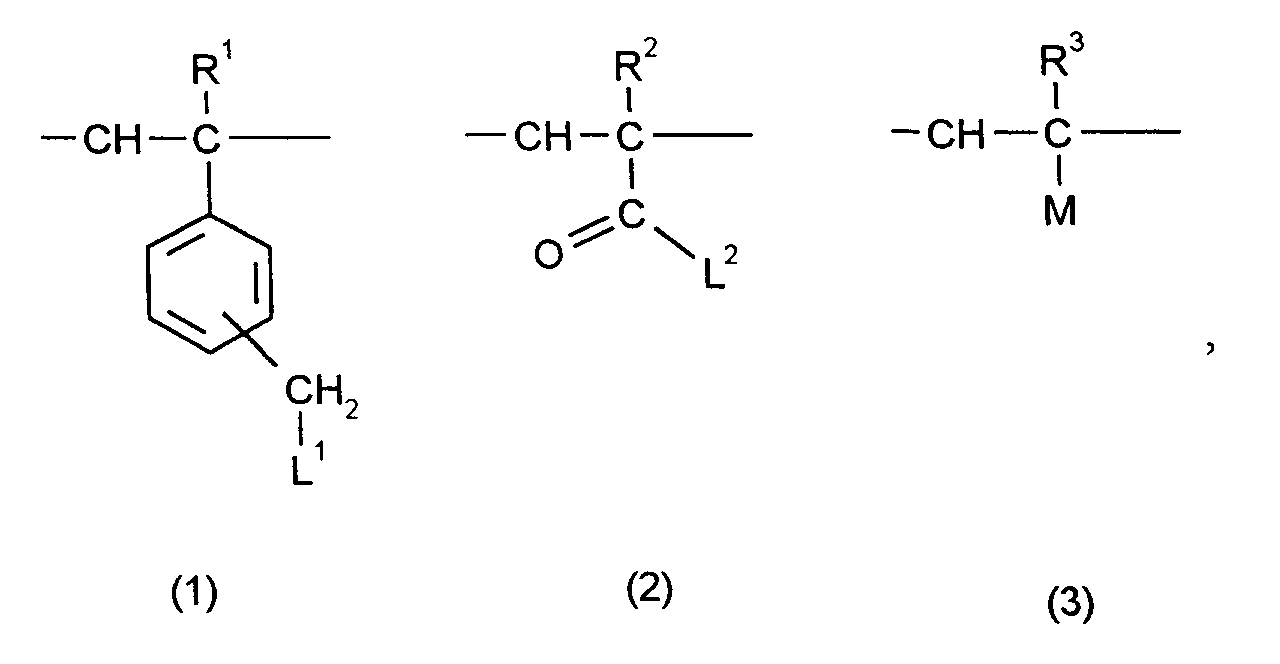
- Die vorliegende Erfindung betrifft (Co)Polymerisate, die mindestens einen wiederkehrenden Kettenbaustein der allgemeinen Formel (1) oder (2) enthalten und gegebenenfalls wiederkehrende Einheiten der allgemeinen Formel (3) enthalten

- R1, R2 und R3
- unabhängig voneinander Wasserstoff oder C1-C6-Alkyl bedeuten,
- M
- für CN oder C1-C30-Alkoxycarbonyl, C1-C30-(Di)Alkylaminocarbonyl, C1-C30-Alkylcarbonyl steht, die jeweils durch Hydroxy oder C1-C6-Alkoxycarbonyl substituiert sein können, weiterhin für Phenyl, Naphthyl, Anthracenyl, Pyridyl oder Carbazolyl steht, die jeweils durch Reste aus der Gruppe Halogen, Hydroxy, Silyl, C1-C30-Alkyl, C6-C18-Aryl, C1-C30-Alkoxy, C1-C30-Alkoxycarbonyl, C1-C30-Acyloxy und C1-C30-Alkylcarbonyl substituiert sein können,
- L1 und L2
- einen photolumineszierenden Rest bedeuten,
- In den obengenannten Formeln bedeuten R1, R2 und R3 unabhängig voneinander vorzugsweise Wasserstoff, Methyl oder Ethyl.
- M steht vorzugsweise für CN oder C1-C15-Alkoxycarbonyl, C1-C15-(Di)Alkyl-aminocarbonyl, C1-C15-Alkylcarbonyl, die jeweils durch Hydroxy oder Methoxycarbonyl, Ethoxycarbonyl, n- oder iso-Propoxycarbonyl substituiert sein können, weiterhin für Phenyl, Naphthyl, Anthracenyl, Pyridyl oder Carbazolyl, die jeweils durch Reste aus der Gruppe Chlor, Brom, Hydroxy, Silyl, C1-C6-Alkyl, C1-C6-Alkoxy, C1-C6-Alkoxycarbonyl, C1-C6-Acyloxy und C1-C6-Alkylcarbonyl, gegebenenfalls durch Methyl, Ethyl, n- oder iso-Propyl substituiertes Phenyl, substituiert sein können.
- L1 und L2 stehen unabhängig voneinander für einen photolumineszierenden Rest, der auf dem Gerüst eines Fluoreszenzfarbstoffs basiert, der ausgewählt ist aus der Gruppe der Cumarine der Formel (4)
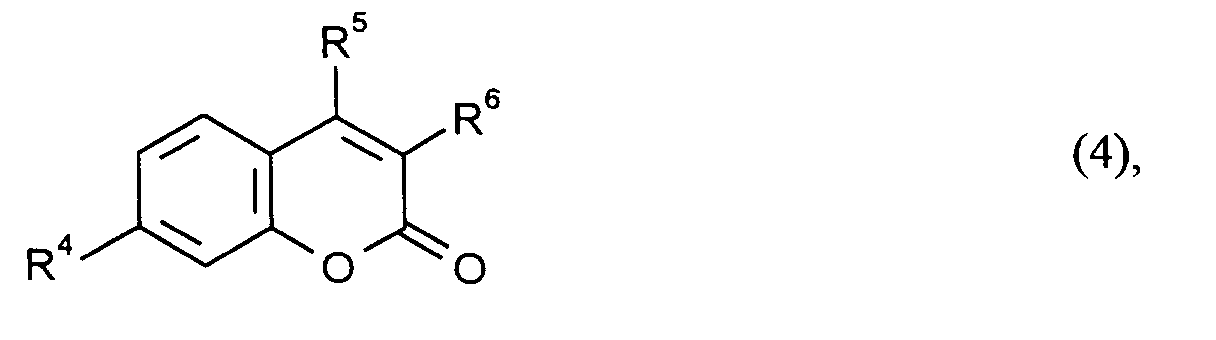


Benzopyrone der Formel (9)

Oxazole, 1,3,4-Oxadiazole der Formel (11)
Benzochinoline der Formel (12)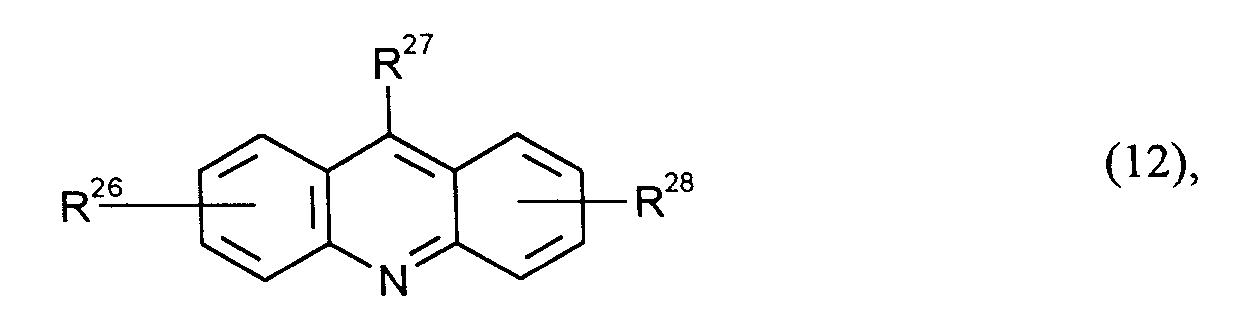
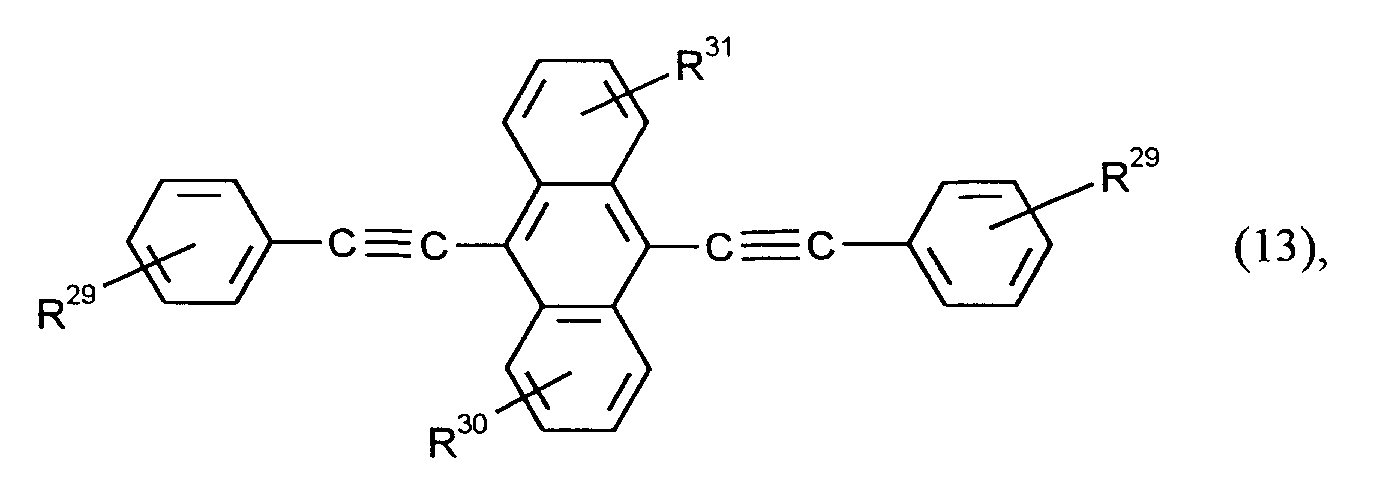

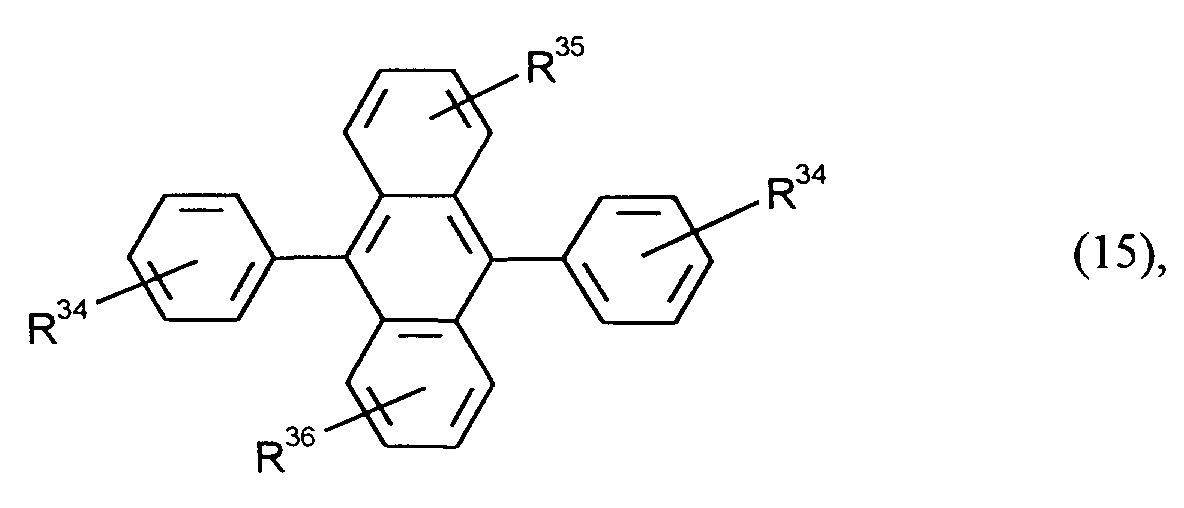

wobei - R4
- für Wasserstoff, C1-C30-Alkyl, C6-C18-Aryl, C7-C24-Aralkyl oder C1-C30-Alkoxy oder für

- R43 und R44
- unabhängig voneinander für Wasserstoff, C1-C30-Alkyl, C6-C18-Aryl, C7-C24-Aralkyl steht, die jeweils durch Hydroxy, Amino, Carboxy oder C1-C4-Alkoxycarbonyl substituiert sein können, oder
- R43 und R44
- gemeinsam mit dem Stickstoff-Atom, an das sie gebunden sind, einen Morpholin-, Piperidin-, Pyrrolidin- oder Piperazinring, der einen oder zwei Substituenten aus der Gruppe Methyl, Ethyl und Phenyl tragen kann, bedeuten können,
- R5
- für Wasserstoff, Cyano, C1-C30-Alkyl, C6-C18-Aryl, C7-C24-Aralkyl, C1-C30-Alkoxy, C2-C12-Acyl, C1-C12-Alkoxycarbonyl, C1-C12-(Di)Alkylaminocarbonyl steht,
- R6
- für Wasserstoff, Cyano, C1-C30-Alkyl, C6-C18-Aryl, C7-C24-Aralkyl, C1-C30-Alkoxy oder für

wobei Z für eine Gruppe OR45 oder
- R45, R46 und R47
- unabhängig voneinander für C1-C30-Alkyl, C6-C18-Aryl oder C7-C24-Aralkyl stehen, wobei die aromatischen Ringe zusätzlich noch durch Halogen, C1-C6-Alkyl, C1-C6-Alkoxy substituiert sein können,
- R7, R8 und R9
- unabhängig voneinander Wasserstoff, C1-C30-Alkyl, C6-C18-Aryl, C7-C24-Aralkyl, C1-C30-Alkoxy, Cyano, C2-C12-Acyl, C1-C12-Alkoxycarbonyl, C1-C12-(Di)Alkylaminocarbonyl oder eine Aminogruppe mit einer oder zwei C1-C6-Alkylgruppen bedeuten,
- R10
- Wasserstoff, Cyano, C1-C30-Alkyl, C6-C18-Aryl, C7-C24-Aralkyl, C1-C30-Alkoxy, Amino, C2-C12-Acyl, C1-C12-Alkoxycarbonyl, C1-C12-(Di)-Alkylaminocarbonyl bedeutet,
- R11
- für Wasserstoff, Halogen, Nitro, C1-C4-Alkoxycarbonyl, C1-C4-Acyl, C8-C24-Aralkenyl, unsubstituiertes Amino oder für ein- oder zweifach, gleich oder verschieden durch C1-C30-Alkyl, C6-C18-Aryl oder C7-C24-Aralkyl substituiertes Amino steht,
- R11
- weiterhin für Morpholinyl, Piperidinyl, Pyrrolidinyl oder Piperazinyl steht, die einen oder zwei Substituenten ausgewählt aus Methyl, Ethyl und/oder Phenyl tragen können,
- R12
- für Wasserstoff, C1-C30-Alkyl, C6-C18-Aryl, C7-C24-Aralkyl oder C1-C30-Alkoxy steht,
- R13
- für Wasserstoff, C1-C30-Alkyl, C6-C18-Aryl, C7-C24-Aralkyl, C1-C30-Alkoxy oder

- R49 und R50
- unabhängig voneinander für C1-C30-Alkyl, C6-C18-Aryl, C7-C24-Aralkyl stehen oder
- R49 und R50
- weiterhin gemeinsam mit dem Stickstoffatom, an das sie gebunden sind, für Morpholinyl, Piperidinyl, Pyrrolidinyl oder Piperazinyl stehen, die einen oder zwei gleich oder verschiedene Substituenten ausgewählt aus Methyl, Ethyl und Phenyl tragen können,
- R14 und R15
- unabhängig voneinander Wasserstoff, Cyano, Halogen, Nitro, C1-C30-Alkyl, C1-C30-Alkoxy, C6-C18-Aryl oder C7-C24-Aralkyl, C1-C12-Alkoxycarbonyl, C2-C12-Acyl, C1-C12-(Di)Alkylaminocarbonyl, C1-C6-(Di)Alkylamino bedeuten,
- R17 und R23
- unabhängig voneinander Wasserstoff, C1-C30-Alkyl, C6-C18-Aryl oder C7-C24-Aralkyl bedeuten und
- R16, R18 bis R22 und R24 bis R40
- unabhängig voneinander Wasserstoff, Cyano, C1-C30-Alkyl, C6-C18-Aryl, C7-C24-Aralkyl, C1-C30-Alkoxy, eine Aminogruppe mit einer oder zwei C1-C6-Alkylgruppen, unsubstituiertes Amino, C2-C12-Acyl, C1-C12-Alkoxycarbonyl oder C1-C12-(Di)Alkylaminocarbonyl bedeuten, wobei die aliphatischen Kohlenstoffketten, wie z.B. Alkyl, Alkoxy, Alkylamino, Aralkyl, in den Resten von R4 bis R13, R16 bis R40 durch eines oder mehrere, vorzugsweise ein oder zwei Heteroatome ausgewählt aus Sauerstoff, Stickstoff und Schwefel und/oder durch einen oder mehrere, vorzugsweise ein oder zwei Phenylenringe, die durch C1-C4-Alkyl und/oder Halogen substituiert sein können, unterbrochen sein können,
- In den o.g. Resten R4 bis R40 trägt pro Fluoreszenzfarbstoff mindestens eine aliphatische, aromatische oder heterocyclische Kohlenstoffkette wenigstens eine Hydroxy-, Carboxy- oder gegebenenfalls eine Amino-Gruppe, vorzugsweise Hydroxy, über die die kovalente Bindung an das Monomere hergestellt wird durch Reaktion dieser Gruppen mit einer am Monomer befindlichen reaktiven Gruppe (z.B. Halogen), vgl. Herstellungsverfahren. Im Falle des Monomers (1) ist diese Anknüpfungsstelle die Methylengruppe am Phenylring (es reagiert -CH2-Cl). Im Falle des Monomers (2) ist die Anknüpfungsstelle die Carbonylgruppe (über -CO-Cl).
- M steht insbesondere für Phenyl, Naphthyl, Anthracenyl, Pyridyl oder Carbazolyl, die jeweils durch Hydroxy, Silyl, C1-C4-Alkyl, gegebenenfalls durch Methyl, Ethyl, n- oder iso-Propyl substituiertes Phenyl, durch C1-C4-Alkoxy, C1-C6-Alkoxycarbonyl, C1-C6-Acyloxy oder C1-C6-Alkylcarbonyl substituiert sein können.
- L1 und L2 stehen unabhängig voneinander insbesondere für einen Fluoreszenzfarbstoffrest ausgewählt aus der Gruppe der Cumarine der Formel (4), Pyrene der Formel (5), 1,8-Naphthalimide der Formel (6), 1,8-Naphthaloylen-1',2'-benzimidazole der Formel (7), Phenothiazine oder Phenoxazine der Formel (8), Carbazole und Fluorene der Formel (10).
- R4
- steht vorzugsweise für C1-C6-Alkyl, C6-C10-Aryl oder C1-C6-Alkoxy oder für

- R43 und R44
- vorzugsweise unabhängig voneinander für C1-C6-Alkyl, C6-C10-Aryl steht, die jeweils durch Hydroxy, Amino substituiert sein können, oder
- R43 und R44
- gemeinsam mit dem Stickstoff-Atom, an das sie gebunden sind, einen Morpholin-, Piperidin-, Pyrrolidin- oder Piperazinring, der einen oder zwei Substituenten aus der Gruppe Methyl, Ethyl und Phenyl tragen kann, bedeuten können.
- R5
- steht vorzugsweise für Wasserstoff oder Cyano,
- R6
- steht vorzugsweise für Wasserstoff, C1-C6-Alkyl, C6-C10-Aryl oder C1-C6-Alkoxy oder für


- R45, R46 und R47
- unabhängig voneinander vorzugsweise für C1-C6-Alkyl oder C6-C10-Aryl, insbesondere Phenyl und Naphthyl, stehen,
- R7, R8 und R9
- stehen vorzugsweise unabhängig voneinander für Wasserstoff, C1-C6-Alkyl, C6-C10-Aryl, C1-C6-Alkoxy oder Cyano,
- R10
- steht vorzugsweise für Wasserstoff, Cyano, C1-C6-Alkyl, C6-C10-Aryl, insbesondere Phenyl oder Naphthyl, C2C4-Acyl oder C1-C6-Alkoxycarbonyl,
- R11
- steht vorzugsweise für Wasserstoff, Halogen, Nitro, C1-C4-Alkoxycarbonyl, C1-C4-Acyl, C8-C24-Aralkenyl, für ein- oder zweifach, gleich oder verschieden durch C1-C6-Alkyl, C6-C10-Aryl, insbesondere Phenyl oder Naphthyl substituiertes Amino,
- R11
- steht weiterhin für Morpholinyl, Piperidinyl, Pyrrolidinyl oder Piperazinyl steht, die einen oder zwei Substituenten ausgewählt aus Methyl, Ethyl und/oder Phenyl tragen können,
- R12
- steht vorzugsweise für C1-C6-Alkyl, C6-C10-Aryl, insbesondere Phenyl oder Naphthyl, oder C7-C12-Aralkyl.
- R13
- steht vorzugsweise für Wasserstoff, C1-C6-Alkyl, C6-C10-Aryl, insbesondere Phenyl oder Naphthyl, oder C1-C6-Alkoxy oder

- R49 und R50
- unabhängig voneinander vorzugsweise für C1-C6-Alkyl, C6-C10-Aryl, insbesondere Phenyl oder Naphthyl stehen, oder
- R49 und R50
- weiterhin gemeinsam mit dem Stickstoffatom, an das sie gebunden sind, für Morpholinyl, Piperidinyl, Pyrrolidinyl oder Piperazinyl stehen, die einen oder zwei gleich oder verschiedene Substituenten ausgewählt aus Methyl, Ethyl und Phenyl tragen können.
- R14 und R15
- stehen vorzugsweise unabhängig voneinander Wasserstoff, Cyano, Halogen, Nitro, C1-C6-Alkyl, C1-C6-Alkoxy, C6-C10-Aryl, insbesondere Phenyl oder Naphthyl,
- R17 und R23
- stehen vorzugsweise unabhängig voneinander für Wasserstoff, C1-C6-Alkyl, C6-C10-Aryl.
- R16, R18 bis R22 und R24 bis R40
- stehen vorzugsweise unabhängig voneinander für Wasserstoff, Cyano, C1-C6-Alkyl, C6-C10-Aryl, C1-C6-Alkoxy, eine Aminogruppe mit einer oder zwei C1-C6-Alkylgruppen, unsubstituiertes Amino,
- Als Alkylrest beispielsweise in Alkyl, Alkoxy, Alkoxycarbonyl oder (Di)Alkylamino wird beispielhaft Methyl, Ethyl, n- oder iso-Propyl, n-, iso- oder tert.-Butyl genannt. Aryl steht insbesondere für Phenyl und Naphthyl. Aralkyl steht insbesondere für Phenyl-C1-C4-Alkyl, z.B. Phenylmethyl, Phenylethyl oder Naphthyl-C1-C4-alkyl, z.B. Naphthylmethyl, Naphthylethyl.
- Die vorliegende Erfindung betrifft weiterhin ein Verfahren zur Herstellung von obengenannten (Co)Polymerisaten, die mindestens einen wiederkehrenden Kettenbaustein der allgemeinen Formel (1) oder (2) und gegebenenfalls wiederkehrende Einheiten der allgemeinen Formel (3) enthalten,

wobei man die entsprechenden Monomere der Formel (20) oder (21)
- farbstoff, welcher die Struktur von L enthält, und einem Styrol- oder Acrylsäurederivat der Formel (22) und (23)

- R1 und R2
- den obengenannten Bedeutungsumfang haben und
- R41
- für ein Halogenatom, vorzugsweise Cl oder Br steht,
- R42
- für ein Halogenatom, vorzugsweise Cl oder Br, eine Hydroxy- oder C1-C6-Alkoxygruppe, steht,
- Die Umsetzung der mit OH-, Carboxy- oder NH-Gruppe funktionalisierten Fluoreszenz-Farbstoffen erfolgt im allgemeinen bei Temperaturen von -30°C bis 100°C, vorzugsweise 0°C bis 60°C.
- Die Polymerisationsverfahren sind in der Literatur beschrieben. Sie können ionisch oder radikalisch erfolgen. Eine anionische Polymerisation kann z.B. durch Starter wie Butyllithium oder Lithiumnaphthalid ausgelöst werden. Eine radikalische Polymerisation kann z.B. durch Radikalstarter wie z.B. Azoinitiatoren oder Peroxide, vorzugsweise AIBN (Azoisobuttersäuredinitril) oder Dibenzoylperoxid, ausgelöst werden. Die Herstellung der Polymere kann in Substanz oder in geeigneten Lösungsmitteln wie Benzol, Toluol, Tetrahydrofuran, Dioxan, Ethylacetat, Xylol, Chlorbenzol, 1-Methoxy-2-propylacetat, chlorierte Kohlenwasserstoffe, Aceton, etc., bei Temperaturen von 20-250°C erfolgen.
- Die Herstellung der erfindungsgemäßen (Co)Polymerisate wird beispielsweise durch das folgende Formelschema dargestellt:
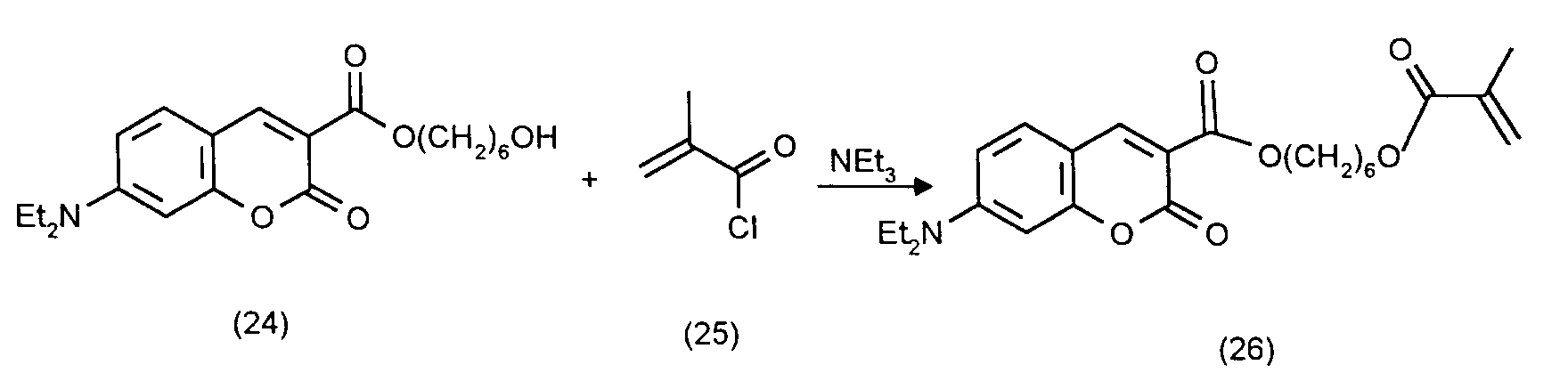

Weiterhin kann die Herstellung der erfindungsgemäßen Polymerisate oder Copolymerisate beispielsweise durch das folgende Formelschema dargestellt werden: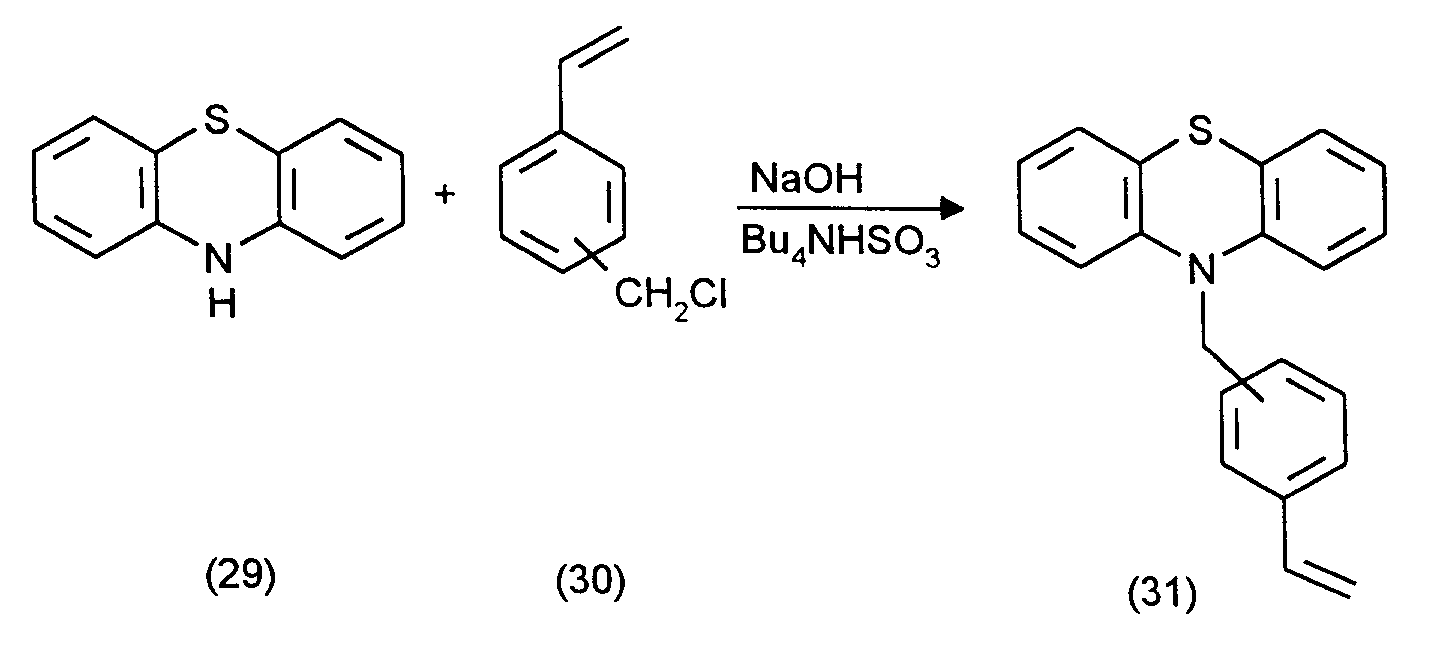

- Weiterhin kann die Herstellung der erfindungsgemäßen Polymerisate oder Copolymerisate beispielsweise durch das folgende Formelschema dargestellt werden:


- Weiterhin kann die Herstellung der erfindungsgemäßen Polymerisate oder Copolymerisate beispielsweise durch das folgende Formelschema dargestellt werden:

- Das Styrolderivat (39) läßt sich auch mit einem Comonomer wie z.B. N-Vinylcarbazol, Styrol, n-Butylacrylat, etc. copolymerisieren.
- (Co)Polymerisate der vorliegenden Erfindung weisen Molekulargewichte im Bereich von 500 bis 1 Million g/Mol, vorzugsweise von 800 bis 500 000 g/Mol - bestimmt durch Gelpermeationschromatographie - auf.
- Die zur Herstellung von erfindungsgemäßen (Co)Polymerisaten benötigten mit OH, SH oder NH funktionalisierten Fluoreszenz-Farbstoffe (vgl. Definition des Restes L) sind teilweise bekannt.
- Die Cumarinderivate der folgenden Formel (4a) sind neu:

- R43 und R44
- unabhängig voneinander für Wasserstoff C1-C30-Alkyl, C6-C18-Aryl, C7-C24-Aralkyl steht, die jeweils durch Hydroxy, Amino, Carboxy oder C1-C4-Alkoxycarbonyl substituiert sein können, oder
- R43 und R44
- gemeinsam mit dem Stickstoff-Atom, an das sie gebunden sind, einen Morpholin-, Piperidin-, Pyrolidin- oder Piperazinring, der einen oder zwei Substituenten aus der Gruppe Methyl, Ethyl und Phenyl tragen kann, bedeuten können, und
- Z
- eine Gruppe OR45 oder

- R45
- C1-C30-Alkyl, C6-C18-Aryl oder C7-C24-Aralkyl bedeutet, die jeweils durch mindestens eine Hydroxygruppe substituiert sind, und wobei die aromatischen Ringe zusätzlich noch durch Halogen, C1-C6-Alkyl, C1-C6-Alkoxy substituiert sein können und
- R46 und R47
- unabhängig voneinander für jeweils gegebenenfalls durch Hydroxy substituiertes C1-C30-Alkyl, C6-C18-Alyl oder C7-C24-Aralkyl stehen, wobei mindestens einer der Reste R46 oder R47 über eine Hydroxygruppe verfügt und wobei die aromatischen Ringe zusätzlich noch durch Halogen, C1-C6-Alkyl, C1-C6-Alkoxy substituiert sein können.
- Die erfindungsgemäßen Cumarin-Derivate der Formel (4a) tragen mindestens eine Hydroxygruppe über die sie an Polymerseitenketten chemisch gebunden werden können.
- In Formel (4a) stehen R43 und R44 unabhängig voneinander vorzugsweise für Wasserstoff oder gegebenenfalls durch Hydroxy, Amino, Carboxy und/oder C1-C4-Alkoxycarbonyl substituiertes C1-C16-Alkyl, jeweils unsubstituiertes oder durch C1-C4-Alkyl, Hydroxy, Amino, Carboxy, C1-C4-Alkoxycarbonyl, Chlor und/oder Brom substituiertes Phenyl, Naphthyl, Phenyl-C1-C4-alkyl oder Naphthyl-C1-C4-alkyl.
- R43 und R44
- stehen insbesondere für gegebenenfalls durch Hydroxy, Amino oder Carboxy substituiertes C1-C6-Alkyl oder Phenyl,
- Z
- steht in der oben genannten Formel (4a) für OR45 oder NR46R47, wobei R45 vorzugsweise für C1-C16-Alkyl, Phenyl, Naphthyl, Phenyl-C1-C4-alkyl oder Naphthyl-C1-C4-alkyl steht, die jeweils durch mindestens eine Hydroxygruppe substituiert sind, und wobei die aromatischen Ringe zusätzlich noch durch Halogen, C1-C6-Alkyl, C1-C6-Alkoxy substituiert sein können,
- R46 und R47
- stehen unabhängig voneinander vorzugsweise für jeweils gegebenenfalls durch Hydroxy substituiertes C1-C16-Alkyl, Phenyl, Naphthyl, Phenyl-C1-C4-alkyl oder Naphthyl-C1-C4-alkyl steht, wobei mindestens einer der Reste R46 oder R47 über eine Hydroxygruppe verfügt und die aromatischen Ringe zusätzlich noch durch Halogen, C1-C6-Alkyl, C1-C6-Alkoxy substituiert sein können.
- R45
- steht besonders bevorzugt für durch eine Hydroxygruppe substituiertes C1-C12-Alkyl.
- R46 und R47
- stehen unabhängig voneinander besonders bevorzugt für gegebenenfalls durch eine Hydroxygruppe substituiertes C1-C12-Alkyl, wobei mindestens einer der Reste R4 und R5 über eine Hydroxygruppe verfügt.
- Die neuen Cumarinderivaten der Formel (4a),

- a) im Falle, daß Z für -OR45 steht, vorzugsweise in einem Eintopfverfahren, aus der Meldrum's-Säure der Formel (I)

R45-OH (II)
gegebenenfalls in Gegenwart eines Verdünnungsmittels wie beispielsweise Toluol, Xylol oder Mesitylen unter Katalyse von beispielsweise p-Toluolsulfonsäure bei Temperaturen im Bereich von 20 bis 250°C, vorzugsweise 80 bis 150°C, das Malonsäure-Derivat der Formel (III) herstellt,

gegebenenfalls in Gegenwart eines Verdünnungsmittels wie beispielsweise Toluol, Xylol oder Mesitylen unter Katalyse von beispielsweise Piperidinacetat bei Temperaturen von 50 bis 250°C, vorzugsweise 80 bis 140°C umsetzt, und - b) im Falle, daß Z für


- R43, R44, R46 und R47
- die oben genannte Bedeutung haben und
- R48
- für C1-C6-Alkyl steht,
- Bei der Durchführung des erfindungsgemäßen Verfahrens a) setzt man im allgemeinen auf 1 Mol Meldrum's Säure der Formel (I) 2-10 Mol, vorzugsweise 3-6 Mol Alkohol der Formel (II) und pro Mol Malonsäure-Derivat der Formel (III) setzt man im allgemeinen 0,5-1,0, vorzugsweise 0,9-1,0 Mol Salicylaldehyd der Formel (IV) ein.
- Bei der Durchführung des erfindungsgemäßen Verfahrens b) setzt man pro Mol Salicylaldehyd der Formel (IV) im allgemeinen 2-20, vorzugsweise 5-10 Mol sekundäres Amin und 1-2, vorzugsweise 1,2-1,5 Mol Malonsäure-Derivat der Formel (VI) ein.
- Die Herstellung der erfindungsgemäßen Curmarinderivate der Formel (4a) für Z = OR45 im Sinne einer Knoevenagel-Kondensation und anschließender Cyclisierung wird beispielhaft durch das folgende Formelschema dargestellt:

- Die Herstellung der erfindungsgemäßen Cumarinderivate der Formel (4a) für Z = NR46R47 wird beispielhaft durch das folgende Formelschema dargestellt:

- Die Ausgangsprodukte der Formeln (I), (II), (III), (IV), (V) und (VI) sind allgemein bekannte Verbindungen der organischen Chemie.
- Die folgenden 1,8-Naphthalimid-Derivate der Formel (6a), (7a-1) und (7b-1) sind ebenfalls neu:
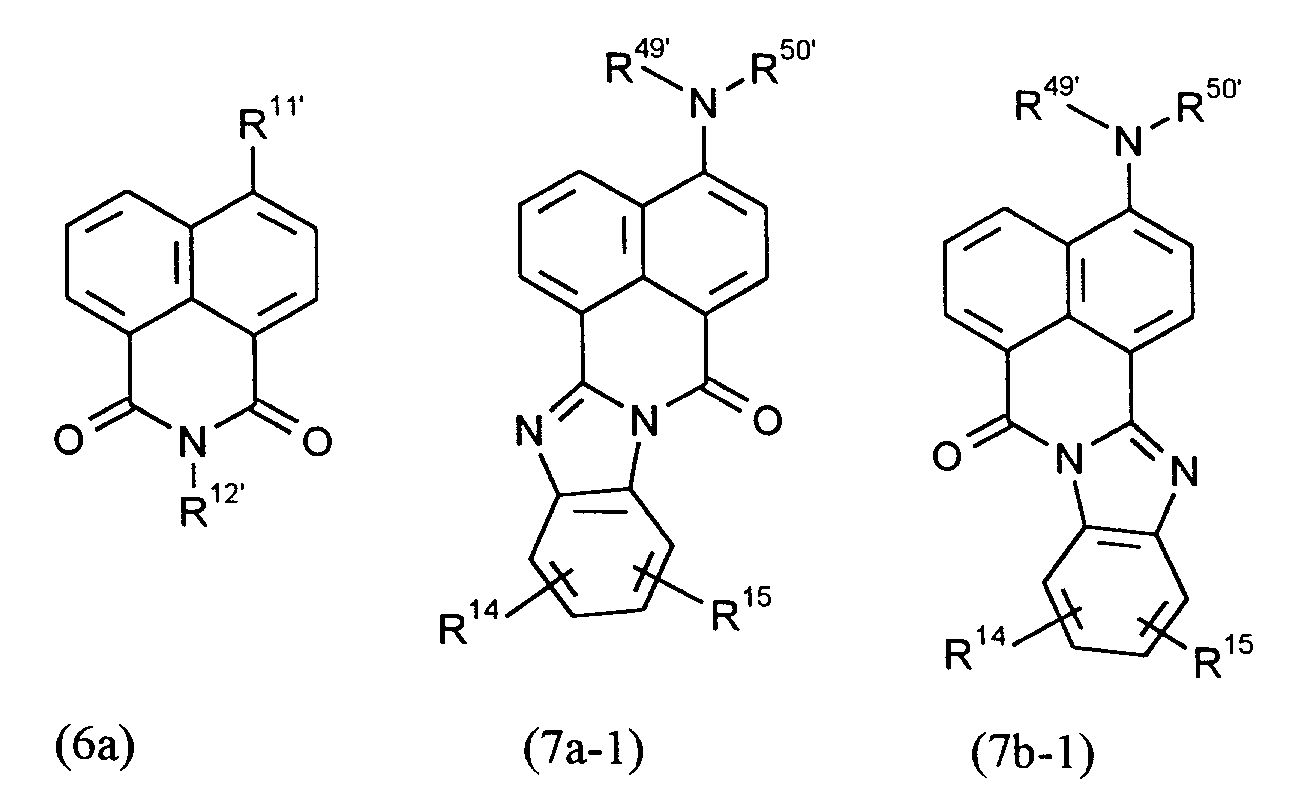
- R11'
- für Wasserstoff, Halogen, Nitro, C1-C4-Alkoxycarbonyl, C1-C4-Acyl, C8-C24-Aralkenyl, unsubstituiertes Amino oder für ein- oder zweifach, gleich oder verschieden durch C1-C30-Alkyl, C6-C18-Aryl, C7-C24-Aralkyl substituiertes Amino steht, wobei die oben genannten Kohlenstoffketten selbst durch Hydroxy und/oder Carboxy substituiert sein können,
- R11'
- weiterhin für Morpholinyl, Piperidinyl, Pyrrolidinyl oder Piperazinyl steht, die einen oder zwei Substituenten ausgewählt aus Methyl, Ethyl und/oder Phenyl tragen können,
- R12'
- für Wasserstoff oder C1-C30-Alkyl, C1-C30-Alkoxy, C6-C18-Aryl, C7-C24-Aralkyl steht, welche ein- oder mehrfach durch Hydroxy und/oder Carboxy substituiert sein können,
und mindestens einer der Reste R11' oder R12' über eine Hydroxy- oder Carboxygruppe verfügt, - R49' und R50'
- unabhängig voneinander für C1-C30-Alkyl, C6-C18-Aryl, C7-C24-Aralkyl stehen, die durch Hydroxy substituiert sein können, wobei mindestens einer der Reste R49' oder R50' über eine Hydroxy- oder Carboxygruppe verfügt.
- R49' und R50'
- weiterhin gemeinsam mit dem Stickstoffatom, an das sie gebunden sind, für Morpholinyl, Piperidyl, Pyrolidyl oder Piperazinyl stehen, die einen oder zwei gleich oder verschiedene Substituenten ausgewählt aus Methyl, Ethyl und Phenyl tragen können und über mindestens eine Hydroxy- oder Carboxygruppe verfügen,
- R14 und R15
- unabhängig voneinander Wasserstoff, Halogen, Cyano, Nitro, C1-C30-Alkyl, C1-C30-Alkoxy, C6-C18-Aryl, C7-C24-Aralkyl, C1-C12-Alkoxycarbonyl, C2-C12-Acyl oder C1-C6-(Di)-Alkylamino bedeuten,
- In der oben genannten Formel (6a) steht
- R11'
- vorzugsweise für Wasserstoff, Chlor, Brom, Nitro, Methoxycarbonyl, Ethoxycarbonyl, n- oder iso-Propoxycarbonyl, Methylcarbonyl, Ethylcarbonyl, n- oder iso-Propylcarbonyl, Amino, für Amino, welches ein- oder zweifach, gleich oder verschieden durch C1-C15-Alkyl, jeweils gegebenenfalls durch Methyl und/oder Ethyl substituiertes Phenyl, Naphthyl, Phenyl-C1-C4-alkyl oder Naphthenyl-C1-C4-alkyl substituiert ist, wobei die oben genannten Kohlenstoffketten selbst durch Hydroxy substituiert sein können, R11' weiterhin vorzugsweise für Morpholinyl, Piperidinyl, Pyrrolidinyl oder Piperazinyl steht, die einen oder zwei Substituenten ausgewählt aus Hydroxy, Methyl, Ethyl und/oder Phenyl tragen können.
- R12'
- steht vorzugsweise für C1-C15-Alkyl, Phenyl oder Phenyl-C1-C6-alkyl, welche durch Hydroxy und die aromatischen Ringen zusätzlich noch durch Halogen, C1-C6-Alkyl und/oder C1-C6-Alkoxy substituiert sein können.
- R11'
- steht insbesondere für Chlor, Brom, Amino, welches ein- oder zweifach, gleich oder verschieden durch C1-C15-Alkyl substituiert ist, Morpholinyl, Piperidinyl, Pyrrolidinyl oder Piperazinyl, wobei die oben genannten Kohlenstoffketten selbst durch Hydroxy substituiert sein können.
- R12'
- steht insbesondere für C1-C12-Alkyl, gegebenenfalls durch Halogen, C1-C6-Alkyl, C1-C6-Alkoxy substituiertes Phenyl, die eine Hydroxygruppe tragen können.
- Mindestens einer der Reste R11' und R12' muß über eine Hydroxygruppe verfügen.
- R49' und R50'
- in den Formeln (7a-1) und (7b-1) stehen vorzugsweise unabhängig voneinander für C1-C15-Alkyl, Phenyl, Phenyl-C1-C6-alkyl, Naphthyl, Naphthyl-C1-C6-alkyl, die einfach oder mehrfach, insbesondere einfach durch Hydroxy substituiert sein können, wobei mindestens einer der Reste R49' oder R50' über eine Hydroxygruppe verfügt.
- R49' und R50'
- stehen weiterhin gemeinsam mit dem Stickstoffatom, an das sie gebunden sind, vorzugsweise für Piperidinyl oder Piperazinyl, die einen oder zwei gleich oder verschiedene Substituenten ausgewählt aus Methyl, Ethyl und Phenyl tragen können und über mindestens eine Hydroxy- oder Carboxygruppe verfügen,
- R14 und R15
- in den Formeln (7a-1) und (7b-1) stehen vorzugsweise unabhängig voneinander für Wasserstoff, Halogen, C1-C15-Alkyl, C1-C15-Alkoxy, C1-C4-Alkoxycarbonyl, C1-C4-Acyl- oder Di(C1-C6-Alkyl)amino, jeweils durch Methyl und/oder Ethyl substituiertes Phenyl, Phenyl-C1-C6-alkyl, Naphthyl oder Naphthyl-C1-C6-alkyl.
- R49' und R50'
- stehen insbesondere für C1-C12-Alkyl, Phenyl, Phenyl-C1-C6-alkyl, die durch eine Hydroxygruppe substituiert sein können, wobei mindestens einer der Reste R49' oder R50' über eine Hydroxygruppe verfügt.
- R14 und R15
- stehen insbesondere für Wasserstoff, Halogen, C1-C12-Alkyl, C1-C12-Alkoxy, Di(C1-C6-alkyl)amino, Phenyl.
- Die Zahl der Hydroxygruppen und/oder Carboxygruppen beträgt mindestens eine, es können jedoch auch bis zu vier Hydroxy- und/oder Carboxygruppen sein.
- Die aromatischen Ringe in den oben genannten Resten können einfach bis fünffach, vorzugsweise einfach bis dreifach, gleich oder verschieden durch die genannten Substituenten substituiert sein.
- Die aliphatischen Kohlenstoffketten, wie z.B. Alkyl, Alkoxy, Alkylamino, Aralkyl, in R43, R44, R45, R46 und R47, R11', R12', R45', R50' können durch eines oder mehrere, vorzugsweise ein oder zwei Heteroatome ausgewählt aus Sauerstoff, Stickstoff und Schwefel und/oder durch ein oder mehrere, vorzugsweise ein oder zwei Phenylenringe, die durch C1-C4-Alkyl und/oder Halogen substituiert sein können, unterbrochen sein.
- Ein Verfahren zur Herstellung von neuen 1,8-Naphthalimid-Derivaten der Formel (6a)

- R11' und R12'
- die obengenannte Bedeutung haben,
- a) ein 1,8-Naphthalsäureanhydrid der Formel (VII) und ein primäres Amin der Formel (VIII),

- b) im Falle, daß R11' in Formel (6a) unsubstituiertes, ein- oder zweifach substituiertes Amino oder cyclisches Amino bedeutet, ein 1,8-Naphthalimid der Formel (6a-1)

- R11''
- für Halogen, vorzugsweise Chlor, Brom oder Iod, oder Nitro steht,

- Ein Verfahren zur Herstellung von neuen 1,8-Naphthalimid-Derivaten der Formel (7a-1) und (7b-1) (Verfahren C),

- R14, R15, R49' und R50'
- die obengenannte Bedeutung haben,
- R14, R15 und R11''
- den obigen Bedeutungsumfang haben,
- Bei der Durchführung des erfindungsgemäßen Verfahrens a) zur Herstellung der 1,8-Naphthalimid-Derivate der Formel (6a) setzt man im allgemeinen pro Mol Verbindung der Formel (VII) 1 bis 1,8 Mol, vorzugsweise 1,2 bis 1,4 Mol primäres Amin der Formel (VIII) ein.
- Bei der Durchführung des erfindungsgemäßen Verfahrens b) zur Herstellung der 1,8-Naphthalimid-Derivate der Formel (6a-1) setzt man im allgemeinen pro Mol Verbindung der Formel (VIIa) 1 bis 1,8 Mol, vorzugsweise 1,2 bis 1,4 Mol des primären Amins der Formel (VIII) und pro Mol Verbindung der Formel (6a-1) 1,2 bis 5 Mol, vorzugsweise 2 bis 2,5 Mol des entsprechenden primären, sekundären oder cyclischen Amins.
- Die Herstellung der erfindungsgemäßen 1,8-Naphthalimid-Derivate der Formel (6a), Verfahren (a) und (b) wird beispielhalft durch das folgende Formelschema dargestellt:

- Bei der Durchführung des erfindungsgemäßen Verfahrens C) zur Herstellung der 1,8-Naphthalimid-Derivate der Formel (7a-1) und (7b-1) setzt man im allgemeinen pro Mol Verbindung der Formel (VIIa) 1 bis 1,8 Mol, vorzugsweise 1,2 bis 1,4 Mol des o-Phenylendiamins der Formel (X) und pro Mol Verbindung (IXa-b) 1,2 bis 5 Mol, vorzugsweise 2 bis 2,5 Mol des sekundären Amins der Formel (XI) ein.
- Die Herstellung der erfindungsgemäßen 1,8-Naphthalimid-Derivate der Formel (7a-1 und 7b-1) wird beispielhaft durch das folgende Formelschema dargestellt:

- Die Ausgangsprodukte der Formeln (VII), (VIII), (VIIa), (X) und (XI) zur Herstellung der erfindungsgemäßen Verbindungen (7 a-1 und 7 b-1) sind allgemein bekannte Verbindungen der organischen Chemie.
- Die zur Herstellung von erfindungsgemäßen (Co)Polymerisaten weiterhin benötigten Styrol- und Acrylsäure-Derivate der Formeln (22) und (23) sind allgemein bekannte Verbindungen.
- Die erfindungsgemäßen (Co)Polymerisate zeichnen sich durch ihre lumineszierenden Eigenschaften und Filmbildungsvermögen aus und lassen sich durch Gießen, Rakeln oder Spin-coating auf geeignete Unterlagen aufbringen. Die Produkte zeigen sowohl in Lösungen als auch als Filme Photolumineszenz bei Bestrahlung. Die (Co)Polymerisate der vorliegenden Erfindung sind zum Aufbau von elektrolumineszierenden Anzeigen geeignet.
- Die Erfindung betrifft daher die Verwendung der oben beschriebenen (Co)Polymerisate in der lumineszierenden Schicht einer elektrolumineszierenden Anordnung, die dadurch gekennzeichnet ist,
daß sich eine elektrolumineszierende Schicht zwischen zwei Elektroden befindet,
daß mindestens eine der beiden Elektroden im sichtbaren Spektralbereich transparent ist,
daß beim Anlegen einer Gleichspannung im Bereich von 0,1 bis 100 Volt Licht im Frequenzbereich von 200 bis 2000 nm emittiert wird,
daß zwischen der elektrolumineszierenden Schicht und den Elektroden zusätzlich eine oder mehrere Zwischenschichten angeordnet sein können. - Diese Zwischenschichten sind aus der Literatur bekannt (vergl. Appl. Phys. Lett., 57, 531 (1990)) und werden dort als HTL (hole transport layer) und als ETL (electron transport layer) bezeichnet. Der Zweck solcher Zwischenschichten liegt u.a. in der Erhöhung der Elektrolumineszenzintensität.
- Die erfindungsgemäßen elektrolumineszierenden Polymere können auch als eine Mischung miteinander oder mit mindestens einem weiteren Material in der elektrolumineszierenden Schicht eingesetzt werden. Bei diesem weiteren Material kann es sich um inerte Binder, ladungsträgertransportierende Substanzen wie in EP-A 532 798 oder EP-A 564 224 beschrieben, oder Mischungen aus inerten Bindern und ladungsträgertransportierenden Substanzen handeln.
- Die Mischungen aus den erfindungsgemäßen Polymeren und einem weiteren Material zeichnen sich u.a. dadurch aus, daß sie filmbildend sind und durch Gießen, Rakeln oder Spin-coating großflächig auf geeignete Substrate aufgebracht werden können. Als Substrat sind transparente Träger wie Glas oder Kunststoff-Folien (z.B. Polyester, wie Polyethylenterephthalat oder Polyethylennaphthalat, Polycarbonat, Polysulfon, Polyimid-Folien) geeignet.
- Bei dem inerten Binder handelt es sich vorzugsweise um lösliche transparente Polymere wie z.B. Polycarbonate, Polystyrol, Polyvinylpyridin, Polymethylphenylsiloxan und Copolymere des Polystyrols wie SAN, Polysulfone, Polyacrylate, Polyvinylcarbazol, Vinylacetat- und Vinylalkoholpolymere und -copolymere.
-
- 1. Herstellung des 3-(6-Hydroxyhexoxycarbonyl)-7-diethylamino-cumarins, Formel (24) im Reaktionsschema
Eine Lösung von Bis-(6-hydroxyhexyl)-malonat in 1,6-Hexandiol wird beim Erhitzen einer Mischung aus 21,6 g (0,15 mol) Meldrum's-Säure, 59 g (0,50 mol), 1,6-Hexandiol und 0,28 g (1,5 mmol) p-Toluolsulfonsäuremonohydrat für 2 h bei 140°C dargestellt.
Anschließend versetzt man die resultierende Lösung mit 26,0 g (0,135 mol) 4-Diethylamino-salicylaldehyd, 0,7 ml Piperidin und 0,1 ml Essigsäure. Die Reaktionsmischung wird 3 h bei 110°C gerührt und nach Abkühlung mit 300 ml Wasser versetzt. Man extrahiert die Suspension mit Dichlormethan. Die organische Phase wird eingeengt und der Rückstand aus Toluol umkristallisiert.
Man erhält 40,2 g (83 % der Theorie) 3-(6-Hydroxyhexoxycarbonyl)-7-diethylamino-cumarin als gelbe Kristalle mit einem Schmelzpunkt von 85 bis 86°C. - 2. Herstellung des 3-(6-Methacryloxyhexoxycarbonyl)-7-diethylamino-cumarin, Formel (26) im Reaktionsschema
Zu einer Lösung von 16,3 g (0,045 Mol) 3-(6-Hydroxyhexoxycarbonyl)-7-diethylamino-cumarin (24) und 10,0 g (0,10 Mol) frisch destilliertem Triethylamin in 50 ml trockenem Tetrahydrofuran tropft man unter Rühren und Eiswasser-Kühlung 8,36 g (0,08 Mol) Methacryloylchlorid (25). Die Reaktionsmischung wird 5 h bei Raumtemperatur gerührt. Anschließend wird die Reaktionsmischung mit 200 ml Wasser und 200 ml Methylenchlorid behandelt. Nach der Phasentrennung wird die wäßrige Phase noch zweimal mit je 100 ml Methylenchlorid extrahiert. Die vereinigten organischen Auszüge werden neutral gewaschen und mit Natriumsulfat getrocknet. Nach Abdestillieren des Lösungsmittels im Vakuum wird der Rückstand durch eine kurze Kieselgelsäule mit Diethylether als Laufmittel adsorptiv filtriert. Nach Abdestillieren des Lösungsmittels erhält man 17,6 g (92 % der Theorie) blaßgelbes Öl. - 3. Herstellung des Copolymerisats gemäß Formel (28) im Reaktionsschema mit x = 13 Mol-%, y = 87 Mol-%
Eine Lösung von 5,0 g (0,012 Mol) 3-(6-Methacryloxyhexoxycarbonyl)-7-diethylamino-cumarin (26), 10,0 g (0,078 Mol) n-Butylacrylat (27) und 0,15 g (0,91 mMol) AIBN in 80 ml trockenem Chlorbenzol wird unter Vakuum entgast und anschließend unter Stickstoff bei 100°C 3 h gerührt. Die Polymerisationsmischung wird dann mit 0,15 g (0,91 mMol) AIBN in drei Portionen innerhalb 3 h nachgestartet. Die Lösung wird anschließend in 100 ml Methanol unter Rühren zugetropft und dann die Suspension abgesaugt. Das Rohprodukt wird noch zweimal aus Methylenchlorid/Methanol-Mischung gefällt. Ausbeute 12,7 g (85 % der Theorie). -
- 1. Herstellung vom N-(m/p-Vinylbenzyl)-phenothiazin, Formel (31)
Zu einer Mischung von 20 g (0,10 Mol) Phenothiazin (29), 18,4 g (0,12 Mol) m/p-Vinylbenzylchlorid (30) und 3,39 g (0,01 Mol) Tributylammoniumhydrogensulfit in 100 ml Isobutylmethylketon wird unter Rühren bei 0°C 100 ml 45 %ige Natronlauge zugefügt. Das Reaktionsgemisch wird bei Raumtemperatur 4 h kräftig gerührt und dann mit 100 ml Wasser und 150 ml Isobutylmethylketon verdünnt. Nach der Phasentrennung wird die organische Lösung neutral gewaschen und mit Natriumsulphat getrocknet. Anschließend wird die Lösung durch eine kurze Kieselgelsäule mit Diethylether als Laufmittel adsorptiv filtriert. Nach Entfernung des Lösungsmittels erhält man 30 g (95 % der Theorie) blaßgelbes Öl. - 2. Herstellung des Copolymerisats gemäß Formel (33), mit x = 28 Mol-%, y = 72 Mol-%
In Analogie zu dem im Beispiel 1 beschriebenen Verfahren läßt sich aus 5,0 g (0,016 Mol) N-(m/p-Vinylbenzyl)-phenothiazin (31), 5,0 g (0,042 Mol) m/p-Methylstyrol (32) und insgesamt 0,15 g (0,91 mMol) AIBN mit Toluol als Lösungsmittel 8,0 g (80 % der Theorie) des Copolymerisats (33) herstellen. -
- 1. 4/5-(N-Methyl-N-hydroxyethyl)amino-1,8-napthoylen-1',2'-benzimidazol
erhält man analog Beispiel 5, Punkt 1, aus 4/5-Chlor-1,8-naphthoylen-1',2'-benzimidazol in 82%-iger Ausbeute als rotbraune Kristalle vom Schmelzpunkt 168-169°C. - 2. Herstellung des 4/5-(N-Methyl-N-methacryloxyethyl)amino-1,8-naphthoylen-1',2'-benzimidazols, Formel (35)
In Analogie zu dem im Beispiel 1 beschriebenen Verfahren wird ausgehend von 5,83 g (0,017 Mol) 4/5-(N-Methyl-N-hydroxyethyl)amino-1,8-naphthoylen-1'2'-benzimidazol (34) und 3,24 g (0,031 Mol) Methacryloylchlorid (25) 6,3 g (90 % der Theorie) des Methacrylats (35) hergestellt. Bei der Aufarbeitung wird die Reaktionsmischung mit Wasser behandelt und die resultierte Suspension abgesaugt. Das Rohprodukt wird aus Toluol bei tiefer Temperatur umkristallisiert. - 3. Herstellung des Copolymerisats gemäß Formel (37), worin x = 55 Mol-%, y = 45 Mol-%
In Analogie zu dem im Beispiel 1 beschriebenen Verfahren läßt sich aus 4,0 g (9,7 mMol) 4/5-(N-Methyl-N-methacryloxyethyl)amino-1,8-naphthoylen-1'2'-benzimidazoles (35), 1,5 g (7,8 mMol) N-Vinylcarbazol (36) und insgesamt 50 mg (0,30 mMol) AIBN mit Chlorbenzol als Lösungsmittel 4,8 g (87 % der Theorie) des Copolymerisats (37) herstellen. -
- 1. N-Isoamyl-4-(N'-Methyl-N'-hydroxyethyl)amino-1,8-napthalamid
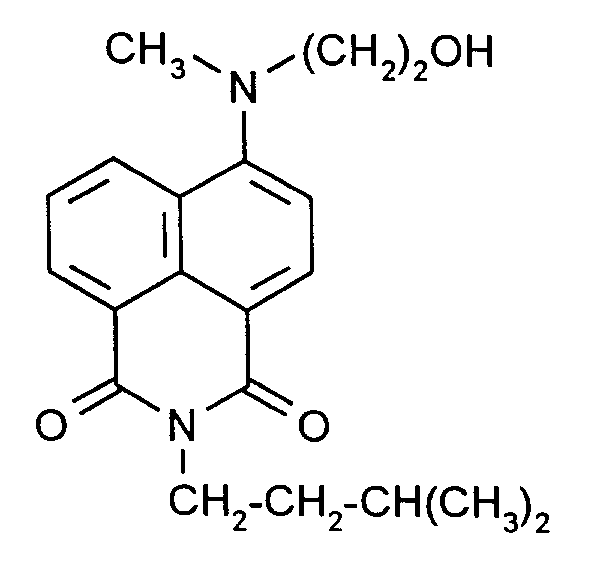
- 2. Herstellung des N-Isoamyl-4-(N'-Methyl-N'-m/p-vinylbenzyloxyethyl)amino-1,8-naphthalimids (39)
Zu einer gerührten Lösung von 4,0 g (0,036 Mol) Kalium-tert-butylat in 40 ml trockenem Tetrahydrofuran wird unter Stickstoff bei 5°C eine Lösung von 10,2 g (0,03 Mol) N-Isoamyl-4-(N'-Methyl-N'-hydroxyethyl)amino-1,8-naphthalimid (38) in 30 ml trockenem Tetrahydrofuran zugetropft. Das Gemisch wird noch 5 h bei Raumtemperatur gerührt. Anschließend wird 5,0 g (0,033 Mol) m/p-Vinylbenzylchlorid (30) zu der rotbraun verfärbten Lösung bei Raumtemperatur zugetropft. Nach 3 h wird die Reaktionsmischung mit 200 ml Wasser und 300 ml Methylenchlorid behandelt. Nach der Phasentrennung wird die wäßrige Phase noch zweimal mit je 100 ml Methylenchlorid extrahiert. Die vereinigten organischen Auszüge werden neutral gewaschen und mit Natriumsulfat getrocknet. Nach Abdestillieren des Lösungsmittels im Vakuum wird der Rückstand durch eine kurze Kieselgelsäule mit Diisopropylether als Laufmittel adsorptiv filtriert, wobei ein Vorlauf mit geringer Menge von m/p-Vinylbenzylchlorid entfernt wird. Nach Abdestillieren des Lösungsmittels erhält man 9,6 g (70 % der Theorie) gelbes Öl. - 3. Herstellung des Homopolymerisats gemäß Formel (40)
In Analogie zu dem im Beispiel 1 beschriebenen Verfahren läßt sich aus 3,0 g (6,6 mMol) N-Isoamyl-4-(N'-Methyl-N'-m/p-vinylbenzyl-oxyethyl)-amino-1,8-naphthalimids (39) und insgesamt 30 mg (0,18 mMol) AIBN mit Toluol als Lösungsmittel 2,3 g (77 % der Theorie) des Homopolymerisats (40) herstellen. - 4. Herstellung einer elektrolumineszierenden Anordnung
ITO beschichtetes Glas (hergestellt von der Firma Balzers) wird in 20 x 30 mm große Substrate geschnitten und gereinigt. Dabei werden folgende Schritte sukzessiv durchgeführt:- 1) 15 min mit dest. Wasser und Falterol im Ultraschallbad spülen,
- 2) 2 x 15 min mit jeweils frischem dest. Wasser im Ultraschallbad spülen,
- 3) 15 min mit Ethanol im Ultraschallbad spülen,
- 4) 2 x 15 min mit jeweils frischem Aceton im Ultraschallbad spülen,
- 5) Trocknen auf fusselfreien Linsentüchern.
Der so hergestellte Film wird anschließend mit Al-Elektroden bedampft. Dazu werden mit Hilfe einer Lochmaske isolierte Al-Punkte mit einem Durchmesser von 3 mm auf den Film gedampft. Während des Aufdampfens herrscht in einer Aufdampfapparatur (Leybold) ein Druck unter 10-5 mbar.
Die ITO-Schicht und die Al-Elektrode wird über elektrische Zuführung mit einer Spannungsquelle verbunden. Beim Erhöhen der Spannung fließt ein elektrischer Strom durch die Anordnung und die beschriebene Schicht elektroluminesziert. Die Elektrolumineszenz liegt im gelb-grünen Spektralbereich und tritt bei positiv gepoltem ITO-Kontakt auf. -
- 1. Herstellung von N-Hydroxyethyl-4-piperidinyl-1,8-napthalimid
Ein Gemisch aus 20,0 g (0,073 mol) 4-Chlor-N-hydroxyethyl-1,8-naphthalimid, 25,8 g (0,30 mol) Piperidin, 2,0 g Kupfer(II)-sulfat und 200 ml Ethylenglykolmonomethylether wird 2 h unter Rückfluß gerührt. Die Lösung wird auf Raumtemperatur abgekühlt und anschließend mit 1 l Wasser versetzt. Man extrahiert die Suspension mit Dichlormethan. Die organische Phase wird eingeengt und der Rückstand aus Toluol umkristallisiert. Man erhält 16 g (68 % der Theorie) braune Kristalle vom Schmelzpunkt 152-153°C. - 2. Herstellung des N-(m/p-Vinylbenzyloxyethyl)-4-piperidyl-1,8-naphthalimids, Formel (42)
In Analogie zu dem im Beispiel 4 beschriebenen Verfahren läßt sich aus 6,48 g (0,020 Mol) N-Hydroxyethyl-4-piperidyl-1,8-naphthalimid (41) und 3,67 g (0,024 Mol) m/p-Vinylbenzylchlorid (30) 6,4 g (73 % der Theorie) des N-(m/p-Vinylbenzyloxyethyl)-4-piperidyl-1,8-naphthalimids (42) herstellen. - 3. Herstellung des Comopolymerisats gemäß Formel (44) mit x = 1,2 Mol-% und y = 98,8 Mol-%
In Analogie zu dem im Beispiel 1 beschriebenen Verfahren läßt sich aus 0,16 g (0,36 mMol) des N-(m/p-Vinylbenzyloxyethyl)-4-piperidyl-1,8-naphthalimids (42), 3,0 g (28,8 mMol) Styrol (43) und insgesamt 30 mg (0,18 mMol) AIBN mit Toluol als Lösungsmittel 2,5 g (79 % der Theorie) des Copolymerisats (44) herstellen. -
- 1. Herstellung des Copolymerisats gemäß Formel (45) mit x = 1 Mol-% und y = 99 Mol-%
In Analogie zu dem im Beispiel 1 beschriebenen Verfahren läßt sich aus 0,10 g (0,22 mMol) des N-Isoamyl-4-(N'-Methyl-N'-m/p-Vinylbenzyloxyethyl)amino-1,8-napthalimids (39), 4,20 g (21,8 mMol) N-Vinylcarbazol (36) und insgesamt 30 mg (0,18 mMol) AIBN mit Toluol als Lösungsmittel 4,15 g (96 % der Theorie) des Copolymerisats (45) herstellen.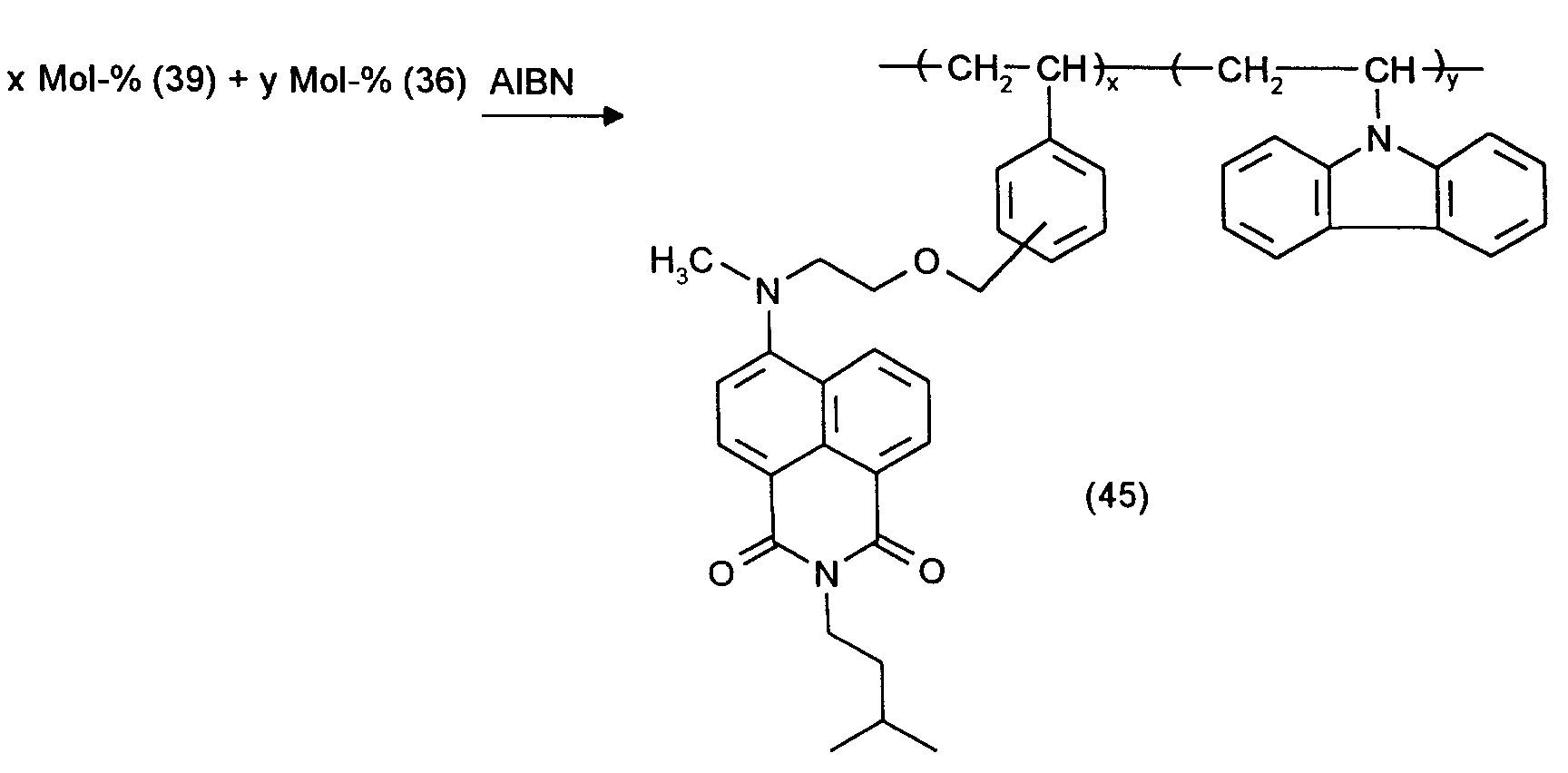
- 2. Herstellung einer elektrolumineszierenden Anordnung
Herstellungsverfahren wie beschrieben im Beispiel 4. Die Dicke des trockenen Films des Copolymerisats gemäß Formel (45) beträgt 144 nm und der Ra-Wert der Oberfläche beträgt 12 nm. Die Elektrolumineszenz liegt im gelb-grünen Spektralbereich.
und die so erhaltene Verbindung der Formel (6a-1) anschließend mit einem primären oder sekundären Amin oder Piperidin, Morpholin, Pyrolidin oder Piperazin, welche einen oder zwei Substituenten ausgewählt aus Methyl, Ethyl und/oder Phenyl tragen können, oder mit einer wäßrigen Ammoniaklösung gegebenenfalls in Gegenwart von Lösungsmitteln wie beispielsweise Methoxyethanol oder Butanol gegebenenfalls unter Katalyse von beispielsweise einem Kupfer(II)-Salz bei Temperaturen von 50 bis 250°C, vorzugsweise 100 bis 150°C umsetzt.
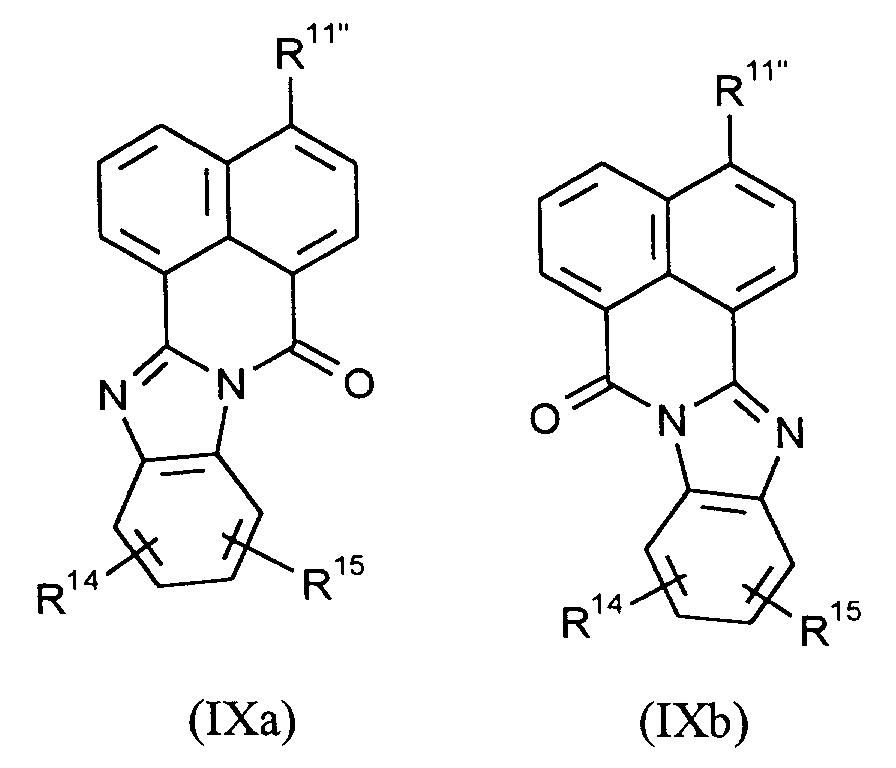

und einem o-Phenylendiamin der Formel (X)

bei Temperaturen von 50 bis 250°C, vorzugsweise 90 bis 140°C, gegebenenfalls in Gegenwart von Lösungsmitteln wie beispielsweise Essigsäure, Butanol, Chlorbenzol, Toluol oder Xylol herstellt und das 1,8-Naphthalimid-Derivat der Formel (IXa und b) anschließend mit einem sekundären Amin der Formel (XI),

unter Katalyse von beispielsweise einem Kupfer(II)-Salz bei Temperaturen von 50 bis 250°C, vorzugsweise 100 bis 150°C, gegebenenfalls in Gegenwart eines Lösungsmittels wie beispielsweise Methoxyethanol oder Butanol, umsetzt.

Claims (8)
- (Co)Polymerisate, die mindestens einen wiederkehrenden Kettenbaustein der allgemeinen Formel (1) oder (2) und gegebenenfalls wiederkehrende Einheiten der allgemeinen Formel (3) enthalten
 R1, R2 und R3 unabhängig voneinander Wasserstoff oder C1-C6-Alkyl bedeuten,M für CN oder C1-C30-Alkoxycarbonyl, C1-C30-(Di)Alkylaminocarbonyl, C1-C30-Alkylcarbonyl steht, die jeweils durch Hydroxy oder C1-C6-Alkoxycarbonyl substituiert sein können, weiterhin für Phenyl, Naphthyl, Anthracenyl, Pyridyl oder Carbazolyl steht, die jeweils durch Reste aus der Gruppe Halogen, Hydroxy, Silyl, C1-C30-Alkyl, C6-C18-Aryl, C1-C30-Alkoxy, C1-C30-Alkoxycarbonyl, C1-C30-Acyloxy und C1-C30-Alkylcarbonyl substituiert sein können,L1 und L2 einen photolumineszierenden Rest bedeutet,wobei der Anteil der Struktureinheiten der Formeln (1) und/oder (2) jeweils 0,5 bis 100 Mol-% und (3) 0 bis 99,5 Mol-% betragen und sich die Mol-%-Anteil zu 100 ergänzen.
 - (Co)Polymerisate gemäß Anspruch 1, wobei
L1 und L2 unabhängig voneinander für einen photolumineszierenden Rest stehen, der auf dem Gerüst eines Fluoreszenzfarbstoffs basiert, der ausgewählt ist aus der Gruppe der Cumarine der Formel (4)


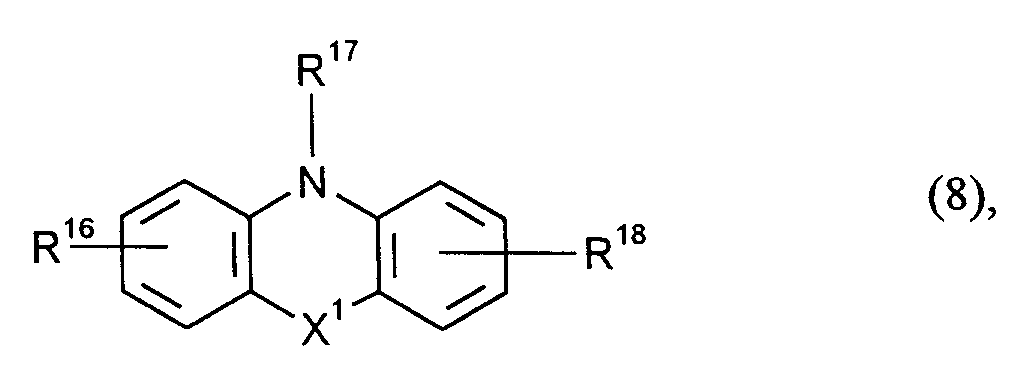
Benzopyrone der Formel (9)

Oxazole, 1,3,4-Oxadiazole der Formel (11)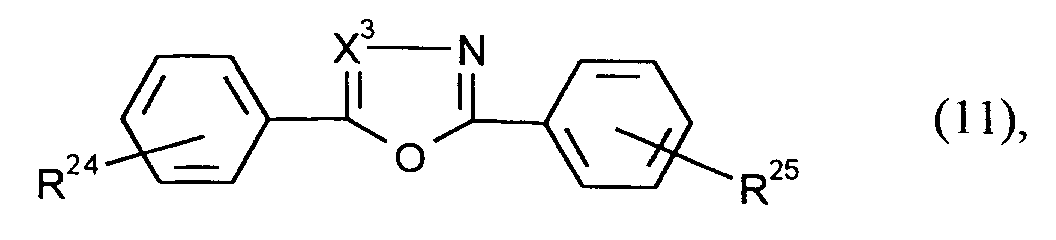
Benzochinoline der Formel (12)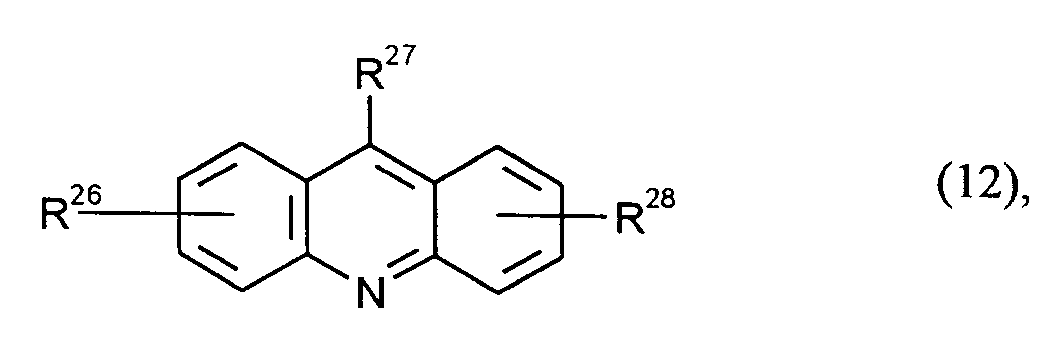


wobeiR4 für Wasserstoff, C1-C30-Alkyl, C6-C18-Aryl, C7-C24-Aralkyl oder C1-C30-Alkoxy oder für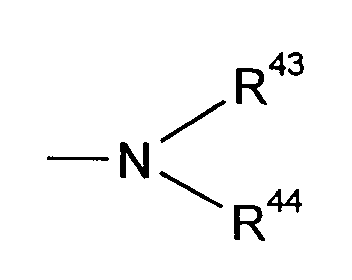
R43 und R44 unabhängig voneinander für Wasserstoff, C1-C30-Alkyl, C6-C18-Aryl, C7-C24-Aralkyl steht, die jeweils durch Hydroxy, Amino, Carboxy oder C1-C4-Alkoxycarbonyl substituiert sein können, oderR43 und R44 gemeinsam mit dem Stickstoff-Atom, an das sie gebunden sind, einen Morpholin, Piperidin-, Pyrrolidin- oder Piperazinring, der einen oder zwei Substituenten aus der Gruppe Methyl, Ethyl und Phenyl tragen kann, bedeuten können,R5 für Wasserstoff, Cyano, C1-C30-Alkyl, C6-C18-Aryl, C7-C24-Aralkyl, C1-C30-Alkoxy, C2-C12-Acyl, C1-C12-Alkoxycarbonyl, C1-C12-(Di)-Alkylaminocarbonyl steht,R6 für Wasserstoff, Cyano, C1-C30-Alkyl, C6-C18-Aryl, C7-C24-Aralkyl, C1-C30-Alkoxy oder für
wobei Z für eine Gruppe OR45 oder R45, R46 und R47 unabhängig voneinander für C1-C30-Alkyl, C6-C18-Aryl oder C7-C24-Aralkyl stehen, wobei die aromatischen Ringe zusätzlich noch durch Halogen, C1-C6-Alkyl, C1-C6-Alkoxy substituiert sein können,R7, R8 und R9 unabhängig voneinander Wasserstoff, C1-C30-Alkyl, C6-C18-Aryl, C7-C24-Aralkyl, C1-C30-Alkoxy, Cyano, C2-C12-Alkoxycarbonyl, C1-C12-(Di)Alkylaminocarbonyl oder eine Aminogruppe mit einer oder zwei C1-C6-Alkylgruppen bedeuten,R10 für Wasserstoff, Cyano, C1-C30-Alkyl, C6-C18-Aryl, C7-C24-Aralkyl, C1-C30-Alkoxy, Amino, eine Aminogruppe mit einer oder zwei C1-C6-Alkylgruppen, C2-C12-Acyl, C1-C12-Alkoxycarbonyl, C1-C12-(Di)-Alkylaminocarbonyl bedeutet,R11 für Wasserstoff, Halogen, Nitro, C1-C4-Alkoxycarbonyl, C1-C4-Acyl, C8-C24-Aralkenyl, unsubstituiertes Amino oder für ein- oder zweifach, gleich oder verschieden durch C1-C30-Alkyl, C6-C18-Aryl oder C7-C24-Aralkyl substituiertes Amino steht,R11 weiterhin für Morpholinyl, Piperidinyl, Pyrrolidinyl oder Piperazinyl steht, die einen oder zwei Substituenten ausgewählt aus Methyl, Ethyl und/oder Phenyl tragen können,R12 für Wasserstoff, C1-C30-Alkyl, C6-C18-Aryl, C7-C24-Aralkyl oder C1-C30-Alkoxy steht,R13 für Wasserstoff, C1-C30-Alkyl, C6-C18-Aryl, C7-C24-Aralkyl, C1-C30-Alkoxy oder
 R49 und R50 unabhängig voneinander für C1-C30-Alkyl, C6-C18-Aryl, C7-C24-Aralkyl stehen oderR49 und R50 weiterhin gemeinsam mit dem Stickstoffatom, an das sie gebunden sind, für Morpholinyl, Piperidinyl, Pyrrolidinyl oder Piperazinyl stehen, die einen oder zwei gleich oder verschiedene Substituenten ausgewählt aus Methyl, Ethyl und Phenyl tragen können,R14 und R15 unabhängig voneinander Wasserstoff, Cyano, Halogen, Nitro, C1-C30-Alkyl, C1-C30-Alkoxy, C6-C18-Aryl oder C7-C24-Aralkyl, C1-C12-Alkoxycarbonyl, C2-C12-Acyl, C1-C12-(Di)Alkylaminocarbonyl, C1-C6-(Di)Alkylamino bedeuten,R17 Wasserstoff, C1-C30-Alkyl, C6-C18-Aryl oder C7-C24-Aralkyl bedeuten undR16, R18 bis R22 und R24 bis R40 unabhängig voneinander Wasserstoff, Cyano, C1-C30-Alkyl, C6-C18-Aryl, C7-C24-Aralkyl, C1-C30-Alkoxy, eine Aminogruppe mit einer oder zwei C1-C6-Alkylgruppen, unsubstituiertes Amino, C2-C12-Acyl, C1-C12-Alkoxycarbonyl oder C1-C12-(Di)Alkylaminocarbonyl bedeuten, wobei die aliphatischen Kohlenstoffketten, wie z.B Alkyl, Alkoxy, Alkylamino, Aralkyl, in den Resten von R4 bis R13, R16 bis R40 durch eines oder mehrere, vorzugsweise ein oder zwei Heteroatome ausgewählt aus Sauerstoff, Stickstoff und Schwefel und/oder durch einen oder mehrere, vorzugsweise ein oder zwei Phenylenringe, die durch C1-C4-Alkyl und/oder Halogen substituiert sein können, unterbrochen sein können,und wobei weiterhin die Anknüpfung des Luminophors an die Polymerseitenketten über ein Sauerstoff einer Hydroxy- oder Carboxygruppe oder ein Stickstoff einer Amino- oder primären Aminogruppe an den obengenannten Substituenten erfolgt.
 - (Co)Polymerisate gemäß Anspruch 1, wobei der Anteil der Struktureinheiten der Formeln (1) und/oder (2) 0,5 bis 60 Mol-% und gegebenenfalls der Formel (3) 40 bis 99,5 Mol-% betragen.
- (Co)Polymerisate gemäß Anspruch 1, wobei L für einen Fluoreszenzfarbstoff ausgewählt aus der Gruppe der Cumarine der Formel (4), Pyrene der Formel (5), 1,8-Naphthalimide der Formel (6), 1,8-Naphthaloylen-1',2'-benzimidazole der Formel (7), Phenotiazine oder Phenoxazine der Formel (8), Carbazole und Fluorene der Formel (10) steht.
- Verfahren zur Herstellung von (Co)Polymeren der Formel (1) gemäß Anspruch 1, wobei man Monomere der Formel (20) oder (21)

und einem Styrol- oder Acrylsäurederivat der Formel (22) und (23) R1 und R2 den obengenannten Bedeutungsumfang haben,R41 für Halogen steht undR42 für Halogen, eine Hydroxy- oder C1-C6-Alkoxygruppe, steht,in Gegenwart eine Base herstellt und diese dann gegebenenfalls in Gegenwart von Comonomeren der Bausteine gemäß Formel (3) polymerisiert.
 - Verwendung der (Co)Polymerisate der Formel (1) gemäß Anspruch 1 zur Herstellung von elektrolumineszierenden Anordnungen.
- Elektrolumineszierende Anordnung, die als elektrolumineszierende Substanz (Co)Polymerisate gemäß Anspruch 1 enthält.
- Elektrolumineszierende Anordnung gemäß Anspruch 7, enthaltend zwei Elektroden, zwischen denen sich eine elektrolumineszierende Schicht befindet, die die (Co)Polymerisate als elektrolumineszierende Schicht enthalten, und wobei zwischen der elektrolumineszierenden Schicht und den Elektroden eine oder mehrere Zwischenschichten angeordnet sein können.
Applications Claiming Priority (2)
| Application Number | Priority Date | Filing Date | Title |
|---|---|---|---|
| DE19505942A DE19505942A1 (de) | 1995-02-21 | 1995-02-21 | (Co)Polymerisate auf Basis von Vinyl-Einheiten und ihre Verwendung in elektrolumineszierenden Anordnungen |
| DE19505942 | 1995-02-21 |
Publications (3)
| Publication Number | Publication Date |
|---|---|
| EP0728775A2 true EP0728775A2 (de) | 1996-08-28 |
| EP0728775A3 EP0728775A3 (de) | 1998-04-01 |
| EP0728775B1 EP0728775B1 (de) | 2001-10-04 |
Family
ID=7754616
Family Applications (1)
| Application Number | Title | Priority Date | Filing Date |
|---|---|---|---|
| EP96101800A Expired - Lifetime EP0728775B1 (de) | 1995-02-21 | 1996-02-08 | (Co)Polymerisate auf Basis von Vinyl-Einheiten und ihre Verwendung in elektrolumineszierenden Anordnungen |
Country Status (9)
| Country | Link |
|---|---|
| US (2) | US6248457B1 (de) |
| EP (1) | EP0728775B1 (de) |
| JP (1) | JPH08245726A (de) |
| KR (1) | KR960031494A (de) |
| CN (1) | CN1142510A (de) |
| AT (1) | ATE206439T1 (de) |
| CA (1) | CA2169711A1 (de) |
| DE (2) | DE19505942A1 (de) |
| TW (1) | TW384305B (de) |
Cited By (9)
| Publication number | Priority date | Publication date | Assignee | Title |
|---|---|---|---|---|
| EP0767234A3 (de) * | 1995-10-02 | 1997-07-09 | Bayer Ag | (Co)Polymerisate auf Basis von Vinyl-Einheiten und ihre Verwendung in elektrolumineszierenden Anordnungen |
| US5891975A (en) * | 1995-03-29 | 1999-04-06 | Bayer Aktiengesellschaft | (Co)polymers based on vinyl units and use thereof in electroluminescent devices |
| US6075106A (en) * | 1995-03-29 | 2000-06-13 | D-51368 Bayer Ag | (Co)polymers based on vinyl units and use thereof in electroluminescent devices |
| US6114463A (en) * | 1996-08-16 | 2000-09-05 | Bayer Ag | Copolymers based on vinyl units and their use in electroluminescent devices |
| US6248457B1 (en) | 1995-02-21 | 2001-06-19 | Bayer Ag | Copolymers based on vinyl units and use thereof in electroluminescent devices |
| FR2867383A1 (fr) * | 2004-03-09 | 2005-09-16 | Oreal | Composition comprenant un compose monomerique a effet optique et procede employant ladite composition |
| FR2867970A1 (fr) * | 2004-03-25 | 2005-09-30 | Oreal | Composition comprenant un compose monomerique a effet optique et procede employant ladite composition |
| EP1582540A1 (de) * | 2004-03-26 | 2005-10-05 | L'oreal | Neue Blockpolymere, diese enthaltende Zusammensetzung und deren Verwendung |
| WO2005097776A1 (fr) * | 2004-03-09 | 2005-10-20 | L'oreal | Composition comprenant un compose monomerique a effet optique, procede employant ladite composition, compose monomerique, polymere le comprenant et utilisation |
Families Citing this family (36)
| Publication number | Priority date | Publication date | Assignee | Title |
|---|---|---|---|---|
| KR100441512B1 (ko) * | 1996-10-07 | 2004-10-08 | 삼성에스디아이 주식회사 | 전기발광표시소자용발색화합물 |
| FR2780979B1 (fr) * | 1998-07-10 | 2000-10-06 | Thomson Csf | Copolymeres derives du n-(2,5 di tertbutyl phenyl naphtalimide) emettant dans le vert,materiau comprenant ce copolymere,diode electroluminescente comprenant le materiau electroluminescent |
| US8669325B1 (en) | 1999-06-11 | 2014-03-11 | Sydney Hyman | Compositions image making mediums and images |
| US9786194B2 (en) | 1999-06-11 | 2017-10-10 | Sydney Hyman | Image making medium compositions and images |
| WO2000077085A1 (en) * | 1999-06-11 | 2000-12-21 | Sydney Hyman | Image making medium |
| US9744800B2 (en) | 1999-06-11 | 2017-08-29 | Sydney Hyman | Compositions and image making mediums |
| US8921473B1 (en) | 2004-04-30 | 2014-12-30 | Sydney Hyman | Image making medium |
| US6645428B1 (en) * | 2000-04-27 | 2003-11-11 | Ondeo Nalco Company | Fluorescent monomers and tagged treatment polymers containing same for use in industrial water systems |
| JP2002141173A (ja) * | 2000-08-22 | 2002-05-17 | Semiconductor Energy Lab Co Ltd | 発光装置 |
| CN1291983C (zh) * | 2000-11-24 | 2006-12-27 | 东丽株式会社 | 发光元件材料和使用该材料的发光元件 |
| KR100416718B1 (ko) * | 2000-12-19 | 2004-01-31 | 광주과학기술원 | 작용기로서 카르바졸을 측쇄로 갖는 스티렌 유도체의 합성방법 |
| SG92833A1 (en) | 2001-03-27 | 2002-11-19 | Sumitomo Chemical Co | Polymeric light emitting substance and polymer light emitting device using the same |
| US7049011B2 (en) * | 2002-03-14 | 2006-05-23 | Tdk Corporation | Organic electroluminescent device |
| US7410746B2 (en) * | 2002-03-29 | 2008-08-12 | Dai Nippon Printing Co., Ltd. | Photoradical polymerization initiator, radical generator, photosensitive compound and photosensitive resin composition containing these materials and product or its accessory portions using the composition |
| US6984461B2 (en) * | 2002-06-21 | 2006-01-10 | Samsung Sdi Co., Ltd. | Blue electroluminescent polymer and organic-electroluminescent device using the same |
| JP2005534790A (ja) * | 2002-07-30 | 2005-11-17 | シーメンス アクチエンゲゼルシヤフト | 針状x線蛍光物質による支持体の蒸着方法 |
| US6818919B2 (en) * | 2002-09-23 | 2004-11-16 | Air Products And Chemicals, Inc. | Light emitting layers for LED devices based on high Tg polymer matrix compositions |
| US7267892B2 (en) * | 2004-02-25 | 2007-09-11 | Eastman Kodak Company | Electroluminescent devices having pendant naphthylanthracene-based polymers |
| US11355027B2 (en) | 2004-04-30 | 2022-06-07 | Sydney Hyman | Image making medium compositions and images |
| JP4706243B2 (ja) * | 2004-11-30 | 2011-06-22 | Tdk株式会社 | 有機el素子及び有機el素子の製造方法 |
| JP4867169B2 (ja) * | 2005-01-11 | 2012-02-01 | セイコーエプソン株式会社 | 導電性高分子、導電層、電子デバイスおよび電子機器 |
| KR20080020635A (ko) * | 2005-06-22 | 2008-03-05 | 스미또모 가가꾸 가부시키가이샤 | 고분자 재료 및 고분자 발광 소자 |
| JP5317315B2 (ja) * | 2005-10-07 | 2013-10-16 | 住友化学株式会社 | 高分子化合物とそれを用いた高分子発光素子 |
| WO2009011427A1 (ja) * | 2007-07-18 | 2009-01-22 | Asahi Glass Company, Limited | 蛍光発光性官能基を有する化合物およびその重合体の製造方法 |
| US8339040B2 (en) * | 2007-12-18 | 2012-12-25 | Lumimove, Inc. | Flexible electroluminescent devices and systems |
| DE102010006377A1 (de) * | 2010-01-29 | 2011-08-04 | Merck Patent GmbH, 64293 | Styrolbasierte Copolymere, insbesondere für die Anwendung in optoelektronischen Bauteilen |
| JP5703372B2 (ja) | 2010-06-04 | 2015-04-15 | トンジ ユニバーシティTongji University | ピレンおよびピロールのコポリマーならびに該コポリマーの生成方法 |
| JP5387534B2 (ja) * | 2010-09-08 | 2014-01-15 | 信越化学工業株式会社 | コーティング用組成物 |
| CN103183971B (zh) * | 2011-12-30 | 2016-08-03 | 财团法人工业技术研究院 | 染料标示型高分子、聚光板及其形成方法、太阳能电池模组及免插电灯具 |
| KR101989660B1 (ko) | 2013-07-09 | 2019-06-14 | 에보니크 데구사 게엠베하 | 전기활성 중합체, 그의 제조 방법, 전극 및 그의 용도 |
| US10211409B2 (en) | 2014-02-02 | 2019-02-19 | Molecular Glasses, Inc. | Noncrystallizable sensitized layers for OLED and OEDs |
| CN104212201B (zh) * | 2014-08-06 | 2017-04-05 | 京东方科技集团股份有限公司 | 聚合物染料及其制备方法、光阻组合物和显示装置 |
| KR101551464B1 (ko) | 2014-09-17 | 2015-09-09 | 중앙대학교 산학협력단 | 지질 이중층이 형성된 하이드로겔 입자 및 그 제조방법 |
| JP6786858B2 (ja) * | 2015-06-19 | 2020-11-18 | 株式会社リコー | エレクトロクロミック化合物及びエレクトロクロミック組成物 |
| US10040887B2 (en) | 2015-12-28 | 2018-08-07 | Samsung Electronics Co., Ltd. | Copolymer, organic light-emitting device material including the same, and organic light-emitting device including the organic light-emitting device material |
| CN118580406B (zh) * | 2023-03-02 | 2025-05-30 | 中国科学院理化技术研究所 | 一类适用于多种波长光刻的香豆素类非化学放大型光刻胶及其制备方法和应用 |
Family Cites Families (35)
| Publication number | Priority date | Publication date | Assignee | Title |
|---|---|---|---|---|
| US3330834A (en) | 1967-07-11 | Naphthalimide whitening agents anb method of making same | ||
| DE1232352B (de) | 1964-07-15 | 1967-01-12 | Bayer Ag | Verfahren zur Herstellung von Acrylnitril-Copolymerisaten |
| US3821383A (en) | 1972-07-10 | 1974-06-28 | Ayerst Mckenna & Harrison | Compositions for and a method of treating diabetic complications |
| DE2360705A1 (de) | 1973-12-06 | 1975-06-26 | Hoechst Ag | Wasserunloesliche verbindungen, verfahren zu ihrer herstellung und ihre verwendung als farbstoffe |
| CA1079516A (en) * | 1975-06-30 | 1980-06-17 | Edmond S. Perry | Scintillation counting compositions and elements |
| US4127499A (en) | 1975-12-15 | 1978-11-28 | Eastman Kodak Company | Scintillation counting compositions |
| SU726116A1 (ru) | 1977-04-15 | 1980-04-05 | Ордена Трудового Красного Знамени Институт Высокомолекулярных Соединений Ан Ссср | Сшитый сополимер в качестве модели дл изучени сшитых полимерных систем |
| US4254109A (en) | 1979-11-08 | 1981-03-03 | Ayerst, Mckenna & Harrison Inc. | 1H-Benz[de]isoquinoline-2(3H)-acetic acid derivatives |
| US4539507A (en) | 1983-03-25 | 1985-09-03 | Eastman Kodak Company | Organic electroluminescent devices having improved power conversion efficiencies |
| US4598081A (en) | 1984-10-12 | 1986-07-01 | Nauchno-Issledovatelsky Institut Endokrinologii I Obmena Veschestv | 1,3-dioxo-1H-benz(de)isoquinoline-2(3H) butyric acid, pharmacologically acceptable salts thereof and compositions containing the same for treatment of diabetes mellitus complications |
| IT1214618B (it) | 1985-06-27 | 1990-01-18 | I P A International Pharmaceut | Composti e composizioni farmaceutiche per la terapia di retinopatie e neuropatie diabetiche. |
| GB8528428D0 (en) | 1985-11-19 | 1985-12-24 | Bunzl Flexpack Ltd | Packaging of fresh fruit & vegetables |
| US4720432A (en) | 1987-02-11 | 1988-01-19 | Eastman Kodak Company | Electroluminescent device with organic luminescent medium |
| US4769292A (en) | 1987-03-02 | 1988-09-06 | Eastman Kodak Company | Electroluminescent device with modified thin film luminescent zone |
| GB8712057D0 (en) | 1987-05-21 | 1987-06-24 | British Petroleum Co Plc | Optical modulators |
| US5126214A (en) | 1989-03-15 | 1992-06-30 | Idemitsu Kosan Co., Ltd. | Electroluminescent element |
| US5077142A (en) | 1989-04-20 | 1991-12-31 | Ricoh Company, Ltd. | Electroluminescent devices |
| GB8909011D0 (en) | 1989-04-20 | 1989-06-07 | Friend Richard H | Electroluminescent devices |
| DE69012892T2 (de) | 1989-07-04 | 1995-05-11 | Mitsubishi Chem Ind | Organische elektrolumineszente Vorrichtung. |
| DE69110922T2 (de) | 1990-02-23 | 1995-12-07 | Sumitomo Chemical Co | Organisch elektrolumineszente Vorrichtung. |
| JP3069139B2 (ja) | 1990-03-16 | 2000-07-24 | 旭化成工業株式会社 | 分散型電界発光素子 |
| GB9018698D0 (en) | 1990-08-24 | 1990-10-10 | Lynxvale Ltd | Semiconductive copolymers for use in electroluminescent devices |
| US5286803A (en) | 1990-11-26 | 1994-02-15 | The United States Of America As Represented By The Secretary Of The Navy | Coumarin dyes and side-chain coumarin dye-substituted polymers which exhibit nonlinear optical properties |
| US5408109A (en) | 1991-02-27 | 1995-04-18 | The Regents Of The University Of California | Visible light emitting diodes fabricated from soluble semiconducting polymers |
| US5235045A (en) | 1992-03-19 | 1993-08-10 | Microbiomed Corporation | Non-azo naphthalimide dyes |
| US5393614A (en) | 1992-04-03 | 1995-02-28 | Pioneer Electronic Corporation | Organic electroluminescence device |
| DE4232394A1 (de) | 1992-09-26 | 1994-03-31 | Basf Ag | Copolymerisate mit nichtlinear optischen Eigenschaften und deren Verwendung |
| GB9226475D0 (en) * | 1992-12-18 | 1993-02-10 | Cambridge Display Tech Ltd | Chromophoric polymeric compositions |
| US5414069A (en) | 1993-02-01 | 1995-05-09 | Polaroid Corporation | Electroluminescent polymers, processes for their use, and electroluminescent devices containing these polymers |
| JP3505761B2 (ja) | 1993-12-27 | 2004-03-15 | チッソ株式会社 | 共重合体、その製造法及びそれを用いた電界発光素子 |
| ATE287929T1 (de) | 1994-05-06 | 2005-02-15 | Bayer Ag | Leitfähige beschichtungen hergestellt aus mischungen enthaltend polythiophen und lösemittel |
| DE19505942A1 (de) | 1995-02-21 | 1996-08-22 | Bayer Ag | (Co)Polymerisate auf Basis von Vinyl-Einheiten und ihre Verwendung in elektrolumineszierenden Anordnungen |
| DE19505940A1 (de) * | 1995-02-21 | 1996-08-22 | Bayer Ag | Cumarinderivate, Verfahren zur Herstellung und ihre Verwendung als Zwischenprodukte |
| DE19511484A1 (de) * | 1995-03-29 | 1996-10-02 | Bayer Ag | (Co)Polymerisate auf Basis von Vinyl-Einheiten und ihre Verwendung in elektrolumineszierenden Anordnungen |
| DE19536843A1 (de) * | 1995-10-02 | 1997-04-03 | Bayer Ag | (Co)Polymerisate auf Basis von Vinyl-Einheiten und ihre Verwendung in elektrolumineszierenden Anordnungen |
-
1995
- 1995-02-21 DE DE19505942A patent/DE19505942A1/de not_active Withdrawn
-
1996
- 1996-02-08 DE DE59607797T patent/DE59607797D1/de not_active Expired - Fee Related
- 1996-02-08 EP EP96101800A patent/EP0728775B1/de not_active Expired - Lifetime
- 1996-02-08 AT AT96101800T patent/ATE206439T1/de not_active IP Right Cessation
- 1996-02-09 US US08/599,581 patent/US6248457B1/en not_active Expired - Fee Related
- 1996-02-09 TW TW085101605A patent/TW384305B/zh not_active IP Right Cessation
- 1996-02-16 JP JP8053955A patent/JPH08245726A/ja active Pending
- 1996-02-16 CA CA002169711A patent/CA2169711A1/en not_active Abandoned
- 1996-02-16 CN CN96103456A patent/CN1142510A/zh active Pending
- 1996-02-17 KR KR1019960003999A patent/KR960031494A/ko not_active Ceased
-
2001
- 2001-05-08 US US09/850,843 patent/US6403239B2/en not_active Expired - Fee Related
Cited By (13)
| Publication number | Priority date | Publication date | Assignee | Title |
|---|---|---|---|---|
| US6403239B2 (en) | 1995-02-21 | 2002-06-11 | Bayer Ag | (Co)polymers based on vinyl units and use thereof in electroluminescent devices |
| US6248457B1 (en) | 1995-02-21 | 2001-06-19 | Bayer Ag | Copolymers based on vinyl units and use thereof in electroluminescent devices |
| US6075106A (en) * | 1995-03-29 | 2000-06-13 | D-51368 Bayer Ag | (Co)polymers based on vinyl units and use thereof in electroluminescent devices |
| US5891975A (en) * | 1995-03-29 | 1999-04-06 | Bayer Aktiengesellschaft | (Co)polymers based on vinyl units and use thereof in electroluminescent devices |
| US5905128A (en) * | 1995-10-02 | 1999-05-18 | Bayer Ag | (CO) polymers based on vinyl units and use thereof in electroluminescent arrangements |
| EP0767234A3 (de) * | 1995-10-02 | 1997-07-09 | Bayer Ag | (Co)Polymerisate auf Basis von Vinyl-Einheiten und ihre Verwendung in elektrolumineszierenden Anordnungen |
| US5807945A (en) * | 1995-10-02 | 1998-09-15 | Bayer Ag | (Co)polymers based on vinyl units and use thereof in electroluminescent arrangements |
| US6114463A (en) * | 1996-08-16 | 2000-09-05 | Bayer Ag | Copolymers based on vinyl units and their use in electroluminescent devices |
| FR2867383A1 (fr) * | 2004-03-09 | 2005-09-16 | Oreal | Composition comprenant un compose monomerique a effet optique et procede employant ladite composition |
| WO2005097776A1 (fr) * | 2004-03-09 | 2005-10-20 | L'oreal | Composition comprenant un compose monomerique a effet optique, procede employant ladite composition, compose monomerique, polymere le comprenant et utilisation |
| FR2867970A1 (fr) * | 2004-03-25 | 2005-09-30 | Oreal | Composition comprenant un compose monomerique a effet optique et procede employant ladite composition |
| WO2005102250A1 (fr) * | 2004-03-25 | 2005-11-03 | L'oreal | Composition comprenant un compose monomerique a effet optique, procede employant ladite composition, compose monomerique, polymere le comprenant et utilisation |
| EP1582540A1 (de) * | 2004-03-26 | 2005-10-05 | L'oreal | Neue Blockpolymere, diese enthaltende Zusammensetzung und deren Verwendung |
Also Published As
| Publication number | Publication date |
|---|---|
| EP0728775B1 (de) | 2001-10-04 |
| CA2169711A1 (en) | 1996-08-22 |
| CN1142510A (zh) | 1997-02-12 |
| EP0728775A3 (de) | 1998-04-01 |
| DE59607797D1 (de) | 2001-11-08 |
| JPH08245726A (ja) | 1996-09-24 |
| US20010026879A1 (en) | 2001-10-04 |
| US6248457B1 (en) | 2001-06-19 |
| DE19505942A1 (de) | 1996-08-22 |
| TW384305B (en) | 2000-03-11 |
| US6403239B2 (en) | 2002-06-11 |
| ATE206439T1 (de) | 2001-10-15 |
| KR960031494A (ko) | 1996-09-17 |
Similar Documents
| Publication | Publication Date | Title |
|---|---|---|
| EP0728775B1 (de) | (Co)Polymerisate auf Basis von Vinyl-Einheiten und ihre Verwendung in elektrolumineszierenden Anordnungen | |
| EP0767234B1 (de) | (Co)Polymerisate auf Basis von Vinyl-Einheiten und ihre Verwendung in elektrolumineszierenden Anordnungen | |
| EP0728745A1 (de) | 1,8-Naphthalimid-Derivate, Verfahren zur Herstellung und ihre Verwendung als Zwischenprodukte | |
| EP0735055A2 (de) | (CO)Polymerisate auf Basis von Vinyl-Einheiten und ihre Verwendung in elektrolumineszierenden Anordnungen | |
| EP0728754B1 (de) | Cumarinderivate, Verfahren zur Herstellung und ihre Verwendung als Zwischenprodukte | |
| EP0825207A2 (de) | (Co) Polymerisate auf Basis von Vinyl-Einheiten und ihre Verwendung in elektrolumineszierenden Anordnungen | |
| EP0707020B1 (de) | Konjugierte Polymere mit Spirozentren und ihre Verwendung als Elektrolumineszenzmaterialien | |
| DE69630737T2 (de) | Silacyclopentadienderivate und diese enthaltende organische Elektrolumineszenzelemente | |
| DE60005901T2 (de) | Elektrolumineszierende Anordungen mit Diketopyrrolopyrrolen | |
| WO1997039045A1 (de) | Polymere mit spiroatomen und ihre verwendung als elektrolumineszenzmaterialien | |
| DE19829947A1 (de) | Elektrolumineszierende Anordnungen mit Bor-Chelaten | |
| KR100295284B1 (ko) | 발광단을 함유한 디아세틸렌계 중합체 및 이를 이용한 전계발광소자 | |
| US3484380A (en) | Fluorescent europium chelates with tetradentate ligands | |
| DE19643097A1 (de) | Vernetzbare Triarylaminverbindungen und deren Verwendung als Ladungstransportmaterialien | |
| US6075106A (en) | (Co)polymers based on vinyl units and use thereof in electroluminescent devices | |
| KR102849993B1 (ko) | 형광염료 및 이를 포함하는 색변환 고분자 소재 | |
| KR101544415B1 (ko) | 신규한 백색 발광 고분자, 그 제조 방법 및 이를 이용한 전기 발광 소자 | |
| KR20080107840A (ko) | 신규한 백색 발광 고분자, 그 제조 방법 및 이를 이용한전기 발광 소자 |
Legal Events
| Date | Code | Title | Description |
|---|---|---|---|
| PUAI | Public reference made under article 153(3) epc to a published international application that has entered the european phase |
Free format text: ORIGINAL CODE: 0009012 |
|
| AK | Designated contracting states |
Kind code of ref document: A2 Designated state(s): AT BE CH DE FR GB IT LI NL |
|
| PUAL | Search report despatched |
Free format text: ORIGINAL CODE: 0009013 |
|
| AK | Designated contracting states |
Kind code of ref document: A3 Designated state(s): AT BE CH DE FR GB IT LI NL |
|
| 17P | Request for examination filed |
Effective date: 19981001 |
|
| 17Q | First examination report despatched |
Effective date: 19990309 |
|
| GRAG | Despatch of communication of intention to grant |
Free format text: ORIGINAL CODE: EPIDOS AGRA |
|
| GRAG | Despatch of communication of intention to grant |
Free format text: ORIGINAL CODE: EPIDOS AGRA |
|
| GRAH | Despatch of communication of intention to grant a patent |
Free format text: ORIGINAL CODE: EPIDOS IGRA |
|
| GRAH | Despatch of communication of intention to grant a patent |
Free format text: ORIGINAL CODE: EPIDOS IGRA |
|
| GRAA | (expected) grant |
Free format text: ORIGINAL CODE: 0009210 |
|
| AK | Designated contracting states |
Kind code of ref document: B1 Designated state(s): AT BE CH DE FR GB IT LI NL |
|
| REF | Corresponds to: |
Ref document number: 206439 Country of ref document: AT Date of ref document: 20011015 Kind code of ref document: T |
|
| REG | Reference to a national code |
Ref country code: CH Ref legal event code: NV Representative=s name: E. BLUM & CO. PATENTANWAELTE Ref country code: CH Ref legal event code: EP |
|
| REF | Corresponds to: |
Ref document number: 59607797 Country of ref document: DE Date of ref document: 20011108 |
|
| REG | Reference to a national code |
Ref country code: GB Ref legal event code: IF02 |
|
| GBT | Gb: translation of ep patent filed (gb section 77(6)(a)/1977) |
Effective date: 20011217 |
|
| PGFP | Annual fee paid to national office [announced via postgrant information from national office to epo] |
Ref country code: DE Payment date: 20020121 Year of fee payment: 7 |
|
| PGFP | Annual fee paid to national office [announced via postgrant information from national office to epo] |
Ref country code: GB Payment date: 20020206 Year of fee payment: 7 |
|
| PGFP | Annual fee paid to national office [announced via postgrant information from national office to epo] |
Ref country code: CH Payment date: 20020211 Year of fee payment: 7 |
|
| PGFP | Annual fee paid to national office [announced via postgrant information from national office to epo] |
Ref country code: AT Payment date: 20020222 Year of fee payment: 7 |
|
| PG25 | Lapsed in a contracting state [announced via postgrant information from national office to epo] |
Ref country code: FR Free format text: LAPSE BECAUSE OF NON-PAYMENT OF DUE FEES Effective date: 20020228 |
|
| PGFP | Annual fee paid to national office [announced via postgrant information from national office to epo] |
Ref country code: NL Payment date: 20020228 Year of fee payment: 7 Ref country code: BE Payment date: 20020228 Year of fee payment: 7 |
|
| ET | Fr: translation filed | ||
| PLBE | No opposition filed within time limit |
Free format text: ORIGINAL CODE: 0009261 |
|
| STAA | Information on the status of an ep patent application or granted ep patent |
Free format text: STATUS: NO OPPOSITION FILED WITHIN TIME LIMIT |
|
| 26N | No opposition filed | ||
| PG25 | Lapsed in a contracting state [announced via postgrant information from national office to epo] |
Ref country code: GB Free format text: LAPSE BECAUSE OF NON-PAYMENT OF DUE FEES Effective date: 20030208 Ref country code: AT Free format text: LAPSE BECAUSE OF NON-PAYMENT OF DUE FEES Effective date: 20030208 |
|
| PG25 | Lapsed in a contracting state [announced via postgrant information from national office to epo] |
Ref country code: LI Free format text: LAPSE BECAUSE OF NON-PAYMENT OF DUE FEES Effective date: 20030228 Ref country code: CH Free format text: LAPSE BECAUSE OF NON-PAYMENT OF DUE FEES Effective date: 20030228 Ref country code: BE Free format text: LAPSE BECAUSE OF NON-PAYMENT OF DUE FEES Effective date: 20030228 |
|
| PG25 | Lapsed in a contracting state [announced via postgrant information from national office to epo] |
Ref country code: NL Free format text: LAPSE BECAUSE OF NON-PAYMENT OF DUE FEES Effective date: 20030901 |
|
| PG25 | Lapsed in a contracting state [announced via postgrant information from national office to epo] |
Ref country code: DE Free format text: LAPSE BECAUSE OF NON-PAYMENT OF DUE FEES Effective date: 20030902 |
|
| GBPC | Gb: european patent ceased through non-payment of renewal fee | ||
| REG | Reference to a national code |
Ref country code: CH Ref legal event code: PL |
|
| NLV4 | Nl: lapsed or anulled due to non-payment of the annual fee |
Effective date: 20030901 |
|
| REG | Reference to a national code |
Ref country code: FR Ref legal event code: ST |
|
| PG25 | Lapsed in a contracting state [announced via postgrant information from national office to epo] |
Ref country code: IT Free format text: LAPSE BECAUSE OF NON-PAYMENT OF DUE FEES Effective date: 20050208 |