EP0729015A1 - Dispositif pour classer des fruits et de légumes selon la qualité et le rang - Google Patents
Dispositif pour classer des fruits et de légumes selon la qualité et le rang Download PDFInfo
- Publication number
- EP0729015A1 EP0729015A1 EP96102593A EP96102593A EP0729015A1 EP 0729015 A1 EP0729015 A1 EP 0729015A1 EP 96102593 A EP96102593 A EP 96102593A EP 96102593 A EP96102593 A EP 96102593A EP 0729015 A1 EP0729015 A1 EP 0729015A1
- Authority
- EP
- European Patent Office
- Prior art keywords
- weighing
- goods
- signal
- carrier
- identification carrier
- Prior art date
- Legal status (The legal status is an assumption and is not a legal conclusion. Google has not performed a legal analysis and makes no representation as to the accuracy of the status listed.)
- Withdrawn
Links
- 235000013311 vegetables Nutrition 0.000 title claims abstract description 19
- 235000013399 edible fruits Nutrition 0.000 title claims abstract description 17
- 238000005303 weighing Methods 0.000 claims abstract description 46
- 238000011156 evaluation Methods 0.000 claims abstract description 11
- 239000000969 carrier Substances 0.000 claims abstract description 9
- 238000001514 detection method Methods 0.000 claims description 10
- 230000008859 change Effects 0.000 claims description 9
- 238000000034 method Methods 0.000 claims description 2
- 230000008569 process Effects 0.000 claims description 2
- 230000002596 correlated effect Effects 0.000 claims 1
- 230000036962 time dependent Effects 0.000 claims 1
- 241000234427 Asparagus Species 0.000 description 10
- 235000005340 Asparagus officinalis Nutrition 0.000 description 10
- 238000003306 harvesting Methods 0.000 description 6
- 238000011161 development Methods 0.000 description 3
- 230000018109 developmental process Effects 0.000 description 3
- XEEYBQQBJWHFJM-UHFFFAOYSA-N Iron Chemical group [Fe] XEEYBQQBJWHFJM-UHFFFAOYSA-N 0.000 description 1
- 230000004888 barrier function Effects 0.000 description 1
- 235000015895 biscuits Nutrition 0.000 description 1
- 230000000295 complement effect Effects 0.000 description 1
- 230000001419 dependent effect Effects 0.000 description 1
- 238000012423 maintenance Methods 0.000 description 1
- 230000007246 mechanism Effects 0.000 description 1
- 238000012986 modification Methods 0.000 description 1
- 230000004048 modification Effects 0.000 description 1
- 235000014594 pastries Nutrition 0.000 description 1
- 238000000926 separation method Methods 0.000 description 1
Images

Classifications
-
- G—PHYSICS
- G01—MEASURING; TESTING
- G01G—WEIGHING
- G01G11/00—Apparatus for weighing a continuous stream of material during flow; Conveyor belt weighers
- G01G11/003—Details; specially adapted accessories
-
- B—PERFORMING OPERATIONS; TRANSPORTING
- B07—SEPARATING SOLIDS FROM SOLIDS; SORTING
- B07C—POSTAL SORTING; SORTING INDIVIDUAL ARTICLES, OR BULK MATERIAL FIT TO BE SORTED PIECE-MEAL, e.g. BY PICKING
- B07C5/00—Sorting according to a characteristic or feature of the articles or material being sorted, e.g. by control effected by devices which detect or measure such characteristic or feature; Sorting by manually actuated devices, e.g. switches
- B07C5/16—Sorting according to weight
-
- B—PERFORMING OPERATIONS; TRANSPORTING
- B07—SEPARATING SOLIDS FROM SOLIDS; SORTING
- B07C—POSTAL SORTING; SORTING INDIVIDUAL ARTICLES, OR BULK MATERIAL FIT TO BE SORTED PIECE-MEAL, e.g. BY PICKING
- B07C5/00—Sorting according to a characteristic or feature of the articles or material being sorted, e.g. by control effected by devices which detect or measure such characteristic or feature; Sorting by manually actuated devices, e.g. switches
- B07C5/34—Sorting according to other particular properties
- B07C5/3412—Sorting according to other particular properties according to a code applied to the object which indicates a property of the object, e.g. quality class, contents or incorrect indication
Definitions
- the invention relates to a device for assigning goods such as vegetables or fruit according to different classes and batches according to the preamble of claim 1.
- Devices of this type are used, in particular, for asparagus pricking, in which the employed workers are remunerated in relation to performance. Payment is made taking into account the quantity collected and the qualities collected.
- Such devices have so far had a conveyor belt on which the asparagus spears are arranged transversely to the direction of conveyance. Several sorting staff then sit on the belt, selecting different asparagus qualities and placing them in an assigned box.
- DE 34 40 052 A1 shows a reading device for a transport device for goods which is provided with a carrier for machine-readable identification codes. These identification codes are provided with clock markings, so that reading errors due to different conveyor speeds Transport device can be excluded. However, this device is also not suitable for assigning vegetables or pieces of fruit to a particular collector.
- each assistant is assigned an identification identifier which is noted on an identification carrier.
- the auxiliary person involved in harvesting can carry this identification carrier with him or a flap for receiving the carrier can be provided on a collecting basket. If the caregiver weighs the collected fruit or vegetable qualities, they have so far been placed on a transport device, e.g. B. a conveyor belt.
- the auxiliary person places his identification carrier on a carrier provided on the transport device.
- a reading device for reading the identification carrier is provided in the course of the transport device, so that a controller can assign all subsequent or previous weighings to this identification carrier.
- the identification carrier can be used in conjunction with an initial or End marks are used, whereby the system is informed that the batch area assigned to an identification carrier begins with the mark or ends with an end mark. As a rule, the assignment is controlled in such a way that all fruit or vegetable qualities weighed after the identification carrier has been read in are assigned to this identification carrier until a further identification carrier is read in.
- a time circuit can also be provided which completes a batch calculation if there is no more weighing for a certain time.
- the weighing can be based on either absolute values or difference values. It is important that the amount of different fruit or vegetable qualities is recorded precisely, so that a size for the remuneration of the assistant can then be determined. The sorting is still carried out by hand using suitable forces.
- the identification carrier is read in and the batch is only assigned to the new carrier after it has been ensured that the weighing of the previous batch has been completed.
- This is realized by checking the weighing output signals or the output signals of a detector device which is arranged on the transport device for detecting the goods. If these weighing or detector signals have not changed for a predetermined period of time or have not occurred, it is assumed that the weighing of the previous batch has been completed.
- Such a check can be done easily achieved with a counter or clock block that is set or reset by a change or the occurrence of a signal.
- the preferably digital count signal can then be compared with a reference value.
- the scales preferably have an interface with a digital data output, so that the weighing results can be fed directly to the controller or to an evaluation device connected to the controller. There, the weighing results are multiplied by stored evaluation factors that are characteristic of the different fruit or vegetable qualities. Subsequently, an overall result is determined from the weighted class results, which then only has to be converted into a monetary value. This can also be done by the evaluation device.
- the transport device is preferably designed as a conveyor belt.
- the carrier can be provided in the form of pockets formed on the top of the conveyor belt, into which the identification carriers can be at least partially inserted.
- the identification carriers are well protected against pollution, among other things.
- the carrier can be designed in the form of clips which fix the identification carrier against the conveyor belt. From the standpoint of handling and maintenance, it is particularly advantageous if the carrier is designed as a Velcro strip running in the transport direction of the conveyor belt, which interacts with a complementary Velcro connection surface on the back of the identification carrier.
- the scanner for reading the identification carrier is also used for scanning the size of the goods and, if appropriate, the color of the goods (gray value), as a result of which the class assignment can also be automated.
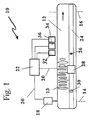
- the figure shows an allocation device 10 with a conveyor belt 12, which runs around two horizontally arranged deflection axes 14, 16.
- the assignment device is designed for the assignment of asparagus qualities 13 to different harvest helpers.
- a motor 18 for actuating the conveyor belt 12 is provided in the region of the first deflection axis 14. This motor 18 is connected to a central control 22 via a data line 20.
- a carrier 24 in the form of a Velcro belt is provided on the conveyor belt 12.
- Identification carriers 26, which are read by a laser scanner 28, are arranged on this carrier 24. If necessary, can still on the carrier 24 Start or end marks 30 are placed, which mark the limit of the batch assigned to a harvest worker. However, the border can also be marked by a subsequent identification carrier that is assigned to another harvest worker.
- the asparagus qualities are fed to three electronic scales 32, 34, 36 by sorting forces, which are connected to the central control 22 via data cables 20.
- the controller 22 assigns the digitally obtained differential weighing signal between two identification identifiers or an identification identifier and a start or end mark to an identification carrier 26.
- the controller 22 contains an evaluation device which immediately multiplies the weighing results of the electronic scales 32, 34, 36 according to the class quality by an evaluation factor and in this way determines a value on the basis of which the harvest assistant is remunerated. The value can also be calculated directly as remuneration.
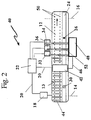
- the laser scanner 42 for detecting the identification code can at the same time be designed as a size measuring device for the vegetables or fruit to be classified, in which case the sorting of the collected goods on the different scales can also be automated.
- an actuating device 48, 52 is provided which, depending on the scanning result, distributes the goods to the different class scales 32, 34, 36.
- the conveyor belt can have subdivisions 50 formed transversely to the direction of conveyance indicated by the arrow, as a result of which an exact alignment of the asparagus on the conveyor belt 12 is ensured.
- the assignment device 40 shown in FIG. 2 contains a laser scanner 42 for reading the identification carrier 26 as well as for detecting the size of the elongated vegetable parts 44. This is connected to the controller 22 via a data line 20 and to the actuating device 48 via a further data line 46.
- the elongated vegetable parts are placed in spaces between guide knobs 50, which are arranged in two rows in parallel on the conveyor belt, in such a way that elongated vegetables or fruit placed on the belt are aligned with their longitudinal axis transverse to the transport direction.
- guide knobs 50 instead of the guide knobs 50, ribs and similar alignment arrangements can also be provided on the belt.
- the scanner 42 detects the size, thickness, gray values and / or color features of the individual pieces of fruit or vegetable and, depending on these parameters, actuates three stamps 52 of an actuating device 48 arranged one behind the other in the running direction of the belt, so that the corresponding vegetable or fruit quality is obtained from the Guide between the knobs 50 is pushed onto a corresponding scale 32 to 36, which is provided for the appropriate quality or class.
- This system works fully automatically and enables the vegetables or fruits to be sorted into defined quality classes and the assignment of the batches to specific identification carriers. It can be provided that fruit or vegetables that fall out of the specified classes are transported to the end of the belt and fall there into a container for rejects. This fruit or vegetable is accordingly not taken into account when calculating the fee for the harvest assistant assigned to the identification carrier.
- the conveyor belt itself acts as a carrier, in which case the identification carrier is simply placed on the conveyor belt.
- the identification carrier should preferably be placed here on a defined area of the conveyor belt, unless a scanner is provided which scans the conveyor belt over the entire width.
- the identification carrier can e.g. have a magnetic layer which interacts with an iron structure under the conveyor belt, so that it is difficult to move the identification carrier.
- the device 60 contains a conveyor belt 62, on which the collected goods are placed. At the beginning of the conveyor belt in the support area of the goods, a reading device 64 is provided, into which an identification carrier can be inserted. The reading device 64 is connected to a controller 66, which in turn has inputs for the output signals from four scales 68, 70, 72, 74 of a weighing device.
- An assignment logic is provided in the control system, which examines the output signal of each balance for changes. If such a change caused by the loading of the goods with the goods to be classified is detected, a counter is reset which delivers a time-bound output signal. This counter counts up clocked until it is reset by another change in the output signal.
- the output of the counter serves as a comparison value for a comparison circuit and is applied to a first input of a comparator of this circuit, at the second input of which a predetermined reference value is applied. This reference value corresponds to the counter value of the counter corresponding to a specific time period. If the count value of the counter at the first input exceeds the reference value at the second input, an end-of-weighing signal is issued for the corresponding scale.
- the comparison circuit sends an end of weighing signal to the control to indicate that the weighing process for one batch has been completed and the weighing of a new batch can be started.
- the reference value can be set to the same value or different values for all scales.
- a suitable value would be, for example, in a range from approximately 10 seconds to 30 seconds. This timing is essential in order to prevent the weighing of the goods of a previous batch, which is carried out simultaneously when reading in a new identification medium, from being already assigned to the new identification medium. Therefore, the weighings are only assigned to the new identification carrier if all scales have not been loaded with a new good for a certain time.
- the assignment logic of the control can also only allow the reading in of a new identification carrier when the comparison circuit has generated an end of weighing signal.
- a detection device 76 arranged on the conveyor belt e.g. a light barrier to detect goods on the conveyor belt to generate an end-of-weighing signal, in which case with a spatially spaced arrangement of the batches on the conveyor belt and / or when the conveyor is stopped when a batch is newly placed, a clean separation of the individual batches and thus a correct assignment are also possible to an identification carrier would be possible.
- control system has a memory for several identifiers of identification carriers, which is processed in the order in which it is entered.
- time-bound signal it is not absolutely necessary for the time-bound signal to be the up or down signal of a counter.
- a signal can also be formed by constantly forming the difference between the time of the change and the current time value. All types of signals are possible which allow a conclusion to be drawn as to what period of time lies between the last change in the output signal of the balance or detection device and the current system time.
- a counter can also be set to a predetermined reference value, an end-of-weighing signal being emitted when the counter has counted down to zero.
Landscapes
- Physics & Mathematics (AREA)
- General Physics & Mathematics (AREA)
- Sorting Of Articles (AREA)
Applications Claiming Priority (2)
| Application Number | Priority Date | Filing Date | Title |
|---|---|---|---|
| DE19506041 | 1995-02-21 | ||
| DE1995106041 DE19506041C1 (de) | 1995-02-21 | 1995-02-21 | Vorrichtung zum Zuordnen von Obst und Gemüse nach Klassen und Chargen |
Publications (1)
| Publication Number | Publication Date |
|---|---|
| EP0729015A1 true EP0729015A1 (fr) | 1996-08-28 |
Family
ID=7754676
Family Applications (1)
| Application Number | Title | Priority Date | Filing Date |
|---|---|---|---|
| EP96102593A Withdrawn EP0729015A1 (fr) | 1995-02-21 | 1996-02-21 | Dispositif pour classer des fruits et de légumes selon la qualité et le rang |
Country Status (2)
| Country | Link |
|---|---|
| EP (1) | EP0729015A1 (fr) |
| DE (1) | DE19506041C1 (fr) |
Families Citing this family (4)
| Publication number | Priority date | Publication date | Assignee | Title |
|---|---|---|---|---|
| DE19845938C1 (de) * | 1998-10-06 | 2000-03-16 | Sipro Mes Und Steuerungstechni | Vorrichtung zum Sortieren und/oder Klassifizieren von stangenförmigem Gemüse |
| DE102010030908B4 (de) * | 2010-07-02 | 2014-10-16 | Strube Gmbh & Co. Kg | Verfahren zur Klassifizierung in Saatgutpartien enthaltener Objekte, Sortierverfahren und zugehörige Vorrichtungen |
| CN111957587B (zh) * | 2020-09-07 | 2023-09-05 | 横店集团东磁股份有限公司 | 一种用于磁瓦的自动称重分档装置及其实现方法 |
| DE102020134139A1 (de) | 2020-12-18 | 2022-06-23 | Christoph Neubauer | Vorrichtung für die Handhabung eines Behälters mit geernteten Spargelstangen und/oder für die Erfassung von die Spargelstangen betreffende Informationen |
Citations (4)
| Publication number | Priority date | Publication date | Assignee | Title |
|---|---|---|---|---|
| FR2360357A1 (fr) * | 1976-08-06 | 1978-03-03 | Citron Marcel | Reglette d'indexation optique a curseur et dispositif de lecture |
| EP0180283A2 (fr) * | 1984-11-02 | 1986-05-07 | Pees Steuer- und Regelanlagen GmbH | Dispositif pour la lecture à leur passage d'objets ou de bacs de transport pourvus d'un porteur d'informations |
| EP0336790A2 (fr) * | 1988-04-08 | 1989-10-11 | M.A.F.(Materiel Pour L'arboriculture Fruitiere) S.A. | Dispositif pour assurer le transport et le calibrage pondéral d'objets fragiles |
| FR2640230A1 (fr) * | 1988-12-09 | 1990-06-15 | Reybier Fromageries | Dispositif pour la commande du remplissage de conteneurs de poids constant a l'aide de produits de poids variable |
Family Cites Families (1)
| Publication number | Priority date | Publication date | Assignee | Title |
|---|---|---|---|---|
| DE3123677C2 (de) * | 1981-06-15 | 1983-12-01 | Yamato Scale Co. Ltd., Akashi, Hyogo | Einrichtung zum Zusammenstellen einer bestimmten Anzahl von festen Gegenständen zu einer Gruppe |
-
1995
- 1995-02-21 DE DE1995106041 patent/DE19506041C1/de not_active Expired - Fee Related
-
1996
- 1996-02-21 EP EP96102593A patent/EP0729015A1/fr not_active Withdrawn
Patent Citations (4)
| Publication number | Priority date | Publication date | Assignee | Title |
|---|---|---|---|---|
| FR2360357A1 (fr) * | 1976-08-06 | 1978-03-03 | Citron Marcel | Reglette d'indexation optique a curseur et dispositif de lecture |
| EP0180283A2 (fr) * | 1984-11-02 | 1986-05-07 | Pees Steuer- und Regelanlagen GmbH | Dispositif pour la lecture à leur passage d'objets ou de bacs de transport pourvus d'un porteur d'informations |
| EP0336790A2 (fr) * | 1988-04-08 | 1989-10-11 | M.A.F.(Materiel Pour L'arboriculture Fruitiere) S.A. | Dispositif pour assurer le transport et le calibrage pondéral d'objets fragiles |
| FR2640230A1 (fr) * | 1988-12-09 | 1990-06-15 | Reybier Fromageries | Dispositif pour la commande du remplissage de conteneurs de poids constant a l'aide de produits de poids variable |
Also Published As
| Publication number | Publication date |
|---|---|
| DE19506041C1 (de) | 1996-05-02 |
Similar Documents
| Publication | Publication Date | Title |
|---|---|---|
| AT398174B (de) | Verfahren und vorrichtung zum trennen von entrindeten holzknüppeln | |
| DE2624308C2 (de) | Einrichtung zum Abtasten von Glasflaschen zwecks Formerkennung | |
| EP0634957B1 (fr) | Procede de classement sequentiel du courrier dans des installations de tri postal | |
| DE69117411T2 (de) | Vorrichtung zur Analyse von Proben | |
| DE2947958C2 (fr) | ||
| DE1406112B2 (de) | Einrichtung zur Überwachung der Länge von oder des Ab st. and es zwischen längs einer Förderbahn bewegten Gegenständen | |
| DE3304299A1 (de) | Vorrichtung zum pruefen der kopfenden von zigaretten | |
| DE102007040301B4 (de) | Verfahren und Vorrichtung zur dynamischen Kontrollwägung | |
| WO1999026734A1 (fr) | Procede et dispositif pour l'identification et le tri d'objets transportes sur bande | |
| DE2836025A1 (de) | Erkennungs- und entfernungssystem | |
| DE102005055755B4 (de) | Vorrichtung zum Wiegen mit mehreren Wägezellen | |
| DE2752193C2 (de) | Transportvorrichtung für Serienerzeugnisse innerhalb einer Wägevorrichtung | |
| DE2831843C2 (fr) | ||
| DE102006003270A1 (de) | Vorrichtung und Verfahren zum Sortieren von ungeordneten Behältern in einem Kommissioniersystem | |
| DE2738360C3 (de) | Gerät zum Überwachen des Leerungszustandes von in einem Förderweg laufenden Umschlägen | |
| DE4014130A1 (de) | Vorrichtung zum behandeln von kartenfoermigen gegenstaenden | |
| DE3804307C2 (fr) | ||
| EP0616303A1 (fr) | Dispositif de transport vertical de pièces de monnaie | |
| EP0629979A2 (fr) | Dispositif de contrôle pour des pièces de monnaie | |
| DE2637331C3 (de) | Sortiereinrichtung für Furnierabschnitte | |
| DE1295442B (de) | Vorrichtung zum Zaehlen und Markieren von durch Zerteilen eines fortlaufenden Stranges herruehrenden Zigaretten oder anderen Gegenstaenden | |
| DE19506041C1 (de) | Vorrichtung zum Zuordnen von Obst und Gemüse nach Klassen und Chargen | |
| DE3730683A1 (de) | Verfahren und vorrichtung zur kontrolle von gegenstaenden | |
| DE102008007906A1 (de) | Vorrichtung zur Verarbeitung gleich geformter Kleinteile | |
| DE3008745A1 (de) | Verfahren zur ueberpruefung und gewaehrleistung der brauchbarkeit von kunststoffbehaeltern und vorrichtung zur durchfuehrung eines solchen verfahrens |
Legal Events
| Date | Code | Title | Description |
|---|---|---|---|
| PUAI | Public reference made under article 153(3) epc to a published international application that has entered the european phase |
Free format text: ORIGINAL CODE: 0009012 |
|
| AK | Designated contracting states |
Kind code of ref document: A1 Designated state(s): DE ES GR NL |
|
| 17P | Request for examination filed |
Effective date: 19970227 |
|
| STAA | Information on the status of an ep patent application or granted ep patent |
Free format text: STATUS: THE APPLICATION IS DEEMED TO BE WITHDRAWN |
|
| 18D | Application deemed to be withdrawn |
Effective date: 19990901 |