EP0729031A1 - Trousse de réactifs pour déterminer le taux d'hémoglobine - Google Patents
Trousse de réactifs pour déterminer le taux d'hémoglobine Download PDFInfo
- Publication number
- EP0729031A1 EP0729031A1 EP96102222A EP96102222A EP0729031A1 EP 0729031 A1 EP0729031 A1 EP 0729031A1 EP 96102222 A EP96102222 A EP 96102222A EP 96102222 A EP96102222 A EP 96102222A EP 0729031 A1 EP0729031 A1 EP 0729031A1
- Authority
- EP
- European Patent Office
- Prior art keywords
- haemoglobin
- content
- reagent
- blood
- determining
- Prior art date
- Legal status (The legal status is an assumption and is not a legal conclusion. Google has not performed a legal analysis and makes no representation as to the accuracy of the status listed.)
- Withdrawn
Links
Images

Classifications
-
- G—PHYSICS
- G01—MEASURING; TESTING
- G01N—INVESTIGATING OR ANALYSING MATERIALS BY DETERMINING THEIR CHEMICAL OR PHYSICAL PROPERTIES
- G01N33/00—Investigating or analysing materials by specific methods not covered by groups G01N1/00 - G01N31/00
- G01N33/48—Biological material, e.g. blood, urine; Haemocytometers
- G01N33/50—Chemical analysis of biological material, e.g. blood, urine; Testing involving biospecific ligand binding methods; Immunological testing
- G01N33/72—Chemical analysis of biological material, e.g. blood, urine; Testing involving biospecific ligand binding methods; Immunological testing involving blood pigments, e.g. haemoglobin, bilirubin or other porphyrins; involving occult blood
- G01N33/721—Haemoglobin
-
- G—PHYSICS
- G01—MEASURING; TESTING
- G01N—INVESTIGATING OR ANALYSING MATERIALS BY DETERMINING THEIR CHEMICAL OR PHYSICAL PROPERTIES
- G01N33/00—Investigating or analysing materials by specific methods not covered by groups G01N1/00 - G01N31/00
- G01N33/48—Biological material, e.g. blood, urine; Haemocytometers
- G01N33/50—Chemical analysis of biological material, e.g. blood, urine; Testing involving biospecific ligand binding methods; Immunological testing
- G01N33/72—Chemical analysis of biological material, e.g. blood, urine; Testing involving biospecific ligand binding methods; Immunological testing involving blood pigments, e.g. haemoglobin, bilirubin or other porphyrins; involving occult blood
- G01N33/721—Haemoglobin
- G01N33/723—Glycosylated haemoglobin
Definitions
- the invention relates to a set of reagents for determining the content of total haemoglobin in a blood sample or a sample derived from blood, said set comprising a haemolysis reagent which is an acidic solution having a pH between about 0.5 and 5.0, preferably between about 0.5 and 3.0, and a green chromophore forming reagent, which is a basic solution having a pH between about 7.0 and 12.0, preferably between about 9.0 and 11.5, and containing a non-ionic detergent and/or an anionic detergent.
- the invention further relates to a set of reagents for determining both the content of total haemoglobin and the content of a particular haemoglobin derivative in a blood sample or a sample derived from blood.
- the invention also concerns a method for determining the content of total haemoglobin, and preferably also the content of a particular haemoglobin derivative, in a blood sample or a sample derived from blood, and the use of the above set of reagents in such a method.
- a green chromophore forming reagent means a reagent capable of forming a greenish product, hereafter referred to as green chromophore, with the haemolysate obtained after treating a blood sample or a sample derived from blood with the above defined haemolysis reagent, whereby the green chromophore has an absorption spectrum similar to that of alkaline haematin D-575 described in British Patent Publication No. 2 052 056.
- the green chromophore is the stable reaction product of all forms of haemoglobin with the green chromophore forming reagent.
- British Patent Publication No. 2 052 056 describes a simple method for spectrometric determination of the total haemoglobin content in blood, consisting of adding to the blood sample a reagent containing a water-soluble non-ionic detergent in a strongly alkaline solution of pH between 12.7 and 13.7, incubating for at least one minute and measuring the absorption at a wave length of about 575 nm.
- This method is based on the fact that all haemoglobin derivatives under those conditions are converted into a uniform stable reaction product, called alkaline hematin D-575, a green chromophore having a maximum of absorption at 575 nm.
- This method however has the drawback that the strongly alkaline reagent tends to absorb ambient carbon dioxide and thus become less basic, thereby limiting preservation of this reagent under conditions of use, especially in automatic clinical chemistry analyzers.
- European Patent Publication No. 559 164 discloses another method for determining the total haemoglobin content in a blood sample, consisting of adding to the blood sample a reagent containing a ionic detergent in a substantially neutral solution of pH between 5.0 and 9.5, incubating for a period of 1 to 10 minutes and measuring the absorption at a wavelength of 540 nm.
- the reagent lyses the erythrocytes contained in the blood sample and reacts with the haemoglobin released so as to convert it quantitatively into a green chromophore.
- This method has the drawback that it shows a strong interference with lipids and therefore gives false results for patients with an elevated level of lipids, as is often the case for diabetic patients.
- Japanese Patent Publication No. 227171/1985 describes another method of determining the total content of haemoglobin consisting of washing a sample of whole blood with a physiological saline solution to obtain the erythrocytes, lysing the erythrocytes in a neutral solution and treating the sample obtained with a solution of pH of at least 11.5 containing TRITON® X100, so as to convert all haemoglobin forms into a green chromophore.
- This method also has the drawback that the alkaline reagent tends to absorb ambient carbon dioxide and thus become less basic.
- the reaction used for determination of the total content of haemoglobin is very sensitive to a variation of pH of the alkaline reagent.
- the problem addressed by the present invention is to find a set of reagents and a method for spectrophotometric determination of the content of total haemoglobin, as well as for spectrophotometric determination of both the content of total haemoglobin and the content of a particular haemoglobin derivative, in a blood sample or a sample derived from blood, that does not have the above drawbacks.
- the set of reagents of the invention and the method using same have the surprising advantages that the determination of total haemoglobin is not affected by a variation of pH of the green chromophore forming reagent, nor by the presence of lipids in the blood sample or the sample derived from blood.
- the haemolysis reagent preferably contains a protease which is active in a pH range comprised between about 0.5 and 5.0.
- protease is pepsin. This protease is effective when used at a concentration of at least 10 kU/ml, preferably at least 100 kU/ml.
- a non-ionic detergent such as isotridecyl poly(ethyleneglycol) 8 (GENAPOL® X80 - Boehringer Mannheim) or a sorbitanester (e.g. TWEEN® - ICI).
- a non-ionic detergent such as isotridecyl poly(ethyleneglycol) 8 (GENAPOL® X80 - Boehringer Mannheim) or a sorbitanester (e.g. TWEEN® - ICI).
- the haemolysis reagent advantageously contains a small amount of an agent capable of oxidizing haem.
- an agent capable of oxidizing haem is 5-bromo-5-nitro-1,3-dioxane, which is preferably used at a concentration of about 0.01 to 0.1% (w/v).
- That agent which can for instance conveniently be found as the main constituent of BRONIDOX K (Henkel) or at a concentration of about 10% in propyleneglycol in BRONIDOX L (Henkel), also prevents microbial growth.
- the detergent contained in the green chromophore forming reagent may be an anionic detergent or a non-ionic detergent. This detergent apparently helps in unfolding the protein, so as to make the haem group more accessible and oxidizable.
- Suitable non ionic detergents are for instance isotridecyl poly(ethyleneglycol) 8 (GENAPOL® X80 - Boehringer Mannheim), 4-(1,1,3,3-tetramethylbutyl)-phenol ethoxylate (TRITON® X-100 - Rohm & Haas), polyethyleneglycol-lauryl-ether, polyethyleneglycolcetyl-ether, polyethyleneglycol-oleyl-ether, polyethyleneglycol-stearyl-ether, or a mixture of such ethers (e.g. BRIJ® 58 - Atlas Chemie).
- 4-(1,1,3,3-tetramethylbutyl)-phenol ethoxylate and isotridecyl-poly(ethyleneglycol) 8 are particularly suitable, the latter detergent being preferred.
- the non-ionic detergent is generally used at a concentration between about 5 and 100 mM, preferably between about 10 and 70 mM.
- a clarifying agent such as a cholate salt, e.g. sodium cholate, is preferably added in order to avoid turbidity problems often encountered with non-ionic detergents at a temperature higher than room temperature, e.g. about 37 C°, which is generally-used in automatic analyzers.
- the concentration of the clarifying agent in the green chromophore forming reagent is preferably from about 6 to about 18 mM.
- Suitable anionic detergents are for instance sodium dodecylsulfate (SDS), sodium dioctylsulfosuccinate (DONS) or SULFORIZINATE (made from olive or ricinus oil with sulfuric acid, available from Chemische Fabrik G. Zimmerli A.G., CH-4663 Aarburg, Switzerland).
- SDS sodium dodecylsulfate
- DONS sodium dioctylsulfosuccinate
- SULFORIZINATE made from olive or ricinus oil with sulfuric acid, available from Chemische Fabrik G. Zimmerli A.G., CH-4663 Aarburg, Switzerland.
- the invention also relates to a set of reagents for determining both the content of total haemoglobin and the content of a particular haemoglobin derivative in a blood sample or a sample derived from blood, said set comprising
- the reagent for determining the content of a particular haemoglobin derivative is a reagent that allows determining, preferably without any prior purification step, the amount of a particular haemoglobin derivative in the haemolysate resulting from treatment of the sample with the above haemolysis reagent.
- An interesting example of such a reagent is an immunoreagent comprising an antibody, preferably a monoclonal antibody, that specifically binds to a particular haemoglobin derivative.
- Haemoglobin derivatives for which such a set of reagents is useful are all haemoglobin forms present in blood which are of clinical interest, particularly glycated haemoglobin derivatives, such as haemoglobin A1a, haemoglobin A1b and haemoglobin A1c.
- the above set of reagents allows to determine the ratio between the content of a particular glycated haemoglobin derivative and the content of total haemoglobin. That ratio reflects the average glucose level in blood over a period of time and hence represents an interesting parameter for monitoring metabolic control in diabetes.
- the above set of reagents is particularly adapted to the determination of the ratio between the content of haemoglobin A1c and the content of total haemoglobin.
- the reagent for determining the content of haemoglobin A1c is preferably an immunoreagent comprising at least one monoclonal antibody which specifically recognizes this protein.
- An example of such a monoclonal antibody is the monoclonal antibody disclosed in US Patent No. 4,727,036.
- the invention also relates to a method for determining the content of total haemoglobin in a blood sample or a sample derived from blood, said method comprising the steps of
- the haemolysis step (a) is preferably performed by mixing the sample with the haemolysis reagent for a period of at least about 5 seconds, preferably from about 5 seconds to about 5 minutes.
- the reaction time to convert all haemoglobin derivatives of the haemolysate into the green chromophore is generally not more than about 250 seconds, preferably not more than about 100 seconds.
- the absorbance of the solution is measured at a wave length where the green chromophore has an extinction coefficient sufficiently higher than that of the other components present in the sample, generally between about 500 and 600 nm, particularly between about 540 and 590 nm.
- a particularly advantageous wave length is about 570 nm.
- An important advantage of the method of the invention is that the reaction of conversion of all haemoglobin derivatives into a green chromophore, shows almost no sensitivity to a variation of pH of the green chromophore forming reagent.
- the method of the invention has the advantage, in contrast to the method described in European Patent Publication No. 559 164, that the presence of lipids at physiological concentrations does not interfere with the determination of haemoglobin.
- the invention also concerns a method for determining both the content of total haemoglobin and the content of a particular haemoglobin derivative in a blood sample or a sample derived from blood, said method comprising the steps of
- the above method is particularly adapted to the determination of the ratio between the content of haemoglobin A1c and the content of total haemoglobin.
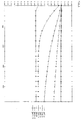
- Figure 1 represents the variation as a function of time of the absorbance at a wave length of about 550 nm, of the reaction product between different green chromophore forming reagents having a pH from 11.5 to 7.0 and the haemolysate obtained by treating the blood sample with water.
- Figure 2 represents the variation as a function of time of the absorbance at a wave length of about 550 nm of the reaction product between different green chromophore forming reagents having a pH from 11.5 to 7.0 and the haemolysate obtained by treating the blood sample with an haemolysis reagent containing 0.02% 5-bromo-5-nitro-1,3-dioxane (BRONIDOX K-Henkel), 200 kU/l porcine pepsin, 20 mM citrate buffer pH 2.4.
- BRONIDOX K-Henkel 5-bromo-5-nitro-1,3-dioxane
- the curves corresponding to the green chromophore forming reagents having a pH from 11.5 to 7.0 represent how the green chromophore forming reaction, which is the basis of the spectrophotometric determination of the total content of haemoglobin, is affected by a change of pH of the green chromophore forming reagent.
- Sensitivity of the total haemoglobin determination reaction to a variation of pH of the green chromophore forming reagent for a haemolysis step performed in a neutral solution Sensitivity of the total haemoglobin determination reaction to a variation of pH of the green chromophore forming reagent for a haemolysis step performed in a neutral solution.
- This reaction consisted in mixing the blood sample with demineralized water for about 1 minute, then mixing the haemolysate obtained with the above described green chromophore forming reagents and spectrometrically following at a wave length of about 550 nm the formation of the green chromophore.
- Figure 1 represents the variation as a function of time of the absorbance at about 550 nm for the above described green chromophore forming reagents having a pH between 11.5 and 7.0.
- a short time for completion of the chromophore forming reaction is desirable for a speedy assay for determining total haemoglobin.
- the instrument is set so as to measure the absorbance value after a given reaction time, e.g. about 100 seconds.
- the absorbance value is proportional to the amount of total haemoglobin in the sample only if the quantitative reaction of conversion of all haemoglobin derivatives into the green chromophore has been completed.
- haemolysis reagents of pH between 0.5 and 5.0, containing or not containing a protease active in this range of pH and/or an agent capable of oxidizing haem were prepared.
- haemolysis reagents of pH between 0.5 and 5.0, containing or not containing a protease active in this range of pH and/or an agent capable of oxidizing haem were prepared.
- haemolysis reagents of pH between 0.5 and 5.0, containing or not containing a protease active in this range of pH and/or an agent capable of oxidizing haem were prepared.
- haemolysis reagents of pH between 0.5 and 5.0, containing or not containing a protease active in this range of pH and/or an agent capable of oxidizing haem were prepared.
- the influence of the haemolysis step on the sensitivity of the total haemoglobin determination reaction to a variation of pH of the green chromophore forming reagent was studied by mixing the blood sample with different haemolysis reagents for about 1 minute and mixing the haemolysate obtained with the green chromophore forming reagents prepared in Example 1 1) and another green chromophore forming reagent having a pH of 12.0 (containing 40 mM GENAPOL® X-80, 12 mM sodium cholate, and 400 mM potassium phosphate buffer), and spectrometrically following at a wave length of about 550 nm the formation of the green chromophore.
- the absorbance spectrum was determined for the green chromophore obtained.
- the 550 end-point absorbance is reached after a maximum of about 250 seconds for all green chromophore forming reagents having a pH from 12.0 to 7.0, the change in the 550 end-point absorbance being from about 0.185 for a pH of the green chromophore forming reagent of 11.5, to about 0.245 for a pH of the green chromophore forming reagent of 7.0.
- Those results compared to those obtained in Example 1 under paragraph 2) illustrate the reactivity increase and the change of the 550 end-point absorbance mentioned in the preceding paragraph.
- the 550 end-point absorbance is reached after a maximum of about 100 seconds for all green chromophore forming reagents having a pH from 12.0 to 7.0, the change in the 550 end-point absorbance being from about 0.185 for a pH of the green chromophore reagent of 12.0, to about 0.22 for a pH of the green chromophore forming reagent of 7.0.
- Those results compared to those obtained under paragraph a) above illustrate the reactivity increase and the change to a lesser extent of the 550 end-point absorbance mentioned in the preceding paragraph.
- the 550 end-point absorbance is reached after a maximum of 100 seconds for all green chromophore forming reagents having a pH from 12.0 to 7.0, the change in the 550 end-point absorbance being from about 0.18 for a pH of the green chromophore reagent of 12, to about 0.195 for a pH of the green chromophore forming reagent of 7.0.
- Those results compared to those obtained under paragraph b) above illustrate the reactivity increase and the change to a lesser extent of the 550 end-point absorbance mentioned in the preceding paragraph.
- Figure 2 represents the variation as a function of time of the absorbance at a wave length of 550 nm of the reaction product between different green chromophore forming reagents having a pH from 11.5 to 7.0 and the haemolysate obtained by treating the blood sample with the above haemolysis reagent.
- Figure 2 shows that a decrease of the pH of the green chromophore forming reagent from 11.5 to 9.0, e.g. due to carbon dioxide absorption, will not significantly affect the time at which the 550 end-point absorbance is reached, nor the value of the latter, and hence will not lead to errors in the measurement of total haemoglobin content when the absorbance is measured at about 550 nm.
- the green chromophore obtained has the same end-point absorbance at a wave length of about 570 nm for green chromophore forming reagents having a pH from 12.0 to 7.0, a change of pH within this range does not lead to errors in the measurement of total haemoglobin content if the absorbance is measured at this wave length.
- INTRALIPID containing per ml 200 mg Soyae ol. fract., 12 mg fract. e vitello ovi and 22.5 mg glycerol, available from Kabi Vitrum - Sweden
- a set of reagents according to the invention comprising a haemolysis reagent of pH of about 2.4 containing 300 kU/l porcine pepsin, 20 mM citric acid, 0.02 % (w/v) 5-bromo-5-nitro-1,3-dioxane, and a green chromophore forming reagent containing 40 mM GENAPOL X-80, 12 mM sodium cholate, 400 mM potassium phosphate buffer pH 11.5.
Landscapes
- Health & Medical Sciences (AREA)
- Life Sciences & Earth Sciences (AREA)
- Hematology (AREA)
- Engineering & Computer Science (AREA)
- Molecular Biology (AREA)
- Biomedical Technology (AREA)
- Chemical & Material Sciences (AREA)
- Immunology (AREA)
- Urology & Nephrology (AREA)
- Biotechnology (AREA)
- Microbiology (AREA)
- Cell Biology (AREA)
- Food Science & Technology (AREA)
- Medicinal Chemistry (AREA)
- Physics & Mathematics (AREA)
- Analytical Chemistry (AREA)
- Biochemistry (AREA)
- General Health & Medical Sciences (AREA)
- General Physics & Mathematics (AREA)
- Pathology (AREA)
- Investigating Or Analysing Biological Materials (AREA)
- Measuring Or Testing Involving Enzymes Or Micro-Organisms (AREA)
Applications Claiming Priority (2)
| Application Number | Priority Date | Filing Date | Title |
|---|---|---|---|
| EP95102635 | 1995-02-24 | ||
| EP95102635 | 1995-02-24 |
Publications (1)
| Publication Number | Publication Date |
|---|---|
| EP0729031A1 true EP0729031A1 (fr) | 1996-08-28 |
Family
ID=8219006
Family Applications (1)
| Application Number | Title | Priority Date | Filing Date |
|---|---|---|---|
| EP96102222A Withdrawn EP0729031A1 (fr) | 1995-02-24 | 1996-02-15 | Trousse de réactifs pour déterminer le taux d'hémoglobine |
Country Status (3)
| Country | Link |
|---|---|
| EP (1) | EP0729031A1 (fr) |
| JP (1) | JPH08262027A (fr) |
| CA (1) | CA2169882A1 (fr) |
Cited By (4)
| Publication number | Priority date | Publication date | Assignee | Title |
|---|---|---|---|---|
| RU2159442C1 (ru) * | 1999-11-23 | 2000-11-20 | Закрытое акционерное общество "Вектор-Бест" | Набор реагентов для определения концентрации гемоглобина в крови |
| WO2008009445A1 (fr) * | 2006-07-21 | 2008-01-24 | Roche Diagnostics Gmbh | Réactif pour la digestion d'hémoglobine |
| US8080423B2 (en) | 2004-08-05 | 2011-12-20 | Asahi Kasei Pharma Corporation | Reagent containing protease reaction promoter and/or colorant stabilizer |
| US8268017B2 (en) | 2007-02-22 | 2012-09-18 | Asahi Kasei Pharma Corporation | Method for stabilizing leuco-type colorant |
Families Citing this family (1)
| Publication number | Priority date | Publication date | Assignee | Title |
|---|---|---|---|---|
| JP4989628B2 (ja) * | 2006-03-24 | 2012-08-01 | アークレイ株式会社 | グリコヘモグロビン濃度測定方法および濃度測定装置 |
Citations (5)
| Publication number | Priority date | Publication date | Assignee | Title |
|---|---|---|---|---|
| EP0003340A2 (fr) * | 1978-01-25 | 1979-08-08 | Rolf. Prof.Dr. Zander | Procédé et réactif pour la détermination du taux d'hémoglobine dans le sang |
| US4255385A (en) * | 1979-10-23 | 1981-03-10 | Abbott Laboratories | Reagent and test kit for determining glycosylated hemoglobin |
| EP0033543A1 (fr) * | 1980-02-04 | 1981-08-12 | F. HOFFMANN-LA ROCHE & CO. Aktiengesellschaft | Procédé pour la détermination d'une sorte spéciale d'hémoglobine et utilisation dudit procédé pour la détection du diabète |
| DE3729639A1 (de) * | 1987-09-04 | 1989-03-23 | Guenter Keul | Haemoglobinbestimmungsmethode |
| EP0559164A2 (fr) * | 1992-03-05 | 1993-09-08 | Roche Diagnostics GmbH | Méthode immunologique pour déterminer HbAIc |
-
1996
- 1996-02-15 EP EP96102222A patent/EP0729031A1/fr not_active Withdrawn
- 1996-02-20 CA CA 2169882 patent/CA2169882A1/fr not_active Abandoned
- 1996-02-23 JP JP3687396A patent/JPH08262027A/ja active Pending
Patent Citations (5)
| Publication number | Priority date | Publication date | Assignee | Title |
|---|---|---|---|---|
| EP0003340A2 (fr) * | 1978-01-25 | 1979-08-08 | Rolf. Prof.Dr. Zander | Procédé et réactif pour la détermination du taux d'hémoglobine dans le sang |
| US4255385A (en) * | 1979-10-23 | 1981-03-10 | Abbott Laboratories | Reagent and test kit for determining glycosylated hemoglobin |
| EP0033543A1 (fr) * | 1980-02-04 | 1981-08-12 | F. HOFFMANN-LA ROCHE & CO. Aktiengesellschaft | Procédé pour la détermination d'une sorte spéciale d'hémoglobine et utilisation dudit procédé pour la détection du diabète |
| DE3729639A1 (de) * | 1987-09-04 | 1989-03-23 | Guenter Keul | Haemoglobinbestimmungsmethode |
| EP0559164A2 (fr) * | 1992-03-05 | 1993-09-08 | Roche Diagnostics GmbH | Méthode immunologique pour déterminer HbAIc |
Cited By (5)
| Publication number | Priority date | Publication date | Assignee | Title |
|---|---|---|---|---|
| RU2159442C1 (ru) * | 1999-11-23 | 2000-11-20 | Закрытое акционерное общество "Вектор-Бест" | Набор реагентов для определения концентрации гемоглобина в крови |
| US8080423B2 (en) | 2004-08-05 | 2011-12-20 | Asahi Kasei Pharma Corporation | Reagent containing protease reaction promoter and/or colorant stabilizer |
| WO2008009445A1 (fr) * | 2006-07-21 | 2008-01-24 | Roche Diagnostics Gmbh | Réactif pour la digestion d'hémoglobine |
| US7807401B2 (en) | 2006-07-21 | 2010-10-05 | Roche Diagnostics Operations, Inc. | Reagent for digestion of hemoglobin |
| US8268017B2 (en) | 2007-02-22 | 2012-09-18 | Asahi Kasei Pharma Corporation | Method for stabilizing leuco-type colorant |
Also Published As
| Publication number | Publication date |
|---|---|
| JPH08262027A (ja) | 1996-10-11 |
| CA2169882A1 (fr) | 1996-08-25 |
Similar Documents
| Publication | Publication Date | Title |
|---|---|---|
| Liem et al. | Quantitative determination of hemoglobin and cytochemical staining for peroxidase using 3, 3′, 5, 5′-tetramethylbenzidine dihydrochloride, a safe substitute for benzidine | |
| Rumley et al. | Analytical aspects of antioxidants and free radical activity in clinical biochemistry | |
| Ellman et al. | A precise method for the determination of whole blood and plasma sulfhydryl groups | |
| Rice-Evans et al. | [241 Total antioxidant status in plasma and body fluids | |
| Benzie | An automated, specific, spectrophotometric method for measuring ascorbic acid in plasma (EFTSA) | |
| Cao et al. | [5] Measurement of oxygen radical absorbance capacity in biological samples | |
| Miller et al. | Spectrophotometric determination of antioxidant activity | |
| Schosinsky et al. | Measurement of ceruloplasmin from its oxidase activity in serum by use of o-dianisidine dihydrochloride | |
| Apak et al. | Total antioxidant capacity assay of human serum using copper (II)-neocuproine as chromogenic oxidant: the CUPRAC method | |
| EP0020788B1 (fr) | Piece d'essai pour la mesure du glucose | |
| Nickel et al. | Improved peroxidase assay method using leuco 2, 3′, 6-trichloroindophenol and application to comparative measurements of peroxidatic catalysis | |
| KR101207418B1 (ko) | 효소법을 이용하는 당화혈색소 정량분석용 용혈시약 조성물 | |
| AU652092B2 (en) | Immunological method for the determination of a haemoglobin derivative | |
| US5156947A (en) | Process for reduction of the matrix effect in a fructosamine determination assay | |
| JP2640847B2 (ja) | 過酸の分析方法および分析用試薬 | |
| US5057435A (en) | Reagent and methods for calcium determination | |
| Degiampietro et al. | Determination of thiocyanate in plasma and saliva without deproteinisation and its validation as a smoking parameter | |
| US4438204A (en) | Determination of glycosilated hemoglobin | |
| EP0215170A1 (fr) | Procédé de mesure unicolore pour la détermination de la fructosamine | |
| US4152116A (en) | Composition and method for the determination of ascorbic acid | |
| Andreu et al. | Determination of direct-bilirubin by a fluorimetric-enzymatic method based on bilirubin oxidase | |
| US5149633A (en) | Process and reagent for the specific determination of fructosamine content in blood and samples obtained from blood | |
| JPS6342230B2 (fr) | ||
| CA2169882A1 (fr) | Ensemble de reactifs permettant de determiner la teneur en hemoglobine totale | |
| EP0141134B1 (fr) | Détermination de métaux alcalins |
Legal Events
| Date | Code | Title | Description |
|---|---|---|---|
| PUAI | Public reference made under article 153(3) epc to a published international application that has entered the european phase |
Free format text: ORIGINAL CODE: 0009012 |
|
| 17P | Request for examination filed |
Effective date: 19960215 |
|
| AK | Designated contracting states |
Kind code of ref document: A1 Designated state(s): AT BE CH DE DK ES FR GB GR IE IT LI LU NL PT |
|
| STAA | Information on the status of an ep patent application or granted ep patent |
Free format text: STATUS: THE APPLICATION HAS BEEN WITHDRAWN |
|
| 18W | Application withdrawn |
Withdrawal date: 19970528 |