EP0730136A1 - Niveau à bulle avec ensemble de fiole encapsulé - Google Patents
Niveau à bulle avec ensemble de fiole encapsulé Download PDFInfo
- Publication number
- EP0730136A1 EP0730136A1 EP96103126A EP96103126A EP0730136A1 EP 0730136 A1 EP0730136 A1 EP 0730136A1 EP 96103126 A EP96103126 A EP 96103126A EP 96103126 A EP96103126 A EP 96103126A EP 0730136 A1 EP0730136 A1 EP 0730136A1
- Authority
- EP
- European Patent Office
- Prior art keywords
- vial
- sleeve
- liquid
- assembly
- providing
- Prior art date
- Legal status (The legal status is an assumption and is not a legal conclusion. Google has not performed a legal analysis and makes no representation as to the accuracy of the status listed.)
- Granted
Links
- 239000007788 liquid Substances 0.000 claims abstract description 65
- 239000000463 material Substances 0.000 claims abstract description 38
- 238000000034 method Methods 0.000 claims abstract description 26
- 239000004417 polycarbonate Substances 0.000 claims abstract description 8
- 229920000515 polycarbonate Polymers 0.000 claims abstract description 8
- 239000005341 toughened glass Substances 0.000 claims abstract description 5
- 239000012858 resilient material Substances 0.000 claims abstract description 4
- 239000000314 lubricant Substances 0.000 claims description 17
- -1 polyethylene terephthalate Polymers 0.000 claims description 7
- LYCAIKOWRPUZTN-UHFFFAOYSA-N Ethylene glycol Chemical compound OCCO LYCAIKOWRPUZTN-UHFFFAOYSA-N 0.000 claims description 6
- PEDCQBHIVMGVHV-UHFFFAOYSA-N Glycerine Chemical compound OCC(O)CO PEDCQBHIVMGVHV-UHFFFAOYSA-N 0.000 claims description 6
- 238000007598 dipping method Methods 0.000 claims description 6
- 230000014759 maintenance of location Effects 0.000 claims description 6
- 229920000139 polyethylene terephthalate Polymers 0.000 claims description 6
- 239000005020 polyethylene terephthalate Substances 0.000 claims description 6
- 229920000915 polyvinyl chloride Polymers 0.000 claims description 6
- 239000004800 polyvinyl chloride Substances 0.000 claims description 6
- 230000000452 restraining effect Effects 0.000 claims description 6
- 238000007789 sealing Methods 0.000 claims description 6
- 239000004814 polyurethane Substances 0.000 claims description 4
- 229920002635 polyurethane Polymers 0.000 claims description 4
- 239000004677 Nylon Substances 0.000 claims description 3
- 239000012530 fluid Substances 0.000 claims description 3
- 235000011187 glycerol Nutrition 0.000 claims description 3
- 238000010438 heat treatment Methods 0.000 claims description 3
- WGCNASOHLSPBMP-UHFFFAOYSA-N hydroxyacetaldehyde Natural products OCC=O WGCNASOHLSPBMP-UHFFFAOYSA-N 0.000 claims description 3
- 239000002480 mineral oil Substances 0.000 claims description 3
- 235000010446 mineral oil Nutrition 0.000 claims description 3
- 239000000203 mixture Substances 0.000 claims description 3
- 229920001778 nylon Polymers 0.000 claims description 3
- 229920003229 poly(methyl methacrylate) Polymers 0.000 claims description 3
- 229920000728 polyester Polymers 0.000 claims description 3
- 239000004926 polymethyl methacrylate Substances 0.000 claims description 3
- 229920001296 polysiloxane Polymers 0.000 claims description 3
- 238000004519 manufacturing process Methods 0.000 description 7
- 238000005299 abrasion Methods 0.000 description 4
- 238000006748 scratching Methods 0.000 description 4
- 230000002393 scratching effect Effects 0.000 description 4
- 229920006217 cellulose acetate butyrate Polymers 0.000 description 3
- 238000010276 construction Methods 0.000 description 3
- 239000011521 glass Substances 0.000 description 3
- 239000003599 detergent Substances 0.000 description 2
- 238000004851 dishwashing Methods 0.000 description 2
- 239000003822 epoxy resin Substances 0.000 description 2
- 238000001704 evaporation Methods 0.000 description 2
- 230000008020 evaporation Effects 0.000 description 2
- 230000000704 physical effect Effects 0.000 description 2
- 229920000647 polyepoxide Polymers 0.000 description 2
- 239000000126 substance Substances 0.000 description 2
- XLYOFNOQVPJJNP-UHFFFAOYSA-N water Substances O XLYOFNOQVPJJNP-UHFFFAOYSA-N 0.000 description 2
- NIXOWILDQLNWCW-UHFFFAOYSA-N acrylic acid group Chemical group C(C=C)(=O)O NIXOWILDQLNWCW-UHFFFAOYSA-N 0.000 description 1
- 230000002411 adverse Effects 0.000 description 1
- 230000003466 anti-cipated effect Effects 0.000 description 1
- 238000005452 bending Methods 0.000 description 1
- 238000003780 insertion Methods 0.000 description 1
- 230000037431 insertion Effects 0.000 description 1
- 238000003754 machining Methods 0.000 description 1
- 239000002184 metal Substances 0.000 description 1
- 238000002360 preparation method Methods 0.000 description 1
- 230000002265 prevention Effects 0.000 description 1
- 238000000926 separation method Methods 0.000 description 1
- 239000004575 stone Substances 0.000 description 1
- 239000002023 wood Substances 0.000 description 1
Images

Classifications
-
- G—PHYSICS
- G01—MEASURING; TESTING
- G01C—MEASURING DISTANCES, LEVELS OR BEARINGS; SURVEYING; NAVIGATION; GYROSCOPIC INSTRUMENTS; PHOTOGRAMMETRY OR VIDEOGRAMMETRY
- G01C9/00—Measuring inclination, e.g. by clinometers, by levels
- G01C9/18—Measuring inclination, e.g. by clinometers, by levels by using liquids
- G01C9/24—Measuring inclination, e.g. by clinometers, by levels by using liquids in closed containers partially filled with liquid so as to leave a gas bubble
- G01C9/34—Measuring inclination, e.g. by clinometers, by levels by using liquids in closed containers partially filled with liquid so as to leave a gas bubble of the tubular type, i.e. for indicating the level in one direction only
Definitions
- This invention relates generally to geometric instruments and, more particularly, to builder's levels.
- Such levels commonly have an elongate frame in which are mounted two or more tube-like vials oriented at 90° to one another.
- Such vials have an inner barrel-shaped cavity and are partially filled with a clear liquid which does not freeze at the lowest anticipated temperature. With the vial only partially filled, a bubble is visible in the vial and the positional relationship of such bubble with respect to reference lines on or around the vial is an indication of whether the frame is horizontal or vertical.
- Typical level vials are made of hard material, e.g., glass or acrylic, and are fragile. Since levels are subjected to rough use around construction sites, vial breakage, abrasion and scratching are relatively common. Of course, breakage makes the level unusable while vial abrasion and scratching make it more difficult to see the position of the bubble.
- Yet another arrangement for protecting a level vial includes a transparent lens covering the opening in which the vial is mounted.
- Such lenses are made of polycarbonate or tempered glass, as examples. And such lenses must be mounted separately from the vial itself, an operation that has adverse implications for manufacturing costs and possible loss of the lens during use. Even with such vial protection, it is not unheard of for a user to break both the lens and the vial in a single incident.
- U.S. Patent No. 3,871,109 shows a vial outer body having one or two insert members inside such body.
- the body is part of the liquid-containing structure, either as a "connector” holding the insert members together and/or as a wall in contact with liquid.
- the body and insert members can be made of cellulose acetate butyrate or other materials but at least for some embodiments, the material selected must be sufficiently hard to be machinable.
- Cellulose acetate butyrate presumably machinable, is used for such hard, non-resilient products as signal light lenses, signs, lawn sprinklers and tooth brush handles.
- Cellulose acetate butyrate has a hardness of about 30 to 115 on the Rockwell R scale.
- the vial of the Vaida patent has bubble reference markings on the outward surface of the insert members or on the outside of the outer body. Separate opaque annular rings inside the vial are also mentioned as a way to provide reference markings.
- U.S. Patent No. 784,418 depicts a spirit level with an outer casing surrounding and in contact with a liquid-containing glass tube.
- the casing is apparently of opaque material, perhaps metal, since a viewing opening is provided in such casing.
- Such level is said to be durable.
- Another object of the invention is to provide an improved level vial which reduces the incidence of vial breakage.
- Another object of the invention is to provide an improved level vial which is resilient and shock-absorbing.
- Still another object of the invention is to provide an improved level vial which is non-shatterable.
- Another object of the invention is to provide an improved level vial which is easy and inexpensive to manufacture.
- Another object of the invention is to provide an improved level vial which resists scratching and abrasion.
- Yet another object of the invention is to provide an improved level vial which provides a degree of magnification of the vial bubble. How these and other objects are accomplished will become apparent from the following descriptions and from the drawings.
- the invention involves a liquid vial assembly comprising a liquid-containing vial having a seamless cylindrical wall, i.e., a wall formed as a unitary structure unbroken by joints, abutments or the like along its length.
- a seamless cylindrical wall i.e., a wall formed as a unitary structure unbroken by joints, abutments or the like along its length.
- Such wall (together with any end plugs or the like) confines the liquid in the assembly.
- a transparent outer sleeve extends along the wall and the resistance of the vial to breakage is thereby improved by such sleeve.
- such outer sleeve is resilient (and slightly stretched when on the vial) but it may also be made of a rigid, relatively-hard material.
- the sleeve has an interior passage with a first diameter
- the vial cylindrical wall has an outer second diameter and in the instance of a resilient sleeve in its non-stretched or "repose" state, the first diameter is not greater than the second diameter. Most preferably, such first diameter is less than such second diameter.
- a preferred resilient outer sleeve has a hardness in the range of 60 to 100 as measured on the Shore A scale and, more preferably, a hardness in the range of 75 to 85 on such scale.
- An ideal material for a resilient sleeve is polyvinyl chloride or polyurethane tubing.
- the resilient sleeve is stretched around the wall. In other words, such sleeve is in tension about its circumference. Because the sleeve firmly "grips" the vial, the sleeve and the vial are tightly secured to one another.
- the vial cylindrical wall has an outside diameter
- the entire assembly has an outside diameter
- the outside diameter of the assembly is at least about 1.03 times the outside diameter of the cylindrical wall. More preferably, the outside diameter of the assembly is in the range of about 1.3 to 1.8 times the outside diameter of the cylindrical wall.
- the outside diameter of the vial wall is about 0.373 inches and when such sleeve is in its "unstretched" or repose state, its inside diameter is about 0.360 inches and its outside diameter is about 0.550 inches.
- the outer sleeve is generally rectangular in cross-section, e.g., square, and the reference lines and the bubble are more greatly magnified for easier viewing.
- Liquids suitable for use in the above-described embodiment include mineral oil, silicone fluid and glycerine or other liquids having similar viscosity, resistance to evaporation and chemical compatibility with the material(s) from which the vial and sleeve are made.
- Such liquid may be provided between the vial and the sleeve by straightforward application or by using differential pressure between the sleeve ends.
- the liquid may be drawn or "sucked" into one end of the sleeve by immersing that end in the liquid and imposing a slight vacuum at the other.
- such liquid may be pressure-injected into an end.
- a liquid-sealing member extending between the cylindrical wall and the outer sleeve.
- sealing members include epoxy resin and elastomeric seals, as examples.
- the vial cylindrical wall is made of a first material and the outer sleeve is made of a second material which is substantially non-shatterable.
- a resilient sleeve is desired, such second material may be polyvinyl chloride, polyurethane or another material having similar physical properties.
- a harder sleeve is desired, such second material may be selected from a group of materials including polycarbonate, polymethyl methacrylate, amorphous nylon, tempered glass, polyethylene terephthalate, polyethylene terephthalate glycol and polyester polycarbonate blends.
- the invention also involves a new method for making an encapsulated level vial.
- such method includes the steps of providing a liquid-containing vial, providing a sleeve made of resilient material and urging the vial and sleeve together while pressurizing the tube interior, thereby slightly stretching the sleeve. If the vial and sleeve evidence some "sticktion" when being urged together, a lubricant may be provided between such vial and sleeve.
- Ways to provide such lubricant include dipping the sleeve in a lubricant and/or dipping the vial in a lubricant, or otherwise applying the lubricant to the sleeve and/or to the vial.
- a lubricant comprising a few drops of dishwashing detergent mixed with, say, one-half cup of water is very satisfactory.
- the vial and sleeve may also be assembled by providing a generally-cylindrical liquid-containing vial, providing a sleeve having a first end and a second end and restraining the sleeve first end.
- the vial is urged into the second end of the sleeve.
- the restraining step includes placing an abutment member against the first end in a manner to permit air to escape from the sleeve interior passage. Possible "shaving" of the wall defining the sleeve interior passage may be avoided by slightly chamfering the end edge of the vial.
- a preferred method for making an encapsulated level vial includes the steps of providing a liquid-containing vial, providing a sleeve, applying a liquid to the vial, to the sleeve or to both and urging the vial and sleeve together.
- the liquid may be provided between the vial and the sleeve after such vial and sleeve are assembled.
- a seal member is applied between the vial and the sleeve for liquid retention.
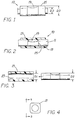
- FIGURE 1 is a side elevation view, somewhat enlarged, of an embodiment of the new level vial assembly.
- FIGURE 2 is a side elevation view of the vial assembly of FIGURE 1 with the resilient outer sleeve shown in cross-section.
- FIGURE 3 is a side elevation view of the vial assembly of FIGURE 1 with the vial and outer sleeve separated in preparation for assembly.
- FIGURE 4 is an end elevation view of another embodiment of the new vial assembly.
- FIGURE 5 is a side elevation view of the embodiment of FIGURE 4 taken along the viewing plane 5-5 thereof.
- FIGURE 6 is a cross-section side elevation view of one-half of another embodiment of the new vial assembly. The view is that portion of the assembly to one side of the assembly longitudinal central axis and is enlarged to show certain details.
- FIGURE 7 is a side elevation view of the embodiment of FIGURE 6.
- the rigid outer sleeve is shown in cross-section.
- FIGURE 8 is a representative view of an aspect of assembling the embodiment of FIGURE 1 using an exemplary arbor press. Parts are broken away.
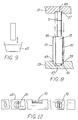
- FIGURE 9 is a representative view of a vessel of lubricant and a sleeve or vial to be dipped in such lubricant.
- FIGURE 10 is a side elevation view of an aspect of assembling the embodiment of FIGURE 1 using a described abutment member.
- FIGURE 11 is an elevation view of the abutment member taken along the viewing plane 11-11 of FIGURE 10. Surfaces are shown in dashed outline and parts are broken away.
- FIGURE 12 is an elevation view of a carpenter or builder's level incorporating the inventive vial assembly. Parts are broken away.
- the new liquid vial assembly 10 comprises a liquid-containing vial 11 having a seamless, generally-cylindrical wall 13, i.e., a wall 13 formed as a unitary structure unbroken by joints, abutments or the like along its length.
- a wall 13 formed as a unitary structure unbroken by joints, abutments or the like along its length.
- Such wall 13 (together with any end plugs 15 or the like) confines the liquid 17 (and the bubble 19) used for determining whether, e.g., a floor is horizontal or a wall is vertical.
- a transparent outer sleeve 21 extends along the wall 13 and the resistance of the vial 11 to breakage is thereby improved by such sleeve 21.
- the outer sleeve 21 is resilient (and slightly stretched when on the vial 11) but as shown in FIGURE 6, such sleeve 21 may also be made of a rigid, relatively-hard material.
- the sleeve 21 has an interior passage 23 with a first diameter D1
- the vial cylindrical wall 13 has an outer second diameter D2.
- the first diameter D1 is not greater than the second diameter D2.
- such first diameter D1 is less than such second diameter D2.
- a preferred resilient outer sleeve 21 has a hardness in the range of 60 to 100 as measured on the Shore A scale and, more preferably, a hardness in the range of 75 to 85 on such scale.
- An ideal material for a resilient sleeve 21 is polyvinyl chloride tubing or polyurethane.
- the resilient sleeve 21 is stretched around the wall. In other words, such sleeve 21 is in tension about its circumference. Because the sleeve 21 "grips" the vial 11 very firmly, the sleeve 21 and the vial 11 are tightly secured to one another.
- the vial cylindrical wall 11 has an outside diameter D2
- the entire assembly 10 has an outside diameter D3 and the outside diameter D3 of the assembly is at least about 1.03 times the outside diameter D2 of the cylindrical wall 13. More preferably, the outside diameter D3 of the assembly 10 is in the range of about 1.3 to 1.8 times the outside diameter D2 of the cylindrical wall 13.
- the outside diameter D2 of the vial wall 13 is about 0.373 inches and when such sleeve 21 is in its "unstretched" or repose state, its inside diameter D1 is about 0.360 inches.
- the sleeve outside diameter D3 is about 0.550 inches or slightly less.
- FIGURES 1 and 2 With a cylindrical sleeve 21 (whether resilient as in FIGURES 1 and 2 or rigid as in FIGURE 6), there is very-apparent magnification of both the reference lines 25 around the outer circumference of the vial 11 and the bubble 19 in the vial 11 so that the relationship of the bubble 19 to the lines 25 is easier to see. Such magnification is apparent by comparing FIGURES 1 and 2.
- the outer sleeve 21 is generally rectangular in cross-section, e.g., square, and the reference lines 25 and the bubble 19 are more greatly magnified for easier viewing.
- FIGURES 4 and 5 represent a vial assembly 10 having a rectangular sleeve 21 which is either resilient or hard.
- Liquids 27 suitable for use in the above-described embodiment include mineral oil, silicone fluid and glycerine or other liquids having similar viscosity, resistance to evaporation and chemical compatibility with the material(s) from which the vial 11 and sleeve 21 are made.
- a liquid-sealing member 29 extending between the cylindrical wall 13 and the outer sleeve 21.
- Appropriate sealing members 29 include epoxy resin 29a and elastomeric seals 29b, as examples.
- Another way to make an assembly 10 having a hard sleeve 21 is to beat the sleeve 21 so that it expands slightly. After such heating, the sleeve 21 and the vial 11 are assembled to one another. When the sleeve 21 cools, it is in intimate contact with the vial 11 and separation of the two is quite difficult. No liquid-sealing member 29 would normally be required.
- the vial cylindrical wall 13 is made of a first material and the outer sleeve 21 is made of a second material which is substantially non-shatterable.
- second material may be polyvinyl chloride or another material having similar physical properties.
- a harder material is desired, such material may be selected from a group of materials including polycarbonate, polymethyl methacrylate, amorphous nylon, tempered glass, polyethylene terephthalate, polyethylene terephthalate glycol and polyester polycarbonate blends.
- a preferred sleeve 21 made of such relatively-hard material has a hardness in the range of 75-100 and, most preferably, in the range of 90-95, both measured on the Rockwell M scale.
- FIGURE 9 depicts the top and bottom platens of an arbor press, an exemplary machine useful in the method.
- the top platen 31 has a counterbored pocket 37 while the bottom platen 33 has counterbored pockets 39 and 41.
- the pocket 39 is sized to receive an end 43 of the sleeve 21 with slight clearance.
- the pockets 37 and 41 are sized to receive respective ends 45, 47 of the vial 11 with slight clearance.
- the vial 11 and sleeve 21 are urged together by moving the top platen 31 toward the bottom platen 33. After initial insertion, the vial 11 seals the other end 49 of the sleeve 21, the pressure of the air trapped in the sleeve 21 increases and the sleeve 21 stretches somewhat as represented by the dashed lines 51.
- the method may be carried out by reversing the positions of the vial 11 and sleeve 21 from those shown in FIGURE 8 and, with appropriately-configured pockets 37, 39, 41 in appropriate platens 31, 33, urging the sleeve 21 downward onto the vial 11.
- higher-production "clamp-like" tooling and equipment may be used for urging sleeve 21 and vial 11 together.
- the vial 11 and sleeve 21 may also be assembled by providing a generally-cylindrical liquid-containing vial 11, providing a sleeve 21 having a first end 53 and a second end 55 and restraining the sleeve first end 53.
- the vial 11 is urged into the second end 55 of the sleeve 21.
- the restraining step includes placing an abutment member 57 against the first end 53 in a manner to permit air to escape from the sleeve interior passage 23.
- Possible "shaving" of the wall defining the sleeve interior passage 23 may be avoided by slightly chamfering the end edge 59 of the vial 11.
- a suitable abutment member 57 is shown in FIGURE 11.
- a lubricant 63 may be provided between such vial 11 and sleeve 21. Ways to provide such lubricant 63 include dipping the sleeve 21 in a lubricant 63 as shown in FIGURE 9 and/or dipping the vial 11 in a lubricant 63, or otherwise applying the lubricant 63 to the sleeve 21 and/or to the vial 11.
- a lubricant 63 comprising a few drops of dishwashing detergent mixed with, say, one-half cup of water is very satisfactory.
- a variant of the preferred method for making an encapsulated level vial assembly 10 having a hard sleeve 21 includes the steps of providing a liquid-containing vial 11, providing a sleeve 21, applying a liquid 27 to the vial 11, to the sleeve 21 or to both and urging the vial 11 and sleeve 21 together.
- the liquid may be provided between the vial 11 and the sleeve 21 after such vial 11 and sleeve 21 are assembled.
- Such liquid 27 may be provided between the vial 11 and the sleeve 21 by differential pressure between the sleeve ends 53, 55.
- the liquid 27 may be drawn or “sucked” into one end 53 or 55 of the sleeve 21 by immersing that end 53 or 55 in the liquid 27 and imposing a slight vacuum at the other.
- such liquid 27 may be pressure-injected into an end 53 or 55.
- a seal member 29 is used between the vial 11 and the sleeve 21 for liquid retention.
- FIGURE 12 shows a builder's level 65 equipped with the new vial assembly 10.
- the encapsulated vial assembly 10 involves a new mode of construction and affords the user new properties not heretofore available in level vials.
- the assembly 10 represents the first practical, easy-to-make, easy-to-mount success in the field of builder's levels.
Landscapes
- Physics & Mathematics (AREA)
- Engineering & Computer Science (AREA)
- General Physics & Mathematics (AREA)
- Radar, Positioning & Navigation (AREA)
- Remote Sensing (AREA)
- Details Of Rigid Or Semi-Rigid Containers (AREA)
- Medical Preparation Storing Or Oral Administration Devices (AREA)
Applications Claiming Priority (2)
| Application Number | Priority Date | Filing Date | Title |
|---|---|---|---|
| US08/397,430 US5588217A (en) | 1995-03-01 | 1995-03-01 | Level vial assembly with encapsulated vial |
| US397430 | 1999-09-17 |
Publications (2)
| Publication Number | Publication Date |
|---|---|
| EP0730136A1 true EP0730136A1 (fr) | 1996-09-04 |
| EP0730136B1 EP0730136B1 (fr) | 2002-06-26 |
Family
ID=23571170
Family Applications (1)
| Application Number | Title | Priority Date | Filing Date |
|---|---|---|---|
| EP96103126A Expired - Lifetime EP0730136B1 (fr) | 1995-03-01 | 1996-03-01 | Niveau à bulle avec ensemble de fiole encapsulé |
Country Status (3)
| Country | Link |
|---|---|
| US (1) | US5588217A (fr) |
| EP (1) | EP0730136B1 (fr) |
| DE (1) | DE69621966T2 (fr) |
Families Citing this family (17)
| Publication number | Priority date | Publication date | Assignee | Title |
|---|---|---|---|---|
| IL123586A (en) | 1998-03-06 | 2001-04-30 | Karpo Ind Ltd | Spirit level with hand grips |
| US6138369A (en) * | 1998-04-08 | 2000-10-31 | Mushin; Uriel | Level indicator for a wall-mounted fixture |
| DE29814656U1 (de) * | 1998-08-14 | 1999-12-23 | Stabila-Messgeräte Gustav Ullrich GmbH & Co KG, 76855 Annweiler | Wasserwaage |
| US6205669B1 (en) * | 1999-02-04 | 2001-03-27 | Dennis R. Sollars | Wall hanging level |
| US6735880B1 (en) * | 1999-11-22 | 2004-05-18 | Great Neck Saw Manufacturers, Inc. | Vial and method of making same |
| US6434842B1 (en) | 2000-08-13 | 2002-08-20 | Rasping Level Technology Inc. | Rasping level |
| US6915586B2 (en) | 2003-08-18 | 2005-07-12 | Empire Level Mfg. Corp. | Box level |
| US7086167B2 (en) * | 2004-04-16 | 2006-08-08 | Empire Level Mfg. Corp. | Overmolded vial for use with a level |
| GB0500906D0 (en) | 2005-01-17 | 2005-02-23 | Dupont Teijin Films Us Ltd | Coextruded polymeric film |
| US7603961B2 (en) * | 2006-05-15 | 2009-10-20 | Danny Mayenschein | Lighted orientation device |
| US7472487B2 (en) * | 2006-05-26 | 2009-01-06 | The Stanley Works | Level |
| DE202009016443U1 (de) * | 2009-12-04 | 2011-04-14 | Bayerische Maß-Industrie Arno Keller GmbH | Wasserwaage aus einem Holz-Kunststoff-Verbundmaterial |
| IL224928A0 (en) | 2013-02-26 | 2013-07-31 | Kapro Ind Ltd | leveler |
| US9170104B2 (en) | 2013-12-16 | 2015-10-27 | Stanley Black & Decker, Inc. | Level vial and method of manufacturing same |
| USD730207S1 (en) | 2014-03-05 | 2015-05-26 | Kapro Industries Ltd. | Spirit level |
| USD750984S1 (en) | 2014-09-30 | 2016-03-08 | Kapro Industries Ltd. | Box spirit level with ruler |
| USD805928S1 (en) | 2016-09-21 | 2017-12-26 | Kapro Industries Ltd. | Stud layout level |
Citations (5)
| Publication number | Priority date | Publication date | Assignee | Title |
|---|---|---|---|---|
| FR1147312A (fr) * | 1956-04-09 | 1957-11-21 | Fiole incassable perfectionnée pour niveaux et dispositifs analogues | |
| US3871109A (en) * | 1973-03-12 | 1975-03-18 | Peter P Vaida | Level vial |
| FR2449868A1 (fr) * | 1979-02-26 | 1980-09-19 | Stanley Mabo | Enveloppe pour la protection d'une fiole de niveau |
| DE3407583A1 (de) * | 1984-03-01 | 1984-10-04 | Werner 8401 Graßlfing Krieger | Unzerbrechliche wasserwaage |
| EP0455979A2 (fr) * | 1990-05-08 | 1991-11-13 | Bayerische Mass-Industrie Arno Keller Gmbh | Procédé de fabrication d'une fiole pour niveau à bulle |
Family Cites Families (14)
| Publication number | Priority date | Publication date | Assignee | Title |
|---|---|---|---|---|
| US3311990A (en) * | 1967-04-04 | Edward j. brenner | ||
| US2755561A (en) * | 1956-07-24 | hqlnjaah | ||
| US784418A (en) * | 1901-05-13 | 1905-03-07 | Henry N Northoff | Spirit-level. |
| US1291230A (en) * | 1917-11-24 | 1919-01-14 | Frederick Stitzel | Indicator. |
| US1384062A (en) * | 1919-05-19 | 1921-07-12 | Happle John | Level |
| US1578786A (en) * | 1923-08-20 | 1926-03-30 | E R Watts & Son Ltd | Spirit level |
| US1614814A (en) * | 1923-09-26 | 1927-01-18 | Adolph D Willson | Gradometer |
| US1654248A (en) * | 1925-05-16 | 1927-12-27 | Erdmann Friedrich | Illuminated level |
| US1622752A (en) * | 1926-05-05 | 1927-03-29 | George J Yakesh | Inclination indicator |
| US2102364A (en) * | 1935-12-23 | 1937-12-14 | Dietzgen Eugene Co | Spirit level and means for mounting same |
| US2221912A (en) * | 1939-11-13 | 1940-11-19 | Bausch & Lomb | Liquid level |
| GB1001771A (en) * | 1963-05-01 | 1965-08-18 | Saunders Roe & Nuclear Entpr | Improvements in or relating to the illumination of levelling bubbles |
| US4085515A (en) * | 1977-01-17 | 1978-04-25 | Darden Donald R | Alignment device |
| JPS60232502A (ja) * | 1984-05-04 | 1985-11-19 | Tokyo Optical Co Ltd | 液体プリズム |
-
1995
- 1995-03-01 US US08/397,430 patent/US5588217A/en not_active Expired - Lifetime
-
1996
- 1996-03-01 DE DE69621966T patent/DE69621966T2/de not_active Expired - Fee Related
- 1996-03-01 EP EP96103126A patent/EP0730136B1/fr not_active Expired - Lifetime
Patent Citations (5)
| Publication number | Priority date | Publication date | Assignee | Title |
|---|---|---|---|---|
| FR1147312A (fr) * | 1956-04-09 | 1957-11-21 | Fiole incassable perfectionnée pour niveaux et dispositifs analogues | |
| US3871109A (en) * | 1973-03-12 | 1975-03-18 | Peter P Vaida | Level vial |
| FR2449868A1 (fr) * | 1979-02-26 | 1980-09-19 | Stanley Mabo | Enveloppe pour la protection d'une fiole de niveau |
| DE3407583A1 (de) * | 1984-03-01 | 1984-10-04 | Werner 8401 Graßlfing Krieger | Unzerbrechliche wasserwaage |
| EP0455979A2 (fr) * | 1990-05-08 | 1991-11-13 | Bayerische Mass-Industrie Arno Keller Gmbh | Procédé de fabrication d'une fiole pour niveau à bulle |
Also Published As
| Publication number | Publication date |
|---|---|
| EP0730136B1 (fr) | 2002-06-26 |
| DE69621966D1 (de) | 2002-08-01 |
| US5588217A (en) | 1996-12-31 |
| DE69621966T2 (de) | 2003-03-27 |
Similar Documents
| Publication | Publication Date | Title |
|---|---|---|
| US5588217A (en) | Level vial assembly with encapsulated vial | |
| US3311990A (en) | Edward j. brenner | |
| CA2083067C (fr) | Niveau pour positionnement de poteaux | |
| US20110162222A1 (en) | Spirit level having horizontal bubble vial with improved bubble visibility | |
| US10852133B2 (en) | Level with metal frame supporting protective outer body | |
| US8011109B2 (en) | Casing mount for a cylindrical vial | |
| CA2138235A1 (fr) | Detecteur et discriminateur de niveau optiques | |
| US11506491B2 (en) | Vial with improved visibility for level | |
| WO2003039969A3 (fr) | Emballage pour lentilles de contact | |
| MXPA05013852A (es) | Estructura y metodo para soportar y proteger tubos en niveles. | |
| FR2715133B1 (fr) | Récipient à paroi souple déformable, du type flacon, poche ou tube, et procédé de fabrication d'un tel récipient. | |
| US2755561A (en) | hqlnjaah | |
| US5495290A (en) | Video camera having a view finder with a shield | |
| US5309645A (en) | Combination plumb or level and height setting instruments | |
| US20060254066A1 (en) | Level-determining adhesive patch | |
| GB2348953A (en) | Spirit level device | |
| GB2287534A (en) | Adjustable spirit level | |
| KR20080004099U (ko) | 수평각도측정기 | |
| JP2002181707A (ja) | プール水の透明度測定鏡筒および透明度測定キット | |
| CN219046151U (zh) | 一种互卡式光学镜片 | |
| JPH0767543B2 (ja) | 角度が固定された遠心分離機ロータに用いるチューブ | |
| WO2009136947A1 (fr) | Niveau | |
| US7501182B2 (en) | Light transmitting material, structure connecting light transmitting material and optical device, and method for manufacturing light transmitting material | |
| KR920001888Y1 (ko) | 수도계량기 계수투시판내의 기포방지장치 | |
| CN210864191U (zh) | 一种望远镜塑料镜身 |
Legal Events
| Date | Code | Title | Description |
|---|---|---|---|
| PUAI | Public reference made under article 153(3) epc to a published international application that has entered the european phase |
Free format text: ORIGINAL CODE: 0009012 |
|
| AK | Designated contracting states |
Kind code of ref document: A1 Designated state(s): DE FR GB |
|
| 17P | Request for examination filed |
Effective date: 19961213 |
|
| 17Q | First examination report despatched |
Effective date: 19990527 |
|
| GRAG | Despatch of communication of intention to grant |
Free format text: ORIGINAL CODE: EPIDOS AGRA |
|
| GRAG | Despatch of communication of intention to grant |
Free format text: ORIGINAL CODE: EPIDOS AGRA |
|
| GRAH | Despatch of communication of intention to grant a patent |
Free format text: ORIGINAL CODE: EPIDOS IGRA |
|
| GRAH | Despatch of communication of intention to grant a patent |
Free format text: ORIGINAL CODE: EPIDOS IGRA |
|
| GRAH | Despatch of communication of intention to grant a patent |
Free format text: ORIGINAL CODE: EPIDOS IGRA |
|
| GRAA | (expected) grant |
Free format text: ORIGINAL CODE: 0009210 |
|
| AK | Designated contracting states |
Kind code of ref document: B1 Designated state(s): DE FR GB |
|
| REG | Reference to a national code |
Ref country code: GB Ref legal event code: FG4D |
|
| REF | Corresponds to: |
Ref document number: 69621966 Country of ref document: DE Date of ref document: 20020801 |
|
| ET | Fr: translation filed | ||
| PLBE | No opposition filed within time limit |
Free format text: ORIGINAL CODE: 0009261 |
|
| STAA | Information on the status of an ep patent application or granted ep patent |
Free format text: STATUS: NO OPPOSITION FILED WITHIN TIME LIMIT |
|
| 26N | No opposition filed |
Effective date: 20030327 |
|
| PGFP | Annual fee paid to national office [announced via postgrant information from national office to epo] |
Ref country code: GB Payment date: 20040225 Year of fee payment: 9 |
|
| PGFP | Annual fee paid to national office [announced via postgrant information from national office to epo] |
Ref country code: FR Payment date: 20040309 Year of fee payment: 9 |
|
| PGFP | Annual fee paid to national office [announced via postgrant information from national office to epo] |
Ref country code: DE Payment date: 20040311 Year of fee payment: 9 |
|
| PG25 | Lapsed in a contracting state [announced via postgrant information from national office to epo] |
Ref country code: GB Free format text: LAPSE BECAUSE OF NON-PAYMENT OF DUE FEES Effective date: 20050301 |
|
| PG25 | Lapsed in a contracting state [announced via postgrant information from national office to epo] |
Ref country code: DE Free format text: LAPSE BECAUSE OF NON-PAYMENT OF DUE FEES Effective date: 20051001 |
|
| GBPC | Gb: european patent ceased through non-payment of renewal fee |
Effective date: 20050301 |
|
| PG25 | Lapsed in a contracting state [announced via postgrant information from national office to epo] |
Ref country code: FR Free format text: LAPSE BECAUSE OF NON-PAYMENT OF DUE FEES Effective date: 20051130 |
|
| REG | Reference to a national code |
Ref country code: FR Ref legal event code: ST Effective date: 20051130 |