EP0730860B1 - Mischmicellen - Google Patents
Mischmicellen Download PDFInfo
- Publication number
- EP0730860B1 EP0730860B1 EP96103363A EP96103363A EP0730860B1 EP 0730860 B1 EP0730860 B1 EP 0730860B1 EP 96103363 A EP96103363 A EP 96103363A EP 96103363 A EP96103363 A EP 96103363A EP 0730860 B1 EP0730860 B1 EP 0730860B1
- Authority
- EP
- European Patent Office
- Prior art keywords
- mixed micelles
- glycero
- micelles according
- water
- phosphocholine
- Prior art date
- Legal status (The legal status is an assumption and is not a legal conclusion. Google has not performed a legal analysis and makes no representation as to the accuracy of the status listed.)
- Expired - Lifetime
Links
Classifications
-
- A—HUMAN NECESSITIES
- A61—MEDICAL OR VETERINARY SCIENCE; HYGIENE
- A61K—PREPARATIONS FOR MEDICAL, DENTAL OR TOILETRY PURPOSES
- A61K8/00—Cosmetics or similar toiletry preparations
- A61K8/02—Cosmetics or similar toiletry preparations characterised by special physical form
- A61K8/0291—Micelles
-
- A—HUMAN NECESSITIES
- A61—MEDICAL OR VETERINARY SCIENCE; HYGIENE
- A61K—PREPARATIONS FOR MEDICAL, DENTAL OR TOILETRY PURPOSES
- A61K8/00—Cosmetics or similar toiletry preparations
- A61K8/18—Cosmetics or similar toiletry preparations characterised by the composition
- A61K8/30—Cosmetics or similar toiletry preparations characterised by the composition containing organic compounds
- A61K8/67—Vitamins
- A61K8/671—Vitamin A; Derivatives thereof, e.g. ester of vitamin A acid, ester of retinol, retinol, retinal
-
- A—HUMAN NECESSITIES
- A61—MEDICAL OR VETERINARY SCIENCE; HYGIENE
- A61K—PREPARATIONS FOR MEDICAL, DENTAL OR TOILETRY PURPOSES
- A61K8/00—Cosmetics or similar toiletry preparations
- A61K8/18—Cosmetics or similar toiletry preparations characterised by the composition
- A61K8/30—Cosmetics or similar toiletry preparations characterised by the composition containing organic compounds
- A61K8/67—Vitamins
- A61K8/676—Ascorbic acid, i.e. vitamin C
-
- A—HUMAN NECESSITIES
- A61—MEDICAL OR VETERINARY SCIENCE; HYGIENE
- A61K—PREPARATIONS FOR MEDICAL, DENTAL OR TOILETRY PURPOSES
- A61K8/00—Cosmetics or similar toiletry preparations
- A61K8/18—Cosmetics or similar toiletry preparations characterised by the composition
- A61K8/30—Cosmetics or similar toiletry preparations characterised by the composition containing organic compounds
- A61K8/67—Vitamins
- A61K8/678—Tocopherol, i.e. vitamin E
-
- A—HUMAN NECESSITIES
- A61—MEDICAL OR VETERINARY SCIENCE; HYGIENE
- A61K—PREPARATIONS FOR MEDICAL, DENTAL OR TOILETRY PURPOSES
- A61K9/00—Medicinal preparations characterised by special physical form
- A61K9/10—Dispersions; Emulsions
- A61K9/107—Emulsions ; Emulsion preconcentrates; Micelles
- A61K9/1075—Microemulsions or submicron emulsions; Preconcentrates or solids thereof; Micelles, e.g. made of phospholipids or block copolymers
-
- A—HUMAN NECESSITIES
- A61—MEDICAL OR VETERINARY SCIENCE; HYGIENE
- A61Q—SPECIFIC USE OF COSMETICS OR SIMILAR TOILETRY PREPARATIONS
- A61Q19/00—Preparations for care of the skin
-
- C—CHEMISTRY; METALLURGY
- C07—ORGANIC CHEMISTRY
- C07F—ACYCLIC, CARBOCYCLIC OR HETEROCYCLIC COMPOUNDS CONTAINING ELEMENTS OTHER THAN CARBON, HYDROGEN, HALOGEN, OXYGEN, NITROGEN, SULFUR, SELENIUM OR TELLURIUM
- C07F9/00—Compounds containing elements of Groups 5 or 15 of the Periodic Table
- C07F9/02—Phosphorus compounds
- C07F9/06—Phosphorus compounds without P—C bonds
- C07F9/08—Esters of oxyacids of phosphorus
- C07F9/09—Esters of phosphoric acids
- C07F9/10—Phosphatides, e.g. lecithin
-
- Y—GENERAL TAGGING OF NEW TECHNOLOGICAL DEVELOPMENTS; GENERAL TAGGING OF CROSS-SECTIONAL TECHNOLOGIES SPANNING OVER SEVERAL SECTIONS OF THE IPC; TECHNICAL SUBJECTS COVERED BY FORMER USPC CROSS-REFERENCE ART COLLECTIONS [XRACs] AND DIGESTS
- Y10—TECHNICAL SUBJECTS COVERED BY FORMER USPC
- Y10T—TECHNICAL SUBJECTS COVERED BY FORMER US CLASSIFICATION
- Y10T428/00—Stock material or miscellaneous articles
- Y10T428/29—Coated or structually defined flake, particle, cell, strand, strand portion, rod, filament, macroscopic fiber or mass thereof
- Y10T428/2982—Particulate matter [e.g., sphere, flake, etc.]
- Y10T428/2984—Microcapsule with fluid core [includes liposome]
Definitions
- the present invention relates to new mixed micelles and Compositions that contain such mixed micelles.
- Micell systems are poor for aqueous solubilization in water or insoluble active ingredients, e.g. active pharmaceutical ingredients in formulations which can be administered parenterally, to improve the parenteral compatibility with water-soluble active substances (cf. EP-A-0280 887) or to improve skin penetration by pharmaceutical Active ingredients or cosmetics are used (cf. EP-A-0 439 042).
- the European patent application EP 154 977 describes Glycerin ether phosphatide, used for the preparation of the above Mixed micelle systems can be used.
- Phase transition temperature that with saturated phosphatides long-chain fatty acid residues is significantly higher than e.g. at Soya- or Egg lecithin (e.g. at around 50 ° C for fully hydrogenated soy lecithin as opposed to about -18 ° C for the non-hydrogenated Product). This fact is used e.g. of perhydrated Soyalecithin for the production of mixed micelles for storage temperatures from room temperature or below.
- Lecithins with short chain carboxylic acids have a low one Phase transition temperature, so that in principle mixed micelles at room temperature are producible.
- these lecithins are too toxic or hemolytic to be used parenterally, however Mixed micelles of dihexanoyl lecithin and egg or soy lecithin for such Proposed applications (see. EP-A-0011745).
- Dilaurylphosphatidylcholine shows a phase transition temperature of approx. 0 ° C and has no hemolytic activity. It however, the one typical for egg and soy lecithin and for use in Bile salt mixed micelles important antihemolytic effect, so that DLPC bile salt mixed micelles are also not used parenterally.
- the invention further relates to the use of such Mixed micelles for aqueous solubilization of bad or in water non-soluble active ingredients, e.g. active pharmaceutical ingredients in formulations which can be administered parenterally, to improve the parenteral compatibility with water-soluble active ingredients or Improve skin penetration of pharmaceutical agents or Cosmetics, continue in Diagnostics to stabilize proteins, such as e.g. membrane-bound receptors.
- active ingredients e.g. active pharmaceutical ingredients in formulations which can be administered parenterally, to improve the parenteral compatibility with water-soluble active ingredients or Improve skin penetration of pharmaceutical agents or Cosmetics, continue in Diagnostics to stabilize proteins, such as e.g. membrane-bound receptors.
- the mixed micelles according to the invention can be in aqueous solution from the components, i.e. from a bile salt or dihexanoyl lecithin, and a phosphatide with saturated, branched fatty acid residues in a manner known per se, e.g. as in the patent publications DE-A-27 30 570 and WO 90/08534 are described, for example by mixing the individual components or by making the Micellogen and an optionally added active ingredient in one organic solvents, e.g.
- Methylene chloride, ethanol and / or Methanol dissolves the solvent, conveniently in one Rotary evaporator, removed and the residue in water or one aqueous solution of pharmaceutical auxiliaries, such as buffer substances or Triggers isotonizing agents; or the free bile acids, if appropriate with the addition of pharmaceutical auxiliaries and / or water-soluble Active ingredients, suspended in water, the phosphatide and optionally active pharmaceutical ingredients or cosmetics dispersed in the suspension and the product with a base, e.g. an alkali hydroxide, neutralized.
- pharmaceutical auxiliaries such as buffer substances or Triggers isotonizing agents
- free bile acids if appropriate with the addition of pharmaceutical auxiliaries and / or water-soluble Active ingredients, suspended in water, the phosphatide and optionally active pharmaceutical ingredients or cosmetics dispersed in the suspension and the product with a base, e.g. an alkali hydroxide, neutralized.
- bile acid salts for the inventive Mixed micelles are suitable are alkali salts, such as sodium salts of Cholic acid, glycocholic acid, taurocholic acid, deoxycholic acid, glyco- or Taurodeoxycholic acid, chenodeoxycholic acid and glyco- or taurochenoxydeoxycholic acid.
- Sodium glycocholate is preferred.
- the molar The ratio of phosphatide: bile acid salt is appropriately about 0.1: 1 to 2: 1, preferably 0.8: 1 to 1.5: 1.
- the bile salt concentration is said to be always above the bile salt-specific micelle concentration (CMC).
- the mixed micelles according to the invention can active pharmaceutical ingredients for parenteral, topical or oral Administration included, especially insoluble or poorly soluble in water Active substances, or cosmetics, as well as auxiliary substances, such as buffers, e.g. Phosphate-, Citrate or tris buffer; or isotonizing agents e.g. Sodium chloride, Mannitol, sorbitol or glucose; or preservatives, e.g. Methyl- or propyl p-hydroxybenzoate, benzyl alcohol or phenol.
- buffers e.g. Phosphate-, Citrate or tris buffer
- isotonizing agents e.g. Sodium chloride, Mannitol, sorbitol or glucose
- preservatives e.g. Methyl- or propyl p-hydroxybenzoate, benzyl alcohol or phenol.
- retinoids are like all trans, 13-cis and 9-cis retinoic acid and its derivatives including aromatic Compounds such as etretinate, vitamin K, vitamin D and their derivatives; peroxide-containing active ingredients such as artemisinin, arteflene and benzoyl peroxide; water-soluble low-molecular and high-molecular active substances such as Pyrimidine analogs (5-fluorouracil); heparin; and proteins.
- Interferons such as IFN- ⁇ , IFN- ⁇ , IFN- ⁇ hybrid interferons; Interleukins (IL), such as IL-1 (ETAF, LAF), IL-2 (TCGF), IL-3 (Multi-CSF, MCGF), IL-4 (BSF-1, BCGF-1), IL-5 (TRF, BCGF-II), IL-7 (lymphopoietin 1); Lymphotoxin (TNF- ⁇ ); Macrophage inhibitory factor (MIF); thymopoietin (TPO); Transforming growth factor- ⁇ (TGF- ⁇ ); Transforming Growth Factor- ⁇ (TGF- ⁇ ); Tumor necrosis factor (TNF- ⁇ , cachectin, DIF); Uromodulin (Tamm-Horsfall protein); neuroleukin; CD4; Proteins with Effects on immune functions, such as granulocyte colony stimulating Factor (G-CSF), granulocyte-macrophage
- G-CSF granul
- Vitamin E examples of cosmetics in the mixed micelles according to the invention
- Vitamin E, panthenol and humectants can be included such as lactic and pyrrolidone carboxylic acid and their salts.
- the mixed micelles according to the invention can be in aqueous or organic-aqueous solution or as lyophilisates of such solutions available.
- the mixed micelles can be mixed in one Concentration up to about 200 mg phosphatide / ml may be included.
- the Mixed micell solutions can be pharmaceutical active ingredients or cosmetics preferably contained in amounts of up to about 20 mg / ml.
- Phosphatides with branched fatty acid residues are generally known. You come e.g. in breast milk and skin lipids. You can e.g. by partial esterification of glycerin with the corresponding saturated, branched fatty acids for di-ester, phosphorylation of the diester and reaction with a suitable choline salt, such as choline tosylate, as described below or in analogy.
- a suitable choline salt such as choline tosylate
- Ethanol and water were degassed to prepare the solutions and all manipulations carried out under red light and nitrogen.
- the water-soluble excipients were dissolved in water and the pH adjusted to 6.0 set.
- 9-cis-retinoic acid and tocopherol were dissolved in ethanol.
- the Solution of the water-soluble substances became the ethanolic lecithin solution given and stirred until a clear solution is formed (18 h).
- the ethanolic solution of 9-cis-retinoic acid was added and set the volume.
- the mixed micelle solution thus obtained was in Bottles filled with Teflon stoppers and sterilized at 120 ° C for 20 min.
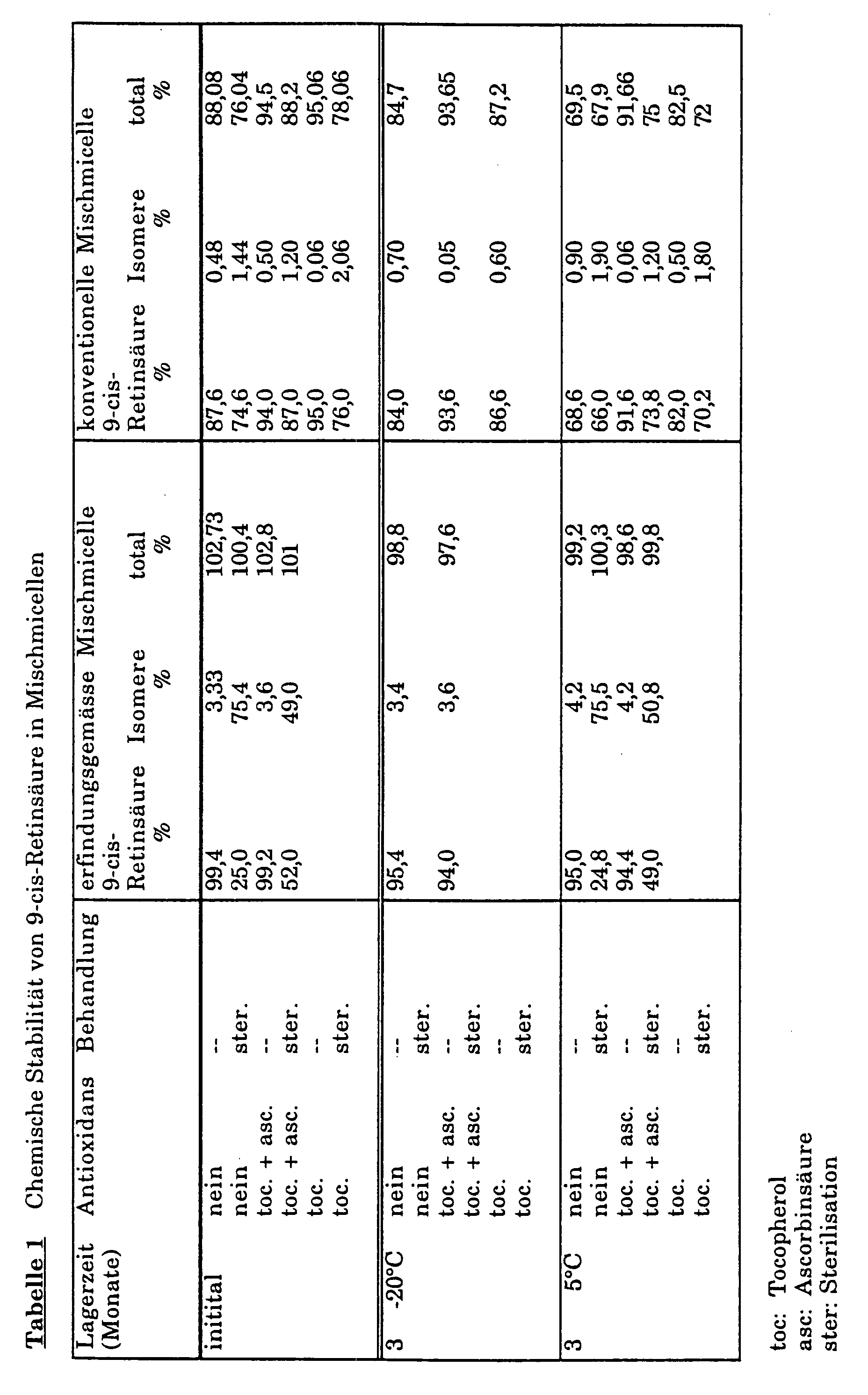
- the chemical stability of 9-cis retinoic acid in these solutions after 3 Months of storage at different temperatures is from Table 1 seen.
Landscapes
- Health & Medical Sciences (AREA)
- Life Sciences & Earth Sciences (AREA)
- General Health & Medical Sciences (AREA)
- Animal Behavior & Ethology (AREA)
- Public Health (AREA)
- Veterinary Medicine (AREA)
- Epidemiology (AREA)
- Chemical & Material Sciences (AREA)
- Birds (AREA)
- Molecular Biology (AREA)
- Organic Chemistry (AREA)
- Biochemistry (AREA)
- Biophysics (AREA)
- Dispersion Chemistry (AREA)
- Medicinal Chemistry (AREA)
- Pharmacology & Pharmacy (AREA)
- Dermatology (AREA)
- Medicinal Preparation (AREA)
- Cosmetics (AREA)
- Pharmaceuticals Containing Other Organic And Inorganic Compounds (AREA)
- Coloring Foods And Improving Nutritive Qualities (AREA)
Description
- 1,2-Di(10-methylnonadecanoyl)-sn-glycero-3-phosphoethanolamin,
- 1,2-Di(10-methylstearoyl)-sn-glycero-3-phosphoethanolamin,
- 1,2-Di(8-methylheptadecanoyl)-sn-glycero-3-phosphoethanolamin,
- 1,2-Di(8-methylpalmitoyl)-sn-glycero-3-phosphoethanolamin, und
- 1,2-Di(10-ethylstearoyl)-sn-glycero-3-phosphoethanolamin.
| /01 | /02 | /03 | /04 | /05 | ||
| 9-cis-Retinsäure | 0,5 | 0,5 | 0,5 | 0,5 | 0,5 | mg |
| Ethanol 94% (w/w) | 100,0 | 100,0 | 100,0 | 100,0 | 100,0 | mg |
| Glycocholsäure | 88,5 | 88,5 | 88,5 | 88,5 | 88,5 | mg |
| Iso-Lecithin | 163 | 163 | mg | |||
| Soya-Lecithin | 152 | 152 | 152 | mg | ||
| NaOH ad | pH 6,0 | pH 6,0 | pH 6,0 | pH 6,0 | pH 6,0 | |
| Benzylalkohol | 10,0 | 10,0 | 10,0 | 10,0 | 10,0 | mg |
| dl-α-Tocopherol | -- | 10,0 | -- | 10,0 | 10,0 | µg |
| Ascorbinsäure | -- | 50,0 | -- | -- | 50,0 | µg |
| Wasser ad | 1,0 | 1,0 | 1,0 | 1,0 | 1,0 | ml |

Claims (11)
- Mischmicellen, die ausa) einem Phosphatid mit gesättigten, verzweigten Fettsäureresten undb) einem Gallensäuresalz oder Dihexanoyllecithin gebildet sind.
- Mischmicellen gemäss Anspruch 1, in denen die verzweigten Fettsäurereste 14 bis 20 C-Atome in gerader Kette enthalten.
- Mischmicellen gemäss Anspruch 1, in denen die verzweigten Fettsäurereste eine ungerade Anzahl von C-Atomen in gerader Kette aufweisen.
- Mischmicellen gemäss den Ansprüchen 1-3, in denen die verzweigten Fettsäurereste durch eine Methyl- oder Aethylgruppe einfach substituierte Fettsäurereste sind.
- Mischmicellen gemäss den Ansprüchen 1-4, deren Phasenübergangstemperatur unterhalb 20°C liegt.
- Mischmicellen gemäss den Ansprüchen 1-5, in denen das Phosphatidoder ein Enantiomer davon, oder ein entsprechendes Phospho-ethanolamin ist.1,2-Di(10-methylnonadecanoyl)-sn-glycero-3-phosphocholin,1,2-Di(10-methylstearoyl)-sn-glycero-3-phosphocholin,1,2-Di(8-methylheptadecanoyl)-sn-glycero-3-phosphocholin,1,2-Di(8-methylpalmitoyl)-sn-glycero-3-phosphocholin, oder1,2-Di(10-ethylstearoyl)-sn-glycero-3-phosphocholin,
- Mischmicellen gemäss den Ansprüchen 1-6, die ein Gallensäuresalz enthalten.
- Mischmicellen gemäss den Ansprüchen 1-7, die einen pharmazeutischen Wirkstoff oder ein Kosmetikum enthalten.
- Wässrige Kompositionen, enthaltend Mischmicellen gemäss den Ansprüchen 1-7, und Lyophilisate davon.
- Verfahren zur Herstellung von Mischmicellen gemäss den Ansprüchen 1-7 durch Vermischen der einzelnen Bestandteile oder dadurch, dass man die Micellbildner und einen gegebenenfalls beizufügenden Wirkstoff in einem organischen Lösungsmittel, z.B. Methylenchlorid, Aethanol und/oder Methanol löst, das Lösungsmittel, zweckmässig in einem Rotationsverdampfer, entfernt und den Rückstand in Wasser oder einer wässrigen Lösung von pharmazeutischen Hilfsstoffen, wie Pufferstoffen oder Isotonisierungsmitteln löst; oder die freien Gallensäuren, gegebenenfalls unter Zusatz pharmazeutischer Hilfsstoffe und/oder wasserlöslicher Wirkstoffe, in Wasser suspendiert, das Phosphatid und gegebenenfalls pharmazeutische Wirkstoffe oder Kosmetika in der Suspension dispergiert und das Produkt mit einer Base neutralisiert.
- Verwendung von Mischmicellen gemäss den Ansprüchen 1-7 zur wässrigen Solubilisierung von in Wasser schlecht oder nicht löslichen pharmazeutischen Wirkstoffen in parenteral verabreichbaren Formulierungen, zur Verbesserung der parenteralen Verträglichkeit bei wasserlöslichen Wirkstoffen oder zur Verbesserung der Hautpenetration von pharmazeutischen Wirkstoffe oder Kosmetika.
Applications Claiming Priority (3)
| Application Number | Priority Date | Filing Date | Title |
|---|---|---|---|
| CH65495 | 1995-03-07 | ||
| CH654/95 | 1995-03-07 | ||
| CH65495 | 1995-03-07 |
Publications (3)
| Publication Number | Publication Date |
|---|---|
| EP0730860A2 EP0730860A2 (de) | 1996-09-11 |
| EP0730860A3 EP0730860A3 (de) | 1996-12-18 |
| EP0730860B1 true EP0730860B1 (de) | 2002-01-02 |
Family
ID=4192048
Family Applications (1)
| Application Number | Title | Priority Date | Filing Date |
|---|---|---|---|
| EP96103363A Expired - Lifetime EP0730860B1 (de) | 1995-03-07 | 1996-03-05 | Mischmicellen |
Country Status (10)
| Country | Link |
|---|---|
| US (1) | US5747066A (de) |
| EP (1) | EP0730860B1 (de) |
| JP (1) | JP2740153B2 (de) |
| CN (1) | CN1064365C (de) |
| AR (1) | AR003933A1 (de) |
| AT (1) | ATE211382T1 (de) |
| BR (1) | BR9600926A (de) |
| CA (1) | CA2170687A1 (de) |
| DE (1) | DE59608527D1 (de) |
| TR (1) | TR199600185A2 (de) |
Cited By (6)
| Publication number | Priority date | Publication date | Assignee | Title |
|---|---|---|---|---|
| US7622130B2 (en) | 2004-05-19 | 2009-11-24 | Los Angeles Biomedical Research Institute at Harbor UCLA-Medical Center | Methods and compositions for the non-surgical removal of fat |
| US7754230B2 (en) | 2004-05-19 | 2010-07-13 | The Regents Of The University Of California | Methods and related compositions for reduction of fat |
| US8653058B2 (en) | 2011-04-05 | 2014-02-18 | Kythera Biopharmaceuticals, Inc. | Compositions comprising deoxycholic acid and salts thereof suitable for use in treating fat deposits |
| US8846066B2 (en) | 2004-05-19 | 2014-09-30 | The Regents Of The University Of California | Methods and related compositions for reduction of fat and skin tightening |
| US9186364B2 (en) | 2009-03-03 | 2015-11-17 | Kythera Biopharmaceuticals, Inc. | Formulations of deoxycholic acid and salts thereof |
| US11344561B2 (en) | 2011-02-18 | 2022-05-31 | Allergan Sales, Llc | Treatment of submental fat |
Families Citing this family (42)
| Publication number | Priority date | Publication date | Assignee | Title |
|---|---|---|---|---|
| US7070799B1 (en) * | 1998-02-10 | 2006-07-04 | Generex Pharmaceuticals, Inc. | Method for administering insulin to the buccal region |
| US6350458B1 (en) | 1998-02-10 | 2002-02-26 | Generex Pharmaceuticals Incorporated | Mixed micellar drug deliver system and method of preparation |
| DE19834814A1 (de) * | 1998-08-01 | 2000-02-03 | Beiersdorf Ag | Kosmetische und dermatologische Zubereitungen mit einem wirksamen Gehalt an Gallensäuren, ihren Salzen und/oder ihren Derivaten |
| US6849263B2 (en) * | 1998-12-21 | 2005-02-01 | Generex Pharmaceutical Incorporated | Pharmaceutical compositions for buccal delivery of pain relief medications |
| US7087215B2 (en) * | 1998-12-21 | 2006-08-08 | Generex Pharmaceuticals Incorporated | Methods of administering and enhancing absorption of pharmaceutical agents |
| US6267985B1 (en) | 1999-06-30 | 2001-07-31 | Lipocine Inc. | Clear oil-containing pharmaceutical compositions |
| US6294192B1 (en) | 1999-02-26 | 2001-09-25 | Lipocine, Inc. | Triglyceride-free compositions and methods for improved delivery of hydrophobic therapeutic agents |
| US6761903B2 (en) | 1999-06-30 | 2004-07-13 | Lipocine, Inc. | Clear oil-containing pharmaceutical compositions containing a therapeutic agent |
| US6383471B1 (en) | 1999-04-06 | 2002-05-07 | Lipocine, Inc. | Compositions and methods for improved delivery of ionizable hydrophobic therapeutic agents |
| US6309663B1 (en) | 1999-08-17 | 2001-10-30 | Lipocine Inc. | Triglyceride-free compositions and methods for enhanced absorption of hydrophilic therapeutic agents |
| US6458383B2 (en) | 1999-08-17 | 2002-10-01 | Lipocine, Inc. | Pharmaceutical dosage form for oral administration of hydrophilic drugs, particularly low molecular weight heparin |
| US20030236236A1 (en) * | 1999-06-30 | 2003-12-25 | Feng-Jing Chen | Pharmaceutical compositions and dosage forms for administration of hydrophobic drugs |
| US7732404B2 (en) * | 1999-12-30 | 2010-06-08 | Dexcel Ltd | Pro-nanodispersion for the delivery of cyclosporin |
| US20050059031A1 (en) * | 2000-10-06 | 2005-03-17 | Quantum Dot Corporation | Method for enhancing transport of semiconductor nanocrystals across biological membranes |
| EP2085781B2 (de) * | 2000-10-06 | 2020-03-11 | Life Technologies Corporation | Zellen mit spektralen Signaturen und Verfahren zur Herstellung und Verwendung davon |
| IL139177A0 (en) * | 2000-10-20 | 2001-11-25 | S C Republic Dev S R L | Sustained release drug delivery system |
| WO2002080883A2 (en) * | 2001-03-27 | 2002-10-17 | Phares Pharmaceutical Research N.V. | Method and composition for solubilising a biologically active compound with low water solubility |
| EP1498123A1 (de) * | 2003-07-18 | 2005-01-19 | Aventis Pharma S.A. | Emulgierende Systeme enthaltend Azetidin Derivate |
| EP1699432A2 (de) * | 2003-12-22 | 2006-09-13 | Aventis Pharmaceuticals, Inc. | Injizierbare phosphatidylcholin-präparate |
| ATE446581T1 (de) * | 2004-03-12 | 2009-11-15 | Trinity College Dublin | Magnetoresistives medium |
| JP4546228B2 (ja) * | 2004-12-02 | 2010-09-15 | 株式会社資生堂 | 経皮吸収促進用油性皮膚外用組成物 |
| GB0522942D0 (en) | 2005-11-10 | 2005-12-21 | Leigh Steven | Dissolution composition |
| US20070185066A1 (en) * | 2005-12-20 | 2007-08-09 | Verus Pharmaceuticals, Inc. | Systems and methods for the delivery of corticosteroids |
| US20070249572A1 (en) * | 2005-12-20 | 2007-10-25 | Verus Pharmaceuticals, Inc. | Systems and methods for the delivery of corticosteroids |
| US20070197486A1 (en) * | 2005-12-20 | 2007-08-23 | Verus Pharmaceuticals, Inc. | Methods and systems for the delivery of corticosteroids |
| US20070178049A1 (en) * | 2005-12-20 | 2007-08-02 | Verus Pharmaceuticals, Inc. | Systems and methods for the delivery of corticosteroids having an enhanced pharmacokinetic profile |
| US20070160542A1 (en) * | 2005-12-20 | 2007-07-12 | Verus Pharmaceuticals, Inc. | Methods and systems for the delivery of corticosteroids having an enhanced pharmacokinetic profile |
| WO2007095341A2 (en) * | 2006-02-15 | 2007-08-23 | Tika Läkemedel Ab | Sterilization of corticosteroids with reduced mass loss |
| WO2008040799A2 (en) * | 2006-10-06 | 2008-04-10 | Boehringer Ingelheim International Gmbh | Process for preparing instant forms of aqueous mixed micellar solutions as physiological buffer systems for use in the analysis of in vitro release |
| ES2335636B1 (es) * | 2008-02-29 | 2011-05-11 | Lipotec, S.A. | Composicion cosmetica o dermofarmaceutica de micelas mixtas. |
| US11304960B2 (en) | 2009-01-08 | 2022-04-19 | Chandrashekar Giliyar | Steroidal compositions |
| CN102058528B (zh) * | 2009-11-13 | 2012-12-12 | 中国科学院上海药物研究所 | 一种黄豆苷元胶束及其制备方法 |
| US9034858B2 (en) | 2010-11-30 | 2015-05-19 | Lipocine Inc. | High-strength testosterone undecanoate compositions |
| US20180153904A1 (en) | 2010-11-30 | 2018-06-07 | Lipocine Inc. | High-strength testosterone undecanoate compositions |
| US9358241B2 (en) | 2010-11-30 | 2016-06-07 | Lipocine Inc. | High-strength testosterone undecanoate compositions |
| US20120148675A1 (en) | 2010-12-10 | 2012-06-14 | Basawaraj Chickmath | Testosterone undecanoate compositions |
| US9498485B2 (en) | 2014-08-28 | 2016-11-22 | Lipocine Inc. | Bioavailable solid state (17-β)-hydroxy-4-androsten-3-one esters |
| US20170246187A1 (en) | 2014-08-28 | 2017-08-31 | Lipocine Inc. | (17-ß)-3-OXOANDROST-4-EN-17-YL TRIDECANOATE COMPOSITIONS AND METHODS OF THEIR PREPARATION AND USE |
| US20160361322A1 (en) | 2015-06-15 | 2016-12-15 | Lipocine Inc. | Composition and method for oral delivery of androgen prodrugs |
| WO2017127834A1 (en) * | 2016-01-23 | 2017-07-27 | Sand Bruce J | Enhanced transdermal delivery of active agents |
| US20180147215A1 (en) | 2016-11-28 | 2018-05-31 | Lipocine Inc. | Oral testosterone undecanoate therapy |
| US12150945B2 (en) | 2018-07-20 | 2024-11-26 | Lipocine Inc. | Liver disease |
Family Cites Families (10)
| Publication number | Priority date | Publication date | Assignee | Title |
|---|---|---|---|---|
| IT1202370B (it) * | 1976-07-12 | 1989-02-09 | Hoffmann La Roche | Soluzioni inietabili in cui l'atti vita' emolitica degli agenti di formazione di micelle naturali e' evitata mediante l'aggiunta di lipoidi e relativi prodotti |
| GR73668B (de) * | 1978-11-21 | 1984-03-28 | Hoffmann La Roche | |
| IL72420A (en) * | 1983-07-22 | 1987-10-30 | Hoffmann La Roche | Aqueous vitamin e solutions and their manufacture |
| CA1264162A (en) * | 1984-03-15 | 1990-01-02 | Manfred Breuninger | Glycerol ether phosphatides |
| CA1319886C (en) * | 1987-02-03 | 1993-07-06 | Alberto Ferro | Mixed micelle solutions |
| DE3903753A1 (de) * | 1989-02-06 | 1990-08-23 | Schering Ag | Verfahren zur herstellung waessriger mischmicelloesungen |
| NZ232865A (en) * | 1989-03-21 | 1992-07-28 | Hoffmann La Roche | A mixed-micelle solution comprising a micelle former and an immunomodulator |
| DE3938030A1 (de) * | 1989-11-13 | 1991-05-16 | Schering Ag | Verfahren zur herstellung waessriger mischmicelloesungen |
| CA2033725C (en) * | 1990-01-24 | 2001-05-29 | Folker Pittrof | Pharmaceutical and cosmetic compositions containing a salt of cholanic acid |
| EP0471309A1 (de) * | 1990-08-17 | 1992-02-19 | F. Hoffmann-La Roche Ag | Verwendung von Mischmicellen |
-
1996
- 1996-02-28 JP JP8040969A patent/JP2740153B2/ja not_active Expired - Lifetime
- 1996-02-29 CA CA002170687A patent/CA2170687A1/en not_active Abandoned
- 1996-03-05 DE DE59608527T patent/DE59608527D1/de not_active Expired - Fee Related
- 1996-03-05 AT AT96103363T patent/ATE211382T1/de not_active IP Right Cessation
- 1996-03-05 EP EP96103363A patent/EP0730860B1/de not_active Expired - Lifetime
- 1996-03-05 AR ARP960101632A patent/AR003933A1/es unknown
- 1996-03-06 TR TR96/00185A patent/TR199600185A2/xx unknown
- 1996-03-06 BR BR9600926A patent/BR9600926A/pt active Search and Examination
- 1996-03-06 CN CN96102193A patent/CN1064365C/zh not_active Expired - Fee Related
- 1996-03-07 US US08/612,047 patent/US5747066A/en not_active Expired - Fee Related
Cited By (13)
| Publication number | Priority date | Publication date | Assignee | Title |
|---|---|---|---|---|
| US7754230B2 (en) | 2004-05-19 | 2010-07-13 | The Regents Of The University Of California | Methods and related compositions for reduction of fat |
| US8298556B2 (en) | 2004-05-19 | 2012-10-30 | The Regents Of The University Of California | Methods and related compositions for the non-surgical removal of fat |
| US7622130B2 (en) | 2004-05-19 | 2009-11-24 | Los Angeles Biomedical Research Institute at Harbor UCLA-Medical Center | Methods and compositions for the non-surgical removal of fat |
| US8846066B2 (en) | 2004-05-19 | 2014-09-30 | The Regents Of The University Of California | Methods and related compositions for reduction of fat and skin tightening |
| US10058561B2 (en) | 2004-05-19 | 2018-08-28 | The Regents Of The University Of California | Methods and related compositions for reduction of fat and skin tightening |
| US9186364B2 (en) | 2009-03-03 | 2015-11-17 | Kythera Biopharmaceuticals, Inc. | Formulations of deoxycholic acid and salts thereof |
| US10071105B2 (en) | 2009-03-03 | 2018-09-11 | Kythera Biopharmaceuticals, Inc. | Formulations of deoxycholic acid and salts thereof |
| US10500214B2 (en) | 2009-03-03 | 2019-12-10 | Allergan Sales, Llc | Formulations of deoxycholic acid and salts thereof |
| US11179404B2 (en) | 2009-03-03 | 2021-11-23 | Allergan Sales, Llc | Formulations of deoxycholic acid and salts thereof |
| US11344561B2 (en) | 2011-02-18 | 2022-05-31 | Allergan Sales, Llc | Treatment of submental fat |
| US12161653B2 (en) | 2011-02-18 | 2024-12-10 | Allergan Sales, Llc | Treatment of submental fat |
| US8653058B2 (en) | 2011-04-05 | 2014-02-18 | Kythera Biopharmaceuticals, Inc. | Compositions comprising deoxycholic acid and salts thereof suitable for use in treating fat deposits |
| US10946030B2 (en) | 2011-04-05 | 2021-03-16 | Allergan Sales, Llc | Formulations of deoxycholic acid and salts thereof |
Also Published As
| Publication number | Publication date |
|---|---|
| JP2740153B2 (ja) | 1998-04-15 |
| EP0730860A2 (de) | 1996-09-11 |
| CN1064365C (zh) | 2001-04-11 |
| DE59608527D1 (de) | 2002-02-07 |
| JPH08245339A (ja) | 1996-09-24 |
| EP0730860A3 (de) | 1996-12-18 |
| CA2170687A1 (en) | 1996-09-08 |
| BR9600926A (pt) | 1997-12-30 |
| AR003933A1 (es) | 1998-09-30 |
| ATE211382T1 (de) | 2002-01-15 |
| US5747066A (en) | 1998-05-05 |
| TR199600185A2 (tr) | 1997-03-21 |
| CN1138585A (zh) | 1996-12-25 |
Similar Documents
| Publication | Publication Date | Title |
|---|---|---|
| EP0730860A2 (de) | Mischmicellen | |
| US5147859A (en) | Complexes of glycerrhetinic acid with phospholipids and pharmaceutical and cosmetic compositions containing them | |
| US5166139A (en) | Complexes of saponins and their aglycons with phospholipids and pharmaceutical and cosmetic compositions containing them | |
| EP0011745B1 (de) | Kolloide wässrige Zusammensetzung für pharmazeutische Zwecke, und deren Herstellung | |
| DE69128653T2 (de) | Verwendung von Alphatocopherol phosphate oder eines Derivates davon zur Herstellung kosmetischer, dermatologischer oder pharmazeutischer Präparate mit anti-radikaler Aktivität und Zusammensetzungen | |
| DE69434459T2 (de) | Zusammensetzung, welche apoptosis verhindert, methode zur reinigung dieser zusammensetzung und verwendungen davon | |
| EP0300282B1 (de) | Pharmazeutische und kosmetische Mittel, die Komplexe von Flavanolignanen mit Phospholipeden enthalten | |
| DE4430593C2 (de) | Verfahren zur Herstellung von Liposomal verkapseltem Taxol | |
| DE68922278T2 (de) | Liposom mit einem neuen Phosphat als Membranbestandteil, Liposomzubereitungen, sowie Kosmetika, welche dieses Phosphat beinhalten. | |
| DE3713494A1 (de) | Verfahren zur herstellung einer dispersion von lipidkuegelchen in einer waessrigen phase und nach diesem verfahren erhaeltliche dispersionen | |
| JP2010241818A (ja) | 電子移動剤のホスフェート誘導体を含有する処方 | |
| EP0956853A2 (de) | Verwendung von Nanodispersionen in pharmazeutischen Endformulierungen | |
| DE3713493A1 (de) | Kosmetisches oder pharmazeutisches mittel auf basis einer waessrigen dispersion von lipidkuegelchen | |
| EP1019417A1 (de) | Phospholipidanaloge verbindungen | |
| EP1002546B1 (de) | Verwendung von Estern der 12-Hydroxystearinsäure als Solubilisatoren | |
| EP1480620B1 (de) | (ester)-lysolecithine in liposomen | |
| DE68903736T2 (de) | Stabilisierte 2-phenyl-1,2-benzisoselenazol-3(2h)-on enthaltende, parenteral anzuwendende loesung und verfahren zu deren herstellung. | |
| EP1827379A2 (de) | Formulierungen mit alkylphosphocholinen unter verwendung von neuen negativen ladungsträgern | |
| DE60118625T2 (de) | Stabilisierte ascorbinsäure -3- phosphat- derivate | |
| JP2002535251A (ja) | 癌治療のための新規化合物 | |
| DE60029979T2 (de) | Liposomen-Formulierung der Verbindung 6,9-BIS-[(2-aminoethyl)benzo[g]isochinolin-5,10-dionidimaleat | |
| EP0747040A1 (de) | Petroleum mit Inositolphosphaten | |
| DE69605556T2 (de) | Ascorbyl-phosphorylcholesterol | |
| DE3042975A1 (de) | Mikrodispersion mit einem wirkstoff und/oder einem reagens in salzform als disperser phase | |
| EP1267943A2 (de) | Arzneimittel zur stimulierung der leukopoese, zur behandlung von tumor- und protozoenerkrankungen, von akarinosis, arthropodiasis und verfahren zu seiner herstellung |
Legal Events
| Date | Code | Title | Description |
|---|---|---|---|
| PUAI | Public reference made under article 153(3) epc to a published international application that has entered the european phase |
Free format text: ORIGINAL CODE: 0009012 |
|
| 17P | Request for examination filed |
Effective date: 19960305 |
|
| AK | Designated contracting states |
Kind code of ref document: A2 Designated state(s): AT BE CH DE DK ES FI FR GB GR IE IT LI LU NL PT SE |
|
| PUAL | Search report despatched |
Free format text: ORIGINAL CODE: 0009013 |
|
| AK | Designated contracting states |
Kind code of ref document: A3 Designated state(s): AT BE CH DE DK ES FI FR GB GR IE IT LI LU NL PT SE |
|
| 17Q | First examination report despatched |
Effective date: 20000606 |
|
| GRAG | Despatch of communication of intention to grant |
Free format text: ORIGINAL CODE: EPIDOS AGRA |
|
| GRAG | Despatch of communication of intention to grant |
Free format text: ORIGINAL CODE: EPIDOS AGRA |
|
| GRAH | Despatch of communication of intention to grant a patent |
Free format text: ORIGINAL CODE: EPIDOS IGRA |
|
| GRAH | Despatch of communication of intention to grant a patent |
Free format text: ORIGINAL CODE: EPIDOS IGRA |
|
| GRAA | (expected) grant |
Free format text: ORIGINAL CODE: 0009210 |
|
| REG | Reference to a national code |
Ref country code: GB Ref legal event code: IF02 |
|
| AK | Designated contracting states |
Kind code of ref document: B1 Designated state(s): AT BE CH DE DK ES FI FR GB GR IE IT LI LU NL PT SE |
|
| PG25 | Lapsed in a contracting state [announced via postgrant information from national office to epo] |
Ref country code: NL Free format text: LAPSE BECAUSE OF FAILURE TO SUBMIT A TRANSLATION OF THE DESCRIPTION OR TO PAY THE FEE WITHIN THE PRESCRIBED TIME-LIMIT Effective date: 20020102 Ref country code: IT Free format text: LAPSE BECAUSE OF FAILURE TO SUBMIT A TRANSLATION OF THE DESCRIPTION OR TO PAY THE FEE WITHIN THE PRE;WARNING: LAPSES OF ITALIAN PATENTS WITH EFFECTIVE DATE BEFORE 2007 MAY HAVE OCCURRED AT ANY TIME BEFORE 2007. THE CORRECT EFFECTIVE DATE MAY BE DIFFERENT FROM THE ONE RECORDED.SCRIBED TIME-LIMIT Effective date: 20020102 Ref country code: IE Free format text: LAPSE BECAUSE OF FAILURE TO SUBMIT A TRANSLATION OF THE DESCRIPTION OR TO PAY THE FEE WITHIN THE PRESCRIBED TIME-LIMIT Effective date: 20020102 Ref country code: GR Free format text: LAPSE BECAUSE OF FAILURE TO SUBMIT A TRANSLATION OF THE DESCRIPTION OR TO PAY THE FEE WITHIN THE PRESCRIBED TIME-LIMIT Effective date: 20020102 Ref country code: GB Free format text: LAPSE BECAUSE OF FAILURE TO SUBMIT A TRANSLATION OF THE DESCRIPTION OR TO PAY THE FEE WITHIN THE PRESCRIBED TIME-LIMIT Effective date: 20020102 Ref country code: FR Free format text: LAPSE BECAUSE OF FAILURE TO SUBMIT A TRANSLATION OF THE DESCRIPTION OR TO PAY THE FEE WITHIN THE PRESCRIBED TIME-LIMIT Effective date: 20020102 Ref country code: FI Free format text: LAPSE BECAUSE OF FAILURE TO SUBMIT A TRANSLATION OF THE DESCRIPTION OR TO PAY THE FEE WITHIN THE PRESCRIBED TIME-LIMIT Effective date: 20020102 |
|
| REF | Corresponds to: |
Ref document number: 211382 Country of ref document: AT Date of ref document: 20020115 Kind code of ref document: T |
|
| REG | Reference to a national code |
Ref country code: CH Ref legal event code: EP |
|
| REG | Reference to a national code |
Ref country code: IE Ref legal event code: FG4D Free format text: GERMAN |
|
| REF | Corresponds to: |
Ref document number: 59608527 Country of ref document: DE Date of ref document: 20020207 |
|
| PG25 | Lapsed in a contracting state [announced via postgrant information from national office to epo] |
Ref country code: LU Free format text: LAPSE BECAUSE OF NON-PAYMENT OF DUE FEES Effective date: 20020305 Ref country code: AT Free format text: LAPSE BECAUSE OF NON-PAYMENT OF DUE FEES Effective date: 20020305 |
|
| PG25 | Lapsed in a contracting state [announced via postgrant information from national office to epo] |
Ref country code: LI Free format text: LAPSE BECAUSE OF NON-PAYMENT OF DUE FEES Effective date: 20020331 Ref country code: CH Free format text: LAPSE BECAUSE OF NON-PAYMENT OF DUE FEES Effective date: 20020331 Ref country code: BE Free format text: LAPSE BECAUSE OF NON-PAYMENT OF DUE FEES Effective date: 20020331 |
|
| PG25 | Lapsed in a contracting state [announced via postgrant information from national office to epo] |
Ref country code: SE Free format text: LAPSE BECAUSE OF FAILURE TO SUBMIT A TRANSLATION OF THE DESCRIPTION OR TO PAY THE FEE WITHIN THE PRESCRIBED TIME-LIMIT Effective date: 20020402 Ref country code: PT Free format text: LAPSE BECAUSE OF FAILURE TO SUBMIT A TRANSLATION OF THE DESCRIPTION OR TO PAY THE FEE WITHIN THE PRESCRIBED TIME-LIMIT Effective date: 20020402 Ref country code: DK Free format text: LAPSE BECAUSE OF FAILURE TO SUBMIT A TRANSLATION OF THE DESCRIPTION OR TO PAY THE FEE WITHIN THE PRESCRIBED TIME-LIMIT Effective date: 20020402 |
|
| NLV1 | Nl: lapsed or annulled due to failure to fulfill the requirements of art. 29p and 29m of the patents act | ||
| PG25 | Lapsed in a contracting state [announced via postgrant information from national office to epo] |
Ref country code: ES Free format text: LAPSE BECAUSE OF FAILURE TO SUBMIT A TRANSLATION OF THE DESCRIPTION OR TO PAY THE FEE WITHIN THE PRESCRIBED TIME-LIMIT Effective date: 20020730 |
|
| REG | Reference to a national code |
Ref country code: IE Ref legal event code: FD4D |
|
| BERE | Be: lapsed |
Owner name: F. *HOFFMANN-LA ROCHE A.G. Effective date: 20020331 |
|
| PG25 | Lapsed in a contracting state [announced via postgrant information from national office to epo] |
Ref country code: DE Free format text: LAPSE BECAUSE OF NON-PAYMENT OF DUE FEES Effective date: 20021001 |
|
| EN | Fr: translation not filed | ||
| PLBE | No opposition filed within time limit |
Free format text: ORIGINAL CODE: 0009261 |
|
| REG | Reference to a national code |
Ref country code: CH Ref legal event code: PL |
|
| STAA | Information on the status of an ep patent application or granted ep patent |
Free format text: STATUS: NO OPPOSITION FILED WITHIN TIME LIMIT |
|
| 26N | No opposition filed | ||
| NLV1 | Nl: lapsed or annulled due to failure to fulfill the requirements of art. 29p and 29m of the patents act |