EP0731271A2 - Einrichtung zum Einbringen von Kraftstoff in den Brennraum einer Brennkraftmaschine - Google Patents
Einrichtung zum Einbringen von Kraftstoff in den Brennraum einer Brennkraftmaschine Download PDFInfo
- Publication number
- EP0731271A2 EP0731271A2 EP96890011A EP96890011A EP0731271A2 EP 0731271 A2 EP0731271 A2 EP 0731271A2 EP 96890011 A EP96890011 A EP 96890011A EP 96890011 A EP96890011 A EP 96890011A EP 0731271 A2 EP0731271 A2 EP 0731271A2
- Authority
- EP
- European Patent Office
- Prior art keywords
- valve
- mixing chamber
- fuel
- gas
- chamber
- Prior art date
- Legal status (The legal status is an assumption and is not a legal conclusion. Google has not performed a legal analysis and makes no representation as to the accuracy of the status listed.)
- Granted
Links
Images
Classifications
-
- F—MECHANICAL ENGINEERING; LIGHTING; HEATING; WEAPONS; BLASTING
- F02—COMBUSTION ENGINES; HOT-GAS OR COMBUSTION-PRODUCT ENGINE PLANTS
- F02D—CONTROLLING COMBUSTION ENGINES
- F02D7/00—Other fuel-injection control
- F02D7/02—Controlling fuel injection where fuel is injected by compressed air
-
- F—MECHANICAL ENGINEERING; LIGHTING; HEATING; WEAPONS; BLASTING
- F02—COMBUSTION ENGINES; HOT-GAS OR COMBUSTION-PRODUCT ENGINE PLANTS
- F02M—SUPPLYING COMBUSTION ENGINES IN GENERAL WITH COMBUSTIBLE MIXTURES OR CONSTITUENTS THEREOF
- F02M47/00—Fuel-injection apparatus operated cyclically with fuel-injection valves actuated by fluid pressure
- F02M47/04—Fuel-injection apparatus operated cyclically with fuel-injection valves actuated by fluid pressure using fluid, other than fuel, for injection-valve actuation
- F02M47/046—Fluid pressure acting on injection-valve in the period of injection to open it
-
- F—MECHANICAL ENGINEERING; LIGHTING; HEATING; WEAPONS; BLASTING
- F02—COMBUSTION ENGINES; HOT-GAS OR COMBUSTION-PRODUCT ENGINE PLANTS
- F02M—SUPPLYING COMBUSTION ENGINES IN GENERAL WITH COMBUSTIBLE MIXTURES OR CONSTITUENTS THEREOF
- F02M67/00—Apparatus in which fuel-injection is effected by means of high-pressure gas, the gas carrying the fuel into working cylinders of the engine, e.g. air-injection type
- F02M67/02—Apparatus in which fuel-injection is effected by means of high-pressure gas, the gas carrying the fuel into working cylinders of the engine, e.g. air-injection type the gas being compressed air, e.g. compressed in pumps
- F02M67/04—Apparatus in which fuel-injection is effected by means of high-pressure gas, the gas carrying the fuel into working cylinders of the engine, e.g. air-injection type the gas being compressed air, e.g. compressed in pumps the air being extracted from working cylinders of the engine
Definitions
- the invention relates to a device for introducing fuel into the combustion chamber of an internal combustion engine with a delivery device for the fuel, an injection valve for removing compressed gas from the cylinder and for blowing the gas and the delivered fuel into the cylinder, with a valve-side mixing chamber for storage of the gas, the injection valve having a valve for controlling the gas exchange between the combustion chamber and the mixing chamber on the valve side.
- a device of the type mentioned is known, with which compressed gas is removed from the cylinder during one working cycle, temporarily stored and blown into the cylinder together with the fuel in the following working cycle, the removal of a small amount being called Gas from the cylinder is timed via a valve opening into the combustion chamber of the cylinder. Fuel is injected into the extracted hot gas stored in the valve chamber of the valve, whereby an essentially homogeneous gas-fuel mixture is achieved. Finally, the stored fuel-gas mixture is blown into the cylinder through the valve opening into the cylinder in the subsequent working cycle. According to an embodiment variant of the known device, it is known to change the injection duration and the injection quantity, in particular independently of one another, as a function of engine operating parameters.
- the injection valve With the same engine operating parameters, i.e. with the same load, speed, etc., the injection valve always opens and closes at a specific crankshaft position.
- this has the disadvantage that the closing time of the valve must be selected so that even in the worst case no combustion can take place in the mixing room, since this would lead to coking.
- it is desirable to close the valve late during the compression phase. Due to the spatial distance between the ignition source and the injection valve, a considerably later closing time than the ignition time is possible due to the flame spread.
- the object of the present invention is to avoid these disadvantages and to enable constant, reproducible operating conditions in a device of the type mentioned.
- the mixing chamber is in operative connection with at least one sensor element for measuring the pressure and / or the temperature of the mixing chamber and the valve is closed as a function of at least the physical variable measured by the at least one sensor element. It is preferably provided that the sensor element is connected to an electronic control unit which supplies a closing signal generated as a function of the measured size to a hydraulic, pneumatic or electromagnetic valve actuation device.
- the closing time of the injection valve is determined directly by the physical conditions in the mixing room, such as temperature and / or pressure. As high a pressure as possible can be realized in the mixing room, which is subject to very small cyclical fluctuations.
- the closing time is set so that there can be no combustion in the mixing chamber.
- the reasonably possible closing time can be determined by a characteristic pressure or temperature specification. According to the present invention, this variable is used as a control or manipulated variable in order to realize the latest possible closing time of the valve without the flame entering the mixing chamber, similar to a knock control of the ignition timing, and thus to store the respective highest possible pressure in the mixing chamber.
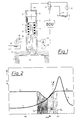
- an injection valve 1 of an internal combustion engine is shown schematically. With 2 it is Cylinder head, indicated by the reference numeral 3, a cylinder of the internal combustion engine.
- a valve 5 is slidably mounted in the valve housing 4 of the injection valve 1.
- the valve 5 is actuated by a hydraulic actuation device 6, for example.
- the actuating device 6 can also be pneumatic or electrical.
- an actuating piston 7 of the valve 5 is pressurized with hydraulic pressure in the pressure chamber 8 against the force of a spring 9, whereby the valve 5 is deflected into the open position. When the pressure is released, the valve 5 is brought into the closed position by the spring 9.
- a hydraulic line 10 leads into the pressure chamber 8 and can be connected to a pump 12 or the like via a switching valve 11. In a second position of the switching valve 11, the pressure chamber 8 can be relieved via the relief line 13.
- the switching valve 11 is actuated via an electronic control unit ECU.
- a mixing chamber 14 Arranged within the valve housing 4 is a mixing chamber 14 which, in the open position of the valve 5, is flow-connected to the combustion chamber 21 of the internal combustion engine.
- a fuel flow path 15 opens into the mixing chamber 14, via which fuel can be injected into the mixing chamber 14.
- the fuel supply system is indicated by the fuel tank 16, the fuel delivery device 17, a fuel valve 18 and the line 15.
- a temperature sensor 19 and / or a pressure sensor 20 is provided, the data of which are supplied to the control unit ECU.
- the cylinder pressure p 1 indicated by the line A and the pressure p 2 symbolized by the line B in the mixing chamber 14 are plotted over the crank angle KW.
- the arrow C indicates the ignition point in the area of the top dead center OT.
- the reference symbol UT stands for bottom dead center.
- the blowing-in phase of the blowing-in valve 1 is indicated by the reference symbol D, the reference symbol D 0 marking the opening point and E 0 the closing point of the blowing-in valve 1.
- the valve 5 is opened and discharges the contents of the mixing chamber 14 into the combustion chamber 21 within the cylinder 3.
- the recharging phase E of the blowing valve 1 follows, during which gas flows into the mixing chamber 14 as the combustion chamber pressure increases.
- the recharging phase E must have ended before combustion takes place within the mixing space 14.
- the mixing chamber 14 is discharged again in the following cycle during the blowing phase D.
- the injection valve thus remains open during the injection phase D and the recharge phase E.
- the closing time D 0 of the injection valve 4 is as late as possible.
- the closing time D 0 must not take place too late in order to reliably exclude combustion in the mixing room 14.
- at least one temperature sensor 19 and / or a pressure sensor 20 is provided for monitoring the temperature and / or the pressure within the mixing space 14, as shown in FIG. 1.
Landscapes
- Engineering & Computer Science (AREA)
- Chemical & Material Sciences (AREA)
- Combustion & Propulsion (AREA)
- Mechanical Engineering (AREA)
- General Engineering & Computer Science (AREA)
- Physics & Mathematics (AREA)
- Fluid Mechanics (AREA)
- Electrical Control Of Air Or Fuel Supplied To Internal-Combustion Engine (AREA)
- Fuel-Injection Apparatus (AREA)
- Output Control And Ontrol Of Special Type Engine (AREA)
Abstract
Description
- Die Erfindung betrifft eine Einrichtung zum Einbringen von Kraftstoff in den Brennraum einer Brennkraftmaschine mit einer Fördereinrichtung für den Kraftstoff, einem Einblaseventil zum Entnehmen von verdichtetem Gas aus dem Zylinder und zum Einblasen des Gases und des geförderten Kraftstoffes in den Zylinder, mit einem ventilseitigen Mischraum zur Speicherung des Gases, wobei das Einblaseventil ein Ventil zur Steuerung des Gasaustausches zwischen dem Brennraum und dem ventilseitigen Mischraum aufweist.
- Aus der EP-PS 0 328 602 ist eine Einrichtung der genannten Art bekannt, mit der verdichtetes Gas während eines Arbeitszyklus aus dem Zylinder entnommen, zwischengespeichert und im darauffolgenden Arbeitszyklus zusammen mit dem Kraftstoff in den Zylinder eingeblasen wird, wobei die Entnahme einer kleinen Menge heißen Gases aus dem Zylinder zeitlich gesteuert über ein in den Brennraum des Zylinders öffnendes Ventil erfolgt. In das im Ventilraum des Ventils gespeicherte entnommene heiße Gas wird Kraftstoff eingespritzt, wodurch ein im wesentlichen homogenes Gas-Kraftstoff-Gemisch erreicht wird. Schließlich wird das gespeicherte Kraftstoff-Gas-Gemisch im darauffolgenden Arbeitszyklus durch das in den Zylinder öffnende Ventil in den Zylinder eingeblasen. Gemäß einer Ausführungsvariante der bekannten Einrichtung ist es bekannt, die EInblasedauer und die Einspritzmenge, insbesondere unabhängig voneinander, in Abhängigkeit von Motorbetriebsparametern zu verändern. Bei gleichen Motorbetriebsparametern, also bei gleicher Last, Drehzahl, etc., öffnet und schließt das Einblaseventil dabei stets bei einer bestimmten Kurbelwellenstellung. Dies hat allerdings den Nachteil, daß der Schließzeitpunkt des Ventiles so gewählt werden muß, daß auch im ungünstigsten Falle keine Verbrennung im Mischraum stattfinden kann, da dies zu Verkokungen führen würde. Um andererseits den Druck im ventilseitigen Mischraum möglichst hoch zu halten, ist ein spätes Schließen des Ventiles während der Kompressionsphase erwünscht. Durch den räumlichen Abstand der Zündquelle zum Einblaseventil ist infolge der Flammenausbreitung ein erheblich späterer Schließzeitpunkt als der Zündzeitpunkt möglich. Bei einer gemäß dem Stand der Technik unflexiblen Schließzeitpunktfestsetzung des Einblaseventiles kommt es infolge der für Ottomotoren charakteristischen zyklischen Schwankungen zu starken Schwankungen des Speicherdruckes im Mischraum und somit zu stark unterschiedlichen Einblasedrücken, weshalb das Druckverhältnis zwischen Mischkanal und Brennraum kaum reproduzierbar ist.
- Aufgabe der vorliegenden Erfindung ist es, diese Nachteile zu vermeiden und bei einer Einrichtung der genannten Art konstante, reproduzierbare Betriebsbedingungen zu ermöglichen.
- Erfindungsgemäß wird dies dadurch erreicht, daß der Mischraum mit zumindest einem Sensorelement zur Messung des Druckes und/oder der Temperatur des Mischraumes in Wirkverbindung steht und das Schließen des Ventiles in Abhängigkeit zumindest der durch das zumindest eine Sensorelement gemessenen physikalischen Größe erfolgt. Vorzugsweise ist vorgesehen, daß das Sensorelement mit einer elektronischen Steuereinheit verbunden ist, welche ein in Abhängigkeit der gemessenen Größe erzeugtes Schließsignal einer hydraulischen, pneumatischen oder elektromagnetischen Ventilbetätigungseinrichtung zuführt.
- Der Schließzeitpunkt des Einblaseventiles wird direkt von den physikalischen Bedingungen im Mischraum, wie Temperatur und/oder Druck bestimmt. Es kann somit ein möglichst hoher Druck im Mischraum realisiert werden, der sehr geringen zyklischen Schwankungen unterliegt. Der Schließzeitpunkt ist dabei so festgesetzt, daß keinesfalls eine Verbrennung in der Mischkammer stattfinden kann. Für einen gegebenen Betriebspunkt der Brennkraftmaschine kann der damit sinnvoll mögliche Schließzeitpunkt durch eine charakteristische Druck- oder Temperaturangabe bestimmt werden. Diese Größe wird gemäß der vorliegenden Erfindung als Regel- oder als Stellgröße verwendet, um ähnlich einer Klopfregelung des Zündzeitpunktes den spätestmöglichen Schließzeitpunkt des Ventiles ohne Eintritt der Flamme in die Mischkammer zu realisieren und damit den jeweiligen höchstmöglichen Druck im Mischraum zu speichern.
- Die Erfindung wird anhand der Fig. näher erläutert. Es zeigen
- Fig. 1 das erfindungsgemäße Einblaseventil im Längsschnitt,
- Fig. 2 ein Druck-Kurbelwinkel-Diagramm.
- In Fig. 1 ist schematisch ein Einblaseventil 1 einer nicht weiter dargestellten Brennkraftmaschine gezeigt. Mit 2 ist der Zylinderkopf, mit dem Bezugszeichen 3 ein Zylinder der Brennkraftmaschine angedeutet. Im Ventilgehäuse 4 des Einblaseventiles 1 ist ein Ventil 5 verschiebbar gelagert. Das Ventil 5 wird durch eine beispielsweise hydraulische Betätigungseinrichtung 6 betätigt. Genauso kann die Betätigungseinrichtung 6 auch pneumatisch oder elektrisch sein. Bei der in Fig. 1 dargestellten hydraulischen Betätigungseinrichtung 6 wird ein Betätigungskolben 7 des Ventils 5 mit hydraulischem Druck in der Druckkammer 8 entgegen der Kraft einer Feder 9 mit Druck beaufschlagt, wodurch das Ventil 5 in die Öffnungsstellung ausgelenkt wird. Bei Druckentlastung wird das Ventil 5 durch die Feder 9 in die Schließstellung gebracht. In den Druckraum 8 führt eine Hydraulikleitung 10, welche über ein Schaltventil 11 mit einer Pumpe 12 oder dgl. verbindbar ist. In einer zweiten Stellung des Schaltventiles 11 kann der Druckraum 8 über die Entlastungsleitung 13 entlastet werden. Das Schaltventil 11 wird über eine elektronische Steuereinheit ECU betätigt.
- Innerhalb des Ventilgehäuses 4 ist ein Mischraum 14 angeordnet, welcher in der Öffnungsstellung des Ventils 5 mit dem Brennraum 21 der Brennkraftmaschine strömungsverbunden ist. In den Mischraum 14 mündet ein Kraftstoffströmungsweg 15, über welchen Kraftstoff in den Mischraum 14 eingespritzt werden kann. Das Kraftstoffversorgungssystem ist durch den Kraftstoffbehälter 16, die Kraftstoffördereinrichtung 17, ein Kraftstoffventil 18 und die Leitung 15 angedeutet. Zur Messung der Temperatur und/oder des Druckes im Mischraum 14 ist ein Temperatursensor 19 und/oder ein Drucksensor 20 vorgesehen, dessen bzw. deren Daten der Steuereinheit ECU zugeführt werden.
- In dem in Fig. 2 gezeigten Druck-Kurbelwinkelschaubild ist der durch die Linie A angedeutete Zylinderdruck p1 und der durch die Linie B symbolisierte Druck p2 im Mischraum 14 über dem Kurbelwinkel KW aufgetragen. Der Pfeil C deutet den Zündzeitpunkt im Bereich des oberen Totpunktes OT an. Das Bezugszeichen UT steht für den unteren Totpunkt. Die Einblasephase des Einblaseventiles 1 ist durch das Bezugszeichen D angedeutet, wobei das Bezugszeichen D0 den Öffnungspunkt und E0 den Schließpunkt des Einblaseventils 1 markieren. Während der Einblasephase D ist das Ventil 5 geöffnet und entlädt den Inhalt des Mischraumes 14 in den Brennraum 21 innerhalb des Zylinders 3. Unmittelbar an die Einblasephase D schließt bei Einrichtungen der eingangs genannten Art die Wiederaufladephase E des Einblaseventils 1 an, während der bei steigendem Brennraumdruck Gas in den Mischraum 14 strömt. Die Wiederaufladephase E muß beendet sein, bevor eine Verbrennung innerhalb des Mischraumes 14 stattfindet. Nach darauffolgender Einspritzung von Kraftstoff in das heiße gespeicherte Gas im Mischraum 14 wird im darauffolgenden Zyklus während der Einblasephase D der Mischraum 14 wieder entladen. Das Einblaseventil bleibt somit während der Einblasephase D und der Wiederaufladephase E geöffnet.
- Zur Erzielung hoher Einblasedrücke während der Einblasephase D ist es vorteilhaft, wenn der Schließzeitpunkt D0 des Einblaseventiles 4 möglichst spät erfolgt. Allerdings darf der Schließzeitpunkt D0 auch nicht zu spät erfolgen, um eine Verbrennung im Mischraum 14 sicher auszuschließen. Um den optimalen Schließzeitpunkt D0 des Einblaseventiles 1 zu bestimmen, ist erfindungsgemäß zumindest ein Temperatursensor 19 und/oder ein Drucksensor 20 zur Überwachung der Temperatur und/oder des Druckes innerhalb des Mischraumes 14 vorgesehen, wie in Fig. 1 gezeigt ist.
Claims (2)
- Einrichtung zum Einbringen von Kraftstoff in den Brennraum einer Brennkraftmaschine mit einer Fördereinrichtung für den Kraftstoff, einem Einblaseventil zum Entnehmen von verdichtetem Gas aus dem Zylinder und zum Einblasen des Gases und des geförderten Kraftstoffes in den Zylinder, mit einem ventilseitigen Mischraum zur Speicherung des Gases, wobei das Einblaseventil ein Ventil zur Steuerung des Gasaustausches zwischen dem Brennraum und dem ventilseitigen Mischraum aufweist, dadurch gekennzeichnet , daß der Mischraum (14) mit zumindest einem Sensorelement (19; 20) zur Messung des Druckes und/oder der Temperatur des Mischraumes (14) in Wirkverbindung steht und das Schließen des Ventiles (5) in Abhängigkeit zumindest der durch das zumindest eine Sensorelement (19; 20) gemessenen physikalischen Größe erfolgt.
- Einrichtung nach Anspruch 1, dadurch gekennzeichnet, daß das Sensorelement (19; 20) mit einer elektronischen Steuereinheit (ECU) verbunden ist, welche ein in Abhängigkeit der gemessenen physikalischen Größe(n) erzeugtes Schließsignal einer hydraulischen, pneumatischen oder elektromagnetischen Ventilbetätigungseinrichtung (6) zuführt.
Applications Claiming Priority (2)
| Application Number | Priority Date | Filing Date | Title |
|---|---|---|---|
| AT353/95 | 1995-02-27 | ||
| AT0035395A AT408137B (de) | 1995-02-27 | 1995-02-27 | Einrichtung zum einbringen von kraftstoff in den brennraum einer brennkraftmaschine |
Publications (3)
| Publication Number | Publication Date |
|---|---|
| EP0731271A2 true EP0731271A2 (de) | 1996-09-11 |
| EP0731271A3 EP0731271A3 (de) | 1996-10-30 |
| EP0731271B1 EP0731271B1 (de) | 1998-03-25 |
Family
ID=3488370
Family Applications (1)
| Application Number | Title | Priority Date | Filing Date |
|---|---|---|---|
| EP96890011A Expired - Lifetime EP0731271B1 (de) | 1995-02-27 | 1996-01-23 | Einrichtung zum Einbringen von Kraftstoff in den Brennraum einer Brennkraftmaschine |
Country Status (4)
| Country | Link |
|---|---|
| US (1) | US5647336A (de) |
| EP (1) | EP0731271B1 (de) |
| AT (1) | AT408137B (de) |
| DE (1) | DE59600120D1 (de) |
Families Citing this family (5)
| Publication number | Priority date | Publication date | Assignee | Title |
|---|---|---|---|---|
| US20030012985A1 (en) | 1998-08-03 | 2003-01-16 | Mcalister Roy E. | Pressure energy conversion systems |
| AT7202U1 (de) * | 2002-12-19 | 2004-11-25 | Avl List Gmbh | Verfahren zum betreiben einer mit gas betriebenen brennkraftmaschine |
| CA2798870C (en) | 2012-12-17 | 2014-07-22 | Westport Power Inc. | Air-enriched gaseous fuel direct injection for an internal combustion engine |
| WO2014144581A1 (en) | 2013-03-15 | 2014-09-18 | Mcalister Technologies, Llc | Internal combustion engine and associated systems and methods |
| US9255560B2 (en) * | 2013-03-15 | 2016-02-09 | Mcalister Technologies, Llc | Regenerative intensifier and associated systems and methods |
Family Cites Families (6)
| Publication number | Priority date | Publication date | Assignee | Title |
|---|---|---|---|---|
| DE3872217D1 (de) * | 1987-08-12 | 1992-07-23 | Avl Verbrennungskraft Messtech | Einrichtung zur einbringung des kraftstoffes in den brennraum einer brennkraftmaschine. |
| US4944277A (en) * | 1989-03-03 | 1990-07-31 | Outboard Marine Corporation | Cylinder entrapment system with an air spring |
| AT407428B (de) * | 1989-04-12 | 2001-03-26 | Avl Verbrennungskraft Messtech | Hydraulisch betätigbares ventil mit steuerbarem hub |
| AT408256B (de) * | 1989-07-31 | 2001-10-25 | Avl Verbrennungskraft Messtech | Vorrichtung zum einbringen von kraftstoff in den brennraum einer brennkraftmaschine |
| CA2159608C (en) * | 1993-04-29 | 2004-06-22 | Nicholas John Ellwood | Fuel injected internal combustion engine |
| AT408138B (de) * | 1995-02-23 | 2001-09-25 | Avl Verbrennungskraft Messtech | Einrichtung zum einbringen von kraftstoff in den brennraum einer brennkraftmaschine |
-
1995
- 1995-02-27 AT AT0035395A patent/AT408137B/de not_active IP Right Cessation
-
1996
- 1996-01-23 EP EP96890011A patent/EP0731271B1/de not_active Expired - Lifetime
- 1996-01-23 DE DE59600120T patent/DE59600120D1/de not_active Expired - Fee Related
- 1996-02-26 US US08/606,917 patent/US5647336A/en not_active Expired - Fee Related
Also Published As
| Publication number | Publication date |
|---|---|
| US5647336A (en) | 1997-07-15 |
| EP0731271A3 (de) | 1996-10-30 |
| EP0731271B1 (de) | 1998-03-25 |
| DE59600120D1 (de) | 1998-04-30 |
| ATA35395A (de) | 2001-01-15 |
| AT408137B (de) | 2001-09-25 |
Similar Documents
| Publication | Publication Date | Title |
|---|---|---|
| DE4313852A1 (de) | Kraftstoffeinspritzeinrichtung für Brennkraftmaschinen | |
| EP0954695B1 (de) | Zweistoffdüse zur einspritzung von kraftstoff und einer zusatzflüssigkeit | |
| DE2558699A1 (de) | Pumpeduese fuer die kraftstoffeinspritzung in brennkraftmaschinen | |
| EP1864014B1 (de) | Kraftstoffeinspritzeinrichtung für eine mehrzylindrige brennkraftmaschine | |
| DE10024268A1 (de) | Vorrichtung zur Benzindirekteinspritzung in einer Kolbenbrennkraftmaschine | |
| DE2935851A1 (de) | Treibstoffinjektor | |
| DE19728111A1 (de) | Kraftstoffeinspritzsystem | |
| DE69728270T2 (de) | Brennstoff-gas-gemisch einspritzsystem | |
| EP2876275B1 (de) | Hubkolben-Brennkraftmaschine und Verfahren zum Betrieb einer Hubkolben-Brennkraftmaschine | |
| DE19625698A1 (de) | Einspritzeinrichtung zum kombinierten Einspritzen von Kraftstoff und Zusatzflüssigkeit | |
| DE19746491A1 (de) | Kraftstoffeinspritzanlage für eine Brennkraftmaschine | |
| EP1704316B1 (de) | Verfahren und vorrichtung zum steuern eines ventils und verfahren und vorrichtung zum steuern einer pumpe-d se-vorrichtung mi t dem ventil | |
| EP0731271B1 (de) | Einrichtung zum Einbringen von Kraftstoff in den Brennraum einer Brennkraftmaschine | |
| EP0982492B1 (de) | Vorrichtung zum Einspritzen von Brennstoff für eine Hubkolbenbrennkraftmaschine | |
| DE19709446C1 (de) | Fördereinrichtung für Brennstoff | |
| DE19529826C1 (de) | Einspritzventil für Common-Rail-Einspritzsysteme | |
| DE102004035301B4 (de) | Dieselmotor | |
| EP1881186B1 (de) | Verfahren zum Betreiben einer Brennkraftmaschine mit mehreren Zylindern | |
| CH660401A5 (de) | Brennstoffeinspritzanlage an einer brennkraftmaschine. | |
| EP1464819A2 (de) | Verfahren zum Betreiben einer Brennkraftmaschine | |
| EP1941143A1 (de) | Verfahren zum betrieb einer brennkraftmaschine | |
| DE4030890A1 (de) | Kraftstoffeinblaseinrichtung fuer zweitakt-brennkraftmaschinen | |
| EP1751414B1 (de) | Verfahren und vorrichtung zum steuern eines ventils | |
| EP1377745B1 (de) | Verfahren zum betreiben einer pumpe-düse-einheit sowie pumpe-düse-einheit | |
| DE2064554A1 (de) | Einrichtung zur Förderung von Hydraulikmengen mit vorgegebenem Druck, z. B. Kraftstoffeinspritzung bei Brennkraftmaschinen |
Legal Events
| Date | Code | Title | Description |
|---|---|---|---|
| PUAI | Public reference made under article 153(3) epc to a published international application that has entered the european phase |
Free format text: ORIGINAL CODE: 0009012 |
|
| AK | Designated contracting states |
Kind code of ref document: A2 Designated state(s): DE ES FR GB IT SE |
|
| PUAL | Search report despatched |
Free format text: ORIGINAL CODE: 0009013 |
|
| AK | Designated contracting states |
Kind code of ref document: A3 Designated state(s): DE ES FR GB IT SE |
|
| 17P | Request for examination filed |
Effective date: 19961102 |
|
| RAP1 | Party data changed (applicant data changed or rights of an application transferred) |
Owner name: AVL LIST GMBH |
|
| GRAG | Despatch of communication of intention to grant |
Free format text: ORIGINAL CODE: EPIDOS AGRA |
|
| GRAG | Despatch of communication of intention to grant |
Free format text: ORIGINAL CODE: EPIDOS AGRA |
|
| GRAH | Despatch of communication of intention to grant a patent |
Free format text: ORIGINAL CODE: EPIDOS IGRA |
|
| 17Q | First examination report despatched |
Effective date: 19970901 |
|
| GRAH | Despatch of communication of intention to grant a patent |
Free format text: ORIGINAL CODE: EPIDOS IGRA |
|
| GRAA | (expected) grant |
Free format text: ORIGINAL CODE: 0009210 |
|
| AK | Designated contracting states |
Kind code of ref document: B1 Designated state(s): DE ES FR GB IT SE |
|
| PG25 | Lapsed in a contracting state [announced via postgrant information from national office to epo] |
Ref country code: ES Free format text: THE PATENT HAS BEEN ANNULLED BY A DECISION OF A NATIONAL AUTHORITY Effective date: 19980325 |
|
| GBT | Gb: translation of ep patent filed (gb section 77(6)(a)/1977) |
Effective date: 19980402 |
|
| REF | Corresponds to: |
Ref document number: 59600120 Country of ref document: DE Date of ref document: 19980430 |
|
| ITF | It: translation for a ep patent filed | ||
| PG25 | Lapsed in a contracting state [announced via postgrant information from national office to epo] |
Ref country code: SE Free format text: LAPSE BECAUSE OF FAILURE TO SUBMIT A TRANSLATION OF THE DESCRIPTION OR TO PAY THE FEE WITHIN THE PRESCRIBED TIME-LIMIT Effective date: 19980625 |
|
| ET | Fr: translation filed | ||
| PGFP | Annual fee paid to national office [announced via postgrant information from national office to epo] |
Ref country code: DE Payment date: 19990116 Year of fee payment: 4 |
|
| PGFP | Annual fee paid to national office [announced via postgrant information from national office to epo] |
Ref country code: FR Payment date: 19990128 Year of fee payment: 4 |
|
| PLBE | No opposition filed within time limit |
Free format text: ORIGINAL CODE: 0009261 |
|
| STAA | Information on the status of an ep patent application or granted ep patent |
Free format text: STATUS: NO OPPOSITION FILED WITHIN TIME LIMIT |
|
| 26N | No opposition filed | ||
| PG25 | Lapsed in a contracting state [announced via postgrant information from national office to epo] |
Ref country code: GB Free format text: LAPSE BECAUSE OF NON-PAYMENT OF DUE FEES Effective date: 20000123 |
|
| GBPC | Gb: european patent ceased through non-payment of renewal fee |
Effective date: 20000123 |
|
| PG25 | Lapsed in a contracting state [announced via postgrant information from national office to epo] |
Ref country code: FR Free format text: LAPSE BECAUSE OF NON-PAYMENT OF DUE FEES Effective date: 20000929 |
|
| PG25 | Lapsed in a contracting state [announced via postgrant information from national office to epo] |
Ref country code: DE Free format text: LAPSE BECAUSE OF NON-PAYMENT OF DUE FEES Effective date: 20001101 |
|
| REG | Reference to a national code |
Ref country code: FR Ref legal event code: ST |
|
| PG25 | Lapsed in a contracting state [announced via postgrant information from national office to epo] |
Ref country code: IT Free format text: LAPSE BECAUSE OF NON-PAYMENT OF DUE FEES;WARNING: LAPSES OF ITALIAN PATENTS WITH EFFECTIVE DATE BEFORE 2007 MAY HAVE OCCURRED AT ANY TIME BEFORE 2007. THE CORRECT EFFECTIVE DATE MAY BE DIFFERENT FROM THE ONE RECORDED. Effective date: 20050123 |