EP0732017B1 - Systeme et procede permettant d'envoyer et de recevoir des commandes d'autorisation de longueur variable destinees a des services numeriques - Google Patents
Systeme et procede permettant d'envoyer et de recevoir des commandes d'autorisation de longueur variable destinees a des services numeriques Download PDFInfo
- Publication number
- EP0732017B1 EP0732017B1 EP95904793A EP95904793A EP0732017B1 EP 0732017 B1 EP0732017 B1 EP 0732017B1 EP 95904793 A EP95904793 A EP 95904793A EP 95904793 A EP95904793 A EP 95904793A EP 0732017 B1 EP0732017 B1 EP 0732017B1
- Authority
- EP
- European Patent Office
- Prior art keywords
- authorization
- data
- security element
- control information
- blackout
- Prior art date
- Legal status (The legal status is an assumption and is not a legal conclusion. Google has not performed a legal analysis and makes no representation as to the accuracy of the status listed.)
- Expired - Lifetime
Links
Images




Classifications
-
- H—ELECTRICITY
- H04—ELECTRIC COMMUNICATION TECHNIQUE
- H04L—TRANSMISSION OF DIGITAL INFORMATION, e.g. TELEGRAPHIC COMMUNICATION
- H04L9/00—Cryptographic mechanisms or cryptographic arrangements for secret or secure communications; Network security protocols
- H04L9/32—Cryptographic mechanisms or cryptographic arrangements for secret or secure communications; Network security protocols including means for verifying the identity or authority of a user of the system or for message authentication, e.g. authorization, entity authentication, data integrity or data verification, non-repudiation, key authentication or verification of credentials
-
- H—ELECTRICITY
- H04—ELECTRIC COMMUNICATION TECHNIQUE
- H04H—BROADCAST COMMUNICATION
- H04H20/00—Arrangements for broadcast or for distribution combined with broadcast
- H04H20/28—Arrangements for simultaneous broadcast of plural pieces of information
-
- H—ELECTRICITY
- H04—ELECTRIC COMMUNICATION TECHNIQUE
- H04B—TRANSMISSION
- H04B7/00—Radio transmission systems, i.e. using radiation field
- H04B7/14—Relay systems
- H04B7/15—Active relay systems
- H04B7/204—Multiple access
- H04B7/2041—Spot beam multiple access
-
- H—ELECTRICITY
- H04—ELECTRIC COMMUNICATION TECHNIQUE
- H04N—PICTORIAL COMMUNICATION, e.g. TELEVISION
- H04N21/00—Selective content distribution, e.g. interactive television or video on demand [VOD]
- H04N21/20—Servers specifically adapted for the distribution of content, e.g. VOD servers; Operations thereof
- H04N21/23—Processing of content or additional data; Elementary server operations; Server middleware
- H04N21/234—Processing of video elementary streams, e.g. splicing of video streams or manipulating encoded video stream scene graphs
- H04N21/2347—Processing of video elementary streams, e.g. splicing of video streams or manipulating encoded video stream scene graphs involving video stream encryption
-
- H—ELECTRICITY
- H04—ELECTRIC COMMUNICATION TECHNIQUE
- H04N—PICTORIAL COMMUNICATION, e.g. TELEVISION
- H04N21/00—Selective content distribution, e.g. interactive television or video on demand [VOD]
- H04N21/40—Client devices specifically adapted for the reception of or interaction with content, e.g. set-top-box [STB]; Operations thereof
- H04N21/43—Processing of content or additional data, e.g. demultiplexing additional data from a digital video stream; Elementary client operations, e.g. monitoring of home network or synchronising decoder's clock; Client middleware
- H04N21/44—Processing of video elementary streams, e.g. splicing a video clip retrieved from local storage with an incoming video stream or rendering scenes according to encoded video stream scene graphs
- H04N21/4405—Processing of video elementary streams, e.g. splicing a video clip retrieved from local storage with an incoming video stream or rendering scenes according to encoded video stream scene graphs involving video stream decryption
-
- H—ELECTRICITY
- H04—ELECTRIC COMMUNICATION TECHNIQUE
- H04N—PICTORIAL COMMUNICATION, e.g. TELEVISION
- H04N21/00—Selective content distribution, e.g. interactive television or video on demand [VOD]
- H04N21/40—Client devices specifically adapted for the reception of or interaction with content, e.g. set-top-box [STB]; Operations thereof
- H04N21/45—Management operations performed by the client for facilitating the reception of or the interaction with the content or administrating data related to the end-user or to the client device itself, e.g. learning user preferences for recommending movies, resolving scheduling conflicts
- H04N21/4508—Management of client data or end-user data
- H04N21/4524—Management of client data or end-user data involving the geographical location of the client
-
- H—ELECTRICITY
- H04—ELECTRIC COMMUNICATION TECHNIQUE
- H04N—PICTORIAL COMMUNICATION, e.g. TELEVISION
- H04N21/00—Selective content distribution, e.g. interactive television or video on demand [VOD]
- H04N21/40—Client devices specifically adapted for the reception of or interaction with content, e.g. set-top-box [STB]; Operations thereof
- H04N21/45—Management operations performed by the client for facilitating the reception of or the interaction with the content or administrating data related to the end-user or to the client device itself, e.g. learning user preferences for recommending movies, resolving scheduling conflicts
- H04N21/462—Content or additional data management e.g. creating a master electronic programme guide from data received from the Internet and a Head-end or controlling the complexity of a video stream by scaling the resolution or bit-rate based on the client capabilities
- H04N21/4627—Rights management associated to the content
-
- H—ELECTRICITY
- H04—ELECTRIC COMMUNICATION TECHNIQUE
- H04N—PICTORIAL COMMUNICATION, e.g. TELEVISION
- H04N21/00—Selective content distribution, e.g. interactive television or video on demand [VOD]
- H04N21/80—Generation or processing of content or additional data by content creator independently of the distribution process; Content per se
- H04N21/83—Generation or processing of protective or descriptive data associated with content; Content structuring
- H04N21/835—Generation of protective data, e.g. certificates
- H04N21/8355—Generation of protective data, e.g. certificates involving usage data, e.g. number of copies or viewings allowed
-
- H—ELECTRICITY
- H04—ELECTRIC COMMUNICATION TECHNIQUE
- H04N—PICTORIAL COMMUNICATION, e.g. TELEVISION
- H04N7/00—Television systems
- H04N7/16—Analogue secrecy systems; Analogue subscription systems
- H04N7/162—Authorising the user terminal, e.g. by paying; Registering the use of a subscription channel, e.g. billing
- H04N7/163—Authorising the user terminal, e.g. by paying; Registering the use of a subscription channel, e.g. billing by receiver means only
-
- H—ELECTRICITY
- H04—ELECTRIC COMMUNICATION TECHNIQUE
- H04N—PICTORIAL COMMUNICATION, e.g. TELEVISION
- H04N7/00—Television systems
- H04N7/16—Analogue secrecy systems; Analogue subscription systems
- H04N7/167—Systems rendering the television signal unintelligible and subsequently intelligible
- H04N7/1675—Providing digital key or authorisation information for generation or regeneration of the scrambling sequence
Definitions
- the present invention relates generally to digital signal transmission, and more particularly, to a system and method for transmitting control information together with a multiplex of digital services, including imaging services, for selective display of the services at a plurality of remote locations.
- the primary media investigated for providing such services to date comprise, for example, coaxial cable, land-based microwave, so-called cellular radio, broadcast FM, broadcast satellite and optical fiber, to name a few.
- Each media has its own characteristics. For example, comparing cable and satellite for digital data transmission, cable tends to have a medium error rate, but, when errors appear, the errors come in long bursts. Satellite as a media has a pretty poor error rate, primarily due to the requisite weak signal power, and hence, low signal to noise ratio. In satellite, then, the poor error rate is specially corrected utilizing such techniques as convolutional error correctors, not required in a cable environment.
- the generated data stream comprises a continuous sequence of frames, each frame comprising two fields, and each field comprising a plurality of lines.
- a first group of lines of a field defines a transport layer and a second group of lines defines a service data region.
- a feature of the disclosed scheme is the ability to dynamically vary the multiplexed data stream from field to field.
- a further feature of the disclosed scheme is that the data transmission rate of the multiplexed data stream is related to the frequency of known analog video formats, i.e. frame, field and horizontal line rates.
- authorization control When such a variety of services are transmitted, it is desirable for system operators to exert various forms of authorization control over the services transmitted to a user.
- the system operator can make a set of services available to some users but not to others.
- the forms of authorization control desired by the system operators may differ depending on a classification of the service provided, a classification of the user receiving the service, or both.
- US 4,866,770 (assigned to the present applicant) discloses such a system that enables transmission of individual subscriber teletext messages, audio and video to individual subscribers and permits group communications of audio, video, teletext and data information from a single central subscriber location.
- a composite signal including the information to be transmitted as well as system wide, individual decoder and group decoder control signals is transmitted.
- the system-wide control signals include data germane to operation of each of the decoders of the system, including key information needed to decode the composite signal.
- Authorization control includes implementation of a blackout, whereby one or more services are denied to a user according to a predetermined classification. For example, broadcasters may be prohibited by contract from broadcasting a sporting event to users within a fixed distance from the stadium, arena, or track where the sporting event takes place in order to protect ticket revenues.
- the decoder at the user's location calculates whether a blackout is required according to a complicated, three-dimensional mathematical algorithm.
- the decoder must be equipped with a processor capable of performing the calculations. If such a processor is already provided in the decoder, the processor must be diverted from other jobs to perform the complex calculations necessary to determine whether the decoder is within the blackout area. Accordingly, the speed of processing is reduced.
- B-MAC B-type Multiplexed Analog Component
- Spotlighting is another type of authorization control where one or more services are provided only to a predetermined class of users. Thus, spotlighting may be considered as the inverse of blackout.
- the group authorization is implemented as follows. Each decoder is sent an addressed data packet which specifies the group to which the decoder belongs. System data includes seeds and control information, and two bytes are used to send CSACS packets. CSACS packets send the entire authorization stream in a list of group codes. If a decoder is a member of a listed group, it uses the CSACS package authorization description. If the decoder is not a member of the listed groups, it is not authorized. Accordingly, a blackout can be implemented by removing a group to be blacked out from the transmitted list.
- control such as audio routing and mute controls, data mute control, video on/off, etc. is transmitted via the CSACS method of group authorization so as to extend the available bits of system data.
- this information would be sent in one session if allowed by the system data.
- reception of a CSACS cycle was required to make authorization possible.
- Authorization control may also be used by the broadcaster to offer a variety of service packages to users at different prices. This is called tiering, and the various service packages available to users are called tiers.
- tiering the various service packages available to users are called tiers.
- a single tier pointer is transmitted. The tier pointer references a bit string in the decoder. If the bit pointed to by the tier pointer is in a first state, authorization occurs. If the bit pointed to is in a second state, authorization is denied.
- the operator is afforded maximum flexibility if the system can support numerous- authorization control schemes.
- an increasing portion of the transmitted signal must be dedicated to authorization control information.
- less capacity is available for the transmission of services.
- a significant amount of time may be needed for a decoder to decrypt authorization control information encrypted by the broadcaster at an encoder.
- the need of certain authorization schemes may vary over time as conditions change. Therefore, an operator may waste a significant portion of transmission bandwidth by providing for authorization control schemes that are not in use.
- a system for implementing a circular blackout and/or spotlight authorization that may be easily and efficiently determined at a decoder.
- a plurality of authorization codes are transmitted from an encoder to a decoder in fields of a plurality of data frames.
- the data frames containing the authorization codes are framed by start and end bytes. Frames that do not include authorization data may be interposed between data frames that contain authorization data.
- the authorization codes may be transmitted in a plurality of cycles of frames. Each of the fields must be completely received from start to end without errors or omissions in order for the authorization to be implemented.
- Other authorization schemes may be implemented in addition to those in the frame cycles. Accordingly, the authorization schemes in the cycle of frames can be supplemental to those not in the cycle of frames, and authorization may be achieved without transmission of the authorization in the cycle of frames.
- the circular blackout/spotlight codes specify a circular region in terms of a center latitude, a center longitude, and a radius.
- a particular decoder receiving stores its location in terms of longitude and latitude.
- a distortion factor is stored to effect a two-dimensional calculation of whether the decoder is in the circular region that approximates the much more complicated three-dimensional calculation.
- the two-dimensional calculation requires fewer arithmetic operations than the prior art three-dimensional algorithms discussed above. Accordingly, less processor time is consumed in making the blackout/spotlight determination at the decoder.
- the present invention is highly flexible in that, among other features described above, it need not be used in connection with each programming service.
- the present invention may be implemented in a system for multiplexing a plurality of digital service data streams at varying data rates and transmitting the services from an origination point to a plurality of remote locations.
- a digital service may comprise a collection selectable by the user from any of a number of low data rate, medium data rate and high data rate services including, but not limited to, video (both standard and high resolution), audio (from monaural to "surround-sound"), and data (from subscription software to video games to high speed data-base exchanges).
- the present invention is described conveniently in the context of a pay television system such as a cable television or direct broadcast satellite system (DBS), that typically distribute a variety of program services to subscribers for presentation on home terminal equipment which is the property of the end user or subscriber to the pay services.
- home terminal equipment may comprise video game apparatus, a television signal receiver (either standard or high definition), a home computer, a printer (either a facsimile or high resolution image printer), a stereo sound system, a telephone (including portable, mobile or stationary), a picture-phone, an energy system or alarm equipment interface, or any other known such apparatus or combination of apparatus.
- the present invention is also envisioned to be used in the telecommunications environment or other fixed or switched one-way or two-way program apparatus. It will be assumed, however, that such services be converted, if not already in digital form, to digital form for transmission over the present system.
- FIG. 1 shows a transmitter site 100 including an encoder and a receiver site 150 including a decoder according to the present invention applied in the environment of a satellite communications system.
- Audio/video compressor circuits 101(1) to 101(m) are shown for individually receiving audio service data and/or video service data, for example, from a plurality of programmers providing such services.
- MPEG video compressor known in the art is a National Transcommunications, Ltd. (England) NTL 2000 V compressor.
- a plurality of low data rate services for example, RS232 digital data, are received at low speed data formatters 105(1) to 105(n).
- the audio video compressors compress the received medium and high data rate data in accordance with known algorithms (for example, in accordance with currently known or proposed standards such as MPEG I or II, audio or video, in particular, for example, ISO 11171 or ISO 13818).
- Control computer 120 supplies control information, preferably as data packets, to the multiplexer 110.
- the data packets may be constructed by the control computer according to specified formats responsive to the entry of appropriate instructions into control computer 120. Accordingly, the operator can control the various modes of authorization made available by the present invention. The specific information required by the decoder to implement authorization modes and the data structure by which this information can be transmitted is discussed in greater detail below.
- control computer 120 controls multiplexer 110 to time division multiplex the compressed medium and high data rate streams output from compressors 101(1) to 101(m) and the low data rate streams output from formatters 105(1) to 105(n) into a serial data stream for output to modulator 130.
- the high speed data link connecting multiplexer 110 and modulator 130 may be coaxial cable, optical fiber or twisted pair, so long as the transmission is relatively noise free and at sufficient data rate.
- the control information and the data streams are encrypted.
- Modulator 130 then modulates the multiplexed digital data stream on to a carrier and up converts the carrier as necessary for transmission via, for example, C or Ku band frequencies through a satellite antenna 140.
- Modulator 130 may preferably comprise a quadrature phase shift key modulator known in the art for satellite transmission.
- Satellite antenna 140 beams a signal including the modulated data to satellite 160 which may be functionally referred to as a transponder.
- Transponder 160 simply repeats the received signal toward earth and satellite receiver antenna 151.
- Receiver site 150 typically includes a tuner/demodulator 154 for selecting one of a plurality of channels to which satellite tuner/demodulator 154 may be tuned.
- Tuner/demodulator 154 down converts and outputs a demodulated data stream to clock and data recovery circuit 155.
- Clock and data recovery circuit 155 in turn outputs an error corrected data stream and synchronization data to demultiplexer 158. Additional details concerning a suitable clock and data recovery may be obtained from U.S. Patent No. 5699385 , entitled “Method and Apparatus for Locating and Tracking a QPSK carrier", filed concurrently herewith and incorporated herein by reference.
- a user may input a selected channel via a selector (hereinafter referred to as KBD) 156, e.g. remote control or using push buttons on a panel thereof, keypad, etc.
- KBD selector
- the channel selection information is sent to display control processor (DCP) 153.
- the demultiplexer 158 extracts control information corresponding to the selected channel from the received data.
- the DCP 153 then reads the control information out of the demultiplexer 158.
- the control information may be encrypted as discussed above and may include authorization information. Accordingly, the DCP supplies the encrypted control information to digital compression in-board security element (DISE) 157.
- DISE 157 decrypts the control information and determines whether the decoder is authorized to receive the selected channel. If so, the DISE 157 supplies to the demultiplexer 158 via DCP 153 decryption information for decrypting the data corresponding to the selected channel and information concerning the location of the selected channel data in the multiplexed data.
- DISE digital compression in-board security element
- DISE 157 preferably comprises a secure microprocessor including on-board read only memory (ROM) and random access memory (RAM).
- ROM read only memory
- RAM random access memory
- One such secure microprocessor may be a -Motorola MC68HC05SC27.
- MC68HC05SC21 which is referred to in U.S. Patent Number 4381481 , entitled “Method and Apparatus for Uniquely Encrypting a Plurality of Services at a Transmission Site", incorporated herein by reference.
- Certain other security elements are discussed in U.S. Patent No. 5,029,207 and U.S. Patent No. 5,237,610 .
- the demultiplexer 158 responsive to the information output by DISE 157, locates, demultiplexes (i.e., extracts), and decrypts the data streams corresponding to the selected channel and then provides the demultiplexed data streams to various output ports to subscriber equipment 159 via peripheral data processors 152.
- the demultiplexer may be an application specific integrated ciruit (ASIC). Further details concerning the operation of the demultiplexer 158 and the peripheral data processors 152 may be obtained from U.S. Patent No. 5923755 , entitled “A Multi-Service Data Receiver Architecture", filed concurrently herewith.
- further details concerning encryption and decryption, among other things, may be found in U.S. Patent No. 5381481 , entitled “Method and Apparatus for Uniquely Encrypting a Plurality of Services as a Transmission site”.
- the user or subscriber equipment may comprise, for example, standard or high definition television reception equipment, digital audio reception equipment, digital data processors or computers, video game equipment, facsimile receiver/printers, energy management equipment and the like.
- the receiver site 150 may not only be a subscriber to services but may be a provider of services such as a cable television system operator. In such a scenario, the receiver site 150 may not include typical subscriber equipment 159 but may include cable television system headend equipment known in the art including television modulators and digital audio service providing equipment and the like.
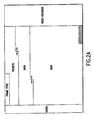
- FIG. 2A there is shown a generic frame having highly flexible characteristics.
- the static or fixed elements of the depicted scalable multiplex according to the present invention are BLOCK SYNCH (or HSYNCH) and FRAME SYNC. All other depicted elements of the frame are flexible and may change from medium to medium and from frame to frame.
- Reed-Solomon error correction parity data may be provided for satellite transmission and omitted for less error prone forms of media.
- PACKETS data comprises control information, including authorization control information, as well as low speed data services. Moreover, the delineation between what is shown as PACKETS data and areas for medium speed (audio) and high speed (video) data portions are flexible, and the figure is not intended to show that the boundaries between such forms of data is fixed at any one point in the frame.
- a predetermined structure is provided to the frame in that - FRAME SYNCH follows the first byte of HSYNCH in a frame according to the present invention.
- PACKETS data follows FRAME SYNCH, followed in turn by medium speed (audio) and high speed (video) data in that order.
- PACKETS is intended to refer to a collection of, for example, control or system data blocks which are intended to signal or control a receiver to, for example, identify the data types or data services and the respective data beginning and ending boundaries to follow.
- the control data blocks may serve to limit the variety of services available to an end user as well as provide a basis upon which the end user may control his receiver to receive and output data services as he chooses.
- the user's selection of services may be limited by their on-hand equipment and their preferences to particular ones of the authorized services in particular arrangements of the various multiplexed data streams or blocks that follow in the data stream.
- Low speed data refers to teletext, facsimile, conditional access, alarm, energy management, certain audio and other data streams which typically exhibit data rates of less than sixty-four kilobytes per second.
- Medium speed data refers to more sophisticated forms of audio such as "surround-sound" and medium speed data rates between, for example, 64 kilobytes per second and Tl carrier or D1 (telecommunications) rates of approximately one megabit per second.
- High speed data refers to some compressed forms of video transmission up to data rates required for high definition color television, be it in a MUSE, European, so-called Grand Alliance proposed U.S. format or other HDTV format. Such a structure is not intended to be fixed; for example, the present suggested data rates may be broken into only two regions of low and high speed data. Nevertheless, for example, low speed data will always be included within PACKETS data and precede higher speed data sections of the frame, and high speed data will always follow slower speed data and precede the first HSYNCH and FRAME SYNCH words for
- the size of a particular frame is dictated by the transmission medium and the data to be carried.
- One of the features of the present invention is a minimization of the number of bytes utilized for authorization of services and a maximization of the payload or information data portions of the frame.
- transmitter power and signal to noise objectives are achieved along with information payload maximization.
- large frames are inherently more efficient, and there is an improved tolerance of long burst errors, for example, in a cable or satellite environment.
- Other factors weigh against the choice of too large a frame. These include the speed of achieving synchronization at a receiver and the cost of error correction circuitry such as memory costs at a receiver site.
- Reed-Solomon block code denoted REED-SOLOMON and appearing in Figure 2A as a narrow but long rectangular column at the right of the figure.
- the Reed-Solomon block code is appended to the information data bytes as forward error correction (FEC) parity bytes.
- FEC forward error correction
- the proportion of FEC bytes to information bytes is on the order of from one to ten per cent depending on the particular medium or mixture of media or application.
- Interleaving wherein bytes of a number of blocks grouped in the depicted frame are shuffled between blocks according to a predetermined algorithm known to transmitter and receiver alike, may be employed to provide additional protection against extended bursts of errors. Further information concerning interleaving may be found in U.S. Patent No. 5583562 , entitled "System and Method for Transmitting a Plurality of Digital Services Including Imaging Services,” filed concurrently herewith.
- a nearly square, but not perfectly square, frame is preferred and thus the practical maximum limit on the vertical dimension is about 512 lines or blocks.
- a practical maximum number of video services is on the order of thirty-two and on concurrent audio services, sixty-four, assuming video and audio data compression is utilized without greatly sacrificing received signal resolution.
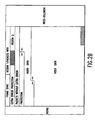
- PACKETS data follows the FRAME SYNC word in the frame. Certain PACKETS data is utilized to identify the number of bytes provided in a frame for a particular service when byte stuffing is required. Referring to Figure 2B , the PACKETS data portion of the multiplex frame may be said to further consist of two regions: one region including a MUX Structure Control packet requiring additional forward error correction and a second region requiring now additional forward error correction than the Reed-Solomon coding provided for each row or line (excluding HSYNCH).
- PACKETS data do not require additional forward error correction. These include video and audio control, seed packets for decryption, cyclic system data, composite virtual channel and definition packets for providing what may be perceived as additional data services, addressed data packets for transmitting messages to addressed decoders, text and utility data packets and other service packets. Additional details of the various PACKETS data may be obtained from U.S. Patent No. 5583562 entitled “System and Method for Transmitting a Plurality of Digital Services Including Imaging Services,” filed concurrently herewith.
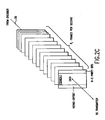
- Figure 2C illustrates that a sequence of frames in the form of Figures 2A or 2B are transmitted to a receiver according to the present invention.
- the sequence of frames need not be composed of identical allocation of packets, low speed data, etc. Rather, the content of individual frames may altered by the operator in accordance with the services and authorization control desired.
- an encoder according to the present invention typically involves A/V compressors 101(1) to 101(m).
- Particular suggested capacities for one such A/V compressor, for example, compressor 101(1) are to limit the number of input video streams to 1 and to provide up to a maximum of four audio input streams (or two stereo streams) each comprising left and right input streams.
- low speed data formatters 105(1) to 105(n) be provided.
- each low speed data formatter may handle, for example, sixteen or even thirty-two input data streams. Consequently, it is contemplated that the number of such formatters required will number only 1 or 2.
- Low speed data formatters typically receive low speed data in a predetermined format, such as RS232, and strip the data of any header data, start data, stop data, parity data and such depending on the predetermined and identified input data stream so that only true information carrying data remains in a serial data stream.
- Audio/video service streams A1 to An are received from audio/video compressors at audio/video data buffer 410.
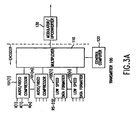
- Service multiplexer 110 operates to multiplex a plurality of digital service streams for transmission to remote locations. Also shown are inputs to a low speed data buffer 412 from low speed data formatters 105(1) to 105(n).
- Buffer 410 (audio/video) and buffer 412 for low speed data preferably signal a buffer fullness condition to the next functional element, for example, encryption block 415, if encryption is desired, or on to multiplex frame formatter 418 for low speed data.
- Encryption block 415 is intended to represent the inclusion of, for example, single or double tiers of encryption in accordance with seeds and keys and particular, predetermined algorithms as required for the digital service streams, for example, in a pay environment.
- Conditional access data including addressed data packets, global seed and virtual channel packets (or seed packets and composite virtual channel packets), is input, for example, from a billing computer or subscriber service computer for storage in conditional access data buffer 417.
- Conditional access data typically defines the services, especially pay services, to which a subscriber has subscribed. This data interfaced also via interface 414 is processed and packeted into protect region 1 PACKETS via conditional access data processing block 417 for input to multiplex formatter 418.
- multiplex (MUX) block 418 is a multiplexed frame structure as described by Figures 2A , 2B and 2C .
- the output digital stream is Reed Solomon encoded according to an appropriate encoding scheme depending on the noise characteristics of the transmission media by a well known Reed Solomon encoder 454.
- the frame is interleaved on a byte(s) (rows and columns switching) basis at interleave block 462.
- Interleave circuit 462 interleaves the data frame by transposing row and column addresses of data within the frame.
- HSYNCH and FRAME SYNCH are inserted into the frame just prior to transmission at synch insert block 458. This data then appears at a receiver at its original location in the frame while all other data is interleaved.
- the Addressed Data Packet (ADP) is transmitted using 32 byte packets.
- the ADP is used to provide decoder specific information to the decoder.
- Each ADP has a USER-ID value of 32 bits which corresponds to the decoder's unique address.
- the demultiplexer 158 will only select the ADPs which match the decoder's selected USER-ID. Further information concerning the ADP will be discussed below.
- the Virtual Channel Packet is a 32 byte (256-bit) packet transmitted within the PACKETS region.
- the VIRTUAL CHANNEL PACKET contains the information required by the decoder to determine where a requested channel actually is located within the various multiplex channels.
- the present invention will be described in context of one of several fields in the VIRTUAL CHANNEL PACKET. However, it should be understood that the present invention may form part of a different packet or, alternatively, may form a separate packet.
- the authorization information provided by the present invention may be referred to as "encrypted cycling data" or "cycling data.”
- Figure 4 depicts the various fields that comprise one preferred embodiment of a VIRTUAL CHANNEL PACKET.
- the DCP 153 controls the demultiplexer 158 to extract the VIRTUAL CHANNEL PACKET corresponding to the channel input by the user to KBD 156.
- the extracted VIRTUAL CHANNEL PACKET is then sent to DISE 157 for decryption and a determination whether the selected channel is authorized.
- DISE 157 for decryption and a determination whether the selected channel is authorized.
- the ENCRYPTED CYCLE COMMAND carries a code that indicates the type of data contained in the ENCRYPTED CYCLE DATA field.
- the ENCRYPTED CYCLE COMMAND is a 4-bit code.
- the number of bits required for the ENCRYPTED CYCLE COMMAND may vary depending on the number of types of data contained in the ENCRYPTED CYCLE DATA field.
- the present invention preferably includes a WAIT FOR BLACKOUT/SPOTLIGHT CYCLE, which may be e.g., a 1-bit field, that indicates that authorization control is utilized for a particular service (i.e., the selected channel). For example, when the WAIT FOR BLACKOUT/SPOTLIGHT CYCLE is set, the DISE 157 must wait for a complete encrypted cycle describing, for example, the blackout area before authorization is issued. Service will not be available to the user until the complete encrypted cycle is received. When the bit is clear, no blackout is implemented.
- a WAIT FOR BLACKOUT/SPOTLIGHT CYCLE which may be e.g., a 1-bit field, that indicates that authorization control is utilized for a particular service (i.e., the selected channel).
- the WAIT FOR BLACKOUT/SPOTLIGHT CYCLE when the WAIT FOR BLACKOUT/SPOTLIGHT CYCLE is set, the DISE 157 must wait for a complete encrypted cycle describing, for example, the blackout area before authorization is issued. Service will
- the ENCRYPTED CYCLE DATA field carries the cycling data.
- Figure 5 illustrates a format for the cycling data having three 8-bit bytes. Of course, the number of bits and bytes used may vary, and the exact format illustrated should not be considered to limit the present invention.
- the ENCRYPTED CYCLE DATA is delivered to the decoder in a sequence of frames.
- the ENCRYPTED CYCLE DATA field in each frame must be completely received from start to finish without errors or omissions in order for the authorization to be issued by DISE 157.
- the sequence of ENCRYPTED CYCLE DATA is bounded by a START command and is followed by a STOP command, which may also carry a validation word (e.g., checksum).
- a first packet in sequence must contain the START command.
- the STOP command indicates the end of the sequence. Together, the START and STOP commands frame a data cycle.
- the START command also initiates the tier authorization cycle and is ended by the STOP command.
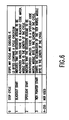
- FIG. 5 the most significant byte is used to indicate the kind of START or STOP command.
- Figure 6 illustrates a set of START and STOP command types that may be implemented. Of course, the number and kind of command types depicted in Figure 6 should not be considered limiting.
- the STOP command may be used to stop any kind of cycle. Thereafter, the command that is stopped will then be executed by the DISE 157.
- Several different types of START commands may be implemented depending on the variety of authorization schemes offered. For example, a BLACKOUT START indicates that the receiving decoders should be authorized unless there is a blackout code match. A SPOTLIGHT START indicates that the receiving decoders should not be authorized unless there is a spotlight code match.
- a TIER POINTER START begins the accumulation of tier words. Additional details concerning the tier words will be provided below.
- the middle byte of the START command describes, for example, the length of the cycle.
- the length field may indicate the number of sessions that the cycle lasts.
- the middle byte may indicate the number of seconds to wait for authorization.
- the length field may be provided only in connection with the START command.
- the least significant byte may define a checksum field, which may be sent only with the STOP command, in order to ensure accuracy.
- the checksum may correspond to the sum of the data bytes and the ENCRYPTED CYCLE COMMAND value of all commands between the START and STOP commands.
- the bytes of START and STOP commands need not included when determining the checksum value.
- An alternative error correction code may also be provided, or none at all.
- the BLACKOUT command contains a blackout code which, if it matches a corresponding value stored in the receiving decoder, sets the decoder to "not authorized" regardless of any previous state.
- a method by which the corresponding value can be stored in the receiving decoder is discussed below.
- a transmitted BLACKOUT code of zero may be ignored, although it should not be transmitted to avoid delay in authorization.
- the SPOTLIGHT command contains a spotlight code. If the spotlight code matches a corresponding value stored in the receiving decoder, the decoder is set to "authorized" regardless of any previous state, assuming all higher priority authorization conditions are satisfied. A method by which the corresponding value can be stored in the receiving decoder is discussed below. A transmitted SPOTLIGHT code of zero may be ignored, although it should not be transmitted to avoid delays in authorization.
- the BLACKOUT LOCATION command describes a circular blackout region. If the decoder's location is within the region, the decoder is set to "not authorized" regardless of any previous state.
- the blackout location may be sent in two frames.
- the first frame may include the radius of the circular region and latitude of the center location.
- the second frame may include the longitude of the center location.
- this particular format should not be considered limiting.
- the circular region may be described in three or more frames or, if desired, in a single frame. In addition, the circular region may be described using other variables and/or co-ordinate systems.
- the SPOTLIGHT LOCATION command describes a circular spotlight region. If the decoder's location is within the region, the decoder is set to "authorized" regardless of any previous state, assuming all higher priority authorization conditions are satisfied.
- the spotlight location is transmitted, for example, in two data frames. The first frame may provide the radius and latitude and the second frame may provide the longitude. As above, this particular format should not be considered limiting.
- the system described is intended to provide flexible control of blackout and/or spotlight authorization for national or even international applications.
- the dual blackout and spotlight type are intended for two different requirements. However, the different blackout/spotlight types may interact.
- the BLACKOUT/SPOTLIGHT codes are intended for regional segregation, e.g. city, county, state, or country, any combination of one or more, and/or according to any other classification schemes.
- Authorization codes for example four or more, may be stored within the decoder to allow authorization control on the basis of several classifications.
- the transmission side can then send a list of counties which are to be blacked out, or blackout an entire state except for one county.
- the BLACKOUT/SPOTLIGHT LOCATION codes are intended for circular blackout or spotlight regions.
- Each decoder can be in one location, defined as a location on the surface of the Earth, e.g. using longitude and latitude.
- the transmission side can indicate circular regions and the decoder decides if it is within the indicated region. If it is, the decoder blacks out or spotlights the selected service depending on the command sent. If the blackout and spotlight systems reside and operate together, the operator may, for example, use a circular region for blackout centered on a stadium and then explicitly spotlight nearby counties. This feature of the present invention will be discussed in greater detail below.
- the START command may also implement an initial state for the transmission cycle.
- a blackout cycle may start with all decoders authorized, and then a list of spotlight codes can be sent. Thus, the order of transmission would be important for determining the authorization at a particular decoder. In either initial state, both spotlight and blackout codes can be transmitted.
- the DISE 157 in the decoder may simply maintain one bit representing whether the service is authorized or not. For example, the START command may set or clear the authorization bit corresponding to a particular service. As each command is received, the authorization bit can be set to the other state. Of course, the DISE 157 may wait for the entire cycle to be received before , it releases authorization seeds regardless of the initial state.
- the WAIT FOR BLACKOUT/SPOTLIGHT CYCLE field may be provided to ensure that authorization is not implemented until the full cycle is received. If the WAIT FOR BLACKOUT/SPOTLIGHT CYCLE bit is clear, for example, the cycle is ignored and the DISE 157 can immediately authorize the service if allowed.
- the present invention may be implemented so that the complete cycle needs to be received without error before authorization can be established.
- a checksum command may be used to verify the entire cycle, but provision of a checksum complicates the software.
- the Reed-Solomon section and/or the virtual channel packet check may be used to flag the loss of data.
- the packet containing the cycling data e.g., the virtual channel packet
- a "session" is the time for which an authorization sequence is valid.
- a session is a software requirement, and hardware support is added to enable a session to be implemented.
- a session may comprise 13 frames and have a duration of about 0.25 sec. Therefore, transmission of one blackout cycle, having one START, two data packets, and one STOP, takes about one second. However, this should not be considered to limit the present invention.
- a session may be selected to ensure enough time to decrypt all conditional access data, but not too long to delay authorization.
- video and audio will not start until the first session after seeds have been calculated and stored in the demultiplexer 158.
- System hardware maintains a session count for software reference. When the session count is zero, the decryptors are re-initialized.
- the session counter may be variable (e.g. 0 to 63) so that the session length may be increased or decreased depending on how long the DISE requires to calculate authorization.
- seeds for all encryptors are maintained over multiple data frames.
- All of the authorization data may be distributed over the course of a session.
- global seed may be placed in frame 1
- global system data may be placed in frame 2
- virtual channel packets may be placed in any of frames 0-3, and ADPs may be placed in any frame.
- this is intended merely as an example and should not be considered limiting.
- any placement that is efficient for the DISE may be implemented.
- only one virtual channel packet for each virtual channel is sent per session. Accordingly, only one cycling data packet will be received that session.
- the cycling data may provide specific authorization in addition to that provided by system data such as global system data, global seed, and virtual channel packets.
- system data such as global system data, global seed, and virtual channel packets.
- the cycling data may be optional in the sense that it is not necessary for authorization, but is rather an extra stream for particularized authorization control.
- the virtual channel packet may include a VIDEO/RADIO/TEXT TIER POINTER that may be used if a tier cycle is not implemented. When the cycling data is not enabled, authorization time can be minimized.
- a sequencing bit may be added that toggles for every new word transmitted in the cycle. Accordingly, the decoder can detect when new information is transmitted and, for example, ignore repeated data in a subsequent session by waiting for the sequencing bit to change before accepting the next entry in the cycle. Accordingly, cycling data may be repeated to ensure its reception.
- This sequencing bit may be contained in the virtual channel packet, or other packet that incudes the encrypted cycling data.
- Figure 4 shows that the virtual channel packet includes a CYCLING DATA ID BIT which may be used to toggle each time new ENCRYPTED ENCYCLING DATA bytes are transmitted.
- the sequencing bit may also allow the decoder to merge multiple virtual channel packets without resulting error.
- the checksum calculation may indicate an error. Accordingly, the CYCLING DATA ID BIT can help to determine the correct checksum as well as determine when data can be used.
- the video/radio/text tier pointer cycle is used to emulate the B-MAC Group Mode authorization (i.e., CSACS packets) using a tiered system. This is done by transmitting a list of tiers pointers to each decoder instead of one tier pointer as in the B-MAC implementation. Tiers are stored in the DISE of each decoder, and a tier pointer indexes ("points") to one bit in the tier. If that bit is in a first state, e.g., "1”, the decoder will authorize for the serviced described by the virtual channel packet. If the bit pointed to is in a second state, e.g., "0", authorization is denied.
- B-MAC Group Mode authorization i.e., CSACS packets
- the decoder When a plurality of tier pointers are transmitted, the decoder will authorize service if any of the bits pointed to are, e.g., "1". The decoder can thus be authorized in a group-like scheme. According to one embodiment of the present invention, service is described by the virtual channel packet and may include video, audio, text, or data authorization.
- the virtual channel packet may include a VIDEO/RADIO/TEXT TIER POINTER which indexes a bit string in the DISE 157.
- the VIDEO/RADIO/TEXT TIER POINTER may be for example 8-bits. However, the actual number of bits in the VIDEO/RADIO/TEXT TIER POINTER may depend on the number of bits in the bit string in the DISE 157. If the bit pointed to is, for example, set, the virtual channel is automatically authorized, unless deauthorized by some overriding priority such as parental rating.
- the VIDEO/RADIO/TEXT TIER POINTER applies to all services which share, for example, the video and audio system.
- the virtual channel packet may also include a INVERSE TIER AUTHORIZATION field, which may be, for example, a 1-bit field.
- the INVERSE TIER AUTHORIZATION field may be used to affect the way the VIDEO/RADIO/TEXT TIER POINTER is processed.
- the INVERSE TIER AUTHORIZATION is in a first state, the decoder is authorized at the end of the cycle if a tier pointer points to a bit in the DISE that is set.
- the INVERSE TIER AUTHORIZATION is in a second state, the decoder is authorized unless the tier pointer points to a bit that is set, in which case the decoder is deauthorized at the end of the cycle.
- the result of ORing all of the tier bits may be used to determine authorization. If the encrypted cycle is enabled, all tier cycle bits must be received before authorizing, even in an inverse mode.
- the state of the INVERSE TIER AUTHORIZATION at the start of the cycle determines the state for the entire cycle. Any change to the INVERSE TIER AUTHORIZATION can only apply to the next complete cycle.
- the INVERSE TIER AUTHORIZATION may be applied to the main tier pointer VIDEO/RADIO/TEXT TIER POINTER as well as the cycling tier pointers.
- the virtual channel packet may also include a WAIT FOR VIDEO/AUDIO/TEXT TIER POINTER CYCLE which may be e.g., a 1-bit field, that indicates that the DISE may wait for a completed tier cycle when in a first state, e.g. "1".
- a second state e.g., "0" only the main tier pointer would be used for authorization.
- the main tier pointer and the cycling tier pointers, if enabled, point to a tier bit.
- this pointed to bit is in a second state, the decoder will not become authorized.
- the decoder will become authorized, and no further bits will deauthorize the decoder. This then is the logical OR of all tier bits pointed to. If all of the bits pointed to are in the second state, the decoder remains unauthorized. If any one of the bits pointed to is in a first state, the decoder will be authorized.
- the video/radio/text tier pointer START command initiates a cycle of tier pointers.
- the tier pointer may comprise three 8-bit bytes depending on the bit space allocated for the ENCRYPTED CYCLING DATA in, for example, the virtual channel packet. If any of the, for example, three 8-bit tier pointers contained in the ENCRYPTED CYCLING DATA field point to a bit of the DISE that is in a first state (e.g., "1"), the decoder becomes authorized when the STOP command is received. An authorized decoder would become deauthorized if a-STOP command is received for the tier cycle and no tier pointer pointed to a bit in the DISE that is in the first state.
- a first state e.g., "1”
- tier pointers there are three tier pointers in any one data packet. If only one or two tiers remain to be sent, a previous tier pointer may be repeated to fill in the unused locations. This may be required according to some implementations to avoid inadvertently pointing to a valid bit in the DISE and thereby authorizing service.
- the location of a circular blackout/spotlight region is transmitted in the ENCRYPTED CYCLE DATA field by specifying a radius and by specifying a point on Earth using longitude and latitude.
- each decoder must also store its own location as discussed above.
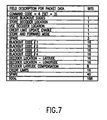
- FIG. 7 illustrates a decoder authorization addressed data packet (ADP) that is transmitted to each decoder individually.
- ADP authorization addressed data packet
- each decoder receives and stores in the DISE 157 four blackout codes contained in the fields BLACKOUT CODE #1-#4 when the STORE BLACKOUT CODES field is, for example, "1".
- Any non-zero value for the blackout codes is compared by the DISE 157 against the BLACKOUT codes contained in the ENCRYPTED CYCLE DATA field of received virtual channel packets that follow. If there is a match, the blackout/spotlight is implemented. Blackout is implemented, e.g., by denying authorization. On the other hand, spotlight can be implemented by proceeding with authorization.
- the physical location of the decoder may be encoded using standard latitude and longitude position in minutes, for example, and transmitted in the DECODER LOCATION-LATITUDE and DECODER LOCATION-LONGITUDE fields of the ADP.
- the DISE 157 will store the decoder location when the STORE DECODER LOCATION field is, for example, "1". If the decoder is within the radius of a circle transmitted in the ENCRYPTED CYCLE DATA field of the virtual channel packet, the decoder blacks out or spotlights the service.
- the decoder processes the fields of the ADP and any transmitted codes of the virtual channel packet only if the USE DECODER LOCATION field is, for example, "1". Thus, the USE DECODER LOCATION field will indicate whether the circular blackout/spotlight function is utilized in an individual decoder.
- the latitude and longitude identifications are accurate to a one minute arc, there is 21,600 divisions (360 degrees * 60 minutes/degree) radially. If the radius is always provided in the same units (i.e., minutes), a maximum circle of about 293 miles would be described.
- the particular units of latitude, longitude, and radius are provided as examples and should not be considered to limit the present invention. Of course, the radius may easily be converted to other units, for example kilometers, if the operator so prefers.
- the present invention includes a distortion code transmitted to the decoder based upon its location.
- the distortion code may be transmitted in the DECODER LATITUDE COMPENSATION field of the decoder authorization ADP.
- the distortion code permits the approximation of a circle on a surface in three dimensional space (i.e., the earth's surface) using a two dimensional coordinate system of latitude and longitude.
- a circular blackout/spotlight is described by a distance from a point on earth, i.e. the distance between the decoder and the center of the blackout/spotlight circular region.
- the actual distance follows an arc along the Earth's surface between the center of the blackout/spotlight circle and the decoder location. If the distance were calculated in the decoder, trigonometric functions and extensive use of multiplication and division operations would be required.
- One principle of the present invention is to shift the burden of performing the complicated mathematics from the decoder to the encoder. Accordingly, the encoder may output one simple number, the distortion code.
- the particular algorithm for calculating the distortion code will now be discussed.
- the algorithm is preferably stored in the ROM of DISE 157.
- r represents the radius of the blackout/spotlight region in minutes
- the decoder is outside of a circular region if both of the following expressions are true: r ⁇ ABS ⁇ B - Y r ⁇ ABS ⁇ A - X
- the decoder may still be outside of the blackout/spotlight region even if one or both of expressions (2) and (3) are not true.
- the decoder is within the circle, the following expression is true: r 2 > dist * A - X 2 + B - Y 2
- the distortion factor cos 2 (B) is transmitted to the decoder in the ADP. Therefore, the decoder can perform the simplified circular blackout/spotlight determination. Accordingly, if the decoder within a circular blackout region, authorization of the service will be denied. If the decoder is not within the circular blackout region, service will be authorized if higher priority authorization conditions are met. On the other hand, if the decoder is within a circular spotlight region, service will be authorized provided higher priority conditions are met. If the decoder is not within the circular spotlight region, authorization of service will be denied. In a preferred embodiment, the calculation of the circular blackout/spotlight is performed in the DISE 157. However, the calculation may be performed in a non-secure microprocessor, for example DCP 153, or an application specific integrated circuit (ASIC) such as demultiplexer 158.
- ASIC application specific integrated circuit
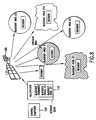
- Figure 8 illustrates an example of the use of BLACKOUT codes in combination with BLACKOUT LOCATION codes.
- the control computer 120 must transmit the blackout codes and decoder location for storage in the DISE 157 of an individual decoder. This is accomplished by transmitting blackout codes and decoder location in an ADP using the BLACKOUT CODES, the DECODER LOCATION, and the DECODER LATITUDE COMPENSATION fields. This may occur at any time prior to the desired blackout authorization.
- the decoders receive their respective ADPs and store the data in the BLACKOUT CODES, the DECODER LOCATION, and the DECODER LATITUDE COMPENSATION fields. Accordingly, the decoders are initialized to implement both regional and circular authorization control.
- an operator can blackout a service to a particular circular area (referred to as blackout circle #1) as well as to a particular region (corresponding to blackout code #3) by entry of an appropriate instruction set in control computer 120.
- the control computer 120 formats the instructions, for example, into a sequence of virtual channel packets, which is multiplexed in to a sequence of frames together with the transmitted services.
- the sequence of multiplexed frames which are transmitted via a satellite to receivers 150 in a variety of locations.
- Decoders receive the sequence of frames and send the blackout information to their respective DISE 157 to determine authorization.
- DISE 157 calculates whether the decoder is within the blackout circle #1 and whether it is within the blackout region defined by blackout code #3. Decoders within circular blackout region #1 or the region corresponding to blackout code #5 will not be authorized. Decoders in other areas, such as blackout areas #2 and #3 and the region corresponding to blackout code #10, will be authorized.
- Figure 9 illustrates an example of the interaction of overlapping blackout and spotlight commands.
- an operator may enter appropriate instructions to control computer 120 to generate a plurality of data packets which are multiplexed into a sequence of frames together with service data by multiplexer 110.
- the sequence of frames is transmitted to various decoders via satellite 160.
- the spotlight circle #2 defines a circle within the area defined by blackout code #5. Accordingly, decoders outside of the region defined by blackout area #5, e.g., decoder 900, will be authorized. Decoders within the region defined by blackout code #5, e.g., decoders 910 and 920, will initially be deauthorized. However, decoders within spotlight circle #2, e.g., decoder 920, will be authorized when the spotlight information is processed by the decoder.
Landscapes
- Engineering & Computer Science (AREA)
- Signal Processing (AREA)
- Multimedia (AREA)
- Computer Security & Cryptography (AREA)
- Databases & Information Systems (AREA)
- Computer Networks & Wireless Communication (AREA)
- Time-Division Multiplex Systems (AREA)
- Two-Way Televisions, Distribution Of Moving Picture Or The Like (AREA)
- Radio Relay Systems (AREA)
- Communication Control (AREA)
- Television Systems (AREA)
Claims (26)
- Dispositif permettant de recevoir des flux de données numériques définissant une pluralité de services, lesdits flux de données numériques étant multiplexés (110) dans chacune d'une séquence de trames et ladite séquence de trames de multiplexage étant divisée en une pluralité de sessions, dans lequel les trames de multiplexage comprennent, de plus, une première information de commande d'autorisation pour autoriser la pluralité de services définis par lesdits flux de données numériques et dans lequel une session représente le temps pour lequel la première information de commande d'autorisation est valide, et une seconde information de commande d'autorisation pour fournir une commande d'autorisation supplémentaire, et dans lequel ladite première information de commande d'autorisation est incluse dans les trames de multiplexage de chaque session, et ladite seconde information de commande d'autorisation comprend une pluralité de parties réparties sur les trames de multiplexage de plus d'une session, dans lequel ladite seconde information de commande d'autorisation incluse dans une quelconque session est insuffisante pour autoriser un récepteur à faire usage d'un service pour un quelconque récepteur dans ledit système de communication, le dispositif pouvant être exploité en vue de déterminer une autorisation d'un récepteur afin de faire usage desdits services définis par au moins l'un desdits flux de données numériques, comprenant :un sélecteur (153) pour sélectionner un service défini par au moins l'un desdits flux de données numériques ;des moyens d'extraction (158) en réponse audit sélecteur permettant d'extraire les première et seconde informations de commande d'autorisation correspondant audit (aux dits) flux de données numériques provenant des trames de multiplexage de plus d'une session ; etun élément de sécurité (157) pour déterminer si le récepteur est autorisé à faire usage du service sélectionné, en utilisant la première information de commande d'autorisation et la seconde information de commande d'autorisation extraites à partir des trames de plus d'une session caractérisé en ce que :la seconde information de commande d'autorisation comprend une information définissant une zone circulaire incluant une position d'un point central et une distance radiale à partir du point central, et ledit élément de sécurité (157) comprend, de plus :dans lequel ledit élément de sécurité (157) détermine si le service sélectionné est autorisé selon la seconde information de commande d'autorisation sur la base du fait de savoir si la position du récepteur se trouve à l'intérieur de la zone circulaire.des moyens de stockage pour stocker une information définissant une position du récepteur et un facteur de distorsion géographique ; etdes moyens de calcul (120) pour calculer si la position du récepteur est à l'intérieur de la zone circulaire sur la base du point central, de la distance radiale, de la position du récepteur et du facteur de distorsion géographique ; et
- Dispositif selon la revendication 1 dans lequel ledit élément de sécurité (157), utilisant ladite seconde information de commande d'autorisation extraite, met en oeuvre une pluralité de modes d'autorisation pour déterminer si le service sélectionné est autorisé.
- Dispositif selon la revendication 2, dans lequel la seconde information de commande d'autorisation comprend des commandes d'autorisation et des données d'autorisation spécifiques pour l'un de ladite pluralité de modes d'autorisation mis en oeuvre par ledit élément de sécurité (157).
- Dispositif selon la revendication 3, dans lequel les commandes d'autorisation et les données d'autorisation spécifient une zone d'occultation circulaire et dans lequel ledit élément de sécurité (157) met en oeuvre un mode d'autorisation d'occultation circulaire.
- Dispositif selon la revendication 3, dans lequel les commandes d'autorisation et les données d'autorisation spécifient une zone de spot lumineux circulaire et dans lequel ledit élément de sécurité (157) met en oeuvre un mode d'autorisation de spot lumineux circulaire.
- Dispositif selon la revendication 3, dans lequel les commandes d'autorisation et les données d'autorisation spécifient un groupe d'occultations et dans lequel ledit élément de sécurité (157) met en oeuvre un mode d'autorisation de groupe d'occultations.
- Dispositif selon la revendication 3, dans lequel les commandes d'autorisation et les données d'autorisation spécifient un groupe de spots lumineux et dans lequel ledit élément de sécurité (157) met un oeuvre un mode d'autorisation de groupe de spots lumineux.
- Dispositif selon la revendication 3, dans lequel les commandes d'autorisation et les données d'autorisation spécifient un champ d'autorisation à niveaux superposés et dans lequel ledit élément de sécurité (157) met en oeuvre un mode d'autorisation à niveaux superposés.
- Dispositif selon la revendication 8, dans lequel :ledit élément de sécurité (157) comporte une mémoire permettant de stocker une chaîne de valeurs, dans lequel chaque valeur correspond, soit à un premier état, soit à un second état ; etlesdites données d'autorisation comprennent un pointeur de niveau superposé qui indexe une valeur de ladite chaîne de valeurs stockées dans ladite mémoire, dans lequel ledit élément de sécurité (157) détermine que le service sélectionné est autorisé si la valeur indexée par le pointeur de niveau superposé correspond au premier état et détermine que le service sélectionné n'est pas autorisé si la valeur indexée par le pointeur de niveau superposé correspond au second état.
- Dispositif selon la revendication 8, dans lequel :ledit élément de sécurité (157) comprend une mémoire pour stocker une chaîne de valeurs, dans lequel chaque valeur correspond, soit à un premier état, soit à un second état ; etles données d'autorisation comportent une pluralité de pointeurs de niveau superposé qui indexent, chacun, une valeur de la chaîne de valeurs stockées dans ladite mémoire, dans lequel ledit élément de sécurité (157) détermine que le service sélectionné est autorisé si l'une quelconque des valeurs indexées par la pluralité de pointeurs de niveau superposé correspond au premier état et détermine que le service sélectionné n'est pas autorisé si chacun des pointeurs de niveau superposé indexe des valeurs correspondant au second état.
- Dispositif selon la revendication 3, la longueur desdites données d'autorisation étant variable en nombre d'octets.
- Dispositif selon la revendication 11, dans lequel les données d'autorisation de longueur variable en octet est précédée d'une commande d'autorisation de départ (START) dans une première session et est suivie d'une commande d'autorisation d'arrêt (STOP) dans une session suivante.
- Dispositif selon la revendication 1, dans lequel chaque trame de la séquence de trames comprend des données en paquets, des données de moyenne vitesse, des données de vitesse élevée, les première et seconde information d'autorisation de commande étant contenues dans les données en paquets et les flux de données numériques étant contenus dans au moins les données de moyenne vitesse et les données de vitesse élevée.
- Dispositif selon la revendication 13, dans lequel la seconde information d'autorisation de commande est incluse dans des paquets distincts desdites données en paquets.
- Dispositif selon la revendication 14, dans lequel les paquets distincts sont de longueur fixe et ladite seconde information de commande d'autorisation est contenue dans les paquets distincts de trames dans un nombre variable de sessions.
- Dispositif selon la revendication 1, dans lequel ladite information d'accès délivrée par ledit élément de sécurité (157) comprend une information de position concernant la position d'une partie dudit (desdits) flux de données dans chaque trame.
- Dispositif selon la revendication 1, dans lequel ledit (lesdits) flux de données numériques est (sont) crypté(s) et dans lequel :ledit élément de sécurité (157) comprend des moyens pour fournir une information de décryptage correspondant audit (aux dits) flux de données numériques aux dits moyens d'extraction (158) si le service sélectionné est autorisé ; etlesdits moyens d'extraction comportent des moyens de décryptage pour décrypter ledit (lesdits) flux de données numériques définissant ledit service sélectionné en utilisant ladite information de décryptage.
- Dispositif selon la revendication 1, dans lequel ledit (lesdits) flux de données numériques est (sont) crypté(s) et dans lequel :ledit élément de sécurité (157) comprend des moyens pour fournir une information de décryptage correspondant audit (aux dits) service(s) de données numériques aux dits moyens d'extraction (158) si le service sélectionné est autorisé ; etlesdits moyens d'extraction (158) comportent des moyens de décryptage pour décrypter ledit (lesdits) flux de données numériques en utilisant ladite information de décryptage.
- Dispositif selon la revendication 1, dans lequel la seconde information de commande d'autorisation définit une zone circulaire d'occultation et dans lequel ledit élément de sécurité (157) détermine que le canal sélectionné n'est pas autorisé si la position du récepteur est calculée comme se trouvant à l'intérieur de la zone circulaire d'occultation.
- Dispositif selon la revendication 1, dans lequel la seconde information de commande d'autorisation définit une zone circulaire de spot lumineux et dans lequel ledit élément de sécurité (157) détermine que le canal sélectionné n'est pas autorisé si la position du récepteur est calculée comme étant à l'extérieur de la zone circulaire de spot lumineux.
- Dispositif selon la revendication 1, dans lequel lesdits moyens de calcul (120) calculent que la position du récepteur se situe à l'intérieur de la zone circulaire si :

où r est la distance radiale ;
(A, B) définissent la position du récepteur ;
(X, Y) définissent le point central ; et
cos2 (B) est le facteur de distorsion géographique. - Dispositif selon la revendication 1, dans lequel ledit sélecteur comprend un sélecteur de canal.
- Dispositif selon la revendication 15, dans lequel le paquet distinct dans la première trame contenant une seconde information de commande d'autorisation comprend une commande de départ (START) et le paquet distinct de la dernière trame contenant une seconde information de commande d'autorisation comprend une commande d'arrêt (STOP).
- Dispositif selon la revendication 1, la longueur de ladite seconde information de commande d'autorisation étant variable quant au nombre d'octets.
- Dispositif selon la revendication 24, dans lequel ledit élément de sécurité détermine si le service sélectionné est autorisé seulement après que ladite seconde information de commande d'autorisation a été reçue dans sa totalité.
- Dispositif selon la revendication 25, dans lequel la seconde information de commande d'autorisation à longueur variable comporte une commande d'autorisation de départ (START) dans une première session et une commande d'autorisation d'arrêt (STOP) dans une dernière session.
Applications Claiming Priority (3)
| Application Number | Priority Date | Filing Date | Title |
|---|---|---|---|
| US160830 | 1993-12-03 | ||
| US08/160,830 US5506904A (en) | 1993-08-04 | 1993-12-03 | System and method for transmitting and receiving variable length authorization control for digital services |
| PCT/US1994/013844 WO1995015634A1 (fr) | 1993-12-03 | 1994-12-02 | Systeme et procede permettant d'envoyer et de recevoir des commandes d'autorisation de longueur variable destinees a des services numeriques |
Publications (3)
| Publication Number | Publication Date |
|---|---|
| EP0732017A1 EP0732017A1 (fr) | 1996-09-18 |
| EP0732017A4 EP0732017A4 (fr) | 2002-10-25 |
| EP0732017B1 true EP0732017B1 (fr) | 2008-03-12 |
Family
ID=22578640
Family Applications (1)
| Application Number | Title | Priority Date | Filing Date |
|---|---|---|---|
| EP95904793A Expired - Lifetime EP0732017B1 (fr) | 1993-12-03 | 1994-12-02 | Systeme et procede permettant d'envoyer et de recevoir des commandes d'autorisation de longueur variable destinees a des services numeriques |
Country Status (8)
| Country | Link |
|---|---|
| US (1) | US5506904A (fr) |
| EP (1) | EP0732017B1 (fr) |
| JP (1) | JP3537439B2 (fr) |
| KR (1) | KR960706727A (fr) |
| AU (1) | AU680090B2 (fr) |
| BR (1) | BR9408235A (fr) |
| MA (1) | MA23386A1 (fr) |
| WO (1) | WO1995015634A1 (fr) |
Families Citing this family (81)
| Publication number | Priority date | Publication date | Assignee | Title |
|---|---|---|---|---|
| US6292568B1 (en) | 1966-12-16 | 2001-09-18 | Scientific-Atlanta, Inc. | Representing entitlements to service in a conditional access system |
| US6847611B1 (en) * | 1990-12-10 | 2005-01-25 | At&T Corp. | Traffic management for frame relay switched data service |
| US5434850A (en) | 1993-06-17 | 1995-07-18 | Skydata Corporation | Frame relay protocol-based multiplex switching scheme for satellite |
| US6771617B1 (en) * | 1993-06-17 | 2004-08-03 | Gilat Satellite Networks, Ltd. | Frame relay protocol-based multiplex switching scheme for satellite mesh network |
| JP3340532B2 (ja) | 1993-10-20 | 2002-11-05 | 株式会社日立製作所 | ビデオの検索方法および装置 |
| FI964919A7 (fi) | 1994-06-08 | 1997-02-07 | Hughes Electronics Corp | Laite ja menetelmä hybridiverkkoon pääsyä varten |
| US6473793B1 (en) * | 1994-06-08 | 2002-10-29 | Hughes Electronics Corporation | Method and apparatus for selectively allocating and enforcing bandwidth usage requirements on network users |
| US6701370B1 (en) * | 1994-06-08 | 2004-03-02 | Hughes Electronics Corporation | Network system with TCP/IP protocol spoofing |
| US5727065A (en) | 1994-11-14 | 1998-03-10 | Hughes Electronics | Deferred billing, broadcast, electronic document distribution system and method |
| US5652795A (en) * | 1994-11-14 | 1997-07-29 | Hughes Electronics | Method and apparatus for an adapter card providing conditional access in a communication system |
| US6937729B2 (en) * | 1995-04-03 | 2005-08-30 | Scientific-Atlanta, Inc. | Representing entitlements to service in a conditional access system |
| US8548166B2 (en) | 1995-04-03 | 2013-10-01 | Anthony J. Wasilewski | Method for partially encrypting program data |
| US7224798B2 (en) * | 1995-04-03 | 2007-05-29 | Scientific-Atlanta, Inc. | Methods and apparatus for providing a partial dual-encrypted stream in a conditional access overlay system |
| US6246767B1 (en) | 1995-04-03 | 2001-06-12 | Scientific-Atlanta, Inc. | Source authentication of download information in a conditional access system |
| US6560340B1 (en) | 1995-04-03 | 2003-05-06 | Scientific-Atlanta, Inc. | Method and apparatus for geographically limiting service in a conditional access system |
| US20040136532A1 (en) * | 1995-04-03 | 2004-07-15 | Pinder Howard G. | Partial dual-encrypted stream utilizing program map tables |
| US6252964B1 (en) * | 1995-04-03 | 2001-06-26 | Scientific-Atlanta, Inc. | Authorization of services in a conditional access system |
| US6424717B1 (en) | 1995-04-03 | 2002-07-23 | Scientific-Atlanta, Inc. | Encryption devices for use in a conditional access system |
| US5914712A (en) * | 1995-05-08 | 1999-06-22 | Video Jukebox Network, Inc. | Interactive video system |
| DE19521485A1 (de) | 1995-06-13 | 1996-12-19 | Deutsche Telekom Ag | Verfahren und Vorrichtung zur Übertragung von vertraulichen Verbindungsaufbau- und Serviceinformationen zwischen teilnehmerseitigen Endeinrichtungen und einer oder mehreren digitalen Vermittlungsstellen |
| US5966120A (en) * | 1995-11-21 | 1999-10-12 | Imedia Corporation | Method and apparatus for combining and distributing data with pre-formatted real-time video |
| US7917643B2 (en) * | 1996-09-12 | 2011-03-29 | Audible, Inc. | Digital information library and delivery system |
| US5926624A (en) | 1996-09-12 | 1999-07-20 | Audible, Inc. | Digital information library and delivery system with logic for generating files targeted to the playback device |
| US5956620A (en) | 1997-01-17 | 1999-09-21 | Com Dev Limited | Analog processor for digital satellites |
| JP4268690B2 (ja) | 1997-03-26 | 2009-05-27 | ソニー株式会社 | 認証システムおよび方法、並びに認証方法 |
| US6081524A (en) * | 1997-07-03 | 2000-06-27 | At&T Corp. | Frame relay switched data service |
| EP1189438A3 (fr) * | 1997-08-01 | 2009-04-22 | Scientific-Atlanta, Inc. | Procédé et appareil permettant de limiter géographiquement les services dans un système à accès conditionnel |
| US7515712B2 (en) * | 1997-08-01 | 2009-04-07 | Cisco Technology, Inc. | Mechanism and apparatus for encapsulation of entitlement authorization in conditional access system |
| US6047162A (en) | 1997-09-25 | 2000-04-04 | Com Dev Limited | Regional programming in a direct broadcast satellite |
| US6115422A (en) * | 1997-09-26 | 2000-09-05 | International Business Machines Corporation | Protocol and procedure for time base change in an MPEG-2 compliant datastream |
| US6356567B2 (en) | 1997-09-26 | 2002-03-12 | International Business Machines Corporation | Embedded clock recovery and difference filtering for an MPEG-2 compliant transport stream |
| US6181706B1 (en) | 1997-09-26 | 2001-01-30 | International Business Machines Corporation | Common buffer for multiple streams and control registers in an MPEG-2 compliant transport register |
| US6072771A (en) * | 1997-09-26 | 2000-06-06 | International Business Machines Corporation | Detection of errors in table data |
| US6275507B1 (en) | 1997-09-26 | 2001-08-14 | International Business Machines Corporation | Transport demultiplexor for an MPEG-2 compliant data stream |
| US6091772A (en) * | 1997-09-26 | 2000-07-18 | International Business Machines, Corporation | Black based filtering of MPEG-2 compliant table sections |
| US6195403B1 (en) | 1997-09-26 | 2001-02-27 | International Business Machines Corporation | Pulse generator for a voltage controlled oscillator |
| US6078594A (en) * | 1997-09-26 | 2000-06-20 | International Business Machines Corporation | Protocol and procedure for automated channel change in an MPEG-2 compliant datastream |
| US6229801B1 (en) | 1997-09-26 | 2001-05-08 | International Business Machines Corporation | Delivery of MPEG2 compliant table data |
| US6088357A (en) * | 1997-09-26 | 2000-07-11 | International Business Machines Corporation | Auxiliary transport assist processor especially for an MPEG-2 compliant decoder |
| IL122272A (en) * | 1997-11-21 | 2005-06-19 | Nds Ltd | Symbol display system |
| US6154172A (en) * | 1998-03-31 | 2000-11-28 | Piccionelli; Gregory A. | System and process for limiting distribution of information on a communication network based on geographic location |
| US6377558B1 (en) | 1998-04-06 | 2002-04-23 | Ericsson Inc. | Multi-signal transmit array with low intermodulation |
| US6253237B1 (en) | 1998-05-20 | 2001-06-26 | Audible, Inc. | Personalized time-shifted programming |
| US8175977B2 (en) | 1998-12-28 | 2012-05-08 | Audible | License management for digital content |
| US6934255B1 (en) | 1999-02-02 | 2005-08-23 | Packeteer, Inc. | Internet over satellite apparatus |
| US6480961B2 (en) * | 1999-03-02 | 2002-11-12 | Audible, Inc. | Secure streaming of digital audio/visual content |
| US7298846B2 (en) * | 1999-12-13 | 2007-11-20 | Scientific-Atlanta, Inc. | Method of identifying multiple digital streams within a multiplexed signal |
| US6968568B1 (en) * | 1999-12-20 | 2005-11-22 | International Business Machines Corporation | Methods and apparatus of disseminating broadcast information to a handheld device |
| US6885680B1 (en) | 2000-01-24 | 2005-04-26 | Ati International Srl | Method for synchronizing to a data stream |
| US6785336B1 (en) | 2000-01-24 | 2004-08-31 | Ati Technologies, Inc. | Method and system for retrieving adaptation field data associated with a transport packet |
| US6778533B1 (en) | 2000-01-24 | 2004-08-17 | Ati Technologies, Inc. | Method and system for accessing packetized elementary stream data |
| US6804266B1 (en) | 2000-01-24 | 2004-10-12 | Ati Technologies, Inc. | Method and apparatus for handling private data from transport stream packets |
| US7366961B1 (en) | 2000-01-24 | 2008-04-29 | Ati Technologies, Inc. | Method and system for handling errors |
| US6999424B1 (en) | 2000-01-24 | 2006-02-14 | Ati Technologies, Inc. | Method for displaying data |
| US8284845B1 (en) | 2000-01-24 | 2012-10-09 | Ati Technologies Ulc | Method and system for handling data |
| US6763390B1 (en) | 2000-01-24 | 2004-07-13 | Ati Technologies, Inc. | Method and system for receiving and framing packetized data |
| US6988238B1 (en) | 2000-01-24 | 2006-01-17 | Ati Technologies, Inc. | Method and system for handling errors and a system for receiving packet stream data |
| US7113546B1 (en) | 2000-05-02 | 2006-09-26 | Ati Technologies, Inc. | System for handling compressed video data and method thereof |
| US6674805B1 (en) | 2000-05-02 | 2004-01-06 | Ati Technologies, Inc. | System for controlling a clock signal for synchronizing a counter to a received value and method thereof |
| AR028459A1 (es) * | 2000-05-18 | 2003-05-07 | Nagravision Sa | Metodo de gestion de bases de datos distribuidas |
| US6985588B1 (en) * | 2000-10-30 | 2006-01-10 | Geocodex Llc | System and method for using location identity to control access to digital information |
| US8472627B2 (en) | 2000-10-30 | 2013-06-25 | Geocodex Llc | System and method for delivering encrypted information in a communication network using location indentity and key tables |
| US7120254B2 (en) | 2000-10-30 | 2006-10-10 | Geocodex Llc | Cryptographic system and method for geolocking and securing digital information |
| US7095945B1 (en) | 2000-11-06 | 2006-08-22 | Ati Technologies, Inc. | System for digital time shifting and method thereof |
| US7530085B2 (en) | 2001-01-02 | 2009-05-05 | Nds Limited | Method and system for control of broadcast content access |
| US7979914B2 (en) * | 2001-06-25 | 2011-07-12 | Audible, Inc. | Time-based digital content authorization |
| US20030088768A1 (en) * | 2001-11-02 | 2003-05-08 | International Business Machines Corporation | Transmitting a broadcast via the internet within a limited distribution base of listeners |
| US7254716B1 (en) * | 2002-02-13 | 2007-08-07 | Lsi Corporation | Security supervisor governing allowed transactions on a system bus |
| US8214655B2 (en) * | 2002-03-29 | 2012-07-03 | Kabushiki Kaisha Toshiba | Data structure of multimedia file format, encrypting method and device thereof, and decrypting method and device thereof |
| US7343398B1 (en) | 2002-09-04 | 2008-03-11 | Packeteer, Inc. | Methods, apparatuses and systems for transparently intermediating network traffic over connection-based authentication protocols |
| US7132953B2 (en) * | 2003-06-26 | 2006-11-07 | Lear Corporation | Spring sensor assembly for a vehicle seat cushion |
| US20050060420A1 (en) * | 2003-09-11 | 2005-03-17 | Kovacevic Branko D. | System for decoding multimedia data and method thereof |
| US8396216B2 (en) * | 2003-11-21 | 2013-03-12 | Howard G. Pinder | Partial dual-encryption using program map tables |
| BRPI0418751B1 (pt) * | 2004-04-19 | 2017-06-20 | Telecom Italia S.P.A | Method and system for controlling traffic routing related to a mobile node associated with a network of an provider, communications network, and computer program product |
| US7873573B2 (en) | 2006-03-30 | 2011-01-18 | Obopay, Inc. | Virtual pooled account for mobile banking |
| US9137490B2 (en) * | 2007-04-10 | 2015-09-15 | At&T Intellectual Property I, L.P. | System and method for video transmission scheduling |
| US9003464B2 (en) | 2007-08-27 | 2015-04-07 | At&T Intellectual Property I, L.P. | System and method of verifying a video blackout event |
| US8924997B2 (en) | 2007-11-01 | 2014-12-30 | At&T Intellectual Property, I, L.P. | System and method of restricting access to media content |
| US8352997B2 (en) | 2008-11-14 | 2013-01-08 | At&T Intellectual Property I, L.P. | System and method of monitoring blackout events |
| US8769705B2 (en) | 2011-06-10 | 2014-07-01 | Futurewei Technologies, Inc. | Method for flexible data protection with dynamically authorized data receivers in a content network or in cloud storage and content delivery services |
| US8891963B2 (en) * | 2011-09-09 | 2014-11-18 | Evertz Microsystems Ltd. | Hybrid signal router |
Family Cites Families (23)
| Publication number | Priority date | Publication date | Assignee | Title |
|---|---|---|---|---|
| US4077005A (en) * | 1971-06-18 | 1978-02-28 | The United States Of America As Represented By The Secretary Of The Navy | Secure position identity and time reporting system |
| EP0049280B1 (fr) * | 1980-03-31 | 1990-10-31 | General Instrument Corporation | Arrangement de communication par television pour transmettre des signaux de donnees |
| US4823386A (en) * | 1981-04-02 | 1989-04-18 | Texscan Corporation | Addressable subscriber cable television system |
| US4587514A (en) * | 1984-09-07 | 1986-05-06 | Verilink Corporation | Interface method and apparatus |
| US4829569A (en) * | 1984-09-21 | 1989-05-09 | Scientific-Atlanta, Inc. | Communication of individual messages to subscribers in a subscription television system |
| US4652903A (en) * | 1984-09-21 | 1987-03-24 | Scientific Atlanta, Inc. | Frequency generation for multiplexed analog component color television encoding and decoding |
| US4697277A (en) * | 1985-02-21 | 1987-09-29 | Scientific Atlanta, Inc. | Synchronization recovery in a communications system |
| US4763357A (en) * | 1985-04-18 | 1988-08-09 | Barr William S | Method and apparatus for providing secure electronic communications |
| US4860352A (en) * | 1985-05-20 | 1989-08-22 | Satellite Financial Systems Corporation | Satellite communication system and method with message authentication suitable for use in financial institutions |
| US4817142A (en) * | 1985-05-21 | 1989-03-28 | Scientific Atlanta, Inc. | Restoring framing in a communications system |
| JPH0685517B2 (ja) * | 1985-06-28 | 1994-10-26 | ソニー株式会社 | 情報サ−ビスシステム |
| JPS62281626A (ja) * | 1986-05-30 | 1987-12-07 | Nippon Telegr & Teleph Corp <Ntt> | デジタルデ−タ伝送方式 |
| US4890321A (en) * | 1986-07-08 | 1989-12-26 | Scientific Atlanta, Inc. | Communications format for a subscription television system permitting transmission of individual text messages to subscribers |
| US4866770A (en) * | 1986-07-08 | 1989-09-12 | Scientific Atlanta, Inc. | Method and apparatus for communication of video, audio, teletext, and data to groups of decoders in a communication system |
| US4962449A (en) * | 1988-04-11 | 1990-10-09 | Artie Schlesinger | Computer security system having remote location recognition and remote location lock-out |
| US4995080A (en) * | 1988-08-04 | 1991-02-19 | Zenith Electronics Corporation | Television signal scrambling system and method |
| US4989245A (en) * | 1989-03-06 | 1991-01-29 | General Instrument Corporation | Controlled authorization of descrambling of scrambled programs broadcast between different jurisdictions |
| US4994909A (en) * | 1989-05-04 | 1991-02-19 | Northern Telecom Limited | Video signal distribution system |
| US5062105A (en) * | 1990-01-02 | 1991-10-29 | At&T Bell Laboratories | Programmable multiplexing techniques for mapping a capacity domain into a time domain within a frame |
| US5200823A (en) * | 1991-03-29 | 1993-04-06 | Scientific-Atlanta, Inc. | Virtual channels for a multiplexed analog component (mac) television system |
| US5231664A (en) * | 1991-11-14 | 1993-07-27 | Zenith Electronics Corporation | Cable system having multiple barkering |
| US5231665A (en) * | 1991-11-20 | 1993-07-27 | Zenith Electronics Corporation | Cable television system having dynamic market code shuffling |
| US5243652A (en) * | 1992-09-30 | 1993-09-07 | Gte Laboratories Incorporated | Location-sensitive remote database access control |
-
1993
- 1993-12-03 US US08/160,830 patent/US5506904A/en not_active Expired - Lifetime
-
1994
- 1994-12-01 MA MA23713A patent/MA23386A1/fr unknown
- 1994-12-02 EP EP95904793A patent/EP0732017B1/fr not_active Expired - Lifetime
- 1994-12-02 WO PCT/US1994/013844 patent/WO1995015634A1/fr not_active Ceased
- 1994-12-02 JP JP51578095A patent/JP3537439B2/ja not_active Expired - Lifetime
- 1994-12-02 BR BR9408235A patent/BR9408235A/pt not_active Application Discontinuation
- 1994-12-02 AU AU13340/95A patent/AU680090B2/en not_active Ceased
-
1996
- 1996-06-03 KR KR1019960702923A patent/KR960706727A/ko not_active Withdrawn
Also Published As
| Publication number | Publication date |
|---|---|
| AU680090B2 (en) | 1997-07-17 |
| EP0732017A4 (fr) | 2002-10-25 |
| JPH09506227A (ja) | 1997-06-17 |
| AU1334095A (en) | 1995-06-19 |
| EP0732017A1 (fr) | 1996-09-18 |
| BR9408235A (pt) | 1997-08-26 |
| MA23386A1 (fr) | 1995-07-01 |
| WO1995015634A1 (fr) | 1995-06-08 |
| US5506904A (en) | 1996-04-09 |
| JP3537439B2 (ja) | 2004-06-14 |
| KR960706727A (ko) | 1996-12-09 |
Similar Documents
| Publication | Publication Date | Title |
|---|---|---|
| EP0732017B1 (fr) | Systeme et procede permettant d'envoyer et de recevoir des commandes d'autorisation de longueur variable destinees a des services numeriques | |
| CA2177138C (fr) | Systeme et procede permettant d'autoriser simultanement plusieurs canaux virtuels | |
| US5400401A (en) | System and method for transmitting a plurality of digital services | |
| US5923755A (en) | Multi-service data receiver architecture | |
| US5519780A (en) | System and method for providing compressed digital teletext services and teletext support services | |
| US6201798B1 (en) | Signaling protocol for satellite direct radio broadcast system | |
| EP1158790B1 (fr) | Dispositif et méthode de présentation intégrée d'un service secondaire faisant partie d'un service primaire | |
| US6185265B1 (en) | System for time division multiplexing broadcast channels with R-1/2 or R-3/4 convolutional coding for satellite transmission via on-board baseband processing payload or transparent payload | |
| EP1115251B1 (fr) | Système de transmission par paquet avec sélection de canal au recepteur | |
| CN110234021B (zh) | 发送和接收广播信号的装置及发送和接收广播信号的方法 | |
| US20040133917A1 (en) | Video on demand using MCMD and TDM or FDM | |
| AU1383299A (en) | Signaling protocol for satellite direct radio broadcast system | |
| US8014525B2 (en) | Digital broadcasting transmitting system for conditional access and method thereof, and digital broadcasting receiving terminal and method thereof | |
| CA2177571C (fr) | Systeme et procede permettant d'envoyer et de recevoir des commandes d'autorisation de longueur variable destinees a des services numeriques | |
| EP1223689B1 (fr) | Méthode de correction de l'horloge de référence dans la liaison descendante d'un système de communication par satellite du type multi-faisceaux et fonctionnant en mode rafale multiplexé | |
| GB2196516A (en) | Data transmission | |
| Drury | MPEG-2 for DVB and cable |
Legal Events
| Date | Code | Title | Description |
|---|---|---|---|
| PUAI | Public reference made under article 153(3) epc to a published international application that has entered the european phase |
Free format text: ORIGINAL CODE: 0009012 |
|
| 17P | Request for examination filed |
Effective date: 19960627 |
|
| AK | Designated contracting states |
Kind code of ref document: A1 Designated state(s): CH FR GB LI NL |
|
| RAP1 | Party data changed (applicant data changed or rights of an application transferred) |
Owner name: SCIENTIFIC-ATLANTA, INC. |
|
| A4 | Supplementary search report drawn up and despatched | ||
| AK | Designated contracting states |
Kind code of ref document: A4 Designated state(s): CH FR GB LI NL |
|
| A4 | Supplementary search report drawn up and despatched |
Effective date: 20021025 |
|
| RIC1 | Information provided on ipc code assigned before grant |
Free format text: 7H 04L 9/32 A, 7H 04N 7/16 B |
|
| 17Q | First examination report despatched |
Effective date: 20040810 |
|
| GRAP | Despatch of communication of intention to grant a patent |
Free format text: ORIGINAL CODE: EPIDOSNIGR1 |
|
| GRAS | Grant fee paid |
Free format text: ORIGINAL CODE: EPIDOSNIGR3 |
|
| GRAA | (expected) grant |
Free format text: ORIGINAL CODE: 0009210 |
|
| AK | Designated contracting states |
Kind code of ref document: B1 Designated state(s): CH FR GB LI NL |
|
| REG | Reference to a national code |
Ref country code: GB Ref legal event code: FG4D |
|
| REG | Reference to a national code |
Ref country code: CH Ref legal event code: EP |
|
| NLV1 | Nl: lapsed or annulled due to failure to fulfill the requirements of art. 29p and 29m of the patents act | ||
| PG25 | Lapsed in a contracting state [announced via postgrant information from national office to epo] |
Ref country code: NL Free format text: LAPSE BECAUSE OF FAILURE TO SUBMIT A TRANSLATION OF THE DESCRIPTION OR TO PAY THE FEE WITHIN THE PRESCRIBED TIME-LIMIT Effective date: 20080312 |
|
| ET | Fr: translation filed | ||
| PLBE | No opposition filed within time limit |
Free format text: ORIGINAL CODE: 0009261 |
|
| STAA | Information on the status of an ep patent application or granted ep patent |
Free format text: STATUS: NO OPPOSITION FILED WITHIN TIME LIMIT |
|
| 26N | No opposition filed |
Effective date: 20081215 |
|
| REG | Reference to a national code |
Ref country code: CH Ref legal event code: PL |
|
| PG25 | Lapsed in a contracting state [announced via postgrant information from national office to epo] |
Ref country code: LI Free format text: LAPSE BECAUSE OF NON-PAYMENT OF DUE FEES Effective date: 20081231 Ref country code: CH Free format text: LAPSE BECAUSE OF NON-PAYMENT OF DUE FEES Effective date: 20081231 |
|
| PGFP | Annual fee paid to national office [announced via postgrant information from national office to epo] |
Ref country code: GB Payment date: 20131227 Year of fee payment: 20 |
|
| PGFP | Annual fee paid to national office [announced via postgrant information from national office to epo] |
Ref country code: FR Payment date: 20131217 Year of fee payment: 20 |
|
| REG | Reference to a national code |
Ref country code: GB Ref legal event code: PE20 Expiry date: 20141201 |
|
| PG25 | Lapsed in a contracting state [announced via postgrant information from national office to epo] |
Ref country code: GB Free format text: LAPSE BECAUSE OF EXPIRATION OF PROTECTION Effective date: 20141201 |