EP0732059B1 - Kontinuierliche Herstellung von Kaugummie aus einem Grundmassekonzentrat - Google Patents
Kontinuierliche Herstellung von Kaugummie aus einem Grundmassekonzentrat Download PDFInfo
- Publication number
- EP0732059B1 EP0732059B1 EP19950301644 EP95301644A EP0732059B1 EP 0732059 B1 EP0732059 B1 EP 0732059B1 EP 19950301644 EP19950301644 EP 19950301644 EP 95301644 A EP95301644 A EP 95301644A EP 0732059 B1 EP0732059 B1 EP 0732059B1
- Authority
- EP
- European Patent Office
- Prior art keywords
- gum base
- mixing
- ingredients
- mixer
- gum
- Prior art date
- Legal status (The legal status is an assumption and is not a legal conclusion. Google has not performed a legal analysis and makes no representation as to the accuracy of the status listed.)
- Expired - Lifetime
Links
- 235000015218 chewing gum Nutrition 0.000 title claims description 126
- 229940112822 chewing gum Drugs 0.000 title claims description 122
- 239000012141 concentrate Substances 0.000 title claims description 102
- 238000004519 manufacturing process Methods 0.000 title claims description 29
- 238000002156 mixing Methods 0.000 claims description 192
- 239000004615 ingredient Substances 0.000 claims description 128
- 238000000034 method Methods 0.000 claims description 67
- 229920001971 elastomer Polymers 0.000 claims description 50
- 239000000806 elastomer Substances 0.000 claims description 49
- 239000000203 mixture Substances 0.000 claims description 39
- 239000000945 filler Substances 0.000 claims description 36
- 239000000796 flavoring agent Substances 0.000 claims description 30
- 235000003599 food sweetener Nutrition 0.000 claims description 27
- 239000003765 sweetening agent Substances 0.000 claims description 27
- 239000000314 lubricant Substances 0.000 claims description 26
- 239000004014 plasticizer Substances 0.000 claims description 18
- 235000019634 flavors Nutrition 0.000 claims description 17
- 239000007788 liquid Substances 0.000 claims description 17
- 239000003995 emulsifying agent Substances 0.000 claims description 14
- 238000002347 injection Methods 0.000 claims description 14
- 239000007924 injection Substances 0.000 claims description 14
- VTYYLEPIZMXCLO-UHFFFAOYSA-L Calcium carbonate Chemical compound [Ca+2].[O-]C([O-])=O VTYYLEPIZMXCLO-UHFFFAOYSA-L 0.000 claims description 13
- 235000013355 food flavoring agent Nutrition 0.000 claims description 13
- -1 softener Substances 0.000 claims description 12
- 239000001993 wax Substances 0.000 claims description 12
- 239000007787 solid Substances 0.000 claims description 9
- 229920000642 polymer Polymers 0.000 claims description 7
- 229910000019 calcium carbonate Inorganic materials 0.000 claims description 6
- 229920002689 polyvinyl acetate Polymers 0.000 claims description 6
- 239000011118 polyvinyl acetate Substances 0.000 claims description 6
- 229920002367 Polyisobutene Polymers 0.000 claims description 5
- 229920003051 synthetic elastomer Polymers 0.000 claims description 5
- 229920002554 vinyl polymer Polymers 0.000 claims description 5
- GWEVSGVZZGPLCZ-UHFFFAOYSA-N Titan oxide Chemical compound O=[Ti]=O GWEVSGVZZGPLCZ-UHFFFAOYSA-N 0.000 claims description 4
- 239000001506 calcium phosphate Substances 0.000 claims description 4
- 238000007599 discharging Methods 0.000 claims description 4
- 239000005062 Polybutadiene Substances 0.000 claims description 3
- 229920002857 polybutadiene Polymers 0.000 claims description 3
- 229920003048 styrene butadiene rubber Polymers 0.000 claims description 3
- 239000000454 talc Substances 0.000 claims description 3
- 229910052623 talc Inorganic materials 0.000 claims description 3
- VHOQXEIFYTTXJU-UHFFFAOYSA-N Isobutylene-isoprene copolymer Chemical compound CC(C)=C.CC(=C)C=C VHOQXEIFYTTXJU-UHFFFAOYSA-N 0.000 claims description 2
- YKTSYUJCYHOUJP-UHFFFAOYSA-N [O--].[Al+3].[Al+3].[O-][Si]([O-])([O-])[O-] Chemical compound [O--].[Al+3].[Al+3].[O-][Si]([O-])([O-])[O-] YKTSYUJCYHOUJP-UHFFFAOYSA-N 0.000 claims description 2
- PNEYBMLMFCGWSK-UHFFFAOYSA-N aluminium oxide Inorganic materials [O-2].[O-2].[O-2].[Al+3].[Al+3] PNEYBMLMFCGWSK-UHFFFAOYSA-N 0.000 claims description 2
- 239000001913 cellulose Substances 0.000 claims description 2
- 229920002678 cellulose Polymers 0.000 claims description 2
- 235000010980 cellulose Nutrition 0.000 claims description 2
- 239000004927 clay Substances 0.000 claims description 2
- 229910052570 clay Inorganic materials 0.000 claims description 2
- 229920001577 copolymer Polymers 0.000 claims description 2
- 239000001095 magnesium carbonate Substances 0.000 claims description 2
- 229910000021 magnesium carbonate Inorganic materials 0.000 claims description 2
- 239000000463 material Substances 0.000 claims description 2
- OGIDPMRJRNCKJF-UHFFFAOYSA-N titanium oxide Inorganic materials [Ti]=O OGIDPMRJRNCKJF-UHFFFAOYSA-N 0.000 claims description 2
- QORWJWZARLRLPR-UHFFFAOYSA-H tricalcium bis(phosphate) Chemical compound [Ca+2].[Ca+2].[Ca+2].[O-]P([O-])([O-])=O.[O-]P([O-])([O-])=O QORWJWZARLRLPR-UHFFFAOYSA-H 0.000 claims description 2
- 229910000391 tricalcium phosphate Inorganic materials 0.000 claims description 2
- 229940078499 tricalcium phosphate Drugs 0.000 claims description 2
- 235000019731 tricalcium phosphate Nutrition 0.000 claims description 2
- 125000000391 vinyl group Chemical group [H]C([*])=C([H])[H] 0.000 claims description 2
- 235000019739 Dicalciumphosphate Nutrition 0.000 claims 1
- 235000019738 Limestone Nutrition 0.000 claims 1
- YYRMJZQKEFZXMX-UHFFFAOYSA-L calcium bis(dihydrogenphosphate) Chemical compound [Ca+2].OP(O)([O-])=O.OP(O)([O-])=O YYRMJZQKEFZXMX-UHFFFAOYSA-L 0.000 claims 1
- 235000010216 calcium carbonate Nutrition 0.000 claims 1
- FUFJGUQYACFECW-UHFFFAOYSA-L calcium hydrogenphosphate Chemical compound [Ca+2].OP([O-])([O-])=O FUFJGUQYACFECW-UHFFFAOYSA-L 0.000 claims 1
- 229910000390 dicalcium phosphate Inorganic materials 0.000 claims 1
- 229940038472 dicalcium phosphate Drugs 0.000 claims 1
- 239000006028 limestone Substances 0.000 claims 1
- ZLNQQNXFFQJAID-UHFFFAOYSA-L magnesium carbonate Chemical compound [Mg+2].[O-]C([O-])=O ZLNQQNXFFQJAID-UHFFFAOYSA-L 0.000 claims 1
- 235000014380 magnesium carbonate Nutrition 0.000 claims 1
- HCWCAKKEBCNQJP-UHFFFAOYSA-N magnesium orthosilicate Chemical compound [Mg+2].[Mg+2].[O-][Si]([O-])([O-])[O-] HCWCAKKEBCNQJP-UHFFFAOYSA-N 0.000 claims 1
- 239000000391 magnesium silicate Substances 0.000 claims 1
- 229910052919 magnesium silicate Inorganic materials 0.000 claims 1
- 235000019792 magnesium silicate Nutrition 0.000 claims 1
- 229910000150 monocalcium phosphate Inorganic materials 0.000 claims 1
- 235000019691 monocalcium phosphate Nutrition 0.000 claims 1
- 235000008504 concentrate Nutrition 0.000 description 74
- 239000000047 product Substances 0.000 description 32
- PEDCQBHIVMGVHV-UHFFFAOYSA-N Glycerol Natural products OCC(O)CO PEDCQBHIVMGVHV-UHFFFAOYSA-N 0.000 description 14
- 235000000346 sugar Nutrition 0.000 description 12
- 230000008569 process Effects 0.000 description 11
- 238000011144 upstream manufacturing Methods 0.000 description 10
- 229920005989 resin Polymers 0.000 description 9
- 239000011347 resin Substances 0.000 description 9
- 235000020357 syrup Nutrition 0.000 description 9
- 239000006188 syrup Substances 0.000 description 9
- 240000008042 Zea mays Species 0.000 description 8
- 235000005824 Zea mays ssp. parviglumis Nutrition 0.000 description 8
- 235000002017 Zea mays subsp mays Nutrition 0.000 description 8
- 235000005822 corn Nutrition 0.000 description 8
- 235000011187 glycerol Nutrition 0.000 description 7
- 239000008123 high-intensity sweetener Substances 0.000 description 7
- 235000013615 non-nutritive sweetener Nutrition 0.000 description 7
- 230000008901 benefit Effects 0.000 description 6
- 239000003921 oil Substances 0.000 description 6
- 235000019198 oils Nutrition 0.000 description 6
- 150000003505 terpenes Chemical class 0.000 description 6
- 235000007586 terpenes Nutrition 0.000 description 6
- XLYOFNOQVPJJNP-UHFFFAOYSA-N water Substances O XLYOFNOQVPJJNP-UHFFFAOYSA-N 0.000 description 6
- RSWGJHLUYNHPMX-UHFFFAOYSA-N Abietic-Saeure Natural products C12CCC(C(C)C)=CC2=CCC2C1(C)CCCC2(C)C(O)=O RSWGJHLUYNHPMX-UHFFFAOYSA-N 0.000 description 5
- KHPCPRHQVVSZAH-HUOMCSJISA-N Rosin Natural products O(C/C=C/c1ccccc1)[C@H]1[C@H](O)[C@@H](O)[C@@H](O)[C@@H](CO)O1 KHPCPRHQVVSZAH-HUOMCSJISA-N 0.000 description 5
- 239000003086 colorant Substances 0.000 description 5
- KHPCPRHQVVSZAH-UHFFFAOYSA-N trans-cinnamyl beta-D-glucopyranoside Natural products OC1C(O)C(O)C(CO)OC1OCC=CC1=CC=CC=C1 KHPCPRHQVVSZAH-UHFFFAOYSA-N 0.000 description 5
- VBICKXHEKHSIBG-UHFFFAOYSA-N 1-monostearoylglycerol Chemical compound CCCCCCCCCCCCCCCCCC(=O)OCC(O)CO VBICKXHEKHSIBG-UHFFFAOYSA-N 0.000 description 4
- IIZPXYDJLKNOIY-JXPKJXOSSA-N 1-palmitoyl-2-arachidonoyl-sn-glycero-3-phosphocholine Chemical compound CCCCCCCCCCCCCCCC(=O)OC[C@H](COP([O-])(=O)OCC[N+](C)(C)C)OC(=O)CCC\C=C/C\C=C/C\C=C/C\C=C/CCCCC IIZPXYDJLKNOIY-JXPKJXOSSA-N 0.000 description 4
- HBKBEZURJSNABK-MWJPAGEPSA-N 2,3-dihydroxypropyl (1r,4ar,4br,10ar)-1,4a-dimethyl-7-propan-2-yl-2,3,4,4b,5,6,10,10a-octahydrophenanthrene-1-carboxylate Chemical class C([C@@H]12)CC(C(C)C)=CC1=CC[C@@H]1[C@]2(C)CCC[C@@]1(C)C(=O)OCC(O)CO HBKBEZURJSNABK-MWJPAGEPSA-N 0.000 description 4
- FBPFZTCFMRRESA-FSIIMWSLSA-N D-Glucitol Natural products OC[C@H](O)[C@H](O)[C@@H](O)[C@H](O)CO FBPFZTCFMRRESA-FSIIMWSLSA-N 0.000 description 4
- 239000003963 antioxidant agent Substances 0.000 description 4
- 235000006708 antioxidants Nutrition 0.000 description 4
- 239000003925 fat Substances 0.000 description 4
- 235000019197 fats Nutrition 0.000 description 4
- 239000012530 fluid Substances 0.000 description 4
- 235000010445 lecithin Nutrition 0.000 description 4
- 239000000787 lecithin Substances 0.000 description 4
- 229940067606 lecithin Drugs 0.000 description 4
- 235000002639 sodium chloride Nutrition 0.000 description 4
- 239000000243 solution Substances 0.000 description 4
- 239000000600 sorbitol Substances 0.000 description 4
- 235000010356 sorbitol Nutrition 0.000 description 4
- 239000004322 Butylated hydroxytoluene Substances 0.000 description 3
- NLZUEZXRPGMBCV-UHFFFAOYSA-N Butylhydroxytoluene Chemical compound CC1=CC(C(C)(C)C)=C(O)C(C(C)(C)C)=C1 NLZUEZXRPGMBCV-UHFFFAOYSA-N 0.000 description 3
- 229920001908 Hydrogenated starch hydrolysate Polymers 0.000 description 3
- 229920005549 butyl rubber Polymers 0.000 description 3
- 235000010354 butylated hydroxytoluene Nutrition 0.000 description 3
- 229940095259 butylated hydroxytoluene Drugs 0.000 description 3
- 230000009977 dual effect Effects 0.000 description 3
- 238000009472 formulation Methods 0.000 description 3
- 238000004898 kneading Methods 0.000 description 3
- 239000008188 pellet Substances 0.000 description 3
- 150000003839 salts Chemical class 0.000 description 3
- 150000005846 sugar alcohols Chemical class 0.000 description 3
- 150000003626 triacylglycerols Chemical class 0.000 description 3
- SPFMQWBKVUQXJV-BTVCFUMJSA-N (2r,3s,4r,5r)-2,3,4,5,6-pentahydroxyhexanal;hydrate Chemical compound O.OC[C@@H](O)[C@@H](O)[C@H](O)[C@@H](O)C=O SPFMQWBKVUQXJV-BTVCFUMJSA-N 0.000 description 2
- CIWBSHSKHKDKBQ-JLAZNSOCSA-N Ascorbic acid Chemical compound OC[C@H](O)[C@H]1OC(=O)C(O)=C1O CIWBSHSKHKDKBQ-JLAZNSOCSA-N 0.000 description 2
- 108010011485 Aspartame Proteins 0.000 description 2
- RFSUNEUAIZKAJO-ARQDHWQXSA-N Fructose Chemical compound OC[C@H]1O[C@](O)(CO)[C@@H](O)[C@@H]1O RFSUNEUAIZKAJO-ARQDHWQXSA-N 0.000 description 2
- FYYHWMGAXLPEAU-UHFFFAOYSA-N Magnesium Chemical compound [Mg] FYYHWMGAXLPEAU-UHFFFAOYSA-N 0.000 description 2
- ZTHYODDOHIVTJV-UHFFFAOYSA-N Propyl gallate Chemical compound CCCOC(=O)C1=CC(O)=C(O)C(O)=C1 ZTHYODDOHIVTJV-UHFFFAOYSA-N 0.000 description 2
- 108010009736 Protein Hydrolysates Proteins 0.000 description 2
- FAPWRFPIFSIZLT-UHFFFAOYSA-M Sodium chloride Chemical compound [Na+].[Cl-] FAPWRFPIFSIZLT-UHFFFAOYSA-M 0.000 description 2
- 229930006000 Sucrose Natural products 0.000 description 2
- CZMRCDWAGMRECN-UGDNZRGBSA-N Sucrose Chemical compound O[C@H]1[C@H](O)[C@@H](CO)O[C@@]1(CO)O[C@@H]1[C@H](O)[C@@H](O)[C@H](O)[C@@H](CO)O1 CZMRCDWAGMRECN-UGDNZRGBSA-N 0.000 description 2
- QAOWNCQODCNURD-UHFFFAOYSA-N Sulfuric acid Chemical compound OS(O)(=O)=O QAOWNCQODCNURD-UHFFFAOYSA-N 0.000 description 2
- 244000299461 Theobroma cacao Species 0.000 description 2
- 239000000605 aspartame Substances 0.000 description 2
- IAOZJIPTCAWIRG-QWRGUYRKSA-N aspartame Chemical compound OC(=O)C[C@H](N)C(=O)N[C@H](C(=O)OC)CC1=CC=CC=C1 IAOZJIPTCAWIRG-QWRGUYRKSA-N 0.000 description 2
- 235000010357 aspartame Nutrition 0.000 description 2
- 229960003438 aspartame Drugs 0.000 description 2
- 230000001055 chewing effect Effects 0.000 description 2
- 238000001816 cooling Methods 0.000 description 2
- 229960000673 dextrose monohydrate Drugs 0.000 description 2
- 238000010586 diagram Methods 0.000 description 2
- 235000013399 edible fruits Nutrition 0.000 description 2
- 239000000839 emulsion Substances 0.000 description 2
- 229960002737 fructose Drugs 0.000 description 2
- YQEMORVAKMFKLG-UHFFFAOYSA-N glycerine monostearate Natural products CCCCCCCCCCCCCCCCCC(=O)OC(CO)CO YQEMORVAKMFKLG-UHFFFAOYSA-N 0.000 description 2
- 235000010985 glycerol esters of wood rosin Nutrition 0.000 description 2
- SVUQHVRAGMNPLW-UHFFFAOYSA-N glycerol monostearate Natural products CCCCCCCCCCCCCCCCC(=O)OCC(O)CO SVUQHVRAGMNPLW-UHFFFAOYSA-N 0.000 description 2
- 238000010438 heat treatment Methods 0.000 description 2
- 230000002209 hydrophobic effect Effects 0.000 description 2
- XMGQYMWWDOXHJM-UHFFFAOYSA-N limonene Chemical compound CC(=C)C1CCC(C)=CC1 XMGQYMWWDOXHJM-UHFFFAOYSA-N 0.000 description 2
- 239000001525 mentha piperita l. herb oil Substances 0.000 description 2
- OSWPMRLSEDHDFF-UHFFFAOYSA-N methyl salicylate Chemical compound COC(=O)C1=CC=CC=C1O OSWPMRLSEDHDFF-UHFFFAOYSA-N 0.000 description 2
- 229920003052 natural elastomer Polymers 0.000 description 2
- 229920001194 natural rubber Polymers 0.000 description 2
- 238000005457 optimization Methods 0.000 description 2
- 235000019477 peppermint oil Nutrition 0.000 description 2
- 229920001223 polyethylene glycol Polymers 0.000 description 2
- 238000002360 preparation method Methods 0.000 description 2
- 238000012545 processing Methods 0.000 description 2
- 238000010008 shearing Methods 0.000 description 2
- 239000002904 solvent Substances 0.000 description 2
- 239000005720 sucrose Substances 0.000 description 2
- 150000008163 sugars Chemical class 0.000 description 2
- 239000003760 tallow Substances 0.000 description 2
- URAYPUMNDPQOKB-UHFFFAOYSA-N triacetin Chemical compound CC(=O)OCC(OC(C)=O)COC(C)=O URAYPUMNDPQOKB-UHFFFAOYSA-N 0.000 description 2
- GRWFGVWFFZKLTI-UHFFFAOYSA-N α-pinene Chemical compound CC1=CCC2C(C)(C)C1C2 GRWFGVWFFZKLTI-UHFFFAOYSA-N 0.000 description 2
- WTARULDDTDQWMU-RKDXNWHRSA-N (+)-β-pinene Chemical compound C1[C@H]2C(C)(C)[C@@H]1CCC2=C WTARULDDTDQWMU-RKDXNWHRSA-N 0.000 description 1
- WTARULDDTDQWMU-IUCAKERBSA-N (-)-Nopinene Natural products C1[C@@H]2C(C)(C)[C@H]1CCC2=C WTARULDDTDQWMU-IUCAKERBSA-N 0.000 description 1
- NUFKRGBSZPCGQB-FLBSXDLDSA-N (3s)-3-amino-4-oxo-4-[[(2r)-1-oxo-1-[(2,2,4,4-tetramethylthietan-3-yl)amino]propan-2-yl]amino]butanoic acid;pentahydrate Chemical class O.O.O.O.O.OC(=O)C[C@H](N)C(=O)N[C@H](C)C(=O)NC1C(C)(C)SC1(C)C.OC(=O)C[C@H](N)C(=O)N[C@H](C)C(=O)NC1C(C)(C)SC1(C)C NUFKRGBSZPCGQB-FLBSXDLDSA-N 0.000 description 1
- 239000001195 (9Z,12Z,15Z)-octadeca-9,12,15-trienoic acid Substances 0.000 description 1
- OWEGMIWEEQEYGQ-UHFFFAOYSA-N 100676-05-9 Natural products OC1C(O)C(O)C(CO)OC1OCC1C(O)C(O)C(O)C(OC2C(OC(O)C(O)C2O)CO)O1 OWEGMIWEEQEYGQ-UHFFFAOYSA-N 0.000 description 1
- GRWFGVWFFZKLTI-IUCAKERBSA-N 1S,5S-(-)-alpha-Pinene Natural products CC1=CC[C@@H]2C(C)(C)[C@H]1C2 GRWFGVWFFZKLTI-IUCAKERBSA-N 0.000 description 1
- LOVYCUYJRWLTSU-UHFFFAOYSA-N 2-(3,4-dichlorophenoxy)-n,n-diethylethanamine Chemical compound CCN(CC)CCOC1=CC=C(Cl)C(Cl)=C1 LOVYCUYJRWLTSU-UHFFFAOYSA-N 0.000 description 1
- 239000004377 Alitame Chemical class 0.000 description 1
- 229920001412 Chicle Polymers 0.000 description 1
- 235000019499 Citrus oil Nutrition 0.000 description 1
- 244000180278 Copernicia prunifera Species 0.000 description 1
- 235000010919 Copernicia prunifera Nutrition 0.000 description 1
- FBPFZTCFMRRESA-KVTDHHQDSA-N D-Mannitol Chemical compound OC[C@@H](O)[C@@H](O)[C@H](O)[C@H](O)CO FBPFZTCFMRRESA-KVTDHHQDSA-N 0.000 description 1
- ZZZCUOFIHGPKAK-UHFFFAOYSA-N D-erythro-ascorbic acid Natural products OCC1OC(=O)C(O)=C1O ZZZCUOFIHGPKAK-UHFFFAOYSA-N 0.000 description 1
- FBPFZTCFMRRESA-JGWLITMVSA-N D-glucitol Chemical compound OC[C@H](O)[C@@H](O)[C@H](O)[C@H](O)CO FBPFZTCFMRRESA-JGWLITMVSA-N 0.000 description 1
- 229920001353 Dextrin Polymers 0.000 description 1
- 239000004375 Dextrin Substances 0.000 description 1
- 240000000896 Dyera costulata Species 0.000 description 1
- 229920001875 Ebonite Polymers 0.000 description 1
- 241000196324 Embryophyta Species 0.000 description 1
- 239000001856 Ethyl cellulose Substances 0.000 description 1
- ZZSNKZQZMQGXPY-UHFFFAOYSA-N Ethyl cellulose Chemical compound CCOCC1OC(OC)C(OCC)C(OCC)C1OC1C(O)C(O)C(OC)C(CO)O1 ZZSNKZQZMQGXPY-UHFFFAOYSA-N 0.000 description 1
- 241001553290 Euphorbia antisyphilitica Species 0.000 description 1
- 229930091371 Fructose Natural products 0.000 description 1
- 239000005715 Fructose Substances 0.000 description 1
- 240000001238 Gaultheria procumbens Species 0.000 description 1
- 235000007297 Gaultheria procumbens Nutrition 0.000 description 1
- WQZGKKKJIJFFOK-GASJEMHNSA-N Glucose Natural products OC[C@H]1OC(O)[C@H](O)[C@@H](O)[C@@H]1O WQZGKKKJIJFFOK-GASJEMHNSA-N 0.000 description 1
- 239000004378 Glycyrrhizin Chemical class 0.000 description 1
- 244000043261 Hevea brasiliensis Species 0.000 description 1
- 101000801619 Homo sapiens Long-chain-fatty-acid-CoA ligase ACSBG1 Proteins 0.000 description 1
- 102100033564 Long-chain-fatty-acid-CoA ligase ACSBG1 Human genes 0.000 description 1
- GUBGYTABKSRVRQ-PICCSMPSSA-N Maltose Natural products O[C@@H]1[C@@H](O)[C@H](O)[C@@H](CO)O[C@@H]1O[C@@H]1[C@@H](CO)OC(O)[C@H](O)[C@H]1O GUBGYTABKSRVRQ-PICCSMPSSA-N 0.000 description 1
- 240000002636 Manilkara bidentata Species 0.000 description 1
- 240000001794 Manilkara zapota Species 0.000 description 1
- 235000011339 Manilkara zapota Nutrition 0.000 description 1
- 229930195725 Mannitol Natural products 0.000 description 1
- 239000004594 Masterbatch (MB) Substances 0.000 description 1
- 235000006679 Mentha X verticillata Nutrition 0.000 description 1
- 235000002899 Mentha suaveolens Nutrition 0.000 description 1
- 235000001636 Mentha x rotundifolia Nutrition 0.000 description 1
- 108050004114 Monellin Proteins 0.000 description 1
- 235000007265 Myrrhis odorata Nutrition 0.000 description 1
- BPQQTUXANYXVAA-UHFFFAOYSA-N Orthosilicate Chemical compound [O-][Si]([O-])([O-])[O-] BPQQTUXANYXVAA-UHFFFAOYSA-N 0.000 description 1
- 240000007594 Oryza sativa Species 0.000 description 1
- 235000007164 Oryza sativa Nutrition 0.000 description 1
- 235000021314 Palmitic acid Nutrition 0.000 description 1
- 241001495453 Parthenium argentatum Species 0.000 description 1
- 240000004760 Pimpinella anisum Species 0.000 description 1
- 235000012550 Pimpinella anisum Nutrition 0.000 description 1
- 239000004698 Polyethylene Substances 0.000 description 1
- 239000004372 Polyvinyl alcohol Substances 0.000 description 1
- WTARULDDTDQWMU-UHFFFAOYSA-N Pseudopinene Natural products C1C2C(C)(C)C1CCC2=C WTARULDDTDQWMU-UHFFFAOYSA-N 0.000 description 1
- 229920002472 Starch Polymers 0.000 description 1
- 235000021355 Stearic acid Nutrition 0.000 description 1
- 239000004376 Sucralose Substances 0.000 description 1
- 235000009470 Theobroma cacao Nutrition 0.000 description 1
- 229930003268 Vitamin C Natural products 0.000 description 1
- TVXBFESIOXBWNM-UHFFFAOYSA-N Xylitol Natural products OCCC(O)C(O)C(O)CCO TVXBFESIOXBWNM-UHFFFAOYSA-N 0.000 description 1
- YGCFIWIQZPHFLU-UHFFFAOYSA-N acesulfame Chemical class CC1=CC(=O)NS(=O)(=O)O1 YGCFIWIQZPHFLU-UHFFFAOYSA-N 0.000 description 1
- 229960005164 acesulfame Drugs 0.000 description 1
- 239000002253 acid Substances 0.000 description 1
- 230000002378 acidificating effect Effects 0.000 description 1
- 150000007513 acids Chemical class 0.000 description 1
- 235000019409 alitame Nutrition 0.000 description 1
- 108010009985 alitame Chemical class 0.000 description 1
- WQZGKKKJIJFFOK-PHYPRBDBSA-N alpha-D-galactose Chemical compound OC[C@H]1O[C@H](O)[C@H](O)[C@@H](O)[C@H]1O WQZGKKKJIJFFOK-PHYPRBDBSA-N 0.000 description 1
- XCPQUQHBVVXMRQ-UHFFFAOYSA-N alpha-Fenchene Natural products C1CC2C(=C)CC1C2(C)C XCPQUQHBVVXMRQ-UHFFFAOYSA-N 0.000 description 1
- MVNCAPSFBDBCGF-UHFFFAOYSA-N alpha-pinene Natural products CC1=CCC23C1CC2C3(C)C MVNCAPSFBDBCGF-UHFFFAOYSA-N 0.000 description 1
- 230000004075 alteration Effects 0.000 description 1
- 235000016302 balata Nutrition 0.000 description 1
- 235000013871 bee wax Nutrition 0.000 description 1
- 239000012166 beeswax Substances 0.000 description 1
- WQZGKKKJIJFFOK-VFUOTHLCSA-N beta-D-glucose Chemical compound OC[C@H]1O[C@@H](O)[C@H](O)[C@@H](O)[C@@H]1O WQZGKKKJIJFFOK-VFUOTHLCSA-N 0.000 description 1
- 239000011648 beta-carotene Substances 0.000 description 1
- 235000013734 beta-carotene Nutrition 0.000 description 1
- 150000001579 beta-carotenes Chemical class 0.000 description 1
- GUBGYTABKSRVRQ-QUYVBRFLSA-N beta-maltose Chemical compound OC[C@H]1O[C@H](O[C@H]2[C@H](O)[C@@H](O)[C@H](O)O[C@@H]2CO)[C@H](O)[C@@H](O)[C@@H]1O GUBGYTABKSRVRQ-QUYVBRFLSA-N 0.000 description 1
- 229930006722 beta-pinene Natural products 0.000 description 1
- 239000011230 binding agent Substances 0.000 description 1
- 235000010634 bubble gum Nutrition 0.000 description 1
- 239000004067 bulking agent Substances 0.000 description 1
- 235000019282 butylated hydroxyanisole Nutrition 0.000 description 1
- 150000001720 carbohydrates Chemical class 0.000 description 1
- 239000003795 chemical substances by application Substances 0.000 description 1
- 235000019219 chocolate Nutrition 0.000 description 1
- 239000010500 citrus oil Substances 0.000 description 1
- 239000010634 clove oil Substances 0.000 description 1
- 230000001112 coagulating effect Effects 0.000 description 1
- 235000019868 cocoa butter Nutrition 0.000 description 1
- 229940110456 cocoa butter Drugs 0.000 description 1
- 150000001875 compounds Chemical class 0.000 description 1
- 238000011437 continuous method Methods 0.000 description 1
- 238000010924 continuous production Methods 0.000 description 1
- 238000007796 conventional method Methods 0.000 description 1
- 238000005520 cutting process Methods 0.000 description 1
- 239000000625 cyclamic acid and its Na and Ca salt Chemical class 0.000 description 1
- HCAJEUSONLESMK-UHFFFAOYSA-N cyclohexylsulfamic acid Chemical class OS(=O)(=O)NC1CCCCC1 HCAJEUSONLESMK-UHFFFAOYSA-N 0.000 description 1
- 235000019425 dextrin Nutrition 0.000 description 1
- 239000008121 dextrose Substances 0.000 description 1
- 235000014113 dietary fatty acids Nutrition 0.000 description 1
- 239000006185 dispersion Substances 0.000 description 1
- 238000005516 engineering process Methods 0.000 description 1
- 239000000686 essence Substances 0.000 description 1
- 150000002148 esters Chemical class 0.000 description 1
- 235000019325 ethyl cellulose Nutrition 0.000 description 1
- 229920001249 ethyl cellulose Polymers 0.000 description 1
- 239000000284 extract Substances 0.000 description 1
- 238000001125 extrusion Methods 0.000 description 1
- 239000000194 fatty acid Substances 0.000 description 1
- 229930195729 fatty acid Natural products 0.000 description 1
- 150000004665 fatty acids Chemical class 0.000 description 1
- 235000013305 food Nutrition 0.000 description 1
- 239000012634 fragment Substances 0.000 description 1
- 239000008369 fruit flavor Substances 0.000 description 1
- 235000012055 fruits and vegetables Nutrition 0.000 description 1
- 229930182830 galactose Natural products 0.000 description 1
- 229960003082 galactose Drugs 0.000 description 1
- LCWMKIHBLJLORW-UHFFFAOYSA-N gamma-carene Natural products C1CC(=C)CC2C(C)(C)C21 LCWMKIHBLJLORW-UHFFFAOYSA-N 0.000 description 1
- 229960001031 glucose Drugs 0.000 description 1
- 235000013773 glyceryl triacetate Nutrition 0.000 description 1
- LPLVUJXQOOQHMX-UHFFFAOYSA-N glycyrrhetinic acid glycoside Chemical class C1CC(C2C(C3(CCC4(C)CCC(C)(CC4C3=CC2=O)C(O)=O)C)(C)CC2)(C)C2C(C)(C)C1OC1OC(C(O)=O)C(O)C(O)C1OC1OC(C(O)=O)C(O)C(O)C1O LPLVUJXQOOQHMX-UHFFFAOYSA-N 0.000 description 1
- UYRUBYNTXSDKQT-UHFFFAOYSA-N glycyrrhizic acid Chemical class CC1(C)C(CCC2(C)C1CCC3(C)C2C(=O)C=C4C5CC(C)(CCC5(C)CCC34C)C(=O)O)OC6OC(C(O)C(O)C6OC7OC(O)C(O)C(O)C7C(=O)O)C(=O)O UYRUBYNTXSDKQT-UHFFFAOYSA-N 0.000 description 1
- 229960004949 glycyrrhizic acid Drugs 0.000 description 1
- 235000019410 glycyrrhizin Nutrition 0.000 description 1
- LPLVUJXQOOQHMX-QWBHMCJMSA-N glycyrrhizinic acid Chemical class O([C@@H]1[C@@H](O)[C@H](O)[C@H](O[C@@H]1O[C@@H]1C([C@H]2[C@]([C@@H]3[C@@]([C@@]4(CC[C@@]5(C)CC[C@@](C)(C[C@H]5C4=CC3=O)C(O)=O)C)(C)CC2)(C)CC1)(C)C)C(O)=O)[C@@H]1O[C@H](C(O)=O)[C@@H](O)[C@H](O)[C@H]1O LPLVUJXQOOQHMX-QWBHMCJMSA-N 0.000 description 1
- 239000010514 hydrogenated cottonseed oil Substances 0.000 description 1
- 239000008173 hydrogenated soybean oil Substances 0.000 description 1
- 239000008172 hydrogenated vegetable oil Substances 0.000 description 1
- 238000010348 incorporation Methods 0.000 description 1
- 229960004903 invert sugar Drugs 0.000 description 1
- 229920000126 latex Polymers 0.000 description 1
- 229940087305 limonene Drugs 0.000 description 1
- 229920003008 liquid latex Polymers 0.000 description 1
- 239000007791 liquid phase Substances 0.000 description 1
- 239000011777 magnesium Substances 0.000 description 1
- 229910052749 magnesium Inorganic materials 0.000 description 1
- 239000000845 maltitol Substances 0.000 description 1
- 235000010449 maltitol Nutrition 0.000 description 1
- VQHSOMBJVWLPSR-WUJBLJFYSA-N maltitol Chemical compound OC[C@H](O)[C@@H](O)[C@@H]([C@H](O)CO)O[C@H]1O[C@H](CO)[C@@H](O)[C@H](O)[C@H]1O VQHSOMBJVWLPSR-WUJBLJFYSA-N 0.000 description 1
- 229940035436 maltitol Drugs 0.000 description 1
- 239000000594 mannitol Substances 0.000 description 1
- 235000010355 mannitol Nutrition 0.000 description 1
- 239000001683 mentha spicata herb oil Substances 0.000 description 1
- HEBKCHPVOIAQTA-UHFFFAOYSA-N meso ribitol Natural products OCC(O)C(O)C(O)CO HEBKCHPVOIAQTA-UHFFFAOYSA-N 0.000 description 1
- 150000004702 methyl esters Chemical class 0.000 description 1
- 125000002496 methyl group Chemical group [H]C([H])([H])* 0.000 description 1
- 239000012764 mineral filler Substances 0.000 description 1
- 238000012986 modification Methods 0.000 description 1
- 230000004048 modification Effects 0.000 description 1
- 229920001206 natural gum Polymers 0.000 description 1
- 230000007935 neutral effect Effects 0.000 description 1
- 231100000252 nontoxic Toxicity 0.000 description 1
- 230000003000 nontoxic effect Effects 0.000 description 1
- 235000021313 oleic acid Nutrition 0.000 description 1
- ZQPPMHVWECSIRJ-KTKRTIGZSA-N oleic acid group Chemical group C(CCCCCCC\C=C/CCCCCCCC)(=O)O ZQPPMHVWECSIRJ-KTKRTIGZSA-N 0.000 description 1
- IPCSVZSSVZVIGE-UHFFFAOYSA-N palmitic acid group Chemical group C(CCCCCCCCCCCCCCC)(=O)O IPCSVZSSVZVIGE-UHFFFAOYSA-N 0.000 description 1
- 239000012188 paraffin wax Substances 0.000 description 1
- WXZMFSXDPGVJKK-UHFFFAOYSA-N pentaerythritol Chemical class OCC(CO)(CO)CO WXZMFSXDPGVJKK-UHFFFAOYSA-N 0.000 description 1
- 239000003208 petroleum Substances 0.000 description 1
- 239000008177 pharmaceutical agent Substances 0.000 description 1
- 230000000704 physical effect Effects 0.000 description 1
- 239000000419 plant extract Substances 0.000 description 1
- 229920000573 polyethylene Polymers 0.000 description 1
- 229920001195 polyisoprene Polymers 0.000 description 1
- 229920002451 polyvinyl alcohol Polymers 0.000 description 1
- 239000000843 powder Substances 0.000 description 1
- 239000003755 preservative agent Substances 0.000 description 1
- 239000000473 propyl gallate Substances 0.000 description 1
- 235000010388 propyl gallate Nutrition 0.000 description 1
- 229940075579 propyl gallate Drugs 0.000 description 1
- 230000009467 reduction Effects 0.000 description 1
- 235000009566 rice Nutrition 0.000 description 1
- 238000005096 rolling process Methods 0.000 description 1
- 239000005060 rubber Substances 0.000 description 1
- 235000019204 saccharin Nutrition 0.000 description 1
- CVHZOJJKTDOEJC-UHFFFAOYSA-N saccharin Chemical class C1=CC=C2C(=O)NS(=O)(=O)C2=C1 CVHZOJJKTDOEJC-UHFFFAOYSA-N 0.000 description 1
- 229940081974 saccharin Drugs 0.000 description 1
- 239000000901 saccharin and its Na,K and Ca salt Chemical class 0.000 description 1
- 238000004904 shortening Methods 0.000 description 1
- 239000011780 sodium chloride Substances 0.000 description 1
- 235000019721 spearmint oil Nutrition 0.000 description 1
- 239000008107 starch Substances 0.000 description 1
- 235000019698 starch Nutrition 0.000 description 1
- 238000003860 storage Methods 0.000 description 1
- 239000000126 substance Substances 0.000 description 1
- 235000019408 sucralose Nutrition 0.000 description 1
- BAQAVOSOZGMPRM-QBMZZYIRSA-N sucralose Chemical compound O[C@@H]1[C@@H](O)[C@@H](Cl)[C@@H](CO)O[C@@H]1O[C@@]1(CCl)[C@@H](O)[C@H](O)[C@@H](CCl)O1 BAQAVOSOZGMPRM-QBMZZYIRSA-N 0.000 description 1
- 239000003784 tall oil Substances 0.000 description 1
- 239000008399 tap water Substances 0.000 description 1
- 235000020679 tap water Nutrition 0.000 description 1
- 239000000892 thaumatin Substances 0.000 description 1
- 235000010436 thaumatin Nutrition 0.000 description 1
- 239000004408 titanium dioxide Substances 0.000 description 1
- 239000011732 tocopherol Substances 0.000 description 1
- 229930003799 tocopherol Natural products 0.000 description 1
- 235000019149 tocopherols Nutrition 0.000 description 1
- 229960002622 triacetin Drugs 0.000 description 1
- 235000013311 vegetables Nutrition 0.000 description 1
- 239000011718 vitamin C Substances 0.000 description 1
- 235000019154 vitamin C Nutrition 0.000 description 1
- 239000000341 volatile oil Substances 0.000 description 1
- 238000005406 washing Methods 0.000 description 1
- 230000002087 whitening effect Effects 0.000 description 1
- 239000009637 wintergreen oil Substances 0.000 description 1
- 239000002023 wood Substances 0.000 description 1
- 239000000811 xylitol Substances 0.000 description 1
- 235000010447 xylitol Nutrition 0.000 description 1
- HEBKCHPVOIAQTA-SCDXWVJYSA-N xylitol Chemical compound OC[C@H](O)[C@@H](O)[C@H](O)CO HEBKCHPVOIAQTA-SCDXWVJYSA-N 0.000 description 1
- 229960002675 xylitol Drugs 0.000 description 1
- QUEDXNHFTDJVIY-UHFFFAOYSA-N γ-tocopherol Chemical class OC1=C(C)C(C)=C2OC(CCCC(C)CCCC(C)CCCC(C)C)(C)CCC2=C1 QUEDXNHFTDJVIY-UHFFFAOYSA-N 0.000 description 1
Images


Classifications
-
- A—HUMAN NECESSITIES
- A23—FOODS OR FOODSTUFFS; TREATMENT THEREOF, NOT COVERED BY OTHER CLASSES
- A23G—COCOA; COCOA PRODUCTS, e.g. CHOCOLATE; SUBSTITUTES FOR COCOA OR COCOA PRODUCTS; CONFECTIONERY; CHEWING GUM; ICE-CREAM; PREPARATION THEREOF
- A23G4/00—Chewing gum
-
- A—HUMAN NECESSITIES
- A23—FOODS OR FOODSTUFFS; TREATMENT THEREOF, NOT COVERED BY OTHER CLASSES
- A23G—COCOA; COCOA PRODUCTS, e.g. CHOCOLATE; SUBSTITUTES FOR COCOA OR COCOA PRODUCTS; CONFECTIONERY; CHEWING GUM; ICE-CREAM; PREPARATION THEREOF
- A23G4/00—Chewing gum
- A23G4/02—Apparatus specially adapted for manufacture or treatment of chewing gum
-
- A—HUMAN NECESSITIES
- A23—FOODS OR FOODSTUFFS; TREATMENT THEREOF, NOT COVERED BY OTHER CLASSES
- A23G—COCOA; COCOA PRODUCTS, e.g. CHOCOLATE; SUBSTITUTES FOR COCOA OR COCOA PRODUCTS; CONFECTIONERY; CHEWING GUM; ICE-CREAM; PREPARATION THEREOF
- A23G4/00—Chewing gum
- A23G4/06—Chewing gum characterised by the composition containing organic or inorganic compounds
- A23G4/08—Chewing gum characterised by the composition containing organic or inorganic compounds of the chewing gum base
Definitions
- the present invention relates to a method for making chewing gum, without separate manufacture of a chewing gum base, but using a gum base concentrate that contains some key gum base ingredients which may be common to a large number of gum bases.
- chewing gum base and chewing gum product have been manufactured using separate mixers, different mixing technologies and, often, different factories.
- One reason for this is that the optimum conditions for manufacturing gum base, and for manufacturing chewing gum from gum base and other ingredients such as sweeteners and flavours, are so different that it has been difficult to integrate both tasks.
- Gum base manufacture involves dispersive (often high shear) mixing of difficult-to-blend ingredients such as elastomer, filler, elastomer plasticizer, base softeners/emulsifiers, and sometimes wax, and typically requires long mixing times.
- Chewing gum product manufacture involves combining the gum base with more delicate ingredients such as product softeners, bulk sweeteners, high intensity sweeteners, and flavoring agents, using distributive (generally lower shear) mixing for shorter time periods.
- chewing gum products now vary in terms of sugar versus sugarless gum, standard tack versus non-tack or reduced tack gum, bubble gum versus regular (non-bubble) chewing gum, stick gum versus tab or pellet gum, and a wide variety of flavors and flavor combinations for each class of gum.
- the tailoring of gum bases, and the matching of gum bases to particular chewing gums, has become complex because different gum base formulations are preferred for different classes and flavors of chewing gum.
- the manufacturing of gum bases has also become complicated due to the large number of gum bases that must now be made.
- gum base concentrates In order to simplify gum base manufacture, gum base concentrates have been developed which contain less than all of the ingredients for a particular gum base, but which contain ingredients which may be common to a large number of gum bases.
- Statutory Inventory Registration H1241 issued to Synosky et al., discloses a gum base concentrate which contains from 15 to 25% synthetic elastomer, from 40 to 70% synthetic elastomer plasticizer including a terpene resin, from 10 to 25% wax, from to 1 to 12% softener, and from 0 to 3% filler.
- French Patent Application 2,635,441 discloses a gum base concentrate containing up to 85% polymer in addition to mineral fillers and plasticizers.
- the polymer is a high molecular weight elastomer having a "numerical" molecular weight of at least 220,000 and a molecular weight "by weight" of at least 450,000.
- U.S. Patent 4,305,962 issued to Del Angel, discloses an elastomer/resin masterbatch formed by mixing a finely ground ester gum resin with a latex elastomer to form an emulsion, coagulating the emulsion using sodium chloride and sulfuric acid, separating the coagulated solid crumbs from the liquid phase, washing the solid crumbs, and removing the excess water.
- U.S. Patent 4,187,320 issued to Koch et al. discloses a two stage process for preparing a chewing gum base.
- the first stage a solid elastomer, an elastomer solvent, and an oleaginous plasticizer are combined and mixed together under high shear.
- a hydrophobic plasticizer, a non-toxic vinyl polymer, and an emulsifier are added to the mixture and mixed using high shear.
- European Publication 0,273,809 discloses a gum base premix which includes at least one elastomer and at least one filler.
- the premix which is made in a mill, is then divided into fragments, and combined with other gum base and/or chewing gum ingredients.
- a method of making chewing gum having gum base ingredients, sweetener, flavour and other gum ingredients, the method comprising:
- the method of the present invention may be carried out in an apparatus comprising:
- the present invention is a method for making chewing gum from a gum base concentrate by a two-stage process which does not require an intermediate base finishing stage and which does not require alteration of an existing or typical chewing gum formulation.
- a gum base concentrate is prepared by combining a high molecular weight elastomer with at least one of lubricant and filler, preferably both. Mixing of the gum base concentrate ingredients can be accomplished using any conventional gum base mixing process. Other gum base ingredients may also be included in the concentrate, but are not required at this stage.
- the composition of the gum base concentrate should be formulated to include ingredients which are common to a plurality of chewing gum products, preferably a large number of chewing gum products.
- the gum base concentrate is combined with any remaining gum base ingredients, and with other chewing gum ingredients, in a separate chewing gum mixing process.
- the chewing gum mixing process is an efficient continuous process.
- the continuous chewing gum mixing process is designed with the dual ability to a) combine the gum base concentrate with any remaining gum base ingredients and then b) combine the gum base with remaining chewing gum ingredients such as sweeteners, flavoring agents, chewing gum softeners, etc.
- a variety of continuous mixing extruders, and other continuous mixing processes, can be properly designed and retrofitted to perform these dual functions.
- Fig. 1 is a partial exploded perspective view of a preferred Buss continuous high efficiency mixer used to practice the method of the invention, illustrating a mixing barrel and mixing screw arrangement.
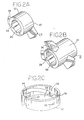
- Fig. 2A is a perspective view of an on-screw element used on the upstream side of a restriction ring assembly, in the presently preferred high efficiency mixer configuration.
- Fig. 2B is a perspective view of an on-screw element used on the downstream side of a restriction ring assembly, in the presently preferred high efficiency mixer configuration.
- Fig. 2C is a perspective view of a restriction ring assembly used in the presently preferred high efficiency mixer configuration.
- Fig. 3 is a perspective view showing the relative positioning of the elements of Figs. 2A, 2B and 2C in the presently preferred high efficiency mixer configuration.
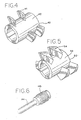
- Fig. 4 is a perspective view of a low-shear mixing screw element used in the presently preferred high efficiency mixer configuration.
- Fig. 5 is a perspective view of a high-shear mixing screw element used in the presently preferred high efficiency mixer configuration.
- Fig. 6 is a perspective view of a barrel pin element used in the presently preferred high efficiency mixer configuration.
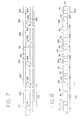
- Fig. 7 is a schematic diagram of a presently preferred arrangement of mixing barrel pins and ingredient feed ports used to practice the method of the invention.
- Fig. 8 is a schematic diagram of a presently preferred mixing screw configuration used to practice the method of the invention.
- the phrase "gum base concentrate” is defined as any mixture of less than all gum base ingredients used for a particular chewing gum, and/or any mixture of gum base ingredients in which some ingredients are present in less than the amounts ultimately used for a particular chewing gum, subject to the proviso that the gum base concentrate includes most or all of the high molecular weight elastomer used in the gum base and at least some gum base lubricant, or filler, or both.
- the term “high molecular weight elastomer” refers to rubbers which give chewing gum desirable chewing characteristics but which are too hard to incorporate into the gum base (or gum base concentrate) without intensive dispersive mixing. These polymers include butyl rubber, styrene butadiene rubber, polyisoprene, and butadiene rubber, having weight average molecular weights in the range of 50,000 to 1,000,000, and more typically 100,000 to 200,000.
- soft elastomers when their weight average molecular weight is below 50,000 (typically 8,000 to 20,000). Such soft polymers may, but need not be included in the gum base concentrate, and may alternatively be mixed with the gum base concentrate and other gum base ingredients during the continuous chewing gum mixing stage, as explained below.
- the gum base concentrate should be formulated with a composition that renders the concentrate useful in a variety of chewing gum bases and chewing gums.
- Complete chewing gum bases may include elastomers, elastomer plasticizers, waxes, fats, oils, softeners, emulsifiers, fillers, texturizers and miscellaneous ingredients such as antioxidants, preservatives, colorants and whiteners.
- the typical finished gum base constitutes from 5 to 95% by weight of the chewing gum composition, more typically from 10 to 50% by weight of the chewing gum, and most commonly from 20 to 30% by weight of the chewing gum.
- Elastomers constitute from 5 to 95 per cent by weight of the base, preferably from 10 to 70 per cent by weight and most preferably from 15 to 45 per cent by weight.
- Elastomers may include synthetic elastomers such as polyisobutylene, polybutadiene, isobutylene-isoprene copolymer, styrene-butadiene copolymer, polyvinyl acetate, vinyl acetate-vinyl laureate copolymer, polyethylene, ethylene vinyl acetate, polyvinyl alcohol or mixtures thereof.
- Elastomers may also include natural elastomers, including natural rubber such as smoked or liquid latex and guayule as well as natural gums such as jelutong, lechi caspi, perillo, massaranduba balata, massaranduba chocolate, nispero, rosindinha, chicle, gutta hang kang or mixtures thereof.
- natural elastomers include natural rubber such as smoked or liquid latex and guayule as well as natural gums such as jelutong, lechi caspi, perillo, massaranduba balata, massaranduba chocolate, nispero, rosindinha, chicle, gutta hang kang or mixtures thereof.
- Elastomers provide the rubbery, cohesive nature to the gum which varies depending on the elastomer's chemical and physical properties, and how the elastomer is blended with other ingredients. Synthetic elastomers are preferred for use with the present invention.
- Elastomer plasticizers modify the finished gum firmness when used in the gum base.
- Elastomer plasticizers typically constitute from 0 to 75 per cent by weight of the gum base, preferably from 5 to 45 per cent by weight and most preferably from 10 to 30 per cent by weight.
- Elastomer plasticizers include natural rosin esters such as glycerol ester of partially hydrogenated rosin, glycerol ester of polymerized rosin, glycerol ester of partially dimerized rosin, glycerol ester of rosin, glycerol ester of tall oil rosin, pentaerythritol esters of partially hydrogenated rosin, methyl and partially hydrogenated methyl esters of rosin, pentaerythritol ester of rosin or mixtures.
- Elastomer plasticizers also include synthetics such as terpene resins derived from alpha-pinene, beta-pinene, dipentene or di-limonene, and combinations thereof.
- Waxes include synthetic (e.g. polyethylene and Fischer-Tropsch waxes) and natural (candelilla carnauba, beeswax, rice bran or mixtures thereof) and petroleum (e.g. microcrystalline and paraffin). Waxes, when used, generally constitute up to 30 weight per cent of the gum base. When used, waxes aid in the curing of finished gum made from the gum base and also help improve the release of flavor, increase the shelf life and improve the chewing texture.
- synthetic waxes e.g. polyethylene and Fischer-Tropsch waxes
- natural candelilla carnauba, beeswax, rice bran or mixtures thereof
- petroleum e.g. microcrystalline and paraffin
- Fillers modify the texture of the gum base and aid processing.
- Fillers/texturizers include magnesium and calcium carbonate, ground limestone and silicate types such as magnesium and aluminum silicate, clay, alumina, talc as well as titanium oxide, mono-, di- and tricalcium phosphate, cellulose polymers such as ethylcellulose and methylceltulose, wood, or mixtures thereof.
- the filler typically comprises from 1 to 60 per cent by weight of the gum base.
- Gum bases which utilize acidic ingredients preferably contain a filler that is inert to acids, most preferably talc.
- Softeners and emulsifiers modify the texture and cause the hydrophobic and hydrophilic components of the gum base and chewing gum to become more miscible.
- Softeners/emulsifiers include tallow, hydrogenated tallow, lard, hydrogenated and partially hydrogenated vegetable oils, cocoa butter, glycerol monostearate, glycerol triacetate, lecithin, mono-, di- and triglycerides, acetylated mono-, di- and triglycerides, distilled mono-, di- and triglycerides, and fatty acids (e.g. stearic, palmitic, oleic, linoleic and linolenic acids) or mixtures thereof.
- Softeners/emulsifiers generally constitute from 0.5 to 40 weight per cent of the gum base.
- Antioxidants prolong shelf life and storage of the gum base, finished gum and/or their respective components including fat and flavor oils.
- Antioxidants may include butylated hydroxyanisole (BHA), butylated hydroxytoluene (BHT), beta-carotenes, tocopherols, acidulants such as Vitamin C, propyl gallate or mixtures thereof.
- Colorants and whiteners impart desired color characteristics or remove undesired color by whitening of the base and/or chewing gum.
- Colorants and whiteners include FD & C type lakes, plant extracts, fruit and vegetable extracts, titanium dioxide or mixtures thereof.
- the gum base concentrate is formulated using less than all of the gum base ingredients, and/or using lesser quantities of some of the gum base ingredients than are ultimately present in the gum base and chewing gum.
- the gum base concentrate includes a high molecular weight elastomer component which may contain one or more of the elastomers listed above.
- the gum base concentrate also contains a lubricant or a filler, or both.
- a lubricant is any ingredient which reduces friction in the mixing process.
- the lubricant can be a) any of the softener/emulsifiers mentioned above, b) any of the elastomer plasticizers mentioned above, c) a low molecular weight (“soft") elastomer, or d) any combination of the foregoing.
- the filler may be any of the fillers mentioned above, or a combination thereof.
- the composition of the base concentrate may vary widely depending on the intended composition of the chewing gum product(s) in which it will be used, the equipment used in processing and other factors specific to the actual manufacturing operation. However, it will preferably contain all of the hard (high molecular weight) elastomer to be used'in the finished gum composition and sufficient additional base ingredients (lubricant and/or filler) to allow efficient dispersive mixing.
- the lubricant and/or filler levels will be carefully chosen to facilitate mixing.
- the lubricant reduces friction and shearing force to prevent overloading the mixer motor and other components.
- the filler increases friction and shearing to ensure adequate dispersive mixing of the hard elastomer.
- the concentrate will contains from 5 to 60% elastomer (preferably from 8 to 40%), from 0 to 90% lubricant (preferably from 40 to 80%), from 0 to 60% filler (preferably from 5 to 40%) and from 0 to 20% other base ingredients (preferably from 0 to to 10%).
- elastomer preferably from 8 to 40%
- lubricant preferably from 40 to 80%
- filler preferably from 5 to 40%
- other base ingredients preferably from 0 to to 10%
- at least 20% is hard (high molecular weight) elastomer.
- the gum base concentrate includes at least some elastomer, lubricant and filler.
- the gum base concentrate may also include one or more additional gum base ingredients, as described above, provided that the inclusion of such ingredient does not eliminate the advantage of the gum base concentrate having a composition which is useful in a variety of different gum bases and chewing gums.
- the gum base concentrate should be composed of ingredients that are common to different gum bases.
- the gum base concentrate will include some or all of the desired fats and oils, because these may be more difficult to add and mix later on.
- the gum base concentrate can be prepared using any conventional high shear/high dispersion batch mixer which is typically used to manufacture a complete gum base.
- a continuous mixer or compounder may also be used as long as the mixer provides adequate dispersive mixing to effectively blend the ingredients.
- One suitable conventional mixer is a sigma blade mixer having a front to rear blade speed ratio of about 2:1, as described Statutory Invention Registration H1241, issued to Synosky et al.
- One suitable continuous mixer for the gum base concentrate is a paddle mixer as described in US Patent 5419919.
- Other continuous mixers include a blade-and-pin mixer, a corotating twin screw extruder, a counterrotating twin screw extruder, or a single screw extruder, provided that the mixer is capable of being configured and run in a manner which yields a homogeneous gum base concentrate.
- elastomer, lubricant and/or filler can be added to a heated sigma blade mixer and blended homogeneously. Then the remainder of these ingredients, and other gum base ingredients (if included), may be added sequentially and blended until a homogeneous mass is attained. This can usually be achieved in about one to four hours, depending on the exact composition of the gum base concentrate.
- the final mass temperature can be from 60 to 150°C, preferably from 80 to 120°C.
- the completely mixed molten mass can be emptied from the mixer into coated or lined pans, extruded or cast into any desirable shape, and allowed to cool or solidify.
- the molten gum base concentrate can be fed directly into the continuous chewing gum mixing operation if the gum base concentrate mixing equipment and continuous chewing gum mixing equipment are located at the same facility.
- the gum base concentrate is added to a continuous mixing apparatus which is configured for adding and mixing both the remaining gum base ingredients and the remaining chewing gum ingredients.
- the continuous mixer may be a properly configured twin screw extruder (with corotating or counterrotating screws), paddle mixer, blade-and-pin mixer, single screw extruder, or another continuous mixing apparatus.
- One particularly suitable continuous mixer is a high efficiency blade-and-pin mixer, described in the parent U.S. Application Serial No. 08/305 363.
- Another well-suited continuous mixer is a corotating twin-screw extrusion mixer, such as a Werner-Pfleiderer ZSK-58 available from Werner-Pfleiderer Corp. of Ramsey, N.J.
- the continuous mixer typically includes a plurality of mixing zones located a) at or near the upstream end of the mixer, b) at or near the center of the mixer, and c) at or near the downstream (exit) end of the mixer.
- the blade-and-pin mixer described in the above-identified parent application includes five mixing zones. Different ingredients are continuously fed into different zones of the continuous mixer. Once in the mixer, the ingredients are simultaneously blended with other ingredients and fed downstream toward the exit of the mixer.
- the gum base concentrate is preferably fed into the upstream zone of the continuous mixer, for example, the first zone of a five-zone blade-and-pin mixer.
- the concentrate may be fed in a molten or liquified form from a heated tank.
- the gum base concentrate may be ground and fed as solid pellets.
- the upstream zones of the mixer may be configured for high efficiency dispersive mixing. However, this is not absolutely essential for the present invention, and less intensive distributive mixing may also be employed.
- the remaining gum base ingredients which have not been included or which have been only partially included in the gum base concentrate, are added into the first mixing zone, downstream from the addition of the concentrate. These remaining gum base ingredients may include softeners, elastomer solvents, resins, additional fillers, colors, antioxidants, and low molecular weight elastomers.
- the ingredients become mixed to form a substantially homogeneous molten gum base within about the first 50-70 percent of the mixer length, or by about the end of the third mixing zone of a five-zone blade-and-pin mixer.
- the mixing zones at or near the downstream end of the continuous mixer are configured for distributive mixing.
- Distributive mixing is gentler than dispersive mixing, involves less shear, generates less heat, and is easier on the ingredients being mixed.
- the remaining (non-base) chewing gum ingredients are added and mixed with the molten gum base in the distributive mixing zone or zones.
- the gum base which is generally water-insoluble, constitutes from 5 to 95% by weight of the chewing gum product, more typically from 10 to 50% by weight of the chewing gum, most commonly from 20 to 30% by weight of the chewing gum.
- the chewing gum includes a generally watersoluble portion which may include softeners, bulk sweeteners, high intensity sweeteners, flavoring agents and combinations thereof. Softeners are added to the chewing gum in order to optimize the chewability and mouth feel of the gum.
- the softeners which are also known as plasticizers or plasticizing agents, generally constitute from 0.5 to 15% by weight of the chewing gum.
- the softeners may include glycerin, lecithin, and combinations thereof.
- Aqueous sweetener solutions such as those containing sorbitol, hydrogenated starch hydrolysates, corn syrup and combinations thereof, may also be used as softeners and binding agents in chewing gum.
- Bulk sweeteners constitute from 5 to 95% by weight of the chewing gum, more typically from 20 to 80% by weight of the chewing gum and most commonly from 30 to 60% by weight of the chewing gum.
- Bulk sweeteners may include both sugar and sugarless sweeteners and components.
- Sugar sweeteners may include saccharide containing components including but not limited to sucrose, dextrose, maltose, dextrin, dried invert sugar, fructose, levulose, galactose, corn syrup solids, and the like, alone or in combination.
- Sugarless sweeteners include components with sweetening characteristics but are devoid of the commonly known sugars.
- Sugarless sweeteners include but are not limited to sugar alcohols such as sorbitol, mannitol, xylitol, hydrogenated starch hydrolysates, maltitol, and the like, alone or in combination.
- High intensity sweeteners may also be present and are commonly used with sugarless sweeteners. When used. high intensity sweeteners typically constitute from 0.001 to 5% by weight of the chewing gum, preferably from 0.01 to 1% by weight of the chewing gum. Typically, high intensity sweeteners are at least 20 times sweeter than sucrose. These may include but are not limited to sucralose, aspartame, salts of acesulfame, alitame, saccharin and its salts, cyclamic acid and its salts, glycyrrhizin, dihydrochalcones, thaumatin, monellin, and the like, alone or in combination.
- Combinations of sugar and/or sugarless sweeteners may be used in chewing gum.
- the sweetener may also function in the chewing gum in whole or in part as a water soluble bulking agent. Additionally, the softener may provide additional sweetness such as with aqueous sugar or alditol solutions.
- Flavor should generally be present in the chewing gum in an amount within the range of from 0.1 to 15% by weight of the chewing gum, preferably between from 0.2 to 5% by weight of the chewing gum, most preferably from 0.5 to 3% by weight of the chewing gum.
- Flavoring agents may include essential oils, synthetic flavors or mixtures thereof including but not limited to oils derived from plants and fruits such as citrus oils, fruit essences, peppermint oil, spearmint oil, other mint oils, clove oil, oil of wintergreen, anise and the like.
- Artificial flavoring agents and components may also be used in the flavor ingredient of the invention. Natural and artificial flavoring agents may be combined in any sensorially acceptable fashion.
- Optional ingredients such as colors, emulsifiers, pharmaceutical agents and additional flavoring agents may also be included in chewing gum.
- U.S. Application Serial No. 08/305,363 discloses using a high efficiency continuous mixer (for example, a blade-and-pin mixer) to make chewing gum without requiring separate manufacture of a gum base. Except for the separate manufacture of a gum base concentrate, as taught herein, procedures similar to those set forth in the above-identified parent application can be used to make chewing gum according to this invention.
- a mixing distance, or L/D can be expressed as a ratio of the length of a particular active region of mixer screw, which is composed of mixing elements, divided by the maximum diameter of the mixer barrel in this active region.
- the method of the invention comprises performing the following mixing steps in a single continuous mixer:
- the gum base concentrate and other gum base ingredients be completely added and mixed upstream from the remaining chewing gum ingredients, and that the remaining ingredients be completely added downstream for mixing with the already blended gum base.
- the invention also encompasses variations of this procedure wherein a portion of gum base ingredients may be added downstream with or after some remaining chewing gum ingredients, and/or wherein a portion of the remaining (non-base) ingredients may be added upstream with or before some of the base ingredients.
- a substantially homogeneous chewing gum product mass may be formed in a single continuous mixer, using an L/D of not more than about 40, without requiring separate manufacture of a gum base except for the gum base concentrate.
- the gum base manufacture can be completed using a mixing L/D of about 25 or less, preferably about 20 or less, most preferably about 15 or less.
- the remaining chewing gum ingredients can be combined with the gum base to make a finished chewing gum product using a mixing L/D of about 25 or less, preferably about 15 or less, most preferably about 10 or less.
- the mixing of the gum base ingredients and the remaining chewing gum ingredients preferably occur in different parts of the mixer, but may overlap, so long as the total mixing is achieved using an L/D of about 40 or less, preferably about 30 or less, most preferably about 20 or less.
- the chewing gum manufacture can be completed using a total mixing L/D of about 19.
- the gum base concentrate can be added and mixed with the remaining gum base ingredients using an L/D of about 15 or less, and the remaining chewing gum ingredients can be combined with the gum base ingredients using a further L/D of about 5 or less.
- a blade-and-pin mixer is exemplified in Fig. 1.
- a blade-and-pin mixer uses a combination of selectively configured rotating mixer blades and stationary barrel pins to provide efficient mixing over a relatively short distance.
- a commercially available blade-and-pin mixer is the Buss kneader, manufactured by Buss AG in Switzerland, and available from Buss America, located in Bloomingdale, Illinois.
- a presently preferred blade-and-pin mixer 100 includes a single mixing screw 120 turning inside a barrel 140 which, during use, is closed and completely surrounds the mixing screw 120.
- the mixing screw 120 includes a generally cylindrical shaft 122 and three rows of mixing blades 124 arranged at evenly spaced locations around the screw shaft 122 (with only two of the rows being visible in Fig. 1).
- the mixing blades 124 protrude radially outward from the shaft 122, with each one resembling the blade of an axe.
- the mixing barrel 140 includes an inner barrel shaft 142 which is generally cylindrical when the barrel 140 is closed around the screw 120 during operation of the mixer 100.
- Three rows of stationary pins 144 are arranged at evenly spaced locations around the screw shaft 142, and protrude radially inward from the barrel shaft 142.
- the pins 144 are generally cylindrical in shape, and may have rounded or bevelled ends 146.
- the mixing screw 120 with blades 124 rotates inside the barrel 140 and is driven by a variable speed motor (not shown). During rotation, the mixing screw 120 also moves back and forth in an axial direction, creating a combination of rotational and axial mixing which is highly efficient. During mixing, the mixing blades 124 continually pass between the stationary pins 144, yet the blades and the pins never touch each other. Also, the radial edges 126 of the blades 124 never touch the barrel inner surface 142, and the ends 146 of the pins 144 never touch the mixing screw shaft 122.
- Figs. 2-6 illustrate various screw elements which can be used to configure the mixing screw 120 for optimum use.
- Figs. 2A and 2B illustrate on-screw elements 20 and 21 which are used in conjunction with a restriction ring assembly.
- the on-screw elements 20 and 21 each include a cylindrical outer surface 22, a plurality of blades 24 projecting outward from the surface 22, and an inner opening 26 with a keyway 28 for receiving and engaging a mixing screw shaft (not shown).
- the second on-screw element 21 is about twice as long as the first on-screw element 20.
- Fig. 2C illustrates a restriction ring assembly 30 used to build back pressure at selected locations along the mixing screw 120.
- the restriction ring assembly 30 includes two halves 37 and 39 mounted to the barrel housing 142, which halves engage during use to form a closed ring.
- the restriction ring assembly 30 includes a circular outer rim 32, an inner ring 34 angled as shown, and an opening 36 in the inner ring which receives, but does not touch, the on-screw elements 20 and 21 mounted to the screw shaft. Mounting openings 35 in the surface 32 of both halves of the restriction ring assembly 30 are used to mount the halves to the barrel housing 142.
- Fig. 3 illustrates the relationship between the restriction ring assembly 30 and the on-screw elements 20 and 21 during operation.
- the on-screw element 20 on the upstream side of the restriction ring assembly includes a modified blade 27 permitting clearance of the inner ring 34.
- the other on-screw element 21 is placed generally downstream of the restriction element 30, and has an end blade (not visible) which moves close to and wipes the opposite surface of the inner ring 34.
- the clearances between outer surfaces 22 of the on-screw elements 20 and 21 and the inner ring 34 of the restriction ring assembly 30, which can vary and preferably are on the order of 1-5mm, determine to a large extent how much pressure build-up will occur in the upstream region of the restriction ring assembly 30 during operation of the mixer 100.
- the upstream on-screw element 20 has an L/D of about 1/3
- the downstream on-screw element 21 has an L/D of about 2/3, resulting in a total L/D of about 1.0 for the on-screw elements.
- the restriction ring assembly 30 has a smaller L/D of about 0.45 which coincides with the L/D of on-screw elements 20 and 21, which engage each other but do not touch the restriction ring assembly.
- Figs. 4 and 5 illustrate the mixing or "kneading" elements which perform most of the mixing work.
- the primary difference between the lower shear mixing element 40 of Fig. 4 and the higher shear mixing element 50 of Fig. 5 is the size of the mixing blades which project outward on the mixing elements.
- the higher shear mixing blades 54 which project outward from the surface 52 are larger and thicker than the lower shear mixing blades 44 projecting outward from the surface 42 in Fig. 4.
- the mixing blades are arranged in three circumferentially-spaced rows, as explained above with respect to Fig. 1.
- Fig. 6 illustrates a single stationary pin 144 detached from the barrel 140.
- the pin 144 includes a threaded base 145 which permits attachment at selected locations along the inner barrel shaft 142. It is also possible to configure some of the pins 144 as liquid injection ports by providing them with hollow center openings.
- Fig. 7 is a schematic view showing the presently preferred barrel configuration, including the presently preferred arrangement of barrel pins 144.
- Fig. 8 is a corresponding schematic view illustrating the presently preferred mixing screw configuration.
- the mixer 200 whose preferred configuration is illustrated in Figs. 7 and 8 has an overall active mixing L/D of about 19.
- the mixer 200 includes an initial feed zone 210 and five mixing zones 220, 230, 240, 250 and 260.
- the zones 210, 230, 240, 250 and 260 include five possible large feed ports 212, 232, 242, 252 and 262, respectively, which can be used to add major (e.g. solid) ingredients to the mixer 200.
- the zone 260 is also configured with three smaller liquid injection ports 261, 263 and 264 which can be used to add liquid ingredients.
- the liquid injection ports 261, 263 and 264 include special barrel pins 144 formed with hollow centers, as explained above.
- barrel pins 144 are preferably present in most or all of the available locations, in all three rows as shown.
- Zone 210 which is the initial feed zone, is configured with about 1-1/3 L/D of low shear elements, including two of the elements 40 shown in Fig. 4.
- the L/D of the initial feed zone 210 is not counted as part of the overall active mixing L/D of 19, discussed above, because its purpose is merely to convey ingredients into the mixing zones.
- the first mixing zone 220 is configured, from left to right (Fig. 8), with two low shear mixing elements 40 (Fig. 4) followed by two high shear elements 50 (Fig. 5).
- the two low shear mixing elements contribute about 1-1/3 L/D of mixing
- the two high shear mixing elements contribute about 1-1/3 L/D of mixing.
- Zone 220 has a total mixing L/D of about 3.0, including the end part covered by a 57mm restriction ring assembly 30 with cooperating on-screw elements 20 and 21 (not separately designated in Fig. 8).
- the restriction ring assembly 30 with cooperating on-screw elements 20 and 21, straddling the end of the first mixing zone 220 and the start of the second mixing zone 230 have a combined L/D of about 1.0, part of which is in the second mixing zone 230.
- zone 230 is configured, from left to right, with three low shear mixing elements 40 and 1.5 high shear mixing elements 50.
- the three low shear mixing elements contribute about 2.0 L/D of mixing, and the 1.5 high shear mixing elements contribute about 1.0 L/D of mixing.
- Zone 230 has a total mixing L/D of about 4.0.
- Zone 240 Straddling the end of the second mixing zone 230 and the start of the third mixing zone 240 are a 60mm restriction ring assembly 30 with cooperating on-screw elements having a combined L/D of about 1.0. Then, zone 240 is configured, from left to right, with two low shear mixing elements 40 contributing a mixing L/D of about 1 1/3 , followed by 1.5 high shear mixing elements 50 contributing a mixing L/D of about 1.0, followed by one low shear mixing element 40 contributing a mixing L/D of about two thirds. Zone 240 also has a total mixing L/D of about 4.0.
- Straddling the end of the third mixing zone 240 and the start of the fourth mixing zone 250 are 1.5 high shear mixing elements 50 contributing a mixing L/D of about 1.0. Then, the remainder of the fourth mixing zone 250 and the fifth mixing zone 260 are configured with eleven low shear mixing elements contributing a mixing L/D of about 7 1 / 3 .
- Zone 250 has a total mixing L/D of about 4.0, and zone 260 has a total mixing L/D of about 4.0.
- the mixer temperature is preferably optimized so that the gum base is at about 54.4°C (130°F) or lower when it initially meets the other chewing gum ingredients, and the chewing gum product is at about 54.4°C (130°F) or lower (preferably 51.7°C (125°) or lower) when it exits the mixer.
- This temperature optimization can be accomplished, in part, by selectively heating and/or water cooling the barrel sections surrounding the mixing zones 220, 230, 240, 250 and 260.
- the gum base concentrate and any remaining gum base ingredients are added to the first large feed port 212 in the feed zone 210 of the mixer 200, and are subjected to dispersive mixing in the first mixing zone 220 and the second mixing zone 230 while being conveyed in the direction of the arrow 122. Then, the gum base ingredients are subjected to more distributive mixing in the third mixing zone 240, while being conveyed in the direction of arrow 122. By the time the ingredients leave the zone 240, the gum base manufacture should be complete. The gum base should leave the third mixing zone 240 as a substantially homogeneous, lump-free compound with a uniform color. Of course, the gum base could only be observed by stopping the mixer and opening the mixer barrel.
- the fourth mixing zone 250 is used primarily to cool the gum base, although minor chewing gum ingredients may be added here. Then, to manufacture the final chewing gum product, glycerin, corn syrup, other bulk sugar sweeteners, high intensity sweeteners, and flavors can be added to the fifth mixing zone 260, and the ingredients are subjected to distributive mixing. If the gum product is to be sugarless, hydrogenated starch hydrolysate or sorbitol solution can be substituted for the corn syrup and powdered alditols can be substituted for the sugars.
- glycerin is added to the first liquid injection port 261 in the fifth mixing zone 260.
- Solid ingredients are added to the large feed port 262.
- Syrups corn syrup, hydrogenated starch hydrolyzate, sorbitol solution, etc.
- flavors are added to the final liquid injection port 264.
- Flavors can alternatively be added at ports 261 and 263 in order to help plasticize the gum base, thereby reducing the temperature and torque on the screw. This may permit running of the mixer at higher rpm and throughput.
- the gum ingredients are compounded to a homogeneous mass which is discharged from the mixer as a continuous stream or "rope".
- the continuous stream or rope can be deposited onto a moving conveyor and carried to a forming station, where the gum is shaped into the desired form such as by rolling it into sheets, scoring, and cutting into sticks.
- the following gum base concentrate was prepared using techniques similar to conventional techniques for making a gum base. Specifically, a high shear W & P dual blade sigma mixer was used having a front blade speed of 252 rpm, heated with 45 psi steam, and having a 341kg (750-lb) batch size. A two-hour mixing cycle was used, and the batch was discharged at 95 to 120°C.
- the above gum base concentrate had a homogeneous consistency, and a composition suitable for use in a variety of chewing gum products.
- a chewing gum product was made using a Buss blade-and-pin mixer having five mixing barrel zones, a mixing L/D of about 19, and an additional feed conveying L/D of about 1 1/3 before the first mixing zone.
- the mixer had a maximum barrel diameter of 100 mm and a screw length of 2080 mm.
- the mixing screw was designed using the preferred configuration described above with respect to Figs. 7 and 8.
- the feed rates were designed to yield about 136kg (300 pounds) per hour of chewing gum product. No die was used at the downstream end of the mixer, and the product exited as a continuous rope.
- Liquid ingredients were fed using volumetric pumps into the large feed ports and/or smaller liquid injection ports generally positioned as described above, unless otherwise indicated.
- the pumps were appropriately sized and adjusted to achieve the desired feed rates.
- Dry ingredients were added using gravimetric screw feeders into the large feed ports positioned as described above. Again, the feeders were appropriately sized and adjusted to achieve the desired feed rates.
- Temperature control was accomplished by circulating water through jackets surrounding each mixing barrel zone and inside the mixing screw, as needed. Where water cooling was desired, tap water (typically at about 13°C (55°F)) was used without additional chilling.
- Fluid temperatures were recorded for both the fluid and the ingredient mixture. Fluid (water) temperatures were set for each barrel mixing zone (corresponding to zones 220, 230, 240, 250 and 260 in Figs. 7 and 8), and are reported below as Z1, Z2, Z3, Z4 and Z5, respectively. Fluid temperatures were also set for the mixing screw 120, and are reported below as S1.
- the ingredients were mixed together and conveyed downstream using a mixing screw speed of 60 rpm.
- the zone temperatures (Z1-Z5,°F) were set at 66°C (150), 66°C (150), 38°C (100), 13°C (55) and 13°C (55), respectively.
- the screw temperature (S1) was set at 13°C (55°F).
- the mixture temperatures (T1-T6,°F) were measured as 66°C (150), 67°C (153), 53°C (128), 31°C (87), 35°C (95), and 39°C (103), respectively.
- Example 2 The following is an example of a different chewing gum product that can be made using the same gum base concentrate of Example 1.
- This chewing gum formulation which is fruit-flavored, would also include a different ultimate gum base composition than the chewing gum of Example 2.
- Comparison of Examples 2 and 3 indicates that, when the method of the invention is employed, significantly different chewing gum compositions with significantly different gum bases can be made using the same gum base concentrate and very similar manufacturing techniques.
- This Example illustrates the continuous preparation of a gum base concentrate using a paddle mixer as described in U.S. Patent No, 5419919
- the paddle mixer can be a 12.7 cm (5-inch) paddle diameter Teledyne Readco continuous twin screw mixer, available from Teledyne Readco in York, Pennsylvania.
- the paddle mixer can be heated to 175°C and run at 250 rpm.
- a Teledyne Readco paddle mixer may include an initial twin feed screw positioned adjacent to a first ingredient addition port, followed by 28 segments on each screw shaft which are user configurable.
- Paddle elements may be placed on each segment in any of four axial positions numbered 1-4 (separated by relative angles of 0°, 90°, 180° and 270°) to generate forward, neutral or back pressure over a series of segments.
- each of the twin screw shafts can be configured as follows:
- Into the first feed port can be added 6.42kg (14.12 lbs)/hr of butyl rubber, 15.96kg (35.12 lb)/hr of calcium carbonate, and 12.67kg (27.88 lbs)/hr of terpene resin.
- Into the second feed port can be added 19.5 kg (42.88 lbs)/hr of polyvinyl acetate.
- the product will be 54.5kg (120 lbs)/hr of homogeneous gum base concentrate which can be fed continuously, in molten form, into a continuous chewing gum mixer as described in Example 5.
- Example 4 illustrates the continuous preparation of a wintergreen-flavored sugar chewing gum using the base concentrate of Example 4.
- Two identical Werner-Pfleiderer ZSK 58 twin screw continuous mixing extruders can be placed in parallel with each other, and in series with the Teledyne Readco mixer used to make the gum base concentrate of Example 4.
- Each ZSK 58 is equipped with six 240 mm long, 58 mm diameter barrel segments or zones. As such, each barrel segment has a nominal L/D of 4 and each ZSK 58 has a nominal total mixer L/D of 24.
- the continuous molten gum base concentrate stream exiting the paddle mixer is divided into two equal streams of 60 pounds per hour, with one stream feeding each of the ZSK 58 continuous mixers.
- Each continuous mixer is configured with a screw profile selected to provide sufficient distributive mixing in the first 3-4 barrel sections (12-16 L/D) in order to incorporate oils and polyisobutylene into the gum base concentrate, thereby providing a finished gum base. Thereafter, the remainder of each ZSK 58 mixer (2-3 barrel sections, or 8-12 L/D) is configured for distributive mixing to facilitate incorporation of the remaining (non-base) chewing gum ingredients.
- each of the twin mixing screws in each ZSK 58 mixer can be configured as follows.
- the first (upstream) zone, adjacent to a first feed port, can be configured with 180 mm of forward conveying elements followed by 60 mm of forward tooth mixing elements.
- the second and third zones (and, possibly, the fourth) can each be configured with 90 mm of forward conveying elements, followed by 120 mm of forward turbine elements, followed by 30 mm of reverse conveying elements.
- a disk element can be employed to restrict the flow of the gum base ingredients, causing localized filling of the mixer and better mixing of the gum base ingredients.
- forward conveying elements can be used exclusively or can be combined with occasional groups of kneading blocks to ensure product homogeneity.
- This conveying and light kneading arrangement provides a more gentle distributive mixing of the remaining (non-base) chewing gum ingredients with the gum base ingredients in the final zones of each ZSK 58 mixer.
- Another major feed port, used for adding bulk sweeteners and other non-base ingredients, is provided at the beginning of the first chewing gum mixing zone, just downstream from the last gum base mixing zone.
- the six zones can be set to temperatures (°C) of 120, 110, 80, 49, 49 and 49, respectively.
- the specific ingredients can be added as follows, for each of the ZSK 58 continuous mixers.
- Into the second major feed port (in the fourth zone, assuming the gum base manufacture is completed in zone 3) can be added 93.6kg (206 lbs)/hr of sugar, 18.2kg (40 lbs)/hr of dextrose monohydrate, 2.36kg (5.20 lbs)/hr of encapsulated aspartame, and 2.18kg (4.80 lbs)/hr of encapsulated acesultame K. Also, a mixture of 10% glycerin and 90% corn syrup can be added at 24.2kg (53.2 lbs)/hr into the fourth zone, using a liquid injection port just downstream from the major feed port.
- a mixture of 6% lecithin and 94% wintergreen flavor can be added at 3.1kg (6.80 lbs)/hr using a liquid injection port in the sixth zone.
- the result will be a wintergreen-flavored chewing gum, produced at 182kg (400 lbs)/hr by each of the two ZSK 58 continuous mixers.
Landscapes
- Chemical & Material Sciences (AREA)
- Life Sciences & Earth Sciences (AREA)
- Engineering & Computer Science (AREA)
- Food Science & Technology (AREA)
- Polymers & Plastics (AREA)
- Inorganic Chemistry (AREA)
- Confectionery (AREA)
Claims (40)
- Verfahren zum Herstellen von Kaugummi, der Gummibasen-Zutaten, Süßungsmittel, Geschmacksstoff und andere Gummi-Zutaten aufweist, wobei das Verfahren umfasst:a) Herstellen eines Gummibasen-Konzentrats, das Elastomer mit hohem Molekulargewicht und einen ersten Anteil Füllstoff oder Schmierstoff oder beides sowie einen ersten Anteil einer oder mehrerer zusätzlicher Gummibasen-Zutaten umfasst, die aus der Gruppe ausgewählt werden, die Elastomer, Elastomer-Plastifiktor, Wachs, Weichmacher, Emulgator und Kombinationen daraus umfasst;b) kontinuierliches Zuführen des Gummibasen-Konzentrats zu einem kontinuierlichen Mischer;c) kontinuierliches Zuführen von verbleibendem Füllstoff, Schmierstoff und allen anderen Gummibasen-Zutaten und Zutatenanteilen, Süßungsmittel, Geschmakksstoff und anderen Gummi-Zutaten zu dem kontinuierlichen Mischer und kontinuierliches Mischen derselben mit dem Gummibesen-Konzentrat, um ein Kaugummierzeugnis auszubilden; undd) kontinuierliches Abgeben des Kaugummierzeugnisses aus dem kontinuierlichen Mischer.
- Verfahren nach Anspruch 1, wobei der erste Anteil Füllstoff oder Schmierstoff in dem Gummibasen-Konzentrat weniger als einen Gesamtanteil Füllstoff und Schmierstoff enthält.
- Verfahren nach Anspruch 1 oder 2, wobei der erste Anteil Füllstoff oder Schmierstoff in dem Gummibasen-Konzentrat den gesamten Füllstoff, der in der Gummibase einzusetzen ist, jedoch keinen Schmierstoff, enthält.
- Verfahren nach einem der Ansprüche 1 bis 3, wobei die restlichen Zutaten, die dem Mischer zugeführt werden, von 0 bis 75 Gew.-% Elastomer-Plastifikator, von 0 bis 30 Gew.-% Wachs, von 1 bis 60 Gew.-% Füllstoff sowie von 0,5 bis 40 Gew.-% Weichmacher/Emulgatoren des Gewichtes der Gummibase umfassen.
- Verfahren nach einem der Ansprüche 1 bis 4, wobei wenigstens ein Süßungsmittel und wenigstens ein Geschmacksstoff stromab von anderen verbleibenden Zutaten, die dem Mischer zugeführt werden, dem Mischer kontinuierlich zugeführt werden und kontinuierlich mit den Zutaten und dem Konzentrat gemischt werden.
- Verfahren nach einem der Ansprüche 1 bis 5, wobei die Zutaten in dem kontinuierlichen Mischer verteilendem Mischen unterzogen werden, um das Kaugummierzeugnis auszubilden.
- Verfahren nach einem der Ansprüche 1 bis 6, wobei das Elastomer von 5 bis 60 Gew.-% des Gummibasen-Konzentrats bildet.
- Verfahren nach Anspruch 7, wobei das Elastomer von 8 bis 40 Gew.-% des Gummibasen-Konzentrats bildet.
- Verfahren nach einem der Ansprüche 1 bis 8, wobei das Gummibasen-Konzentrat bis zu 60 % des Gewichtes des Konzentrats Füllstoff enthält.
- Verfahren nach Anspruch 9, wobei das Gummibasen-Konzentrat von 8 bis 40 % des Gewichtes des Konzentrats Füllstoff enthält.
- Verfahren nach einem der Ansprüche 1 bis 10, wobei das Gummibasen-Konzentrat bis zu 90 % des Gewichtes des Konzentrats Schmierstoff enthält.
- Verfahren nach Anspruch 11, wobei das Gummibasen-Konzentrat von 40 bis 80 % des Gewichtes des Konzentrats Schmierstoff enthält.
- Verfahren nach einem der Ansprüche 1 bis 12, wobei die Schritte b) und c) unter Verwendung eines Verhältnisses von Mischlänge zu Durchmesser von nicht mehr als 40 ausgeführt werden.
- Verfahren nach Anspruch 13, wobei die Schritte b) und c) unter Verwendung eines Verhältnisses von Gesamtmischlänge zu Durchmesser von nicht mehr als 30 % ausgeführt werden.
- Verfahren nach Anspruch 14, wobei die Schritte b) und c) unter Verwendung eines Verhältnisses von Mischlänge zu Durchmesser von nicht mehr als 20 ausgeführt werden.
- Verfahren nach Anspruch 5, wobei Süßungsmittel und Geschmacksstoff mit den Zutaten und Konzentrat unter Verwendung eines Verhältnisses von Mischlänge zu Durchmesser von nicht mehr als 25 gemischt werden.
- Verfahren nach Anspruch 16, wobei Süßungsmittel und Geschmacksstoff mit den Zutaten und Konzentrat unter Verwendung eines Verhältnisses von Mischlänge zu Durchmesser von nicht mehr als 15 gemischt werden.
- Verfahren nach Anspruch 17, wobei Süßungsmittel und Geschmacksstoff mit den Zutaten und Konzentrat unter Verwendung eines Verhältnisses von Mischlänge zu Durchmesser von nicht mehr als 10 gemischt werden.
- Verfahren nach Anspruch 5, wobei das Zuführen und Mischen vor dem Zusetzen von Süßungsmittel und Geschmacksstoff unter Verwendung eines Verhältnisses von Mischlänge zu Durchmesser von nicht mehr als 25 ausgeführt werden.
- Verfahren nach Anspruch 19, wobei das Zuführen und Mischen vor dem Zusetzen von Süßungsmittel und Geschmacksstoff unter Verwendung eines Verhältnisses von Mischlänge zu Durchmesser von nicht mehr als 15 ausgeführt werden.
- Verfahren nach einem der Ansprüche 1 bis 20, wobei Gummibasen-Konzentrat unter Verwendung eines Chargenmischers hergestellt wird.
- Verfahren nach Anspruch 21, wobei der Chargenmischer einen Z-Klingenmischer umfasst.
- Verfahren nach einem der Ansprüche 1 bis 20, wobei das Gummibasen-Konzentrat unter Verwendung eines kontinuierlichen Mischers hergestellt wird.
- Verfahren nach Anspruch 23, wobei der kontinuierliche Mischer einen Paddelmischer umfasst.
- Verfahren nach Anspruch 23, wobei der kontinuierliche Mischer einen Klingenund-Zapfen-Mischer umfasst.
- Verfahren nach Anspruch 23, wobei der kontinuierliche Mischer einen gleichlaufenden Doppelschneckenextruder umfasst.
- Verfahren nach Anspruch 23, wobei der kontinuierliche Mischer einen gegenlaufenden Doppelschneckenextruder umfasst.
- Verfahren nach einem der Ansprüche 1 bis 27, wobei der kontinuierliche Kaugummimischer einen gleichlaufenden Doppelschneckenextruder umfasst.
- Verfahren nach einem der Ansprüche 1 bis 27, wobei der kontinuierliche Kaugummimischer einen gegenlaufenden Doppelschneckenextruder umfasst.
- Verfahren nach einem der Ansprüche 1 bis 27, wobei der kontinuierliche Kaugummimischer einen Paddelmischer umfasst.
- Verfahren nach einem der Ansprüche 1 bis 27, wobei der kontinuierliche Kaugummimischer einen Einschneckenextruder umfasst.
- Verfahren nach einem der Ansprüche 1 bis 31, wobei das Elastomer mit dem hohen Molekulargewicht in dem Gummibasen-Konzentrat ein synthetisches Elastomer umfasst, das aus der Gruppe ausgewählt wird, die aus Polyisobutylen, Polybutadien, lsobutylen-lsopren-Copolymer, Styrolbutadien-Copolymer, Polyvinylacetat, Vinylacetat-Vinyllaurat-Copolymer, Polyethylen, Ethylen-Vinylacetat und Gemischen daraus besteht.
- Verfahren nach einem der Ansprüche 1 bis 32, wobei das Gummibasen-Konzentrat einen Füllstoff umfasst, der aus der Gruppe ausgewählt wird, die aus Magnesiumcarbonat, Calciumcarbonat, Kalkstein, Aluminiumsilicat, Ton, Aluminiumoxid, Talk, Titanoxid, Monocalciumphosphat, Dicalciumphosphat, Tricalciumphosphat, Cellulosepolymeren und Gemischen daraus besteht.
- Verfahren nach einem der Ansprüche 1 bis 33, wobei das Gummibasen-Konzentrat ein Schmierstoffmaterial umfasst, das aus der Gruppe ausgewählt wird, die aus Weichmachem/Emulgatoren, Elastomer-Plastifikatoren, Elastomeren mit niedrigem Molekulargewicht und Kombinationen daraus besteht.
- Verfahren nach einem der Ansprüche 1 bis 34, das in einer Vorrichtung ausgeführt wird, die umfasst:a) einen kontinuierlichen Mischer mit einem oder mehreren Zuführanschlüssen, die an einer ersten Position zur Aufnahme eines Gummibasen-Konzentrats angeordnet sind, wobei das Konzentrat ein Elastomer mit hohem Molekulargewicht und einem ersten Anteil Füllstoff oder Schmierstoff oder beiden, sowie einen ersten Anteil einer oder mehrerer zusätzlicher Gummibasen-Zutaten umfasst, die aus der Gruppe ausgewählt werden, die aus Plastifikatoren, Wachsen, Weichmachern, Emulgatoren und Kombinationen daraus besteht;b) einen oder mehrere zweite Zuführanschlüsse an den kontinuierlichen Mischer, die an einer zweiten Position, die stromab von der ersten Position liegt, zur Aufnahme eines zweiten Anteile eines oder mehrerer Füllstoffe oder Schmierstoffe und eines zweiten Anteils einer oder mehrerer der zusätzlichen Gummibasen-Zutaten in den kontinuierlichen Mischer angeordnet sind;c) einen oder mehrere dritte Zuführanschlüsse an den kontinuierlichen Mischer, die an einer dritten Position angeordnet sind. die stromab von der zweiten Position liegt, zur Aufnahme von Kaugummi-Zutaten in den kontinuierlichen Mischer,d) einen oder mehrere Mischabschnitte in dem kontinuierlichen Mischer zum Mischen der zweiten Anteile der Gummibasen-Zutaten und der Kaugummi-Zutaten mit dem Gummibasen-Konzentrat, um ein Kaugummierzeugnis auszubilden; unde) wobei der kontinuierliche Mischer einen oder mehrere Abgabeauslasse zum kontinuierlichen Abgeben des ausgebildeten Kaugummierzeugnisses aus dem kontinuierlichen Mischer hat.
- Verfahren nach Anspruch 35, wobei der kontinuierlichen Mischer ein Extruder ist.
- Verfahren nach Anspruch 35 oder 36, wobei der kontinuierliche Mischer ein oder mehrere stark scherende Mischschneckenelemente und ein oder mehrere schwach scherende Mischschneckenelemente aufweist.
- Verfahren nach einem der Ansprüche 35 bis 37, wobei der kontinuierliche Mischer eines oder mehrere Trommelschneckenelemente hat.
- Verfahren nach einem der Ansprüche 35 bis 38, wobei die zweiten Zuführanschlüsse feste Zutaten aufnehmen und die dritten Zuführanschlüsse flüssige Zutaten aufnehmen.
- Verfahren nach einem der Ansprüche 35 bis 39, wobei der eine oder die mehreren zweiten Zuführanschlüsse ausreichend groß sind, um feste Gummibasen-Zutaten aufzunehmen und wenigstens einer der dritten Zuführanschlüsse ein Flüssigkeitseinspritzanschluss ist, der erheblich kleiner ist als die zweiten Zuführanschlüsse.
Priority Applications (4)
| Application Number | Priority Date | Filing Date | Title |
|---|---|---|---|
| EP19950301644 EP0732059B1 (de) | 1995-03-13 | 1995-03-13 | Kontinuierliche Herstellung von Kaugummie aus einem Grundmassekonzentrat |
| DK95301644T DK0732059T3 (da) | 1995-03-13 | 1995-03-13 | Kontinuert tyggegummifremstilling af et basiskoncentrat |
| DE1995630970 DE69530970T2 (de) | 1995-03-13 | 1995-03-13 | Kontinuierliche Herstellung von Kaugummi aus einem Grundmassekonzentrat |
| ES95301644T ES2201085T3 (es) | 1995-03-13 | 1995-03-13 | Fabricacion continua de goma de mascar a partir de un concentrado de goma base. |
Applications Claiming Priority (1)
| Application Number | Priority Date | Filing Date | Title |
|---|---|---|---|
| EP19950301644 EP0732059B1 (de) | 1995-03-13 | 1995-03-13 | Kontinuierliche Herstellung von Kaugummie aus einem Grundmassekonzentrat |
Publications (2)
| Publication Number | Publication Date |
|---|---|
| EP0732059A1 EP0732059A1 (de) | 1996-09-18 |
| EP0732059B1 true EP0732059B1 (de) | 2003-06-04 |
Family
ID=8221129
Family Applications (1)
| Application Number | Title | Priority Date | Filing Date |
|---|---|---|---|
| EP19950301644 Expired - Lifetime EP0732059B1 (de) | 1995-03-13 | 1995-03-13 | Kontinuierliche Herstellung von Kaugummie aus einem Grundmassekonzentrat |
Country Status (4)
| Country | Link |
|---|---|
| EP (1) | EP0732059B1 (de) |
| DE (1) | DE69530970T2 (de) |
| DK (1) | DK0732059T3 (de) |
| ES (1) | ES2201085T3 (de) |
Families Citing this family (2)
| Publication number | Priority date | Publication date | Assignee | Title |
|---|---|---|---|---|
| US5827549A (en) * | 1996-02-21 | 1998-10-27 | Wm. Wrigley, Jr. Company | Process control system for automated continuous production of chewing gum |
| DE10024122A1 (de) | 2000-05-18 | 2001-11-22 | Lipp Mischtechnik Gmbh | Vorrichtung zur Herstellung von Kaugummi |
Family Cites Families (2)
| Publication number | Priority date | Publication date | Assignee | Title |
|---|---|---|---|---|
| FR2607671B1 (fr) * | 1986-12-04 | 1991-02-08 | Gen Foods France | Procede de fabrication directe de gomme de base pour pate masticatoire et de chewing-gum |
| FR2635441B1 (fr) * | 1988-08-18 | 1991-12-27 | Gen Foods France | Concentres de gomme de base a haute teneur en polymeres, leur procede de preparation et leur utilisation dans la fabrication de gomme a macher |
-
1995
- 1995-03-13 DE DE1995630970 patent/DE69530970T2/de not_active Expired - Lifetime
- 1995-03-13 EP EP19950301644 patent/EP0732059B1/de not_active Expired - Lifetime
- 1995-03-13 ES ES95301644T patent/ES2201085T3/es not_active Expired - Lifetime
- 1995-03-13 DK DK95301644T patent/DK0732059T3/da active
Also Published As
| Publication number | Publication date |
|---|---|
| EP0732059A1 (de) | 1996-09-18 |
| DE69530970D1 (de) | 2003-07-10 |
| DK0732059T3 (da) | 2003-10-06 |
| DE69530970T2 (de) | 2003-12-04 |
| ES2201085T3 (es) | 2004-03-16 |
Similar Documents
| Publication | Publication Date | Title |
|---|---|---|
| RU2201095C2 (ru) | Способ непрерывного производства жевательной резинки (варианты) и продукт жевательной резинки, изготовленный по этому способу (варианты) | |
| CA2158202C (en) | Continuous process for the manufacture of chewing gum | |
| US6086925A (en) | Chewing gum base manufacturing process using plurality of lubricating agents feed inlets | |
| US5773053A (en) | Chewing gum base manufacturing process using plurality of softening agents inlets | |
| US5976581A (en) | Continuous chewing gum manufacturing process using rework gum | |
| AU714596B2 (en) | Continuous chewing gum manufacture from base concentrate | |
| US6004589A (en) | Chewing gum base manufacturing process using plurality of filler feed inlet locations | |
| EP0732059B1 (de) | Kontinuierliche Herstellung von Kaugummie aus einem Grundmassekonzentrat | |
| AU712918B2 (en) | Chewing gum base manufacturing process using plurality of softening agents inlets | |
| EP0759703B2 (de) | Verfahren zur kontinuierlichen herstellung von kaugummigrundmasse unter verwendung von polyvinylacetat und unter entfernung der flüchtigen stoffe | |
| WO1996008159A1 (en) | Chewing gum base manufacturing process using plurality of softening agents inlets | |
| WO1996008161A1 (en) | Chewing gum base manufacturing process using plurality of filler feed inlet locations | |
| EP0763331B1 (de) | Kontinuierliches Verfahren zum Herstellen von Kaugummi mit aufgearbeitem Gummi | |
| WO1996008160A1 (en) | Chewing gum base manufacture using polyvinyl acetate and volatiles removal | |
| EP0759702B1 (de) | Verfahren zur kontinuierlichen herstellung von kaugummigrundmasse unter zufügen eines füllstoffes an einer vielzahl von zuführenden einlassstellen | |
| EP0759701B1 (de) | Verfahren zur kontinuierlichen herstellung von kaugummigrundmasse unter zufügen von weichmachern an einer vielzahl von zuführenden einlassstellen | |
| AU775609B2 (en) | Reduced antioxidant gum base and method of preparation | |
| CA2199704C (en) | Reduced antioxidant gum base and method of preparation | |
| EP0763329B1 (de) | Herstellung von Kaugummi mittels kontinuierlichem Mischer mit hohem Wirkungsgrad | |
| EP0732060A1 (de) | Kaugummigrundmasse mit vermindertem Gehalt an Antioxidantien und Verfahren zu deren Herstellung | |
| EP0763327B1 (de) | Herstellung von Kaugummi mittels hochwirksamer kontinuierlicher Mischung | |
| JPH10502543A (ja) | 基材濃縮物からの連続的チューインガム製造 |
Legal Events
| Date | Code | Title | Description |
|---|---|---|---|
| PUAI | Public reference made under article 153(3) epc to a published international application that has entered the european phase |
Free format text: ORIGINAL CODE: 0009012 |
|
| AK | Designated contracting states |
Kind code of ref document: A1 Designated state(s): DE DK ES FR GB IT NL |
|
| 17P | Request for examination filed |
Effective date: 19970219 |
|
| 17Q | First examination report despatched |
Effective date: 19971212 |
|
| GRAH | Despatch of communication of intention to grant a patent |
Free format text: ORIGINAL CODE: EPIDOS IGRA |
|
| GRAH | Despatch of communication of intention to grant a patent |
Free format text: ORIGINAL CODE: EPIDOS IGRA |
|
| GRAA | (expected) grant |
Free format text: ORIGINAL CODE: 0009210 |
|
| AK | Designated contracting states |
Designated state(s): DE DK ES FR GB IT NL |
|
| REG | Reference to a national code |
Ref country code: GB Ref legal event code: FG4D |
|
| REF | Corresponds to: |
Ref document number: 69530970 Country of ref document: DE Date of ref document: 20030710 Kind code of ref document: P |
|
| REG | Reference to a national code |
Ref country code: DK Ref legal event code: T3 |
|
| REG | Reference to a national code |
Ref country code: ES Ref legal event code: FG2A Ref document number: 2201085 Country of ref document: ES Kind code of ref document: T3 |
|
| PLBQ | Unpublished change to opponent data |
Free format text: ORIGINAL CODE: EPIDOS OPPO |
|
| PLBI | Opposition filed |
Free format text: ORIGINAL CODE: 0009260 |
|
| ET | Fr: translation filed | ||
| PLAX | Notice of opposition and request to file observation + time limit sent |
Free format text: ORIGINAL CODE: EPIDOSNOBS2 |
|
| 26 | Opposition filed |
Opponent name: CADBURY SCHWEPPES PLC Effective date: 20040304 |
|
| NLR1 | Nl: opposition has been filed with the epo |
Opponent name: CADBURY SCHWEPPES PLC |
|
| PLBB | Reply of patent proprietor to notice(s) of opposition received |
Free format text: ORIGINAL CODE: EPIDOSNOBS3 |
|
| PGFP | Annual fee paid to national office [announced via postgrant information from national office to epo] |
Ref country code: NL Payment date: 20060216 Year of fee payment: 12 |
|
| PLCK | Communication despatched that opposition was rejected |
Free format text: ORIGINAL CODE: EPIDOSNREJ1 |
|
| APBP | Date of receipt of notice of appeal recorded |
Free format text: ORIGINAL CODE: EPIDOSNNOA2O |
|
| APAH | Appeal reference modified |
Free format text: ORIGINAL CODE: EPIDOSCREFNO |
|
| PGFP | Annual fee paid to national office [announced via postgrant information from national office to epo] |
Ref country code: ES Payment date: 20070326 Year of fee payment: 13 |
|
| APBQ | Date of receipt of statement of grounds of appeal recorded |
Free format text: ORIGINAL CODE: EPIDOSNNOA3O |
|
| NLV4 | Nl: lapsed or anulled due to non-payment of the annual fee |
Effective date: 20071001 |
|
| PGFP | Annual fee paid to national office [announced via postgrant information from national office to epo] |
Ref country code: IT Payment date: 20070522 Year of fee payment: 13 |
|
| PG25 | Lapsed in a contracting state [announced via postgrant information from national office to epo] |
Ref country code: NL Free format text: LAPSE BECAUSE OF NON-PAYMENT OF DUE FEES Effective date: 20071001 |
|
| APBU | Appeal procedure closed |
Free format text: ORIGINAL CODE: EPIDOSNNOA9O |
|
| REG | Reference to a national code |
Ref country code: ES Ref legal event code: FD2A Effective date: 20080314 |
|
| PLBN | Opposition rejected |
Free format text: ORIGINAL CODE: 0009273 |
|
| STAA | Information on the status of an ep patent application or granted ep patent |
Free format text: STATUS: OPPOSITION REJECTED |
|
| 27O | Opposition rejected |
Effective date: 20090119 |
|
| PG25 | Lapsed in a contracting state [announced via postgrant information from national office to epo] |
Ref country code: ES Free format text: LAPSE BECAUSE OF NON-PAYMENT OF DUE FEES Effective date: 20080314 |
|
| PG25 | Lapsed in a contracting state [announced via postgrant information from national office to epo] |
Ref country code: IT Free format text: LAPSE BECAUSE OF NON-PAYMENT OF DUE FEES Effective date: 20080313 |
|
| PLAB | Opposition data, opponent's data or that of the opponent's representative modified |
Free format text: ORIGINAL CODE: 0009299OPPO |
|
| R26 | Opposition filed (corrected) |
Opponent name: CADBURY SCHWEPPES PLC Effective date: 20040304 |
|
| PGFP | Annual fee paid to national office [announced via postgrant information from national office to epo] |
Ref country code: DK Payment date: 20110325 Year of fee payment: 17 |
|
| PGFP | Annual fee paid to national office [announced via postgrant information from national office to epo] |
Ref country code: FR Payment date: 20110331 Year of fee payment: 17 |
|
| PGFP | Annual fee paid to national office [announced via postgrant information from national office to epo] |
Ref country code: DE Payment date: 20110329 Year of fee payment: 17 Ref country code: GB Payment date: 20110325 Year of fee payment: 17 |
|
| REG | Reference to a national code |
Ref country code: DK Ref legal event code: EBP |
|
| GBPC | Gb: european patent ceased through non-payment of renewal fee |
Effective date: 20120313 |
|
| REG | Reference to a national code |
Ref country code: FR Ref legal event code: ST Effective date: 20121130 |
|
| PG25 | Lapsed in a contracting state [announced via postgrant information from national office to epo] |
Ref country code: GB Free format text: LAPSE BECAUSE OF NON-PAYMENT OF DUE FEES Effective date: 20120313 Ref country code: FR Free format text: LAPSE BECAUSE OF NON-PAYMENT OF DUE FEES Effective date: 20120402 |
|
| REG | Reference to a national code |
Ref country code: DE Ref legal event code: R119 Ref document number: 69530970 Country of ref document: DE Effective date: 20121002 |
|
| PG25 | Lapsed in a contracting state [announced via postgrant information from national office to epo] |
Ref country code: DK Free format text: LAPSE BECAUSE OF NON-PAYMENT OF DUE FEES Effective date: 20120331 |
|
| PG25 | Lapsed in a contracting state [announced via postgrant information from national office to epo] |
Ref country code: DE Free format text: LAPSE BECAUSE OF NON-PAYMENT OF DUE FEES Effective date: 20121002 |