EP0732277A2 - Verpackte elektrische Lampe - Google Patents
Verpackte elektrische Lampe Download PDFInfo
- Publication number
- EP0732277A2 EP0732277A2 EP96200686A EP96200686A EP0732277A2 EP 0732277 A2 EP0732277 A2 EP 0732277A2 EP 96200686 A EP96200686 A EP 96200686A EP 96200686 A EP96200686 A EP 96200686A EP 0732277 A2 EP0732277 A2 EP 0732277A2
- Authority
- EP
- European Patent Office
- Prior art keywords
- carton
- lamp
- electric lamp
- lines
- line
- Prior art date
- Legal status (The legal status is an assumption and is not a legal conclusion. Google has not performed a legal analysis and makes no representation as to the accuracy of the status listed.)
- Granted
Links
Images


Classifications
-
- B—PERFORMING OPERATIONS; TRANSPORTING
- B65—CONVEYING; PACKING; STORING; HANDLING THIN OR FILAMENTARY MATERIAL
- B65D—CONTAINERS FOR STORAGE OR TRANSPORT OF ARTICLES OR MATERIALS, e.g. BAGS, BARRELS, BOTTLES, BOXES, CANS, CARTONS, CRATES, DRUMS, JARS, TANKS, HOPPERS, FORWARDING CONTAINERS; ACCESSORIES, CLOSURES, OR FITTINGS THEREFOR; PACKAGING ELEMENTS; PACKAGES
- B65D5/00—Rigid or semi-rigid containers of polygonal cross-section, e.g. boxes, cartons or trays, formed by folding or erecting one or more blanks made of paper
- B65D5/42—Details of containers or of foldable or erectable container blanks
- B65D5/44—Integral, inserted or attached portions forming internal or external fittings
- B65D5/50—Internal supporting or protecting elements for contents
- B65D5/5002—Integral elements for containers having tubular body walls
- B65D5/5007—Integral elements for containers having tubular body walls formed by inwardly protruding of folded parts of the body
Definitions
- the invention relates to a packed electric lamp comprising:
- Such a packed electric lamp is known from GB-A 696,597.
- a fold is present therein around all edges in the carton, which fold is directed towards the second end.
- the lamp has a spherical bulb with a neck-shaped portion which supports the lamp cap.
- the bulb is suspended with its spherical portion on the folds, in its zone of comparatively great diameter, in contact with an edge of the incision lines, the cutting edges of the folds.
- the carton has a second set of identical folds, mirrored in the centre of curvature of the spherical bulb, which folds form the means near the second end of the carton which prevent the lamp from passing to the exterior.
- the bulb of an electric lamp is much wider than the lamp cap.
- GB-A 203,953 discloses a packed electric lamp whose packaging carton has a platform at a distance from the first end, formed by four dual-hinge flaps which hinge about a concave folding line and are provided with a convex folding line, the platform having an opening through which the lamp cap is just passed, but which does keep the lamp cap inside the carton. Near the second end of the carton, four similar folds are cut out and hinged inwards as in the packaging described above. The carton has a conventional closure at the second end. The folds form a buffer for the bulb. The operations for erecting the carton and packing the lamp are numerous and complicated.
- a packed electric lamp with a similar platform with an opening for the lamp cap is known from DE-A 1 854 368.
- the second end of the carton here has four flaps glued together two-by-two, which lie inside the carton while it is still flat and which form a self-losing end face when the carton is formed.
- the lamp is inserted into the carton, which is still open at the first end, with its bulb in front. It is necessary for the lamp cap to be centred before subsequently flaps at the first end can be closed, which are to form the recessed platform with the opening.
- the carton for this purpose has a long, transverse incision across each edge near the first end, and a comparatively short incision beyond half the height.
- Electric lamps for consumer use are available in a wide variety. It is often felt to be desirable to take a lamp from its packaging in order to ascertain that the correct choice is made as to bulb shape, mirror coating, finish, or colour. Added to this, operating voltage, wattage, lamp life, colour temperature and lumen output (may) play a part. Some information on the lamp may be most conveniently presented by the lamp itself, other information is most clearly presented alphanumerically. If a lamp is destined for a sales area in which several languages are spoken, it is desirable for the printed information to be given in each of these languages. Preferably, one side of the packaging should provide enough space for this.
- this object is achieved in that an incision line is present in only two of the edges, and the folds pivoted into the carton extend towards the lamp cap of the lamp.
- the folds cooperate with a narrow portion of the lamp, they have to bridge a comparatively great distance between carton and lamp, and the windows created thereby in the walls are comparatively large and wide open.
- the windows may be easily enlarged in a single operation during making of the blank of the carton, whether for technical or aesthetic reasons, without impairing the retention of the lamp in the carton or the protective function of the carton.
- the carton has a comparatively great strength in its longitudinal direction because only two edges are cut through, in contrast to the packaging cartons from the cited literature. The two remaining edges still make their full, essential contributions to the supporting force of the carton. This is of importance when the packed lamps are stacked.
- the carton may be favorable when the carton has an at least partly closed end face at its first end, also for creating a stable base surface by means of which the packed lamp can be stacked on top of another lamp.
- the carton may for this purpose, for example, have a self-closing end face, but alternative end faces may also be used such as, for example, a conventional closure, such as a flap which hinges at a side wall with a closing flap connected thereto which is inserted into the carton. It is favorable for fixation of the closing flap when the adjacent walls have folded side flaps.
- each incision line may extend transversely to the edges, merge into adjoining portions at an angle, and thus connect to the boundary lines, for example with a kink or bend.
- a region may be present in the central region, near the edge, which region is concave towards the second end of the blank of the carton. The folds will then each surround the lamp over a certain angle in the shaped carton. This embodiment provides an increased dimensional tolerance.
- the boundary lines enclose an obtuse angle in the carton blank. It is favorable when this angle is approximately 120 ⁇ 10°.
- the folding lines in the folds originating from the edges then enclose a wide obtuse angle with one another, for example of 130 ⁇ 10°, in the shaped carton, so that the lamp when dropped into the carton automatically centres itself in the diagonal plane through said edges. It is convenient to move the regions inward while the carton is being erected from its flat shape obtained from the blank.
- the folds are subdivided by a line, for example a cut/increase line, on either side of the folding line originating from the relevant edge.
- these lines may be bisectors.
- the lines facilitate pivoting of the folds into the interior, because in this embodiment no or substantially no deformation of the carton occurs during pivoting.
- the lines give the cutting edge of each fold a planer, and also a steeper aspect, which also facilitates guiding of the lamp into its end position.
- the angle enclosed by the folding lines is even greater then, for example 180 ⁇ 10°.
- the carton has a window at the area of the lamp cap at least near one fold, for example in each of the side walls of said fold.
- the correct lamp may then be readily chosen without printed information.
- an additional window is present in a side wall at the area of greatest bulb diameter, for example in the side wall or side walls comprising the windows for the lamp cap.
- lamps with an e.g. hemispherical mirror coating opposite the lamp cap are in use, the difference between these two types may then be readily observed. This is because the mirror coating has its boundary substantially at the area of greatest bulb diameter.
- the carton comprises as means of blocking the passage of the lamp first and second tags which are present at the first and second side walls, respectively, and which are interconnected via wedges at the edges of the carton. These tags are folded about transverse lines so as to narrow the carton at its second end.
- the wedges lie inside the carton, each have a first folding line which forms an extension of the corresponding edge when the carton is open, and are bounded on either side of said edge by a second line along the first tags and a third line along the second tags, which lines start from the relevant edges and along which lines folding takes place, these lines each enclosing an angle of less than 90° in the blank of the carton.
- the first tags project obliquely into the carton, while the second tags extend substantially in a plane through the transverse lines.
- the incision line in each of the two edges of the carton is not symmetrical, but asymmetrical relative to that edge.
- the boundary line encloses an angle of less than 45° with the edge in the relevant first side wall, while the second side wall is substantially completely traversed by the boundary line, which runs substantially perpendicular to the edge.
- the incision line gives the fold a concave cutting edge which grips around the lamp.
- the second end of the carton is at least substantially closed, for example by means of a flap hinged to a side wall and connected to a closing tag and possibly to side flaps.
- the folds with the lamp and the closure of the second end in this modification give the carton such a stiffness that the first end may remain entirely open. This provides a saving in packaging material and makes for very easy packaging.
- the carton may be formed from material comprising cellulose, for example cardboard, for example semi- or mini-corrugated cardboard and the like, but in particular from duplex cardboard.
- the bulb of the electric lamp may have a shape chosen from a wide variety: spherical, spherical with a neck-shaped end portion, ovoidal, possibly with a dome-shaped free end, mushroom-shaped, etc.
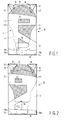
- an electric lamp 1 with a light-transmitting bulb 2 having an end portion 3 supporting a lamp cap 4 is accommodated in a packaging carton 10 of substantially rectangular cross-section, made of duplex cardboard in the Figure.
- the bulb drawn is spherical and has a neck-shaped portion. Lamps without such a neck-shaped portion and lamps with a bulb curved into a shape other than a spherical shape, however, may be accommodated in similar, possibly differently dimensioned cartons.
- the carton has first 11, 11' and second mutually opposed side walls 12, 12', which side walls are interconnected along edges 13, 13' of the carton formed along folding lines, and also a first end 14 near the lamp cap 4 of the lamp and a second end 15 opposed thereto near the bulb 2.
- the carton 10 has a respective incision line 30 through diagonally opposed edges 13', in the side walls 11, 12 and 11', 12', respectively, which adjoin these edges 13'.
- Boundary lines 31, 32 run from said incision line 30 in each of the respective two side walls 11, 12 and 11', 12' to a point P of the intersected edge 13', which point lies closer to the first end 14, so as to limit together with the incision line 30 regions of said side walls 11, 12 and 11', 12' which are pivoted into the carton 10 as folds 33, thus narrowing the carton.
- the incision line 30 thus forms the cutting edge of the fold 33 here.
- the carton has means near the second end 15 which block the passage of the lamp.
- An incision line 30 is present in only two edges 13'.
- the folds 33 flipped over into the carton 10 extend towards the lamp cap 4 of the lamp 1.
- the first end 14 of the carton has an end face which is closed at least partly by a closure 16 provided with a closing flap 16b and side flaps 16a (see also Fig. 4).
- the incision lines 30 each have a central portion 30', transverse to the edges 13' (see Fig. 4), and adjoining portions 30'' which merge into the central portion at an angle thereto and connect with the boundary lines 31, 32.
- the boundary lines 31, 32 enclose an angle of 120 ⁇ 10° in the blank of the carton.
- the folds 33 each have a line 35 on either side of the folding line 34 originating from the relevant edge 13', in the Figure the bisector of the angle between the folding line 34 and the relevant boundary line 31, 32, a fold being made on said lines 35.
- the lines 35 are cut/crease lines.
- the carton 10 has a window 36 at the area of the lamp cap 4 near a fold 33.
- the side walls 11, 12 having such a window 36 have an additional window 37 at the area of greatest diameter of the bulb 2.
- the second end 15 of the carton has first 17 and second tags 18 which are present at the first and second side walls 11, 11'; 12, 12', respectively, and which are interconnected via wedges 19 at the edges 13, 13' of the carton.
- the tags 17, 18 are folded about transverse lines 20 so as to narrow the carton 10 at its second end 15.
- the wedges 19 lie inside the carton 10 and each have a first folding line 21 which forms an extension of the corresponding edge 13, 13' when the carton is open (cf. Fig. 4) and are bounded on either side thereof by a second line 22 lying alongside the first tags 17 and a third line 23 lying alongside the second tags 18, around which lines a fold has been made.
- the lines 22, 23 start from the corresponding edges and each enclose an acute angle with the first folding line 21.
- each wedge 19 enclose an angle of less than 90° in the blank of the carton.
- the first tags 17 project into the carton obliquely and the second tags 18 extend substantially in a plane through the transverse lines 20.
- the first tags 17 each have an outer surface which encloses an acute angle with the bulb 2.
- the first tags 17 have concave edges 17'.
- the second lines 22 of the wedges 19 are cut/crease lines.
- the third lines 23 of the wedges 19 are score lines.
- the transverse lines 20 are also score lines.
- the second 22 and third lines 23 of the wedges 19 enclose an angle of 50 ⁇ 10° in the blank of the carton.
- the second lines 22 enclose an angle ⁇ of 20 ⁇ 5°
- the third lines 23 an angle ⁇ of 30 ⁇ 5° with the first folding lines 21.
- the carton keeps the lamp securely fixed.
- Fig. 4 shows how much material is required for the conventional closure with which the first end 14 of the carton is provided.
- the closure 16 large in itself, is extended with a closing flap 16b which is inserted into the carton.
- comparatively large side flaps 16a are present.
- Fig. 4 clearly demonstrates the difference in quantity of material present at the first and at the second end of the carton to be shaped, and also renders it evident that considerably smaller cutting, losses occur at the second end.
- the carton may be provided with an alternative closure at its first end.
- Fig. 4 shows a glue strip 13a, 13a' with an interruption at the area of the transverse line 20.
- the glue strip is adhered to the side wall 12 with the closure 16 so as to obtain a flat carton which may be supplied to a packaging machine. Said interruption serves to prevent the carton becoming too rigid locally.
- the three-dimensional carton may be readily shaped from the flat carton and closed at its first end. Then the lamp is inserted and the second end is closed, for example, in that the first tags are pushed obliquely inwards.
- the Figure shows that the openings 38 in the shaped carton which will arise when the folds 33 have been pivoted inwards are greater than the opening caused by the folds.
- the object of this is to present a completer picture of the lamp, and has been realised by means of additional incisions.
- Windows 36 are present near one of the two folds 33 at the area of the lamp cap, one in each side wall 11, 12.
- the two types of windows have the same dimensions perpendicular to the edge 13', but different ones in side wall 11 and in side wall 12 for stylistic reasons.
- the blank of the carton still provides ample space for alphanumerical information, e.g. in one of the side walls. It is indicated with a dash-dot line how the incision line may be varied in an alternative embodiment so as to give the fold 33 a cutting edge having a central portion 30' with a concave shape around the edge 13'.
- the packed electric lamp may well serve for stacking another one on top.
- a stable base surface is offered for this purpose.
- the carton to be shaped from the blank shown is fully open at its first end 14 and fully closed at its second end 15 by means of a flap 16 with a closing tag 16b and cooperating side flaps 16a.
- the incision line 30 is asymmetrical and bounds, with boundary lines 31, 32, a region which will form a fold 33.
- the boundary line 31 in the first side wall 11 encloses an angle of less than 45° with the folding line 34 which originates from the edge 13'.
- the boundary line 32 traverses the second side wall 12 substantially entirely and is substantiallyy perpendicular to the edge 13'.
- the incision line 30 gives the fold 33 a concave cutting edge which will grip around a lamp.
- the portion of the fold 33 between the boundary line 31 and the folding line 35 extends, substantially flat, at a small angle to the first side wall 11.
Landscapes
- Engineering & Computer Science (AREA)
- Mechanical Engineering (AREA)
- Packaging Frangible Articles (AREA)
- Cartons (AREA)
Priority Applications (1)
| Application Number | Priority Date | Filing Date | Title |
|---|---|---|---|
| EP19960200686 EP0732277B1 (de) | 1995-03-17 | 1996-03-13 | Verpackte elektrische Lampe |
Applications Claiming Priority (5)
| Application Number | Priority Date | Filing Date | Title |
|---|---|---|---|
| EP95200655 | 1995-03-17 | ||
| EP95200655 | 1995-03-17 | ||
| EP96200142 | 1996-01-22 | ||
| EP96200142 | 1996-01-22 | ||
| EP19960200686 EP0732277B1 (de) | 1995-03-17 | 1996-03-13 | Verpackte elektrische Lampe |
Publications (3)
| Publication Number | Publication Date |
|---|---|
| EP0732277A2 true EP0732277A2 (de) | 1996-09-18 |
| EP0732277A3 EP0732277A3 (de) | 1997-02-12 |
| EP0732277B1 EP0732277B1 (de) | 1998-09-23 |
Family
ID=27236684
Family Applications (1)
| Application Number | Title | Priority Date | Filing Date |
|---|---|---|---|
| EP19960200686 Expired - Lifetime EP0732277B1 (de) | 1995-03-17 | 1996-03-13 | Verpackte elektrische Lampe |
Country Status (1)
| Country | Link |
|---|---|
| EP (1) | EP0732277B1 (de) |
Cited By (2)
| Publication number | Priority date | Publication date | Assignee | Title |
|---|---|---|---|---|
| CN108820439A (zh) * | 2018-07-17 | 2018-11-16 | 南京林业大学 | 一种便于折叠制作的灯泡包装盒 |
| CN119774102A (zh) * | 2025-01-14 | 2025-04-08 | 武汉大学 | 一种一纸成型的防护与展示结构 |
Families Citing this family (1)
| Publication number | Priority date | Publication date | Assignee | Title |
|---|---|---|---|---|
| RU2309103C2 (ru) * | 2005-02-28 | 2007-10-27 | Виктор Иванович Цай | Упаковка электрических ламп |
Family Cites Families (7)
| Publication number | Priority date | Publication date | Assignee | Title |
|---|---|---|---|---|
| GB203953A (en) * | 1922-11-10 | 1923-09-20 | Rowland Hunt | Cartons or boxes for electric lamps |
| DE904277C (de) * | 1950-09-04 | 1954-02-18 | Traugott Schmid | Verpackungsschachtel fuer Gluehlampen |
| GB696597A (en) * | 1951-01-30 | 1953-09-02 | Douglas Stuart Mackenzie | Improved carton for the packing of fragile articles |
| BE605559A (fr) * | 1961-01-17 | 1961-11-16 | Lehner-Stirnemann Max | Boîte prismatique à base carrée, destinée à contenir une ampoule électrique |
| GB1092353A (en) * | 1964-09-12 | 1967-11-22 | Waddington Ltd J | Display cartons, packages and like containers |
| US3337033A (en) * | 1965-03-22 | 1967-08-22 | Riegel Paper Corp | Carton |
| DE7828046U1 (de) * | 1978-09-21 | 1979-01-04 | Color Druck Baiersbronn Wilhel | Karton zum Verpacken von kugelfoermigen Koerpern |
-
1996
- 1996-03-13 EP EP19960200686 patent/EP0732277B1/de not_active Expired - Lifetime
Cited By (3)
| Publication number | Priority date | Publication date | Assignee | Title |
|---|---|---|---|---|
| CN108820439A (zh) * | 2018-07-17 | 2018-11-16 | 南京林业大学 | 一种便于折叠制作的灯泡包装盒 |
| CN108820439B (zh) * | 2018-07-17 | 2023-09-05 | 南京林业大学 | 一种便于折叠制作的灯泡包装盒 |
| CN119774102A (zh) * | 2025-01-14 | 2025-04-08 | 武汉大学 | 一种一纸成型的防护与展示结构 |
Also Published As
| Publication number | Publication date |
|---|---|
| EP0732277B1 (de) | 1998-09-23 |
| EP0732277A3 (de) | 1997-02-12 |
Similar Documents
| Publication | Publication Date | Title |
|---|---|---|
| US5097948A (en) | Cigarette pack | |
| US4260059A (en) | Container having an internal support for fragile articles and blank therefor | |
| US5361907A (en) | Box for storing ampules | |
| US4717022A (en) | Octagonal-shaped shipping container | |
| US5497899A (en) | Composite package | |
| US6523738B1 (en) | Packaging for a bottle | |
| KR860001753A (ko) | 병 운 반 구 | |
| BG63914B1 (bg) | Разгъвка на опаковка за цигари | |
| US4890738A (en) | Collapsible display carrier and method of making | |
| US3968924A (en) | Bulb carton | |
| US3750870A (en) | Shadow box carton | |
| US5702002A (en) | Packed electric lamp | |
| US4552293A (en) | Container blank having relieved edge construction | |
| EP0732277B1 (de) | Verpackte elektrische Lampe | |
| US4192445A (en) | Packaging container including integral corner locks | |
| US4320830A (en) | Carton having pivotable platform | |
| US2732996A (en) | Radio tube cartons | |
| US5507387A (en) | Foldable box for packaging of an electric lamp | |
| US4032006A (en) | Shock resistant container | |
| US3977592A (en) | Die cut container blank | |
| US4128168A (en) | Display carton with retaining panels | |
| JP4145414B2 (ja) | 包装用容器 | |
| US4230260A (en) | Foldable protective packaging sleeve or carton | |
| FI78435B (fi) | Av ett aemne framstaellbar ask. | |
| US4417660A (en) | Carton for packaging lamp shades or the like |
Legal Events
| Date | Code | Title | Description |
|---|---|---|---|
| PUAI | Public reference made under article 153(3) epc to a published international application that has entered the european phase |
Free format text: ORIGINAL CODE: 0009012 |
|
| AK | Designated contracting states |
Kind code of ref document: A2 Designated state(s): DE FR GB |
|
| PUAL | Search report despatched |
Free format text: ORIGINAL CODE: 0009013 |
|
| AK | Designated contracting states |
Kind code of ref document: A3 Designated state(s): DE FR GB |
|
| 17P | Request for examination filed |
Effective date: 19970812 |
|
| GRAG | Despatch of communication of intention to grant |
Free format text: ORIGINAL CODE: EPIDOS AGRA |
|
| 17Q | First examination report despatched |
Effective date: 19971013 |
|
| GRAG | Despatch of communication of intention to grant |
Free format text: ORIGINAL CODE: EPIDOS AGRA |
|
| GRAH | Despatch of communication of intention to grant a patent |
Free format text: ORIGINAL CODE: EPIDOS IGRA |
|
| GRAH | Despatch of communication of intention to grant a patent |
Free format text: ORIGINAL CODE: EPIDOS IGRA |
|
| GRAA | (expected) grant |
Free format text: ORIGINAL CODE: 0009210 |
|
| AK | Designated contracting states |
Kind code of ref document: B1 Designated state(s): DE FR GB |
|
| REF | Corresponds to: |
Ref document number: 69600671 Country of ref document: DE Date of ref document: 19981029 |
|
| ET | Fr: translation filed | ||
| PLBE | No opposition filed within time limit |
Free format text: ORIGINAL CODE: 0009261 |
|
| STAA | Information on the status of an ep patent application or granted ep patent |
Free format text: STATUS: NO OPPOSITION FILED WITHIN TIME LIMIT |
|
| 26N | No opposition filed | ||
| REG | Reference to a national code |
Ref country code: GB Ref legal event code: IF02 |
|
| REG | Reference to a national code |
Ref country code: GB Ref legal event code: 746 Effective date: 20050628 |
|
| PGFP | Annual fee paid to national office [announced via postgrant information from national office to epo] |
Ref country code: GB Payment date: 20070327 Year of fee payment: 12 |
|
| PGFP | Annual fee paid to national office [announced via postgrant information from national office to epo] |
Ref country code: DE Payment date: 20070516 Year of fee payment: 12 |
|
| PGFP | Annual fee paid to national office [announced via postgrant information from national office to epo] |
Ref country code: FR Payment date: 20070329 Year of fee payment: 12 |
|
| GBPC | Gb: european patent ceased through non-payment of renewal fee |
Effective date: 20080313 |
|
| REG | Reference to a national code |
Ref country code: FR Ref legal event code: ST Effective date: 20081125 |
|
| PG25 | Lapsed in a contracting state [announced via postgrant information from national office to epo] |
Ref country code: DE Free format text: LAPSE BECAUSE OF NON-PAYMENT OF DUE FEES Effective date: 20081001 |
|
| PG25 | Lapsed in a contracting state [announced via postgrant information from national office to epo] |
Ref country code: FR Free format text: LAPSE BECAUSE OF NON-PAYMENT OF DUE FEES Effective date: 20080331 |
|
| PG25 | Lapsed in a contracting state [announced via postgrant information from national office to epo] |
Ref country code: GB Free format text: LAPSE BECAUSE OF NON-PAYMENT OF DUE FEES Effective date: 20080313 |