EP0732418B1 - Acier inoxydable martensitique tres resistant a la corrosion et a soudabilite excellente et son procede de fabrication - Google Patents
Acier inoxydable martensitique tres resistant a la corrosion et a soudabilite excellente et son procede de fabrication Download PDFInfo
- Publication number
- EP0732418B1 EP0732418B1 EP95932907A EP95932907A EP0732418B1 EP 0732418 B1 EP0732418 B1 EP 0732418B1 EP 95932907 A EP95932907 A EP 95932907A EP 95932907 A EP95932907 A EP 95932907A EP 0732418 B1 EP0732418 B1 EP 0732418B1
- Authority
- EP
- European Patent Office
- Prior art keywords
- steel
- stainless steel
- corrosion
- content
- martensitic stainless
- Prior art date
- Legal status (The legal status is an assumption and is not a legal conclusion. Google has not performed a legal analysis and makes no representation as to the accuracy of the status listed.)
- Expired - Lifetime
Links
Images


Classifications
-
- C—CHEMISTRY; METALLURGY
- C22—METALLURGY; FERROUS OR NON-FERROUS ALLOYS; TREATMENT OF ALLOYS OR NON-FERROUS METALS
- C22C—ALLOYS
- C22C38/00—Ferrous alloys, e.g. steel alloys
- C22C38/18—Ferrous alloys, e.g. steel alloys containing chromium
- C22C38/40—Ferrous alloys, e.g. steel alloys containing chromium with nickel
- C22C38/42—Ferrous alloys, e.g. steel alloys containing chromium with nickel with copper
-
- C—CHEMISTRY; METALLURGY
- C21—METALLURGY OF IRON
- C21D—MODIFYING THE PHYSICAL STRUCTURE OF FERROUS METALS; GENERAL DEVICES FOR HEAT TREATMENT OF FERROUS OR NON-FERROUS METALS OR ALLOYS; MAKING METAL MALLEABLE, e.g. BY DECARBURISATION OR TEMPERING
- C21D8/00—Modifying the physical properties of ferrous metals or ferrous alloys by deformation combined with, or followed by, heat treatment
- C21D8/02—Modifying the physical properties of ferrous metals or ferrous alloys by deformation combined with, or followed by, heat treatment during manufacturing of plates or strips
-
- C—CHEMISTRY; METALLURGY
- C21—METALLURGY OF IRON
- C21D—MODIFYING THE PHYSICAL STRUCTURE OF FERROUS METALS; GENERAL DEVICES FOR HEAT TREATMENT OF FERROUS OR NON-FERROUS METALS OR ALLOYS; MAKING METAL MALLEABLE, e.g. BY DECARBURISATION OR TEMPERING
- C21D1/00—General methods or devices for heat treatment, e.g. annealing, hardening, quenching or tempering
- C21D1/18—Hardening; Quenching with or without subsequent tempering
-
- C—CHEMISTRY; METALLURGY
- C21—METALLURGY OF IRON
- C21D—MODIFYING THE PHYSICAL STRUCTURE OF FERROUS METALS; GENERAL DEVICES FOR HEAT TREATMENT OF FERROUS OR NON-FERROUS METALS OR ALLOYS; MAKING METAL MALLEABLE, e.g. BY DECARBURISATION OR TEMPERING
- C21D2211/00—Microstructure comprising significant phases
- C21D2211/008—Martensite
Definitions
- the present invention relates to a martensitic stainless steel having excellent resistance to corrosion by CO 2 and sulfide stress cracking and good weldability.
- EP-A-0 384 317 discloses a high-strength martensitic stainless steel containing 0.1 or less C, 1% or less Si, 2% or less Mn, 8-14% Cr, 1.2-4.5% Cu, 0.005-0.2% Al, 0.01-0.15% N and the balance being Fe and unavoidable impurities.
- An object of the present invention is to provide a martensitic stainless steel having CO 2 corrosion resistance high enough to withstand the maximum service temperature of the line pipe, excellent sulfide stress cracking resistance (SSC resistance), and good toughness of welding heat-affected zone by regulating specific constituents.
- the high-corrosion-resistant martensitic stainless steel having excellent weldability of the present invention is defined in claims 1 and 2.
- the process for producing a high-corrosion-resistant martensitic stainless steel according to the present invention is characterized by comprising the steps of: subjecting a steel plate, produced by hot-rolling a stainless steel slab having the above composition, to austenitization at a temperature of Ac 3 point to 1000°C; subjecting the hardened steel plate to final tempering at a temperature of 550°C to Ac 1 point; and cold-rolling the steel plate to prepare a steel pipe.
- the present inventors From the results of many experiments conducted on the behavior of various elements on the corrosion resistance, mechanical properties and other properties, the present inventors have found that (1) the resistance to corrosion by CO 2 can be improved by the addition of Cu and Ni in combination, (2) the sulfide stress cracking resistance can be improved by adding Mo, and (3) the toughness of the weld heat-affected zone can be improved by lowering the C and N contents and regulating the constituents of the steel so as to provide a martensite phase.
- Fig. 1 is a diagram showing the corrosion rate of 0.02%C-2%Ni steels with varied Cr, Mo, and Cu contents.
- ⁇ represents data for steels having a Cu content of 1 to 3%
- ⁇ represents data for steels with no Cu added thereto.
- the corrosion rate is expressed as the depth of corrosion per year in substitute ocean water of 120°C saturated with CO 2 gas of 40 atm. When the corrosion rate is not more than 0.1 mm/y, the steel is evaluated as having satisfactory corrosion resistance. As can be seen from Fig. 1, the contribution of Mo to the corrosion rate is 1.6 times greater than the contribution of Cr to the corrosion rate.
- the corrosion rate of the steel with Cu added is the same as that of the steel wherein the content of Cr + 1.6Mo is 5% higher than the steel with Cu not added.
- Cr and Mo are typical ferrite forming elements and the incorporation of these elements in a large amount results in the formation of a ferrite phase.
- the addition of a large amount of an austenite forming element is necessary, rendering the conditions, necessary for lowering the C and N contents, more strict.
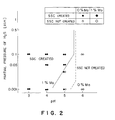
- SSC sulfide stress cracking
- both ⁇ and ⁇ represent steels with Mo: 0%, and both ⁇ and ⁇ represent steels with Mo: 1%.
- SSC was not occurred, whereas for the steels represented by ⁇ and ⁇ , SSC was occurred.
- a dotted line represents the boundary between the occurrence of SSC and the freedom from SSC with respect to 0% Mo, and a solid line represents the boundary between the occurrence of SSC and the freedom from SSC with respect to 1% Mo. From Fig. 2, it is apparent that steels with Mo added are free from SSC even under severe conditions of high partial pressure of H 2 S and low pH.
- C is an element which forms a Cr carbide or the like and deteriorates the corrosion resistance. It, however, has a high capability of forming austenite, offering the effect of inhibiting the formation of a ferrite phase.
- the amount of C added is less than 0.005%, the contemplated effect cannot be attained.
- the addition of C in an amount exceeding 0.035% causes precipitation of a large amount of carbides, such as Cr carbide, resulting in deteriorated toughness and, at the same time, enhances the hardness of the weld heat-affected zone, here again resulting in deteriorated toughness.
- the C content is limited to 0.005 to 0.035%.
- Si contained in the steel is the residual Si after use as a deoxidizer in steelmaking.
- the Si content exceeds 0.50%, the toughness and the sulfide stress cracking resistance are deteriorated. Therefore, the Si content is limited to not more than 0.50%.
- Mn is an element which lowers the intergranular strength and deteriorates the cracking resistance in a corrosive environment. It, however, serves to form MnS, rendering S harmless. In addition, it is useful for bringing the structure to a single phase of austenite. When the Mn content is less than 0.1%, the contemplated effect cannot be attained. On the other hand, when it exceeds 1.0%, the intergranular strength is significantly lowered. For this reason, the Mn content is limited to 0.1 to 1.0%.
- P P segregates in the grain boundaries and consequently lowers the intergranular strength, resulting in deteriorated sulfide stress cracking resistance. Therefore, the P content is limited to not more than 0.03%.
- S forms inclusions based on sulfides, deteriorating the hot workability. Therefore, the upper limit of the S content is 0.005%.
- Mo serves to improve the CO 2 corrosion resistance and, in addition, as shown in Fig. 2, has the effect of improving the SSC resistance.
- Mo content is less than 1.0%, the contemplated effect is unsatisfactory. Therefore, the amount of Mo added is limited to not less than 1.0%.
- the amount of Mo added is excessively large, the effect is saturated and, at the same time, the deformation resistance on heating is increased, resulting in lowered hot workability. For this reason, the upper limit of the Mo content is 3.0%.
- Cu is the most important additive element which is enriched in a corrosion film to improve the resistance to corrosion by CO 2 as shown in Fig. 1.
- a combination of desired corrosion resistance with martensitic structure cannot be attained without Cu.
- the Cu content is less than 1.0%, the effect is unsatisfactory. Therefore, the Cu content is limited to not less than 1.0%.
- the upper limit of the Cu content is 4.0%.
- Ni The ability of Cu to improve the corrosion resistance can be markedly improved by adding Cu in combination with Ni. This is considered attributable to the fact that Cu combines with Ni to form a compound which is enriched in the corrosion film. The Cu enrichment is difficult in the absence of Ni. Further, Ni is an element having a high capability of forming austenite and, hence, is useful for realizing the martensitic structure and improving the hot workability. When the Ni content is less than 1.5%, the effect of improving the hot workability is unsatisfactory, while when it exceeds 5%, the Ac 1 transformation point becomes excessively low, rendering the tempering difficult. For the above reason, the Ni content is limited to 1.5 to 5%.
- Al contained in the steel is the residual Al after use as a deoxidizer in steelmaking.
- Al content exceeds 0.06%, AlN is formed in a large amount, resulting in deteriorated toughness of the steel. For this reason, the upper limit of the Al content is 0.06%.
- N is an element which is unavoidably contained in the steel. It enhances the hardness of the weld heat-affected zone and deteriorates the toughness. For this reason, the upper limit of the N content is 0.01%.
- C and N act similarly to each other and deteriorate the toughness of the weld heat-affected zone.
- the addition of C and N in a total amount exceeding 0.03% results in deteriorated toughness. For this reason, the total content of C and N is limited to not more than 0.03%.
- the steel of the present invention having the above composition has good resistance to corrosion by CO 2 .
- ferrite forming elements such as Cr and Mo
- a ferrite phase is formed in weld heat-affected zone resulting in deteriorated toughness. Therefore, the contents of ferrite forming elements should be limited. It is known that C, N, Ni, and Cu inhibit the formation of the ferrite phase, whereas Cr and Mo accelerate the formation of the ferrite phase. Steels with varied content of these elements were prepared by the melt process to experimentally determine the contribution of individual elements.
- Ti is dispersed as TiN or Ti oxides to inhibit the grain growth in weld heat-affected zone to inhibit the deterioration of the toughness.
- Ti content is excessively low, the contemplated effect cannot be attained.
- TiC is precipitated resulting in deteriorated toughness.
- the Ti content is limited to 0.005 to 0.1%.
- N which has been fixed as TiN does not contribute to the hardness of the weld heat-affected zone and, hence, does not contribute to the deterioration of the toughness.
- the total content of N in the form of TiN that is, (N - 3.4Ti), and C may be not more than 0.03.
- Ca and REM serve to bring inclusions to a spherical form, thus rendering the inclusions harmless.
- the content of Ca and REM is excessively low, the contemplated effect cannot be attained, while when it is excessively high, the amount of inclusions becomes so large that the sulfide stress cracking resistance is deteriorated. Therefore, the Ca content is limited to 0.001 to 0.02%, and the REM content is limited to 0.003 to 0.4%.
- Zr combines with P detrimental to the sulfide stress cracking resistance to form a stable compound, thereby reducing the amount of P in a solid solution form to substantially reduce the P content.
- the Zr content is excessively low, the contemplated effect cannot be attained.
- coarse oxides are formed to lower the toughness and the sulfide stress cracking resistance. For this reason, the Zr content is limited to 0.01 to 0.2%.
- the above steel as hot-rolled and after reheating to the Ac 3 transformation point or above has a martensitic structure. Since, however, the steel having a martensitic structure is too hard and has low sulfide stress cracking resistance, it should be tempered to form a tempered martensitic structure. When the strength cannot be reduced to a desired level by certain tempering, the formation of martensite followed by heating to a dual-phase region between Ac 1 and Ac 3 and additional tempering can provide a tempered martensitic structure having low strength.
- the steel of the present invention is quenched at a temperature of Ac 3 to 1000°C. This is because when the hardening temperature exceeds 1000°C, grains are coarsened to deteriorate the toughness, while when it is below Ac 3 , a dual-phase region of austenite and ferrite is formed.
- the tempering is usually carried out twice.
- the upper limit of the final tempering temperature is Ac 1 .
- a tempering temperature below 550°C is excessively low for attaining contemplated tempering. Therefore, in this case, the tempering is unsatisfactory, and, in addition, the hardness is not decreased.
- the lower limit of the final tempering temperature is 550°C.
- steels having chemical compositions specified in Table 1 were prepared by the melt process, cast, and rolled by a model rolling mill into seamless steel pipes which were then heat-treated under conditions specified in Table 2.
- Steel Nos. 1 to 8 are steels of the present invention
- steel Nos. 9 to 13 are comparative steels.
- N and C + (N - 3.4Ti) for steel No. 9, Cr + 1.6Mo and Ni(eq) for steel No. 10, Cu for steel No. 11, Ni for steel No. 12, and Mo for steel No. 13 are outside the scope of the present invention.
- the resistance to corrosion by CO 2 was determined by immersing a test piece in substitute ocean water of 120°C saturated with CO 2 gas of 40 atm and measuring the weight loss by corrosion to determine the corrosion rate.
- the sulfide stress cracking resistance was determined by mixing 1 N acetic acid with 1 mol/liter sodium acetate to adjust the solution to pH 3.5, saturating the solution with 10% hydrogen sulfide + 90% nitrogen gas or carbon dioxide gas, placing an unnotched round rod test piece (diameter in parallel portion 6.4 mm, length in parallel portion 25 mm) into the solution, applying in this state a tensile stress corresponding to 80% of the yield strength to the test piece to measure the time taken for the test piece to be broken (breaking time).
- breaking time When the test piece is not broken in a 720-hr test, it can be regarded as having excellent sulfide stress cracking resistance.
Landscapes
- Chemical & Material Sciences (AREA)
- Engineering & Computer Science (AREA)
- Mechanical Engineering (AREA)
- Materials Engineering (AREA)
- Metallurgy (AREA)
- Organic Chemistry (AREA)
- Physics & Mathematics (AREA)
- Thermal Sciences (AREA)
- Crystallography & Structural Chemistry (AREA)
- Heat Treatment Of Steel (AREA)
Claims (3)
- Un acier inoxydable martensitique très résistant à la corrosion et présentant une soudabilité excellente en ayant une structure martensitique recuite, ledit acier inoxydable martensitique comprenant en poids C : 0,005 à 0,035%, Si : pas plus de 0,50%, Mn : 0,1 à 1,0%, P : pas plus de 0,03%, S : pas plus de 0,005%, Cr : 10,0 à 13,5%, Cu : 1,0 à 4,0%, Ni : 1,5 à 5,0%, Al : pas plus de 0,06%, et N : pas plus de 0,01%, facultativement un ou plusieurs éléments parmi Ti : 0,005 à 0,1%, Zr : 0,01 à 0,2%, Ca : 0,001 à 0,02%, 0,003 à 0,4% de REM et le reste se composant de Fe et d'impuretés inévitables, et satisfaisant à :
- Un acier inoxydable martensitique très résistant à la corrosion et présentant une soudabilité excellente et une excellente résistance SSC en ayant une structure martensitique recuite, ledit acier inoxydable martensitique comprenant en poids C : 0,005 à 0,035%, Si : pas plus de 0,50%, Mn : 0,1 à 1,0%, P : pas plus de 0,03%, S : pas plus de 0,005%, Mo : 1,0 à 3,0%, Cu : 1,0 à 4,0%, Ni : 1,5 à 5,0%, Al : pas plus de 0,06%, N : pas plus de 0,01%, et Cr satisfaisant une exigence représentée par la formule 13 > Cr + 1,6Mo ≥ 8, facultativement un ou plusieurs éléments choisis parmi Ti : 0,005 à 1,0%, Zr : 0,01 à 0,2%, Ca : 0,001 à 0,02%, 0,003 à 0,4% de REM et le reste se composant de Fe et d'impuretés inévitables, et satisfaisant à
- Un procédé de fabrication d'un acier inoxydable martensitique très résistant à la corrosion et présentant une soudabilité excellente, ledit procédé comprenant les étapes consistant à : soumettre une plaque d'acier, réalisée par laminage à chaud d'une brame d'acier inoxydable ayant une composition conforme aux revendications 1 ou 2, à une austénisation à une température du point d'Ac3 jusqu'à 1000°C pour durcir la plaque d'acier ; soumettre la plaque d'acier durcie à un recuit final à une température de 550°C jusqu'au point d'Ac1 ; et laminer à froid la plaque d'acier.
Applications Claiming Priority (10)
| Application Number | Priority Date | Filing Date | Title |
|---|---|---|---|
| JP23791894 | 1994-09-30 | ||
| JP23792094A JP3412926B2 (ja) | 1994-09-30 | 1994-09-30 | 溶接性に優れた耐co2腐食性と耐硫化物応力割れ性マルテンサイト系ステンレス鋼 |
| JP237918/94 | 1994-09-30 | ||
| JP237919/94 | 1994-09-30 | ||
| JP23791994 | 1994-09-30 | ||
| JP23792094 | 1994-09-30 | ||
| JP23791894A JPH08100235A (ja) | 1994-09-30 | 1994-09-30 | 高溶接性マルテンサイト系ステンレス鋼及びその製造方法 |
| JP237920/94 | 1994-09-30 | ||
| JP23791994A JPH08100236A (ja) | 1994-09-30 | 1994-09-30 | 溶接性の優れた高耐食性マルテンサイト系ステンレス鋼及びその製造方法 |
| PCT/JP1995/001950 WO1996010654A1 (fr) | 1994-09-30 | 1995-09-27 | Acier inoxydable martensitique tres resistant a la corrosion et a soudabilite excellente et son procede de fabrication |
Publications (3)
| Publication Number | Publication Date |
|---|---|
| EP0732418A1 EP0732418A1 (fr) | 1996-09-18 |
| EP0732418A4 EP0732418A4 (fr) | 1998-04-01 |
| EP0732418B1 true EP0732418B1 (fr) | 2001-03-28 |
Family
ID=27332518
Family Applications (1)
| Application Number | Title | Priority Date | Filing Date |
|---|---|---|---|
| EP95932907A Expired - Lifetime EP0732418B1 (fr) | 1994-09-30 | 1995-09-27 | Acier inoxydable martensitique tres resistant a la corrosion et a soudabilite excellente et son procede de fabrication |
Country Status (6)
| Country | Link |
|---|---|
| US (1) | US5716465A (fr) |
| EP (1) | EP0732418B1 (fr) |
| KR (1) | KR960706569A (fr) |
| CN (1) | CN1044263C (fr) |
| DE (1) | DE69520488T2 (fr) |
| WO (1) | WO1996010654A1 (fr) |
Cited By (1)
| Publication number | Priority date | Publication date | Assignee | Title |
|---|---|---|---|---|
| AU2002334417B2 (en) * | 2001-10-18 | 2006-03-16 | Nippon Steel Corporation | Martensitic stainless steel |
Families Citing this family (21)
| Publication number | Priority date | Publication date | Assignee | Title |
|---|---|---|---|---|
| US7235212B2 (en) * | 2001-02-09 | 2007-06-26 | Ques Tek Innovations, Llc | Nanocarbide precipitation strengthened ultrahigh strength, corrosion resistant, structural steels and method of making said steels |
| CN1159213A (zh) * | 1994-07-21 | 1997-09-10 | 新日本制铁株式会社 | 具有优异热加工性和硫化物应力裂纹抗性的马氏体不锈钢 |
| DE19755409A1 (de) * | 1997-12-12 | 1999-06-17 | Econsult Unternehmensberatung | Nichtrostender Baustahl und Verfahren zu seiner Herstellung |
| JP3576472B2 (ja) * | 1999-12-28 | 2004-10-13 | Jfeスチール株式会社 | 低炭素マルテンサイト系ステンレス鋼用溶接材料および低炭素マルテンサイト系ステンレス鋼材のアーク溶接方法 |
| JP4240189B2 (ja) * | 2001-06-01 | 2009-03-18 | 住友金属工業株式会社 | マルテンサイト系ステンレス鋼 |
| DE60228395D1 (de) * | 2001-12-26 | 2008-10-02 | Jfe Steel Corp | Strukturbauelement eines Fahrzeuges aus Martensitischem Rostfreistahlblech |
| MXPA04010008A (es) * | 2002-04-12 | 2005-07-01 | Sumitomo Metal Ind | Metodo para fabricar un acero inoxidable martensitico. |
| US6899773B2 (en) * | 2003-02-07 | 2005-05-31 | Advanced Steel Technology, Llc | Fine-grained martensitic stainless steel and method thereof |
| JP4188124B2 (ja) * | 2003-03-31 | 2008-11-26 | 独立行政法人物質・材料研究機構 | 焼き戻しマルテンサイト系耐熱鋼の溶接継手 |
| JP4950528B2 (ja) * | 2006-03-16 | 2012-06-13 | 株式会社神戸製鋼所 | 溶接熱影響部の靭性に優れた低降伏比高張力鋼材およびその製法 |
| CA2661655C (fr) * | 2006-08-31 | 2014-05-27 | Sumitomo Metal Industries, Ltd. | Acier inoxydable martensitique pour structure soudee |
| JP4951564B2 (ja) * | 2008-03-25 | 2012-06-13 | 住友化学株式会社 | 再生硫黄回収装置 |
| CN102144041B (zh) * | 2008-09-04 | 2014-05-14 | 杰富意钢铁株式会社 | 油井管用马氏体系不锈钢无缝钢管及其制造方法 |
| CN101956097B (zh) * | 2010-10-15 | 2012-08-22 | 镇江忆诺唯记忆合金有限公司 | 一种CuAlMn低温记忆合金板材加工方法 |
| CN104942004B (zh) * | 2015-05-18 | 2017-12-19 | 攀钢集团成都钢钒有限公司 | 超超临界发电机组用无缝钢管的生产方法 |
| CN105256120B (zh) * | 2015-10-21 | 2017-06-06 | 苏州雷格姆海洋石油设备科技有限公司 | 一种海洋石油开采设备用锻制工件精加工前的最终热处理方法 |
| JP6735082B2 (ja) * | 2015-11-06 | 2020-08-05 | 株式会社神戸製鋼所 | 鋼部材および鋼板ならびにこれらの製造方法 |
| CN106011684A (zh) * | 2016-07-26 | 2016-10-12 | 四川六合锻造股份有限公司 | 一种高强高韧不锈钢材料及其制备方法 |
| CN113584407A (zh) * | 2020-04-30 | 2021-11-02 | 宝山钢铁股份有限公司 | 一种高强度耐高温腐蚀马氏体不锈钢及其制造方法 |
| CN116926411A (zh) * | 2022-03-29 | 2023-10-24 | 宝山钢铁股份有限公司 | 耐高浓度硫化物应力腐蚀开裂马氏体不锈钢油套管用钢及其制造方法 |
| CN118345316B (zh) * | 2024-06-18 | 2024-11-08 | 内蒙古科技大学 | 一种耐磨钢板及其制备方法 |
Family Cites Families (8)
| Publication number | Priority date | Publication date | Assignee | Title |
|---|---|---|---|---|
| GB1214293A (en) * | 1966-11-14 | 1970-12-02 | Hadfields Ltd | Martensitic stainless steels |
| US4769213A (en) * | 1986-08-21 | 1988-09-06 | Crucible Materials Corporation | Age-hardenable stainless steel having improved machinability |
| DE3787961T2 (de) * | 1986-12-30 | 1994-05-19 | Nisshin Steel Co., Ltd., Tokio/Tokyo | Verfahren zur Herstellung von rostfreien Chromstahlband mit Zweiphasen-Gefüge mit hoher Festigkeit und hoher Dehnung und mit niedriger Anisotropie. |
| US5049210A (en) * | 1989-02-18 | 1991-09-17 | Nippon Steel Corporation | Oil Country Tubular Goods or a line pipe formed of a high-strength martensitic stainless steel |
| US5089067A (en) * | 1991-01-24 | 1992-02-18 | Armco Inc. | Martensitic stainless steel |
| JPH04268019A (ja) * | 1991-02-22 | 1992-09-24 | Nippon Steel Corp | マルテンサイト系ステンレス鋼ラインパイプの製造方法 |
| JPH05156408A (ja) * | 1991-11-29 | 1993-06-22 | Nippon Steel Corp | 溶接性に優れた高強度マルテンサイトステンレス鋼とその製造方法 |
| JPH05163529A (ja) * | 1991-12-11 | 1993-06-29 | Nippon Steel Corp | 高温耐食性に優れた複層型溶接鋼管の製造方法 |
-
1995
- 1995-09-27 WO PCT/JP1995/001950 patent/WO1996010654A1/fr not_active Ceased
- 1995-09-27 CN CN95191186A patent/CN1044263C/zh not_active Expired - Fee Related
- 1995-09-27 US US08/649,701 patent/US5716465A/en not_active Expired - Lifetime
- 1995-09-27 KR KR1019960702826A patent/KR960706569A/ko not_active Ceased
- 1995-09-27 EP EP95932907A patent/EP0732418B1/fr not_active Expired - Lifetime
- 1995-09-27 DE DE69520488T patent/DE69520488T2/de not_active Expired - Lifetime
Cited By (1)
| Publication number | Priority date | Publication date | Assignee | Title |
|---|---|---|---|---|
| AU2002334417B2 (en) * | 2001-10-18 | 2006-03-16 | Nippon Steel Corporation | Martensitic stainless steel |
Also Published As
| Publication number | Publication date |
|---|---|
| WO1996010654A1 (fr) | 1996-04-11 |
| DE69520488T2 (de) | 2001-09-27 |
| US5716465A (en) | 1998-02-10 |
| KR960706569A (ko) | 1996-12-09 |
| CN1044263C (zh) | 1999-07-21 |
| EP0732418A1 (fr) | 1996-09-18 |
| EP0732418A4 (fr) | 1998-04-01 |
| CN1138880A (zh) | 1996-12-25 |
| DE69520488D1 (de) | 2001-05-03 |
Similar Documents
| Publication | Publication Date | Title |
|---|---|---|
| EP0732418B1 (fr) | Acier inoxydable martensitique tres resistant a la corrosion et a soudabilite excellente et son procede de fabrication | |
| EP1546417B1 (fr) | Tuyau en acier sans soudure a haute resistance, s'agissant notamment de resistance aux craquelures provoquees par l'hydrogene et procede de fabrication | |
| US5948183A (en) | Hot-rolled steel sheet and method for forming hot-rolled steel sheet having low yield ratio, high strength and excellent toughness | |
| EP0771366B1 (fr) | ACIER INOXYDABLE MARTENSITIQUE POSSEDANT DES PROPRIETES EXCELLENTES DE FAçONNAGE A CHAUD ET DE RESISTANCE A LA FISSURATION PROVOQUEE PAR LES CONTRAINTES EXERCEES PAR LE SULFURE | |
| US5167731A (en) | Martensitic stainless steel for an oil well | |
| JP2003193204A (ja) | マルテンサイト系ステンレス鋼 | |
| US20010001966A1 (en) | Martensitic stainless steel for seamless steel pipe | |
| US5985209A (en) | Martensitic steel for line pipe having excellent corrosion resistance and weldability | |
| RU2136776C1 (ru) | Высокопрочная сталь для магистральных трубопроводов, имеющая низкий коэффициент текучести и повышенную низкотемпературную вязкость | |
| JP2791804B2 (ja) | 高強度かつ耐食性の優れたマルテンサイト系ステンレス鋼 | |
| JPH06293915A (ja) | 耐co2 腐食性、耐サワー性に優れた低合金ラインパイプ用鋼板の製造方法 | |
| JP3303647B2 (ja) | 耐サワー性と耐炭酸ガス腐食性とに優れた溶接鋼管 | |
| JP3620319B2 (ja) | 耐食性と溶接性に優れたマルテンサイト系ステンレス鋼 | |
| JP3588380B2 (ja) | ラインパイプ用マルテンサイト系ステンレス鋼板の製造方法 | |
| JP3422880B2 (ja) | 溶接部硬さの低い高耐食マルテンサイト系ステンレス鋼 | |
| JP3422877B2 (ja) | 溶接部硬さの低い高耐食マルテンサイト系ステンレス鋼 | |
| JPH06293914A (ja) | 耐co2 腐食性、haz靱性に優れた低合金ラインパイプ用鋼板の製造方法 | |
| JP3444244B2 (ja) | 靱性に優れた高張力鋼材およびその製造方法 | |
| JPH10176240A (ja) | トンネル支保工用h形鋼およびその製造方法 | |
| JP2001192773A (ja) | ラインパイプ用鋼 | |
| JP2001064745A (ja) | 経済性および靱性に優れた高張力鋼材 | |
| JP3412926B2 (ja) | 溶接性に優れた耐co2腐食性と耐硫化物応力割れ性マルテンサイト系ステンレス鋼 | |
| JPH08100236A (ja) | 溶接性の優れた高耐食性マルテンサイト系ステンレス鋼及びその製造方法 | |
| JPH05214446A (ja) | 耐サワー性と低温靱性に優れた高Ni合金クラッド鋼板の製造方法 | |
| JPH09256115A (ja) | 耐サワー特性に優れた良溶接性マルテンサイト系ステンレス鋼およびその製造方法 |
Legal Events
| Date | Code | Title | Description |
|---|---|---|---|
| PUAI | Public reference made under article 153(3) epc to a published international application that has entered the european phase |
Free format text: ORIGINAL CODE: 0009012 |
|
| 17P | Request for examination filed |
Effective date: 19960627 |
|
| AK | Designated contracting states |
Kind code of ref document: A1 Designated state(s): DE FR GB IT |
|
| A4 | Supplementary search report drawn up and despatched |
Effective date: 19980216 |
|
| AK | Designated contracting states |
Kind code of ref document: A4 Designated state(s): DE FR GB IT |
|
| 17Q | First examination report despatched |
Effective date: 19991223 |
|
| GRAG | Despatch of communication of intention to grant |
Free format text: ORIGINAL CODE: EPIDOS AGRA |
|
| GRAG | Despatch of communication of intention to grant |
Free format text: ORIGINAL CODE: EPIDOS AGRA |
|
| GRAH | Despatch of communication of intention to grant a patent |
Free format text: ORIGINAL CODE: EPIDOS IGRA |
|
| GRAH | Despatch of communication of intention to grant a patent |
Free format text: ORIGINAL CODE: EPIDOS IGRA |
|
| GRAA | (expected) grant |
Free format text: ORIGINAL CODE: 0009210 |
|
| AK | Designated contracting states |
Kind code of ref document: B1 Designated state(s): DE FR GB IT |
|
| REF | Corresponds to: |
Ref document number: 69520488 Country of ref document: DE Date of ref document: 20010503 |
|
| ITF | It: translation for a ep patent filed | ||
| ET | Fr: translation filed | ||
| REG | Reference to a national code |
Ref country code: GB Ref legal event code: IF02 |
|
| PLBE | No opposition filed within time limit |
Free format text: ORIGINAL CODE: 0009261 |
|
| STAA | Information on the status of an ep patent application or granted ep patent |
Free format text: STATUS: NO OPPOSITION FILED WITHIN TIME LIMIT |
|
| 26N | No opposition filed | ||
| PGFP | Annual fee paid to national office [announced via postgrant information from national office to epo] |
Ref country code: IT Payment date: 20100918 Year of fee payment: 16 Ref country code: FR Payment date: 20100921 Year of fee payment: 16 |
|
| PGFP | Annual fee paid to national office [announced via postgrant information from national office to epo] |
Ref country code: GB Payment date: 20100922 Year of fee payment: 16 |
|
| PGFP | Annual fee paid to national office [announced via postgrant information from national office to epo] |
Ref country code: DE Payment date: 20100922 Year of fee payment: 16 |
|
| GBPC | Gb: european patent ceased through non-payment of renewal fee |
Effective date: 20110927 |
|
| PG25 | Lapsed in a contracting state [announced via postgrant information from national office to epo] |
Ref country code: IT Free format text: LAPSE BECAUSE OF NON-PAYMENT OF DUE FEES Effective date: 20110927 |
|
| REG | Reference to a national code |
Ref country code: FR Ref legal event code: ST Effective date: 20120531 |
|
| REG | Reference to a national code |
Ref country code: DE Ref legal event code: R119 Ref document number: 69520488 Country of ref document: DE Effective date: 20120403 |
|
| PG25 | Lapsed in a contracting state [announced via postgrant information from national office to epo] |
Ref country code: DE Free format text: LAPSE BECAUSE OF NON-PAYMENT OF DUE FEES Effective date: 20120403 |
|
| PG25 | Lapsed in a contracting state [announced via postgrant information from national office to epo] |
Ref country code: FR Free format text: LAPSE BECAUSE OF NON-PAYMENT OF DUE FEES Effective date: 20110930 Ref country code: GB Free format text: LAPSE BECAUSE OF NON-PAYMENT OF DUE FEES Effective date: 20110927 |