EP0733528A2 - Dispositif pour le nettoyage automatique d'une bicyclette - Google Patents
Dispositif pour le nettoyage automatique d'une bicyclette Download PDFInfo
- Publication number
- EP0733528A2 EP0733528A2 EP96104384A EP96104384A EP0733528A2 EP 0733528 A2 EP0733528 A2 EP 0733528A2 EP 96104384 A EP96104384 A EP 96104384A EP 96104384 A EP96104384 A EP 96104384A EP 0733528 A2 EP0733528 A2 EP 0733528A2
- Authority
- EP
- European Patent Office
- Prior art keywords
- cleaning
- bicycle
- door
- brushes
- cabin
- Prior art date
- Legal status (The legal status is an assumption and is not a legal conclusion. Google has not performed a legal analysis and makes no representation as to the accuracy of the status listed.)
- Granted
Links
Images





Classifications
-
- B—PERFORMING OPERATIONS; TRANSPORTING
- B60—VEHICLES IN GENERAL
- B60S—SERVICING, CLEANING, REPAIRING, SUPPORTING, LIFTING, OR MANOEUVRING OF VEHICLES, NOT OTHERWISE PROVIDED FOR
- B60S3/00—Vehicle cleaning apparatus not integral with vehicles
- B60S3/04—Vehicle cleaning apparatus not integral with vehicles for exteriors of land vehicles
- B60S3/041—Vehicle cleaning apparatus not integral with vehicles for exteriors of land vehicles specially adapted for two-wheeled vehicles
-
- B—PERFORMING OPERATIONS; TRANSPORTING
- B08—CLEANING
- B08B—CLEANING IN GENERAL; PREVENTION OF FOULING IN GENERAL
- B08B1/00—Cleaning by methods involving the use of tools
- B08B1/30—Cleaning by methods involving the use of tools by movement of cleaning members over a surface
- B08B1/32—Cleaning by methods involving the use of tools by movement of cleaning members over a surface using rotary cleaning members
- B08B1/34—Cleaning by methods involving the use of tools by movement of cleaning members over a surface using rotary cleaning members rotating about an axis parallel to the surface
Definitions
- the invention relates to a device for fully automatic cleaning of a bicycle.
- the bike is cleaned, dried and maintained.
- Such devices are known.
- DE 4325973C1 describes a device in which the bicycle is adjusted horizontally for cleaning in the longitudinal axis.
- Rotating brush-type cleaning rollers which can be moved on both sides of the bike, can be moved parallel and are vertically adjustable, and fulfill the two-part cleaning effect.
- Sliding spray devices arranged on both sides also ensure cleaning.
- the brush-like cleaning rollers and the spraying and drying devices are moved in the longitudinal direction. This requires a large amount of space, which extends at least to two bike lengths.
- the width of the cabin is at least one bike length.
- the sliding doors on both sides of the cabin also require a lot of space.
- the space required by the design and the effort involved in sliding and pivoting elements is very large and cost-intensive.
- the equipment room is freely accessible, so that unauthorized manipulation is possible and the risk of injury is high.
- the rotating brush-like cleaning rollers are unsuitable for cleaning a bicycle. Brush parts can get caught in bicycle elements (chain, brakes) and damage or destroy them.
- the cleaning rollers which are arranged vertically but can be moved in the longitudinal direction, do not ensure satisfactory removal of dirt particles; these are distributed lengthways on the bike.
- the spray devices for cleaning and drying are arranged unfavorably, since they distribute the dirt or water and do not rinse or blow away.
- the large floor pan is constantly damp and dirty. This is disadvantageous because the interior of the device must be entered.
- EP 0 222 861 B1 and DE-GM 91 12116 describe devices for cleaning two-wheelers that work solely with the aid of nozzles or spray devices. These methods are not suitable for cleaning a bicycle because stuck dirt cannot be removed and the pressure-sensitive bearings of a bicycle can be damaged.
- DE-PS 939795 describes a bicycle cleaning machine that works with a large number of individual brushes. However, these do not reach every point of the bike, so that complete cleaning is not achieved.
- the invention has for its object to provide a fully automatic and functional device for cleaning bicycles.
- the cleaning process of this device is designed in such a way that the greatest possible cleanliness is achieved within a very short time.
- Up to four work steps are carried out.
- the first step is prewashing without detergent. This serves to soak and dissolve dirt. This is followed by the application of cleaning agents that loosen dirt, greases and oils.
- Mechanical cleaning is carried out using cleaning brushes that perform pendulum movements. This is advantageous because short-stroke movements of the bristles loosen the dirt well and eliminate the risk of damage.
- the loosened dirt particles are rinsed off. All steps are carried out in such a way that the respective work step is carried out from top to bottom. This is advantageous because the dirt particles are removed downwards and removed from the bike.
- the swing door is operated either semi or fully automatically. In the semi-automatic version, it is opened by hand after cleaning / drying has ended. When opened, the door is automatically locked. The door is automatically closed with a spring-damper element after the bike has been removed. In this state, the door is also locked in order to prevent unauthorized access.
- the fully automatic design of the revolving door provides for actuation by means of a motor. The lock is as described above. Due to the ease of use, the space required and the effectiveness of the cleaning and drying process, the bike is advantageously suspended vertically. A swiveling lever arm to hold the front wheel fulfills two functions. The bike is brought into the cabin with minimal effort by supporting the leverage by means of a spring-damper element.
- a sled is used to clean the bicycle and is arranged to be vertically displaceable. Cleaning brushes with swivel arms are attached to this. This allows the cleaning brushes to be folded in or out. This is achieved using two run-up wedges at the lower end of the guide rail.
- the lever arms are locked with the cleaning brushes or automatically pivot into the cleaning position with the help of a spring-damper element when the carriage is raised.
- the cleaning brushes perform an oscillating movement thanks to an eccentric drive. This is advantageous since bicycle elements are not damaged or destroyed and a high cleaning effect is achieved.
- the swivel device with cleaning brushes is provided on both sides of the bike to ensure complete cleaning.
- Two nozzle systems are used to apply water, detergent and air to the bike.
- the nozzles are arranged on both sides. Their beam direction is slanted downwards. This is advantageous because dirt and water are rinsed off or blown off.
- the water cycle provides for the recovery of the water from the pre-wash and post-wash. This is advantageous because it reduces water consumption. Environmental compatibility is also guaranteed by filter elements and oil separators.
- the storage container for cleaning agents is designed so that service work can be carried out at long intervals.
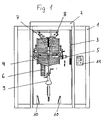
- FIG. 1 shows a cabin (1), on the cover of which an advertising element (2) is mounted.
- the bicycle (9) is lifted into the cabin with a lifting mechanism (3).
- the nozzle system (7,8) supplies water, detergent and air.
- An energy chain (6) guides the supply lines during the vertical movement of the cleaning unit, protected against mechanical damage.
- the ramp wedges (10) ensure the pivoting movement of the lever arms of the cleaning brushes.
- the control, operating and checkout unit (11) sets the cleaning process in motion and controls the process.
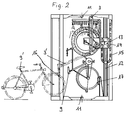
- Fig. 2 shows a side view of the cabin.
- the bearing (11) is the fulcrum for the revolving door.
- the guide rail (12) receives the carriage (13) which is driven by a motor (14).
- the cable routing chain (6) receives the lines of the washing unit.
- the bicycle (9 ') is hooked into the receiving hook (16).
- the lifting device (3 ') is brought into position (3).
- the bicycle (9) hangs vertically in the cabin.
- a bracket (17) locks the bike.
- FIG 3 shows a cabin (1) which is divided into three rooms.
- the equipment rooms (19, 20) serve to accommodate the electrical devices and the water and detergent supply unit.
- the cleaning process is carried out automatically in the wet cell (18). This is accessible through a sealed, rotatably mounted door (21).
- the brush and nozzle system (4,7,8) is mounted on the chassis (13) and is moved by a gear motor (14).
- a cable routing chain takes air (22), water and detergent supply lines.
- the fan (23) generates the air flow for drying the bicycle.
- the containers (24, 25) are used to hold water and detergent.
- a pump (26) is used to convey the various media.
- a valve (27) is used to control the delivery rate and to introduce the media into the corresponding line system.
- the pump enables water to be recovered from the cleaning process.
- the pump (28) conveys the waste water into the waste water network via a filter unit (29) with an oil separator.
- Fig. 4 shows the structure of the cabin.
- a frame (30) this has a lightweight frame construction.
- the modular system ensures uncomplicated installation.
- the front walls (31, 32), the side walls (33) and the rear wall (34) serve for cladding. These can optionally be heat-insulated to ensure functional reliability in all weather conditions.
- FIG. 2 shows an embodiment of an advertising medium that can also be used as a display element for the process flow.
- Fig. 5 shows the door mechanism in a semi-automatic version.
- the door (21) which is rotatably mounted in the bearing point (11), is brought into position (21).
- An automatically triggered lock (38) holds the door in this position.
- the lock is released in a time-controlled manner, a spring element (39) returns the door to the starting position. It is also locked here.
- Fig. 6 shows the door mechanism in automatic execution.
- the door (21) which is rotatably mounted in the bearing point (11), is brought into position (21) by means of a motor (40).
- An automatically triggered lock (38) holds the door in this position.
- the lock is released in a time-controlled manner and the motor returns the door to the starting position. It is also locked here.
- Fig. 7a shows a vertically arranged guide rail (12).
- the carriage (13) is guided without play by means of adjustable rollers (41).
- the motor (14) is used to automatically move the carriage.
- the pendulum movement of the cleaning brush (4) is generated by a rotatably mounted, eccentrically driven pendulum (42). This is done by a motor (43).
- FIG. 7b shows a cleaning brush (4) which carries out an oscillating movement by means of a toothed wheel (44) and a toothed rack (46) driven by an eccentric disc (45).
- Fig. 8 shows the carriage (13) on which the swivel arms (47) are articulated in the bearing (48).
- the cleaning brushes (4) are attached to the swivel arms.
- the swivel arms and brushes are moved into position (4) or (47) by means of a ramp wedge (10) brought and automatically held in this position by a lock (49) as required.
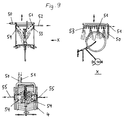
- Fig. 9 shows different views of the nozzle system.
- the U-shaped pipe system (50) with the nozzles (51) is used to blow off the bicycle with compressed air for the purpose of drying.
- the pipe system (52) with nozzles (53) is used to apply water.
- the nozzles (51, 53) are arranged in such a way that their main jet direction is directed downwards.
- the nozzles (54) for applying the cleaning agent are located inside the cleaning brushes (4).
- the nozzles are supplied by means of a flexible feed line (55).
- the 10 shows a water tank (56) which is filled with fresh water by means of a float (57).
- the water pump (59) conveys the liquid to the nozzle system (60) via a filter (58).
- the cleaning agent tank (61) supplies the nozzle system (62) with liquid. Delivery is either via a proportioner (63) via filter (58) and water pump (59) with changeover of a valve (64) or via a separate line system with filter (65) and pump (66) directly into the nozzle system (62).
- the admixer (63) and the valve (64) are omitted.
- the water from the prewash and afterwash reaches the submersible pump (68) via the drip pan (67). This conveys the water into the tank (56) via a self-cleaning filter system (69).
- the collecting container (70) serves to collect coarse-grained dirt.
- the water of the main wash is introduced into the sewage system with a submersible pump (71) via a filter (72) with an oil separator.
- Fig. 11 shows different variants in the execution of the vertical guide of the cleaning carriage.
- the round rod (12a) serves as a guide for the slide or ball-bearing slide (73a).
- the profile of the guide rail (12b) can be designed such that the sliding or ball-bearing rollers are guided in any direction without play.
- the rollers (41) can be attached in such a way that they can be fed to the guide rail (12c) without play.
- the guide rail (12d) can be designed such that it is provided in the friction or running surfaces with special elements in order to ensure low-friction and quiet running of the bearing elements (73C).
- Fig. 12 shows different versions of the door.
- the door (21a) can be designed as a one-piece revolving door either with a central bearing or mounted in a guide rail.
- the door (21b) can be designed as a two-part revolving door either with a central bearing or mounted in a guide rail.
- the door can be designed as a one-piece (21c) or two-piece (21d) door.
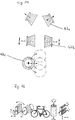
- the brush (4a) can preferably carry out an oscillating or rotating movement perpendicular to the plane of the bicycle.
- the brush (4b) can carry out a sliding movement parallel to the vertical axis of the bicycle, the longitudinal axis of the bicycle or combinations of the movements.
- the brush (4c) can carry out a combination of pendulum / rotary movement and sliding movement.
- the brushes (4d) can be assembled in segments and perform the above-mentioned movements.
- an additional pendulum movement around the perpendicular to the bike level can be carried out.
- the brush (4e) can perform a pendulum or rotational movement parallel to the longitudinal axis of the bicycle and can optionally be moved at the same time.
- the brush (4f) can perform a pendulum or rotational movement parallel to the vertical bicycle axis and can optionally also be moved parallel to the vertical bicycle or longitudinal axis or a combination of both directions.
- the brush (4g) can be composed of individually rotating or oscillating brush segments and can optionally also perform a sliding movement parallel to the vertical or longitudinal axis of the bicycle or in combination.
- Fig. 14 shows different movement options of the swivel arms.
- the swivel arm (47a) can be swiveled sideways or away from the bicycle.
- the swivel arm (47b) can be moved parallel or vertically or in combination to the bike level.
- the swivel arm can be swiveled parallel to the bike level.
- Fig. 15 shows a further version of the supply system.
- a storage tank (77) for after-treatment chemicals for preserving and / or sealing the bicycle can be added.
- Appropriate chemicals are added to the fresh water via an injector (74) with a downstream check valve (78).
- An additional fresh water delivery unit enables use independent of the mains network.
- An additional recovery tank (76) which is preceded by a coarse filter unit (79) in addition to the existing filter unit, enables water that has already been used to be reused.
- Fig. 16 shows the brush variants and possibilities of movement shown in Fig. 13 when the bicycle is used in a horizontal position.
Landscapes
- Engineering & Computer Science (AREA)
- Mechanical Engineering (AREA)
- Vehicle Cleaning, Maintenance, Repair, Refitting, And Outriggers (AREA)
- Automatic Cycles, And Cycles In General (AREA)
- Cleaning In General (AREA)
Applications Claiming Priority (2)
| Application Number | Priority Date | Filing Date | Title |
|---|---|---|---|
| DE29505047U DE29505047U1 (de) | 1995-03-24 | 1995-03-24 | Vorrichtung zur vollautomatischen Reinigung eines Fahrrades |
| DE29505047U | 1995-03-24 |
Publications (3)
| Publication Number | Publication Date |
|---|---|
| EP0733528A2 true EP0733528A2 (fr) | 1996-09-25 |
| EP0733528A3 EP0733528A3 (fr) | 1996-10-16 |
| EP0733528B1 EP0733528B1 (fr) | 1998-07-22 |
Family
ID=8005850
Family Applications (1)
| Application Number | Title | Priority Date | Filing Date |
|---|---|---|---|
| EP96104384A Expired - Lifetime EP0733528B1 (fr) | 1995-03-24 | 1996-03-20 | Dispositif pour le nettoyage automatique d'une bicyclette |
Country Status (3)
| Country | Link |
|---|---|
| EP (1) | EP0733528B1 (fr) |
| AT (1) | ATE168635T1 (fr) |
| DE (2) | DE29505047U1 (fr) |
Cited By (5)
| Publication number | Priority date | Publication date | Assignee | Title |
|---|---|---|---|---|
| CN106184131A (zh) * | 2015-05-06 | 2016-12-07 | 戴钢 | 柜式多功能自行车自动清洗机 |
| CN108473113A (zh) * | 2015-10-28 | 2018-08-31 | S·库马尔 | 用于清洁物体特别是两轮车辆的装置 |
| WO2021232084A1 (fr) | 2020-05-22 | 2021-11-25 | Wintersteiger Ag | Appareil de nettoyage pour bicyclette |
| US11229930B2 (en) * | 2016-02-18 | 2022-01-25 | Jeanneworks, Inc. | Washing system and methods of use |
| CN117048560A (zh) * | 2023-09-27 | 2023-11-14 | 浙江隆源装备科技股份有限公司 | 一种智能型节水洗车机 |
Families Citing this family (5)
| Publication number | Priority date | Publication date | Assignee | Title |
|---|---|---|---|---|
| DE19824271A1 (de) * | 1998-05-29 | 1999-12-02 | Paul Stahljans | Waschanlage zum automatischen Naßreinigen von sperrigen Gegenständen, insbesondere Zweirädern in einem Waschvorgang |
| FR2907407B1 (fr) * | 2006-10-23 | 2008-12-05 | Girard Jean Michel Denis Berna | Dispositif pour laver les roues a rayons |
| IL187952A0 (en) * | 2007-12-06 | 2008-11-03 | Uriel Aharonov | Device for cleaning a two-wheeled vehicle |
| EP2537720B1 (fr) * | 2011-06-20 | 2013-08-28 | Tecnolazzeri F.LLI S.N.C. Di Lazzeri Walter e Giovanni | Appareil pour laver des bicyclettes |
| DE102011052215A1 (de) * | 2011-07-05 | 2013-01-10 | Stefan Sarfert | Vorrichtung zum Reinigen von Zweirädern |
Family Cites Families (3)
| Publication number | Priority date | Publication date | Assignee | Title |
|---|---|---|---|---|
| CH679646A5 (en) * | 1990-10-01 | 1992-03-31 | Emil Weinhold | Automatic bicycle cleaning equipment - has detachable holder in water-tight cabin, with spray nozzles supplied under pressure |
| DE9208442U1 (de) * | 1992-06-24 | 1992-08-13 | Simhart, Christine, 8000 München | Fahrradputzbox |
| DE29506873U1 (de) * | 1995-04-24 | 1995-06-22 | Hochmuth, Walter, 90431 Nürnberg | Vorrichtung zum Reinigen eines Zweirads |
-
1995
- 1995-03-24 DE DE29505047U patent/DE29505047U1/de not_active Expired - Lifetime
-
1996
- 1996-03-20 AT AT96104384T patent/ATE168635T1/de not_active IP Right Cessation
- 1996-03-20 DE DE59600353T patent/DE59600353D1/de not_active Expired - Fee Related
- 1996-03-20 EP EP96104384A patent/EP0733528B1/fr not_active Expired - Lifetime
Cited By (6)
| Publication number | Priority date | Publication date | Assignee | Title |
|---|---|---|---|---|
| CN106184131A (zh) * | 2015-05-06 | 2016-12-07 | 戴钢 | 柜式多功能自行车自动清洗机 |
| CN108473113A (zh) * | 2015-10-28 | 2018-08-31 | S·库马尔 | 用于清洁物体特别是两轮车辆的装置 |
| CN108473113B (zh) * | 2015-10-28 | 2021-06-08 | S·库马尔 | 用于清洁物体特别是两轮车辆的装置 |
| US11229930B2 (en) * | 2016-02-18 | 2022-01-25 | Jeanneworks, Inc. | Washing system and methods of use |
| WO2021232084A1 (fr) | 2020-05-22 | 2021-11-25 | Wintersteiger Ag | Appareil de nettoyage pour bicyclette |
| CN117048560A (zh) * | 2023-09-27 | 2023-11-14 | 浙江隆源装备科技股份有限公司 | 一种智能型节水洗车机 |
Also Published As
| Publication number | Publication date |
|---|---|
| EP0733528B1 (fr) | 1998-07-22 |
| EP0733528A3 (fr) | 1996-10-16 |
| ATE168635T1 (de) | 1998-08-15 |
| DE59600353D1 (de) | 1998-08-27 |
| DE29505047U1 (de) | 1995-06-22 |
Similar Documents
| Publication | Publication Date | Title |
|---|---|---|
| EP2089662B1 (fr) | Procédé et dispositif de nettoyage de capteurs solaires | |
| DE2202713C3 (de) | Einrichtung zum Steuern einer selbsttätigen Fensterwaschanlage | |
| EP0733528B1 (fr) | Dispositif pour le nettoyage automatique d'une bicyclette | |
| KR20010050110A (ko) | 건물 외벽 및 창유리 청소로봇 | |
| WO2007088056A1 (fr) | Installation sanitaire dotee d'un systeme de nettoyage du plancher | |
| EP0637531B1 (fr) | Dispositif de nettoyage pour véhicules à deux roues, notamment pour bicyclettes | |
| DE9112116U1 (de) | Automatische Zweiradreinigungseinrichtung | |
| DE202012103156U1 (de) | Außenmauer-Reinigungsautomat | |
| DE102007010478A1 (de) | Vorrichtung zur Reinigung von Tunnelflächen mit Hochdruck-Vakuum-Technik | |
| DE20221863U1 (de) | Vorrichtung zur Innenreinigung von Silos | |
| DE3503049A1 (de) | Fassadenreinigungsvorrichtung | |
| DE19824271A1 (de) | Waschanlage zum automatischen Naßreinigen von sperrigen Gegenständen, insbesondere Zweirädern in einem Waschvorgang | |
| EP0447601A1 (fr) | Dispositif de nettoyage de marquages routiers | |
| DE2748142A1 (de) | Fenster- und fassadenreinigungsgeraet | |
| DE4027613C2 (fr) | ||
| DE19509422A1 (de) | Vorrichtung zur Reinigung von Lüftungskanälen | |
| EP0804897B1 (fr) | Machine pour nettoyer les sols, en particulier machine pour aspirer et frotter | |
| DE29909258U1 (de) | Waschvorrichtung für Autofußmatten aus vorzugsweise gummiartigem Material | |
| DE102004034819B3 (de) | Transportable Reinigungsvorrichtung | |
| DE19950199B4 (de) | Reinigungsstation zum Besprühen und/oder Spülen von Fahrzeugkarosserien und Verfahren zum Reinigen von Fahrzeugkarosserien | |
| DE1503865A1 (de) | Decken-Abwasch-Geraet | |
| DE102015108263A1 (de) | Reinigungsvorrichtung und Fahrzeugwaschanlage | |
| DE2202931A1 (de) | Vorrichtung insbesondere zum Reinigen von Fensterblenden | |
| DE2553714A1 (de) | Vorrichtung zum waschen, desinfizieren und trocknen von einrichtungsgegenstaenden in krankenanstalten | |
| DE19649748A1 (de) | Halteraupen, insbesondere für eine automatische Reinigungsvorrichtung |
Legal Events
| Date | Code | Title | Description |
|---|---|---|---|
| PUAI | Public reference made under article 153(3) epc to a published international application that has entered the european phase |
Free format text: ORIGINAL CODE: 0009012 |
|
| PUAL | Search report despatched |
Free format text: ORIGINAL CODE: 0009013 |
|
| AK | Designated contracting states |
Kind code of ref document: A2 Designated state(s): AT CH DE FR LI NL |
|
| AK | Designated contracting states |
Kind code of ref document: A3 Designated state(s): AT CH DE FR LI NL |
|
| 17P | Request for examination filed |
Effective date: 19970314 |
|
| GRAG | Despatch of communication of intention to grant |
Free format text: ORIGINAL CODE: EPIDOS AGRA |
|
| GRAG | Despatch of communication of intention to grant |
Free format text: ORIGINAL CODE: EPIDOS AGRA |
|
| GRAH | Despatch of communication of intention to grant a patent |
Free format text: ORIGINAL CODE: EPIDOS IGRA |
|
| 17Q | First examination report despatched |
Effective date: 19971127 |
|
| GRAH | Despatch of communication of intention to grant a patent |
Free format text: ORIGINAL CODE: EPIDOS IGRA |
|
| GRAA | (expected) grant |
Free format text: ORIGINAL CODE: 0009210 |
|
| AK | Designated contracting states |
Kind code of ref document: B1 Designated state(s): AT CH DE FR LI NL |
|
| PG25 | Lapsed in a contracting state [announced via postgrant information from national office to epo] |
Ref country code: NL Free format text: LAPSE BECAUSE OF FAILURE TO SUBMIT A TRANSLATION OF THE DESCRIPTION OR TO PAY THE FEE WITHIN THE PRESCRIBED TIME-LIMIT Effective date: 19980722 Ref country code: FR Free format text: LAPSE BECAUSE OF FAILURE TO SUBMIT A TRANSLATION OF THE DESCRIPTION OR TO PAY THE FEE WITHIN THE PRESCRIBED TIME-LIMIT Effective date: 19980722 |
|
| REF | Corresponds to: |
Ref document number: 168635 Country of ref document: AT Date of ref document: 19980815 Kind code of ref document: T |
|
| REG | Reference to a national code |
Ref country code: CH Ref legal event code: EP |
|
| REF | Corresponds to: |
Ref document number: 59600353 Country of ref document: DE Date of ref document: 19980827 |
|
| REG | Reference to a national code |
Ref country code: CH Ref legal event code: NV Representative=s name: TROESCH SCHEIDEGGER WERNER AG |
|
| EN | Fr: translation not filed | ||
| NLV1 | Nl: lapsed or annulled due to failure to fulfill the requirements of art. 29p and 29m of the patents act | ||
| PLBE | No opposition filed within time limit |
Free format text: ORIGINAL CODE: 0009261 |
|
| STAA | Information on the status of an ep patent application or granted ep patent |
Free format text: STATUS: NO OPPOSITION FILED WITHIN TIME LIMIT |
|
| 26N | No opposition filed | ||
| PGFP | Annual fee paid to national office [announced via postgrant information from national office to epo] |
Ref country code: AT Payment date: 20000314 Year of fee payment: 5 |
|
| PGFP | Annual fee paid to national office [announced via postgrant information from national office to epo] |
Ref country code: CH Payment date: 20000530 Year of fee payment: 5 |
|
| PG25 | Lapsed in a contracting state [announced via postgrant information from national office to epo] |
Ref country code: AT Free format text: LAPSE BECAUSE OF NON-PAYMENT OF DUE FEES Effective date: 20010320 |
|
| PG25 | Lapsed in a contracting state [announced via postgrant information from national office to epo] |
Ref country code: LI Free format text: LAPSE BECAUSE OF NON-PAYMENT OF DUE FEES Effective date: 20010331 Ref country code: CH Free format text: LAPSE BECAUSE OF NON-PAYMENT OF DUE FEES Effective date: 20010331 |
|
| REG | Reference to a national code |
Ref country code: CH Ref legal event code: PL |
|
| PGFP | Annual fee paid to national office [announced via postgrant information from national office to epo] |
Ref country code: DE Payment date: 20011206 Year of fee payment: 6 |
|
| PG25 | Lapsed in a contracting state [announced via postgrant information from national office to epo] |
Ref country code: DE Free format text: LAPSE BECAUSE OF NON-PAYMENT OF DUE FEES Effective date: 20021001 |