EP0733570A2 - Dispositif pour coupler la bande dans une machine d'enroulement - Google Patents
Dispositif pour coupler la bande dans une machine d'enroulement Download PDFInfo
- Publication number
- EP0733570A2 EP0733570A2 EP96103998A EP96103998A EP0733570A2 EP 0733570 A2 EP0733570 A2 EP 0733570A2 EP 96103998 A EP96103998 A EP 96103998A EP 96103998 A EP96103998 A EP 96103998A EP 0733570 A2 EP0733570 A2 EP 0733570A2
- Authority
- EP
- European Patent Office
- Prior art keywords
- roller
- web
- winding
- roll
- pressure medium
- Prior art date
- Legal status (The legal status is an assumption and is not a legal conclusion. Google has not performed a legal analysis and makes no representation as to the accuracy of the status listed.)
- Withdrawn
Links
Images


Classifications
-
- B—PERFORMING OPERATIONS; TRANSPORTING
- B65—CONVEYING; PACKING; STORING; HANDLING THIN OR FILAMENTARY MATERIAL
- B65H—HANDLING THIN OR FILAMENTARY MATERIAL, e.g. SHEETS, WEBS, CABLES
- B65H19/00—Changing the web roll
- B65H19/22—Changing the web roll in winding mechanisms or in connection with winding operations
- B65H19/26—Cutting-off the web running to the wound web roll
-
- B—PERFORMING OPERATIONS; TRANSPORTING
- B65—CONVEYING; PACKING; STORING; HANDLING THIN OR FILAMENTARY MATERIAL
- B65H—HANDLING THIN OR FILAMENTARY MATERIAL, e.g. SHEETS, WEBS, CABLES
- B65H19/00—Changing the web roll
- B65H19/22—Changing the web roll in winding mechanisms or in connection with winding operations
- B65H19/2238—The web roll being driven by a winding mechanism of the nip or tangential drive type
- B65H19/2246—The web roll being driven by a winding mechanism of the nip or tangential drive type and the roll being supported on two rollers
-
- B—PERFORMING OPERATIONS; TRANSPORTING
- B65—CONVEYING; PACKING; STORING; HANDLING THIN OR FILAMENTARY MATERIAL
- B65H—HANDLING THIN OR FILAMENTARY MATERIAL, e.g. SHEETS, WEBS, CABLES
- B65H2301/00—Handling processes for sheets or webs
- B65H2301/40—Type of handling process
- B65H2301/41—Winding, unwinding
- B65H2301/414—Winding
- B65H2301/4148—Winding slitting
-
- B—PERFORMING OPERATIONS; TRANSPORTING
- B65—CONVEYING; PACKING; STORING; HANDLING THIN OR FILAMENTARY MATERIAL
- B65H—HANDLING THIN OR FILAMENTARY MATERIAL, e.g. SHEETS, WEBS, CABLES
- B65H2301/00—Handling processes for sheets or webs
- B65H2301/40—Type of handling process
- B65H2301/41—Winding, unwinding
- B65H2301/417—Handling or changing web rolls
- B65H2301/418—Changing web roll
- B65H2301/4182—Core or mandrel insertion, e.g. means for loading core or mandrel in winding position
- B65H2301/41826—Core or mandrel insertion, e.g. means for loading core or mandrel in winding position by gripping or pushing means, mechanical or suction gripper
Definitions
- the proposed invention relates to the technical field of winding web-like material made of paper, film, plastic, fabric, textiles or the like. At least one roll with at least one rotatable first roller touching the forming roll on its outer circumference.
- Devices of the type mentioned are used, for example, to cut relatively wide webs of said material into narrow strips with the aid of at least one longitudinal cutting device and then to wind these strips into smaller rolls.
- Such devices were known for example from US-A 3 841 578, EP-A 0 118 384 or DE-U 83 17 214.
- the unwinding role is exhausted after a long period of use of the device and must be replaced by a new one.
- the at least one reel to be rewound reaches its final shape, generally its finally desired diameter, after a certain operating time, which is why it is necessary to remove this reel or these reels from the machine and to start winding at least one new reel .
- the web-like material 1 runs through a longitudinal cutting device 3.
- the originally relatively wide web-like material 1 is cut into several narrower strips in its running direction, ie in the direction of arrow 2.
- each narrower strip is wound up into a roll.
- the longitudinal cutting device 3 it is also possible with the longitudinal cutting device 3 to cut or cut so-called edge strips from the web-like material 1, so that the edge of the web-like material Material 1 becomes sufficiently straight and clean for the subsequent winding process.
- edge strips can either also be wound up into rolls or can be fed to a waste device. In this way, at least one strip is created, which is wound up for a later roll. However, several strips can also be cut out of the web-like material 1, each of which is wound up into a roll.
- the so-called winding point contains a first roller 4 which, with the help of its circumference, touches the circumference of the at least one roll 5 created by the winding process during the winding process.
- the first roller 4 can be, for example, a support roller of a so-called support roller roller or else a support roller of a so-called support roller winder, depending on the type of winding machine in which the first roller 4 is installed.
- the first roller 4 is rotatably mounted in a corresponding frame and can be driven at its periphery or in its center with the aid of a suitable device as desired.
- 1 shows a so-called carrier roller winder, for example, to which a fourth roller 6 is assigned.
- the fourth roller 6 can also be designed in the form of a support roller. It is also rotatably mounted in the corresponding frame and can be driven as required.
- the device shown also contains a device for removing the wound roll or rolls 5.
- This device essentially comprises a swivel body 8.
- the swivel body 8 is by means of a joint 9 or Several such joints are pivotally mounted in one or more bearings 10 in the machine frame or in a part connected to it. With the help of a further bearing 11, a pressure medium cylinder 12 is connected to the machine frame, the pressure medium cylinder 12, on the other hand, being pivotably attached to the swivel body 8 with the aid of a bearing 13.
- a plurality of such cylinders and bearings which can be arranged one behind the other in the direction of view of FIG. 1, can be provided if required.
- the pivot body 8 can be pivoted in the direction of the arrow 14. It can be pivoted, for example, from a standby position in such a way that the right end 15 of the pivot body 8 in FIG. 1 comes in close proximity to the outer circumference of the first roller 4.
- at least one roller 16 can be rotatably mounted on the right end 15, so that it is possible to pivot the swivel body 8 in such a way that its right end 15 rests on the outer circumference of the first roller 4.
- the swivel body 8 can be swiveled with the aid of the pressure medium cylinder 12, for example to the left in FIG. 1, that an already finished wound roll 5 'inserted therein can be conveyed out of the swivel body 8 to the left. In this way, the roll 5 'or more such rolls can be fed to a corresponding tray.
- the upper surface 17 of the swivel body 8 is either a grid or even a closed one Surface, for example, box-shaped arranged between two corresponding side parts, so that the roller - or the rollers 5 '- is sufficiently supported by the swivel body 8.
- the upper surface 17 of the swivel body 8 is firmly connected to the side parts 18 and 19.
- windows 20 and 21 are incorporated into the upper surface 17, for example.
- the periphery of the further roller 22 projects through the window 20 and the periphery of a third roller 23 projects through the window 21.
- the rollers 22 and 23 are rotatably mounted in corresponding bearings 24 to 27 in the swivel body 8 or its individual parts.
- the further roller 22 is connected to a motor 28 and the third roller 23 to a motor 29, so that the further roller 22 and / or the third roller 23 can be rotated by excitation of the corresponding motors.
- the bearings of the rollers 22 and 23 are selected such that, as already indicated, the circumferences of both rollers protrude slightly from the upper surface 17 of the swivel body 8. In this way it is possible that at least one completely wound roll is supported by the rollers 22 and 23 with a corresponding pivot position of the pivot body 8. If at least one of the motors 28 and 29 is also driven, then it becomes possible to rotate the at least one finished roller 5 'at least relatively slowly.
- the swivel body 8 can be pivoted with the aid of the pressure medium cylinder 12 in such a way that the respective roller 5' is conveyed out of the winding machine in order to be able to be fed to a corresponding storage area.
- rollers 22 and 23 it may also be possible, if this turns out to be necessary, to use smaller, even narrower rollers, or else appropriately designed, fixed strips, as long as it is possible for the respective roller 5 'on these devices of this type support and thereby rotate that the cut end of the web-like material 1 can be forced onto the next lower winding position of the respective roll 5 '. It is not necessary to drive the respective roller 5 'exclusively on its circumference. It is also conceivable, for example, to drive the respective roller 5 'rotatably in its center, so that a rotational movement of the respective roller 5' can also be expected in this way.
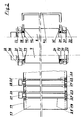
- first roller 4 is rotatably supported by means of bearings 30 and 31 in frame parts 32 and 33 by means of trunnions 34 and 35. With the help of a motor 36, the first roller 4 can be driven if necessary.
- the fourth roller 6 is also rotatably supported by means of bearings 37 and 38 and journals 39 and 40, for example also in the housing or frame parts 32 and 33. Swivel arms 41 and 42 are rotatably supported on the journals 39 and 40. The swivel arms 41 and 42 are connected to a housing 43.
- the housing 43 is connected to the pressure medium cylinder by means of a joint 44 45 connected. This is firmly connected to the machine frame by means of a joint 46.
- the carrier 50 can be guided against the housing 43 or removed from it in such a way that a gap 55 can essentially be closed or opened.
- the inner surface 56 of the housing 43 is also substantially crescent-shaped and, as it lies in the interior of the housing 43, also has a trough-shaped design, so that at least one new winding tube 57, a winding shaft or the like is inserted into the interior of the resulting trough can be, before the housing 43 has been pivoted by means of the pressure medium cylinder 45.
- the housing 43 pivots in the direction of the arrow 47, for example counterclockwise, so that the roller 54 or its periphery impinges on the periphery or the peripheries of the roller or rollers 5. Further introduction of pressure medium into the pressure medium cylinder 45 causes the housing to pivot further 43 in the direction of arrow 47, also counterclockwise, so that the roller 5 can be lifted out of the carrier roller bed formed by the first roller 4 and fourth roller 6.
- the roller 5 comes out of the support roller bed onto the upper surface 17 of the swivel body 8 can be caught there by the second support roller bed formed by the further roller 22 and the third roller 23.
- the housing 43 and all the parts connected to it form a device for removing the respective wound roll 5.This is due to the fact that the inner surface 56 of the housing 43 is trough-shaped, and there is a new winding tube, even before the removal process 57 has found new winding shaft or the like, the new winding tube or winding shaft or the like.
- the carrier 50 together with the joint 49, thus forms a type of flap or the like, which can be moved with the aid of the pressure medium cylinder 52 relative to the housing 43, which is approximately crescent-shaped in cross section. Instead of such a flap, however, a type of slide is also conceivable, with which the gap 55 can be opened or closed as required.
- the longitudinal cutting device 3 essentially comprises a lower knife 58 which is rotatably mounted in the machine frame (not shown) and which can be driven if necessary.
- Several such lower knives are arranged one behind the other in the direction of view of FIG. 1, for example in that the lower knife 58 is equipped with a plurality of cutting points or cutting edges, that is to say, for example, consists of a so-called knife sleeve.
- Several such cutting points are arranged one behind the other in FIG. 1 and can also extend over the entire width of the web-like material or its greatest width. At least one possibly driven upper knife 59 interacts with the lower knife 58.
- a plurality of upper knives 59 can be arranged one behind the other in the viewing direction in FIG. 1.
- the upper knives and possibly also the lower knives can assume different positions one behind the other in the direction of view of FIG. 1, so that it is possible to cut strips of different width from the web-like material, depending on how wide the rolls 5 or 5 'to be wound are desired .
- the upper knife or the upper knife 59 is / are each mounted on corresponding slide guides which allow the respective upper knife 59 to be displaced, to be lifted out of the effective area of the respective cutting edge of the respective lower knife 58 and to be used again at another point.
- the respective upper knife 59 can be shifted in the direction of view of FIG. 1 and fixed at the desired location.
- the knives in particular the upper knives 59, are very sharp in order to use them to produce cut edges in the web-like material 1, which allow rolls 5 or 5 'to be wound up properly. Since the knives, in particular the upper knives 59, are sharp, they must be protected against unintentional contact because an operator can injure themselves very easily due to the sharpness of the knives when the conversion work is carried out. In addition, an operator can injure himself on the knives if they are exposed unprotected while other operations are being carried out. For this reason, a cover 60 is proposed which can extend over the entire width of the web-like material or which is divided into individual sections or parts, so that a plurality of similar covers 60 'are arranged one behind the other in the direction of view of FIG. 1.
- Each cover can contain at least one joint 61, which is appropriately mounted in at least one bearing block 62.
- the bearing block 62 is firmly connected to the rest of the machine frame, which can also consist, for example, of parts of the floor of a production hall.
- the cover 60 has a cross section which corresponds approximately to a large Latin Z.
- the right end 63 of the cover 60 projects at least over the upper knife 59 or both over the upper knife 59 and the lower knife 58.
- the cover 60 can be pivoted in the direction of arrow 64 around the joint 61, for example by hand or by corresponding pressure medium cylinders or other similar devices with a similar effect.
- the cover 60 has been pivoted counterclockwise in the direction of the arrow 64, then at least one upper knife 59 is freely accessible in front of the operator, so that, for example, an approximately blunt upper knife 59 can be exchanged for a sharpened one. In addition, other operations are easily possible. If, on the other hand, the cover 60 has been pivoted extremely in the direction of the arrow 64, ie counterclockwise against a stop 65, then access to the upper knife or the upper knives 59 is denied. At the same time the cover, in particular its upper surface 66, forms an access path for an operator 67 who can climb the upper surface 66, for example with the aid of a step 68.
- any necessary operations for example in the vicinity of the winding station 7, can be carried out so that the operator 67 can comfortably reach the winding station.
- the covers 60 'are thus essentially parallel to the first roller 4 or the roller 5 or their geometric axes. Since several covers 60 'can be arranged one behind the other, they are arranged along a straight line which is arranged in the direction of view of FIG. 1.
- the arrangement of a plurality of relatively short partial covers 60 'forming the cover 60 has the advantage that the operator 67 can stand on the adjacent partial cover 60' even when handling one of the upper knives 59 and thus opening a partial cover 60 ', provided that the latter is closed.
- rails 69 and 70 can also be arranged on each partial cover 60 ', which engage in corresponding counter rails 71 and 72.
- the counter rails 71 and 72 are firmly connected to the machine frame or the floor for the machine frame. In this way, a partial cover 60 'cannot be pivoted in the direction of the arrow 64, but can be moved along the rails and counter rails 69 to 72 in order to achieve essentially the same goal as when they were pivoted.
- the rails 69 to 72 are therefore arranged in such a way that their longitudinal extension is perpendicular or essentially perpendicular to the geometric axis of the first roller 4.
- covers 60 or partial covers 60 'above the cutting device 3 in such a way that they are only placed loosely or placed in corresponding holders.
- this has the disadvantage that the covers may not always remain in the correct location, but may not be present at all or may not be present at all, so that unwanted access to the sharp knives cannot always be completely prevented despite the presence of covers.
- Holders 73 and 74 which can be pivoted with the aid of corresponding pressure medium cylinders are mounted on the bearing journals 34 and 35 of the first roller 4.
- Each holder consists of a radially inner part 75 and a radially outer part 76.
- the outer part 76 contains a swivel joint 77, whereas the inner part 75 contains a joint 78.
- Between the joints 77 and 78 there is a pressure medium cylinder 79 which, when appropriate pressure medium is introduced, is able to remove the outer part 76 relative to the inner part 75 by a certain distance.
- there is a tongue 80 on each outer part 76 which is guided in at least one rail 81, which in turn is located on the inner part 75.
- Each radially outer part 76 is provided with a holder 82, in which a wire, a narrow knife or any other device can be fastened, which allows the web-shaped material 1 to be transverse to its direction of rotation indicated by arrow 2 or approximately transverse to it, to cut or separate.
- a wire, a narrow knife or any other device can be fastened, which allows the web-shaped material 1 to be transverse to its direction of rotation indicated by arrow 2 or approximately transverse to it, to cut or separate.
- the holders 73 and 74 can be present in pairs and can be synchronized with one another, there is the possibility of separating the web-like material 1 in order to complete the removal of one to allow wound roll 5 or 5 'from the machine.
- each holder for example the holder 73 in FIG. 1, can be pivoted into an elf position.
- other positions are also possible, for example a one-o'clock position or a two-o'clock position, depending on the size of the available space.
- the wire / the knife can be moved radially to the first roller 4 with the aid of the respective pressure medium cylinder 79, it is possible to cut through the web-like material 1 when at least one completely wound roll has assumed the position 5 'and that Material 1 is thus stretched between the further roller 22 and the first roller 4 and is ready for separation.
- a holder 73 or 74, including the parts attached to it, is assigned to the end face of the first roller 4.
- a narrow hand-shaped knife can also be used, which in turn can be provided either with a straight bevel or with a so-called serrated bevel.
- a web-like material can be cut into several strips lengthwise, ie in its running direction, and wound up into a roll.
- This roll can then be removed very quickly from the winding shaft and a new winding tube or the like can be inserted into the winding point for a subsequent winding process.
- the wound roll can, in particular, if it has been provided with glue or the like at a suitable location with the aid of a nozzle 83, in a second one given by the rollers 22 and 23 Carrier roller bed are closed in order to then finally remove them from the winding device and for example to be able to feed them to a tray.
- a carriage, carriage or the like. 84 may be provided.
- the carriage, carriage or the like 84 can be moved along guides 85 and 86, which in turn are arranged perpendicular to the direction of travel of the web-like material 1 indicated by the arrow 2 and essentially parallel to the upper surface 17, so that the guides 85 and 86 are arranged at least transversely across the entire width of the web-like material 1 at right angles to the web-like material 1 itself.
- the carriage 85 is essentially known per se, for example from European patent application 99 732.
- a cutting groove 87 machined into the swivel body 8 complements the device.
- the cutting groove 87 runs parallel to the guides 85 and 86.
- Further guides 88 and 89 can be connected to the guides 85 and 86 in such a way that the carriage 84 in FIG. 1 can be displaced vertically in accordance with the arrow 90.
- the trolley or the like. 84 can be lowered so far, if necessary, that an adhesive strip or a corresponding glue nozzle located thereon can reach the web-like material 1, which spreads out on the upper surface 17 to receive adhesive or the like is.
- Said glue nozzle is attached to the carriage or the like 84.
- the carriage or the like 84 can also contain a rolling device, of which an adhesive tape, possibly under Inclusion of a carrier or support band can be removed.
- the carriage 84 or the like can contain a roll-up device with which the carrier tape can be rewound after the adhesive tape has been detached from the carrier tape and transferred to the web-like material 1.
- the carriage or the like 84 can at the same time support a knife which is able to cut the web-like material 1 transversely to its running direction.
- the guides 88 and 89 can also form a cage as a whole, in which the carriage 84 or the like can be moved in the sense mentioned.
- the cage would have the advantage that it can be moved to an ineffective place when not in use by a corresponding holding or pivoting device, for example upwards in FIG. 1. This would have the further advantage that the carriage 84, its guides, etc. would not block access to the facility 67 in question. Appropriate motorized drives, controls, safety devices etc. also complement this device as well as the entire machine in question.
- the bearings 24 to 26 are fastened in or on the swivel body 8 in such a way that the geometrical axis of the respective roller 22 or 23 comes to lie essentially parallel to that of the first roller 4.
- the rollers 4, 22 and 23 are thus also parallel to one another and parallel to the respective roller or rollers 5 building up as a result of the winding process.
- the parts 43 to 54 overall result in a device for ejecting the wound roller or rollers 5, that is to say for removing them the respective roll 5 from the winding station 7 and thus altogether from the proposed mechanical device.
- the glue strips applied by the glue nozzles or the adhesive strips applied with the help of the carriage can also be dimensioned such that they can also be used to fasten a new start of the web to a new winding tube or winding shaft.
Landscapes
- Motor Or Generator Frames (AREA)
- Diaphragms For Electromechanical Transducers (AREA)
- Replacement Of Web Rolls (AREA)
Applications Claiming Priority (2)
| Application Number | Priority Date | Filing Date | Title |
|---|---|---|---|
| DE29504915U | 1995-03-23 | ||
| DE29504915U DE29504915U1 (de) | 1995-03-23 | 1995-03-23 | Einrichtung mit Halterung |
Publications (2)
| Publication Number | Publication Date |
|---|---|
| EP0733570A2 true EP0733570A2 (fr) | 1996-09-25 |
| EP0733570A3 EP0733570A3 (fr) | 1997-10-29 |
Family
ID=8005751
Family Applications (1)
| Application Number | Title | Priority Date | Filing Date |
|---|---|---|---|
| EP96103998A Withdrawn EP0733570A3 (fr) | 1995-03-23 | 1996-03-14 | Dispositif pour coupler la bande dans une machine d'enroulement |
Country Status (2)
| Country | Link |
|---|---|
| EP (1) | EP0733570A3 (fr) |
| DE (1) | DE29504915U1 (fr) |
Family Cites Families (3)
| Publication number | Priority date | Publication date | Assignee | Title |
|---|---|---|---|---|
| US4326680A (en) * | 1980-07-02 | 1982-04-27 | The Black Clawson Company | Web cutter for a surface winder |
| DE4006412A1 (de) * | 1990-03-01 | 1991-09-05 | Helmut Schenke | Vorrichtung zum aufwickeln von folienrollen |
| ES2105019T3 (es) * | 1993-08-24 | 1997-10-16 | Beloit Technologies Inc | Procedimiento y dispositivo de enrollamiento para enrollar una tira. |
-
1995
- 1995-03-23 DE DE29504915U patent/DE29504915U1/de not_active Expired - Lifetime
-
1996
- 1996-03-14 EP EP96103998A patent/EP0733570A3/fr not_active Withdrawn
Also Published As
| Publication number | Publication date |
|---|---|
| DE29504915U1 (de) | 1995-06-01 |
| EP0733570A3 (fr) | 1997-10-29 |
Similar Documents
| Publication | Publication Date | Title |
|---|---|---|
| AT399856B (de) | Verfahren und vorrichtung zum automatischen trennen und anwickeln einer warenbahn | |
| AT400558B (de) | Verfahren und vorrichtung zum aufrollen und wickeln einer bahn | |
| DE4208746C2 (de) | Verfahren und Vorrichtung zum Wechseln von Spulen | |
| DE69814882T2 (de) | Kombination von 5-ht wiederaufnahme-inhibitoren und h5-ht 1b antagonisten oder partiellen agonisten | |
| DE4334029C2 (de) | Tragwalzen-Wickelmaschine | |
| DE2600522C2 (fr) | ||
| DE3907136A1 (de) | Vorrichtung zum verbinden von materialbahnen | |
| DE3630744C2 (de) | Kontinuierlich arbeitende Umrollvorrichtung mit einer Andrückwalze | |
| DE3308059C2 (fr) | ||
| DE3035652C2 (de) | Andruckwalzen in Tragwalzen-Wickelmaschinen | |
| DE2649289B2 (de) | Rollenwechselvorrichtung in einer Aufrolleinrichtung für Bahnen | |
| EP0893382B1 (fr) | Dispositif pour raccorder des bandes pendant la rotation de bobines | |
| EP2223876A2 (fr) | Agencement de dispositifs de coupe de rouleaux et procédé de fonctionnement d'un agencement de dispositifs de coupe de rouleaux | |
| DE4425662C1 (de) | Vorrichtung zum Quertrennen einer Papierbahn | |
| EP0733569B1 (fr) | Dispositif d'enroulement avec boítier | |
| EP0733570A2 (fr) | Dispositif pour coupler la bande dans une machine d'enroulement | |
| DE2158474C3 (de) | Vorrichtung zum Verbinden der Enden bahnförmigen Wickelgutes, insbesondere Papierbahnen, beim Wickelrollenwechsel | |
| DE29504916U1 (de) | Einrichtung mit Abdeckung | |
| DE29504914U1 (de) | Einrichtung mit Wagen | |
| EP1997755B1 (fr) | Dispositif d'écorchage d'un rouleau d'une bande de matériau d'un tambour de rouleau | |
| DE29504918U1 (de) | Einrichtung mit Abführvorrichtung | |
| EP0873940B1 (fr) | Machine de coupe de rouleaux avec dispositif d'emballage | |
| EP0337372A2 (fr) | Dispositif de formation d'un rouleau à partir d'une pièce de bande | |
| EP1438249B1 (fr) | Dispositif d'enroulement de bandes de matiere sur des arbres d'enroulement | |
| DE29719544U1 (de) | Vorrichtung zum Schneiden einer Bahn |
Legal Events
| Date | Code | Title | Description |
|---|---|---|---|
| PUAI | Public reference made under article 153(3) epc to a published international application that has entered the european phase |
Free format text: ORIGINAL CODE: 0009012 |
|
| AK | Designated contracting states |
Kind code of ref document: A2 Designated state(s): DE FR GB IT |
|
| ITCL | It: translation for ep claims filed |
Representative=s name: BARZANO' E ZANARDO MILANO S.P.A. |
|
| GBC | Gb: translation of claims filed (gb section 78(7)/1977) | ||
| EL | Fr: translation of claims filed |
Free format text: CORRECTIONS |
|
| PUAL | Search report despatched |
Free format text: ORIGINAL CODE: 0009013 |
|
| AK | Designated contracting states |
Kind code of ref document: A3 Designated state(s): DE FR GB IT |
|
| 17P | Request for examination filed |
Effective date: 19971006 |
|
| STAA | Information on the status of an ep patent application or granted ep patent |
Free format text: STATUS: THE APPLICATION HAS BEEN WITHDRAWN |
|
| 18W | Application withdrawn |
Withdrawal date: 20000127 |