EP0733688A1 - Procédé de collage d'objets en utilisant des dispersions aqueuses à partir d'acrylate/méthacrylate contenant un agent de déstabilisation - Google Patents
Procédé de collage d'objets en utilisant des dispersions aqueuses à partir d'acrylate/méthacrylate contenant un agent de déstabilisation Download PDFInfo
- Publication number
- EP0733688A1 EP0733688A1 EP96104192A EP96104192A EP0733688A1 EP 0733688 A1 EP0733688 A1 EP 0733688A1 EP 96104192 A EP96104192 A EP 96104192A EP 96104192 A EP96104192 A EP 96104192A EP 0733688 A1 EP0733688 A1 EP 0733688A1
- Authority
- EP
- European Patent Office
- Prior art keywords
- dispersion
- acid
- destabilizing agent
- sensitive adhesive
- bonded
- Prior art date
- Legal status (The legal status is an assumption and is not a legal conclusion. Google has not performed a legal analysis and makes no representation as to the accuracy of the status listed.)
- Granted
Links
- 239000006185 dispersion Substances 0.000 title claims abstract description 51
- 239000003795 chemical substances by application Substances 0.000 title claims abstract description 25
- 238000000034 method Methods 0.000 title claims abstract description 24
- 230000000368 destabilizing effect Effects 0.000 title claims description 29
- 230000001070 adhesive effect Effects 0.000 title description 20
- 239000000853 adhesive Substances 0.000 title description 16
- NIXOWILDQLNWCW-UHFFFAOYSA-M Acrylate Chemical compound [O-]C(=O)C=C NIXOWILDQLNWCW-UHFFFAOYSA-M 0.000 title description 3
- 150000002734 metacrylic acid derivatives Chemical class 0.000 title 1
- KRKNYBCHXYNGOX-UHFFFAOYSA-N citric acid Chemical compound OC(=O)CC(O)(C(O)=O)CC(O)=O KRKNYBCHXYNGOX-UHFFFAOYSA-N 0.000 claims abstract description 18
- 229920000642 polymer Polymers 0.000 claims abstract description 17
- 239000004820 Pressure-sensitive adhesive Substances 0.000 claims abstract description 13
- 239000002253 acid Substances 0.000 claims abstract description 13
- 239000003995 emulsifying agent Substances 0.000 claims abstract description 13
- 238000001035 drying Methods 0.000 claims abstract description 10
- QTBSBXVTEAMEQO-UHFFFAOYSA-N Acetic acid Chemical compound CC(O)=O QTBSBXVTEAMEQO-UHFFFAOYSA-N 0.000 claims abstract description 9
- 239000007787 solid Substances 0.000 claims abstract description 8
- 229920001577 copolymer Polymers 0.000 claims abstract description 7
- 239000000178 monomer Substances 0.000 claims abstract description 7
- 239000004033 plastic Substances 0.000 claims abstract description 7
- 150000001252 acrylic acid derivatives Chemical class 0.000 claims abstract description 6
- 125000000217 alkyl group Chemical group 0.000 claims abstract description 6
- 229910052751 metal Inorganic materials 0.000 claims abstract description 6
- 239000002184 metal Substances 0.000 claims abstract description 6
- 229920003023 plastic Polymers 0.000 claims abstract description 6
- 239000000919 ceramic Substances 0.000 claims abstract description 5
- 239000000123 paper Substances 0.000 claims abstract description 5
- CERQOIWHTDAKMF-UHFFFAOYSA-N Methacrylic acid Chemical compound CC(=C)C(O)=O CERQOIWHTDAKMF-UHFFFAOYSA-N 0.000 claims abstract description 4
- 239000011111 cardboard Substances 0.000 claims abstract description 4
- 239000004753 textile Substances 0.000 claims abstract description 4
- 239000002023 wood Substances 0.000 claims abstract description 4
- 150000003839 salts Chemical class 0.000 claims abstract description 3
- NBIIXXVUZAFLBC-UHFFFAOYSA-N Phosphoric acid Chemical compound OP(O)(O)=O NBIIXXVUZAFLBC-UHFFFAOYSA-N 0.000 claims abstract 4
- VEXZGXHMUGYJMC-UHFFFAOYSA-N Hydrochloric acid Chemical compound Cl VEXZGXHMUGYJMC-UHFFFAOYSA-N 0.000 claims abstract 2
- 229910000147 aluminium phosphate Inorganic materials 0.000 claims abstract 2
- IXCSERBJSXMMFS-UHFFFAOYSA-N hydrogen chloride Substances Cl.Cl IXCSERBJSXMMFS-UHFFFAOYSA-N 0.000 claims abstract 2
- 239000000243 solution Substances 0.000 claims description 8
- SMZOUWXMTYCWNB-UHFFFAOYSA-N 2-(2-methoxy-5-methylphenyl)ethanamine Chemical compound COC1=CC=C(C)C=C1CCN SMZOUWXMTYCWNB-UHFFFAOYSA-N 0.000 claims description 7
- 230000009477 glass transition Effects 0.000 claims description 5
- 238000004026 adhesive bonding Methods 0.000 claims description 4
- 239000000463 material Substances 0.000 claims description 3
- 239000008151 electrolyte solution Substances 0.000 claims description 2
- 239000000758 substrate Substances 0.000 abstract description 3
- 239000003792 electrolyte Substances 0.000 abstract description 2
- 125000000391 vinyl group Chemical group [H]C([*])=C([H])[H] 0.000 abstract description 2
- 229920002554 vinyl polymer Polymers 0.000 abstract description 2
- CSNNHWWHGAXBCP-UHFFFAOYSA-L Magnesium sulfate Chemical compound [Mg+2].[O-][S+2]([O-])([O-])[O-] CSNNHWWHGAXBCP-UHFFFAOYSA-L 0.000 abstract 2
- ZCCIPPOKBCJFDN-UHFFFAOYSA-N calcium nitrate Chemical compound [Ca+2].[O-][N+]([O-])=O.[O-][N+]([O-])=O ZCCIPPOKBCJFDN-UHFFFAOYSA-N 0.000 abstract 2
- UXVMQQNJUSDDNG-UHFFFAOYSA-L Calcium chloride Chemical compound [Cl-].[Cl-].[Ca+2] UXVMQQNJUSDDNG-UHFFFAOYSA-L 0.000 abstract 1
- 229910000020 calcium bicarbonate Inorganic materials 0.000 abstract 1
- 239000001110 calcium chloride Substances 0.000 abstract 1
- 229910001628 calcium chloride Inorganic materials 0.000 abstract 1
- 235000011148 calcium chloride Nutrition 0.000 abstract 1
- 229910052943 magnesium sulfate Inorganic materials 0.000 abstract 1
- 235000019341 magnesium sulphate Nutrition 0.000 abstract 1
- 239000002245 particle Substances 0.000 description 15
- XLYOFNOQVPJJNP-UHFFFAOYSA-N water Substances O XLYOFNOQVPJJNP-UHFFFAOYSA-N 0.000 description 12
- 239000002313 adhesive film Substances 0.000 description 7
- 239000010410 layer Substances 0.000 description 7
- NIXOWILDQLNWCW-UHFFFAOYSA-N 2-Propenoic acid Natural products OC(=O)C=C NIXOWILDQLNWCW-UHFFFAOYSA-N 0.000 description 5
- CQEYYJKEWSMYFG-UHFFFAOYSA-N butyl acrylate Chemical compound CCCCOC(=O)C=C CQEYYJKEWSMYFG-UHFFFAOYSA-N 0.000 description 5
- 230000001687 destabilization Effects 0.000 description 5
- 239000006260 foam Substances 0.000 description 5
- 238000002474 experimental method Methods 0.000 description 4
- 239000007864 aqueous solution Substances 0.000 description 3
- 230000015572 biosynthetic process Effects 0.000 description 3
- 238000006116 polymerization reaction Methods 0.000 description 3
- 238000005507 spraying Methods 0.000 description 3
- PPBRXRYQALVLMV-UHFFFAOYSA-N Styrene Chemical compound C=CC1=CC=CC=C1 PPBRXRYQALVLMV-UHFFFAOYSA-N 0.000 description 2
- 239000012790 adhesive layer Substances 0.000 description 2
- 239000008346 aqueous phase Substances 0.000 description 2
- 239000008367 deionised water Substances 0.000 description 2
- 229910021641 deionized water Inorganic materials 0.000 description 2
- 230000003993 interaction Effects 0.000 description 2
- 229920002126 Acrylic acid copolymer Polymers 0.000 description 1
- NLHHRLWOUZZQLW-UHFFFAOYSA-N Acrylonitrile Chemical compound C=CC#N NLHHRLWOUZZQLW-UHFFFAOYSA-N 0.000 description 1
- -1 CaCl 2 Chemical class 0.000 description 1
- 239000013032 Hydrocarbon resin Substances 0.000 description 1
- CERQOIWHTDAKMF-UHFFFAOYSA-M Methacrylate Chemical compound CC(=C)C([O-])=O CERQOIWHTDAKMF-UHFFFAOYSA-M 0.000 description 1
- 229920002367 Polyisobutene Polymers 0.000 description 1
- VMHLLURERBWHNL-UHFFFAOYSA-M Sodium acetate Chemical compound [Na+].CC([O-])=O VMHLLURERBWHNL-UHFFFAOYSA-M 0.000 description 1
- 150000007513 acids Chemical class 0.000 description 1
- 238000010923 batch production Methods 0.000 description 1
- 244000309464 bull Species 0.000 description 1
- 230000000052 comparative effect Effects 0.000 description 1
- 238000007334 copolymerization reaction Methods 0.000 description 1
- 238000009826 distribution Methods 0.000 description 1
- 229920001971 elastomer Polymers 0.000 description 1
- 230000002349 favourable effect Effects 0.000 description 1
- SLGWESQGEUXWJQ-UHFFFAOYSA-N formaldehyde;phenol Chemical compound O=C.OC1=CC=CC=C1 SLGWESQGEUXWJQ-UHFFFAOYSA-N 0.000 description 1
- 239000011521 glass Substances 0.000 description 1
- 229920006270 hydrocarbon resin Polymers 0.000 description 1
- 125000002768 hydroxyalkyl group Chemical group 0.000 description 1
- 239000003999 initiator Substances 0.000 description 1
- 150000002500 ions Chemical class 0.000 description 1
- 239000000155 melt Substances 0.000 description 1
- 239000000203 mixture Substances 0.000 description 1
- 239000003960 organic solvent Substances 0.000 description 1
- 229920001568 phenolic resin Polymers 0.000 description 1
- 229920001485 poly(butyl acrylate) polymer Polymers 0.000 description 1
- 229920006254 polymer film Polymers 0.000 description 1
- 239000003505 polymerization initiator Substances 0.000 description 1
- 229920000193 polymethacrylate Polymers 0.000 description 1
- 229920002635 polyurethane Polymers 0.000 description 1
- 239000004814 polyurethane Substances 0.000 description 1
- 229920001289 polyvinyl ether Polymers 0.000 description 1
- 239000011148 porous material Substances 0.000 description 1
- USHAGKDGDHPEEY-UHFFFAOYSA-L potassium persulfate Chemical compound [K+].[K+].[O-]S(=O)(=O)OOS([O-])(=O)=O USHAGKDGDHPEEY-UHFFFAOYSA-L 0.000 description 1
- 230000005588 protonation Effects 0.000 description 1
- 239000001632 sodium acetate Substances 0.000 description 1
- 235000017281 sodium acetate Nutrition 0.000 description 1
- 239000001509 sodium citrate Substances 0.000 description 1
- 239000002904 solvent Substances 0.000 description 1
- 239000007921 spray Substances 0.000 description 1
- 239000000126 substance Substances 0.000 description 1
- HRXKRNGNAMMEHJ-UHFFFAOYSA-K trisodium citrate Chemical compound [Na+].[Na+].[Na+].[O-]C(=O)CC(O)(CC([O-])=O)C([O-])=O HRXKRNGNAMMEHJ-UHFFFAOYSA-K 0.000 description 1
- 229940038773 trisodium citrate Drugs 0.000 description 1
- 238000005303 weighing Methods 0.000 description 1
Images
Classifications
-
- C—CHEMISTRY; METALLURGY
- C09—DYES; PAINTS; POLISHES; NATURAL RESINS; ADHESIVES; COMPOSITIONS NOT OTHERWISE PROVIDED FOR; APPLICATIONS OF MATERIALS NOT OTHERWISE PROVIDED FOR
- C09J—ADHESIVES; NON-MECHANICAL ASPECTS OF ADHESIVE PROCESSES IN GENERAL; ADHESIVE PROCESSES NOT PROVIDED FOR ELSEWHERE; USE OF MATERIALS AS ADHESIVES
- C09J133/00—Adhesives based on homopolymers or copolymers of compounds having one or more unsaturated aliphatic radicals, each having only one carbon-to-carbon double bond, and at least one being terminated by only one carboxyl radical, or of salts, anhydrides, esters, amides, imides, or nitriles thereof; Adhesives based on derivatives of such polymers
- C09J133/04—Homopolymers or copolymers of esters
- C09J133/06—Homopolymers or copolymers of esters of esters containing only carbon, hydrogen and oxygen, the oxygen atom being present only as part of the carboxyl radical
- C09J133/08—Homopolymers or copolymers of acrylic acid esters
-
- C—CHEMISTRY; METALLURGY
- C09—DYES; PAINTS; POLISHES; NATURAL RESINS; ADHESIVES; COMPOSITIONS NOT OTHERWISE PROVIDED FOR; APPLICATIONS OF MATERIALS NOT OTHERWISE PROVIDED FOR
- C09J—ADHESIVES; NON-MECHANICAL ASPECTS OF ADHESIVE PROCESSES IN GENERAL; ADHESIVE PROCESSES NOT PROVIDED FOR ELSEWHERE; USE OF MATERIALS AS ADHESIVES
- C09J5/00—Adhesive processes in general; Adhesive processes not provided for elsewhere, e.g. relating to primers
-
- C—CHEMISTRY; METALLURGY
- C08—ORGANIC MACROMOLECULAR COMPOUNDS; THEIR PREPARATION OR CHEMICAL WORKING-UP; COMPOSITIONS BASED THEREON
- C08L—COMPOSITIONS OF MACROMOLECULAR COMPOUNDS
- C08L2666/00—Composition of polymers characterized by a further compound in the blend, being organic macromolecular compounds, natural resins, waxes or and bituminous materials, non-macromolecular organic substances, inorganic substances or characterized by their function in the composition
- C08L2666/28—Non-macromolecular organic substances
-
- C—CHEMISTRY; METALLURGY
- C08—ORGANIC MACROMOLECULAR COMPOUNDS; THEIR PREPARATION OR CHEMICAL WORKING-UP; COMPOSITIONS BASED THEREON
- C08L—COMPOSITIONS OF MACROMOLECULAR COMPOUNDS
- C08L2666/00—Composition of polymers characterized by a further compound in the blend, being organic macromolecular compounds, natural resins, waxes or and bituminous materials, non-macromolecular organic substances, inorganic substances or characterized by their function in the composition
- C08L2666/54—Inorganic substances
-
- C—CHEMISTRY; METALLURGY
- C09—DYES; PAINTS; POLISHES; NATURAL RESINS; ADHESIVES; COMPOSITIONS NOT OTHERWISE PROVIDED FOR; APPLICATIONS OF MATERIALS NOT OTHERWISE PROVIDED FOR
- C09J—ADHESIVES; NON-MECHANICAL ASPECTS OF ADHESIVE PROCESSES IN GENERAL; ADHESIVE PROCESSES NOT PROVIDED FOR ELSEWHERE; USE OF MATERIALS AS ADHESIVES
- C09J2301/00—Additional features of adhesives in the form of films or foils
- C09J2301/30—Additional features of adhesives in the form of films or foils characterized by the chemical, physicochemical or physical properties of the adhesive or the carrier
- C09J2301/302—Additional features of adhesives in the form of films or foils characterized by the chemical, physicochemical or physical properties of the adhesive or the carrier the adhesive being pressure-sensitive, i.e. tacky at temperatures inferior to 30°C
Definitions
- the invention relates to a method for gluing plastic, wood, paper, ceramic or metal parts by means of aqueous pressure-sensitive adhesive dispersions based on acrylate / methacrylate.
- PSA dispersions are increasingly preferred over conventional, solvent-based PSAs due to their ecological and occupational safety advantages.
- PSA dispersions consist of adhesive particles that are finely distributed in an aqueous phase. The fine distribution of the adhesive particles in the aqueous phase enables good processability and above all good contact with the adhesive surface. After the water has evaporated, the adhesive particles form an adhesive film. If the adhesive films of two parts to be bonded are brought together under pressure, the adhesive films will melt together and thus result in permanent bonding.
- the adhesive particles preferably consist of polymer systems with glass transition temperatures which are generally below -10 ° C.
- polyvinyl ethers, types of polyisobutylene, often in combination with phenol formaldehyde or hydrocarbon resins, poly (meth) acrylates are also frequently used. These can in the presence of radical-forming polymerization initiators and molecular weight regulators, for. B. in the batch process or in the feed process, in which emulsifiers or monomers are metered in during the polymerization.
- the monomers can be polymerized in one or more stages.
- Core / shell polymers are often produced in a multi-stage process (cf. Houben-Weyl, Methods of Organic Chemistry, 4th edition, Vol. XIV, G. Thieme 1961; H. Raunch-Puntigam, Th. Völker, Acryl- und Methacrylitatien, p. 221, Springer Verlag 1967)
- the PSA dispersions In order to stabilize the polymeric adhesive particles in the dispersion, the PSA dispersions usually contain emulsifiers. Pressure-sensitive adhesive dispersions which contain little or no emulsifier offer application-related advantages. So z. B. reduces foam formation. These dispersions are often stabilized by copolymerization of acids, e.g. B. 0.5 - 10 wt .-% acrylic acid based on the total polymer of the adhesive particles.
- Japanese patent JP 62 100 570 (see also: Chemical Abstracts 107: 199822a, 1987) describes aqueous PSA dispersions based on alkyl (meth) acrylates with a high solids content without the addition of emulsifiers.
- the adhesive particles have a core / shell structure, the outer shell of the adhesive particles consisting of a copolymer of 45 parts of butyl acrylate and 5 parts of acrylic acid. Since there is no emulsifier, the acrylic acid groups of the polymer are essential for the stability of the dispersion.
- the aqueous systems generally have the disadvantage that comparatively longer drying times or an additional drying step are necessary in order to form sticky polymer films with sufficient initial adhesion.
- the parts to be bonded with it for. B. exposed to warm air or simply left for a long time. If the drying time is too short, the adhesive effect may be insufficient, since the adhesive films have not yet formed sufficiently on the surfaces. In this case, the adhesive parts do not stick together.
- the invention has for its object to provide a method which allows parts with an aqueous PSA dispersion to be permanently bonded without a drying step immediately after the adhesive has been applied.
- the object was achieved by a process for bonding bodies by means of an aqueous PSA dispersion of copolymers consisting of more than 70% by weight of C 1 -C 14 alkyl (meth) acrylates and, if appropriate, further vinyl-polymerizable comonomers and of a proportion of acrylic or methacrylic acid of 0.5 to 10 wt .-%, based on the monomers used, with a glass transition temperature T g below - 10 ° C, with an emulsifier content of at most 1 wt .-% based on the polymer and a solids content of 10 to 65% by weight, based on the dispersion which is applied to the surfaces to be bonded, characterized in that the pressure-sensitive adhesive dispersion layers are brought into contact with a destabilizing agent DA,
- a destabilizing agent DA in the sense of the invention is the aqueous solution of an acid or an electrolyte which is introduced into the dispersion and leads to a filming of the adhesive particles.
- a destabilizing agent DA in the sense of the invention is the aqueous solution of an acid or an electrolyte which is introduced into the dispersion and leads to a filming of the adhesive particles.
- citric acid or trisodium citrate 2 - 10% by weight citric acid or trisodium citrate, 0.1 - 1N acetic acid or sodium acetate, 0.5 - 4% solution of H 3 PO 4 or (NH 4 ) 2 HPO 4 , 0 , 01 - 1N HCl, 2 - 20% aqueous solutions of alkaline earth salts such as CaCl 2 , CaHCO 3 , Ca (NO 3 ) 2 , or MgSO 4 .
- alkaline earth salts such as CaCl 2 , CaHCO 3 , Ca (NO 3 ) 2 , or MgSO 4 .
- the destabilizing effect is achieved by bringing the destabilizing agent DA into contact with the pressure-sensitive adhesive dispersion layers applied to the parts to be bonded. This can e.g. B. done by spraying or atomizing the aqueous solution with the destabilizing agent DA.
- the inventive method is suitable for aqueous PSA dispersions from copolymers of more than 70 wt .-% C 1 - C 14 alkyl (meth) acrylates, for. B. butyl acrylate, with a proportion of 0.5 to 10 wt .-% acrylic or methacrylic acid based on the monomers used and a glass transition temperature T g below - 10 ° C.
- z. B. styrene, acrylonitrile or hydroxyalkyl (meth) acrylates can be contained in the polymer.
- the total composition of the monomers used must result in a copolymer with a glass transition temperature T g of below -10 ° C, since otherwise there are insufficient adhesive properties.
- the glass temperature T g can e.g. B. the literature reference Brandrup and EH Immergut, "Polymer Handbook” Interscience 1966, pp. III-61 to III-63, or the "Kunststoff Handbuch", volume IX, edited by R. Vieweg and F. Esser, Carl-Hanser-Verlag, Kunststoff 1975, pp. 333 to 339 and TG Fox in "Bull. Am. Physics Soc.”, Vol. I, (3) p. 123 (1956).
- the destabilizing effect is due to the interaction of the destabilizing agent DA with the acid groups on the water / polymer interfaces of the dispersion particles. Protonation of these acid groups by lowering the pH when using an acid, e.g. B. HCl, can lead to the destabilization of individual polymer particles, which then initiate film formation in the dispersion by fusing together. Similarly, it is conceivable that the interaction of ions, such as. B. Ca ++ , initiates the film formation with the acid groups of neighboring polymer particles to a certain extent via bridging.
- the solids content must be between 10 and 65% by weight, based on the dispersion. Below this range there is no or insufficient destabilization, above this the process makes no sense since the processability is extremely poor.
- the dispersion must also not contain more than about 1% by weight of an emulsifier. In the case of PSA dispersions which do not meet the stated properties, there is no or insufficient destabilization of the dispersion.
- the destabilizing effect can e.g. B. be shown by two test specimens, e.g. B. two metal or plastic plates with an aqueous PSA dispersion, which has the properties mentioned above, sprinkled with the destabilizing agent DA, and then the parts immediately merged with the painted surfaces. A sufficient destabilizing effect is present when the plates stick to each other and adhesive threads become visible when they are pulled apart violently.
- the destabilizing effect depends on the type and the concentration and the amount of the destabilizing agent DA applied and on the nature of the PSA dispersion and the thickness of the applied layers. Furthermore, the ambient temperature and the type and surface quality of the parts to be glued can have an influence on the gluing process.
- the following information is intended as a guide.
- the destabilization z. B. by uniform spraying of about 100 ml of 5% citric acid.
- PSA dispersions with a relatively high emulsifier content e.g. B. 0.5 - about a maximum of 1 wt .-%
- the person skilled in the art can determine the most favorable combination of the selected pressure-sensitive adhesive dispersion, the substrate to be bonded and a suitable destabilizing agent DA, its concentration and the amount applied by simple preliminary tests. For this purpose, he can coat a sample of his parts to be glued with the selected pressure-sensitive adhesive dispersion and then with the destabilizing agent DA, for. B. Spray 5% citric acid solution or 10% CaCl 2 solution and then join the parts together. If the adhesive effect is as desired, the concentration and z. B. sufficient as a spray amount.
- the method can be used practically independently of the individual adhesive shadows of the PSA dispersion used, provided that the above mentioned properties are met. Thus, the method is generally suitable for gluing bodies that, for. B. of plastic, paper, cardboard, wood, ceramic, metal or textiles, both the same materials and different materials can be glued together.
- aqueous PSA dispersion with the following properties is used: Polymer structure: copolymer, prepared by feed polymerization (4 h at 70 ° C) without emulsifier in demineralized water in the presence of 0.4% by weight potassium peroxodisulfate as radical initiator, consisting of approx. 98% by weight n-butyl acrylate and 2% by weight % Acrylic acid, the acrylic acid being stirred into the butyl acrylate only after half the polymerization time, so that there is a core / shell structure of the polymer particles with polybutyl acrylate in the core and an outer shell made of butyl acrylate / acrylic acid copolymer.
- the solids content is approx. 59% by weight
- the average particle radius is approximately 360 nm
- the viscosity at 20 ° C is approx. 300 mPa ⁇ s
- Test specimen
- a foam block made of soft polyurethane with the dimensions 30 x 160 x 70 mm (height x length x width) is used as the test specimen.
- the test specimen is placed flat.
- the PSA dispersion is applied to the large upper surface with a doctor blade so that the surface is completely wetted with it.
- the order quantity corresponds to approx. 3.5 g.
- the destabilizing agent DA (A or B) is sprayed from an atomizer bottle onto the pressure-sensitive adhesive dispersion layer.
- the amount sprayed, determined by weighing, is approximately 1 g.
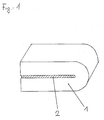
- test specimen is now folded in the middle so that the pressure-sensitive adhesive dispersion layer comes into contact with itself (see FIG. 1).
- the test specimen under tension remains folded.
- the adhesive effect corresponds to that which is obtained without destabilizing agent DA if an additional drying step, e.g. B. Dry in warm air. If only water and no destabilizing agent DA (test C) are used, the plastic under tension opens up again immediately after being compressed.
Landscapes
- Chemical & Material Sciences (AREA)
- Organic Chemistry (AREA)
- Adhesives Or Adhesive Processes (AREA)
- Transition And Organic Metals Composition Catalysts For Addition Polymerization (AREA)
- Manufacture Of Macromolecular Shaped Articles (AREA)
Applications Claiming Priority (2)
| Application Number | Priority Date | Filing Date | Title |
|---|---|---|---|
| DE19510814 | 1995-03-24 | ||
| DE19510814A DE19510814A1 (de) | 1995-03-24 | 1995-03-24 | Verfahren zum Verkleben von Körpern mittels wäßriger Haftklebedispersionen auf Acrylat/Methacrylat-Basis unter Verwendung eines destabilisierenden Agens DA |
Publications (2)
| Publication Number | Publication Date |
|---|---|
| EP0733688A1 true EP0733688A1 (fr) | 1996-09-25 |
| EP0733688B1 EP0733688B1 (fr) | 1999-06-09 |
Family
ID=7757634
Family Applications (1)
| Application Number | Title | Priority Date | Filing Date |
|---|---|---|---|
| EP96104192A Expired - Lifetime EP0733688B1 (fr) | 1995-03-24 | 1996-03-15 | Procédé de collage d'objets en utilisant des dispersions aqueuses à partir d'acrylate/méthacrylate contenant un agent de déstabilisation |
Country Status (4)
| Country | Link |
|---|---|
| EP (1) | EP0733688B1 (fr) |
| AT (1) | ATE181097T1 (fr) |
| DE (2) | DE19510814A1 (fr) |
| ZA (1) | ZA962333B (fr) |
Cited By (1)
| Publication number | Priority date | Publication date | Assignee | Title |
|---|---|---|---|---|
| DE102008047966A1 (de) * | 2008-09-18 | 2010-03-25 | Tesa Se | Repulpierbare Klebmassen |
Families Citing this family (1)
| Publication number | Priority date | Publication date | Assignee | Title |
|---|---|---|---|---|
| DE19718315A1 (de) * | 1997-04-30 | 1998-11-05 | Rmh Polymers Gmbh & Co Kg | Verfahren für das Verkleben fester und poröser Materialien |
Citations (5)
| Publication number | Priority date | Publication date | Assignee | Title |
|---|---|---|---|---|
| EP0145686A2 (fr) * | 1983-12-09 | 1985-06-19 | Olof Carlsson | Agent de floculation et sa préparation |
| JPS62100570A (ja) * | 1985-10-25 | 1987-05-11 | Nitto Electric Ind Co Ltd | 水分散型感圧性接着剤組成物 |
| EP0408386A1 (fr) * | 1989-07-14 | 1991-01-16 | Eka Nobel Ab | Adhésif pour revêtement de sol |
| EP0451554A1 (fr) * | 1990-04-10 | 1991-10-16 | National Starch and Chemical Investment Holding Corporation | Agents liants pour étoffes non tissées |
| EP0596300A1 (fr) * | 1992-11-06 | 1994-05-11 | BASF Aktiengesellschaft | Dispersion ou solution aqueuse réticulable au divinyléther |
-
1995
- 1995-03-24 DE DE19510814A patent/DE19510814A1/de not_active Withdrawn
-
1996
- 1996-03-15 AT AT96104192T patent/ATE181097T1/de active
- 1996-03-15 DE DE59602139T patent/DE59602139D1/de not_active Expired - Fee Related
- 1996-03-15 EP EP96104192A patent/EP0733688B1/fr not_active Expired - Lifetime
- 1996-03-22 ZA ZA962333A patent/ZA962333B/xx unknown
Patent Citations (5)
| Publication number | Priority date | Publication date | Assignee | Title |
|---|---|---|---|---|
| EP0145686A2 (fr) * | 1983-12-09 | 1985-06-19 | Olof Carlsson | Agent de floculation et sa préparation |
| JPS62100570A (ja) * | 1985-10-25 | 1987-05-11 | Nitto Electric Ind Co Ltd | 水分散型感圧性接着剤組成物 |
| EP0408386A1 (fr) * | 1989-07-14 | 1991-01-16 | Eka Nobel Ab | Adhésif pour revêtement de sol |
| EP0451554A1 (fr) * | 1990-04-10 | 1991-10-16 | National Starch and Chemical Investment Holding Corporation | Agents liants pour étoffes non tissées |
| EP0596300A1 (fr) * | 1992-11-06 | 1994-05-11 | BASF Aktiengesellschaft | Dispersion ou solution aqueuse réticulable au divinyléther |
Non-Patent Citations (1)
| Title |
|---|
| DATABASE WPI Week 8724, Derwent World Patents Index; AN 87-167600, XP002008421 * |
Cited By (1)
| Publication number | Priority date | Publication date | Assignee | Title |
|---|---|---|---|---|
| DE102008047966A1 (de) * | 2008-09-18 | 2010-03-25 | Tesa Se | Repulpierbare Klebmassen |
Also Published As
| Publication number | Publication date |
|---|---|
| DE59602139D1 (de) | 1999-07-15 |
| DE19510814A1 (de) | 1996-09-26 |
| ATE181097T1 (de) | 1999-06-15 |
| ZA962333B (en) | 1996-09-27 |
| EP0733688B1 (fr) | 1999-06-09 |
Similar Documents
| Publication | Publication Date | Title |
|---|---|---|
| DE3544790C2 (fr) | ||
| EP0789724B1 (fr) | Dispersion aqueuse de polymere | |
| EP0296491B1 (fr) | Dispersions aqueuses de polymères, stables au stockage | |
| DE69213760T2 (de) | Haftfreie elastomere acrylat-mikrokugeln | |
| EP0043464B1 (fr) | Procédé pour la préparation de dispersions de copolymères à répartition de grandeur de particules étroite avec comportement d'écoulement dilatant dans un large domaine de concentration | |
| DE69421908T2 (de) | Druckempfindlicher klebstoff mit verbesserter wiederaufbereitung der pulpe | |
| EP0048320B1 (fr) | Dispersions aqueuses de matières synthétiques sans émulsifiant | |
| EP0084809A2 (fr) | Dispersion de matière plastique acrylique | |
| EP0320865B1 (fr) | Procédé de préparation de dispersions aqueuses de polymères | |
| DE3150730C2 (fr) | ||
| EP0332011B1 (fr) | Préparation de dispersions aqueuses de polyalkylméthacrylates par polymérisation en deux stades et leur utilisation dans des peintures pour le bois | |
| EP0027850B1 (fr) | Polymère en émulsion agissant comme épaississant en milieu acide et son utilisation | |
| EP0515719B1 (fr) | Copolymères d'acrylates auto-adhésifs, procédé de leur préparation et objets plats auto-adhésifs les contenants | |
| EP2013239B1 (fr) | Utilisation d'une composition de polymère aqueuse comme liant pour des substrats sous forme de fibres ou de grains | |
| EP0122586A2 (fr) | Procédé de la préparation des polymères en émulsion sans émulsifiant ni colloide protecteur. | |
| DE4141168A1 (de) | Waessrige kontaktkleberdispersionen, verfahren zu deren herstellung sowie deren verwendung | |
| DE3531601A1 (de) | Waermefester haftklebestoff | |
| WO1995009896A1 (fr) | Preparations polymeres aqueuses | |
| DE3134222C2 (fr) | ||
| DE4007637A1 (de) | Waessrige polymerisatdispersionen | |
| DE69919829T2 (de) | Acrylische druckempfindliche Klebstoff-Zusammensetzung und Verfahren zu ihrer Herstellung | |
| EP0733688B1 (fr) | Procédé de collage d'objets en utilisant des dispersions aqueuses à partir d'acrylate/méthacrylate contenant un agent de déstabilisation | |
| EP0960889B1 (fr) | Liant contenant des groupes phosphates ou phosphonates pour la protection contre la corrosion | |
| DE69526234T2 (de) | Copolymerlatex und verfahren zu seiner herstellung | |
| DE1910488A1 (de) | Konzentrierte Acrylatdispersionen |
Legal Events
| Date | Code | Title | Description |
|---|---|---|---|
| PUAI | Public reference made under article 153(3) epc to a published international application that has entered the european phase |
Free format text: ORIGINAL CODE: 0009012 |
|
| AK | Designated contracting states |
Kind code of ref document: A1 Designated state(s): AT BE CH DE DK ES FR GB IT LI NL SE |
|
| 17P | Request for examination filed |
Effective date: 19970228 |
|
| 17Q | First examination report despatched |
Effective date: 19980130 |
|
| GRAG | Despatch of communication of intention to grant |
Free format text: ORIGINAL CODE: EPIDOS AGRA |
|
| GRAG | Despatch of communication of intention to grant |
Free format text: ORIGINAL CODE: EPIDOS AGRA |
|
| GRAH | Despatch of communication of intention to grant a patent |
Free format text: ORIGINAL CODE: EPIDOS IGRA |
|
| GRAH | Despatch of communication of intention to grant a patent |
Free format text: ORIGINAL CODE: EPIDOS IGRA |
|
| ITF | It: translation for a ep patent filed | ||
| GRAA | (expected) grant |
Free format text: ORIGINAL CODE: 0009210 |
|
| AK | Designated contracting states |
Kind code of ref document: B1 Designated state(s): AT BE CH DE DK ES FR GB IT LI NL SE |
|
| PG25 | Lapsed in a contracting state [announced via postgrant information from national office to epo] |
Ref country code: SE Free format text: THE PATENT HAS BEEN ANNULLED BY A DECISION OF A NATIONAL AUTHORITY Effective date: 19990609 Ref country code: NL Free format text: LAPSE BECAUSE OF FAILURE TO SUBMIT A TRANSLATION OF THE DESCRIPTION OR TO PAY THE FEE WITHIN THE PRESCRIBED TIME-LIMIT Effective date: 19990609 Ref country code: ES Free format text: THE PATENT HAS BEEN ANNULLED BY A DECISION OF A NATIONAL AUTHORITY Effective date: 19990609 |
|
| REF | Corresponds to: |
Ref document number: 181097 Country of ref document: AT Date of ref document: 19990615 Kind code of ref document: T |
|
| REG | Reference to a national code |
Ref country code: CH Ref legal event code: EP |
|
| GBT | Gb: translation of ep patent filed (gb section 77(6)(a)/1977) |
Effective date: 19990611 |
|
| REF | Corresponds to: |
Ref document number: 59602139 Country of ref document: DE Date of ref document: 19990715 |
|
| ET | Fr: translation filed | ||
| PG25 | Lapsed in a contracting state [announced via postgrant information from national office to epo] |
Ref country code: DK Free format text: LAPSE BECAUSE OF FAILURE TO SUBMIT A TRANSLATION OF THE DESCRIPTION OR TO PAY THE FEE WITHIN THE PRESCRIBED TIME-LIMIT Effective date: 19990909 |
|
| PG25 | Lapsed in a contracting state [announced via postgrant information from national office to epo] |
Ref country code: AT Free format text: LAPSE BECAUSE OF NON-PAYMENT OF DUE FEES Effective date: 20000315 |
|
| PG25 | Lapsed in a contracting state [announced via postgrant information from national office to epo] |
Ref country code: LI Free format text: LAPSE BECAUSE OF NON-PAYMENT OF DUE FEES Effective date: 20000331 Ref country code: CH Free format text: LAPSE BECAUSE OF NON-PAYMENT OF DUE FEES Effective date: 20000331 Ref country code: BE Free format text: LAPSE BECAUSE OF NON-PAYMENT OF DUE FEES Effective date: 20000331 |
|
| PLBE | No opposition filed within time limit |
Free format text: ORIGINAL CODE: 0009261 |
|
| STAA | Information on the status of an ep patent application or granted ep patent |
Free format text: STATUS: NO OPPOSITION FILED WITHIN TIME LIMIT |
|
| 26N | No opposition filed | ||
| BERE | Be: lapsed |
Owner name: ROHM G.M.B.H. Effective date: 20000331 |
|
| REG | Reference to a national code |
Ref country code: CH Ref legal event code: PL |
|
| REG | Reference to a national code |
Ref country code: GB Ref legal event code: IF02 |
|
| REG | Reference to a national code |
Ref country code: FR Ref legal event code: CJ |
|
| PGFP | Annual fee paid to national office [announced via postgrant information from national office to epo] |
Ref country code: GB Payment date: 20040303 Year of fee payment: 9 |
|
| PGFP | Annual fee paid to national office [announced via postgrant information from national office to epo] |
Ref country code: DE Payment date: 20040305 Year of fee payment: 9 |
|
| PGFP | Annual fee paid to national office [announced via postgrant information from national office to epo] |
Ref country code: FR Payment date: 20040310 Year of fee payment: 9 |
|
| PG25 | Lapsed in a contracting state [announced via postgrant information from national office to epo] |
Ref country code: IT Free format text: LAPSE BECAUSE OF NON-PAYMENT OF DUE FEES;WARNING: LAPSES OF ITALIAN PATENTS WITH EFFECTIVE DATE BEFORE 2007 MAY HAVE OCCURRED AT ANY TIME BEFORE 2007. THE CORRECT EFFECTIVE DATE MAY BE DIFFERENT FROM THE ONE RECORDED. Effective date: 20050315 Ref country code: GB Free format text: LAPSE BECAUSE OF NON-PAYMENT OF DUE FEES Effective date: 20050315 |
|
| PG25 | Lapsed in a contracting state [announced via postgrant information from national office to epo] |
Ref country code: DE Free format text: LAPSE BECAUSE OF NON-PAYMENT OF DUE FEES Effective date: 20051001 |
|
| GBPC | Gb: european patent ceased through non-payment of renewal fee |
Effective date: 20050315 |
|
| PG25 | Lapsed in a contracting state [announced via postgrant information from national office to epo] |
Ref country code: FR Free format text: LAPSE BECAUSE OF NON-PAYMENT OF DUE FEES Effective date: 20051130 |
|
| REG | Reference to a national code |
Ref country code: FR Ref legal event code: ST Effective date: 20051130 |