EP0734021A2 - Méthode et appareil pour décoder des données audio numériques codées selon le format MPEG de niveau 1 ou 2 - Google Patents
Méthode et appareil pour décoder des données audio numériques codées selon le format MPEG de niveau 1 ou 2 Download PDFInfo
- Publication number
- EP0734021A2 EP0734021A2 EP96104308A EP96104308A EP0734021A2 EP 0734021 A2 EP0734021 A2 EP 0734021A2 EP 96104308 A EP96104308 A EP 96104308A EP 96104308 A EP96104308 A EP 96104308A EP 0734021 A2 EP0734021 A2 EP 0734021A2
- Authority
- EP
- European Patent Office
- Prior art keywords
- data
- range
- quantizised
- samples
- control unit
- Prior art date
- Legal status (The legal status is an assumption and is not a legal conclusion. Google has not performed a legal analysis and makes no representation as to the accuracy of the status listed.)
- Withdrawn
Links
- 238000000034 method Methods 0.000 title claims abstract description 115
- 238000012545 processing Methods 0.000 claims abstract description 37
- 239000011159 matrix material Substances 0.000 claims abstract description 28
- 230000009466 transformation Effects 0.000 claims abstract description 20
- 238000013139 quantization Methods 0.000 claims abstract description 16
- 230000008569 process Effects 0.000 claims description 91
- 230000015654 memory Effects 0.000 claims description 63
- 230000006870 function Effects 0.000 claims description 10
- 230000003139 buffering effect Effects 0.000 claims 1
- 238000004364 calculation method Methods 0.000 description 13
- 239000008187 granular material Substances 0.000 description 12
- 238000001914 filtration Methods 0.000 description 6
- 238000004886 process control Methods 0.000 description 5
- 230000008901 benefit Effects 0.000 description 4
- 238000007781 pre-processing Methods 0.000 description 4
- 241001269238 Data Species 0.000 description 3
- 230000004913 activation Effects 0.000 description 3
- 238000001994 activation Methods 0.000 description 3
- 238000013461 design Methods 0.000 description 3
- 238000010586 diagram Methods 0.000 description 3
- 238000013507 mapping Methods 0.000 description 3
- 230000000873 masking effect Effects 0.000 description 3
- 230000009467 reduction Effects 0.000 description 3
- 238000007906 compression Methods 0.000 description 2
- 230000006835 compression Effects 0.000 description 2
- 238000013144 data compression Methods 0.000 description 2
- 238000005516 engineering process Methods 0.000 description 2
- 230000003595 spectral effect Effects 0.000 description 2
- 238000012546 transfer Methods 0.000 description 2
- 238000009825 accumulation Methods 0.000 description 1
- 238000007792 addition Methods 0.000 description 1
- 238000003491 array Methods 0.000 description 1
- 230000000903 blocking effect Effects 0.000 description 1
- 239000013078 crystal Substances 0.000 description 1
- 230000007423 decrease Effects 0.000 description 1
- 230000003247 decreasing effect Effects 0.000 description 1
- 210000005069 ears Anatomy 0.000 description 1
- 230000000694 effects Effects 0.000 description 1
- 238000011156 evaluation Methods 0.000 description 1
- 208000035204 infantile sudden cardiac failure Diseases 0.000 description 1
- 230000010354 integration Effects 0.000 description 1
- 230000004807 localization Effects 0.000 description 1
- 238000005457 optimization Methods 0.000 description 1
- 238000011946 reduction process Methods 0.000 description 1
- 238000005070 sampling Methods 0.000 description 1
- 239000004065 semiconductor Substances 0.000 description 1
- 230000005236 sound signal Effects 0.000 description 1
- 238000001228 spectrum Methods 0.000 description 1
- 230000003068 static effect Effects 0.000 description 1
- 238000012360 testing method Methods 0.000 description 1
- 230000001131 transforming effect Effects 0.000 description 1
Images








Classifications
-
- H—ELECTRICITY
- H04—ELECTRIC COMMUNICATION TECHNIQUE
- H04N—PICTORIAL COMMUNICATION, e.g. TELEVISION
- H04N5/00—Details of television systems
- H04N5/44—Receiver circuitry for the reception of television signals according to analogue transmission standards
- H04N5/60—Receiver circuitry for the reception of television signals according to analogue transmission standards for the sound signals
- H04N5/602—Receiver circuitry for the reception of television signals according to analogue transmission standards for the sound signals for digital sound signals
Definitions
- Layer 1 and 2 algorithms are basing on a common principle of said encoder. For data compression boths methods the reduction of redundance as well as the reduction of irrelevance are used, thus in general the decoded signal can not completely be reconstructed.
- a framework of a data stream comprimized according to the method of a MPEG audio layer x is consisting of a synchronization word (Sync), a header, an optional CRC test sum, page information, quantizised subband samples and optional additional informations.
- Sync synchronization word
- page information page information
- quantizised subband samples optional additional informations.
- page informations the bit allocation table and the informations about scale factors are contained.
- bit allocation table is ascertained by the psycho acoustic model. There the number of bits is stated used for quantizising of each part band to be quantizised. Each value of the bit allocation table has a width of four bits, thus the accuracy of quantizising ranges between 0 and 15 bit. A bit allocation of 0 bit means, that no information will be transmitted for the corresponding part band.
- the page information is consisting of a completely bit allocation table as well as of scale factors for each group. However the scale factors are transmitted only for those bands bits are allocated.
- Layer 2 in essential distinguishes from layer 1 by an increased frame length and a more efficient coding of the page information and by this it reaches an increased quality having a higher rate of compression.
- the bit allocation table in layer 2 isn't completely build up for the whole 32 part bands, but is limited on a determined number of subbands depending on bit rate and mode. Additionally the values stored in the bit allocation tables doesn't directly indicate the quantization width, but they are an index to one of the four bit allocation tables in which these number is stored. Coding the indices 2, 3 or 4 bits are used for different frequency ranges.
- PCM data are processed within a frame. From these data 36 data for each part band are resulting after filtering having said data divided into three groups of 12 values. For each group a scale factor is defined. Because in stationary signals said three scale factors of a subband doesn't differ or differ only negligible from another respectively saving data transfer rate for the scale factors can be succeeded transmitting only once equal scale factors of a part band.
- the information about which scale factors of a subband are contained into the data stream is stated in the select informations of the scale factor (SCFSI). Therefore four different patterns of the scale factors are coded using 2 bit and stated for each used part band.
- the decoding procedure comprises three functional units:
- the decoder first is synchronizing itself to the block structure of the bit stream and is disassembling again said stream into additional informations and quantizised spectral data. These are the basics for a subsequent reconstruction of the spectrum. Finally an inverse filter bank is transmitting the spectral datas in the range of time again.
- an audio decoder can be build up for layer 1 to 3. It's function is described in "Single Chip Implementation of an ISO/MPEG Layer III Decoder", in AES, 26.2.-1.3.1994, Amsterdam. It deals with a programmable DSP comprising an arithmetic unit, two parallel memory blocks having corresponding address generators and a control unit. The capacity-use of the arithmetical unit will be optimized using a so-called “Harvard architecture", whereas data of commands and audio data are transmitted at separated data paths.
- the arithmetic unit comprises a multiplier/ accumulator (MAC) and an arithmetic logic unit (ALU).
- the decoder offers the advantage being flexibly usable because of it's free programmability.
- the high input power is derogatory compared to user oriented circuits and a high chip area is necessary, so that together with further functional units, such as a video decoder, a common integration of the circuit isn't possible.
- the circuit offers no possibility having parallel processes increasing the throughput rate and minimizing the clock frequency respectively getting a decreased input power.
- a decoder unit L 64111 for layer 1 and 2 of LSI-Logic comprises four components: preparser, decoder, DRAM-Controler and PCM interface. It requires external DRAM. The manner of operation is described in ELRAD, volume 1, 1994, page 66.
- the preparser is sorting the whole data of the audio part out of the MPEG system stream, synchronizing system and audio data stream and is removing the parametrical header and the informations of times.
- the decoder is unpacking the audio data and is processing inverse quantization, scaling and filtering.
- the decoding process is starting with a start command produced by the microprocessor or transmitted via an external start input.
- the decoder is reading the parameter and the information out of the external DRAM, whereas the DRAM-controler is coordinating the process of writing of the parser and the process of reading of the decoder.
- the processes of inverse quantization, scaling, transformation into the range of time, as well as windowing are running serial one after another controlled by a programm.
- a multiplier accumulator unit is integrated into the decoder logic processing the calculations necessary.
- this audio decoder can not proceed processes for decoding parallel, so that resources are not used in an optimum way. Moreover for controlling the processes an external microcontroler is necessary. Further, usually data are stored relative to their group into the process using a linear, logical address. But the memory access to the audio data differs according to the various processes, so that memory areas can't be overwritten. For this, a shared memory can't utilized an optimized way especially with hard wired untis for data processing.
- Object of the invention is providing a method and an apparatus for decoding of digital audio data coded in the layer 1 or 2 of the MPEG format.
- the method and the apparatus should be designed such a way, than it can be integrated requiring a chip area as low as possible.
- the apparatus should have an input power as low as possible minimizing the necessary clock rate. From there the solution should not be based on a digital signal processor (DSP). Rather the resources should be used by the invention in an optimum way. For this, the expenditure of processing units should be minimized and the memory should be utilized in an optimized way.
- DSP digital signal processor
- An essential advantage of the invention is the optimized capacity-use of the multiplier.
- the common use of the processing unit is facilitated by dividing the processes up to different control units and processing them in time multiplex.
- the processes can be yet started parallel, because they cooperative regulate the access to the multiplier thus dissolving access conflicts.
- inverse quantization, rescaling and windowing can be started parallel, when the processes of transformation of said rescaled sample data using a matrix calculation, decoding of said header and synchronization of frames are completed.
- the local memory should be a part memory designed for fixed values for standardized coefficients.
- the first and second control units are able to commonly reading and writing the shared memory, so that said second control unit is placed at the rescaled audio's disposal. Because in the following matrix calculation the multiplier is fully working to capacity anyway, no parallel rescaling is processed. There is no need for the first control unit accessing to the shared memory in this period, so that no conflict arises.
- a further optimization of the decoder can be achieved by reduction of the required operations for the process of filtering. For this the standardized algorithm of the filter is transformed. By this the processing efford necessary decreases by a half.
- a very advantageous design of the decoder can be achieved by the individual processes accessing to a linear logical address room being transformed to a physical address inbetween the common memory.
- a plurality of address map modes are defined releasing memory areas depending on the processes carried out and carrying out the memory allocation. Data which are no more used, can be overwritten nearly suddenly, so that the memory is used at an optimum.
- the control of said address map mode is taken place through the system control unit.
- the hole unit shown in figure 1 is comprising of four blocks: first control unit ("Frame-Unpacker") 2, second control unit ("Filter bank”) 3, processing unit 1 and system control unit 5 and two FIFO memorys 6 and 7 for handling input and output data.
- the data stream will be read using the input FIFO memory 6.
- first control unit (“Frame-Unpacker") 2 synchronisation, evaluation of the header and decoding of page informations is taken place.
- the first control unit 2 is responsible for the reconstruction of the quantizised and scaled samples. The reconstructed samples are transformed into the range of time, windowed and transfered to the output FIFO memory 7 afterwards using said second control unit (“Filter bank”) 3.
- first and second control unit 2 and 3 (“Frame-Unpacker” and “Filter bank”) are using common resources.
- the complete multiplications and additions are processed into said processing unit 1 comprising only one multiplier accumulator unit (MAC), the data transfer between first and second control unit 2 and 3 is taken place via a commonly used shared memory 4.
- MAC multiplier accumulator unit
- Achieving a more efficient capacity-use of the common resources they are processed having a time multiplex tightly interlocking into each other. Control of the processes is processed by a system control unit 5.
- Said processing unit 1 comprises a multiplier accumulator unit having two inputs and one output. Using a control vector it can be determined, whether the results of a multiplication shall be summarized by the use of an accumulator. The result of the multiplication and the content of the accumulator respectively can be connected to said input.
- Gecke-Buffer 8 is able to store a complete granule.
- Decoding of the data stream can be processed using five processes "Page info”, “Sample rekonstruction”, “Calculation of matrix”, “Windowing” and “Output”. Said processes are tightly interlocked into each other, succeeding in an utilization of the common resources as efficient as possible. Based upon the logical order of the processes depending on the data flow the processes are described. It is obvious, as shown in the table 3, that the processes are accessing corresponding common resources.
- Synchronisation of the processes is taken place cooperative via the individual processes, the order of the activations of the processes will be determined by the system control unit 5.
- Said system control unit 5 can be realized as a programmable unit or a hard wired logic circuit.
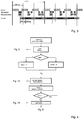
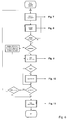
- a flow possibly for decoding is shown in the flow diagram in figure 4.
- An essential functional features of the system control unit 5 is the generation of start signals for starting the individual processes. The end of the processes will be signaled to the system control unit 5 by the first and second control units 2 and 3.
- the corresponding signal For activation of a process using a start signal the corresponding signal will be set to the value '1' for one clock cycle. Afterwards the active process is blocking the whole other processes accessing common lives using a RDY signal equal '0'. If the active process ends at a location where the process can be interrupted or arrives at this location, thus the process is signalizing this state switching over the RDY signal at '1'. The system control unit 5 afterwards defines the process to be activated next. An exception hereof is the output process controlled by an external clock being continuously active.
- the SCFSI-Information selected information of the scale factor
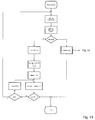
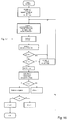
- the handling how to read the SCFI-Signal is described in figure 10.
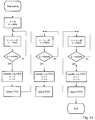
- the scale factors are read and stored into the local memory 9 of the first control unit 2. This process is described in figure 11.
- sample Reconstrutation the samples of the bit stream are inverse quantizised and rescaled. For this, first the samples of the frequency area of a granule are read out of the data stream and inverse quantizised afterwards. For this, two multiplications are required, whose results are summarized using the accumulator. This provisional result will be send to the input and will be multiplied to the scale factor. Altogether three multiplications are necessary per sample. This calculation can be taken out in the time multiplex together with the windowing. For making possible each of the processes accessing to the commonly used processing unit 1 (MAC) the processes can be stopped at defined times and later started again.
- MAC processing unit 1
- Essential functional elements of this process are preprocessing together with degrouping and control of the multiplier unit for processing the actual reconstruction.
- the data are read out of the stream and are directly written into the FIFO output memory 9. If the data are grouped a degrouping will be processed. For this the data are written block wise into the FIFO output memory 9 using three stages at a maximum. Reconstruction is taken place in such a manner, that there is a reset of the processing unit 1. After that a coded sampled data are multiplied to the coefficients of inverse quantization. The result of the inverse quantization will be multiplied to the scale factor afterwards. Then the reconstructed data are written into the granule buffer 8 of the common shared memory 4.
- the data arising in the area of time are read out of the local memory 10 of the filter bank and together with the respective coefficients of a local ROM memory they are written into the processing unit 1.
- the multiplication and accumulation will be processed. Because the coefficients for windowing are showing symmetrical characteristics only half of the data given in the standard are stored.
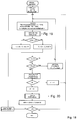
- the access to the RAM addresses of the local memory 10 is controlled by the procedure "Calculate new RAM offset". This process is described in figure 19. After each 16 PCM data of the lower and upper storage area are processed, the result will be written into the output FIFO memory 9. Afterwards the procedure is stopped.
- Output is used for the output of the PCM audio data (e.g. to a DAC, hard disk, et cetera) from the output FIFO memory 9.
- the output clock rate will be defined by an external clock signal (e.g. sample rate or bus clock).
- the addressing of the common shared memory 4 is not taken place directly by the processes accessing to the memories, but by using an address mapping device 11. That way an optimized utilization of the granule buffer 8 can be achieved, while memory cells getting free can be overwritten immediately.
- the control of said adress mapping device 11 is taken place by a map mode being set by said system control unit 5.
- the map mode is defining, in which place of the shared memory 4 the samples are stored. Through the postponement in time of the processes accessing to the shared memory 4 it results, that each process is changing the map mode in another moment.
- one aspect of the invention is transforming the linear logical address area of the individual processes to a physical address of the shared memory 4 with the help of a function of transformation.
- said instruction for transformation is not static, but depends on the state of the decoder dynamically.
- the logical division of the memory is choosen such a way, that the 8 bit width address is divided in three areas, as shown in figure 21.
- the bit 7 is dividing a 256 data sized memory in one area per channel.
- bits 1 and 0 are dividing each of the two areas into four groups, whereas the following assignment is valid:
- the parameter J of the function of transformation is representing said addresssing modus being set by the system control unit 5 depending on the state of the decoder.
- the addresssing mode will be set to value 0 while initializing the decoder and will be incremented after processing of a granule. For this a modulo-seven counter is used. Because the various processes finishing processing of a granule at different times, the modus of addressing of the processes temporary distinguish about one. Using said process control it can be guaranteed, that never two processes are writing the same memory cells.
- Said function of transformation can be implemented easily by a group of 7x1 multiplexer as a hardware.
- Said method of addr,essing results in, that 24 of the 32 memory cells getting free by the first of said three matrix operations of a granule are used again by the reconstruction. Also after the second matrix operation 24 memory cells are available for the reconstruction. After the third matrix operation, i.e. after termination of the matrix operations of a granule in the layer 2, the remaining 48 memory data are vacant for the reconstruction.
Landscapes
- Engineering & Computer Science (AREA)
- Multimedia (AREA)
- Signal Processing (AREA)
- Compression, Expansion, Code Conversion, And Decoders (AREA)
Applications Claiming Priority (4)
| Application Number | Priority Date | Filing Date | Title |
|---|---|---|---|
| DE1995110226 DE19510226C1 (de) | 1995-03-23 | 1995-03-23 | Verfahren und Einrichtung zur Decodierung von, im Layer 1 oder 2 des MPEG-Formats codierter, digitaler Toninformation |
| DE19510226 | 1995-03-23 | ||
| DE1995115612 DE19515612A1 (de) | 1995-04-28 | 1995-04-28 | Verfahren und Einrichtung zur Adressierung eines Speichermediums zur Zwischenspeicherung bei der digitalen Tondatenverarbeitung |
| DE19515612 | 1995-04-28 |
Publications (2)
| Publication Number | Publication Date |
|---|---|
| EP0734021A2 true EP0734021A2 (fr) | 1996-09-25 |
| EP0734021A3 EP0734021A3 (fr) | 1999-05-26 |
Family
ID=26013567
Family Applications (1)
| Application Number | Title | Priority Date | Filing Date |
|---|---|---|---|
| EP96104308A Withdrawn EP0734021A3 (fr) | 1995-03-23 | 1996-03-19 | Méthode et appareil pour décoder des données audio numériques codées selon le format MPEG de niveau 1 ou 2 |
Country Status (2)
| Country | Link |
|---|---|
| US (1) | US5832445A (fr) |
| EP (1) | EP0734021A3 (fr) |
Cited By (7)
| Publication number | Priority date | Publication date | Assignee | Title |
|---|---|---|---|---|
| GB2320870A (en) * | 1996-12-19 | 1998-07-01 | Kokusai Denshin Denwa Co Ltd | Coding bit rate converting for coded audio data |
| WO1999026346A1 (fr) * | 1997-11-14 | 1999-05-27 | Crystal Semiconductor Corp. | Circuits de decodage audio numerique, procedes et systemes correspondants |
| DE19754296A1 (de) * | 1997-12-08 | 1999-06-10 | Thomson Brandt Gmbh | Synchronisationseinrichtung |
| US6349285B1 (en) | 1999-06-28 | 2002-02-19 | Cirrus Logic, Inc. | Audio bass management methods and circuits and systems using the same |
| US6356871B1 (en) | 1999-06-14 | 2002-03-12 | Cirrus Logic, Inc. | Methods and circuits for synchronizing streaming data and systems using the same |
| US6446037B1 (en) | 1999-08-09 | 2002-09-03 | Dolby Laboratories Licensing Corporation | Scalable coding method for high quality audio |
| US6665409B1 (en) | 1999-04-12 | 2003-12-16 | Cirrus Logic, Inc. | Methods for surround sound simulation and circuits and systems using the same |
Families Citing this family (8)
| Publication number | Priority date | Publication date | Assignee | Title |
|---|---|---|---|---|
| TW395142B (en) * | 1997-05-15 | 2000-06-21 | Matsushita Electric Industrial Co Ltd | Compressed code decoding device and audio decoding device |
| IL122299A (en) * | 1997-11-25 | 2003-11-23 | Broadcom Corp | Video encoding device |
| US6215754B1 (en) * | 1997-12-30 | 2001-04-10 | Joel Vidal | High capacity compact disk player |
| US6085163A (en) * | 1998-03-13 | 2000-07-04 | Todd; Craig Campbell | Using time-aligned blocks of encoded audio in video/audio applications to facilitate audio switching |
| US6240379B1 (en) * | 1998-12-24 | 2001-05-29 | Sony Corporation | System and method for preventing artifacts in an audio data encoder device |
| KR20010090176A (ko) * | 2000-03-23 | 2001-10-18 | 이계철 | 엠펙 오디오 디코더의 합성필터 |
| EP1382170B1 (fr) * | 2001-04-27 | 2007-10-10 | Siemens Aktiengesellschaft | Procede servant a limiter les frais de signalisation dans un systeme a porteuses multiples avec attribution dynamique de bits, et dispositif d'emission/reception correspondant |
| WO2004112255A1 (fr) * | 2003-06-16 | 2004-12-23 | Matsushita Electric Industrial Co., Ltd. | Dispositif et procede de traitement de paquets |
-
1996
- 1996-03-19 EP EP96104308A patent/EP0734021A3/fr not_active Withdrawn
- 1996-03-22 US US08/621,764 patent/US5832445A/en not_active Expired - Fee Related
Non-Patent Citations (6)
| Title |
|---|
| BERGHER L ET AL: "MPEG AUDIO DECODER FOR CONSUMER APPLICATIONS" PROCEEDINGS OF THE CUSTOM INTEGRATED CIRCUITS CONFERENCE, SANTA CLARA, MAY 1 - 4, 1995, no. CONF. 17, 1 May 1995, pages 413-416, XP000536835 INSTITUTE OF ELECTRICAL AND ELECTRONICS ENGINEERS * |
| DATABASE INSPEC INSTITUTE OF ELECTRICAL ENGINEERS, STEVENAGE, GB Inspec No. 5227619, OBERTHUR T ET AL: "Flexible MPEG audio decoder core with low power consumption and small gate count" XP002097043 & INTEGRATION ISSUES IN LARGE COMMERCIAL MEDIA DELIVERY SYSTEMS, PHILADELPHIA, PA, USA, 23-24 OCT. 1995, vol. 2615, pages 81-88, ISSN 0277-786X, Proceedings of the SPIE - The International Society for Optical Engineering, 1996, SPIE-Int. Soc. Opt. Eng, USA * |
| F.-OTTO WITTE, MARTIN DIETZ, WERNER SINNH\FER, (ITT INTERMETALL): SINGLE CHIP IMPLEMENTATION OF AN ISO/MPEG LAYER III DECODER, no. 96 CONF. AES 3805, 26 February 1994 - 1 March 1994, XP002097317 * |
| IWADARE M ET AL: "A SINGLE-CHIP MPEG/AUDIO DECODER LSI BASED ON A COMPACT DECODING ALGORITHM" VLSI SIGNAL PROCESSING, vol. 8, 16 September 1995, pages 118-125, XP000617309 * |
| MATURI G: "SINGLE CHIP MPEG AUDIO DECODER" IEEE TRANSACTIONS ON CONSUMER ELECTRONICS, vol. 38, no. 3, 1 August 1992, pages 348-355, XP000311864 * |
| TSAI T -H ET AL: "AN,PEG AUDIO DECODER CHIP" IEEE TRANSACTIONS ON CONSUMER ELECTRONICS, vol. 41, no. 1, February 1995, pages 89-96, XP000529213 * |
Cited By (10)
| Publication number | Priority date | Publication date | Assignee | Title |
|---|---|---|---|---|
| GB2320870A (en) * | 1996-12-19 | 1998-07-01 | Kokusai Denshin Denwa Co Ltd | Coding bit rate converting for coded audio data |
| GB2320870B (en) * | 1996-12-19 | 2001-08-29 | Kokusai Denshin Denwa Co Ltd | Coding bit rate converting method and apparatus for coded audio data |
| WO1999026346A1 (fr) * | 1997-11-14 | 1999-05-27 | Crystal Semiconductor Corp. | Circuits de decodage audio numerique, procedes et systemes correspondants |
| US6081783A (en) * | 1997-11-14 | 2000-06-27 | Cirrus Logic, Inc. | Dual processor digital audio decoder with shared memory data transfer and task partitioning for decompressing compressed audio data, and systems and methods using the same |
| DE19754296A1 (de) * | 1997-12-08 | 1999-06-10 | Thomson Brandt Gmbh | Synchronisationseinrichtung |
| US6230141B1 (en) | 1997-12-08 | 2001-05-08 | Deutsche Thomson-Brandt Gmbh | Synchronization of a two-channel audio decoder with a multichannel audio decoder |
| US6665409B1 (en) | 1999-04-12 | 2003-12-16 | Cirrus Logic, Inc. | Methods for surround sound simulation and circuits and systems using the same |
| US6356871B1 (en) | 1999-06-14 | 2002-03-12 | Cirrus Logic, Inc. | Methods and circuits for synchronizing streaming data and systems using the same |
| US6349285B1 (en) | 1999-06-28 | 2002-02-19 | Cirrus Logic, Inc. | Audio bass management methods and circuits and systems using the same |
| US6446037B1 (en) | 1999-08-09 | 2002-09-03 | Dolby Laboratories Licensing Corporation | Scalable coding method for high quality audio |
Also Published As
| Publication number | Publication date |
|---|---|
| EP0734021A3 (fr) | 1999-05-26 |
| US5832445A (en) | 1998-11-03 |
Similar Documents
| Publication | Publication Date | Title |
|---|---|---|
| EP0734021A2 (fr) | Méthode et appareil pour décoder des données audio numériques codées selon le format MPEG de niveau 1 ou 2 | |
| US5946352A (en) | Method and apparatus for downmixing decoded data streams in the frequency domain prior to conversion to the time domain | |
| US6430533B1 (en) | Audio decoder core MPEG-1/MPEG-2/AC-3 functional algorithm partitioning and implementation | |
| US5448310A (en) | Motion estimation coprocessor | |
| US5719998A (en) | Partitioned decompression of audio data using audio decoder engine for computationally intensive processing | |
| US5893066A (en) | Fast requantization apparatus and method for MPEG audio decoding | |
| US5860060A (en) | Method for left/right channel self-alignment | |
| US6049862A (en) | Signal processor executing compressed instructions that are decoded using either a programmable or hardwired decoder based on a category bit in the instruction | |
| JPH08111642A (ja) | Mpeg規格の音声映像デコーダ及び音声映像をデコードする方法 | |
| US6757658B1 (en) | Audio decoder core (acore) MPEG sub-band synthesis algorithmic optimization | |
| US5845239A (en) | Modular audio data processing architecture | |
| KR19980064056A (ko) | 오디오 복호화 장치 및 신호 처리 장치 | |
| US6192427B1 (en) | Input/output buffer managed by sorted breakpoint hardware/software | |
| US5703579A (en) | Decoder for compressed digital signals | |
| CN106231489A (zh) | 音频的处理方法和装置 | |
| US6032081A (en) | Dematrixing processor for MPEG-2 multichannel audio decoder | |
| KR0147758B1 (ko) | Mpeg-2 오디오 복호화기의 합성 필터 | |
| Han et al. | An ASIC implementation of the MPEG-2 audio decoder | |
| US6434686B1 (en) | Address generating circuit | |
| US7068280B1 (en) | Method and apparatus to provide overlay buffering | |
| Oberthuer et al. | Flexible MPEG audio decoder core with low power consumption and small gate count | |
| KR0155527B1 (ko) | 복합 멀티미디어 보드의 pc 정합방법 및 그 장치 | |
| US5708847A (en) | Method of digital signal processing and apparatus using a reference operation cycle including a processing period and a transfer period | |
| Bieger et al. | Rapid prototyping for configurable system-on-a-chip platforms: A simulation based approach | |
| KR100240003B1 (ko) | Mpeg-1 오디오 부호화기의 오디오 신호처리 방법 |
Legal Events
| Date | Code | Title | Description |
|---|---|---|---|
| PUAI | Public reference made under article 153(3) epc to a published international application that has entered the european phase |
Free format text: ORIGINAL CODE: 0009012 |
|
| AK | Designated contracting states |
Kind code of ref document: A2 Designated state(s): AT BE CH DE DK ES FI FR GB GR IE IT LI LU MC NL PT SE |
|
| PUAL | Search report despatched |
Free format text: ORIGINAL CODE: 0009013 |
|
| AK | Designated contracting states |
Kind code of ref document: A3 Designated state(s): AT BE CH DE DK ES FI FR GB GR IE IT LI LU MC NL PT SE |
|
| STAA | Information on the status of an ep patent application or granted ep patent |
Free format text: STATUS: THE APPLICATION IS DEEMED TO BE WITHDRAWN |
|
| 18D | Application deemed to be withdrawn |
Effective date: 19991127 |