EP0734712A1 - Hybrides Dentalimplantat - Google Patents
Hybrides Dentalimplantat Download PDFInfo
- Publication number
- EP0734712A1 EP0734712A1 EP96302160A EP96302160A EP0734712A1 EP 0734712 A1 EP0734712 A1 EP 0734712A1 EP 96302160 A EP96302160 A EP 96302160A EP 96302160 A EP96302160 A EP 96302160A EP 0734712 A1 EP0734712 A1 EP 0734712A1
- Authority
- EP
- European Patent Office
- Prior art keywords
- dental implant
- cementum
- membrane
- particles
- hybrid
- Prior art date
- Legal status (The legal status is an assumption and is not a legal conclusion. Google has not performed a legal analysis and makes no representation as to the accuracy of the status listed.)
- Granted
Links
- 239000004053 dental implant Substances 0.000 title claims abstract description 108
- 239000002245 particle Substances 0.000 claims abstract description 53
- 238000000034 method Methods 0.000 claims abstract description 34
- 239000012528 membrane Substances 0.000 claims description 67
- 108010010803 Gelatin Proteins 0.000 claims description 44
- 239000008273 gelatin Substances 0.000 claims description 44
- 229920000159 gelatin Polymers 0.000 claims description 44
- 235000019322 gelatine Nutrition 0.000 claims description 44
- 235000011852 gelatine desserts Nutrition 0.000 claims description 44
- 102000008186 Collagen Human genes 0.000 claims description 13
- 108010035532 Collagen Proteins 0.000 claims description 13
- 229920001436 collagen Polymers 0.000 claims description 13
- 229910052588 hydroxylapatite Inorganic materials 0.000 claims description 12
- XYJRXVWERLGGKC-UHFFFAOYSA-D pentacalcium;hydroxide;triphosphate Chemical compound [OH-].[Ca+2].[Ca+2].[Ca+2].[Ca+2].[Ca+2].[O-]P([O-])([O-])=O.[O-]P([O-])([O-])=O.[O-]P([O-])([O-])=O XYJRXVWERLGGKC-UHFFFAOYSA-D 0.000 claims description 12
- 239000000725 suspension Substances 0.000 claims description 11
- 239000000463 material Substances 0.000 claims description 9
- 230000003100 immobilizing effect Effects 0.000 claims description 8
- IAYPIBMASNFSPL-UHFFFAOYSA-N Ethylene oxide Chemical compound C1CO1 IAYPIBMASNFSPL-UHFFFAOYSA-N 0.000 claims description 4
- 238000010894 electron beam technology Methods 0.000 claims description 4
- 239000000499 gel Substances 0.000 claims description 4
- 238000001035 drying Methods 0.000 claims description 2
- 150000001875 compounds Chemical class 0.000 claims 1
- 239000000758 substrate Substances 0.000 description 39
- 210000000988 bone and bone Anatomy 0.000 description 20
- 241000283690 Bos taurus Species 0.000 description 17
- 239000000243 solution Substances 0.000 description 16
- PEDCQBHIVMGVHV-UHFFFAOYSA-N Glycerine Chemical compound OCC(O)CO PEDCQBHIVMGVHV-UHFFFAOYSA-N 0.000 description 15
- 210000004261 periodontium Anatomy 0.000 description 15
- 230000003239 periodontal effect Effects 0.000 description 12
- 210000001519 tissue Anatomy 0.000 description 12
- RTZKZFJDLAIYFH-UHFFFAOYSA-N Diethyl ether Chemical compound CCOCC RTZKZFJDLAIYFH-UHFFFAOYSA-N 0.000 description 10
- 239000003431 cross linking reagent Substances 0.000 description 10
- 230000001954 sterilising effect Effects 0.000 description 10
- 238000004519 manufacturing process Methods 0.000 description 9
- 229920000642 polymer Polymers 0.000 description 7
- 238000004659 sterilization and disinfection Methods 0.000 description 7
- 210000004746 tooth root Anatomy 0.000 description 6
- 210000004027 cell Anatomy 0.000 description 5
- 230000006870 function Effects 0.000 description 5
- 238000002360 preparation method Methods 0.000 description 5
- VYPSYNLAJGMNEJ-UHFFFAOYSA-N Silicium dioxide Chemical compound O=[Si]=O VYPSYNLAJGMNEJ-UHFFFAOYSA-N 0.000 description 4
- MCMNRKCIXSYSNV-UHFFFAOYSA-N Zirconium dioxide Chemical compound O=[Zr]=O MCMNRKCIXSYSNV-UHFFFAOYSA-N 0.000 description 4
- 238000010521 absorption reaction Methods 0.000 description 4
- 238000007796 conventional method Methods 0.000 description 4
- 239000000835 fiber Substances 0.000 description 4
- 210000004195 gingiva Anatomy 0.000 description 4
- 150000002484 inorganic compounds Chemical class 0.000 description 4
- 229910010272 inorganic material Inorganic materials 0.000 description 4
- 239000002002 slurry Substances 0.000 description 4
- 239000000126 substance Substances 0.000 description 4
- 208000034070 Dental ankylosis Diseases 0.000 description 3
- 239000007864 aqueous solution Substances 0.000 description 3
- 230000015572 biosynthetic process Effects 0.000 description 3
- 230000001413 cellular effect Effects 0.000 description 3
- 238000004090 dissolution Methods 0.000 description 3
- 238000000227 grinding Methods 0.000 description 3
- 235000015110 jellies Nutrition 0.000 description 3
- 239000008274 jelly Substances 0.000 description 3
- 150000002894 organic compounds Chemical class 0.000 description 3
- -1 poly(ε-caprolactone) Polymers 0.000 description 3
- 239000011148 porous material Substances 0.000 description 3
- 230000008569 process Effects 0.000 description 3
- XLYOFNOQVPJJNP-UHFFFAOYSA-N water Substances O XLYOFNOQVPJJNP-UHFFFAOYSA-N 0.000 description 3
- OKTJSMMVPCPJKN-UHFFFAOYSA-N Carbon Chemical compound [C] OKTJSMMVPCPJKN-UHFFFAOYSA-N 0.000 description 2
- 241000282693 Cercopithecidae Species 0.000 description 2
- 208000035473 Communicable disease Diseases 0.000 description 2
- WZUVPPKBWHMQCE-UHFFFAOYSA-N Haematoxylin Chemical compound C12=CC(O)=C(O)C=C2CC2(O)C1C1=CC=C(O)C(O)=C1OC2 WZUVPPKBWHMQCE-UHFFFAOYSA-N 0.000 description 2
- 241000282414 Homo sapiens Species 0.000 description 2
- 206010061218 Inflammation Diseases 0.000 description 2
- RTAQQCXQSZGOHL-UHFFFAOYSA-N Titanium Chemical compound [Ti] RTAQQCXQSZGOHL-UHFFFAOYSA-N 0.000 description 2
- PNEYBMLMFCGWSK-UHFFFAOYSA-N aluminium oxide Inorganic materials [O-2].[O-2].[O-2].[Al+3].[Al+3] PNEYBMLMFCGWSK-UHFFFAOYSA-N 0.000 description 2
- 230000008901 benefit Effects 0.000 description 2
- 239000000560 biocompatible material Substances 0.000 description 2
- 210000002808 connective tissue Anatomy 0.000 description 2
- 239000000834 fixative Substances 0.000 description 2
- 238000004108 freeze drying Methods 0.000 description 2
- 239000007943 implant Substances 0.000 description 2
- 238000002513 implantation Methods 0.000 description 2
- 208000015181 infectious disease Diseases 0.000 description 2
- 230000004054 inflammatory process Effects 0.000 description 2
- 239000011859 microparticle Substances 0.000 description 2
- 239000004570 mortar (masonry) Substances 0.000 description 2
- 230000003287 optical effect Effects 0.000 description 2
- 229920003229 poly(methyl methacrylate) Polymers 0.000 description 2
- 239000004926 polymethyl methacrylate Substances 0.000 description 2
- 230000002035 prolonged effect Effects 0.000 description 2
- 230000005855 radiation Effects 0.000 description 2
- 239000000377 silicon dioxide Substances 0.000 description 2
- 239000007787 solid Substances 0.000 description 2
- 229910052719 titanium Inorganic materials 0.000 description 2
- 239000010936 titanium Substances 0.000 description 2
- 102000009027 Albumins Human genes 0.000 description 1
- 108010088751 Albumins Proteins 0.000 description 1
- 229920000049 Carbon (fiber) Polymers 0.000 description 1
- 229920002101 Chitin Polymers 0.000 description 1
- 229920001661 Chitosan Polymers 0.000 description 1
- 235000003913 Coccoloba uvifera Nutrition 0.000 description 1
- 241000938605 Crocodylia Species 0.000 description 1
- 208000002064 Dental Plaque Diseases 0.000 description 1
- 229920002307 Dextran Polymers 0.000 description 1
- 102000009123 Fibrin Human genes 0.000 description 1
- 108010073385 Fibrin Proteins 0.000 description 1
- BWGVNKXGVNDBDI-UHFFFAOYSA-N Fibrin monomer Chemical compound CNC(=O)CNC(=O)CN BWGVNKXGVNDBDI-UHFFFAOYSA-N 0.000 description 1
- 241001507252 Japanese monkeys Species 0.000 description 1
- 241000282564 Macaca fuscata Species 0.000 description 1
- 241000124008 Mammalia Species 0.000 description 1
- 241001465754 Metazoa Species 0.000 description 1
- CERQOIWHTDAKMF-UHFFFAOYSA-M Methacrylate Chemical compound CC(=C)C([O-])=O CERQOIWHTDAKMF-UHFFFAOYSA-M 0.000 description 1
- 229930040373 Paraformaldehyde Natural products 0.000 description 1
- 239000004698 Polyethylene Substances 0.000 description 1
- 229920000954 Polyglycolide Polymers 0.000 description 1
- 240000008976 Pterocarpus marsupium Species 0.000 description 1
- 241000282887 Suidae Species 0.000 description 1
- 229920006362 Teflon® Polymers 0.000 description 1
- 238000009825 accumulation Methods 0.000 description 1
- 239000002390 adhesive tape Substances 0.000 description 1
- 150000001298 alcohols Chemical class 0.000 description 1
- 229920003232 aliphatic polyester Polymers 0.000 description 1
- 238000004458 analytical method Methods 0.000 description 1
- 230000001174 ascending effect Effects 0.000 description 1
- 108091008698 baroreceptors Proteins 0.000 description 1
- 230000004888 barrier function Effects 0.000 description 1
- 210000004763 bicuspid Anatomy 0.000 description 1
- 239000005312 bioglass Substances 0.000 description 1
- 239000012620 biological material Substances 0.000 description 1
- 210000004204 blood vessel Anatomy 0.000 description 1
- 230000003139 buffering effect Effects 0.000 description 1
- BRPQOXSCLDDYGP-UHFFFAOYSA-N calcium oxide Chemical compound [O-2].[Ca+2] BRPQOXSCLDDYGP-UHFFFAOYSA-N 0.000 description 1
- 239000000292 calcium oxide Substances 0.000 description 1
- ODINCKMPIJJUCX-UHFFFAOYSA-N calcium oxide Inorganic materials [Ca]=O ODINCKMPIJJUCX-UHFFFAOYSA-N 0.000 description 1
- 229910052799 carbon Inorganic materials 0.000 description 1
- 239000004917 carbon fiber Substances 0.000 description 1
- 239000011203 carbon fibre reinforced carbon Substances 0.000 description 1
- 210000000250 cementoblast Anatomy 0.000 description 1
- 238000006243 chemical reaction Methods 0.000 description 1
- 239000011248 coating agent Substances 0.000 description 1
- 238000000576 coating method Methods 0.000 description 1
- 230000000052 comparative effect Effects 0.000 description 1
- 239000002131 composite material Substances 0.000 description 1
- 238000010276 construction Methods 0.000 description 1
- 238000001816 cooling Methods 0.000 description 1
- 238000004132 cross linking Methods 0.000 description 1
- 230000006378 damage Effects 0.000 description 1
- 210000004268 dentin Anatomy 0.000 description 1
- 210000004513 dentition Anatomy 0.000 description 1
- 230000008021 deposition Effects 0.000 description 1
- 201000010099 disease Diseases 0.000 description 1
- 208000037265 diseases, disorders, signs and symptoms Diseases 0.000 description 1
- 239000012153 distilled water Substances 0.000 description 1
- 238000009826 distribution Methods 0.000 description 1
- 238000005516 engineering process Methods 0.000 description 1
- 230000002708 enhancing effect Effects 0.000 description 1
- 238000002474 experimental method Methods 0.000 description 1
- 238000000605 extraction Methods 0.000 description 1
- 229950003499 fibrin Drugs 0.000 description 1
- 235000013305 food Nutrition 0.000 description 1
- 238000001879 gelation Methods 0.000 description 1
- 229910021397 glassy carbon Inorganic materials 0.000 description 1
- 150000004676 glycans Chemical class 0.000 description 1
- 230000005484 gravity Effects 0.000 description 1
- 238000010438 heat treatment Methods 0.000 description 1
- 230000006698 induction Effects 0.000 description 1
- VNWKTOKETHGBQD-UHFFFAOYSA-N methane Chemical compound C VNWKTOKETHGBQD-UHFFFAOYSA-N 0.000 description 1
- 238000012986 modification Methods 0.000 description 1
- 230000004048 modification Effects 0.000 description 1
- 229920005615 natural polymer Polymers 0.000 description 1
- 210000002997 osteoclast Anatomy 0.000 description 1
- 229920002866 paraformaldehyde Polymers 0.000 description 1
- 230000008447 perception Effects 0.000 description 1
- 230000010412 perfusion Effects 0.000 description 1
- 230000001766 physiological effect Effects 0.000 description 1
- 239000002504 physiological saline solution Substances 0.000 description 1
- 229920000747 poly(lactic acid) Polymers 0.000 description 1
- 229920001610 polycaprolactone Polymers 0.000 description 1
- 229920000573 polyethylene Polymers 0.000 description 1
- 239000004633 polyglycolic acid Substances 0.000 description 1
- 239000004626 polylactic acid Substances 0.000 description 1
- 238000006116 polymerization reaction Methods 0.000 description 1
- 229920001282 polysaccharide Polymers 0.000 description 1
- 239000005017 polysaccharide Substances 0.000 description 1
- 210000001774 pressoreceptor Anatomy 0.000 description 1
- 102000004169 proteins and genes Human genes 0.000 description 1
- 108090000623 proteins and genes Proteins 0.000 description 1
- 230000011514 reflex Effects 0.000 description 1
- 239000011347 resin Substances 0.000 description 1
- 229920005989 resin Polymers 0.000 description 1
- 238000007790 scraping Methods 0.000 description 1
- 210000004872 soft tissue Anatomy 0.000 description 1
- 239000010414 supernatant solution Substances 0.000 description 1
- 229920001059 synthetic polymer Polymers 0.000 description 1
- 238000010257 thawing Methods 0.000 description 1
- 230000036346 tooth eruption Effects 0.000 description 1
- 230000001720 vestibular Effects 0.000 description 1
- 238000005303 weighing Methods 0.000 description 1
Images

Classifications
-
- A—HUMAN NECESSITIES
- A61—MEDICAL OR VETERINARY SCIENCE; HYGIENE
- A61L—METHODS OR APPARATUS FOR STERILISING MATERIALS OR OBJECTS IN GENERAL; DISINFECTION, STERILISATION OR DEODORISATION OF AIR; CHEMICAL ASPECTS OF BANDAGES, DRESSINGS, ABSORBENT PADS OR SURGICAL ARTICLES; MATERIALS FOR BANDAGES, DRESSINGS, ABSORBENT PADS OR SURGICAL ARTICLES
- A61L27/00—Materials for grafts or prostheses or for coating grafts or prostheses
- A61L27/36—Materials for grafts or prostheses or for coating grafts or prostheses containing ingredients of undetermined constitution or reaction products thereof, e.g. transplant tissue, natural bone, extracellular matrix
- A61L27/3604—Materials for grafts or prostheses or for coating grafts or prostheses containing ingredients of undetermined constitution or reaction products thereof, e.g. transplant tissue, natural bone, extracellular matrix characterised by the human or animal origin of the biological material, e.g. hair, fascia, fish scales, silk, shellac, pericardium, pleura, renal tissue, amniotic membrane, parenchymal tissue, fetal tissue, muscle tissue, fat tissue, enamel
-
- A—HUMAN NECESSITIES
- A61—MEDICAL OR VETERINARY SCIENCE; HYGIENE
- A61K—PREPARATIONS FOR MEDICAL, DENTAL OR TOILETRY PURPOSES
- A61K6/00—Preparations for dentistry
- A61K6/30—Compositions for temporarily or permanently fixing teeth or palates, e.g. primers for dental adhesives
-
- A—HUMAN NECESSITIES
- A61—MEDICAL OR VETERINARY SCIENCE; HYGIENE
- A61L—METHODS OR APPARATUS FOR STERILISING MATERIALS OR OBJECTS IN GENERAL; DISINFECTION, STERILISATION OR DEODORISATION OF AIR; CHEMICAL ASPECTS OF BANDAGES, DRESSINGS, ABSORBENT PADS OR SURGICAL ARTICLES; MATERIALS FOR BANDAGES, DRESSINGS, ABSORBENT PADS OR SURGICAL ARTICLES
- A61L27/00—Materials for grafts or prostheses or for coating grafts or prostheses
- A61L27/14—Macromolecular materials
- A61L27/22—Polypeptides or derivatives thereof, e.g. degradation products
- A61L27/222—Gelatin
-
- A—HUMAN NECESSITIES
- A61—MEDICAL OR VETERINARY SCIENCE; HYGIENE
- A61L—METHODS OR APPARATUS FOR STERILISING MATERIALS OR OBJECTS IN GENERAL; DISINFECTION, STERILISATION OR DEODORISATION OF AIR; CHEMICAL ASPECTS OF BANDAGES, DRESSINGS, ABSORBENT PADS OR SURGICAL ARTICLES; MATERIALS FOR BANDAGES, DRESSINGS, ABSORBENT PADS OR SURGICAL ARTICLES
- A61L27/00—Materials for grafts or prostheses or for coating grafts or prostheses
- A61L27/14—Macromolecular materials
- A61L27/22—Polypeptides or derivatives thereof, e.g. degradation products
- A61L27/24—Collagen
-
- A—HUMAN NECESSITIES
- A61—MEDICAL OR VETERINARY SCIENCE; HYGIENE
- A61L—METHODS OR APPARATUS FOR STERILISING MATERIALS OR OBJECTS IN GENERAL; DISINFECTION, STERILISATION OR DEODORISATION OF AIR; CHEMICAL ASPECTS OF BANDAGES, DRESSINGS, ABSORBENT PADS OR SURGICAL ARTICLES; MATERIALS FOR BANDAGES, DRESSINGS, ABSORBENT PADS OR SURGICAL ARTICLES
- A61L27/00—Materials for grafts or prostheses or for coating grafts or prostheses
- A61L27/36—Materials for grafts or prostheses or for coating grafts or prostheses containing ingredients of undetermined constitution or reaction products thereof, e.g. transplant tissue, natural bone, extracellular matrix
-
- A—HUMAN NECESSITIES
- A61—MEDICAL OR VETERINARY SCIENCE; HYGIENE
- A61L—METHODS OR APPARATUS FOR STERILISING MATERIALS OR OBJECTS IN GENERAL; DISINFECTION, STERILISATION OR DEODORISATION OF AIR; CHEMICAL ASPECTS OF BANDAGES, DRESSINGS, ABSORBENT PADS OR SURGICAL ARTICLES; MATERIALS FOR BANDAGES, DRESSINGS, ABSORBENT PADS OR SURGICAL ARTICLES
- A61L27/00—Materials for grafts or prostheses or for coating grafts or prostheses
- A61L27/36—Materials for grafts or prostheses or for coating grafts or prostheses containing ingredients of undetermined constitution or reaction products thereof, e.g. transplant tissue, natural bone, extracellular matrix
- A61L27/3641—Materials for grafts or prostheses or for coating grafts or prostheses containing ingredients of undetermined constitution or reaction products thereof, e.g. transplant tissue, natural bone, extracellular matrix characterised by the site of application in the body
- A61L27/3645—Connective tissue
Definitions
- the present invention relates to a dental implant, and more specifically to a hybrid dental implant which induces an alveolar bone-periodontal membrane-dental root attachment system similar to the attachment system of an alveolar bone-periodontal membrane-dental root of a normal, natural tooth.
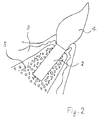
- a treatment as shown in Figure 2 has been clinically applied.
- a dental implant 2 made of a biocompatible material such as titanium and hydroxyapatite is inserted into an alveolar bone 5 through a gingiva 3, and an upper structure 4 such as an artificial tooth is mounted on the dental implant 2.
- Such a dental implant forms a periodontium which is different from the original tissue structure, causing dental ankylosis where the alveolar bone comes into direct contact with the dental implant.
- the periodontium transmits the occlusive pressure directly to the jawbone, causing a destruction of the alveolar bone as a subsequent reaction against mechanical stress, and the dental implant itself is oscillated or sinks in the alveolar bone.
- the periodontium around the dental implant has an infectious disease or inflammation due to accumulation of dental plaque and the like on the root, such a disease or inflammation rapidly spreads to the alveolar bone. Due to these problems, rapid and wide spread use of the dental implant has been prevented.
- the largest drawback of the conventional dental implant known to date is that the attachment of the dental implant to the periodontium is different from the inherent attachment system.
- the cementum and the periodontal membrane exist between the dental root and the alveolar bone, and a bundle of collagen fibers run vertically from the dental root toward the alveolar bone.
- the bundle of collagen fibers serves to tightly bind the dental root to the alveolar bone.
- the cementum not only serves to bond the dental root and the periodontal membrane, but also plays an important role of maintaining the periodontium balanced for a longer period of time.
- the periodontal membrane functions by buffering the occlusive pressure, perceiving the occlusive pressure via a baroreceptor, and a nervous adjusting function or a reflex function based on the perception.
- the periodontal membrane also serves as a barrier against an infectious disease and inhibits induction of osteoclasts which cause bone absorption.
- periodontium having the inherent attachment system is necessary for successful functioning of the dental implant, and it is therefore desired to provide a dental implant capable of constructing such an periodontium.
- Japanese Laid-Open Patent Publication No. 6-7381 discloses a method for constructing a pseudo-periodontal membrane around a dental implant. According to this method, periodontal membrane cells collected from an extracted tooth are cultured, and the cultured periodontal membrane cells are further subjected to an enrichment culture to form a pseudo-periodontal membrane. The pseudo-periodontal membrane is interposed between the dental implant and the alveolar bone or jawbone. In this method, however, it is required to use periodontal membrane cells obtained from the recipient himself or herself who is to receive the prosthesis treatment or periodontal membrane cells obtained from others which are not rejected by the recipient. This method is therefore not suitable for general use.
- the hybrid dental implant of this invention has cementum particles on a surface of a dental implant substrate.
- a bioabsorbable membrane containing the cementum particles is formed on the dental implant substrate.
- the surface of the dental implant substrate is made of hydroxyapatite.
- the bioabsorbable membrane is made of at least one material selected from the group consisting of gelatin, crosslinked gelatin, collagen, and crosslinked collagen.
- the hybrid dental implant is sterilized with ethylene oxide gas.
- the hybrid dental implant is sterilized with electron beams.
- the invention described herein makes possible the advantage of providing a hybrid dental implant which is free from dental ankylosis caused by direct contact with the alveolar bone and induces an alveolar bone-periodontal membrane-dental root attachment system similar to the attachment system of an alveolar bone-periodontal membrane-dental root of a normal tooth.
- Figure 1 is a schematic sectional view of a periodontium formed around a hybrid dental implant according to the present invention inserted in an alveolar bone.
- Figure 2 is a schematic sectional view of a periodontium formed around a conventional dental implant inserted into an alveolar bone.
- the hybrid dental implant according to the present invention includes cementum particles on the surface of a dental implant substrate.
- the material for the dental implant substrate used in the present invention is not limited, but can be any material generally used for a typical dental implant. Especially used is a material which is less harmful to organisms and excellent in toughness and friction resistance
- the preferred example of the dental implant substrate is at least one material selected from the group of titanium, hydroxyapatite, silica, alumina, zirconia, and bioglass. In particular, hydroxyapatite, which is a highly biocompatible material, is more preferred.
- the cementum particles used in the present invention are prepared from mat yellowish white cementum having a Mohs' hardness of about 4 to about 5, a specific gravity of about 2.02 to about 2.04, and a refractive index of about 1.562 to about 1.566.
- the cementum is a bone-like hard tissue having a thickness of about 0.02 to about 0.5 mm covering the dental root surface of animals higher than reptiles.
- the cementum does not contain blood vessels inside and is generally distinguishable from the bone.
- the cementum is classified into the primary cementum (acellular cementum) and cellular cementum. In particular, the primary cementum and cellular cementum of higher mammals such as cows and pigs are preferred. The primary cementum is more preferred.
- the shape of the cementum particles used in the present invention is not limited, but any shape such as a granular shape may be used.
- the cementum particles used in the present invention are preferably microparticles.
- the average diameter of the cementum particles i.e., average of the lengths along the major axis of the cementum particles
- Such cementum particles that satisfy the above range requirement of the average diameter are mostly absorbed into the tissue of the organism before the formation of a periodontium around the dental implant.
- the cementum particles are prepared by using appropriate means, for example, scraping the dental root surface of an extracted tooth with a dental scaler, and then grinding the scraped pieces of cementum with a mortar, a ball mill, and the like.
- the amount of cementum particles applied to the surface of the dental implant substrate varies depending on the shape, particle size distribution, and physiological activity of the cementum used.
- the amount of the cementum particles is preferably about 0.1 to about 6.0 mg per cm 2 of the surface of the dental implant substrate. More preferred is about 0.5 to about 4.0 mg in order to facilitate formation of a periodontium.
- the method for applying and immobilizing the cementum particles to the surface of the dental implant substrate is not limited, but any conventional method can be employed.
- the cementum particles may be adhered and/or immobilized to the surface of the dental implant substrate by use of an immobiliser.
- An organic or inorganic compound capable of immobilizing the cementum particles to the surface of the dental implant substrate may be used as the immobilizer.
- a bioabsorbable membrane containing the cementum particles may be attached to the surface of the dental implant substrate.
- organic compound used as the immobilizer examples include synthetic polymers and natural polymers, both including bioabsorbable polymers.
- bioabsorbable polymers are preferred as they are less harmful to organisms, facilitate dissolution and absorption of cementum particles into the tissue to the organism, and serve in forming a periodontium of the dental implant similar to that of a normal, natural tooth.
- bioabsorbable polymers examples include: aliphatic polyesters such as polylactic acid, polyglycolic acid, and poly( ⁇ -caprolactone); proteins and polysaccharides such as collagen, gelatin, albumin, dextran, chitin, chitosan, and fibrin; and crosslinked structures thereof.
- aliphatic polyesters such as polylactic acid, polyglycolic acid, and poly( ⁇ -caprolactone)
- proteins and polysaccharides such as collagen, gelatin, albumin, dextran, chitin, chitosan, and fibrin
- crosslinked structures thereof examples include: aliphatic polyesters such as polylactic acid, polyglycolic acid, and poly( ⁇ -caprolactone); proteins and polysaccharides such as collagen, gelatin, albumin, dextran, chitin, chitosan, and fibrin; and crosslinked structures thereof.
- the method for immobilizing the cementum particles to the surface of the dental implant substrate with the above organic compounds as an immobilizer is not limited, but conventional methods for immobilizing a particulate substance to a substrate surface can be employed.
- the immobilization is performed in either of the following manners.
- the cementum particles are immobilized to the surface of the dental implant substrate.
- concentration of the gelatin solution used in the above method is preferably in the range of about 20 to about 500 g/l, and the amount of the crosslinking agent is preferably in the range of about 0.2 to about 50 g/l.
- the inorganic compound used as the immobilizer examples include hydroxyapatite, silica, alumina, zirconia, and calcium oxide.
- hydroxyapatite which is a component existing in the organism is most preferable.
- the method for immobilizing the cementum particles to the surface of the dental implant substrate with the above inorganic compounds as an immobilizer is not limited, but conventional methods for immobilizing a particulate substance to a substrate surface can be employed.
- the immobilization is performed in the following manner. Powdered hydroxyapatite is suspended in water and sufficiently agitated to form a slurry. An appropriate amount of the cementum particles is dispersed in the slurry, and the dental implant substrate is immersed in the slurry. After removal from the slurry, the surface of the dental implant substrate is lyophilized.
- the cementum particles are immobilized to the surface of the dental implant substrate.
- the amount of hydroxyapatite is preferably in the range of about 200 to about 800 g/l.
- the above method using inorganic compounds may further include the step of adding the aforementioned bioabsorbable polymer such as gelatin to the suspension for enhancing the immobilization of the cementum particles to the surface of the dental implant substrate, and/or the step of coating the immobilized cementum particles with the aforementioned bioabsorbable polymer such as gelatin for preventing the immobilized cementum particles from separating from the substrate.
- the bioabsorbable membrane may be made of any material which can dissolve and/or decompose to be absorbed into the tissue of the organism when the resultant hybrid dental implant is inserted in the alveolar bone.
- the material for the bioabsorbable membrane include the aforementioned bioabsorbable polymers.
- at least one material selected from the group consisting of gelatin, crosslinked gelatin, collagen, and crosslinked collagen which have high biocompatibility or bioaffinity is preferably used.
- the structure of the bioabsorbable membrane is not limited, but a porous structure is preferable to increase the efficiency of dissolution and/or absorption of the membrane into the tissue of the organism.
- the method for producing the bioabsorbable membrane with cementum particles immobilized therein is not limited, but conventional methods for producing a membrane with a particulate substance immobilized therein can be employed.
- a bioabsorbable membrane is produced in the following manner.
- a crosslinking agent such as glycerol polyglycidyl ether is dissolved in an aqueous gelatin solution.
- the resultant solution is poured to spread on a smooth plate and cooled (at 5 to 10°C for 20 minutes, for example) to obtain membrane-like gelatin gel.
- the gelatin gel is then lyophilized to remove water and heated (at 110°C for two hours, for example) to obtain a crosslinked gelatin membrane with a porous structure.
- the concentration of the gelatin solution is preferably in the range of about 10 to about 200 g/l, and the amount of the crosslinking agent is preferably in the range of about 0.1 to about 20 g/l.
- the thus produced bioabsorbable membrane is attached to the surface of the dental implant substrate by a known method.
- an aqueous gelatin solution with a crosslinking agent such as glycerol polyglycidyl ether dissolved therein is applied to the surface of the dental implant substrate.
- the bioabsorbable membrane obtained by the above method is then attached to the resultant surface of the dental implant substrate.
- the membrane containing the cementum particles is immobilized to the surface of the dental implant substrate.
- the concentration of the gelatin solution applied to the surface of the dental implant is preferably in the range of about 10 to about 200 g/l, and the amount of the crosslinking agent is preferably in the range of about 0.1 to about 20 g/l.
- the hybrid dental implant according to the present invention is obtained by applying and immobilizing the cementum particles to the surface of the dental implant substrate.
- the hybrid dental implant is generally sterilized before clinical use.
- Examples of the method for sterilizing the dental implant include ethylene oxide gas sterilization, electron beam sterilization, and radiation sterilization.
- either one of the ethylene oxide gas sterilization and the electron beam sterilization is preferably used.
- an attachment system similar to the periodontium of a normal tooth may not be obtained according to the sterilization conditions.
- FIG. 1 shows an example of the hybrid dental implant of the present invention obtained by the methods described above.
- a hybrid dental implant 1 includes cementum particles 11 immobilized to the surface of a dental implant substrate 12.
- the hybrid dental implant 1 is inserted into an alveolar bone 5 located inside a gingiva 3 by a known method, so as to allow an upper structure 4 such as an artificial dental tooth to be mounted on the hybrid dental implant 1.
- a periodontal membrane 13 composed of a fibrous connective tissue is then formed between the hybrid dental implant 1 and the alveolar bone 5.
- the hybrid dental implant according to the present invention is suitable as a dental implant for elderly people and those who have lost a number of teeth.
- Teeth were extracted from a bovine jawbone, supplied from a slaughterhouse, with dental extracting forceps and stored frozen at -4°C. After thawing, attached gingiva tissue was immediately removed by use of a surgical knife and a surgical scaler. At that time, the cellular cementum were scraped off. After these procedures, curettage of the primary cementum was per formed, 100 to 200 strokes per tooth, using a surgical scaler. Since the thickness of the bovine primary cementum was 0.4 to 0.5 mm, the curettage corresponding to this number of strokes did not allow the scaler to reach the dentin underlying the cementum. By the above method, 2.3 g of abraded primary cementum pieces were obtained from 40 bovine teeth.
- the primary cementum was collected in a 25 ml tube containing physiological saline, and centrifuged. After the supernatant solution was removed, the abraded primary cementum pieces precipitated on the bottom of the tube were collected, dried spontaneously on a clean bench, and then lyophilized. The dried abraded pieces were placed in a mortar, pulverized with a pestle, and sifted to obtain bovine cementum particles with a diameter of about 0.075 mm or less. The average diameter of the bovine cementum particles was about 0.014 mm.
- the plate was mounted on a horizontal support kept at 5 to 10°C, so that the solution was cooled for 20 minutes to allow gelation.
- the plate was then mounted on a support kept at -70°C to allow the gelated solution to be frozen by cooling from its lower side.
- the resulting frozen gel was then lyophilized at a temperature not higher than 25°C, thereby to obtain a gelatin membrane.
- the thus-obtained gelatin membrane was heated at 110°C for two hours for crosslinking. After the heating, the membrane was washed with distilled water at 50°C, removing residual uncrosslinked gelatin and the crosslinking agent, and lyophilized again, to obtain the crosslinked gelatin membrane.
- the thus-obtained crosslinked gelatin membrane was a double-layer porous membrane including a solid layer on one side and a layer with a number of pores on the other side.
- the size of the membrane was 8 cm ⁇ 8 cm, the average thickness thereof was 0.18 mm, and the average pore diameter was 0.093 mm.
- the resultant crosslinked gelatin membrane was placed in a sealed vessel and left to stand for one minute while the pressure in the vessel is lowered to 30 mmHg. The pressure was then returned to the ambient pressure. After repeating this process three times, the gelatin membrane was left to stand for 30 minutes under the ambient pressure.
- the above-mentioned process allows the bovine cementum particles to deposit on the membrane.
- the membrane was lyophilized with a lyophilization apparatus (FTS-FD-6-54B, FTS Systems, Inc.) to obtain the crosslinked gelatin membrane with bovine cementum particles immobilized therein.
- Example 1 Preparation and experimentation of hybrid dental implant with bovine cementum particles immobilized thereto
- aqueous solution (viscosity 28 millipoise, jelly toughness 96 g (6.66%)) containing 2% by weight of commercially available gelatin (Nippi Inc.) was thinly applied to a commercially available dental implant substrate having a surface made of hydroxyapatite (Apaceram, length: 9 mm, inner diameter: 4.5 mm, Asahi Optical Co., Ltd.) with a small brush.
- the crosslinked gelatin membrane with bovine cementum particles immobilized therein obtained in Production Example 3 was cut into an appropriate size, and attached to the surface of the dental implant substrate so that no overlap of the membrane nor a portion uncovered with the membrane would be formed on the surface.
- the resultant substrate was lyophilized with a lyophilization apparatus (FTS-FD-6-54B, FTS Systems, Inc.) to obtain the hybrid dental implant with bovine cementum particles immobilized thereon.
- the resultant hybrid dental implant was placed in a polyethylene bag and sealed.
- the bag was then irradiated with light from an ultraviolet sterilizing lamp (15 Watt, Toshiba Corp.) placed 30 cm apart from the bag for 30 minutes each from the upper and lower sides of the bag. Then, the bag was stored in a refrigerator at 5°C.
- the Japanese monkey was sacrificed 12 weeks after implantation of the dental implants, tissues were immediately fixed via perfusion of half-strength Karnousky fixative. Block specimens including the dental implant and the corresponding peri-implant soft and hard tissues were then removed and placed in 2.5% glutaraldehyde-2.0% paraformaldehyde fixative (pH 7.2, 4°C) for 2 weeks. After fixation, experimental areas were cut with the Exakt-Cutting-Grinding System (EXAKT, Hamburg, Germany) in the bucco-lingual direction to produce specimens. All specimens were dehydrated in an ascending series of alcohols and embedded in Technovit 7200 methacrylate resin (Kaiser, Wehrheim, Germany).
- blocks were sectioned at 200 ⁇ m according to the above-mentioned Exakt-Cutting-Grinding System and subsequently ground to a thickness of 70 to 80 ⁇ m. Sections were stained with hematoxylin-eosin prior to histological analysis.
- the alveolar bone and the dental implant were found separated by a certain distance and a soft tissue membrane consistent with perioumtal ligament-like tissue was formed in the entire area between the alveolar bone and the dental implant. Cementoblastic cells deeply stained with hematoxylin were formed on the entire interface between the dental implant and the periodontal membrane, indicating the deposition of the cementum including cementoblasts on the dental implant.
- an alveolar bone-periodontal membrane-dental root attachment system similar to the attachment system of an alveolar bone-periodontal membrane-dental root of a normal, natural tooth was found.
Landscapes
- Health & Medical Sciences (AREA)
- Life Sciences & Earth Sciences (AREA)
- Chemical & Material Sciences (AREA)
- Oral & Maxillofacial Surgery (AREA)
- Epidemiology (AREA)
- Animal Behavior & Ethology (AREA)
- General Health & Medical Sciences (AREA)
- Public Health (AREA)
- Veterinary Medicine (AREA)
- Transplantation (AREA)
- Dermatology (AREA)
- Engineering & Computer Science (AREA)
- Medicinal Chemistry (AREA)
- Biomedical Technology (AREA)
- Botany (AREA)
- Chemical Kinetics & Catalysis (AREA)
- Molecular Biology (AREA)
- Zoology (AREA)
- Urology & Nephrology (AREA)
- Biophysics (AREA)
- Vascular Medicine (AREA)
- Materials For Medical Uses (AREA)
- Dental Preparations (AREA)
- Dental Prosthetics (AREA)
Applications Claiming Priority (3)
| Application Number | Priority Date | Filing Date | Title |
|---|---|---|---|
| JP96215/95 | 1995-03-28 | ||
| JP9621595 | 1995-03-28 | ||
| JP09621595A JP3471967B2 (ja) | 1995-03-28 | 1995-03-28 | ハイブリッド型人工歯根 |
Publications (2)
| Publication Number | Publication Date |
|---|---|
| EP0734712A1 true EP0734712A1 (de) | 1996-10-02 |
| EP0734712B1 EP0734712B1 (de) | 2002-03-06 |
Family
ID=14159023
Family Applications (1)
| Application Number | Title | Priority Date | Filing Date |
|---|---|---|---|
| EP96302160A Expired - Lifetime EP0734712B1 (de) | 1995-03-28 | 1996-03-28 | Hybrides Dentalimplantat |
Country Status (6)
| Country | Link |
|---|---|
| US (1) | US5772439A (de) |
| EP (1) | EP0734712B1 (de) |
| JP (1) | JP3471967B2 (de) |
| AT (1) | ATE213930T1 (de) |
| CA (1) | CA2172883A1 (de) |
| DE (1) | DE69619569T2 (de) |
Cited By (2)
| Publication number | Priority date | Publication date | Assignee | Title |
|---|---|---|---|---|
| FR2784284A1 (fr) * | 1998-10-13 | 2000-04-14 | Natural Implant Sa | Procede de preparation d'un implant dentaire par immersion dans une culture de cellules mesenchymateuses, dispositif de culture de cellules pour la preparation dudit implant et implant obtenu |
| WO2008021921A2 (en) | 2006-08-17 | 2008-02-21 | Warsaw Orthopedic, Inc | Medical implant sheets useful for tissue regeneration |
Families Citing this family (28)
| Publication number | Priority date | Publication date | Assignee | Title |
|---|---|---|---|---|
| DE19630034A1 (de) * | 1996-07-25 | 1998-04-23 | Huels Chemische Werke Ag | Biohybrides Zahnimplantat |
| JP3657413B2 (ja) | 1997-12-02 | 2005-06-08 | 慶彦 清水 | 人工歯及びその製造方法 |
| US8563232B2 (en) | 2000-09-12 | 2013-10-22 | Lifenet Health | Process for devitalizing soft-tissue engineered medical implants, and devitalized soft-tissue medical implants produced |
| US6293970B1 (en) * | 1998-06-30 | 2001-09-25 | Lifenet | Plasticized bone and soft tissue grafts and methods of making and using same |
| US6669476B2 (en) | 2000-06-27 | 2003-12-30 | David Michael Prestipino | Nanophase dental prosthetics and method |
| JP4836318B2 (ja) * | 2000-11-24 | 2011-12-14 | 京セラ株式会社 | 歯根膜形成能を有する人工歯根 |
| SE519564C2 (sv) * | 2001-07-04 | 2003-03-11 | Nobel Biocare Ab | Implantat, t ex dentalt implantat, belagt med bentillväxtstimulerande medel |
| US7067169B2 (en) * | 2003-06-04 | 2006-06-27 | Chemat Technology Inc. | Coated implants and methods of coating |
| US20070231364A1 (en) * | 2004-04-30 | 2007-10-04 | Kunio Nishimoto | Biocompatible Membrane and Process for Producing the Same |
| US20060073592A1 (en) * | 2004-10-06 | 2006-04-06 | Wendell Sun | Methods of storing tissue matrices |
| EP3517137A1 (de) * | 2005-11-14 | 2019-07-31 | Biomet 3I, LLC | Ablagerung diskreter nanopartikel auf einer implantatoberfläche |
| KR100775579B1 (ko) | 2006-09-22 | 2007-11-09 | 김백기 | 지르코니아를 포함하는 치과용 임플란트 |
| US10426578B2 (en) | 2006-10-16 | 2019-10-01 | Natural Dental Implants, Ag | Customized dental prosthesis for periodontal or osseointegration and related systems |
| US8602780B2 (en) * | 2006-10-16 | 2013-12-10 | Natural Dental Implants, Ag | Customized dental prosthesis for periodontal or osseointegration and related systems and methods |
| US8454362B2 (en) * | 2006-10-16 | 2013-06-04 | Natural Dental Implants Ag | Customized dental prosthesis for periodontal- or osseointegration, and related systems and methods |
| US9539062B2 (en) | 2006-10-16 | 2017-01-10 | Natural Dental Implants, Ag | Methods of designing and manufacturing customized dental prosthesis for periodontal or osseointegration and related systems |
| US7665600B1 (en) | 2006-11-13 | 2010-02-23 | Practicon, Inc. | Dental floss envelope package with cutter element |
| KR100733726B1 (ko) | 2007-04-06 | 2007-06-29 | 주식회사 디에스아이 | 수산화인회석/알루미나/실리카 복합체를 이용한 임플란트용매식체 |
| USD571045S1 (en) | 2007-07-03 | 2008-06-10 | Practicon, Inc. | Dental floss dispensing package |
| US7637940B2 (en) * | 2007-07-06 | 2009-12-29 | Boston Scientific Scimed, Inc. | Stent with bioabsorbable membrane |
| US9744043B2 (en) | 2007-07-16 | 2017-08-29 | Lifenet Health | Crafting of cartilage |
| ES2545781T3 (es) | 2008-01-28 | 2015-09-15 | Biomet 3I, Llc | Implante superficial con mayor hidrofilia |
| DE102008010893B3 (de) * | 2008-02-23 | 2009-07-09 | Resorba Wundversorgung Gmbh & Co. Kg | Implantat zum Einbringen in einen Alveolarraum |
| ITFI20080224A1 (it) * | 2008-11-18 | 2010-05-19 | Giovanni Baldi | Dispositivo per la sterilizzazione di viti e/o protesi dentali |
| US8641418B2 (en) | 2010-03-29 | 2014-02-04 | Biomet 3I, Llc | Titanium nano-scale etching on an implant surface |
| CA3054722A1 (en) | 2010-07-08 | 2012-01-12 | Lifecell Corporation | Method for shaping tissue matrices |
| WO2013142118A1 (en) | 2012-03-20 | 2013-09-26 | Biomet 3I, Llc | Surface treatment for an implant surface |
| US11179505B2 (en) | 2016-02-11 | 2021-11-23 | Lifecell Corporation | Methods for stabilizing collagen-containing tissue products against enzymatic degradation |
Citations (6)
| Publication number | Priority date | Publication date | Assignee | Title |
|---|---|---|---|---|
| EP0128706A2 (de) * | 1983-06-10 | 1984-12-19 | University Patents, Inc. | Körperimplantate einer extracellulären Matrix sowie Mittel und Methoden zur Herstellung und Verwendung solcher Implantate |
| EP0256695A2 (de) * | 1986-08-08 | 1988-02-24 | Paul A. Fugazzotto | Als knocheninduzierendes Mittel verwendbares Produkt und Verfahren zu seiner Herstellung |
| WO1989012472A1 (en) * | 1988-06-14 | 1989-12-28 | Ab Idea | Implant and method of making it |
| WO1990013302A1 (en) * | 1989-04-28 | 1990-11-15 | Brigham And Women's Hospital | Novel materials and methods for guided tissue regeneration |
| JPH07330531A (ja) * | 1994-06-03 | 1995-12-19 | Kanebo Ltd | 歯周病治療材の製造方法 |
| EP0693523A2 (de) * | 1994-07-19 | 1996-01-24 | Col-Bar R & D Ltd. | Matrix auf der Basis von Kollagen |
Family Cites Families (5)
| Publication number | Priority date | Publication date | Assignee | Title |
|---|---|---|---|---|
| US5071351A (en) * | 1986-07-02 | 1991-12-10 | Collagen Corporation | Dental implant system |
| JPH0714400B2 (ja) * | 1992-06-23 | 1995-02-22 | 伊藤 慎一 | インプラントへの歯根膜組織の付着形成法 |
| US5439951A (en) * | 1993-03-24 | 1995-08-08 | Children's Medical Center Corporation | Isolation of the calcium-phosphate crystals of bone |
| US5584880A (en) * | 1994-04-28 | 1996-12-17 | Martinez; Miguel | Orbital implant |
| US5501706A (en) * | 1994-11-29 | 1996-03-26 | Wildflower Communications, Inc. | Medical implant structure and method for using the same |
-
1995
- 1995-03-28 JP JP09621595A patent/JP3471967B2/ja not_active Expired - Fee Related
-
1996
- 1996-03-27 US US08/624,871 patent/US5772439A/en not_active Expired - Fee Related
- 1996-03-28 DE DE69619569T patent/DE69619569T2/de not_active Expired - Fee Related
- 1996-03-28 AT AT96302160T patent/ATE213930T1/de not_active IP Right Cessation
- 1996-03-28 EP EP96302160A patent/EP0734712B1/de not_active Expired - Lifetime
- 1996-03-28 CA CA002172883A patent/CA2172883A1/en not_active Abandoned
Patent Citations (6)
| Publication number | Priority date | Publication date | Assignee | Title |
|---|---|---|---|---|
| EP0128706A2 (de) * | 1983-06-10 | 1984-12-19 | University Patents, Inc. | Körperimplantate einer extracellulären Matrix sowie Mittel und Methoden zur Herstellung und Verwendung solcher Implantate |
| EP0256695A2 (de) * | 1986-08-08 | 1988-02-24 | Paul A. Fugazzotto | Als knocheninduzierendes Mittel verwendbares Produkt und Verfahren zu seiner Herstellung |
| WO1989012472A1 (en) * | 1988-06-14 | 1989-12-28 | Ab Idea | Implant and method of making it |
| WO1990013302A1 (en) * | 1989-04-28 | 1990-11-15 | Brigham And Women's Hospital | Novel materials and methods for guided tissue regeneration |
| JPH07330531A (ja) * | 1994-06-03 | 1995-12-19 | Kanebo Ltd | 歯周病治療材の製造方法 |
| EP0693523A2 (de) * | 1994-07-19 | 1996-01-24 | Col-Bar R & D Ltd. | Matrix auf der Basis von Kollagen |
Non-Patent Citations (2)
| Title |
|---|
| DATABASE WPI Section Ch Week 9608, Derwent World Patents Index; Class A96, AN 96-074704, XP002007588 * |
| P.HANES E.A.: "Cell and fiber attachment to demineralized cementum from normal root surfaces.", JOURNAL OF PERIODONTOLOGY, vol. 60, no. 4, 1989, pages 188 - 198, XP000575686 * |
Cited By (6)
| Publication number | Priority date | Publication date | Assignee | Title |
|---|---|---|---|---|
| FR2784284A1 (fr) * | 1998-10-13 | 2000-04-14 | Natural Implant Sa | Procede de preparation d'un implant dentaire par immersion dans une culture de cellules mesenchymateuses, dispositif de culture de cellules pour la preparation dudit implant et implant obtenu |
| WO2000021456A1 (fr) * | 1998-10-13 | 2000-04-20 | Societe Anonyme Natural Implant | Procede et dispositif de preparation d'un implant dentaire par immersion dans une culture de cellules mesenchymateuses |
| AU757566B2 (en) * | 1998-10-13 | 2003-02-27 | Societe Anonyme Natural Implant | Method and device for preparing a dental implant by immersion in a mesenchymal cell culture |
| US6589525B2 (en) | 1998-10-13 | 2003-07-08 | Societe Anonyme Natural Implant | Method and device for preparing a dental implant by immersion in a culture of mesenchymal cells |
| WO2008021921A2 (en) | 2006-08-17 | 2008-02-21 | Warsaw Orthopedic, Inc | Medical implant sheets useful for tissue regeneration |
| WO2008021921A3 (en) * | 2006-08-17 | 2008-05-22 | Warsaw Orthopedic Inc | Medical implant sheets useful for tissue regeneration |
Also Published As
| Publication number | Publication date |
|---|---|
| EP0734712B1 (de) | 2002-03-06 |
| CA2172883A1 (en) | 1996-09-29 |
| JP3471967B2 (ja) | 2003-12-02 |
| ATE213930T1 (de) | 2002-03-15 |
| DE69619569T2 (de) | 2002-09-26 |
| US5772439A (en) | 1998-06-30 |
| DE69619569D1 (de) | 2002-04-11 |
| JPH08266559A (ja) | 1996-10-15 |
Similar Documents
| Publication | Publication Date | Title |
|---|---|---|
| US5772439A (en) | Hybrid dental implant | |
| US5306304A (en) | Flexible membranes produced from organic bone matrix for skeletal repair and reconstruction | |
| Schepers et al. | Bioactive glass particles of narrow size range: a new material for the repair of bone defects | |
| Rosen et al. | The treatment of intrabony defects with bone grafts. | |
| Nevins et al. | Human histologic evaluation of bioactive ceramic in the treatment of periodontal osseous defects. | |
| US5093179A (en) | Methods and articles for treating periodontal disease and bone defects | |
| Yaffe et al. | Restoration of periodontal attachment employing enriched collagen solution in the dog | |
| Marei et al. | Preservation and regeneration of alveolar bone by tissue-engineered implants | |
| HU206611B (en) | Process for producing email-layer for inducing binding | |
| JP6653437B2 (ja) | インプラント培養歯根膜細胞シート複合体、その製造方法及びその利用方法 | |
| De Putter et al. | Transmucosal implants of dense hydroxylapatite | |
| EP0263086A1 (de) | Bindungsinduzierende Komposition | |
| Steflik et al. | Osteoblast activity at the dental implant‐bone interface: transmission electron microscopic and high voltage electron microscopic observations | |
| Frame et al. | Biologic basis for interpositional autogenous bone grafts to the mandible | |
| Peterson et al. | Clinical, radiographical, and histological evaluation of porous rooted polymethylmethacrylate dental implants | |
| Ashman et al. | Placement of implants into ridges grafted with bioplant HTR synthetic bone: histological long-term case history reports | |
| JPH08276003A (ja) | 硬組織修復材料および埋入型医療用具 | |
| WO1999060951A1 (en) | Compositions for regenerating tissue that has degenerated, and methods for using such compositions | |
| Fontana et al. | Freeze‐dried dura mater for guided tissue regeneration in post‐extraction dental implants: a clinical and histologic study | |
| Stavropoulos | Deproteinized bovine bone xenograft | |
| Bang et al. | Allogenic demineralized dentin implants in jaw defects of Java monkeys | |
| Ohayon | Ridge enlargement using deproteinized bovine bone and a bioresorbable collagen membrane: a tomodensitometric, histologic, and histomorphometric analysis. | |
| JP2000079161A (ja) | 骨再生材料 | |
| Hürzeler et al. | Bone augmentation using a synthetic bone graft in dogs | |
| RU2178277C2 (ru) | Материал для остеопластики |
Legal Events
| Date | Code | Title | Description |
|---|---|---|---|
| PUAI | Public reference made under article 153(3) epc to a published international application that has entered the european phase |
Free format text: ORIGINAL CODE: 0009012 |
|
| AK | Designated contracting states |
Kind code of ref document: A1 Designated state(s): AT BE CH DE DK ES FI FR GB GR IE IT LI LU MC NL PT SE |
|
| 17P | Request for examination filed |
Effective date: 19970225 |
|
| 17Q | First examination report despatched |
Effective date: 20000810 |
|
| GRAG | Despatch of communication of intention to grant |
Free format text: ORIGINAL CODE: EPIDOS AGRA |
|
| GRAG | Despatch of communication of intention to grant |
Free format text: ORIGINAL CODE: EPIDOS AGRA |
|
| GRAH | Despatch of communication of intention to grant a patent |
Free format text: ORIGINAL CODE: EPIDOS IGRA |
|
| GRAH | Despatch of communication of intention to grant a patent |
Free format text: ORIGINAL CODE: EPIDOS IGRA |
|
| REG | Reference to a national code |
Ref country code: GB Ref legal event code: IF02 |
|
| GRAA | (expected) grant |
Free format text: ORIGINAL CODE: 0009210 |
|
| AK | Designated contracting states |
Kind code of ref document: B1 Designated state(s): AT BE CH DE DK ES FI FR GB GR IE IT LI LU MC NL PT SE |
|
| PG25 | Lapsed in a contracting state [announced via postgrant information from national office to epo] |
Ref country code: LI Free format text: LAPSE BECAUSE OF FAILURE TO SUBMIT A TRANSLATION OF THE DESCRIPTION OR TO PAY THE FEE WITHIN THE PRESCRIBED TIME-LIMIT Effective date: 20020306 Ref country code: IT Free format text: LAPSE BECAUSE OF FAILURE TO SUBMIT A TRANSLATION OF THE DESCRIPTION OR TO PAY THE FEE WITHIN THE PRE;WARNING: LAPSES OF ITALIAN PATENTS WITH EFFECTIVE DATE BEFORE 2007 MAY HAVE OCCURRED AT ANY TIME BEFORE 2007. THE CORRECT EFFECTIVE DATE MAY BE DIFFERENT FROM THE ONE RECORDED.SCRIBED TIME-LIMIT Effective date: 20020306 Ref country code: GR Free format text: LAPSE BECAUSE OF FAILURE TO SUBMIT A TRANSLATION OF THE DESCRIPTION OR TO PAY THE FEE WITHIN THE PRESCRIBED TIME-LIMIT Effective date: 20020306 Ref country code: FI Free format text: LAPSE BECAUSE OF FAILURE TO SUBMIT A TRANSLATION OF THE DESCRIPTION OR TO PAY THE FEE WITHIN THE PRESCRIBED TIME-LIMIT Effective date: 20020306 Ref country code: CH Free format text: LAPSE BECAUSE OF FAILURE TO SUBMIT A TRANSLATION OF THE DESCRIPTION OR TO PAY THE FEE WITHIN THE PRESCRIBED TIME-LIMIT Effective date: 20020306 Ref country code: BE Free format text: LAPSE BECAUSE OF FAILURE TO SUBMIT A TRANSLATION OF THE DESCRIPTION OR TO PAY THE FEE WITHIN THE PRESCRIBED TIME-LIMIT Effective date: 20020306 Ref country code: AT Free format text: LAPSE BECAUSE OF FAILURE TO SUBMIT A TRANSLATION OF THE DESCRIPTION OR TO PAY THE FEE WITHIN THE PRESCRIBED TIME-LIMIT Effective date: 20020306 |
|
| REF | Corresponds to: |
Ref document number: 213930 Country of ref document: AT Date of ref document: 20020315 Kind code of ref document: T |
|
| PGFP | Annual fee paid to national office [announced via postgrant information from national office to epo] |
Ref country code: GB Payment date: 20020315 Year of fee payment: 7 |
|
| REG | Reference to a national code |
Ref country code: CH Ref legal event code: EP |
|
| PG25 | Lapsed in a contracting state [announced via postgrant information from national office to epo] |
Ref country code: MC Free format text: LAPSE BECAUSE OF NON-PAYMENT OF DUE FEES Effective date: 20020328 Ref country code: LU Free format text: LAPSE BECAUSE OF NON-PAYMENT OF DUE FEES Effective date: 20020328 Ref country code: IE Free format text: LAPSE BECAUSE OF NON-PAYMENT OF DUE FEES Effective date: 20020328 |
|
| PGFP | Annual fee paid to national office [announced via postgrant information from national office to epo] |
Ref country code: SE Payment date: 20020328 Year of fee payment: 7 Ref country code: FR Payment date: 20020328 Year of fee payment: 7 |
|
| PGFP | Annual fee paid to national office [announced via postgrant information from national office to epo] |
Ref country code: NL Payment date: 20020329 Year of fee payment: 7 |
|
| REF | Corresponds to: |
Ref document number: 69619569 Country of ref document: DE Date of ref document: 20020411 |
|
| PGFP | Annual fee paid to national office [announced via postgrant information from national office to epo] |
Ref country code: DE Payment date: 20020430 Year of fee payment: 7 |
|
| PG25 | Lapsed in a contracting state [announced via postgrant information from national office to epo] |
Ref country code: PT Free format text: LAPSE BECAUSE OF FAILURE TO SUBMIT A TRANSLATION OF THE DESCRIPTION OR TO PAY THE FEE WITHIN THE PRESCRIBED TIME-LIMIT Effective date: 20020606 Ref country code: DK Free format text: LAPSE BECAUSE OF FAILURE TO SUBMIT A TRANSLATION OF THE DESCRIPTION OR TO PAY THE FEE WITHIN THE PRESCRIBED TIME-LIMIT Effective date: 20020606 |
|
| REG | Reference to a national code |
Ref country code: CH Ref legal event code: PL |
|
| PG25 | Lapsed in a contracting state [announced via postgrant information from national office to epo] |
Ref country code: ES Free format text: LAPSE BECAUSE OF FAILURE TO SUBMIT A TRANSLATION OF THE DESCRIPTION OR TO PAY THE FEE WITHIN THE PRESCRIBED TIME-LIMIT Effective date: 20020925 |
|
| REG | Reference to a national code |
Ref country code: IE Ref legal event code: MM4A |
|
| PLBE | No opposition filed within time limit |
Free format text: ORIGINAL CODE: 0009261 |
|
| STAA | Information on the status of an ep patent application or granted ep patent |
Free format text: STATUS: NO OPPOSITION FILED WITHIN TIME LIMIT |
|
| 26N | No opposition filed |
Effective date: 20021209 |
|
| PG25 | Lapsed in a contracting state [announced via postgrant information from national office to epo] |
Ref country code: GB Free format text: LAPSE BECAUSE OF NON-PAYMENT OF DUE FEES Effective date: 20030328 |
|
| PG25 | Lapsed in a contracting state [announced via postgrant information from national office to epo] |
Ref country code: SE Free format text: LAPSE BECAUSE OF NON-PAYMENT OF DUE FEES Effective date: 20030329 |
|
| PG25 | Lapsed in a contracting state [announced via postgrant information from national office to epo] |
Ref country code: NL Free format text: LAPSE BECAUSE OF NON-PAYMENT OF DUE FEES Effective date: 20031001 Ref country code: DE Free format text: LAPSE BECAUSE OF NON-PAYMENT OF DUE FEES Effective date: 20031001 |
|
| EUG | Se: european patent has lapsed | ||
| GBPC | Gb: european patent ceased through non-payment of renewal fee |
Effective date: 20030328 |
|
| PG25 | Lapsed in a contracting state [announced via postgrant information from national office to epo] |
Ref country code: FR Free format text: LAPSE BECAUSE OF NON-PAYMENT OF DUE FEES Effective date: 20031127 |
|
| NLV4 | Nl: lapsed or anulled due to non-payment of the annual fee |
Effective date: 20031001 |
|
| REG | Reference to a national code |
Ref country code: FR Ref legal event code: ST |