EP0735112B1 - Mixtures of reactive azo dyes and their use for dyeing fibrous material containing hydroxy and/or carbonamide groups - Google Patents
Mixtures of reactive azo dyes and their use for dyeing fibrous material containing hydroxy and/or carbonamide groups Download PDFInfo
- Publication number
- EP0735112B1 EP0735112B1 EP96104707A EP96104707A EP0735112B1 EP 0735112 B1 EP0735112 B1 EP 0735112B1 EP 96104707 A EP96104707 A EP 96104707A EP 96104707 A EP96104707 A EP 96104707A EP 0735112 B1 EP0735112 B1 EP 0735112B1
- Authority
- EP
- European Patent Office
- Prior art keywords
- dyes
- dye
- formula
- hydrogen
- dye mixture
- Prior art date
- Legal status (The legal status is an assumption and is not a legal conclusion. Google has not performed a legal analysis and makes no representation as to the accuracy of the status listed.)
- Expired - Lifetime
Links
Images
Classifications
-
- D—TEXTILES; PAPER
- D06—TREATMENT OF TEXTILES OR THE LIKE; LAUNDERING; FLEXIBLE MATERIALS NOT OTHERWISE PROVIDED FOR
- D06P—DYEING OR PRINTING TEXTILES; DYEING LEATHER, FURS OR SOLID MACROMOLECULAR SUBSTANCES IN ANY FORM
- D06P1/00—General processes of dyeing or printing textiles, or general processes of dyeing leather, furs, or solid macromolecular substances in any form, classified according to the dyes, pigments, or auxiliary substances employed
- D06P1/38—General processes of dyeing or printing textiles, or general processes of dyeing leather, furs, or solid macromolecular substances in any form, classified according to the dyes, pigments, or auxiliary substances employed using reactive dyes
-
- C—CHEMISTRY; METALLURGY
- C09—DYES; PAINTS; POLISHES; NATURAL RESINS; ADHESIVES; COMPOSITIONS NOT OTHERWISE PROVIDED FOR; APPLICATIONS OF MATERIALS NOT OTHERWISE PROVIDED FOR
- C09B—ORGANIC DYES OR CLOSELY-RELATED COMPOUNDS FOR PRODUCING DYES, e.g. PIGMENTS; MORDANTS; LAKES
- C09B67/00—Influencing the physical, e.g. the dyeing or printing properties of dyestuffs without chemical reactions, e.g. by treating with solvents grinding or grinding assistants, coating of pigments or dyes; Process features in the making of dyestuff preparations; Dyestuff preparations of a special physical nature, e.g. tablets, films
- C09B67/0033—Blends of pigments; Mixtured crystals; Solid solutions
- C09B67/0046—Mixtures of two or more azo dyes
- C09B67/0051—Mixtures of two or more azo dyes mixture of two or more monoazo dyes
- C09B67/0052—Mixtures of two or more reactive monoazo dyes
Definitions
- the invention is in the technical field of fiber-reactive dyes.
- Dyeing with such dye mixtures has long been known in practice as "trichromatic dyeing". As a rule, three dyes are used, each of which is blue, yellow or red in color. However, one or two other dyes are often also used in this dye mixture, often only in small amounts, in order to achieve certain effects and shifts in the shade.
- a prerequisite for the use of the dyes in a mixture in trichromatic dyeing is that the dyes have the same dyeing behavior as possible; this applies in particular to their substantivity, migration behavior and degree of fixation.
- the dyeing behavior of the dyes should also be as identical as possible during the entire dyeing process in order to obtain the same nuances at the beginning of the dyeing process, such as in a continuous dyeing process, as at the end of the process.
- the invention thus relates in particular to dye mixtures which correspond to the content of one or two copper formazan dyes corresponding to the general formula (3) mentioned and defined below and one or more azo dyes which are selected from the group consisting of one or more, such as two, three and four, monoazo dyes of the general formula (1a) or (1b) or (1a) and (1b) mentioned and defined below, one or more, such as two or three, monoazo dyes corresponding to the general formula (2), defined below and one or more, such as two, three or four disazo dyes are selected according to the general formula (4) mentioned and defined below and optionally one or two monoazo dyes are selected according to the general formula (5) mentioned and defined below:
- a sulfo group is a group of the general formula -SO 3 M
- a carboxy group is a group of the general formula -COOM
- a sulfato group is a group of the general formula -OSO 3 M
- a thiosulfato group is a group of the general formula -S-SO 3 M, each with M the meaning given above.
- the dyes of the general formulas (1) to (5) are, for example, from the German patent no. 960 534 and 965 902 and the U.S. Patent No. 4,257,770, European Patent Nos. 0 032 187, 0 094 055, 0 073 481, 0 028 787, 0 028 788 and 0 135 040 known or can be analogous to the procedures described there getting produced.
- the groups Y-SO 2 - are preferably bonded to the benzene radical in the meta or para position to the azo groups or amino groups.
- Y-SO 2 is preferred - vinylsulfonyl and particularly preferably ⁇ -sulfatoethylsulfonyl.
- Mixtures according to the invention are particularly characterized in that they one or more, such as two, three or four, monoazo dyes corresponding to the general formula (1a) or (1b) or (1a) and (1b) and one or two copper formazan dyes corresponding to the general formula (3) or one or more, such as two, three or four, disazo dyes accordingly of the general formula (4) or a mixture of these dyes of the general Formulas (3) and (4) and optionally one or two monoazo dyes contain according to the general formula (5), or they are thereby characterized in that they correspond to one or two copper formazan dyes of the general formula (3) or one or more, such as two, three or four, Disazo dyes according to the general formula (4) or a mixture these dyes of the general formulas (3) and (4) and one or more, such as two or three monoazo dyes corresponding to the general formula (2) and optionally one or two monoazo dyes corresponding to the general formula (5) included.
- R 20 is preferably sulfo.
- Z 1 is preferably acetyl. If monoazo dyes corresponding to the general formulas (1a) and (1b) are present in the dye mixtures, these are preferably those dyes in which the groups are Y-SO 2 - vinylsulfonyl and ⁇ -sulfatoethylsulfonyl and R 20 is sulfo.
- the dyes of the general formulas (1) to (5) can in the mixtures according to the invention in any mixing ratios that lead to the desired nuances within the color triangle or to the the desired nuances. So the mixtures of the Dyes (1) and (3) these dyes in a ratio of 99: 1 wt .-% to Contain 1:99% by weight. Dye mixtures with a dye (1a) or (1b) and a mixture of dyes (3) and (4) and optionally one Dye (5) can these dyes in a ratio of 1:99: 0 to 99: 1: 0 or from 1: 92: 7 to 97.5: 2.3: 0.2% by weight.
- formulas (3) and (4) contain, then the dye or dyes of the formula (3) and the dye or dyes of the general formula (4) to one another preferably in Mixing ratio of 75:25 to 25:75% by weight, in particular 60:40 to 40: 60% by weight.
- dyes of the formula (5) in the dye mixtures according to the invention included usually together with the dyes of the general Formula (4).
- Residues of diazo components in the general formulas (1), (2), (4) and (5) and phenyl substituted by a group -SO 2 -Y in the formulas (1a) and (2) are, for example, 3- ( ⁇ - Sulfatoethylsulfonyl) phenyl, 4- ( ⁇ -sulfatoethylsulfonyl) phenyl, 2-methyl-5-methoxy-4- ( ⁇ -sulfatoethylsulfonyl) phenyl, 2-methoxy-5- ( ⁇ -sulfatoethylsulfonyl) phenyl and 2.5 -Dimethoxy-4- ( ⁇ -sulfatoethylsulfonyl) phenyl and their vinylsulfonyl, ⁇ -chloroethylsulfonyl and ⁇ -thiosulfatoethylsulfonyl derivatives as well as 3-sulfophenyl
- the dyes of the formulas (1) to (5) can have different fiber-reactive groups -SO 2 -Y within the meaning of Y.
- the dye mixtures can contain dyes of the same chromophore in which the fiber-reactive groups -SO 2 -Y are on the one hand vinylsulfonyl groups and on the other hand ⁇ -chloroethylsulfonyl or ⁇ -thiosulfatoethylsulfonyl or preferably ⁇ -sulfatoethylsulfonyl groups.
- the proportion of this vinylsulfonyl dye to the corresponding ⁇ -chloro or ⁇ -thiosulfato or ⁇ -sulfatoethylsulfonyl dye is preferably up to about 10 mol% , based on the respective dye chromophore.
- the dye mixtures according to the invention can be prepared in solid form or in liquid (dissolved) form. They generally contain the at water-soluble and in particular fiber-reactive dyes usual Electrolyte salts such as sodium chloride, potassium chloride and sodium sulfate, and can furthermore contain the auxiliaries customary in commercial dyes, such as Buffer substances that have a pH in aqueous solution between 3 and 7 able to adjust, such as sodium acetate, sodium borate, Sodium bicarbonate, sodium dihydrogen phosphate and Disodium hydrogenphosphate, when in solid form, small amounts of Desiccants or solubility enhancers, such as those known Naphthalenesulfonic acid-formaldehyde condensation products, and in liquid Form as in aqueous solution (including the content of Thickeners, as they are common with printing pastes), substances that Ensure the shelf life of these preparations (mixtures), such as anti-mold agents.
- Electrolyte salts such as sodium chloride, potassium chloride and sodium sulf
- the dye mixtures according to the invention are as dye powders containing electrolyte salts with a total dye content of 20 to 70% by weight, based on the dye powder or the preparation.
- This Dye powder / preparations can also contain the buffer substances mentioned a total amount of up to 5% by weight, based on the dye powder, contain. If the dye mixtures according to the invention in aqueous Solution is present, the total dye content in these aqueous Solutions up to about 50% by weight, such as between 5 and 40 % By weight.
- the electrolyte salt content in these aqueous solutions is preferred below 10% by weight, based on the aqueous solution;
- the watery Solutions liquid preparations
- the dye mixtures according to the invention can be used in a conventional manner are produced, so by mechanical mixing of the individual dyes or mixtures of 2 or 3 such individual dyes with the others Individual dyes in the form of their dye powder or aqueous solutions.
- the dye mixtures according to the invention by mechanical Mixing the individual dyes are made, so when mixing required actuating means, dedusting means or other aids, which in the Dyeing technique common and in the dye preparations used for this are common, admitted.
- aqueous dye solutions of the individual components (Individual dyes) or, where appropriate, dye solutions that already have two or contain several of these individual components, so you get also by simply mixing taking into account the amounts of Dye solutions and their dye concentrations to the desired Dye mixture in aqueous form (liquid preparation).
- Such watery Dye solutions of the individual components or mixtures of such Individual components can also be synthesis solutions that result from synthesis of the individual components or, if the synthesis permits, from the synthesis of mixtures of individual dyes are available.
- the mixture of the individual dye solutions (synthesis solutions) obtained aqueous Solutions with the dye mixtures according to the invention can then be used directly, optionally after filtration, concentration and / or addition of a buffer or other auxiliaries, as a liquid preparation for dyeing be fed.
- the invention can also be made from them powder or granular dye mixtures of the desired Composition and adjustment, for example by spray drying and win in a fluidized bed if necessary.
- aqueous dye solutions according to the invention with the inventive Dye mixtures can be used to set the desired Dye mixture ratios and color shades particularly advantageous to be mixed in such a way that one deals with the multi-component analysis With the help of UV / VIS spectra and the exact quantities and Dye concentrations of those contained in the aqueous starting solutions Individual components (individual dyes) determined and these under the control of a Control procedure mixed together.
- This procedure is based on the recording of UV / VIS spectra with the help of a photodiode spectrometer (see also EP-A-0 385 587) or a fast-scanning Grating spectrometer with subsequent multi-component analysis, which, according to Calibration with the pure individual dyes or mixtures of such dyes or their aqueous solutions, with mathematical decomposition into Individual components precise information about the amount of dye and -concentrations in the solutions. At any time, one can Monitor the current content of the dyes. By a high The resolution of the measuring device can detect even the smallest absorption shoulders are used to differentiate between the dyes.
- the least squares method and the Main component regression are, for example, in Anal. Chem. 1988, 60, 1193, Anal. Chem. 1988, 60, 1202 and Anal. Chem. 1990, 62, 1091 of D. Haaland and E. V. Thomas and in A. tutorial, Laboratory for Chemometrics and Center for Process Analytical Chemistry, Dept. of Chemistry, University of Washington, Seattle, WA 98195, by P. Geladi and B. Kowalewski described.
- the goal of these computational approaches is mathematical Obtain equations by which the content of the unknown mixtures can be determined.
- the principle of the PLS algorithm is the one available Decompose spectra into a series of mathematical spectra that act as factors to be discribed. A detailed description of the procedure is out available literature.
- the individual dye solutions are fed via an inlet and an outlet pumped through a flow cell.
- the cuvette diameter can be up to 0.1 cm small so that even highly concentrated solutions can be measured.
- the The cuvette is in a UV / VIS spectrometer, which is either a Diode-line spectrometer or a fast-scanning grating spectrometer.
- Dye solutions of individual components can be used directly be measured spectroscopically.
- the ATR measurement technology Attenuated Total Reflection
- This technique uses a Quartz or alkali metal glass rod or a suitable light-transporting one Device immersed in the solution to be measured and at the interface measured between probe surface and liquid.
- the samples used have a concentration of 5 to 500 g / l of dye.
- the ATR probe is connected to the spectrometer via an optical fiber.
- the length of the light guide can be up to 1000 m for measurements in the VIS range amount, which is why the spectrometer is centrally located in a control room can be. In explosion-protected companies, no other must Precautions are taken.
- the target mixture To an aqueous solution of the dye mixture according to the invention with a certain dye content and a certain dye composition, the target mixture must be measured and theirs Color coordinates and percentage composition can be determined.
- This Data are used during the setting or dosing of the individual components as a target against which the color difference and the individual concentrations can be calculated and displayed graphically.
- An addition to this required dyes as components of the mixture to one already submitted dye or a mixture of dyes Mixing according to the invention is now carried out until the target concentrations and the target color is reached.
- the analytical method is not only advantageous suitable for dye solutions in their composition and their Dye concentrations, but also dye liquors in a corresponding manner and the bath extract which takes place in the dye bath during the dyeing process analyze online; if desired, this can be represented graphically.
- dyeing pretreated cotton or polyamide Mixed fabrics are used, for example, as follows: an aqueous one Dye liquor from the dye mixture according to the invention and, for example, two or three other reactive dyes that can be used in trichromatic dyeing is presented in a customary dyeing apparatus; then that will Textile introduced. The liquor becomes continuous at room temperature circulated to achieve a uniform color.
- the cuvette is in a UV / VIS spectrometer, either a diode line spectrometer or a fast scanning grating spectrometer.
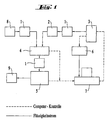
- This sample for example of 0.5 ml, can be taken from the liquor, for example, by pumping it with a pump (1) (see Figure 1) pumps through a thin Teflon or rubber hose in a circle and a valve (2) located therein opens for a short period of time, which corresponds to a 0.5 ml flow.
- the sample taken is blunted with a pH 7 buffer solution from a buffer storage vessel (8), diluted with water and pumped through a flow cell of the UV / VIS spectrometer (5) and finally into the waste vessel (9) by means of a pump.
- the sample and the buffer solution are mixed in or by an autosampler (4), which transmits a start signal to the UV / VIS measuring device (5).
- the time control is triggered by the slower preparation step.
- a dependency of the dyeing process on these parameters can also be recognized by a pH value and temperature measuring device (6).
- a suitable program of the computer (7) allows a pump to continuously raise the pH during the coloring by pumping in lye. This corresponds to an Automet process (see in particular ® Remazol Automet) for dyeing, which not only runs according to a preset algorithm, but can also be controlled by the degree of exhaustion of the dyes.
- the used liquor can then be mixed with the necessary amount of dye and if necessary water can be concentrated again.
- the Concentration is also monitored with the multi-component analysis.
- the dye mixtures according to the invention deliver depending on the composition of the individual dye components according to those in the art for fiber-reactive Dyes numerous application and fixing methods described, especially according to the procedures of trichromatic staining, on hydroxy and / or fiber materials containing carbonamide groups different color shades with good color structure and especially good ones Washability of unfixed dye components from the colored materials.
- the present invention thus also relates to the use of dye mixtures according to the invention or of one or two of the Dyes of the general formula (3) and one or more of the dyes of the general formulas (1a), (1b), (2) and / or (4) and optionally (5) together or partially together, especially in one Trichromatic dyeing process, for dyeing (including printing) of hydroxy and / or fiber materials containing carbonamide groups or process for Dyeing such fiber materials using an inventive one Dye mixture or one or two of the dyes of the general Formula (3) and one or more of the dyes of the general formulas (1a), (1b), (2) and / or (4) and optionally (5) together or partially together, especially in a trichromatic staining process by using the Dye mixture or these dyes in dissolved form on the substrate applied and the dyes by the action of an alkaline agent or fixed on the fiber by heat or by both measures.
- Materials containing hydroxyl groups are natural or synthetic materials containing hydroxyl groups, such as cellulose fiber materials, also in the form of paper, or their regenerated products and polyvinyl alcohols.
- Cellulose fiber materials are preferably cotton, but also others Vegetable fibers such as linen, hemp, jute and ramie fibers; regenerated Cellulose fibers are, for example, cellulose and viscose rayon.
- Materials containing carbonamide groups are, for example, synthetic and natural polyamides and polyurethanes, especially in the form of fibers, for example wool and other animal hair, silk, leather, polyamide-6,6, Polyamide-6, polyamide-11 and polyamide-4.
- the dye mixtures according to the invention are used after generally known methods for dyeing and printing fiber materials according to the known application techniques for fiber-reactive dyes. There the dyes of the dye mixtures according to the invention to one another show good combination behavior, the invention Dye mixtures are particularly advantageous in the pull-out dyeing process be used.
- the acid-binding and the fixation of the dyes on the cellulose fibers effecting agents are, for example, water-soluble basic salts of Alkali metals and the alkaline earth metals of inorganic or organic Acids, as well as compounds that release alkali in the heat.
- the alkali metal hydroxides and alkali metal salts of to name weak to moderate inorganic or organic acids, of the alkali compounds preferably the sodium and Potassium compounds are meant.
- Such acid-binding agents are for example sodium hydroxide, potassium hydroxide, sodium carbonate, Sodium bicarbonate, potassium carbonate, sodium formate, Sodium dihydrogen phosphate and disodium hydrogen phosphate.
- the dyes of the invention are chemically attached to the cellulose fiber bound; in particular the cellulose dyeings show the usual Post-treatment by rinsing to remove unfixed ones Dye proportions have excellent wet fastness properties, especially since they did not become fixed Wash out dye parts easily because of their good cold water solubility to let.
- the dyeings on polyurethane and polyamide fibers are usually made from acidic environment. So you can, for example, the dyebath acetic acid and / or ammonium sulfate and / or acetic acid and ammonium acetate or Add sodium acetate to get the desired pH.
- leveling aids such as based on a Reaction product of cyanuric chloride with three times the molar amount of one Aminobenzenesulfonic acid or aminonaphthalenesulfonic acid or based on a Reaction product of, for example, stearylamine with ethylene oxide.
- the material to be colored is at a temperature of around 40 ° C Bath introduced, moved there for some time, then the dye bath on the desired weakly acidic, preferably weakly acetic acid pH adjusted and the actual coloring at a temperature between 60 and 98 ° C carried out.
- the dyeings can also at boiling temperature or at temperatures up to 120 ° C (under pressure).
- Parts by weight are Parts by weight, the percentages are percentages by weight, if not noted otherwise. Parts by weight are in relation to parts by volume Kilograms to liters.
- the formulas of the dyes in the form of the free acid are given, the quantitative parts refer to the acidic form.
- the dyes are customary for water-soluble dyes present form as an electrolyte salt (e.g. sodium chloride and sodium sulfate-containing alkali metal salt powder used.
- an aqueous solution such as an aqueous solution obtainable from the synthesis
- These solutions may also contain or contain electrolyte salts such as sodium chloride or conventional auxiliaries such as buffers and surfactants) are mixed together.
- the aqueous dye mixture obtained according to the invention can be used directly in the fed for dyeing or by spray drying and optionally granulation can be converted into the solid form.
- the dye mixture according to the invention provides according to the in the art for fiber-reactive dyes, for example, customary application and fixing processes strong, level gray dyeings and prints on cellulose fiber materials good fastness properties.
- the aqueous dye mixture obtained according to the invention can be used directly in the fed for dyeing or by spray drying and optionally granulation can be converted into the solid form.
- the dye mixture according to the invention provides according to the in the art for fiber-reactive dyes, for example, customary application and fixing processes strong, level black dyeings and prints on cellulose fiber materials with good fastness properties.
- the dye mixture according to the invention obtained delivers in the art dyeing and printing processes customary for fiber-reactive dyes, for example as described in Examples A to F below, deep red in color level dyeings and prints with good fastness properties.
- 100 parts of a mercerized, bleached cotton jersey are in one Jet dyeing machine with 1000 parts of an aqueous solution containing 1 part of the red-coloring monoazo dye of the formula (E), 1 part of the yellow-coloring Monoazo dye of formula (D) and 1 part of the blue color
- 100 parts of a mercerized, bleached cotton jersey are in a jet dyeing machine, the 1000 parts of an aqueous solution with 1 part of the yellow dye of formula (D), 0.5 part of the red dye of formula (C), 0.5 part of the contains red-coloring dye of the formula (E), 0.3 part of the navy-blue coloring dye of the formula (A) and 0.2 part of the blue-coloring dye of the formula (G) and 80 parts of sodium sulfate.
- the jersey is first moved in the dye bath at 20 ° C for about five minutes; five parts of a 15% aqueous sodium carbonate solution and 2 parts of a 33% aqueous sodium hydroxide solution are then added with further movement of the dyeing liquor.
- the dyeing liquor is continuously heated to 60 ° C. within 15 minutes and the dyeing process is continued at 60 ° C. for a further 60 minutes.
- the dyeing liquor is then drained off and the dyed jersey is rinsed, aftertreated and finished in accordance with the instructions in Example A. A level brown color with good fastness properties is obtained.
- 100 parts of a mercerized, bleached cotton jersey are placed in a jet dyeing machine, the 1000 parts of an aqueous solution with 0.3 part of the yellow dye of the formula (D), 0.3 part of the red dye of the formula (C), 0.3 Contains parts of the red-coloring dye of the formula (E), 0.3 part of the navy-blue coloring dye of the formula (A) and 0.2 parts of the blue-coloring dye of the formula (G) and 80 parts of sodium sulfate.
- the jersey is first moved in the dye bath at 20 ° C for about five minutes; then 5 parts of a 15% aqueous sodium carbonate solution and 2 parts of a 33% aqueous sodium hydroxide solution are added with further movement of the dyeing liquor.
- the dyeing liquor is continuously heated to 60 ° C. within 15 minutes and the dyeing process is continued at 60 ° C. for a further 60 minutes.
- the dyeing liquor is then drained off and the dyed jersey is rinsed, aftertreated and finished in accordance with the instructions in Example A.
- a level beige coloring with good fastness properties is obtained.
- 100 parts of a mercerized, bleached cotton jersey are in a jet dyeing machine for 60 minutes at 60 ° C in 1000 parts of an aqueous dyeing solution, which is 1 part of the yellow dye of formula (D), 1 part of the red dye of formula (C), Contains 0.25 part of the navy blue dye of formula (A), 0.25 part of the blue copper formazan dye of formula (G) and 50 parts of sodium sulfate, 5 parts of a 15% aqueous sodium carbonate solution and 2 parts of a 33% aqueous sodium hydroxide solution .
- the dyed cotton jersey obtained is then aftertreated and finished in the customary manner, as indicated, for example, in Example A. A level brown color with good fastness properties is obtained.
- 100 parts of a mercerized, bleached cotton jersey are in a jet dyeing machine for 60 minutes at 60 ° C in 1000 parts of an aqueous dyeing solution, the 0.2 parts of the yellow dye of the formula (F), 0.1 part of the red dyeing monoazo dye of the formula (C), 0.1 part of the red-coloring dye of the formula (E), 0.12 part of the copper formazan dye of the formula (G) and 0.18 part of the navy-blue coloring dye of the formula (A) and 50 parts of sodium sulfate, 5 parts of an aqueous Contains 15% sodium carbonate solution and 2 parts of a 33% aqueous sodium hydroxide solution.
- the dyed cotton jersey obtained is then aftertreated and finished in the customary manner, as indicated, for example, in Example A. A level brown color with good fastness properties is obtained.
- Example A The procedure of Example A is followed for dyeing 100 parts of a mercerized, bleached cotton jersey and 1000 parts of an aqueous solution which contains the dye mixture described in the table examples below and the electrolyte salts and alkaline agents given in Example A are added to the dye liquor . After completing the dyeings in accordance with the conditions given in Example A, level dyeings are obtained in the in each Hue given in the table example.
Landscapes
- Chemical & Material Sciences (AREA)
- Engineering & Computer Science (AREA)
- Textile Engineering (AREA)
- Chemical Kinetics & Catalysis (AREA)
- Organic Chemistry (AREA)
- Coloring (AREA)
Description
Die Erfindung liegt auf dem technischen Gebiet der faserreaktiven Farbstoffe.The invention is in the technical field of fiber-reactive dyes.
Bei dem Bemühen, die Farbstoffgammen durch moderne Reaktivfarbstoffe zu erweitern oder zu ergänzen, stößt man in vielerlei Hinsicht an Grenzen, die durch eine einzelne Farbstoffkomponente nicht oder nur ungenügend gelöst werden können. Insbesondere dann, wenn bestimmte Farbnuancen gewünscht werden, sind hierzu einzelne Farbstoffe nicht geeignet. Vielmehr können bestimmte Farbnuancen nur dann erhalten werden, wenn man Mischungen von bestimmten verschiedenfarbigen Farbstoffen einsetzt. Um alle Farbnuancen erzeugen zu können, bedarf es theoretisch nach der subtraktiven Farbmischung nur dreier Farbstoffe, die die Idealfarbe Cyan, Gelb und Magenta besitzen. Der Farbraum, der von diesem Farbdreieck gebildet wird, enthält alle Farbtöne, die durch Mischung zugänglich sind.In an effort to add dye dyes by using modern reactive dyes expand or supplement, you come across limits in many ways a single dye component can not be solved or only insufficiently can. Especially when certain color shades are desired, individual dyes are not suitable for this. Rather, certain can Color shades can only be obtained if you mix of certain uses different colored dyes. To create all shades of color theoretically, it only takes three after the subtractive color mixing Dyes that have the ideal color cyan, yellow and magenta. The color space which is formed by this color triangle, contains all the hues that pass through Mixture are accessible.
Das Färben mit solchen Farbstoffmischungen ist in der Praxis schon lange als
"Trichromiefärbung" bekannt. In der Regel werden drei Farbstoffe eingesetzt,
von denen der jeweils einzelne blau-, gelb- bzw. rotfärbend ist. Oft werden
jedoch auch noch zusätzlich ein oder zwei andere Farbstoffe in dieser
Farbstoffmischung, oft nur in geringen Mengen, verwendet, um hierdurch
bestimmte Wirkungen und Verschiebungen in der Nuance zu erreichen.
Eine Voraussetzung für den Einsatz der Farbstoffe in Mischung in der
Trichromiefärbung ist, daß die Farbstoffe ein möglichst gleiches Färbeverhalten
besitzen; dies betrifft insbesondere deren Substantivität, Migrationsverhalten
und Fixiergrad. Das Färbeverhalten der Farbstoffe soll zudem während des
gesamten Färbeprozesses möglichst gleich sein, um sowohl am Anfang des
Färbeprozesses, wie beispielsweise bei einem kontinuierlichen Färbeverfahren,
gleiche Nuancen wie am Ende des Verfahrens zu erhalten. So kann es bei idealer
Trichromiefärbung nicht schädlich sein, daß der Färbeprozeß zu irgendeinem
Zeitpunkt abgebrochen wird, wenn er mit demselben Färberezept zu späterer
Zeit weitergeführt wird; denn der Farbton der erhaltenen Färbung sollte zu jeder
Zeit des Färbeprozesses nahezu identisch sein, und lediglich die Farbtiefe sollte
zunehmen.Dyeing with such dye mixtures has long been known in practice as "trichromatic dyeing". As a rule, three dyes are used, each of which is blue, yellow or red in color. However, one or two other dyes are often also used in this dye mixture, often only in small amounts, in order to achieve certain effects and shifts in the shade.
A prerequisite for the use of the dyes in a mixture in trichromatic dyeing is that the dyes have the same dyeing behavior as possible; this applies in particular to their substantivity, migration behavior and degree of fixation. The dyeing behavior of the dyes should also be as identical as possible during the entire dyeing process in order to obtain the same nuances at the beginning of the dyeing process, such as in a continuous dyeing process, as at the end of the process. Thus, with ideal trichromatic staining, it cannot be harmful that the staining process is interrupted at any time if it is continued at a later time with the same staining recipe; because the hue of the dye obtained should be almost identical at all times in the dyeing process, and only the depth of color should increase.
Mit der vorliegenden Erfindung wurde nunmehr gefunden, daß Farbstoffe der nachstehend angegebenen und definierten allgemeinen Formeln (1a), (1b) und (2) bis (5) gemeinsam oder teilweise gemeinsam den Anforderungen an den Einsatz in der Trichromiefärbung entsprechen, wobei der Einsatz eines Farbstoffes entsprechend der allgemeinen Formel (3) zwingend ist.With the present invention it has now been found that dyes of general formulas (1a), (1b) and (2) given and defined below to (5) together or partially together the requirements for use in the trichromatic stain, using a dye according to the general formula (3) is mandatory.
Die Erfindung betrifft somit insbesondere Farbstoffmischungen, die durch den
Gehalt eines oder zweier Kupferformazanfarbstoffe entsprechend der
nachstehend genannten und definierten allgemeinen Formel (3) und eines oder
mehrerer Azofarbstoffe, die aus der Gruppe von einem oder mehreren, wie zwei,
drei und vier, Monoazofarbstoffen entsprechend der nachstehend genannten und
definierten allgemeinen Formel (1a) oder (1b) oder (1a) und (1b), einem oder
mehreren, wie zwei oder drei, Monoazofarbstoffen entsprechend der
nachstehend genannten und definierten allgemeinen Formel (2), einem oder
mehreren, wie zwei, drei oder vier, Disazofarbstoffen entsprechend der
nachstehend genannten und definierten allgemeinen Formel (4) und
gegebenenfalls einem oder zwei Monoazofarbstoffen entsprechend der
nachstehend genannten und definierten allgemeinen Formel (5) ausgewählt sind,
gekennzeichnet sind:
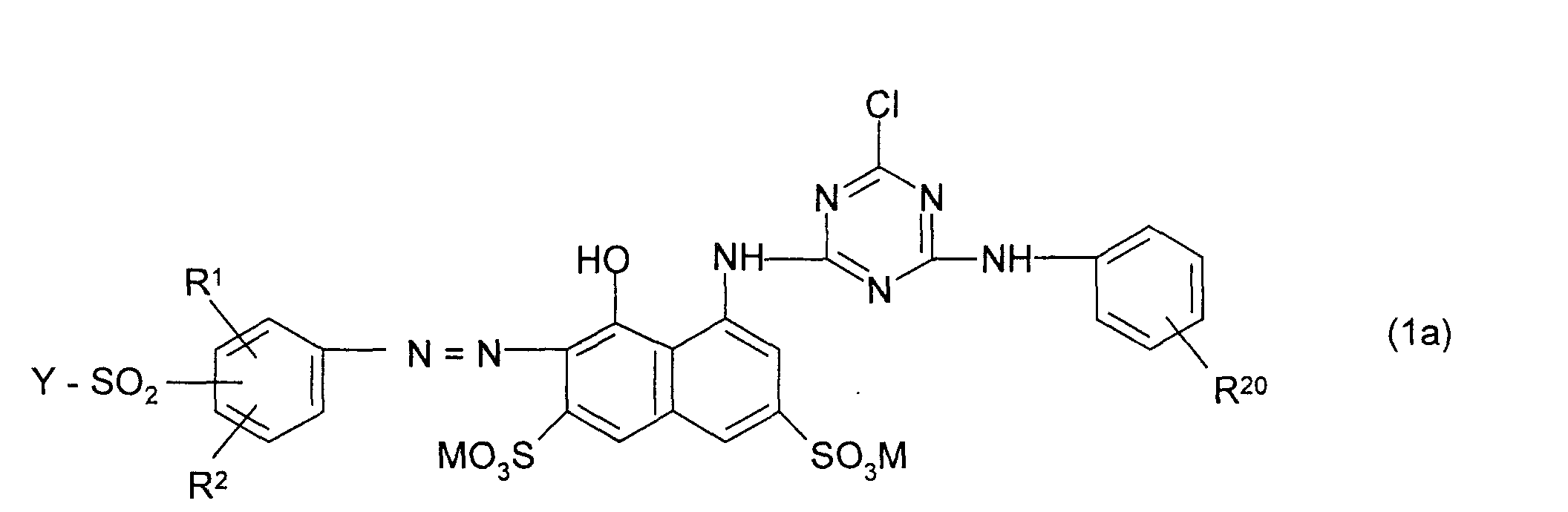

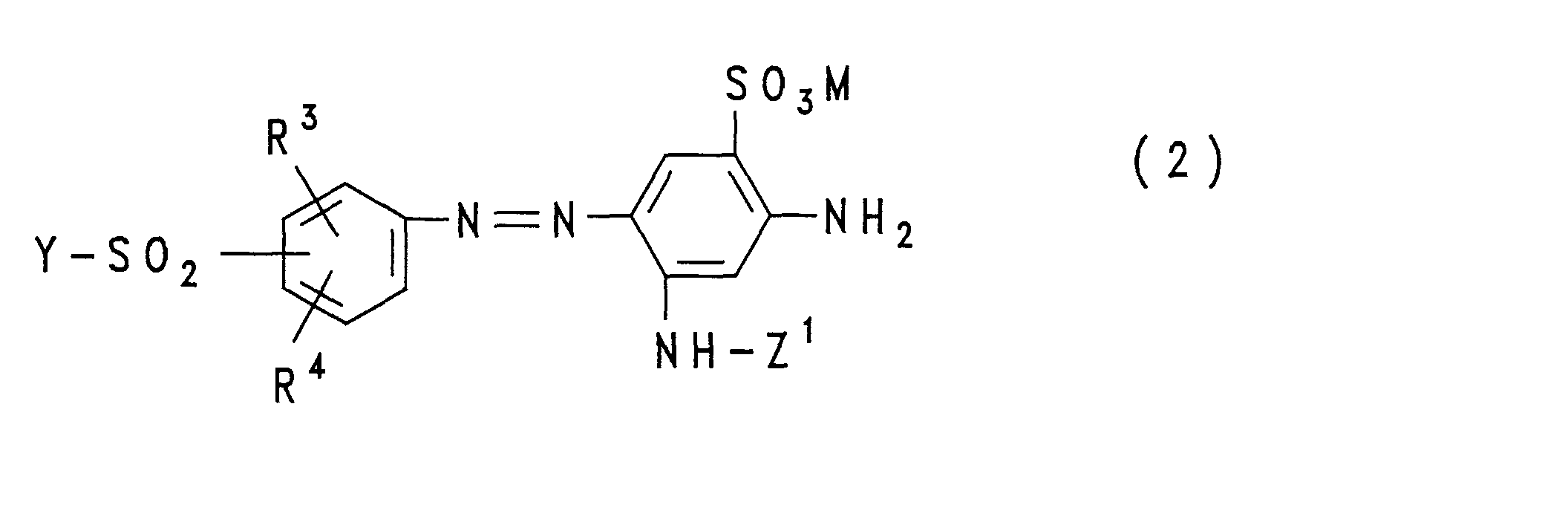
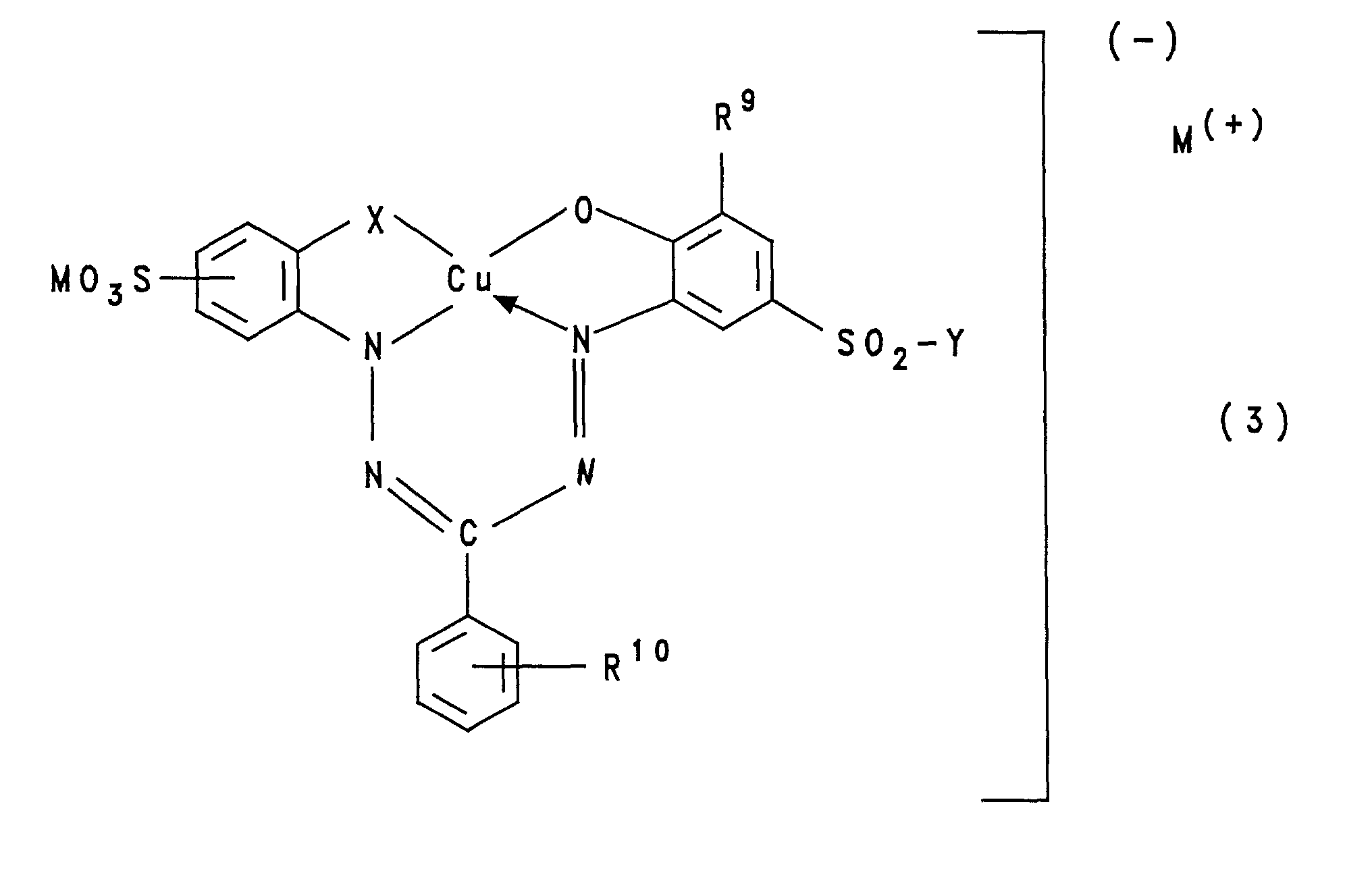

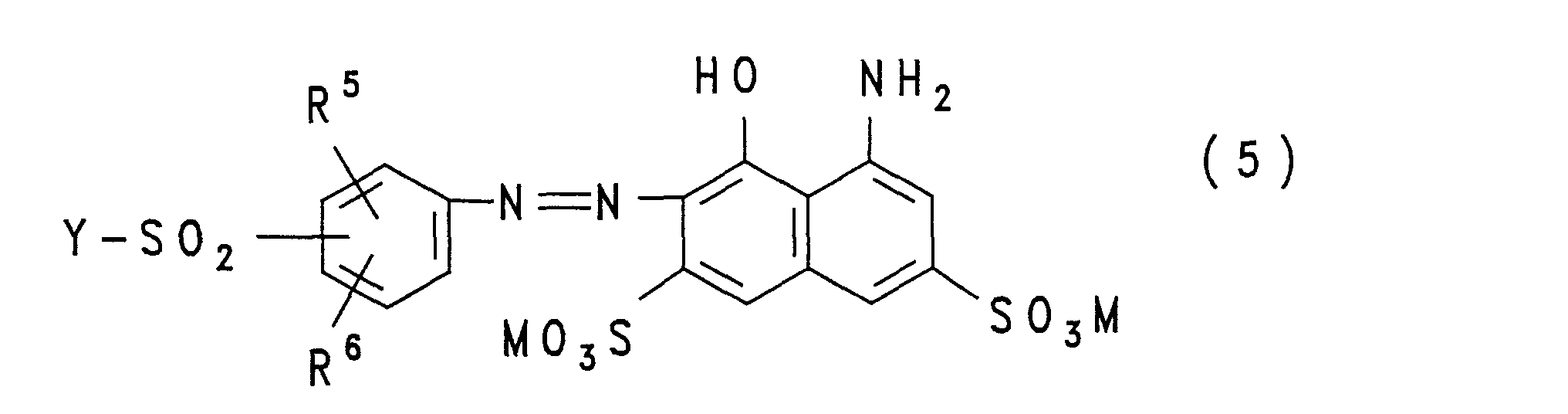
In diesen Formeln bedeuten:
- M
- ist Wasserstoff oder ein Alkalimetall, wie Lithium, Natrium und Kalium;
- R1
- ist Wasserstoff, Methyl, Ethyl, Methoxy oder Ethoxy, vorzugsweise Methoxy und Wasserstoff und insbesondere Wasserstoff;
- R2
- ist Wasserstoff, Methyl, Ethyl, Methoxy oder Ethoxy, vorzugsweise Wasserstoff;
- R3
- ist Wasserstoff, Methyl, Ethyl, Methoxy oder Ethoxy, vorzugsweise Methoxy und Wasserstoff und insbesondere Wasserstoff;
- R4
- ist Wasserstoff, Methyl, Ethyl, Methoxy oder Ethoxy, vorzugsweise Wasserstoff;
- R5
- ist Wasserstoff, Methyl, Ethyl, Methoxy oder Ethoxy, vorzugsweise Methoxy und Wasserstoff und insbesondere Wasserstoff;
- R6
- ist Wasserstoff, Methyl, Ethyl, Methoxy oder Ethoxy, vorzugsweise Wasserstoff;
- R7
- ist Wasserstoff, Methyl, Ethyl, Methoxy oder Ethoxy, vorzugsweise Methoxy und Wasserstoff und insbesondere Wasserstoff;
- R8
- ist Wasserstoff, Methyl, Ethyl, Methoxy oder Ethoxy, vorzugsweise Wasserstoff;
- R9
- ist Wasserstoff oder Sulfo;
- R10
- ist Wasserstoff, Alkyl von 1 bis 4 C-Atomen, wie Methyl oder Ethyl, Sulfo, Carboxy, Alkanoyl von 2 bis 5 C-Atomen, wie Propionyl oder Acetyl, oder eine Gruppe der Formel -SO2-Y, in welcher Y eine der nachstehend genannten Bedeutungen besitzt, bevorzugt Wasserstoff oder Sulfo;
- R20
- ist Wasserstoff, Methyl, Sulfo oder Carboxy;
- X
- ist Carbonyloxy der Formel -CO-O- oder Oxy der Formel -O- oder die Gruppe -SO3 (-), bevorzugt Carbonyloxy;
- Y
- ist jedes, unabhängiges voneinander, Vinyl, β-Chlorethyl, β-Thiosulfatoethyl oder β-Sulfatoethyl;
- Z1
- ist Alkanoyl von 2 bis 5 C-Atomen, wie Propionyl und Acetyl, oder ist
Benzoyl, 2-Cyanoamino-4-chlor-1,3,5-triazin-6-yl, 2-Cyanoamino-4-fluor-1,3,5-triazin-6-yl,
2,4-Dichlor-1,3,5-triazin-6-yl oder eine Gruppe der
allgemeinen Formel (a)
in welcher
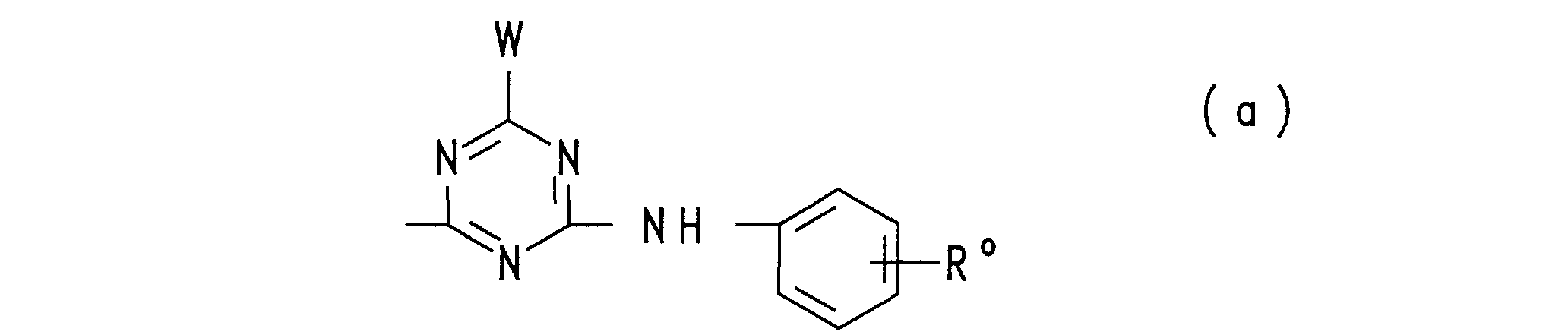
- W
- Chlor, Fluor oder Cyanoamino und
- Ro
- Sulfo, Carboxy oder eine Gruppe der allgemeinen Formel -SO2-Y mit Y einer der oben genannten Bedeutungen ist.
- M
- is hydrogen or an alkali metal such as lithium, sodium and potassium;
- R 1
- is hydrogen, methyl, ethyl, methoxy or ethoxy, preferably methoxy and hydrogen and in particular hydrogen;
- R 2
- is hydrogen, methyl, ethyl, methoxy or ethoxy, preferably hydrogen;
- R 3
- is hydrogen, methyl, ethyl, methoxy or ethoxy, preferably methoxy and hydrogen and in particular hydrogen;
- R 4
- is hydrogen, methyl, ethyl, methoxy or ethoxy, preferably hydrogen;
- R 5
- is hydrogen, methyl, ethyl, methoxy or ethoxy, preferably methoxy and hydrogen and in particular hydrogen;
- R 6
- is hydrogen, methyl, ethyl, methoxy or ethoxy, preferably hydrogen;
- R 7
- is hydrogen, methyl, ethyl, methoxy or ethoxy, preferably methoxy and hydrogen and in particular hydrogen;
- R 8
- is hydrogen, methyl, ethyl, methoxy or ethoxy, preferably hydrogen;
- R 9
- is hydrogen or sulfo;
- R 10
- is hydrogen, alkyl of 1 to 4 carbon atoms, such as methyl or ethyl, sulfo, carboxy, alkanoyl of 2 to 5 carbon atoms, such as propionyl or acetyl, or a group of the formula -SO 2 -Y, in which Y is a has the meanings given below, preferably hydrogen or sulfo;
- R 20
- is hydrogen, methyl, sulfo or carboxy;
- X
- is carbonyloxy of the formula -CO-O- or oxy of the formula -O- or the group -SO 3 (-) , preferably carbonyloxy;
- Y
- each is, independently of one another, vinyl, β-chloroethyl, β-thiosulfatoethyl or β-sulfatoethyl;
- Z 1
- is alkanoyl of 2 to 5 carbon atoms, such as propionyl and acetyl, or is benzoyl, 2-cyanoamino-4-chloro-1,3,5-triazin-6-yl, 2-cyanoamino-4-fluoro-1,3 , 5-triazin-6-yl, 2,4-dichloro-1,3,5-triazin-6-yl or a group of the general formula (a) in which
- W
- Chlorine, fluorine or cyanoamino and
- R o
- Sulfo, carboxy or a group of the general formula -SO 2 -Y with Y is one of the meanings mentioned above.
Die einzelnen Formelglieder in den Formeln (1), (2), (3), (4) und (5) können im Rahmen ihrer Definition zueinander von gleicher oder verschiedener Bedeutung sein.The individual formula elements in the formulas (1), (2), (3), (4) and (5) can in Framework of their definition to each other of the same or different meaning his.
Eine Sulfogruppe ist eine Gruppe der allgemeinen Formel -SO3M, eine Carboxygruppe eine Gruppe der allgemeinen Formel -COOM, eine Sulfatogruppe eine Gruppe der allgemeinen Formel -OSO3M und eine Thiosulfatogruppe eine Gruppe der allgemeinen Formel -S-SO3M, jeweils mit M der oben angegebenen Bedeutung.A sulfo group is a group of the general formula -SO 3 M, a carboxy group is a group of the general formula -COOM, a sulfato group is a group of the general formula -OSO 3 M and a thiosulfato group is a group of the general formula -S-SO 3 M, each with M the meaning given above.
Die Farbstoffe der allgemeinen Formeln (1) bis (5) sind beispielsweise aus den deutschen Patentschriften Nrs. 960 534 und 965 902 und der U.S.-Patentschrift Nr. 4 257 770, den europäischen Patentschriften Nrs. 0 032 187, 0 094 055, 0 073 481, 0 028 787, 0 028 788 und 0 135 040 bekannt oder können analog den dort beschriebenen Verfahrensweisen hergestellt werden. The dyes of the general formulas (1) to (5) are, for example, from the German patent no. 960 534 and 965 902 and the U.S. Patent No. 4,257,770, European Patent Nos. 0 032 187, 0 094 055, 0 073 481, 0 028 787, 0 028 788 and 0 135 040 known or can be analogous to the procedures described there getting produced.
Die Gruppen Y-SO2- stehen bevorzugt in meta- oder para-Stellung zu den Azogruppen bzw. Aminogruppen an den Benzolrest gebunden. Bevorzugt ist Y-SO2- Vinylsulfonyl und insbesondere bevorzugt β-Sulfatoethylsulfonyl.The groups Y-SO 2 - are preferably bonded to the benzene radical in the meta or para position to the azo groups or amino groups. Y-SO 2 is preferred - vinylsulfonyl and particularly preferably β-sulfatoethylsulfonyl.
Erfindungsgemäßen Mischungen sind insbesondere dadurch gekennzeichnet, daß sie einen oder mehrere, wie zwei, drei oder vier, Monoazofarbstoffe entsprechend der allgemeinen Formel (1a) oder (1b) oder (1a) und (1b) und einen oder zwei Kupferformazanfarbstoffe entsprechend der allgemeinen Formel (3) oder einen oder mehrere, wie zwei, drei oder vier, Disazofarbstoffe entsprechend der allgemeinen Formel (4) oder eine Mischung dieser Farbstoffe der allgemeinen Formeln (3) und (4) und gegebenenfalls einen oder zwei Monoazofarbstoffe entsprechend der allgemeinen Formel (5) enthalten, oder sie sind dadurch gekennzeichnet, daß sie einen oder zwei Kupferformazanfarbstoffe entsprechend der allgemeinen Formel (3) oder einen oder mehrere, wie zwei, drei oder vier, Disazofarbstoffe entsprechend der allgemeinen Formel (4) oder eine Mischung dieser Farbstoffe der allgemeinen Formeln (3) und (4) und einen oder mehrere, wie zwei oder drei, Monoazofarbstoffe entsprechend der allgemeinen Formel (2) und gegebenenfalls einen oder zwei Monoazofarbstoffe entsprechend der allgemeinen Formel (5) enthalten.Mixtures according to the invention are particularly characterized in that they one or more, such as two, three or four, monoazo dyes corresponding to the general formula (1a) or (1b) or (1a) and (1b) and one or two copper formazan dyes corresponding to the general formula (3) or one or more, such as two, three or four, disazo dyes accordingly of the general formula (4) or a mixture of these dyes of the general Formulas (3) and (4) and optionally one or two monoazo dyes contain according to the general formula (5), or they are thereby characterized in that they correspond to one or two copper formazan dyes of the general formula (3) or one or more, such as two, three or four, Disazo dyes according to the general formula (4) or a mixture these dyes of the general formulas (3) and (4) and one or more, such as two or three monoazo dyes corresponding to the general formula (2) and optionally one or two monoazo dyes corresponding to the general formula (5) included.
In Formel (1a) ist R20 bevorzugt Sulfo. In Formel (2) ist Z1 bevorzugt Acetyl. Sind in den Farbstoffmischungen Monoazofarbstoffe entsprechend den allgemeinen Formeln (1a) und (1b) enthalten, so sind dies bevorzugt solche Farbstoffe, in welchen die Gruppen Y-SO2- Vinylsulfonyl und β-Sulfatoethylsulfonyl darstellen und R20 für Sulfo steht.In formula (1a), R 20 is preferably sulfo. In formula (2) Z 1 is preferably acetyl. If monoazo dyes corresponding to the general formulas (1a) and (1b) are present in the dye mixtures, these are preferably those dyes in which the groups are Y-SO 2 - vinylsulfonyl and β-sulfatoethylsulfonyl and R 20 is sulfo.
Die Farbstoffe der allgemeinen Formeln (1) bis (5) können in den erfindungsgemäßen Mischungen in beliebigen Mischungsverhältnissen, die innerhalb des Farbdreiecks zu den gewünschten Nuancen führen oder zu den gewünschten Nuancen beitragen, vorliegen. So können die Mischungen der Farbstoffe (1) und (3) diese Farbstoffe in einem Verhältnis von 99:1 Gew.-% bis 1:99 Gew.-% enthalten. Farbstoffmischungen mit einem Farbstoff (1a) oder (1b) und einer Mischung der Farbstoffe (3) und (4) und gegebenenfalls einem Farbstoff (5) können diese Farbstoffe in einem Verhältnis von 1:99:0 bis 99:1:0 oder von 1:92:7 bis 97,5:2,3:0,2 Gew.-% enthalten.The dyes of the general formulas (1) to (5) can in the mixtures according to the invention in any mixing ratios that lead to the desired nuances within the color triangle or to the the desired nuances. So the mixtures of the Dyes (1) and (3) these dyes in a ratio of 99: 1 wt .-% to Contain 1:99% by weight. Dye mixtures with a dye (1a) or (1b) and a mixture of dyes (3) and (4) and optionally one Dye (5) can these dyes in a ratio of 1:99: 0 to 99: 1: 0 or from 1: 92: 7 to 97.5: 2.3: 0.2% by weight.
In gleicher Weise können Farbstoffmischungen der Farbstoffe (2) und (3) die
Farbstoffe (2) und (3) in einem Verhältnis von 1:99 bis 99:1 Gew.-%
enthalten. In den Farbstoffmischungen mit einem Farbstoff (2) und einer
Mischung der Farbstoffe (3) und (4) und gegebenenfalls einem Farbstoff (5)
liegen diese Farbstoffe in der Regel ebenso in einem Mischungsverhältnis von
1:99:0 bis 99:1:0 oder von 1:92:7 bis 97,5:2,3:0,2 vor.
Mischungen aus Farbstoffen der Formeln (1), (2) und (3) oder (3) und (4) und
gegebenenfalls (5) enthalten diese Farbstoffe in der Regel in folgendem
Mischungsverhältnis:
Mixtures of dyes of the formulas (1), (2) and (3) or (3) and (4) and optionally (5) generally contain these dyes in the following mixing ratio:
Sind in den erfindungsgemäßen Farbstoffmischungen zwei oder mehrere Farbstoffe entsprechend den allgemeinen Formeln (1a) und (1b) mit einem oder zweien der Farbstoffe (1a) mit dem Rest R gleich Sulfo enthalten, so liegen die Farbstoffe der Formeln (1a) und (1b) zueinander bevorzugt im Mischungsverhältnis von 75 : 25 bis 25 : 75 Gew.-%, insbesondere von 60 : 40 bis 40 : 60 Gew.-%, vor.There are two or more in the dye mixtures according to the invention Dyes according to the general formulas (1a) and (1b) with one or contain two of the dyes (1a) with the radical R equal to sulfo, so the Dyes of the formulas (1a) and (1b) to each other preferably in Mixing ratio of 75:25 to 25:75% by weight, in particular 60:40 to 40: 60% by weight.
Sind in den erfindungsgemäßen Farbstoffmischungen Farbstoffe der allgemeinen Formeln (3) und (4) enthalten, so liegen der oder die Farbstoffe der Formel (3) und der oder die Farbstoffe der allgemeinen Formel (4) zueinander bevorzugt im Mischungsverhältnis von 75 : 25 bis 25 : 75 Gew.-%, insbesondere von 60 : 40 bis 40 : 60 Gew.-%, vor.Are dyes of the general in the dye mixtures according to the invention If formulas (3) and (4) contain, then the dye or dyes of the formula (3) and the dye or dyes of the general formula (4) to one another preferably in Mixing ratio of 75:25 to 25:75% by weight, in particular 60:40 to 40: 60% by weight.
Sind in den erfindungsgemäßen Farbstoffmischungen Farbstoffe der Formel (5) enthalten, so in der Regel zusammen mit den Farbstoffen der allgemeinen Formel (4). Sind sie in Mischungen zusammen mit einem oder mehreren Farbstoffen der Formel (4) enthalten, so mit einem Gehalt von bis zu 10 Gew.-%, bezogen auf die Farbstoffe der Formel (4).Are dyes of the formula (5) in the dye mixtures according to the invention included, usually together with the dyes of the general Formula (4). Are they mixed together with one or more Contain dyes of the formula (4), with a content of up to 10% by weight, based on the dyes of the formula (4).
Reste von Diazokomponenten in den allgemeinen Formeln (1), (2), (4) und (5) sowie durch eine Gruppe -SO2-Y substituiertes Phenyl in den Formeln (1a) und (2) sind beispielsweise 3-(β-Sulfatoethylsulfonyl)-phenyl, 4-(β-Sulfatoethylsulfonyl)-phenyl, 2-Methyl-5-methoxy-4-(β-sulfatoethylsulfonyl)-phenyl, 2-Methoxy-5-(β-sulfatoethylsulfonyl)-phenyl und 2,5-Dimethoxy-4-(β-sulfatoethylsulfonyl)-phenyl sowie deren Vinylsulfonyl-, β-Chlorethylsulfonyl- und β-Thiosulfatoethylsulfonyl-Derivate sowie 3-Sulfo-phenyl und 4-Sulfophenyl, hiervon bevorzugt 2-Methoxy-5-(β-sulfatoethylsulfonyl)-phenyl und 2,5-Dimethoxy-4-(β-sulfatoethylsulfonyl)-phenyl und insbesondere 3-(β-Sulfatoethylsulfonyl)-phenyl und 4-(β-Sulfatoethylsulfonyl)-phenyl bzw. 3-Sulfophenyl.Residues of diazo components in the general formulas (1), (2), (4) and (5) and phenyl substituted by a group -SO 2 -Y in the formulas (1a) and (2) are, for example, 3- (β- Sulfatoethylsulfonyl) phenyl, 4- (β-sulfatoethylsulfonyl) phenyl, 2-methyl-5-methoxy-4- (β-sulfatoethylsulfonyl) phenyl, 2-methoxy-5- (β-sulfatoethylsulfonyl) phenyl and 2.5 -Dimethoxy-4- (β-sulfatoethylsulfonyl) phenyl and their vinylsulfonyl, β-chloroethylsulfonyl and β-thiosulfatoethylsulfonyl derivatives as well as 3-sulfophenyl and 4-sulfophenyl, of which preferably 2-methoxy-5- (β-sulfatoethylsulfonyl ) -phenyl and 2,5-dimethoxy-4- (β-sulfatoethylsulfonyl) phenyl and especially 3- (β-sulfatoethylsulfonyl) phenyl and 4- (β-sulfatoethylsulfonyl) phenyl or 3-sulfophenyl.
Die Farbstoffe der Formel (1) bis (5) können, insbesondere bei gleichem Chromophor, innerhalb der Bedeutung von Y unterschiedliche faserreaktive Gruppen -SO2-Y besitzen. Insbesondere können die Farbstoffmischungen Farbstoffe gleichen Chromophors enthalten, in denen die faserreaktiven Gruppen -SO2-Y zum einen Vinylsulfonylgruppen und zum anderen β-Chlorethylsulfonyl- oder β-Thiosulfatoethylsulfonyl- oder bevorzugt β-Sulfatoethylsulfonyl-Gruppen sind. Ist in den Farbstoffmischungen solch eine Farbstoffkomponente in Form eines Vinylsulfonyl-Farbstoffes vorhanden, so liegt der Anteil dieses Vinylsulfonyl-Farbstoffes zu dem entsprechenden β-Chlor- oder β-Thiosulfato- oder β-Sulfatoethylsulfonyl-Farbstoff bevorzugt bei bis zu etwa 10 Mol-%, bezogen auf den jeweiligen Farbstoffchromophor, vor. The dyes of the formulas (1) to (5), especially with the same chromophore, can have different fiber-reactive groups -SO 2 -Y within the meaning of Y. In particular, the dye mixtures can contain dyes of the same chromophore in which the fiber-reactive groups -SO 2 -Y are on the one hand vinylsulfonyl groups and on the other hand β-chloroethylsulfonyl or β-thiosulfatoethylsulfonyl or preferably β-sulfatoethylsulfonyl groups. If such a dye component is present in the dye mixtures in the form of a vinylsulfonyl dye, the proportion of this vinylsulfonyl dye to the corresponding β-chloro or β-thiosulfato or β-sulfatoethylsulfonyl dye is preferably up to about 10 mol% , based on the respective dye chromophore.
Die erfindungsgemäßen Farbstoffmischungen können als Präparation in fester oder in flüssiger (gelöster) Form vorliegen. Sie enthalten im allgemeinen die bei wasserlöslichen und insbesondere faserreaktiven Farbstoffen üblichen Elektrolytsalze, wie Natriumchlorid, Kaliumchlorid und Natriumsulfat, und können desweiteren die in Handelsfarbstoffen üblichen Hilfsmittel enthalten, wie Puffersubstanzen, die einen pH-Wert in wäßriger Lösung zwischen 3 und 7 einzustellen vermögen, wie Natriumacetat, Natriumborat, Natriumhydrogencarbonat, Natriumdihydrogenphosphat und Dinatriumhydrogenphosphat, bei Vorliegen in fester Form geringe Mengen an Sikkativen oder die Löslichkeit verbessernden Mitteln, wie die bekannten Naphthalinsulfonsäure-Formaldehyd-Kondensationsprodukte, und in flüssiger Form, wie in wäßriger Lösung (einschließlich des Gehaltes von Verdickungsmitteln, wie sie bei Druckpasten üblich sind), Substanzen, die die Haltbarkeit dieser Präparationen (Gemische) gewährleisten, wie beispielsweise schimmelverhütende Mittel.The dye mixtures according to the invention can be prepared in solid form or in liquid (dissolved) form. They generally contain the at water-soluble and in particular fiber-reactive dyes usual Electrolyte salts such as sodium chloride, potassium chloride and sodium sulfate, and can furthermore contain the auxiliaries customary in commercial dyes, such as Buffer substances that have a pH in aqueous solution between 3 and 7 able to adjust, such as sodium acetate, sodium borate, Sodium bicarbonate, sodium dihydrogen phosphate and Disodium hydrogenphosphate, when in solid form, small amounts of Desiccants or solubility enhancers, such as those known Naphthalenesulfonic acid-formaldehyde condensation products, and in liquid Form as in aqueous solution (including the content of Thickeners, as they are common with printing pastes), substances that Ensure the shelf life of these preparations (mixtures), such as anti-mold agents.
Im allgemeinen liegen die erfindungsgemäßen Farbstoffmischungen als elektrolytsalzhaltige Farbstoffpulver mit einem Gesamtfarbstoffgehalt von 20 bis 70 Gew.-%, bezogen auf das Farbstoffpulver bzw. die Präparation, vor. Diese Farbstoffpulver/Präparationen können zudem die erwähnten Puffersubstanzen in einer Gesamtmenge von bis zu 5 Gew.-%, bezogen auf das Farbstoffpulver, enthalten. Sofern die erfindungsgemäßen Farbstoffmischungen in wäßriger Lösung vorliegen, beträgt der Gesamtfarbstoffgehalt in diesen wäßrigen Lösungen bis zu etwa 50 Gew.-%, wie beispielsweise zwischen 5 und 40 Gew.-%., wobei der Elektrolytsalzgehalt in diesen wäßrigen Lösungen bevorzugt unterhalb 10 Gew.-%, bezogen auf die wäßrige Lösung, beträgt; die wäßrigen Lösungen (Flüssigpräparationen) können die erwähnten Puffersubstanzen in der Regel in einer Menge von bis zu 5 Gew.-%, bevorzugt bis zu 2 Gew.-%, enthalten.In general, the dye mixtures according to the invention are as dye powders containing electrolyte salts with a total dye content of 20 to 70% by weight, based on the dye powder or the preparation. This Dye powder / preparations can also contain the buffer substances mentioned a total amount of up to 5% by weight, based on the dye powder, contain. If the dye mixtures according to the invention in aqueous Solution is present, the total dye content in these aqueous Solutions up to about 50% by weight, such as between 5 and 40 % By weight. The electrolyte salt content in these aqueous solutions is preferred below 10% by weight, based on the aqueous solution; the watery Solutions (liquid preparations) can use the buffer substances mentioned in the Usually in an amount of up to 5% by weight, preferably up to 2% by weight, contain.
Die erfindungsgemäßen Farbstoffmischungen können in üblicher Weise hergestellt werden, so durch mechanisches Mischen der einzelnen Farbstoffe oder von Mischungen von 2 oder 3 solcher Einzelfarbstoffe mit den anderen Einzelfarbstoffen in Form von deren Farbstoffpulver oder wäßrigen Lösungen. Werden die erfindungsgemäßen Farbstoffmischungen durch mechanisches Mischen der Einzelfarbstoffe hergestellt, so werden beim Mischen eventuell erforderliche Stellmittel, Entstaubungsmittel oder weitere Hilfsmittel, die in der Färbereitechnik üblich und in den hierzu verwendeten Farbstoffpräparationen üblich sind, zugegeben. The dye mixtures according to the invention can be used in a conventional manner are produced, so by mechanical mixing of the individual dyes or mixtures of 2 or 3 such individual dyes with the others Individual dyes in the form of their dye powder or aqueous solutions. Are the dye mixtures according to the invention by mechanical Mixing the individual dyes are made, so when mixing required actuating means, dedusting means or other aids, which in the Dyeing technique common and in the dye preparations used for this are common, admitted.
Geht man von wäßrigen Farbstofflösungen der Einzelkomponenten (Einzelfarbstoffe) oder gegebenenfalls von Farbstofflösungen, die bereits zwei oder mehrere dieser Einzelkomponenten enthalten, aus, so gelangt man ebenfalls durch einfaches Vermischen unter Berücksichtigung der Mengen der Farbstofflösungen und deren Farbstoffkonzentrationen zu der gewünschten Farbstoffmischung in wäßriger Form (Flüssigpräparation). Solche wäßrigen Farbstofflösungen der Einzelkomponenten oder Mischungen solcher Einzelkomponenten können auch Syntheselösungen sein, die aus der Synthese der Einzelkomponenten oder, sofern es die Synthese zuläßt, aus der Synthese von Mischungen von Einzelfarbstoffen erhältlich sind. Die so durch Mischung der einzelnen Farbstofflösungen (Syntheselösungen) erhaltenen wäßrigen Lösungen mit den erfindungsgemäßen Farbstoffmischungen können dann direkt, gegebenenfalls nach Filtration, Aufkonzentrieren und/oder Zusatz eines Puffers oder anderer Hilfsstoffe, als Flüssigpräparation der färberischen Verwendung zugeführt werden. Aus ihnen lassen sich aber auch die erfindungsgemäßen pulver- oder granulatförmigen Farbstoffmischungen der gewünschten Zusammensetzung und Einstellung beispielsweise durch Sprühtrocknung und erforderlichenfalls in einem Wirbelbett gewinnen.One starts from aqueous dye solutions of the individual components (Individual dyes) or, where appropriate, dye solutions that already have two or contain several of these individual components, so you get also by simply mixing taking into account the amounts of Dye solutions and their dye concentrations to the desired Dye mixture in aqueous form (liquid preparation). Such watery Dye solutions of the individual components or mixtures of such Individual components can also be synthesis solutions that result from synthesis of the individual components or, if the synthesis permits, from the synthesis of mixtures of individual dyes are available. The mixture of the individual dye solutions (synthesis solutions) obtained aqueous Solutions with the dye mixtures according to the invention can then be used directly, optionally after filtration, concentration and / or addition of a buffer or other auxiliaries, as a liquid preparation for dyeing be fed. However, the invention can also be made from them powder or granular dye mixtures of the desired Composition and adjustment, for example by spray drying and win in a fluidized bed if necessary.
Die erfindungsgemäßen wäßrigen Farbstofflösungen mit den erfindungsgemäßen Farbstoffmischungen können jedoch zur Einstellung von gewünschten Farbstoffmischungsverhältnissen und Farbtonnuancen insbesondere vorteilhaft in der Weise gemischt werden, daß man sich der Multikomponentenanalyse mit Hilfe von UV/VIS-Spektren bedient und hiermit die genauen Mengen und Farbstoffkonzentrationen der in den wäßrigen Ausgangslösungen enthaltenen Einzelkomponenten (Einzelfarbstoffe) ermittelt und diese unter Kontrolle eines Steuerungsverfahrens miteinander vermischt. Diese Verfahrensweise basiert auf der Aufzeichnung von UV/VIS-Spektren mit Hilfe eines Photodioden-Spektrometers (s. hierzu auch EP-A-0 385 587) oder eines schnellscannenden Gitterspektrometers mit anschließender Multikomponenten-Analyse, die, nach Eichung mit den reinen Einzelfarbstoffen oder Mischungen solcher Farbstoffe bzw. deren wäßrigen Lösungen, unter mathematischer Zerlegung in die Einzelkomponenten genaue Angaben über die Farbstoffmengen und -konzentrationen in den Lösungen liefert. Zu jedem Zeitpunkt kann über einen Monitor der aktuelle Gehalt der Farbstoffe abgelesen werden. Durch eine hohe Auflösung des Meßgerätes können auch kleinste Absorptions-Schultern erfaßt werden, die zur genauen Abgrenzung der Farbstoffe untereinander dienen.The aqueous dye solutions according to the invention with the inventive Dye mixtures, however, can be used to set the desired Dye mixture ratios and color shades particularly advantageous to be mixed in such a way that one deals with the multi-component analysis With the help of UV / VIS spectra and the exact quantities and Dye concentrations of those contained in the aqueous starting solutions Individual components (individual dyes) determined and these under the control of a Control procedure mixed together. This procedure is based on the recording of UV / VIS spectra with the help of a photodiode spectrometer (see also EP-A-0 385 587) or a fast-scanning Grating spectrometer with subsequent multi-component analysis, which, according to Calibration with the pure individual dyes or mixtures of such dyes or their aqueous solutions, with mathematical decomposition into Individual components precise information about the amount of dye and -concentrations in the solutions. At any time, one can Monitor the current content of the dyes. By a high The resolution of the measuring device can detect even the smallest absorption shoulders are used to differentiate between the dyes.
Es hat sich bewährt, vor Meßbeginn Eichreihen der zu bestimmenden Farbstoffe zu vermessen. Die Eichmessungen können nun sowohl Einzelkomponenten als auch Mischungen mehrerer Komponenten enthalten. Die genauen Konzentrationen werden in das Computerprogramm, getrennt nach Farbstoff, eingegeben. Der Konzentrationsbereich der Eichlösungen sollte den Meßbereich beinhalten. Aus diesen Angaben wird eine Kalibriermatrix errechnet, die zur späteren Bestimmung der Farbstoffkomponenten erforderlich ist. Unter der hier eingesetzten Multikomponenten-Analyse wird die quantitative Analytik von Farbstoffgemischen verstanden, die sich folgender mathematischer Algorithmen bedient: Partial Least Squares Type 1 (PLS-1), Partial Least Squares Type 2 (PLS-2) - Methoden der kleinsten Fehlerquadrate, Principal Component Regression analysis (PCR) sowie Classic Least Squares (CLS) oder Inverse Least Squares (ILS). Die Methode der kleinsten Fehlerquadrate (PLS) sowie die Hauptkomponenten-Regression (PCR) werden bspw. in Anal. Chem. 1988, 60, 1193, Anal. Chem. 1988, 60, 1202 und Anal. Chem. 1990, 62, 1091 von D. Haaland und E. V. Thomas sowie in A. Tutorial, Laboratory for Chemometrics and Center for Process Analytical Chemistry, Dept. of Chemistry, University of Washington, Seattle, WA 98195, von P. Geladi und B. Kowalewski beschrieben. Das Ziel dieser rechnerischen Ansätze ist, mathematische Gleichungen zu erhalten, durch die der Gehalt der unbekannten Mischungen bestimmt werden kann. Das Prinzip des PLS-Algorithmus ist es, die erhältlichen Spektren in eine Reihe mathematischer Spektren zu zerlegen, die als Faktoren beschrieben werden. Eine detaillierte Beschreibung der Vorgehensweise ist aus der angegebenen Literatur erhältlich. It has proven useful to calibrate the dyes to be determined before starting the measurement to measure. The calibration measurements can now both individual components also contain mixtures of several components. The exact Concentrations are entered into the computer program, separated by dye, entered. The concentration range of the calibration solutions should be the measuring range include. A calibration matrix is calculated from this information later determination of the dye components is required. Under the here The multicomponent analysis used is the quantitative analysis of Dye mixtures understood the following mathematical algorithms Serves: Partial Least Squares Type 1 (PLS-1), Partial Least Squares Type 2 (PLS-2) - least squares methods, principal component Regression analysis (PCR) as well as Classic Least Squares (CLS) or Inverse Least Squares (ILS). The least squares method and the Main component regression (PCR) are, for example, in Anal. Chem. 1988, 60, 1193, Anal. Chem. 1988, 60, 1202 and Anal. Chem. 1990, 62, 1091 of D. Haaland and E. V. Thomas and in A. Tutorial, Laboratory for Chemometrics and Center for Process Analytical Chemistry, Dept. of Chemistry, University of Washington, Seattle, WA 98195, by P. Geladi and B. Kowalewski described. The goal of these computational approaches is mathematical Obtain equations by which the content of the unknown mixtures can be determined. The principle of the PLS algorithm is the one available Decompose spectra into a series of mathematical spectra that act as factors to be discribed. A detailed description of the procedure is out available literature.
Über einen Zulauf und einen Ablauf werden die einzelnen Farbstofflösungen durch eine Durchflußküvette gepumpt. Der Küvettendurchmesser kann bis zu 0,1 cm klein sein, um auch hochkonzentrierte Lösungen messen zu können. Die Küvette befindet sich in einem UV/VIS-Spektrometer, das entweder ein Diodenzeilen-Spektrometer oder ein schnellscannendes Gitter-Spektrometer ist. Farbstofflösungen von Einzelkomponenten (Einzelfarbstoffen) können direkt spektroskopisch vermessen werden. Bei Farbstoffmischungen, die direkt, ohne aufbereitenden Zwischenschritt, analysierbar sind, kann die ATR-Meßtechnik (Attenuated Total Reflection) eingesetzt werden. Bei dieser Technik wird ein Quarz- oder Alkalimetallglasstab oder eine hierfür geeignete lichttransportierende Vorrichtung in die zu messende Lösung getaucht und an der Grenzfläche zwischen Sondenoberfläche und Flüssigkeit gemessen. Die hierfür üblicherweise eingesetzten Proben haben eine Konzentration von 5 bis 500 g/l Farbstoff. Die ATR-Sonde ist über einen Glasfaserlichtleiter mit dem Spektrometer verbunden. Die Länge des Lichtleiters kann bei Messungen im VIS-Bereich bis zu 1000 m betragen, weswegen das Spektrometer zentral in einer Meßwarte untergebracht werden kann. Bei explosionsgeschützten Betrieben muß so keine weitere Vorsorge getroffen werden.The individual dye solutions are fed via an inlet and an outlet pumped through a flow cell. The cuvette diameter can be up to 0.1 cm small so that even highly concentrated solutions can be measured. The The cuvette is in a UV / VIS spectrometer, which is either a Diode-line spectrometer or a fast-scanning grating spectrometer. Dye solutions of individual components (single dyes) can be used directly be measured spectroscopically. For dye mixtures that are direct, without preparatory intermediate step, can be analyzed, the ATR measurement technology (Attenuated Total Reflection) can be used. This technique uses a Quartz or alkali metal glass rod or a suitable light-transporting one Device immersed in the solution to be measured and at the interface measured between probe surface and liquid. The usual for this The samples used have a concentration of 5 to 500 g / l of dye. The ATR probe is connected to the spectrometer via an optical fiber. The length of the light guide can be up to 1000 m for measurements in the VIS range amount, which is why the spectrometer is centrally located in a control room can be. In explosion-protected companies, no other must Precautions are taken.
Um eine erfindungsgemäße wäßrige Lösung der Farbstoffmischung mit einem bestimmten Farbstoffgehalt und einer bestimmten Farbstoffzusammensetzung der Mischung einstellen zu können, muß die Zielmischung eingemessen und ihre Farbkoordinaten und prozentuale Zusammensetzung ermittelt werden. Diese Daten dienen während der Einstellung bzw. Dosierung der Einzelkomponenten als Zielgröße, gegen die die Farbdifferenz und die Einzelkonzentrationen berechnet und graphisch dargestellt werden. Eine Zugabe der hierzu erforderlichen Farbstoffe als Komponenten der Mischung zu einem bereits vorgelegten Farbstoff oder einer Mischung von Farbstoffen der erfindungsgemäßen Mischung erfolgt nun so lange, bis die Zielkonzentrationen sowie der Zielfarbton erreicht ist. To an aqueous solution of the dye mixture according to the invention with a certain dye content and a certain dye composition To be able to adjust the mixture, the target mixture must be measured and theirs Color coordinates and percentage composition can be determined. This Data are used during the setting or dosing of the individual components as a target against which the color difference and the individual concentrations can be calculated and displayed graphically. An addition to this required dyes as components of the mixture to one already submitted dye or a mixture of dyes Mixing according to the invention is now carried out until the target concentrations and the target color is reached.
Die Analysenmethode ist in vorteilhafter Weise nicht nur dazu geeignet, Farbstofflösungen in ihrer Zusammensetzung und ihren Farbstoffkonzentrationen, sondern in entsprechender Weise auch Färbeflotten sowie den während des Färbeprozesses in dem Färbebad erfolgenden Badauszug online zu analysieren; dies kann gewünschtenfalls graphisch dargestellt werden. Bei Färbungen von vorbehandelter Baumwolle oder polyamidhaltiger Mischgewebe geht man beispielsweise folgendermaßen vor: Eine wäßrige Farbstoffflotte aus der erfindungsgemäßen Farbstoffmischung und bspw. zwei oder drei anderen, in der Trichromiefärbung verwendbaren Reaktivfarbstoffen wird in einer hierfür üblichen Färbeapparatur vorgelegt; anschließend wird das Textil eingebracht. Die Flotte wird bei Raumtemperatur kontinuierlich umgewälzt, um eine gleichmäßige Färbung zu erzielen. Über einen Zulauf und einen Ablauf wird die Flotte durch dünne Gummi- oder Teflonschläuche durch eine Durchflußküvette gepumpt, wobei der Küvettendurchmesser, wie schon im oberen Fall erwähnt, bis zu 0,1 cm klein sein kann, um auch hochkonzentrierte Flotten messen zu können. Die Küvette befindet sich in einem UV/VIS-Spektrometer, das entweder ein Diodenzeilen-Spektrometer oder ein schnellscannendes Gitter-Spektrometer ist. Da es sich im vorliegenden Fall um eine neutrale Farbstoffflotte handelt, kann diese direkt spektroskopisch vermessen werden oder es kann alternativ bei Farbstoffmischungen, die direkt und ohne aufbereitenden Zwischenschritt analysierbar sind, die ATR-Meßtechnik (Attenuated Total Reflection) eingesetzt werden in der gleichen Weise, wie oben für die Herstellung der wäßrigen Farbstoffmischungen beschrieben.The analytical method is not only advantageous suitable for dye solutions in their composition and their Dye concentrations, but also dye liquors in a corresponding manner and the bath extract which takes place in the dye bath during the dyeing process analyze online; if desired, this can be represented graphically. For dyeing pretreated cotton or polyamide Mixed fabrics are used, for example, as follows: an aqueous one Dye liquor from the dye mixture according to the invention and, for example, two or three other reactive dyes that can be used in trichromatic dyeing is presented in a customary dyeing apparatus; then that will Textile introduced. The liquor becomes continuous at room temperature circulated to achieve a uniform color. About an inflow and The fleet is drained through thin rubber or Teflon hoses a flow cell is pumped, the cell diameter, as in the The above case mentioned can be as small as 0.1 cm to be highly concentrated To be able to measure fleets. The cuvette is in a UV / VIS spectrometer, either a diode line spectrometer or a fast scanning grating spectrometer. Since this is the case a neutral dye liquor is involved, this can be done directly spectroscopically can be measured or it can alternatively be used in the case of dye mixtures and can be analyzed without a preparatory intermediate step, the ATR measurement technology (Attenuated Total Reflection) can be used in the same way as above described for the preparation of the aqueous dye mixtures.
Bei Beginn des Färbeprozesses wird mit der kontinuierlichen Messung am
Spektrometer begonnen. Das Computerprogramm startet eine Messung am
Spektrometer und verarbeitet das aufgezeichnete Spektrum mit Hilfe der
Multikomponenten-Analyse. Die hieraus ermittelten Konzentrationen werden in
Prozent Ausgangsmenge umgerechnet und graphisch am Bildschirm angezeigt.
Bei der Trichromie kann man nun bspw. ermitteln, in welchem Umfange und
Qualitätsausmaß die erfindungsgemäße Farbstoffmischung zu bestimmten, in
der Trichromie üblicherweise einsetzbaren blaufärbenden, rotfärbenden und
orange- oder gelbfärbenden Reaktivfarbstoffe passend eingesetzt werden
können und wie sich in diesem Prozeß die Baderschöpfung ergibt.
Färberelevante Einflüsse, die die Zugabe von Zusatzstoffen, wie bspw.
Elektkrolysesalze und Alkali, oder auch Temperaturänderungen betreffen,
werden auf diese Weise ebenso schnell und zweifelsfrei erkannt. Der
Trichromiefärbeprozeß läßt sich auf diese Weise leicht überwachen. Dies kann in
der Weise geschehen, daß man von der Färbeflotte kontinuierlich kleine Proben
entnimmt, die mit Pufferlösung neutralisiert werden, wie dies in oben
beschriebener Weise mit den Eichlösungen erfolgte. Zweifelsohne ist es wichtig,
daß die Eichungen bei denselben Bedingungen vorgenommen wurden wie die
spätere Messung, denn die Absorptionen und Extinktionen der Farbstoffe
können sich bei höheren pH-Werten ändern. Diese Probe, bspw. von 0,5 ml,
kann bspw. in der Weise der Flotte entnommen werden, indem man diese mit
einer Pumpe (1) (s. hierzu
Figur 1) durch einen dünnen Teflon- oder Gummischlauch im Kreis pumpt und
ein darin befindliches Ventil (2) für eine kurze Zeitdauer, die einem
0,5 ml-Durchfluß entspricht, öffnet. Die entnommene Probe wird mit einer
pH 7-Pufferlösung aus einem Puffervorratsgefäß (8) abgestumpft, mit Wasser
verdünnt und mittels einer Pumpe durch eine Durchflußküvette des UV/VIS-Spektrometers
(5) und schließlich in das Abfallgefäß (9) gepumpt. Die Mischung
der Probe und der Pufferlösung wird in oder durch einen Autosampler (4)
vorgenommen, der dem UV/VIS-Meßgerät (5) ein Startsignal übermittelt. Die
Zeitsteuerung wird in diesem Fall von dem langsameren Aufbereitungsschritt
getriggert. Durch ein pH-Wert- und Temperatur-Meßgerät (6) kann außerdem
eine Abhängigkeit des Färbeprozesses von diesen Parametern erkannt werden.
Durch ein geeignetes Programm des Computers (7) kann zum Beispiel eine
Pumpe durch Zupumpen von Lauge den pH-Wert während der Färbung
kontinuierlich anheben. Dies entspricht einem Automet-Verfahren
(s. insbesondere ® Remazol Automet) bei Färbungen, das jedoch nicht nur nach
einem voreingestellten Algorithmus abläuft, sondern auch von dem Ausziehgrad
der Farbstoffe gesteuert werden kann. At the beginning of the staining process, continuous measurement on the spectrometer is started. The computer program starts a measurement on the spectrometer and processes the recorded spectrum using multicomponent analysis. The concentrations determined from this are converted into a percentage of the initial quantity and displayed graphically on the screen. In the case of trichrome, it is now possible, for example, to determine to what extent and to what extent the dye mixture according to the invention can be used appropriately for certain blue-dyeing, red-dyeing and orange-or yellow-dyeing reactive dyes which can usually be used in trichrome, and how bath exhaustion results in this process. Color-relevant influences, which relate to the addition of additives, such as, for example, electrolysis salts and alkali, or also changes in temperature, are recognized just as quickly and without doubt in this way. The trichromatic staining process can be easily monitored in this way. This can be done by continuously taking small samples from the dye liquor, which are neutralized with buffer solution, as was done in the manner described above with the calibration solutions. It is undoubtedly important that the calibrations were carried out under the same conditions as the later measurement, because the absorption and extinction of the dyes can change at higher pH values. This sample, for example of 0.5 ml, can be taken from the liquor, for example, by pumping it with a pump (1) (see
Figure 1) pumps through a thin Teflon or rubber hose in a circle and a valve (2) located therein opens for a short period of time, which corresponds to a 0.5 ml flow. The sample taken is blunted with a
Die verbrauchte Flotte kann anschließend mit der notwendigen Menge Farbstoff und erforderlichenfalls Wasser wieder aufkonzentriert werden. Die Aufkonzentration wird ebenso mit der Multikomponenten-Analyse überwacht.The used liquor can then be mixed with the necessary amount of dye and if necessary water can be concentrated again. The Concentration is also monitored with the multi-component analysis.
Die erfindungsgemäßen Farbstoffmischungen liefern je nach Zusammensetzung der einzelnen Farbstoffkomponenten nach den in der Technik für faserreaktive Farbstoffe zahlreich beschriebenen Anwendungs- und Fixierverfahren, insbesondere nach den Verfahrensweisen der Trichromiefärbung, auf hydroxy- und/oder carbonamidgruppenhaltigen Fasermaterialien Färbungen unterschiedlicher Farbnuancen mit gutem Farbaufbau und insbesondere guter Auswaschbarkeit nicht fixierter Farbstoffanteile aus den gefärbten Materialien.The dye mixtures according to the invention deliver depending on the composition of the individual dye components according to those in the art for fiber-reactive Dyes numerous application and fixing methods described, especially according to the procedures of trichromatic staining, on hydroxy and / or fiber materials containing carbonamide groups different color shades with good color structure and especially good ones Washability of unfixed dye components from the colored materials.
Gegenstand der vorliegenden Erfindung ist somit auch die Verwendung der erfindungsgemäßen Farbstoffmischungen oder von einem oder zwei der Farbstoffe der allgemeinen Formel (3) und einem oder mehreren der Farbstoffe der allgemeinen Formeln (1a), (1b), (2) und/oder (4) und gegebenenfalls (5) gemeinsam oder teilweise gemeinsam, insbesondere in einem Trichromiefärbeprozeß, zum Färben (einschließlich Bedrucken) von hydroxy- und/oder carbonamidgruppenhaltigen Fasermaterialien bzw. Verfahren zum Färben solcher Fasermaterialien unter Verwendung einer erfindungsgemäßen Farbstoffmischung oder von einem oder zwei der Farbstoffe der allgemeinen Formel (3) und einem oder mehreren der Farbstoffe der allgemeinen Formeln (1a), (1b), (2) und/oder (4) und gegebenenfalls (5) gemeinsam oder teilweise gemeinsam, insbesondere in einem Trichromiefärbeprozeß, indem man die Farbstoffmischung bzw. diese Farbstoffe in gelöster Form auf das Substrat appliziert und die Farbstoffe durch Einwirkung eines alkalisch wirkenden Agens oder durch Hitze oder durch beide Maßnahmen auf der Faser fixiert. The present invention thus also relates to the use of dye mixtures according to the invention or of one or two of the Dyes of the general formula (3) and one or more of the dyes of the general formulas (1a), (1b), (2) and / or (4) and optionally (5) together or partially together, especially in one Trichromatic dyeing process, for dyeing (including printing) of hydroxy and / or fiber materials containing carbonamide groups or process for Dyeing such fiber materials using an inventive one Dye mixture or one or two of the dyes of the general Formula (3) and one or more of the dyes of the general formulas (1a), (1b), (2) and / or (4) and optionally (5) together or partially together, especially in a trichromatic staining process by using the Dye mixture or these dyes in dissolved form on the substrate applied and the dyes by the action of an alkaline agent or fixed on the fiber by heat or by both measures.
Hydroxygruppenhaltige Materialien sind natürliche oder synthetische hydroxygruppenhaltige Materialien, wie beispielsweise Cellulosefasermaterialien, auch in Form von Papier, oder deren Regeneratprodukte und Polyvinylalkohole. Cellulosefasermaterialien sind vorzugsweise Baumwolle, aber auch andere Pflanzenfasern, wie Leinen, Hanf, Jute und Ramiefasern; regenerierte Cellulosefasern sind beispielsweise Zellwolle und Viskosekunstseide. Materials containing hydroxyl groups are natural or synthetic materials containing hydroxyl groups, such as cellulose fiber materials, also in the form of paper, or their regenerated products and polyvinyl alcohols. Cellulose fiber materials are preferably cotton, but also others Vegetable fibers such as linen, hemp, jute and ramie fibers; regenerated Cellulose fibers are, for example, cellulose and viscose rayon.
Carbonamidgruppenhaltige Materialien sind beispielsweise synthetische und natürliche Polyamide und Polyurethane, insbesondere in Form der Fasern, beispielsweise Wolle und andere Tierhaare, Seide, Leder, Polyamid-6,6, Polyamid-6, Polyamid-11 und Polyamid-4.Materials containing carbonamide groups are, for example, synthetic and natural polyamides and polyurethanes, especially in the form of fibers, for example wool and other animal hair, silk, leather, polyamide-6,6, Polyamide-6, polyamide-11 and polyamide-4.
Die Anwendung der erfindungsgemäßen Farbstoffmischungen erfolgt nach allgemein bekannten Verfahren zum Färben und Bedrucken von Fasermaterialien gemäß den bekannten Anwendungstechniken für faserreaktive Farbstoffe. Da die Farbstoffe der erfindungsgemäßen Farbstoffmischungen zueinander ein sehr gutes Kombinationsverhalten zeigen, können die erfindungsgemäßen Farbstoffmischungen insbesondere mit Vorteil in den Ausziehfärbeverfahren eingesetzt werden. Demgemäß erhält man mit ihnen beispielsweise auf Cellulosefasern nach den Ausziehverfahren aus langer Flotte bei Temperaturen zwischen 40 und 105°C, gegebenenfalls bei Temperaturen bis zu 130°C unter Druck, und gegebenenfalls in Gegenwart von üblichen Färbereihilfsmitteln unter Verwendung von säurebindenden Mitteln und gegebenenfalls neutralen Salzen, wie Natriumchlorid oder Natriumsulfat, Färbungen in sehr guten Farbausbeuten und mit ausgezeichnetem Farbaufbau und, im wesentlichen unabhängig von der Färbedauer, gleicher Nuance. Man kann dabei so vorgehen, daß man das Material in das warme Bad einbringt und dieses allmählich auf die gewünschte Färbetemperatur erwärmt und den Färbeprozeß bei dieser Temperatur zu Ende führt.The dye mixtures according to the invention are used after generally known methods for dyeing and printing fiber materials according to the known application techniques for fiber-reactive dyes. There the dyes of the dye mixtures according to the invention to one another show good combination behavior, the invention Dye mixtures are particularly advantageous in the pull-out dyeing process be used. Accordingly, you get up with them, for example Cellulose fibers after the extraction process from a long liquor at temperatures between 40 and 105 ° C, possibly at temperatures up to 130 ° C below Pressure, and optionally in the presence of customary dyeing aids Use of acid-binding agents and optionally neutral salts, such as sodium chloride or sodium sulfate, dyeings in very good color yields and with excellent color structure and, essentially independent of the Dyeing time, same shade. One can proceed in such a way that one Introduce material into the warm bath and gradually bring it to the desired one Dyeing temperature warmed and the dyeing process ended at this temperature leads.
Ebenfalls erhält man nach den üblichen Druckverfahren für Cellulosefasern - die entweder einphasig durchgeführt werden können, beispielsweise durch Bedrucken mit einer Natriumbicarbonat oder ein anderes säurebindendes Mittel und das Farbmittel enthaltenden Druckpaste und durch anschließendes Dämpfen bei 100 bis 103°C, oder die zweiphasig, beispielsweise durch Bedrucken mit neutraler oder schwach saurer, das Farbmittel enthaltenden Druckpaste und anschließendes Fixieren entweder durch Hindurchführen der bedruckten Ware durch ein heißes elektrolythaltiges alkalisches Bad oder durch Überklotzen mit einer alkalischen elektrolythaltigen Klotzflotte mit anschließendem Verweilen dieses behandelten Materials oder anschließendem Dämpfen oder anschließender Behandlung mit Trockenhitze, durchgeführt werden können, - farbstarke Drucke mit gutem Stand der Konturen und einem klaren Weißfond. Der Ausfall der Drucke ist von wechselnden Fixierbedingungen nur wenig abhängig. Sowohl in der Färberei als auch in der Druckerei sind die mit den erfindungsgemäßen Farbstoffmischungen erhaltenen Fixiergrade sehr hoch. Bei der Fixierung mittels Trockenhitze nach den üblichen Thermofixierverfahren verwendet man Heißluft von 120 bis 200°C. Neben dem üblichen Wasserdampf von 101 bis 103°C kann auch überhitzter Dampf und Druckdampf von Temperaturen bis zu 160°C eingesetzt werden.You also get the usual printing process for cellulose fibers - which can either be carried out in one phase, for example by Print with a sodium bicarbonate or other acid binding agent and printing paste containing the colorant and then steaming at 100 to 103 ° C, or the two-phase, for example by printing with neutral or slightly acidic printing paste containing the colorant and subsequent fixing either by passing the printed goods through by a hot electrolytic alkaline bath or by padding with an alkaline electrolyte-containing padding liquor with subsequent lingering this treated material or subsequent steaming or subsequent treatment with dry heat can be carried out, strong-colored prints with good contours and a clear white background. The failure of the prints is little of changing fixing conditions dependent. Both in the dyeing and in the printing works are the ones with the degrees of fixation obtained according to the invention are very high. At fixation using dry heat using the usual heat-setting processes hot air from 120 to 200 ° C is used. In addition to the usual water vapor from 101 to 103 ° C can also superheated steam and pressure steam from Temperatures up to 160 ° C can be used.
Die säurebindenden und die Fixierung der Farbstoffe auf den Cellulosefasern bewirkenden Mittel sind beispielsweise wasserlösliche basische Salze der Alkalimetalle und der Erdalkalimetalle von anorganischen oder organischen Säuren, ebenso Verbindungen, die in der Hitze Alkali freisetzen. Insbesondere sind die Alkalimetallhydroxide und Alkalimetallsalze von schwachen bis mittelstarken anorganischen oder organischen Säuren zu nennen, wobei von den Alkaliverbindungen vorzugsweise die Natrium- und Kaliumverbindungen gemeint sind. Solche säurebindenden Mittel sind beispielsweise Natriumhydroxid, Kaliumhydroxid, Natriumcarbonat, Natriumbicarbonat, Kaliumcarbonat, Natriumformiat, Natriumdihydrogenphosphat und Dinatriumhydrogenphosphat.The acid-binding and the fixation of the dyes on the cellulose fibers effecting agents are, for example, water-soluble basic salts of Alkali metals and the alkaline earth metals of inorganic or organic Acids, as well as compounds that release alkali in the heat. In particular, the alkali metal hydroxides and alkali metal salts of to name weak to moderate inorganic or organic acids, of the alkali compounds preferably the sodium and Potassium compounds are meant. Such acid-binding agents are for example sodium hydroxide, potassium hydroxide, sodium carbonate, Sodium bicarbonate, potassium carbonate, sodium formate, Sodium dihydrogen phosphate and disodium hydrogen phosphate.
Durch die Behandlung der Farbstoffe der erfindungsgemäßen Farbstoffmischungen mit den säurebindenden Mitteln, gegebenenfalls unter Wärmeeinwirkung, werden die Farbstoffe chemisch an die Cellulosefaser gebunden; insbesondere die Cellulosefärbungen zeigen nach der üblichen Nachbehandlung durch Spülen zur Entfernung von nicht fixierten Farbstoffanteilen ausgezeichnete Naßechtheiten, zumal sich nicht fixierte Farbstoffanteile leicht wegen ihrer guten Kaltwasserlöslichkeit auswaschen lassen. By treating the dyes of the invention Dye mixtures with the acid-binding agents, optionally under Exposure to heat, the dyes are chemically attached to the cellulose fiber bound; in particular the cellulose dyeings show the usual Post-treatment by rinsing to remove unfixed ones Dye proportions have excellent wet fastness properties, especially since they did not become fixed Wash out dye parts easily because of their good cold water solubility to let.
Die Färbungen auf Polyurethan- und Polyamidfasern werden üblicherweise aus saurem Milieu ausgeführt. So kann man beispielsweise dem Färbebad Essigsäure und/oder Ammoniumsulfat und/oder Essigsäure und Ammoniumacetat oder Natriumacetat zufügen, um den gewünschten pH-Wert zu erhalten. Zur Erreichung einer brauchbaren Egalität der Färbung empfiehlt sich ein Zusatz an üblichen Egalisierhilfsmitteln, wie beispielsweise auf Basis eines Umsetzungsproduktes von Cyanurchlorid mit der dreifach molaren Menge einer Aminobenzolsulfonsäure oder Aminonaphthalinsulfonsäure oder auf Basis eines Umsetzungsproduktes von beispielsweise Stearylamin mit Ethylenoxid. In der Regel wird das zu färbende Material bei einer Temperatur von etwa 40°C in das Bad eingebracht, dort einige Zeit darin bewegt, das Färbebad dann auf den gewünschten schwach sauren, vorzugsweise schwach essigsauren pH-Wert nachgestellt und die eigentliche Färbung bei einer Temperatur zwischen 60 und 98°C durchgeführt. Die Färbungen können aber auch bei Siedetemperatur oder bei Temperaturen bis zu 120°C (unter Druck) ausgeführt werden.The dyeings on polyurethane and polyamide fibers are usually made from acidic environment. So you can, for example, the dyebath acetic acid and / or ammonium sulfate and / or acetic acid and ammonium acetate or Add sodium acetate to get the desired pH. For An addition is recommended to achieve a useful levelness of coloration usual leveling aids, such as based on a Reaction product of cyanuric chloride with three times the molar amount of one Aminobenzenesulfonic acid or aminonaphthalenesulfonic acid or based on a Reaction product of, for example, stearylamine with ethylene oxide. In the Usually the material to be colored is at a temperature of around 40 ° C Bath introduced, moved there for some time, then the dye bath on the desired weakly acidic, preferably weakly acetic acid pH adjusted and the actual coloring at a temperature between 60 and 98 ° C carried out. The dyeings can also at boiling temperature or at temperatures up to 120 ° C (under pressure).
Die nachstehenden Beispiele dienen zur Erläuterung der Erfindung. Die Teile sind Gewichtsteile, die Prozentangaben stellen Gewichtsprozente dar, sofern nicht anders vermerkt. Gewichtsteile stehen zu Volumenteilen im Verhältnis von Kilogramm zu Liter.The following examples serve to illustrate the invention. The parts are Parts by weight, the percentages are percentages by weight, if not noted otherwise. Parts by weight are in relation to parts by volume Kilograms to liters.
Sofern in den Beispielen die Formeln der Farbstoffe in Form der freien Säure angegeben sind, beziehen sich die Mengenteile auf die saure Form. In der Regel werden die Farbstoffe jedoch in der für wasserlösliche Farbstoffe üblich vorliegenden Form als elektrolytsalzhaltiges (beispielsweise natriumchlorid- und natriumsulfathaltiges) Alkalimetallsalz-Pulver eingesetzt. Provided in the examples the formulas of the dyes in the form of the free acid are given, the quantitative parts refer to the acidic form. Usually however, the dyes are customary for water-soluble dyes present form as an electrolyte salt (e.g. sodium chloride and sodium sulfate-containing alkali metal salt powder used.
47 Teile einer wäßrigen Lösung, wie bspw. einer aus der Synthese erhältlichen
wäßrigen Lösung, mit 23,5 Teilen des Kupferformazanfarbstoffes der Formel (G)
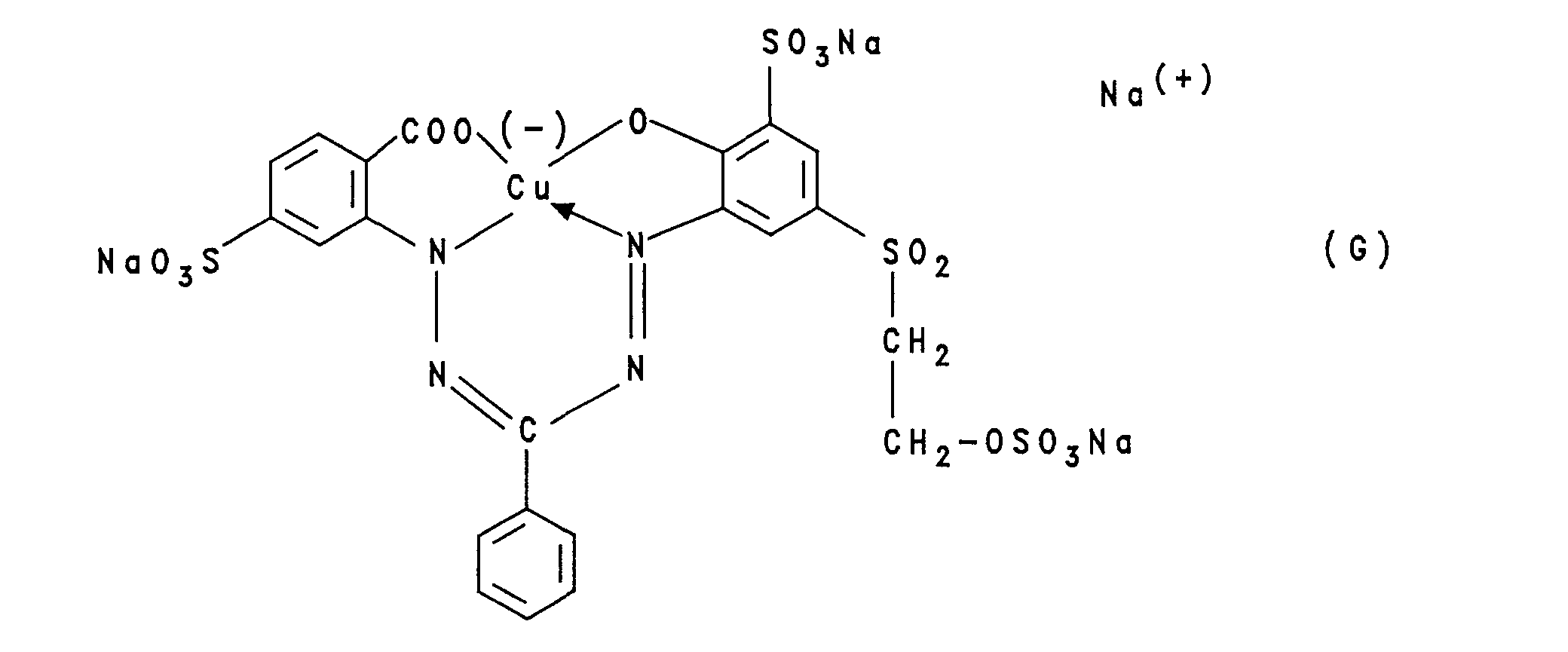
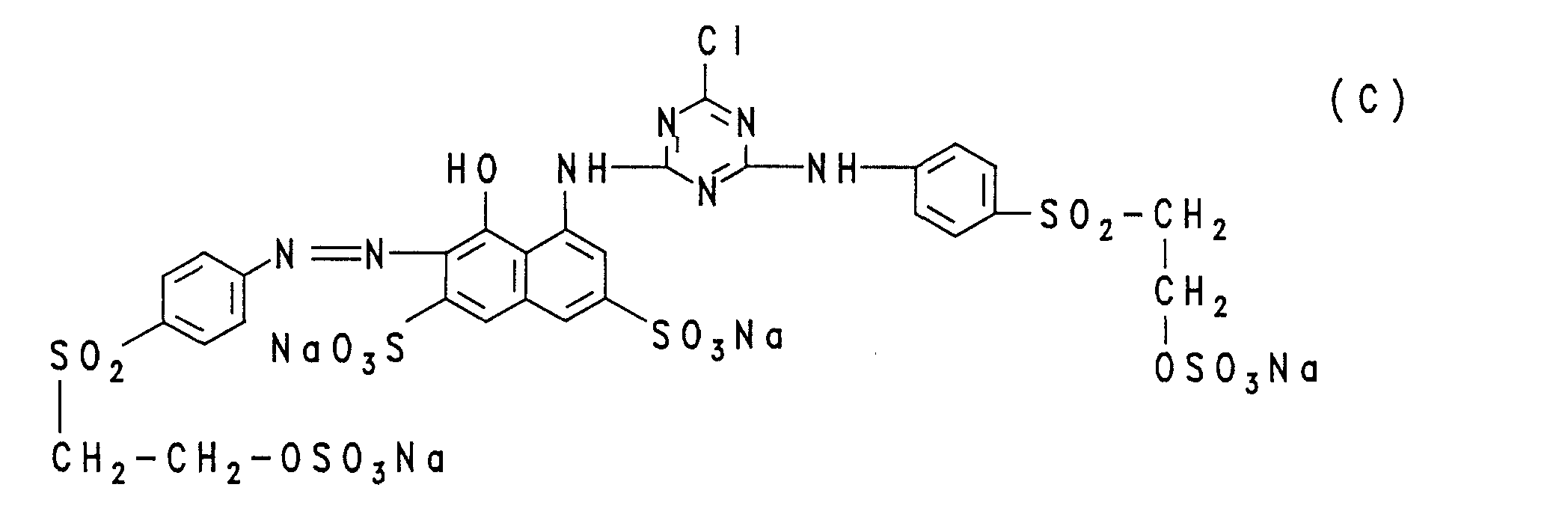
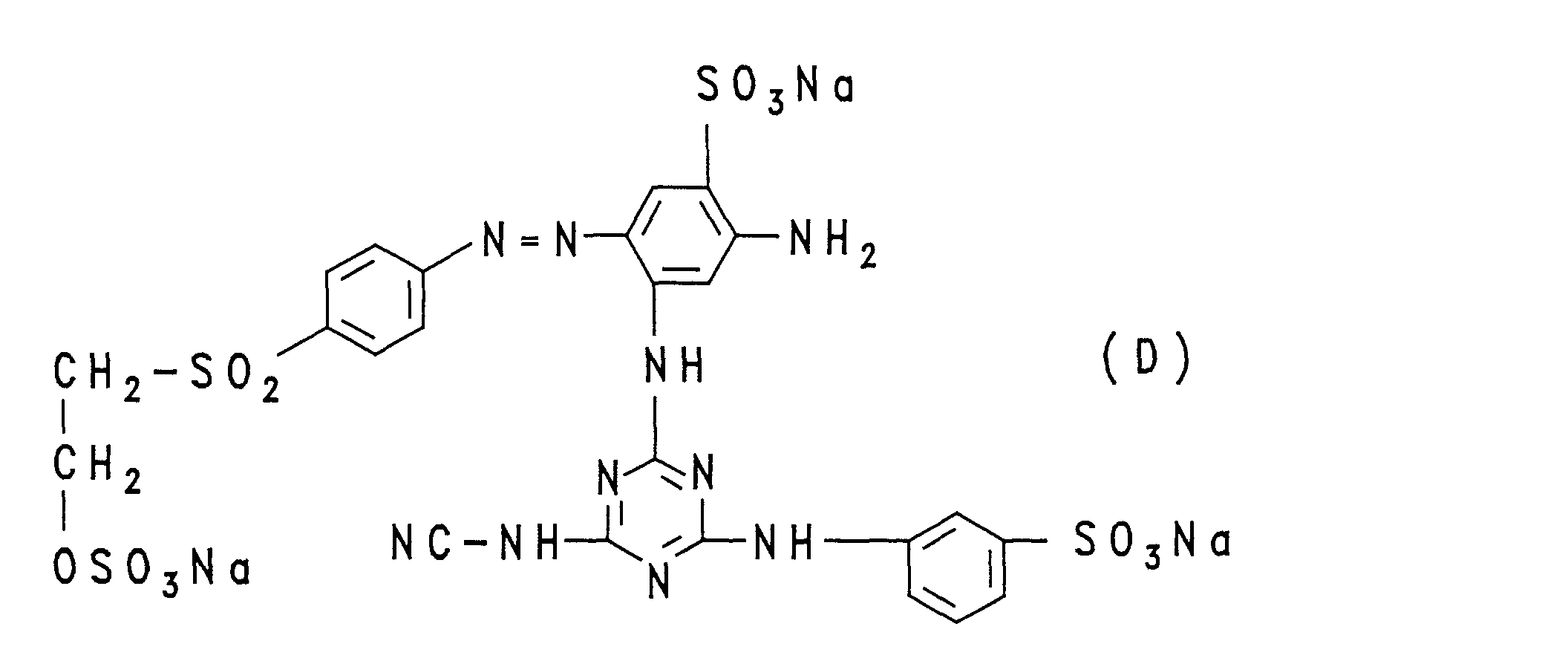
Die erhaltene erfindungsgemäße wäßrige Farbstoffmischung kann direkt der färberischen Verwendung zugeführt oder durch Sprühtrocknung und gegebenenfalls Granulierung in die feste Form übergeführt werden. Die erfindungsgemäße Farbstoffmischung liefert nach den in der Technik für faserreaktive Farbstoffe üblichen Applikations- und Fixierverfahren beispielsweise auf Cellulosefasermaterialien farbstarke, egale graue Färbungen und Drucke mit guten Echtheitseigenschaften.The aqueous dye mixture obtained according to the invention can be used directly in the fed for dyeing or by spray drying and optionally granulation can be converted into the solid form. The dye mixture according to the invention provides according to the in the art for fiber-reactive dyes, for example, customary application and fixing processes strong, level gray dyeings and prints on cellulose fiber materials good fastness properties.
20 Teile einer wäßrigen Lösung, wie bspw. einer aus der Synthese erhältlichen
wäßrigen Lösung, mit 10 Teilen des Kupferformazanfarbstoffes der Formel (G),
20 Teile einer wäßrigen Lösung, wie bspw. einer aus der Synthese erhältlichen
wäßrigen Lösung, mit 10 Teilen des marineblaufärbenden Disazofarbstoffes der
Formel (A) und 1 Teil des rotfärbenden Monoazofarbstoffes der Formel (B),

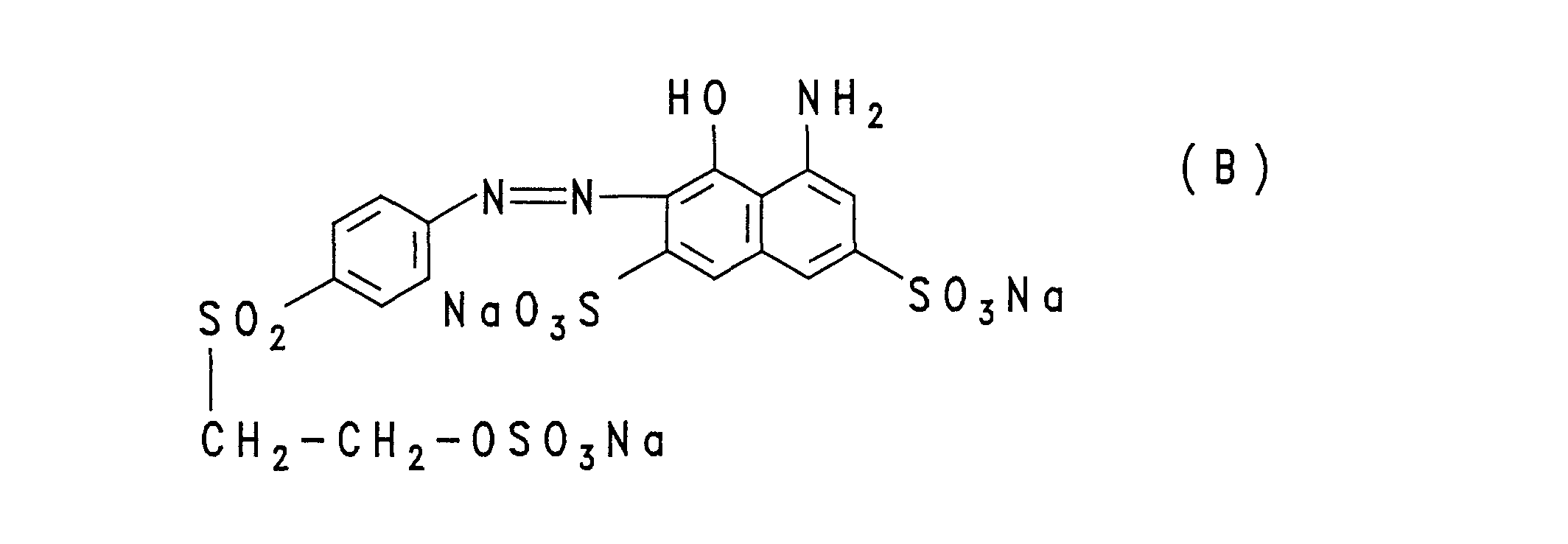
Die erhaltene erfindungsgemäße wäßrige Farbstoffmischung kann direkt der färberischen Verwendung zugeführt oder durch Sprühtrocknung und gegebenenfalls Granulierung in die feste Form übergeführt werden. Die erfindungsgemäße Farbstoffmischung liefert nach den in der Technik für faserreaktive Farbstoffe üblichen Applikations- und Fixierverfahren beispielsweise auf Cellulosefasermaterialien farbstarke, egale schwarze Färbungen und Drucke mit guten Echtheitseigenschaften.The aqueous dye mixture obtained according to the invention can be used directly in the fed for dyeing or by spray drying and optionally granulation can be converted into the solid form. The dye mixture according to the invention provides according to the in the art for fiber-reactive dyes, for example, customary application and fixing processes strong, level black dyeings and prints on cellulose fiber materials with good fastness properties.
33 Teile eines elektrolytsalzhaltigen (vorwiegend natriumchloridhaltigen) Farbstoffpulvers des Farbstoffes der Formel (C) mit einem Farbstoffgehalt von 50 %, 20,5 Teile eines elektrolytsalzhaltigen Farbstoffpulvers des Farbstoffes der Formel (D) mit einem Farbstoffgehalt von 50 % und 15,5 Teile einer Mischung eines elektrolytsalzhaltigen Farbstoffpulvers der Farbstoffe der Formeln (A), (B) und (G) mit einem Farbstoffgehalt von 25 % des Farbstoffes (A), von 0,5 % des Farbstoffes (B) und von 25 % des Farbstoffes (G) werden miteinander mechanisch vermischt.33 parts of an electrolyte salt (predominantly sodium chloride) Dye powder of the dye of formula (C) with a dye content of 50%, 20.5 parts of an electrolyte salt-containing dye powder of the dye of formula (D) with a dye content of 50% and 15.5 parts of a Mixture of an electrolyte salt-containing dye powder of the dyes of the formulas (A), (B) and (G) with a dye content of 25% of the dye (A), from 0.5% of the dye (B) and 25% of the dye (G) mechanically mixed together.
Die erhaltene erfindungsgemäße Farbstoffmischung liefert nach in der Technik für faserreaktive Farbstoffe üblichen Färbe- und Druckverfahren, beispielsweise wie in den nachfolgenden Beispielen A bis F beschrieben, farbstarke dunkelrote egale Färbungen und Drucke von guten Echtheitseigenschaften.The dye mixture according to the invention obtained delivers in the art dyeing and printing processes customary for fiber-reactive dyes, for example as described in Examples A to F below, deep red in color level dyeings and prints with good fastness properties.
In den nachfolgenden Tabellenbeispielen sind weitere erfindungsgemäße
Farbstoffmischungen beschrieben, die auf den in der Beschreibung genannten
Materialien, insbesondere Cellulosefasermaterialien, wie Baumwolle, nach den in
der Technik für faserreaktive Farbstoffe üblichen Färbe- und Druckverfahren
egale Färbungen und Drucke mit den in dem jeweiligen Tabellenbeispiel
angegebenen Farbton liefern (in dem jeweiligen Tabellenbeispiel ist der Farbton
bei mittlerer Farbtiefe angegeben, die mit der erfindungsgemäßen
Farbstoffmischung erhalten werden kann; je nach Einsatzmenge der
Farbstoffmischung in das Färbebad, die Färbeflotte oder Druckpaste ergeben sich
naturgemäß hellere oder dunklere Farbtöne).
100 Teile eines mercerisierten, gebleichten Baumwolltrikots werden in einer Jet-Färbeanlage mit 1000 Teilen einer wäßrigen Lösung, die 1 Teil des rotfärbenden Monoazofarbstoffes der Formel (E), 1 Teil des gelbfärbenden Monoazofarbstoffes der Formel (D) und 1 Teil des blaufärbenden100 parts of a mercerized, bleached cotton jersey are in one Jet dyeing machine with 1000 parts of an aqueous solution containing 1 part of the red-coloring monoazo dye of the formula (E), 1 part of the yellow-coloring Monoazo dye of formula (D) and 1 part of the blue color
Kupferformazanfarbstoffes der Formel (G) sowie 80 Teile wasserfreies
Natriumsulfat, 5 Teile einer wäßrigen 15 %igen Natriumcarbonatlösung und
2 Vol.-Teile einer 33 %igen wäßrigen Natriumhydroxidlösung enthält, während
60 Minuten bei einer Färbetemperatur von 60°C gefärbt. Danach wird die
Färbeflotte abgelassen und das gefärbte Trikot zunächst mit kaltem, sodann mit
heißem und mit kochendem Wasser gespült, in einer wäßrigen Waschlösung, die
in 1000 Teilen etwa 1 bis 2 Teile eines nichtionogenen handelsüblichen
Waschmittels enthält, während 15 Minuten bei 95 bis 100°C behandelt, erneut
mit heißem und mit kaltem Wasser gespült und anschließend geschleudert und
getrocknet.
Es wird eine egale rotbraune Färbung mit guten Echtheitseigenschaften erhalten.Contains copper formazan dye of the formula (G) and 80 parts of anhydrous sodium sulfate, 5 parts of an aqueous 15% sodium carbonate solution and 2 parts by volume of a 33% aqueous sodium hydroxide solution, colored for 60 minutes at a dyeing temperature of 60 ° C. The dyeing liquor is then drained off and the dyed jersey is rinsed first with cold, then with hot and with boiling water, in an aqueous washing solution which contains about 1 to 2 parts of a nonionic commercial detergent in 1000 parts, for 15 minutes at 95 to 100 ° C treated, rinsed again with hot and cold water and then spun and dried.
A level red-brown color with good fastness properties is obtained.
100 Teile eines mercerisierten, gebleichten Baumwolltrikots werden in eine Jet-Färbeanlage,
die 1000 Teile einer wäßrigen Lösung mit 1 Teil des gelbfärbenden
Farbstoffes der Formel (D), 0,5 Teile des rotfärbenden Farbstoffes der Formel
(C), 0,5 Teile des rotfärbenden Farbstoffes der Formel (E), 0,3 Teile des
marineblaufärbenden Farbstoffes der Formel (A) und 0,2 Teile des blaufärbenden
Farbstoffes der Formel (G) sowie 80 Teile Natriumsulfat enthält, eingetragen.
Das Trikot wird zunächst in der Färbeflotte von 20°C etwa fünf Minuten
bewegt; sodann werden unter weiterer Bewegung der Färbeflotte fünf Teile
einer 15 %igen wäßrigen Natriumcarbonatlösung und 2 Teile einer 33 %igen
wäßrigen Natriumhydroxidlösung hinzugegeben. Die Färbeflotte wird innerhalb
von 15 Minuten stetig auf 60°C erwärmt und der Färbeprozeß bei 60°C noch
weitere 60 Minuten weitergeführt. Anschließend wird die Färbeflotte abgelassen
und das gefärbte Trikot gemäß den Angaben des Beispieles A gespült,
nachbehandelt und fertiggestellt.
Es wird eine egale braune Färbung mit guten Echtheitseigenschaften erhalten.100 parts of a mercerized, bleached cotton jersey are in a jet dyeing machine, the 1000 parts of an aqueous solution with 1 part of the yellow dye of formula (D), 0.5 part of the red dye of formula (C), 0.5 part of the contains red-coloring dye of the formula (E), 0.3 part of the navy-blue coloring dye of the formula (A) and 0.2 part of the blue-coloring dye of the formula (G) and 80 parts of sodium sulfate. The jersey is first moved in the dye bath at 20 ° C for about five minutes; five parts of a 15% aqueous sodium carbonate solution and 2 parts of a 33% aqueous sodium hydroxide solution are then added with further movement of the dyeing liquor. The dyeing liquor is continuously heated to 60 ° C. within 15 minutes and the dyeing process is continued at 60 ° C. for a further 60 minutes. The dyeing liquor is then drained off and the dyed jersey is rinsed, aftertreated and finished in accordance with the instructions in Example A.
A level brown color with good fastness properties is obtained.
100 Teile eines mercerisierten, gebleichten Baumwolltrikots werden in eine Jet-Färbeanlage,
die 1000 Teile einer wäßrigen Lösung mit 0,3 Teile des
gelbfärbenden Farbstoffes der Formel (D), 0,3 Teile des rotfärbenden
Farbstoffes der Formel (C), 0,3 Teile des rotfärbenden Farbstoffes der Formel
(E), 0,3 Teile des marineblaufärbenden Farbstoffes der Formel (A) und 0,2 Teile
des blaufärbenden Farbstoffes der Formel (G) sowie 80 Teile Natriumsulfat
enthält, eingetragen. Das Trikot wird zunächst in der Färbeflotte von 20°C etwa
fünf Minuten bewegt; sodann werden unter weiterer Bewegung der Färbeflotte
5 Teile einer 15 %igen wäßrigen Natriumcarbonatlösung und 2 Teile einer
33 %igen wäßrigen Natriumhydroxidlösung hinzugegeben. Die Färbeflotte wird
innerhalb von 15 Minuten stetig auf 60°C erwärmt und der Färbeprozeß bei
60°C noch weitere 60 Minuten weitergeführt. Anschließend wird die Färbeflotte
abgelassen und das gefärbte Trikot gemäß den Angaben des Beispieles A
gespült, nachbehandelt und fertiggestellt.
Es wird eine egale beige Färbung mit guten Echtheitseigenschaften erhalten.100 parts of a mercerized, bleached cotton jersey are placed in a jet dyeing machine, the 1000 parts of an aqueous solution with 0.3 part of the yellow dye of the formula (D), 0.3 part of the red dye of the formula (C), 0.3 Contains parts of the red-coloring dye of the formula (E), 0.3 part of the navy-blue coloring dye of the formula (A) and 0.2 parts of the blue-coloring dye of the formula (G) and 80 parts of sodium sulfate. The jersey is first moved in the dye bath at 20 ° C for about five minutes; then 5 parts of a 15% aqueous sodium carbonate solution and 2 parts of a 33% aqueous sodium hydroxide solution are added with further movement of the dyeing liquor. The dyeing liquor is continuously heated to 60 ° C. within 15 minutes and the dyeing process is continued at 60 ° C. for a further 60 minutes. The dyeing liquor is then drained off and the dyed jersey is rinsed, aftertreated and finished in accordance with the instructions in Example A.
A level beige coloring with good fastness properties is obtained.
100 Teile eines mercerisierten, gebleichten Baumwolltrikots werden in einer Jet-Färbeanlage
während 60 Minuten bei 60°C in 1000 Teilen einer wäßrigen
Färbelösung, die 1 Teil des gelbfärbenden Farbstoffes der Formel (D), 1 Teil des
rotfärbenden Farbstoffes der Formel (C), 0,25 Teile des marineblaufärbenden
Farbstoffes der Formel (A), 0,25 Teile des blaufärbenden
Kupferformazanfarbstoffes der Formel (G) sowie 50 Teile Natriumsulfat, 5 Teile
einer 15 %igen wäßrigen Natriumcarbonatlösung und 2 Teile einer 33 %igen
wäßrigen Natriumhydroxidlösung enthält, gefärbt. Anschließend wird das
erhaltene, gefärbte Baumwolltrikot in üblicher Weise, wie beispielsweise in
Beispiel A angegeben, nachbehandelt und fertiggestellt.
Es wird eine egale braune Färbung mit guten Echtheitseigenschaften erhalten.100 parts of a mercerized, bleached cotton jersey are in a jet dyeing machine for 60 minutes at 60 ° C in 1000 parts of an aqueous dyeing solution, which is 1 part of the yellow dye of formula (D), 1 part of the red dye of formula (C), Contains 0.25 part of the navy blue dye of formula (A), 0.25 part of the blue copper formazan dye of formula (G) and 50 parts of sodium sulfate, 5 parts of a 15% aqueous sodium carbonate solution and 2 parts of a 33% aqueous sodium hydroxide solution . The dyed cotton jersey obtained is then aftertreated and finished in the customary manner, as indicated, for example, in Example A.
A level brown color with good fastness properties is obtained.
100 Teile eines mercerisierten, gebleichten Baumwolltrikots werden in einer Jet-Färbeanlage
während 60 Minuten bei 60°C in 1000 Teilen einer wäßrigen
Färbelösung, die 0,2 Teile des gelbfärbenden Farbstoffes der Formel (F), 0,1
Teile des rotfärbenden Monoazofarbstoffes der Formel (C), 0,1 Teile des
rotfärbenden Farbstoffes der Formel (E), 0,12 Teile des
Kupferformazanfarbstoffes der Formel (G) und 0,18 Teile des
marineblaufärbenden Farbstoffes der Formel (A) sowie 50 Teile Natriumsulfat, 5
Teile einer wäßrigen 15 %igen Natriumcarbonatlösung und 2 Teile einer 33
%igen wäßrigen Natriumhydroxidlösung enthält, gefärbt. Anschließend wird das
erhaltene, gefärbte Baumwolltrikot in üblicher Weise, wie beispielsweise in
Beispiel A angegeben, nachbehandelt und fertiggestellt.
Es wird eine egale braune Färbung mit guten Echtheitseigenschaften erhalten. 100 parts of a mercerized, bleached cotton jersey are in a jet dyeing machine for 60 minutes at 60 ° C in 1000 parts of an aqueous dyeing solution, the 0.2 parts of the yellow dye of the formula (F), 0.1 part of the red dyeing monoazo dye of the formula (C), 0.1 part of the red-coloring dye of the formula (E), 0.12 part of the copper formazan dye of the formula (G) and 0.18 part of the navy-blue coloring dye of the formula (A) and 50 parts of sodium sulfate, 5 parts of an aqueous Contains 15% sodium carbonate solution and 2 parts of a 33% aqueous sodium hydroxide solution. The dyed cotton jersey obtained is then aftertreated and finished in the customary manner, as indicated, for example, in Example A.
A level brown color with good fastness properties is obtained.
40 Teile des Farbstoffes der Formel (F) (in Form seines elektrolytsalzhaltigen
Farbstoffpulvers), 1,5 Teile des Farbstoffes der Formel (C) (in Form seines
elektrolytsalzhaltigen Farbstoffpulvers) und 2 Teile des Farbstoffes der Formel
(G) (in Form seines elektrolytsalzhaltigen Farbstoffpulvers) werden in 1000
Teilen Wasser von etwa 20°C gelöst. Zu dieser Farbstofflösung werden 25
Teile einer 33 %igen wäßrigen Natronlauge und 95 Teile Wasserglas von 38°
Bé gegeben. Mercerisierte Baumwollpopeline wird mit dieser Färbeflotte auf
einem handelsüblichen Foulard mit einer Flottenaufnahme von etwa 70 %
geklotzt, auf eine Docke aufgewickelt, in eine Plastikfolie eingehüllt und bei
20°C mehrere Stunden verweilen lassen. Anschließend wird das gefärbte
Gewebe wie üblich nachbehandelt und fertiggestellt, wie bpsw. in der im
Beispiel A angegebenen Weise.
Man erhält eine egale orangebraune Färbung mit guten Echtheitseigenschaften.40 parts of the dye of formula (F) (in the form of its electrolyte salt-containing dye powder), 1.5 parts of the dye of formula (C) (in the form of its electrolyte salt-containing dye powder) and 2 parts of the dye of formula (G) (in the form of its electrolyte salt-containing Dye powder) are dissolved in 1000 parts of water at about 20 ° C. 25 parts of a 33% strength aqueous sodium hydroxide solution and 95 parts of 38 ° Bé water glass are added to this dye solution. Mercerized cotton poplin is padded with this dye liquor on a commercially available foulard with a liquor absorption of about 70%, wound up on a dock, wrapped in plastic wrap and left to stand at 20 ° C for several hours. The dyed fabric is then post-treated and finished as usual, such as bpsw. in the manner indicated in Example A.
A level orange-brown coloration with good fastness properties is obtained.
Man verfährt gemäß der Verfahrensweise des Beispieles A zur Färbung von
100 Teilen eines mercerisierten, gebleichten Baumwolltrikots und setzt hierzu
als Färbeflotte 1000 Teile einer wäßrigen Lösung hinzu, die die in den
nachfolgenden Tabellenbeispielen beschriebene Farbstoffmischung sowie die in
Beispiel A angegebenen Elektrolytsalze und alkalisch wirkenden Mitteln enthält.
Nach Fertigstellung der Färbungen gemäß den in Beispiel A angegebenen
Bedingungen erhält man egale Färbungen in den in dem jeweiligen
Tabellenbeispiel angegebenen Farbton.
Hue given in the table example.
Claims (14)
- A dye mixture comprising one or two copper formazan dyes of the formula (3) given and defined below and one or more azo dyes which are selected from the group of one or more monoazo dyes of the formula (la) or (1b) or (la) and (1b) given and defined below, one or more monoazo dyes of the formula (2) given and defined below, one or more disazo dyes of the formula (4) given and defined below and, if desired, one or two monoazo dyes of the formula (5) given and defined below:

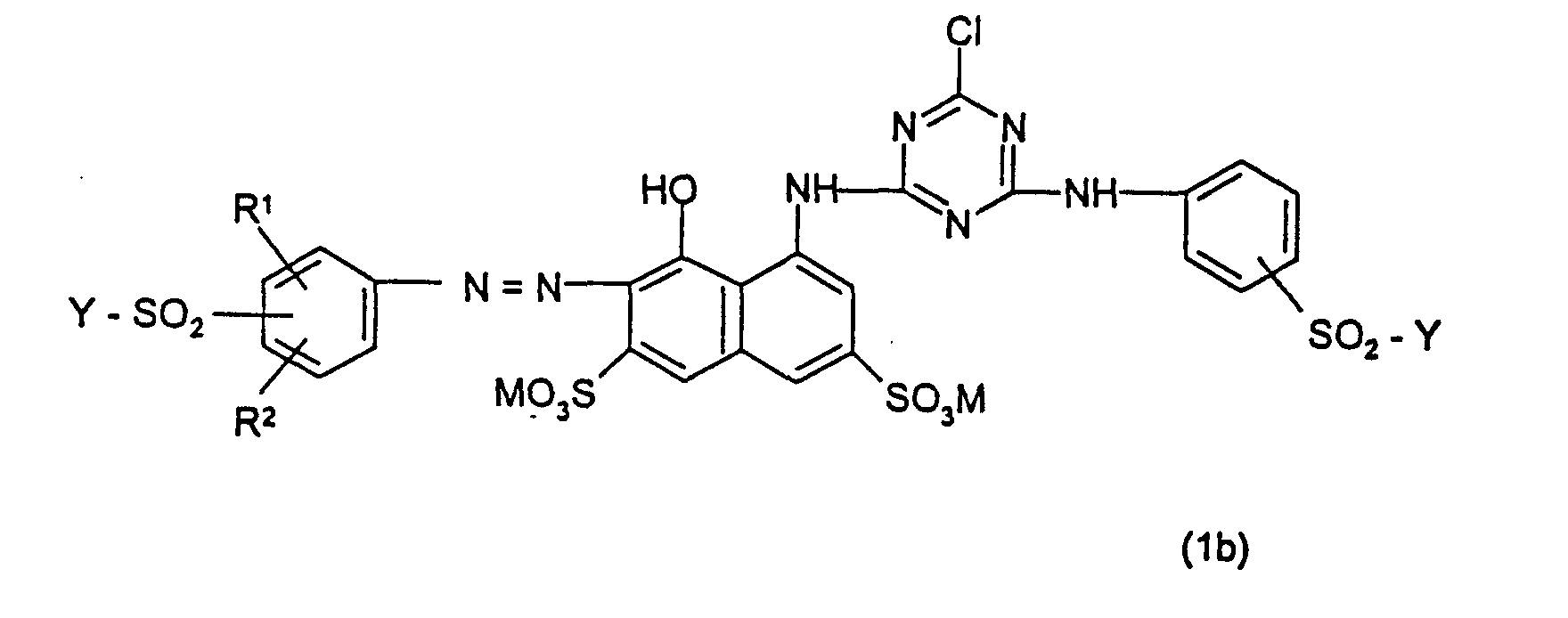

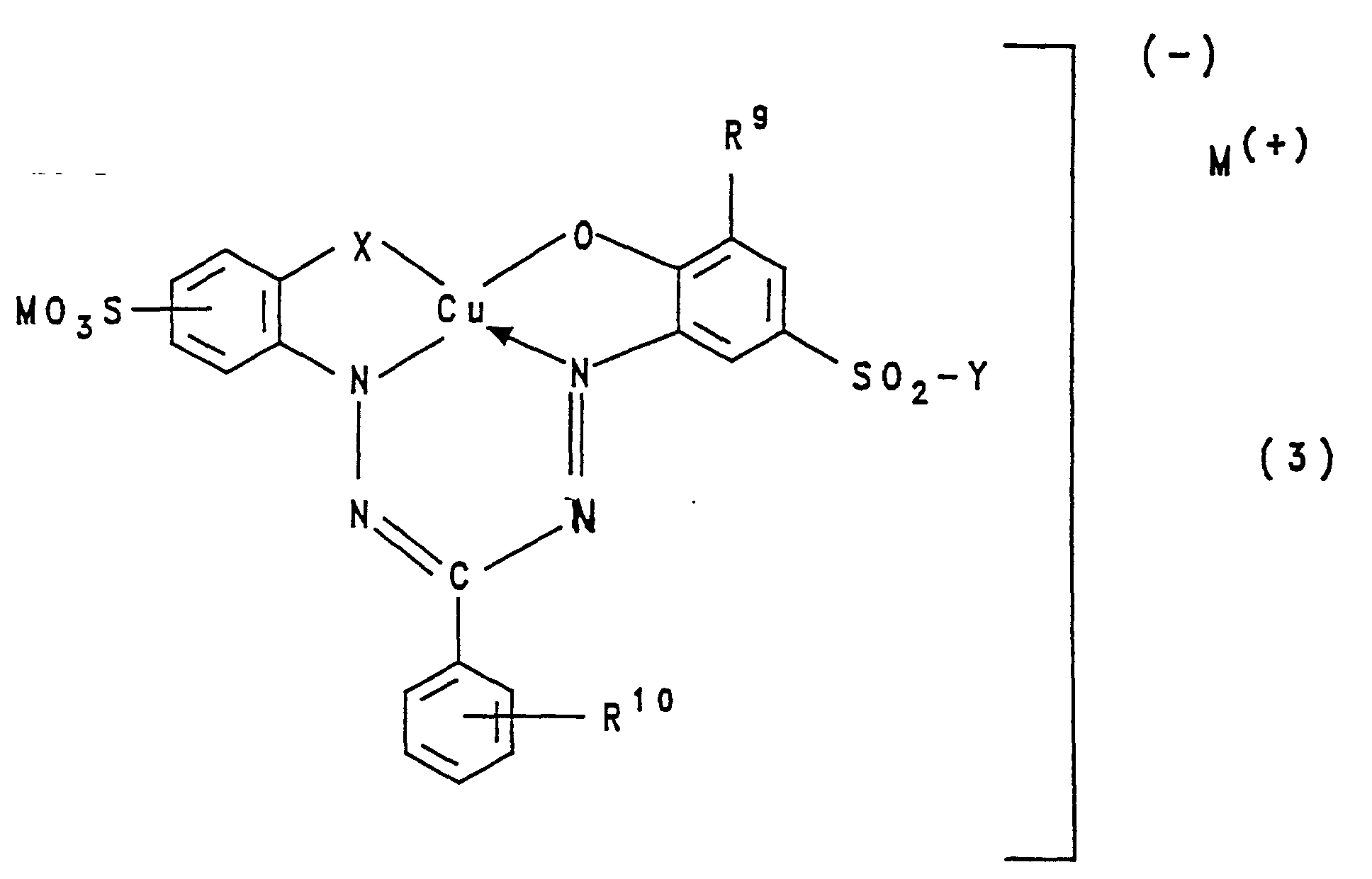
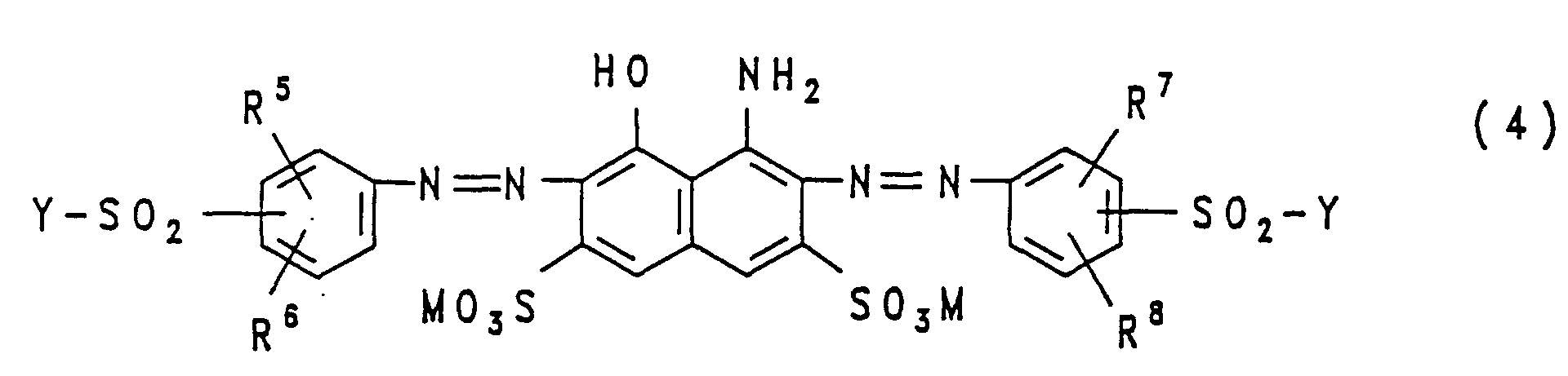 in which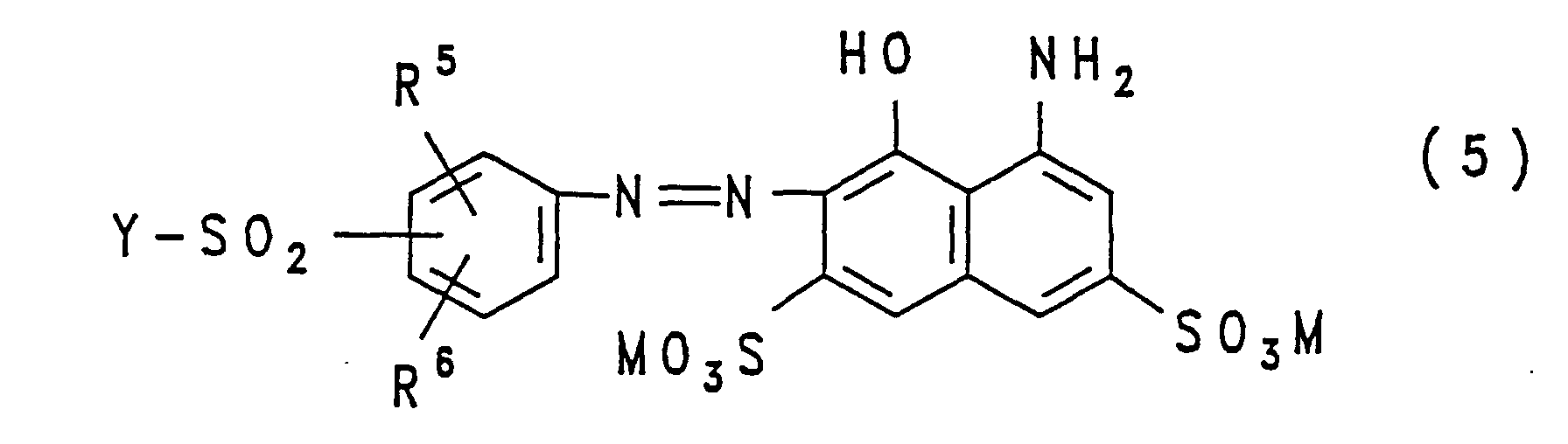
- M
- is hydrogen or an alkali metal,
- R1
- is hydrogen, methyl, ethyl, methoxy or ethoxy,
- R2
- is hydrogen, methyl, ethyl, methoxy or ethoxy,
- R3
- is hydrogen, methyl, ethyl, methoxy or ethoxy,
- R4
- is hydrogen, methyl, ethyl, methoxy or ethoxy,
- R5
- is hydrogen, methyl, ethyl, methoxy or ethoxy,
- R6
- is hydrogen, methyl, ethyl, methoxy or ethoxy,
- R7
- is hydrogen, methyl, ethyl, methoxy or ethoxy,
- R8
- is hydrogen, methyl, ethyl, methoxy or ethoxy,
- R9
- is hydrogen or sulfo,
- R10
- is hydrogen, alkyl of 1 to 4 carbon atoms, sulfo, carboxyl, alkanoyl of 2 to 5 carbon atoms or a group of the formula -SO2-Y where Y has one of the meanings given below,
- R20
- is hydrogen, methyl, sulfo or carboxyl,
- X
- is carbonyloxy of the formula -CO-O- or oxy of the
formula -O- or is the group -SO3 (-),
each Y, independently of the others, is vinyl, β-chloroethyl, β-thiosulfatoethyl or β-sulfatoethyl, - Z1
- is alkanoyl of 2 to 5 carbon atoms, benzoyl, 2-cyanoamino-4-chloro-1,3,5-triazin-6-yl,
2-cyanoamino-4-fluoro-1,3,5-triazin-6-yl,
2,4-dichloro-1,3,5-triazin-6-yl
or a group of the formula (a)
in which
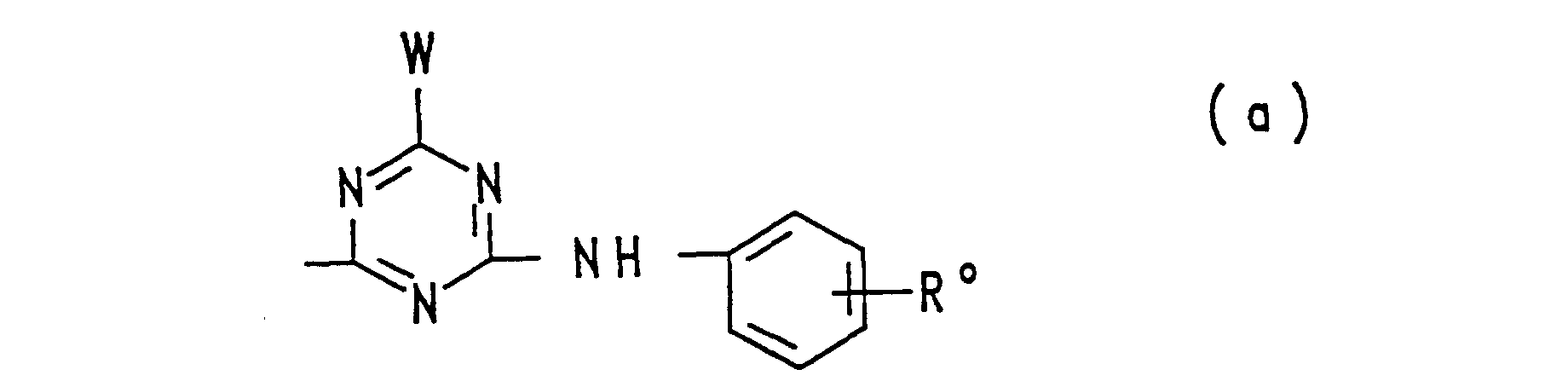
- W
- is chlorine, fluorine or cyanamino and
- R0
- is sulfo, carboxyl or a group of the formula -SO2-Y where Y has one of the meanings given above.
- A dye mixture as claimed in claim 1 comprising one or more monoazo dyes of the formula (1a) or (1b) or a mixture of the same and one or two copper formazan dyes of the formula (3) or comprising one or more monoazo dyes of the formula (1a) or (1b) or a mixture of the same, one or two copper formazan dyes of the formula (3), one or more disazo dyes of the formula (4) and, if desired, one or two monoazo dyes of the formula (5).
- A dye mixture as claimed in claim 1 comprising one or more monoazo dyes of the formula (2) and one or two copper formazan dyes of the formula (3) or comprising one or more monoazo dyes of the formula (2), one or two copper formazan dyes of the formula (3), one or more disazo dyes of the formula (4) and, if desired, one or two monoazo dyes of the formula (5).
- A dye mixture as claimed in one of claims 1 to 3, wherein R1, R3, R5 and R7, independently of one another, are each methoxy or hydrogen and R2, R4, R6 and R8 are each hydrogen.
- A dye mixture as claimed in at least one of claims 1 to 4, wherein each Y, independently of the others, is vinyl or β-sulfatoethyl.
- A dye mixture as claimed in at least one of claims 1 to 5, wherein the dye mixture contains two or more dyes of the formula (1a) and (1b) in which in formula (1a) the radical R20 is sulfo.
- A dye mixture as claimed in claim 6, wherein the dye(s) of the formula (1a) where R is sulfo and the dye(s) of the formula (1b) are present in a mixing ratio of 75 : 25 to 25 : 75% by weight.
- A dye mixture as claimed in at least one of claims 1 to 7, wherein the dye mixture contains two or more dyes of the formulae (3) and (4).
- A dye mixture as claimed in claim 8, wherein the dye(s) of the formula (3) and the dye(s) of the formula (4) are present in a mixing ratio of 75 : 25 to 25 : 75% by weight.
- A dye mixture as claimed in claim 8 or 9, wherein the dye mixture contains one or two dyes of the formula (5).
- A process for preparing a dye mixture as claimed in claim 1, 2 or 3, which comprises mixing the individual dyes or mixtures of two or three of such individual dyes with the other individual dyes or mixtures thereof in the form of their dye powders or aqueous solutions.
- Use of a dye mixture as claimed in at least one of claims 1 to 10 or of one or two of the dyes of the formula (3) as claimed and defined in claim 1 and one or more dyes of the formulae (1a), (1b), (2) and (4) and, if desired, (5) together or some of them together for dyeing hydroxyl- and/or carboxamido-containing fiber material.
- A process for dyeing hydroxyl- and/or carboxamido-containing fiber material, in which dyes are applied to the material in dissolved form and the dyes are fixed on the material by means of heat and/or by means of an alkaline agent, which process comprises using, as the dyes, a dye mixture as claimed in at least one of claims 1 to 10 or of one or two of the dyes of the formula (3) as claimed and defined in claim 1 and one or more dyes of the formulae (1a, (1b), (2) and (4) and, if desired, (5) together or some of them together.
- The process as claimed in claim 13, which comprises using a dye mixture as claimed in at least one of claims 1 to 10 or one or two of the dyes of the formula (3) as claimed and defined in claim 1 and one or more dyes of the formulae (1a), (1b), (2) and (4) and, if desired, (5) together or some of them together in a trichromatic dyeing method.
Applications Claiming Priority (2)
| Application Number | Priority Date | Filing Date | Title |
|---|---|---|---|
| DE19511688 | 1995-03-30 | ||
| DE19511688A DE19511688C2 (en) | 1995-03-30 | 1995-03-30 | Dye mixtures of fiber-reactive azo dyes and their use for dyeing fiber material containing hydroxyl and / or carbonamide groups |
Publications (3)
| Publication Number | Publication Date |
|---|---|
| EP0735112A2 EP0735112A2 (en) | 1996-10-02 |
| EP0735112A3 EP0735112A3 (en) | 1996-11-13 |
| EP0735112B1 true EP0735112B1 (en) | 2001-08-01 |
Family
ID=7758165
Family Applications (1)
| Application Number | Title | Priority Date | Filing Date |
|---|---|---|---|
| EP96104707A Expired - Lifetime EP0735112B1 (en) | 1995-03-30 | 1996-03-25 | Mixtures of reactive azo dyes and their use for dyeing fibrous material containing hydroxy and/or carbonamide groups |
Country Status (5)
| Country | Link |
|---|---|
| US (1) | US5779739A (en) |
| EP (1) | EP0735112B1 (en) |
| JP (1) | JP3910231B2 (en) |
| DE (2) | DE19511688C2 (en) |
| TR (1) | TR199600248A2 (en) |
Families Citing this family (27)
| Publication number | Priority date | Publication date | Assignee | Title |
|---|---|---|---|---|
| DE19640203A1 (en) | 1996-09-30 | 1998-04-02 | Dystar Textilfarben Gmbh & Co | Mixtures of blue-dyeing fiber-reactive dyes and their use for dyeing fiber material containing hydroxyl and / or carbonamide groups |
| SG68660A1 (en) * | 1997-04-07 | 1999-11-16 | Ciba Sc Holding Ag | Mixtures of reactive dyes and their use |
| US5989298A (en) * | 1997-04-07 | 1999-11-23 | Ciba Speciality Chemicals Corporation | Mixtures of reactive dyes and their use |
| US5931974A (en) * | 1998-07-28 | 1999-08-03 | Dystar Textilfarben Gmbh & Co. | Deep black dye mixtures of fiber-reactive azo dyes and use thereof for dyeing hydroxy- and/or carboxamido-containing fiber material |
| DE19844841A1 (en) * | 1998-09-30 | 2000-04-13 | Dystar Textilfarben Gmbh & Co | Dye mixtures of water-soluble fiber-reactive azo dyes, process for their preparation and their use |
| DE19851497A1 (en) * | 1998-11-09 | 2000-05-18 | Dystar Textilfarben Gmbh & Co | Dye mixtures of fiber-reactive azo dyes and their use |
| US6171349B1 (en) * | 1999-01-20 | 2001-01-09 | Everlight Usa, Inc. | Reactive dye composition |
| US6126700A (en) * | 1999-01-20 | 2000-10-03 | Everlight Usa, Inc. | Black dye composition |
| DE60008698T2 (en) | 1999-02-05 | 2004-07-29 | Ciba Specialty Chemicals Holding Inc. | BLACK INKING INKS AND THEIR USE |
| US6143039A (en) * | 1999-04-12 | 2000-11-07 | Dystar Textilfarben Gmbh & Co. | Blue dye mixtures of fiber-reactive copper complex formazan dyes |
| TR200102952T2 (en) * | 1999-04-15 | 2002-04-22 | Dystar Textilfarben Gmbh & Co. Deutschland Kg. | Dark dark blue dye mixtures of azo dyes reacting with fiber and a method for preparing them |
| DE19923989A1 (en) * | 1999-05-26 | 2000-11-30 | Dystar Textilfarben Gmbh & Co | Water-soluble fiber-reactive dyes, processes for their preparation and their use |
| US6159251A (en) * | 1999-10-05 | 2000-12-12 | Dystar Textilfarbon Gmbh & Co. Deutschland Kg | Dye mixtures of fiber-reactive azo dyes and use thereof for dyeing material containing hydroxy-and/or carboxamido groups |
| JP2004504469A (en) * | 2000-07-25 | 2004-02-12 | ダイスター・テクスティルファルベン・ゲゼルシャフト・ミト・ベシュレンクテル・ハフツング・ウント・コンパニー・ドイッチュラント・コマンデイトゲゼルシャフト | Black dye mixtures of fiber-reactive azo dyes, their preparation and their use for dyeing hydroxy- and / or carboxamide-containing fiber materials |
| US6712863B2 (en) * | 2000-12-11 | 2004-03-30 | Dystar Textilfarben Gmbh & Co. Deutschland Kg | Black dye mixtures of fiber-reactive azo dyes, methods for their preparation and use thereof for dyeing hydroxy-and/or carboxamido-containing fiber material |
| DE10064496A1 (en) * | 2000-12-22 | 2002-07-04 | Dystar Textilfarben Gmbh & Co | Black dye mixtures of fiber-reactive azo dyes and their use for dyeing fiber material containing hydroxyl and / or carbonamide groups |
| AU2002344364A1 (en) * | 2001-06-01 | 2002-12-16 | Dystar Textilfarben Gmbh And Co. Deutschland Kg | Black dye mixtures of fiber-reactive azo dyes and use thereof for dyeing material containing hydroxy-and/or carboxamido groups |
| GB0124842D0 (en) * | 2001-10-17 | 2001-12-05 | Clariant Int Ltd | Improvements relating to organic compounds |
| KR100593205B1 (en) | 2005-01-25 | 2006-06-28 | (주)경인양행 | Novel yellow dyes and mixtures thereof |
| CN101289579B (en) * | 2007-04-16 | 2011-03-30 | 明德国际仓储贸易(上海)有限公司 | Black dye composition and black ink composition |
| US20090068325A1 (en) * | 2007-09-10 | 2009-03-12 | Gil Depicciotto | Method of treatment of fresh produce |
| CN102585553B (en) * | 2011-01-14 | 2013-12-04 | 上海雅运纺织化工股份有限公司 | Navy-blue reactive dye composition and dyeing application thereof |
| CN102277011A (en) * | 2011-06-17 | 2011-12-14 | 上海雅运纺织化工有限公司 | Red reactive dye composition and application thereof to fiber dyeing |
| CN102911524B (en) * | 2012-10-31 | 2015-04-15 | 无锡润新染料有限公司 | Reactive golden yellow dye and composite reactive brown dye |
| CN103554978A (en) * | 2013-09-29 | 2014-02-05 | 天津德凯化工股份有限公司 | Golden yellow reactive dye and preparation method thereof |
| CN112574591B (en) * | 2020-12-14 | 2022-07-26 | 湖北华丽染料工业有限公司 | Scarlet reactive dye and application thereof |
| CN114835410B (en) * | 2022-05-31 | 2023-02-28 | 西安交通大学 | Method for Screening Drying Process by Visualizing Glass Fiber Sizing Migration Degree with Dye |
Family Cites Families (21)
| Publication number | Priority date | Publication date | Assignee | Title |
|---|---|---|---|---|
| DE965902C (en) * | 1949-07-19 | 1957-09-19 | Hoechst Ag | Process for fixing water-soluble organic compounds on substrates with a fibrous structure |
| DE960534C (en) * | 1950-01-09 | 1957-03-21 | Hoechst Ag | Process for the production of real colors and prints |
| JPS594451B2 (en) * | 1978-07-21 | 1984-01-30 | 住友化学工業株式会社 | Manufacturing method of disazo dye |
| DE2945537A1 (en) * | 1979-11-10 | 1981-05-21 | Hoechst Ag, 6000 Frankfurt | COPPER COMPLEX MOLDING COMPOUNDS, METHOD FOR THE PRODUCTION THEREOF AND THEIR USE AS DYES |
| IN153408B (en) * | 1979-11-10 | 1984-07-14 | Hoechst Ag | |
| DE2949034A1 (en) * | 1979-12-06 | 1981-06-25 | Hoechst Ag, 6230 Frankfurt | WATER-SOLUBLE AZO COMPOUNDS, METHOD FOR THE PRODUCTION THEREOF AND THEIR USE AS DYES |
| DE3134357A1 (en) * | 1981-08-31 | 1983-03-10 | Hoechst Ag, 6000 Frankfurt | WATER-SOLUBLE AZO COMPOUNDS, METHOD FOR THE PRODUCTION THEREOF AND THEIR USE AS DYES |
| DE3217812A1 (en) * | 1982-05-12 | 1983-11-17 | Hoechst Ag, 6230 Frankfurt | MONOAZO COMPOUNDS, METHOD FOR THEIR PRODUCTION AND THEIR USE AS DYES |
| DE3326638A1 (en) * | 1983-07-23 | 1985-02-07 | Hoechst Ag, 6230 Frankfurt | COPPER COMPLEX MOLDING COMPOUNDS, METHOD FOR THE PRODUCTION THEREOF AND THEIR USE AS DYES |
| JPH0774314B2 (en) * | 1988-09-08 | 1995-08-09 | 三菱化学株式会社 | Water-soluble dye mixture |
| JPH02202956A (en) * | 1989-01-24 | 1990-08-13 | Rika Sangyo Kk | Reactive black dye composition |
| KR920004546B1 (en) * | 1989-07-27 | 1992-06-08 | 세끼스이 아이꼬 가부시끼가이샤 | Adhesive Container |
| JPH03101875A (en) * | 1989-09-13 | 1991-04-26 | Kanto Auto Works Ltd | Electrostatic coating method for resin molded objects |
| KR910008343A (en) * | 1989-10-13 | 1991-05-31 | 김한중 | LPG, LNG gas fueled boilers and ondol plywood made of aluminum chassis |
| ES2052229T3 (en) * | 1990-01-09 | 1994-07-01 | Ciba Geigy Ag | PROCEDURE FOR THE DYEING AND PRINTING OF TRICROMATIC MATES ON CELLULOSIC TEXTILE FIBER MATERIALS. |
| TW268967B (en) * | 1992-11-28 | 1996-01-21 | Hoechst Ag | |
| DE4332047A1 (en) * | 1993-09-21 | 1995-03-23 | Hoechst Ag | Mixtures of fiber-reactive dyes and their use for dyeing fiber materials |
| DE4405358A1 (en) * | 1994-02-19 | 1995-08-24 | Hoechst Ag | Reactive dye mixtures |
| DE4414320A1 (en) * | 1994-04-25 | 1995-10-26 | Hoechst Ag | Black dye mixtures of fiber-reactive azo dyes and their use for dyeing fiber material containing hydroxyl and / or carbonamide groups |
| DE4415385A1 (en) * | 1994-05-02 | 1995-11-09 | Hoechst Ag | Black dye mixtures of fiber-reactive azo dyes and their use for dyeing fiber material containing hydroxyl and / or carbonamide groups |
| US5456727A (en) * | 1994-05-24 | 1995-10-10 | Hoechst Celanese Corporation | Dye compositions for polyamides |
-
1995
- 1995-03-30 DE DE19511688A patent/DE19511688C2/en not_active Expired - Fee Related
-
1996
- 1996-03-25 EP EP96104707A patent/EP0735112B1/en not_active Expired - Lifetime
- 1996-03-25 DE DE59607386T patent/DE59607386D1/en not_active Expired - Lifetime
- 1996-03-28 US US08/627,937 patent/US5779739A/en not_active Expired - Lifetime
- 1996-03-28 TR TR96/00248A patent/TR199600248A2/en unknown
- 1996-03-29 JP JP07760996A patent/JP3910231B2/en not_active Expired - Fee Related
Also Published As
| Publication number | Publication date |
|---|---|
| JPH08269350A (en) | 1996-10-15 |
| EP0735112A2 (en) | 1996-10-02 |
| DE19511688C2 (en) | 1999-07-22 |
| TR199600248A3 (en) | 1996-10-21 |
| JP3910231B2 (en) | 2007-04-25 |
| EP0735112A3 (en) | 1996-11-13 |
| DE59607386D1 (en) | 2001-09-06 |
| TR199600248A2 (en) | 1996-10-21 |
| US5779739A (en) | 1998-07-14 |
| DE19511688A1 (en) | 1996-10-02 |
Similar Documents
| Publication | Publication Date | Title |
|---|---|---|
| EP0735112B1 (en) | Mixtures of reactive azo dyes and their use for dyeing fibrous material containing hydroxy and/or carbonamide groups | |
| EP0731145B1 (en) | Black dyestuff mixtures of fibre reactive azo dyestuffs and their utilization for dyeing of hydroxy- and/or carbonamide group containing fibre material | |
| EP0971002B1 (en) | Mixtures of reactive dyes and their use for dyeing fiber material containing hydroxy and/or carbonamide groups | |
| EP0827987B1 (en) | Mixtures of azo reactive dyes and their use for dyeing fiber material containing hydroxy or carbonamide groups | |
| EP1000983B1 (en) | Dye mixture, process for its preparation and its use | |
| EP0832939B1 (en) | Mixtures of reactive azo dyes dyeing in blue and their use for dyeing fibrous material containing hydroxy and/or carbonamide groups | |
| EP0735111A1 (en) | Mixture of blue reactive dyes and its use for dyeing fibrous materials containing hydroxy and/or carbonamide groups | |
| EP0999240A2 (en) | Mixtures of water soluble reactive azo dyes and their use | |
| DE60000275T2 (en) | Black dye mixtures of fiber-reactive azo dyes, their production processes and their use for dyeing fiber material containing hydroxyl and / or carbonamide groups | |
| DE69901275T2 (en) | Orange dye mixtures of fiber-reactive azo dyes and their use for dyeing material containing hydroxyl and / or carbonamide groups | |
| DE10064496A1 (en) | Black dye mixtures of fiber-reactive azo dyes and their use for dyeing fiber material containing hydroxyl and / or carbonamide groups | |
| DE60002644T2 (en) | Dye mixtures of fiber-reactive azo dyes and their use for dyeing material containing hydroxyl and / or carbonamide groups | |
| DE60004597T2 (en) | Dye mixtures of fiber-reactive azo dyes and their use for dyeing material containing hydroxyl and / or carbonamide groups | |
| EP0226198B1 (en) | Process for isothermic quick-dyeing of wool | |
| EP0992546B1 (en) | Mixtures of water soluble reactive azo dyes, process to manufacture them and their use | |
| EP3521379A1 (en) | Fibre-reactive azo dyes and mixtures of dyestuffs, method for their preparation and their use for dyeing or printing | |
| EP1043366A2 (en) | Mixtures of dyes containing fibre-reactive groups, process to manufacture them and their use for dyeing fibre materials |
Legal Events
| Date | Code | Title | Description |
|---|---|---|---|
| PUAI | Public reference made under article 153(3) epc to a published international application that has entered the european phase |
Free format text: ORIGINAL CODE: 0009012 |
|
| PUAL | Search report despatched |
Free format text: ORIGINAL CODE: 0009013 |
|
| AK | Designated contracting states |
Kind code of ref document: A2 Designated state(s): CH DE FR GB IT LI |
|
| AK | Designated contracting states |
Kind code of ref document: A3 Designated state(s): CH DE FR GB IT LI |
|
| 17P | Request for examination filed |
Effective date: 19970513 |
|
| RAP1 | Party data changed (applicant data changed or rights of an application transferred) |
Owner name: DYSTAR TEXTILFARBEN GMBH & CO. DEUTSCHLAND KG |
|
| 17Q | First examination report despatched |
Effective date: 19990823 |
|
| GRAG | Despatch of communication of intention to grant |
Free format text: ORIGINAL CODE: EPIDOS AGRA |
|
| GRAG | Despatch of communication of intention to grant |
Free format text: ORIGINAL CODE: EPIDOS AGRA |
|
| GRAH | Despatch of communication of intention to grant a patent |
Free format text: ORIGINAL CODE: EPIDOS IGRA |
|
| GRAH | Despatch of communication of intention to grant a patent |
Free format text: ORIGINAL CODE: EPIDOS IGRA |
|
| GRAA | (expected) grant |
Free format text: ORIGINAL CODE: 0009210 |
|
| AK | Designated contracting states |
Kind code of ref document: B1 Designated state(s): CH DE FR GB IT LI |
|
| REG | Reference to a national code |
Ref country code: CH Ref legal event code: EP |
|
| REF | Corresponds to: |
Ref document number: 59607386 Country of ref document: DE Date of ref document: 20010906 |
|
| ITF | It: translation for a ep patent filed | ||
| GBT | Gb: translation of ep patent filed (gb section 77(6)(a)/1977) |
Effective date: 20011107 |
|
| EN | Fr: translation not filed | ||
| REG | Reference to a national code |
Ref country code: GB Ref legal event code: IF02 |
|
| EN | Fr: translation not filed |
Free format text: BO 01/52 PAGES: 283, IL Y A LIEU DE SUPPRIMER: LA MENTION DE LA NON REMISE. LA REMISE EST PUBLIEE DANS LE PRESENT BOPI. |
|
| ET | Fr: translation filed | ||
| PLBE | No opposition filed within time limit |
Free format text: ORIGINAL CODE: 0009261 |
|
| STAA | Information on the status of an ep patent application or granted ep patent |
Free format text: STATUS: NO OPPOSITION FILED WITHIN TIME LIMIT |
|
| 26N | No opposition filed | ||
| REG | Reference to a national code |
Ref country code: GB Ref legal event code: 732E Free format text: REGISTERED BETWEEN 20110303 AND 20110309 |
|
| PG25 | Lapsed in a contracting state [announced via postgrant information from national office to epo] |
Ref country code: IT Free format text: LAPSE BECAUSE OF NON-PAYMENT OF DUE FEES Effective date: 20100325 |
|
| PGFP | Annual fee paid to national office [announced via postgrant information from national office to epo] |
Ref country code: FR Payment date: 20110317 Year of fee payment: 16 Ref country code: CH Payment date: 20110314 Year of fee payment: 16 |
|
| PGFP | Annual fee paid to national office [announced via postgrant information from national office to epo] |
Ref country code: GB Payment date: 20110323 Year of fee payment: 16 Ref country code: IT Payment date: 20110318 Year of fee payment: 16 Ref country code: DE Payment date: 20110317 Year of fee payment: 16 |
|
| PGRI | Patent reinstated in contracting state [announced from national office to epo] |
Ref country code: IT Effective date: 20110616 |
|
| REG | Reference to a national code |
Ref country code: FR Ref legal event code: TP |
|
| REG | Reference to a national code |
Ref country code: CH Ref legal event code: PL |
|
| GBPC | Gb: european patent ceased through non-payment of renewal fee |
Effective date: 20120325 |
|
| REG | Reference to a national code |
Ref country code: FR Ref legal event code: ST Effective date: 20121130 |
|
| PG25 | Lapsed in a contracting state [announced via postgrant information from national office to epo] |
Ref country code: GB Free format text: LAPSE BECAUSE OF NON-PAYMENT OF DUE FEES Effective date: 20120325 Ref country code: FR Free format text: LAPSE BECAUSE OF NON-PAYMENT OF DUE FEES Effective date: 20120402 Ref country code: CH Free format text: LAPSE BECAUSE OF NON-PAYMENT OF DUE FEES Effective date: 20120331 Ref country code: LI Free format text: LAPSE BECAUSE OF NON-PAYMENT OF DUE FEES Effective date: 20120331 |
|
| REG | Reference to a national code |
Ref country code: DE Ref legal event code: R119 Ref document number: 59607386 Country of ref document: DE Effective date: 20121002 |
|
| PG25 | Lapsed in a contracting state [announced via postgrant information from national office to epo] |
Ref country code: IT Free format text: LAPSE BECAUSE OF NON-PAYMENT OF DUE FEES Effective date: 20120325 |
|
| PG25 | Lapsed in a contracting state [announced via postgrant information from national office to epo] |
Ref country code: DE Free format text: LAPSE BECAUSE OF NON-PAYMENT OF DUE FEES Effective date: 20121002 |