EP0735824B1 - Separation rectale - Google Patents
Separation rectale Download PDFInfo
- Publication number
- EP0735824B1 EP0735824B1 EP95933244A EP95933244A EP0735824B1 EP 0735824 B1 EP0735824 B1 EP 0735824B1 EP 95933244 A EP95933244 A EP 95933244A EP 95933244 A EP95933244 A EP 95933244A EP 0735824 B1 EP0735824 B1 EP 0735824B1
- Authority
- EP
- European Patent Office
- Prior art keywords
- rectum
- bag
- anus
- gripping apparatus
- tissues
- Prior art date
- Legal status (The legal status is an assumption and is not a legal conclusion. Google has not performed a legal analysis and makes no representation as to the accuracy of the status listed.)
- Expired - Lifetime
Links
Images

Classifications
-
- A—HUMAN NECESSITIES
- A22—BUTCHERING; MEAT TREATMENT; PROCESSING POULTRY OR FISH
- A22B—SLAUGHTERING
- A22B5/00—Accessories for use during or after slaughtering
- A22B5/0094—Cutting or blocking the rectum of a carcass, e.g. for avoiding fecal contamination
Definitions
- This invention relates to a process and apparatus for separating and closing the rectum of a slaughtered animal carcass.
- the separating of the rectum and closing or "bagging" of the anus is presently a manual operation in the case of cattle and also usually in the case of other slaughtered animals.
- the carcass is hanging from an overhead rail by hooks attached to the bovine's rear legs.
- the slaughterman stands on an elevated floor which is at a height such that the anus of the bovine is at approximately waist level.
- the speed of the conveyor is such that a new animal passes in front of the slaughterman between every 20 and 50 seconds, depending upon the schedule for the abattoir.
- the slaughterman's first task is to separate the rectum.
- the flesh next to the anus is gripped with one hand and the knife held with the other.
- the hold on the anus is to tension the rectum away from the knife.
- the first series of cuts is around the inner surface of the pelvic bone to a depth of approximately 80mm; several strokes are needed to completely circumscribe the anus, rectum and urogenital organs.
- the next series of cuts are required to separate the organs to depths approaching 300mm; the knife hand by this stage is within the pelvis.
- the time taken to perform the separating task is about 10 seconds.
- the stage after the separation of the rectum is the sealing and tying of the rectum.
- a plastic bag is used to cover the separated rectum and associated tissue.
- the bag can then be tied onto the tissue using various devices, such as string, elastic bands or an elastrator ring which is a type of food-approved O-ring which must be expanded using pneumatic pliers.
- the time taken for the sealing is about 10 seconds.
- slaughterman is then required to sterilise his knife and clean any contamination from his hands and arms.
- a mechanised or partially mechanised process is known for use with smaller animals, particularly pigs.
- This mechanised operation involves holding the anus against movement by application of a vacuum, followed by advancing a tubular saw blade which cuts around the rectum.
- the strength of the hold by use of a vacuum is not great and the process and apparatus is unsuitable for larger animals, particularly cattle.
- a process for separating and closing the rectum of a slaughtered animal carcass comprising the steps of:
- the step of cutting tissues may comprise manually cutting tissues around the rectum by manual operation of a cutting tool, e.g. by a slaughterman using a knife.
- the cutting may be carried out by mechanically advancing and operating a cutting means such as a powered cutting blade or saw so as to cut tissues around the rectum to a predetermined depth inside the pelvic cavity.
- the process may include the further step of applying longitudinal tension to the rectum by partial retraction of the gripping apparatus subsequent to the step of gripping tissues so as to thereby straighten the path of the rectum and minimise lateral movement of the rectum during the step of cutting tissues.
- the application of tension is preferred whether the cutting operation is a manual or mechanised process.
- the retraction of the gripping apparatus may continue until a predetermined magnitude of longitudinal tension is applied, or until a predetermined linear extent of retraction is reached.
- an apparatus for separating and closing the rectum of a slaughtered animal carcass including:
- the gripping apparatus comprises a bung member and a clamp, the bung member being arranged to be inserted into the rectum past the anus to a depth so that sphincter muscle tissues constrict behind the bung member and the clamp being advanceable from an initial retracted position to a clamping position in which it clamps the constricted sphincter muscle tissues against a rear portion of the bung member.
- the bung member may have a generally conical shaped head having a rounded nose, the head being mounted on a shaft, the head being inserted in use through the anus into the rectum without piercing the anal canal walls, the head of the bung member having a back face defining a shoulder so that after the head has been inserted to a sufficient depth into the rectum, the sphincter muscle tissues constrict around the shaft behind the shoulder.
- the clamp may be generally annular in shape so as to clamp the constricted sphincter muscle tissues against the shoulder around substantially the entire periphery of the shoulder.
- Advancing means may be operative, after the bag has enclosed the anus and terminal end section of the rectum and has been constricted around the rectum, to advance the bung member and clamp generally in the cranial direction so as to push the bagged anus and end section of the rectum through the pelvic cavity towards the bulk of the abdominal viscera of the carcass.
- the apparatus may include cutting means for mechanically cutting the tissues around the rectum to a predetermined depth inside the pelvic cavity of the carcass.
- the cutting means may include a dorsal cutter coaxially mounted with the gripping apparatus and movable to advance past the gripping apparatus without contacting the closure bag so as to cut tissues of the carcass in an arc between the rectum and the vertebrae, the cutting means also including a ventral cutter movable to advance past the gripping apparatus and operative to cut tissues in an arc between the rectum and the pubis.
- the dorsal and ventral cutters are preferably advanced to perform their respective cutting operations sequentially, although simultaneous operation of the cutters may be possible.
- the gripping apparatus may be movable in the ventral direction by a short distance before advancement of the dorsal cutter so as to thereby move the rectum in that direction and increase the separation between the rectum and the vertebrae enabling the dorsal cutter to be advanced with a reduced possibility of the dorsal cutter contacting and piercing the rectum at the dorsal side of the rectum; the gripping apparatus furthermore being movable in the dorsal direction by a short distance before advancement of the ventral cutter so as to thereby move the rectum in that direction and increase the separation between the rectum and the pubis thereby enabling the ventral cutter to be advanced with a reduced possibility of the ventral cutter contacting and piercing the rectum at the ventral side of the rectum.
- the bagging means may surround the gripping apparatus and may locate and hold the bag during the operation of the gripping apparatus to grip tissues in the region of the anus of the carcass, the bagging means being advanceable past the gripping apparatus and into the region where the tissues have been cut so that the bag inverts as it is being advanced while the closed end of the bag remains gripped at the anus by the gripping apparatus.
- the bagging means includes a bagging sleeve coaxially mounted with the gripping apparatus and mounted for selective advancing movement past the gripping apparatus, whereby the closure bag can be initially located so as to enclose the gripping apparatus and to extend along outside the bagging sleeve with the open top of the bag being clamped by a bag clamp at a point along the length of the sleeve spaced from the end of the sleeve nearer the gripping apparatus, the bag clamp being releasable when the bagging sleeve is advanced to enable the bag to slide back along the bagging sleeve as it is being inverted to enclose the rectum.
- the bagging means preferably further includes a restricting means operative to apply to the rectum a restricting device to cause restriction of the rectum at the point spaced from the anus after the bag has been located around the rectum.
- the restricting device is preferably a restricting ring and the restricting means comprises means for installing the restricting ring which is initially located at the end of the bagging sleeve closest to the gripping apparatus when the bagging means is fully retracted but which is released by the restricting means when the bagging sleeve is fully extended and the bag is located around the anus and end section of the rectum so that the ring thereby tightly clamps the bag to the rectum and constricts the rectum at that point.
- the bagged rectum may be allowed to fall deeper into the pelvic cavity, particularly if the carcass is suspended by the hind legs.
- the bung member and clamp may be further advanced to push the bagged rectum through the pelvic cavity towards the bulk of the abdominal viscera.
- the gripping apparatus can then be released, by retracting the clamp from the bung member in the preferred embodiment, thereby releasing the bagged anus and terminal section of the rectum.
- the apparatus includes a gripping apparatus 20 over which a closure bag 15 is first located.
- the gripping apparatus 20 comprises a conical head 21 with a rounded nose 22 and rear shoulder 23 mounted on a shaft 24 and an annular clamp 25 selectively movable towards and away from the shoulder 23.
- the clamp 25 may be closed against the shoulder 23 and the gripping means 20 is moved to a preset position and the bagging means 30 is extended, e.g to a position as shown in broken line in Fig. 2.
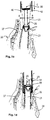
- a ring loading device (not shown) is positioned at the front of the bagging means 30, and an elastrator sealing ring 31 is stretched and deposited onto the end of the inner tube 32 of the bagging means 30 (Fig. 1a).
- the clamp 25 is opened and the gripping apparatus 20 is extended to a preset position to allow bag loading.
- a bag loading device (not shown) feeds a plastic bag 15 over the gripping apparatus 20 and bagging means 30.
- Suitable means mounted on the bag loading device, forces the open end of the plastic bag 15 into the bag clamp 35 (Fig. 2).
- the bag clamp 35 closes and effectively anchors the open end of the bag 15.
- the carcass 10 has preferably been prepared so that the hide is removed entirely from the carcass.
- the hide covering the anus 11 is skinned so that the external sphincter muscle 19 remains intact on the carcass.
- the carcass is suspended in a known centred position at the bagging station.
- a probe (not shown) applies low voltage to the base of the tail 12, causing the tail to centralise and become erect.
- a tail restraint mechanism 14 applies a small downward load onto the tail to hold it in position during anus location.
- the gripping apparatus 20 and bagging means 30 may be supported by an adjustable overhead support assembly 40 which can be manually positioned to locate the head 21 adjacent the anus 11.
- an automatic anus locater (not shown) locates the position of the anus 11, e.g. by analysing the profile of the carcass to locate the concavity where the anus is located, and relays the data to a Programmable Logic Controller (PLC) for the apparatus.
- PLC Programmable Logic Controller
- the head 21 is then advanced and enters the anus 11 to a pre-determined position where the sphincter muscle tissues 19 have constricted behind the head 21 (Fig. 1a).
- the application of a voltage to the base of the tail 12, the provision of the tail restraint 14, and the automatic anus locater can be omitted from the process and apparatus since the slaughterman can locate the anus 11 and rectum 13 and can control the clamping operation.
- the advancement of the head 21 can be manually controlled by manually positioning the carcass 10 and/or mounting assembly 40 for the head 21 and by manually initiating the head advancement, e.g. by operation of a switch.
- the gripping apparatus 20 moves in a dorsal direction A (Fig. 1a), i.e. to the dorsal side of the pelvic cavity, until the clamp 25 contacts the carcass 10 in the approximate area of the first caudal vertebra. Integral force transducers (not shown) detect this contact and relay the information to the PLC. The gripping apparatus 20 then moves in a ventral direction B to detect resistance from the pubis 16. These two measurements set the parameters for the operation of the dorsal and ventral cutting blades 41, 42 described below.
- the gripping apparatus 20 is centred (manually or automatically) at the grip position (Fig. 1a) and the clamp 25 is closed, effectively gripping the anus 11, by gripping the external sphincter muscle tissues 19 between the shoulder 23 and clamp 25.
- the pre-applied plastic bag 15 is also clamped but not pierced (Fig. 1b).
- the bagging means 30 is moved away from the carcass 10 to apply a preset load or tension to the gripped plastic bag 15, thus ensuring the bag is clear of the cutting area, i.e. where the slaughterman will be wielding the knife, or, in the mechanical cutting embodiment, in the path of the cutters 41, 42.
- the gripping apparatus 20 is moved away from the carcass 10 to apply tension to the bung area and straighten the rectum 13.
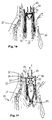
- the bagging means 30 moves proportionally to maintain bag tension (Fig. 1c).
- the connective tissues around the rectum 13 are then manually cut.
- the apparatus is positioned for the dorsal cut by moving the gripping apparatus 20 in the ventral direction B by a distance determined as described above, thus moving the gripped rectum 13 in the ventral direction maximising the separation of the rectum 13 from the vertebrae 17.
- the arcuate dorsal cutter blade 41 is advanced by ram 43 to cut tissues in an arc around the dorsal side of the rectum 13.
- the apparatus is then positioned by dorsal displacement in direction A for the ventral cut and the ventral cutter blade 42 is advanced by ram 44 in direction C to cut tissues in an arc around the ventral side of the rectum 13 (Fig. 1c).
- the cutter blades 41, 42 are then withdrawn.
- the cutter blades 41, 42, tail restraint 14, means 43, 44 for effecting the ventral and dorsal movement are not needed and are therefore omitted from the apparatus.
- the bag clamp 35 releases the open end of the plastic bag 15.
- the bagging means 30 moves fully forward (Fig. 1d) and inverts the plastic bag 15 over the severed bung or terminal end section of the rectum 13 which is held in the gripping apparatus 20.
- a mechanical actuation e.g. advancement of outer sleeve 33 relative to inner sleeve 32 causes the pre-applied expanded elastrator sealing ring 31 to be dislodged from the end of inner sleeve 32.
- the ring 31 contracts and clamps the plastic bag 15 to the severed rectum 13 (Fig. 1f).
- the severed rectum 13 is now completely sealed by the plastic bag 15 to a point approximately 150 mm in from the anus 11 in the case of a bovine carcass.
- the bagging means 30 is withdrawn in direction D (Fig. 1f) and advancing means 45 advances the gripping apparatus 20 to push the bagged and sealed rectum 13 in the cranial direction into the pelvic cavity to a distance of approximately 600 to 700 mm. This will sever any remaining connective tissue between the rectum and the pelvis.
- the clamp 25 is opened and the gripping apparatus 20 withdrawn fully from the carcass 10 in direction E (Fig. 1f). If the bagged rectum has not already been pushed deeper into the pelvic cavity, the release of the clamp 25 allows the bagged rectum to fall under gravity deeper into the pelvic cavity, particularly if the carcass is suspended by the hind legs with the animal's head down.
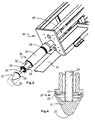
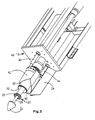
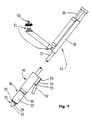
- the apparatus in Fig. 5 is suitable for manual positioning and operation.
- the gripping apparatus 20 and bagging means 30 in Fig. 5 are constructed and operated the same as in the previously described embodiments.
- the cutting blades 41, 42 are not provided since the apparatus in Fig. 5 is useable with manual cutting of tissues around the rectum.
- the overhead support assembly 40 in Fig. 5 is suspended from part 50 of the building structure so that the entire assembly 40 can be moved linearly along the part 50 and can also be moved rotatably about joints 51 to position the gripping apparatus 20 preparatory to rectum clamping and separating.
- Handles 52 enable an operator to manually position the assembly. Adjacent the handles 52 there are control switches 53, 54, 55 which can be selectively operated so as to control the operation of the apparatus. Switch 53 can be operated to extend and retract the head 21 of the gripping apparatus 20 as described earlier.
- Switch 54 can be operated to selectively advance and retract the entire assembly by controlling operation of the advancing means 45.
- the advancing means 45 comprises an advancing ram 56 which moves support arm 57 in the mounting sleeve 58 so as to thereby advance and retract the support assembly 40 and hence the gripping apparatus 20 and bagging means 30.
- advancement of the support assembly 40 can be carried out to insert the head 21 into the rectum 13.
- retraction of the support assembly 40 by operation of the advancing ram 56 in the reverse direction provides the tension to retract and straighten the rectum 13 (Fig. 1c) preparatory to manual cutting of tissues around the rectum.
- the third switch 55 can be activated to advance the bagging means 30 so as to apply the bag 15 and sealing ring 31.
- the gripping apparatus 20 is released and the entire assembly is retracted to remove the head 21 from the rectum 13.
- the process and apparatus of the present invention have been successfully tested on both heifers and steers.
- the process and apparatus can enable the present manual methods of anus bunging and rectum bagging to be at least partially mechanised and possibly to a substantial extent automated, although some operations such as the initial placement of the elastrator ring 31 and closure bag 15 over the bagging means 30, and location of the anus 11 adjacent and aligned with the gripping apparatus 20, may be quickly and simply carried out manually.
- the mechanised advancement of the head 21 into the anus 11, the closure of the clamp 25 and the retraction of the closed clamp 25 to apply tension to straighten and hold the rectum 13, and the application of the bag 15 and sealing ring 31 can be selectively initiated by the slaughterman by operating respective switches provided on the apparatus. This enables closer control of the operations to enable detection of and corrections for irregular circumstances. If desired, the apparatus can be sterilised between successive operations.
Landscapes
- Life Sciences & Earth Sciences (AREA)
- Engineering & Computer Science (AREA)
- Food Science & Technology (AREA)
- Orthopedics, Nursing, And Contraception (AREA)
- Medical Preparation Storing Or Oral Administration Devices (AREA)
- External Artificial Organs (AREA)
Abstract
Claims (10)
- Procédé de séparation et d'ensachage du rectum (13) d'une carcasse (10) d'animal abattu, caractérisé en ce que le procédé comprend les étapes suivantes de :positionnement d'un sac (15) de fermeture sur un appareil (20) de saisie de façon telle que l'appareil de saisie soit positionné à l'extrémité fermée du sac,saisie des tissus (19) dans la région de l'anus (11) de la carcasse (10) par mise en oeuvre de l'appareil (20) de saisie, agissant à travers le sac (15) mais sans perforer le sac,découpe des tissus autour du rectum (13) jusqu'à une certaine profondeur à l'intérieur de la cavité pelvienne de la carcasse (10) sans percer le rectum,avancement du sac (15) de fermeture, de façon à entourer le rectum (13) aux endroits où les tissus ont été découpés et resserrement du sac autour du rectum dans une position éloignée vers l'intérieur de l' anus (11), de façon à enserrer le rectum, étape de resserrement par laquelle le sac renferme l'anus et une section d'extrémité terminale du rectum, et déplacement de l'appareil (20) de saisie permettant à l'anus (11) ensaché et à la section d'extrémité terminale du rectum (13) d'entrer à l'intérieur de la cavité pelvienne de la carcasse (10) pour être extraits avec d'autres viscères sans décharge de l'anus contaminant la carcasse.
- Procédé selon la revendication 1, caractérisé en ce que l'étape de découpe des tissus comprend une découpe manuelle des tissus autour du rectum (13) grâce à la mise en oeuvre manuelle d'un outil de découpe.
- Procédé selon la revendication 1 ou 2, caractérisé par une étape supplémentaire d'application d'une tension longitudinale au rectum (13) par une rétraction partielle de l'appareil (20) de saisie après l'étape de saisie des tissus (19), de façon à redresser ainsi le tracé du rectum (13) et à minimiser le mouvement latéral du rectum pendant l'étape de découpe des tissus.
- Dispositif de séparation et d'ensachage du rectum (13) d'une carcasse (10) d'animal abattu caractérisé par :un appareil (20) de saisie sur lequel un sac (15) de fermeture peut être positionné, de façon telle que l'appareil de saisie soit positionné à l'extrémité fermée du sac, l'appareil (20) de saisie étant mis en oeuvre pour saisir des tissus (19) dans la région de l'anus (11) de la carcasse (10), en agissant à travers le sac (15) mais sans perforer le sac,des moyens (30) d'ensachage destinés à faire avancer le sac (15) de fermeture, de façon à entourer le rectum (13), aux endroits où les tissus autour du rectum ont été découpés jusqu'à une certaine profondeur à l'intérieur de la cavité pelvienne de la carcasse sans percer le rectum, grâce auxquels le sac (15) peut être resserré autour du rectum (13) en une position éloignée vers l' intérieur de l'anus (11), de façon à enserrer ainsi le rectum pour que le sac renferme l'anus et une section d'extrémité terminale du rectum,l'appareil (20) de saisie pouvant être déplacé pour permettre à l'anus (11) ensaché et à la section d'extrémité terminale du rectum d'entrer plus profondément dans la cavité pelvienne de la carcasse (10) et d'être extraits avec d'autres viscères sans décharge de l'anus contaminant la carcasse.
- Dispositif selon la revendication 4, caractérisé en ce que l'appareil (20) de saisie comprend un élément obstruant (21) et une mâchoire de serrage (25), l'élément obstruant étant adapté pour être inséré dans le rectum (13) au delà de l'anus (11) à une certaine profondeur, de façon telle que les tissus (19) à muscle de sphincter se resserrent derrière l'élément obstruant (21), et la mâchoire de serrage (25) pouvant être avancée d'une position rétractée initiale à une position de serrage dans laquelle elle serre les tissus (19) à muscle de sphincter resserrés contre une portion (23) arrière de l'élément obstruant.
- Dispositif selon la revendication 5, caractérisé en ce que l'élément obstruant comporte une tête (21) généralement en forme de cône comportant un nez (22) arrondi, la tête étant montée sur une tige (24), la tête (21) mise en oeuvre étant insérée à travers l'anus (11) dans le rectum (13) sans percer les parois du canal anal, la tête de l'élément obstruant comportant une face arrière définissant un épaulement (23), de façon telle qu'après que la tête (21) a été insérée à une profondeur suffisante dans le rectum (13), les tissus (19) à muscle de sphincter se resserrent autour de la tige (24) derrière l'épaulement (23).
- Dispositif selon la revendication 5 ou 6, caractérisé par des moyens (45) d'avancement mis en oeuvre après que le sac (15) a enfermé l'anus (11) et la section d'extrémité terminale du rectum (13) et a été resserré autour du rectum pour avancer l'élément obstruant (21) et la mâchoire (25) de serrage généralement dans la direction crânienne, de façon à pousser l'anus ensaché et la section d'extrémité du rectum (13) à travers la cavité pelvienne en direction de la masse des viscères abdominaux de la carcasse.
- Dispositif selon l'une quelconque des revendications 4 à 7, caractérisé en ce que les moyens (30) d'ensachage entourent l'appareil (20) de saisie et positionnent et maintiennent le sac (15) pendant la mise en oeuvre de l'appareil (20) de saisie pour saisir les tissus dans la région de l'anus (11) de la carcasse (10), les moyens (30) d'ensachage pouvant être avancés au delà de l'appareil (20) de saisie et dans la région où les tissus ont été découpés, de façon telle que le sac (15) se retourne durant son avancée, l'extrémité fermée du sac reste agrippée au niveau de l'anus (11) par l'appareil (20) de saisie.
- Dispositif selon la revendication 8, caractérisé en ce que les moyens (30) d'ensachage comprennent un manchon (33) d'ensachage fixé de manière coaxiale à l'appareil (20) de saisie et monté pour permettre un mouvement d'avancement sélectif au delà de l'appareil de saisie, dans lequel le sac (15) de fermeture peut être positionné initialement de façon à enfermer l'appareil (20) de saisie et s'étendre à l'extérieur le long du manchon (33) d'ensachage, le haut du sac (15) ouvert étant alors serré par une mâchoire (35) de serrage de sac en un point placé le long du manchon, éloigné de l'extrémité du manchon et plus proche de l'appareil (20) de saisie, la mâchoire (35) de serrage à sac pouvant être desserrée lorsque le manchon (33) d'ensachage est avancé pour permettre au sac (15) de se retourner et glisser le long du manchon (33) d'ensachage pour enfermer le rectum (13).
- Dispositif selon la revendication 8 ou 9, caractérisé en ce que les moyens (30) d'ensachage comprennent en outre des moyens (32) de resserrement mis en oeuvre pour appliquer au rectum un élément (31) resserrant pour resserrer le rectum (13) en un point éloigné de l'anus (11) après que le sac (15) a été positionné autour du rectum.
Applications Claiming Priority (5)
| Application Number | Priority Date | Filing Date | Title |
|---|---|---|---|
| AUPM8406/94 | 1994-09-26 | ||
| AUPM8406A AUPM840694A0 (en) | 1994-09-26 | 1994-09-26 | Rectum separating |
| AUPM2002/95 | 1995-03-27 | ||
| AUPN2002A AUPN200295A0 (en) | 1995-03-27 | 1995-03-27 | Rectum separating |
| PCT/AU1995/000637 WO1996009770A1 (fr) | 1994-09-26 | 1995-09-26 | Separation rectale |
Publications (3)
| Publication Number | Publication Date |
|---|---|
| EP0735824A1 EP0735824A1 (fr) | 1996-10-09 |
| EP0735824A4 EP0735824A4 (fr) | 1997-05-14 |
| EP0735824B1 true EP0735824B1 (fr) | 1998-04-29 |
Family
ID=25644778
Family Applications (1)
| Application Number | Title | Priority Date | Filing Date |
|---|---|---|---|
| EP95933244A Expired - Lifetime EP0735824B1 (fr) | 1994-09-26 | 1995-09-26 | Separation rectale |
Country Status (8)
| Country | Link |
|---|---|
| US (1) | US5688164A (fr) |
| EP (1) | EP0735824B1 (fr) |
| AU (1) | AU686886B2 (fr) |
| CA (1) | CA2177391C (fr) |
| DE (1) | DE69502271T2 (fr) |
| DK (1) | DK0735824T3 (fr) |
| NZ (1) | NZ293519A (fr) |
| WO (1) | WO1996009770A1 (fr) |
Families Citing this family (23)
| Publication number | Priority date | Publication date | Assignee | Title |
|---|---|---|---|---|
| US5741176A (en) * | 1996-07-26 | 1998-04-21 | Stork Gamco Inc. | Skin-holding vent cutter |
| NL1006691C2 (nl) * | 1997-07-30 | 1999-02-02 | Stork Mps Bv | Inrichting voor het scheiden van botmateriaal uit een vleesstuk. |
| AUPO943997A0 (en) * | 1997-09-26 | 1997-10-16 | Meat Research Corporation | Anal sealing |
| US6190250B1 (en) | 1998-02-20 | 2001-02-20 | Stork Gamco Incorporated | Method and apparatus for performing processing operations on a slaughtered animal or part thereof |
| US6193595B1 (en) | 1998-02-20 | 2001-02-27 | Stork Gamco Incorporated | Methods and apparatus for performing processing operations on a slaughtered animal or part thereof |
| DK174160B1 (da) * | 1998-09-25 | 2002-07-29 | Sfk Danfotech As | Apparatur for desinfektion af rectum samt fremgangsmåde og anvendelse heraf |
| US6244949B1 (en) * | 1999-11-18 | 2001-06-12 | James A. Moody | Method and apparatus for removing internal organs from a slain deer |
| US6265004B1 (en) | 1999-11-19 | 2001-07-24 | G. Douglas Cagle | Poultry visceral cavity shaping method and product |
| NL1015137C2 (nl) * | 1999-12-24 | 2001-06-26 | Stork Mps Bv | Werkwijze voor het uit een karkas verwijderen van een uiteinde van het darmkanaal en aarsboor. |
| NL1026016C2 (nl) * | 2004-04-23 | 2005-10-25 | Systemate Group Bv | Inrichting en werkwijze voor het lossnijden van een aars van een karkas. |
| US7367877B1 (en) * | 2005-03-31 | 2008-05-06 | Luster Michael A | Big game field dressing tool and method |
| DK1937077T3 (da) * | 2005-09-06 | 2012-01-23 | Teknologisk Inst | Mørbradfriskæring |
| NL1033199C2 (nl) * | 2007-01-10 | 2008-07-18 | Systemate Group Bv | Inrichting voor het uitsnijden van de aars van slachtgevogelte. |
| US7597614B2 (en) * | 2007-09-21 | 2009-10-06 | Hunter's Specialties, Inc. | Big game animal field dressing tool and method |
| NL2001677C2 (nl) * | 2008-06-12 | 2009-12-15 | Stork P M T B V | Schraapkop, inrichting en werkwijze voor het reinigen van de nek van gevogelte karkassen. |
| FR2946502B1 (fr) * | 2009-06-10 | 2013-05-10 | Termet Solefi | Liasse de sacs, procede et distributeur. |
| NL2003787C2 (nl) * | 2009-11-11 | 2011-05-12 | Kuziba B V | Afsluiter, samenstellende delen van de afsluiter, inrichting en werkwijze voor het aanbrengen van een dergelijke afsluiter. |
| US9504261B1 (en) * | 2014-12-17 | 2016-11-29 | Joseph Wayne Collins | Method and apparatus useful in field dressing game animals |
| US9485996B2 (en) * | 2014-12-31 | 2016-11-08 | Robert E. Ellis | Game dressing tool |
| NL2016862B1 (en) * | 2016-05-31 | 2017-12-11 | Humboldt Bv | Method and device for detaching and enclosing the outer end of the rectum of a carcass. |
| MX2022010375A (es) * | 2020-03-31 | 2022-11-07 | Marel Red Meat B V | Perforadora de intestino ciego con portador de intestino ciego. |
| DK180939B1 (en) | 2021-05-31 | 2022-07-04 | Teknologisk Inst | System for automatic cutting and sealing of the rectum of an animal carcasses |
| DK181104B1 (en) | 2021-09-13 | 2022-12-16 | Teknologisk Inst | System for automatic cutting and sealing of the rectum of a pig carcasses |
Family Cites Families (9)
| Publication number | Priority date | Publication date | Assignee | Title |
|---|---|---|---|---|
| DE258627C (fr) * | ||||
| NL156025B (nl) * | 1975-04-29 | 1978-03-15 | Meyn Pieter | Inrichting voor het uitsnijden van de aars van een vogel. |
| NL189443C (nl) * | 1990-04-03 | 1994-06-16 | Stork Pmt | Cloaca-snijder. |
| NL9001308A (nl) * | 1990-06-08 | 1992-01-02 | Stork Pmt | Inrichting voor het uitsnijden van de aars van geslacht gevogelte. |
| DK19891D0 (da) * | 1991-02-06 | 1991-02-06 | Bettina Lysbo | Udtagning af fedtende paa svin |
| NL9101742A (nl) * | 1991-10-17 | 1993-05-17 | Stork Nijhuis Bv | Inrichting voor het verwijderen van de aars van slachtdieren. |
| DK0630185T3 (da) * | 1993-01-08 | 1998-01-26 | Aubert George | Proces og anordning til tilskæring og tilstopning af analåbningen på dyr på slagterier efter aflivning |
| NL9300686A (nl) * | 1993-04-22 | 1994-11-16 | Stork Rms Bv | Bestuurde inrichting voor het verwijderen van de aars van slachtdieren. |
| US5580304A (en) * | 1995-01-18 | 1996-12-03 | Baader North America Corporation | Method and apparatus for venting slaughtered poultry |
-
1995
- 1995-09-26 CA CA002177391A patent/CA2177391C/fr not_active Expired - Fee Related
- 1995-09-26 NZ NZ293519A patent/NZ293519A/en unknown
- 1995-09-26 DE DE69502271T patent/DE69502271T2/de not_active Expired - Fee Related
- 1995-09-26 DK DK95933244T patent/DK0735824T3/da active
- 1995-09-26 EP EP95933244A patent/EP0735824B1/fr not_active Expired - Lifetime
- 1995-09-26 US US08/624,430 patent/US5688164A/en not_active Expired - Fee Related
- 1995-09-26 AU AU35988/95A patent/AU686886B2/en not_active Ceased
- 1995-09-26 WO PCT/AU1995/000637 patent/WO1996009770A1/fr not_active Ceased
Also Published As
| Publication number | Publication date |
|---|---|
| CA2177391A1 (fr) | 1996-04-04 |
| AU3598895A (en) | 1996-04-19 |
| WO1996009770A1 (fr) | 1996-04-04 |
| CA2177391C (fr) | 2005-03-01 |
| DE69502271D1 (en) | 1998-06-04 |
| EP0735824A1 (fr) | 1996-10-09 |
| AU686886B2 (en) | 1998-02-12 |
| NZ293519A (en) | 1996-11-26 |
| DE69502271T2 (de) | 1998-12-17 |
| EP0735824A4 (fr) | 1997-05-14 |
| DK0735824T3 (da) | 1999-02-22 |
| US5688164A (en) | 1997-11-18 |
Similar Documents
| Publication | Publication Date | Title |
|---|---|---|
| EP0735824B1 (fr) | Separation rectale | |
| EP0948895B1 (fr) | Procédé et dispositif pour désosser des pièces de pied d'animaux abattus | |
| US5312292A (en) | Automatic animal processing | |
| AU761478B2 (en) | Humane fish killing method and apparatus | |
| US5139457A (en) | Automatic animal processing | |
| US5195923A (en) | Automatic animal processing | |
| US5302149A (en) | Boning method and apparatus | |
| USRE36645E (en) | Method and apparatus for removing a hide from a back portion and tail of a carcass | |
| US7815497B2 (en) | Apparatus and method for cutting-free of tender-loin | |
| JP2000125752A (ja) | 屠殺した動物の頭から肉を回収する装置 | |
| EP0523197B1 (fr) | Ouverture de peaux de carcasses | |
| AU645320B2 (en) | poning method and apparatus | |
| CA1327434C (fr) | Traitement automatique de carcasses | |
| AU641833B2 (en) | Carcass hide opening | |
| EP0509613A2 (fr) | Dispositif de coupe automatique de poitrail animal | |
| AU627117B2 (en) | Automatic animal head removal | |
| EP0832563B1 (fr) | Procédé de désossement mécanisé d'un quartier avant | |
| NZ235513A (en) | Apparatus for cutting brisket of animal carcass | |
| NZ206314A (en) | Method and apparatus for peeling pelt from suspended carcass |
Legal Events
| Date | Code | Title | Description |
|---|---|---|---|
| PUAI | Public reference made under article 153(3) epc to a published international application that has entered the european phase |
Free format text: ORIGINAL CODE: 0009012 |
|
| 17P | Request for examination filed |
Effective date: 19960625 |
|
| AK | Designated contracting states |
Kind code of ref document: A1 Designated state(s): DE DK FR GB NL |
|
| A4 | Supplementary search report drawn up and despatched |
Effective date: 19970327 |
|
| AK | Designated contracting states |
Kind code of ref document: A4 Designated state(s): DE DK FR GB NL |
|
| GRAG | Despatch of communication of intention to grant |
Free format text: ORIGINAL CODE: EPIDOS AGRA |
|
| 17Q | First examination report despatched |
Effective date: 19970825 |
|
| GRAG | Despatch of communication of intention to grant |
Free format text: ORIGINAL CODE: EPIDOS AGRA |
|
| GRAH | Despatch of communication of intention to grant a patent |
Free format text: ORIGINAL CODE: EPIDOS IGRA |
|
| GRAH | Despatch of communication of intention to grant a patent |
Free format text: ORIGINAL CODE: EPIDOS IGRA |
|
| GRAA | (expected) grant |
Free format text: ORIGINAL CODE: 0009210 |
|
| AK | Designated contracting states |
Kind code of ref document: B1 Designated state(s): DE DK FR GB NL |
|
| REF | Corresponds to: |
Ref document number: 69502271 Country of ref document: DE Date of ref document: 19980604 |
|
| ET | Fr: translation filed | ||
| REG | Reference to a national code |
Ref country code: DK Ref legal event code: T3 |
|
| PLBE | No opposition filed within time limit |
Free format text: ORIGINAL CODE: 0009261 |
|
| STAA | Information on the status of an ep patent application or granted ep patent |
Free format text: STATUS: NO OPPOSITION FILED WITHIN TIME LIMIT |
|
| 26N | No opposition filed | ||
| REG | Reference to a national code |
Ref country code: GB Ref legal event code: IF02 |
|
| PGFP | Annual fee paid to national office [announced via postgrant information from national office to epo] |
Ref country code: GB Payment date: 20060914 Year of fee payment: 12 |
|
| PGFP | Annual fee paid to national office [announced via postgrant information from national office to epo] |
Ref country code: NL Payment date: 20060927 Year of fee payment: 12 Ref country code: DK Payment date: 20060927 Year of fee payment: 12 |
|
| PGFP | Annual fee paid to national office [announced via postgrant information from national office to epo] |
Ref country code: DE Payment date: 20061025 Year of fee payment: 12 |
|
| REG | Reference to a national code |
Ref country code: DK Ref legal event code: EBP |
|
| GBPC | Gb: european patent ceased through non-payment of renewal fee |
Effective date: 20070926 |
|
| PG25 | Lapsed in a contracting state [announced via postgrant information from national office to epo] |
Ref country code: NL Free format text: LAPSE BECAUSE OF NON-PAYMENT OF DUE FEES Effective date: 20080401 |
|
| NLV4 | Nl: lapsed or anulled due to non-payment of the annual fee |
Effective date: 20080401 |
|
| PG25 | Lapsed in a contracting state [announced via postgrant information from national office to epo] |
Ref country code: DE Free format text: LAPSE BECAUSE OF NON-PAYMENT OF DUE FEES Effective date: 20080401 |
|
| REG | Reference to a national code |
Ref country code: FR Ref legal event code: ST Effective date: 20080531 |
|
| PG25 | Lapsed in a contracting state [announced via postgrant information from national office to epo] |
Ref country code: FR Free format text: LAPSE BECAUSE OF NON-PAYMENT OF DUE FEES Effective date: 20071001 Ref country code: DK Free format text: LAPSE BECAUSE OF NON-PAYMENT OF DUE FEES Effective date: 20071001 |
|
| PGFP | Annual fee paid to national office [announced via postgrant information from national office to epo] |
Ref country code: FR Payment date: 20060928 Year of fee payment: 12 |
|
| PG25 | Lapsed in a contracting state [announced via postgrant information from national office to epo] |
Ref country code: GB Free format text: LAPSE BECAUSE OF NON-PAYMENT OF DUE FEES Effective date: 20070926 |