EP0736621A1 - Dreistand offenfach Jacquardmaschine - Google Patents
Dreistand offenfach Jacquardmaschine Download PDFInfo
- Publication number
- EP0736621A1 EP0736621A1 EP96200740A EP96200740A EP0736621A1 EP 0736621 A1 EP0736621 A1 EP 0736621A1 EP 96200740 A EP96200740 A EP 96200740A EP 96200740 A EP96200740 A EP 96200740A EP 0736621 A1 EP0736621 A1 EP 0736621A1
- Authority
- EP
- European Patent Office
- Prior art keywords
- hook
- knife
- carry
- height
- jacquard machine
- Prior art date
- Legal status (The legal status is an assumption and is not a legal conclusion. Google has not performed a legal analysis and makes no representation as to the accuracy of the status listed.)
- Granted
Links
- 230000000717 retained effect Effects 0.000 claims abstract description 18
- 230000014759 maintenance of location Effects 0.000 claims description 26
- 230000003993 interaction Effects 0.000 claims description 7
- 238000009941 weaving Methods 0.000 claims description 7
- 230000005540 biological transmission Effects 0.000 description 3
- 206010013710 Drug interaction Diseases 0.000 description 1
- 230000036461 convulsion Effects 0.000 description 1
- 230000037431 insertion Effects 0.000 description 1
- 238000003780 insertion Methods 0.000 description 1
- 230000001788 irregular Effects 0.000 description 1
Images





Classifications
-
- D—TEXTILES; PAPER
- D03—WEAVING
- D03C—SHEDDING MECHANISMS; PATTERN CARDS OR CHAINS; PUNCHING OF CARDS; DESIGNING PATTERNS
- D03C3/00—Jacquards
- D03C3/20—Electrically-operated jacquards
-
- D—TEXTILES; PAPER
- D03—WEAVING
- D03C—SHEDDING MECHANISMS; PATTERN CARDS OR CHAINS; PUNCHING OF CARDS; DESIGNING PATTERNS
- D03C3/00—Jacquards
- D03C3/06—Double-lift jacquards
-
- D—TEXTILES; PAPER
- D03—WEAVING
- D03C—SHEDDING MECHANISMS; PATTERN CARDS OR CHAINS; PUNCHING OF CARDS; DESIGNING PATTERNS
- D03C3/00—Jacquards
- D03C3/12—Multiple-shed jacquards, i.e. jacquards which move warp threads to several different heights, e.g. for weaving pile fabrics
Definitions
- the present invention relates to a three-position open-shed jacquard machine, comprising:
- each system with two interacting hooks can take at least one warp thread to three different heights - hereinafter called positions.
- positions After each half movement cycle of the knives - which is whenever one of the knives is situated in its top dead centre - one or more weft threads on the weaving loom are inserted into the shed formed between the warp threads. The insertion of one or more weft threads is hereinafter called a shot.
- the three positions of the warp threads can be achieved for each shot. This means that a warp thread which is situated in a first position for a particular shot can either remain in said first position or be taken to the second position or to the third position for the next shot.
- European Patent 0,399,930 discloses a three-position open-shed jacquard machine.
- this jacquard machine in order to make the three positions possible, it is necessary to have a system with two sets of interacting hooks disposed adjacent to each other.
- the interacting hooks of each set are interconnected by means of a lifter cord.
- Each lifter cord is passed under a top lifter roller of a respective lifter element.
- Another lifter cord is immovably fixed by one end and is then passed over a bottom lifter roller of one lifter element, under a reversing roller which is immovably fixed lower down than the lifter elements on a fixed part of the jacquard machine, and over a bottom lifter roller of the other lifter element.
- the other end of said lifter cord is connected to a harness cord for lifting at least one warp thread.
- said warp thread can be taken as desired into one of three possible positions for each shot.
- a control element is necessary for each set of interacting hooks, in order to be able to make the desired selection.
- this jacquard machine takes up twice the amount of space as a two-position open-shed jacquard machine. Besides, this jacquard machine works out to be fairly expensive.
- German Patent No. 4,101,778 discloses two three-position jacquard machines, with the characteristics indicated in the first paragraph of this description.
- Each system for lifting at least one warp thread to three different positions comprises two interacting hooks, one control element, and one lifter element.
- one of the knives is provided with a carrier flange at two different heights, so that each hook can be carried along either by the top carrier flange or by the bottom carrier flange of a knife.
- the top carrier flange is situated approximately at the level of the bent-over top end of a hook situated at the selection height.
- the two knives have only one carrier flange.
- one of the two knives is connected to a transmission system in such a way that in its bottom dead centre it goes to the same height as the other knife, but in its top dead centre it is not lifted as high as the other knife.
- the object of this invention is to provide a three-position open-shed jacquard machine which does not have the disadvantages indicated above.
- Both embodiments comprise two second knives which are movable up and down in phase opposition, and which in the vicinity of their top dead centre can carry along a respective hook from the selection height, while the first and second knife interacting with the same hook are movable in phase opposition.
- retaining means are provided for retaining each hook taken into the non-carry position in the vicinity of the selection height, and the control element can be operated to retain each hook in the non-carry position during an upward movement of its first knife until its first knife is situated outside the carry zone, and subsequently to take the hook into the carry position, so that the hook is carried along by its downward moving second knife.
- retaining means are provided for retaining each hook taken into a first non-carry position in the vicinity of the selection height, and each hook at the selection height can be taken into three different positions by its control element:
- the jacquard machines according to this invention take up only half the amount of space as the jacquard machine according to European Patent No. 0,399,930.
- this jacquard machine is also much less expensive and less complex than the jacquard machine known from this European patent.
- a hook can be carried along from the selection height by a first knife if said knife is situated approximately in the bottom dead centre, and by a second knife if said knife is situated approximately in the top dead centre. In these positions the speed of said knives is still relatively low, so that a hook can be carried along from a stationary position in a smooth and virtually jerk-free manner by its first and its second knife.
- This system comprises one lifter element with a top and a bottom lifter roller, while a first lifter cord, which connects the two interacting hooks, is passed under the top lifter roller, and while a second lifter cord is attached by one end in a fixed point, is passed over the bottom lifter roller, and is connected by the other end to a harness cord, for lifting one or more warp threads.
- a hook situated at the selection height can be moved into two different positions: a carry position, in which the hook can be carried along by its first knife, and a non-carry position, in which the hook cannot be carried along by its first knife and is in interaction with its retaining element, in order to be retained in the vicinity of the selection height.
- a hook situated at the selection height can likewise be taken into the abovementioned situations a), b), c) during the half movement cycle of the knives concerned, by taking the hook into the carry position, into the, first non-carry position, and into the second non-carry position respectively.
- situation c) can be reached without making the hook interact with its retaining element.
- a hook in situation a) is at a height (+h) above the selection height
- in situation b) is in the vicinity of the selection height
- in situation c) is at the height (-h) below the selection height.
- a hook carried along by a first knife is taken to the selection height when said first knife is situated in its bottom dead centre.
- a hook carried along by a second knife is taken to the selection height when said second knife is situated in its top dead centre.
- the warp threads are a height (h) lower down relative to the "Up” position.
- For the left-hand hook in situation b) is a height (h) lower down than in situation a), so that the end of the second lifter cord connected to the harness cord is likewise situated a height (h) lower down.
- the warp threads are a height (2h) lower down relative to the "Up” position.
- For the left-hand hook in situation c) is a height (2h) lower down than in situation a), so that the end of the second lifter cord connected to the harness cord is likewise situated a height (2h) lower down.
- the right-hand hook which was at the selection height for the first shot, can be taken according to the selected option into one of the situations a), b) or c) (see above) during the half movement cycle of the knives concerned (between the first and the second shot).
- the first embodiment of the jacquard machine according to this invention is preferably provided with retaining means, in order to retain each hook taken into the non-carry position at a retention height lower down than the selection height, while each hook taken into the non-carry position at the selection height is in inter-action with its retaining element, and in that position is movable downwards until it is at the retention height, so that said hook can be supported by its downward moving second knife at least until its upward moving first knife has left the carry zone.
- the hook In order to ensure that a hook situated at the selection height is carried along by its downward moving second knife, as described above, the hook must be taken into the non-carry position for the time needed by the first knife to leave the carry zone, and must subsequently be taken into the carry position, in order to ensure that the hook does not remain retained by its retaining element.
- each hook is provided with a retaining opening, while two projections disposed at a fixed height are provided, which projections can be situated in the retaining opening of a respective hook, in order to retain said hook at a retention height lower down than the selection height, while each projection goes into the retaining opening of a respective hook through said hook at the selection height being taken into the non-carry position, and each hook which has been taken into the non-carry position, with a projection in its retaining opening, is movable from the selection height to the retention height, so that said hook can be supported by its downward moving second knife at least until its upward moving first knife has left the carry zone.
- the height of the retaining opening of each hook is in this case preferably such that the vertical play of the projection provided for said hook in the retaining opening is at least equal to the distance between the selection height and the retention height of the hook.
- Such a hook is retained at the retention height through the fact that the hook rests with the top edge of its retaining opening on the top side of a projection. Taking this hook at the selection height into the non-carry position causes the projection to move into the bottom of the retaining opening, while there is a free space between the top side of the projection and the top edge of the retaining opening (a vertical play), and the hook - supported by its second knife - can move downwards until it is at the retention height. In this case the second knife can support the hook at least until its upward moving first knife has left the carry zone.
- each second knife in its top dead centre can carry along a respective hook from the selection height, while the carry zone of each first knife extends above the bottom dead centre of said first knife over a distance which is less than the distance between the selection height and the retention height of the hook interacting with said first knife.
- An upward moving first knife consequently leaves the carry zone before the hook interacting with said first knife - supported by its downward moving second knife - has reached the retention height.
- the hook can consequently be taken smoothly (for example, without friction of the projection against the top edge of the retaining opening) into the carry position, in order to be carried along by its second knife.
- each first knife preferably extends from above the bottom dead centre of said first knife over a distance which is less than half the distance between the selection height and the retention height of the hook interacting with said first knife.
- control element of this jacquard machine is provided with means for exerting an electromagnetic force on the hooks.
- each hook situated at the selection height can be taken into two different positions: the carry position and the non-carry position.
- the control element is preferably designed in such a way that each hook can also be taken from the non-carry position to the carry position at any height between the selection height and the retention height.
- each hook is preferably provided with a magnetized element, while the control element is provided with means which can be operated in such a way that they exert a magnetic force of attraction and a magnetic force of repulsion on the respective magnetized elements, in order to take a hook situated at the selection height into two different positions, while the third position can be achieved by not operating the abovementioned means, so that no magnetic force is exerted.
- each hook is taken into the carry position under the influence of a magnetic force of repulsion, and is taken into the first non-carry position under the influence of a magnetic force of attraction, while the hook is in the second non-carry position when no magnetic force is exerted on the hook.
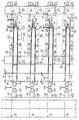
- Figures 1A to 4E relate to the first embodiment of the jacquard machine.
- Figures 1A to 1C show diagrammatically the first and second knives, a control element, and two interacting hooks in interaction with a system for lifting warp threads on a weaving loom.
- the respective figures represent successive situations during a half movement cycle of the knives, where a hook is carried along by its first knife from the selection height.
- Figures 2A to 2B show the same device in successive situations, where a hook is carried along by its second knife from the selection height.
- Figures 3A to 3D show the same device in successive situations, where a hook is retained at the retention height.
- Figures 4A to 4D show in detail the control element and the top part of one hook of the same device in successive situations, where a hook at the selection height is placed in such a way that it can be carried along by its second knife.
- Figure 4E shows in detail the control element and the top part of one hook of the same device, in a situation in which said hook is retained at the retention height.
- Figures 5A to 8C relate to the second embodiment of the jacquard machine.
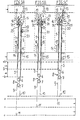
- Figures 5A to 5C show diagrammatically the first and second knives, a control element and two interacting hooks in interaction with a system for lifting warp threads on a weaving loom.
- the respective figures each show a different situation of this device for a first shot, a different position of the warp threads being obtained in each case.
- Figures 6A to 6C show different situations of the same device for a second shot, a different position of the warp threads being obtained in each case.
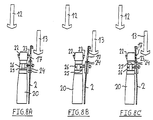
- FIGS 7A to 7C show in detail the control element and the top part of one hook of the same device, in the second non-carry position, the carry position and the first non-carry position respectively.
- FIGS 8A to 8C show the same as the respective Figures 7A to 7C, but for an alternative embodiment of the control element and the hooks.
- the first embodiment of the jacquard machine according to this invention comprises two hooks (1), (2) made of a flexible material, with a top end (3), (4) which is bent over downwards.
- first lifter cord (5) is attached at the bottom end of each hook (1), (2).
- This first lifter cord (5) is passed under the top lifter roller (6) of a lifter element (8).
- a second lifter cord (9) is attached by one end to a fixed part (10) of the jacquard machine, is passed over the bottom lifter roller (7) of the lifter element (8), and is connected by the other end (11) to a harness cord (not shown in the figures) for lifting warp threads on a weaving loom.
- Said jacquard machine also comprises two first knives (12), (13) which by means of a drive unit are movable vertically up and down in phase opposition to each other, and two second knives (14), (15) which are disposed below a respective first knife (12), (13), and by means of a drive unit are movable vertically up and down in phase opposition to each other (the drive units are not shown in the figures).
- the drive of the knives (12), (13), (14), (15) is such that the first (12), (13) and second knives (14), (15), which are situated above one another, move in phase opposition to each other.
- the first (12), (13) and second knives (14), (15) move up and down over the same height (h), while each second knife (14), (15) in its top dead centre is situated lower down than the height which the upper first knife (12), (13) reaches when it is situated in its bottom dead centre.
- Each hook (1), (2) is provided with a retaining opening (16), (17) and with a laterally projecting supporting lug (18), (19).
- the jacquard machine also comprises a control element (20), disposed at a fixed height and having two coils (21) for exerting an electromagnetic force of attraction on the hooks (1), (2).
- a projection (22), (23) is provided in the vicinity of said coils (21), on either side of the control element (20).
- the control element (20) is disposed between the two vertical planes in which the knives (12), (13), (14), (15) move up and down.
- the two interacting hooks (1), (2) are provided on either side of the control element (20), in such a way that each hook can rest with its supporting lug (18), (19) on a second knife (14), (15).
- a second knife (14), (15) is situated in its top dead centre, the hook (1), (2) supported by said second knife (14), (15) is at the selection height (S).
- a hook (1), (2) situated at the selection height (S) is situated with its top end (3), (4) above the carrier flange of a first knife (12), (13) situated in the bottom dead centre, so that the hook (1), (2) can be carried along by said first knife and is situated with its retaining opening (16), (17) opposite a projection (22), (23).
- the hook (1), (2) springs back to its straight position, in which case the projection (22), (23) leaves the retaining opening (16), (17), and the top end (3), (4) of the hook (1), (2) goes back within the range of the carrier flange of its first knife (12), (13). This position is called the carry position.
- the left-hand hook (1) is situated in the carry position and is supported by its second knife (14) at the selection height (S). There is a vertical distance (d) between the top end (3) of this hook (1) and the carrier flange of the first knife (12) interacting therewith, which first knife is in its bottom dead centre.
- the top side of the projection (22) is situated a vertical distance (2d) lower than the top edge of the retaining opening (16), the last-mentioned vertical distance (2d) being virtually twice that of the first-mentioned vertical distance (d).
- Figure 1B shows the situation at the moment when the left-hand first knife (12) and the right-hand second knife (15) have been moved up over the first-mentioned vertical distance (d).
- the left-hand second knife (14) and the right-hand first knife (13) have been moved down over the same distance (d).
- the left-hand hook (1) is situated at the selection height (S), while it rests with its top end (3) on the carrier flange of its first knife (12), and while the supporting lug (18) of the hook (1) is situated the same vertical distance (d) higher than the carrier flange of its second knife (14).
- Figure 1C shows the situation at the moment when the left-hand first knife (12) and the right-hand second knife (15) are situated in their top dead centre.
- the right-hand first knife (13) and the left-hand second knife (14) are then situated in their bottom dead centre.
- the left-hand hook (1) has now been taken by its first knife (12) to the height (+h).
- Figure 2A shows the same situation as that of Figure 1A.
- Figures 2A to 2D show the successive situations (with the same half movement cycle of the knives (12, 13, 14, 15) as in Figures 1A to 1D) when the left-hand hook (1) is carried along by its downward moving second knife (14).
- the left-hand hook (1) can no longer be carried along by its first knife (12).
- the hook (1) moves downwards over the same distance (d), so that the relative movement of the hook (1) with respect to the first knife (12) is equal to 2d.
- the vertical distance between the top end (3) of the hook (1) and the carrier flange of the first knife (12) is only equal to d in the situation of Figure 2A.
- the first knife (12) is thus already above its carry zone.
- Said carry zone i.e. the path of a first knife on which said knife can carry along a hook (1), (2)
- Figure 2D shows the situation when the left-hand first knife (12) has reached its top dead centre.
- the left-hand hook (1) at that moment has been taken by its second knife (14) to the height (-h).
- the right-hand hook (2) has been taken to the selection height (S) by its second knife (15).
- the left-hand hook (1) has been taken a height (h) lower, while the right-hand hook has been taken upwards over the same height (h).
- the warp threads consequently remain in the same position, the "Down" position (O).
- Figures 3A and 3B show the same situations as the respective Figures 2A and 2B.
- the control element (20) remains in operation, in order to retain the left-hand hook (1) in the non-carry position. This operation remains retained until the left-hand hook (1) has been moved downwards to the retention height (V). At that moment the operation of the control element can be ended, since the hook (1) is retained in the non-carry position by an upward projecting edge on the top side of the projection.
- the left-hand knife (12) has reached its top dead centre (Figure 3D)
- the left-hand (1) and the right-hand hook (2) are situated at the retention height (V) and at the selection height (S) respectively.
- control element (20) and the top part of one of the hooks (2) are shown in detail in Figures 4A to 4E; in Figures 4A to 4D in the successive situations in which the control element (20) is operated, in order to have the hook (2) carried along by its second knife (15), and in Figure 4E in the situation in which the hook (2) is retained at the retention height (V).
- the second embodiment of the jacquard machine according to this invention (see Figures 5A to 8C) likewise has two first knives (12), (13), two second knives (14), (15) and two interacting hooks (1), (2) connected to the same system (5, 8, 9) for lifting warp threads as that in the first embodiment.
- Said hooks (1), (2) and knives (12), (13), (14), (15) are provided in such a way that they can interact in the same way as in the case of the first embodiment of the jacquard machine.
- the second embodiment differs from the first in that the hooks (1), (2) along the edge of the control element (20) are provided with a permanent magnet (24), the magnetic north pole and south pole of which are situated opposite a bottom coil (25) and a top coil (26) respectively of the control element (20) when the hook is situated at the selection height (S).
- the control element (20) is also provided so that it can exert an electromagnetic force of attraction and an electromagnetic force of repulsion on the permanent magnet (24) of the hooks (1), (2) situated at the selection height (S).
- a magnetic north pole is created by the top coil (26) and a magnetic south pole by the bottom coil (25).
- the north pole and the south pole of the control element (20) are thus situated opposite the south pole and the north pole respectively of a permanent magnet (24).
- a force of attraction is thus exerted on the permanent magnet (24), so that the hook (1), (2) bends towards the control element (20).
- a projection (22), (23) goes into the retaining opening (16), (17) of the hook (1), (2).
- the hook (1), (2) is thus situated in the first non-carry position.
- the hooks (1), (2) in a variant embodiment can also be provided with a permanent magnet (24), the magnetic north pole of which is situated at the side of the hook (1), (2) facing the control element (20), while the magnetic south pole is situated at the other side of the hook (1), (2).
- the coils (25), (26) are then provided next to each other on either side of the control element (20), so that each coil (25), (26) can be situated opposite the magnetic north pole of the permanent magnet (24) of one of the hooks (1), (2), if said hook (1), (2) has been taken to the selection height (S).
- FIGs 5A to 5C show how for a first shot the three different positions (B, M, O) of the warp threads are achieved.
- Figures 6A to 6C this is shown for a following shot.
- one of the hooks (1), (2) is situated at the selection height (S)
- the other hook (1), (2) is either taken to the height (-h) by its second knife (14), (15) or retained at the selection height (S) by a projection (22), (23), or is taken to the height (+h) by its first knife (12), (13).
- the warp threads are taken into the respective positions "Down” (O), "Middle” (M) and “Up” (B).
Landscapes
- Engineering & Computer Science (AREA)
- Textile Engineering (AREA)
- Looms (AREA)
Applications Claiming Priority (2)
| Application Number | Priority Date | Filing Date | Title |
|---|---|---|---|
| BE9500306A BE1009268A3 (nl) | 1995-04-04 | 1995-04-04 | Driestanden open-gaap jacquardmachine. |
| BE9500306 | 1995-04-04 |
Publications (2)
| Publication Number | Publication Date |
|---|---|
| EP0736621A1 true EP0736621A1 (de) | 1996-10-09 |
| EP0736621B1 EP0736621B1 (de) | 1999-08-11 |
Family
ID=3888903
Family Applications (1)
| Application Number | Title | Priority Date | Filing Date |
|---|---|---|---|
| EP19960200740 Expired - Lifetime EP0736621B1 (de) | 1995-04-04 | 1996-03-18 | Dreistand offenfach Jacquardmaschine |
Country Status (3)
| Country | Link |
|---|---|
| EP (1) | EP0736621B1 (de) |
| BE (1) | BE1009268A3 (de) |
| TR (1) | TR199600273A1 (de) |
Cited By (4)
| Publication number | Priority date | Publication date | Assignee | Title |
|---|---|---|---|---|
| EP0884410A1 (de) * | 1997-06-12 | 1998-12-16 | N.V. Michel Van de Wiele | Vierstellungs-Offenfach-Jacquardmaschine |
| WO1999010576A1 (de) * | 1997-08-26 | 1999-03-04 | Textilma Ag | Jaquardvorrichtung für eine webmaschine |
| EP0982419A3 (de) * | 1998-08-24 | 2000-03-08 | N.V. Michel Van de Wiele | Fachbildungsmechanismus für Jacquardmaschinen |
| CN119615484A (zh) * | 2024-12-30 | 2025-03-14 | 吴江万工机电设备有限公司 | 一种紧凑型三位置选针装置及其组件、电子提花机 |
Citations (6)
| Publication number | Priority date | Publication date | Assignee | Title |
|---|---|---|---|---|
| FR2287539A1 (fr) * | 1974-10-09 | 1976-05-07 | Zangs Ag Maschf | Metier jacquard a double leve et a grande ouverture de la foule |
| FR2587046A1 (fr) * | 1985-08-13 | 1987-03-13 | Textima Veb K | Dispositif de commande des dessins dans les machines textiles |
| EP0399930A1 (de) * | 1989-05-24 | 1990-11-28 | Staubli-Verdol S.A. | Verbesserungen an Jacquardvorrichtungen mit drei Positionen |
| FR2648160A1 (fr) * | 1989-06-12 | 1990-12-14 | Textima Veb K | Machine jacquard a foule ouverte avec commande electromagnetique de platines pour un metier a tisser la peluche, en particulier un metier a tisser les doubles tapis |
| EP0408076A1 (de) * | 1989-07-14 | 1991-01-16 | N.V. Michel Van de Wiele | Vorrichtung zur Platinenwahl an einer elektronisch gesteuerten Jacquardmaschine |
| DE4101778C1 (de) * | 1991-01-18 | 1992-04-02 | Fa. Oskar Schleicher, 4050 Moenchengladbach, De |
-
1995
- 1995-04-04 BE BE9500306A patent/BE1009268A3/nl not_active IP Right Cessation
-
1996
- 1996-03-18 EP EP19960200740 patent/EP0736621B1/de not_active Expired - Lifetime
- 1996-04-03 TR TR96/00273A patent/TR199600273A1/xx unknown
Patent Citations (6)
| Publication number | Priority date | Publication date | Assignee | Title |
|---|---|---|---|---|
| FR2287539A1 (fr) * | 1974-10-09 | 1976-05-07 | Zangs Ag Maschf | Metier jacquard a double leve et a grande ouverture de la foule |
| FR2587046A1 (fr) * | 1985-08-13 | 1987-03-13 | Textima Veb K | Dispositif de commande des dessins dans les machines textiles |
| EP0399930A1 (de) * | 1989-05-24 | 1990-11-28 | Staubli-Verdol S.A. | Verbesserungen an Jacquardvorrichtungen mit drei Positionen |
| FR2648160A1 (fr) * | 1989-06-12 | 1990-12-14 | Textima Veb K | Machine jacquard a foule ouverte avec commande electromagnetique de platines pour un metier a tisser la peluche, en particulier un metier a tisser les doubles tapis |
| EP0408076A1 (de) * | 1989-07-14 | 1991-01-16 | N.V. Michel Van de Wiele | Vorrichtung zur Platinenwahl an einer elektronisch gesteuerten Jacquardmaschine |
| DE4101778C1 (de) * | 1991-01-18 | 1992-04-02 | Fa. Oskar Schleicher, 4050 Moenchengladbach, De |
Cited By (6)
| Publication number | Priority date | Publication date | Assignee | Title |
|---|---|---|---|---|
| EP0884410A1 (de) * | 1997-06-12 | 1998-12-16 | N.V. Michel Van de Wiele | Vierstellungs-Offenfach-Jacquardmaschine |
| BE1011210A3 (nl) * | 1997-06-12 | 1999-06-01 | Wiele Michel Van De Nv | Vierstanden-opengaap-jacquardmachine. |
| WO1999010576A1 (de) * | 1997-08-26 | 1999-03-04 | Textilma Ag | Jaquardvorrichtung für eine webmaschine |
| EP0982419A3 (de) * | 1998-08-24 | 2000-03-08 | N.V. Michel Van de Wiele | Fachbildungsmechanismus für Jacquardmaschinen |
| BE1012129A3 (nl) * | 1998-08-24 | 2000-05-02 | Wiele Michel Van De Nv | Gaapvormingsmechanisme voor jacquardmachines. |
| CN119615484A (zh) * | 2024-12-30 | 2025-03-14 | 吴江万工机电设备有限公司 | 一种紧凑型三位置选针装置及其组件、电子提花机 |
Also Published As
| Publication number | Publication date |
|---|---|
| EP0736621B1 (de) | 1999-08-11 |
| TR199600273A1 (tr) | 1996-10-21 |
| BE1009268A3 (nl) | 1997-01-07 |
Similar Documents
| Publication | Publication Date | Title |
|---|---|---|
| EP0723041A1 (de) | Dreistand-Offenbach-Jacquardmaschine | |
| EP0736621B1 (de) | Dreistand offenfach Jacquardmaschine | |
| US5666999A (en) | Shedding selection devices with biomorf or piezo electric bending elements | |
| US4530382A (en) | Shed forming arrangement | |
| US7806149B2 (en) | Shedding apparatus for a weaving machine, in particular for a ribbon weaving machine | |
| EP2524073B1 (de) | Auswahlvorrichtung für eine fachformungsvorrichtung einer webmaschine | |
| KR0156255B1 (ko) | 전자적으로 작동되는 자카드 제어장치 | |
| EP0803597A3 (de) | Jacquardmaschine | |
| EP1136603B1 (de) | Hakenwahlvorrichtung für die Fachbildungseinrichtung einer Webmaschine | |
| EP3655574B1 (de) | Fachformende vorrichtung für eine webmaschine | |
| EP0930385B1 (de) | Fachbildungsvorrichtung für Webmaschinen | |
| EP0982419B1 (de) | Fachbildungsmechanismus für Jacquardmaschinen | |
| JP2001207346A (ja) | 織機用杼口形成装置 | |
| EP0770721B1 (de) | Fachbildungsvorrichtung zur Wahl von Fachbildungsmitteln mit Hilfe von piezoelektrischen Elementen | |
| US6478055B2 (en) | Pulleyless shed-forming device for a weaving machine | |
| EP0439440A1 (de) | Elektromagnetische modulare, computergesteuerte Kettfadensteuervorrichtung für die Bildweberei | |
| CN1190999A (zh) | 用于多臂机龙头的拉钩选择装置 | |
| EP0420869B1 (de) | Elektronisches positionskontrollsystem | |
| JPH0336945B2 (de) | ||
| BE1009137A4 (nl) | Driestanden niet-open-gaap jacquardmachine. | |
| EP2313544A2 (de) | Selektions- und führungskörper für haken in einer jacquardmaschine | |
| HK1010566B (en) | Hook selection device for a weaving loom dobby head | |
| JP2000027047A (ja) | 織機におけるヘルド駆動装置 | |
| HK1131644B (en) | Shedding apparatus for a weaving machine, in particular for a ribbon weaving machine | |
| CS243475B2 (cs) | Prošlupní zařízení pro textilní stroje, zejména tkací stavy |
Legal Events
| Date | Code | Title | Description |
|---|---|---|---|
| PUAI | Public reference made under article 153(3) epc to a published international application that has entered the european phase |
Free format text: ORIGINAL CODE: 0009012 |
|
| AK | Designated contracting states |
Kind code of ref document: A1 Designated state(s): BE FR GB IT |
|
| 17P | Request for examination filed |
Effective date: 19961021 |
|
| 17Q | First examination report despatched |
Effective date: 19970911 |
|
| GRAG | Despatch of communication of intention to grant |
Free format text: ORIGINAL CODE: EPIDOS AGRA |
|
| GRAG | Despatch of communication of intention to grant |
Free format text: ORIGINAL CODE: EPIDOS AGRA |
|
| GRAH | Despatch of communication of intention to grant a patent |
Free format text: ORIGINAL CODE: EPIDOS IGRA |
|
| GRAH | Despatch of communication of intention to grant a patent |
Free format text: ORIGINAL CODE: EPIDOS IGRA |
|
| GRAA | (expected) grant |
Free format text: ORIGINAL CODE: 0009210 |
|
| AK | Designated contracting states |
Kind code of ref document: B1 Designated state(s): BE FR GB IT |
|
| ET | Fr: translation filed | ||
| ITF | It: translation for a ep patent filed | ||
| PLBE | No opposition filed within time limit |
Free format text: ORIGINAL CODE: 0009261 |
|
| STAA | Information on the status of an ep patent application or granted ep patent |
Free format text: STATUS: NO OPPOSITION FILED WITHIN TIME LIMIT |
|
| 26N | No opposition filed | ||
| REG | Reference to a national code |
Ref country code: GB Ref legal event code: IF02 |
|
| PGFP | Annual fee paid to national office [announced via postgrant information from national office to epo] |
Ref country code: GB Payment date: 20090325 Year of fee payment: 14 |
|
| PGFP | Annual fee paid to national office [announced via postgrant information from national office to epo] |
Ref country code: IT Payment date: 20090325 Year of fee payment: 14 |
|
| GBPC | Gb: european patent ceased through non-payment of renewal fee |
Effective date: 20100318 |
|
| PG25 | Lapsed in a contracting state [announced via postgrant information from national office to epo] |
Ref country code: GB Free format text: LAPSE BECAUSE OF NON-PAYMENT OF DUE FEES Effective date: 20100318 Ref country code: IT Free format text: LAPSE BECAUSE OF NON-PAYMENT OF DUE FEES Effective date: 20100318 |
|
| PGFP | Annual fee paid to national office [announced via postgrant information from national office to epo] |
Ref country code: FR Payment date: 20140319 Year of fee payment: 19 |
|
| PGFP | Annual fee paid to national office [announced via postgrant information from national office to epo] |
Ref country code: BE Payment date: 20140319 Year of fee payment: 19 |
|
| REG | Reference to a national code |
Ref country code: FR Ref legal event code: ST Effective date: 20151130 |
|
| PG25 | Lapsed in a contracting state [announced via postgrant information from national office to epo] |
Ref country code: FR Free format text: LAPSE BECAUSE OF NON-PAYMENT OF DUE FEES Effective date: 20150331 |
|
| PG25 | Lapsed in a contracting state [announced via postgrant information from national office to epo] |
Ref country code: BE Free format text: LAPSE BECAUSE OF NON-PAYMENT OF DUE FEES Effective date: 20150331 |